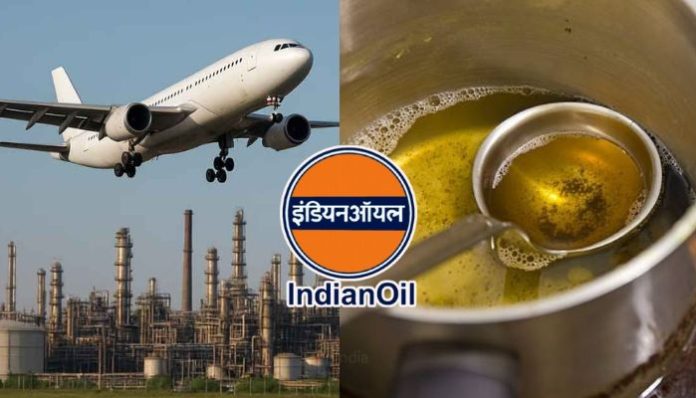
Who would have thought that used cooking oil, often discarded after frying samosas, pooris and pakoras, could be used as a reliable Sustainable Aviation Fuel (SAF)? However, after US, Indonesia, China, Singapore, Japan, Malaysia, and various European nations, India is set to produce SAF using used cooking oil (UCO) at a commercial scale.
Recently, India’s largest refiner and fuel retailer, Indian Oil Corporation (IOC) became the first in the country to receive the prestigious ISCC CORSIA Certification for Sustainable Aviation Fuel production at its Panipat Refinery.
What is Sustainable Aviation Fuel
Similar in chemical composition to traditional aviation turbine fuel (ATF) or jet fuel, which is made from crude oil, SAF is a biofuel made from sustainable feedstocks. This implies that the SAF-ATF blend is easily compatible with current aviation engines.
Depending on the efficiency and sustainability of the feedstock and production process, SAF can reduce carbon emissions—one of the harmful greenhouse gases—by up to 80% over the course of a conventional jet fuel’s lifecycle.
Various studies have found that commercial aviation produces 2.5% of the world’s CO2 emissions. According to an Air Transport Action Group report, in 2023 alone, commercial aviation’s contribution to CO2 emissions wasat roughly 882 million tonnes. This makes it imperative to switch from traditional to more sustainable fossil fuels to bring down carbon emissions to optimal level and protect the environment.
Interestingly, the aviation industry estimates that more than 60% of the global aviation sector’s decarbonisation efforts will likely come from SAF alone.
What is ISCC CORSIA certification
The ISCC CORSIA certification, i.e., International Sustainability & Carbon Certification (ISCC), developed under the Carbon Offsetting and Reduction Scheme for International Aviation (CORSIA) by the International Civil Aviation Organisation (ICAO), validates that SAF meets the highest international sustainability and lifecycle carbon emission standards.
SAF produced at Indian Oil’s Panipat Refinery has undergone rigorous assessment for lifecycle carbon emissions and traceability, creating a clear pathway for Indian airlines to integrate certified SAF into their operations. The certification also sets a benchmark for other domestic refiners and industry players to scale up SAF production. This is in line with the government’s vision of achieving net-zero emissions by 2070.
Earlier this month, Civil Aviation Minister Ram Mohan Naidu Kinjarapu announced that Indian Oil’s Panipat Refinery has been certified as the country’s first Sustainable Aviation Fuel producer.
IOC’s Panipat Refinery to start SAF biofuel production at commercial scale
IOC has said that by end of this calendar year, its Panipat Refinery will start producing SAF from used cooking oil at a commercial scale. By December 2025, IOC will have the capacity to produce 35,000 tonnes per year of SAF from used cooking oil. This used cooking oil will be sourced from large hotel chains, restaurants, and sweets and snacks companies like Haldiram’s. While these companies normally discard cooking oil after single use since it becomes unhealthy, now the same oil will be used to produce sustainable aviation fuel.
Speaking about the significance of producing SAF and used cooking oil collected for the same, IOC’s Chairman Arvind Sawhney said, “The capacity (35,000 tonnes per year) will be sufficient to meet the country’s 1 per cent SAF blending requirement (for international flights) by 2027… For feedstock (used cooking oil), we will be engaging aggregators to collect it from big hotel chains and restaurants. There is a large amount of such oil available in the country. The only challenge is collection. While it is easy to collect from large hotel chains, a solution needs to be found for collection from small users, including households.”
SAF production, however, comes with its own challenges as despite offering a lower carbon footprint, SAF made from used cooking oil is currently three to four times more expensive than conventional fuel due to its higher production costs, which are caused by issues including feedstock constraints and evolving production technology.