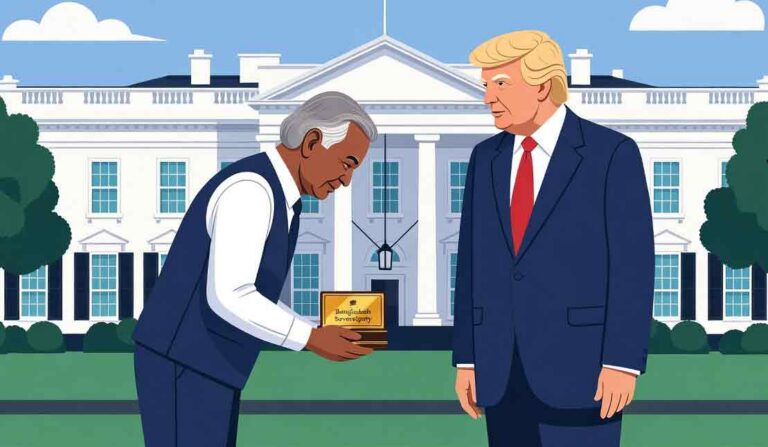
Bangladesh is set to sign a tariff agreement with the United States on February 9, just three days before the country’s national elections. However, the content of the agreement aimed at reducing tariffs on Bangladeshi exports to the USA will not be made public; it will be a secret deal signed by a government not elected democratically. This is because the deal will come under a non-disclosure agreement signed by the interim government with the US.
On 13 June 2024, Bangladesh’s interim government under Dr Muhammad Yunus signed the non-disclosure agreement (NDA) with the United States. The justification was familiar and deliberately vague: urgency, economic pressure, and the need to ease so-called “reciprocal taxes” imposed during the Donald Trump administration. But in politics, how something is done often matters more than why. And in this case, the manner of the agreement tells a far more troubling story than the official explanations ever did, as explained by Aminul Hoque Polash, a Bangladeshi political activist, researcher and former government official, in an article published on News18.
The NDA was rushed through without meaningful consultation with Parliament, industry stakeholders, or the public. Because it was classified as a non-disclosure agreement, citizens were told they had no right to know what was promised, traded, or quietly conceded. The interim government repeated a single defensive line, nothing in the deal goes against national interest, while carefully avoiding the obvious question: if there was truly nothing to hide, why hide it at all?
That claim collapsed when a draft leaked from Bangladesh’s National Board of Revenue. The 20-page document did not read like a routine confidentiality instrument. It was expansive, intrusive, and asymmetrical. Page after page diluted Bangladesh’s policy autonomy. Decision-making authority linked to national security, trade policy, natural resources, and even foreign relations appeared, in effect, subordinated to the preferences of a foreign state. This was not secrecy for efficiency; it was secrecy to avoid accountability.
What followed makes the pattern unmistakable.
At the time the NDA was signed, media reports suggested that Bangladesh had committed to buying 25 Boeing aircraft and importing wheat from the United States. In August, Commerce Adviser Sheikh Bashir Uddin publicly claimed that US officials did not seem serious about selling Boeing planes. Biman Bangladesh Airlines echoed that it was unaware of any such plan. And yet, just four months later, on 30 December 2025, Biman’s board approved the purchase of 14 Boeing aircraft.
This was no coincidence. Under the interim government, a massive and arguably unnecessary procurement valued at around Tk 37,000 crore taka, or roughly 3 billion dollars, is now being fast-tracked. To grease the wheels, Sheikh Bashir Uddin was appointed Chairman of Biman on 27 August 2025. Soon after, Dr Yunus’s closest associates — Security Adviser Khalilur Rahman, Special Assistant Faiz Ahmed Taiyeb (with the rank of State Minister), and senior bureaucrat Akhtar Ahmed — were inducted into Biman’s board. Institutional independence gave way to personal loyalty, and procurement decisions followed accordingly. The purchase of US Black Hawk helicopters for the armed forces fits neatly into the same pattern.
Food security tells a similarly grim story. In July 2025, the interim government signed an MoU with the US Wheat Exporters Association to import 3.5 million tonnes of wheat over five years at a base price of 308 dollars per tonne. This would be defensible only if global prices were comparable. They are not. Wheat is currently available on the international market for around 226–230 dollars per tonne. Bangladesh has already imported 220,000 tonnes under this deal, locking in inflated costs that will inevitably push up flour prices. That increase will cascade across food markets, hitting the poorest households first and hardest.
Then there is the absurdity of the shipping deal. On 12 August 2025, the interim government approved the purchase of two bulk carrier ships from a US firm for nearly 1,000 crore taka. The United States is not even among the world’s top shipbuilding nations. The punchline is cruel: both ships will be built in China. Bangladesh is effectively buying Chinese-made ships through an American intermediary at above-market prices, a perfect metaphor for policy capture disguised as diplomacy.
Energy decisions under the interim government may prove even more damaging. A 15-year LNG purchase agreement with Excelerate Energy, worth around 1 lakh crore taka, has handed effective control of Bangladesh’s LNG imports to a single US company. Under previous governments, Bangladesh diversified supply through competitive long-term contracts with Qatar and Oman. Excelerate was initially meant to introduce competition. Instead, after August 2024, it became dominant.
The sequence is revealing. Former US ambassador Peter D. Haas left the State Department in September 2024 and joined Excelerate as a strategic adviser. In October, Excelerate’s CEO met Dr Yunus in Dhaka. Soon after, the interim government revised the agreement, fixing LNG prices at 15.69 dollars per MMBtu, at least 2.5 dollars higher than prevailing spot rates, and dramatically higher than the 9.5–9.93 dollars Bangladesh paid in April 2024. Competition was replaced by dependency, and consumers will pay the price for years.
The December decision to buy short-term LNG from SOCAR Trading S.A. adds another layer of concern. The deal followed a personal intervention by Dr Yunus after a high-profile visit by Azerbaijan’s president’s daughters. Once again, national energy policy appeared to hinge not on transparent evaluation but on personal networks and opaque diplomacy.
This spree is not confined to the United States. The interim government has announced or explored an astonishing range of defence and industrial procurements: JF-17 jets from Pakistan, Eurofighter Typhoons from Europe, J-10CE jets and drone factories with China, submarines from South Korea, T-129 ATAK helicopters from Turkey, and even a defence agreement with Japan. For an unelected interim administration, this is strategic overreach on a historic scale, commitments that will bind future elected governments for decades.
Ports and terminals, the arteries of sovereignty, are being signed away with equal haste. A 33-year deal with APM Terminals for Laldiya, a 30-year handover of the New Mooring Container Terminal to DP World, and a 22-year lease of the Pangaon inland terminal to Medlog SA together lock Bangladesh into long-term dependencies that future governments may find impossible to unwind.
Taken together, these decisions form a coherent picture. Dr Yunus has concentrated governing authority and used it to serve two masters at once: personal networks and foreign interests. The costs will not be abstract. They will appear as higher food prices, costlier energy, reduced policy autonomy, and a weakened economy. Ordinary Bangladeshis will bear the burden.
The final act is political insurance. A referendum-style electoral exercise is being prepared to manufacture a “Yes” mandate, followed by constitutional changes designed to make these decisions irreversible. Western powers, far from objecting, appear comfortable with this outcome, which secures influence, contracts, and strategic leverage.
The purpose for which Dr Yunus took control of Bangladesh’s governance has now been fully executed. The staged election on the 12th is meant to seal the deal. What remains is a country locked into agreements it never consented to, carrying costs it never approved, and living with consequences that will last far beyond the tenure of an interim government.
Ahead of Indian Prime Minister Narendra Modi’s historic visit to Malaysia on Saturday (7th February), a radical Islamic preacher named Mohammed Zamri Vinoth has threatened to organise a rally against Hindu temples in the Islamic country.
In a Facebook post on Friday (7th February), he stated, “Don’t be fooled by their propaganda and tactics. We (will) fight (against) intruders. Tomorrow’s (rally is) on at 8pm in front of Sogo KL”
Vinoth’s open display of Hinduphobia continues despite the directives of the Malaysian government to call off his rally.
Prime Minister Narendra Modi is on a 2-day State visit to Malaysia between 7th and 8th February. He was invited to the Islamic Republic by his counterpart Dato’ Seri Anwar Ibrahim. This will be the Indian PM’s first visit to Malaysia after the 2 nations elevated their bilateral ties to a Comprehensive Strategic Partnership in August 2024. The two leaders will enhance collaboration in trade, defence, education, tourism, connectivity and agriculture.
A notorious Islamic preacher, Mohammed Zamri Vinoth, is now attempting to sully the bilateral ties of both nations and spread hate against the Hindu minorities living in Malaysia. For the unversed, Vinoth is of Malaysian Tamil descent and was originally born a Hindu. He was previously known as Vinoth Kalimuthu.
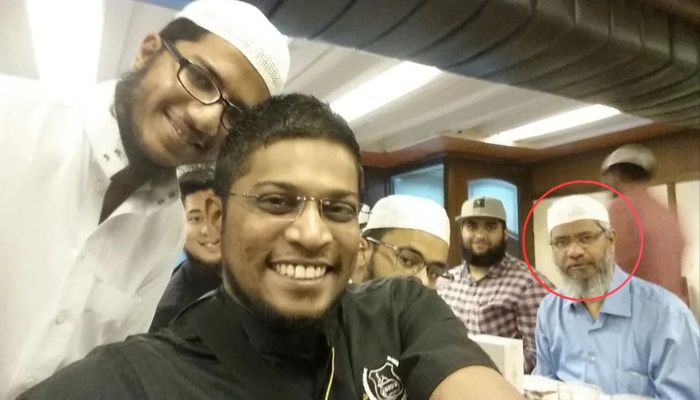
The 41-year-old radical has been making vitriolic remarks about Hinduism and dehumanising the minority community in the country ever since converting to Islam. Interestingly, he is a staunch follower of the Indian fugitive and hate preacher Zakir Naik, who has been given asylum in Malaysia by its government.
In April 2019, the Malaysian government arrested Mohammed Zamri Vinoth after he made derogatory remarks about Hinduism. He was booked for spreading disunity and hatred among people. According to Star TV, the radical preacher also has a criminal past.
The action against him followed after members of the Hindu community and NGOs filed 867 complaints with the police. A case was lodged against Vinoth under Section 298A of the Penal Code and Section 233 of the Communications and Multimedia Act 1998.
A few months later, Mohammed Zamri Vinoth vowed to give up his Malaysian citizenship if his mentor, Zakir Naik, was extradited to India by the government. “If the government wants to send back Zakir Naik or extradite him, I will not hesitate to hand over my IC,” he had claimed in June 2019.
Mohammed Zamri Vinoth and his repeated targeting of Hindu religion
Over the years, the hate preacher has targeted Hinduism on several occasions. In March 2024, Vinoth made a TikTok video insulting Hindus deities, particularly Lord Shiva. Malaysian MP RSN Rayer had demanded strong action against Vinoth at that time.
“In a series of TikTok videos, Zamri is seen giving explainers about several deities worshipped by Hindus in the country. This is because his explanation of the deities is a form of insult (to Hindus) as Lord Shiva is worshipped by the Hindu community. We would like to appeal to the home minister to order that Zamri be charged immediately,” he had said then.
A year later in March 2025, the Islamic preacher made a disgraceful mockery of the Hindu kavadi ritual. In a Facebook post, he claimed that Hindus performing the kavadi ritual appeared possessed and drunk while chanting ‘Vel Vel.’
The Deputy President of the Malaysian Indian Congress (MIC), Saravanan Murugan, had remarked, “(His comments) were extremely disrespectful and deeply offensive to the Hindu community. This is clearly against the Madani government’s stance on 3R (race, religion and royalty) matters.”
Although his posts were taken down by Facebook, Mohammed Zamri Vinoth got away with no legal consequences. This further bolstered him to continue his tirade against the Hindu community, which constitutes only 6% of the population.
The new anti-Hindu campaign
The follower of Zakir Naik is back in the news with a new campaign targeting Hindu places of worship and branding them ‘illegal’. Mohammed Zamri Vinoth had demanded action against Hindu temples. To coerce the authorities into submission, he had vowed to organise a rally along with his radical followers ahead of PM Modi’s visit to Malaysia.
He had dehumanised Malaysian Hindus as ‘parya‘, a derogatory reference to the pariah caste. “Are you guys aware that Parya in India are also not eligible for free land? This means the illegal temple gang is more despicable than the Parya for they want everything free,” Vinoth had remarked.
In the meantime, DAP Socialist Youth (DAPSY) chief Woo Kah Leong has appealed to authorities to stop the rally of the hate preacher as it would fuel racial and religious tensions. He had requested everyone to stop using the slur ‘kuil haram‘ (illegal temple).
He pointed out, “These places of worship carry long and complex histories, and should be seen as part of the nation’s cultural fabric and proof that Malaysia’s diverse communities can live together peacefully. Rallies intended to spark controversy or inflame public sentiment are not solutions. Instead, they risk worsening misunderstandings and damaging racial unity.”
“Malaysia was built on a long-standing spirit of unity among all races. All parties must reject discriminatory narratives and prioritise humane, constitutional, and inclusive solutions,” Leong concluded.
Similar demands have been made by the People’s Progressive Party (PPP) of Malaysia.
The Malaysian government has directed him against participating in any public demonstrating during the 2-day visit of the Indian Prime Minister. The Indian community had also urged the police to take action.
A government spokesperson named Fahmi Fadzil informed that PM Dato’ Seri Anwar Ibrahim will not allow anyone to jeopardise the country’s security.
It must be mentioned that no action has been taken against Mohammed Zamri Vinoth yet despite filing of a whopping 894 complaints. The Islamic hate preacher and fan of Zakir Naik remains undeterred in his resolve to peddle Hinduphobia and further divide the Malaysian society.
Things are getting heated between the US and civil unrest-hit Iran once again, and the verbal attacks ongoing between the Iranian Mullah regime and the American megalomaniac President for weeks might finally escalate into a military conflict. While the US under Donald Trump claims to care about freeing Iranians from the oppressive Khamenei regime, the Trump administration’s alert issued to its citizens comes across as an extension of America’s history of abandoning its citizens in war zones.
The US government’s Iran alert gives a stark picture of isolation, peril and abandonment for American citizens, turning most of Iran’s land borders into de facto no-go zones amidst escalating tensions. While the Iranian frontier spans more than 5,800 kilometres across seven neighbouring countries, the US government advisory confines safe exit options to only a handful of narrow corridors, with Armenia and Turkey being the primary options, while Turkmenistan is a rather complicated alternative requiring special permissions. The Trump administration has explicitly warned against approaching the borders with Iraq, Afghanistan, and Pakistan.
The advisory added that Azerbaijan’s land borders are closed to routine traffic, and therefore not available for use to leave Iran.
The warning cited widespread security measures, including road closures, public transportation halts, and severe internet and mobile network restrictions. Many airlines have cancelled or limited flights into and out of Iran, severely impacting air travel options. “Leave Iran now”, the alert says, adding, “Have a plan for departing Iran that does not rely on US government help.
Given the hostility between the US government and the Iranian regime, US citizens face heightened threats of arbitrary questioning, arrest, and long-term detention, particularly when presenting American passports or showing US ties, the alert reminded people. Iran does not recognise dual nationality, placing dual US-Iranian citizens at additional risk. The alert asks people with dual citizenship to use only their Iranian passport when leaving the country.
The US government informed its citizens that as of 5th February 2026, the Armenian land border at Agarak/Norduz is open. The Turkish land border crossings with Iran are open. Turkmenistan’s land borders with Iran are also open, but US citizens need special authorisation from the government of Turkmenistan before approaching the border, the alert said.
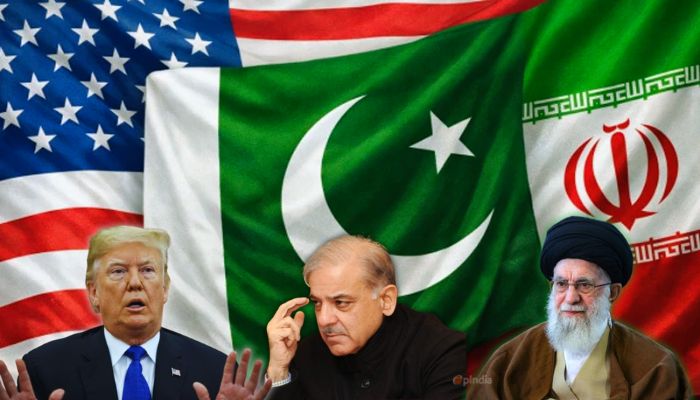
While keeping long stretches of Iran-Iraq border (1,599 km), and Iran-Afghanistan border (921 km) off-limits is understandable due to their current situations and historical equations with the US, the Trump administration urging its stranded citizens in Iran to avoid leaving the country via Pakistan border, despite the White House’s longstanding portrayal of Islamabad as a main ally in counterterrorism and regional stability, is quite intriguing.
Despite Pakistan exporting nothing but Islamic terrorism to the US, and squeezing dollars out of Washington in the name of counterterrorism in Afghanistan for years, USA never severed ties with Pakistan. However, the public displays of camaraderie via military aid, joint operations, diplomatic niceties, and the over-dramatic Trump sycophancy of the Sharif-Munir duo, have not masked the underlying distrust.
Basically, America does not trust its ‘ally’ Pakistan to protect American citizens leaving Iran. Besides the Pakistani leadership’s ‘all talks and no action’ nature, the major cause for America’s distrust is the fact that the Iran-Pakistan border is essentially the Iran-Pakistan-occupied-Balochistan interface. The Iran-Balochistan border is a volatile zone wherein Baloch freedom fighters undertake operations attacking oppressive Pakistani forces. Besides, Iran and Pakistan have also indulged in military skirmishes with both countries accusing each other of harbouring terrorists.
The US government’s warning to its citizens stranded in Iran to steer clear, America has acknowledged, though implicitly, that Balochistan remains a problematic territory where even its explicitly subservient Pakistan military and its controlled political leadership cannot guarantee safety. Apparently, the US-Pakistan friendship is confined to fetching the natural resources of Pakistan-occupied Balochistan and declaring Baloch liberation outfits like the Majeed Brigade as ‘terrorist organisations’. Perhaps the Trump administration does not trust the Pakistani forces to protect stray Americans in a crisis when they cannot protect their own troops otherwise.
Despite the Iran-Pakistan lawless frontiers with the Sunni jihadist outfit Jaish-al-Adl active in Iran’s Sistan and Baluchestan and Baloch militant groups giving a tough time to occupying Pakistani forces in Balochistan, it is embarrassing for Islamabad that the US does trust its ‘major non-NATO ally’ with the safety of its citizens.
In fact, the US government’s own travel advisory on Pakistan rates occupied Balochistan as a Level 4 “Do Not Travel” zone, admitting that they have limited ability to assist American citizens or dual-citizenship holders there.
US can bomb countries afar but not assist its stranded citizens in warzones: Superpower devoid of compassion and accountability for its own people?
The United States is undeniably a superpower, an economic giant and has one of the world’s finest militaries. However, the US government’s recent advisory to its citizens in Iran is the latest chapter in American foreign policy of prioritising strategic withdrawal over citizen welfare. This is not the first time that America essentially said ‘Apna apna dekh lo’ (everyone for themselves) to its citizens stranded in a crisis-hit foreign country. The US has a history of abandoning stranded nationals when push comes to shove.
Among the most inhumane and disgraceful abandonments of American citizens by the US government was in 2021 during the Taliban takeover of Afghanistan. The US government, led by President Joe Biden, made an abrupt decision to withdraw American troops from Afghanistan, and after initial evacuations, the US left thousands of its citizens and allies scrambling as the Taliban expanded control. Biden’s ‘over-the-horizon’ counterterrorism promise rang hollow.
If we go back in history, in 1975, the fall of Saigon marked the end of the Vietnam War and the final collapse of South Vietnam as North Vietnamese forces and their allies captured the capital. This situation arose because in 1973, the American military withdrew forces, leaving their Vietnamese allies to their fate after years of making promises of establishing a ‘unified’, ‘democratic’, and ‘stable’ Vietnam.
The 2012 Benghazi Attack also serves as a stark reminder of how the self-declared biggest superpower of the world failed to protect its citizens, including diplomats in the conflict-torn Libya. A Benghazi House Committee report found that the US military failed to immediately send a force to Benghazi, even eight hours after the attack at the US diplomatic mission began, and two American citizens were killed.
In April 2023, American citizens stranded in crisis-hit Sudan raged against the US government for its apathy towards its own nationals stranded there. They expressed disbelief and anger against the American government for outrightly abandoning them and leaving them on their own to navigate their way out of Sudan alive and safe. “I am incredibly shocked and disgusted by the American lacklustre response to the health and safety of their citizens,” an American citizen said back then.
While several countries were rescuing their stranded citizens, the US government maintained that the situation was not ‘conducive’ to sending rescue teams for civilian evacuation. While civilians were not prioritised, the US government evacuated its military personnel a week in advance. The US government kept throwing the usual ‘we are in close contact with our citizens’ and ‘we are actively facilitating their departure’; however, nothing was moving in reality.
The stranded American citizens revealed that they received “barely any assistance” from the US State Department since the violent clashes between the Sudanese Armed Forces (SAF) and Rapid Support Forces (RSF) broke out.
“To be honest with you, the State Department was useless, utterly useless throughout this entire period. We expected the Department to provide some kind of guidance, but the guidance was the template, just shelter in place, no critical information being provided,” another American citizen told the media at that time.
America’s opprobrious history of abandonment of Americans also extends to civil-war hit Yemen. Back in 2015, when the Yemeni civil war was at its peak, and thousands of American citizens stranded there were essentially abandoned by the US government.
While India and China conducted massive evacuation drives to rescue their citizens, the US did not launch any such operation. Excuse? The usual ‘security concerns’ and ‘situation not conducive’ claims. “Designating an evacuation point for a large group of U.S. citizens has the potential to put those individuals’ safety and security at risk,” a State Department official said in a statement back then.
Sudan, Iran, Syria, Libya, Ukraine and beyond, India rescues Indians
Countries like India, on the contrary, have consistently been launching evacuation drives whenever and wherever required. India’s Operation Sankat Mochan evacuated over 2,000 Indian nationals in South Sudan in 2016.
Under Operation Raahat, India airlifted its 4,600 citizens from Yemen in 2015. In fact, while the US failed to rescue even American citizens, India evacuated over 1000 nationals from more than 41 countries, including those from France, the US, the UK and even Pakistan, from Yemen that year.
In June 2025, the Modi government launched ‘Operation Sindhu’ to evacuate 115 Indian nationals, stranded in Iran, amid an increase in hostilities with Israel. They were first taken from Iran to Armenia and then brought back to New Delhi via a special flight. An additional 117 Indians were brought to New Delhi through another special evacuation flight from Turkmenistan. By the end of the operation, India rescued over a thousand of its nationals from Iran.
In 2024, India rescued 5 Indian nationals who were stuck in Syria, following the overthrow of President Bashar Assad by rebels.
In 2023, the Modi government launched Operation Kaveri to evacuate Indians from war-hit Sudan, bringing back 3,862 people in less than 2 weeks.
In 2022, India started one of its biggest rescue missions named Operation Ganga, under which 25000 Indian nationals were rescued from Ukraine amid the outbreak of war with Russia. India also rescued 147 foreign nationals. While the US often remained reluctant to even deploy military missions to evacuate its citizens, the Indian government sent 4 Union Ministers to coordinate this rescue operation. India rescued several Pakistani and Bangladeshi nationals as well.
In 2021, India launched Operation Devi Shakti to bring back over 800 Indians stranded in Afghanistan after the Taliban took over the country in 2021. In June 2014, India rescued 46 Indian nurses from ISIS captivity in Iraq.
Countries like India and China have orchestrated large-scale extractions from countries afar and in highly challenging circumstances, to pull out their citizens without hesitation or reluctance. It is not that America is incapable of rescuing its citizens in crisis-hit countries or nations it is about to bomb; however, the blunt “have a plan that does not rely on US government help” directive is nothing but a candid admission of America’s hands-off approach. After Sudan and Yemen, Americans in Iran are left to fend for themselves in a high-risk environment where detention, kidnappings or worse, killings, are routine threats.
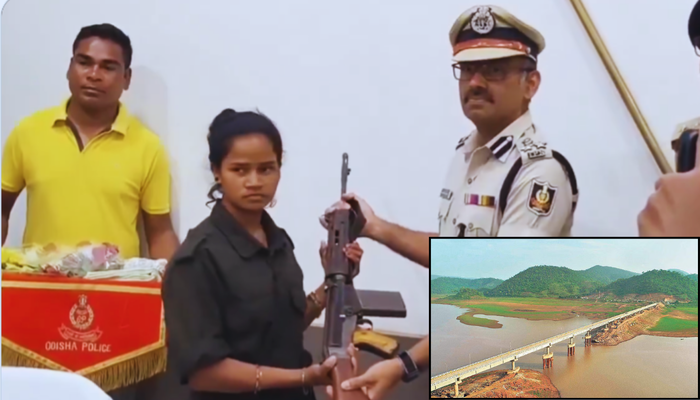
In a major success under the ongoing anti-Naxal operations, two Odisha districts of Koraput and Malkangiri were recently declared Naxal-free by the authorities. The Koraput district was declared Naxal-free on Thursday (5th February) after the surrender of Maoist ACM cadre Mamta Podiami to DIG, South West region, Dr Kanwar Vishal Singh. Podiami surrendered with an SLR (Self-Loading Rifle) and 10 rounds of ammunition.
“After declaring Malkangiri district Naxal-free yesterday, today we are declaring Koraput district Naxal-free. Today, a Naxal cadre of ACM rank, Mamata, surrendered with an SLR rifle, ten rounds of ammunition, and other materials. There was a reward of Rs 5.5 lakh for her, and Rs 1.65 lakh for her SLR. She will receive these benefits… A few days ago, 22 Naxals surrendered in Malkangiri, where our DGP of Odisha Police was present… Even after declaring Koraput Naxal-free, we will remain fully alert…” said DIG, South West region, Dr Kanwar Vishal Singh, speaking to the media.
#WATCH | Odisha: Koraput district was declared naxal-free after Maoist ACM cadre Mamta Podiam surrendered to DIG, South West region, Dr Kanwar Vishal Singh with an SLR (Self-Loading Rifle) and 10 rounds of ammunition.
According to DIG Singh, Podiami, a resident of Chhattisgarh, was involved in many anti-government activities in the bordering areas of Odisha and Chhattisgarh. She was booked in 2023 by Katekalyan police in Bijapur district for violence. Podiami will now be given the amount of reward that she carried along with the amount of reward on the weapon she surrendered. “She will be entitled to financial assistance of ₹5.5 lakh announced on her head, along with an additional ₹1.65 lakh for surrendering the weapon. Besides, she will get all benefits under the state’s surrender and rehabilitation policy,” the DIG said, urging the remaining Naxal cadres in other areas of the state to lay down the weapons and join the mainstream.
Odisha’s Director General of Police, Y B Khurania, assured full support of the Odisha government to the Naxals who chose to surrender. “I appeal to the CPI cadres and leaders to come and join the mainstream society. The Odisha government assures that all cadres who choose to surrender will receive full support, protection and assistance under the comprehensive rehabilitation and reintegration programme, enabling them to rebuild their lives in a peaceful and dignified manner,” DGP Y B Khurania said.
According to police, Koraput has become the fourth district under the south-western police range, after Malkangiri, Nuapada and Nabarangpur, to become Naxal-free. The development comes ahead of the March 31, 2026, deadline of eradicating the Left Wing Extremism from the country.
A day before, on Wednesday (4th February), the Malkangiri district was declared Naxal-free following the surrender of Maoist leader Sukhram Markram, who carried a reward of ₹21 lakh. Days before, the Nabrangpur district was also declared Maoist-free after nine Naxals laid down weapons in Chhattisgarh. Sukhram Markam was the area committee member of the banned CPI(Maoist). He surrendered one SLR rifle, ammunition and other articles to the police.
According to police, Markam was involved in a series of violent incidents across Odisha, Andhra Pradesh and Chhattisgarh. However, now that he has laid down his weapons, he will receive full assistance from the state government in leading a normal life. Malkangiri SP Binod Patil said that Sukhram Markam will get benefits under the Odisha government’s rehabilitation policy.
Major anti-Naxal operations in Koraput and Malkangiri
In May 2025, dreaded Maoist leader Kunjam Hidma was arrested by the Odisha police in a special operation in the dense Petguda forests of the Koraput district. He was arrested after the district police received the input that he had been hiding in the forest area after escaping from Chhattisgarh. Hidma, originally from the Janaguda village in Chhattisgarh’s Bijapur, was wanted in Koraput, Odisha, for multiple crimes over the years. One AK-47 rifle, 35 rounds of ammunition, 117 electric and non-electric detonators, walkie-talkies, gunpowder, and Maoist literature were seized from Hidma’s possession.
In December 2025, 22 Maoists, carrying a combined bounty of ₹2.18 crore, surrendered in the Malkangiri district. Among the Maoists were 10 women, including a divisional committee member (DCM) and six area committee members (ACMs). 19 of the surrendered Maoist cadres belonged to the Dandakaranya special zonal committee (DKSZC), while two were from the Andhra-Odisha border special zonal committee (AOBSZC) and one from the Gadchiroli area committee. They were all involved in a series of violence in Odisha and Chhattisgarh.
Anti-Naxal operations assisted by infrastructural improvement
Crucial infrastructural development and the resultant connectivity to remote Naxal-infested areas provided a much-needed operational ease to the Centre’s anti-Naxal strategy. The 910-metre bridge built over the river Gurupriya in 2018 in the Malkangiri district, once considered a Naxal breeding ground, was a part of this crucial infrastructural enhancement. The Malkangiri district shares a border with Andhra Pradesh and Chhattisgarh and was affected by Left-wing extremism.
The Swabhiman Anchal area of the Malkangiri district was isolated in the early 1960s due to the construction of a 65-km water channel as part of the Balimela reservoir project. The isolated geography offered a perfect hideout to Maoists, who thrived in the area. In 2008, they carried out an ambush attack against security personnel near the Balimela reservoir, killing 39 of them. In February 2011, Maoists abducted the then Malkangiri District Collector R Vineel Krishna and a junior engineer while they were inspecting works in the cut-off areas. They were and kept hostage by the Maoists for eight days, and were released only after securing the release of top Maoist leader Ganti Prasadam. Later on, four BSF personnel, including a commandant, were killed in a landmine blast. The isolated and challenging geography of the area emboldened the Naxals, who intensified attacks on security forces.
However, the construction of the Gurupriya river bridge proved lethal for the Naxals in the Malkangiri district. The bridge connected around 170 villages in the Naxal-affected areas. Its construction started in the mid 1980s with an estimated cost of ₹8 crore, but ended up taking over four decades at an expenditure of ₹172 crore. The reason for the delay in the construction of the bridge was the resistance of Maoists, who could foresee that the construction of the bridge would lead to the eradication of their strongholds. Subsequently, the central government deployed BSF personnel in the area in 2015 to complete the construction of the bridge.
After the bridge, the government constructed all-weather roads in the villages, accommodating over 30,000 people. As a result, almost all habitations in the Swabhiman Anchal were connected with all-weather roads. This dealt a major blow to the Maoist dominance in the area. This was followed by the BSF setting up multiple company operating bases (COB), which are heavily-armed outposts, to combat Maoists in the Swabhiman Anchal.
Operation Kagar and the centre’s commitment to a Naxal-free India
Over the last decade, the central government has amped up operations in Naxal strongholds to entirely uproot the Maoist cadres. The government has adopted a two-pronged strategy of eliminating the Maoist cadres through military operations clubbed with development-oriented works such as expansion of roads, transport facilities, water, electricity and other welfare schemes of the government reaching the villagers.
As part of this strategy, the central government launched Operation Kagar in January 2024 to eradicate Naxalism in Chhattisgarh, Maharashtra (Gadchiroli), Odisha, Jharkhand, Madhya Pradesh and Telangana. Under the operation, around 1 lakh para-military troops, including the Central Reserve Police Force (CRPF), its elite CoBRA units, District Reserve Guards DRG), and state police, equipped with modern technology, have been deployed in the left-wing terrorism affected areas to completely uproot the naxal terrorism from its last remaining strongholds.
The success of the centre’s anti-Naxal operation can be estimated from the fact that from 2015 to 2025, the number of Naxal-affected districts came down from 106 to 18. Out of these districts, 12 were considered the worst affected by Naxalism. However, this number further dropped to just 6 worst Naxal-affected districts, including Bijapur, Kanker, Narayanpur, and Sukma in Chhattisgarh, West Singhbhum in Jharkhand and Gadhchiroli in Maharashtra.
Last month, the Centre released a detailed 10-point plan to ensure that areas cleared of Left-Wing Extremism remain peaceful. The plan is meant for the post-Left-Wing Extremism phase and focuses on stabilising districts that have lived through years of violence. It aligns with the development-oriented part of the Centre’s two-pronged strategy for eliminating Naxalism.
Two recent deals announced in early February 2026 involving Mahindra & Mahindra’s largest-ever export order and Ashok Leyland’s defence and EV partnership signed a clear shift in India’s manufacturing story. What Indonesia is buying is not just vehicles but Indian-built systems designed to run at scale. The message is unmistakable that Make in India has moved from aspiration to international credibility.
Mahindra’s 35,000-vehicle order: A rural logistics game-changer
Mahindra & Mahindra has landed its biggest export deal to date, announcing the supply of 35000 pickup vehicles to Indonesia in 2026. The order was issued and placed by Indonesian state-owned enterprise Agrinas Pangan Nusantara for the Koperasi Desa/Kelurahan Merah Putih (KDKMP) project. It is notable as it surpasses Mahindra’s total vehicle exports in FY25, underscoring the scale and strategic nature of the deal.
We are delighted to announce Mahindras largest ever export order of 35000 Scorpio Pickups for Indonesia to be delivered through 2026 . These pickups will be made at our Nasik plant in Maharashtra.This is truly a make in India for the world moment and we would like to thank…
The truck will be distributed throughout Indonesia’s village-level cooperative (Koperasi) to improve rural logistics and supply chain efficiency. It is designed to function in harsh rural environments; the Scorpio pickups will handle first-mile aggregation by transporting produce directly from farms to cooperatives, as well as support intra-village movement of goods. This is projected to reduce post-harvest losses, increase farmers’ market access, and allow for more efficient distribution of key goods.
The Scorpio LCV, manufactured entirely in India at Mahindra’s Nashik facility, is world-renowned for its durable design, high payload capacity, and low running costs, all of which are critical for large-scale rural deployment. The vehicles for the Indonesian project have been modified to fit local operating needs, such as rugged country roads and agricultural paths, making them ideal for long-term, high-utilisation operation.
Beyond its business value, the transaction has broader strategic implications. It portrays Mahindra as a reliable mobility partner in Indonesia’s national development goal while also emphasising India’s expanding role as a provider of scalable, made-in-India mobility solutions. The deal also provides a significant boost to Mahindra’s international operations, bolstering India’s manufacturing reputation in foreign markets and increasing the worldwide footprint of the Make in India effort.
Ashok Leyland and PT Pindad: From exports to co-development
Ashok Leyland has signed a strategic MoU with PT Pindad, Indonesia’s government-owned defence and industrial company, going beyond traditional exports. The agreement focuses on the combined development and production of electric buses and defence vehicles that are specifically adapted to Indonesia’s mobility and national security needs.
Unlike a typical buyer-seller contract, the collaboration focuses on co-development. Ashok Leyland brings competence in commercial vehicles, electric mobility and defence platforms, while PT Pindad provides local technical capabilities, manufacturing facilities, and deep integration with Indonesia’s defence ecosystem. The end result is a strategy that integrates Indian technology into locally made platforms, aligning with Indonesia’s goal of self-reliance.
Ashok Leyland signs a landmark Memorandum of Understanding (MoU) with PT Pindad, Indonesia’s premier state-owned defence and industrial equipment manufacturer. The agreement, signed at Pindad’s headquarters in Bandung, marks a major milestone in strengthening bilateral… pic.twitter.com/HuJkOtVETi
The MoU was signed in the presence of Prof. Sigit P. Santosa, CEO of PT Pindad; Mr Amandeep Singh, President of International Operations, Defence, LCV, and PSB at Ashok Leyland; and Lord Tariq, Advisor to the Board of Hinduja Auto, on 4th February 2026.
A key pillar of the partnership is Switch Mobility, Ashok Leyland’s electric mobility subsidiary. Switch Mobility has created electric bus platforms with global applications; under this MoU, these platforms will be tailored to Indonesia’s geography, climate, infrastructure, and operational requirements. The electric buses are designed to help Indonesia shift to clean, energy-efficient public transportation, lowering emissions and boosting urban mobility.
On the defence side, the collaboration focuses on tactical and military vehicles, which are strategically important. Co-development of defence vehicles demonstrates a high level of trust by sharing design expertise, performance criteria, and operational know-how. For Indonesia, it supports the goal of locally made defence platforms. For India, it indicates rising acceptance of Indian defence mobility solutions in international markets.
Strategically, the MoU represents a significant shift in how Indian manufacturing is seen abroad. Ashok Leyland does not present itself as a low-cost exporter but rather as a technological partner capable of developing future-ready mobility and defence solutions. For Make in India, this agreement reinforces a clear message: Indian companies are increasingly co-creating complex systems abroad rather than simply delivering finished items.
Why this is big for Make In India
Taken together, the Mahindra and Ashok Leyland purchases represent a watershed moment for Make in India. Vehicles designed and constructed in India are already powering foreign national initiatives ranging from Indonesia’s village-level logistics network to its public transportation and defence mobility plans. It demonstrates that Indian manufacturing operates on a national scale abroad rather than simply satisfying overseas orders. The emphasis has switched from exporting finished goods to exporting capabilities. Mahindra produces durable, cost-effective vehicles for widespread rural deployment, while Ashok Leyland introduces EV platforms and defence mobility knowledge into domestic manufacture. Crucially, Indian businesses are increasingly viewed as dependable long-term partners rather than low-cost alternatives, as evidenced by extensive partnerships on electric and defence vehicles, which demand faith in engineering quality and lifetime support. Together, these transactions show that Make in India now competes on scale, trust, and technology, indicating a shift from a local manufacturing mantra to a globally certified industrial competency.
Conclusion
From improving rural logistics to enabling electric mobility and co-developing defence platforms, India is moulding full-fledged mobility ecosystems around the world rather than just exporting vehicles. The Mahindra and Ashok Leyland deals mark a significant shift in how the Indian industry is seen abroad. Make in India has advanced beyond size to credibility, and its adoption by countries such as Indonesia is not a coincidence, but a determined strategic decision.
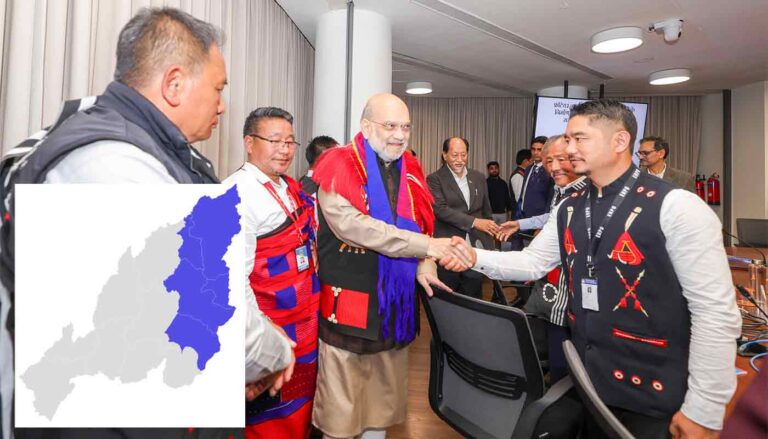
On 5th February (Thursday), the centre, Nagaland government and representatives of the Eastern Nagaland Peoples Organisation (ENPO), the highest authority representing eight identified Naga tribes in the six eastern districts of the state, signed a historic Memorandum of Agreement (MoA) in the national capital. The move has indicated another notable breakthrough in achieving Prime Minister Narendra Modi’s aspiration for a flourishing and peaceful Northeast.
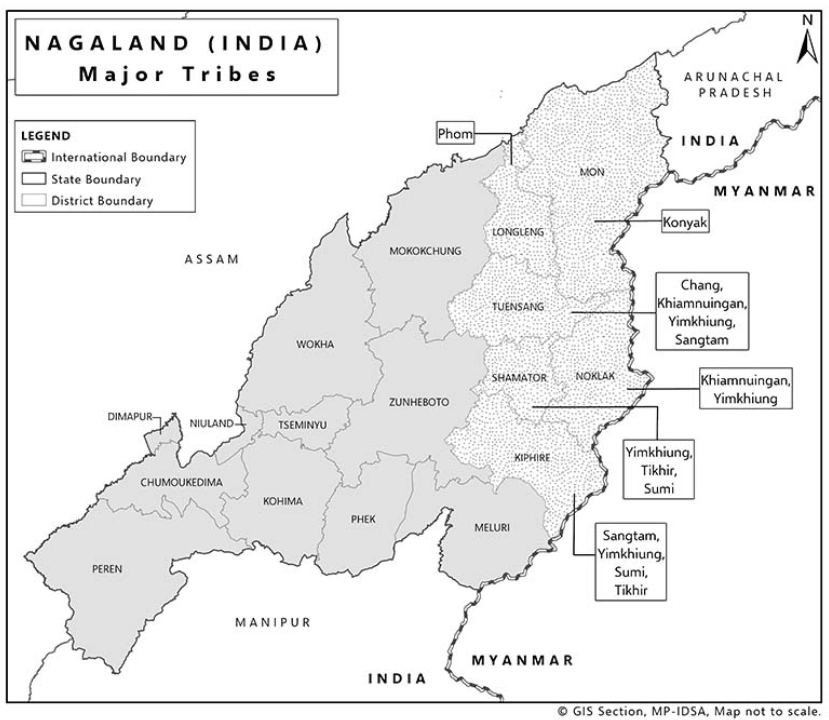
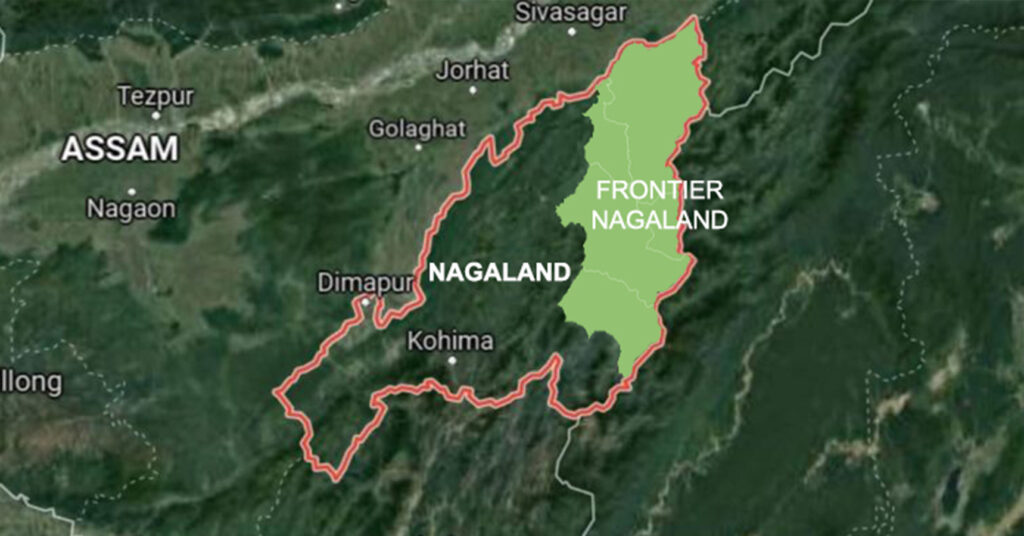
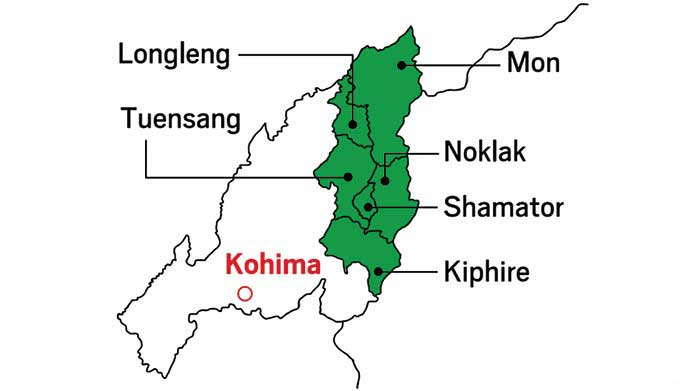
The tripartite agreement was inked in front of Nagaland Chief Minister Dr Neiphiu Rio, alongside Union Home Minister and Cooperation Minister Amit Shah. It will facilitate the establishment of the Frontier Nagaland Territorial Authority (FNTA) for the six districts of Nagaland, including Tuensang, Mon, Kiphire, Longleng, Noklak and Shamator. The pivotal step is set to result in the devolution of authority with regard to 46 FNTA subjects.
Image via idsa.in
Senior officials from the Union Ministry of Home Affairs and state government, including Yanth Ungo Patton, the deputy chief minister of Nagaland, his cabinet colleagues and other dignitaries were also present during the momentous event in New Delhi.
The prime minsiter lauded the “historic agreement” which will improve the growth track of Eastern Nagaland and offer new opportunities and prosperity to its people. He added, “It reflects our unwavering commitment to peace, progress and inclusive growth in the North East.”
This is a historic agreement indeed, which will enhance the development trajectory of Eastern Nagaland in particular. I am sure it will open new avenues of opportunity and prosperity for the people. It reflects our unwavering commitment to peace, progress and inclusive growth in… https://t.co/bKsHl8rWOn
Amit Shah referred to the agreement as a measure for “resolving decades-long pending issues of Eastern Nagaland.” He remarked, “It is a giant step towards realising Modi Ji’s vision for a peaceful and prosperous Northeast by resolving all contentious issues.”
Today a historic agreement was signed between Govt of India, Govt of Nagaland and ENPO resolving decades-long pending issues of Eastern Nagaland. It is a giant step towards realising Modi Ji's vision for a peaceful and prosperous Northeast by resolving all contentious issues. pic.twitter.com/sxt23lBX1n
The chief minister of Nagaland also shared the news of the important pact involving his government, the centre and ENPO.
I am happy to announce that today, 5th Feb 2026, the Govt. of Nagaland signed the Memorandum of Agreement (MoA) with the Govt. of India and the Eastern Nagaland Peoples’ Organisation for the formation of the ‘Frontier Nagaland Territorial Authority’ within the State of Nagaland.” pic.twitter.com/xbfVbluj31
A substantial move towards a harmonious North East
“PM Modi has envisioned a North East that is free from insurgency, violence, disputes and developed. Today, we have taken one more step forward in realising that vision,” Shah declared on the occasion. According to him, the accord is crucial to end conflict and informed that the Modi government has entered into 12 significant arrangements in the region since 2019.
He assured the ENPO delegates that the centre will both support and bear responsibility for the development of Eastern Nagaland. He conveyed that a certain sum will be determined annually, and the Ministry of Home Affairs will also cover the establishment’s initial costs.
Image via Freepik
Shah further mentioned that he had assured the ENPO representatives in 2021-2022 that PM Modi is committed to the cause of a peaceful North East and will address their concerns, urging them to maintain faith and take part in the democratic process, as they are going to receive justice and the respect they deserve.
He expressed happiness over the settlement of the dispute and highlighted how the officials from the Home Ministry served as a bridge between ENPO and the Nagaland government for a considerable amount of time.
The home minister also emphasised the strategic importance of the ENPO area and congratulated the entire state, its citizens and government, including Rio and his cabinet, as well as the two parliamentarians from Nagaland, for their contributions in bringing the negotiations to a logical end. He stated that the governments of the state and India will join hands to accelerate Eastern Nagaland’s development.
“Today’s agreement is a victory for Naga society, and I hope that mutual trust among all sections of people will increase. I also thank the Government of India for bringing the matter to a conclusion and hope we will keep on getting cooperation from the central government in the future,” Rio similarly voiced during the landmark program.
Image via Mokokchung Times
The agreement stipulates that Frontier Nagaland Territorial Authority will have a mini-secretariat led by an additional chief secretary or principal secretary, and its development expenditures will be shared proportionately by area and population. However, it remains completely compliant with the terms of Article 371(A) of the Indian Constitution.
This special framework aims to promote Eastern Nagaland through improved decision-making, financial autonomy, expedited growth of infrastructure, economic empowerment, and optimal resource use. According to Home Secretary Govind Mohan, the MoA will help in putting an end to protracted negotiations and guarantee that institutionalised governance, along with development mechanisms, fulfil the local expectations of eastern Nagaland.
Separation to inclusion: How the Modi administration addressed the prolonged dispute
There has been a persistent demand for the eastern Nagas to be separated since independence. The Tuensang Mon People’s Organisation, which was renamed the Eastern Naga People’s Organisation in 2005, started out in 1994 as a formal protest against the backwardness and alienation of the eastern Naga tribes.
The creation of a Frontier Nagaland Territorial Authority, which would include the six eastern districts of Kiphira, Longling, Mon, Noklang, Shamator and Tuensang, was initiated by the ENPO in 2010. They called for a separate political system to tackle development and governance imbalances in Eastern Nagaland and wanted financial, legislative and executive independence. They also complained about the under-representation of eastern Naga tribes in the government.
The confrontation was fraught with election boycotts, strikes, several meetings with the shareholders, assurances and more. Progress was made many times, only to encounter roadblocks. However, the Modi government continuously engaged in discussions and listened to the demands of ENPO.
Image via Drishti IAS
A formal dialogue between the MHA and the ENPO was started in 2022 by a high-level committee in an effort to reach a consensus. However, the latter’s insistent demand for a separate state prevented the talks from reaching an agreement. However, the group eventually agreed upon the centre’s proposal for a territorial authority with more autonomy under the FNTA structure.
The ENPO provisionally nodded to the Modi government’s plan to create the FNTA under Article 371(A) during the inaugural meeting in December 2024, handing over executive, legislative and budgetary authority to the eastern Nagas. A series of meetings followed and the outfit cut down its demands.
Its desire for an independent state was ultimately suspended during last year’s final negotiations, and a proposition for founding a special autonomous administrative entity dubbed the FNTA within the state of Nagaland was approved. This is scheduled to be reviewed in ten years, and controversial issues will be worked out through democratic political processes.
Conclusion
The North East had been plagued by severe neglect under the Indian National Congress regime. However, the Modi government has brought about positive changes, undertaking extensive actions to mainstream and connect the entire region with the rest of the country while also promoting development in its most remote areas.
Furthermore, there have been repeated attempts to find an amicable solution to issues raised by opposing factions, which have helped to alleviate long-standing feelings of marginalisation, political upheaval, violence and unrest, thus delivering stability and a pathway to a better future.
It is due to the relentless efforts of the government that the ENPO’s quest for a distinct state drastically dropped and it welcomed a special administrative structure (FNTA) with restricted autonomy under Article 371(A). Now, an incredibly contentious segment of history has come to an end, giving way to a new dawn filled with hope and devoid of a drawn-out conflict in the region.
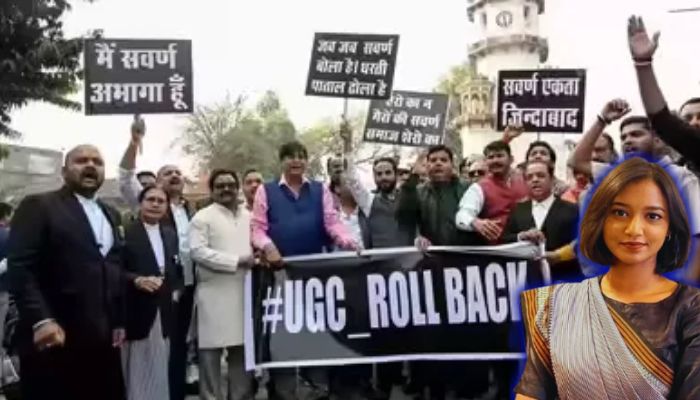
The Supreme Court of India stayed the implementation of the draconian University Grants Commission (Promotion of Equity in Higher Education Institutions) Regulations of 2026 on 29th January. However, outrage against the UGC guidelines and counter-narratives in support of it are keeping the debate alive and heated. In her desperation to justify the implementation of the caste-discrimination guidelines, advocate Disha Wadekar gave an absurd argument that if caste-based discrimination guidelines are made caste-neutral, then “What is the point of that provision of discrimination?”
In an interview with The Telegraph India published on 2nd February, Disha Wadekar said, “Now everyone is pointing out that there is a separate definition of caste discrimination. Section 3(C) defines caste discrimination as caste-based discrimination, based on caste or race against Scheduled Castes, Scheduled Tribes, and OBCs. Caste-based discrimination definition that everyone has a problem with, who should it include?”
"Are you saying that SC, ST and OBCs, caste based discrimination should also include other categories? Then, what is the point of that provision of discrimination? Then there is no discrimination, right?"
“If that should be a caste-neutral definition is what the question is, then are you saying that alongside SC, ST, and OBCs, caste-based discrimination definition should also include other categories, and it should be caste neutral, then what is the point of that provision of discrimination then? Then there is no discrimination, right? That actually means that there is no discrimination,” she added.
Disha Wadekar drew parallels between a caste-based discrimination definition and a gender-based discrimination definition and said, “It is like saying that gender-based discrimination definition should have men who say that I am being discriminated against on the basis of gender.”
She inadvertently exposed her hypocrisy by making such a claim since the UGC Regulations of 2026 did not identify discrimination on the basis of gender exclusively for women. However, discrimination against the general castes has been specifically excluded.
She further attempts to discredit the legitimate concerns raised by those protesting against the caste-based discrimination guidelines, saying that punishments will be civil remedies, and no one will be outrightly lodged in jail, and the committee will hear both sides before decidinga punishment proportionate to its findings in a matter.
Outrageously flawed gender-discrimination analogy, presumed guilt and a deliberate overlooking of how the UGC caste-based discrimination definition only widens the societal divide
Advocate Disha Wadekar compared the definition of caste-based discrimination in question to gender laws by saying that “It is like saying that the gender-based discrimination definition should have men, who say that I am being discriminated against on the basis of gender.”
The comparison that ‘upper caste’ groups or the general category should not be included in the caste-based discrimination definition, just as men should not be included in any gender-based discrimination definition of protective laws, essentially kills even the possibility of the acknowledgement of the general category facing discrimination due to their ascriptive identity. Similarly, Wadekar’s argument implies that men can never be discriminated against based on their gender.
While prevalence does shape opinions, and even policies and laws, it does not mean that the non-protected groups are immune to discrimination based on their caste or gender-based identity. Wadekar’s logic plays into the general notion that if caste-based discrimination has taken place somewhere, the victim must by default be from the SC, ST, or OBC category while the discriminator must be from the general category. It is like legitimising the coarse argument of presumed guilt, “Ye purush hai, isne toh kia hi hoga [discrimination/harassment]” and “Ye upper-caste wala hai, isne kia hi hoga caste-based discrimination].
However, there have been incidents, and there is an undeniable possibility of ‘upper-caste’ individuals being subjected to discrimination and harassment based on their caste identity. There have been incidents in the past where genocidal slogans have been raised on campus, calls for Brahmin exodus have been made, and other similar incidents have been reported.
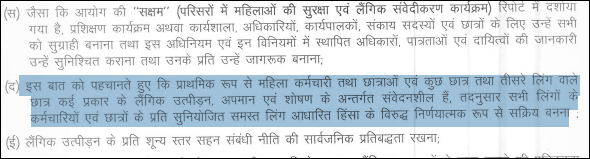
Interestingly, while Wadekar suggests that gender-based discrimination happens only against women and thus men should not be included in such definitions, the UGC rules on gender-based discrimination are gender-neutral. The UGC rules cover discrimination against all humans, be it women, men, or the third gender.
Regulation 3(d) of the UGC (Prevention, Prohibition and Redressal of Sexual Harassment of Women Employees and Students in Higher Educational Institutions) Regulations, 2015, and other related clauses explicitly require higher educational institutions (HEIs) to act on sexual harassment complaints from male, female, and third gender individuals. This gender-neutrality also extends to broader grievance mechanisms, including the UGC Redressal of Grievances of Students Regulations, 2023, which although keeps women in central focus, says, “Act decisively against all gender-based violence perpetrated against employees and students of all sexes recognising that primarily women employees and students and some male students and students of the third gender are vulnerable to many forms of sexual harassment and humiliation and exploitation”.
The UGC has to a great extent managed to make gender-based protections gender-neutral without losing their core purpose, which is to address the structural and more prevalent discrimination while still ensuring redress for men or transgender individuals in cases that occur.
If this logic can successfully be applied to gender-based discrimination, where despite the prevalence being overwhelmingly against the rules remain inclusive.
In another interview, Wadekar says that she does suggest that upper-caste students do not experience harassment or victimisation at all, but cases are “typically individual-specific and not rooted in ascriptive group identity.”
A simple question arises here: how did she arrive at the conclusion that cases of harassment or victimisation of upper-caste students are ‘typically individual-specific’, and not ‘rooted in ascriptive group identity’? Can or have not Brahmins or other upper caste individuals not targeted for their pure vegetarian food preferences, or their Shikha (tuft of hair) or for wearing Janeu (sacred thread) by those linking their harmless religious practice to caste supremacism?
Back in 2022, “Brahmin-Baniyas, we are coming for you. We will avenge”, “Go back to Shakha”, “Brahmins Leave the Campus”, “Brahmin Bharat Chhodo”, “Now there will be blood” and other such slogans were spray-painted on the walls of Delhi’s Jawaharlal University by leftist groups. The professors targeted by the miscreants included Nalin Kumar Mohapatra, Raj Yadav, Pravesh Kumar, and Vandana Mishra.
1) This is from JNU.
Slogans on the wall: 1. Brahmin Bharat Chhodo. 2. Brahmino-Baniyas, we are coming for you! We will avenge.
School of Language Literature and Culture Studies in JNU. (2nd building, 3rd floor). pic.twitter.com/h4lGkotana
In April 2022, “Kashmir to bas jhanki hai, poora Bharat baaki hai” (Kashmir is only the beginning, whole India is still there) and “Brahman Teri kabr khudegi BHU ki dharti par” (Graves of the Brahmins will be dug at the BHU campus), slogans were written inside Banaras Hindu University.
In 2024, Ashoka University students shouted anti-Brahmin-Baniya slurs during demonstrations on 26th March. Social media users shared videos of the students chanting “Brahmin-Baniyawaad Murdabad” and other similar provocative phrases. In addition to abusing the Baniya and Brahmin communities, they chanted “Jai Savitri-Jai Fatima” and “Jai Bheem-Jai Meem”, while also demanding on-campus caste census and reservation.
In Karnataka, there have been incidents wherein Brahmin students were asked to cut off their Janeu before appearing for the CET exam. In Shivamogga, a Brahmin student was forced to cut his Janeu, throw it in the dustbin and only then was he allowed to appear in the exam, even as there was no rule that Janeu or any such religious objects were banned. Not to forget, despite what the Dharma says, Janeu/Janivara/Poonool is often associated with Brahmins and is described by ‘left-liberal’ cabal as a symbol of Brahminism and Brahmin caste superiority. In fact, Tamil Nadu has a history of the Poonool of Brahmins being forcibly cut to mock them, and such incidents continue to occur.
These incidents indicate that the so-called upper-caste groups are also subjected to harassment or discrimination based on their ascriptive group identity. The ‘Brahmins Leave Bharat’ or ‘Graves of Brahmins will be dug’, or ‘avenge Baniyas’ slogans invoke genocidal and expulsion rhetoric rooted in supposed historical group roles, reflecting the structural discrimination Disha Wadekar attributes only to SC, ST and OBCs.
Not all incidents of victimisation of upper caste students are ‘individual-specific’, some are rooted in group-based animus, and not all incidents of victimisation of SC, ST, or OBC students are caste-based discrimination or harassment, but individual-specific. Yet, Wadekar chose to dismiss caste-based discrimination against upper-caste individuals in HEIs as non-ascriptive. The only difference is that while the reserved groups would have the framework under the currently stayed UGC 2026 rules to have their real, imaginary, alleged or exaggerated grievances heard and redressed, the upper caste groups do not have such a specific framework.
With caste-based discrimination getting narrowly defined as unfair treatment against SC/ST/OBS with emphasis on structural or ascriptive identity harm, the UGC gave stronger institutional teeth, preventive duties, and symbolic recognition to complaints from the reserved categories, while similar grievances of the ‘upper-caste’ students would fall under the general 2023 rules.
Wadekar’s argument that the uproar by the general category people over the lack of a redressal is invalid since the 2023 regulation has been incorporated in the UGC 2026 regulation, and they can file complaints. This would not essentially address caste-based discrimination, as she herself admitted. Basically, not only Disha Wadekar, but the UGC itself is legitimising the unfair idea that upper caste individuals can never face harassment or victimisation based on their caste identity even as casteist slurs are hurled against them, calls for their violent ouster and genocide are given, and can only face individual-specific verbal and/or violent attack or harassment.
Since the UGC 2026 guidelines do not symmetrically recognise caste-based discrimination against general category students as a specific category of harm, a one-way street is created wherein the ascriptive caste discrimination is presumed unidirectional, while bidirectional or individual caste-specific from general category individuals is relegated to less specialised and less deterrent mechanism. Is this not in violation of Article 14, since the framework here essentially treats similar harms differently based on caste origins, rooted in the misconception that upper-caste students cannot face real caste-based discrimination due to their supposed historical caste ‘privilege’? Is it not a case of presumed guilt wherein GCs are labelled as inherent ‘oppressors’? Is there an intention to keep the ‘upper caste’ individuals guilt-trapped in the oppressor-oppressed matrix?
In conversation with The TelegraphIndia, advocate Disha Wadekar further suggests that those protesting against the UGC 2026 guidelines are doing a hue and cry over a non-issue like the misuse of the rules. This argument came even as there is a massive example of the general misuse of the SC/ST Act against upper-caste people. She said that it is not like a reserved category student would file a complaint before varsity authorities accusing anyone from the general category, and the accused person would immediately be stuffed in jail. Rather, she says, due process will be followed and the accused student will have the opportunity to present his/her case and present evidence etc, and only if the Committee finds the allegation to be true that warnings, or fines, etc., would be imposed.
However, what if a reserved category student files a complaint alleging caste-based harassment/discrimination against a general category student, the university’s committee dismisses the complaint as frivolous and the reserved category student ends up accusing the committee members of bias and files a case against them under the SC/ST Act? This may sound far-fetched and alarmist but in times where an entire village of Brahmin residents has been booked under the SC/ST Act over a wage-related dispute in Bihar’s Darbhanga, even as many of the accused men reside in Delhi-Mumbai for work, anything is possible.
The origins of the UGC regulations on equity, notification of the guidelines and the Supreme Court intervention
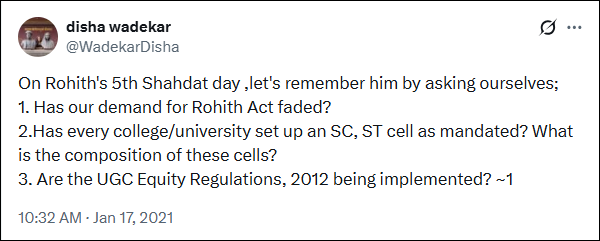
The 2025 draft regulations emerged out of a PIL filed in 2019 by mothers of students of Rohith Vemula and Payal Tadvi, who died in 2016 and 2019, respectively. Their families alleged that the students committed suicide after being subjected to caste-based discrimination. The petitioner, represented by Senior Advocate Indira Jaising, along with advocates Prasanna S. and Disha Wadekar, sought the implementation of anti-discrimination measures in educational institutions. Wadekar drafted the 10 suggestions to be included in the UGC Bill, and most of those suggestions were accepted by the Central government. This came after the Supreme Court passed an order in September 2025, recording the ten specific suggestions made by the petitioners represented by Wadekar, Jaising and Prasanna S., and directed the UGC to revise the draft.
The PIL did not reportedly demand an entirely new set of regulations, but a strict enforcement of the existing University Grants Commission (Promotion of Equity in Higher Educational Institutions) Regulations, 2012. The 2012 rules required universities to establish Equal Opportunity Cells to handle complaints of discrimination, particularly against Scheduled Castes (SC) and Scheduled Tribes (ST) students.
However, the petitioners were not happy with the 2025 draft regulations, and Senior Advocate Indira Jaising proposed ten core changes in the draft. The proposed reforms included grievance committees with substantial marginalised representation and grant withdrawal for non-compliance. The Supreme Court fixed an 8-week deadline for the finalisation of the regulations. Finally, the Promotion of Equity in Higher Education Institutions Regulations, 2026, were notified on January 13, 2026.
The 2026 regulations ruled out the general castes as victims of caste-based violence by restricting the category of victims to SCs, STs, and OBCs. There is no provision for general category students to raise a complaint when subjected to caste-based discrimination. The 2026 regulations not only assume that caste-based discrimination is only directed towards people from the SC, ST, and OBC communities, but, in a way, promote reverse caste-based discrimination by excluding general castes, which form a large section of the academic community, from protection.
As outrage erupted over the draconian rules, the matter reached the Supreme Court, which put a stay on the implementation of the UGC 2026 guidelines.
While a final decision in the matter is pending, the outrage around the UGC 2026 guidelines in the context of caste-based discrimination is justified not only because of its inherent flaw but also because this matter will set a precedent. It must not be forgotten how the suicide of Rohith Vemula was politicised, used by anti-Hindu elements to villainise ‘upper caste’ groups, and Karnataka Congress is coming up with caste-discrimination laws in Rohith Vemula’s name, while the closure report filed by Telangana Police states that Rohith Vemula did not even belong to the Scheduled Caste (SC) category. He was just using an SC certificate. The police concluded that he killed himself, fearing the exposure of his true caste identity.
In fact, advocate Disha Wadekar calls the day Rohith Vemula committed suicide “Shahadat Day”, suggesting that he was a ‘martyr’.
Disha Wadekar and her past shenanigans
Disha Wadekar is a Supreme Court lawyer with specialisation in personal law, caste discrimination, and anti-discrimination jurisprudence. She obtained her law degree from Columbia Law School in the US and is a co-founder of the Centre for Equity, Diversity and Equality (CEDE).
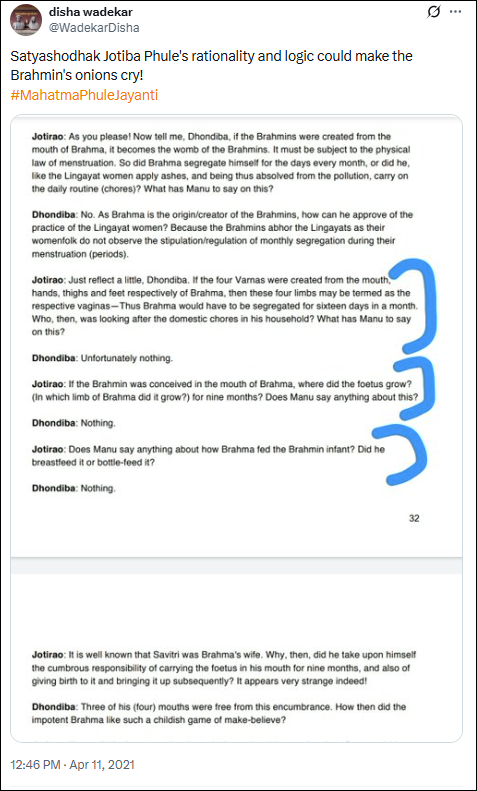
Unsurprisingly, Wadekar harbours deep disdain for the Brahmin community, as evident from her social posts. In one such post, she wrote, “Satyashodhak Jotiba Phule’s rationality and logic could make the Brahmin’s onions cry!”
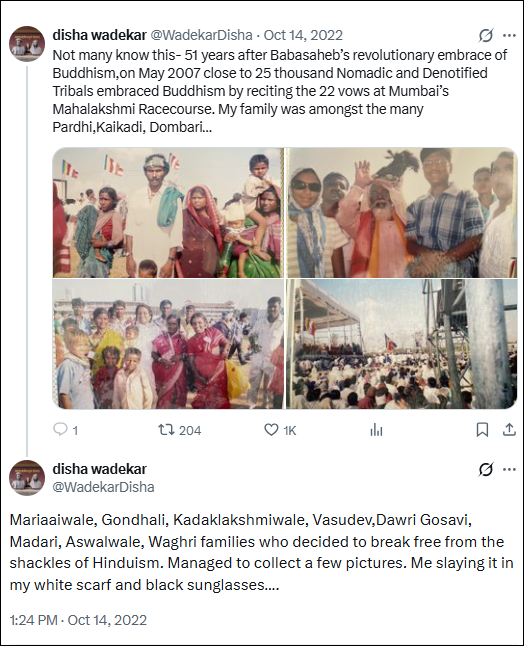
In a post insinuating that Hinduism, the faith of the majority community of India, is oppressive, Wadekar wrote, “Not many know this- 51 years after Babasaheb’s revolutionary embrace of Buddhism, in May 2007, close to 25 thousand Nomadic and Denotified Tribals embraced Buddhism by reciting the 22 vows at Mumbai’s Mahalakshmi Racecourse. My family was amongst the many Pardhi, Kaikadi, Dombari… Mariaaiwale, Gondhali, Kadaklakshmiwale, Vasudev, Dawri Gosavi, Madari, Aswalwale, Waghri families who decided to break free from the shackles of Hinduism.”
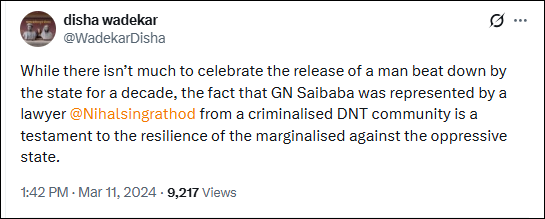
Disha Wadekar is also a fan of urban naxal GN Saibaba, who was sentenced to life imprisonment by a Gadchiroli sessions court in 2017 for waging war against India for his Maoist links and involvement in anti-national activities. He was convicted under sections 13, 18, 20, 38 and 39 of the UAPA. G N Saibaba was first arrested in May 2014 on charges of being a member of the banned CPI-Maoists, plus providing logistics and carrying out recruitment for them.
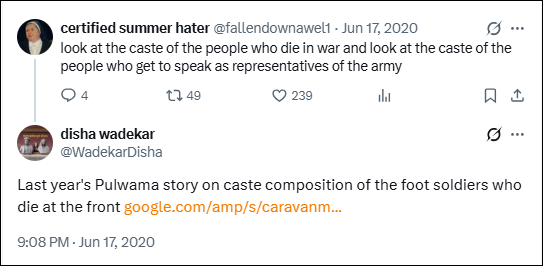
Wadekar has earlier tried to bring in her ‘caste’ narrative even in the martyrdom of the soldiers of the Indian Army, and highlighted an article in the Caravan magazine on the “caste composition of the foot soldiers who die at the front”.
It must be recalled that the CRPF had strongly criticised the disgraceful caste-composition analysis of the martyrs of the 2019 Pulwama Islamic terror attack. CRPF chief Moses Dhinakaran had said that Jawans of the army are only “Indians” and that any caste, colour, and religion divide is non-existent in the Army.
She drafted the 10 specific suggestions to be put in the UGC bill. (Most were accepted by the BJP Gov).
Btw! You can see her arguing here against the EWS. Look at the contempt in her voice even for our poor brethren!
Notably, Disha Wadekar is also opposed to the reservation given to the Economically Weaker Section (EWS) group, arguing that it is nothing but an “upper caste reservation”.
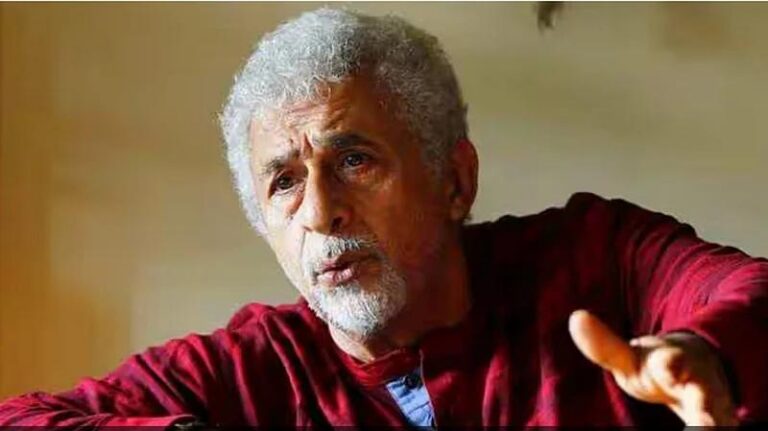
Naseeruddin Shah’s recent op-ed, published in the Indian Express, triggered by his alleged “disinvitation” from a Mumbai University Urdu Department event, is less a statement of fact and more a familiar performance of grievance politics. The actor claims he was first invited to Jashn-e-Urdu on February 1 and then informed a day before that his presence was no longer required. He further says no official explanation was offered and that the organisers publicly suggested he had declined the invitation himself, a claim he disputes.
Up to this point, the matter is straightforward: an invitation was issued, later withdrawn, and the communication around that reversal was, at best, clumsy and opaque. That is the sum total of what is actually known. Everything else in Shah’s op-ed is inference, speculation, and political colouring.
It is also hard to miss the irony: Shah is casting himself as a victim of “intolerance” for being disinvited from an event meant to commemorate Urdu, a language and literary tradition that has, for centuries, thrived in India’s plural cultural space. If anything, the very existence of such a university event undercuts the sweeping civilisational gloom he tries to paint. Yet he presents this episode not as an administrative lapse or institutional muddle, but as proof of a broader ideological crackdown.
In his defence, Shah claims a very senior university official reportedly told him that he openly makes comments against India but such unverified random remarks cannot be taken as the University’s official stance to what Shah describes as ‘disinvitation’ for the Urdu event.
Instead of seeking a formal clarification from the university or placing the correspondence in the public domain, Shah chose to leap straight to motive. He framed the episode as an act of ideological retaliation, attributing it to his “sharp political views” and to what he described as a climate of “rising intolerance.” In doing so, he converted an administrative or organisational decision, about which no confirmed reason is on record, into a morality play with himself cast as the silenced dissenter.
This is precisely where Shah’s argument weakens. There is, at present, no public evidence establishing why the invitation was withdrawn. Universities cancel speakers for a host of reasons: scheduling conflicts, internal disagreements, funding issues, pressure from multiple sides, or simple bureaucratic dysfunction. None of these possibilities is flattering, but neither do they automatically amount to ideological censorship. By skipping the basic step of demanding a clear explanation and instead publishing an op-ed that imputes political motives, Shah replaces inquiry with insinuation.
In his column, he goes further, rehearsing a familiar catalogue of complaints about the current political climate, the Prime Minister, “thought police,” “doublespeak,” and a country supposedly unrecognisable from the one he grew up in. None of this, however, establishes that Mumbai University disinvited him for these reasons. It merely uses the incident as a springboard to restate his long-standing political positions and to reinforce a narrative of personal and community victimhood.
This pattern is not new. Shah has, for years, positioned himself as a cultural dissenter against what he sees as a majoritarian, nationalist turn in public life. He has repeatedly attacked films like The Kashmir Files and The Kerala Story as propaganda and a “dangerous trend,” even invoking Nazi Germany to describe the popularity of such cinema. He has also blamed audiences for not supporting filmmakers he considers ideologically aligned with his own worldview. In other words, he is not a neutral commentator suddenly shocked by intolerance; he is an active participant in a deeply polarised cultural debate.
That context matters because it explains why his op-ed reads less like a careful account of an administrative slight and more like a political manifesto built around a personal grievance. The episode becomes useful not as a question to be resolved but as a prop to reinforce a broader ideological narrative: that dissenting voices (of a particular kind) are being systematically squeezed out, and that Muslims and liberal critics are uniquely imperilled.
The irony deepens when one recalls that Shah himself has, in the past, been dismissive of very real threats when they did not fit his preferred narrative. His comments downplaying the danger posed to Nupur Sharma by Islamist threats, later grotesquely contradicted by the Udaipur beheading of Kanhaiya Lal, stand as a stark reminder that his moral alarm system is highly selective. When violence or intimidation comes from quarters he is reluctant to confront, the threats become “hollow.” When he faces an unexplained professional setback, it is immediately elevated into proof of systemic persecution.
None of this is to say that disinviting a speaker at the last minute without a clear explanation is acceptable. It isn’t. Institutions owe invitees transparency and basic professional courtesy. But there is a difference between demanding accountability and constructing a political narrative in the absence of evidence. Shah chose the latter.
If the actor genuinely wanted the truth, the obvious course was to seek a written explanation from the university and make that public. If the reason turned out to be political pressure or ideological vetting, the case would be far stronger and far more damaging to the institution involved. By pre-emptively assigning motive and publishing a polemic instead, Shah ensured that the episode would generate heat rather than light.
In the end, this controversy says less about Mumbai University, whose decision-making remains unexplained, and more about Shah’s reflex to interpret every personal slight through the lens of ideological victimhood. Conjecture is not evidence. And grievance, however eloquently written, is not a substitute for facts.
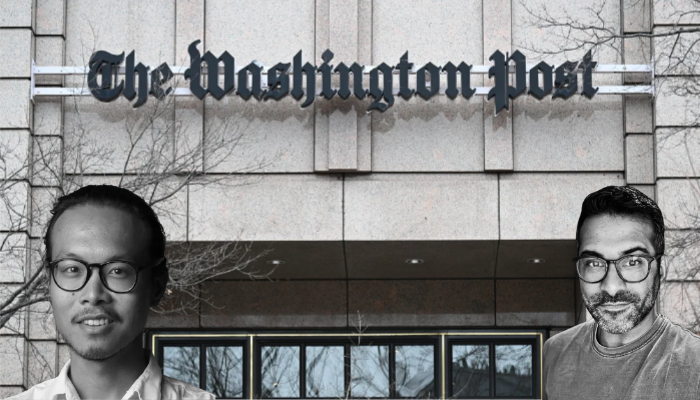
The Washington Post has announced it is cutting one-third of its workforce and has begun large layoffs across all divisions of the corporation, which would drastically reduce its coverage of international and sports news. The decision was announced on Wednesday (4th January) and will affect staff members from all departments.
The United States (US) daily’s sports section will disappear and some of its remaining correspondents are going to cover sports culture in the features unit. Its books and metro segments along with the flagship news podcast “Post Reports,” will all face the same outcome. The move asserted to bring “stability” by executive editor Matt Murray has been described “absolute bloodbath” and as one of the “darkest days in the history” of the newspaper which is owned by Amazon founder and billionaire Jeff Bezos.
However, Murray discussed the necessity to compete in a saturated media industry and admitted that the daily has had difficulty reaching “customers” and stated, “Today, the Washington Post is taking a number of actions across the company to secure our future.” He added that the overseas coverage headcount will be reduced with about 12 bureaus maintained “with a focus on national security issues.”
He told the employees on call, “We all recognise the actions we are taking today will be painful, most of all, of course, for those of you who are directly affected, but for everybody. I know that the reset is going to feel like a shock to the system and raise some questions for everybody.” Local and foreign reporters had also begged Bezos to keep their jobs prior to the announcement but to no avail.
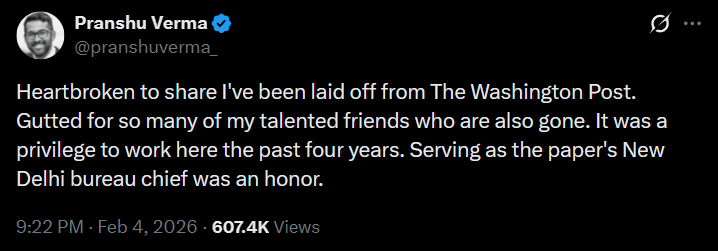
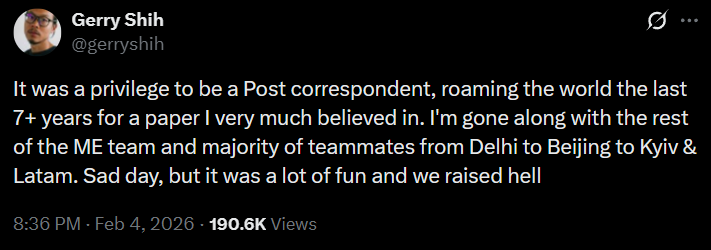
The action also had repercussions for the company’s Indian staff as many notable names, including Shashi Tharoor’s son, Ishaan Tharoor, were among the more than 300 individuals who were shown the door. Likewise, many impacted parties shared the same on social media. Pranshu Verma, the New Delhi Bureau Chief and Gerry Shih, the Jerusalem Bureau Chief of The Washington Post have also been ousted.
Notably, the two have emerged as prominent anti-India figures connected with the outlet already infamous for its biased coverage, similar to the rest of the Western media. “Heartbroken to share I’ve been laid off from The Washington Post. Gutted for so many of my talented friends who are also gone,” Verma, who was with the newspaper for four years, referred to the association as an “honour.”
Shih called his time with The Washington Post a “privilege” and mentioned that he had spent more than seven years travelling the world “for a paper I very much believed in.” He remarked, “I’m gone along with the rest of the ME (Middle East) team and the majority of teammates from Delhi to Beijing to Kyiv & Latam. Sad day, but it was a lot of fun and we raised hell.”
Meet Pranshu Verma who tried to target the Modi government to protect his job
According to The Washington Post’s official website Verma was “responsible for covering news out of India, Bangladesh, Sri Lanka, Nepal and Bhutan. Verma joined The Post in 2022 and covered artificial intelligence. He previously wrote about technology at the Boston Globe and reported on diplomacy and transportation at the New York Times.”
His journalism career began at the Philadelphia Inquirer, where he covered politics in New Jersey alongside prisons. He holds degrees from the University of Delaware and the Graduate School of Journalism at Columbia University. Now, the axe has fallen on his job despite publicly slandering the Modi government to his superiors.
Verma tried to beg the management to spare his position by claiming that the media house was one of the few in India that can do “accountability reporting without fear of government censure.” However, his statement, which was intended to portray the Modi government as autocratic and was actually a resume, a loyalty affidavit and an ideological confession consolidated into one, appeared to have fallen on deaf ears.
His attempts to satisfy his liberal employee were subsequently aided by his emphasis on the bureau’s repeated attacks against the Modi government, accompanied by unfounded allegations aimed to discredit not only the ruling party but the entire nation.
Verma went on to proudly highlight several articles including those on Indian billionaires being “treated far better than others,” accusations of crony capitalism under the leadership of Prime Minister Narendra Modi, pieces about the nation’s corporations purportedly “fuelling Russia’s war in Ukraine” and the portrayal of India’s campaign to reduce illegal immigration as a “draconian deportation campaign of Muslims to Bangladesh.”
Each illustration was meant to reflect ideological conformity with the perspective that has progressively characterised The Washington Post’s international reporting especially in relation to India.
What is needed to become a journalist at the Washington Post
Verma made it abundantly clear what was required to be recruited as an Indian reporter at The Washington Post. The country which is presently governed by a “right-wing” government, already despised in liberal circles, should be painted as a dubious entity and its actions must be viewed through the lenses of tyranny, majoritarianism and moral delinquency rather than as a sovereign democracy confronting challenging issues.
Hence, Verma peddled a national security issue concerning illegal Rohingya immigration which involves falsified documents, border penetration and even criminal charges as a sorrow tale of communal persecution. Similarly, billionaires were presented as tools for government corruption rather than commercial players in a free market.
According to him, geopolitics does not serve as the origin of diplomatic strife, which is instigated by the personal and strategic ambitions of powers like the United States but is a “breakdown” resulting from India’s alleged moral failings. New Delhi is repeatedly vilified for its attempts to defend its sovereignty and the welfare of its people.
Verma was fundamentally gloating about the narrative his coverage disseminated and the detrimental effects his biased and inaccurate reporting has had on India over the years while leveraging it as a plank in hopes of keeping his job. It is indeed ironic that while he relentlessly attacked Indian billionaires and voiced concerns about censorship in India, he had to turn to an American mogul for work.
His arguments about freedom from power were contradicted by appeals to the generosity of the affluent owner but what defines a liberal if not blatant hypocrisy and double standards?
Meet Gerry Shih who is deeply committed to the cause of Khalistan separatism
The Washington Post stated that Gerry Shih, who attended Stanford University, became its part in 2018 and covered Israel, the Palestinian territories and the larger Middle East as the Jerusalem Bureau Chief. He previously “served as the New Delhi Bureau Chief from 2021-2025 and reported on politics, foreign policy, intelligence and technology in India and other South Asian countries.”
Gerry also covered China for the newspaper after “working for the Associated Press, Reuters and The New York Times. He was a finalist for the Pulitzer Prize for International Reporting in 2024 for his reporting on India and received the 2020 Osborn Elliott Prize.” He is reportedly of Chinese descent.
“He reported for the Associated Pressfrom Beijing, where he covered the Chinese government crackdown in Xinjiang, domestic politics and foreign policy. He has also covered Silicon Valley’s social media companies for Reuters and Northern California for The New York Times,” informed The Media Rumble.
It is unnecessary to reiterate that being anti-India is not an oddity but rather a highly encouraged norm and requisite to join The Washington Post. Therefore, in line with this tradition, Gerry chose not only to use his pen to advocate for Khalistan separatists but also collaborated with Prime Minister Justin Trudeau’s government in accusing India without any substantiation.
The collusion shattered the glass walls of journalistic integrity
The Royal Canadian Mounted Police (RCMP) and the government made grave but groundless allegations against India on 14th October 2024, contending that Indian agents, officials and senior Indian diplomats, including Sanjay Kumar Verma, who was India’s High Commissioner to the nation at the time had engaged in “criminal activities” on Canadian soil.
The newspaper produced a story written by Gerry and Greg Miller on the charges levelled by Canadian officials within hours and even declared Amit Shah as one of the conspirators in unlawful criminal operations. Canada’s National Security Advisor, Nathalie Drouin and Deputy Minister of Foreign Affairs, David Morrison, were the government sources cited in the article.
However, it was already unveiled how the daily was briefed days before the RCMP and Canadian authorities accused India. It was merely waiting for a press conference before printing a prepared report. The assassination of terrorist Hardeep Singh Nijjar and other targeted killings as well as attacks on separatist elements were blamed on India. Canada’s NSA dictated these accusations to the media house long before any formal conclusions or evidence were made public.
The revelation adequately burst the bubble of the credibility of the newspaper’s independent journalism and integrity as its writers were discovered to be moonlighting as Ottawa’s instruments to demean New Delhi.
Unyielding attacks directed at India, promotion of conspiracy theories
Gerry, who had been using The Washington Post to accuse India of every “conceivable wrongdoing” from the withdrawal of “daring” content on Netflix and Amazon due to pressure from the Modi government to “hate speech” on Facebook to murders of terrorists in Pakistan spotted a golden opportunity to further the propaganda when the United States stated that India attempted to murder the banned “Sikhs For Justice” supremo, Gurpatwant Singh Pannun in 2023.
Gerry insisted that Samant Kumar Goel, the former Chief of the Research and Analysis Wing (R&AW), was completely involved in the conspiracy while conversing with Karan Thapar on the propaganda channel The Wire.
He first wrote, “US intelligence agencies have assessed that the operation targeting Pannun was approved by the R&AW Chief at the time, Samant Goel” in his article and later defended the statement as an “assessment from what we understand of US intelligence agencies,” in the 2024 interview.
Gerry eloborated, “Again, this was not sort of a one-off a rogue actor, that this had higher up approval from within the agency including from the secretary Goel, and if we also take into consideration what our sources have told us about the pressure that he was under pressure to eliminate these threats, that has contributed to this understanding that this was an operation.”
However, his “reporting” raised strong doubts in light of his complicity with the Canadian government and his consistent propensity to fabricate in his criticisms of India. Gerry has continuously illustrated his intellectual deceit as he did not even hesitate to equate India with China in 2022.
The Modi government decided to follow an independent foreign policy and did not cave to Western influence in the Russia-Ukraine War. However, he slammed the government for not aligning with the polity he favours and serves.
“Modi on same page as China on the issues of human rights, climate change, the treatment of religious minorities and freedom of expression, claims of Western hypocrisy emanating from Indian diplomats could well be coming from Chinese diplomats,” he mentioned while reacting to a column on anti-India The Caravan, authored by another member of the leftist lobby, Sushant Singh who is at Yale University.
“WP (The Washington Post) would love the absurdities in this article (meaning Sushant Singh’s article in The Caravan) coming from a kindred spirit targeting his own country with a Yale connection in mind. No one with an iota of intellectual honesty can bracket India and China on the issues mentioned. Shih expelled from China enjoying India’s freedom,” former Indian Foreign Secretary Kanwal Sibal had appropriately fired back at him.
Conclusion
The firings are the most recent in a string of buyouts and personnel reductions that have occurred throughout the media outlet’s offices in recent years due to criticism of certain editorial choices made by the publication which conveyed that it will not support a presidential candidate before the 2024 US presidential election, a stance taken by Bezos. Afterwards, it swiftly lost tens of thousands of subscribers.
Interestingly, the newspaper had backed a candidate in the majority of presidential elections since the 1970s and all of them were Democrats. Moreover, the decision made by Bezos to centre the paper’s opinion section on “personal liberties and free markets” last year led to the resignation of the division’s editor.
The company is notorious for its partial and politically motivated reporting and has a deep-rooted prejudice against India as well as profound resentment towards the Modi government which has only grown over time. Verma and Gerry also devoted their utmost efforts to penetrate this narrative and were foundational to this corrupt legacy.
However, the fresh development has once again brought attention to the internal issues of the firm and has proved that disparaging India specifically by the modern brown sepoys does not ensure job security within liberal media. They are all disposable, irrespective of their eagerness to launch unwarranted attacks on their country.
A fresh controversy has erupted after WikiLeaks shared a long post on X on Wednesday, 4th February, highlighting previously released emails that expose the connection between the convicted sex offender Jeffrey Epstein and The New York Times.
The email is discussing the possibility of “outing” Arthur Ochs ‘Pinch’ Sulzberger Jr., the former publisher of The New York Times. The post has once again brought attention to Epstein’s behind-the-scenes connections with powerful media companies and the tone in which he spoke about influence, leverage, and elite institutions.
Epstein Email: “outing” New York Times publisher Sulzberger will see “the end of the establishment.”
One month before the abrupt departure of Arthur Ochs ‘Pinch’ Sulzberger Jr as publisher of the New York Times, Epstein wrote to attorney Brad Karp: “How about Sulzberger would… pic.twitter.com/8pv9k4kGca
In its post, WikiLeaks cited an email trail that took place about a month before Sulzberger abruptly stepped down as publisher of The New York Times in December 2017. His retirement became official two weeks later.
Emails that sparked the debate
According to the details highlighted by WikiLeaks, one month before Sulzberger’s retirement, Epstein wrote to attorney Brad Karp asking, “How about Sulzberger? Would that be funny?” Karp reportedly responded, “That would be pretty ironic and give whole new meaning to his nickname ‘pinch’.” The exchange appeared to suggest that Epstein was considering publicly exposing Sulzberger in some way.
The following day, Epstein had a conversation with journalist Michael Wolff about a potential sex scandal that, in their words, could mean “the end of the establishment as we know it.” Epstein asked, “If Bannon outed Charlie and Pinch Sulzberger, then what?” Wolff replied, “The end of the establishment as we know it.” Epstein responded, “That’s the way I see it. ‘Pinch’ = sulz your silver bullet.”
The discussion referenced Charlie Rose, the veteran television journalist who was fired from CBS just three weeks later following allegations of sexual misconduct. While the emails do not prove coordination or direct involvement in subsequent events, they reveal how Epstein privately framed scandals involving powerful media figures as tools capable of shaking the elite establishment.
In another exchange dated 11th December 2017, Wolff wrote to Epstein about “Big names on the horizon” for potential sexual abuse scandals and mentioned Arthur Sulzberger as his “favourite.” Epstein replied in a casual tone, “You and I are old news? :)”
On 13th December 2017, The New York Times officially announced that 66-year-old Sulzberger would retire as publisher. His departure took effect two weeks later. The day after the announcement, Epstein emailed Landon Thomas Jr., then a journalist at the Times, writing, “Sulzberger – told you.” When Thomas asked for proof of what was driving the retirement, Epstein responded with a single word: “Wait.”
🇺🇸 Apparently Epstein casually joked about “outing” ‘Pinch’ Sulzberger Jr., saying it would be “the end of the establishment,” with Brad Karp replying that it would be “pretty ironic and give a whole new meaning to his nickname ‘pinch’.”
Epstein’s relationship with the Sulzberger family reportedly dated back to the 1970s, when he spent time at the family’s country estate. This detail was mentioned in a draft profile written by Landon Thomas Jr. for New York Magazine in 2015, though the profile was never published.
The New York Times has also downplayed the significance of the latest document release, stating that the materials “reveal a bygone elite” and are “steeped in a clubby world that is all but gone.” This has raised questions about whether Arthur Ochs “Pinch” Sulzberger Jr. had any direct connection with convicted sex offender Jeffrey Epstein.
Today, the paper is led by A.G. Sulzberger, son of “Pinch” Sulzberger and the fifth generation of the family to run the newspaper since it was acquired in 1896. While there is no direct evidence showing that Epstein’s conversations resulted in action against Sulzberger, the tone of the emails has fueled speculation.
Who is Arthur Ochs Sulzberger Jr.
Arthur Ochs Sulzberger Jr., born on 22nd September 1951, is an American journalist and longtime leader of The New York Times. He served as publisher of the newspaper from 1992 to 2018 and as chairman of The New York Times Company from 1997 to 2020. In December 2017, he announced that he would step aside as publisher, appointing his son, A.G. Sulzberger, to lead the company beginning 1st January, 2018.
Born in Mount Kisco, New York, Sulzberger is the son of Arthur Ochs “Punch” Sulzberger Sr. and the grandson of Arthur Hays Sulzberger. He is also the great-grandson of Adolph Ochs, who purchased The New York Times in 1896 and transformed it into a leading national newspaper. Sulzberger grew up in New York and graduated from the Browning School before earning a Bachelor of Arts degree in political science from Tufts University in 1974.
He began his journalism career as a reporter for the Raleigh Times in North Carolina and later worked as a London correspondent for the Associated Press. In 1978, he joined The New York Times as a correspondent in the Washington bureau and later held positions including metro reporter and assistant metro editor. He also completed Harvard Business School’s program for management development in 1985.
Throughout the 1980s, Sulzberger held key business and editorial roles within the company, including assistant publisher and deputy publisher. During his tenure, he oversaw major modernisation projects, including automated colour printing facilities and expanded distribution systems. When he became publisher in 1992 and chairman in 1997, he led the Times into the digital era while navigating the changing media landscape.
Background: The Epstein Files
The renewed focus on Epstein’s emails comes amid the broader release of investigative material under what is known as the Epstein Files. In December last year, the U.S. Department of Justice (DoJ) released millions of pages of documents following months of political pressure and a legal deadline established by Congress through the Epstein Files Transparency Act.
On 30th January, the DoJ released a massive cache of materials, over 3 million pages of investigative records, more than 2,000 videos, and around 180,000 images. The documents included interviews with victims of sex crimes and numerous email correspondences involving Epstein and various prominent individuals. Reports indicated that several high-profile names appeared in the materials, including Microsoft co-founder Bill Gates and US former President George HW Bush. The newly released files have reignited public scrutiny over Epstein’s connections with influential personalities across politics, business, and media.