Home Blog Page 148

Bahraich violence: Shot at close range, body riddled with 40 wounds, toes burnt; court awards death penalty in Ram Gopal Mishra murder case – Read what the judgment says

0

On 11th December, the Bahraich Court awarded the death sentence to one and life imprisonment to ten others in the brutal murder case of Ram Gopal Mishra. The incident, which took place on 13th October 2024 during the Durga idol immersion procession, had shaken the nation. The judgment was pronounced by First Additional District and Sessions Judge Pawan Kumar Sharma. In the judgment, the court not merely recorded the guilt or innocence of the accused but reconstructed, step by step, how a religious procession was attacked and turned into a scene of extreme brutality, terror, and prolonged breakdown of law and order across the district. OpIndia accessed judgment in the case.

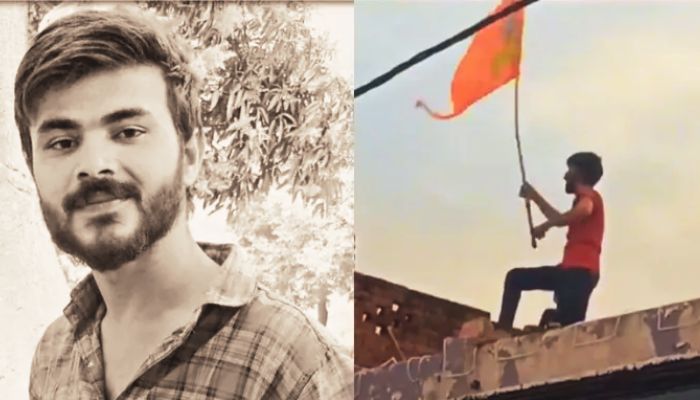
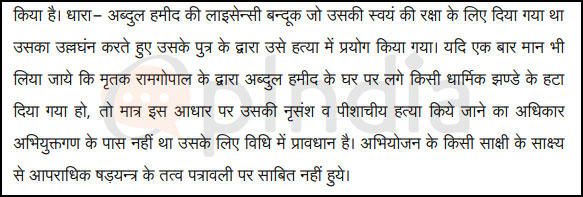
As there were videos of Ram Gopal Mishra tearing down a green flag from a rooptop, Islamists had justified the murder. However, the court also made it clear that even if, for the sake of argument, it was assumed that Ram Gopal had removed or interfered with a religious flag installed at Abdul Hamid’s house, such an act could never confer any right upon the accused to unleash brutal and barbaric violence. The judgment underlined that the licensed firearm issued to Abdul Hamid was meant strictly for self-defence, and its use by his son constituted a clear violation of law. The court observed that the legal system provides remedies for any such grievance, and no individual or group is entitled to take the law into their own hands by resorting to lynching or murderous retaliation.
Source: Bahraich District Court

Ram Gopal Mishra had gone to Maharajganj market in the evening to watch the Durga idol immersion procession. He was accompanied by his brother Harimilan Mishra and other relatives and villagers. The procession consisted of multiple village idols mounted on tractors and vehicles and proceeded through the market area in the usual course.

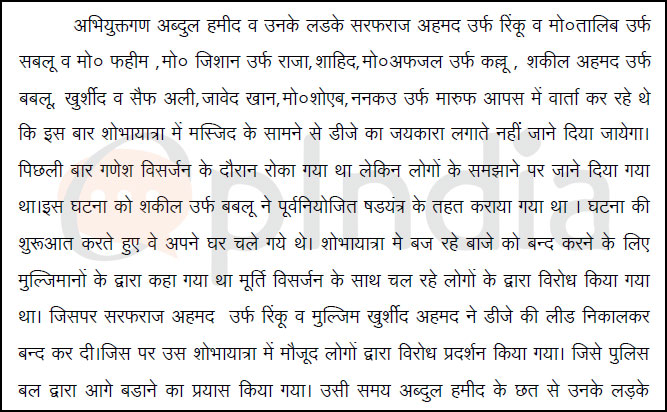
As the procession reached in front of the house of Abdul Hamid in Maharajganj, objections were raised regarding the songs that were being played on the DJ accompanying the procession. The court also recorded that a Ganesh Chaturthi immersion procession had earlier been stopped at the same location. However, that incident did not turn violent, as the procession was allowed to move ahead after locals intervened. According to witnesses’ testimonies, demands were made to stop the music. When Hindus refused to stop the DJ, the wire of the DJ was pulled, which triggered an immediate confrontation.
Source: Bahraich District Court

The court recorded that the confrontation soon turned into chaos. Stones, bricks, and bottles were thrown at the procession from the rooftop. Panic spread through the procession as people rushed to safety. As fear gripped the area, shopkeepers quickly shut down their shops.

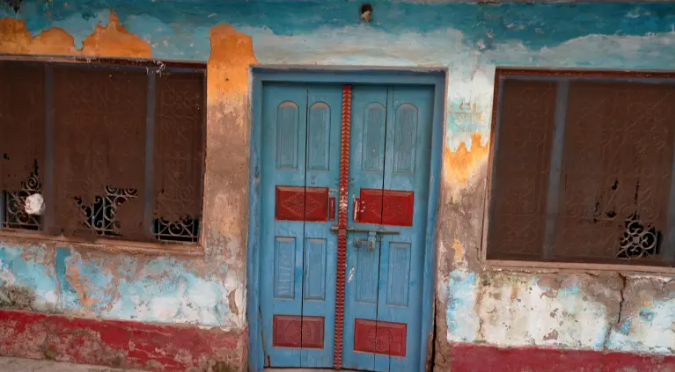
Amidst the disorder, Ram Gopal Mishra was forcibly caught and dragged inside Abdul Hamid’s house. According to the court documents, multiple eyewitnesses stated that the door was shut after he was pulled inside. Moments later, gunshots were heard from within the house. Several rounds were fired in quick succession, as per the witnesses. The court noted that there was no dispute that the firing took place from inside the premises and that Ram Gopal Mishra was shot at close range.

When Ram Gopal Mishra was eventually pulled out by his relatives, he was in a grievously injured condition. Notably, when Rajan and Kishan were trying to pull Ram Gopal out of Abdul Hamid’s house, two rounds were fired upon them as well. He was rushed to the district hospital at Bahraich. However, he succumbed to his injuries. The incident triggered widespread panic in the area. The court observed that the Maharajganj market descended into complete disorder. People fled the area. Homes and shops were shut. The atmosphere was described by witnesses as one of terror and fear.

The FIR in the case

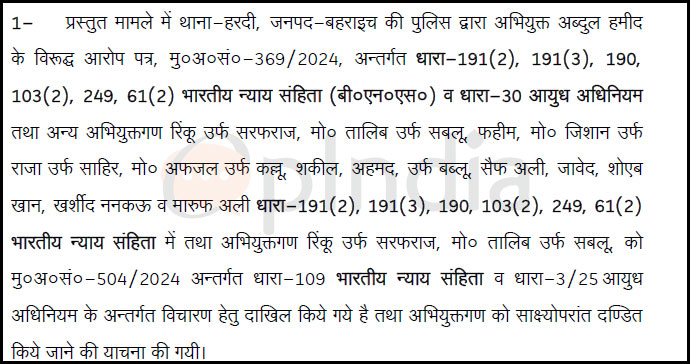
The FIR in the matter was registered on the complaint of Harimilan Mishra, brother of Ram Gopal Mishra. He approached the police and lodged an official complaint detailing how his brother was dragged into Abdul Hamid’s house and shot dead. In his complaint, he named Hamid, his sons, and others as the assailants. He also mentioned that there were some persons present at the scene who were unknown to him.
Source: Bahraich District Court

During the trial, the defence repeatedly attempted to raise doubts over the timing of the FIR and claimed that it was “anti-timed”, calling it fabricated. However, the court rejected the argument, noting that Harimilan Mishra first took his injured brother to the hospital, which was a natural and expected response in such circumstances.

The court further took note of the fact that the incident had plunged the district into chaos. Internet services across Bahraich were suspended for several days. Additional police forces, including RAF and PAC, were deployed from outside the district. In such a situation, a delay in the formal registration of the FIR was not only plausible but inevitable.

The court also noted that the core allegations against the accused remained consistent throughout the investigation and trial. The defence failed to show any material contradiction or manipulation arising out of the alleged delay.

Who was Ram Gopal Mishra and why his death mattered to the court

While the judgment is primarily based on the facts of the case, it did not treat Ram Gopal Mishra as a mere statistic. During the sentencing phase, the court stated that Ram Gopal had been married only a few months prior to the incident. His sudden and violent death did not merely extinguish one life but shattered an entire family, leaving his young wife’s future irreversibly altered.

The court noted that Ram Gopal was unarmed and helpless when he was dragged inside the house. Whatever may have transpired outside during the chaos of the procession, the court emphasised that once he was inside the premises, the act of firing multiple rounds at close range crossed every conceivable boundary of proportionality, restraint, or lawful conduct.

Early defence narrative and references to videos

During the course of arguments, the defence tried to introduce an alternative narrative. They referred to videos purportedly showing Ram Gopal Mishra climbing onto a rooftop or tearing a flag during the chaos. These references were placed before the court as part of an attempt to suggest provocation or a different sequence of events.

However, the court was careful in its treatment of these claims. While the court noted that such arguments were raised, it stated that even if such acts were assumed for the sake of argument, they could not, in law or in reason, justify what followed. The court did not accept any narrative that sought to dilute responsibility for dragging Ram Gopal Mishra inside a house and subjecting him to repeated gunfire and extreme violence. The emphasis remained on the manner of killing and the level of brutality involved.

Eyewitness accounts, what the court accepted, and how the medical evidence exposed the brutality

During the trial, the prosecution examined a large number of witnesses to establish not only the identity of the assailants but also the manner in which Ram Gopal was killed. Substantial space in the judgment was devoted to analysing the testimonies of those eyewitnesses who were present during the Durga idol immersion procession and saw the violence unfolding on the day of the incident.

Harimilan, in his sworn testimony, informed the court that he, Ram Gopal , along with other relatives including Rajan and Kishan, went to Maharajganj market to watch the idol immersion. He categorically stated that Abdul Hamid, his sons Sarfaraz alias Rinku and Fahim, and others were present in front of their house when the procession reached there. He described how Ram Gopal was forcibly dragged inside the house.
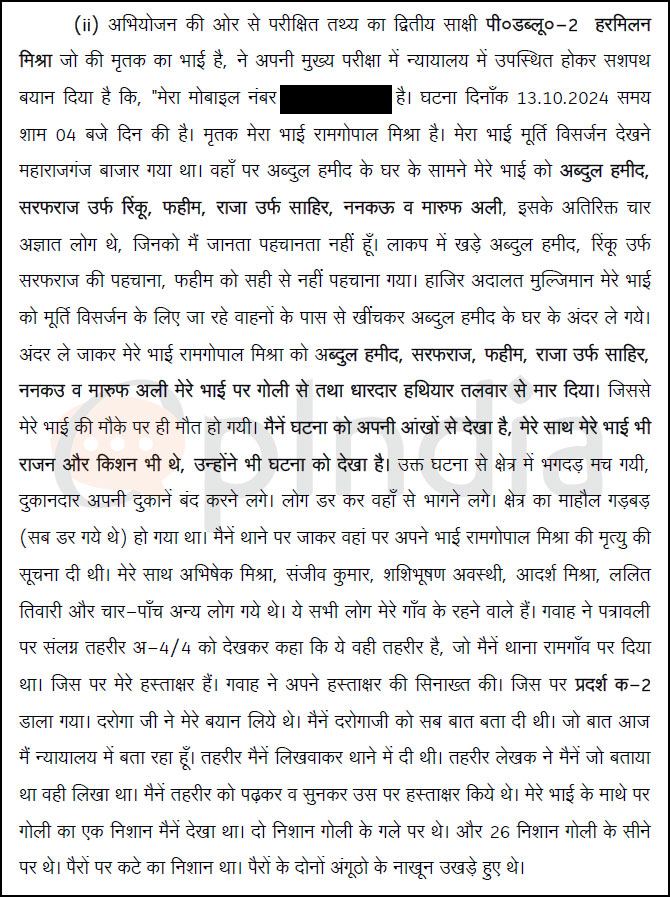
He stated that once his brother was dragged inside, the door was shut, and he heard multiple rounds of gunfire from within. Due to the sudden firing and the panic created, he and others were unable to immediately intervene.

Rajan Mishra, Ram Gopal’s cousin, corroborated Harimilan Mishra’s testimony. He, along with others, later took Ram Gopal to the district hospital, where he was declared dead.

Abhishek Mishra, another eyewitness in the case, further strengthened the prosecution case. He told the court that he witnessed Ram Gopal being dragged from the procession and that multiple accused were involved in pulling him inside the house. He further stated that when Ram Gopal was brought out, he had visible gunshot injuries on the upper body and head.

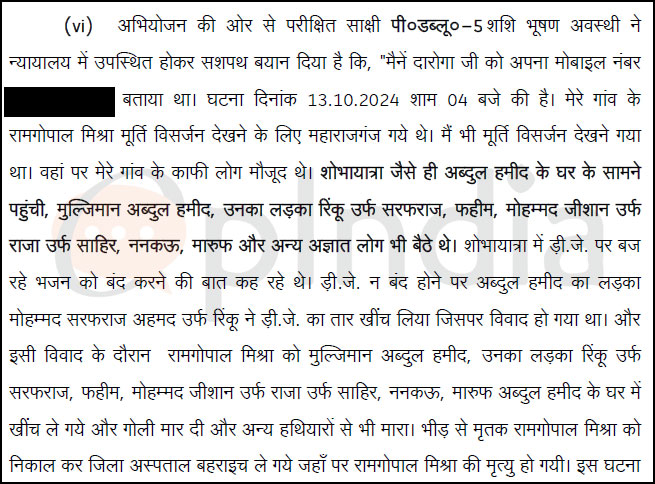
Shashibhushan Awasthi, another eyewitness in the case, told the court how objections were raised and the DJ wire was pulled, leading to the confrontation. He also told the court about the terror that spread in the market. Importantly, he testified that the violence did not stop at firing alone and that the manner in which Ram Gopal Mishra was attacked indicated extreme cruelty.
Source: Bahraich District Court

The defence argued that all eyewitnesses were interested or partisan witnesses because they belonged to the same village or were related to the deceased. Relying on settled legal principles, the court held that relationship by itself does not render a witness unreliable. The court observed that in incidents occurring during public processions, it is natural that those present and affected would be relatives or acquaintances. What mattered was whether their testimonies were consistent, credible, and corroborated by independent evidence.

Post-mortem report – a body riddled with bullets

Perhaps the most damning part of the judgment was the medical evidence. The post-mortem report revealed a level of violence that the court repeatedly described as brutal, cruel, and shocking to the conscience.

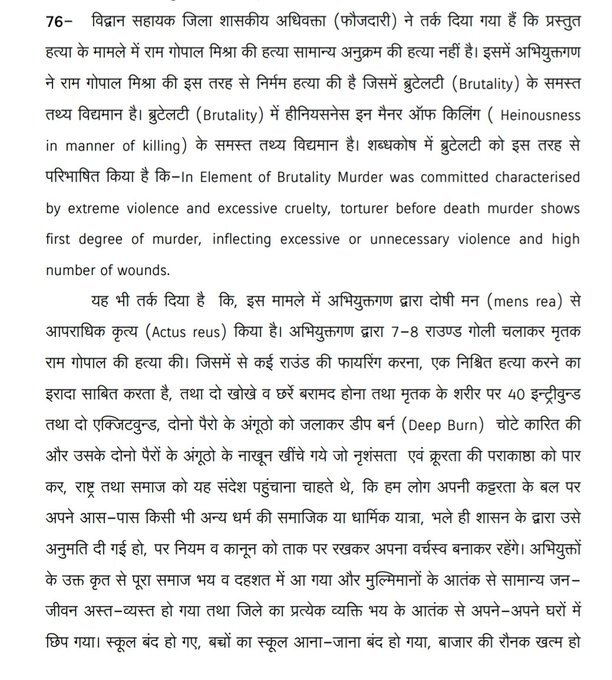
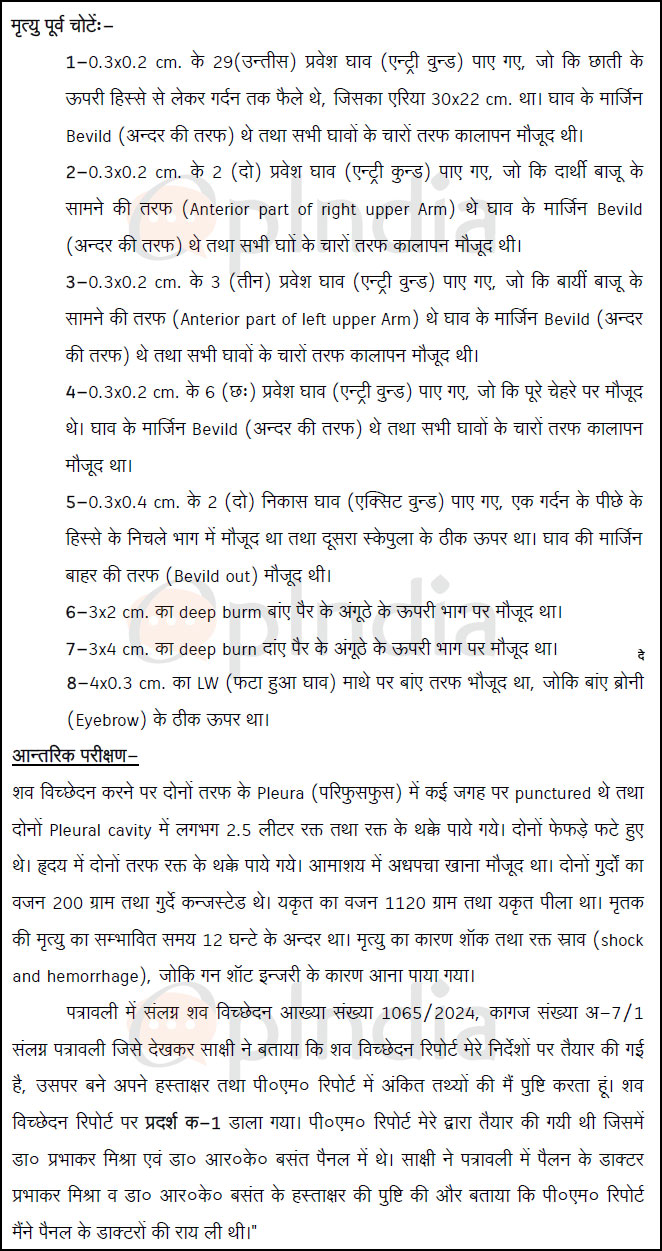
According to the post-mortem findings, Ram Gopal’s body bore forty firearm entry wounds. These were not confined to one area but spread across vital parts of the body. The chest, neck, face, and upper limbs showed multiple entry wounds along with two exit wounds. The margins of the wounds showed blackening, which indicated that the shots were fired from close range. The court specifically noted that close-range firing eliminated any possibility of accidental or stray bullets.
Source: Bahraich District Court

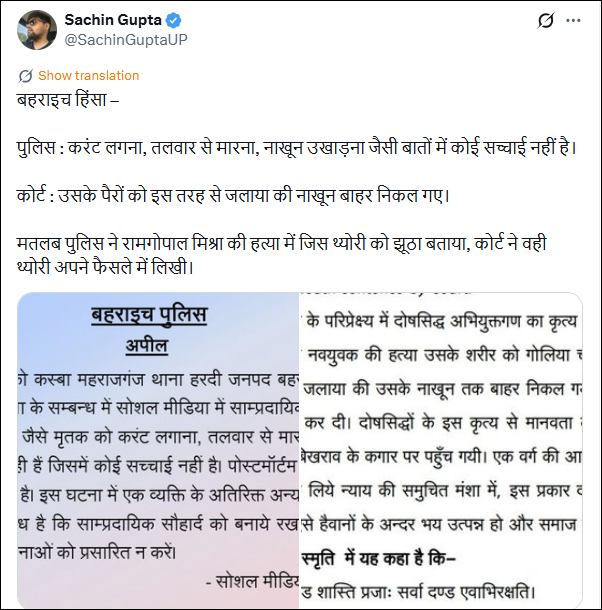
The medical examination further revealed deep burn injuries on both toes. The court noted that the toes were burned to such an extent that the nails had come out. A lacerated wound was present above the eyebrow, caused by a blunt object. Internally, both lungs were found punctured, and the pleural cavities contained approximately 2.5 litres of blood and clots. The heart contained clotted blood. Death was caused by shock and haemorrhage resulting from the gunshot injuries. The court observed that the medical evidence completely demolished the defence narrative that Ram Gopal may have been shot once or accidentally during the chaos. The sheer number of entry wounds, the presence of close-range firing indicators, and the additional injuries established that the attack was deliberate, sustained, and intended to ensure death.

Defence arguments versus medical reality

One of the key defence arguments was that the post-mortem did not conclusively show injuries caused by a sword or sharp-edged weapon. The court, while dealing with this argument, said that the absence of certain types of injuries did not weaken the prosecution case, particularly when the cause of death was clearly related to the injuries caused by the firearm. The court further observed that even if some injuries were caused by blunt objects or burning, the overwhelming evidence of multiple gunshot wounds was sufficient to establish murder beyond reasonable doubt.

The court also addressed the defence claims that Ram Gopal had climbed onto a rooftop or interfered with a flag, leading to firing by an unknown person. The court stated that such arguments were speculative and unsupported by credible evidence. More importantly, the court held that even assuming chaos or provocation during the procession, nothing could explain or justify firing multiple rounds at close range at an unarmed individual.

Police investigation, encounter, recovery of murder weapon, and how the court reached the death penalty conclusion

Following the murder of Ram Gopal Mishra, the police swung into action immediately. The incident had not only triggered a criminal investigation but also a district-wide law and order emergency. Internet services were suspended, additional forces were called, and the district remained on edge for several days. Against this backdrop, the police launched an intensive search for the accused named in the FIR.

During the investigation, police teams received specific intelligence inputs indicating that some of the accused were attempting to flee towards the Nepal border. The police acted on the information, and multiple teams were formed, including the local police and SOG units, to nab the accused. On 17th October 2024, officers reached the area near an ice cream factory and an adjoining resting place. Four accused, including Abdul Hamid and his sons Sarfaraz, Fahim, and Talib, were apprehended.

During the interrogation, the accused told the police about the weapon used in the murder, which was a licensed 12-bore SBBL gun belonging to Abdul Hamid. It was hidden near a canal bridge. Based on the information, a recovery operation was planned.

When police took Sarfaraz and Talib to recover the weapon, they attempted to escape. They pushed police personnel, broke free, and fired upon the police team using the hidden firearm. The police retaliated in self-defence, and they sustained bullet injuries to their legs. From the location, the police recovered the gun, a fired cartridge stuck in the barrel, and a live cartridge.

The court noted that the forensic science laboratory later confirmed that the bullets recovered from the body of Ram Gopal Mishra had been fired from the same weapon. According to the judgment, this recovery directly connected the accused to the murder and eliminated any lingering doubt regarding the source of the gunfire.

Court’s assessment of unlawful assembly and common object

In the judgment, the court analysed whether the accused acted as part of an unlawful assembly and whether the murder was committed in furtherance of a common object. The court noted that objections to the procession, pulling the DJ wire, stone pelting, dragging Ram Gopal inside the house, firing multiple rounds, and subsequent attempts to flee together formed a continuous chain of events.

The court rejected the defence argument that the incident was a spontaneous outburst or an isolated act by one individual. It held that the evidence showed coordinated conduct and participation by several accused, even though the precise role of each differed.

Sentencing hearing and the question of ‘rarest of rare’

While sentencing the accused, the court held that the manner of killing demonstrated a “cold-blooded” intent to ensure death. The repeated firing at vital organs, the additional acts of cruelty, and the context in which the murder was committed led the court to conclude that Sarfaraz’s role crossed the threshold into the “rarest of rare” category and awarded him the death penalty.

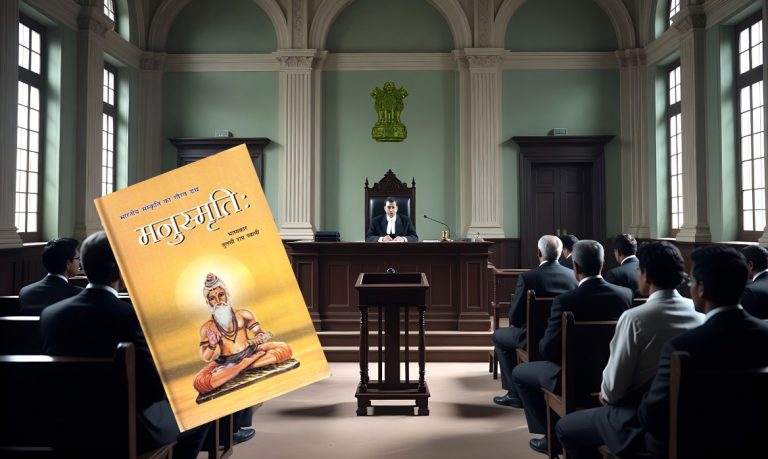
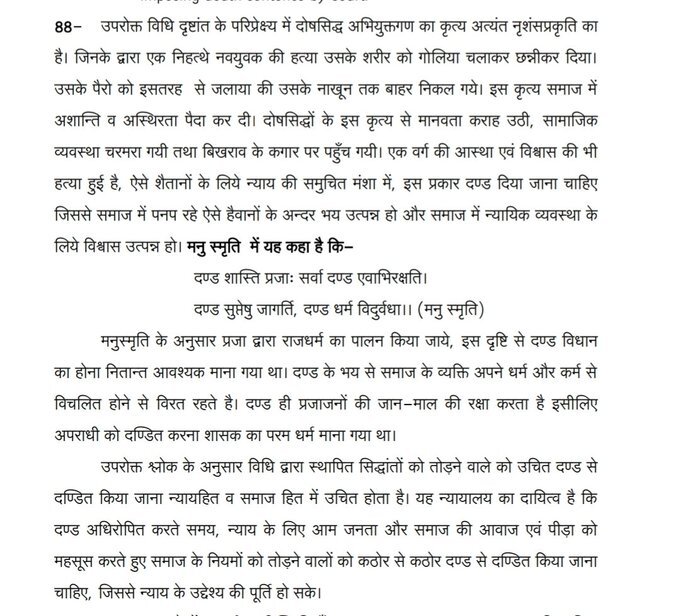
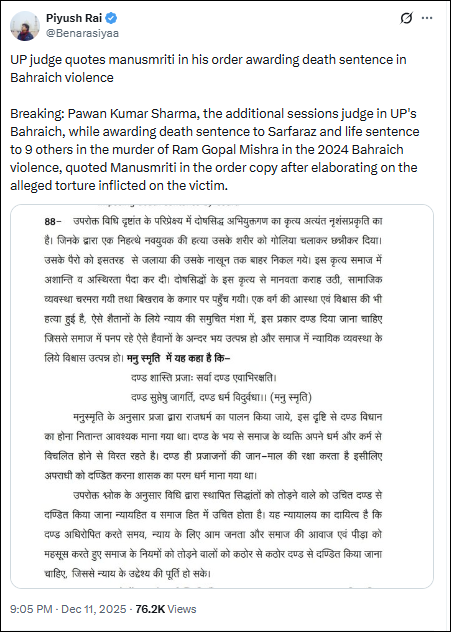
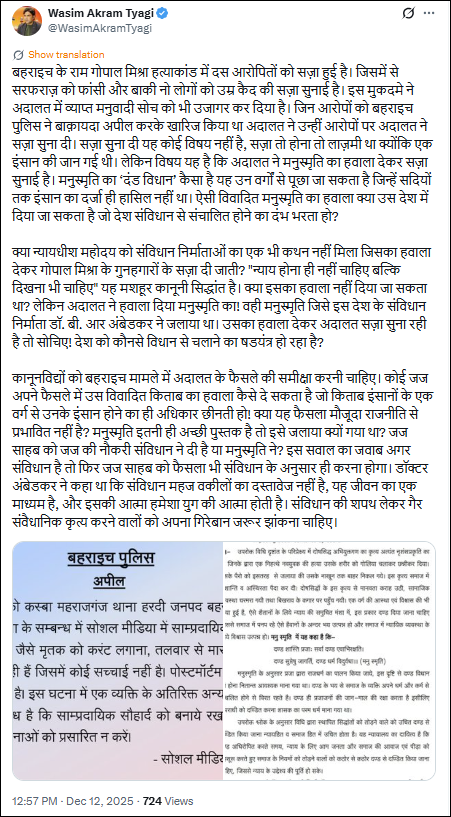
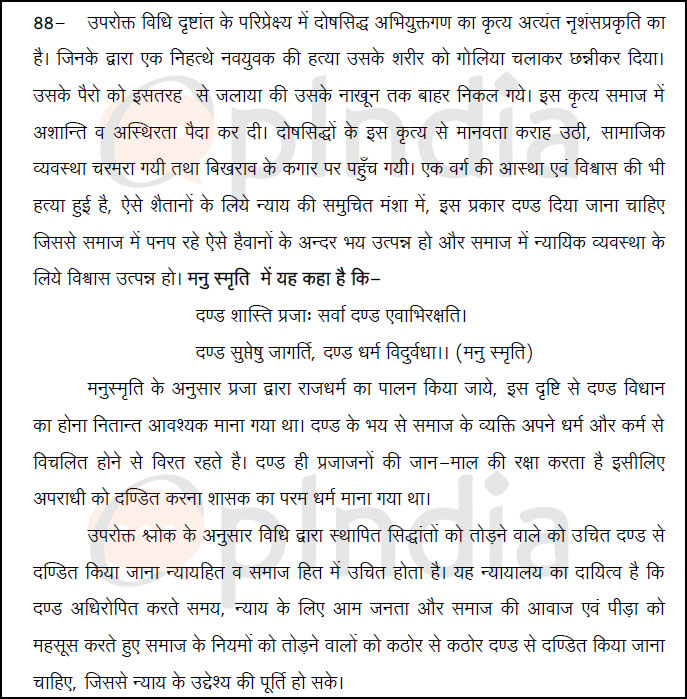
While discussing the principles governing punishment, the court also referred to classical jurisprudential thought on the role of punishment in maintaining social order. The court cited Manusmriti to underline the idea that punishment is central to the preservation of justice and societal balance.

The court quoted the verse, “दण्ड शास्ति प्रजाः सर्वा दण्ड एवाभिरक्षति। दण्ड सुप्तेषु जागर्ति, दण्ड धर्म विदुर्वधा॥”, which means “Punishment governs all creatures; Punishment alone protects them; Punishment lies awake while all are asleep; the wise regard Punishment as Law itself”.
Source: Bahraich District Court

The court, citing the verse, observed that punishment disciplines society, protects the innocent, and acts as a deterrent even when people are inclined to transgress the law. The court noted that the concept of punishment, as articulated in Manusmriti, treats punishment not as vengeance but as an essential instrument of governance to prevent chaos, lawlessness, and moral collapse. In the context of the Bahraich violence, the court held that failure to impose proportionate punishment for such a brutal crime would undermine public faith in the justice system and embolden further acts of violence.

Death penalty, life sentences, and final directions

Accordingly, the court awarded the death penalty to Sarfaraz for the offence of murder, subject to confirmation by the Allahabad High Court. Abdul Hamid and several other accused were sentenced to life imprisonment along with additional terms of rigorous imprisonment and fines under various provisions of the Bharatiya Nyaya Sanhita and the Arms Act. Some accused were acquitted after the court found that the evidence against them did not meet the standard of proof beyond reasonable doubt.

The court directed that all sentences would run concurrently and issued orders for the preparation of warrants. In the case of the death sentence, the court ordered that the record be referred to the High Court for confirmation, as mandated by law.

Who got what sentence – death penalty, life terms, and rigorous imprisonment

Sarfaraz, along with the death penalty, was also awarded a total of eight years of rigorous imprisonment with a Rs 1,30,000 fine. Abdul Hamid was sentenced to life imprisonment with a Rs 1,81,000 fine. Life imprisonment was also awarded to Talib, Fahim, Saif Ali, Javed Khan, Mohammad Jishan, Shoaib Khan, Nankau, and Maruf Ali, with a fine of Rs 1,50,000. The court held that although their individual roles varied, their participation in the unlawful assembly that culminated in the murder stood proved beyond reasonable doubt.

Khursheed, Shakeel Ahmed, and Mohammad Afzal were acquitted, as the prosecution could not establish their role in the crime beyond reasonable doubt. The convicted individuals will remain in judicial custody under the applicable provisions until the Allahabad High Court confirms or commutes the sentence.

The judgment in Ram Gopal Mishra’s murder case serves as a stark reminder that provocation, even if claimed to be religious in nature, can never give anyone the right to take an extreme step such as murder. In its final conclusion, the court made it clear that even if Ram Gopal Mishra had removed or touched a religious flag, as alleged by the defence, such an act could never be treated as provocation for killing. The judgment stressed that the law provides clear legal remedies for any such act, not a licence for violent retaliation. By misusing a licensed firearm meant solely for self-defence, the accused crossed every legal boundary, turning a minor dispute into a brutal and unlawful killing.
Meet R Sreelekha, Kerala’s first female IPS officer, who is likely to be BJP’s mayor in Thiruvananthapuram

The Bharatiya Janata Party (BJP) has scripted a historic political victory in the state of Kerala by capturing power at the Thiruvananthapuram Corporation after 45 long years of uninterrupted rule by the CPI(M)-led Left in the state capital’s civic body. This victory is a major turn in the political history of the state’s capital, which was always regarded as a Left stronghold.

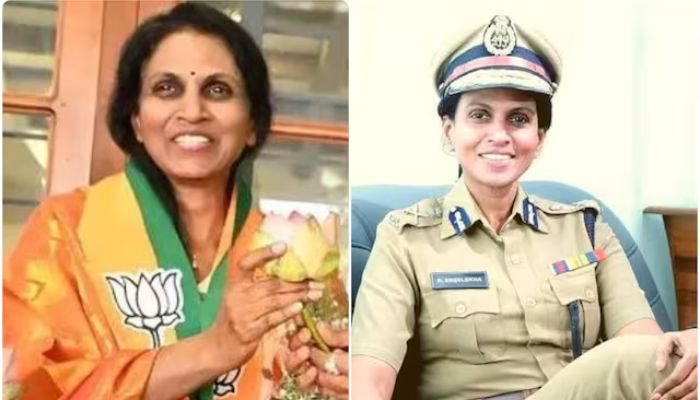
Adding to the significance of the moment, Kerala’s first woman Indian Police Service (IPS) officer, R Sreelekha, emerged as one of the most prominent faces of the BJP’s breakthrough. The retired Director General of Police (DGP) won the Sasthamangalam division by a massive margin, making her victory one of the standout results of the election.

Her victory has also caused a buzz in political quarters about the possibility of the BJP nominating her as their candidate for the mayor’s position. If that is the case, Sreelekha would be the first mayor for the BJP in Thiruvananthapuram.

When questioned about the possibility, Sreelekha replied that it is entirely in the hands of the party leadership. “I have come to know that no candidate has ever secured such a huge lead in the Sasthamangalam ward. I thank the people for their clear verdict,” she told reporters after the results.

She also said that despite facing strong criticism from both the Left Democratic Front (LDF) and the Congress during the campaign, voters stood firmly by her. “There was constant criticism against me beyond expected limits. I am happy that the people of my ward rejected all of it and supported me,” she said.

Who is R Sreelekha?

Born and brought up in Thiruvananthapuram, R Sreelekha has had a long and varied career in public service. Before joining the police, she worked as a lecturer at Shree Vidyadhiraja College. She later joined the Reserve Bank of India as a Grade B officer in Mumbai.

At just 26 years of age, she cleared the civil services examination and became Kerala’s first woman IPS officer in January 1987, breaking a major barrier in a profession dominated by men at the time.

During the next 33 years, Sreelekha held various significant posts both in the state as well as in the national setup. She was the District Superintendent of Police in Alappuzha, Pathanamthitta, and Thrissur districts of Kerala. She then held the post of Superintendent of Police and Deputy Inspector General with the Central Bureau of Investigation (CBI).

Her career involved overseeing various major departments such as the Crime Branch, Vigilance, Armed Police, Fire & Rescue Services, Motor Vehicles Department, and the Prison Department. In 2017, she was given the promotion to Director General of Police. She became the first woman officer to achieve the highest position in the police department in the state of Kerala.

During her tenure with the CBI, she gained a reputation as “Raid Sreelekha” for her no-nonsense approach to combating corruption and for her fearlessness in conducting investigations.

She retired from service in December 2020 after over three decades of serving in the police force.

Sreelekha’s contribution beyond policing

Sreelekha is also known for introducing several reforms during her service. As Transport Commissioner, she pushed for e-governance initiatives and played a key role in improving road safety in Kerala. She led Asia’s first Road Safety Hackathon with support from the World Bank.

She was instrumental in launching ‘THUNA’, a digital platform aimed at improving communication between the police and the public. She also started HATS, a counselling centre designed to help police personnel dealing with stress and mental health issues.

Her work earned her several awards, including the President’s Police Medals for Meritorious and Distinguished Service, the Indian Overseas Award for Public Service, and the Kerala government’s Meritorious Service Award.

In 2015, she was selected for the prestigious Chevening Fellowship by the UK government and received training at institutions such as King’s College London, London Business School and Scotland Yard.

Apart from her administrative career, Sreelekha is also a writer. She has authored nine books, including novels and works focused on women’s legal awareness. She regularly writes columns for Malayalam magazines. Her latest novel, Balipatham, published by Mathrubhumi Books in 2024, retells the legend of King Mahabali.

She holds a degree in English Literature and an MBA in Human Resource Management, giving her a blend of academic, administrative and literary experience.

Entry into politics and election outcome

After her retirement, Sreelekha remained in the limelight, sometimes creating controversy with her opinions. She was noticed for expressing that actor Dileep was unfairly dragged into the 2017 sexual assault incident of another actress. Recently, she questioned the delay in registering a sexual harassment charge against Congress leader Rahul Mamkootathil, who is an expelled member of Congress.

She formally became a member of the BJP in October 2024, citing that she was inspired by Prime Minister Narendra Modi. Sreelekha had maintained that she never favoured any political side as a police officer.

In the civic polls, the BJP became the single largest party in a 101-member Thiruvananthapuram Corporation by winning 50 seats in the wards. CPI(M)-led LDF managed to get 29 seats, while Congress-led United Democratic Front (UDF) gained 19 seats. Two seats were taken by independent candidates. 

Although the BJP came one seat short of a majority, it is a defining moment in the political history of the state capital. As the party is basking in the ascendancy it never thought possible, the spotlight is now on whether R Sreelekha gets to head the Corporation, heralding a new era in the political landscape of Kerala.

Arunachal Tragedy: Death of 21 workers in truck accident came to light 2 days later when lone survivor reached a BRO camp, contractor Sirajul Ahmed arrested

0

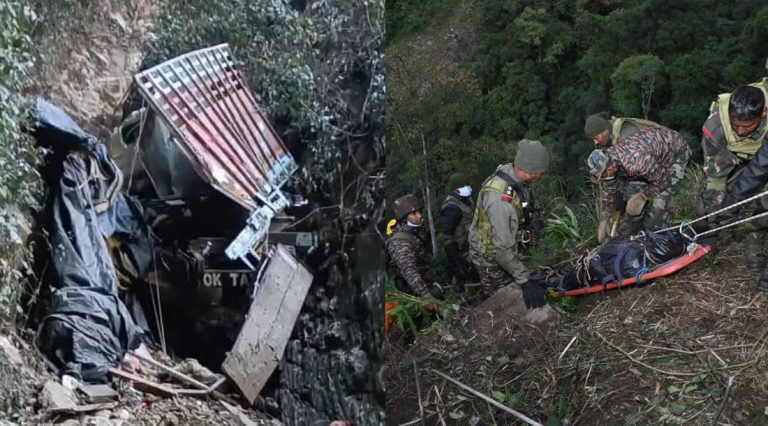
In a tragic incident, a vehicle carrying 22 labourers plunged into a deep gorge on the Hayuliang-Chaglagam road in Anjaw district in Arunachal Pradesh on 8th December. However, the incident came to light two days later, on Wednesday (10th December), after the lone injured survivor managed to reach a GREF (General Reserve Engineer Force) Camp of BRO (Border Roads Organisation). He informed the personnel there about the accident, in which 21 labourers are feared dead.

The bodies of 7 labourers have so far been recovered in the rescue operation that began on 11th December. Efforts are going on to pull out the rest of the mortal remains from the deep gorge in the remote location.

In the meantime, contractor Sirajul Ahmed has been arrested by the Arunachal Police and is being questioned.

Authorities came to know about the accident only after the lone survivor informed them

According to Anjaw superintendent of police (SP) Anurag Dwivedi, the vehicle carrying a group of 22 labourers left Tinsukia district in Assam on Sunday (7th December) for Chaglagam in Arunachal Pradesh, near the India-China border, where they were engaged for construction work. When the labourers did not arrive at the construction site by 10th December, their associates raised an alarm at the Hayuliang police station. Subsequently, Hayuliang police mobilised local sources to locate the missing labourers. As the Hayuliang police were searching for the missing labourers, they found out about the lone survivor, Buddheswar Deep, who was receiving first aid at the BRO camp.

After surviving the accident, injured Buddheswar Deep managed to climb around 300 meters from the gorge, and then walked for 2 days through treacherous and forested terrain to reach the Chipra GREF camp on Wednesday night. Personnel at the camp were shocked to learn about the incident that took place at Laliang village between Hayuliang and Chaglagam in Anjaw district, which borders both Myanmar and China. By the next morning, the district administration and the BRO began a search-and-rescue operation.

Deep informed the authorities about the exact site of the accident. The survivor was later moved to Assam Medical College and Hospital (AMCH) in Dibrugarh for treatment. Talking about the incident, he said, “There were 22 people in the blue truck…. I fell asleep while listening to songs on my mobile phone. Don’t know how I fell, how I got up and where my mobile phone is. I walked (to the camp). It was very difficult.”

He said that another worker was alive in the truck, but he could not do anything as he himself was badly injured, and the terrain is very difficult.

Multiple Army teams, assisted by medical units, GREF personnel, NDRF teams, local police and the civil administration, are engaged in the operation to bring up the bodies. Around 100 personnel have been deployed in the operation. An NDRF (National Disaster Response Force) team of 30 personnel reached Hayuliang from Dibrugarh on Thursday evening.

The teams descended the nearly 200-metre-deep gorge using belay ropes and located the mangled vehicle after around 4 hours of effort. They have identified 19 bodies so far, out of which 7 have been brought up, one by one. Some bodies remained untraced. The recovered bodies have been shifted to the District Hospital in Hayuliang for post-mortem and further formalities.

Giving updates on the rescue operation, the District Disaster Management Officer (DDMO) for Anjaw, Nang Chingni Choupoo, said that the rescue team is making all possible efforts to retrieve the dead bodies. “Today (Saturday, 13th December) is the third day of the rescue operation, and the joint rescue team has started the operation and is trying everything possible to retrieve the bodies. On Friday, the search operation at the site was suspended after the recovery of six bodies due to darkness, with the NDRF team returning to its night halt location at Metengliang.” Choupoo said the body of the seventh worker was recovered on Saturday,” Choupoo said. “They (the bodies) were handed over to the civil police in the presence of district authorities and representatives from Tinsukia district administration,” she added.

The rescue operation is facing difficulties due to rough terrain

The DDMO said that the rescue team has been facing difficulties in the rescue operation due to the rough terrain of the area. 19 victims have so far been identified by the authorities, and 18 bodies have been spotted. The victims who have been indentified are- Gudheswor Deep (23), Rahul Kumar (25), Somir Deep (22), Arjun Kumar (28), Pankaj Manki (20), Ajay Manki (30), Abjay Kumar (26), Abhoy Dhuria (24), Rohit Manki (20), Dhirendra Kumar (22), Ador Tanti (24), Dhiren Chariya (28), Rojoin Nag (21), Deep Gogala (28), Ramselok Buna (26), Samaron Nag (26), Binay Kumar (26), Karan Kumar (26) and Junash Munda (20). 18 out of the 22 labourers hailed from the Gilapukhuri Tea Estate in Assam’s Tinsukia district. The Sub-Contractor of the Zilla Parishad Member (ZPM), Chaglagam, is being questioned to verify the details of labourers engaged in the construction project.

The Indian Army, along with the teams of the National Disaster Relief Management (NDRF), the State Disaster Relief Management (SDRF), the General Reserve Engineer Force (GREF), and local police, has been conducting the rescue operation. Speaking about the accident, Defence PRO Lt Col Mahendra Rawat said that the accident site, which lies about 12 km short of Chaglagam, is a remote area with an extremely rugged terrain. This is the reason that local agencies did not come to know about the accident until the survivor approached them on Wednesday.

The next day, the Army’s Spear Corps mobilised multiple rescue columns, medical teams, GREF personnel, local police, NDRF teams and the Hayuliang additional deputy commissioner. However, it was only after four hours of search involving rope descent that rescuers spotted the wreckage around 200 metres below the road, hidden by dense forest cover.

Contractor arrested

The police have launched an investigation to find the cause of the accident. As part of the probe, Arunachal Pradesh Police on Thursday arrested Sijajul Ahmed, the contractor who had brought the workers from Assam to Arunachal to work at a construction project. Ahmed was handed over to Assam Police and shifted to Tinsukia in Assam on Friday.

Ahmed is accused of negligence in transporting the workers to such a hostile terrain. Police will also check whether the truck was fit to run on the steep moutain road.

State and centre announce financial aid for the families of the deceased

Arunachal Pradesh Chief Minister Pema Khandu expressed sorrow over the loss of lives in the accident. “Deeply saddened by the tragic vehicle accident in Anjaw. My heartfelt condolences to the bereaved families, and prayers for the speedy recovery of those injured. In this difficult moment, I extend my sincere gratitude to the Indian Army, BRO, the NDRF, and the local administration for their swift response, rescue operations, and tireless efforts in such challenging terrain,” CM Khandu wrote on X, 12th December.

Assam Chief Minister Himanta Biswa Sarma expressed grief and condolences on the tragic incident. He said that the governments of Assam and Arunachal Pradesh are working closely on the rescue activities. He announced an ex gratia amount of ₹5 lakh each for the families of the deceased.

“Nothing can fill the void created by the loss of a loved one, but to provide support so that the family can tide over the initial crisis, we are extending a token of assistance of ₹5 lakh each. Our Govt stands with the families in this moment of grief,” Sarma wrote on X on Friday (12th December).

Prime Minister Modi offered condolences on the unfortunate event and announced financial aid for the families of the victims.

“Distressed by the loss of lives due to a mishap in the Anjaw district of Arunachal Pradesh. My thoughts are with those who have lost their loved ones. I pray for the speedy recovery of those injured. An ex gratia of Rs. 2 lakh from PMNRF would be given to the next of kin of each deceased. The injured would be given Rs. 50,000,” the PMO announced on Thursday/

From Messi chaos in Kolkata to Bengaluru stampede: How Opposition-run states keep proving they consistently fail at the most basic functions of governance

0

What was billed as a dream-come-true moment for football fans in Kolkata spiralled into disorder, vandalism, and police lathi-charge within minutes. Lionel Messi’s brief appearance at the Vivekananda Yuba Bharati Krirangan, better known as Salt Lake Stadium, did not merely disappoint thousands of fans. It exposed, yet again, a chronic and dangerous truth about opposition-ruled states: they repeatedly fail the most basic test of governance, maintaining law and order during predictable mass events.

The chaos in Kolkata is not an isolated embarrassment. It echoes, disturbingly, the tragic stampede in Bengaluru earlier this year, during Royal Challengers Bengaluru’s IPL victory celebrations, where at least 11 people lost their lives. One incident ended in vandalism and humiliation; the other ended in death. The underlying cause in both cases, however, is the same administrative collapse under opposition governments.

Kolkata: A global embarrassment

Messi arrived at Salt Lake Stadium alongside Inter Miami teammates Rodrigo de Paul and Luis Suárez, triggering scenes of unrestrained frenzy that any competent administration should have anticipated. The Argentine icon entered the stadium during the second half of the Mohun Bagan vs Diamond Harbour match. The moment his Audi rolled onto the turf, anyone with access to the field surged towards the vehicle.

Police personnel, cameramen, pitch invaders, organisers, ministers, and VVIPs converged simultaneously. Instead of enforcement, what echoed through the stadium were desperate pleas from organisers: “Please give him space, please vacate the field.” That line alone captured the failure; the State had surrendered control of its own venue.

Messi, dressed in black and tightly ringed by security, struggled to move as the crowd swelled by the minute. Despite spending over 15 minutes on the ground, organisers failed to clear even a basic viewing corridor. Thousands of ticket-holders, many of whom paid up to Rs 10,000, could barely spot him. At 5’7”, Messi was hardly visible even from the press box, while photographers were left guessing where exactly the GOAT was amid the human crush.

The chaos was compounded by the presence of ministers and VVIPs swarming the footballer, including event organiser Satadru Dutta and West Bengal sports minister Aroop Biswas. What should have been a fan-centric moment was converted into a political spectacle, further fuelling public anger.

Chants of “Messi, Messi” soon gave way to loud boos. Within minutes, frustration spilt into vandalism. Plastic bottles and debris were hurled. The stadium property was damaged. The law-and-order situation deteriorated so rapidly that police were forced to resort to a lathi-charge to disperse the crowd.

Just 22 minutes after entering the stadium, Messi was escorted back to his car. As he departed, fans shouted “We want Messi,” many leaving without ever laying eyes on the football legend they had paid dearly to see.

Chief Minister Mamata Banerjee later issued an apology on X and announced an enquiry committee headed by a retired judge, a familiar opposition reflex: post-facto remorse instead of preventive governance.

Bengaluru: The same failure, with fatal consequences

If Kolkata was a warning, Bengaluru, earlier this year, was the tragedy that had already unfolded.

During RCB’s first-ever IPL title celebrations after 18 years, a massive crowd gathered outside the M. Chinnaswamy Stadium. The event was entirely foreseeable. The scale of public enthusiasm was obvious well in advance. Yet, the Congress-led Karnataka government failed to prepare.

The result was a deadly stampede that killed at least 11 people and injured dozens more. Eyewitness accounts and viral videos revealed bottlenecked entry points, uncontrolled crowd surges, poor barricading, and an underprepared police and emergency response system. Fans were packed shoulder to shoulder with no clearly demarcated entry or exit routes, a fundamental violation of crowd-management protocols.

This was not an act of fate. It was a man-made disaster.

The failure stands in sharp contrast to how Mumbai handled Team India’s T20 World Cup victory parade last year. Under the NDA-led Maharashtra government, an open-bus procession along Marine Drive drew an even larger crowd, stretching from Nariman Point to Chowpatty. Yet, through meticulous planning, layered security, and firm policing, not a single major incident occurred.

In Bengaluru, no open-bus parade was even attempted. And yet, even a stadium-centric celebration turned fatal.

Governance without authority

Taken together, the Kolkata chaos and the Bengaluru tragedy earlier this year reveal a consistent pattern. Opposition governments prioritise optics over order, symbolism over systems, and appeasement over enforcement.

They politicise the police. They hesitate to impose discipline. They fear being seen as “strict.” And when disorder inevitably follows, they retreat into apologies, compensation announcements, and enquiry committees.

Law and order is not optional governance. It is the foundation of the state’s legitimacy.

Messi being whisked away unseen amid a lathi-charge in Kolkata and fans being trampled to death in Bengaluru earlier this year are not unfortunate coincidences. They are symptoms of a deeper governance failure.

India does not need more post-event apologies. It needs governments that prevent chaos before it erupts.

And time and again, opposition-ruled states have shown that when it comes to maintaining law and order, the most basic function of governance, they are simply not fit for the job.

Exclusive: Brother of Ram Gopal Mishra, murdered by Muslim mob during Bahraich riots, speaks to OpIndia, thanks Yogi govt for ensuring justice

A court in the Bahraich district of Uttar Pradesh has delivered its verdict in the October 2024 communal violence case, handing out strict punishment to those found guilty. The court awarded the death penalty to the main accused, Sarfaraz alias Rinku, while nine others were sentenced to life imprisonment for their role in the riots and the murder of Ram Gopal Mishra.

The verdict was pronounced on Thursday, 11th December 2025, nearly 14 months after the incident, which had shaken the region during Durga Puja celebrations.

“Justice was possible only because of this government,” says the victim’s brother

Reacting to the court’s decision, Harimilan Mishra, brother of the deceased Ram Gopal Mishra, expressed satisfaction with the verdict and openly thanked the Yogi Adityanath-led BJP government for ensuring justice.

Speaking to OpIndia, Harimilan said the punishment was possible only because of the strong legal push by the present government. He claimed that under a Samajwadi Party government, the outcome would have been very different.

“If there were no Yogi government, this punishment would not have been possible. If it were an SP government, we Hindus would have been the ones sent to jail,” he said, speaking in Awadhi (उन्होंने अवधी में बोलते हुए कहा, “योगी सरकार न होत भाजपा कै, तो इहो सजा कहाँ होई पावत। सपा के सरकार होत तो उल्टा हमहै सब बंद होए जात।”).

He added that instead of justice, the victims would have faced harassment and legal action if a different political dispensation were in power.

Brutality of the crime still haunts the family

Harimilan Mishra also spoke about the brutal condition in which his brother’s body was found. He recalled that even after the post-mortem, blood was still oozing from Ram Gopal’s toes. His nails had been ripped out, pointing to extreme torture.

He said these details were not just personal memories but were also clearly mentioned in the charge sheet and the court’s judgment, underlining the seriousness of the crime.

Convictions and acquittals

The court held 10 people guilty in the case. Apart from Sarfaraz alias Rinku, who was awarded the death penalty for murdering Ram Gopal Mishra, nine others received life imprisonment.

Those sentenced to life include Abdul Hamid (Sarfaraz’s father), his brothers Fahim and Talib alias Sablu, along with Saif, Javed, Zeeshan, Nankau, Shoaib, and Maruf.

However, the court acquitted three accused, Khursheed, Shakeel, and Afzal, citing a lack of sufficient evidence. Harimilan Mishra expressed concern over their acquittal, saying it could create problems in the future and questioning how they were let off.

What happened on 13th October, 2024

The violence broke out on 13th October, 2024, in Rehua Mansoor village of Bahraich during Durga Puja idol immersion. According to the case details, a dispute started after some local Muslims objected to songs being played during the procession.

The argument quickly escalated into large-scale violence. Stones were pelted at Hindu devotees, leaving several people injured. Idols being taken for immersion were also damaged during the attack. In retaliation, there was vandalism of nearby houses and shops.

Murder of Ram Gopal Mishra

During the chaos, Ram Gopal Mishra was accused by the mob of climbing onto a roof and removing a green flag. Following this, Sarfaraz alias Rinku shot him dead.

The killing became the most serious outcome of the riots and led to widespread outrage.

Following the incident, police registered 13 FIRs, 11 at Hardi police station and two at Ramgaon police station. After the investigation, 13 people were named as accused.

Initially, five accused were booked under the National Security Act (NSA), including Sarfaraz, Abdul Hamid, Talib alias Sablu, Shakeel alias Bablu, and Khursheed. Later, the NSA was also imposed on the remaining accused.

The court’s verdict has now brought legal closure to one of the most sensitive communal violence cases in recent years in Uttar Pradesh, even as the acquittal of three accused continues to raise questions for the victim’s family.

SC rules that nation’s interest lie above rights of terror accused in 2010 Jnaneshwari Express sabotage case: Here is everything you need to know about it

Hearing a Special Leave Petition filed by the Central Bureau of Investigation (CBI) against the Calcutta High Court’s order granting bail to the accused in the 2010 Jnaneshwari Express derailment case, the Supreme Court, on Thursday (11th December), held that the national interest lies above personal liberty.

A bench of Justices Sanjay Karol and NK Singh criticised the Calcutta High Court for granting bail to the accused and said that “acts of barbarity cannot be excused”. “…the rights of an individual are always subservient to the nation’s interest, the High Court fell in error in granting bail,” the court noted in the judgment. “While the Constitution permits the members of the public, be it whichever group/section of society they belong to, to oppose, within the permits of the law, a stand taken by the State, such acts of barbarity cannot be excused,” it added.

The Court, however, refused to interfere with the order of the High Court and did not reverse the bail granted to the accused. It quoted the painfully slow pace of the trial and the years spent by the accused in jail as the reason for not reversing the High Court’s order.

“…It is a matter of record that an earlier application for bail, about a decade ago in the year 2016, had been rejected with the High Court recording that examination of the remaining witnesses should be completed within a year. If in 2022, the Court finds that despite such direction and also the passage of nearly six years, the same could not be achieved, it cannot be said to have not considered the case in its proper light,” the apex court said.

“…The trial being at an advanced stage is also not something that can be, in this case, a ground to send the respondent-accused behind bars. The trial is of the year 2010, and as we stand at the end of 2025, still 28 witnesses are to be examined. We may note that the glacial pace at which the trial has proceeded cannot justify the incarceration of the accused, particularly when they have already been in prison for a dozen years, and once out, have not given the authorities reason to seek urgent cancellation, or even stay on the impugned judgment when this Court issued notice, or even anytime thereafter,” the Court stated.

“…This Court does not interfere against the grant of bail unless circumstances warranting such an exercise of power are plainly present in a given set of circumstances,” it adding “interfering with the liberty of the accused, at this stage, particularly when nothing else holds against them, would not be justified”.

On November 9, 2022, the Calcutta High Court granted bail to one of the accused in the Jnaneshwari Express derailment case. Subsequently, on February 28, 2023, the High Court released eleven accused on bail, followed by the release of another accused on bail on June 13, 2023. The CBI approached the Supreme Court against the judgments/orders of the High Court.

Background of the case

In a horrific incident on May 28, 2010, the Jnaneshwari Express, passing between Kehmasoli and Sardiha stations on the Kharagpur-Tatanagar section of the Kharagpur division, had a head-on collision with a goods train. The incident turned out to be a well-thought-out conspiracy in which the accused damaged the rail tracks near Rajabandh to cause the accident. The conspiracy was carried out on the intervening night of 27th -28th May 2010 by the accused persons.

“The pandral clips of the railway tracks were removed, with the knowledge and intention that grievous hurt would be caused to the passengers of a train. This action caused the derailment of the train, which thereafter collided with an oncoming goods train from the opposite direction, causing widespread loss of life,” as stated in the Supreme Court judgment. In addition to that, a loss of 25 crores approx was caused to the Government due to the destruction of property.

An FIR was registered on June 9, 2010, against unidentified persons under Sections 120B, 302, 307, 323, 325, 326, 440, 212 of the Indian Penal Code,1860, Sections 150/151 of the Indian Railways Act, 1989, and Sections 16/18 of the Unlawful Activities (Prevention) Act, 1967. During the investigation of the case, the motive behind the crime was found to be the resentment among the Maoist cadres due to the deployment of a joint force of State Police and Central Paramilitary Force in the jurisdiction of Jhargram Police Station to combat the capture of Rasua village by the Maoists. The accused worked with the common intention and hatched a conspiracy to pressure the Government to withdraw the Joint Forces from the Jhargram Police Station area and create terror.

Directions given by the Supreme Court relating to the delay in the trial

Even though the Supreme Court refused to reverse the bail order of the Calcutta High Court, it issued a set of directions to the trial court to speed up the trial of the case. It directed the trial court to record the status and reasons in an order for the trial that had remained pending for so many years.

It further asked the trial court to conduct a day-to-day hearing of the case and grant adjournments only in exceptional circumstances. The Court directed the Administrative Judge of the High Court nominated by the Chief Justice of the Calcutta High Court to seek a report from the Trial judge every four weeks to ensure compliance with its directions.

Referring to the Crimes in India Report, 2023, published by the National Crimes Records Bureau, the Supreme Court highlighted that the total number of cases pending for investigation in 2023 under the UAPA was 394919 and 479420, respectively. The Court instructed the State Legal Services Authority to take steps to inform undertrials of their right to representation, either by counsel of their own choice or through a legal aid counsel.

In addition to that, it directed the Chief Justices of all the High Courts to examine the number of cases pending within their States under laws such as the UAPA. It further directed the Chief Justices to ascertain the number of special courts/ sessions courts dealing with such offences, and see if there is any shortage of courts, judges, and public prosecutors in such cases, to eliminate the reasons for delay.


Echoes of Manu: How ancient law shapes modern indian jurisprudence

Manusmriti has a complex role in Indian legal thought. In contrast to the Constitution, statutes, and legally binding precedent, it is not a source of enforceable law for constitutional courts. However, because Indian courts frequently discuss the nation’s social history, the development of personal laws, and the moral language that society uses to interpret justice, it still appears in judicial speech. Because of this, Manusmriti is occasionally cited not to “apply” its regulations but rather to highlight more traditional normative concepts, contrast tradition with contemporary constitutional obligations, or uphold moral standards, particularly in situations pertaining to social reform, women’s dignity, and family relationships. 

In two parts, we look at this limited but recurrent “relevance.” Dr. B. R. Ambedkar’s interaction with Manusmriti is briefly discussed in the first section. Although Ambedkar is renowned for criticising Manusmriti as a representation of caste oppression and graded inequality, his continued involvement with it also shows why historical texts and constitutional authority must be kept distinct in constitutional democracies. The second section focuses on published Supreme Court and High Court rulings where justices have cited Manusmriti, replicating the verses as they appear in the rulings and outlining the rationale for the quotations. The main contention is that Manusmriti serves only as an illustrative or rhetorical reference in Indian adjudication, with the decision’s binding authority deriving from established legislation and constitutional principles. 

Any study that wishes to demonstrate how “Manu” is still ingrained in Indian legal imagination even in the constitutional era must take into account the fact that Ambedkar’s interaction with Manusmriti was far more complex than the widely held stereotype of an indiscriminate rejection of the entire text. Although he used the dramatic act of burning a copy of the Manusmriti at Mahad in 1927 as a political protest against caste and gender oppression, his sophisticated legal and constitutional work frequently makes a distinction between the text’s objectionable parts and its provisions that could be interpreted as supporting equality and women’s rights, which he occasionally purposefully invoked. Thus, although rejecting birth-based hierarchy as unconstitutional, the same legal culture that Ambedkar transformed through the Constitution continued to regard Manusmriti and the larger Dharmashastra tradition as historical roots of Hindu law.  

Ambedkar’s protest: targeted, not textualist

Ambedkar publicly burned a copy of the Manusmriti in Mahad in 1927 as a moral and political protest against the religious justification for caste inequality and untouchability. Instead of framing the event now known as Manusmriti Dahan Diwas as a philological judgment on every line of the book, Ambedkar specifically framed it as a strike against those particular laws in the text that denied Dalits access to water, temples, education, and dignity. Ambedkar’s response to critics who mocked the act by claiming that Manusmriti was already “outdated” was telling if the text was socially dead, its supporters should not be disturbed by its symbolic burning. This indicates that his target was not a thorough theological exegesis of the entire work, but rather the still-living caste ideology that was drawn from specific passages of Manu. 

Ambedkar’s doctrinal critique: specific provisions

Ambedkar’s criticism of Manusmriti in his later academic and political works regularly focuses on specific doctrinal clusters, the systematic subjugation of women, the immutability of varna by birth, and caste-specific punishments. For instance, he objects to verses that forbid interdining and intermarriage, place women under lifelong male supervision, and impose mutilatory punishments on Shudras who hear or recite the Veda. He interprets these passages as the canonical justification for untouchability and patriarchy. However, contemporary analyses of his writings reveal that Ambedkar did not downplay the text’s historical complexity and was well aware that legal tradition frequently reinterpreted or softened harsh provisions. This further suggests that Ambedkar’s disagreement was with the oppressive strands that were accepted as normative rather than with all of Manu’s ideas or norms. 

Ambedkar citing Manu in reform debates

The Hindu Code Bill discussions provide the most convincing proof that Ambedkar did not view Manusmriti as a monolithic enemy, since he occasionally cited Manu to support progressive reforms, particularly those pertaining to women’s inheritance. According to archival reconstructions of those discussions, Ambedkar used these readings strategically to convince conservative members that his ideas were not completely out of step with the Shastric tradition by pointing out that Manu could be interpreted to recognize certain proprietary rights of women. If one assumes that Ambedkar’s position was an unqualified denunciation of the entire text, then this legislative strategy that criticizes oppressive verses while invoking more egalitarian strands makes little sense. Rather, it represents a jurist engaging critically with an inherited source of Hindu law, drawing arguments for equality from within while demolishing its casteist core. 

Manu within Hindu Law tradition

Manusmriti was a foundational Dharmashastra for pre-modern and colonial jurists, but it was never the only or final word. Later commentators such as Vijnaneshwara (Mitakshara) and Jimutavahana (Dayabhaga) mediated it, adopting and modifying Manu’s rules on subjects like inheritance and joint families. According to contemporary doctrinal accounts, the Dharmashastra corpus, which includes Manu, Yajnavalkya, and others, is the ultimate source of both major schools of Hindu law, Mitakshara, which spread throughout most of India, and Dayabhaga in Bengal. This means that Manu’s categories, concepts, and terminology were carried over into the classical law that colonial courts subsequently treated as “Hindu personal law.” Therefore, even before to independence, Indian courts applied a juristically filtered Manu rooted in commentarial traditions that adapted his rules to local and temporal settings rather than applying “Manusmriti” in its entirety.

Manu’s juristic legacy in codified Hindu Law

Even though the codified Hindu law statutes of the 1950s and later on guardianship, succession, marriage, and minority were specifically written to overturn numerous injustices that can be linked to the Manusmriti and later Dharmashastras, they nevertheless maintain a number of legal categories and presumptions influenced by this tradition. Despite being redefined and trimmed by legislation and case law, concepts like coparcenary, joint family property, sapinda relationships, and ritual proximity are historically rooted in Manu-centered Dharmashastra discourse, and courts continue to interpret them using classical commentaries that heavily reference Manusmriti.

As the Law Minister spearheading these reforms, Ambedkar recognised this continuity. By enacting legislation to change Hindu law, he made sure that the aspects of Manu that went against constitutional equality were eliminated while the structural ideas that allowed for the maintenance of orderly family, property, and duty relationships within a democratic, secular framework could be preserved. 

How Indian courts have actually used Manusmriti

Manusmriti is not a legally binding source in contemporary Indian law; instead, courts base their decisions on the Constitution, statutes, and precedents. However, courts may use ancient writings, such as Manusmriti, as cultural ethical examples to highlight principles like equality, decency, and women’s protection. The court is employing a well-known passage as a moral reminder when enforcing constitutional or statutory duties (dowry law, women’s safety, victim compensation, PCPNDT enforcement, etc.) in the majority of recorded “Manusmriti citations,” rather than “applying” Manusmriti as law.

Supreme Court using Manusmriti

Up to 2019, the Supreme Court has directly quoted or cited Manusmriti in seven published judgments, frequently in Hindu personal law, interpretive theory, or rights-related matters, according to survey study based on SCC Online and Indiankanoon. Vimla Bai v. Hiralal Gupta is one early example found by this research, in which the Court addressed the idea of “bandhava” (kinsman) in Hindu inheritance and mentioned Manusmriti as one of the classical dharmashastric sources influencing Mitakshara doctrine, even though the judgment does not include lengthy Sanskrit passages. Later, in Vijay Narayan Thatte v. State of Maharashtra, the Court again relied more on the conceptual framework than on duplicating specific verses, citing Mimamsa interpretation principles and mentioning Manusmriti as part of the shastric foundation. 

The Supreme Court’s 2025 ruling, which maintained a father’s conviction for raping his minor daughter under the POCSO Act and cited Manusmriti to bolster its condemnation of incestuous sexual abuse, is the most notable contemporary example. In order to support their claim that granting bail would violate the constitutional promise of justice to every child, the Bench of Justices Aravind Kumar and Sandeep Mehta cited a verse that highlights the honor and importance of women in the home and society. They noted that this sentiment now aligns with the “constitutional vision” of non-negotiable dignity for women and children. In scholarly writing, you can describe this as “a verse from Manusmriti extolling the protection and honor owed to women in the family,” reference the case and the report, and then explain how the Court transformed a cultural cliché into a constitutional principle that upholds women’s rights without having to quote the original verse. 

The position of personal law and dharmashastra sources following the Constitution is another significant area of Supreme Court doctrine that indirectly supports Manu’s legal significance. The Court emphasized in Sri Krishna Singh v. Mathura Ahir (AIR 1980 SC 707) that judges must apply “recognised and authoritative sources,” such as Smritis and commentaries, in matters of Hindu personal law unless they are modified by statute or custom. This keeps Manusmriti within the recognised canon of sources, even if the judgment does not quote any specific shloka. This method is essential to your research argument because it demonstrates how the highest court views Manu and other Smritis as part of the legal lineage that continues to influence uncodified portions of Hindu law, always subject to statutory override and constitutional review. 

High Court using Manusmriti

When it comes to maintenance responsibilities in Hindu joint families, High Courts have been more inclined than the Supreme Court to replicate or at least closely paraphrase certain phrases from the Manusmriti. The Delhi High Court used a verse from Chapter 9 (often cited as 9.108) that establishes the karta of a Mitakshara joint family’s obligation to support all dependent members, including wives and children, as historical support for the contemporary legal duty of family maintenance in two Narang v. Narang rulings, according to the “Manusmriti and the Judiciary” study. 

The 2024 Jharkhand High Court ruling on a maintenance dispute, in which Justice Subhash Chand cited Manusmriti to determine a wife’s entitlement to support, is a more recent and contentious example. According to media reports and summaries, the court framed the ideal Hindu view of women’s role in the home by citing a well known passage that is frequently paraphrased as follows: “where the women of a family are miserable, that family is soon destroyed and the family flourishes where the women are content.” The court then denied the specific wife maintenance based on the facts.

Manusmriti verses have also been used by High Courts to influence the law of spousal and post-marital obligations in various situations. In a case mentioned in the same survey (Das v. Das), the Chhattisgarh High Court read a traditional dharmashastric duty into contemporary matrimonial law by citing an uncited Manu verse regarding a husband’s ongoing duty to his wife. The court held that even in cases where a husband receives a decree for the restoration of conjugal rights, he is still obligated to pay maintenance if she does not return. Manu’s legal categories and moral rhetoric have been selectively re-used by courts to fill statutory gaps and to justify duties consistent with modern understandings of family justice. This type of reasoning where an ostensibly patriarchal text is used to protect a financially vulnerable wife fits the larger thesis.

Court’s treating Manusmriti as ‘holy book’ or ‘scripture’

In addition to direct verse-level quotes, certain High Court rulings have publicly referred to Manusmriti as a “holy book” or “our scriptures,” which is pertinent to the judiciary’s current normative positioning of Manu. The Bench referred to the Manusmriti as a “holy book” while refusing to quash a FIR against a political spokesperson accused of tearing it on live television, according to coverage of an Allahabad High Court case in 2025. This phrase subtly elevates the text’s symbolic status even though the order is basically about criminal procedure and freedom of religion. 

Similar to this, women’s organizations and activists criticized Delhi High Court judge Justice Prathiba M. Singh for praising Manusmriti for giving women in Indian scriptures a “respectable position” in an extrajudicial speech at a FICCI event. They pointed out the conflict between this praise and the Constitution’s commitment to equality. 

Conclusion

Dr. B.R. Ambedkar’s engagement with the Manusmriti is an example of a selective and principled critique, he acknowledged the text’s wider juristic complexity and possibility for reformist readings while focusing on the sections that solidified gender oppression and caste systems. In the Hindu Code Bill debates, he deliberately invoked egalitarian strands like women’s proprietary rights to advance legislative equality, exhibiting a jurist’s discernment rather than outright rejection. His symbolic burning at Mahad in 1927 protested specific verses sanctioning untouchability and unequal punishments. His constitutional vision is in line with this balanced approach, keep the flexible frameworks for a democratic system while eliminating the oppressive. Manusmriti verses on family maintenance (such as Chapter 9 duties of the karta), women’s household honor, and moral condemnation of incest are cited by Supreme Court and High Court benches to support statutory rights under POCSO or CrPC without endorsing the text’s discriminatory core. This selectivity is echoed in contemporary judicial practice.

After being scrutinized through the Mitakshara and Dayabhaga schools and selectively confirmed after codification, Manusmriti’s persistent presence in Indian adjudication highlights its deeply embedded significance within the Dharmashastra tradition that informs Hindu personal law. Courts use Manu as illustrative moral rhetoric or historical genealogy, always subservient to constitutional supremacy and equality under Articles 14–15, from Sri Krishna Singh v. Mathura Ahir, which affirms Smritis as authoritative sources, to recent Jharkhand and Delhi High Court invocations of verses on spousal duties and women’s “respectable position.” Manu’s evolution from prescriptive code to contested cultural reference is revealed by this critiqued yet operationalized integration, which embodies Ambedkar’s legacy: a legal system that respects indigenous heritage while subjecting it to egalitarian scrutiny, ensuring Manu survives not as sovereign law but as a pruned ancestor in India’s judicial DNA. 

Bogus charges, undue incarcerations- Youths arrested during SP rule in Akhlaq murder case hope for justice under Yogi government: Read OpIndia’s special report

The Bisahda village in Dadri of Uttar Pradesh, has once again captured media attention after Yogi government submitted a petition to the court seeking the withdrawal of cases against all 18 individuals accused in the Akhlaq murder case. The development has instilled a sense of hope in the families of the accused for potential justice. However, the family of Akhlaq has raised concerns regarding the government’s action. On 12th December (Friday), the district court is scheduled to deliberate on the matter of whether all charges against the accused will be dismissed.

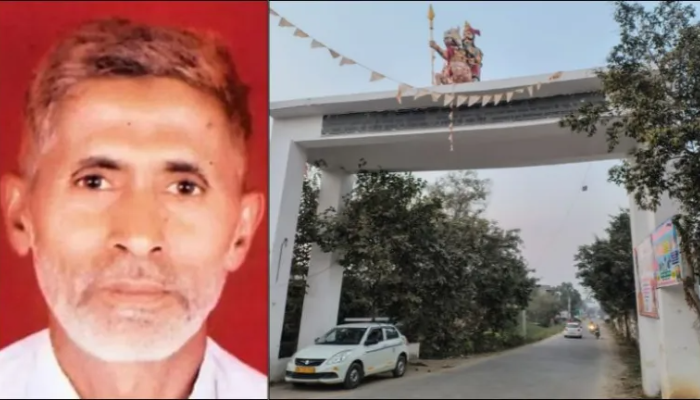
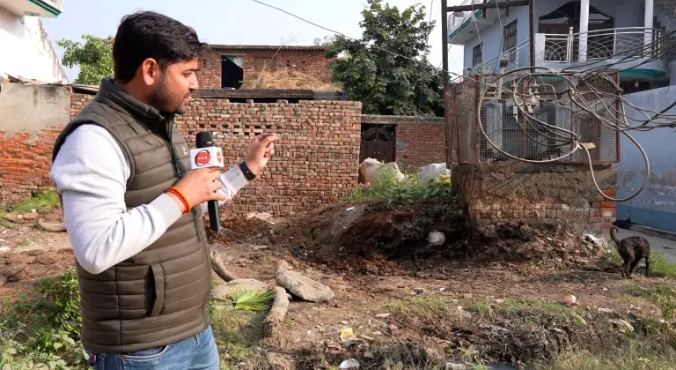
Hence, OpIndia team visited the village which is 50 kilometers from Delhi, a day earlier. Its entrance is marked by a statue of Maharana Pratap and a sign with an image of King Mihir Bhoj welcoming visitors to the “sacred area of Bisahda.” We subsequently arrived at the location where Mohammad Akhlaq had killed the cow and discarded its remnants onto a dung heap by the roadside. However, no one was willing to talk to us. We then proceeded to the residence of Arun Sisodia, a veterinarian situated 50 meters from Akhlaq’s home, who had recognised the remains as those of a cow, drawing upon his expertise.

Sisodia stated that Shivam, a resident of the village, witnessed Akhlaq discarding a polythene bag on the roadside during the night. “Upon inspecting the bag, I discovered the remains (mouth and ears) of a Friesian calf,” Sisodia highlighted. He added, “My sole offense was utilising my 21 years of experience to recognise the parts, a fact that was soon validated by two laboratories.”

Troubled families narrate their ordeal

Sisodia further clarified that the police terrorised the village, unjustly accusing innocent people for political reasons after the incident. “This was a blunder by the Akhilesh government. As a result, I was imprisoned for 23 months. Everything fell apart. I used to make 3-4 thousand rupees each day by treating animals, but my business collapsed after my incarceration. Now, we are left with only one hope: CM Yogi, who we trust can bring us justice,” he mentioned.

Afterward, OpIndia discovered that Bharatiya Janata Party leader Sanjay Rana’s son Vishal Rana, who had been identified as the primary suspect in the case, also departed from the village. The house was locked. The window grills exhibited signs of rust and the ceiling had caved in. The dilapidated place symbolised the anguish of a family in distress. Villagers voiced that Sanjay’s political aspirations effectively ended following the matter.

We then interviewed Yogendra Sharma, the father of Puneet Sharma, who is also implicated in the case. He explained that his home was situated approximately 400 meters from the location of the instance. His son was sleeping on the roof at the time and rushed downstairs after he learnt about the situation. However, bystanders prevented him from approaching the site. Nevertheless, Puneet was booked and spent nearly 17 months behind bars.

According to Yogendra, Akhlaq’s family akin to his, already knew that the young man was not part of the incident, yet he was wrongfully charged due to political rivalry. He added, “At this point, the Yogi government has acknowledged our ordeal and the court is our ultimate hope.”

Media depicted Hindus as terrorists

Former village head Rakesh Rana conveyed that the government has yet to provide any proof regarding who was responsible for Akhlaq’s death. “The accused were named by individuals due to personal oppositions. The Samajwadi Party government saw the incident from a communal viewpoint, siding against the Hindus,” he pointed out.

Rakesh recounted, “The intimidation by that government’s police was such that vegetable vendors refused to enter the hamlet and many people fled out of fear of the cops. At that time, the media portrayed us as terrorists, as if we were oppressing Muslims, while the genuine feelings of the villagers were never represented.”

“Akhlaq’s family has been part of the village for generations. The names of the accused were changed despite this which revealed a profound conspiracy. Our children suffered torture in prison. Ravi’s death in custody was a direct result of this,” he complained. Rakesh noted that the previous governments had retracted cases even against terrorists while these were just innocent individuals concerning the withdrawal of the case.

Sanjeev Rana, living about 150 meters from Akhlaq’s home, stated that the families of all the accused have lost their way. “After Akhlaq’s passing, the SP government was responsible for snuffing the life out of 20 families in the village. They are all like the living dead. The time has now arrived when ruler will battle ruler. The SP government favoured the Muslims, while the Yogi government will ensure justice for us Hindus,” he emphasised.

Akhlaq became a hardliner following his trip to Pakistan

Veterinarian Sisodia, who is also Akhlaq’s neighbour conveyed that Akhlaq’s family was exceptionally kind. He often visited their home and even recalled having a photograph of Akhlaq in his wedding album. He conveyed that Akhlaq’s behaviour transformed after returning from Pakistan and several people associated with Jamaat began visiting his house. Sisodia added that Akhlaq even provided these persons with food and his radicalisation intensified during this period.

Sanjeev mentioned that Akhlaq was a blacksmith. “He was once engaged in a conversation that raised suspicions. When a person expressed concern and asked to see his mobile phone, he refused and instead threw it into a fire furnace. Akhlaq had become more radicalised after interacting with Jamaatis and his growing affection for Pakistan was becoming clear,” Sanjeev remembered.

Hindus repeatedly demonstrated spirit of brotherhood.

Sisodia pointed out that Hindus played a crucial role in preventing the divorce of Akhlaq’s brother Mohammad Afzal’s daughter, Kamar Jahan and they united to support her. Rakesh Rana likewise stated that a sense of brotherhood always existed in the village. He added, “Hindus donated land for the mosque and Eidgah in the village and also contributed to their construction.”

“The two daughters of a destitute Muslim hakim were wed by Hindus in the village, even after Akhlaq’a death,” Rakesh mentioned. He asserted that no untoward event occurred in the village either before or after Akhlaq died. He stated, “The deceased’s siblings did not even sustain a scratch.”

Sanjeev stated that Akhlaq’s family was very close with Hindus but he perpetrated a grave offense that severely damaged the village’s sense of unity.

On 28th September 2015, Akhlaq, who lived in Bisahda village within the Dadri Assembly constituency, slaughtered a cow following Eid. This act incited a furious mob of thousands who forcibly removed Akhlaq and his son Danish from their residence and assaulted them. The injured Akhlaq succumbed to his wounds while receiving medical care at the hospital. The cow slaughter incident was initially regarded as a fabrication, but laboratory tests later verified that the meat disposed of by Akhlaq was, in fact, cow meat.

Ram Gopal Mishra murder: As Bahraich court sentences Sarfaraz to death and others to life imprisonment, read how the old police statement is being misleadingly used to question the verdict

On the 11th of December 2025, a sessions court in Uttar Pradesh’s Bahraich sentenced Sarfaraz alias Rinku to death in the October 2024 communal violence case, wherein a Hindu youth, Ram Gopal Mishra, was murdered

In this case, 10 people were found guilty by the Additional Sessions Judge (First) Pawan Kumar Sharma. While Sarfaraz has been sentenced to death for shooting Ram Gopal Mishra dead, the nine others have been sentenced to life imprisonment. Sarfaraz’s father, Abdul Hameed, and his two brothers, Faheem and Talib alias Sabloo, are among the convicts. In addition to the death sentence for Sarfaraz and jail term for the other convicts, the court also imposed a fine of Rs 1 lakh each.

Besides Sarfaraz and some of his family members, Saif, Javed, Zeeshan, Nankau, Shoaib, and Maruf have been sentenced to life imprisonment. The court, however, acquitted Khurshid, Shakeel, and Afzal over a lack of sufficient evidence.

The accused were charged under Section 103(2) of the Criminal Procedure Code (CrPC), apart from sections 191(2), 191(3), 190, 109(2), 249, 61(2), and Section 30 of the Arms Act.

Notably, the convicted persons have the right to appeal, and their appeals can be filed within 30-90 days, seeking commutation or revocation of the sentence. Defence lawyer Mukhtar Alam has said that an appeal against the verdict will be filed.

Meanwhile, Ram Gopal Mishra’s widow, Roli Mishra, has welcomed the verdict and said, “We are satisfied with the court’s decision. The person who shot my husband has been given the death penalty.”

Durga idol immersion and the brutal murder of Ram Gopal Mishra by Islamists

The murder case of Ram Gopal Mishra stems from Islamist mob violence in the Bahraich district of Uttar Pradesh on 13th October 2024, during a Maa Durga idol immersion (visarjan) procession in the Maharajganj market under the Hardi Police Station precinct. A 22-year-old Ram Gopal Mishra, a Rehua Mansoor village resident, was claimed to have climbed onto the roof of one of the convicts in the present case, Abdul Hameed. It was alleged that Mishra removed green ‘Islamic’ flags installed there, replacing them with saffron Hindu flags. Some videos of the incident also surfaced on social media.

It was moments after this incident; Ram Gopal Mishra, who got married just two months before the incident, was brutally assaulted by the convicted Islamists and shot dead by Sarfaraz. Several other Hindu devotees were injured in the stone pelting by the Muslim mob. The Durga puja idols heading for immersion were also damaged in the stone pelting. In retaliatory violence, the Hindus had also vandalised the houses and shops in the area. A total of 13 FIRs were registered in the case, 11 at Hardi police station and two at Ramgaon police station.

Source: Bhaskar, file

It all started when local Muslims protested against the music played in the immersion procession, resulting in a clash. Following an investigation into the incident, the police charged 13 people, including the main accused. Five of these accused were charged under the National Security Act, including Abdul Hameel, Mohammad Talib alias Sablu, Mohammad Sarfaraz Ahmed alias Rinku, Shakeel Ahmed alias Bablu, and Khurshid. The remaining eight were later charged under the NSA.

The next morning (14th October 2024), a crowd carrying the body of the youth killed in the violence was stopped by the police. After the police placated them, the family took the body and went home. However, the crowd became enraged and set fire to a bike showroom and a private hospital.

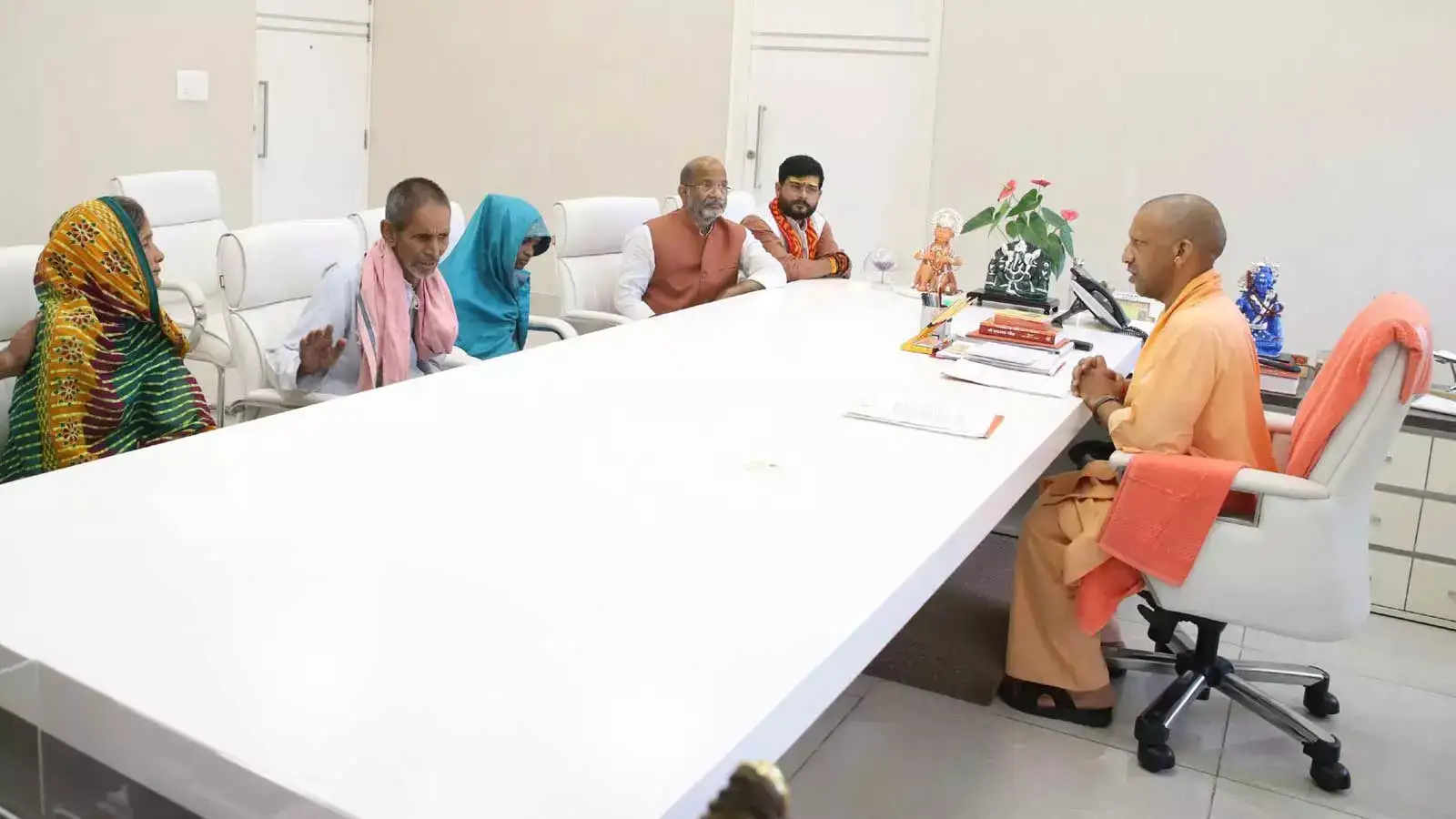
In the aftermath of the Islamist mob violence, internet services were temporarily suspended, and large police forces were deployed. Later, Chief Minister Yogi Adityanath met the deceased victim’s family, assuring justice, financial aid and a government job for Ram Gopal Mishra’s widow, Roli Mishra.

Source: NBT

After the dust settled, the government initiated bulldozer action against illegal constructions belonging to the accused killers of Ram Gopal Mishra.

The deceased victim’s family had, back then, alleged that Ram Gopal Mishra would not have been killed had police not resorted to a lathi-charge against the Hindus, which created chaos, and people started fleeing everywhere. The Islamist perpetrators reportedly exploited the chaos and dragged Ram Gopal Mishra into a house, where he was assaulted and shot dead by Sarfaraz.

How Islamists and media tried to whitewash and justify the brutal murder

OpIndia had reported about the alleged Nepal madarsa connection of the convict Abdul Hameed. It was reported that Hamed has connections to anti-India elements in Nepal and visits a madrasa near Fultekra in the Banke district of Nepal. It is said to be a hub of anti-India and anti-Hindu activities.

It was reported how the Islamo-leftist media had tried to rationalise Ram Gopal Mishra’s brutal killing. Newslaundry, a leftist propaganda outlet, had tried to suggest that since the Hindu procession reportedly played “Tel laga lo Dabur ka naam mita do Babur ka” song on DJ, it ‘offended’ the Muslims and thus the brutality inflicted by them on the Hindu youth is justified. It was reported by locals that the Hindu procession also played songs mocking Pakistan, which also allegedly offended the Islamists.

Islamists widely circulated the propaganda ground report video by Newslaundry online to establish that since Hindus played an ‘offensive’ song, Muslims grew infuriated and thus unrest erupted.

What the court said in its order sentencing the killers of Ram Gopal Mishra, and how the mere mention of a Manusmriti shloka is being used to create confusion

In the order dated 11th December 2025, ASJ Pawan Kumar said that the act committed against Ram Gopal Mishra by the convicted persons was “extremely heinous in nature. The judge noted that Mishra’s body was riddled with bullets, and his one leg was burnt in such a manner that even his nails came off. He emphasised that the cruelty inflicted by the convicts shook humanity, and they deserve appropriate punishment.

“… the act committed by the convicted accused is of an extremely heinous nature. They brutally killed an unarmed young man, riddling his body with bullets. His legs were burned so severely that even his nails came off. This act created unrest and instability in society. The cruelty displayed by the convicts shook humanity, disrupted the social order, and pushed it to the brink of collapse. For such perpetrators, the true intent of justice requires that punishment be awarded in a manner that instils fear in those who harbour similar tendencies and reinforces public confidence in the judicial system”.

ASJ Pawan Kumar also cited a shloka from the Manusmriti to emphasise the imperative to punish those who violate the law.

The shloka cited by the judge is, “Danḍa śāsti prajāḥ sarvā, danḍa evābhirakṣati. Danḍa supṭeṣu jāgarti, danḍa dharm avidurvaḍhā.”

“According to Manusmriti, penal laws were considered essential to ensure that the people followed the duty of the state (Rajdharma). The fear of punishment kept society from deviating from its duties and responsibilities. Punishment alone protected the lives and property of its citizens, and therefore, punishing criminals was considered the ultimate duty of the ruler,” the court order reads.

“…it is appropriate in the interests of justice and society to punish those who violate the principles established by law with appropriate punishment. It is the court’s responsibility to impose penalties, heeding the cries and anguish of the public and society for justice, and to punish those who violate societal rules with the harshest possible punishment, so that the purpose of justice can be achieved,” it adds.

Notably, the court’s observation that Mishra’s feet were burned in such a way that the nails came out is being widely cited by many to suggest that while the Bahraich Police had refuted the claims of Mishra being subjected to torture before killing, the court has accepted the same ‘theory’.

Journalist Sachin Gupta wrote, “Bahraich Violence – Police: There is no truth to claims like being electrocuted, beaten with a sword, or nails being pulled out. Court: His feet were burned in such a way that the nails came out. Meaning: The theory that the police called false in the murder of Ramgopal Mishra was the same theory that the court wrote in its judgment.”

However, the above post fails to mention that the court has not mentioned the claims of electrocution and sword attack at all. Also, “nails were pulled” is not the same as “toes were burned so badly that nails came out”.

Piyush Rai wrote, “UP judge quotes the Manusmriti in his order awarding death sentence in Bahraich violence. Breaking: Pawan Kumar Sharma, the additional sessions judge in UP’s Bahraich, while awarding death sentence to Sarfaraz and life sentence to 9 others in the murder of Ram Gopal Mishra in the 2024 Bahraich violence, quoted Manusmriti in the order copy after elaborating on the alleged torture inflicted on the victim.”

Meanwhile, Wasim Akram Tyagi, an Islamist notorious for peddling fake Muslim victimhood narratives, expressed displeasure over the judge citing a shloka from the Manusmriti. “Did the honourable judge not find even a single statement from the framers of the Constitution to cite while sentencing Gopal Mishra’s culprits?” he lamented.

It is worth recalling that, following several media reports and social media posts, it was claimed that Ram Gopal Mishra’s toenails were deliberately pulled out. However, the police had denied the claims, saying that “There are social media posts that indicate that the body of the deceased was given electric shocks, was attacked with a sword, and that his toenails were desecrated. These posts are not true. The post-mortem report says that the death occurred due to gunshots. No other reason for death has been mentioned in the reports.”

Notably, the postmortem report had stated that the death of the deceased had occurred due to several gunshot wounds. The report further stated that Mishra had several injuries on his face, neck, and arm. The post-mortem report also states that the authorities recovered 7 pellets from the body of Mishra that had 30 entry wounds and 2 exit wounds.

It also mentioned 29 entry wounds on the upper part of the chest extending to the neck, 2 entry wounds on the right upper arm, 3 entry wounds on the left upper arm, and a total of 6 entry wounds on the whole face. Apart from these, there were 2 exit wounds in the back of the neck. A total of 7 pellets were recovered from the body. The cause of the death has been mentioned as shock and haemorrhage caused by gunshots. The report also revealed that Mishra had injuries on 8 spots in his body, including his feet.

The Chief Medical Officer of Bahraich, Sanjay Kumar, had also stated that there were around 25-30 pellet injuries on the body of Mishra. “There are some injury marks on his left eye and on his toes. Some parts of the nails of both his feet are also missing, and toes exhibited burn injuries,” he confirmed.

In the verdict, Judge Pawan Kumar pointed out that Ram Gopal Mishra’s body was riddled with bullets and that the victim’s nails came off. Nowhere does the judgment accept the exaggerated claims of torture, which were refuted by the police earlier. The judgment does not mention the police-debunked claims that Mishra was given electric shocks, was attacked with a sword, or that his toenails were deliberately pulled out.

While it is true that the Bahraich police had denied exaggerated claims of electrocution, sword attacks etc, and stated that the cause of death is bullet wounds alone, it is notable here that the court order is not “contradicting” the police statement at all, unlike what these handles are suggesting.

Both the postmortem report and the Bahraich CMO, Sanjay Kumar, had confirmed that Mishra’s feet, particularly toes, had injuries, and some parts of the nails of his feet were missing. It is only these facts that the court has mentioned in its order, focusing only on the proven brutality, not the claims like sword attacks, electric shocks, nail-pulling or post-shooting prolonged abuse, debunked by the police.

It was confirmed that there were burn injuries, although the nails were not deliberately pulled out. The court order highlights this fact, and even if the ‘toenails missing’ part is set aside, Ram Gopal Mishra’s killing was brutal and torturous. Merely because the judge quoted the Manusmriti, the Islamo-leftists are calling him biased and apparently a ‘Sanghi’.

Dragging Mishra, his burnt toes, 30 bullet wounds caused by multiple close-range shots, 10 people ganging up to kill one unarmed man for merely having removed a religious flag, does amount to cruelty via overkill. The police rejected the unproven extras, and the court did not accept or endorse those extras; however, Islamo-leftists are peddling a narrative that simply because the judge quoted Manusmriti, he is a Hindu hardliner riddled with anti-Muslim bias and thus included exaggerated claims of torture by Muslim convicts on the Hindu youth.

Witness in Sandeshkhali gang-rape case meets with suspicious accident with 2 deaths, but attack on Kolkata snack vendor more important for TMC, Zubair and left-liberals

On 10th December, a prime witness against former All Indian Trinamool Congress (AITC or TMC) leader Sheikh Shahjahan narrowly escaped death after a ten-wheeler truck struck his vehicle in the North 24 Parganas area of West Bengal. Bholanath Ghosh (64) is a crucial witness in land-grab proceedings brought by the Central Bureau Of Investigation (CBI) and Central Bureau Of Investigation (ED) concerning Shahjahan who is also booked over systematic rape of women in Sandeshkhali.

Unfortunately, Ghosh was severely wounded and two people were killed including his son Satyajit and driver Shahanoor Molla in the collision. Notably, the occurrence happened when he was travelling to testify in Basirhat Sub-Divisional Court in relation to one of Shahjahan’s many cases and the former’s family has asserted foul play.

While the shocking event took place in the state ruled by TMC, already infamous for its protection of criminals like Shahjahan for vote-bank politics, the Islamists and their left-liberal allies have been more preoccupied with amplifying a heated confrontation including two snacksvendors in Kolkata.

According to reports, a street vendor selling chicken patties was allegedly beaten close to Kolkata’s Brigade Parade Ground, the site of a “Gita Path (recitation)” event. Afterward, 50-year-old Sheikh Riyazul stated that “eight-nine unknown people, including a disabled man,” assaulted him, in a First Information Report. Similarly, 60-year-old Muhammad Salauddin also filed a case and claimed that “two-three persons” had attacked him for selling chicken patties. Two FIRs have been filed by a lawyer on behalf of the vendors.

Nevertheless, the malevolent ecosystem devised a convenient distraction to redirect attention from the troubling developments surrounding Ghosh owing to this incident.

TMC leader, Islamist “fact-checker” and calculated propaganda

TMC spokesperson Riju Dutta, in a display of impudence associated with his party, could not produce a single remark about the horrific tragedy experienced by Ghosh and its extensive ramifications but he wasted no time in blaming the Bharatiya Janata Party (BJP) and “Hindutva goons” over the matter in relation to the vendors.

Dutta alleged that the program was planned by the saffron party, referring to the occurrence as “just the trailer of things to come if the BJP ever comes to power in Bengal.” He then dramatically commented that the BJP seeks to control people’s lives and Bengal would be at risk of extinction if the party was not stopped.

The state apparently is not at risk due to the perilous pandering to Bangladeshi inflitrators, restrictions on Durga Puja and anti-Hindu pogroms. It is also unaffected by the rampant crime and suspicious attacks on primary witnesses related to important cases involving leaders connected to the ruling party in the state. However, it is a “fight for Bengal” over an issue that has yet to undergo a probe and reach a logical conclusion.

Dutta also left out the fact that if the allegations are indeed true, it is yet another demonstration of deteriorating law and order in the state under the TMC government, and accusing others merely highlights the government’s shortcomings, especially considering its bleak history.

Mohammed Zubair of propagandist “Alt News” also took the lead in crafting this distasteful narrative to shift focus from the two fatalities and the grave charge of an attack on the life of the key witness by his family. If the victims had been of Zubair’s ideological leanings or the accident happened in a BJP-governed state, he would have repeatedly attacked the government and even found a means to shamelessly malign “Hindutva,” regardless of the facts.

Zubair also accused the mainstream media of neglecting the issue and slammed Republic Bangla for “selectivity,” while his own account had no mention of the vital development related to Shahjahan, exemplifying the tactic of “accuse others of what you are guilty of” by Nazi propaganda minister Joseph Goebbels. Zubair has truly established himself as a master in the art of propaganda and the dissemination of particular narratives.

Left-liberal cabal jump on the victimhood bandwagon

The moment Zubair began to peddle the victimhood narrative in an effort to overshadow the significant instance, other members of the cabal also raised their voices in unison with him, deliberately ignoring the evidently larger development for obvious reasons. Likewise, their braindead audience also latched onto this constructed narrative and tried to further the same.

Anti-Hindu Delhi riots accused Apoorvanand who also writes for another propaganda outlet “The Wire” remarked that such incidents are “becoming a common occurrence in India, across various states.” He even added that the community should be concerned about the widespread “criminalisation and lumpanisation of Hindus,” however, “they seem to be relishing this dehumanisation as it harms Muslims & Christians and gives them a sense of power.” The post was retweeted by Zubair.

Apoorvanand, much like the co-founder of Alt News, failed to find any time to tweet about Ghosh’s accident or the serious allegations of his family. Nonetheless, the vitriol directed at Hindus and the perceived hypocrisy is neither novel nor surprising. They have perfected the skill of making a mountain out of a molehill when it benefits their agenda and simultaneously turn a blind eye to even the most critical issues in accordance with their interests.

Apoorvanand, however, went one step further in spreading his obnoxious fabrications. First off, these are not widespread incidents and the administration along with the judiciary is available to inquire about the facts and punish the guilty. Secondly, the veracity of such issues have been regularly exposed and they turn out to be falsehoods and propaganda manufactured by his ilk.

Furthermore, the man would not dare to express similar sentiments regarding terrorism and Muslims, but instead sinks even lower than his already deplorable level, uttering outrageous lies to target Hindus in order to appease and protect his “secular” political despots.

Zubair retweeted another “journalist” Wuqar Hasan, who had reacted to his post to augment the matter. He, akin to the rest of the ecosystem, was indifferent to the troubling events around Shahjahan’s cases.

Sanghamitra Bandyopadhyay lashed out at the police for failing to protect “secularism,” “brotherhood” and “peaceful coexistence” in West Bengal. She seemingly forgot that the police also did not protect the women in Sadeshkhali, the Hindus in Malda and Murshidabad, as well as Bholanath Ghosh, his son and their driver. On the other hand, the administration was focused on safeguarding the culprits. However, as expected her perverse outrage was directed solely for the sake of the vendors and not other victims.

A liberal brought BJP into the matter and tried to convince Bengalis not to support the party if they want to keep consuming fish, chicken and mutton. These individuals never pass up an opportunity to push their political goals. More importantly, they argue that the saffron party should not be allowed to gain power as it would threaten their food habits without any substantiation for these statements. However, TMC should never be ousted regardless of its shameless appeasement politics, the crimes committed by its leaders and the lives lost under its misrule.

Accident or conspiracy: Statements of eyewitnesses and family’s strong suspicions

According to Biswajit, Ghosh’s older son, Shahjahan ordered attempted murder on his father. Ghosh who is an ex-TMC worker and also worked with Shahjahan eventually emerged as an essential witness in a case against him. Biswajit outlined, “They had threatened to kill my father earlier. This is not an accident, 100 per cent murder. Shahjahan’s order was carried out by Sabita Roy and Muslim Sheikh.” Muslim is the vice president and Roy is the president of the Najat Panchayat Samiti.

An investigation has been opened up into the allegations. “We are not sure if it was an accident. We are probing every angle. We are putting more emphasis on why the collision occurred where there is no CCTV coverage and how the driver fled the spot,” mentioned a senior official.

It was unveiled that the truck destroyed a side of Ghosh’s car on the Basanti Highway, contrary to what was first believed to be a head-on crash, which transpired next to the Boiramari petrol station in Najat police station limits. The cops conveyed that the road is not accident-prone and is broad alongside straight.

The truck reportedly approached from behind, hit the automobile, shoved it forward and threw it into a roadside ditch. All three people were trapped inside the four-wheeler when it was crushed. The witnesses disclosed that the truck driver then absconded from the scene.

Ghosh’s family is among the people who have suggested that the catastrophe was planned. They mentioned earlier instances in Sandeshkhali where witnesses were assaulted, on Shahjahan’s orders from the prison. They maintained that the deaths and the crash were “not a coincidence.”

“Reports indicate that the truck was being driven by Abdul Halim Mollah, one of Shahjahan’s closest aides along with his associate Nazrul Mollah. Abdul has long been listed as a fugitive in CBI records. It is therefore evident that this was no accident but a cold, calculated act of murder,” stated Union minister Sukanta Majumdar.

“It was a planned murder and not an accident. It was an attempt to disguise a murder as an accident. Let there be an impartial investigation,” likewise expressed BJP leader Sajal Ghosh.

Conclusion

The aforementioned clearly demonstrated the severity of the incident and its massive impact on the cases associated with Shahjahan. The issue would have been emphasised repeatedly and the government would have been under fire for its inability to act in any other situation.

However, the TMC, Muslim radicals, liberals and their whole group were engaged in burying the paramount matter and bringing the incident related to the vendors in the limelight. They made every effort to ensure that the major development that could potentially influence many lives, the legal proceedings and even the justice that would be served to Shahjahan, somehow disappeared into the backdrop of the fervently attached communal perspective that sought to blame the BJP and Hindutva.