On 4th November, the global higher education analysts “QS Quacquarelli Symonds” published the “QS World University Rankings” regarding Asian educational institutions. Notably, the proportion of Indian institutions in it has climbed by 1,125% in 10 years, from 24 in 2016 to 294 institutions in the QS Asia index.
There are seven Indian universities ranked in the top 100, twenty in the top 200 and sixty-six in the top 500. IIT Delhi, which is placed jointly at 59th position continues to be the top university in India for the fifth consecutive year. 19 Indian universities, including Chandigarh University, BITS Pilani, Shoolini University and OP Jindal Global University, achieved their best-ever rankings. Sathyamaba Institute of Science and Technology improved the most, moving up 111 spots to 262nd place.
Globally, Massachusetts Institute of Technology (MIT) of the USA tops the list, followed by Imperial College London of the UK and Stanford University of the USA. Oxford and Harvard are listed at 4th and 5th. National University of Singapore (NUS) is the only institution from Asia in top 10.
The top 10 Indian Institutions in the list are:
Indian Institute of Technology Delhi (IITD)
Indian Institute of Science
Indian Institute of Technology Madras (IITM)
Indian Institute of Technology Bombay (IITB)
Indian Institute of Technology Kanpur (IITK)
Indian Institute of Technology Kharagpur (IIT-KGP)
University of Delhi
Chandigarh University
Indian Institute of Technology Roorkee (IITR)
Indian Institute of Technology Guwahati (IITG)
The landmark achievement was also recognized by Prime Minister Narendra Modi who added that the government is committed to ensuring quality education for the youth with emphasis on research and innovation. “We are also building institutional capacities in this sector by enabling more educational institutions across India,” he remarked.
Glad to see a record increase in the number of Indian universities in the QS Asia University Rankings over the last decade. Our Government is committed to ensuring quality education for our youth, with a focus on research and innovation. We are also building institutional…
Maulana Abul Kalam Azad University of Technology in West Bengal has been ranked first in Asia for research output (Papers per Faculty) as India leads the continent in research productivity (Papers per Faculty) and PhD Staff with 11 institutions in the top 23. India dominates the Papers per Faculty Indicator with 28 universities in the top 50 and 5 in Asia’s top 10.
Employer reputation has also significantly improved at 36 Indian universities, including IIT Delhi, IIT Kanpur, IIT Madras, IIT Guwahati, and IIT Roorkee. 105 Indian institutes declined, 16 stayed the same and 36 improved. “The expansion of the rankings is associated with the greater volatility observed in this year’s results. Overall, 41 Indian institutions appear in the top 80th percentile of universities. India ranks best in Asia for staff with PhD,” the company stated in an official statement.
India’s National Education Policy (NEP) and its growing research and innovation environment has been credited for the stunning growth, which surpasses that of all other Asian countries.
Matteo Quacquarelli comments on India’s successes
The incredible accomplishment was also praised by Matteo Quacquarelli who is Vice President, Strategy & Analytics at QS Quacquarelli Symonds. He stated that a decade of change in research productivity, creativity and institutional capability is reflected in the nation’s impressive ascent in the QS Asia University Rankings 2026.
Matteo mentioned that India’s ranking has improved tenfold over the last 10 years, indicating the nation’s increasing contribution to Asia’s higher education scene. He also outlined that the country’s performance highlights its expanding research ecosystem and attributed this to the National Educational Policy of the Modi government.
“India’s remarkable rise in the QS Asia University Rankings 2026 reflects a decade of transformation in research productivity, innovation, and institutional capacity. As India marks five years since the launch of the National Education Policy (NEP) 2020, its impact is becoming increasingly evident,” Mattteo pointed out.
He further conveyed, “India dominates the Papers per Faculty indicator, a sign of strengthening research output. At QS, we remain committed to providing trusted data and insights that empower universities, policymakers, and students to navigate this evolving higher education landscape.”
Intererstingly, only three Indian institutions performed better than 90% of their Asian counterparts ten years ago but the number had increased to eleven by 2026.
What are QS Asia University Rankings
The British company Quacquarelli Symonds (QS), a higher education analytics company, created the QS World University Rankings, a portfolio of comparative college and university rankings.
Three components make up the QS system: a global overall ranking, five separate regional tables (Asia, Latin America, Emerging Europe and Central Asia, the Arab Region, and BRICS) and subject rankings that determine the top universities worldwide for 51 different subjects as well as five composite faculty areas.
It is one of the most prominent international rankings that evaluates the standing and effectiveness of universities across the globe and a premier source of comparative institutional performance evaluations for students and university partners worldwide.
For Asia, it uses an approach that is similar to its global rankings but modified for the continent. It assesses institutions according to criteria like internationalisation, instructional resources, research and academic prestige. The results are produced with some extra indicators and modified weightings as well as regional interests are taken into account.
However, it continues to incorporates measures like citations per faculty, faculty/student ratio and employer reputation. Developed in collaboration with regional experts and stakeholders, this collection of criteria is intended to represent important concerns for Asian institutions, utilising as much data as feasible.
They are based on eleven indicators including academic reputation (30%), employer reputation (20%), faculty/student ratio (10%), international research network (10%), citations per publication (10%) and papers per professor (5%), PhD-holding staff (5%), international faculty (2.5%), foreign students (2.5%), incoming exchange students (2.5%) and outbound exchange students (2.5%).
Significance of the rankings
Numerous variables are taken into consideration while calculating the rankings, one of which is academic reputation. It provides an indication of a university’s degree of respect in the international academic community and helps a student in making an informed choice about their future institution.
The higher rankings illustrate the country as a center of quality education, thus not only obtaining international recognition but also stimulating its education tourism.
The impact of studying abroad on cultural experience, support network and visa prospects can be determined by analysing the foreign faculty to student ratio and international research partnerships. Employer reputation and graduation results are important measures of how successfully a university prepares its pupils for the workforce whether through internships or career services.
Rankings like citations per faculty and research network show a university’s influence in the international research community for those pursuing postgraduate studies or research. The sustainability indicator is for students looking for top-notch, environmentally conscientious universities.
Likewise, it aids educators in making informed decisions about their careers by offering them the best options to shape their professional paths. Moreover, the rankings underscores the improvements and efforts made in enhancing the education and research network while also identifying underperformers and providing them with an opportunity to perform better.
There are 1,526 universities including 557 new ones from 25 higher education systems in the 17th edition of the QS Asian University Rankings, including 558 entrants. India included 137 institutions, bringing its total to 294 which is the second-highest while China (Mainland) added 261 institutions to reach 395 and restored its status as the most represented system, after two years. Meanwhile, the University of Hong Kong is ranked as the best university in Asia.
Importantly, India’s representation rose from 24 universities in 2016 to 294 in 2026, a staggering 1,125% growth while China’s increase was 273%.
In what could be called a collective outcome of the suicidal empathy of the non-Muslim New Yorkers and an Islamist zeal of propelling ‘one-of-our-own’ to the helm of power, Zohran Mamdani, a Democrat Socialist and undeclared Islamist, won the mayoral election of New York. Mamdani’s mayoral campaign was marked with sheer Hinduphobia, anti-India falsehoods, and antisemitism, all while posing as a ‘progressive Muslim’. Zohran Mamdani has inherited his limerence for Islamic terrorists from his father, Mahmood Mamdani.
Mahmood Mamdani, a Ugandan scholar, author and political theorist of Indian origin. Known in the Islamo-leftist ideological circles as an outspoken intellectual and scholar having expertise on decolonisation-related studies, there is more to him. In his pursuit of criticising Western interventions, colonialism and deconstructing power structures, Mahmood Mamdani humanised terrorists and suicide bombers.
Mahmood Mamdani equated the Hindus of India to the Hutus of Rwanda
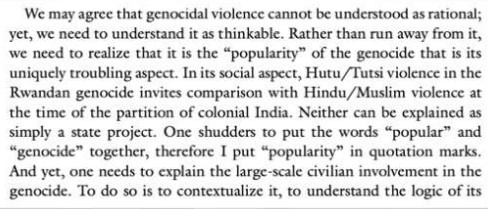
In his book, “When Victims become Killers”, Mamdani compares India to Rwanda and Hindus to the Hutus.
“We may agree that genocidal violence cannot be understood as rational; yet, we need to understand it as thinkable. Rather than run away from it, we need to realize that it is the “popularity” of the genocide that is its uniquely troubling aspect. In its social aspect, Hutu/Tutsi violence in the Rwandan genocide invites comparison with Hindu/Muslim violence at the time of the partition of colonial India. Neither can be explained as simply a state project. One shudders to put the words “popular” and “genocide” together, therefore I put “popularity” in quotation marks. And yet, one needs to explain the large-scale civilian involvement in the genocide. To do so is to contextualize it, to understand the logic of its…” Mahmood Mamdani writes.
In the Rwandan genocide, the Hutu Militia had systematically ethnically cleansed the Tutsi. In the passage mentioned above, Mahmood Mamdani seems to suggest that Hindus are the Hutus who are cleansing the Muslims in India, when the reality is exactly the opposite.
Eulogising Jinnah to dissociating the Islamic Ulema from his demands, favouring the creation of Pakistan: Mahmood Mamdani’s self-created alternate version of history
Mahmood Mamdani has also been a fanboy of Mohammed Ali Jinnah, the founding father of Pakistan, whose genocidal call for a ‘Direct Action Day’ resulted in the killings of countless Hindus. Jinnah. In his book, ‘Good Muslim, Bad Muslim’, Mamdani hails Jinnah as a political intellectual who had a completely secular disposition. He makes these grand claims because, according to him, Jinnah wanted a Pakistan where minorities would get equal rights.
The reality, however, was the exact opposite. Jinnah wanted Pakistan on purely Islamic religious lines, claiming that Muslims were a nation unto themselves and could not co-exist with Hindus.
In addition to whitewashing Jinnah’s Islamic jihadist proclivities, Mahmood Mamdani also claimed that the Islamic Ulema did not favour the creation of Pakistan and were a part of the Indian National Congress. In our research paper “CSDS: The Spider Web”, OpIndia highlighted that while the Ulema may have been a part of the Indian National Congress, since there is no concept of nationhood in Islam, the Ulema was not interested in establishing a political state based on Islam. Rather, it was interested in establishing a Caliphate and that subscribing to the creation of Pakistan would essentially mean giving up the Islamic prophecy of Ghazwa-e-Hind since they would be relinquishing their ‘claim’ on the rest of India.
While the Islamic Ulema and Jinnah’s Muslim mobs inflicted atrocities on Hindus in the name of Islam, Mahmood’s ‘intellectual’ Mamdani passed them off as secular, peaceful and scholarly folks.
Mahmood Mamdani justified terrorism and hailed suicide bombers as ‘soldiers’
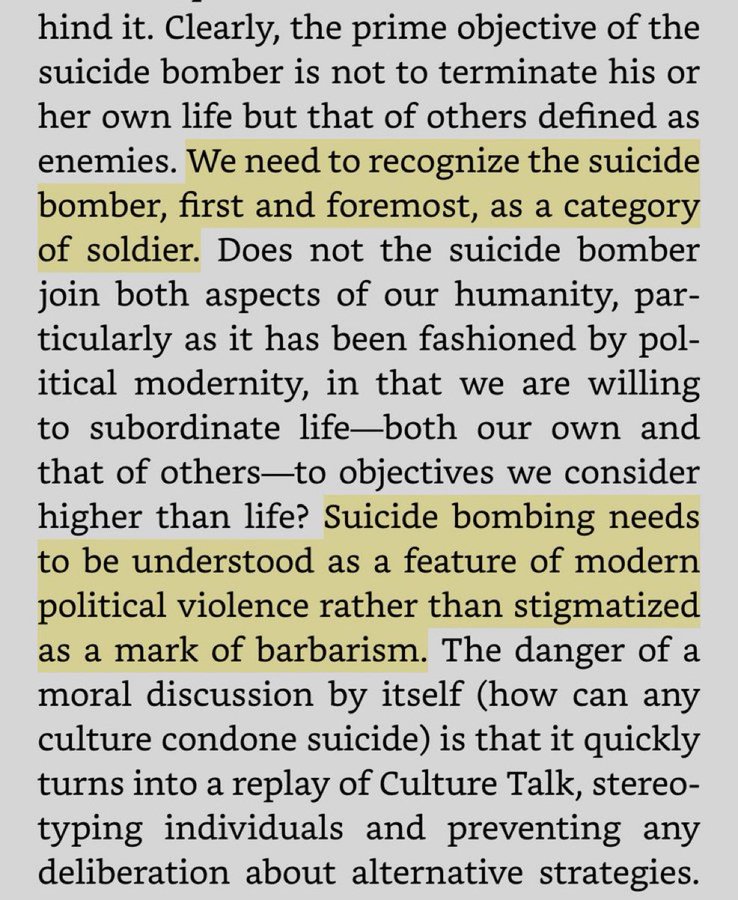
Beyond whitewashing and glorifying those behind the massacre of Hindus in the run of India’s partition in 1947, Mamdani also justified Islamic terrorism. In his 2004 book “Good Muslim, Bad Muslim”, Mahmood Mamdani says that suicide bombers or Fidayeens should be considered ‘soldiers’. He claims that political modernity is predicated on the subordination of life in pursuit of a higher goal. Suicide bombers also follow that goal, and therefore, calling them terrorists would stigmatise the Islamic terrorists. Mamdani, however, either failed to or deliberately did not mention that the “higher purpose” that Jihadis serve is that of a vengeful doctrine in which the persecution and subjugation of non-Muslims is an essential tenet.
Amidst criticism over advocating for calling suicide bombers ‘soldiers’, Mahmood Mamdani, in an interview with the Asia Society, attempted to contextualise and justify his terror-supporting viewpoint.
He said, “To understand terrorism, we need to go beyond self-defence, beyond the violence of liberation movements, beyond the violence of anti-colonial struggles and liberation movements. To understand non-state terror today, we need to understand the historical relationship between state terrorism and non-state terrorism.”
Building his argument on this, Mamdani said that, unlike the Western media’s view of the suicide bombers as a throwback to pre-modernity, either as adult irrationality or as a response of adolescents coerced by patriarchal authority. The suicide bomber comes out of the history of the Intifada.”
He equated the so-called Palestinian ‘freedom struggle’ with the Vietnam War and apartheid South Africa; Palestine remains occupied.
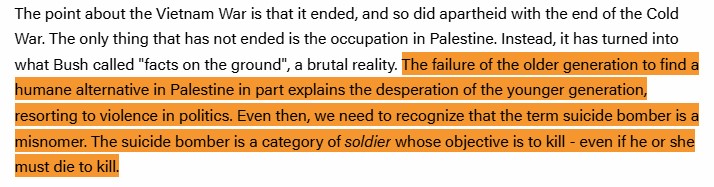
“The failure of the older generation to find a humane alternative in Palestine, in part, explains the desperation of the younger generation, resorting to violence in politics. Even then, we need to recognise that the term suicide bomber is a misnomer. The suicide bomber is a category of soldier whose objective is to kill – even if he or she must die to kill,” he said.
Source: Asia Society Online
Mamdani, however, did not care to mention that even after taking control of the Gaza Strip in 2006, Hamas has recurrently been attacking Israel. Unlike Mahmood Mamdani’s portrayal of Hamas terrorists as youths forced to resort to violence to end Israeli occupation and somehow not driven by religious hatred, it is utterly dishonest. The fight of Palestinian terrorists is not merely about territory or its supposed illegal occupation. Hamas, in its 1988 ‘charter’, also called the “Hamas Covenant”, essentially declares Israel as a “Waqf” property. This, in short, means that all of Israel, from the Jordan River to the Mediterranean Sea, is a property of Allah and belongs exclusively to Muslims.
The Palestinian jihadist outfit draws inspiration from the Islamic holy texts to justify its hatred for and fight against the Jews. The Hamas Covenant’s Article 7 says,“The Day of Judgment will not come about until Moslems fight Jews and kill them. Then, the Jews will hide behind rocks and trees, and the rocks and trees will cry out: ‘O Moslem, there is a Jew hiding behind me, come and kill him,”
Clearly, unlike Vietnam or apartheid South Africa, the Palestine-Israel conflict stems from the Islamist hatred for Jews, although territorial claims remain the apparent trigger. From the 7th century to the 21st, “Khybar Khybar Ya Yahud” has been the war cry of Muslims against the Jews. Territorial contest, ambition to establish control from ‘river to the sea’ is a part of the agenda of Palestinian Islamic terror outfits, not the crux of it.
Mamdani also wants Islamic fundamentalism to be called “political Islam”. He argues that, unlike political Christianity, political Islam marks the movement of secular intellectuals into the religious domain.
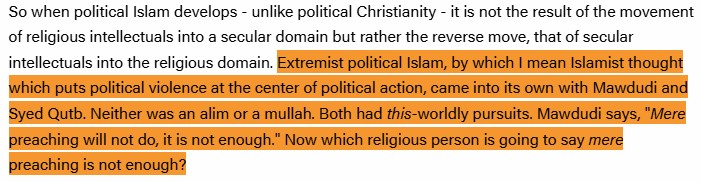
“Extremist political Islam, by which I mean Islamist thought which puts political violence at the center of political action, came into its own with Mawdudi and Syed Qutb. Neither was an alim or a mullah. Both had this-worldly pursuits. Mawdudi says, “Mere preaching will not do, it is not enough.” Now, which religious person is going to say mere preaching is not enough?” he told Asia Society.
However, there is a difference between any religious person and an Islamic religious person. Even Prophet Muhammad preached what he believed was the word of Allah, but was that enough for him and his followers to spread Islam? Did he not fight any wars, seize control of power, and lead expeditions to expand his territory? Can his idea of Islam be called “political Islam”?
Interestingly, Mamdani, in his lectures and writings over the years, has called for the ‘dismantlement’ of the Jewish state of Israel. He argues that the existence of a Jewish state embodies settler-colonialism akin to apartheid South Africa.
Mahmood Mamdani (Image via Hindustan Times)
In 2015, he said, “The Palestinian challenge is to persuade the Jewish population of Israel and the world that – just as in South Africa – the long-term security of a Jewish homeland in historic Palestine requires the dismantling of the Jewish state. Jews can have a homeland in historic Palestine, but not a state.”
This essentially means that Israelis should voluntarily dissolve their state and hand over their territory and fate into the hands of Palestinian ‘authorities’ so that the same Hamas, which continues to attack ‘occupier’ Israel, can completely wipe out Jews who would be living at their mercy. In a nutshell, Mahmood Mamdani wants to convince Jews to commit hara-kiri or ‘Palestinian soldiers’ will continue to be forced to resort to violence.
While America’s most populous city, New York, has voted his son to lead the city, Mahmood Mamdani opines that the Nazis learned to commit ethnic cleansing from the United States. “The Allies who prosecuted individual Nazis at Nuremberg were invested in ignoring Nazism’s political roots, for these roots were also America’s,” Mamdani wrote in one of his books, “Neither Settler Nor Native: The Making and Unmaking of Permanent Minorities.”
Be it in India or anywhere in the world, the Islamo-leftist intellectual cabal has a knack for rewarding genocide whitewashers, Islamists and their sympathisers. The Centre for the Study of Developing Societies (CSDS), a research institute founded by Rajni Kothari, which has a history of anti-Hindu and anti-India bias, honoured Mahmood Mamdani by hosting him as the Rajni Kothari chair in CSDS for the year 2017-18. Interestingly, CSDS receives foreign funding from the Open Society Foundations (OSF), which was founded by American-Hungarian billionaire and a known Modi detractor, George Soros.
OpIndia, in its research paper, revealed that the CSDS receives funding from many other anti-Hindu and anti-India foreign entities, including the Siemenpuu Foundation, Ford Foundation, Henry Luce Foundation, Omidyar, and International Development Research Centre (IDRC), among others. These foreign entities employ anti-Hindu and anti-India ‘intellectuals’ to push narratives undermining India’s democracy and unity, in addition to amplifying Western narratives about oppression and dispossession in India.
Mahmood Mamdani is also a member of the advisory council of an Israel-hating organisation, the Gaza Tribunal. This London-based group, comprising 29 members, besides peddling anti-Israel propaganda, also backs Zohran Mamdani’s BDS (boycott, divest and sanctions) movement against Israel. The Columbia University professor also ran his BDS propaganda on campus and partook in anti-Israel varsity encampment protests last year.
The newly elected New York Mayor’s father also sits on the advisory council of the Arab and Muslim Ethnicities and Diasporas Initiative (AMED). This group is also an anti-Israel outfit which sympathises with the Palestinian Islamic terror group Hamas, which massacred thousands of Israeli civilians on 7th October 2023 and brutalised hostages.
Even in his post-9/11 writings, Mahmood Mamdani argued that the roots of terrorism lie in the US’s Cold War era policies that armed Mujahideen in Afghanistan. He also criticised the “culture talk” that ‘demonises’ Islam wholesale.
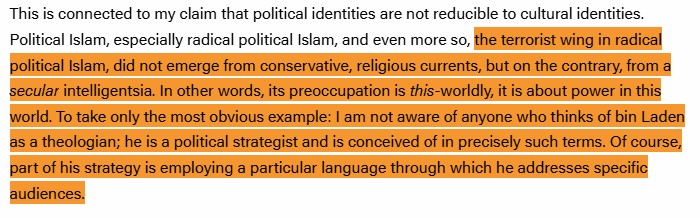
In his book, “Good Muslim, Bad Muslim”, Mamdani wrote, “If 9/11 cut short the celebration of that victory, it also posed the question: at what price was the Cold War won?” No wonder, Mamdani in his Asia Society interview argued that Osama Bin Laden, the mastermind of the 9/11 attacks that killed over 2,000 in New York, was a “political strategist” and not a Kafir-hating Islamic jihadist.
Zohran Mamdani taking forward Mahmood Mamdani’s legacy of whitewashing Islamist terror while posing as a ‘progressive Muslim’
Both Mahmood and Zohran Mamdani have mastered the art of blaming everyone and everything under the sun for Islamic terrorism, but not he actual root cause of it.
In October this year, Zohran Mamdani was seen gleefully posing for pictures with Siraj Wahhaj at the Masjid At-Taqwa, the Bedford-Stuyvesant Mosque, during a visit. Siraj Wahhaj is listed by prosecutors as an “unindicted co-conspirator” in the 1993 World Trade Centre bombing. Besides mollycoddling terrorists publicly to play to the Islamist gallery, Zohran Mamdani also invoked Islamophobia by crying about his Muslim aunt, who somehow did not feel safe taking the subways in her Hijab.
The strategy has been simple and apparently now successful too: pander to Islamists on one hand, cry Islamophobia on the other.
For a quick rise in the Islamo-leftist ecosystem, slandering Indian Prime Minister Narendra Modi is the most convenient and effective way. In May this year, New York City mayoral candidate and Democratic Socialist Zohran Mamdani employed the same tactic and called PM Modi a “war criminal” during a public forum. He said in the context of the 2002 Gujarat Riots, which erupted after Islamists burnt a train bogey full of 59 Hindu pilgrims returning from Ayodhya, who were burnt alive. Mamdani claimed that Modi, who was then the Chief Minister of Gujarat, helped the slaughter of Muslims and that hardly any Gujarati Muslims are there.
This, however, was a blatant lie as the Indian Supreme Court has already given a clean chit to PM Modi. Moreover, the population of Muslims in Gujarat, far from decreasing, has only increased over the years.
At the event, titled “New Mayor, New Media”, Mamdani also compared Modi to Israeli PM Netanyahu, saying, “This is someone we should view in the same manner we do Benjamin Netanyahu. This is a war criminal.”
Born in Uganda to ‘filmmaker’ Mira Nair and ‘author’ Mahmood Mamdani, Zohran Mamdani has earned notoriety for making derogatory remarks against Indian Hindu leaders, especially PM Modi. In 2020, he called Hindus associated with Modi’s party “fascists” and attacked fellow New York politicians Jenifer Rajkumar and Kevin Thomas for not denouncing Modi. At that time, Rajkumar responded strongly, calling Mamdani’s comments “extreme and divisive,” and urged voters to “reject hate, whether from the far left or far right.”
A video from August 2022 showed him leading a mob shouting, “Who are the Hindus? “Harami (Bastards),” which went viral on social media
When the Ram Mandir was being built in Ayodhya, he led a rally against it in 2020. While he was speaking at the rally, derogatory remarks against Hindus were being raised behind him. The rally was organised by Khalistani elements.
In 2023, as well, when PM Modi was scheduled to visit New York, he spewed venom against him, accusing him of the 2002 Gujarat Riots.
Mamdani earlier defended the anti-semitic “Globalise the Intifada” cry, which essentially calls for hatred and violence against Jews across the world. He also refused to acknowledge Israel’s right to exist, a common trait among Islamists and their liberal cheerleaders.
Unsurprisingly, Zohran Mamdani received funding from anti-India and anti-Hindu groups active in the US. OpIndia reported earlier that the Council on American-Islamic Relations (CAIR), an Islamist outfit, contributed $100,000 to New Yorkers for Lower Costs, the largest Parliamentary Action Committee (PAC) backing Zohran Mamdani. Not to forget, CAIR officials were among those who celebrated the Palestinian Islamic terror group Hamas’s massacre of innocent Israeli civilians on 7th October 2023.
OpIndia has constantly reported about how CAIR, which always complains about alleged Islamophobia in the United States, has been aggressively promoting Hinduphobia and anti-Hindu propaganda in India. CAIR was also offended earlier when the names of the LeT terrorists and scenes from the deadly 26/11 terror attack were displayed on a mobile billboard truck in New Jersey. No wonder those who whitewash 26/11 funded the one who downplays 9/11 and mollycoddles Jihadis.
Mamdani also received funding from Anti-Semitic activist Linda Sarsour and many anti-Israel groups. He also received support from Soros-funded Hindus for Human Rights (HfHR) anti-Hindu outfit’s co-founder, Sunita Vishwanath.
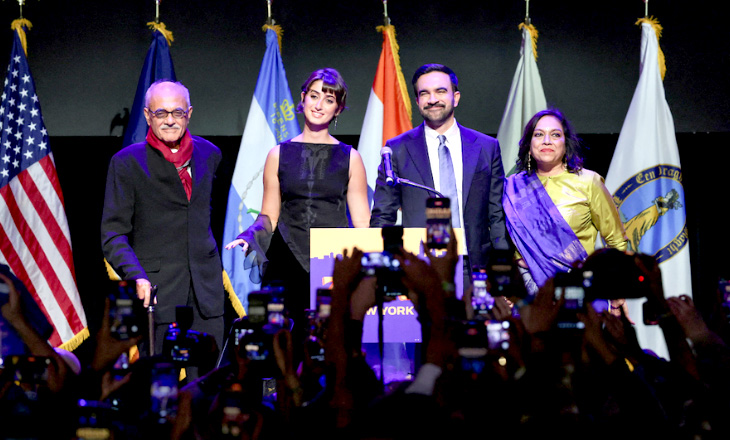
Father defends suicide bombers; son clicks pictures with terrorists and supports Jihadis. Heavily influenced by his father Mahmood Mamdani’s academic works and viewpoints, New York’s new mayor Zohran Mamdani has become the youngest mayor in over a century, the first African born and Indian origin mayor as well as the first Muslim mayor of the biggest city and financial hub of the United States.
While Islamists and their useful idiots have all the reason to rejoice over his victory, Democrat leader Zohran Mamdani’s win marks a concerning tectonic shift in America’s politics, which comes only months after the Donald Trump-led Republican Party registered a thumping triumph in the presidential elections.
A disagreement over a piece of public land in Tamil Nadu has escalated, showing the tensions between religious communities. The issue began when a court gave permission for a Hindu community feast, and the verdict resulted in a massive protest by the local Christian community, who were upset by the decision.
What happened in Dindigul
On Monday, 4th November, the city of Dindigul faced major disruptions. More than 500 members of the Christian community from Panchampatti village held a large-scale “road blockade.” They were protesting against the conduct of an annadhanam, a traditional free food distribution that was being held on a piece of government-owned land.
This food distribution was part of a Hindu temple’s Kumbabishekam, which is a special consecration ceremony. The protest was specifically to show dissent against an order from the Madras High Court, which had permitted the Hindu feast to take place.
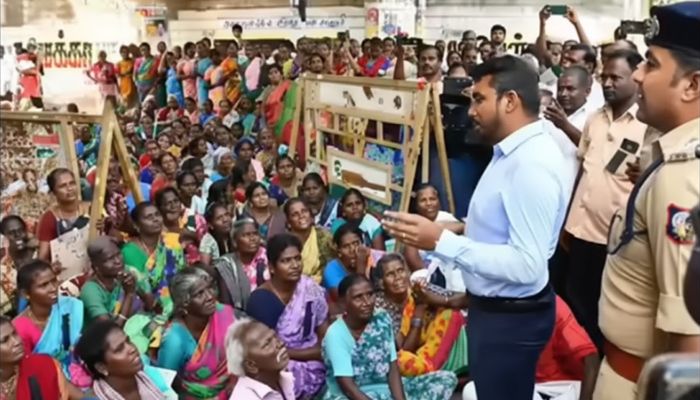
In the early hours of Monday, more than 500 Christian villagers, including women, gathered near the Dindigul collector’s office. They were unhappy with the decision that they intended to hand over their government-issued identity cards, like Aadhaar and voter IDs, as a sign of protest.
They blocked the main road leading to the collectorate and raised slogans condemning the district administration officials. The situation was tense, and more than 100 police personnel had to be deployed to manage law and order.
Later in the day, Dindigul’s District Collector, S. Saravanan, and the Superintendent of Police, A. Pradeep, held talks with the protesters. They managed to pacify the crowd, and after these discussions, the protest was withdrawn. However, this wasn’t the end of the matter. A senior police official confirmed that a case had been registered against 100 people for a related protest they had held at the event site on Sunday night, where they used black flags.
How the dispute started
The story begins with the local Hindu community in Panchampatti village planning their temple’s Kumbabishekam. Following the ceremony, they wanted to organise an annadhanam on a vacant piece of government land. This land just so happens to be located close to both the temple and a local church.
When they first asked for permission, the local authorities, including the police and revenue officials, said no. They denied the request, likely fearing it would cause trouble.
However, a resident felt this was unfair and decided to challenge the rejection in court. The case went to the Madurai Bench of the Madras High Court. The police argued to the court that they refused permission because they were afraid it would create “law and order issues.”
A clear judgment: Public land cannot be reserved for one religion
The court, led by Justice G.R. Swaminathan, looked at the case very carefully. He first asked the most important question: Who owns the land? He found that the open space was listed as a vacant site or gramamatham, which means it is owned by the Panchayat, and therefore, by the government.
Based on this, Justice Swaminathan gave a very important and clear judgment. He stated that if land is owned by the government, it should be available for all sections of society, no matter their religious background. He said, “A public ground should be available for the use of all communities or none.”
The judge held that if a public ground is open to the general public, you cannot exclude one particular group from using it. If the only reason for keeping them out is their religion, then it is a clear violation of Article 15 of the Constitution. The judge also said that the right to hold this feast comes under Article 25.
He flatly rejected the “law and order” excuse from the police and explained that it is the duty of the police to protect a person’s rights and deal with any issues that arise. They cannot simply ban an event to avoid trouble.
What the Christian community argued
During the hearing, the Christian community’s side was also heard. They argued that a stage was built on one side of the ground about 100 years ago. It was a long-standing convention, they said, that this stage would be used by the local Christian community for holding programs during the Easter festival. They argued that Hindus were never allowed to use that ground for any of their religious functions.
They even brought up a “peace committee meeting” from 2017, which had supposedly decided not to allow any new functions on the ground, only those that had been traditionally permitted for the past 100 years. This was also a key point of the protest on Sunday night: the protesters demanded that the public ground be called a ‘pascha ground’ (Easter ground) on the event invitations, which highlights their claim to it.
The judge did not accept this argument. He explained his reasoning very clearly: He could not accept that Christians are allowed to use the ground for Easter, but Hindus are not allowed to use the very same place for Annadhanam. He did add, of course, that when the Christian community is holding its Easter celebrations on a specific day, they alone should be allowed to use it, and anyone else asking for it on that same day should be refused.
The judge noted the village’s population was about 2,500 Christian families and only about 400 Hindu families, and said the police simply citing the Christian community’s opposition as the “law and order situation” was “a very sorry state of affairs.” The court threw out the rejection order and told the local authorities to grant permission for the feast.
A question of rights on government land
The High Court’s order was clear, but the protest that followed shows the deep tensions. This incident has raised a major question: Why did the Hindu community have to fight all the way to the High Court just to hold a one-day community feast on government land?
Even after they won a clear order from the court, they were met with a massive road-blocking protest. This is what many are calling a case of “exclusivity,” where one group feels they have sole rights over public property.
The key point here is that the land isn’t private church property. It’s public, government land. In principle, government property belongs to all citizens, Hindu, Christian, Muslim, or anyone else. Every community should be able to use it for their social and religious activities, as long as they are peaceful and don’t interfere with others.
In a diverse country like India, with so many religions living side-by-side, mutual respect is the only way forward.
There’s also the issue of the protest itself. While everyone has a right to protest, blocking main roads and stopping traffic causes huge problems for ordinary people just trying to get to work, go to the hospital, or live their lives. It punishes the general public for a dispute they have no part in.
Similar Case: The Bombay HC’s ruling on Vishalgadh Fort
This Dindigul incident isn’t the only one of its kind. A very similar case recently happened at another famous site in Tamil Nadus Thiruparankundram Murugam Temple Hill.
The hill is incredibly sacred to Hindus, as it’s one of the Arupadai Veedu, the Six Holy Abodes of Lord Murugan. The controversy started on 27th December, 2024, when some Muslims tried to bring goats and chickens to the Sikkandar Badusha Dargah, which is also located on the same hill, with the intention of slaughtering them.
Police and temple officials stopped them, declaring that animal sacrifice was not allowed in an area so close to the holy Murugan Temple. This led to a protest by more than 20 Muslims at the base of the hill. This dispute also ended up in the Madras High Court. And just like in the Dindigul case, the court had to step in to make things clear.
Justice Vijayakumar looked at all the government and archaeological records, some going back to 1908. He ruled that the site’s official and historical name is Thiruparankundram Hill. He said that attempts to call it “Sikkandar Malai” were mischievous and an attempt to change its real identity.
The court ruled that animal sacrifices are not permitted at the dargah. It noted there was no proof that this was an essential religious practice for them.
The court also clarified that while the Muslim community had rights to a small part of one area, Nellithoppu for prayers during Ramzan and Bakrid, the steps leading up to it, and to the Kasi Vishwanathar Temple on the hill, belong to the temple and cannot be blocked.
The common thread
Looking at both the Dindigul feast and the Thiruparankundram Hill case, a clear pattern seems to be emerging.
In both situations, the Hindu community’s right to use public land (Dindigul) or protect the sanctity of their holy site (Thiruparankundram) was challenged by another community. In Dindigul, it was a protest over a community feast. In Thiruparankundram, it was an attempt to perform animal sacrifice on a sacred Hindu hill.
And in both cases, the Hindu community had to rely on the High Court to step in and save their rights. The Dindigul incident shows that even a direct court order wasn’t enough to stop major protests, highlighting just how fragile the situation on the ground remains.
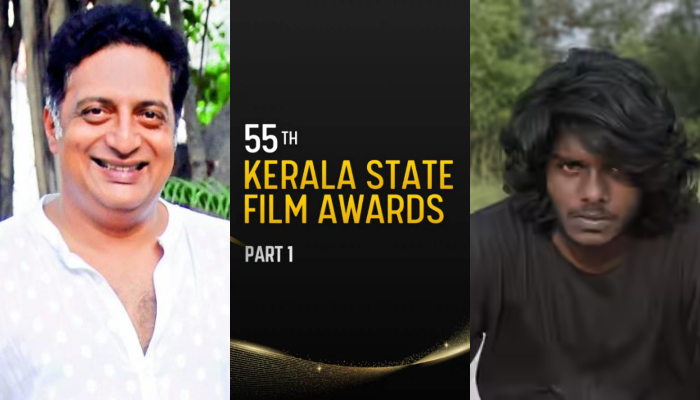
The decision to award rapper Hirandas Murali (30), better known by his stage name Vedan, best lyricist at the 55th Kerala State Film Awards on 3rd November has sparked a severe backlash and drawn condemnation. The anti-Hindu and controversial actor Prakash Raj presided over the award jury.
Vedan, who gained the recognition for Manjummel Boys “Kuthanthram” song, has encountered many charges of rape and sexual abuse. The victim, a former medical student asserted financial exploitation and several assaults in Kochi and Kozhikode. Now, many have questioned the morality and legitimacy of the state awards in light of the developments, particularly as candidates used to be excluded earlier because of pending legal proceedings.
The committee could not “pretend not to see the energy and struggle for survival in his songs,” Prakash Raj claimed, brazenly defending the decision and characterising Vedan’s work as the “voice of today’s generation.” He further alleged, “Vedan’s music embodies the dreams and frustrations of contemporary youth. Rap is the modern expression of rebellion and resilience, it deserves recognition,” asserting that the panel evaluated creative merit rather than personal rows.
Film director Ranjan Pramod, director Jibu Jacob, screenwriter Santhosh Echikkanam, sound designer and director Nithin Lukose, playback singer Gayathri Ashokan as well as actor, writer and dubbing artist Baghyalakshmi constituted the jury.
Meanwhile, social media was soon inundated by netizens expressing their dissatisfaction and accusations aimed at the state government and Prakash Raj concerning their decision. An individual inquired as to why Vedan was even considered when the state’s purported policy is to exclude any candidate with criminal accusations.
Why was Vedan considered for awards? Thought it was state policy to exclude those who are accused in crime. I mean wasn't that one of the reasons #Kammarasambhavam was sidelined!?? Just saying!#KeralaStateFilmAwards
Another criticized the government and raised concerns about the message it conveyed by awarding Vedan even before the court delivered judgment in his cases. The person also questioned the “feminists” regarding their silence on this issue.
What message are you sending to society by giving him the Best Lyricist award before a court verdict in his cases? Why are feminists silent on this? pic.twitter.com/vgNSWCwWKl
A user pointed out the hypocrisy, noting that although numerous women in Malayalam cinema raised alarm over honouring Vairamuthu who has been accused of sexual harassment, no one challenged Prakash Raj for awarding Vedan who faces similar allegations.
While many Women in Malayalam cinema questioned awarding Vairamuthu (accused of sexual harassment), no one questioned jury chairman Prakash Raj for awarding Vedan, who faces similar accusations from several women. pic.twitter.com/dpuMDQfPda
A person remarked that awarding Vedan, even with pending criminal cases involving sexual allegations from several women sets a troubling precedent and expressed, “Shame on Kerala government.”
Shame on Kerala Govt! Honoring rapper Vedan with Best Lyricist award at State Film Awards despite pending criminal cases from sexual allegations by multiple women? Apology or not, this sets a dangerous precedent. Credibility zero pic.twitter.com/ZAXjchcmrq
A netizen stated that Vedan, a rapper recently apprehended for rape and possession of MDMA, received the award for best lyricist while a hijabi Muslim actress won the best actress award for her debut film, emphasizing how the awards have been influenced by leftist politics rather than merit.
Best Actress: Shamla Hamsa- a Muslim woman, always seen in hijab, wins for her first-ever film
Best Songwriter: Vedan- a rapper recently arrested for rape & possession of MDMA
These are this year’s Kerala State Film Awards — courtesy CPM Govt.
Congress MP Hibi Eden openly the rapper while others voiced displeasure and rage, arguing that it sent a negative message to society. Women’s organisations and feminist organisations have also been accused of keeping a “conspicuous silence” on the matter.
Vedan’s contentious history intertwined with grave accusations
A woman accused Vedan of sexual assualt between 2021 and 2023 in the name of of marriage, according to a police complaint submitted in July 2025. “We recorded his arrest after a thorough interrogation using a special questionnaire. We have also obtained digital evidence supporting the allegations,” informed Kochi city police.
The case started with a complaint from a female doctor who reported that Vedan feigned to befriend her, formed a relationship with her and then sexually assaulted her five times over the course of two years in the name of marriage. Additionally, she revealed that he took money from her under the guise of releasing a song. He was evading capture for several weeks and a look out notice was published against him to prevent him from leaving the country.
He faced similar accusations from two other victims. One woman unveiled that she approached Vedan while pursuing research in music. He then made sexual advances towards her in a hotel room after which she had to stop her work owing to the trauma. The second woman reported to have met Vedan at her friend’s house. She grew closer to him as a result of his music and political stance.
However, he proceeded to sexually harass her several times. Chief Minister Pinarayi Vijayan received their complaints via email. According to one of the allegations the assault happened in 2020 and the second incident took place in 2021.
Furthermore, Vedan was arrested in April for marijuana possession. The drugs were found when the Hill Palace police raided the rapper’s flat in Kochi’s Vyttila. An officer disclosed, “Vedan has admitted that he has been using drugs. We seized around 6 grams of marijuana from the apartment. We have recorded his arrest, and he will be released on station bail as the quantity of drugs seized is minimal.” A charge sheet was also submitted by the Hill Palace police to the Judicial First Class Magistrate Court in Thripunithura, in September.
The forest authorities in Ernakulam also nabbed Vedan for wearing a pendant with a tiger tooth. He was given a two-day remand in the forest department’s custody after appearing before the Perumbavoor First Class Judicial Magistrate Court. He was also taken to the Kodanad Malayatoor Divisional Forest Office for interrogation.
Vedan was even charged with defaming Prime Minister Narendra Modi and encouraging caste-based divisions by Palakkad Municipality council member VS Minimol. “The artist has made unsubstantiated, disrespectful and offensive remarks about the Prime Minister, which not only malign his personal and political image but also undermine the dignity of the highest constitutional office in the country,” she highlighted in her complaint.
Vedan started his career in 2020 with “Voice of the Voiceless” album and became popular for his alleged “anti-caste” raps. He produced independent songs and albums in addition to his contributions to Malayalam movies. Interestingly, the awards transpired a few days after his anticipatory bail requirements were relaxed by the Kerala High Court, enabling him to perform overseas. A final report on the matter has already been issued by the Thrikkakkara police.
Notably, the Malayalam film industry has been shaken by serious allegations of rape and sexual assault involving prominent figures, sending shockwaves throughout Mollywood.
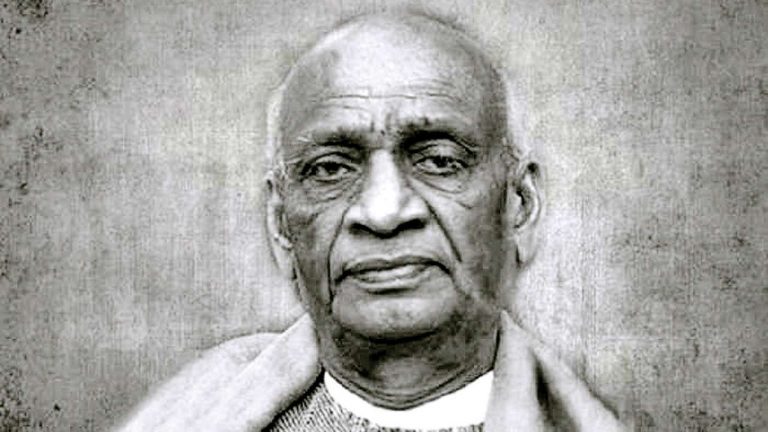
Sardar Patel had a deep and old connection with Gujarat’s Bhavnagar. The “Ironman of India” shared a great bond with Maharaja Krishnakumarsinhji. While Sardar Patel had many interesting memories associated with Bhavnagar, two of them particularly stand out. First, is important for the newly drawn map of the country after independence. But the other memory is one that is buried deep in a dilapidated memorial of Bhavnagar today. An incident worth remembering that has been forgotten.
It was 1939, Bharat was still under the British colonial rule. However, the Bhavnagar Rajvi had announced that Bhavnagar would be the first state to join independent India. Sardar Vallabhbhai Patel had increased his presence in Bhavnagar to discuss this issue. Meanwhile, on 14th and 15th May 1939, the fifth session of the Bhavnagar State Council was held at Bhavnagar under the chairmanship of Sardar Patel. Maharaja Krishnakumarsinhji had also extended an invitation to Sardar Patel.
Sardar Patel came to Bhavnagar on May 14th, 1939, accepting the invitation, and his procession started from the railway station in an open jeep. The Muslim League had already hatched a conspiracy to target Sardar Patel’s journey. Local radical Muslims, under the auspices of the Muslim League, had started preparations in the mosque and even planned to assassinate Sardar Patel.
The arrival of Sardar Patel and the deadly attack by Islamic fanatics
Sardar Patel was coming from the railway station in an open jeep, greeting everyone. As soon as the procession reached Khargate Chowk, a commotion started near Nagina Masjid. A large number of Muslim fundamentalists who were sitting in the mosque as part of a pre-planned conspiracy, brandished their weapons and came out and ran towards Sardar Patel’s jeep. The fundamentalists were moving towards Sardar Patel’s jeep with sharp weapons like swords, knives, axes and machetes.
However, before he could attack Sardar Patel, a young man from Kanbiwad, Bachubhai Patel, and Dakshinamurthy and Lokbharti founder Nanabhai Bhatt both climbed onto Sardar Patel’s jeep and became Sardar Patel’s shield. Meanwhile, all the blows of the Muslim extremists fell on these Hindu youths. Consequently, Bachubhai Patel was seriously injured and died on the spot. Nanabhai Bhatt was also shifted to the hospital for treatment and fortunately he survived.
As soon as the incident was reported, the police constables of Bhavnagar state reached the Nagina Mosque with spears and weapons and dispersed the crowd. But if these Muslim extremists had succeeded in their plan, the history of the country after independence would have been different. The attempt to assassinate Sardar Patel had left the city of Bhavnagar speechless and terrified. In the meeting of the council, Sardar Patel himself had said, “This is not an act done in a momentary rage, there is an intelligent conspiracy behind this that was planned in advance.”
‘The conspiracy was pre-planned’ – then police officer
A case was also filed in the then court of Bhavnagar in this entire matter. In which a total of 14 people were made accused. Their names are recorded as Waras Ali, Bilal Ibrahim, Abdul Sattar Musa, Abdullah Sidi, Usman Khan Mohammad Khan, Usman Nurmiya, Abdul Gafur, Abdul Kader, Aliwad, Musa Abdul, Kasam, Muhammad Suleman, Islamil and Alarakhan Ibrahim. On July 12th, 1939, the then newspaper ‘The Kathiawad Times’ published a detailed report based on the testimony given in the court by the then police officer Popatbhai.
Source: OpIndia Gujarati
In his testimony, Popatbhai told the court that before the program, some people from the Muslim League had submitted a petition demanding that musical instruments not be played. Later, it was found that the petition was written by a person named Abdul Kader Lakhani on the instructions of the Vice President of the Muslim League. Later, Popatbhai informed the secretary of the Parishad, Jadavji Modi, and asked him not to play musical instruments outside the Nagina Masjid. In addition, there was also talk of deploying a heavy police force there. Later, he also spoke to a prominent Muslim leader, Rajumiya, and Rajumiya assured him that the Muslims would not riot and that he would also be present at the reception of Sardar Patel on May 14th, 1939.
Source: OpIndia Gujarati
The following information is based on Popatbhai’s testimony in court:
On May 13th at 9:30 pm, the police were informed through telephone that weapons including sticks, swords and stones had been collected in the Nagina Mosque and that five hundred and one Muslims had also gathered. However, the police said that there was no basis for this information and therefore no order was given to raid the mosque. The next morning, Sardar Patel arrived in Bhavnagar. On the other hand, a heavy security force was deployed in front of the Nagina Mosque.
Source: OpIndia Gujarati
As mentioned earlier, even though no musical instruments were played in front of the mosque, the Muslim fanatics got angry and attacked the Hindus standing outside. A sound was heard, and immediately, Muslim fanatics from all sides attacked the Hindus standing there, shouting, ‘hit me, hit me’. The attackers came with sticks, swords, clubs, umbrellas and knives and started beating the Hindus.
Here, the police officers used their time and saved Hemkhem by requesting Sardar Patel to take another route. Later, more police force was sent and the situation was brought under control. Later, the rioters were also arrested.
Sardar Patel paid tribute to the departed
The Gujarat Mitra newspaper of May 21st, 1939 also talked about this incident and said that one volunteer died and many were seriously injured in the attack by Muslim fanatics. Due to this commotion, the program was also canceled and Sardar Patel was taken directly to his residence. After this incident, spearmen and infantry troops were deployed at important places in the city and Nagina Masjid was surrounded from all sides.
The police searched the mosque and recovered several weapons. Following this, several Islamists were arrested across the city. A number of injured men were taken to Sir Takhtsinhji Hospital and Sardar Patel also visited the men undergoing treatment in the hospital. Meanwhile, due to the intense heat, Maharaja Krishnakumarsinhji, who was staying in Mahuva, was informed about the incident.
Source: OpIndia Gujarati
A bandh was observed in the entire Bhavnagar in honor of Bachubhai Patel, who himself passed away after saving Sardar Patel’s life, and condolences were expressed. A funeral procession was taken out in the evening, in which more than 20 thousand people participated. Sardar Patel was also present during this. While paying tribute, he said, “Such deaths are rare.” Regarding the conspiracy of the Muslim League, he said, “I will not be afraid of such hooliganism in the sacrifice of national service.”
It was shocking that an attempt was made to assassinate Sardar Patel in a progressive and liberal state like Bhavnagar at that time. Had this attempt had been successful, Bhavnagar would have been blackened with national disgrace and the history or even the map of independent India would have been different. Such numerous conspiracies of the Muslim League have always been erased from history and due to this, such attacks on Sardar Patel are never known or read about anywhere.
(This report was originally written in Gujarati. Click this link to read it.)
Ever since the Mohammad Yunus-led interim government took control of power in Bangladesh, Hindus have been a constant target of Islamists. After a female Hindu journalist reported about the atrocities being committed against Hindu minorities in Bangladesh, Islamists have threatened to gangrape her. Her husband has also been assaulted, and instead of nabbing the Islamists, the police threatening the Hindu Hindus.
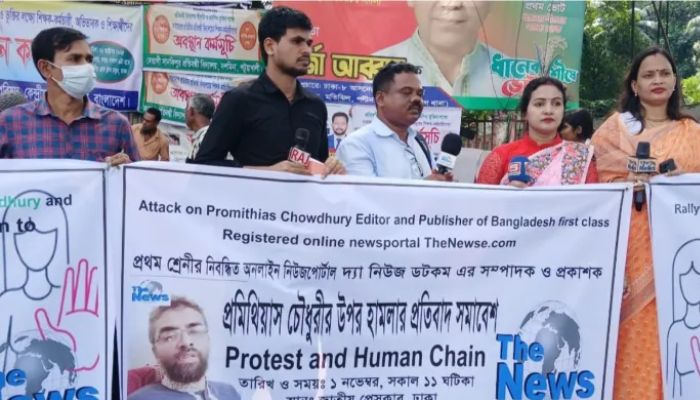
Promithias Chowdhury and his wife, Trina Roy Chowdhury, run a news portal in Bangladesh called TheNewse.com. Promithias is its editor and publisher, while Trina is the portal’s news editor. They live in West Goil village in Barisal district, about 150 kilometres from the capital, Dhaka. The couple has also established an ashram called Anand Lok, through which they help Hindus in the surrounding area. Their fierce journalism and support of Hindus have angered Islamic fundamentalists.
Bangladeshi Hindu journalist Trina Roy speaks to OpIndia about the Islamists targeting her
Speaking to OpIndia, Trina Roy Chowdhury said that she often clashes with local extremists, but on October 29th, things escalated to assault and rape threats. “On the afternoon of October 29th, my husband, Promithias, was called to Nazim Mulla’s shop by Nazim Mulla,” Trina Roy said.
She added, “Nazim and Promithias studied together and were friends, so he thought they were calling for a casual conversation. But when he arrived at the shop, Nazim was arguing with Shaheen over money. Nazim was demanding that Shaheen borrow 3.5 lakh taka.”
“When Promithias arrived, they confronted him. Nazim and Shaheen started saying, ‘You will give us money, you belong to ISKCON.’ When Promithias protested, he was assaulted. He was slapped and beaten.” Trina Roy says, “When Promithias told them, ‘I am your friend,’ they both said to him, ‘You are a Kafir Hindu, how can you be a friend? Bangladesh is ours; we are letting you stay out of kindness. Get out of Bangladesh,” Trina Roy continued.
Trina Roy further told OpIndia that the Islamic fundamentalists also threatened to gangrape her. “They also threatened to gangrape me. They told my husband, ‘Your wife is more dangerous, she doesn’t like us. Get her gangraped by Muslims, so she’ll start liking us and understand what we are,” she said.
The matter, however, did not end there. Promithias was assaulted, forced to sign a stamp paper, and a check was taken. Fakhrul Islam was present at the scene and provided instructions on how to torture Prometheus.
Why are Islamists enraged with the Hindu journalist?
Trina Roy explains that Islamists have a long-standing grudge against her and her husband. Recently, during Navratri, they had a clash with Muslims. She said, “Muslims came near the temple and started smoking cigarettes. When we objected, they resorted to violence and threats. The matter was later resolved after police intervention.”
Moreover, the Islamic fundamentalists in the neighborhood are irritated by their work for Hindus. According to Triya, as a journalist, she writes openly about the atrocities committed by Islamic fundamentalists in Bangladesh. Furthermore, she openly reports on the oppression of Hindus, which irritates the fundamentalists. Triya and Prometheus have done many such stories that have exposed the fundamentalists, and they are looking for an excuse to take revenge on them.
The Police are not helping: Trina tells OpIndia
Trina says she reported the matter to the police on October 29th, but the police have taken no action so far; instead, she is being threatened. “The station in-charge is Muslim, so he’s putting pressure on us,” she says. “When we included the ISKCON issue in our complaint, we were told not to mention it, as it could incite riots.”
She added said that instead of taking action on the complaint, the police have now threatened to file false charges against her husband. She said, “The police told Prometheus, ‘We will file a case against you, saying you are inciting people to demolish the mosque.’ This threat was given to silence us and prevent us from demanding action against Islamic fundamentalists.”
Bangladeshi Hindu journalist further stated that she her entire family are terrified because fundamentalists are keeping an eye on their home. Visitors are being monitored. On October 31st, when some fellow journalists were visiting her, they were also stopped by fundamentalists. They too were threatened. They were told that they would vandalize the house of the person they were visiting.
After this incident, several journalists have been protesting across various places in Bangladesh. They are demanding action against the accused, but the police have fallen on deaf ears. Women say that it has become increasingly difficult for them to live in Bangladesh. In recent years, attacks, rapes, and murders against Hindus and other minorities have been on the rise. The plight of Hindus in Bangladesh is worsening day by day.
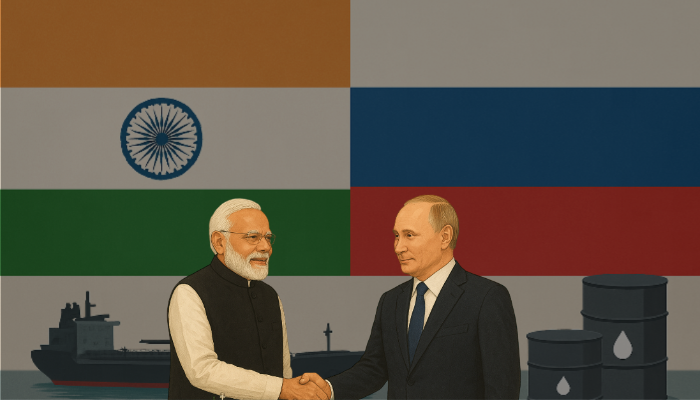
India’s importation of Russian oil has led to significant turmoil in international diplomacy, particularly concerning United States as President Donald Trumpimposed a 50% tariff, including an additional 25% for failing to comply with his demand to cease purchases. The White House and its officials implied a range of pressure tactics to influence New Delhi which did not relent.
Trump even claimed that Prime Minister Narendra Modi assured him he would halt energy purchases from Moscow, last month. However, Ministry of External Affairs (MEA) countered that no phone call took place between the two leaders. Now, preliminary ship-tracking data provided by Kpler and OilX suggested that India’s crude oil imports from Russia have grown in October relative to the prior month, serving as further evidence of the Modi government’s resolute stance in the face of persistent pressure from Washington.
According to Kpler data, India’s intake of Russian oil increased from 1.44 million barrels per day (bpd) in September to approximately 1.48 million bpd in October, reported Reuters. OilX estimated the supplies to be at the same level and disclosed that September imports were 1.43 million barrels per day. Russian-exported oil from Kazakhstan was not included in the figures.
Furthermore, India’s main refiner resumed the consumption of Russian oil, acquiring five cargoes for December arrival from non-sanctioned firms, according to the media house. According to one of the trade sources, Indian Oil Corporation (IOC), the nation’s largest refiner, purchased roughly 3.5 million barrels of ESPO (Eastern Siberia-Pacific Ocean) crude oil at prices equal to those from Dubai for delivery at a port in eastern India in December.
Anuj Jain, head of finance at IOC earlier mentioned that Russian oil continues to be available on the spot market at a discount of $2 to $3 a barrel to Dubai for transport to Indian ports, based on the media outlet. “We never stopped it (buying Russian crude). We are already buying for October, November,” he expressed and added, “There was a dip in buy because our inventory levels were high, so we wanted to optimise our inventory levels also. That was one of major factors.”
Procurement of Russian oil experiences monthly variations
The buying patterns varied each month and have not been uniform or similar. The ship monitoring data conveyed that the imports of climbed up during the first half of October, reversing a three-month decline in arrivals that occurred during July and September as refineries resumed operations to fulfil festival demand.
The imports fell from more than 2 million barrels per day in June to 1.6 million barrels per day in September. However, early October analysis pointed to a recovery as shipments of Russian grades, including Urals, to India increased due to shipping flexibility and new discounts amid weak demand in Western markets.
Global trade analytics company Kpler’s initial findings indicated that October shipments were tracking at about 1.8 million barrels per day up about 250,000 bpd from the previous month. Additionally, Indian refiners attested that they never received orders from the government to stop importing Russian oil.
India’s acquisition of Russian oil increased to 2 million barrels per day, in August as refiners maintained a focus on economic factors in their procurement choices. Russia accounted for up to 38% of the 5.2 million barrels of crude oil imported daily in the first half of August, per global real-time data and analytics provider Kpler. The imports grew from 1.6 million barrels per day in July to 2 million barrels per day.
Notably, the Trump administration issued an official notification slapping tariffs of up to 50%, which included a 25% penalty for obtaining Russian oil during the same month. According to the Helsinki-based Centre for Research on Energy and Clean Air, India received €2.9 billion worth of crude oil from Russia in August as compared to €2.7 billion in July.
IOC chairman Arvinder Singh Sahney outlined, “Neither we are being told to buy nor told not to buy. We are not making extra effort to either increase or decrease the share of Russian crude.” He further asserted, “Russian oil accounted for about 22% of the crude processed by IOC in April-June and the volumes are expected to remain the same in the near future.”
Trade sources and data unveiled that Indian appetite for fuel usually drops during the monsoon season and hence the country’s imports of Russian oil fell in July after soaring the month before as some refiners suspended purchases because of lower discounts, outlined Reuters. India grabbed 1.5 million barrels of Russian oil per day in July, a 24.5% decrease from the previous month.
34% of India’s total imports of 4.44 million bpd in July came from Russia. Reliance, the operator of the largest refining complex in the world, cut its purchases of Russian oil by almost 19% in July from a high base in the previous month, owing to the data which contributed to the decline.
Russian oil imports see steady increase for sometime
India’s imports of crude oil from Russia soared to an 11-month high in June, as domestic refiners expanded their purchases to boost stockpiles amid heightened geopolitical tensions between Israel and Iran, based on analysts. According to Kpler vessel tracking data, Russian oil imports to India were at the highest point since July 2024 in June, totalling 2.08 million barrels per day (bpd).
These were between 2.1 and 2.2 million barrels per day between 1st and 19th June, maintaining Russia’s share of India’s total crude imports at above 35%. “While India’s global imports of crude oil dropped by 6% in June, Russian volumes saw an 8% month-on-month rise to their highest levels since July 2024,” pronounced a European think tank named the “Centre for Research on Energy and Clean Air.”
According to Kpler, the sustained availability of Russian crude oil at lower prices than international benchmarks caused India’s imports to climb to a 10-month high of 1.96 million bpd in May, per a report in The Times of India. India, bought about 5.1 million barrels per day of crude during the month. Russia remained India’s largest supplier, making up more than 38% of all imports.
April witnessed a nine-month peak in Russian oil supplies to India, reported The Indian Express. Kpler stated that India’s imports of Russian oil increased 2.1% in April compared to March to 1.92 million barrels per day, despite the fact that overall oil imports plummeted 7.3% sequentially to 4.88 million bpd. The proportion of Russian crude in India’s oil import basket surged from 35.7% in March to 39.3% in April.
The data from analytics firm Kpler highlighted that India’s imports of Russian oil, primarily Urals crude, were 1.54 million bpd in March after dropping to 1.1 million to 1.2 million bpd over the preceding three months, revealed Reuters. Sources noted that greater supplies were available for Asian markets as a result of Turkey’s biggest oil refiner’s decision to stop importing Russian oil.
According to the sources, Russian oil discounts were down from approximately $2.50 to $3 per barrel last month to between $2.60 and $2.80 per barrel to dated Brent for cargoes loading in March for delivery to Indian ports in April.
The International Energy Agency informed that India has become the largest purchaser of seaborn Russian crude oil, acquiring 1.9 million barrels per day in the first nine months of 2025 or about 40% of Russia’s total exports after Western sanctions over 2022 Ukraine war. Domestic refineries then turn this crude into fuels like petrol and diesel.
Factors influencing the evolving purchasing behavior
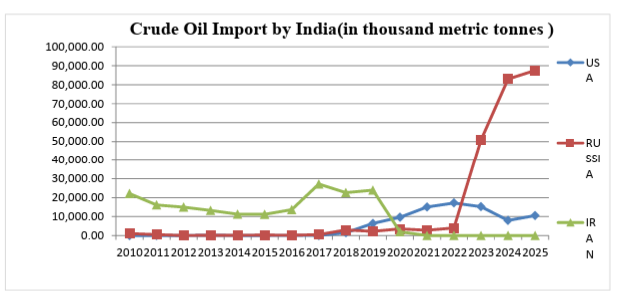
The shift in buying trends is apparent not only each month but also over the span of years. Ministry of Commerce and Industry informed that Russia was India’s top supplier of crude oil in 2024-2025, contributing around 36% of all imports, according to International Journal for Multidisciplinary Research. However, this was not always the case as Russia’s proportion of the nations that export crude oil to India was less than 1% in 2009-10.
Image via International Journal for Multidisciplinary Research
Only over 2% of crude oil imports came from Russia even in 2021-2022. The change was triggered by two factors. The first was the US embargo on Iran, which led to Iran’s percentage of India’s overall oil import basket to drop precipitously. The war between Russia and Ukraine which began in 2022 was the second reason. Diplomacy, energy trade flows and global energy dynamics transformed as a result of the conflict.
The previously mentioned reason was instrumental in India’s energy acquisition from Russia. Likewise, commercial, logistical and geopolitical factors contribute to India’s monthly fluctuations in its purchases of Russian oil with the economic considerations of Indian refiners playing a major role.
India’s Ministry of External Affairs explained its position on importing Russian crude oil in light of shifting dynamics in the world oil market. The altering dynamics of the global oil market have an impact on India’s decisions on its acquisition of crude oil. New Delhi stresses flexibility in energy procurement to satisfy the requirements of its 1.4 billion people and is even contemplating the effects of recent US sanctions on Russian oil corporations. The necessity to obtain reasonably priced energy from a variety of sources motivates Modi government’s strategy.
IOC head Sahney emphasised that Russian crude oil is bought for economic reasons. “We continue to buy, purely based on economic considerations, that is to say if the pricing and characteristics of the crude make sense in our scheme of processing, we buy,” he clarified.
Additionally, the reductions have narrowed to $1.5 per barrel which has resulted in lower imports in July, according to Vetsa Ramakrishna Gupta, Director (Finance) at Bharat Petroleum Corporation Ltd (BPCL). The discount fell substantially to $2.70/barrel in August while it was as high as $40/barrel.
Sahney pointed out that the discounts on Russian crude grades, such as Urals, could cause monthly fluctuations in purchase volumes and stressed that Indian Oil has not been told to cut or boost purchases in reaction to the US tariffs. It is clear that the US tariffs did not play any role and although the current sanctions on Russian oil companies could have an impact, the main impetus for these decisions is the economic feasibility.
More underlying reasons affecting the variations
Turnarounds or periodic maintenance are carried out in Indian oil refineries, which might temporarily lower their processing capacity and intake of crude oil. Monthly and refinery-specific variations in these maintenance schedules cause swings in the total demand for Russian crude.
Provisional government data showed that the crude throughput of Indian refiners fell 4.4% month over month to 5.27 million barrels per day (22.29 million metric tonnes), in August.
“Refinery throughput declined in August compared to July, primarily due to seasonal monsoon-related disruptions, scheduled maintenance shutdowns, and one of the refineries operating at reduced capacity,” voiced Prashant Vasisht, vice president and co-head of corporate ratings at Investment Information and Credit Rating Agency (ICRA).
India imported 18.6 million metric tonnes (MMT) of crude oil in July, a dip from 19.4 MMT the previous year, according to figures from the government’s Petroleum Planning & Analysis Cell (PPAC) owing to scheduled refinery maintenance shutdowns alongside relatively lower demand from the monsoon.
The availability of shipping and insurance services, among other logistical issues might be affected by sanctions or other market conditions, resulting in inconsistency. The Eastern Maritime Corridor between Chennai and Vladivostok serves as a prime example of a new route that would eventually affect viability as well as reliability and the same stands true for the Northern Sea Route.
The availability of shipping and insurance services, among other logistical issues might be affected by sanctions or other market conditions, resulting in inconsistency. The Eastern Maritime Corridor between Chennai and Vladivostok serves as a prime example of a new route that would eventually affect viability as well as reliability and the same stands true for the Northern Sea Route.
Indian refiners are aggressively diversifying their crude oil sources, looking into choices from other regions of the world to improve energy reliability and adaptability. This increases their pool of suppliers and inevitably also causes the monthly share of Russian oil to vary.
According to the Indian Ministry of External Affairs, protecting the interests of Indian customers in a volatile energy environment is New Delhi’s top priority. MEA spokesperson Randhir Jaiswal declared, “Ensuring stable energy prices and secured supplies have been the twin goals of our energy policy. This includes broad basing our energy sourcing and diversifying as appropriate to meet market conditions.”
Contracting for oil usually occurs four to six and even eight weeks as well as months before delivery. The volumes that arrive weeks later are determined by decisions made during these deals which are based on the pricing and conditions that are in effect at the time, adding to the monthly disparity in imports.
There are evidently numerous aspects and circumstances that account for the varying quantities of Russian oil arriving in India. Some play a critical role while others are secondary, yet they all impact the imports in one way or another.
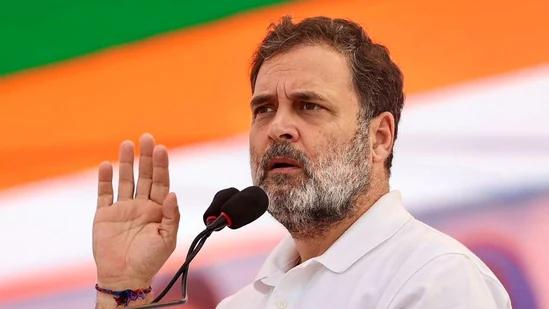
When Rahul Gandhi took the stage in Bihar’s Kutumba on November 4, 2025, he wasn’t speaking as a reformer addressing India’s economic or governance challenges. He was playing the part of a political provocateur, wielding caste as both shield and sword. His claim that “10 per cent of the country’s population controls the judiciary, bureaucracy, business and even the Army” was not merely a factual exaggeration; it was a deliberate act of fear-mongering. Gandhi’s remarks, aimed squarely at fuelling caste divisions ahead of Bihar’s Assembly elections, were less about social justice and more about electoral arithmetic.
Gandhi’s speech painted India in stark binaries: a privileged 10 per cent allegedly lording over the remaining 90 per cent, who he claimed were Dalits, Mahadalits, backward castes, tribals and minorities. He declared that the “most backwards” form the overwhelming majority of India, yet remain invisible in every sphere of power, from business boardrooms to army barracks.
“All the jobs go to them. They have control over the armed forces. You won’t find the remaining 90 per cent population represented anywhere,” he said. The phrasing was not accidental. It was calculated to incite resentment, to turn a complex social structure into a simplistic morality play where a small elite oppresses a vast underclass.
But politics built on grievance rather than governance eventually consumes itself. Gandhi’s claim was not backed by any credible data. There is no official caste-wise record of the Indian Army’s composition, nor any basis to assert that the judiciary or private industry is monopolised by a particular caste bloc. The Indian judiciary, for instance, currently has Justice B.R. Gavai, himself from a Scheduled Caste background, serving as Chief Justice of India. To say that Dalits or backward classes “have no representation” when the nation’s top judge comes from a marginalised community is not just inaccurate; it’s willfully misleading. It reveals not ignorance, but a conscious choice to twist reality for rhetorical effect.
Dragging the Indian Army into caste politics
More disturbingly, by dragging the Indian Armed Forces into this caste narrative, Gandhi crossed a line that even his political opponents have seldom breached. The Indian Army is one of the few institutions that has, for decades, stood as a model of unity beyond caste, religion, or region. Soldiers share rations and risk lives for each other, bound by uniform and duty towards protecting nation, not by social hierarchy. To insinuate that the Armed Forces is somehow “controlled” by a particular caste elite is to plant seeds of distrust where none existed. It undermines morale, disrespects service, and insults the very ethos of “Nation First” that defines our forces.
This isn’t the first time Rahul Gandhi has made such reckless remarks about the military. Only months ago, during his Bharat Jodo Yatra, he alleged that Chinese troops were “thrashing Indian soldiers in Arunachal Pradesh”, a statement that drew a stern rebuke from the Supreme Court. A bench led by Justice Dipankar Datta had then remarked, “If you are a true Indian, you would not say all this.” Clearly, the reprimand failed to instil any restraint. Gandhi’s latest comments are merely a continuation of that pattern: denigrating national institutions to serve a transient political narrative.
The deeper question, however, is why Rahul Gandhi persists with this divisive rhetoric. Bihar, with its entrenched caste-based voting patterns, offers a tempting laboratory for his experiment. The Congress, having lost its traditional appeal among upper castes and struggling to reclaim relevance in the Hindi heartland, has found in “caste consciousness” a convenient substitute for ideology. By amplifying the “90 per cent versus 10 per cent” narrative, Gandhi hopes to mobilise Dalits, Extremely Backward Castes, and minorities under the Congress umbrella. It is the politics of arithmetic masquerading as the politics of social justice. But it is likely to end up being a colossal failure, much like Mr Gandhi’s political journey thus far.
Undermining institutions, dividing India to reverse political fortunes
Nevertheless, the problem is that such politics corrodes the moral core of leadership. A genuine reformer would use data, policy and dialogue to address underrepresentation. He would advocate education reforms, targeted economic support, and inclusion programmes that uplift marginalised communities. Instead, Rahul Gandhi opts for a language of resentment. His words are not a call for reform, they are a declaration of division. In one sweeping generalisation, he has branded entire institutions as casteist and delegitimised the competence of thousands who have risen through merit, sacrifice, and service.
Ironically, this is the same leader whose party’s government in Karnataka has failed to make its own caste survey public. For all his fiery demands of a nationwide caste census, Gandhi’s own state units cannot demonstrate transparency or follow-through. It exposes the hollowness of his advocacy. When data doesn’t align with the narrative, Congress simply abandons the data. What remains is rhetoric. Loud, emotive, and manipulative.
The contradictions don’t end there. Rahul Gandhi’s lament about the “underrepresentation” of Dalits and backward castes in industry ignores the vast network of welfare schemes, reservations, and educational reforms that have been systematically implemented over decades, many of which were either initiated or supported by the same Congress governments he now accuses of perpetuating elitism. In fact, it is a scathing indictment of the reservations system, implemented under his party’s government after India became independent. Is he suggesting that reservations system has that his party leaders fleshed out hadn’t benefitted the marginalized community at all?
His father, grandmother, and great-grandfather presided over decades of Congress rule. If indeed only “10 per cent” control India, it happened under their watch. In effect, Rahul Gandhi’s speech was an indictment of his own political lineage. If one were to come at this conclusion, it is not the upper caste groups, but incompetent Congress leaders who should be held accountable for coming up with a system that has failed in its core objective: bringing equality and ensuring social justice.
Yet he appears unbothered by irony or accountability. His obsession with polarising narratives has become his only tool for political relevance. Bereft of economic ideas, administrative vision, or coherent ideology, he defaults to divisive themes where caste, religion, class, language are each wielded selectively depending on the state he’s addressing. In Kerala, he plays the secular progressive; in Karnataka, the OBC crusader; in Bihar, the caste warrior. The shape of his politics changes, but its essence remains the same: pit one group against another, and hope to reap electoral dividends from the chaos.
Sow social distrust and reap political dividends
What makes his latest attack particularly dangerous is that it normalises distrust in institutions. When a leading opposition figure tells citizens that the judiciary, the Army, and business are all “captured” by a privileged few, he is not just criticising the government; he is delegitimising the Republic itself. It erodes faith in the very systems that keep India stable and functioning. If people begin to believe that justice, defence, and governance are all caste conspiracies, what remains of national unity?
The caste faultlines Gandhi seeks to exploit are real, but they are not insurmountable. India’s trajectory since Independence has been one of slow but undeniable upward mobility across social categories. Educational institutions, public service commissions, and affirmative action policies have opened doors that were once sealed. Yet, progress does not make for good soundbites. For Gandhi, it’s easier to deny progress entirely, to declare that “90 per cent” are invisible and oppressed. That narrative may earn applause at a rally, but it insults the millions of Indians from humble backgrounds who have risen through hard work, education, and perseverance.
It is also telling that Gandhi’s idea of empowerment seems to rely entirely on victimhood. He speaks not of ambition or innovation, but of exclusion. He tells communities that they are not represented, that they are helpless, that the system is stacked against them. Such rhetoric breeds fatalism, not empowerment. A truly transformative politics would inspire people to transcend barriers, not wallow in them. But Gandhi’s speeches seem crafted to cultivate grievance rather than grit.
The Congress once prided itself as a party of national unity of bringing diverse strands of Indian society together under a common banner of nation-building. That vision has long since faded. Today’s Congress, under Rahul Gandhi’s stewardship, is a party that survives on identity politics, on fragmenting the social fabric into electorally convenient pieces. His “10 per cent vs 90 per cent” theory is not just a political argument; it’s a moral regression. It replaces aspiration with envy, solidarity with suspicion, and merit with group victimhood.
If the Congress were genuinely committed to increasing representation, it could have proposed data-backed reforms, perhaps an institutional audit, scholarship expansions, or training pipelines for marginalised candidates in civil services and judiciary. It could have offered constructive criticism of existing systems and suggested policy solutions. Instead, what we witnessed in Bihar was a speech crafted to inflame, not inform. It was theatre, not statesmanship.
Rahul Gandhi’s constant descent into divisive populism also reflects his deeper insecurity. Having failed to present himself as a credible alternative to PM Modi on matters of governance, economy, or foreign policy, he now seeks to become the voice of “the excluded”. But this voice lacks conviction and evidence. When a politician who comes from the country’s most elite political dynasty speaks of “10 per cent controlling everything,” it reeks of hypocrisy. Gandhi himself is the embodiment of privilege, a product of dynastic politics, not social struggle. To see him brand others as “elite” is almost comical.
Desperate for relevance, Rahul Gandhi turns caste into a weapon of political survival
Ultimately, Rahul Gandhi’s November 4 speech in Bihar is symptomatic of a larger malaise within the Congress ecosystem, a complete disconnect from ground reality. Instead of addressing issues like infrastructure, education, or job creation, Gandhi’s politics thrives on emotional manipulation. His call for an India where “90 per cent live with dignity” sounds noble until one realises he’s constructing that dignity atop falsehoods and insinuations.
In a country as complex as India, leadership demands responsibility. It requires empathy tempered by evidence, and criticism grounded in facts. Rahul Gandhi’s words fail this test on all counts. His “10 per cent” remark is not just misleading; it is corrosive. It insults the institutions that protect our democracy and denigrates the people who serve within them. Worse, it seeks to turn fellow Indians against one another on the basis of caste identity, a weapon as old as politics itself, and just as destructive.
Rahul Gandhi’s latest outburst should therefore be seen for what it is: not an act of courage, but of desperation. Unable to inspire confidence through vision, he resorts to sowing doubt through division. In doing so, he risks undoing decades of social progress achieved through dialogue, reform, and representation. His politics may win applause from a partisan crowd, but it does disservice to the idea of India as one nation bound by shared destiny.
For a man who claims to be “uniting India” through his travels and rhetoric, Rahul Gandhi seems alarmingly eager to divide it whenever elections approach. The “10 per cent versus 90 per cent” speech was not a gaffe; it was a glimpse into his political instinct. And that instinct, sadly, is not to heal India’s wounds, but to reopen them for votes.
In Gujarat, Aam Aadmi Party (AAP) leaders are holding daily press conferences, blaming the state government for ignoring farmers’ problems. They are asking why the relief package hasn’t been announced yet and are demanding quick results.
Poet Dushyant Kumar once said “सिर्फ हंगामा खड़ा करना मेरा मकसद नहीं, मेरी कोशिश है कि ये सूरत बदलनी चाहिए।” which trabslates to “creating chaos is not my goal, but to change things for the better“. Looking at AAP’s politics in Gujarat today, it seems the party’s goal is only to create noise. Instead of working for real outcomes.
AAP’s mixed history in Gujarat
Over the years, AAP has tried hard to gain a place in Gujarat politics. In the 2022 Assembly elections, the party made a big push but could win only five seats. Even those victories were more about individual candidates than the party’s strength. After that, the organisation has hardly been active. It has not made much impact in local or national polls. Now, with only two years left for the next Assembly election, the party seems to be trying again with a slightly changed strategy.
AAP seems to be running politics based on community targets. The Patidar community has always played a strong role in Gujarat’s elections. Farmers, too, are an influential group. Recently, AAP raised a big issue of “kad-da pratha” in the Botad APMC and organised what it called a “Kisan Mahapanchayat.” The event turned violent, and some AAP leaders ended up in jail. Many people who joined the protest are now seeking bail. Even when unseasonal rains hit Gujarat, the party turned it into another opportunity to target the government.
More focus on politics than solutions
AAP leaders often project themselves as the protectors of farmers, but they rarely talk about real solutions. Their actions clearly show that the goal is to turn farmers’ issues into political points. The reality of these problems and finding long-term answers don’t seem to interest them much.
The government’s ongoing survey on crop damage
At the end of October, several parts of Gujarat were hit by unseasonal rain and cyclone effects. Many farmers suffered heavy crop losses. Such situations have occurred before, and previous governments also took the necessary steps each time, since it’s the government’s duty to do so.
After such events, the process of paying compensation to farmers begins only after surveys are done. These surveys take time because Gujarat has 34 districts and thousands of villages. It’s not something that can be done overnight.
Right now, the survey is happening across the state. Ministers are visiting affected areas. Even Chief Minister Bhupendra Patel has personally gone to some villages to review the damage. The government has said that once the survey and reports are complete, it will announce a relief package for farmers without delay.
The state government has ordered surveys across all districts. Ministers in charge of each district are supervising them. Officials are visiting villages, working with sarpanchs and local leaders to assess the losses. Once all reports reach the government, the cabinet will decide the relief amount and how to deliver it to farmers.
AAP’s propaganda and misinformation
Meanwhile, AAP continues to hold press meets every day. They twist facts to show that the government is idle. They claim that without AAP’s pressure, farmers’ voices would go unheard. But even before AAP came into existence in Gujarat, surveys and relief packages were regularly done after crop loss.
AAP keeps demanding instant relief. But if the government had declared a package without a survey, these same leaders would have accused it of acting carelessly without understanding the ground reality.
AAP MLA from Visavadar, Gopal Italia, recently said that industrialists’ loans worth 16 lakh crore rupees were forgiven without surveys, but for farmers, surveys are required. The fact, however, is that these loans were not waived off; they were only written off. That means banks do not expect early repayment and remove the amount from profit-loss calculations. They can still recover the money through legal steps. The Finance Minister’s statement in Parliament had made this clear, but Gopal Italia left out that part since it didn’t suit his story.
AAP supporters and YouTube content creators recently tried another trick. When Gandevi MLA and minister Naresh Patel visited a damaged field, he said, “The crops smell so bad,” showing sympathy toward the farmers’ pain. But some self-proclaimed journalists cut the video, twisted it, and circulated it as if the minister was insulting farmers. Gopal Italia then made another video on the same, and AAP propaganda pages spread it widely.
The pattern is clear
All this clearly shows that AAP is trying hard to prove that it alone cares for farmers and that others are indifferent. In reality, the government is still in the middle of the survey process, which naturally takes time. AAP leaders, with little other work at hand, are simply busy holding press conferences and making noise.
It won’t be surprising if, on the day the government announces the relief package, the same leaders rush to take the credit. You can almost be sure of that.
(This report was originally written in Gujarati. Click this link to read it.)
On 3rd November 2025, Rashtriya Janata Dal supremo Lalu Yadav held a roadshow in the Danapur constituency in Bihar for his party’s MLA candidate, Ritlal Rai alias Ritlal Yadav. The RJD candidate is currently lodged in Bhagalpur jail. The out-on-bail RJD patriarch began his roadshow from Digha and ended it in Khagaul, covering 15 kilometres.
Lalu Yadav was accompanied by his daughter Misa Bharti. In an apparent bid to garner sympathy for Ritlal Yadav, the RJD candidate’s daughter also joined the roadshow. She has also been interacting with the media and seeking votes for her jailed father.
VIDEO | Bihar Elections 2025: RJD chief Lalu Prasad Yadav holds a roadshow in Danapur for party candidate Ritlal Yadav. The first phase of voting in the Bihar Elections is scheduled for November 6.#BiharElections2025#BiharElectionWithPTI
Ritlal Yadav contesting the Danapur assembly seat from jail: From don to politician
Ritlal Yadav, also spelt Ritlal Ray or Rit Lal Roy, has been incarcerated in Bhagalpur Jail since April 2025. Yadav is accused of demanding Rs 50 lakh and threatening a builder named Kumar Gaurav. An FIR was registered against Ritlal Yadav at the Khagaul Police Station. On 17th April 2025, Ritlal surrendered before the police and was sent to Beur Jail in Patna. Later, he was moved to Bhagalpur’s special central jail. In October, the RJD MLA came out in police custody to file his nomination from the Danapur constituency.
He's Ritlal Yadav.
He's RJD MLA & candidate from Danapur assembly constituency.
He's currently lodged in jail & so arrived in a jail van to file his nomination.
His arrest came days after Police Police, after a court order, conducted simultaneous raids at 11 of his locations linked to Ritlal Yadav. The police recovered lakhs of rupees in cash and blank checks worth Rs 77.5 lakh. During the multi-location raid, the police also confiscated Police around Rs 11 lakh in cash, a note-counting machine, three guns, old stamp papers, land-related documents, and blank checks from Ritlal Yadav’s residence.
The incarcerated RJD leader, for whom Lalu Yadav himself came out to seek votes, also has a case registered against him for allegedly killing BJP leader Satyanarayan Sinha in the Khagaul area during one of RJD’s rallies in 2005. The RJD candidate is booked in over 40 criminal cases, with charges including murder, extortion, rioting and criminal intimidation.
Lalu Yadav’s roadshow to garner support for Ritlal Yadav’s candidacy came after the Patna High Court denied Ritlal’s plea for temporary release to campaign in the assembly elections on 31st October 2025.
RJD patriarch Lalu Yadav’s roadshow in support of Ritlal Yadav comes across as a well-planned strategic move, as Ritlal’s victory will play a crucial role in paving the way for Misa Bharti’s political future. The Danapur assembly constituency is part of Misa Bharti’s Pataliputra Lok Sabha constituency, where she defeated Lalu’s son-in-law, Ramkripal Yadav, who has now joined the Bhartiya Janata Party (BJP).
The Yadav voters constitute approximately 22% of Danapur voters, followed by approximately 20% Forward Classes, approximately 15% Dalits, 20-25% EBCs, and 6-8% Muslims. Yadav’s vote seemed divided in Danpur as both BJP’s Ramkripal Yadav and RJD’s Ritlal Yadav enjoy support among their caste group. Lalu Yadav, who began his politics on Yadav caste supremacist politics and gave ‘Bhoora Baal Saaf Karo’, wanted to consolidate the Yadav votebank behind Ritlal Yadav.
Recently, Ritlal Yadav’s wife, Rinku Devi, came under investigation for campaigning for her husband even though she is a government school headmaster in Patna. Despite being a government servant, Rinku Devi was allegedly doing election campaigning for Ritlal Yadav during school hours.
Earlier in July 2025, authorities launched a probe against Rinku Devi for allegedly holding a partnership in a construction company in violation of service rules, as she is a government employee.
Hailing from the dominant Yadav caste background, which aligns with RJD’s core voter base and caste supremacist politics, Ritlal Yadav navigated his way to power after rising as a strongman/Bahubali in Patna’s Danapur. Despite his criminal antecedents, the 53-year-old RJD leader enjoys influence in Patna’s rural and semi-rural pockets, especially Danapur. This constituency has been politically volatile and has a history of caste-based as well as muscle-power-driven elections.
Ritlal Yadav’s journey began as a local don in the early 2000s during Lalu Yadav’s “Tel Pilavan, Lathi Ghumavan” rally. It was during this rally in July 2003 that BJP leader Satyanarayan Sinha, who unsuccessfully contested the Danapur bypolls that year, was killed near Jamauddin Chak on the Khagaul-Bihta Road.
Ritlal leveraged his Yadav caste and alleged control over lucrative resources like sand mining and land in Patna. Ritlal Yadav earned notoriety by clashing with BJP leaders and is accused of BJP MLA Satyanarayan Sinha.
Yadav surrendered before the 2010 assembly elections. Ritlal Yadav contested the election from jail as an independent candidate and lost. During the 2020 Bihar elections, Yadav was released from jail after a year and contested the election from Danapur on an RJD ticket. He registered a decisive victory over the BJP candidate. This win boosted RJD’s confidence in the ‘Bahubali’ strategy for reclaiming strongholds.
Although Ritlal Yadav was recently granted bail in the murder case of BJP leader Satyanarayan Sinha, he returned to jail in the extortion case and filed his nomination while in police custody.
According to his election affidavit, Ritlal Yadav owns assets worth Rs 13 crore. He is a 12th pass and faces multiple cases with charges ranging from criminal intimidation, extortion, dacoity-related sections, abetting or conspiring organised crime syndicates, murder, and undue influence in elections, among others.
In his affidavit, Ritlal Yadav has declared 11 pending criminal cases filed against him involving violations of laws pertaining to the Arms Act and the Money Laundering Act, among others.
Ritlal’s name has been linked to several other serious allegations, including the murder of railway contractors on a moving train in Bakhtiyarpur, the murder of his rival Chunnu Singh on the occasion of Chhath, land grabbing and illegal sand mining.
Back in 2023, Ritlal Yadav issued a controversial statement regarding the Ramcharitmanas. He claimed that the Hindu holy text was written in a mosque. He also accused the Bharatiya Janata Party of creating a rift in society in the name of Hindutva, saying that Hindutva wasn’t in danger back when the Mughals ruled over India for such a long duration
The don-turned-politician also has a knack for theatrics, and during a court appearance in July this year, Ritlal Yadav appealed for “euthanasia”, alleging that he faces threats from ‘powerful forces’. This sympathy-garnering tactic is also being employed by his family, who claim that the police are somehow threatening them against seeking votes.
#WATCH दानापुर (बिहार): राजद विधायक और प्रत्याशी रीतलाल यादव की पत्नी रिंकू कुमारी ने बताया, "मेरे घर पर बहुत सारी पुलिस आ जाती है और कहती है कि आप चुनाव प्रचार कर रहे हैं, धमकी देकर वोट मांग रहे हैं… मेरे बच्चों को भी बोल रहे हैं कि तुमको भी जेल में डालेंगे।" pic.twitter.com/KqhCiZjbrO
The Lalu family has long been shielding and fostering criminals for political gains. From Shahabuddin and Taslimuddin to Rajballabh Yadav and now Ritlal Yadav, the RJD continues its trademark politics of playing caste, violence and Bahubalis.