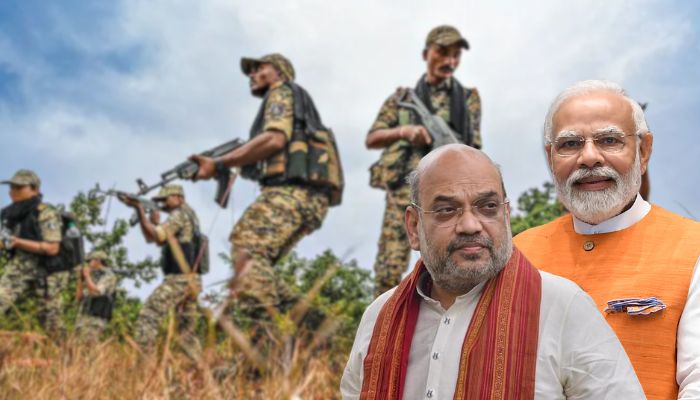
In a reply to an RTI filed by OpIndia, the Ministry of Home Affairs’ Left-Wing Extremism (LWE) Division revealed that funds worth over Rs 630 crore have been released to Naxal-affected states under the Special Infrastructure Scheme (SIS). The scheme is a key component of the Umbrella Scheme for Modernisation of Police Force (MPF).
This RTI reply has added a crucial layer to the picture that emerged from a previous revelation where MHA data showed thousands of Naxals surrendered or neutralised, and record anti-LWE operations since May 2014, when Prime Minister Narendra Modi took charge of office for his first term.
Together, the two replies illustrate how the Modi government’s strategy combined ground-level offensives with systematic modernisation of the state police apparatus.
What the RTI reply says
In its reply, the MHA said, “Under the umbrella scheme of ‘Modernization of Police Forces’, the state-wise and year-wise fund released to the LWE-affected states under Special Infrastructure Scheme (SIS) is enclosed as per Annexure ‘A’. The funds are released to the States after completion of approved projects and submission of the Bills to MHA, on a reimbursement basis. There is no concept of submission of Utilization Certificate by the States under the SIS scheme.”
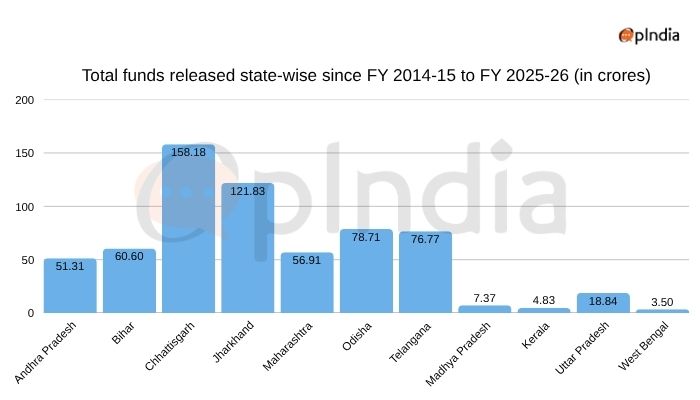
State-wise funds released under SIS (Source: Ministry of Home Affairs, LWE Division)
The details have been provided for ten states, including the most affected states such as Chhattisgarh, Jharkhand, Odisha, Bihar, Telangana, Andhra Pradesh, Maharashtra and West Bengal.
Chhattisgarh, Jharkhand among top beneficiaries
The data show that the bulk of allocations went to Chhattisgarh (Rs 158.18 crore) and Jharkhand (Rs 121.83). These two states have historically witnessed the highest Naxal activity. The funding pattern mirrors the intensity of operations on the ground, where these states also recorded the highest numbers of surrenders and encounters.
The consistent funding shows how central assistance has been used to strengthen Special Task Forces, training facilities, and communication networks in remote LWE-affected districts, improving coordination between central and state security agencies.
Funds linked to project completion and reimbursement
The Ministry of Home Affairs has clarified that the funds under SIS are released only after the states complete approved projects and submit bills for reimbursement. This ensures accountability and implementation-based release rather than upfront disbursement.
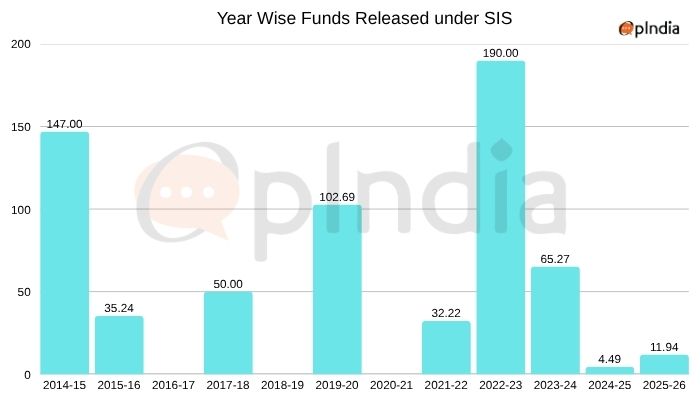
Year-wise total funds released by MHA under SIS. (Source: Ministry of Home Affairs, LWE Division)
The MHA also confirmed that no Utilisation Certificates are required under the SIS scheme, as funds are sanctioned post-verification of project completion. This model enables faster execution and avoids bureaucratic delays that often plague centrally sponsored schemes.
The Special Infrastructure Scheme explained
The Special Infrastructure Scheme (SIS) is designed to strengthen critical police and operational infrastructure in LWE-affected states. It covers modern weapons, fortified police stations, mobility, communication equipment, and specialised training for anti-Naxal operations.
According to information provided by the MHA in the Lok Sabha, SIS is implemented on a fund-sharing basis, out of which 60% is paid by the Central Government and 40% by the State Government. This scheme is being implemented as a sub-scheme of the Umbrella Scheme ‘Modernization of Police Forces’.
While the data on released funds show that a total of Rs 638.85 crore has been released, the MHA’s website clarifies that projects and works worth Rs 1,741 crore have been sanctioned. The sanctioned works include 306 fortified police stations, of which 210 have been constructed.
The information is in sync with the fact that SIS payments are released only after completion of the approved project. The SIS has been a key pillar in improving state preparedness against Naxal attacks, particularly in deep-forest and high-risk zones.
A decades-long war nearing its conclusion
Union Home Minister Amit Shah has, on several occasions, asserted that the menace of Naxalism will be completely eradicated by March 2026 under Operation Kagar. The RTI data accessed by OpIndia, from surrenders to sustained modernisation funding, clearly indicates that the government is progressing rapidly towards achieving that goal. Notably, HM Shah categorically denied requests for ceasefire and talks, pushing for either surrender or encounter of the LWEs, which has left virtually no room for Naxals to continue their armed movement.
The Yunus regime is not leaving any stone unturned to throw Bangladesh into the jaws of radical Islamism. A country, which once boasted of the songs of Kazi Nazrul Islam and Rabindranath Tagore, has now stopped the recruitment of music teachers.
The interim government headed by Muhammad Yunus has scapped the posts of assistant teachers for music and physical education in primary schools. The decision was confirmed by a gazette notification on Monday (3rd November).
Yunus has effectively amended the Government Primary School Teacher Recruitment Rules of 2025 and removed the positions for music teachers.
In a statement, additional secretary Masud Akhtar Khan stated, “Although the rules issued last August had four categories of posts, two categories have been included in the amendment. The posts of assistant teachers for music and physical education are not in the new rules.”
Mullahs up-in-arms against music
It must be mentioned that radical Islamist outfits in Bangladesh had been campaigning for the recruitment of Islamic scholars instead of music teachers.
Bangladesh Jamaat-e-Islami leader Mia Golam Parwar had lashed out at the decision to recruit music and dance teachers. He dubbed it ‘completely unacceptable’ and ‘suicidal move for the nation’.
Another Jamaat leader Mujibur Rahman called for recruitment of Mullahs in schools to teach ‘religion’ based on Dawra-e-Hadith degrees and Fazil degrees from madrassas.
Later, other radical outfits such Islami Andolon Bangladesh (IAB) and Khelafat Majlish conducted seminars denouncing music in schools as promoting ‘atheism’, making next generation ‘faithless’.
IAB’s Ameer Syed Rezaul Karim threatened to unleash chaos on the streets if Islamic scholars were not appointed as teachers.
Bangladesh Khelafat Majlish leader Maulana Jalal Uddin Ahmad claimed that absence of ‘Deeni Taleem’ in Bangladeshi schools was ‘shameful’ despite being a Muslim-majority country.
Yunus, who has a history of appeasing Islamists, gave in to their demands and sidelined music education and cultural inclusion in primary schools of Bangladesh.
Music is Haram in Islam
Music is considered Haram (prohibited) in Islam based on the sayings of the Prophet Muhammad (Hadiths) and certain Quranic verses.
Surah Al-Isra, Verse 64:
[In this verse, Allah warns Satan:] “And incite [to senselessness] whoever you can among them with your voice (bisawtika), and assault them with your cavalry and your infantry, and be a partner with them in wealth and children, and promise them. But Satan does not promise them except delusion.”
Surah An-Najm, Verses 59-61:
“Then at this statement do you wonder? And you laugh and do not weep, While you are engaged in vain amusement/ saamidoon (polytheists’ practice of singing, playing instruments, and making noise)?”
Sahih al-Bukhari:
The Prophet Muhammad said: “From among my followers there will be some people who will consider illegal sexual intercourse, the wearing of silk, the drinking of alcoholic drinks and the use of musical instruments (ma’aazif), as lawful.”
Sunan Ibn Maajah:
The Prophet said: “A people of my Ummah will drink wine, calling it by other than its real name. Merriment will be made for them through the playing of musical instruments and the singing of female singers. Allah will cleave the earth under them and turn others into apes and swine.”
Abdullah ibn Mas’ud (Companion of Prophet Muhammad):
“Singing germinates hypocrisy (nifaaq) in the heart just as water causes crops to grow.”
Muhammad Yunus and his appeasement of Islamic extremists
Bangladesh witnessed a drastic rise in Islamism after Yunus came to power. He first revoked the ban on the radical Islamist outfit ‘Jamaat-e-Islami.’
Thereafter, he released the leader of the radical outfit ‘Ansarullah Bangla Team (ABT)’ Muhammad Jasimuddin Rahmani.
At the same time, Muhammad Yunus downplayed the targeted attacks on the Hindu community by violent Muslim mobs. He has gone on record from lamenting about attacks on Hindus to saying that the claims of atrocities are ‘exaggerated‘.
In that way, the controversial US asset was able to placate Islamic extremists. Given that Awami Legaue was against Islamism, the interim government first banned its student wing ‘Chhatra League,’ and then the parent party.
Under the watch of Muhammad Yunus, Bangladesh saw a drastic rise in vigilante Muslim mobs, which unleashed violence under the pretext of protecting the tenets of Islam.
These mobs were largely unorganised and called themselves ‘Tawhidi Janata (meaning Revolutionary People).’ They came under the spotlight over acts of vandalism and harassment of people.
The Yunus regime introduced new textbooks for primary and secondary students, which falsely claimed that the first declaration of independence of Bangladesh was made by Ziaur Rehman (a favourite icon of Muslim hardliners in Bangladesh).
The interim government also appointed a Hizb ut-Tahrir terrorist named Mohammad Azaz as the administrator for the Dhaka North City Corporation (DNCC).
The situation had become so grim that Bangladeshi ambassador to Morocco Mohammad Harun Al Rashid was forced to slam the Muhammad Yunus-led interim government in a scathing Facebook post in March 2025.
Descent of Bangladesh into the darkness of Islamism
In July this year, the ‘Bangladesh Bank’ gave a Talibani farman (diktat) barring female employees from wearing ‘short dresses’, ‘short sleeves’ and ‘leggings’. The directive by the Central Bank of Bangladesh also recommended that women wear headscarves and hijab.
‘Bangladesh Bank’ also warned of disciplinary actions against employees who refuse to adhere to the new guidelines. The outrageous directive has drawn flak from women groups.
Fauzia Moslem, who serves as the President of the Bangladesh Mahila Parishad pointed out, “I’ve never seen such a directive before. But considering everything happening now, it’s not hard to guess why this guideline was introduced. A certain cultural sphere is being shaped, and this directive reflects that effort.”
This diktat by ‘Bangladesh Bank’ bore an uncanny resemblance to the orders by the Taliban regime in Afghanistan, restricting women from wearing clothes of their choice. Islamists had previously unleashed havoc on university teachers in Bangladesh by labelling them as ‘anti-hijab.’
In July 2025, an Islamic outfit named ‘Jamaat-Char Monai’ announced its plans to turn Bangladesh into a Sharia-compliant nation like Afghanistan. It also vowed to follow the model implemented by the Taliban regime.
The organisation’s leader Mufti Syed Muhammad Faizul Karim declared, “If govt is formed by winning the national election, the Islamic Movement Bangladesh will introduce Sharia law in the country.”
In April this year, Muslims belonging to the radical outfit ‘Hefazat-e-Islam’ hung the effigy of a woman, stripped and defiled it with shoes to demand the abolishment of the Women Affairs Reform Commission in Bangladesh.
The incident occurred at the campus of the University of Dhaka near the iconic ‘Anti Terrorism Raju Memorial’ sculpture. In a deleted video shared by Khoborer Kagoj, Muslims were seen assaulting an effigy of a woman, defiling and kicking it and thrashing it with shoes to display their angst. The effigy of the woman was draped in a saree (the kind that Hindu women wear) with its hands tied behind.
In March 2025, a librarian at Dhaka University, identified as Asif Sardar Arnab, sexually harassed a female student. Although he was initially arrested, Asif was quickly released on bail.
He was cheered and greeted with garlands by a radical Muslim mob, aligned with his behaviour. In the meantime, the victim had been subjected to violent threats for speaking out against the accused.
Asif sexually harassed the female student, claiming that her dress did not ‘sufficiently cover’ her breasts. His action was praised by Muslims for enforcing Islamic morality.
Screengrab of the report
In January this year, a Muslim mob laid siege to the Tilakpur High School in Joypurhat district of Bangladesh. The extremists, comprising madrassa students, carried out vandalism to protest against a friendly football match between two women’s teams.
The match was scheduled to take place on 29th January at the playground of the Tilakpur High School between the Joypurhat and Rangpur women’s football teams.
In visuals that have surfaced on social media, the Muslim mob could be seen vandalising the tin fence of the school. Prior to carrying out the attack, they gathered outside the Tilakpur railway station and gave provocative speeches.
Muslims carry out vandalism, destroy tin fence of Tilakpur High School
The mob demanded the cancellation of the women’s football match, alleging non-observance of purdah. Thereafter, the extremists made their way to the Tilakpur High School and unleashed mayhem.
A radical Muslim declared, “I want to warn those who want to earn money by exposing our women. Be careful. Stop all women’s games in the future. If you don’t stop, then we will show our resistance.”
OpIndia had previously reported on the alarming rise of rape cases in Bangladesh under the watch of Muhammad Yunus. In the meantime, Islamists who committed heinous crimes against women were freed by the top court of the country.
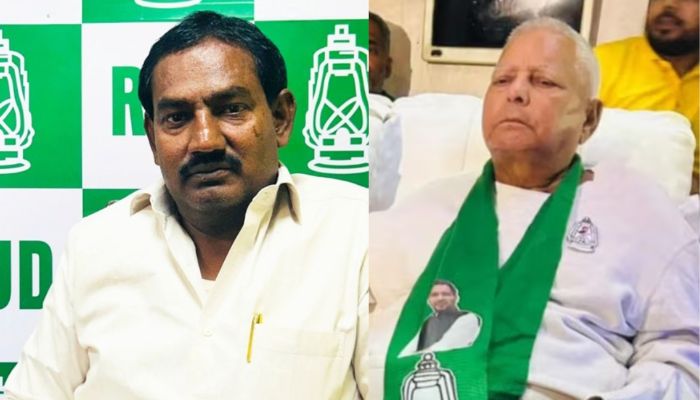
With each passing day, the Rashtriya Janata Dal (RJD) is making it clear that its agenda for the coming Bihar state assembly election is to bring back the wretched “Jungle Raj” era of the 1990s. After using songs glorifying guns, kidnappings and ‘Yadav’ supremacy, and re-mainstreaming the genocidal ‘Bhura Baal Saaf Karo’ slogan, RJD supremo Lalu Prasad Yadav is campaigning for his party’s jailed leader Ritlal Rai alias Ritlal Yadav.
On 3rd November 2025, Lalu Yadav held a roadshow in the Danapur constituency for his party MLA candidate, Ritlal Yadav, who is currently lodged in Bhagalpur jail. Starting from Digha and ending in Khagaul, the roadshow covered 15 kilometres. Lalu Yadav was accompanied by his daughter Misa Bharti and Ritlal Yadav’s daughter.
Notably, Ritlal Yadav is accused of demanding Rs 50 lakh and threatening a builder named Kumar Gaurav. An FIR was registered against Ritlal Yadav at the Khagaul Police Station. On 17th April 2025, Ritlal surrendered before the police and was sent to Beur Jail in Patna. Later, he was moved to Bhagalpur’s special central jail.
Ritlal Yadav, whom Lalu Yadav wants to be voted by the people of Danapur to serve them, also has a case registered against him for allegedly killing BJP leader Satyanarayan Sinha in the Khagaul area during one of RJD’s rallies in 2005. The RJD candidate is booked in over 40 criminal cases, with charges including murder, extortion, rioting and criminal intimidation.
RJD leader and former deputy Chief Minister of Bihar, Tejashwi Yadav, also campaigned for Ritlal Yadav separately.
Many of the locals of Danapur say that they have been victims of Ritlal Yadav’s network and fear over what would happen if he wins the election. Some say that since Ritlal became the MLA, crime and snatching have increased.
Despite his criminal background and bad image, Ritlal Yadav enjoys great influence in the RJD and such is Lalu Yadav’s political compulsion to make a proper balance of caste dynamics since Danapur has a significant Yadav population, mollycoddling criminal strongmen and winnability that he has no qualms in not only giving ticket to a person with 40 criminal cases against him but also do roadshows for him with family.
Mohammad Shahabuddin then, Ritlal Yadav now: RJD’s playbook of backing vote-multiplier criminals
This, however, is not surprising given Lalu Yadav has built much of his political empire on the foundation that blends caste and crime. In fact, the higher the criminal records the better the prospect of getting ticket from the RJD.
Who can forget Mohammad Shahabuddin, the ‘Bahubali’ mafia from the Siwan constituency, who had over 40 criminal cases, including murder and kidnapping, against him. His crimes and terror did not deter Lalu Yadav’s steadfast support from the 1990s through the 2000s. Mohammad Shahabuddin was not only tolerated as a ‘Bahubali’ but the RJD also used him as their vote multiplier, who delivered the loyalty of his supporters, mobilised Muslim votes for Lalu’s party in exchange for impunity during the infamous ‘Jungle Raj’ when Lalu Yadav was the Chief Minister of Bihar.
Shahabuddin was a former member of the National Executive Committee of the Janata Dal and the Rashtriya Janata Dal. He was disqualified from contesting elections following his conviction for the kidnapping and disappearance of Chote Lal Gupta, an activist of the Communist Party of India (Marxist–Leninist) Liberation, for which he was serving a life sentence. He was also accused of killing 15 other Communist Party activists, including the former student leader Chandrashekhar Prasad.
RJD leader Mohammad Shahabuddin ran parallel government with impunity since he had the blessing of Lalu Yadav. He was resolving family and land conflicts through khap panchayats, setting the costs for medical consultations and mediating marital disagreements.
Shahabuddin kidnapped Girish and Satish, the two sons of Chandrakeshwar Prasad, also known as Chanda Babu, for refusing to pay extortion money and for refusing to hand over their land to Shahabuddin. They were then taken to Shahabuddin’s mansion in Pratappur, his village. The brutal orgy that unfolded there on August 16, 2004, shook the entire nation. The two brothers were doused with acid until they died in agony.
Chanda Babu’s third son, Rajiv Roshan, was a witness in this case, but he was also murderedon his way to court. An FIR was filed based on the complaint of Kalavati, the mother of the three sons. However, it took five years for Shahabuddin to be named as an accused in this case. Eventually, Shahabuddin and the other accused were sentenced to life imprisonment. The case went through the local court and the High Court and then reached the Supreme Court, where, within minutes, then-CJI Ranjan Gogoi dismissed Shahabuddin’s petition and upheld the verdict.
Back 2005, Shahabuddin’s home in Pratappur village was raided by the police, and the authorities recovered AK-47s as well as other military hardware that could only be obtained by the army, such as night-vision goggles and laser-guided guns. Shahabuddin’s connection with Pakistan’s intelligence agency, ISI, also emerged as several of the weapons had the marks of Pakistani ordnance companies. The police also accused him of having links with underworld don Dawood Ibrahim and Pakistan-backed Kashmiri Islamic terrorists.
However, Shahabuddin was not the only ‘Bahubali’ the RJD backed. Mohammad Taslimuddin also ran his fiefdom with impunity in the Lalu Raj. Taslimuddin also served as a union minister both under HD Deve Gowda and Manmohan Singh’s governments. Mohammad Taslimuddin, however, terrorised the local authorities, ostensibly taking up issues of the oppressed, until they finally attached his land in Araria.
Taslimuddin had over sixteen cases of rape, dacoity, arson, and robbery filed against him. At least sixteen cases of rape, dacoity, arson, and robbery were submitted against him. An eyewitness disclosed that the MP and two associates brought a young Santhali girl home, drank wine and “then did the wrong things with the girl all night” in one of the unlawful detention files filed under Indian Penal Code 342. He was booked on charges of cheating, forgery, criminal conspiracy (IPC 419, 420, 467, 468, 471 and 120-b), rape and dacoity.
Rabri Devi, who once succeeded her husband Lalu Yadav as Bihar’s Chief Minister, backed her party’s rape-accused MLA Rajballah Yadav. In 2018, a special court in Patna pronounced Rajballabh Yadav and five others guilty of luring and raping a 15-year-old girl in February 2016. The politician was convicted under various sections of the Indian Penal Code and the Protection of Children from Sexual Offences (POCSO) Act.
The victim was forced to watch porn videos and raped. However, displaying peak shamelessness and support for even rapists, Rabri Devi defended Rajballah Yadav while campaigning for his wife, who was contesting from the Nawada Lok Sabha seat in the 2019 general election. She claimed, “The way Raj Ballabh ji has been convicted and he has been set up by those who wanted to spoil his name, thus Vibha Devi (Raj Ballabh’s wife) is the candidate, and we have to help her win. We have to make her win.”
He surrendered before the police, and after a brief hearing held in the Nalanda court, he was released on bond. RJD expelled the legislator after a major uproar to save itself from embarrassment; however, he immediately arrived at Lalu Prasad Yadav’s Patna home after bail to seek his counsel. Rajballabh Yadav never ceased to enjoy Lalu family’s support despite his criminal activities and conviction in a rape case.
Rajballabh Yadav was not the only rape accused individual the Lalu family backed. In fact, Rabri Devi’s brother Sadhu Yadav was also accused of involvement in the Shilpi-Gautam murder case. The Shilpi-Gautam murder case shook the Bihar government of the time. The case was finally closed as a double suicide, although many remain unconvinced with the investigation.
The 23-year-old Shilpi Jain and her alleged boyfriend Gautam Singh went missing on 2nd July 1999, and the next day their dead bodies were found in a semi-nude state inside a car in a parking near quarter number 12, Frazer Road, Patna. This quarter belonged to RJD leader Sadhu Yadav. The police investigation and handling of this case came under serious questioning. Even before the police could secure the crime scene, the supporters of the MLA reached the scene and created a ruckus. The CBI asked for the DNA sample of an MLA, who refused to provide the sample. It is suspected that the politician was Sadhu Yadav.
Back in 1994, a Dalit Hindu girl who was sleeping with her mother in the residence under the Triveniganj police station area was visited by Yogendra Narayan Sardar. He abducted her in his car and gangraped her along with other accused.
The discussion around Lalu Yadav’s Jungle Raj and his constant backing of rapists and criminals is incomplete without mentioning the Champa Biswas rape case. One of Lalu Yadav’s close aides and son of Hemlat Yadav, the then chairperson of the Social Welfare Department, where IAS BB Biswas was also posted, Mrityunjay Kumar Yadav and his friends were accused by an IAS officer of raping his 30-year-old wife, Champa Biswas. It was also alleged that the accused RJD leader also raped her mother, her sister-in-law, two maids and a niece. Champa was subjected to sexual assault multiple times.
Another of Lalu Yadav’s close aides convicted of rape was Yogendra Narayan Sardar, who was an MLA from the Janata Dal. Sardar’s conviction happened in 2020 in a 25-year-old Supaul gangrape case. A district court convicted former Janata Dal MLA Yogendra Narayan Sardar, his son Uma Sardar, Shambhu Singh and Bhupendra Yadav, also known as Bhupen Yadav of violating Sections 376 (rape), 366 (kidnapping), 458 (home trespass), and 324 (voluntary inflicting pain) of the India Penal Code and sentenced them to life in jail. While the lower court convicted Mrityunjay and his mother Hemlata, the High Court acquitted them as the witnesses on Champa’s side backtracked from their statements.
The relationship between criminals and the RJD has only grown stronger and extended to family as in the 2025 Bihar elections, Lalu Yadav’s heir-apparent, Tejashwi Yadav has fielded Osama Shahab, the son of Mohammad Shahabuddin from the Raghunathpur constituency.
Taking his criminal father’s legacy forward, Osama Shahab is accused of involvement in criminal activities. Osama was released from prison only last year, in 2024. The first case was registered regarding 42 kattha land in Chhapiya Buzurg, Hussainganj police station area. Subsequently, an FIR was filed against Osama in Motihari for firing at his brother-in-law over a land dispute. Meanwhile, in 2023, Osama was detained by traffic police in Kota, Rajasthan.
Then, the Hussainganj police arrived in Kota, arrested Osama, and brought him back. He was produced in court in the firing and land dispute cases filed against him. The court sent Osama to the divisional jail. A few days later, Osama was granted bail in the Hussainganj case. However, he remained in jail in the Motihari FIR. His bail plea in this case was rejected in the Motihari Civil Court, after which he was granted bail by the Patna High Court. Osama was finally released from jail in 2024 and is now contesting the election from Raghunathpur on RJD’s ticket.
Recently, a supporter of Osama Shahab, while speaking to OpIndi, said that if the boy who allegedly burnt an ‘I Love Muhammad’ poster was found, Osama Shahab would burn him alive. RJD leaders jumped in to defend Shahab and called him a ‘people’s leader’.
However, RJD and Lalu Yadav’s embrace and endorsement of criminals are not outliers but the norm. Not to forget, most of the RJD candidates in the 2025 Bihar elections carry pending criminal cases.
It is evident that the RJD wants to bring their Jungle Raj of the 1990s back in Bihar. Casteism, glorification of violence and kidnappings, to giving tickets to jailed and accused criminals, RJD has played all its Jungle Raj era cards for the coming elections. However, it is not shocking that Lalu Yadav, who himself was convicted by the court in the Fodder Scam and other corruption cases, is backing criminals.
During 15 -year RJD rule in 1990s and early 2000s, law enforcement collapsed, crimes became rampant, economy decayed, kidnappings for ransom became a thriving industry, mass murders, caste clashes became the new normal. Apparently, by supporting criminals, Lalu Yadav is telling the people of Bihar that his party wants to bring Jungle Raj era back in the state. It remains to be seen what choice the voters make in the coming elections.
In a shocking late-night incident, an Indian Army jawan was fatally stabbed aboard the Jammu Tawi–Sabarmati Express (Train No. 19224) while the train was passing through Rajasthan’s Lunkaransar station in Bikaner district.
The accused, identified as train attendant Juber, allegedly attacked the soldier following a heated argument over a blanket request.
According to the First Information Report (FIR No. 0094/2025) lodged at the Government Railway Police (GRP) Station, Bikaner, the complaint was filed by Devkishan Saran, a Travelling Ticket Examiner (TTE) posted at Bikaner Headquarters. The incident took place around 11 p.m. on November 2, and the FIR was officially registered at 5:45 a.m. on November 3.
As stated in the FIR, TTE Devkishan was on duty on the Sabarmati Express between Bathinda and Bikaner, covering coaches SE-1, SE-2, S-1, S-2, and S-3. When the train departed Lunkaransar station, the pantry car manager, Shiv Kumar, rushed to him, reporting that a violent scuffle had broken out in coach S-2 between a passenger and an attendant from AC coach B-4. On reaching the spot, Devkishan found a man lying unconscious and bleeding heavily between seat numbers 9 and 14 of the sleeper coach.
The pantry car manager informed him that the injured passenger had been involved in a fight with the AC attendant named Juber. On checking the passenger’s ID, the TTE identified the victim as Jigar Kumar Chaudhary, a 27-year-old Indian Army jawan who was travelling from Firozpur Cantt in Punjab to Sabarmati in Gujarat. He was assigned seat number 12 in coach S-3. Devkishan immediately contacted the Commercial Control Office at Bikaner and requested the presence of RPF personnel and medical assistance at the next stop.
When the train reached Bikaner Junction around 1 a.m., the RPF, GRP officers, and a medical team were already waiting. A doctor examined Jigar and declared him dead on arrival, confirming that he had suffered fatal stab injuries to his chest and abdomen. His body was later shifted to Prince Bijay Singh Memorial (PBM) Hospital in Bikaner for post-mortem examination.
The GRP team, led by Inspector Anand Kumar, immediately launched an investigation. All AC coach staff were deboarded and interrogated. Based on witness statements and physical evidence, the police arrested AC attendant Juber under Section 103(1) of the Bharatiya Nyaya Sanhita (BNS), 2023, which pertains to the offence of murder. The police later recovered a blood-stained knife, believed to be the weapon used in the attack, from the train when it reached Merta Road station in Nagaur district early Monday morning.
FIR reveals how the incident unfolded
The FIR’s narrative suggests that the incident stemmed from a seemingly minor argument. Around 12:30 a.m., Jigar Kumar reportedly approached the AC coach attendant and requested a blanket, as the weather had turned cold. The attendant refused, stating that the blankets were meant only for AC passengers. The refusal led to a verbal altercation that quickly escalated into a violent confrontation. In a fit of rage, Juber allegedly pulled out a knife and stabbed Jigar multiple times, leaving him bleeding on the coach floor.
The GRP Bikaner has since sealed the S-2 coach for forensic examination. An FSL team from Jodhpur has been assigned to inspect the compartment and collect biological and physical evidence. Statements from passengers, the pantry manager, and railway staff have been recorded to piece together the sequence of events. Authorities have also informed the Indian Army and the victim’s family in Gujarat, who are expected to arrive in Bikaner for the post-mortem and further legal formalities.
Inspector Anand Kumar, the investigating officer, confirmed that the accused attendant is in custody and being questioned about the events leading up to the murder. “We have recovered the knife used in the crime and recorded multiple eyewitness accounts. A detailed forensic and legal examination is underway,” he said.
The gruesome incident has raised serious concerns about passenger safety and the conduct of outsourced railway staff on long-distance routes. Railway officials have promised a comprehensive internal review of security protocols and staff vetting procedures following the shocking murder of a serving soldier aboard a moving train.
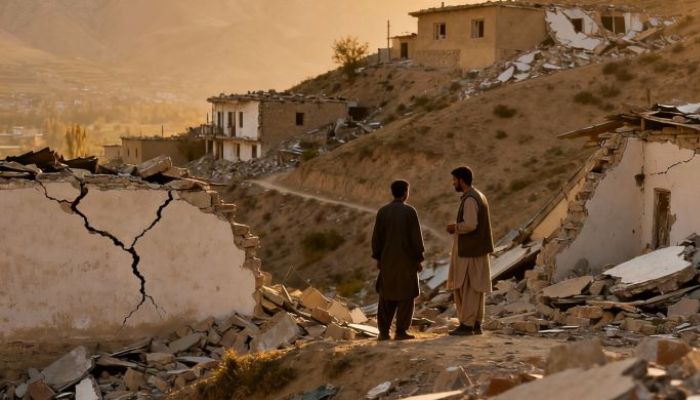
On Monday (3rd November 2025), a 6.3 magnitude earthquake struck Afghanistan. The epicentre was in the Kholm area near Mazar-e-Sharif in northern Afghanistan. The earthquake’s depth was reported 28 kilometres.
Seven people are reported to have died so far. In September, , a powerful earthquake struck eastern Afghanistan, killing 2,200 people. The tremors, which struck on 3rd November, were felt across Afghanistan as well as parts of Tajikistan, Uzbekistan, and Turkmenistan.
❗️?? – A 6.3-magnitude earthquake struck near Mazar-e Sharif in northern Afghanistan early on November 3, 2025, at a depth of 28 km (17.4 miles), affecting a city of about 523,000 people.
At least seven people were killed and around 150 injured, according to provincial… pic.twitter.com/p5pRRsX9iq
Between the years 2020 and 2025, Afghanistan has been struck by numerous earthquakes. Many of these were of magnitudes of 6.0 or greater. At least 50 earthquakes have been recorded in five years, according to geological agencies and news reports.
According to a Reuters report, at least 355 earthquakes with a magnitude of 5.0 or greater have struck Afghanistan since 1990. Over the past 35 years, earthquakes have killed more than 12,000 people.
Official statistics show that earthquakes kill an average of 560 people each year in Afghanistan, resulting in economic losses of approximately $80 million (approximately ₹660 crore).
The cause behind this is analysed to be that Afghanistan is located in a seismic zone where the Indian tectonic plate collides with the Eurasian plate. This collision gives rise to the Hindu Kush and Pamir Mountain ranges that extend to the north and east.
Source: USGS report
Tectonic plates are large slivers of rock beneath Earth’s surface that slowly move out of place. These plates, 50 to 250 kilometres thick, lie within Earth’s upper layer (lithosphere).
Beneath these plates lies a layer of hot, fluid material called the asthenosphere. When these plates collide, move apart, or move past each other, events such as earthquakes, volcanoes, or mountain formations occur.
The Indian Plate is moving from south to north. Meanwhile, the Eurasian Plate, located to the north, is colliding with the Indian Plate. Furthermore, the Arabian Plate is moving southwest and exerts a small influence.
The Hindu Kush region of Afghanistan frequently experiences earthquakes at depths of approximately 100,000 km. These earthquakes cause minimal damage at the Earth’s surface. However, as the depth decreases, the tremors become stronger and more damaging.
The region surrounding Afghanistan is crisscrossed by numerous active fault lines, which regularly trigger moderate to severe earthquakes. Afghanistan’s geographical location makes it naturally prone to earthquakes.
In five years, Afghanistan lost thousands of lives in earthquakes
Afghanistan has been hit by several devastating earthquakes over the past five years. In October 2023, two magnitude 6.3 earthquakes struck the Herat region, killing over 1,000 people and injuring over 2,000. In August 2025, a magnitude 6.0 earthquake struck eastern Afghanistan, causing over 500 deaths. In November 2025, a magnitude 6.3 earthquake struck the Kholm region, killing four people and injuring over 60.
On 12th April 2025, a magnitude 5 earthquake struck Pakistan at a depth of 39 km. Furthermore, on April 16th and 19th, earthquakes of magnitudes 5.6 and 5.8 occurred in the Hindu Kush region and along the Afghanistan-Tajikistan border.
Subsequently, on May 10th and June 29th, earthquakes of magnitudes 5.7 and 5.5 struck Pakistan. These also affected Afghanistan. Then, on August 27, a 5.6 magnitude earthquake struck the Hindu Kush region of Afghanistan, and on August 19th, a 5.2 magnitude earthquake struck at a depth of 186 km. On September 1, a magnitude 6 earthquake struck Afghanistan, killing more than 800 people.
Previously, in 2024, a magnitude 5 earthquake struck the Afghanistan-Tajikistan border region on January 5th. This was followed by a magnitude 6.3 earthquake in the Hindu Kush region of Afghanistan on January 11th. Then, on October 17th, another magnitude 5.5 earthquake struck the same region.
A magnitude 5.8 earthquake struck Afghanistan’s Hindu Kush region on January 5th, 2023. A magnitude 6.5 earthquake struck northern Afghanistan in late March, killing 13 people.
Subsequently, on May 3rd and August 5th, another earthquake of magnitude 5.6 and 5.7 struck the Hindu Kush region. On August 6, a magnitude 5.1 earthquake struck the Afghanistan-Tajikistan border. Several earthquakes in Afghanistan in October killed several people. On November 15th, a magnitude 5.3 earthquake struck the Afghanistan-Tajikistan border region.
In 2022, a magnitude 5.6 earthquake struck western Afghanistan on January 17th at a depth of 30 km. A magnitude 5.7 earthquake struck the Hindu Kush region on February 5, and a magnitude 6 earthquake struck in June, killing more than 1,000 people.
Two or more earthquakes struck Afghanistan on September 5th and 6th, killing eight people. Then, on December 16, a 4.3 magnitude earthquake struck southeastern Afghanistan.
In 2021, a magnitude 4.6 earthquake struck Afghanistan on May 19th at a depth of 17.6 km. On October 7, an earthquake in southern Pakistan killed at least 15 people.
Similarly, in 2020, a magnitude 6.1 earthquake struck the Afghanistan-Tajikistan border region on January 22nd. This was followed by a magnitude 5.4 earthquake in the Hindu Kush region on March 5th. In August, a magnitude 5.5 earthquake struck eastern Afghanistan.
Challenges Afghanistan grapples with in tackling with natural disasters
In Afghanistan, disaster management is a major challenge. The country’s international relations have also weakened since the Taliban seized power in 2021.
This political instability, combined with economic crisis and a lack of technical resources, has slowed relief and rescue operations. Rural and mountainous areas are also difficult to reach, hampering relief efforts.
Afghanistan’s friend and saviour India helping earthquake victims
As the earthquake hit Afghanistan, many countries and organizations sent aid to Afghanistan. India sent medicines, tents, and medical teams. Iran and Pakistan provided first aid and shelter in border areas.
On Monday, Indian External Affairs Minister, S Jaishankar, spoke with his Afghan counterpart and expressed condolences for the loss of lives in the devastating earthquake.
Informing about his conversation with Afghanistan’s Foreign Minister, Mawlawi Amir Khan Muttaqi, Minister Jaishankar said, “Called FM Mawlawi Amir Khan Muttaqi of Afghanistan this afternoon to convey condolences at the loss of lives in the earthquake that struck Balkh, Samangan and Baghlan provinces. Indian relief material for the earthquake impacted communities is being handed over today. Further supplies of medicines to reach soon. Discussed progress in our bilateral relationship since his visit. Welcomed the improving people-to-people contacts between India and Afghanistan. Appreciated the exchange of views on the regional situation.”
Called FM Mawlawi Amir Khan Muttaqi of Afghanistan this afternoon to convey condolences at the loss of lives in the earthquake that struck Balkh, Samangan and Baghlan provinces.
Indian relief material for the earthquake impacted communities is being handed over today. Further…
The United Nations, the Red Cross, and the WHO provided food, water, medical, and psychological support. However, the amount of relief fell far short of the need, and many affected areas were unable to reach aid in time.
The earthquake in Afghanistan has become not just a natural disaster but a severe humanitarian crisis. The vulnerability of the geological landscape, combined with the country’s weak infrastructure, limited resources, and political challenges, has exacerbated this situation.
To deal with this, it is necessary to give priority to disaster preparedness at the local level, strict building standards and international cooperation.
The ongoing religious violence in Nigeria, driven by Islamists has drawn international attention as the United States issued a warning to the West African country regarding its responsibility to protect the community. On 31st October, President Donald Trump stated that he has urged the Defence Department to prepare for a potential “fast” military action Nigeria fails to crack down on the killings of Christians.
He even declared that his administration would immediately cease all aid and support to the nation as well as the US army is going to land there “guns-a-blazing” to eradicate the terrorists who are carrying out these heinous crimes.
Trump referred to Nigeria as a “disgraced country” and emphasised that its administration has to act swiftly. He added, “If we attack, it will be fast, vicious, and sweet just like the terrorist thugs attack our cherished Christians.”
"The United States cannot stand by while such atrocities are happening in Nigeria, and numerous other Countries. We stand ready, willing, and able to save our Great Christian population around the World!" – PRESIDENT DONALD J. TRUMP pic.twitter.com/jvWcJmUPJ7
On 2nd November, Trump informed that the United States military could send soldiers or launch airstrikes to Nigeria to prevent the massacre of “very large numbers” of Christians there and expressed, “I envisage a lot of things.”
“Christianity is facing an existential threat in Nigeria. Thousands of Christians are being killed. Radical Islamists are responsible for this mass slaughter,” he charged and even asked US House of Representatives Appropriations Committee to look into the matter.
Meanwhile, US Defence Secretary Pete Hegseth took to social media to assert, “The Department of War is preparing for action.” He remarked, “Either the Nigerian government protects Christians, or we will kill the Islamic terrorists who are committing these horrible atrocities.”
Yes sir.
The killing of innocent Christians in Nigeria — and anywhere — must end immediately. The Department of War is preparing for action. Either the Nigerian Government protects Christians, or we will kill the Islamic Terrorists who are committing these horrible atrocities. pic.twitter.com/C0v9RHGoS1
“The characterization of Nigeria as religiously intolerant does not reflect our national reality, nor does it take into consideration the consistent and sincere efforts of the government to safeguard freedom of religion and beliefs for all Nigerians,” President Bola Ahmed Tinubu claimed earlier while dismissing the allegations and cited “constitutional guarantees to protect citizens of all faiths,” to emphasise his argument.
“Our administration is committed to working with the United States government and the international community to deepen understanding and cooperation on protection of communities of all faiths,” he added.
Afterward, Daniel Bwala, an adviser to Nigerian President Bola Tinubu conveyed, “We welcome US assistance as long as it recognises our territorial integrity,” reported Reuters. “We don’t take it literally, because we know Donald Trump thinks well of Nigeria,” he mentioned while downplaying Trump’s “disgraced country” comment. “I am sure by the time these two leaders meet and sit, there would be better outcomes in our joint resolve to fight terrorism,” he stressed.
The development transpired after Trump administration re-included the most populous African nation in the list of “Countries of Particular Concern” that the United States maintains have abused religious freedom including China, Myanmar, Iran, Cuba, North Korea, Russia and Pakistan, among others.
This allows for a variety of policy responses, including waivers and punishments, although they are not automatic. Nigeria was put under the label during Trump’s first term as well but it was removed after President Joe Biden came to power.
Hundreds have been kidnapped and about 10,000 have been slaughtered after Bola Tinubu took office in the middle of 2023. Likewise, 3 million people have been forced to leave their homes due to the deteriorating situation.
Violence against Christians in Nigeria
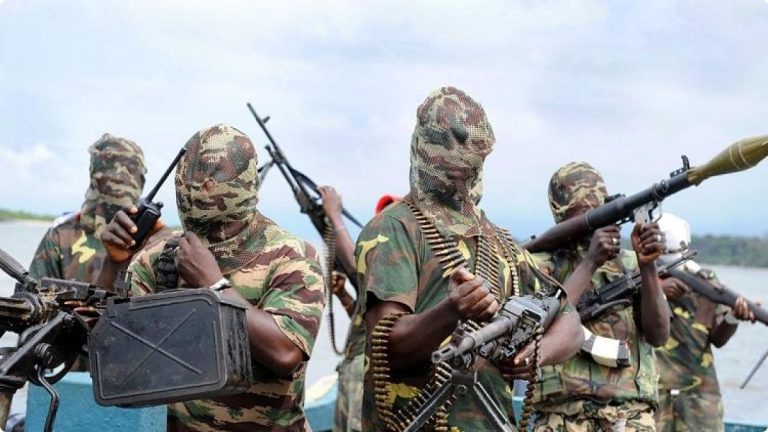
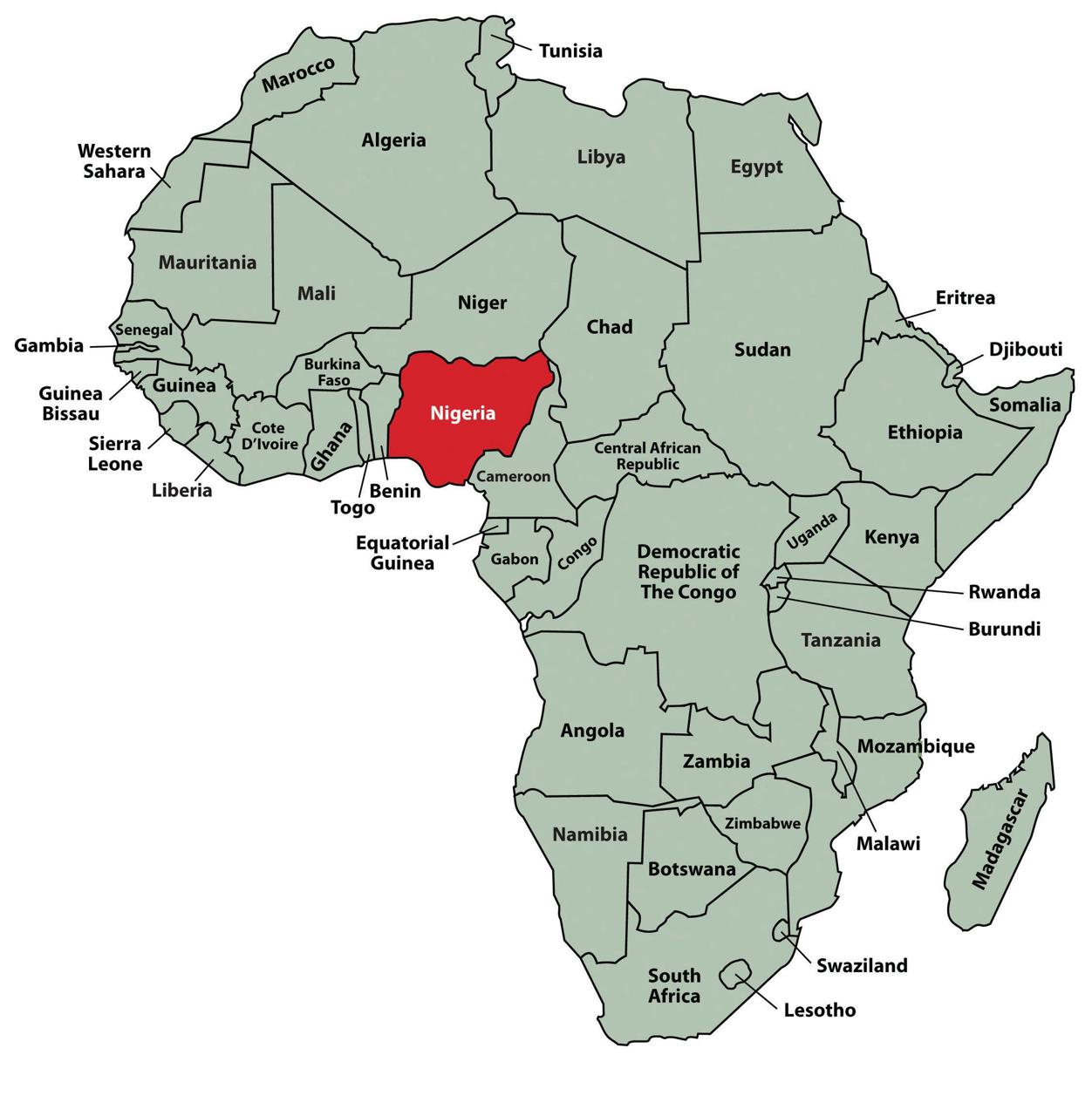
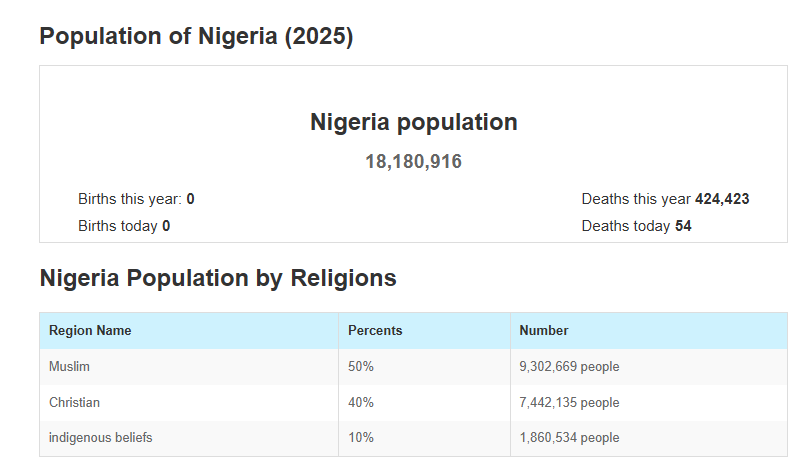
Nigeria which is home to almost 200 million people from 200 different ethnic groups is split between a predominantly Christian south and a largerly Muslim north. Muslims form the majority in the country where jihadi groups like Boko Haram and Islamic State West Africa Province caused mayhem, killing thousands of people including countless Christians.
Gunmen often assault towns in the northwest of the country, kidnapping locals for ransom, while in central Nigeria, there have been recurrent conflicts between primarily Christian farmers and mostly Muslim herders over access to pasture and water. Furthermroe, ethnic differences, communal rivalries, secessionist groups or disputes over limited resources frequently intensify the violence.
21,409 people were killed in 11,862 attacks against civilians in Nigeria between January 2020 and September 2025, based on data gathered by the US based Armed Conflict Location and Event Data (ACLED) program. 317 people were killed in 385 of the incidents which were “targeted events against Christians where Christian identity of the victim was a reported factor.”
The Christian Association of Nigeria voiced that it has been working to raise awareness of “the persecution of Christians in Nigeria” over the years. The US Commission on International Religious Freedom also noted attacks against Muslims and Christians in Nigeria in its 2024 report, which it described as persistent abuses of religious freedom.
Joseph Hayab stated that the situation has improved over time, nevertheless, thousands of Christians have been slain, according to Associated Press. He is a former chairman of the Christian Association of Nigeria in Kaduna state, one of the most affected regions in the country.
Image via livepopulation.com
“In too many cases, the perpetrators have gotten away with it and the impunity is deeply indicative of massive state failure,” pointed out Cheta Nwanze of the Lagos-based SBM Intelligence research firm, per a report in The Washington Post. “The criticism and pressure from Washington did not happen in a vacuum. It’s a result of many years of failure,” asserted Taiwo Hassan Adebayo, a researcher at the Institute of Security Studies.
Terror inflicted by jihadi outfits, Muslim herdsmen
The religious minority, particularly those residing on farms in small towns on the periphery of the largely Christian north central state of Benue tend to be the targets of vicious assaults.
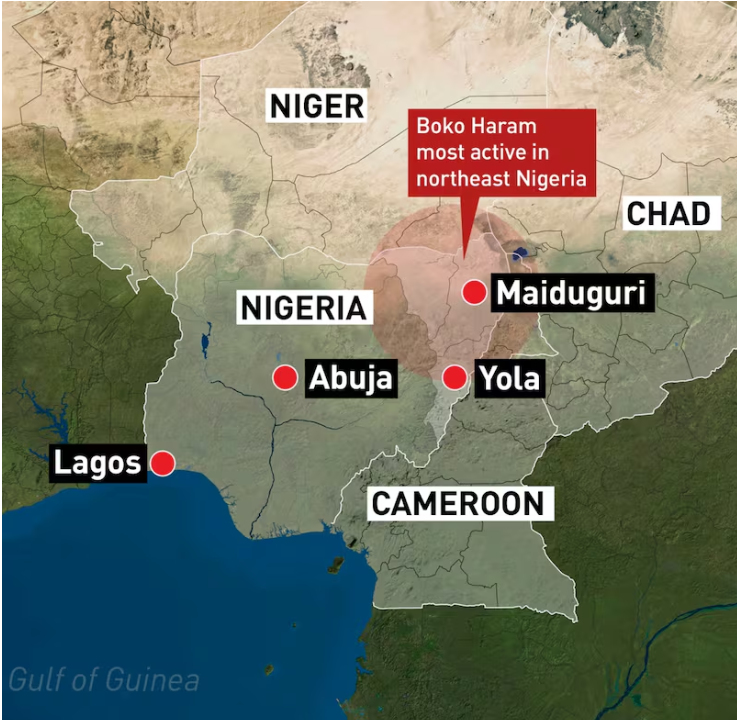
The Boko Haram which desires to establish an Islamic state in Nigeria, started the bloodshed in 2002. The outfit has been planning terrorist strikes against the community and other civilians ever since. Its terrorism is turning harder to contain as tens of thousands of people have been slaughtered since its founding in 2002. Likewise, the unrest is also caused by Fulani Muslim herdsmen.
The distrust of ethnic Fulani pastoral groups stemmed from the deadly jihad that ravaged northern and central Nigeria and upended local structures alongside political systems. Hence, many communities in the area believe that the turmoil is actually a campaign to expel them from their territories.
Image via CBC
“What we are dealing with here in Benue is a calculated, well-planned, full-scale genocidal invasion and land-grabbing campaign by herder terrorists and bandits,” voiced James Ortese Iorzua Ayatse. He is the traditional leader of the ethnic group Tiv in Benue state.
“These Fulani militants account for more attacks against Christians (and Muslims) than either of the more prominent Boko Haram and ISWAP,” complained Religious Freedom Institute President David Trimble. They were accountable for 55% of all Christian fatalities between 2019 and 2023.
Christians reportedly experience prejudice and persecution as second-class citizens in northern Nigerian states governed by Sharia law. Nigerian legislation is rooted in persecution, with over a dozen provinces having sharia courts, blasphemy laws and sharia codes “that oppose equal rights and due process for religious minorities,” Trimble accused.
Notably, Nigeria is a member of the Organisation for Islamic Cooperation which bills itself as “the collective voice of the Muslim world,” despite the fact that there isn’t an official religion of the country in legal terms.
Startling statistics regarding Christian persecution
The International Society for Civil Liberties and Rule of Law (Intersociety), a research and investigative rights organisation with headquarters in Nigeria, released a report, “Martyred Christians in Nigeria,” in early 2023. It disclosed that Islamic terrorists brutally murdered at least 52,250 Nigerian Christians since 2009.
The report added that over 30,000 members of the community were killed during the 8-year presidency of former Nigerian President Muhammadu Buhari who was regularly criticised for not doing enough to address the nation’s mounting insecurity.
During the time, 2,200 Christian schools and 18,000 Christian churches were burned down as more than 1,000 Christian were killed within the first few weeks of 2023. The number of torched churches rose to 19,100 by this September. Additionally, the terrorism also claimed the lives of about 34,000 moderate Muslims.
The Christians in Nigeria, for almost two decades, have been living the very reality you just painted.
Similarly, over 200 Christians were abducted in Northern Nigeria’s Niger state at that time, including more than 100 Christians who were abducted in Adunu (Paikoro) on 14th March 2023. 707 Christians met the same fate throughout the period.
Kaduna had been the scene of at least 101 anti-Christian kidnappings while other states such as Katsina, Taraba, Edo, Ogun, Nassarawa, Kwara, Kogi, Borno, Yobe and Adawama Bauchi, Enugu, Imo, Kebbi, Gombe, Bayelsa and Cross River also witnessed similar occurrences.
Likewise, the Catholic Bishops Conference of Nigeria (CBCN) reported that at least 145 priests have been abducted, 11 have been killed and four are still missing since 2015. However, Intersociety stated that the situation is far worse. It indicated that at least 250 Catholic clergy members and 350 members from other churches have been targeted.
Intersociety also outlined that members of Nigerian army and police special units, as well as their leaders are suspected of abducting, killing and forcibly disappearing pastors from different Christian denominations.
The study also highlighted the existence of jihadi camps, like those in Rijana of Kaduna state where at least 850 Christians have been detained in appalling conditions. They would be tortured or killed if their families don’t pay a ransom. Catholic schools and communities have also been impacted by the systematic abduction of Christian children in eastern Nigeria, who are then taken to Muslim orphanages in the north for conversion to Islam.
Mass Christian exodus from Nigeria
Christians run the risk of dying at the hands of ethnic Fulani herders who joined extremist groups in addition to terrorist entities like Boko Haram. Hence, many people have been forcibly displaced as a result of the atrocities. Approximately 5 million Christians have been uprooted and compelled to live in refugee camps along regional and sub-regional borders as well as Internally Uprooted Persons (IDP) camps within Nigeria.
TERRIFYING: Christians are being hunted like animals in Nigeria.
An Islamist group invaded a Christian village and started shooting everyone in sight.
They are killing Christians on Eid and offering them as human sacrifices.
Nigeria is now among the most dangerous countries in Africa for Christians to live in, according to the Intersociety analysis. This was also noted in the 2023 Watch List that Open Doors, an interdenominational organisation that aids persecuted Christians worldwide, published in January. That report stated that 89% of all Christian deaths globally occur in Nigeria.
This violence has moved throughout the Middle Belt and even further south whereas earlier it primarily affected Christians in the Muslim-majority northern provinces, unveiled Open Doors. The women are taken and sexually violated while men are executed. Nigeria is the country with the highest number of religiously motivated murders worldwide.
Homes, churches and livelihoods are also destroyed by these terrorists. Violence and strife have forced over 16.2 million Christians from their homes in sub-Saharan Africa, including a significant number from Nigeria and pushed them to live in camps.
Evidence indicates religious motivated violence as government alleges otherwise
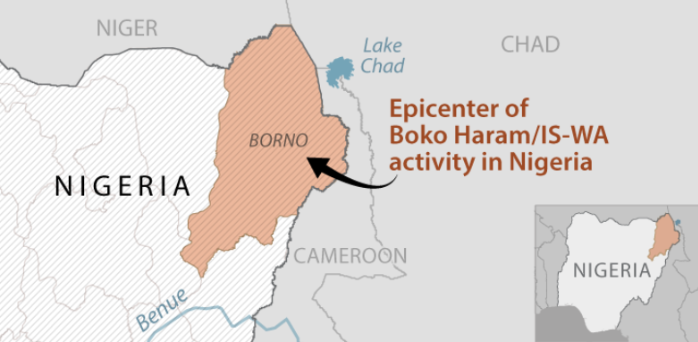
Nigeria has encountered the rise of a number of Islamic extremist groups like Boko Haram and ISWAP especially in the country’s Muslim-majority north while other terror outfits have also begun to operate in recent years and are expanding into other regions, such as southern area. Furthermore, armed and radicalised Fulani group have created devastation in Nigeria’s Middle Belt which is majorly constituted by Christian regions.
Image via everycrsreport.com
All of these groups have caused waves of violence throughout the region, resulting in millions of people being displaced and thousands of deaths annually. The individuals have to survive in despicable conditions in IDP camps. The degree of violence varies throughout Nigeria as the majority of such incidents occur in the northern regions.
The Nigerian government and other analysts dismiss the accusations of violence motivated by religion, claiming that it is not the only cause of the unrest. The claims are partially true as there are other underlying factors as well but it is undeniable that Christians have faced attacks due to their religious beliefs
Christians have been deliberately and repeatedly designated as targets by ISWAP and Boko Haram, highlighted Open Doors. According to several victims when Fulani extremists strike, they chant not only “Allahu Akbar” but also “We will destroy all Christians.” The Islamist doctrine that has influenced them justifies the subjugation of Christians as infidels.
The Observatory for Religious Freedom in Africa which has meticulously gathered information on civilian fatalities and violence in the area, affirmed that the patterns are evident. Considering the relative numbers of Muslims and Christians in northern areas, the fundamentalists kill more Christians than Muslims. Christians are 5.1 times more likely to be kidnapped and 6.5 times more likely to be slain than Muslims.
More than 20,000 people were kidnapped between 2019 and 2023, making it a lucrative industry that supports the growth of Islamist organisations and is connected to active terrorist organisations. Bandits have been known to target anyone inclined to pay a price, but they have discovered that Christians and religious leaders in particular, might command a larger ransom. Thus, they are particularly vulnerable.
Conclusion
The government nabbed and convicted some ISWAP and Boko Haram terrorists but it has not prosecuted any Fulani accused with the same determination. Locals don’t believe that anyone will be held responsible for their violent actions. This is due to the fact that hundreds of suspects have been arrested over the years and the majority of them have since been freed without ever being charged or put on trial.
The recent emphasis on the issue appears to arise from the relentless decade-long violence in Nigeria coupled with evident government negligence and inaction.
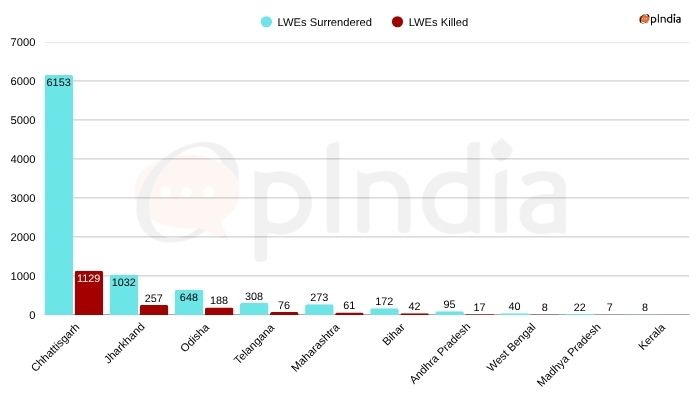
Under the leadership of Prime Minister Narendra Modi, Left-Wing Extremism (LWE) has receded sharply across the “Red Corridor” over 11 years. A reply to OpIndia’s RTI on Naxalism from the Left-Wing Extremism (LWE) Division of the Ministry of Home Affairs (MHA), Government of India, shows that Chhattisgarh recorded the highest LWE surrenders (6,153) and the highest LWE killings (1,129) among the ten tracked states from May 2014 to 30th September 2025.
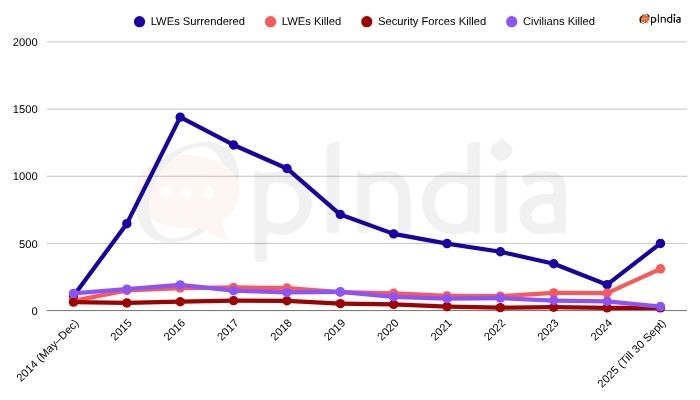
The year 2016 registered the most surrenders (1,440), while 2025 (till 30th September) logged the most LWE killings (311), which indicates shrinking insurgent space and intensified, intelligence-led operations. Minister of Home Affairs Amit Shah has publicly set March 2026 as the target to end the Naxal problem under Operation Kagar.
RTI data shows sharp reduction in Naxal-related violence since 2016, with renewed operational surge in 2025. (Source: Ministry of Home Affairs, LWE Division)
National picture – a shrinking insurgency under a centralised plan
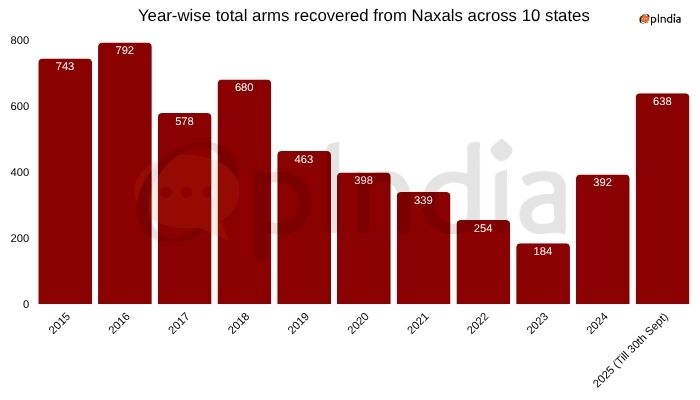
OpIndia received data on 10 states that are West Bengal, Kerala, Chhattisgarh, Jharkhand, Andhra Pradesh, Bihar, Odisha, Telangana, Madhya Pradesh and Maharashtra. According to the data, a total of 8,751 Naxals have surrendered since May 2014 and 1,801 Naxals have been killed. A total of 548 security personnel have lost their lives during operations and 1,630 civilians have been killed during that period. Furthermore, security forces have recovered 5,277 arms from LWEs between May 2014 and 30th September 2025.
The figures align with the Centre’s policy shift to coordinate inter-state operations, development-led outreach and targeted rehabilitation, which reduced the conflict to limited pockets. In a recent statement, HM Shah mentioned that the Naxal movement has reduced to just three districts across the country.
Chhattisgarh is traditionally the core theatre of the Naxal movement. The state leads both in surrenders and killings of LWEs, which reflects intense state-Centre synergy, long-horizon area domination and continued pressure on formations in Bastar and adjoining zones.
RTI data shows Chhattisgarh accounting for nearly two-thirds of all Naxal surrenders and killings across ten states since 2014, followed by Jharkhand and Odisha. (Source: Ministry of Home Affairs, LWE Division)
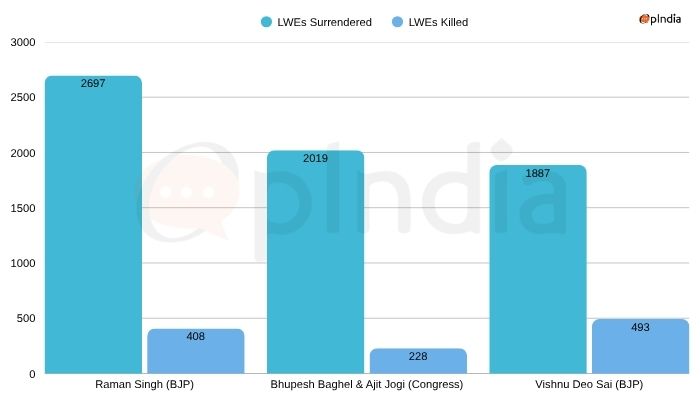
Interestingly, between May 2014 and December 2018, under the Raman Singh-led BJP government, the state recorded around 2,697 Naxal surrenders and 408 LWE killings. The phase reflected strong centre-state synergy, with the Union Home Ministry’s operations and state police actions working in tandem.
In contrast, during Congress rule (Bhupesh Baghel and Ajit Jogi) from 7 December 2018 to 13 December 2023, the figures dropped to around 2,019 surrenders and 228 LWE killings, even as civilian and force casualties saw little improvement.
After Vishnu Deo Sai’s BJP government assumed office in December 2023, the short period till September 2025 has already seen over 1,887 surrenders and 493 Naxal neutralisations, suggesting that the BJP-led coordination between the Centre and state has proven more cohesive and result-oriented in curbing Left-Wing Extremism.
RTI data reveals Chhattisgarh saw stronger anti-Naxal results under BJP governments, with renewed operational success since Vishnu Deo Sai took charge in 2023. (Source: Ministry of Home Affairs, LWE Division)
Jharkhand and Odisha show sustained degradation of cadre strength, while Telangana and Andhra Pradesh remain relatively quiet. West Bengal and Kerala register negligible incident numbers in recent years, consistent with the contraction of the Red Corridor.
Year-wise trend – peak surrenders in 2016, operational squeeze in 2025
2016 emerged as the peak surrender year, which suggests effective pull factors and rehabilitation programmes. 2025 (till 30th September) shows the highest Naxal neutralisations by killing, a sign of the Central Government’s determination to end Naxalism with the help of improved actionable intelligence, better mobility and technology-enabled operations. The twin trend of high surrenders over time and recent operational dominance points towards a maturing counter-insurgency programme that has moved from establishing contact and talks to focused endgame pressure.
Civilian and security force casualties – risk reduced, vigilance retained
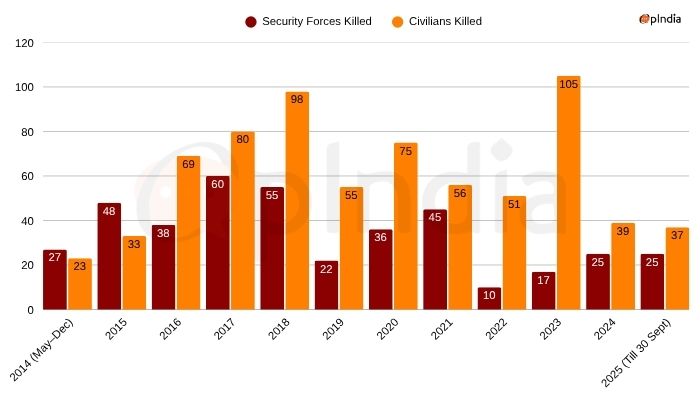
Security forces have paid a price. 548 personnel have been killed since May 2014. However, year-on-year casualties show an overall decline over the years. Civilian deaths (1,630) remain a sombre reminder of the human toll, although the spread and frequency of civilian-targeted incidents have reduced as insurgent control areas have shrunk.
Casualty data from Chhattisgarh shows a sharp reduction in both civilian and security force deaths after 2018, underscoring improved intelligence and field coordination. (Source: Ministry of Home Affairs, LWE Division)
Surrender and rehabilitation – policy credibility and cadre depletion
The consistency of 8,751 surrenders across eleven years points to a credible pipeline from contact to capitulation. Counselling, monetary incentives, livelihood transitions and legal relief for rank-and-file members not involved in grave crimes have successfully attracted those who want to leave the path of the Naxal movement. Furthermore, in recent times, HM Shah categorically denied requests for ceasefire and talks, pushing for either surrender or encounter of the LWEs, which has left virtually no room for Naxals to continue their armed movement.
All these factors have had a compounding effect, including cadre depletion, intelligence inflow and armament recovery, which stood at 5,277 in 11 years, further eroding insurgent capacity to regroup.
Arms recovered – measuring operational dominance
Steady arms recoveries corroborate area domination beyond encounter tallies. Recoveries across multiple states indicate a thinning of arms caches and disruption of supply lines, reducing the ability of units to plan complex ambushes or sustain long campaigns.
According to RTI data, security forces recovered a total of 5,277 arms from Naxals across 10 states between May 2014 and September 2025. (Source: Ministry of Home Affairs, LWE Division)
The road to March 2026 – endgame in shrinking pockets
With the Naxal footprint now limited to select forested belts, the government’s stated objective of ending Naxalism by March 2026 appears to rest on sustained pressure in a few remaining nodes, backed by road connectivity, telecom coverage, welfare saturation and continued surrenders. The overall trajectory since May 2014 shows LWE in strategic retreat, though vigilance remains essential to prevent episodic spikes.
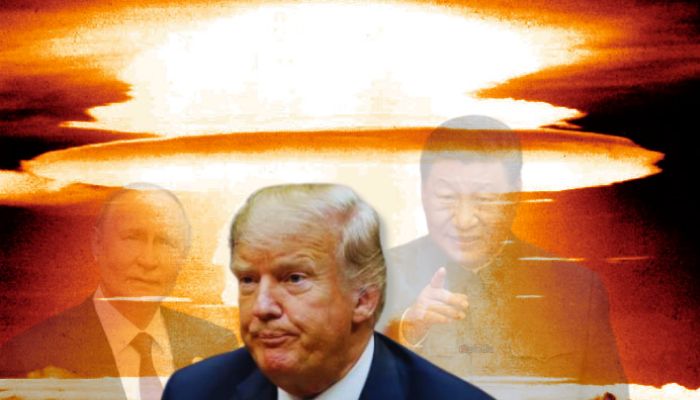
Ever since starting his presidency in January this year, Donald Trump has posited himself as a ‘man of peace’ who is on a mission to end ‘wars’ across the world. However, President Trump is waging his own wars against allies and adversaries alike. After mollycoddling Pakistan’s madarsa-bred ‘Field Marshal’ Asim Munir, bombing Iran, sparking off tariff wars against various countries, including India and China, and failing to end the Russia-Ukraine war, Trump is obsessing over nuclear testing.
On 29th October, Donald Trump directed the Pentagon to immediately increase testing of nuclear weapons and match other countries like Russia and China.
Taking to Truth Social ahead of his meeting with Chinese President Xi Jinping, President Trump said that the US has more nuclear weapons in the world and that in his first term as president, a complete renovation of existing nuclear warheads was accomplished. He claimed to have “hated” to do it. Trump added that because of the nuclear testing programs of other countries, especially Russia and China, he has directed the Department of War to start testing US nuclear weapons on an equal basis.
“The United States has more Nuclear Weapons than any other country. This was accomplished, including a complete update and renovation of existing weapons, during my First Term in office. Because of the tremendous destructive power, I HATED to do it, but had no choice! Russia is second, and China is a distant third, but will be even within 5 years. Because of other countries testing programs, I have instructed the Department of War to start testing our Nuclear Weapons on an equal basis. That process will begin immediately. Thank you for your attention to this matter! PRESIDENT DONALD J. TRUMP,” Trump wrote.
Trump’s directives to the Department of War to increase nuclear weapons testing came days after Russian President Vladimir Putin announced on Sunday that Russia has successfully tested its “unique” nuclear-propelled Burevestnik cruise missile, which can also carry a nuclear warhead.
Now, Trump has doubled down on his on his decision to restart nuclear testing in the United States. In an interview with CBS 60 Minutes, Trump said that despite the US having enough weapons to “blow up” dozens of countries, Russia and China’s nuclear ambitions are the reason for resuming tests.
Trump said that his decision to resume nuclear weapons testing stems from the realisation that the US cannot be the only country that does not carry out tests, despite having a huge arsenal.
“We have more nuclear weapons than any other country. And I think we should do something about denuclearization. And I did actually discuss that with both President Putin and President Xi. We have enough nuclear weapons to blow up the world 150 times. Russia has a lot of nuclear weapons, and China will have a lot. They have some. They have quite a bit, but…” Trump said.
When asked why is there a need to test nuclear weapons, Trump said, “Because you have to see how they work. You know, you do have to— and the reason I’m saying— testing is because Russia announced that they were going to be doing a test. If you notice, North Korea’s testing constantly. Other countries are testing. We’re the only country that doesn’t test, and I want to be— I don’t want to be the only country that doesn’t test.”
He added that while Russia and China do not openly share their tests or details pertaining to them with the world, the US is an “open society”.
“We’re different. We talk about it. We have to talk about it, because otherwise you people are going to report— they don’t have reporters that going to be writing about it. We do,” he said.
Trump’s newfound nuclear obsession, however, is not finding buyers in his own administration, as Vice Admiral Richard Correll, Trump’s nominee to lead STRATCOM (which is the Department of Defense’s command for strategic deterrence and global strike capabilities), said in his testimonial at Capitol Hill that neither China nor Russia have conducted explosive nuclear tests.
“I believe the quote was, ‘start testing our nuclear weapons on an equal basis.’ Neither China or Russia has conducted a nuclear explosive test, so I’m not reading anything into it or reading anything out to it,” Corell said.
While Donald Trump’s decision to increase nuclear testing has triggered scepticism, on Sunday, US Energy Secretary Chris Wright clarified that the testing would not involve nuclear explosions. He said that the testing would focus on “the other parts of a nuclear weapon” to ensure they are working properly.”
In an interview with Fox News, Wright said, “I think the tests we’re talking about right now are systems. “These are not nuclear explosions. These are what we call noncritical explosions.”
American NUCLEAR tests won’t cause mushroom clouds — Energy Sec Wright explains
‘We’re talking about system tests, NOT nuclear explosions… noncritical explosions’
From dreaming of the Nobel Peace Prize to obsessing over nuclear testing: Trump’s evolving rhetoric
Donald Trump’s fixation over nuclear tests marks a sharp pivot from his signature economic pressure and arm-twisting tactics, particularly, the protracted tariff wars with China and clashing with Beijing over rare earth magnets, arbitrary imposition of tariffs on India for buying Russian oil, brining Japan and Vietnam to their knees using tariff threats, and making false claims of ending India-Pakistan war to bolster his Nobel Peace Prize prospects to now unleashing a fresh ‘nuclear’ buzzword from his arsenal of brinkmanship.
Trump justified his tariff war as ‘economic nationalism’ and will now justify his decision that could potentially trigger a nuclear race as imperative for ‘national security’.
Notably, the last time the US undertook nuclear testing was in September 1992 as part of ‘Operation Julin’. Under this operation, a group of seven nuclear tests were conducted. Soon after, the negotiations for the Comprehensive Test Ban Treaty (CTBT) started.
Under this international agreement, all nuclear explosions for both civilian and military purposes are banned. India, China, Pakistan, North Korea, Israel and even Russia are among the 187 nations that have signed it. However, only 178 countries have ratified and implemented this ban treaty. The US is also a signatory of the CTBT; however, it has not ratified it.
Interestingly, North Korea has been the only country regularly conducting nuclear tests in the past quarter-century. The country conducted its last nuclear test in 2017.
While China has expanded its nuclear arsenal and deployed missiles, the country has not tested a nuclear weapon since 1996. Russia, too, has not conducted a nuclear weapons test since 1990. However, it did recently announce that the Kremlin has tested a nuclear-propelled Burevestnik cruise missile, which can also carry a nuclear warhead.
Donald Trump’s nuclear testing hysteria can trigger a nuclear arms race
Donald Trump’s repeated bragging of ordering a resumption of nuclear testing could potentially spark a global nuclear arms race. Whether Trump is going ‘nuclear’ to bolster his supposed strongman image or threaten Russia, China and other nuclear-armed not-so-friendly nations, the US could end up unravelling the fragile norm of the testing moratorium. Trump may be using the excuse of the alleged nuclear testing by Russia and China to resume America’s testing program. Russia, China and other nuclear-armed nations, especially those at war or surrounded by hostile neighbours, could also resume testing, citing reciprocal actions to maintain parity.
Long story cut short, America’s unilateral actions might accelerate a multipolar arms spiral. Russia and China would want to close the gaps with US capabilities. North Korea will also argue, “If they are testing, why should we hold back?” India would want to bolster its nuclear power, given Pakistan’s jihadist army threatens nuclear attacks on India every now and then out of frustration over India repeatedly battering them in conventional conflicts, and the recent suspension of the Indus Waters Treaty. Notably, in his CBS 60 Minutes interview, Trump himself admitted that Pakistan is testing nuclear weapons.
? Trump just dropped the full 73-minute unedited version of his 60 Minutes interview, claiming the network “cut too much.”
India also has to tackle China, although the relations between the two nations are improving lately, in a volatile geopolitical landscape, situations can take an unexpected turn anytime. New Delhi would thus want to be powerful and prepared enough to go ‘nuclear ‘ against the potential Pak-China two-front threat. If Trump’s nuclear testing designs indeed mean full-fledged nuclear weapons testing and not the supposedly downplayed version his officials are telling the media, this will open a window for India and other nuclear-armed countries to resume tests.
It seems that the failure of deterring sovereign nations by the use of tariffs, ending the Russia-Ukraine war, has made Donald Trump flirt with a perilous gamble of nuclear testing to send out a message to America’s adversaries that the US is the top nuclear power and will not shy away from blowing them up. However, by mindlessly flexing the nuclear muscle, Trump is dancing on the precipice of apocalypse, as a vicious cycle would begin wherein each nuclear test will beget countermeasures and who knows, this will collectively push the world into World War III, only this time ‘Little Boy’ will not be the only player.
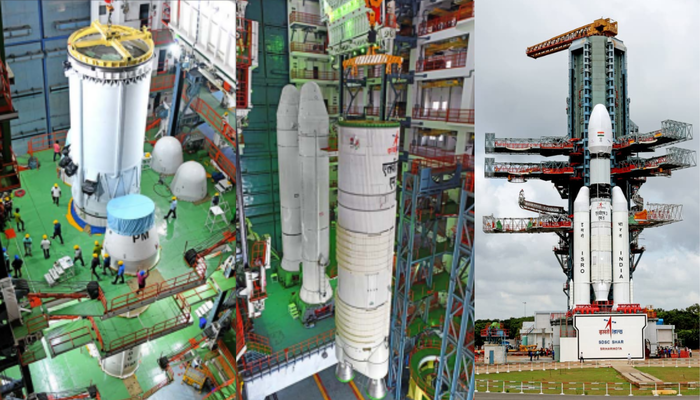
In a remarkable feat, the Indian Space Research Organisation launched the Indian Navy’s GSAT-7R (CMS-03) satellite on Sunday (2nd November) at the Satish Dhawan Space Centre (SDSC), Sriharikota, Andhra Pradesh. What sets the spacecraft apart is that it is India’s heaviest communication satellite to be launched from the country’s soil into the Geosynchronous Transfer Orbit (GTO).
GSAT-7R equipped with indigenous state-of-the-art components
The multi-band communication satellite is expected to boost the Indian Navy’s space-based communications and enhance its maritime domain awareness capabilities. The indigenously developed satellite marks a significant milestone in India’s journey towards self-reliance in space technologies and bolsters India’s sovereign defence communication infrastructure. The satellite is a specimen of the country’s ascending capabilities with respect to designing, building, and launching complex mission-critical satellites. It will remove India’s dependence on the Inmarsat constellation for the strategic communication needs of naval assets.
GSAT-7R is an entirely indigenously made satellite weighs around 4,400 kg and is equipped with many indigenous state-of-the-art components developed specifically to meet the Indian Navy’s operational requirements. It will provide strong telecommunication coverage across the Indian Ocean Region, a wide oceanic region including the Indian landmass. The satellite will considerably enhance connectivity with high-capacity bandwidth, enabling seamless and secure communication links between ships, aircraft, submarines, and Maritime Operations Centres of the Indian Navy. The satellite will strengthen India’s network-centric warfare capabilities by providing real-time, secure voice, video, and data transmission across naval assets, including warships, submarines, aircraft, and shore-based command centres.
Meet #LVM3M5, India’s operational heavy-lift launcher. Height: 43.5 m | Lift Off Mass: 642 t | Stages: 2×S200 Solid, L110 Liquid, C25 Cryogenic.
GSAT-7R will replace GSAT-7 (Rukmini), which was launched in 2013. Both satellites are dedicated to the Indian Navy. Belonging to the same series, the GSAT-7A satellite was launched for the Indian Air Force.
The satellite’s journey to its destination
Like other geostationary satellites launched by ISRO, GSAT-7R will first enter the GTO, which is around 36,000 kilometres above the planet at its farthest point. Then the Liquid Apogee Motor (LAM) will come into play to raise the orbit. Thereafter, the LAM engine will fire multiple times in a carefully orchestrated sequence and duration to adjust the apogee and perigee, achieving a perfect geostationary orbit.
The LAM will initially fire at the perigee (the closest point to Earth) to raise the apogee, followed by a second firing at the apogee (the farthest point) to gradually circularise the orbit. The entire process is expected to take 4-7 days. After the desired orbit is achieved, it will take another 4-5 weeks for satellite commissioning.
The LVM3 launch vehicle
The satellite has been launched aboard the LVM3-M5 launch vehicle, which is referred to as ‘Bahubali’ for its heavy-lift capabilities. The LVM3, also known as Geosynchronous Satellite Launch Vehicle (GSLV) MkIII, earlier launched the Chandrayaan-3 mission, which made India the first country to make a successful landing on the Moon’s south pole. The LVM3 is ISRO’s operational heavy lift Launch vehicle with a positive record of completing several successful missions. The launch, the fifth Operational Flight of the LVM3, was carried out from the Second Launch Pad (SLP), SDSC, SHAR.
The 43.5 metre tall LVM3-M5 launch vehicle was fully assembled and integrated with the satellite before being moved to the second launch pad for pre-launch operations on October 26, 2025. The three-stage rocket was fitted with two solid motor strap-ons (S200), a liquid propellant core stage (L110) and a cryogenic stage (C25). The vehicle provides ISRO much-needed self-reliance in launching heavier communication satellites weighing up to 4,000 kg in GTO.
The entire project was funded by the Ministry of Defence at a cost of ₹1,589 crore (approximately US$225.65 million), and was contracted in June 2019.
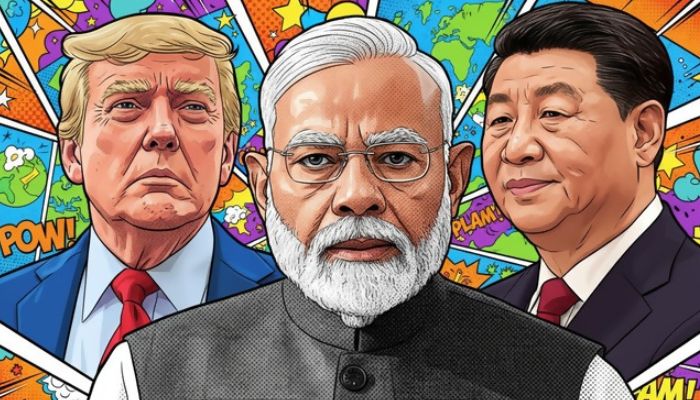
On Thursday (30th October), President Trump and President Xi met in Busan and announced an agreement to reduce tariffs on goods related to fentanyl from 20% to 10%, loosen restrictions on rare earths, and resume China’s purchases of US soybeans.
This was interpreted by many observers as evidence that Beijing and Washington could still negotiate ‘big power bargains’ over everyone else. However, the lesson is more complex for Indian strategists. In order to create room for their actual competition in technology, maritime influence, and global rule-making, both sides trade tactical concessions on tariffs, commodities, or enforcement at the so-called G2.
The Busan talks may initially appear to be a G2 reset, with the two superpowers calming markets and stabilising trade. However, none of the fundamental issues were settled, as evidenced by Taiwan, China’s covert support of Russia, South China Sea tensions, and restrictions on AI chips. What Indian analysts have long suspected is confirmed by the Busan deal.
Beijing and Washington can handle brief tactical pauses, but not a long-term strategic alliance. Their rivalry simply moves into more technical domains that directly impact nations like India when the high-level tensions subside. Therefore, a thaw between the United States and China should not be interpreted as a safer regional environment. Limited compromises can strengthen their hold on long-term power dynamics.
The visible layer: Tariffs, showy détente and a hidden hardening
The story appears simple at first glance. While Beijing needed relief on rare earths after its export restrictions on October 9 had unsettled markets, the U.S. president wanted to see tangible progress on drug control and farm exports. Prior to the APEC meetings, both parties sought to reassure investors. For this reason, the Busan meeting resulted in a deal on soybeans and tariff reductions.
However, Washington’s regulatory apparatus continued to tighten behind the handshake. The Congressional Research Service published a list of new export control measures in September 2025. The use of Huawei’s Ascend AI chips was formally treated as an export-control concern. 42 more Chinese entities were added to the U.S. Entity List.
The previous, more lenient “AI diffusion” rule was eliminated and, crucially for South Korea and Taiwan, Chinese-based Samsung and SK Hynix factories lost their “Validated End User” privileges. China’s soybean purchases and tariff cooperation were essentially accepted by the United States, but restrictions on what really counts, China’s access to cutting edge computing power, semiconductor tools, and American technical know how were not loosened.
This is the most important lesson for India. The tech dispute will not be resolved by a cordial photo op between Beijing and Washington. Delhi should anticipate that Beijing will use its own leverage, such as controls over rare earths, to resist U.S. technology restrictions on China.
This competitive environment will be the setting for India’s “China plus one” manufacturing initiatives, its incentives linked to electronics production, and its aspirations to become a center for chip packaging and ATMP (Assembly, Testing, Marking, and Packaging). To benefit, India must be perceived as a trusted partner who adheres to US technology controls.
The Maritime layer: South china sea pressure and Indian Ocean implications
Since 2016, 2025 has been one of the South China Sea’s most tense and active years. Chinese coast guard ships attacked Philippine boats with water cannons and rammed them on October 12. Prior to the Busan summit, Washington had hinted at planning a “show of force” with allies to reiterate its treaty obligations to Manila, and the U.S. State Department denounced these actions as dangerous.
The seventh joint maritime exercises between the United States and the Philippines in June 2025 had already demonstrated Manila’s refusal to back down. This escalation is significant for India. Washington seeks a reliable, non-aligned, and militarily capable ally to secure the western half of the Indo-Pacific whenever tensions between the United States and China escalate east of the Malacca Strait. Naturally, India is the target of that obligation.
However, Delhi faces additional risks as a result of this. The United States will expect India to maintain stability in the Indian Ocean and stop Chinese “grey-zone” activities there, such as survey ships using fictitious AIS signals, PLAN support vessels staying close to island territories, or civilian-looking ships carrying out covert underwater mapping, if it gets involved in a South China Sea conflict.
Concurrently, China’s trade with Africa and the Gulf will keep growing, employing more alternative networks for payment, insurance, and shipping that are intended to evade American regulation. India will thus face an increasing challenge in maritime surveillance.
In an increasingly crowded and opaque ocean space, the Navy and Coast Guard will have to make a careful distinction between suspicious, dual-use operations and typical Chinese commercial movements. In this sense, the consequences of the rivalry between the United States and China increase India’s maritime burden even when India is not directly involved in the conflict.
The Invisible Layer: Standards, Data, and Parallel Rails
The competition for standards, data, and digital infrastructure is the least talked about but possibly most significant aspect of the current rivalry between the United States and China. The most recent export restrictions imposed by Washington go beyond restricting China’s access to expensive chips. They now focus on cloud services, training support, and the transfer of AI model weights, which could help Chinese businesses get around hardware limitations.
China is reacting in two ways. In order to prevent sanctions from shutting down Huawei’s system, it is first attempting to get its own AI accelerators and digital platforms widely adopted among Belt and Road partners. Second, it is subtly promoting its algorithmic standards and content policies to encourage friendly nations to adopt Chinese-style digital regulations by default. Chinese companies are testing alternative systems for payments, insurance, and vessel tracking (AIS) in order to maintain strategic trade without depending on American frameworks, as U.S. financial and shipping regulations tighten.
For India, this has major ramifications. India’s digital economy is at a critical juncture. It depends on inexpensive Chinese hardware and smartphones to maintain widespread and inexpensive digital access, but it also needs U.S. cloud services, investment, and cutting-edge chips to power its expanding AI and startup sectors. India’s technology costs will increase if it aligns too closely with U.S. regulations, making it more difficult to maintain its inclusive digital model. However, it runs the risk of being subject to U.S. secondary sanctions if it leans too much toward Chinese systems, a problem it has already faced when purchasing Russian oil. Diversifying suppliers, maintaining thorough documentation, and retaining sovereign control over its data continue to be India’s best course of action since 2014. Staying open to both sides, adhering to all regulations, and preventing Beijing or Washington from defining India’s digital standards are the basic strategies.
Why the G2 still can’t make india optional
The Busan meeting also made clear why Beijing and Washington cannot afford to overlook India. India is crucial to the United States in a number of ways. In order to prevent China from opening a second front while American forces are occupied in the South China Sea, India must maintain the Himalayan line.
Additionally, since 2023, U.S. officials and think tanks have been pushing for India to be a reliable destination for international supply chains that are leaving China. Beyond that, Washington values India’s voice in the Global South. India’s statement that “you can work with both sides” is more palatable to many governments in Africa, the Gulf, and Southeast Asia than a direct, hard-line message from Washington.
Though for different reasons, China also regards India as essential. India must maintain stable trade relations with one of the biggest markets in the world, keep organizations like the SCO and BRICS operational, and stop a formal anti-China naval coalition from forming in the Indian Ocean.
India has a special place to operate because of this mutual reliance. A truly multipolar world necessitates a multipolar Asia, as External Affairs Minister S. Jaishankar has stated time and time again since 2024. This means that India and China must manage their relationship, even if it is polarizing. In a nutshell, his message to Washington and Beijing is clear that Asia’s future cannot be decided solely on India’s head.
Modi Doctrine in a G2 world: Interest first, Coalition by issue
The foreign policy of the Modi government exhibits a distinct and consistent pattern when viewed from 2014 to 2025. India continued to purchase oil during the conflict with Russia, but it adhered closely to the price cap regulations. It protected shipping lanes in the Red Sea without completely embracing the Western narrative. India maintained open diplomatic relations with China while maintaining a firm stance along the Line of Actual Control. Protecting national interests first, meticulously documenting every action, and joining coalitions selectively, issue by issue, are the clear guiding principles.
The U.S.-China dynamic is a good fit for the same strategy. When India develops its own capabilities, it will accept American defense and technology partnerships. In order to support Indian manufacturing and consumer welfare, it will maintain economic ties with China. Because Global South nations can voice concerns about Western overreach in the BRICS and SCO forums, it will continue to be active there. Above all, India consistently claims that decisions are made in Delhi and are not influenced by other places.
In 2025, this strategy has become more valuable due to its predictability and transparency. Washington is aware that sanctions evasion is not concentrated in India. Beijing is aware that India is not attempting to militarily encircle China. ASEAN nations can observe that India takes part in Indo-Pacific projects without importing every conflict between the United States and China. This clarity makes India a reliable and stable partner at a time when U.S.-China relations are becoming more transactional, with tariffs falling one day and new AI controls rising the next.
The Under the Radar risks India must track
India must consider three subtle but serious risks in its strategic thinking.
First, Indian cloud service providers or researchers utilizing U.S.-based platforms may face enforcement issues if U.S. export controls extend beyond hardware to include service-level limitations on AI training for Chinese entities, as suggested by the Congressional Research Service report from September 2025. Delhi must get ready by establishing independent capacity or negotiating exemptions.
Second, more vessels with unclear ownership, cargo, or purpose may be seen in the Indian Ocean as Chinese shipping becomes more covert to evade American surveillance. The Indian Navy would have to perform more AIS data analysis and on-sea inspections to ensure maritime security, which would increase surveillance costs.
Third, India may need to firmly defend the global expansion of UPI, the RBI’s rupee-trade initiatives, and its data localization policies if Washington and Beijing eventually reach an agreement on payment systems or data exchanges, say, on Chinese fintech oversight or data-transfer regulations. These ought to be portrayed as crucial elements of India’s strategic autonomy rather than as protectionist policies.
What India should do next
India should have a simple plan for the years 2025–2027. Through the Quad, cooperative maritime awareness programs, and defense production initiatives, it should continue to have close interoperability with Western partners. This guarantees that India’s interests are taken into consideration whenever Washington interacts with Beijing.
India should maintain open trade channels with China at the same time, but with stringent security and documentation requirements. This keeps inexpensive Chinese hardware accessible to Indian manufacturers and consumers without sacrificing security.
India must bolster its own capabilities at home by developing secure AI training facilities, increasing the Navy’s lift and intelligence-surveillance-reconnaissance (ISR) capabilities, and advancing semiconductor assembly and testing (ATMP). By taking these actions, India will be better equipped to withstand any unexpected disruptions in the U.S.-China relationship. Lastly, India should keep spearheading the Global South narrative that states don’t need to take sides. In today’s divisive world, many partners in Africa, ASEAN, the Gulf, and Latin America find this balanced approach credible and comforting.
Conclusion
From Delhi’s point of view, the Busan agreement does not indicate that China and the United States will soon co-rule the world. Instead, it demonstrates that both powers are primarily focused on resolving their own immediate issues, leaving others to deal with the consequences.
Although rare earth exports have resumed, tariffs have been loosened, and cooperation on fentanyl has been promised, South China Sea tensions have increased, U.S. AI controls have grown, and China is still testing its presence in dual-use maritime zones.
Rejecting an either-or option has been India’s most consistent response in this situation, which is consistent with the Modi government’s strategy. India is establishing itself as the third major force in a game that was previously dominated by two by strengthening its technological and defense cooperation with the United States, maintaining a cautious but functional relationship with China, and gradually increasing its own economic and naval power.
In 2025, neither the United States nor China will be able to make long-term decisions about Asia or technology without first asking, “What will India do?” That is already a major accomplishment for a nation that prioritizes strategic autonomy.