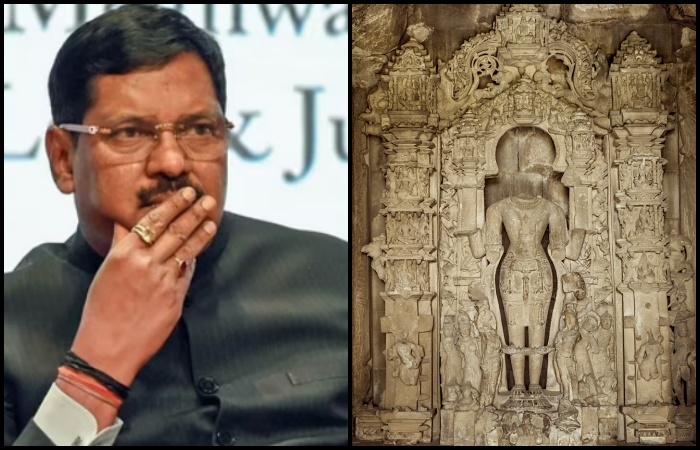
On September 16, 2025, the Supreme Court of India dismissed a petition seeking restoration of a seven-foot mutilated idol of Lord Vishnu at the Javari temple in Khajuraho, Madhya Pradesh. The idol, part of the UNESCO-protected Khajuraho group of monuments, had been beheaded centuries ago during the Mughal invasions, left desecrated and dishonoured ever since.
The petitioner, a devotee named Rakesh Dalal, argued that restoring the idol was not merely about archaeology but about faith, dignity, and the fundamental right of Hindus to worship their deities in wholeness. Represented by Senior Advocate Sanjay M Nuli, he asked the Court to direct the Archaeological Survey of India (ASI) and relevant authorities to repair the idol and revive the sanctity of the temple.
The petition traced the legacy of the Khajuraho temples, built under the Chandravanshi rulers, and argued that years of British indifference followed by post-independence apathy have left the idol in a neglected condition, even after more than seven decades of freedom.
Dalal further maintained that the government’s continued refusal to undertake restoration work amounts to a violation of devotees’ fundamental right to worship. He pointed out that multiple protests, representations, and public campaigns highlighting the issue have yielded no response from the state.
The response from the bench, led by Chief Justice of India BR Gavai, was not legal reasoning but sarcasm. “This is purely publicity interest litigation. Go and ask the deity itself to do something now. You say you are a staunch devotee of Lord Vishnu. So go and pray now,” the CJI told the petitioner.
For Hindus, this remark cut deeper than the centuries-old wound inflicted by Mughal swords. It echoed a familiar taunt: “If your gods are real, why didn’t they protect themselves?” This Hinduphobic trope, weaponised for centuries by Islamist rulers and modern-day secular elites, has now found a resounding endorsement in the Chief Justice of India.
The asymmetry of Indian secularism
Let us imagine, for a moment, if the same remark had been directed at Muslims. Suppose during the hearing of the Waqf (Amendment) Act case, CJI Gavai had told petitioners: “If you don’t like this law, go ask Allah to help you. Pray, and maybe He will restore your lands.” The outrage would have been instantaneous and apocalyptic. The legal fraternity would have issued statements, television anchors would scream “judicial Islamophobia,” NGOs would have dashed off letters to the UN, and the Chief Justice himself would be branded a bigot.
But when the same derision is reserved for Hindus, the reaction is silence. No lawyer council issues statement. No street protests. No petitions for recusal. In India, secularism works only one way. Hindus are mocked, insulted, and ridiculed with impunity. Minorities are treated with kid gloves, protected from the faintest insult, their grievances amplified as existential crises.
While we are discussing the hypocrisy in dealing with the majority and minorities, it is notable to mention here that CJI Gavai, who ridiculed Mr Dalal for a petition to restore Khajuraho idol, was a part of the Supreme Court bench that recently stayed some provisions of the Waqf Amendment Act, 2025, including the provision that says encroached government land cannot be ‘Waqf’ till the dispute is resolved — effectively encouraging encroachment and squatting on government land.
The street veto vs the courtroom
This asymmetry flows from a stark reality: minorities enforce their sensitivities on the streets; Hindus seek redress in the courts.
When Muslims feel insulted, they exercise the “street veto.” They erupt in protests, block roads, and chant “Sar Tan Se Juda” slogans. Individuals are attacked or even killed for perceived blasphemy as evident with the gruesome killing of Kanhaiya Lal in Udaipur. His fault? To support Nupur Sharma for protecting the honour of Lord Shiva and responding to her co-panelist in the language he understands. But instead, the Supreme Court lashed out against Nupur Sharma for her “loose tongue”, holding her singularly responsible for “setting the country on fire.”
Those who went about on the streets killing and vandalizing escaped unharmed. The state and judiciary, fearing bloodshed, treaded carefully.
Hindus, in contrast (and rightfully so) seek remedies through legal petitions. They invoke constitutional rights. They rely on institutions. And what do they receive? Mockery. They are told to “go pray.” Their faith is trivialised, their devotion belittled, and their petitions dismissed as “publicity stunts.”
The message is unmistakable and extremely dangerous: aggression gets respect, pursuing matters as per the law of the land invites ridicule. In practice, secularism in India rewards violence and punishes restraint.
If prayer is the answer, why have courts at all?
The Chief Justice’s remark—“go and pray to your God”—is not only insulting but logically absurd. If divine intervention were the solution, why have courts at all? Why hold hearings, pass judgments, or interpret laws? Every litigant could simply be told to pray, whether they are corporations fighting contracts, citizens disputing land, or victims seeking justice.
But of course, such sarcasm is not dispensed universally. No corporate lawyer has ever been told to “pray to Goddess Lakshmi” for financial disputes. No Christian has been told to “pray to Jesus” for relief. No Muslim has been told to “seek Allah’s mercy” instead of filing waqf claims. Only Hindus are told that their faith invalidates their right to legal remedy.
Normalising Hinduphobia from the bench
What is most dangerous about this episode is how it normalises Hinduphobia. When the Chief Justice of India mocks Hindu faith, he sets the tone for the entire ecosystem. It gives intellectuals, academics, and media elites the confidence to continue deriding Hindu beliefs as superstition, Hindu grievances as “majoritarianism,” and Hindu claims as “publicity stunts.”
This is how prejudice is entrenched, not just through mobs burning temples, but through casual remarks from powerful men in robes. Each sneer chips away at the dignity of Hindus, making mockery of their gods socially acceptable and institutionally sanctioned.
If legally, the CJI believed that the plea fell in the ASI’s domain and not that of the Supreme Court, it would have been sufficient for him to say just that. In fact, given that the Supreme Court is the arbiter and interpreter of the Constitution of India, that is all that the Supreme Court is authorised to say. However, the CJI turned what should have been an innocuous order to approach ASI into a spectacle where in open court, the highest judicial authority of the country mocked the faith of a billion.
A great amount of time may have elapsed, but time is no defence for injustice. Slavery ended centuries after it began. Apartheid ended decades after it was entrenched. Historical wrongs can and must be corrected, no matter how old. To suggest otherwise, which the CJI did with his mockery, is to resign humanity to perpetual wounds.
Ridiculing not just devotion, but centuries of Hindu persecution
By mocking the petitioner, the Chief Justice did not just dismiss a plea; he dismissed centuries of religious persecution faced by Hindus, the attendant pain, and rejected the possibility of reconciliation with history. The same Court that embraced Ram Lalla as a litigant in the seminal Ram Janmabhoomi case chose to laugh at Vishnu’s devotees. The same judiciary that bends over backwards for minority causes told Hindus to “pray” instead of seeking justice through constituionally sanctioned methods.
This is where Indian secularism stands today: a one-way street where Hindus are mocked for their faith, minorities are coddled for their grievances, and justice is selectively dispensed based on who shouts loudest or threatens violence.
But history will not end here. Every mutilated idol, every desecrated temple, every silenced devotee is a reminder that the struggle for civilisational justice is not over. Courts may sneer, but the duty of a civilisation is eternal: to remember, to restore, and to reclaim what is rightfully ours.
Until then, Hindus must live with the bitter truth that even in their own land, in the year 2025, when they seek dignity for their Gods, the highest court in the country tells them: “Go and pray.”
Moral authority to preach mutual respect and tolerance lost
And ultimately, it rests on the court’s discretion to admit or dismiss a petition. But the bench could have been a little sensitive in rejecting Mr. Dalal’s plea. Instead, it chose to mock a petitioner with a sarcastic swipe for merely seeking restoration of a desecrated idol of God dear to him. Judges, often regarded as some of the most erudite voices in society, are expected to exercise restraint and dignity, not indulge in barbs that echo the language of 16th-century iconoclasts.
When the judiciary shows disregard for the deeply held faith of the majority, it forfeits its moral standing to preach tolerance and respect to others.