Eight Pakistan nationals have been arrested in Greece for plotting terror attacks, according to unconfirmed reports, Greek City Times reported.
Greek City Times is a Greek lifestyle site. The arrests have once again brought the spotlight back on Pakistan which has been the main spreader of jihadist terrorism across the globe.
Jihadist terrorism in Europe emerged in the 1990s. In many European countries, awareness of this new development took some time. In fact, the threat posed by jihadist terrorism was underestimated, overlooked, and often misunderstood.
Of all different kinds of political-religious terrorism, transnational jihadist terrorism is the most threatening one to Western values, interests and societies. This form of terrorism is the product of a combination of Islamist ideology and the idea of jihad, as per Greek City Times.
According to, Greek City Times, Pakistan-origin terrorists have been at the forefront of executing this form of terrorism. In September 2020, Europe felt a sudden jolt when arrest warrants were issued for fourteen Pakistanis in Italy in connection with the terrorist attack on the Charlie Hebdo office in Paris.
It confirmed the growing presence of Pakistani radicals in Europe.
French authorities in December 2020 arrested four more Pakistani nationals who had prior knowledge of the attack. Ever since, Pakistani terror supporters have been under constant watch in the UK, Spain, Italy, France and Germany.
In another incident of Pakistan-origin terrorists planning a terror attack on European soil, Greek police arrested two Pakistani nationals in March 2023 who were allegedly planning mass-casualty terrorist attacks against Israeli and Jewish targets in the country.
(This news report is published from a syndicated feed. Except for the headline, the content has not been written or edited by OpIndia staff)
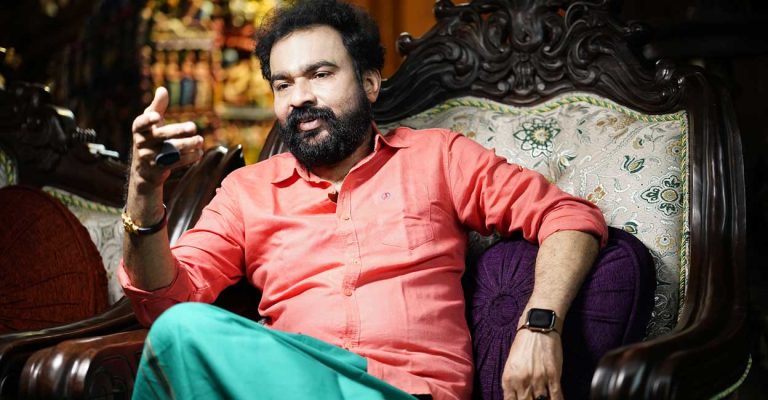
Fake antique dealer Monson Mavunkal was on Saturday sentenced to life imprisonment after a special POCSO court in Ernakulam found him guilty of sexually assaulting a minor girl.
The special Protection of Children from Sexual Offences (POCSO) case court found him guilty of sexually harassing his domestic helper’s minor daughter multiple times. “Fake antique dealer Monson Mavunkal was pronounced guilty in the rape case of a minor. The Special POCSO Court in Kochi pronounced the verdict today. He had sexually harassed his domestic helper’s minor daughter multiple times,” said a prosecutor.
Mavunkal was sentenced to life imprisonment under two sections of the Indian Penal Code (IPC).
“The Kochi special POCSO court sentenced Monson Mavunkal to life imprisonment until the remainder of his natural life in two sections under the IPC. Sections 376(2)(n) and 376(2)(f),” said the prosecutor.
Monson Mavunkal is accused of allegedly swindling crores of rupees by selling fake antiquities. The Crime Branch of Kerala Police arrested him on November 6, 2021.
Mavunkal had pretended to be a collector of artifacts and relics over the last several years and cheated people of over Rs 10 crore.
As per a report, Mavunkal had claimed that his precious antique collection includes a throne of Tipu Sultan, the first edition of the Holy Bible, books used by Maratha King Chhatrapati Shivaji, the last Mughal emperor Aurangazeb and Mysore Sultan Tipu Sultan.
(This news report is published from a syndicated feed. Except for the headline, the content has not been written or edited by OpIndia staff)
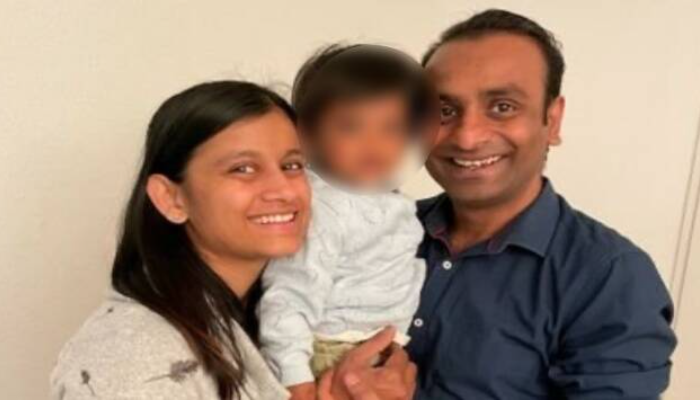
A district court in Pankow, Germany, refused custody of Ariha Shah, a 28-month-old Indian girl, to her biological parents and handed her to Jugendamt, the German juvenile services in two separate judgments on June 13.
The court rejected Dhara and Bhavesh Shah’s request to have the child returned to them directly or, at the very least, given to a third party, the Indian Welfare Services, and instead handed over the child to Jugendamt. It ruled, “The parents are no longer authorised to decide on the whereabouts of their child.”
The court declared that the Central Youth Welfare Office of Berlin would be responsible for making decisions regarding her whereabouts while acting as her temporary guardian. The parents had first requested her custody, but they later withdrew the motion.
Following that, they asked that full parental custody be restored and that she be delivered to the Indian Welfare Services, with the understanding that she would then be sent to Ashok Jain’s foster home in Ahmedabad. The parents also intended to relocate to India with her.
The court cited two injuries on the head and back that Ariha Shah endured in April 2021 that occurred while she was being washed and a genital injury in September of the same year in refusing custody to her parents or the Indian Welfare Services.
It maintained that in order to “avert the existing danger to the child,” parental care ought to be refused. It further stated that the parents were unable to “explain the events in question in a sufficiently consistent manner” and it reached the conclusion “that the mother and/or father (had) intentionally caused the serious genital injuries to the child.”
The parents already have “the right and duty” to visitation twice each month, “on the first and third Tuesday of each month for 60 minutes (of) accompanied contact,” per the district court’s order. The former requested supervised visitation with their daughter once every two days for 90 minutes in their visitation petition.
However, their plea was rejected noting that while maintaining contact with her parents was necessary for Ariha Shah to have a consistent image of them as she grows, “the development of a bond was no longer in the foreground.”
In order to “not cause any additional irritations in the child’s experience,” it was also underlined that the contact frequency shouldn’t be altered. The court decision pronounced that the child should be given time to develop a bond with her foster parents and that any change in visitation frequency or duration could have “a disturbing effect” on her.
Arindam Bagchi, a spokesperson for the Ministry of External Affairs, pleaded with the German government on June 3 “to do all necessary to send Ariha to India as soon as possible, which is also her inalienable right as an Indian national.”
In a letter to the German ambassador to India, Philipp Ackermann, earlier in June, 59 members of Parliament representing 19 political parties, including the Bharatiya Janata Party, Congress, the Left, and the Trinamool Congress asked him to take all necessary steps to facilitate the little girl’s return to India as soon as possible.
After the court verdict, the parents flew from Berlin to New Delhi on June 15 to request that the Indian authorities seek Ariha Shah’s repatriation because she is an Indian citizen. Bhavesh Shah voiced, “We plan to appeal in a higher court in Germany but have little hope of getting a fair trial. We were expecting a verdict like this. They did not opine on the reports of experts who defended us, and just gave a one-sided verdict.”
The couple has made a request for Ariha Shah’s return to the Ministry of External Affairs (MEA). They asserted they had no idea if the Jugendamt would allow visits once she turned three. “And once we lose visitation, if we want to bring her back to India, Ariha herself may not remember us or understand what India is and may refuse to come back. The visitation that has been allowed now is supposed to apply until Ariha settles in with her new foster parents,” Dhara Shah added.
Ariha Shah, the daughter of a Jain couple Bhavesh and Dhara Shah was 7 months old when she was separated from her parents by the authorities of the Germany Child Care Institute after the baby was accidentally hurt by her grandmother. 20 months have passed since then but she has not been returned to her parents.
“Our visitations with Ariha since October 2021 were supervised by a social worker. We constantly received good reports from the social worker. As of September 2022, the social worker observed that the visitations were going well and that they may be increased. Relying on those reports, in September 2022, we went to the family court requesting that the frequency of our visitations should be increased to at least twice a week, but Jugendamt opposed the plea,” Bhavesh reportedly told Indian Express on June 8.
A heated scuffle between women over religious conversion was reported in Urala village under the Mohan Nagar police station area of Durg Bhilai in Chhattisgarh. Local women barged into a ‘prayer meeting’ after learning that two women there are asking the participants to convert to Christianity.
The local women started beating the evangelists. The matter was taken to the police station where both parties agreed for a compromise and no charges were brought in.
As per a report in Amar Ujala, Chitralekha Sahu, a resident of Urala Basti, organized a prayer meeting at her house. During the gathering, Chitralekha was accompanied by a middle-aged woman and a younger woman. These two women began encouraging people to convert. This prompted a group of individuals to arrive at Chitralekha’s house. Upon seeing the growing crowd, Chitralekha quickly fled from the scene. Unfortunately, the two other women who were advocating for religious conversion were confronted and beaten by local women.
The residents of Urala Basti have made accusations that the said women were engaged in converting people under the guise of a prayer meeting in the locality. It is alleged that they were using bribery and misinformation to influence the meeting participants to convert to Christianity. Upon receiving information about the assault, the police promptly arrived at the scene and took both parties to the police station. Subsequently, both parties provided written statements to the police, agreeing not to file complaints. Following this, both groups departed from the police station. The incident’s video has since gone viral on social media, garnering significant attention.
Vipin Rangari, the in-charge of Mohan Nagar police station, said that an incident of assault occurred two days ago in Urala Basti. He said, “Upon receiving the information, the police promptly arrived at the scene and subsequently took both parties involved to the police station. However, neither side filed a formal complaint or pursued any legal action.”
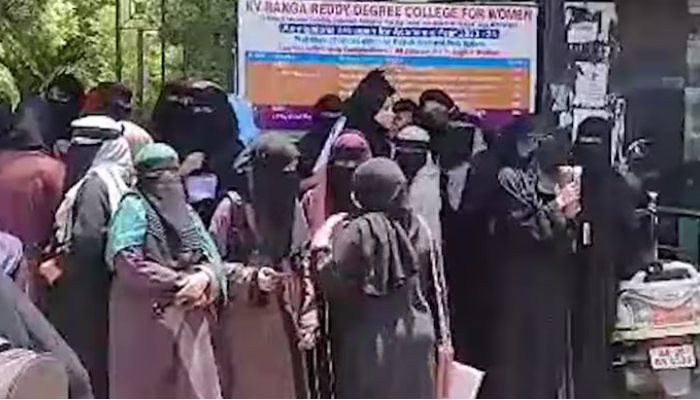
The staff of the KV Ranga Reddy Degree College for Women in Hyderabad allegedly forbade female students who arrived at an examination centre on Friday donning burqas from taking the exam. According to the Muslim pupils, they had to wait for a half-hour and take off their burqas before being permitted to sit for the test. They wear asked to wear it outside the premises after the exams.
A student informed, “They forced us to take off our burqa and told us to wear it outdoors after the exam. This is KV Ranga Reddy College in Santosh Nagar. They told us the same thing on the day of our first exam. Today is our second one and we are yet again directed to remove the burqa. Burqa is approved at other colleges, but not here, so we have to take it off.”
#WATCH | Telangana | Girl students who appeared for examination at KV Ranga Reddy College in Santosh Nagar, Hyderabad allege that they were "forced" to take off their burqa before sitting for the exam. (16.06.2023) pic.twitter.com/JHzWP1agsR
Another student mentioned, “The college authorities have instructed us to not wear a burqa from tomorrow, but, this is against the examination rules. Our parents have complained regarding the issue to Home Minister Mahmood Ali. He said that not allowing female students with burqas into the centre is not right.”
After the incident, Telangana Home Minister Mohammad Mahmood Ali stirred up controversy by suggesting that females should try to keep as much of their bodies covered as they can. When asked about the incident at KV Ranga Reddy College, he responded that issues emerge when ladies wear short dresses.
“Our policy is an absolutely secular policy. Everyone has the right to wear whatever they want. But, one should practice wearing dress according to Hindu or Islamic practices and not follow European culture. We should wear good clothes and respect our dressing customs,” he stated.
The politician added, “Especially, women shouldn’t wear short dresses. They should cover their heads as well as bodies as much as possible. For women, wearing fewer clothes is not convenient. They are at peace when they wear more clothes.” He also assured that the government will take cognizance of the matter and action will be taken accordingly.
#WATCH | "Some Headmaster or Principal might be doing this but our policy is totally secular. People can wear whatever they want but if you wear European dress, it will not be correct…We should wear good clothes. Auratein khaas taur se, kam kapde pehn'ne se pareshaani hoti hai,… pic.twitter.com/iagCgWT1on
On Friday, a few Ranga Reddy Women’s Degree College students who were scheduled to take the Urdu Medium Degree Examination went to the exam centre in burqas. However, they were instructed by the staff there to pull off their burqas before writing the exam.
The students reportedly protested against the college administration for making them remove their burqas in order to take the intermediate supplementary exam. Many parents also complained that their children were singled out because of the burqa and that the college management was unsympathetic to their concerns.
The controversial issue of Muslim girls wearing a hijab in Karnataka’s educational institutions emerged as a raging national debate last year. Hijab was prohibited inside classes at a government pre-university college in Karnataka last year. Following this, the state’s former Bharatiya Janta Party administration, led by chief minister Basavaraj Bommai, issued a directive outlawing the hijab in schools and universities. It was prohibited within government colleges where uniforms were already in place, per the directive.
However, in October of last year, the Supreme Court issued a split decision on whether Muslim students need to remove their hijabs at the school gates. The Chief Justice of India then proposed to appoint a larger bench to decide the case. Justice Hemant Gupta decided that the hijab is not a necessary religious practice and uphold the ban whereas Justice Sudhanshu Dhulia overturned the restriction on the hijab and cited the importance of girl education.
Now, the incumbent Congress government in the southern state is all set to reverse the ban soon.
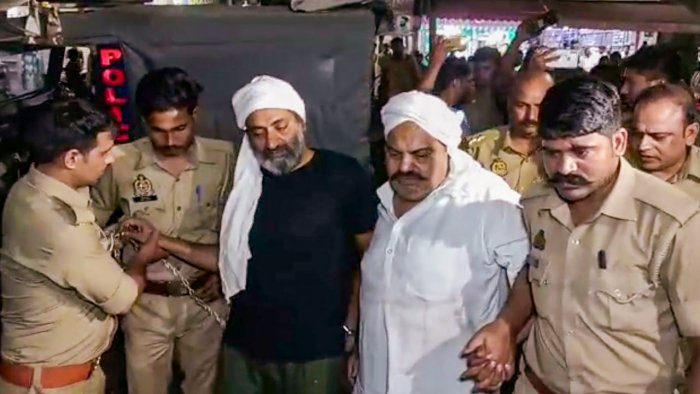
Weeks after mafia-turned-politician Atiq Ahmed and his brother Ashraf Ahmed were shot dead, Prayagraj Police received a call from an unidentified person who threatened to avenge the killing of the mafia brothers. Following this, the Crime Branch traced the location of the mobile number and arrested two suspects on Friday, June 16. According to a Live Hindustanreport, the police have not made a confirmation about the incident yet.
Reportedly, the mobile phone of a person was lost and it was found by a Ganganagar resident. The brother of the person who found the mobile phone had dialled 112 and threatened to take revenge for the murder of Atiq Ahmed and his brother. He also used derogatory language for Uttar Pradesh CM Yogi Adityanath.
Teams of the Crime Branch were tasked to nab the accused persons and investigate the matter. Following this, the two were arrested and are now being questioned by the Jhusi Police.
Notably, in May this year, Prayagraj police lodged an FIR against a Twitter handle ‘The Sajjad Mughal’ for posting a threatening message over Atiq Ahmed’s killing.
The Twitter user shared a video clip wherein Atiq Ahmed’s son Ali Ahmed, currently lodged in Naini jail, was seen addressing a gathering and claimed that the wind would change in Uttar Pradesh when the BJP government in the state loses power.
In other news, the Enforcement Directorate (ED) raided 12 places in Prayagraj, Noida, and Delhi on Thursday, June 15, that were linked to Atiq Ahmed. According to documents obtained by the ED, as many as 50 shell companies were formed at the gangster’s behest by Atiq’s associates in order to divert money acquired from criminal activities.
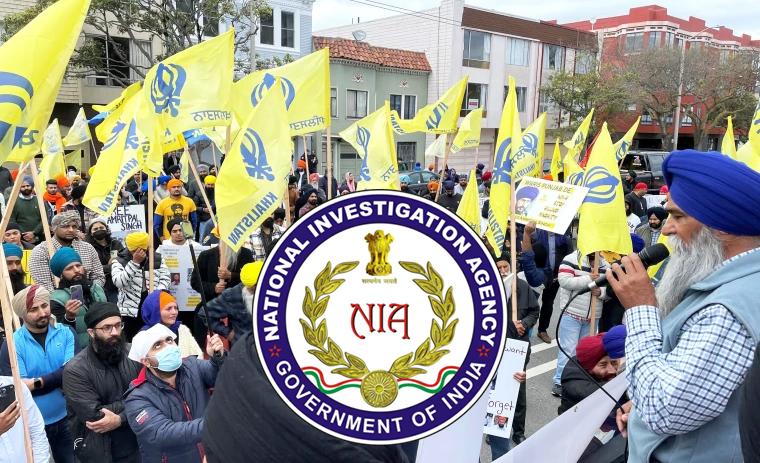
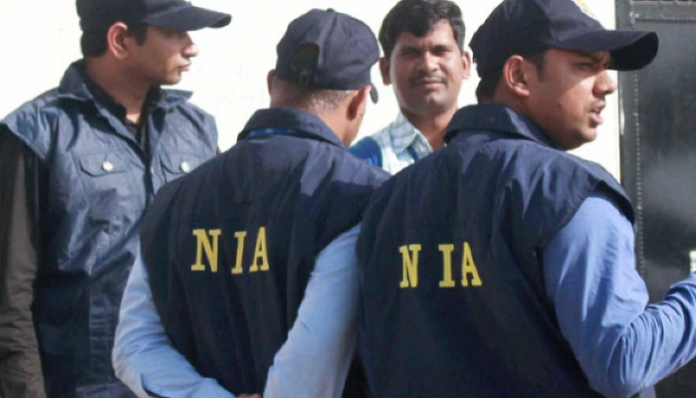
The Ministry of Home Affairs (MHA) is likely to hand over the investigation into the attacks on Indian High Commission in the US and Canada to the National Investigation Agency (NIA). This comes days after an NIA team reached London on May 23 to probe the attack on Indian High Commission there.
The Special Cell of the Delhi Police filed two separate FIRs in connection with the attacks on the Indian High Commissions in San Francisco and Canada in March of this year.
During the attack on the Indian High Commission in Canada, a grenade was also thrown, prompting the Special Cell to register an FIR under the UAPA and the Explosive Act in this instance.
In the same month, a similar attack on the Indian High Commission occurred in San Francisco. In this case, the Special Cell also filed an FIR under the UAPA.
Khalistani attacks on Indian diplomatic missions and consulates
At a time when Indian authorities launched a crackdown on pro-Khalistan leader Amritpal Singh, a dinner reception for High Commissioner of India to Canada Sanjay Kumar Verma in Surrey, British Columbia, on March 20, had to be cancelled due to violent protests by Khalistanis. Back then OpIndia reported how an Indian-origin journalist Sameer Kaushal was “pushed and threatened” by the Khalistanis protesting.
Back then, India had registered its strong protest against the attacks by Khalistani elements. The foreign office in New Delhi had summoned Canada’s High Commissioner and sought an explanation on how the Khalistani elements were permitted to violate the security of the Indian diplomatic mission and consulates in the presence of police.
“The Government of Canada was reminded of its obligations under the Vienna Convention, and was asked to arrest and prosecute individuals who have already been identified as being involved in such acts,” the Ministry of External Affairs (MEA) stated back then.
Khalistani terrorists attack Indian Consulate in San Francisco
On March 19, 2023, the Khalistanis launched an attack on the Indian consulate in San Francisco in the United States. The Khalistani terrorists breached the local authorities’ makeshift security barricades, placed two Khalistani flags inside the consulate, and caused significant damage to the building. Two consulate personnel later removed the flags.
The NIA Act was amended in 2019 allowing NIA probes abroad
On August 2, 2019, Prime Minister Narendra Modi revised the NIA Act to allow the agency to conduct investigations on foreign land. A government notification said, “In exercise of the powers conferred by sub-section (2) of section 1 of the National Investigation Agency (Amendment) Act, 2019 (16 of 2019), the central government hereby appoints the 2nd August 2019, as the date on which the provisions of the said Act shall come into force.” On July 17, 2019, the parliament enacted a law in this regard.
The amendment included a significant provision that extended the NIA’s authority to investigate offences committed outside of India. This provision, however, is subject to existing international treaties as well as the domestic laws of the countries involved.
In conjunction with its investigation into the smuggling of illegal substances and weapons, the National Investigation Agency (NIA) has filed a charge sheet against 13 people, including 10 Sri Lankans and three Indians. The case pertains to the efforts to resuscitate the Liberation Tigers of Tamil Eelam (LTTE) in the two countries.
According to the NIA, a charge sheet against the apprehended individuals for using the illegal drug trade to fund, gather, and store weapons for the resurgence of the LTTE in India and Sri Lanka was submitted on Thursday. Selvakumar M, Vigneshwara Perumal alias Vicky, and Iyyapan Nandhu alias Ayyappan Nandhu are three Indians whose names appeared on it.
C Gunasekaran alias Guna, Pushparajah alias Pookutti Kanna, Mohammad Asmin, Alahapperumaga Sunil Ghamini Fonseka, Stanly Kennady Fernando, Dhanukka Roshan, Ladiya alias Nalin Chathuranga, Vella Suranga alias Gamage Suranga Pradeep, Thilipan alias Dileepan and Danarathnam Nilukshan are the accused Sri Lankan nationals.
Various sections of the Indian Penal Code, the Unlawful Activities (Prevention) Act and the Narcotic Drugs and Psychotropic Substances Act are invoked against them. While Vigneshwara Perumal and Iyyapan Nandhu were arrested in April of this year, the others were caught in December of last year. On July 8 of last year, the NIA suo moto launched the probe and arrested the 13 perpetrators from Tamil Nadu.
Pushparajah and C Gunasekaran ran a drug ring in the island nation and collaborated with Haji Salim, a supplier of both drugs and weapons from Pakistan. “The drugs were being sourced from Salim, who is suspected to be residing in Pakistan. The accused persons were using foreign WhatsApp numbers to carry out the clandestine trade.” NIA highlighted this in its official statement.
Salim Haji has reportedly worked with Pakistan’s Inter-Services Intelligence (ISI). He was in charge of practically all marine drug and weapon smuggling to India, Sri Lanka, the Maldives, and other adjacent nations.
NIA stated, “Investigations in the case had exposed their conspiracy to fund the revival of LTTE through the drug trade. They were arrested (last year) at the Trichy Special Camp. Investigations had further revealed that the accused were using the proceeds of crime to live a lavish life.”
“Several mobile phones with pre-activated Indian SIM cards were also seized from them along with various digital devices, documents relating to drug transactions, cash to the tune of ₹80 lakh, and nine gold bars. The cash and gold were proceeds from the sale of narcotics and were being channelled through hawala networks between Chennai and Sri Lanka. Several transactions using Crypto platforms were also unearthed,” it added.
At least four separate instances involving a plot to relaunch the LTTE’s operations in Sri Lanka and India are being looked into by the federal agency.
Former LTTE intelligence officer Satkunam alias Sabesan was captured by the NIA in October 2021 in connection with an investigation into March 18, 2021, Coast Guard interception of the fishing vessel Ravihansi off the coast of Minicoy in Lakshwadeep, which resulted in the seizure of 300 kg of heroin, thousands of rounds of 9 mm ammunition, and five AK47 rifles.
On Friday, June 16, the Mumbai police informed that two men, namely, Munnawar Mansoori and Azeem Mansoori have been arrested in Bhayander, located in the suburbs of Mumbai, for allegedly sexually harassing and threatening a 13-year-old girl to convert her religion.
The action was taken based on a complaint filed against them by the victim’s mother. They were arrested under Sections 354, 354 (A), 366 (A), 506 and Sections 8, 12 of the POCSO Act.
According to reports, the mother reportedly told the police that on June 12 at around .30 in the evening, the accused took her minor daughter to the terrace of a building and tried to lure her to convert to Islam. They also coerced her to wear a burqa and elope with one of them by offering her gold ornaments. When she refused, the accused molested and sexually assaulted her daughter. After that, they threatened to shoot her using a fake pistol.
The victim’s mother further said that Munnawar and Azeem Mansoori had been following her daughter since June 1 and hurling obscene slurs.
However, after the June 12 episode, the girl narrated the entire incident to her mother, who filed a complaint against both the accused. The cops arrested both men under the relevant sections of the law, including the Protection of Children from Sexual Offences Act (POCSO).
“An FIR has been registered under the jurisdiction of the Bhayandar police station. The FIR states that a minor girl was harassed and threatened to convert to another religion. The accused have been taken into custody under POCSO and section 354 of the IPC,” said DCP Jayant Bajbale.
“A dummy pistol used to threaten the girl has also been recovered,” DCP Bajbale added.
Om Raut’s mega-budget movie Adipurush was released yesterday. The movie is based on Ramayan and the makers had spent a massive amount on PR, promising a magnificent retelling of the Hindu epic. However, though the movie saw full theatres on the day of release, many people have expressed shock and displeasure over the dark themes, cheap-looking VFX, and ‘inappropriate’ dialogues unfit for religious characters.
The Lanka Dahan scene apparently has Hanuman saying to one of Ravan’s sons, “Kapda tere baap ka, tel tere baap ka, aag tere baap ki, aur jalegi bhi tere baap ki”. (The clothes, oil, and fire all belong to your father, it is him who will get burned).
Some other dialogues that have the audience react in disgust are:
“Teri bua ka bageecha nahi hai jo hawa khane chala aya”
“Mere ek sapole ne tere Sheshnaag ko lamba kar diya”
“Marega bete”
“Apne bandaron ko lekar nikal ja”
The lowbrow style and the coarse language of the dialogues are fit for a movie depicting street goons and prison gangs, not an epic that is one of the main religious scriptures for over a billion Hindus all over the world.
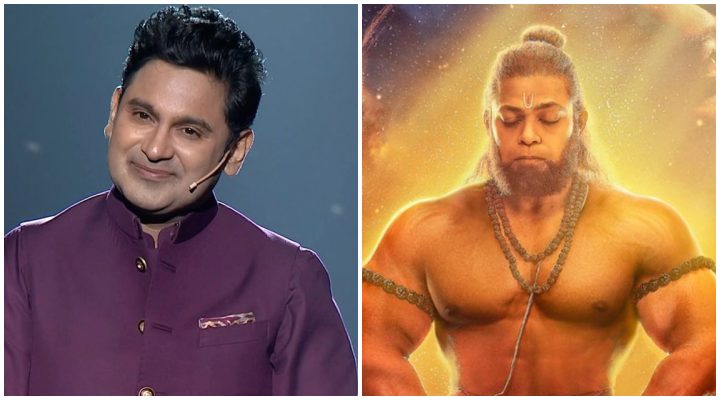
Social media users are surprised that Manoj Muntashir, who wrote the heart-touching lyrics in the superhit songs ‘Teri Mitti’, ‘Galliyan’, and ‘Kaun Tujhe’, etc would be so off the mark in the dialogues of Adipurush.
Manoj Muntashir justifies the dialogues
Following the widespread condemnation and social media criticism, Muntashir has spoken to the media and has tried to justify the dialogues. As per reports, the popular poet and lyricist has stated that he wrote the dialogues keeping the ‘modern, contemporary’ speaking styles of the general public in the country.
He has also stated that all the characters in a story cannot be speaking the same kind of language and that is why he has tried to give different speaking styles for Ram and Hanuman.
"हमने जानबूझकर ऐसा ही रखा है, जिससे आजकल के लोग उससे कनेक्ट हो सकें, आम बोलचाल की भाषा में यह बात रखी है"
◆ आदिपुरुष में हनुमान के विवादित डायलॉग पर मनोज मुंतशिर ने कहा
Muntashir said that the dialogues are not a mistake, but have been written with much thought and after meticulous deliberating. He even claimed that “Kapda tere baap ka, tel tere baap ka” etc is how many popular Kathavaachaks in India tell Ramayan stories. He added that they never wanted to ‘Sanskritise’ Adipurush and the dialogues are kept that way so people can relate to them.
Manoj Muntashir admits he knowingly and intentionally wrote such Tapori-type blasphemous dialogues for Adipurush.
He should have apologised to Hindus for hurting their sentiments instead of defending himself shamelessly. pic.twitter.com/TkFf0QLrAm
It is notable here that in all the narrations and depictions of the Ramayana done so far, nowhere it is shown that Ram and Hanuman are on different levels of linguistic sophistication. In fact, Lord Hanuman is addressed as “Gyan gun sagar”, the ocean of knowledge and good qualities.
As per Hindu beliefs, Hanuman is the son of Vaayu Devta, the Lord of the wind, and a manifestation of Lord Shiva. He is one of the Chiranjeevis (immortals), he was blessed with knowledge and unfathomable power by Surya Deva himself and is a disciple of Rishi Matang too. Hanuman learned all the Vedas, Yoga, and arts from childhood and was blessed by all the Gods with unmatched wisdom, valor, and power.
In fact, in Valmiki Ramayana, there are instances where Lord Ram praises the extent of Hanuman’s knowledge and his way of speaking.
No one knows how did Manoj Muntashir conclude that ‘Gyan gun sagar’ Hanuman’s communication style would be the same as that of a local TikTokiya.
Manoj Muntashir had declared that he is fortunate to be writing Ramayana for this age
Amid the criticisms over the loutish, uncivilized language uttered by Ramayana characters, an old tweet of Manoj Muntashir is going viral where he claimed that he is fortunate to be writing the Ramayana in our times.
However, Muntashir’s attempt to justify the boorish, tacky dialogues he has added in Adipurush are in contrast to previous statements and declarations by the movie makers, that Adipurush is a sincere attempt to retell the Ramayana.
Cringe-level dialogues and ‘cheap VFX’ disappoint viewers of Adipurush
Adipurush has received disappointing reviews from movie critics and audiences alike. Many have pointed out that not only do the costumes, and appearances of the main characters seem odd and unpleasant, but the movie itself comes across as a mockery of a widely popular and revered epic that is worshipped in every Hindu household all over the world.
One Twitter user commented that the one scene of Ram Charan appearing as the bow and arrow-wielding Ram in RRR was more powerful than the entire Adipurush movie.
Many also reminisced about the legendary portrayal of Ravana by NT Rama Rao, the way he depicted the most defining characteristic that made him the demon he was: Arrogance.
Ravana was arrogant. Arrogant that he was learned, arrogant that he had the boon of Brahma and blessings of Shiva, arrogant that he ruled over an impenetrable Lanka. You can see that arrogance personified in NT Rama Rao. Ravana was certainly not a maniac like Saif portrays him. pic.twitter.com/nqwiv9hA4F
Apart from the cringe dialogues, people are also giving a thumbs down to the ‘cheap VFX’ and the blatant attempts to copy Hollywood scenes.
Some users have commented that the scene of Ravana kidnapping Seeta is almost the same as Disney’s Maleficient, the Vanar Sena fighting scenes have a strong resemblance to King Kong scenes, and even the ‘revival’ of Lakshman using Sanjeevani has been done as the scene where Lady Mellisandre revives Jon Snow in Game Of Thrones.