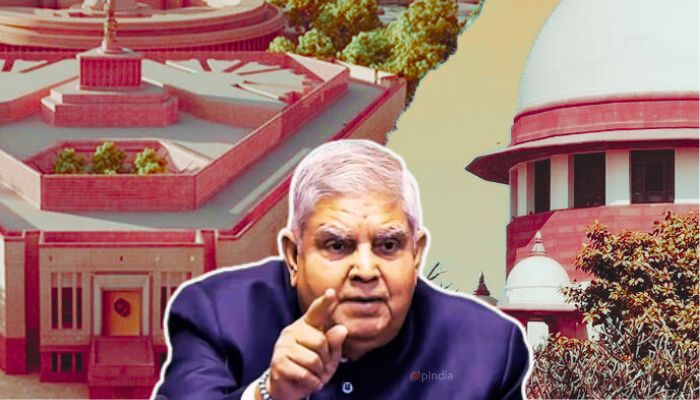
On the 21st of July 2025, Vice‑President Jagdeep Dhankhar resigned and submitted his letter of resignation to President Droupadi Murmu, citing medical reasons and the need to prioritise his health.
The resignation came on the opening day of the Monsoon Session of Parliament, catching many by surprise amid a busy legislative agenda. Speculations are rife about the timing of Dhankhar’s resignation, with the opposition claiming that the reasons behind his stepping down may be far deeper than just health reasons.
In his letter to President Droupadi Murmu, Jagdeep Dhankhar invoked Article 67(a) of the Constitution to make his resignation effective immediately. Citing ongoing health challenges, he stated his intention to “prioritise health care and abide by medical advice.”
From the very onset in 2022, Dhankhar’s tenure as Vice President was marked by his vocal criticism of the judiciary, especially on the issues of its overreach and accountability. Being a seasoned lawyer himself and having a background in the Supreme Court and the Rajasthan High Court, Jagdeep Dhankhar consistently raised concerns over the alleged encroachment of the powers of the legislature and executive by the judiciary, arguing that their actions undermined the supremacy of Parliament and the balance of powers as prescribed in the Constitution.
“Judiciary cannot become executive”: When Vice President Jagdeep Dhankhar warned the judiciary that its overreach might destabilise governance
Hitting back at the judiciary regarding the overturning of parliamentary amendments to the Constitution in December 2022, VP Jagdeep Dhankhar warned that the judiciary cannot become the legislative or the executive because doing so may destabilise the system of government as a whole.
Dhankhar stated during the eighth LM Singhvi memorial lecture that our judiciary, as one of the important institutions of government, cannot be the executive or legislative.
“The doctrine of separation of power is fundamental to our governance. Any incursion, howsoever subtle, in the domain of the other by one has the capacity or potential to unsettle the apple cart of governance,” then vice president stated.
“India in 2015-16 was dealing with a constitutional amendment act and as a matter of record the entire Lok Sabha voted unanimously and there was no abstention in Lok Sabha and that amendment act was passed. In Rajya Sabha, there was no opposition. We the people their ordainment came to be reflected through the most sanctified mechanisms through the applicable mechanisms. That power was undone. The world does not know of any such instance. I appeal to all judicial minds please think of a parallel in the world where a constitutional provision can be undone,” the vice president stated.
In the presence of then Chief Justice of India DY Chandrachud, several Supreme Court judges, Union Ministers, then Delhi Chief Minister Arvind Kejriwal and several lawyers, Dhankhar further said, “Power resides in ‘We the People’ – their mandate, their wisdom… If a constitutional provision that carries the ordainment of the people at large in such a vibrant democracy is undone, what will happen? I appeal to the people here, they constitute a judicial elite class, thinking minds, intellectuals – please find out a parallel in the world where a constitutional provision can be undone.”
He also asserted that while the Indian Constitution clearly states in Article 145(3) that the court may interpret the Constitution where a serious question of law is involved. “Nowhere it say a provision can be run down.”
When VP Jagdeep Dhankhar came down heavily on the Supreme Court for scrapping the NJAC
Back in December 2022, Dhankhar criticised the Supreme Court over the 99th Constitutional Amendment Bill paving way for the National Judicial Appointment Commission (NJAC), which was undone by the Supreme Court in 2015.
“The Parliament in a much-needed historic step passed the 99th Constitutional Amendment Bill, paving the way for the National Judicial Appointment Commission (NJAC). There was unprecedented support for the above. On August 13, 2014, the Lok Sabha unanimously voted in its favour with there being no abstentions. This House too, passed it unanimously on August 14, 2014, with one abstention. Rarely in Parliamentary democracy, there has been such massive support to a Constitutional legislation,” Dhankhar said.
“This process fructified into a Constitutional prescription, after 16 State Assemblies out of 29 States ratified the Central Legislation; the President of India, in terms of Article 111, accorded his consent on December 31, 2014,” he added.
Furthermore, then Vice President, Jagdeep Dhankhar stated that this was the first time that a duly legitimised constitutional prescription was judicially undone, “This historic parliamentary mandate was undone by the Supreme Court on October 16, 2015 by a majority of 4:1 finding the same as not being in consonance with the judicially evolved doctrine of ‘Basic Structure’ of the Constitution,” said.
Dhankhar had called the scrapping of the NJAC a severe compromise of parliamentary sovereignty and disregard of the mandate of the people, of which this house and the Lok Sabha are custodians.
VP Dhankhar had also emphasised that Parliament is the exclusive and ultimate determinative of the architecture of the Constitution.
“We need to bear in mind that in democratic governance, the basis of any ‘Basic Structure’ is the prevalence of primacy of the mandate of the people reflected in the Parliament. Parliament is the exclusive and ultimate determinative of the architecture of the Constitution,” said.
It must be recalled that back in 2014, the National Democratic Alliance (NDA) government brought the National Judicial Appointments Commission (NJAC) Act in an attempt to change the system of appointment of judges. The NJAC was a proposed body, which would have been responsible for the appointment and transfer of judges to the higher judiciary. The NJAC Act and the Constitutional Amendment Act came into force on April 13, 2015. But the top court on October 16, 2015, struck down the NJAC Act. The verdict brought back the primacy of the collegium system of judges appointing judges.
VP Jagdeep Dhankhar differed from Supreme Court’s idea of ‘basic structure’ doctrine
In January 2023, Dhankhar once again reignited the discussion over the doctrine of the separation of powers. This time, he cited the Supreme Court’s landmark judgment in the 1973 Kesavanand Bharati case wherein the court had ruled that while Parliament had the authority to amend the Constitution, it cannot amend its basic structure.
Delivering his inaugural address at the 83rd All-India Presiding Officers Conference in Jaipur, Jagdeep Dhankhar questioned: “Are we a democratic nation?”
Asserting that all three pillars of democracy: legislature, executive and judiciary must function within their limits, then Vice President Jagdeep Dhankhar said, “In a democratic society, the basis of any basic structure is supremacy of the people, sovereignty of the people, sovereignty of Parliament. Executive thrives on the sovereignty of Parliament. Legislatures and Parliament decide who will be the Chief Minister, who will be the Prime Minister. The ultimate power is with the Legislature. The Legislature decides who will be in other institutions. In such a situation, all Constitutional institutions – the Legislative, Executive, Judiciary – are required to be within their limits.”
Expressing his disagreement over the Supreme Court ruling in the Kesavanand Bharati case that the Parliament cannot amend the constitution’s basic structure, Dhankhar said, “In 1973, in the Kesavananda Bharati case, the Supreme Court gave the idea of basic structure, saying that Parliament can amend the Constitution, but not its basic structure. With due respect to the Judiciary, I cannot subscribe to this.”
‘Time has come to revisit’: When Vice President Jagdeep Dhankhar questioned the involvement of the CJI in executive appointments
In February 2025, Vice President Jagdeep Dhankhar questioned how the judiciary can be involved in executive appointments as the Supreme Court of India was hearing a petition seeking to include the Chief Justice of India in the selection committee for the Election Commission. He said while earlier the executive yielded to the inclusion of judges in executive functions, it was time to revisit the norms.
Speaking at the National Judicial Academy, Bhopal, Dhankhar said that such a system should not exist in a democracy like India. He wondered how the Chief Justice of India participates in the selection of the CBI director, even by “statutory prescription”.
The vice president said, “To stir your minds, how can in a country like ours or in any democracy, by statutory prescription, the Chief Justice of India participate in the selection of the CBI director! Can there be any legal rationale for it? I can appreciate that the statutory prescription took shape because the Executive of the day has yielded to a judicial verdict. But time has come to revisit.”
Jagdeep Dhankhar further said, “This surely does not merge with democracy. How can we involve the Chief Justice of India in any executive appointment?”
Dhankhar went on to say that while the Supreme Court has the power to interpret the constitution, there can be no “arrogation of authority” under the guise of interpretation. The essence and spirit which the founding fathers had in mind under Article 145(3) must be respected.”
He further advocated for an increase in the constitutional bench strength, as originally the constitution bench comprised the majority of total judges.
“When the strength of the Supreme Court was eight judges, under Article 145(3), there was a stipulation that interpretation of the Constitution would be by a bench of five judges or more. Please note, when this strength was eight, it was five. And the Constitution allows the highest court of the land to interpret the Constitution. If I analyse arithmetically, they were very sure the interpretation will be by the majority of judges, because the strength then was eight. That five stands as it is. And the number (of total judges) is more than fourfold,” he said.
VP Dhankhar’s advocacy for including domain experts in arbitral process instead of retired judges
In March 2025, Vice-President Jagdeep Dhankhar said that the arbitral process in India is “just an additional burden to the normal hierarchical mechanism of adjudication.”
Addressing the Colloquium organised by the India International Arbitration Centre (IIAC) at Bharat Mandapam, Dhankhar said, “Arbitrators play as much critical role as members of the bar associated with the arbiter process. Surprisingly, there is, I’m saying it with utmost restraint, absolute tight-fist control of a segment of a category that is involved with arbiter process determination. This tight-fist control emanates out of judicial feats. And if we examine it on an objective platform, it is excruciatingly painful.”
Emphasising the significance of Article 136 and its effects on the arbitration process, Dhankhar said that while Article 136 was supposed to be a narrow slit, it is hurting the arbitral process.
“The Attorney General of the country can really reflect and make a big change. Which country in the world, Attorney, tell me, has suo moto cognisance by the highest court? I’m sure I can’t look around. And Article 136 intervention was supposed to be a narrow-slit. The wall has been demolished with anything and everything under the sun, including what a magistrate has to do, what a Session Judge has to do, what a District Judge has to do, and what a High Court Judge has to do. That wall demolition is also hurting the arbitral process. All I am suggesting, in all humility and as a concerned citizen of this country, is that the issue you are debating is critical to micro and small industries. They want a facile, easy arbitral process”.
Jagdeep Dhankhar condemned Supreme Court’s “judicial overreach”, calling it an unelected ‘super Parliament’
In April 2025, VP Jagdeep Dhankhar harshly criticised the recent Supreme Court verdict regarding the powers of the Governor and the President under Articles 200 and 201 of the Constitution. In the Judgment passed on 8th April 2025, a division bench of the Supreme Court set a time limit, not envisaged in the Constitution, on the exercise of power to grant or refuse assent to a state Bill by the President and the Governor. The Supreme Court prescribed a deadline of 3 months on the President’s power to grant or refuse assent to a Bill reserved by the Governor for his consideration.
Without mincing words, VP Dhankhar questioned the Supreme Court for issuing a direction to the President of India. He reminded the Supreme Court that its power is limited to interpreting the Constitution. “We cannot have a situation where you direct the President of India, and on what basis? The only right you have under the Constitution is to interpret the Constitution under Article 145(3), ” said the Vice President in an address during the Valedictory Function of the 6th Rajya Sabha Internship Program at Vice-President’s Enclave on 17th April.
“The President is called upon to decide in a time-bound manner, and if not, it becomes law. So we have judges who will legislate, who will perform executive functions, who will act as super-parliament, and absolutely have no accountability because the law of the land does not apply to them,” he said.
Highlighting the fact that the judgment, which had the effect of modifying the concerned provisions, was delivered by a bench of two judges which did not represent the majority of the total number of judges in the Supreme Court.
“When Article 145(3) was there, the number of judges in the Supreme Court was eight, 5 out of 8, now 5 out of 30 and odd. But forget about it, the judges who issued a mandamus virtually to the President and presented a scenario that it will be the law of the land, have forgotten the power of the Constitution. How can that combination of judges deal with something under Article 145(3) if preserved, it was then for five out of eight. We need to make amends for that also now. Five out of eight would mean interpretation will be by majority. Well, five constitutes more than the majority in eight. But leave that aside. Article 142 has become a nuclear missile against Democratic forces, available to the judiciary 24 x 7,” Dhankhar said.
Notably, in the verdict passed in The State of Tamil Nadu v The Governor of Tamil Nadu and Anr, the Apex Court examined the ambit of powers of the President and the Governor conferred under Articles 200 and 201 of the Constitution. The Supreme Court held that the President should decide on the Bills sent to him by the Governor for consideration within 3 months, and that any delay beyond the prescribed time limit should be justified by recording reasons. Besides, the Court ruled that if the President fails to decide on a Bill within 3 months, then the State government can seek the issuance of the writ of mandamus from the Supreme Court against the President. The judgment has been widely criticised for alleged judicial overreach or a judicial attempt to effectively amend the constitution.
Dhankhar questioned the handling of the Justice Yashwant Varma case
Former Vice-President Dhankhar had also raised questions on how the Supreme Court handled the matter relating to the discovery of huge amounts of unaccounted cash at the house of Justice Yashwant Varma. “An event happened on the night of the 14th and 15th of March in New Delhi, at the residence of a judge. For seven days, no one knew about it. We have to ask questions to ourselves. Is the delay explainable? Condonable? Does it not raise certain fundamental questions? In any ordinary situation, and ordinary situations define the rule of law, things would have been different. It was only on 21st March, disclosed by a newspaper, that people of the country were shocked as never before, ” the Vice-President remarked.
“Thereafter, fortunately, in the public domain, we had input from an authoritative source, the Supreme Court of India. And the input indicated culpability. Input did not lead to doubt that something was amiss. Something requires to be investigated. Now the nation waits with bated breath. The nation is restive because one of our institutions, to which people have always looked up with the highest respect and deference, was put in the dock,” he added.
Jagdeep Dhankhar: The man who questioned judicial overreach, sought accountability and advocated for balance of powers even in the face of backlash from the opposition and slandering by the leftist ecosystem
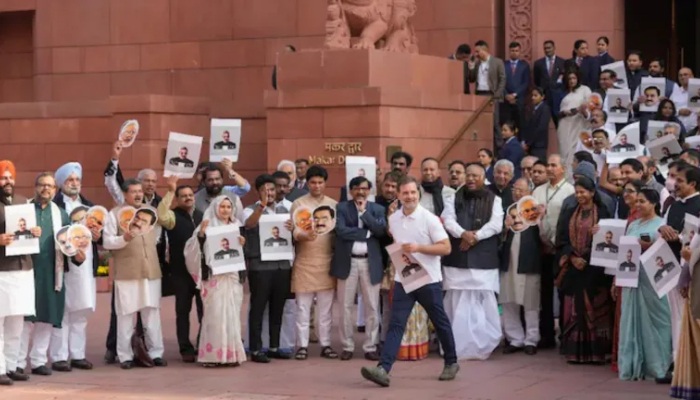
Dhankhar’s fierce critiques of what he deemed judicial overreach and encroachment of the powers of the legislature were not without pushback. Beyond the insulting mimicries, several opposition leaders labelled Dhankhar as ‘non-neutral’ and his comments slamming the judiciary ‘unconstitutional’. The opposition parties and the leftist media cabal even accused the former VP of ‘undermining’ judicial independence. Not to forget, the leftist propaganda portal The Wire went as far as to call Dhankhar a “partisan attack dog” over VP Dhankhar’s criticism of the Supreme Court for using Article 142 and calling it a “nuclear missile against democratic forces”.
Despite the slandering, mockery and criticism, Dhankhar did not shy away from raising concern over judicial overreach, particularly in matters involving a delicate balance of power among the judiciary, executive and legislature. Even in the judge Yaswant Varma case, Jagdeep Dhankhar publicly questioned the actions of the Supreme Court, raising concerns regarding accountability in a democracy wherein elected representatives are subject to scrutiny but judges are nearly immune to all sorts of accountability and scrutiny.
While the opposition and the leftist media ecosystem accused VP Dhankhar of delivering politically charged rhetoric at the behest of his ‘political masters’, the BJP, VP Dhankhar’s remarks were not politically charged or at odds with his constitutional duty, rather, his criticism of the judiciary was driven by a genuine concern over a pattern wherein the judiciary seems to be discharging the duties of President, and at times those of the Parliament as well.
Dhankhar’s courage, however, has not been surprising as even during his tenure as the governor of West Bengal, he repeatedly raised concern over post-poll violence in the state and severely criticised the TMC government for the Birbhum massacre. He remained at loggerheads with the CM Mamata Banerjee-led state government over issues pertaining to federalism and governance, condemning the near-collapse of democracy in the state.
While the opposition and its media cheerleaders mocked Jagdeep Dhankhar, belittled the importance of the Vice President’s post and projected the judiciary as somewhat sacrosanct to criticism, even moved a failed impeachment motion, Jagdeep Dhankhar stood his ground, not for personal gains, not for clout, not for political leverage, but for democracy, for constitution and the supremacy of the people’s mandate.
Several parliamentarians had earlier also raised concerns over judicial activism and overreach; however, Dhankhar’s interventions brought the debate to the forefront, triggering the judiciary, lawmakers and the public to ponder over the question of the judiciary’s role in a healthy democracy.
Jagdeep Dhankhar’s tenure as the Vice President of India and Rajya Sabha chairman will be remembered for many good reasons, especially his role as a defender of constitutional balance. He gave a fervent call for judicial accountability, critiqued judicial overreach while reiterating his belief in parliamentary supremacy. While the opposition parties gave him nothing but insults, mockery and hate, Dhankhar tried to accommodate opposition voices despite ideological differences. Dhankhar’s resignation marks the end of a chapter; however, the questions he raised about the judiciary’s role and accountability will continue to shape India’s constitutional discourse.