Home Blog Page 4420

Tucker Carlson slams ADL for being concerned about Israel’s demography but demonizing him for concerns about USA’s

On Tuesday (April 13), Fox News anchor Tucker Carlson slammed ADL (Anti-Defamation League) for making outrageous claims against the former about allegedly supporting white-supremacist ‘great replacement’ theory. His strong remarks against the ADL, which seeks to stop the defamation of the Jewish people, comes at the backdrop of a debate on population demography change.

In a Fox News segment on Friday (April 9), Tucker Carlson remarked, “The government has shown preference to people who have absolute contempt for our customs, laws and system itself. And they are being treated better than American citizens. I know that the Left and the gatekeepers on Twitter become literally hysterical if you use the term ‘replacement.’ If you try to suggest that the Democratic party is trying to replace the current electorates casting ballots with new obedient people from the third world, then, they become hysterical. This is what is happening actually.”

“This matters on a bunch of different levels but on the basic level, it is a voting rights question. In a democracy, one person equals one vote. If you change the population, then, you dilute the power of the people who live there. Every time you import a new voter, I become disenfranchised as a current voter… Everyone wants to make a racial issue or white replacement theory. This is a voting rights question. I have less political power because they are importing a brand new electorate…They are not allowed to do that? Why are we putting up with this,” he inquired.

(Video Courtesy: Youtube/Fox News)

His comments were directed at the Chief Executive of Delta Airlines named Ed Bastian, who had recently criticised the newly enacted Georgia voting law that called for voter identification for absentee balloting to ensure free and fair elections. Earlier, Bastian said, “I need to make it crystal clear that the final bill is unacceptable and does not match Delta’s values.” Tucker had then pointed out his hypocrisy by emphasising that an ID was required to board a Delta flight and how Ed Bastian did not want this to be the case for elections.

ADL harps tries to get the Fox News anchor fired

Tucker Carlson’s fear of demography change through illegal immigration of foreign nationals by the Joe Biden administration drew the ire of the CEO of Anti-Defamation League Jonathan Greenblatt. In a tweet on Friday (April 9), he said, “”Replacement theory” is a white supremacist tenet that the white race is in danger by a rising tide of non-whites. It is antisemitic, racist and toxic. It has informed the ideology of mass shooters in El Paso, Christchurch and Pittsburgh. Tucker must go.”

It must be pointed out that the Fox News host had specified in the Friday segment that his ‘replacement theory’ was not based on race and instead on voting rights. Given the toxic ‘cancel culture’ rampant in the United States, Jonathan Greenblatt seized the opportunity to get Tucker Carlson fired from his job. He had called upon Fox News CEO Lachlan Murdoch to sack Carlson over his alleged defense of white-supremacist replacement theory.

On Sunday (April 11), Lachlan Murdoch in a letter to ADL CEO responded, “A full review of the guest interview indicates that Mr. Carlson decried and rejected replacement theory. As Mr. Carlson himself stated during the guest interview: ‘White replacement theory? No, no, this is a voting rights question’…Fox Corporation shares your values and abhors anti-semitism, white supremacy and racism of any kind. In fact, I remember fondly the ADL honoring my father with your International Leadership Award, and we continue to support your mission.”

However, Jonathan Greenblatt was not impressed with the response of the Fox News CEO after his plans to get Tucker Carlson sacked, failed miserably. In a tweet, he lamented, “Yesterday, Fox News’ Lachlan Murdoch responded to my letter on Tucker Carlson’s embrace of white supremacist theories. Unfortunately, it missed the mark. The message is simple: it’s a moral failure to not take action against this hate.”

Tucker Carlson exposes the hypocrisy of Anti-Defamation League

On Tuesday (April 13), Tucker Carlson reiterated the nefarious plans of the Democratic party in undermining the US election process. “Demographic change is the key to the Democratic party’s political ambitions. Let’s say that again for emphasis because it is the secret to the entire immigration debate. In order to win and maintain power, Democrats plan to change the population of the country… Their goal is to make you irrelevant,” he said.

The Fox News host added, “It is immigration from other nations, more than anything else, that has driven political transformation,” he said. “Our leaders have no right to encourage foreigners to move to this country in order to change election results. Doing that is an attack on our democracy.”

(Video Courtesy: Youtube/Fox News)

Tucker Carlson was quick to point out the doublespeak of the Anti-Defamation League. He highlighted how in 2010, ADL had objected to the influx of Palestinian refugees in Jewish-dominated Israel, to avert potential demographic change and undermining of political representation and protection of Jewish community.

Quoting the statement by ADL, Carlson read, “With historically high birth rates among the Palestinians, and a possible influx of Palestinian refugees and their descendants now living around the world, Jews would quickly be a minority within a bi-national state, thus likely ending any semblance of equal representation and protection.”

He further read out the ADL’s statement, “In this situation, the Jewish population would be increasingly politically – and potentially physically – vulnerable. It is unrealistic and unacceptable to expect the State of Israel to voluntarily subvert its own sovereign existence and nationalist identity and become a vulnerable minority within what was once its own territory.” Tucker Carlson thus exposed the hypocrisy of ADL by pointing out its dual standards on external population influx in the US and Israel.
It’s a lung… it’s a burnt toast… it’s a duck pic… No! It’s a painting by Mamata Banerjee

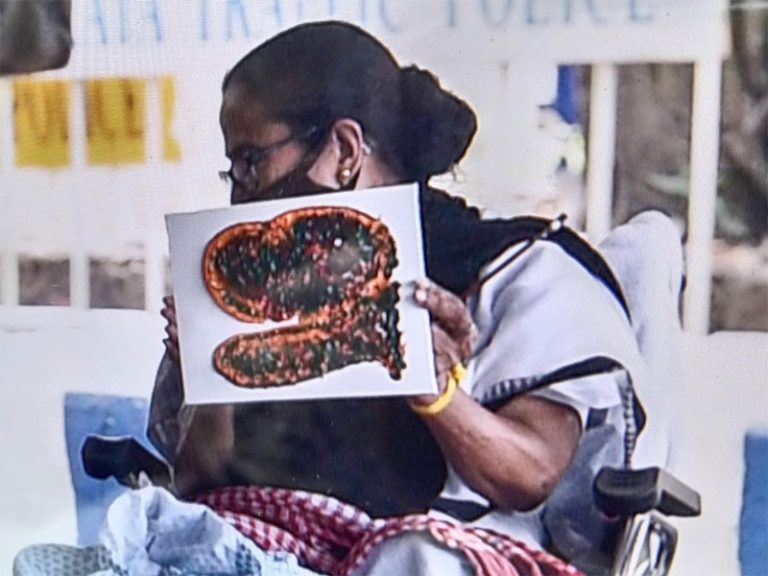
On April 13, Mamata Banerjee did not appear in any election rallies or gave any statement regarding the ongoing Assembly elections in West Bengal after Election Commission banned her from campaigning for 24 hours on April 12. West Bengal CM spent her day binge-painting some ‘masterpieces’ out of which one in particular left netizens scratching their heads.

The miniature painting in question looked like an ‘abstract art’ at first glance, but the more people talked about it, the more speculations raised about the idea behind that painting. Netizen Payal Mehta posted the painting on Twitter and asked if someone can explain what she had drawn.

Here are some of the most interesting replies. Some users compared it with the painting by ‘Majnu Bhai’, a character played by Anil Kapoor in the movie Welcome.

Another user compared to burnt toast.

One user compared the painting to lungs of a smoker.

One user suggested to ‘rotate’ the painting.

And others obliged.

Another netizen looked for ‘visually similar images’.

Banerjee will start campaigning again once the ban is lifted at 8 PM on April 13.

Here’s why lockdown is no longer an option and imposing another at this point makes no sense at all

The second wave of the Coronavirus pandemic has hit India pretty hard. While a significant share of the cases still continue to be from one single state, Maharashtra, cases are rising fast in other states and Union Territories such as Gujarat, Uttar Pradesh, Bihar, Delhi and Chhattsgarh as well. With rising cases, calls for a lockdown have suddenly become fashionable again.

‘Journalists’ and intellectuals are again piling up demanding a lockdown as India continues to record well over 150,000 new cases every day. The central government, on the other hand, has made it clear that lockdowns and night curfews have limited impact on slowing the transmission of the virus.

Even so, confronted with rising cases, demanding lockdowns appear to have become the go-to response for many in the media and others. This is not to say that the first lockdown was not useful or was altogether pointless. It did have its necessity and utility, which we shall elaborate on later in the article.

Before going into the human cost of the lockdowns, it needs to be made clear that there is very little evidence to suggest that lockdowns are especially effective in eliminating the spread of the virus.

Trends since the advent of the Coronavirus pandemic make the futility of lockdowns in this respect further evident. The first lockdown was imposed in India on the 24th of March, 2020 and lasted three weeks. Three weeks later, it was extended till the 3rd of May. Thereafter, the unlock was on in phases and from June, all spaces apart from containment zones and few other places, restrictions had largely been lifted.

Source: Worldometers

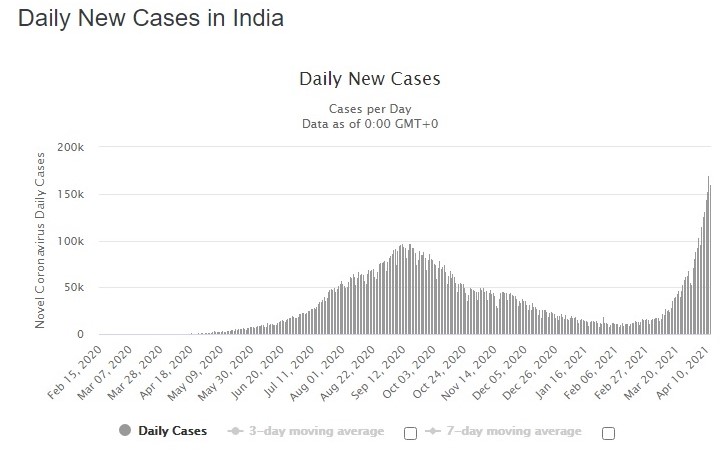
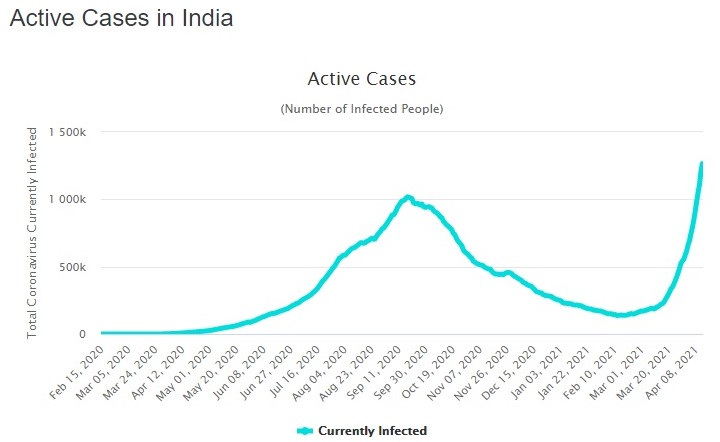
The data from that specific period is noteworthy. From March till June, cases were on the rise all the time despite the fact that the lockdown was in place and numerous restrictions were in order. From June till September, despite the fact that restrictions had largely been lifted, the cases do not show a disproportionate increase or a sudden spike.

What is really interesting, however, is what happens after September. After a peak, cases begin to drop precipitously despite the fact that no lockdown was in place and there wasn’t any strict enforcement of restrictions either. The drop from September 2020 continued well and truly into this year when cases suddenly started increasing in the middle of March.

Source: Worldometers

Even then, the overwhelming share of cases even until a couple of weeks ago were from Maharashtra and Kerala. The sudden uptick could be due to a new variant of the virus, seasonal factors or some other factors, we cannot say for sure and that is for the experts to determine.

Why Lockdown 2020 was justifiable

When the novel Coronavirus surfaced all over the world early 2020, there was very little that any government knew about the virus. What we did know was that the virus was extremely contagious and could be fatal. Therefore, governments worldwide were caught in a situation where there was fire at one end and a frying pan on the other.

Therefore, governments across the world took the tough decision to impose lockdowns in their respective countries. The purpose of the lockdowns was never to eliminate the threat completely. It was to ‘flatten the curve’ of the spread of the virus so that countries had more time to expand their medical infrastructure. The logic was to buy time so that the medical infrastructure could be equipped to handle the growing number of cases.

And India utilized the lockdown period extremely well. Beds were increased, isolation centers were set up, ventilators were procured and more Covid-19 relief centers were established in order to shore up our resources. Meanwhile, the Indian government knew that it could afford to feed the poor until the end of the year.

Thus, while the lockdown would lead to job losses, anarchy and deaths due to starvation could be avoided easily. The lockdown measure was effectively a ‘better-safe-than-sorry’ maneuver and it worked in achieving the desired objective. What it did not succeed in, however, was eliminating the spread of the virus, an objective that was never on the plate to begin with.

Hence, while the lockdown was in place, cases continued to rise and after they were largely lifted in June, cases continued to rise without showing any sudden hike until daily new cases peaked in September at just under a 100,000. Since then, nevertheless, there has been a sharp decline in both new and active cases until March this year.

Thus, enforcing a lockdown now would be pointless because cases would continue to rise just as it did between March and June 2020. Since lockdown did not lead to eliminating the spread of the virus the first time around, it is bizarre to expect that one will now. Furthermore, we can say with some degree of certainty that at some point in the near future, the cases will peak and then start going down again.

In addition, we have a new weapon in our hands this time around against Covid-19. Vaccines. India has focused on inoculating the old and those over 45 years of age and the medical staff first. While there has been criticism of the same in certain circles, trends again demonstrate that the criticism is misguided.

Covid-19 is shown to be disproportionately more of a threat for senior citizens and those with comorbidities such as obesity and the young are relatively much safer from fatal infection from the virus. Therefore, to reduce deaths from Covid-19, it only makes sense that the old are inoculated against the virus on priority.

The human cost of lockdowns

The fundamental reason why further lockdowns should not be imposed, however, is the human cost of it. The economy suffers greatly and India is still recovering from the economic cost of the first lockdown that was imposed. The economic cost is not merely a number on the GDP or the stock market, there are actual jobs that are lost and actual human beings who suffer when they lose those jobs.

And there is sufficient indication that citizens, at this point, will not accept lockdowns as readily as they did the last time around. For instance, after a new lockdown was imposed in Maharashtra, against the recommendation of the Union Government, one fast food seller posted a video online asking the state government to give him poison instead.

In another instance, a video had gone viral from Gujarat where a woman had lost her temper completely after law enforcement officials had reached the spot to shut her shop as per restrictions. In Bihar, students resorted to violence and attacked police officials after attempts were made to shut down private coaching centers as per the orders of the state government.

All of this indicates that patience is wearing thin. While anarchy ought to be condemned, when governments make it illegal for people to earn their livelihoods through ventures which are perfectly ethical and legal right until the moment lockdowns are imposed, there will be pushback. It is not justification for lawlessness but merely a word of caution of what awaits us if lockdowns are imposed against the will of the people.

Small businesses have suffered immensely due to the lockdown and are yet to recover fully. While entire sectors such as tourism and hospitality have been torched, delivery services such as Amazon and Swiggy and Zomato and other avenues where employees can work from home have continued to prosper. Such disparities perhaps explain why lockdowns have support from certain sectors and complete opposition from others because they do not impact everyone equally.

We also have students in Universities who are now looking at an extremely uncertain future ahead and their futures will be further jeopardized if another lockdown is imposed. Schools have either been shut or opening at partial capacity.

Children who are fortunate enough to still be able to enjoy the company of those their age will perhaps be able to avoid any adverse long term impact. But those who do not have company their age at home or in the immediate neighbourhood, it could have consequences that show up in the future.

Thus, we need to expedite our efforts to open up schools and universities at full capacity, not impede the process with further lockdowns.

The Mental Health effects

Then, there is the mental health effects of lockdowns. It is undeniable that human beings do not fare well when forced to live in isolation. It is with good reason that forced isolation for extended periods is one of the most debilitating forms of torture.

While lockdowns do not take away the ability of people to communicate with each other, it does rob people of physical proximity and contact which are essential requirements for the mental health of individuals. Communicating with other humans only digitally, locked away from society, is bound to have debilitating impact on one’s sanity.

Humans are social animals at the end of the day. A lot is said about people not observing Covid-19 restrictions and there is considerable moral shaming that is being dished out. But we have to take into account that the lifestyle that Covid-19 restrictions mandate is fundamentally at odds with human nature.

Human beings are not psychologically equipped to live under such conditions for extended periods. Some obviously can but most cannot and it is unfair to blame them a year after of living through constant Covid-19 induced psychological pressure.

Covid-19 is a threat for sure but it is not the only threat that exists. Policymakers will have to take into account other threats that exist in society and respond accordingly. Poicymakers cannot afford a tunnel vision where they focus excessively on the threat of Covid-19 to the point of denial of all else.

Life often involves making a choice between two bad options. Not imposing a lockdown may be a bad choice but imposing it will prove to be infinitely worse.

Telangana: TRS books all hotels, warns local not to provide accommodation to BJP workers ahead of bypoll in Nagarjunasagar

A young team of Bhartiya Janta Party workers has devised a unique method for staying and election campaigning work in Telangana’s Nagarjunasagar. The assembly constituency is going for a bypoll on April 17 and as per a Deccan Chronicle report, the ruling TRS has used every trick to deny the BJP cadre places to stay.

As per the report, the ruling TRS workers in the area had booked all the resorts and hotels available, in order to prevent the BJP cadre from staying. The TRS also threatened the locals who offered accommodation to the BJP workers. 

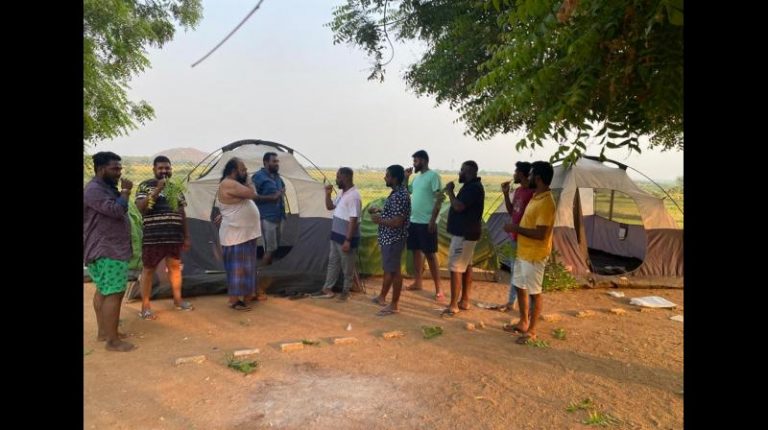
However, the team of young BJP workers, led by former BJYM leader PM Sai Prasad, devised a unique plan. They brought trekking tents and turned their campaign into an adventure trip. During the day the party workers interacted with locals, shared the BJP’s message and stayed in the night in their trekking tents.

PM Sai Prasad was quoted by Deccan Chronicle as saying, “This gave us a great opportunity to develop a bond with the locals. We are cooking our food and sometimes the locals are sharing their food with us.” The campaign team stays in tents for the night and then moves on to the next Tanda (tribal hamlet) in the morning.

Prasad took to Twitter to share his team’s resolve, energy and experience through a video.

PM Sai Prasad and his team have been campaigning for BJP candidate Dr P. Ravi Kumar for the last six days. They only have the tents, and even struggle to find toilets, but the team has been resolute in its efforts, as per the DC report.

Touring one hamlet to the other while chanting ‘Vande Mataram’, ‘Bharat Mata ki Jai” and singing patriotic songs, the yuva brigade’s resolve has just strengthened to face the assault by the ruling party. 

The BJP workers have visited Seethal tanda, Dokkalavai tanda and Rajavaram until now and propagated the need to support a strong political force as an alternative to the TRS and the Congress.

Talking about the hardships faced, “Of course, we are trained to face harsh conditions since our Rashtriya Swayamsevak Sangh and BJYM days,” Prasad said proudly.

After losing its sitting seat in the recently concluded Biennial Graduates’ MLC elections, the party is leaving no stone unturned for the Nagarjunasagar bypoll. The party conducted several surveys, checked the track record of the previous elections and popularity among the people of all the aspirants before declaring the candidate.

Japan to release treated water from Fukushima nuclear plant into the ocean: USA, IAEA support, China condemns

After mulling for years, Japan has finally given a go-ahead to disposing wastewater from the ruined Fukushima Daiichi nuclear plant into the Pacific ocean. During a cabinet meeting on April 13 (Tuesday), Japan decided that it will begin releasing more than a million cubic meters of ‘treated’ water from the crippled nuclear power plant into the ocean. The process will be gradual and is expected to begin in two years.

‘Most realistic’ and ‘unavoidable’ option says Japanese Prime Minister

Japan has long delayed the decision to dispose of the wastewater from the Fukushima Daiichi nuclear plant over criticisms and safety concerns. However, while announcing his government’s decision, Japanese Prime Minister Yoshihide Suga said on Tuesday that dumping treated water containing radioactive substances into the ocean is ‘unavoidable’ and there is no time to delay the reconstruction of Fukushima.

Calling it the ‘most realistic’ option, Suga opined that this was “unavoidable in order to achieve Fukushima’s recovery”.

Suga made the announcement after convening a meeting to formalise plans to release the radioactive water accumulated at the nuclear plant.

IAEA supports Japan’s decision, says it will help

The International Atomic Energy Agency has stated that it will support Japan in carrying out the disposal. Rafael MarianoGrossi, the director of the IAEA has stated in a video message that the organisation welcomes Japan’s decision. He added that the IAEA will provide full technical support for the safe implementation of the plans. He also added that the IAEA will work closely with the Japanese government before, during and after the discharge of the water. Safety review missions will be dispatched and environmental monitoring will be supervised.

The IAEA director assured that the water discharge will be carried out without any adverse impact on human health and the environment. He also added that controlled water discharges into the ocean are routinely used by operational nuclear plants around the world under strict safety and environmental standards.

1.25 million tonnes of water accumulated in the Fukushima Daiichi nuclear plant

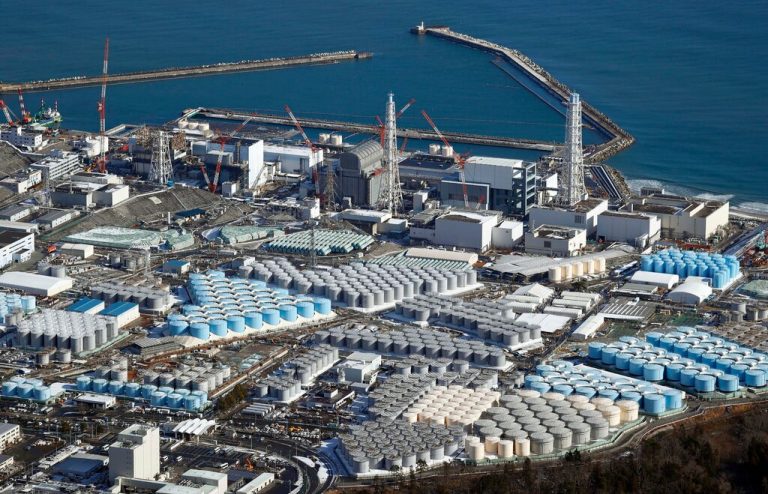
For the uninitiated, the Fukushima Daiichi nuclear plant has been generating a massive amount of radiation-tainted water after being battered by the massive earthquake-triggered tsunami in 2011. It includes water used to cool the plant, as well as rain and groundwater that seeps in daily.

Over the years, around 1.25 million tonnes of water have accumulated in tanks at the nuclear plant, but, now the space used to store the water is expected to run out by next year.

Owing to this, the Japanese government has decided to gradually release the radioactive water into the Pacific ocean.

The plant’s operator Tokyo Electric Power Company Holdings Inc. and government officials have confirmed that the water has been treated using an advanced liquid processing system, or ALPS, to remove most contaminants but radioactive materials like tritium cannot be removed from the water. Japanese experts are, however, of the opinion that tritium in small quantities is not harmful.

“The Japanese government has compiled basic policies to release the processed water into the ocean, after ensuring the safety levels of the water … and while the government takes measures to prevent reputational damage,” Suga told reporters.

China warns of action over Japan’s decision to dump radioactive Fukushima water into the sea

Though the Japanese authorities have confirmed that the water is “treated”, the decision is facing fierce criticism from various quarters.

Japan’s Fisheries Industry has vociferously opposed the plan amidst fear that releasing the water will undermine years of work to restore confidence in seafood from the region. Greenpeace Japan denounced the decision, saying in a statement that it “ignores human rights and international maritime law.”

Not happy with Tokyo’s decision to dump wastewater water from the wrecked Fukushima nuclear plant into the sea, China has also warned action if Japan does not retract from its decision. China’s foreign ministry on Tuesday blasted the Japanese government for being “extremely irresponsible” in its decision. Moreover, China has found support in South Korea, which also expressed its displeasure over Japan’s decision to discharge radioactive wastewater into the Pacific.

The United States has, however, accepted Japan’s approach to clean up the disabled Fukushima nuclear plant, which is operated by the Tokyo Electric Power Company. Secretary of State Anthony Blinken hailed Japan’s efforts as transparent and praised the coordination with IAEA.

Fukushima crisis

The Fukushima crisis had begun in March 2011, after a huge earthquake and tsunami ripped through northeastern Japan leaving more than 19,000 people dead. The subsequent meltdown of three of the plant’s six reactors resulted in the country’s worst nuclear disaster since the 1986 Chernobyl crisis. Tens of thousands of people had to be evacuated from the area, in many cases never to return.

Almost a decade has passed ever since but the clean-up at the crippled plant is far from completed. To keep the three damaged reactor cores from melting, cooling water is pumped through them continuously. The water is then sent through a powerful filtration system that is able to remove all of the radioactive material except for tritium.

There are now about 1.25 million tons of wastewater stored in more than 1,000 tanks at the plant site. The water continues to accumulate at a rate of about 170 tons a day, and releasing all of it is expected to take decades.

One Nation, One MSP, One DBT: With Punjab govt finally implementing DBT, all farmers in India to get MSP directly in their account

On April 10, Punjab had agreed to pay the MSP payments directly into farmers’ accounts via Direct Benefit Transfer. The Centre has been trying to implement the system across India for a long time, but Punjab was adamant about not implementing the same. Earlier, Haryana also came on board and agreed to use EAT (Expenditure Advance Transfer) to pay the farmers leaving only Punjab who wanted to pay the farmers via Arhtiyas (middlemen).

Essentially, Punjab government had held up the implementation of the DBT for farmers several times since 2018. With the Punjab government finally implementing the directions of the central government, India has managed to enforce ‘One Nation, One MSP, One DBT’.

All farmers to now get MSP payment through DBT: Piyush Goyal

On April 12, Union Minister Piyush Goyal took social media to announce that the farmers in Punjab will get MSP payments directly in their accounts like other farmers across the country. He said, “In Punjab, now farmers will get the price of their produce sold on MSP directly in their bank accounts. Like other initiatives by PM Modi for the benefit of the farmers, this step will also benefit small and marginalized farmers.”

He further added that those farmers who cultivate the land on rent would also get payments directly in their bank accounts under the DBT system. “The system is transparent, and farmers should not be misled by anyone. The farmers will get the full price of the produce,” he added.

Now farmers across the country, after selling the produce on MSP, will get money directly in their account. “This is a major change in the interest of the farmers since independence,” he added.

With this announcement, Minister Piyush Goyal confirmed that all farmers in the entire country are now under the umbrella of DBT and hence, every farmer will now get their MSP payment directly in their bank account, without the involvement of middlemen.

Punjab has delayed the implementation several times since 2018

As per the directions of the Ministry of Finance, all registered agencies were asked to implement EAT (Expenditure Advance Transfer) module of PFMS (Public Financial Management System) by June 15, 2018. At that time, the ministry said that in case anyone failed to implement the system, the government will not release the funds to the agency to procure the produce.

Punjab did not comply with the orders and kept on asking for an extension. The state insisted on making payments of farmers’ Minimum Support Price (MSP) through intermediaries or Arhtiyas. The ministry extended the date of implementation of the system for Punjab several times. The last extension was till March 31, 2021, for KMS 2020-21 season.

According to the sources in the ministry, the Department of Food and Public Distribution (DFPD) has repeatedly pursued the Punjab government to implement the guidelines of the Government of India since 2018. During a meeting that was held on February 23, 2021, the state government agreed to implement online payment to farmers directly through e-mode from RMS 2021-22, and the Punjab government also confirmed that they would integrate their online payment system with PFMS to track the flow of the funds to the farmers.

Though the government of Punjab failed to implement a direct payment system, DPFC has released full payments for Admins and Arhtiyas for KMS 2019-20 and 90% of the payment for RMS 2020-21 and KMS 2020-21. The remaining 10% will be released once the state fully implements DBT for MSP payments in the state.

Indian Govt fast tracks emergency approvals for foreign produced Covid-19 vaccines that have received EUAs abroad: Details

0

The Central Government on Tuesday has expedited the process of emergency approvals for foreign produced Covid-19 vaccines that have received Emergency Use Approval (EUA) in other countries in order to boost the vaccination coverage in the country.

In a press release, the Government said that the matter was discussed in the 23rd meeting of the National Expert Group on Vaccine Administration for COVID-19 (NEGVAC) on 11th April, 2021.

The statement said, “The NEGVAC, after comprehensive deliberation, recommended that vaccines for COVID-19, which have been developed & are being manufactured in foreign countries and which have been granted emergency approval for restricted use by USFDA, EMA, UK MHRA, PMDA Japan or which are listed in WHO (Emergency Use Listing) may be granted emergency use approval in India, mandating the requirement of post-approval parallel bridging clinical trial in place of conduct of local clinical trial as per the provisions prescribed under Second Schedule of the New Drugs & Clinical Trials Rules 2019.”

Furthermore, the first 100 beneficiaries of such vaccines will be assessed for safety outcomes for 7 days before the vaccines are utilized for further immunization programme in the country. The Union Government has accepted the recommendation.

“This decision will facilitate quicker access to such foreign vaccines by India & would encourage imports including import of bulk drug material, optimal utilization of domestic fill and finish capacity etc., which will in turn provide a fillip to vaccine manufacturing capacity and total vaccine availability for domestic,” said the statement.

The decision comes at a time when the second wave of the pandemic has hit the country and a day after Sputnik-V vaccine was granted EUA.

The direct fall-out of not implementing farm laws: Punjab Farmers say Arhtiyas asking for signed blank cheques for helping in crop procurement

Farmers in Punjab have alleged that Arhtiyas or the commission agents are now demanding “signed blank cheques” for facilitating procurement, a report published in the Indian Express said.

A farmer named Nihal Singh from Bathinda’s Baluana village was taken aback when he was asked to provide a signed blank cheque from his Arhtiya. Singh alleged he was asked to furnish the cheque to the Arhtiyas against payment of a loan of Rs 2 lakhs taken two years ago.

Though the farmer had been diligently paying periodic instalments to the arhtiya for the past four cropping season and has, so far, paid an amount equal to the principal, he was still asked to submit a blank cheque citing the outstanding interest amount of Rs 1 lakh. This demand meant that Nihal had to push harvesting his crop till deciding whether to provide the signed cheque or not.

“I promised him that I will soon clear his entire debt, but he is not willing to trust me and asked me to give a signed blank cheque as a guarantee against the outstanding amount. He says if I don’t give him the blank cheque, he won’t auction my produce in the mandi. But, I am yet to take a final decision on it,” Singh lamented.

Nihal is the not only one who is suffering from this predicament. Farmers across the state, be it Jalandhar, Khanna, Faridkot, Sangrur or Mansa, have pointed out that similar demands are being made of them by their arhtiyas.

Another farmer, Jagtar Singh of village Ganga Nathana is facing a similar crisis. After having harvested his crop on 7 acres of land, his arhtiya informed him that his crops would only get auctioned when he furnishes a signed blank cheque. Jagtar had borrowed Rs 3 lakh from his arhtiyas for the marriage of his daughter four years back and has been paying money in instalments at the time of procurement.

Similarly, other farmers in Punjab also have similar stories to tell. They claim that their arhtiyas too have asked them to provide signed blank cheques before bringing their crops to the mandi.

Jagsir Singh, farmer leader of BKU(Ugrahan) from Bathinda, acknowledged the new development, stating that several farmer leaders have informed him that their arhtiyas are asking for signed blank cheques from them. Besides cheques, they are asked to furnish their Aadhaar cards in some cases.

Jagsir said they have temporarily stopped arhtiyas from doing so and asked them to wait till the time their senior leaders take a decision on the issue. The arhtiyas, he added, are worried that farmers won’t pay them their pay money back after getting direct payment from the government.

An arhtiya from Khanna Mandi said the signed blank cheques are sought from farmers as security. He said both arhtiyas and farmers know that during every procurement season only a pre-decided amount gets deducted.

Defending the move by arhtiyas, Ravinder Singh Cheema, the president of the Arhtiya Association Punjab, said that arhtiyas pay farmers whenever they need money, and then the farmers pay arhtiyas back during procurement season, adding that only this cycle was being followed.

Farmers in Punjab are used to taking high-interest loans from arhtiyas who auction their produce in the mandis. They pay their loan amount back in instalments in the form of deduction in payment for procurement. The Direct Benefit Transfer has created an imbalance in the non-banking loan system in Punjab. The arhtiyas are apprehensive that the farmers would stop paying their dues once they start receiving amount directly in their bank accounts by the government. To protect themselves from loan default, they have started asking for signed blank cheques from the farmers.

A direct fall out of Punjab not implementing the farm laws

One of the biggest factors plaguing the growth of agriculture sector in the country is the inability of the farmer to find a market and to get a fair price to his produce. To address the issue, the erstwhile governments of different states enacted the Agricultural Produce Market Regulation Acts (APMC Acts), which authorised them to set up and regulate marketing practices in wholesale markets. 

The objective of these markets was to ensure that farmers get a fair price for their produce. However, with each passing year, the APMCs turned out to be inefficient with increasing cartelisation of middlemen, ban on private players to enter the trade, increasing corruption etc. 

The Modi government recently introduced three bills to promote much easier trade for the farm produce and to provide a competitive market for the producers outside the existing APMC system. The three laws were: 

  1. The Farming Produce Trade and Commerce (Promotion and Facilitation) Bill, 2020: This law aims at creating additional trading opportunities outside the APMC market yards to help farmers get remunerative prices due to additional competition
  2. The Farmers (Empowerment and Protection) Agreement on Price Assurance and Farm Services Bill, 2020: This law relates a framework for contract farming through an agreement between a farmer and a buyer prior to the production or rearing of any farm produce. 
  3. The Essential Commodities (Amendment) Bill, 2020: This law aims to regulate the supply of certain food items only under extraordinary circumstances.

Had Punjab implemented the farm laws, the farmers in Punjab would not be dependent on the middlemen (Arhtiyas) to sell their produce and therefore, would not getting blackmailed and harassed.

Arhtiyas call for strike against the state government’s decision to implement the DBT system

Earlier this month, Arhtiyas went on strike protesting against the state government’s decision to implement the direct payment system to farmers, bypassing the Arhtiyas. Even though the Punjab government agreed to the Direct Benefit Transfer (DBT) to farmers against the purchase of foodgrains, the farmers and middlemen in the state were not ready to abandon their existing system.

While the purchase of food grains by the state procurement agencies for the Rabi harvesting session was to start from today, it was blocked by protestors at several places in Punjab. Not a single truck of wheat arrived at Asia’s largest grain market in Khanna in Ludhinana, as farmers stayed away from it. Labourer unions and arhtiyas (commission agents) staged a strike against the scheme of direct payment to the farmers, in ‘support’ of the farmers.

However, hours after the Arhtiyas (commission agents) in Punjab had launched a strike and blocked the purchase of food grains from farmers at mandis, the strike was called off after CM Amarinder Singh held a meeting with them. The Arhtiyas withdrew the strike after the CM assured them that they will remain an integral part of the food grain procurement system.


Scam convict Lalu Yadav’s daughter Rohini to keep Roza during Ramzan for her father’s health, will pray to Allah too

Ahead of Ramzan, the daughter of scam-tainted politician Lalu Yadav has announced that she would fast for a month for the well-being of her father. Lalu Yadav has been convicted for his role in the infamous fodder scam and is now lodged at the AIIMS hospital in New Delhi over ‘poor health conditions’.

In a tweet on Monday (April 12), Rohini Acharya said, “Ramzan is starting from tomorrow. I have decided to undertake fasting for a month for the well-being of my father. I will pray for his recovery and hope that justice will be delivered to him.” She informed that she would also pray to Allah to maintain peace and harmony in the country. “At the same time, I will ask God/Allah to restore peace and harmony in this nation,” Rohini Acharya added.

Daughter of Lalu Yadav fails at monkey balancing

In a desperate attempt at monkey balancing, she tweeted, “It is also the time for Chaitra Navratri. I have the requisite strength within me to celebrate both the festivals with equal devotion.” On being called out for playing religious politics, she added, “I am unaffected by hateful ideologies borne out of venomous society. Happy Chaitra Navratri “

Fodder scam convict maintaining a luxurious lifestyle

Lalu Prasad Yadav, the RJD supremo, was jailed in multiple cases linked to the infamous fodder scam. Instead of living in jail, he had been enjoying his time in the bungalow allotted to the Rajendra Institute of Medical Sciences (RIMS) Director in Ranchi. He was shifted to the Bungalow from RIMS to apparently save him from Coronavirus infection. It is believed that Lalu had been running his party from the hospital for the past two years. During the Bihar elections 2020, he had managed everything from the RIMS Director’s Bungalow. Meanwhile, the Director is forced to stay at the institute’s guest-house. He is now being treated at the AIIMS hospital in Delhi.

Karimganj, Assam: Narsimha temple robbed, gold ornaments and cash looted, priest and family tied and beaten up

0

A temple of Narsimha was attacked at Baliya in Karimganj, Assam by dacoits on Sunday. The priest was beaten up and according to some on social media, the priest’s daughter was threatened with abduction as well.

The matter was reported by The Sentinel, a local newspaper in Assam, as well. The Sentinel reported that the Narsimha temple was robbed on Sunday night. Gold ornaments, cash and other valuables were looted from the temple. The priest’s family was tied and beaten up.

The priest said that initially when noises could be heard, he guessed that it might be due to a storm. But when he heard human voices, he got up from his bed. When he attempted to get hold of one of the robbers, he was nabbed.

One of them held a machete to his neck and threatened him not to speak and everyone was then tied up. The robbers then demanded 1 lakh rupees from them. The robbers also demanded the golden idol and gold ornaments.

The priest told him that he was poor and did not have any cash with him and it was the committee which kept the cash in its possession. He said that he only receives Rs. 1200 to perform the rituals. The incident occurred at about 2am into the night.

The Police is currently investigating the matter. The place is near the India-Bangladesh border but, as per reports, the involvement of locals is suspected as well. In one report, a local said that crimes by those from across the border is rampant in the area but he suspected that locals were involved in the crime as well.