Home Blog Page 4770

Mamata Banerjee directs state officials to not attend meeting despite MHA summons, declines to send 3 IPS officials on central deputation

0

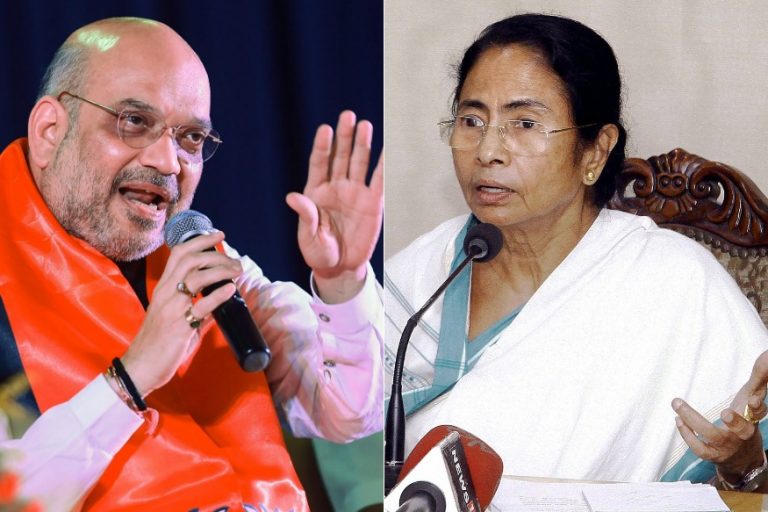
West Bengal Chief Minister Mamata Banerjee has decided not to send the state’s chief secretary and police chief to New Delhi in compliance with Union Home Ministry’s summons in the wake of a mob attack on BJP chief JP Nadda’s convoy.

Mamata’s Chief Secretary Alapan Bandopadhyay wrote to Home Secretary Ajay Bhalla, saying that he has been directed by the state government to not attend the meeting convened on December 14. This being an obvious indication that he had been just obeying the state government’s order.

MHA summons West Bengal CS and DGP to for an explanation on the law and order situation in the state

Union Home Minister Amit Shah had on December 11 (Friday) summoned state CS Bandopadhyay and DGP Virendra asking them to present themselves on December 14 for an explanation on the law and order situation in the state, following Governor Jagdeep Dhankhar’s report on the attack on Nadda’s convoy by alleged supporters of the ruling TMC.

West Bengal Governor slams Mamata Banerjee, writes to HMO

It may be recalled that the WB Governor had Tweeted his concerns over the alarmingly grim situation of law and order in the state. He said that he had summoned the Chief Secretary and the West Bengal DGP to update him regarding the attack on the convoy of BJP President JP Nadda but Dhankar said that as usual, the Mamata Banerjee’s official and the WB police remained non-responsive on the matter. He had also sent his report to the Union Home Ministry on the attack and said the security was inadequate for the convoy, following which Amit Shah had summoned Mamata Banerjee’s Chief Secretary and the state DGP to discuss the state’s law and order situation on December 14.

Mamata Banerjee refuses to send 3 Bengal IPS officers for central deputation

According to reports, she has also refused to send the 3 IPS officers whom the Union Government had recalled from West Bengal following the attack on BJP President. “Union Home Ministry has received a response from the government of West Bengal on three IPS officials who were called for Central deputation. The West Bengal government has said that they can’t spare these officials for Central deputation,” a government official told news agency ANI.

The MHA on December 12 (Saturday) summoned three IPS officers of Bengal, who were responsible for providing security to BJP national head J P Nadda, to serve in central deputation following the attack on his convoy on Thursday which left several BJP leaders including Kailash Vijayvargiya injured in the process. The IPS officers sought were Rajeev Mishra (Additional Director General, South Bengal), Praveen Tripathi (Deputy Inspector General, Presidency Range) and Bholanath Pandey (SP, Diamond Harbour).

BJP senior leaders attacked in West Bengal

BJP chief JP Nadda and party’s national general secretary Kailash Vijayvargiya’s convoy was attacked in West Bengal, as the two leaders were en route Diamond Harbour on December 10 (Thursday). As the senior leaders were headed towards Diamond Harbour to meet party cadres, protesters gathered on the streets and attempted to block the road to stop Nadda’s convoy from passing. Protesters also pelted stones at the vehicle. Videos have surfaced where protestors carrying Trinamool Congress flags are seen throwing stones and bricks at Kailash Vijayvargiya’s car, while the state police stand like mute spectators.

‘State govt not allowing benefits’: TMC MLA writes to West Bengal minister Firhad Hakim over ‘Smart City Mission’ project for Asansol

In a letter to West Bengal minister Firhad Hakin, TMC MLA and Asansol Municipal Corporation Chairman Jitendra Tiwari expressing disappointment over state government not allowing central government’s benefits for development of Asansol as Smart City.

He wrote that after being selected under Union government’s Smart City Mission project, Asansol stood to receive funds of Rs 2,000 crore which would be crucial for city’s development. However, due to political differences between the state and the centre, Asansol has not received the required funds.

He added that instead of that, Asansol administration was promised that they will receive funding from state government for overall development of the city. However, even that fund was not given. Under central government’s solid waste management project, Asansol stood to receive Rs 1,500 crore funding which was state government did not allow because of political differences.

Calling it injustice to Asansol, Tiwari said that various project proposals sent to state government like building Prince Dwarkanath Thakur town hall in Raniganj, renovation of existing town hall in Jamuria as well as several roads of Asansol, Burnpur, Kulti, Raniganj and Jamuria are not being approved by the state government.

He further urged the West Bengal minister to either allow Asansol to utilise the funds allocated by central government for its development or provide similar benefits from state government funds.

Niger witnesses deadly terrorist attack by Boko Haram jihadis, village burned, 27 people killed

In a dastardly incident on Saturday, terrorists associated with Islamist terrorist outfit Boko Haram launched an attack in Toumour village in the Diffa region in South East Niger. The region has over 120,000 refugees from Nigeria and around 1,10,000 refugees from other parts of Nigeria.

As per reports, 27 people were killed in the terror attack and several people were reported as wounded and missing. The terror attack took place hours before the regional elections across Niger on Sunday. An official informed, “Some victims were killed or wounded by bullets, others were burnt inside their houses, consumed by the flames of an enormous fire set by the attackers…”

He stated that the attack was carried out for over 3 hours by 70 terrorists, leading to the destruction of 800-1000 houses, vehicles and the central market. The official emphasised, “It was an attack of unprecedented savagery. Nearly 60% of the village has been destroyed.” He further added that the terrorists had arrived in Toumour village on foot, after having swum across Lake Chad. Issa Lemine, the governor of Diffa region, had visited the burials of the deceased.

Attacks happened a day before elections

Despite the deadly terror attack, which led to the destruction of life and property, the people of Niger voted in the regional and municipal elections on Sunday. However, another official from Bosso region informed that elections did not take place in Toumour village while it was carried out successfully in other parts of the country.

The voting for the regional elections has been postponed in the past, owing to terror attacks in the Sahel county and southeastern Diffa region. The country is scheduled to have its Presidential election in about two weeks’ time.

Niger has been terrorised by Boko Haram since 2009

Other parts of the country, such as the west and the southeast regions had also witnessed such attacks since 2015. Niger has been subjected to radical Islamist terror attacks along the western border with Mali and Burkina Faso. Boko Haram had unleashed its terror on the country, since 2009 in the north-eastern region and Lake Chad region. Reportedly, 36,000 people have lost their lives while 3 million have been displaced. Boko Haram is a Salafi-jihadist Muslim terror organisation founded in 2002 in Nigeria.

Boko Haram expands its control

In June this year, terrorists associated with Boko Haram and its offshoot Islamic State West Africa Province (ISWAP) killed at least 20 soldiers and 40 civilians in Nigeria’s Brono state. The attack came just days after terrorists killed at least 69 people in a raid on a village in a third area, Gubio. Boko Haram is notoriously known for inflicting terror in West African countries with great magnitude. It is based in north-east Nigeria but is also active in neighbouring countries.

Forbes cites a report by Open Doors, an organization working on the topic of religious persecution, which mentions that the terrorist organisations, such as Boko Haram, have significantly expanded their territory. In its report, Open Doors stated that Boko Haram was looking for expansion and eyeing targets of Sub-Saharan Africa.

PFI’s Rauf Sharif had paid for the Hathras trip of arrested Siddique Kappan, had received foreign money worth over Rs 2.5 crores

0

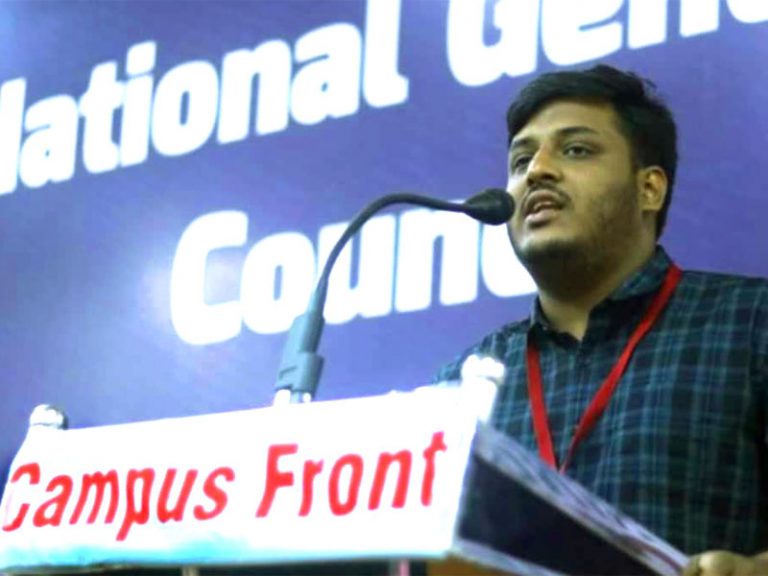
Popular Front of India’s student wing Campus Front of India (CFI) leader KA Rauf Sharif was arrested by Enforcement Directorate (ED) on Saturday from Thiruvananthapuram when he was trying to flee from the country.

As per the ED report, Rauf Sharif had funded the trip by PFI members and self-proclaimed journalist Siddique Kappan to Hathras, Uttar Pradesh after the controversy over the case. A lot of political parties and organisations had gathered in Hathras, trying to stoke unrest and stir up caste violence. The investigation agencies alleged that the PFI members and Kappan intended to disturb social harmony and incite caste violence in the region.

Pretend-journalist Kappan was arrested by the UP Police along with other individuals named Ateequr Rahman and Masood Ahmed on October 4 when they were traveling to Hathras. The ED report submitted before the Principal Sessions Court, Kochi, suggests that the Sharif gave directions and arranged funds for the trip. He had transferred the money to Rahman’s account. Sharif had allegedly received Rs.2.5 crore of foreign funds in his accounts during Covid-19 lockdown, as per the report. Sharif, who works in Oman, was in India at that time, which raised suspicion over the transactions. ED had called him for questioning, but he deliberately did not appear.

Funds received by Sharif

As per reports, Sharif has saving accounts in ICICI Bank, Axis Bank, and Federal Bank. In his ICICI Bank account, he had received Rs.1.35 crore during 2018-2020. He had received foreign funds from Ramiz Ali Prabath and Naufal Shreef totalling Rs.29,18,511 during April-June 2020. The purpose of the funds was mentioned as ‘Payments to hotels by nationals of all FATF-compliant countries or NRIs for their stay.’ During that period, the hotels were not operating due to the Covid-19 lockdown.

The report said, “This purpose looks suspicious as it implies that Rauf Sharif either owns a hotel in India or Oman for which payments were made by Naufal and Ramiz though hotels were not operational during the April-June period this year due to Covid-19. Additionally, there are major high-value expenses by Rauf Sharif for land and vehicle purchases.” It added that transactions worth 67 lakh in his Federal Bank account took place during 2019-2020. He received foreign funds worth 19.7 lakh from Doha in May and October this year. A cash deposit of 16 lakh was also made in his account. ED report also recorded a transaction of 20 lakh in his Axis Bank account.

PMLA case investigation against PFI

In 2018, the ED started an investigation under the Prevention of Money Laundering Act based on a case related to a terrorist camp by PFI and SDPI members at Narath in Kannur. Sharif’s name had come up during the investigation. His name was also mentioned in the FIR registered by the UP Police in the Hathras case. Sharif had known Kappan for the last one year as Kappan has covered several PFI and CFI events.

UP Police had recovered laptops, mobile phones and suspicious literature from Kappan and three PFI members in October. ED Report said that Sharif did not provide any explanation for the foreign funds he had received, and he refused to cooperate in the investigation.

Rauf Sharif’s arrest

Rauf Sharif, leader of the radical Islamic outfit Popular Front of India (PFI), was arrested by the Enforcement Directorate (ED) officials on Saturday from Tiruvanathapuram airport when he was attempting to escape from the country. The immigration officials at Thiruvananthapuram Airport identified him and caught him at the airport. They immediately informed UP Police and ED, after which ED officials reached the airport and took Sharif in custody.

Following the arrest, Sharif has been sent to 14-days judicial remand.

Fact-check: No, woman ‘detained’ under UP’s new anti-forced religious conversion law was not ‘forced to abort’

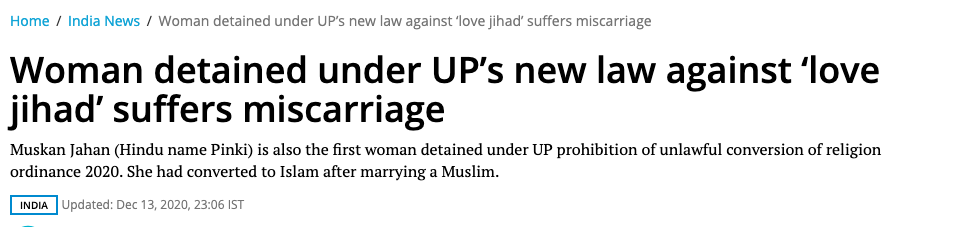
On Sunday, multiple media reports emerged which claimed that a woman, Muskan Jahan, who was allegedly ‘detained’ by Moradabad Police under the anti-forced religious conversion law, was ‘forced to abort’.

Hindustan Times report

The same was also picked up by various international media houses.

Despite it being widely covered by national media, Congress leaders tried to peddle it as ‘not being reported in Indian media’. In fact, The Telegraph report also claims that the woman was given an injection to abort by the staff. Congress leader Srivatsa claims that the abortion happened in police custody.

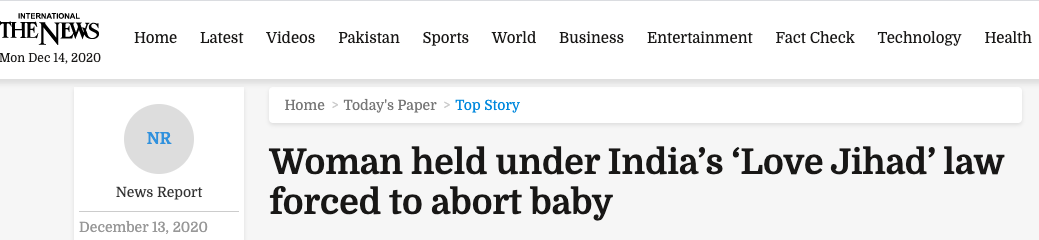
Pakistani media, too picked it up.

Pakistani media report

However, that is incorrect. In fact, as per the administration, the woman has not suffered miscarriage at all. An Indian Express report cites District Probation Officer (Moradabad) Rajesh Chandra Gupta who had said that on Friday woman, who is currently in women protection home, complained of severe stomachache. She was taken to Mahila District Hospital where she was admitted. She was discharged at around 11 AM on Sunday but readmitted at 2 PM after she complained of stomachache again.

Gupta had further said that the media reports of her suffering miscarriage are fake. Medical reports suggest her age to be 22 years old. He said that the magistrate, on whose direction she was sent to protection home, had been informed about her health.

In fact, Hindustan Times report, which screamed ‘miscarriage’ in headline, also cites Kanth Police station inspector Ajay Gautam who had refuted the rumours of her miscarriage.

To verify the claims, OpIndia reached out to Kanth Police station. Speaking to OpIndia, Kanth Police Station SHO said that the reports of woman suffering miscarriage or forced to abort are fake. Doctor’s report also says that there is no miscarriage. He further said that woman is not in police custody but in women’s protection home. He further said that the woman’s statement will be recorded on Monday, December 14.

As per reports, Pinki met Rashid in Dehradun where she was working in a salon adjacent to the one where Rashid worked. They got close and fell in love. In July this year, the duo got married after Pinki converted to Islam and changed her name to Muskan. Soon, she got married. Pinki’s mother had alleged her daughter was forcefully converted to Islam via marriage. Rashid was arrested on Saturday when he was going to get his marriage registered. However, Pinki, while speaking to media persons had claimed she married Rashid as per own wish.

Jharkhand: Communal tension over burial of the dead body of a woman in Forest Department land

0

On Sunday, communal tension flared up in Kechgadhi village in Dumri, Jharkhand over the burial of a dead body on the land owned by the Forest Department, reported Dainik Bhaskar.

As per reports, the family members of a deceased woman, belonging to a ‘particular community’, wanted to bury her on the Forest Department land on Sunday. However, the other communities objected to it, citing that the land belongs to the government and is not meant for religious burials.

When the Dumri police station was informed about the development, the cops tried to pacify both communities and resolve the matter. Forest Department official Amar Vishwakarma, ASI Jaina Balmuchu, Dumri police station in-charge Raju Munda and area superintendent Ravi Bhushan Prasad rushed to the spot and took up the matter with the family and the locals. In the end, the officials were able to convince the family to bury the deceased at their cemetery and not in the Forest Department land.

Demands to legalise MSPs is retrograde, can destroy the farm sector and hurt the Indian economy: Explained

Ever since the Modi government passed three farm laws to free the country’s agricultural marketing and procurement systems, the farmers, especially from Punjab have hit the streets to demand a rollback on the law.

One of the main arguments of the protesting farmers is that the newly enacted laws would alter the existing procurement system and could nullify the MSP system that guarantees them a minimum income to their produce. Fearing a loss to their income through the alleged dismantling of the MSP system, the farmers have now demanded that the centre should bring in a law to give MSPs a legislative framework.

Let us understand what is MSP and how does the system work. We shall also discuss how legalising MSPs is a retrograde step that could be dangerous to India’s farm sector.

What is MSP?

The MSP or Minimum Support Price is the minimum price set by the government at which farmers can expect to sell their produce for the season. If and when market prices fall below the announced MSPs, procurement agencies step in to procure the crop and ‘support’ the prices.

Theoretically, MSPs, which is guaranteed minimum price for the farmers for their produces also acts as a safety net or insurance for them when the market prices go down. It is also the price that government agencies pay whenever they procure the particular crop under their current procurement rules.

Who announces MSP?

Every year, at the beginning of each sowing season, the Cabinet Committee of Economic Affairs announces MSP for various crops based on the recommendations of the Commission for Agricultural Costs and Prices (CACP). The CACP, an advisory body, calculates the MSP based on the demand and supply, the cost of production and price trends in the market among other things when it fixes MSPs.

Also, CACP is not a statutory body set up through an act of Parliament and it can only recommend MSPs. However, the decision on fixing and enforcing finally falls under the government.

At present, the centre announces MSPs for 23 farm commodities — 7 kinds of cereal – paddy, wheat, maize, bajra, jowar, ragi and barley, 5 pulses – chana, arhar/tur, urad, moong and masur, 7 oilseeds – rapeseed-mustard, groundnut, soya bean, sunflower, sesamum, safflower and nigerseed and 4 commercial crops – cotton, sugarcane, copra and raw jute.

Interestingly, sugarcane is the only crop that has provisions for statutory MSP. These provisions came due to its pricing being governed by the Sugarcane (Control) Order, 1966 issued under the Essential Commodities Act. The price of Sugarcane is fixed under a ‘fair and remunerative price’ (FRP) during every sugar year, announced by the government.

Present status of MSP and procurement by states

Other than for Sugarcane, MSPs for any other farm produce does not have any legal backing. Additionally, even though the centre announces a fixed price in the form of MSP, the procurement does not always happen at MSPs. Most of the times, farmers sell their produce at much lower prices than MSP owing to certain uncontrollable market dynamics, factors such as excess supply, lack of storage infrastructure etc.

Another major problem with the MSP is lack of government machinery to the procure all crops that are under the MSP system. The two cereals – wheat and rice, which forms the basis of India’s food security act, are majorly procured by Food Corporation of India under its PDS network.

The state government has the responsibility to procure the produce from the farmers and those states that have better infrastructure and procurement policies will benefit from the current system. Less than 6 per cent of farmers benefit from the current minimum support prices (MSP), according to the Shanta Kumar-headed High-Level Committee on Restructuring of Food Corporation of India (FCI). 

The MSP-based procurement system has also found success in states which has a well-oiled system of middlemen, commission agents and APMC officials. In Punjab, more than 95 per cent of paddy and wheat growers benefit from MSP while in Uttar Pradesh, only 3.6 per cent of the farmers avail the benefit.  

Does the new farm laws concern MSPs?

As stated above, currently the provision of MSPs does not have any legal backing. The three new farm laws passed by the Modi government also do not have any provision for MSP. Legally, there is no law that puts an obligation on the government to purchase farm produce at MSPs from farmers. There are also no laws that put the onus on private players to buy at MSP.

However, based on rumours that the Modi government will repeal MSPs, the farmers from Punjab have now descended on the streets asking for the rollback of the three laws. Farmers are upset with the three farm bills because none of them mentions anything about MSP.

Even though Prime Minister Narendra Modi and his government have categorically stated that the MSP system will remain, the protesting farmers are in no mood to relent. In fact, the three farm bills that have been introduced by the government concerns with the reform of APMCs and introduction of contract farming and have nothing to do with MSP.

Instead, the objective of the new laws is simply to open up the procurement structure in the country and grant farmers, traders freedom of choice to sell and buy agricultural produce outside the existing APMC mandis. The farmers’ premise for demanding the legal backing for MSPs comes from the fear that minimum support price (MSP) will not be enforced once private mandis come up.

Nevertheless, the so-called farmer protests have now turned political resulting in these protesting farmers pushing for several other unconnected demands including the legal backing for the MSPs. One of the major demands of the protesting farmers is that they want the government to codify MSPs and provide legal backing.

However, setting MSP as a floor price legally will effectively derail the market for other players. Legalising MSP is also retrograde and anti-market, which could cause devastation to the Indian farm sector.

The legalisation of MSP and its effects on the agriculture sector and economy

At outset, it is important to understand how public procurement process under the MSP system works in the country. Farmers cultivating any of the 23 crops under the current MSP regime can sell his produce at the local APMC market that falls under his ‘trading area’. Theoretically, the Food Corporation of India purchases the produce brought by the farmer at MSPs that are announced by the government just before each sowing season.

However, the current public procurement by the FCI and the state government do not take place equally in all states. For example, Punjab alone contributes to 127 lakh metric tonnes, i.e., 33 per cent of the total wheat procurement in the country, thanks to its well-structured APMC structure. In states like Bihar, the procurement is less than 0.1 lakh metric tonnes.

In addition to the existing horizontal inequality in procurement among states, there are no guarantees for any farmers that his produce will be procured at the stipulated MSPs. In reality, MSP is just a notional indicative price for the procurement under which the farm produce cannot be bought, however, most of the times the procurement is done at a price much less than MSP.

For example, the MSPs for maize in the current sowing season for Rs 1,850/quintal. However, the market price for maize was somewhere around Rs 1,200/quintal despite the centre’s higher MSP. The increased gap between the MSP and the actual market price is due to the basic demand and supply mismatch. Interestingly, the current fiscal was one of the most productive years for the agricultural sector, which saw a marginally higher growth compared to other sectors amidst the coronavirus induced lockdowns.

The inclination for an average farmer to demand legal backing to MSP comes from this growing gap between MSPs and the realised market price. It is not wrong or unjustified for an average farmer to demand a better price for his produce. However, the legal backing of MSP or codifying the structure of MSP into law and thus regulating the prices of agricultural produces in the country would cause a devastating blow for the farm sector in the country.

The reasons for this are simple. In any free-market economy, the price of any goods and services produced in the country has to be decided by market forces and not by the state. The principles of free-market economy stipulate that the market dynamics will lead to a better price realisation for a good thus creating a balance between producers and consumers. However, if the state starts to regulate the price of goods, the market equilibrium will eventually disrupt leading to either higher prices of the product or completely crashing down the value.

For example, if the state decides to fix legal MSPs for paddy at Rs 2,000/quintal and the market prices are much lesser than the MSPs, private traders would stay away from buying the produce leading to excessive supply than the demand. As demand for the product diminishes, the price of paddy crashes automatically. As buying at lower prices is prohibited as per the law, a buyer cannot buy at a lower price.

However, it also leads to another major problem. The big corporations, private traders can now use the system to advance their interests and force the market to crash only to pick the commodity later at a much lower price. Codifying laws for MSP will be a death knell for a small farmer in the country.

The codification of the MSPs structure will also have a bearing on India’s Public distribution system. With government legalising the procurement prices, the FCI has to procure the cereals at an already prescribed price, which may increase in times of shortage, thus putting extra burden on state finances.

Legalising MSP could create inflation, agro exports will lose the competitive edge

One of the major arguments against legalising MSP is that it could impact the macro-economic prospects of the country by risking an abrupt increase in inflation. The higher costs of procurement and open market operations of food grains caused due to a statutory MSP will increase the food prices, leading to inflation in the economy. The obligation for the government to procure at the prescribed rate of MSP, which will be backed by law, will create supply-side inflationary trends in the economy.

The poor in the country can no more afford such high priced food grains. The risk may also come from the fact that with no demand-side pressure, the price of the food grains may crash due to the market dynamics despite having made MSP legal, making the farmers once again the victim of the flawed policy.

On the exports front too, legalising MSP could cause nothing but harm to the farmers. If MSPs determined by the government and enforced by a law is higher than the prevailing rates at the international market, the agriculture produce from India will become costlier.

India’s agriculture exports, which accounts for about 11 per cent of the total export commodities, will be less attractive leading to losing out in international markets, results in the generation of less foreign exchange. Such volatility in the forex reserves of the country and need for more dollars to fund our increasing imports can also devaluate rupee, fuelling the vicious cycle of Current Account Deficit and inflation.

In a way, the very demand of farmers to force the government to bring in a legislative framework for the MSPs and procurement could cause devastating effect not just on farm sector but also on country’s economy on a whole. Instead of rushing towards pressurising the government to repeal the three farm laws and demanding for codifying MSPs into laws, the protesting farmers should perhaps be aware of the irreversible damage that could cause to the agro sector by enacting laws to make MSPs a legal right.


Sana Khan, who married a cleric after quitting showbiz for Allah, gets moral policed by Islamists on honeymoon pics

Actress Sana Khan, who recently made headlines for leaving her showbiz career for Islam and marrying a Muslim cleric, has been the latest target of moral policing by Islamic fundamentalists.

On Sunday, the actress had uploaded pictures of her, highlighting her time in Gulmarg, Kashmir, on Facebook and Instagram. Through her post, Sana Khan conveyed to her audience that she has been having a good time with her husband Mufti Anas. “Alhamdullilah” kaha karo beshak Quran pak bhi “Alhamdullilah se shuru hota hai (Keep saying Alhamdullilah. Even the Quran begins with it),” the caption of her post read.

However, her ‘modest’, well-intended social media post did not go down with Islamic fundamentalists. She was targetted for not following the basic tenets of Islam and engaging in Haaram (prohibited) activities such as posting pictures online.

Sana Khan had also faced similar backlash for another social media post, uploaded on Saturday.

Follow complete rules of modesty, ordered Islamic fundamentalists

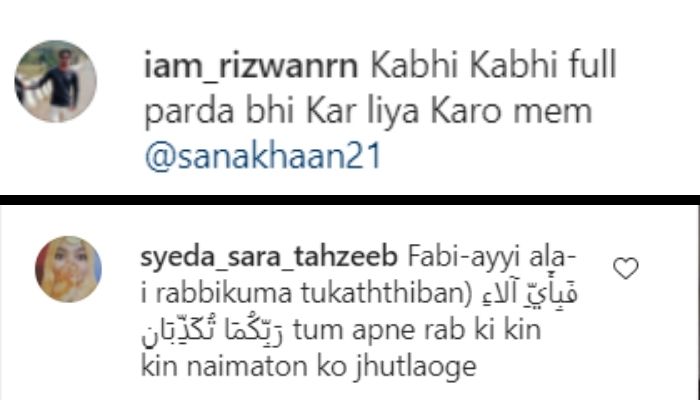
An Instagram user (@iam-rizwanrn) slammed Sana Khan for not following ‘complete purdah’ and not being modest enough. “Sometimes try to completely cover yourself,” he said. It is important to mention that the comment came despite the actress being fully covered. Another user, Syeda rebuked, “How many rules of Allah shall you break?”

Quran does not allow woman to wear ‘manly clothes’

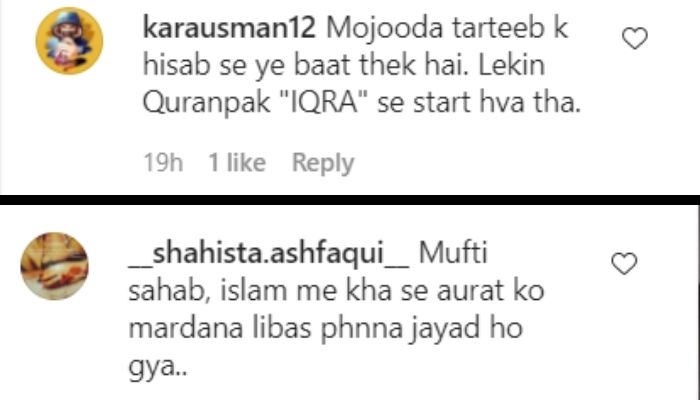
Another user (@karausman12) wasn’t happy either. While ‘correcting’ her knowledge of Quran, he emphasised, “This is okay according to the current customs. However, Quran begins with the word Iqra.” Shahista Ashfaqui, an Instagram user, was irked with her husband Mufti Anas for allowing her to wear ‘manly clothes’. “Since when did it become permissible in Quran for women to wear manly clothes,” she inquired.

Stop uploading pictures on social media, Islamists tell Sana Khan

Besides telling the actress to wear modest clothes and steer away from breaking the ‘rules’ of Allah, Islamists told Sana Khan to stop uploading pictures altogether on social media.

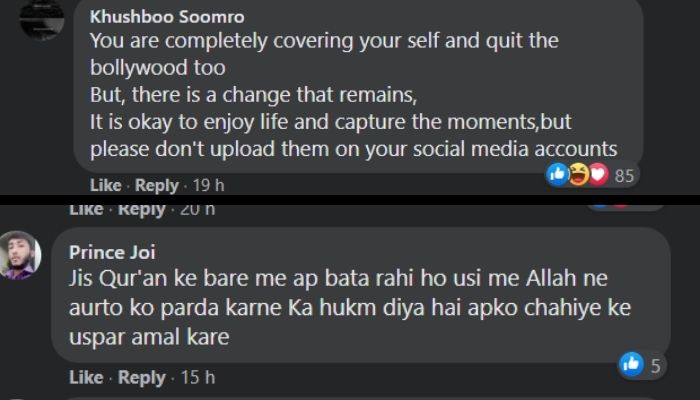
“You are completely covering yourself and quit the Bollywood too. But there is a change that remains. It is okay to enjoy life and capture the moments but please don’t upload them on your social media accounts,” wrote Khushboo Soomro on Facebook. Another user, Prince Joi, emphasised that she must follow the Quran and observe purdah/ full covering that she has been quoting in her social media posts.

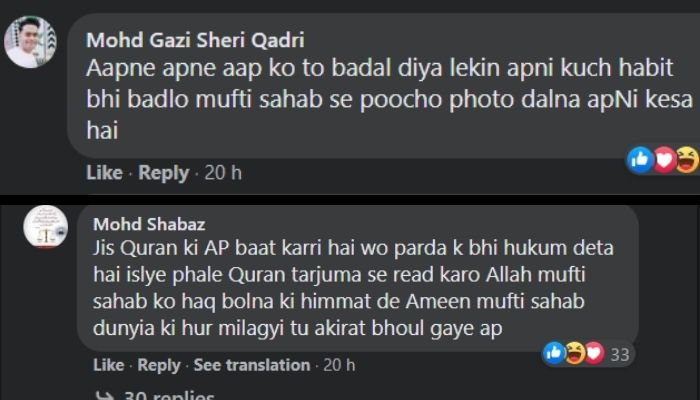
Another user Mohammed Gazi wrote, “You changed yourself but not your habits. Ask your husband about the kind of pictures that are permissible to be posted online”. Mohammed Shabaz also slammed the husband of the actress for not having the courage to educate her the rules of Islam.

Sana Khan quit Bollywood for Islam

In October this year, actress Sana Khan has decided to quit the entertainment industry after being enlightened by the ‘teachings of Islam’. The decision came at the backdrop of her depression phase, following her ‘bitter breakup’ with dancer Melvis Louis. 

In an Instagram post, Sana Khan dubbed her decision to leave showbiz as the ‘happiest day’. While hoping that Allah will ‘guide her’ in her new journey, she asked her followers to pray for her. While invoking Islamic references of the ‘Judgement Day’, she hinted at how her Faith and her profession were at loggerheads with each other. “Therefore, I announce that I will quit the film industry and will serve humanity. I will follow the rules as specified by my Creator. I request my fans to pray for me and hope that Allah will listen to my prayers,” she reiterated.

Actress finds ‘Halal love’, marries cleric

Former Bollywood entertainer Sana Khan, who participated in reality show like Bigg Boss and had acted in Salman Khan movies like Jai Ho had married a Surat-based Muslim Cleric, Mufti Anas in November. As per reports, Bigg Boss 8 contestant Ajaz Khan, who regularly posts communally sensitive remarks on social media, introduced her to her husband.

In the videos that have surfaced online, she was seen wearing a white bridal gown and her husband was also wearing white outfit. She married the Muslim cleric in a small intimate ceremony in Surat. The newly married couple also cut a cake after the wedding.

Chinese Communist Party’s data leak shows how China infiltrated corporates, foreign consulates, including Indian, for spying

Shocking revelations have come forth with the massive leak of Chinese Communist Party (CCP) records. The CCP through a recruitment agency carried out a well-coordinated infiltration by getting its members employed in senior, specialist and advisory positions in consulates of countries such as India, UK, USA and Australia.

According to a report by The Australian, CCP infiltrated the consulates in Shanghai through government-run recruitment agency. Through a well-coordinated effort, advisers were placed in western countries for over a decade.

Whistleblowers have extracted a list of 1.95 million CCP members from a Shanghai server. The list contains details such as names, the positions they held, birthdate and ethnicity. As per the investigation done by The Australian, at least 10 consulates in Shanghai employed CCP members as senior political and government affairs specialists, clerks, economic advisers and executive assistants.

Foreign experts believe that this could be a state-sponsored ‘spying ring’ wherein CCP members are employed in consulates, some for as many as 16 years. The leaked database also revealed that some of the CCP members were employed in corporates such as Boeing, Pfizer and AstraZeneca. Boeing, the American company, has defence contracts worth billions while Pfizer and AstraZeneca are leading pharmaceuticals which are developing the Chinese coronavirus vaccines. CCP members are also recruited at various Western universities as well.

The Australia and New Zealand Banking Group (ANZ), the Australian multinational banking company, has at least one branch of CCP members. The banking company said that it does not interfere in employees’ political inclinations. And while there is no evidence that every CCP member is a Chinese government spy, the new revelations raise severe security concerns.

CCP currently has 92 million members and they must pledge that they put party’s interest above all and be ready at all times to sacrifice all for the party.

Volvo, Citibank, HSBC, IKEA, Volkswagen, Jaguar-Land Rover and Mercedes-Benz are amongst the companies which have CCP members on payroll.

The leaked database shows that the CCP members have been recruited in Indian, Australian, US, British, German, Swiss, New Zealand, Italian and South African missions in Shanghai. The report states that the ­Department of Foreign Affairs and Trade (DAFT) directly hires local staff through a Chinese government agency, the Shanghai Foreign Agency Service Department (SFASD). The SFASD has at least 12 active CCP branches with 249 members.

SFASD’S website currently lists job vacancies for the Australian, US, Czech, Ethiopian, Brazilian, Chilean and Hong Kong consulates in Shanghai from July 2020. The Australian quotes Samuel Armstrong, spokesperson for the British Henry Jackson Society foreign policy think tank who said that the SFASD looks like a well-organised, state sponsored spying ring. Another intelligence officer said that any CCP member working in foreign country’s embassy or consulate is a potential spy.

The leaked database also showed that one CCP member worked for New Zealand Consulate in Shanghai for four years as policy adviser for trade and economics. Further, six CCP members have worked at the US Consulate in Shanghai in various roles including a political specialist, a procurement supervisor and ­an assistant.

There is a current senior officer at the British consulate in Shanghai, who according to The Australian, works near MI6 officers operating under diplomatic cover, with concerns intelligence could be passed back to the CCP. The MI6 is the British Intelligence Agency.

The report further states that the Swiss Embassy has a trade officer and deputy head of station who are CCP members while the German Consulate has a clerk who is a CCP member. Similarly, one CCP member spent as many as 12 years in Italian consulate. Another CCP member spent 16 years in South African consulate.

Another CCP member spent eight years as a senior political and government affairs specialist at the US consulate before moving to the British consulate, the report says.

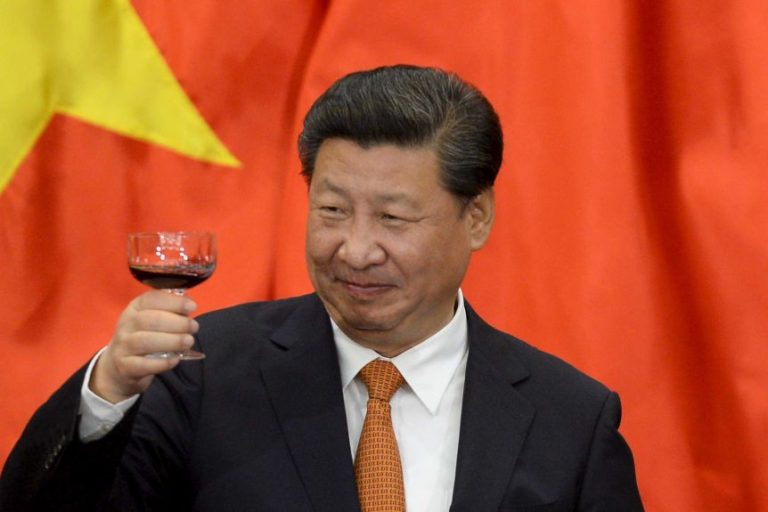
The report says that the massive leak explains how the Chinese President Xi Jinping works: by setting up branches inside companies and government agencies.

The database, originally extracted in April 2016 from Shanghai server, was leaked in mid-September to the newly-formed international group, the Inter-Parliamentary Alliance on China. It is made up of 150 legislators around the world. The leaked data was then provided to an international consortium of four media organisations: The Australian, The Mail on Sunday in Britain, De Standaard in Belgium and Swedish journalists.

Pakistani journalist reporting on atrocities against Hindus and other minorities declared ‘imaginary person’ by Mehr Tarar and others

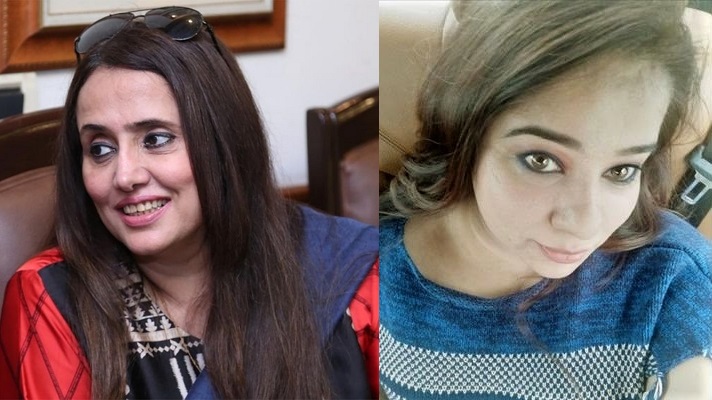
Pakistani columnist and socialite Mehr Tarar has declared that Naila Inayat, a Pakistani journalist with verified Twitter account, is actually a person who doesn’t even exist. Quote tweeting a tweet saying that Ms. Inayat is a fake, fictitious twitter character, Tarar said that she has raised this suspicion earlier also.

Mehr Tarar claimed that no one in Pakistan has met this person, or for that matter, has even heard of her. It is pertinent to note here that Ms. Inayat has written articles in various Pakistani and international mainstream publications. But Ms. Tarar believes that all these publications were dealing with an imaginary person till now.

The tweet that Ms. Tarar was quoting itself was quoting another tweet, which had claimed that Ms. Inayat was created by The Print, news and affairs website launched by Indian journalist Shekhar Gupta. Pakistani Twitter user Maria Sartaj wrote that “A reporter no one had heard of in Pak became the biggest messenger of anti-minority news from Pak”.

A large number of Pakistani social media users made similar claims, which seem ridiculous in the face of it.

The Print was launched by Shekhar Gupta (and Barkha Dutt, who mysteriously dropped out) in 2016, while a simple look at Ms. Inayat’s Twitter profile itself shows that she had been writing for various publications much before the website came into existence. Following is a tweet of hers from 2013, which shows an article authored by her for USA Today:

There are many such tweets and articles from her that are from era when Shekhar Gupta’s website didn’t exist. In fact, most of the articles by Ms. Inayat are in non-Indian publications, and thus the claims of her being imaginary and crated by some Indian journalist are laughable. Yet, someone as senior like Mehr Tarar made resorted to such means.

However, not everyone in Pakistani was party to this weird conspiracy theory. Author Salman Rashid replied to Mehr Tarar, saying that he had met Ms. Inayat personally at The News on Sunday, a Pakistani weekly, in 2007. It may be noted that Ms. Inayat’s Twitter profile mentions that she had worked in the weekly earlier.

The attack on Ms. Inayat by Islamists from Pakistan is understandable, as she has become very popular on social media in India recently due to her reporting on atrocities on minorities in Pakistan, especially kidnap and forced conversion and marriage of Hindu, Sikh and Christian minor girls by Muslim men.

Mehr Tarar had become very popular on social media in India after she was ‘accused‘ of having an affair with senior Congress leader Shashi Tharoor back in 2014.