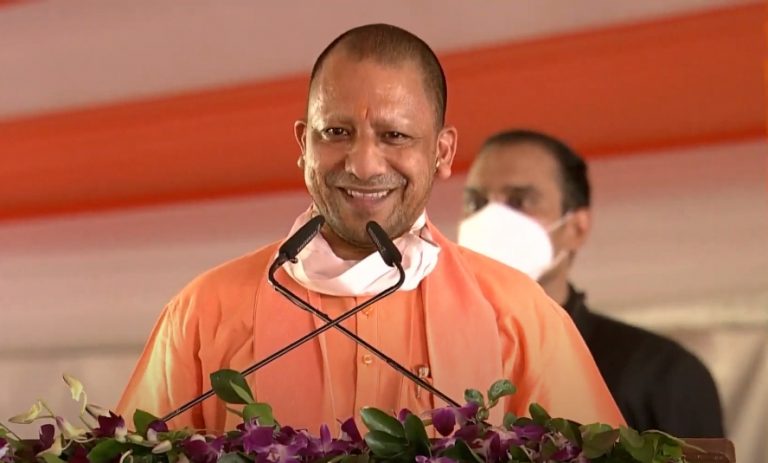
Ram Mandir’s Bhoomi Pujan in Ayodhya was successfully completed yesterday by Prime Minister Narendra Modi. Uttar Pradesh CM Yogi Adityanath had been very actively participating in the preparations of the historic event and was also present when Prime Minister Narendra Modi finally performed the Bhoomi Pujan ceremony at Ayodhya.
While addressing the luminaries, the elated CM had said: “The ‘Bhumi Pujan’ will not only mark the beginning of the construction of the Ram temple but also ‘Ram Rajya’ as envisaged by the Prime Minister”.
In an interview after the Bhoomi Pujan ceremony, when ABP News asked Yogi Adityanath whether he would attend the groundbreaking ceremony of the Mosque whenever it is constructed in Ayodhya, the CM candidly replied: “Neither will anyone call me nor will I go to the mosque foundation laying programme”.
As per the orders of the Supreme Court in the historic verdict handing over the Ram Janmabhoomi site to Hindus, the Uttar Pradesh govt has allotted 5 acres of land to the UP Sunni Waqf Board to construct a mosque in place of the demolished Babri structure. The board has recently constituted a trust to build a mosque on the land in Raunahi, Dhanipur Village, Ayodhya. The ABP journalist was asking the UP CM about the groundbreaking ceremony of this upcoming mosque.
Yogi Adityanath said, ‘if you ask me as a chief minister I have no problem with any religion, sect or tradition but if you want me to reply to you as a Yogi… I will never go”. Further explaining his stance, Yogi said that as a Hindu he has all the rights to express his faith andconduct himself as he wants.
“The day I will be invited, secularism will be in danger”: Yogi Adityanath
“I am neither a litigator nor a defender, therefore neither will someone invite me nor will I go. I know I will never receive any such invitation. The day I will be invited, secularism will be in danger”, said Yogi Adityanath lightheartedly. He also added, “I do not want secularism to be under any kind of threat, so it is best that I keep doing my job quietly and let everyone, irrespective of caste and religion, benefit out of my work and our government schemes,” said the fiery BJP leader.
Yogi Adityanath slams the “merchants of Muslim vote bank”
Slamming all those political parties who indulge in the proverbial vote bank politics, Yogi said that all these “merchants of Muslim vote bank” has never fought any battle honestly. He said that the leaders of these party are completely unaware of the constitutional values.
Further, taking a dig at the politics of appeasement, he said: “When politically motivated leaders wear skull-caps and attend Roza-Iftar, it is not secularism but just a gimmick. Even the public knows it very well”.
Congress never wanted the controversy to end
Launching a direct attack at the Congress party, he said that Congress never wanted that the Ram Janmabhoomi dispute should end. “Vivaad bane rehne dena chahate the”, he said, adding that they wanted that the controversy should never end. The UP CM further said that they are the ones who had questioned the mere existence of Lord Ram. They tried creating as many obstacles as they could, said the CM slamming the Congress party for its hypocrisy over the construction of Ram Mandir in Ayodhya.
He added the power of Indian democracy and the judiciary has shown the world how solutions to problems could be found through democratic and constitutional means.
Yogi concluded by saying that the construction of the Ram Mandir will create immense job opportunities and open up many avenues for the people of Ayodhya. It will be the beginning of a new era, said the Uttar Pradesh CM.
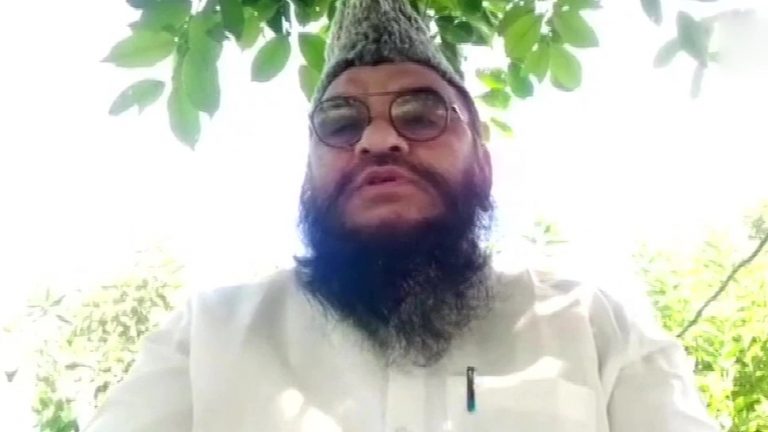
A complaint has been filed against Islamic cleric Maulana Sajid Rashidi – the President of All India Imam Association– for making provocative statements against Hindus and for issuing threats to demolish the yet-to-be-built Ram Mandir at Ayodhya.
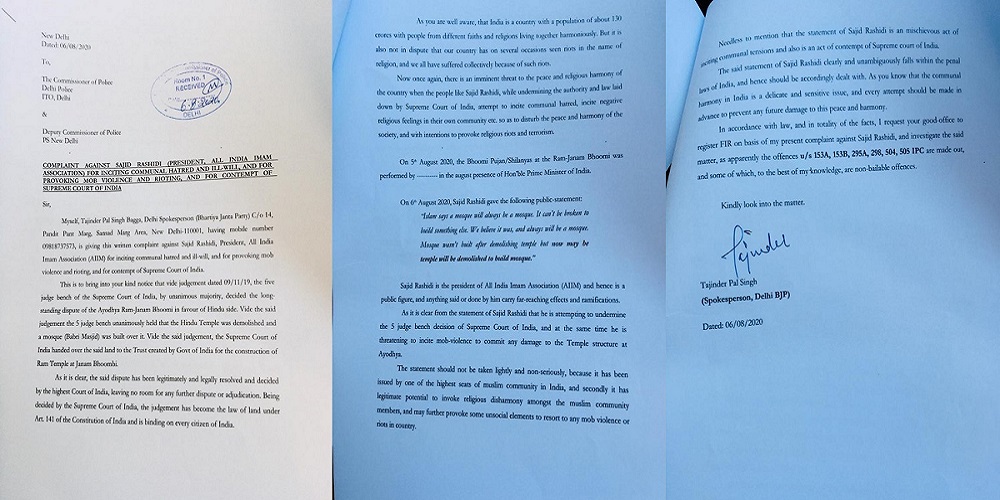
On Thursday, BJP leader Tajinder Pal Bagga registered a complaint with the Delhi Police against the Islamic cleric Maulana Rashid for inciting communal hatred, ill-will and also for provoking mob violence and riots. The complainant has also filed a complaint against the Islamic cleric on charges of contempt of court.
In the complaint, BJP leader Tajinder Pal Bagga accused Maulana Rashidi of undermining the authority and the law laid down by the Supreme Court by attempting to incite communal hatred and negative religious feelings to disturb peace and harmony of the society, with intentions to provoke religious riots and terrorism.
Image Source: Tajinder Bagga
“As it clear from the statement of Sajid Rashidi that he is trying to undermine the 5-judge bench decision of the Supreme Court of India, and at the same time he is threatening to incite mob violence to commit any damage to the temple structure at Ayodhya,” the complaint read.
Demanding action against the Islamic cleric, the complaint further stated that the statement made by Maulana Sajid Rashidi should not be taken lightly and non-seriously as it has been issued by one of the highest seats of the Muslim community of the country and also has potential to invoke religious disharmony amongst the Muslim community members.
The complainant filed a complaint under the sections – 153A, 153B, 295A, 298, 504, 505 of the Indian Penal Code.
Maulana Sajid Rashidi threatens to demolish Ram Mandir at Ayodhya
A day after the Bhoomi Pujan of the Ram temple at Ayodhya, the president of the All India Imam Association Sajid Rashidi made a provocative statement on Thursday saying that a mosque will be rebuilt after demolishing the Ram Mandir.
The Islamic cleric had asserted that the Babri Masjid was not built after demolishing a Hindu temple at the disputed site.
The controversial Islamic cleric also went on to claim that Prime Minister Modi has ‘violated the constitution’ by visiting Ayodhya temple event. He went on to claim that the land in which the temple is being built belonged to the disputed structure, which according to him was demolished by forces similar to German dictator Adolf Hitler’s forces.
The 15th EU-India Summit was held in the virtual space, which can be called the Covid-19 era normal. Before the pandemic made its presence felt, this Summit was planned to be held in March in Brussels. Accordingly, preparations were starting for the Summit and a few programs on the sidelines of the event were on anvil. Abruptly COVID brought an end to all the plans.
The last 2 Summits were held in Delhi in 2017, and in Brussels in 2016 which paved the way for strengthening the trade between EU and India. European Union is only second to the USA as India’s trading partner. Hence the importance of this relationship.
The birth of European Union dates back to 1952 when six countries – Germany, France, Italy, Belgium, Netherlands and Luxembourg – got together to form European Coal and Steel Community to protect their steel and coal industry. In 1957 this was transformed to become European Economic Community (EEC). It is only in 1973 that the UK, Ireland and Denmark joined taking the total to 9. The EEC was also known as the European Common Market (ECM).
Since the 1993 Maastricht treaty, the Community became a Union. One can say it was an economic growth model, without a fiscal and political union. Introduction of borderless trade followed by borderless travel within the Union, except a few countries went a long way in giving a boost to economic activities within the union and outside.
There are many complexities in the EU, few countries are in the visa treaty (Schengen) but not in the currency union and some part of a sub-regional group with free movements with countries not in the EU. The introduction of Euro €in 19 of the 27 countries on the midnight of 1st January 2002 and withdrawing the existing one was a unique feat. The ‘demand’ for EU membership was so high that in a few years the Union expanded to 28 countries that got reduced to 27 post Brexit.
Brexit has come as a dual opportunity for India. While Britain loses the Single Market, the EU’s GDP will be taking a 17% hit. Both these occurrences offer an opportunity for India.
This summit was very timely especially in the midst of the pandemic keeping in mind our quest to Atmanirbhar Bharat based on the call given by Prime Minister Narendra Modi. While the pandemic has challenged the entire humanity both physically and economically, it has thrown up new opportunities and also the need for countries to come together.
There are short term challenges of rekindling the economies and putting it back on track, in the long term challenges like climate change and increasing the use of renewable energy. To finally emerge out of the pandemic, access to COVID tools, including the advent of a vaccine and the close cooperation between the pharmaceuticals companies on both sides will be crucial.
Emerging from the Summit a very positive Joint Statement and a five-year Roadmap 2025 augers very well. The emphasis on a high-level trade and investment dialogue and the formation of a digital investment forum will further strengthen the relatively balanced trade, with India enjoying a surplus. EU accounts for 14.4% of India’s exports (€41.4 billion). A leading investor in India, about €10 billion, 22% of the total FDI inflows in 2019-20. On the other hand, EU the third-largest recipient of Indian FDI, €2.5 billion, 14% of outflows. Close to 4,500 EU companies in India employ 60 lacs people (directly and indirectly).
Another important outcome of this Summit was a comprehensive Road Map for 2025 covering multiple subjects Security, Foreign Policy, Human Rights, Trade and Investment, Business & Economy, Climate change and Clean Energy, Environment Urban Development, Information and Communication Technology, Transport, Outer Space, Health and Food Security, Research and Innovation, Artificial Intelligence, Effective Multilateralism, Connectivity, Indian Ocean and the Pacific, Global Economic Governance, Ocean Governance, Development Partnership, Migration and Mobility, Employment and Social Policy, Education and Culture, Parliaments, Civil Society and Local/Decentralised Authorities, Institutional architecture of the EU-India Strategic Partnership.
For Trade and investment, Business & Economy – as part of the Road Map for 2025 a detailed plan was laid which will go a long way to enhance the much-needed market access, particularly for small and medium-sized enterprises (SMEs). Also addressing issues of existing trade barriers and preventing the emergence of new ones, seeking alignment to international standards and best practices, easing up the assessment of conformity and improving investment conditions.
This road map envisages strengthening the regulatory dialogue on pharmaceuticals, medical devices and biotechnology. This will be fostering alignment with international standards and practices; ensuring the quality of pharmaceutical and the much-needed market access.
Engaging in the bilateral Intellectual Property Rights (IPR) dialogue, working out ambitious and mutually beneficial trade and investment agreements and the optimal use of the Investment Facilitation Mechanism (IFM) established in 2017 will greatly facilitate EU investment flowing into India.
The success of a summit is assessed by the emerging joint statement and its comprehensiveness. In exceptional cases, when ‘issues’ do not get resolved such a joint statement is missing. This happened in a very recent EU summit (June, 22) with a major country. In this instance, the emerging statement read – ‘Defending EU interests and values in a complex vital partnership’.
EU and India is a natural partnership between 27 democratic countries with the world’s largest democracy. India is a country which houses in its bosom multiple religion, languages, cultures, so does the EU in its group of 27. EU and India are very important not only to each other’s’ economic prosperity but the world at large. It is therefore important to see this EU-India Partnership with a lens of economic revivalism of India post-COVID which promises flow of investment and a boost in the manufacturing sector in India.
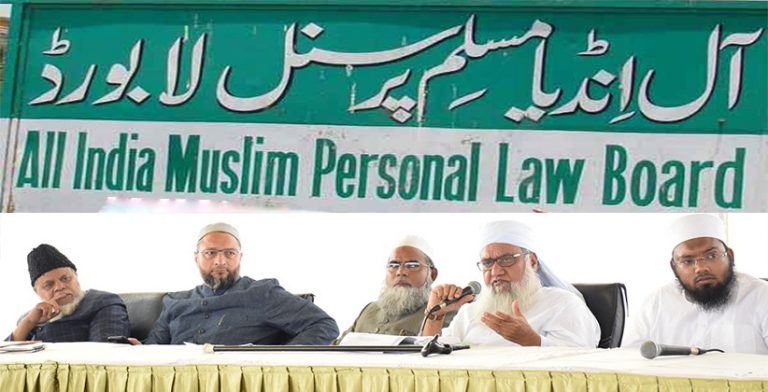
A day after All India Muslim Personal Law Board (AIMPLB) issued a threat against the construction of Ram Mandir, Dalit Positive Movement, an organisation fighting for the rights of the Dalits, have lodged a complaint against the former with the Ministry of Social justice and Empowerment and Ministry of Home Affairs (MHA).
We have lodged a complaint with @MSJEGOI & #MHA seeking FIR on AIMPLB & all its leaders as per SC/ST act for threatening intimidating & hurting the faith of Hindu Dalits on their beloved god Prabhu Shree Ram. We have even sought contempt proceedings & enquiry on their fundings. pic.twitter.com/M2o6BPh9nx
— Dalit Positive Movement (@DalitPositive) August 6, 2020
In the complaint, the organisation has sought an FIR against AIMPLB and all its leaders as per SC/ST act for “hurting the sentiments of the Hindu Dalits and Hindus at large by threatening to overturn Hon. Supreme Court’s Judgement and overtake Prabhu Shree Ram Janmabhoomi temple site to build a mosque”.
The Dalit organisation asks MHA to take cognisance of the “vicious, poisonous and incendiary material” circulated by AIMPLB on social media
Urging the government departments to take cognisance of the “vicious, poisonous and incendiary material” circulated by AIMPLB on social media on the eve of Ram Janmabhoomi’s Bhoomi Pujan ceremony, which has hurt, threatened and enraged the Dalits who have “unshakable faith in their beloved Bhagwaan”, the organisation has requested that the FIR be filed under the SC/ST Atrocities Act against AIMPLB, it’s President and all its leaders.
It has also sought contempt proceedings and enquiry on the fundings of the controversial Islamic body.
Saying that Islamic body seems to be having a larger ploy to discredit constitutional institutions and democratic process and create a constitutional crisis in our country, the Dalit organisation has also sought contempt of court proceedings against AIMPLB.
“We also kindly request the Hon. Supreme Court of India to take cognizance of this clear case of Contempt of Court and take punitive actions against the above accused and their organization at the earliest to set a precedence and set the record straight”, read the complaint.
“Information about the alleged organization available on Wikipedia clearly states that they (AIMPLB) have unconstitutional motives of running a parallel constitution of the Islamic “Sharia Law”. Hence, it is our humble request for you to take immediate and necessary actions to maintain the rule of law and credibility of our democratic system based on our constitutional principles which in under clear and present threat from such non-state actors who are looking to destabilize the peace and harmony of our society”, the complaint stated.
The Dalit organisation finds finances of the Islamic body “to be very fishy”
Speaking to OpIndia, the convenor of Dalit Positive Movement, P Ravi, said that since their organisation finds the finances of AIMPLB “to be very fishy” it has also urged MHA to “investigate the finances and funding of AIMPLB, its leaders and all its cadres along with scrutinizing their international travels in the last as many years and any business or criminal liaison, which may be detrimental to our National security and interests”.
In its complaint the Dalit organisation said that considering the Muslim body’s obvious intentions of stoking religious riots, as a precautionary measure, the MHA should freeze the bank accounts of the organisation and bar the party leaders and cadres from making any international travel.
P Ravi, told OpIndia that he feels that since there is a lot of merit in thier complaint, they believe that action will be taken against the Islamic organisation.
AIMPLB issues a menacing threat on the eve of Ram Mandir Bhoomi Pujan
Yesterday, the controversial Islamic body had taken to Twitter to not only issue menacing threat over the construction of the temple but also hinting at converting back the temple into a mosque in the future. Comparing Babri Masjid to Turkey’s newly converted mosque ‘Hagia Sophia’, the Muslim Personal Board said, “Babri Masjid was and will always be a Masjid”.
Furthermore, attacking the Supreme Court for its judgement in the Ram Janmabhoomi-Babri Masjid case, the AIMPLB claimed that the Supreme Court’s verdict allowing the construction of a Ram Temple was “unjust and unfair”.
The AIMPLB which was among the litigants in the Ram Janmabhoomi-Babri Masjid case in the Supreme Court, also noted that according to the Islamic Shariah, “at whichever place a masjid is established, it remains a masjid there forever till eternity. Hence the Babri masjid was a masjid before, is a masjid today and shall Inshallah remain a masjid”.
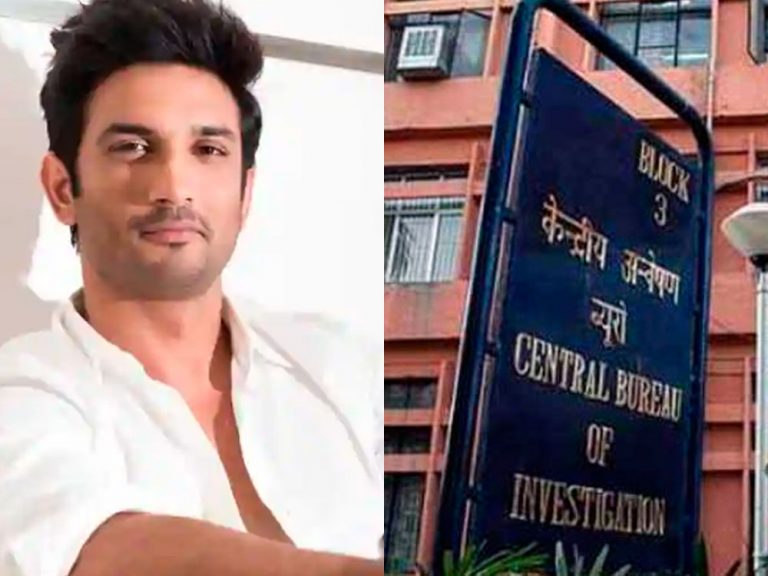
On 6th August, Central Bureau of Investigation informed that they had received a letter from the of Personnel, Public Grievances and Pensions to start probe in Sushant Singh Rajput’s death case. They are in the process of registering the case in the matter. Yesterday, the Supreme Court made it clear that CBI can take up the case and dismissed the arguments by Maharashtra Government against the CBI probe. The central govt had informed the apex court that they have accepted the Bihar police request to hand over the case to CBI.
After getting the notification from Government of India, CBI is in the process of registration of the case. We are also in touch with Bihar Police: Central Bureau of Investigation on #SushantSinghRajputCasepic.twitter.com/tfSStXyVcQ
Center issued the letter to CBI on Bihar Police’s request on 5th August. A case was registered by Sushant’s father KK Singh with Bihar Police on 25th July in which he alleged that Rhea Chakraborty, Sushant’s ex, pushed him to the point that he committed suicide. Ankita Lokhande, Rajput’s ex-girlfriend and co-actor, provided crucial information to Bihar Police. She also offered chat history between her and Sushant, where he claimed he wanted to end a relationship with Rhea.
CBI has formed an elite SIT (Special Investigation Team) will probe the Sushant Singh Rajput case. According to reports, the SIT will be led by IPS officer Manoj Sashidhar. DIG Gagandeep Ghambir and SP Nupur Prasad are also part of the team.
Sushant Singh Rajput case has become a fight between police departments of two states. Bihar Police registered a case and sent a team of four officers to Mumbai to investigate. The officials at Mumbai Police did not provide any support, rather BMC sent one of the officers with Bihar Police in quarantine as soon as he landed in Mumbai. Although Mumbai police are probing the matter, they have not registered any FIR in the matter, and they are ruling out any foul play in the alleged suicide case.
The Enforcement Directorate is also probing the financial angle in the case after Sushant’s father had alleged money from his son’s account was transferred to other accounts that do not belong to Sushant. ED has registered a money laundering case in the matter.
Is being a Hindu acceptable while faith in Hindutva is not? Is it even dangerous? Many Hindus seem wary to be associated with Hindutva, in spite of the fact that Hindutva simply means Hindu-ness or being Hindu. They tend to accept the view which mainstream media peddled for long: ‘Hindutva is intolerant and stands for the ‘communal agenda of an extreme right Hindu party that wants to force uniform Hinduism on this vast country which is fully against the true Hindu ethos.’
“Hindutva is indicative more of the way of life of the Indian people. …Considering Hindutva as hostile, inimical, or intolerant of other faiths, or as communal proceeds from an improper appreciation of its true meaning.”
From personal experience, I also came to the conclusion that Hindutva is not communal and dangerous.
For many years I lived in ‘spiritual India’ without having any idea how important the terms ‘’secular’ and ’communal’ were. The people I met valued India’s great Vedic heritage. They gave me tips which texts to read, which Sants to meet, which mantras to learn, etc., and I wrote about it for German magazines. I thought that all Indians are proud of their ancestors, who had stunningly deep insights into what is true and who left a huge legacy of precious texts unparalleled in the world.
However, when I settled in a ‘normal’ environment away from ashrams and connected with the English speaking middle class, I was shocked that several of my new friends with Hindu names were ridiculing Hinduism without knowing anything about it. They had not even read the Bhagavad-Gita but claimed that Hinduism was the most depraved of all religions and responsible for the ills India is facing. The caste system and Manusmiti were quoted as proof.
My new acquaintances had expected me to join them in denouncing ‘violent’ Hinduism which I could not do as I knew too much, not only from reading but also from doing sadhana. They declared that I had read the wrong books and asked me to read the right books, which would give me the ‘correct’ understanding. They obviously didn’t doubt that their own view was correct.
My neighbour, a self-declared communist, introduced me occasionally to his friends as “the local RSS pracharak”. It was half in jest, but more than half intended to be demeaning. My reaction at that time: “If RSS is in tune with my views, then it must be good.”
Standing up for Hindu Dharma indicted me as belonging to the ‘Hindutva brigade’ that is shunned by political correctness. My fault was that I said that Hindu Dharma is the best option for any society. I did not make a baseless claim, as Christianity and Islam do and which goes mostly unchallenged. I explained why Hindu Dharma is inclusive and not divisive, whereas Christianity and Islam divide humanity into those who supposedly have the ‘true faith’ and those who are wrong and will pay for it eternally in hell, if not already on earth.
Of course, my stand is not communal or dangerous. Hindu Dharma is indeed not only inclusive but also most beneficial for the individual and for society and needs to gain strength at the expense of Christianity and Islam, which are exclusive and therefore harmful. And yes, politicians, too, need to base their lives on Hindu Dharma if they want to be efficient in serving society. Propagating blind belief has no place in politics, but following Dharma is in the interest of all.
Hindu Dharma was never based on unreasonable dogmas and did not need blasphemy laws to keep its followers in check. It is helpful to society as it imparts profound wisdom and gives guidelines for an ideal life that acknowledges the invisible, conscious Essence in this visible universe. It allows freedom of thought and many parallel streams with different ways to connect to this essence emerged which co-existed harmoniously.
Humanity needs to win over the madness that the Supreme Being loves only those humans beings, who believe in a certain book and condemns all others to eternal hellfire. But how to make them see sense?
Even some staunch ‘secular’ Indians occasionally declare themselves as Hindus. It’s a good sign, but they usually get something wrong: They believe that being Hindu means that everything goes – believe in a god or not, be vegetarian or not, go to temples or not. It even seems to imply: be truthful or not. They portray Hindu Dharma as having no fundamentals.
That’s wrong. Hindu Dharma has also fundamentals, but they are benign and helpful.
Being Hindu means to know and value the profound insights of the Rishis and follow their recommendations in one’s life. These insights may not be obvious to the senses, like the claim that everything, including nature, is permeated by the one consciousness (Brahman), but it can be realised as true; similarly, as it is not obvious that the earth goes around the sun, but it can be proven. Being a Hindu does not require blind belief.
Being Hindu also means having the welfare of all at heart, including animals and nature, because each part is intimately connected with the Whole. Especially the cow is revered and the Rishis gave good reasons why it must not be killed.
Being Hindu means following one’s conscience and using one’s intelligence well. It means diving into oneself, trying to connect with one’s Essence. It means trusting one’s own Self, Atman, and doing the right thing at the right time.
Being Hindu means being wise – not deluded or gullible or foolish. This wisdom about the truth of this universe and about how to live life in the best possible way was discovered and preserved in India. Yet its tenets are universal and valid for all humanity.
Isn’t it time for our interconnected world to realise this and benefit?
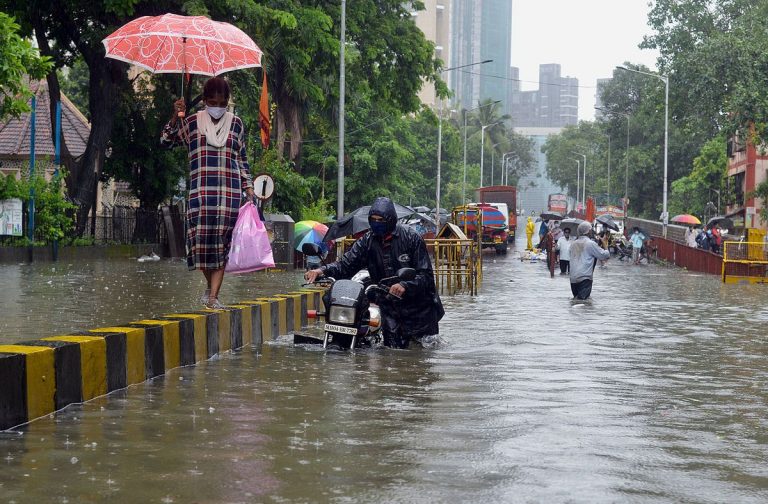
Heavy rainfall in 24-hour span has caused major floods and destruction in Mumbai. The winds reached a top speed of 100 kmph, trees were uprooted, cranes deployed in construction work got damaged, hoardings were torn down and the water gushed in houses across Mumbai. The Colaba observatory recorded 293.8 mm rain till 8:30 PM on Wednesday that was the highest rainfall recorded for the month of August in 46 years.
Rainfall realised during (0830 hrs IST to 2330 hrs IST of 5th Aug 2020) at Mumbai-Colaba:- 32.8 cm. Mumbai-Santacruz:- 13.8 cm.
Intense to very intense spell of rainfall likely to continue over Mumbai during next 3-4 hours. pic.twitter.com/HsotGLVIUV
The annual seasonal average rain for Mumbai is 2,206.4 mm. The city so far has received 2,319.7 mm rain. On Wednesday night, PM Modi also posted a tweet assuring the residents of the City that centre will provide all possible support. He talked to CM Uddhav Thackeray for the same.
PM @narendramodi spoke to Maharashtra CM Shri Uddhav Thackeray regarding the situation prevailing in Mumbai and surrounding areas due to heavy rainfall. PM assured all possible support. @OfficeofUT
The city received the heaviest rain during the nine-hour period of 8:30 AM to 5:30 PM. The observatory reported 229.6 mm rainfall that was highest recorded in the last 22 years. The iconic signage mounted on the top of the Bombay Stock Exchange also got damaged due to rain and strong winds. Ashish Chauhan posted a photo of the damaged signboard and wrote, “The signage on top of the BSE building toppled due to very heavy wind and incessant rain today. We are seeking the help of fire brigade to ensure that the signage doesn’t fall to the ground and injure any one or create property damage for any one. Please bear with us.”
Damaged BSE sign board
Around 200 passengers were stuck in waterlogged areas including railway stations who were rescued by the NDRF team. Chief Minister Uddhav Thackeray has reviewed the situation in Mumbai and the adjoining regions including Palghar that has received 383.1 mm rain in 24 hours.
#WATCH Mumbai: 40 people rescued by National Disaster Response Force after 2 local trains got stuck between Masjid & Bhaykhala stations due to water on tracks. (Video source-NDRF) pic.twitter.com/ADShmBk9s3
Hindus celebrated across the world as the 500-year-old battle to reclaim the Ram Janmabhoomi culminated with Prime Minister Narendra Modi doing the ‘Bhoomi Pujan’ for the Bhavya Ram Mandir. The 5 century battle by Hindus to reclaim their place of worship, their dignity and their cultural heritage should have been an occasion that was celebrated regardless of religion since, in India, Hindu culture is what has kept the country what it is today. However, unsurprisingly, the ‘liberal’ ecosystem was busy not only ruining the end of their mythical “secular” nation but also furthering inane and baseless arguments to make Hindus feel guilty about reclaiming what is rightfully theirs.
One of the foremost arguments used by the apologetics of Islamism when any criticism of the barbarity heaped by invaders is mounted is that any such criticism is misplaced since the current lot of Muslims and their ancestors ‘chose to stay back in India’ even when they had the option to move to the Islamic State of Pakistan after the partition. Essentially, what they intend to say is that the Muslim citizens in India, or even their ancestors, should not be questioned about the acts of Muslim invaders because they are committed to India as much as the next Hindu.
For the most part, at least theoretically, the argument that Muslims of India cannot be held responsible for the barbarity heaped by the Muslim invaders on Hindus is correct. Unless they demolished the Ram Temple with their own hands and helped in the construction of the disputed structure that was called Babri, it is theoretically incorrect to blame them for the actions of Muslim invader thousands of years ago.
However, practically, we have seen that the rose-tinted image of the Indian Muslim does not always hold true. If Muslims were not beholden to the atrocities heaped by Muslim invaders and were indeed peace-loving citizens who acknowledged the atrocities committed, there would not have been widespread riots and systematic murder of Hindus, even in Pakistan, after the disputed structure was demolished by Karsevaks. In fact, if Indian Muslims were truly mindful of what the invaders had taken away from Hindus, they would have voluntarily given up their claim on the disputed structure, as KK Mohammad had suggested.
However, that was not the case. Till date, even after the Bhoomi Pujan, threats issued to Hindus by Islamists and general Muslims have not stopped. From the All India Muslim Personal Law Board to Muslim leaders like Asaduddin Owaisi, the threats to Hindus prove that the image of the Indian Muslim that Liberals want to paint so desperately have a few chinks, to say the least. It is to be noted that these are some of the most powerful representatives of the Muslim community in India. They have been elected by the Muslims and are revered by the Muslims. And hence, to say that their opinion does not represent the popular sentiment amongst the Muslim population could be as ludicrous as saying that PM Modi does not find resonance with Hindus of India.
When the apparent and very real reaction of Indian Muslims goes against the stated narrative, liberals then turn to bizarre arguments to ensure that the image they have created, one of eternal victimhood, doesn’t crumble to the ground.
One of the favourite arguments that are furthered by this delusional coterie is that Indian Muslims stayed back in India out of choice, allegiance and love for India and thus, casting aspersions on their patriotism or even their “tolerance” of the Hindu faith is unfair. Even as the threats by Muslims threw thick and fast, the narrative that was peddled was that “secular” India was being unfair to Muslims who chose to stay back in India. In fact, the narrative often goes a step further. Many claim that “most” Muslims chose to stay back in India and hence, the Muslim community, on the whole, is patriotic and beholden to India and Indian ethos, despite mounting evidence to the contrary.
However, is that premise valid? Did “most” Muslims choose to stay back in India post-partition?
What do the numbers say?
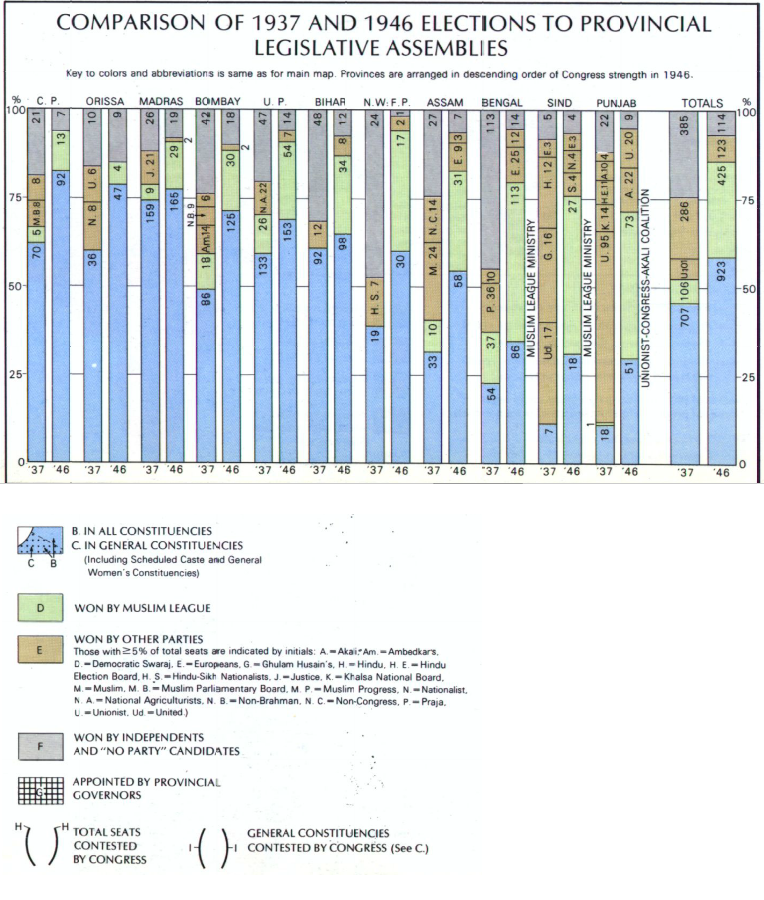
During the provincial elections in 1946, it is an undisputed fact that Muslims voted overwhelmingly for Muslim League which had stirred up religious passions with its demand for a separate Islamic State at the time. The Muslim League asserted that Hindus and Muslims cannot co-exist in the same country and thus, Muslims should have a country of their own carved out of India itself, post-independence.
In total, 87% seats were won by the Muslim League in India in 1946. A closer look at the numbers shows how the demand for a separate Islamic State bolstered the political demand for a separate state.
Source: University of Chicago
The table shows a comparison between the seats won by the Muslim League in 1937 and 1946. As one can see, the number of states that were won by the Muslim League of Jinnah went up manyfold in 1946. In every state, the rise in the popularity of Muslim League was substantial. In states like Bihar, for example, from zero seats in 1937, the Muslim League won a whopping 34 seats out of 40 seats. In Madras, the increase was from 9 to all 29 seats. The pattern holds across all states, or provinces, as they were called during that period.
It is to be remembered that though the two-nation theory itself existed for much longer, a formal political demand was made for a separate state for Muslims in 1940. It was in 1940 that Jinnah formally announced the demand in Lahore. At the 1940 Muslim League conference in Lahore Jinnah said: “Hindus and the Muslims belong to two different religions, philosophies, social customs and literature… It is quite clear that Hindus and Muslims derive their inspiration from different sources of history. They have different epics, different heroes and different episodes… To yoke together two such nations under a single state, one as a numerical minority and the other as a majority must lead to growing discontent and final destruction of any fabric that may be so built up for the government of such a state.”
It was in Lahore that the Muslim League formally recommitted itself to creating an independent Muslim state, including Sindh, Punjab, Baluchistan, the North-West Frontier Province and Bengal, that would be “wholly autonomous and sovereign”. The resolution guaranteed protection for non-Muslim religions. The Lahore Resolution moved by the sitting Chief Minister of Bengal A. K. Fazlul Huq was adopted on 23 March 1940, and its principles formed the foundation for Pakistan’s first constitution.
The formalisation of the demand in 1940 led to a huge surge in the Muslim population supporting the Muslim League and by extension, supporting the demand for a separate Islamic State called Pakistan, which would be carved out of India. It is thus intriguing when several apologists claim that most Muslims stayed back in India out of choice and that most Muslims at the time did not want a separate Islamic state. There can be no denying that there was opposition even from the Muslims at the time to the idea of a separate state, however, political statements and what counts during voting are two rather separate concepts.
If Muslims wanted a separate Islamic State and voted overwhelmingly in its favour, why did so many Muslims stay back?
The obvious argument that is presented, sans facts, to counter the overwhelming support for the creation of Pakistan is that if most Muslims at the time supported the two-nation theory, then why did so many Muslims stay back. And if they indeed did stay back, it only means that they rejected the two-nation theory.
To understand the complete context, we will need to travel back in history a little.
After partition, several leaders were in support of the full exchange of population, including leaders like BR Ambedkar. In his book on Partition, Ambedkar clearly outlines how and why he was in favour of a full population exchange between India and Pakistan, which would essentially mean that all Hindus and other religious factions other than Muslims would come back to India and all Muslims from India would go to Pakistan. In fact, he had even written a basic framework on how the issues arising out of full population exchange could be dealt with.
Sardar Patel had, even after the partition spoken extensively about how Muslims had helped create Pakistan. His famous quote from his speech in Kolkata, 1948, bears testament to the fact. He had said, “Most of the Muslims who have stayed back in Hindustan, helped in creating Pakistan. Now, I don’t understand what has changed in one night that they are asking us not to doubt their loyalty”.
Further, one has to remember that the demand for full population exchange was supported by several stalwarts at the time. A report in Sunday Guardian says, “Dr Mookerjee, accompanied by Rajkumari Amrit Kaur, went to plead with Gandhi for agreeing to Jinnah’s proposal for an exchange of population, the old man’s flat reply was that partition was on a territorial basis and not on religious grounds. Hence, no question of exchanging Hindus from Pakistan with Muslims from India. This was when the division was exclusively on the criterion of religion, Hindu and Muslim”.
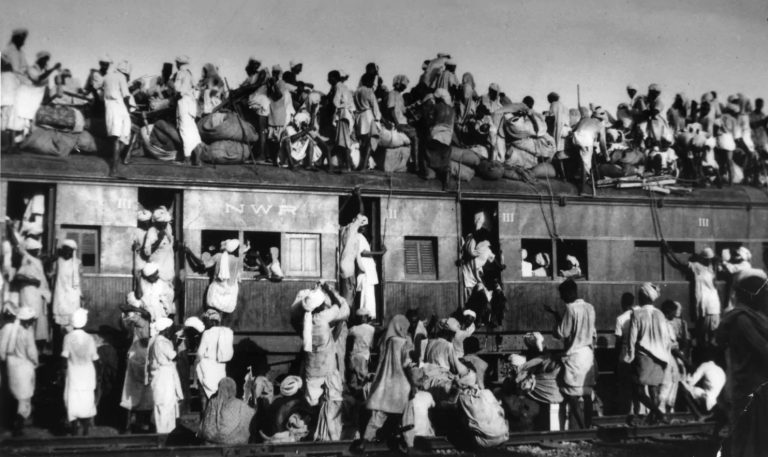
Further, After the partition, which was squarely based on religious lines owing to the demands of Jinnah, widespread riots had broken out in India and the newly formed Pakistan. The non-Muslim citizenry who were in Pakistan started making their way to India and the Muslim citizens in India started making their way to Pakistan. The migration is well documented and proven.
In 1950, an accord was signed between Nehru and Liaquat Ali Khan where each side pledged to secure its minorities and give equality of citizenship regardless of religion. Both sides promised to help recover looted property, assist in the recovery of abducted women and not recognise conversions made during communal disturbances.
Essentially, Jawaharlal Nehru scuttled the de facto population exchange with the 1950 Accord. After the Accord was signed, Muslims, who had left West Bengal, returned and Nehru ensured that their property was restored to them. However, the travesties heaped on the Hindus continue to this day, unabated in Islamic Nations like Pakistan and Bangladesh.
Quoting a report from Daily Pioneer:
Syama Prasad Mukherjee resigned from the Cabinet on April 1, 1950, in protest against Nehru’s failure to take Pakistan to task for the continued suffering of his people. At a Cabinet meeting the same day, Mukherjee said, “What do you care for us Bengali Hindus? What do you care for the criminal assaults on our women?” (Soundings in Modern South Asian History, ed. DA Low) Enraged at the renewed exodus of Hindus, which he viewed as deliberate, he suggested an exchange of populations, which Nehru rejected vehemently.
Nehru, in his communication to the then West Bengal Chief Minister, had further said (as quoted in the DailyPioneer report):
“I have been quite certain right from the beginning that everything should be done to prevent Hindus in east Bengal from migrating to West Bengal…I think the Hindu leaders of East Bengal, who have come away, have done no service to their people. If as you suggest things have gone too far already, then naturally, we shall all do what we can but I shudder at the prospect and the magnitude of the human misery that will come in its train. To the last, I shall try to check migration even if there is war”.
Jawaharlal Nehru was thus, quite vehemently against population exchange and was, in fact, willing to fight a war to ensure that persecuted Hindus are not allowed to migrate back to India.
At the time of widespread riots, even those who wanted to make their way to Pakistan largely could not. And since the State, headed by Jawaharlal Nehru and even MK Gandhi was vehemently against population exchange, there was hardly any facilitation for Muslims to travel to Pakistan after the accord was signed.
The Bihar conundrum
A strange argument that was furthered in the Huffington Post article also cited Bihar as an example saying that the drop in population in Bihar was a mere 2% between 1941 and 1951. Citing this example, the author says that this could not be called a “mass exodus” and hence, even if all the people who voted for the creation of Pakistan left, it stands to prove that those who stayed back did not essentially agree with the decision.
This argument would be rather hilarious if weren’t so woefully uninformed.
The interesting assumption made by the author here is that at the time, it was a free flow of people between Pakistan and India. Much like now, people could simply book their tickets via trains or flights and simply shift to the country of their preference at will. And hence, the ones who stayed back did stay back because they chose to be here. It simply assumes that it was a conscious decision. What the article does not specify, is that from zero seats in 1937, the Muslim League won 34 out of 40 seats in Bihar in 1946 after the political demand for Pakistan was formalised.
The fact remains that complete exchange of population, as discussed earlier in this article, was not exactly a proposition that was supported by the two people who were in the position to make most such decisions at the time – Jawaharlal Nehru and MK Gandhi. In fact, Nehru and Gandhi were explicitly against the idea even at the insistence of stalwarts like Ambedkar. By 1950, the Pact was signed and thus, there was hardly any facility that was actively provided by the state for a population exchange. Add to that, widespread riots had also broken out in the countries.
Perhaps the reason that far more Muslims managed to make their way from Punjab to Pakistan as compared to Bihar is the greatest proof of the logistical nightmare that people who wanted to travel to the ‘other country’ faced. Therefore, to simply assume that Muslims stayed back in India at will, is a fallacy that has long been propagated by malicious elements such as the author of the Huffington Post article.
The argument of suffrage: ‘Those who voted for Pakistan did not represent Indian Muslims’
When facts presented are overwhelming, the intelligentsia that wishes to defend the indefensible often resorts to a strawman argument. One of those arguments were made in the Huffington Post by one Rupa Subramanya. The argument made essentially said that “1946 elections, based on the Sixth Schedule of the1935 Government of India Act, had a limited franchise, which means that only a small percentage of adults—those with money and property—were eligible to vote”.
Essentially, the argument depends on the principles of suffrage saying that since only a percentage of people had the right to vote, the overwhelming support for the creation of Pakistan was not representative of the common Muslim sentiment. In fact, it goes a step further to quote “anecdotal evidence” to counter the actual evidence. The article says, “Anecdotally, there are many stories of upper-middle-class and upper-class Indian Muslims, including erstwhile princes, who decamped for Pakistan in 1947 to land up in senior positions in the government, military, and corporate sectors. Such people, whom one might charitably call carpetbaggers, voted with their feet and chose Pakistan”.
Depending on “anecdotal evidence” to counter numbers is a straw man that is often used by those who wish to lodge their names in the Liberal roster. However, the straw man argument itself, when extended, hardly represents the truth.
To provide further “proof” of this strawman argument, Rupa in Huffington Post extends the argument to Nehru and Congress. She says that Nehru himself was an elitist and hence, did not represent the entire Indian community due to limited suffrage. In fact, she even blames the new age critics of Congress and therefore, Nehru saying that most of the new age critics essentially say that they were elitist and did not represent the interest of wishes of The Hindu community at large back then, and if that argument holds true, it also has to be true that the Muslim League did not represent to wishes of the Muslim population for the same reasons (limited suffrage).
This argument is deeply flawed, to say the least. If one extends the limited suffrage argument, then one will have to almost concede that there was no freedom struggle in India, to begin with, or that at least the struggle may not have had the consensus of the masses. The struggle itself was not put to vote and certainly, did not take the collective consensus of the masses by any electoral method. Is that to say that the freedom struggle had no universal acceptance?
Further, the argument being extended to Congress is also deeply flawed. Even the staunchest critics of Congress do not say that they did not have popular consensus or were acting in a manner that did not have the will of the people included. The criticism has always revolved around how the people, Hindus specifically, were misled by Congress and by extension, by Nehru into believing principles that were against the very basics of Hinduism or even what India was meant to stand for. That the interests of Hindus were compromised is a fact. But it is also a fact that Hindus did support Congress. The criticism is about how the people were fooled by him to toe their line to their own detriment.
Talking about Nehru in isolation to say that Nehru did not have consensus of the people, for the purpose of this argument is flawed too. While Nehru certainly needed the help of MK Gandhi to be catapulted to his political position, it also needs to be understood that at the time, it was not a presidential election that would hinge on the personality himself. It was about the idea that was being presented by the party – Congress, and the idea being presented by the Muslim League. That we criticise those very ideas and how the leaders of Congress fooled the people at the time is a separate debate, however, one cannot possibly argue that the consensus at the time was not with Congress by any means.
This strawman argument can be extended to suit ones narrative as much as one wants. For example, in today’s day and age, this same argument is used to discredit the election of PM Narendra Modi even when universal suffrage is granted. Often, one hears Leftists say that PM Modi was only elected by 33% of the population and hence, he is not the representative voice of the people.
This argument truly has no end. However, even at the time of limited suffrage, the limited voting rights given to Muslims were the exact same limited rights given to Hindus. However, it was not the Hindus demanding a separate state or even asking for separate electoral rights for Hindus and Muslims during the time.
It was Pocker Sahib Bahadur, Muslim member from Madras who had moved the following amendment after the partition of India: “That on a consideration of the report of the Advisory Committee on minorities, fundamental right etc., on minority rights this meeting of the Constituent Assembly resolves that all elections to the Central and Provincial Legislatures should, as far as Muslims are concerned, be held on the basis of separate electorates”.
Sardar Patel at the time had given a scathing speech that decimated the premise of this. He repeatedly argued that it was the Muslims who spearheaded the demand for Pakistan and now that they got their demand, they want to divide India on the basis of religion. Patel made remarks questioning the forked tongue of the Muslims at the time too, saying that sweet words will not compensate for actions.
While this proposition was rejected after a heated debate in the constituent assembly, it was, in fact, a widely popular suggestion in the Muslim community and Patel’s remarks during the debate also stand testament to that fact.
The existence and formation of IUML proves that the Muslims who stayed back in India had no special allegiance towards India
Indian Union Muslim League (IUML), which claims to be born after Indian Independence in 1948, is actually an off-shoot of Pakistan founder and Islamist Mohammad Ali Jinnah’s All India Muslim League (AIML). The All India Muslim League was succeeded by the Muslim League in Pakistan and the Indian Union Muslim League in India. In its website, the Indian Union Muslim League (IUML) claims that its motto is secularism and communal harmony but has often openly indulged in carrying out those objectives which are contrary to its own motto.
The Muslim League had strongly advocated for the establishment of a separate Muslim-majority nation-state, Pakistan successfully led to the partition of British India in 1947 by the British Empire. The birth of Indian Union Muslim League (IUML) in December 1947 was a part of that intention to keep these spirit of the All India Muslim League.
Muhammad Ismail, the first President of the Indian Union Muslim League after it split up from the Jinnah’s Muslim League, had actively participated in the partition movement of the country and was an ardent supporter of the creation of Pakistan. Interestingly, Muhammad Ismail, who claimed IUML was a secular outfit had, in fact, supported the retaining of Sharia law for Indian Muslims in the Constituent Assembly after India’s independence.
Mohammad Ismail, the founder President of IUML, the first political party of Muslims in the new state of India even bargained with Congress to “recognise the League as the sole representative of Muslims”, similar to the policies of Mohammad Ali Jinnah, who had always asserted he and his party AIML was the sole representative of the Muslims in undivided India.
In fact, it is widely accepted that IUML was formed on the advice of Jinnah just before he left the country post partition. According to historians, Jinnah had even said that “There must be a Muslim league in Hindustan”. The AIML had also observed that the protection of minorities in India depended upon the strength of Pakistan and had promised that they “would do all to protect them”.
Essentially, while the Muslims who could travel to Pakistan went to the “promised land of the pure” and the ones who did not, reposed their faith largely in IUML and allied organisations that essentially were created to ensure that Jinnah’s vision in India was preserved.
How then can it be argued that those who stayed back in India post-partition did so by some lofty idea of allegiance to India and the Indian ethos? How then can it be said, time and time again, that the Muslims who stayed back in India at the time rejected the concept of the two-nation theory?
Conclusion
Every factual argument and statistic points to the fact that Muslims who stayed back in India, did not primarily do so out of their innate love for mother India. At least a vast majority of them did not. There are exceptions, however, those exceptions cannot be used to make generic arguments.
The ones who further this strawman argument essentially aim to tell the world that the Muslims who stayed back in India are not as “radical” as the ones who chose to move to Pakistan or even fought for the creation of an Islamic nation. Even if we keep all the historical evidence aside, how would the proponents of this theory explain the exponential rise in radicalism and the unwavering faith in the ideology of Jinnah amongst the Indian Muslims?
One cannot argue that radical Islam and the propensity towards Jinnah has only increased over the years. One recalls the Jinnah Waali Azadi slogans and the calls to break India up yet again. One also remembers the ruckus that was created over one portrait of Jinnah in AMU. And if that is not enough, one recalls the innumerable riots that were initiated by Muslims against the Hindu majority of India.
Essentially, if Muslims who stayed back in India and their current off-springs were genuinely so connected to the ethos of India and its Hindu majority, one will have to logically explain the rise in radicalism that India has seen. This explanation will also have to be plausible and not depend on strawman arguments like the ones in the Huffington Post and other emotional outbursts that form the basis of the propaganda by Islamists and their allies.
Nobody denies the existence of good Muslims. Nobody can ever say with certainty that there are no Muslims in India who still pledge allegiance to the sacred soil of India. Who genuinely embrace Hindu ethos while being Muslims. After all, we have had stalwarts like Dr APJ Kalam and KK Mohammad, who was an integral part of Hindus reclaiming their Ram Mandir legally. However, exceptions are just that – exceptions. They cannot be used to discredit the norm. Facts cannot be brushed under the carpet with emotional wails and the truth cannot be buried with strawman arguments – not forever, anyway, and certainly not with the sole purpose of making Hindus feel perennially guilty.
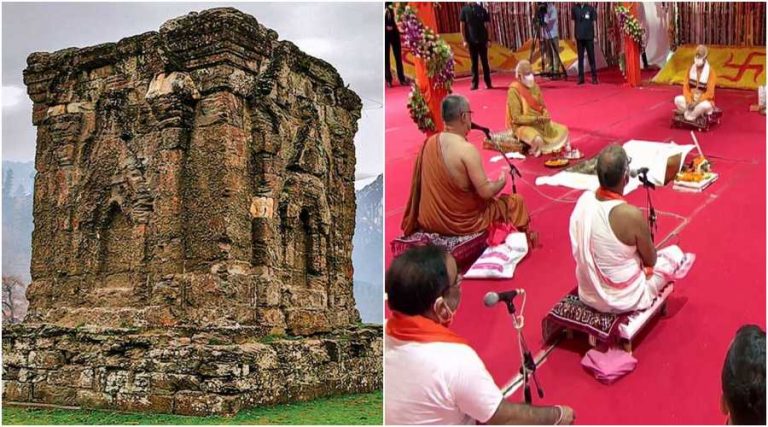
The sacred Sharada Peeth in Pakistan-occupied-Kashmir (PoK) is one of the many shrines whose soil has been used for the Bhoomi Pujan of the Ram Mandir in Ayodhya Wednesday, August 5.
Yesterday was a very emotional day for all Hindus when a centuries-old dream finally came true. Prime Minister Narendra Modi finally performed the Bhoomi Pujan ceremony at Ayodhya. While addressing the luminaries, after performing the historic Bhoomi Pujan, PM Modi had said that the pious task of the construction of Ram Mandir has been strengthened by the soil of various holy shrines and sites from across the country and the water from various holy rivers.
Holy soil from various religious places and waters from 151 rivers were offered in the small pit that had been dug for the ‘Bhoomi Pujan’. One such shrine whose soil is now a part of the foundation of the Ram Mandir is that of the Sharada Peeth. This ancient shrine is situated in Pakistan occupied Kashmir (PoK), the area which was illegally occupied by Pakistan in 1947. It is one of the three most sacred sites for Kashmiri Pandits situated on the banks of the Neelum River.
The soil of Sharada Peeth, whose ruins lie in the PoK, was sent by the Save Sharada Committee through the Vishwa Hindu Parishad (VHP) for the Bhoomi Pujan ten days ago.
It is a very big thing, especially for Kashmiri Pandits: Save Sharada Committee Convenor, Ravinder Pandita
Save Sharada Committee Convenor Ravinder Pandita had handed over the pot with the sacred soil and flowers from the shrine to the VHP on 25 July. Expressing immense pleasure over the auspicious occasion, Pandita said: “The fact that Sharada Peeth’s sacred soil could be a part of Ayodhya’s Ram Mandir’s Bhoomi Pujan gives immense pleasure to all the Kashmiri Pandits. “It is a very big thing, especially for Kashmiri Pandits. We are extremely happy today”, said Pandita, who hails from Kashmir and has been living in New Delhi, fighting for the Sharada cause for decades now.
Holy soil from Sharada Temple in Neelum Valley, Pakistan Occupied Kashmir (PoK) has reached #Ayodhya on the historic occasion of Bhoomi Poojan today. Video from Save Sharada Committee’s Ravinder Pandita. On a day when Imran Khan is helplessly roaming around in Muzaffarabad. pic.twitter.com/d1ZuflbDOX
Speaking to the media the Sharada Peeth convenor said: “Just like the Ayodhya issue, the shakti sthalof Sharada Peeth too is a very old issue and so if the former could get solved, this should also be solved,” says Pandita, hoping that access to the shrine would someday soon be possible.
“If I could visit Kartarpur which I did last year, I should also be able to go visit the Sharada Peeth,” he says reiterating his long pending dream.
Meanwhile, Manjunath Sharma, a resident of Karnataka and an active member of the Seva Sharada Peeth, who had arrived in Ayodhya with the soil said that he was there on the instructions of Chief Ravindra Pandit of Sharda Peeth.
Sharma said: “Actually Indian citizens are not allowed in PoK. So a member Bharatvanshi Venkatesh Raman and his wife, originally from Karnataka and living in China, were sent to PoK by passport from China. The couple arrived in Muzaffarabad, the capital of Pakistan-occupied Kashmir (PoK), from Hong Kong. After reaching PoK, he came to Delhi via Hong Kong with offerings and holy soil from Sharda Peeth. Here he handed over this soil to me.”
“Along with this, I also brought holy water from the Anjana mountain of Karnataka, which is considered to be the birthplace of Hanuman, a devotee of Ram.”
The Sharada Peeth in PoK is one of the 18 Shakti Peethas
The Sharada Peeth is about 207 kilometres north of Muzaffarabad in PoK. The last time any Indian could take a yatra to the shrine was in 1948. Swami Nand Lal, a Kashmiri sadhu, who initially had his ashram at Sharada town, had last visited it. He had to move his ashram from Sharada to Tikker village after the partition.
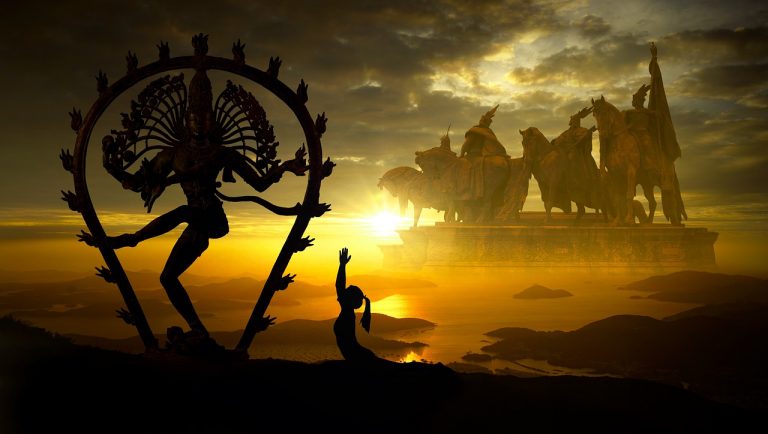
This shrine is significantly important for Hindus because it is said to be one among the 18 Maha Shakti Peethas. It is believed that the Sharada shrine is where Sati Devi’s right hand fell when Lord Vishnu used his Sudarshan chakra to stop Lord Shiva from performing the Tandava Nritya. Lord Shiva was carrying the body of Sati Devi while he was dancing. Sati Devi’s body was cut into various pieces when Lord Vishnu used his Sudarshan Chakra on Lord Shiva and the places where her body parts fell in India and Srilanka went on to be called the Shaktipeethas. There are 18 such places and they are called Ashta (8) Dasa (10) Shaktipeethas and Sharad Peeth is one of them.
The Congress party’s stand on the issue of Ram Mandir Bhoomi Pujan seems to have not gone well within the Kerala unit of the party as senior Congress leader and Lok Sabha MP from Thrissur TN Prathapan has raised objection over party’s endorsement for the construction of Ram Mandir at Ayodhya.
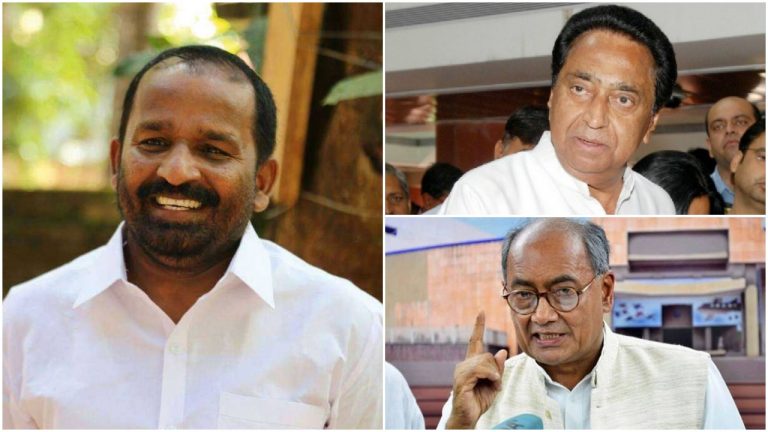
According to the reports, Lok Sabha member from Thrissur TN Prathapan has written a letter to party president Sonia Gandhi to lodge his protest against Madhya Pradesh leaders – Kamal Nath and Digvijay Singh for their statements supporting the construction of Ram Mandir ahead of the historic event at Ayodhya.
The Congress Lok Sabha MP from Thrissur said support offered by the senior Congress leader for the construction of the temple was akin to ‘bowing low for the temporary successes’.
In his letter, Prathapan warned against Congress party’s soft Hindutva approach and said that the Congress must not exclude a ‘sizeable demographic people who grieve the demolition of Babri Masjid, which was like an attack on their own conscience’.
“We can’t chase an extreme religious nationalism with its soft prototype. We need to realise this situation and should accept an alternative, immediately,” the Congress MP said.
Thrissur MP writes letter in response to Kamal Nath, Digvijaya Singh’s statements on Ram Mandir
The angry letter from Kerala MP came after both senior leaders of the Congress party from Madhya Pradesh – Kamal Nath and Digvijaya Singh had welcomed the construction of Ram temple in Ayodhya, claiming that it was former Prime Minister Rajiv Gandhi who had initiated it by opening the doors of Ram Janmabhoomi in 1985.
Taking it to the social media websites such as Facebook and Twitter, Kamal Nath had posted a video message wherein he was seen welcoming the construction of the Ram Temple in Ayodhya. Kamal Nath had also held a recitation of Hanuman Chalisa at his Bhopal residence and had announced that the State Congress unit would send 11 silver bricks to Ayodhya for the Ram Mandir Bhoomi Pujan.
Ahead of the Bhoomi Pujan event, senior Congress leader and former Madhya Pradesh CM Digvijaya Singh too had claimed that the foundation stone of the Lord Ram’s Temple in Ayodhya had already been laid by former Prime Minister Rajiv Gandhi.
Responding to the pro-Hindu statements made by the two senior leaders, Kerala Congress leader TN Prathapan countered by saying, “I think that this particular event is a Sangh Parivar sponsored ‘Religious Political’ one. If we are not invited to this, why would our leaders beg for that?”
Prathapan defends Priyanka Gandhi
Prathapan, stating that the statements of two senior leaders were disappointing, also attempted to do a balancing act as he defended Priyanka Gandhi’s statements on Ram Mandir event. The Congress MP said that Priyanka Gandhi’s position was about wishing unity in the form of Ram Temple and it was acceptable.
“We certainly know that such unity wouldn’t be there as far as Sangh Parivar has power. Ultimately, what matters is not the failures we face but not bowing low for the temporary successes”, he added.
On Tuesday, Priyanka Gandhi had said that she hoped the foundation stone laying ceremony “becomes a celebration of national unity, brotherhood and cultural harmony”. For ages Lord Ram’s character has served as a source of unity for the entire Indian subcontinent, she had said.
Not surprised by Priyanka Gandhi’s comment on Ram Mandir: Kerala CM Pinarayi Vijayan
The Kerala Chief Minister Pinarayi Vijayan too attacked the Congress party over its endorsement for the construction of Ram Mandir. On Wednesday Kerala CM Pinarayi Vijayan said he was not surprised by Priyanka Gandhi Vadra’s statement on the Bhoomi Pujan’ ceremony of the Ram temple.
Targeting the Congress party over its ‘soft-Hindutva’ push, the Chief Minister added that the country would not have been facing such a situation today if Congress had a “definite stand” on secularism.
He said the Congress party’s stand in the Ramjanmabhoomi-Babri Masjid issue is part of history and that the party had remained a “mute spectator” while the mosque was destroyed.
“I am not surprised by Priyanka Gandhi’s stand in this matter. The Congress party’s stand during the period of Rajiv Gandhi and then Narasimha Rao are all part of history. If the Congress had a definite stand on secularism, the country would not have been facing such a situation today,” said the Kerala Chief Minister.