Home Blog Page 5227

TMC leader publicly shamed by locals in South 24 Paraganas for siphoning off compensation meant for Cyclone Amphan victims

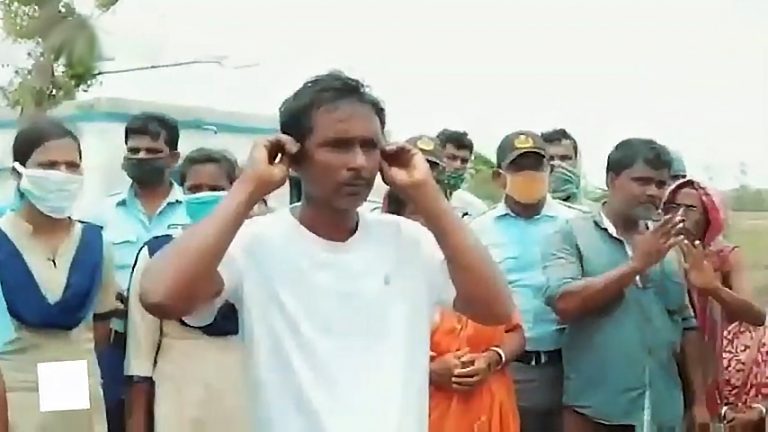
On Tuesday, Swapan Kumar Ghatu, a Trinamool Congress (TMC) leader and a panchayat member in West Bengal, was gheraoed by the residents of Kailashpur village and held hostage at a local school playground for illegally receiving compensation amount, originally meant for the victims of Cyclone Amphan. Swapan is reportedly a member of the Nandakumarpur gram panchayat in Mathurapur Block II of South 24 Parganas, West Bengal.

The locals had alleged that the TMC politician had siphoned off relief funds by listing his family members as the beneficiaries. His bike was also vandalised by the angry residents of Kailashpur village. On receiving information about the incident, police and the Block Development Officer (BDO) rushed to the scene.

“Hold your ears”, ordered a villager. With his hands over his ears, Swapan confessed to fraudulently receiving the money and promised to return it back to the concerned authorities soon. The BDO pacified the agitated villagers that the compensation amount will be recovered from everyone who had illegally obtained the funds, meant for those victimised by the natural disaster. Following that, the TMC leader was escorted from the mob.

Later talking to media , Swapan Kumar Ghatu conceded that there anomalies in compensation distribution. He said that there were some mistakes in preparing the list of beneficiaries, and he apologised for the same.

As per the report, TMC has assured to take action against Swapan after the investigation is concluded in the said case. The Opposition party in the State, BJP, has demanded an impartial inquiry into the matter. BJP has stated that the case was not an isolated one but just one amongst a plethora of other cases involving misappropriation of funds. On the other hand, the residents of Kailashpur village are hoping that the investigation is conducted quickly and they get their assured compensation amount in a short time.

TMC Gram Pradhan suspended

Recently, Narendranath Singh who served as a five-time pradhan of Chanditala II block in Hoogly was reportedly expelled from the Trinamool Congress on charges of corruption in the distribution of relief funds. As per a Telegraph report, Singh had submitted a list of 166 people who were to receive the assured sum of ₹20,000 for damage to houses by the cyclone. However, the Pradhan had listed his phone number against 119 names, besides including his wife as one of the beneficiaries. In his defence, Singh said that the reason behind putting his phone number against the names of beneficiaries was that they did not have mobile phones.

Affluent people received government compensation

Earlier, it was reported that the owners of intact one-story and multi-story concrete houses in Madanpur II Gram Panchayat of Kalyani block in Nadia had received money by falsely claiming that they were the victims of Cyclone Amphan. It was found that 20 houses in the 28 did not suffer even the slightest damage, as they are pucca houses.

Local resident Narayan Haldar had lodged an official complaint with the Block Development Officer (BDO) Deep Chatterjee and the sub-divisional magistrate regarding this issue. “I was shocked to see the list of beneficiaries. They are highly accomplished people. All of them have pucca houses. It is a serious case of corruption,” Haldar was quoted as saying in media reports. Shockingly, TMC leader and Local panchayat member Somnath Adhikari, who too had received compensation for his undamaged house, had justified the same by saying that “whoever gets the opportunity will take government’s money. There is nothing poor or rich about it.”

Several other people had justified getting compensation despite suffering no loss due to the cyclone, and the complainant had accused that all of them are close to the ruling party.

Supreme Court stays FIRs against OpIndia editors and CEO filed by West Bengal govt seeking removal of reports, issues notice to state govt

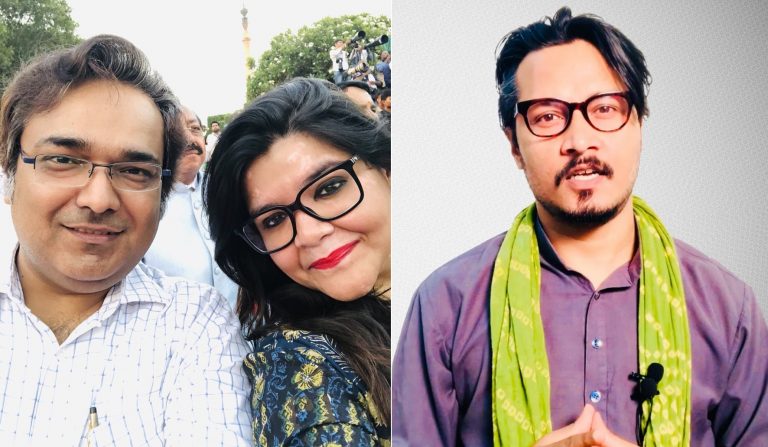
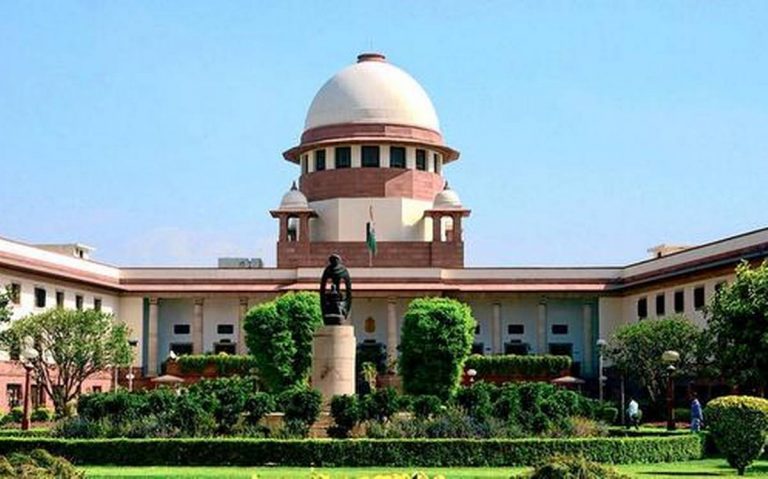
The Supreme Court of India today stayed three FIRs filed by the West Bengal government against four persons, three of them associated with OpIndia, for articles published on the portal. The apex court ordered to stay the FIRs against OpIndia English editor Nupur J. Sharma, OpIndia Hindi editor Ajeet Bharti, CEO Rahul Roushan, and Vaibhav Sharma, husband of Nupur but not associated with the portal. A vacation bench of Justices Sanjay Kishan Kaul and BR Gavai issued the order while taking up the matter via video conferencing on Friday.

Apart from staying the FIRs, the bench also issued a notice to the West Bengal government. The FIRs were filed in relation to three different news articles related to West Bengal on the portal. These reports were published by other media outlets also, and some of the OpIndia reports were actually based on other media reports, but the Mamata Banerjee govt had chosen to target only OpIndia for the reports.

It the petition filed with the apex court, the four petitioners said that the West Bengal govt is taking extortionist and malafide actions to impose illegal censorship in the state by threatening, scuttling, and gagging honest media houses through misuse of state police. “The Government of West Bengal and its authoritarian Kolkata Police is misusing FIRs and brute police-powers not only to intimidate journalists, but also, to intimidate, threaten, and embarrass the family members of such journalists including senior citizens of the family so as to seek deletion of media reports which bring to the public’s notice the actual state of affairs in the State of West Bengal during these difficult times”, the petition had said.

The petition had said that police were using FIRs to scuttle free speech and issuing notices under section 41A of the CrPC to personally intimidate and harass the petitioners. Moreover, despite repeated requests, the police also refused to share the copy of the FIRs with the Petitioners filed against them and didn’t upload the same on their official website, which is a violation of rules and Supreme Court orders.

The first case was filed in relation to a Hindi article published on OpIndia Hindi on 14th May, which had reported an exchange of words between BJP leader and union minister Debasree Chaudhuri and TMC leaders. The BJP MP from Raiganj had alleged that Mamata Banerjee is planning to convert West Bengal into an Islamic state and merge it with Bangladesh. It was a report on comments by her, and reactions to the same by TMC leaders, which was also reported by several media organisations. But the Bengal government decided to file FIR against OpIndia English editor and her husband, who are residents of Kolkata, and Vaibhav was summoned to the police station on 16th May.

It may be noted that Vaibhav is not related to OpIndia, but one phone number used by Nupur is registered in his name, and only because of that phone number, he was interrogated by police. During the interrogation on May 16, the police had threatened that if the report is not deleted, they will be arrested. Police had even talked to Nupur Sharma’s 68-year old father and issued the same threat. When a copy of the FIR was requested, the police had refused the same.

On the same day, Bengal police issued another notice to Nupur Sharma and her husband to appear at a different police station on 17 May, in relation to another report published on OpIndia English. That report was a curation of a Sunday Guardian report, which had claimed that West Bengal government was secretly disposing of bodies pf deceased Coronavirus patients, and was hiding data of Coronavirus deaths.

Subsequently, Rahul Roushan and Ajeet Bharti were also issued notices by West Bengal police to appear for interrogation in Kolkata, but as the lockdown was imposed full-fledged at that time and they are residents of states outside Bengal, they had expressed inability to travel to Kolkata, and requested to be questioned by video conferencing instead. The police is yet to respond to their requests, and also didn’t provide copies of the FIRs as requested by them.

Then on 8th of this month, another case was filed against the portal, this time for an old report on Azaan being played Durga Puja pandal in Kolkata. This report was published on 7th October last year, and it was also reported by several national and local media houses. Moreover, a video of the same had gone viral on social media. Again, a copy of the FIR was not given to the OpIndia editors.

After the repeated threats by police to get reports deleted, the four persons targeted by the West Bengal government decided to move Supreme Court relief, and accordingly, a petition was filed on 12th June through advocate Ravi Sharma seeking to quash the FIRs. The petition stated that as the content was published only on Internet, actions against them can be taken only by the union government under section 69A of the Information Technology Act, and the state government has no jurisdiction over them. The petitioners also pointed out that police do not have powers under the law to demand the removal of content from the internet.

Hearing the arguments from both the sides through video conferencing today, the Supreme Court bench ordered that further proceedings in pursuance to the FIRs have been stayed. The petitioners were represented by senior advocate Mahesh Jethmalani and advocates Sandeep Kapur, Siya Chaudhary, Madhulika Rai. The apex court also ordered to issue a notice to the West Bengal government on the matter. The next hearing in the case is likely to be listed on 14th August.

Office of UN High Commissioner for Human Rights wants 11 ‘activists’ released, arrested for Delhi anti-Hindu riots: Here is what they have been charged with, anti-h

Despite the MEA spokesperson Raveesh Kumar, reiterating to the United Nations’ Office of the United Nations High Commissioner for Human Rights (OHCHR) that CAA is an internal affair of India and that no foreign party has any locus standi on issues related to India’s sovereignty, the UN body has yet again intervened, raising objections at the judicial action initiated against the anti-CAA protestors and rioters by the central government.

Calling the anti-CAA hoodlums, who were instrumental in instigating the mob to unleash a spree of violence across the whole country, “human rights defenders”, the OHCHR urges India to release them immediately.

“These defenders, many of them students, appear to have been arrested simply because they exercised their right to denounce and protest against the CAA (Citizenship Amendment Act), and their arrest seems clearly designed to send a chilling message to India’s vibrant civil society that criticism of government policies will not be tolerated,” the UN body experts said.

“Authorities should immediately release all human rights defenders who are currently being held in pre-trial detention without sufficient evidence, often simply on the basis of speeches they made criticising the discriminatory nature of the CAA,” they said.

OHCHR lists names of 11 anti-CAA protestors whom it wants India to release

Calling the arrest of Safoora Zargar “one of the most alarming cases”, the United Nation’ OHCHR mentioned the name of 11 such anti-CAA hoodlums, whom it wanted India to release. The names being, Meeran Haider, Gulfisha Fatima, Safoora Zargar, Asif Iqbal Tanha, Devangana Kalita, Natasha Narwal, Khalid Saifi, Shifa Ur Rehman, Dr Kafeel Khan, Sharjeel Imam, Akhil Gogoi.

It is pertinent to note here, that all the names which found a mention by the UN’s OHCHR were arrested in connection with the violent demonstrations that rocked several parts of the country, especially the national capital and eventually culminated into full-blown communal riots in the northeast Delhi.

Safoora Zargar

While the United Nations’ OHCHR, which tries to vilify the government for allowing the incarceration of a pregnant woman, chooses to turn a blind eye towards her culpability, it becomes imperative to note that the Jamia student, Safoora Zargar, who was recently granted bail on humanitarian grounds, was accused of inciting mob on Jafrabad Metro Station in Delhi that led to Delhi riots in February 2020. She had been booked under the Unlawful Activities Prevention Act (UAPA).

Her previous bail pleas were rejected by the Delhi Hingh Court noting that the “gravity of offence” against arrested Jamia coordination committee media coordinator Safoora Zargar was serious.

Her arrest has led to a barrage of propaganda accusing the Delhi Police of ‘anti-Muslim’ bias. The Delhi Police had recently slammed far-left propagandists at The Wire for making such dubious allegations.

Meeran Haider

On April 2, the Delhi police arrested a student leader of the Jamia Millia University for instigating violence during the anti-Hindu Delhi riots.

According to the reports, Meeran Haider, a 35-year-old a PhD student from Jamia Millia Islamia University, was arrested in connection with rioting and criminal conspiracy pertaining to anti-Hindu riots in north-east Delhi that have claimed the lives of 53 people and left over 400 injured.

Meeran Haider is also the president of the Rashtriya Janata Dal youth wing’s Delhi unit. Meeran Haider is also a member of Jamia Coordination Committee (JCC).

Reports said that Haider and his few associates had mobilised around 60 people to instigate riots in the national capital. He was also allegedly present in the Chand Bagh area during the riots. The accused had also run Whatsapp groups to incite riots in Delhi.

Gulfisha Fatima

Gulfisha Fatima is one of the Pinjra Tod protesters who was arrested for her patently anti-national and seditious activities which led to the communal violence during protests against the Citizenship Amendment Act in northeast Delhi in February. A Delhi court had last month granted bail to Gulfisha Fatima.

Asif Iqbal Tanha

Arrested on May 17 in the Delhi riots case, the Special Cell of Delhi Police has booked the Jamia Millia Islamia student Asif Iqbal Tanha under the Unlawful Activities (Prevention) Act for purportedly being a part of a larger conspiracy behind the February riots in northeast Delhi.

The development comes days after the Delhi Police’s crime branch arrested the SIO member and Jamia student in connection with the violence that erupted in the national capital during the anti-CAA protests in December last year. He is a resident of Shaheen Bagh.

The police argued in the court that Tanha’s custody was required to uncover the larger conspiracy and to confront him with the electronic data collected during the investigation.

Tanha, a member of the Students Islamic Organisation and a part of Jamia Coordination Committee which led the protests against the Citizenship Amendment Act.

Devangana Kalita

On June 6, the Delhi police investigating the north-east Delhi riots case, booked the second Pinjra Tod activist, Devangana Kalita, under stringent Unlawful Activities Prevention Act (UAPA). She was arrested on May 23 on the allegations of inciting violence.

The JNU student and far-left group Pinjra Tod activist has been booked under the anti-terror charges for allegedly conspiring to incite riots in the parts of Delhi and involving in Unlawful activities.

She was arrested on May 23 by the special cell of Delhi police. The court permitted police to interrogate her and if required arrest her formally on June 3. Devangana has been booked under several sections related to sedition, an attempt to murder, murder, criminal conspiracy, promoting enmity between different groups on grounds of religion, race, place of birth, etc as per a lawyer. This was the fourth case for which Devangana was booked for within a few weeks. The two other cases relate to North-east Delhi riots while one of them is related to the violence that burst out in early December last year.

Natasha Narwal

Before Devangana Kalita, the Delhi Police booked ultra-left activist Natasha Narwal of the controversial group ‘Pinjra Tod’ under the stringent Unlawful Activities Prevention Act (UAPA) for her role in inciting the anti-Hindu communal riots in Northeast Delhi in February. She was the 7th person to be booked under UAPA in the case. 

Khalid Saifi

On June 9, the Crime Branch of Delhi Police had arrested Khalid Saifi, allegedly one of the key conspirators of the violence that took place in the Chand Bagh area during the Delhi anti-Hindu riots in February this year.

Saifi is named as an accused in the third charge-sheet filed by Delhi Police in connection with the Delhi violence case. He is also said to have attended the January 8 meeting at Shaheen Bagh, where Muslims were holding an anti-CAA protest for almost a month.

Moreover, Khalid Saifi is known to be the person who had facilitated the meeting between JNU’s ‘Tukde Tukde’ gang activist Umar Khalid and IB officer Ankit Sharma’s murder accused, the AAP suspended councillor, Tahir Hussain.

As per the Times Now report, Saifi has been named as one of the ‘facilitators’ of the riots. The charge sheet also reportedly mentions that Saifi ran the ‘Shaheen Bagh control room’ to incite, organise and facilitate the Delhi anti-Hindu riots.

Soon after Saifi’s was arrested, pictures of him smiling and posing with Delhi CM Arvind, Kejriwal, Deputy CM Manish Sisodia, journalists Ravish Kumar, Rajdeep Sardesai, Arfa Khanum, Abhisar Sharma and RJ Syema had emerged.

Shifa Ur Rehman

In April, Special Cell of the Delhi Police has arrested one Shifa-Ur-Rehman, the president of the Jamia Alumni Association (JMA), for involvement in the Delhi Anti-Hindu riots under the Unlawful Activities (Prevention) Act (UAPA). 

Delhi Police have stated that Shifa was caught on CCTV footage in riot-hit areas of North East Delhi. Technical evidence such as call records and Whatsapp messages have suggested his role in inciting mobs during the Delhi Anti-Hindu riots. Delhi police, while deamding his custody, said that witnesses had revealed that Shifa Ur Rehman received funds from alumni association of JMI based in Middle Eastern countries and he was coordinating at the protest sites. 

Dr Kafeel Khan

The Uttar Pradesh police have slapped the National Security Act (NSA) against that controversial Gorakhpur ‘doctor’ Kafeel Khan for making provocative comments during his speech on the Citizenship Amendment Act (CAA) at Aligarh Muslim University (AMU) on December 12, 2019.

Controversial ‘doctor’ Kafeel Khan arrested in Mumbai on January 30 for making a provocative speech in the Aligarh Muslim University campus on December 12th, 2019, inciting people against the CAA.

An FIR was filed against Kafeel for attempting to vitiate the peaceful atmosphere and disturb communal harmony. The FIR was registered under section 153-A (Promoting enmity between different groups on ground of religion) of IPC on the 13th of December.

It is pertinent to note here that Kafeel Khan is one of the accused in the BRD Medical College and Hospital children’s death case in Gorakhpur. He had taken to social media to spread false news that he had been given a ‘clean chit’ in the 2017 case in a departmental inquiry. The Uttar Pradesh government had in October initiated a fresh inquiry against him for spreading misinformation in the media and forcibly entering a hospital and trying to treat patients during his suspension period.

Sharjeel Imam

The rabid Islamist Sharjeel Imam was arrested by the Police from Bihar’s Jehanabad. Sedition charges were filed against him in multiple states for his remarks urging Muslims to cut off North East India from the rest of the country by blocking the Chicken’s neck. The arrest was made by the Delhi Police Crime Branch after he was absconding for four days. A manhunt was launched after the video of his seditious speech went viral on social media.

Several states like Uttar Pradesh, Manipur, Assam, Arunachal Pradesh had filed FIRs against him under charges of sedition and other offences for his secessionist statements.

A series of videos had gone viral on social media in which Sharjeel Imam, the chief co-ordinator of Shaheen Bagh protest and a The Wire columnist was seen instigating Muslims of the country to break India by cutting of North-east from the rest of the country. While speaking to Muslim mobs, he said, “Our aim is to cut Assam and North-east India from rest of India”.

Akhil Gogoi

The Krishak Mukti Sangram Samiti leader Akhil Gogoi while addressing a rally at Panitola in Assam’s Tinsukia district had issued a secessionist statement over the Citizenship Amendment Bill. Gogoi had said that if Assamese sentiments are not respected than the state will have to secede from the Union Of India.

Akil Gogoi was already slapped with a sedition case on January 7, after he organised a rally and issued secessionist remarks at Guwahati on January 7, along with Sahitya Akademi winning litterateur Hiren Gohain and senior journalist Manjit Mahanta. The three were booked under sections of 120 (B), 121, 123 and 124 (A).

United Nations High Commissioner for Human Rights (OHCHR) slammed by India

Meanwhile, this is not the first time the United Nations’ OHCHR has interfered in India internal matter. In March it had filed an intervention application in the Supreme Court of India against the implementation of the Citizenship Amendment Act (CAA). The contentious move by the UN’s OHCHR implied that it wanted to be made a party in the existing petitions against the CAA. The message was conveyed to India’s Permanent Mission in Geneva, Switzerland.

India had then slammed the Office of the United Nations High Commissioner for Human Rights (OHCHR) for interfering in its internal affair.


Petition filed in Supreme Court challenging the arbitrary ban in Kerala on animal sacrifice in temples

A plea was filed in the apex court on Thursday challenging a Kerala law that prohibits animal sacrifice for appeasement of deities in temples and temple precincts.

The appeal was filed in the top court after the Kerala High Court summarily rejected the petition against the Kerala Animals and Birds Sacrifices Prohibition Act of 1968 on June 16. The Act bans sacrifice of animal and birds in temples for the propitiation of deity and turns it into criminal activity. The transgression of the law attracts a jail term of up to 3 months and a fine of Rs 300.

The petitioners, who are followers of Shakti worshipping tradition, argued that propitiating deities through animal sacrifice is an essential religious practice backed by religious texts and scriptures followed by them and should, therefore, be allowed.

The petition claimed that the Kerala Animals and Birds Sacrifices Prohibition Act of 1968 criminalises the intent behind the animal sacrifice and not the act itself. “The Act criminalises the intent behind the animal sacrifice and not animal sacrifice per se. If the sacrifice is not for propitiating any deity but for personal consumption, even in the precincts of the temple, it is not forbidden. This arbitrary classification is violative of Article 14 of the Constitution,” the plea said.

The appellants claimed that the Act violates the right to equality, citing similar activities by other religions that are not prohibited by the Act. They claimed that the imposition of the arbitrary law was leading to an “incomplete performance of bali (sacrifice) and diminishing the powers of kul devatha”.

“They reasonably apprehend the wrath of Devi,” the plea contended.

The petitioners also alleged that the impugned Act violates the Central legislation that grants an exemption for the killing of the animals for religious purposes. The petition mentions Section 28 of the Prevention of Cruelty to Animals, 1960, which does not render killing of animals for religious purposes a criminal offence.

Alleging the classification of the law as arbitrary, the petition said, “If the object of the law were to ensure preservation and protection of animals, it would demand its uniform application across all religious communities.”

“Kerala Animals and Birds Sacrifices Prohibition Act, 1968 is repugnant to the provisions of the Prevention of Cruelty to Animals Act, 1960 insofar as the Act operates in the same entry and criminalises an act which the Union Legislation chooses explicitly not to criminalise”, the appeal added.

Newslaundry’s Sharjeel Usmani glorifies Islamist Shahrukh Pathan, who fired at police officials during anti-Hindu riots in Delhi

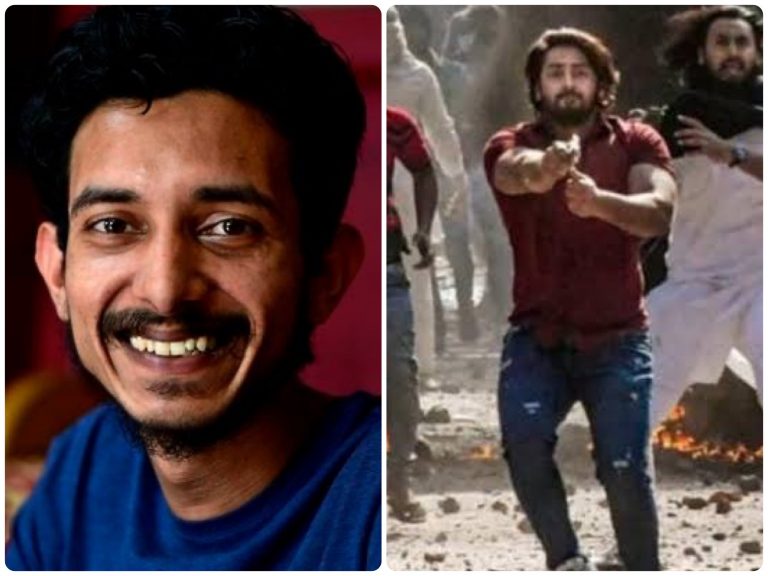
After publicly subscribing to the secessionist ideology of Sharjeel Imam, who had urged Muslims to cut off North-East India from the rest of the country by blocking the Chicken’s Neck, Newslaundry columnist Sharjeel Usmani today glorified Islamist Shahrukh Pathan, accused of opening fire on Delhi police during the anti-Hindu riots that had broken out in the national capital in the last week of February this year.

Sharing an article which said that the accused Shahrukh Pathan, who intended to be a hero by taking up arms during the anti-CAA riots in Delhi will have to face the law, Usmani lavished praises on the accused rioters, saying that he is proud of Shahrukh, who ‘fought for his community’ (Muslims) when the entire state machinery and ‘Hindutva army’ was apparently ‘killing and looting’ them.

“I am proud of Shahrukh Bhai. he fought for the community when the entire state machinery and Hindutva army was involved in killing and looting our community. He is our hero!” tweeted Sharjeel Usmani.

The tweet was posted by Usmani after the Delhi High Court on Wednesday refused to grant relief to the accused—Shahrukh Pathan—and observed that while Pathan’s intentions were to become to hero but he will now have to face the consequences of taking up arms against the Delhi police. Justice Suresh Kumar Kait said he was not disposed to grant relief to Shahrukh Pathan, after which his counsel withdrew the plea.

Delhi High Court refused Pathan’s pleas for bail

The court dismissed the plea as withdrawn. The advocate representing Shahrukh had sought bail for his client on the grounds that he had to take care of his ailing 76-year-old father who is not well and has no one to look after him. Justice Kait then said, “While committing offence, you forget everyone. Now you are thinking about your aged and ailing parents.”

However, denial of reprieve from the Delhi High Court did not sit well with the Newslaundry columnist Sharjeel Usmani, who not only shares his first name with the secessionist Sharjeel Imam but also subscribes to his radical ideology. Notwithstanding court verdict in the case, Usmani took to Twitter to rationalise Shahrukh Pathan’s unlawful acts by claiming that he stood up against the imaginary “state machinery and Hindutva army” that were involved in killing and looting his community.

In sharing his radical ideas and praising a criminal, Usmani perhaps forgot that the CCTV had captured Pathan’s criminal act when he was firing multiple rounds on a Delhi police official Deepak Dahiya while Dahiya was armed only with a baton, and stood unflinching as Pathan kept on firing his illegal weapon.

Sharjeel Usmani’s propaganda war to tarnish India’s reputation abroad

Earlier too, Usmani had no qualms in associating himself with those accused of making provocative and seditious speeches under the pretext of carrying out peaceful protests against the CAA. The ideological compatriot of Sharjeel Imam, Sharjeel Usmani, has announced his intentions of using Muslims as the fifth columns in the country to undermine Indian interests. Shortly after Imam’s arrest, Usmani waged a propaganda war on the country to smear its India’s image abroad. Sharjeel Usmani announced that he, along with two of his friends, will put English subtitles on the videos of ‘hate crimes’ against Muslims in India to circulate them among social media influencers for wider global reach.

After the incendiary speeches of Sharjeel Imam had gone viral on social media, Sharjeel Usmani had rushed in to defend him. He had urged Muslims to not disassociate themselves from the JNU scholar and declared that he was ‘in this together’ with the radical Islamist. Sharjeel Imam also played a critical role in organizing the Shaheen Bagh protests and weaponizing blockades in order to make the state bend to Islamist demands was his idea.

Mohammad Shahrukh alias Shahrukh Pathan had opened fire at Delhi Police

Mohammad Shahrukh or Sharukh Pathan was caught on video brandishing gun and firing bullets against the Delhi police personnel who were trying to subdue the violent riots that erupted in the national capital in February 2020. Shahrukh reportedly opened 8 rounds of fire on Delhi Police on February 24, the day US President Donald Trump was visiting India. He was later arrested by the police.

On the day of US President Donald Trump’s visit to India, the national capital had witnessed unprecedented violence. A Delhi police constable had lost his life in the riots that ensued in the national capital in wake of the protests against the Citizenship Amendment Act. Another DCP was grievously injured during clashes in Delhi’s Gokulpuri. An IB official, Ankit Sharma, was brutally murdered and his dead body was thrown in a drain. Another Hindu, Dilbar Negi, was brutalised by the rioters in Delhi as his limbs were chopped and his body was thrown in the fire. Similarly, the anti-Hindu riots in north-east Delhi also saw Hindu temples being attacked and vandalised by a rampaging mob.

US Senate passes bill for Hong Kong’s autonomy, proposes sanctions against China’s efforts to restrict autonomy

The United States Senate on Thursday passed the ‘Hong Kong autonomy act’ unanimously. This act will allow the US government to penalize banks that will be doing business with the Chinese government or Chinese officials trying to restrict Hong Kong’s autonomy by the new National Security Law.

The bill was brought in by the Democrat Chris Van Hollen from Maryland and Republican Pat Toomey of Pennsylvania. As per reports, companion legislation has been introduced in the house with bipartisan support that is required to pass in the house of representatives to reach President Donald Trump’s desk.

Pat Toomey informed, “The mandatory sanctions established in this bill will punish those in China who seek to undermine Hong Kong’s autonomy or erode the basic freedoms promised to Hongkongers.”

The bill will allow sanctions against officials and institutions

As per reports, the Hong Kong Autonomy Act will enable the USA to restrict or ban visas for officials travelling to the USA, restrict them from acquiring property and making financial transactions subject to the jurisdiction of USA. Any banks or financial institutions who knowingly deal with such persons will be held accountable too.

The amended legislation would apply sanctions against financial institutions only if a bank is intentionally involved in a business with an official or entity that has already been sanctioned or contribute to the contravention of China’s obligation.

Trump signed Uighur bill

Last week, The Trump administration in the USA had signed legislation that allows the American Government to hold Chinese officials responsible for China’s persecution of Uighur and other Muslim minority groups. The bill, formally named the “Uighur Human Rights Policy Act of 2020,” was approved by the House and Senate in May.

Legislation asks for the closure of camps in Xinjiang

The Hill reported that the legislation objects to the treatment of Uighur Muslims and other Muslim minorities by the Chinese Communist Party. It calls for closure of such camps in the Xinjiang region of China. The legislation gives the American government the power to identify and sanction individuals responsible for the abuse of minority groups.

China’s National Security law

China recently passed a controversial national security law that significantly restricts the autonomy previously enjoyed by Hong Kong and enables extradition of wrongdoers from Hong Kong to Mainland China. Widespread protests had erupted in the city for much of last year but the coronavirus pandemic changed the scenario. Taking the cover of the coronavirus outbreak, the Chinese Communist Party quickly passed the national security law on the pretext of restoring law and order in the semi-autonomous region. Protesters have claimed this to be in violation of the treaty signed with Britain in 1997 and termed China’s move as autocratic to quell the dissenting voices.

Over 200 J&K youths issued Pakistani visas go missing, intel sources believe Pakistan training youths to carry out terror attacks in India

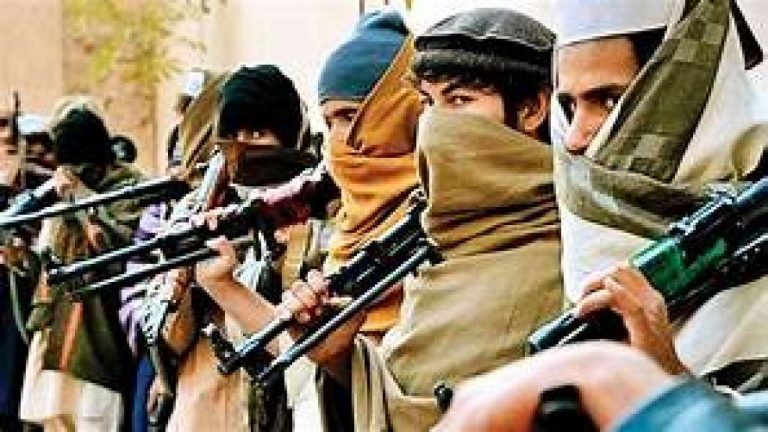
Over 200 Jammu and Kashmir youths who have been given Pakistani visas by the Pakistan High Commission are found to be missing from the valley, which has put the Intelligence agencies on high alert. The authorities fear that these youths have been picked up by Pakistan, which is training them to create unrest in Jammu and Kashmir.

Intelligence sources said: “Pakistan has been targeting the youth from J&K by training, equipping and arming them to carry out terrorist attacks in J&K on the lines of February 2019 Pulwama attack.” 

According to reports, since 2017 the Pakistan High Commission has issued Pakistani visas to 399 youth from jammu and Kashmir, out of which whereabouts of 218 are not known. 

Pakistan High Commission in New Delhi not only runs espionage networks for its military spy agency but also recruits terrorists

Sustained efforts by Pakistan high commission officials in New Delhi to allegedly recruit young men from Jammu and Kashmir for terrorist activities was one of the factors behind India’s decision to reduce its staff presence by half, people familiar with the development said on Thursday.

A source in New Delhi confirmed that the probe by the intelligence agencies indicated that Pakistan was using its High Commission in Delhi not only to run espionage networks for its military spy agency but also recruits terrorists.

India for these reasons and also due to the mistreatment meted out to the Indian diplomats in Pakistan, who were abducted by Pakistani security agencies, asked Pakistan High Commission in Delhi on June 23 to reduce its staff presence by half within 7 days. India would also reduce its own staff in Pakistan by the same proportion.

The Ministry of External Affairs had summoned Pakistan’s Charge d’ Affaires Syed Haider Shah and informed him about India’s concerns regarding the activities of officials of his mission, who have been involved in espionage and associated with terror outfits.

Pak High Commission and its link to terror attacks and terror funding

In the past, India has thwarted many attacks on the Indian soil by terrorists who infiltrated India after receiving their training in Pakistan on the visa issued by the Pakistan High Commission in Delhi. 

NIA which is probing the case of suspended J&K DSP Davinder Singh, who was arrested along with two Hizb-ul-Mujahideen terrorists Naveed Babu and Asif Rather on the 11th of January when they were travelling together in a car, recently revealed that one assistant at Pakistan high commission named Shafaqat was in touch with Singh.

In the month of May, two officials of Pakistan High Commission in New Delhi were caught spying by Delhi Police on May 31. They are accused of roaming around in various places using fake identities.

The two officers, Abid Hussain and Tahir Hussain, reportedly worked in the visa section of the Pakistan High Commission in New Delhi. The Delhi Police Special Cell nabbed the duo red-handed after they were found engaged in espionage activities using fake identities. 

Although they are officially employed in the high commission, they were actually ISI spies sent to India. Both the officers had been declared as persona non grata by the Indian government 

On April 5, three amongst five terrorists who were neutralised by the Indian Army were from Jammu and Kashmir. It was reported that Adil Hussain Mir, Umar Nazir Khan and Sajjad Ahmed Hurrah, the three terrorits who were killed, had travelled to Pakistan in April 2018 on the visa issued by the Pakistan High Commission in New Delhi.

The NIA while investigating the Jammu and Kashmir terror funding case named the First Secretary Press at the Pakistani mission Mudassar Iqbal Cheema. Cheema was at the mission from September 2015 to November 2016. He had given Zahoor Ahmad Shah Watali, the main accused in the case, Rs seventy lacs in two instalments. Watali was the main conduit to send money to Hurriyat leaders from the Pakistani high commission.

Home Ministry calls out Reuters’ misleading report claiming Army has taken over COVID-19 facilities in Delhi, says ‘The news is far away from reality’

The Ministry of Home Affairs has issued a clarification with regards to a factually incorrect article published in the International news organisation Reuters which said that the Indian Army took over the control of COVID-19 facilities in Delhi as the number of caseloads surged uncontrollably. Refuting the allegations levelled in the article, the Spokesman of the Ministry of Home Affairs posted a tweet, saying the news is ‘far away from reality’.

The official Twitter account of the Spokesperson, Ministry of Home Affairs, tweeted that Army has not been called in and only medical personnel of Armed Forces and Central Armed Police Force (CAPF) had been asked to assist at some medical facilities in the national capital.

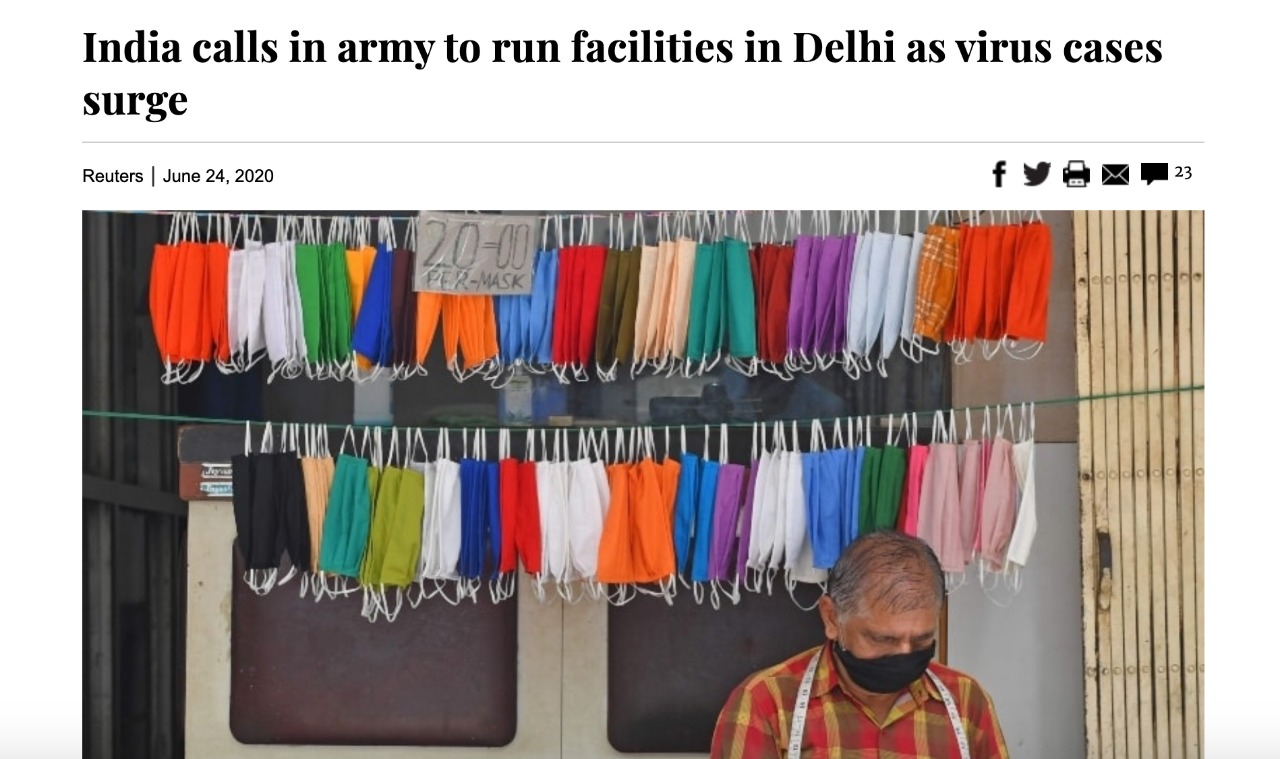
The clarification from the Ministry of Home Affairs came on the heels of an article titled-“India calls in army to run facilities in Delhi as cases surge” published on Reuters asserted that the coronavirus situation in India’s capital New Delhi is so dire that the Armed Forces of the country have been summoned to take control of the COVID-19 facilities in the city.

Source: Reuters

The article published in Reuters contended that the COVID-19 cases in the country are precipitously increasing and that the government had called in army to manage new treatment centres with thousands of additional hospital beds in New Delhi.

The article also quoted Union Home Minister Amit Shah to lend credence to their misguided belief that the Armed Forces will assume the total control of COVID-19 facilities in the national capital. “Armed Forces personnel have been detailed for providing medical care and attention to COVID-19 patients housed in the Railway coaches in Delhi,” the article quoted Home Minister Amit Shah as saying.

Reuters’ unverified claims about Indian Army managing the medical facilities in Delhi was picked up by several Indian and International Media organisations to assert that the Indian capital is so much overwhelmed by the coronavirus caseloads that the control of the medical facilities has been wrenched from the civilian authorities and handed over to the Armed Forces.

Pakistani news daily—Dawn also published the report crediting Reuters that the Indian government has asked the Army to preside over the administration of medical facilities in Delhi.

Source: Dawn

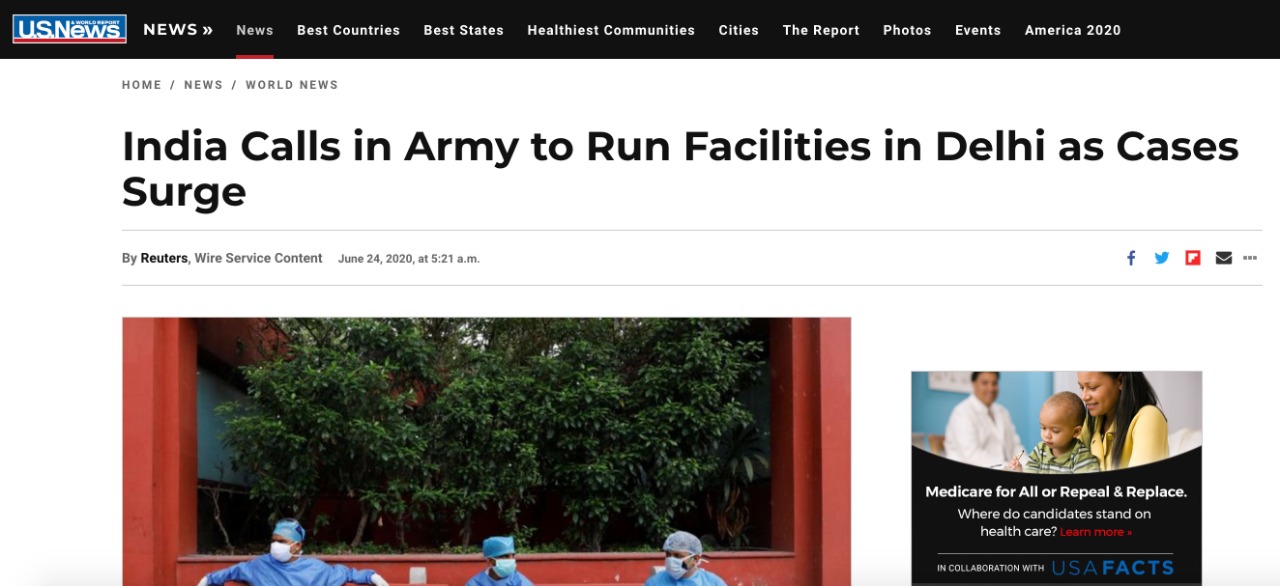
The US News and World Report, another International media organisation which carried the Reuters’ report alleged that the coronavirus situation in Delhi is so grim that Army is being called in to contain the irrepressible rise in the number of coronavirus cases in the national capital.

Source: US News and World Report

Not just International media organisations but Indian organisations also published the report without checking the veracity of the claims made by Reuters. The Essel Group owned India based news organisation— Wion put out a story saying that the Indian Army was called in by the government to run facilities in Delhi as the coronavirus cases saw a spike in the national capital.

Source: The Wion

Coronavirus outbreak in Delhi

The number of COVID-19 cases in India’s capital, New Delhi has risen sharply over the past few weeks as the number of confirmed infections touched the 70,000-mark while 2,365 have reportedly died of the contagion. However, soon after Delhi started reporting a surge in the number of coronavirus cases, Union Home Minister Amit Shah took the driver seat to rollout a synergised strategy to curb the spread of the infection.

Taking charge of the coronavirus situation in Delhi, Shah called an all-party meet and took stock of the situation by visiting the Lok Nayak Jai Prakash Narayan (LNJP) Hospital. The Home Minister took charge of the situation after the Supreme Court pulled up the Delhi government for its abysmal handling of the coronavirus crisis and called the situation in the national capital as scary.

To tackle the increasing surge in the count of coronavirus cases, Amit Shah ordered a makeshift facility at Radha Soami Satsang Beas in south Delhi’s Chhatarpur, which is set to be the biggest Covid-19 temporary hospital in India with over 10,000 beds. The medical facility is set to be operational from today. This temporary facility has been handed over to ITBP for operation, but the other health facilities in the city remain under civilian control.

“Deliberate attempts to cause misunderstanding between Bhutan and Assam”: Bhutan Govt denies claims that it has stopped irrigation water to Assam

Hundreds of farmers in Baksa district along Indo-Bhutan border, Assam, had staged a protest early this week against the Bhutan government’s decision to not allow farmers from the Indian side to channelise water from Bhutan’s side for irrigation.

Thousands of farmers from around 25 villages under Tamulpur sub-division of Baksa district along Indo-Bhutan border are involved in the cultivation of paddy rice by using water from the 100-year-old indigenous irrigation system called dong bandh on the Bhutan side. But this year Bhutan govt didn’t allow the farmers to enter Bhutan to repair the channels, due to which water didn’t reach the farms in Assam.

With demands to resolve the problem, hundreds of farmers of 25 villages in Tamulpur sub-division, on June 22 (Monday) staged protests and blockaded Rongia-Bhutan connecting road for several hours. The farmers demanded the Assam government to take the issue seriously and resolve it soon.

Farmers on Indo-Bhutan border using “Dong” bandh since 1953.

Farmers in Baksa region which is along the Indo-Bhutan border have never seen their harvest getting spoilt by either drought or delayed rainfall, despite having no access to irrigation pipes or water pumps. This is because for the past several decades the farmers in Baksa have been relying on water from the “Dong” bandh system in Okaladonga Barnadi Ashama Aranga. The channels have been used by farmers of Bhutan and India in the region since 1953 to use water from several rivers that originate in Bhutan and flow through the region towards the Brahmaputra.

Several decades ago, farmers in the Indo-Bhutan border, had built small dams on the rivers and routed the water through canals to their paddy fields and household ponds. The Dong bandh irrigation systems of Baksa, which spreads over 300 square kilometres, serve around 149,000 farmers and 94,600 agricultural labourers. This irrigation system is maintained by the Okaladonga Barnadi Ashama Aranga Dong Bandh Committee, which makes sure that the water keeps flowing to the farms. As the bunds are earthen structures, they require regular maintenance, and the channels also get blocked every year due to silt. Assamese farmers every year go across to the Bhutan side and clear the channels and repair the bunds to divert water from rivers in Bhutan into channels that irrigate farms in Assam.

However, as the farmers were not allowed to enter Bhutan this year, the channels could not be cleared and the fields in the area didn’t get water, which had created massive resentment in the entire district.

The news of protest by farmers was used by many to claim that after China and Nepal, now India’s relation with Bhutan has also deteriorated. But now both the Bhutan and Assam govt has issued statements clarifying that Bhutan has not taken any hostile step against Indian farmers, and the problems were created by Coronavirus and natural factors.

Bhutan govt call media reports a “deliberate attempt” to cause misunderstanding between India and Bhutan

After the outrage, the Bhutan government has now issued clarifications. It has rejected claims of stopping irrigation water supply to Assam. The Bhutan Foreign Ministry has said that the charges “are totally baseless” and that these are “deliberate attempts” to cause misunderstanding between the people of Bhutan and Assam.

It clarified that due to the coronavirus restrictions, the farmers from Assam were unable to enter Bhutan to maintain the irrigation system, which otherwise is a usual practice and this has led to the problem in the water supply.

Issuing a clarification on its Facebook page, the Bhutan Foreign Ministry has said: “It is a distressing allegation and the Ministry of Foreign Affairs would like to clarify that the news articles are totally baseless as there is no reason why the flow of water should be stopped at this time. It is a deliberate attempt by vested interests to spread misinformation and cause misunderstanding between the friendly people of Bhutan and Assam.”

Read- Fact-Check: Bhutan is not going to charge mandatory fee of $250 per head per day from tourists from India, Bangladesh and Maldives

“Baksa and Udalguri Districts in Assam have been benefitting from the water sources in Bhutan for many decades and they continue to do so even during the present difficult times when we are faced with the COVID-19 pandemic,” added the Bhutan government.

“However, understanding the difficulty that would be faced by the farmers in Assam, the Samdrup Jongkhar District Officials and the general public have taken the initiative to repair the irrigation channels whenever there are problems to ensure the smooth flow of water to Assam,” said the Bhutan government statement.

Assam chief secretary, Kumar Sanjay Krishna states that the actual reason is “natural blockage”

Earlier in the day, the Assam chief secretary, Kumar Sanjay Krishna had also given similar clarification while speaking to ANI: “Irrigation water comes to Assam from hills of Bhutan, but there were boulders on the way which stopped the flow. We talked to Bhutan and they immediately cleared the path. There’s no dispute and to say that they stopped the water to Assam is wrong.”

Taking to Twitter, Krishna had shunned all media reports calling it “incorrect” and stated that “the actual reason is the natural blockage of informal irrigation channels into Indian fields”.

He also stated that Bhutan has been actually helping to clear the blockage.

The editor of The Bhutanese newspaper in ThimpHu, Tenzing Lamsang had earlier in a series of tweets, stated that Bhutan had, since March, imposed a mandatory 21-day quarantine even for its own citizens upon entering the kingdom. This has also had the effect of preventing Indian farmers from doing so for their agricultural needs.

“This is how we have prevented community transmission so far. Please don’t politicize this or draw non-existential inferences. Situation is not as heartless as it is being made out to be as local government on Bhutan side there had earlier agreed to maintain those water channels,” he tweeted.

Democratic Presidential nominee Joe Biden demands the ‘restoration of people’s rights’ in Kashmir; expresses his disapproval for CAA-NRC

0

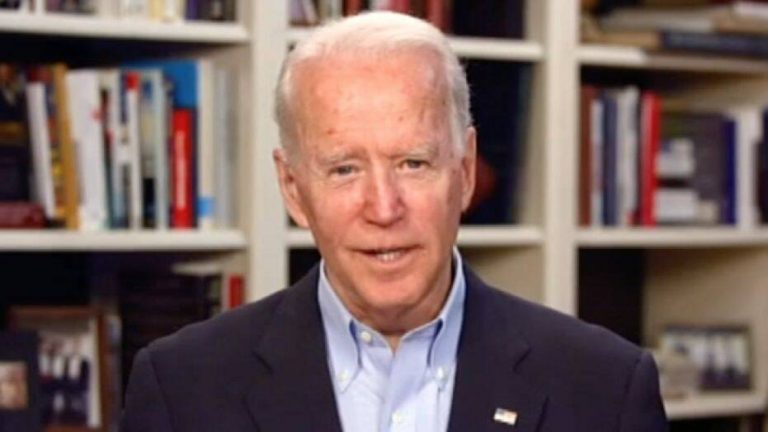
Joe Biden, the 77-year-old former vice president of the United States and now the presumptive Democratic nominee for the forthcoming US Presidential elections, has kicked up a controversy by expressing his unsolicited views on Jammu and Kashmir, Citizenship Amendment Act (CAA) and the National Register of Citizens (NRC) in India.

Democrat Biden who is challenging the 74-year-old Republican incumbent president Donald Trump in the November 3 presidential elections, wants India to take necessary steps to ‘restore rights of all Kashmiris and has expressed disappointment over the Citizenship (Amendment) Act as well as the implementation of the National Register of Citizens in Assam.

A policy paper—’Joe Biden’s agenda for Muslim American community’ was posted recently on his campaign website, which said that the measures (the CAA and the National Register of Citizens) are irreconcilable with the country’s long tradition of secularism and with sustaining a multi-ethnic and multi-religious democracy.

A group of Hindu Americans contacted Biden campaign to express their displeasure over the language used for India and urged it to reassess its views on India. The group has aso sought a similar policy paper on Hindu Americans.

However, the Biden campaign did not respond questions in this regard.

In order to project that Biden comprehends the pains endured by Muslim-American with respect to what is happening in Muslim-majority nations and countries with sizeable Muslim populace, the policy paper categorised Kashmir and Assam in India with the forced detention of over a million Uyghur Muslims in China’s Xinjiang province, and discrimination and brutalities faced by Burma’s Rohingya Muslim minority.

“The Indian government should take all necessary steps to restore rights of all the people of Kashmir. Restrictions on dissent, such as preventing peaceful protests or shutting or slowing down the Internet, weakens democracy,” said the policy paper on Muslim Americans.

The policy paper further added that the presumptive Democratic nominee, Joe Biden is disappointed by the measures that the government of India has taken with the implementation and aftermath of the National Register of Citizens in Assam and the enactment of the Citizenship Amendment Act.

In a bid to lure Indian-American voters, the policy paper hailed Joe Biden as one of the best friends of India and Indian-Americans, claiming the former vice-president, who served under President Barack Obama for eight years, played an instrumental role in the passage of the historic India-US civilian nuclear deal and strongly advocated increasing the bilateral trade between the two countries to $500 billion per annum. Well-acquainted with the Indian-Americans, Biden regularly hosted Diwali at his vice-presidential residence, it said.

However, Rishi Bhutada, a board member of Hindu American Political Action Committee, said that the Biden campaign is missing the much-needed context about “Pakistan-sponsored cross border terrorism in regards to Kashmir”. Defending the CAA, Bhutada added that the former vice president’s election campaign is also missing how the new citizenship amendment act is a good-faith effort by the government to alleviate the pains of approximately 30,000 persecuted religious minorities from Afghanistan, Bangladesh and Pakistan who continue to live in India and are deprived of their basic human rights because of lack of citizenship.