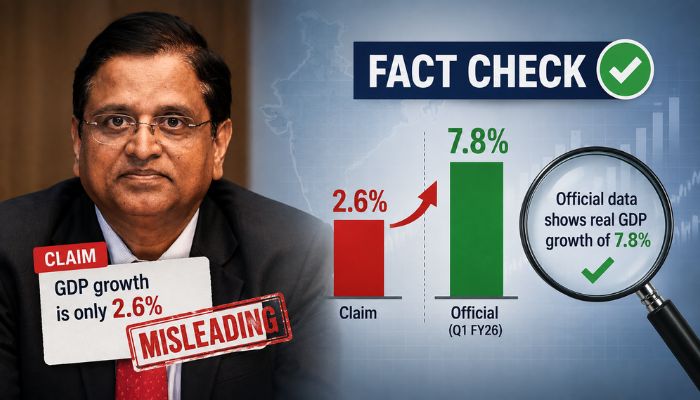
A claim by former Finance Secretary Subhash Chandra Garg that India’s GDP growth was only around 2.6% instead of the officially reported 7.8% went viral on social media. Several users have shared his calculation to claim that the government has manipulated GDP figures to make the economy look stronger than it actually is.
The Congress also picked up the claim to attack the government. In a post on X, the party alleged that the Modi government had “fudged GDP figures” and claimed that, without the alleged manipulation, real GDP growth would have been only 2.6%. But this comparison is misleading because the 2.6% figure being circulated is not an alternative calculation of India’s real GDP growth. It comes from comparing figures from two different GDP series.
𝟕.𝟖% 𝐆𝐃𝐏 𝐆𝐫𝐨𝐰𝐭𝐡 𝐢𝐧 𝐅𝐮𝐝𝐠𝐞𝐝 𝐃𝐚𝐭𝐚, 𝟐.𝟔% 𝐢𝐧 𝐑𝐞𝐚𝐥𝐢𝐭𝐲
Former Finance Secretary in the Modi Govt, Subhash Chandra Garg, has exposed how the Modi government has fudged GDP figures.
Garg questioned the recent revision of India’s GDP numbers and argued that the revision of the previous year’s figures had made the latest growth rate appear much higher. In comments cited by the Congress and media reports, he pointed to the increase in nominal GDP and suggested that, without the revision, growth at current prices could have been around 2.6%.
“The 7.8 per cent figure looks impressive on the face of it, but we should examine the reality behind it,” he said in his interview with NDTV.
However, the claim later gained much traction on social media, as Garg had claimed that India’s real GDP growth was 2.6%. His calculation does not actually support that figure.
The calculation used by Garg compares nominal GDP of ₹88.27 lakh crore in Q1, calculated under the new 2022–23 base-year series, with ₹86.05 lakh crore for Q1 FY26 compiled under the old 2011–12 series. That produces a growth rate of roughly 2.6%.
Why the 2.6% calculation is misleading
According to data cited by several media reports, comparing the two numbers is statistically invalid because one comes from the new GDP series and the other from the old series. Calling 2.6% the ‘real’ growth rate by mixing two incompatible GDP series is not scrutiny; it is simply incorrect arithmetic.
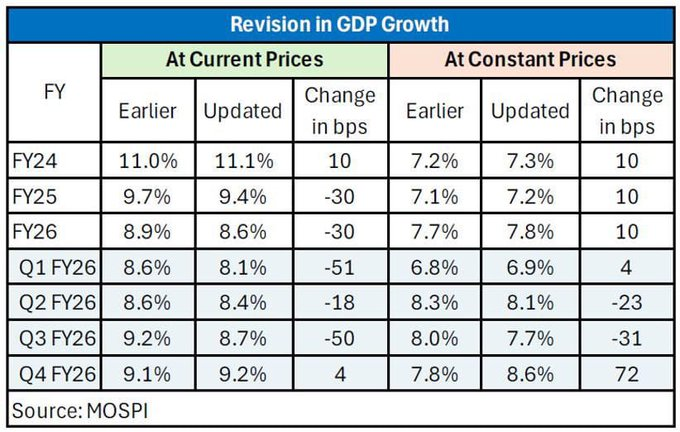
The new GDP series uses 2022-23 as the base year and has updated coverage, sectoral weights, estimation methods, price treatment and data sources. Once a new series is introduced, the historical data is also revised using the new methodology so that comparisons can be made on a like-for-like basis.
Under the new series, nominal GDP in Q1 FY2026-27 stood at ₹88.27 lakh crore, compared with ₹80 lakh crore in Q1 FY2025-26. That represents nominal growth of 10.3%.
More importantly, real GDP, which removes the effect of price changes, increased from ₹75.46 lakh crore to ₹81.36 lakh crore. This gives the official real GDP growth rate of 7.8% for the April-June quarter. These are the figures released by the Ministry of Statistics and Programme Implementation (MoSPI).
4/ Using same series: Q1 FY26 = ₹80.00 lakh cr, Q1 FY27 = ₹88.27. Nominal +10.3%, real +7.8%.
It's the first line of the press note. He didn't have to dig! Just reading would have sufficed.
Congress, its leaders and social media posts amplify the claim
The Congress used Garg’s remarks to accuse the government of manipulating economic data. Several social media users also repeated the claim, suggesting that there was “no real growth” in the Indian economy and that the 7.8% figure was created through statistical manipulation.
"Real GDP growth is 2.6%, not 7.8%. The government is good at revising the base-year data so that it can project GDP growth as high as 7.8%."
Congress leader Supriya Shrinate also launched a similar attack. Sharing a post on X, she wrote, “India’s former Finance Secretary, Subhash Garg, has raised serious concerns on the GDP growth data. Hard facts about how last year’s current price GDP of ₹86 trillion was revised down to ₹80 trillion to arrive at a 7.8%, which would’ve otherwise been 2.6% “He understands India’s finances and what the economic data throws up better than most people”.
India’s former Finance Secretary – Subhash Garg has raised serious concerns on the GDP growth data.
Hard facts about how last year’s current price GDP of ₹86 trillion was revised down to ₹80 trillion to arrive at a 7.8%, which would’ve otherwise been 2.6%
Congress leader Pawan Khera also shared a post accusing the government of manipulating the data. Sharing a post on his X account, Khera wrote, “Subhash Garg has punctured the government’s tall claims of 7.8% GDP growth, arguing that India’s real GDP growth is closer to 2.6%. His contention is even more damning: the previous year’s GDP growth was revised downward, making this year’s growth rate look stronger by comparison. His assessment seems far closer to the lived reality of ordinary Indians — rising prices, falling purchasing power, shrinking disposable incomes and savings, stagnant job opportunities, and rising household debt. These claims cannot simply be dismissed.”
Subhash Garg has punctured the government’s tall claims of 7.8% GDP growth, arguing that India’s real GDP growth is closer to 2.6%.
His contention is even more damning: the previous year’s GDP growth was revised downward, making this year’s growth rate look stronger by… https://t.co/ejGe8Ea7hR
But the viral posts often leave out an important detail: the 2.6% figure is based on mixing the old and new GDP series. It cannot be directly compared with the official 7.8% real growth rate.
This is shocking 🤯
Former Finance Secretary Subhash Garg has said that the real GDP is around 2.6% and nowhere close to 7.8% as reports suggest
GDP numbers are periodically revised when better data becomes available and when the statistical system is updated. The recent exercise involved moving to a new base year of 2022-23, along with changes in data sources and estimation methods.
MoSPI’s latest release shows that real GVA grew 8.2% in Q1 FY2026-27, while nominal GVA increased 11.5%. The services sector was a major contributor, growing 10% in real terms, while manufacturing grew 9.2%.
This does not mean every GDP number is beyond criticism. Quarterly estimates can be revised as more information becomes available, and a high GDP growth rate by itself does not tell us how income, employment or growth are distributed across society.
What about inflation and the GDP deflator?
The 10.3% nominal GDP growth and 7.8% real GDP growth imply an overall GDP deflator increase of roughly 2.3%. However, this should not be confused with CPI or WPI inflation.
The GDP deflator covers the wider economy, including consumption, investment, government services, exports and domestically produced output. The new GDP series also uses more detailed price indices and a double-deflation method for manufacturing, where output and intermediate inputs are adjusted separately.
Therefore, the viral claim that India’s “real GDP growth is only 2.6%” is misleading. Garg did raise questions about GDP revisions, but the 2.6% figure being circulated is not a valid alternative real-growth calculation. The official MoSPI estimate, based on the new and consistently applied GDP series, puts India’s real GDP growth in Q1 FY2026-27 at 7.8%.
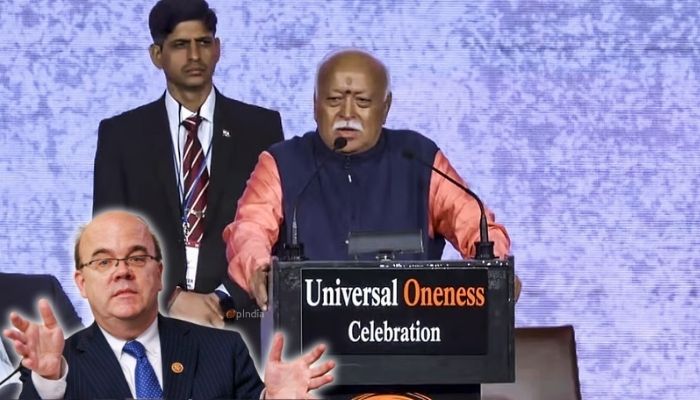
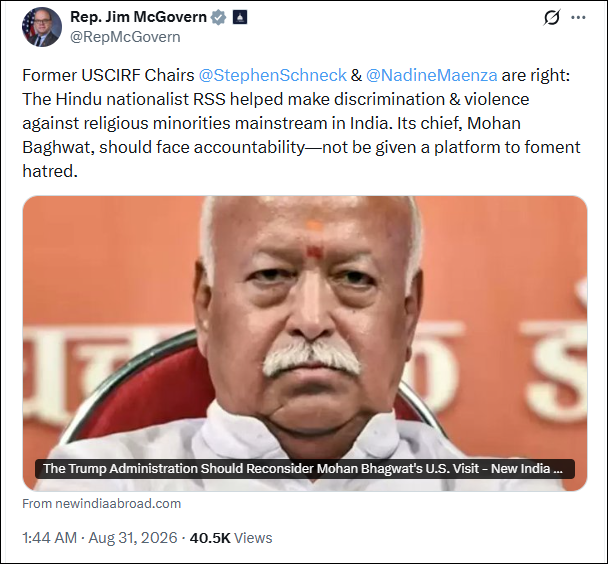
The recent visit of the Rashtriya Swayamsevak Sangh (RSS) chief Mohan Bhagwat to the US has baffled and traumatised the Islamo-leftist cabal. After petitions, propaganda articles, and charged rhetoric could not prevent Bhagwat’s Madison Square event, the Islamo-leftist lobby led by Hindus for Human Rights (HfHR) Action and SACRED Acts has secured a pledge from 100 politicians against receiving donations from RSS-linked entities or its supporters.
100 US Republican and Democrat politicians sign Hindus for Human Rights Action and SACRED Acts pledge to refuse donations from RSS supporters
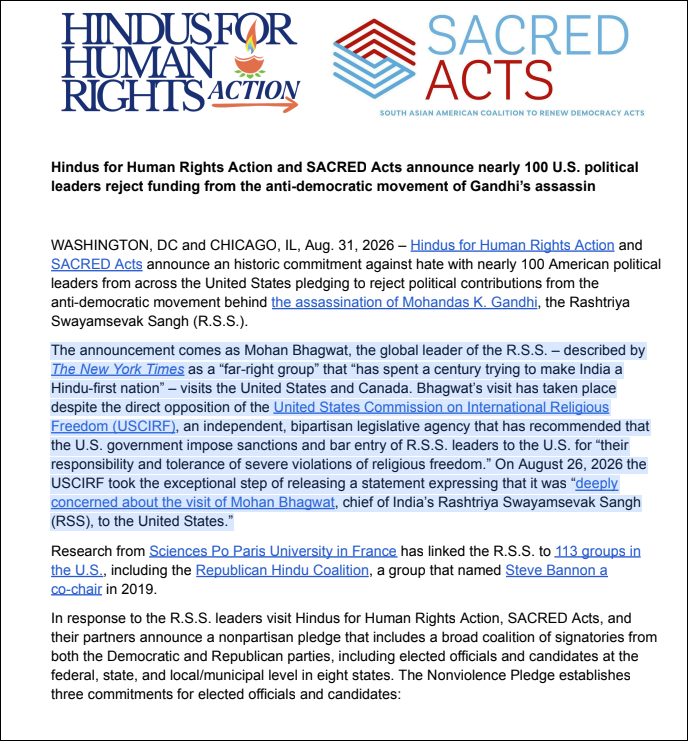
In a press release issued on 31st August, Hindus for Human Rights Action and SACRED Acts said, “– Hindus for Human Rights Action and SACRED Acts announce an historic commitment against hate with nearly 100 American political leaders from across the United States pledging to reject political contributions from the anti-democratic movement behind the assassination of Mohandas K. Gandhi, the Rashtriya Swayamsevak Sangh (R.S.S.).”
The press release cites The New York Times to claim that the RSS is a “far-right group” that has been for nearly a century to turn India into a Hindu-first nation.
Amusingly, the HfHR Action and SACRED Acts lamented that RSS chief Mohan Bhagwat visited the US despite the ‘direct opposition’ of the United States Commission on International Religious Freedom (USCIRF), which recommended barring Bhagwat’s entry into the US and sanctioning RSS leaders.
The press release further stated that the nonpartisan pledge signed by Republican and Democrat politicians establishes three core commitments, including rejection of political violence and intimidation, refusal to accept donations from RSS and its affiliates, and return or redirect all such political contributions to ‘pro-democracy’ outfits.
“In response to the R.S.S. leaders visit Hindus for Human Rights Action, SACRED Acts, and their partners announce a nonpartisan pledge that includes a broad coalition of signatories from both the Democratic and Republican parties, including elected officials and candidates at the federal, state, and local/municipal level in eight states. The Nonviolence Pledge establishes three commitments for elected officials and candidates: Reject political violence and intimidation; Refuse donations linked to the anti-democratic R.S.S. and its affiliates; Return or redirect such political contributions to pro-democracy organizations.”
In addition to requiring the 100 US politicians to sign the SACRED Acts Nonviolence Pledge against RSS, the HfHR Action also urged all American political leaders to make a public statement supporting the USCIRF’s call “to impose sanctions and bar entry of R.S.S. leaders to the U.S. for “their responsibility and tolerance of severe violations of religious freedom.”
Notably, the SACRED Acts Nonviolence Pledge was first launched by SACRED Acts, founded by Pushkar Sharma, in Illinois in 2023, with support from Indian American Muslim Council (IAMC), Asian American Midwest Progressives, India Civil Watch International (ICWI), and Hindus for Human Rights.
As Islamo-leftist activists and politicians join forces to sharpen their attacks on India, the Indian government and the RSS by relying on apocryphal narratives and alarmist rhetoric, it is important to know who all are behind these sinister manoeuvres.
Ahead of Mohan Bhagwat’s US visit, USCIRF demanded sanctions against RSS and R&AW
The USCIRF, headed by a Pakistan-born American, Dr Asif Mahmood, has an opprobrious track record of churning out utterly biased and dubious anti-India reports annually.
In its annual report for the year 2026, the USCIRF has made unfounded allegations against the Indian government, the RSS and India’s Research and Analysis Wing (RAW). In the report, the USCIRF placed India among the countries it describes as “countries of particular concern”. It also urged the US government to designate India as a “Country of Particular Concern” (CPC) for allegedly “engaging in and tolerating systematic, ongoing, and egregious religious freedom violations, as defined by the International Religious Freedom Act (IRFA)”.
Unsurprisingly, the USCIRF actively contributed to the sinister Islamo-leftist campaign in the US to stop RSS Chief Mohan Bhagwat’s Madison Square event.
The US-based organisation openly called for sanctions against the RSS, falsely accusing it of perpetrating attacks on Christians and Muslims in India. It emphasised PM Modi’s association with the RSS to insinuate that the Indian government, in connivance with the RSS, has been targeting religious minorities in the country.
“India’s PM Modi is a member of the Rashtriya Swayamsevak Sangh (RSS), an Indian umbrella organisation whose sub-groups have perpetrated attacks on religious minorities, incl. Christians & Muslims. Now, the RSS leader, Mohan Bhagwat, plans to visit the U.S.,” the USCIRF’s Pakistan-born American Chairman, Dr Asif Mahmood, said.
“RSS leaders, even when affiliated with the Indian gov’t, should not be honoured with high-level meetings or diplomatic courtesies. Instead, the USG should focus on imposing sanctions on RSS members found responsible for FoRB violations,” the organisation’s commissioner Gene Mills remarked.
The Indian Government, however, trashed the USCIRF’s statement, calling it a “biased” organisation with a track record of making “disparaging and inflammatory remarks about India.”
Hindus for Human Rights Action
Officially launched in 2026, with its public launch event held on 11th March, Hindus for Human Rights Action is the political advocacy arm of its parent organisation, Hindus for Human Rights (HfHR).
The HfHR Action describes itself as “A movement for all Hindus seeking to protect democracy, human rights, and pluralism, and dismantle caste and Hindu nationalism.”
HfHR was formed in the year 2019 by two Islamist advocacy groups named Indian American Muslim Council (IAMC) and the Organization for Minorities of India (OFMI). Interestingly, the three organisations had formed another outfit called the Alliance for Justice and Accountability (AJA), which, alongside IAMC, had been at the forefront of leading demonstrations against the visit of PM Modi to Houston on September 22, 2019.
The HfHR chief Sunita Vishwanath, who was pictured alongside Congress MP Rahul Gandhi, had attempted to create hysteria and panic among Indian Muslims about the National Register of Citizens (NRC). HfHR’s founding member Raju also heads EKTA. It is an associate organisation of IAMC. The sole purpose was to have Hindus on the panel to project that the Hindus, in general, were against Hindutva. Interestingly, HfHR ran Facebook ads to promote previous USCIRF reports.
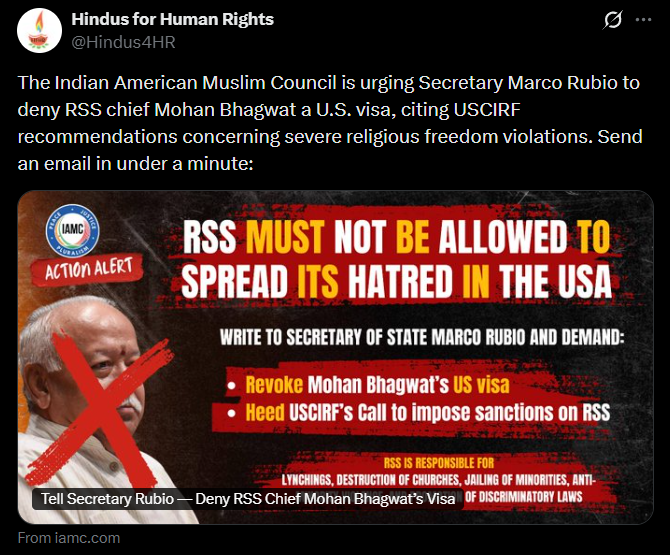
Recently, HfHR endorsed IAMC’s online petition asking people to take part in it to urge Secretary of State Marco Rubio to revoke Bhagwat’s US visa, insisting that otherwise it would “send the wrong message about America’s commitment to religious freedom and the safety of minority communities.”
Indian American Muslim Council
The Indian American Muslim Council (IAMC) is a Washington-based Islamist outfit which has been involved in anti-India activities and pushing an anti-Hindu agenda for many years. In 2021, IAMC campaigned to designate India as a “Country of Particular Concern”.
During the May 2025 India-Pakistan conflict, IAMC and CAIR condemned India’s Operation Sindoor against Pakistan Army-backed terror establishments in Pakistan.
The Indian American Muslim Council is accused of having ties with the banned Islamic terror outfit, Students’ Islamic Movement of India (SIMI). Besides, the Indian American Muslim Council has ties with Lashkar-e-Taiba (LeT) and Jamaat-e-Islami (JeI) through its founder Shaik Ubaid. The IAMC is a Jamaat-e-Islami-backed lobbyist organisation claiming to be a rights advocacy group.
Moreover, the IAMC is also accused of collaborating with and even paying money to various groups in the USA to get India blacklisted by the USCIRF. OpIndia has reported on how the IAMC frequently publishes disinformation to peddle Muslim victimhood propaganda against India. The Indian government slapped the IAMC with the UAPA in 2021.
The IAMC also backed New York Mayor Zohran Mamdani during his mayoral candidacy. Mamdani, a notorious Hinduphobe, had recently lamented not having the authority to cancel the RSS Chief’s event in the city.
SACRED Acts
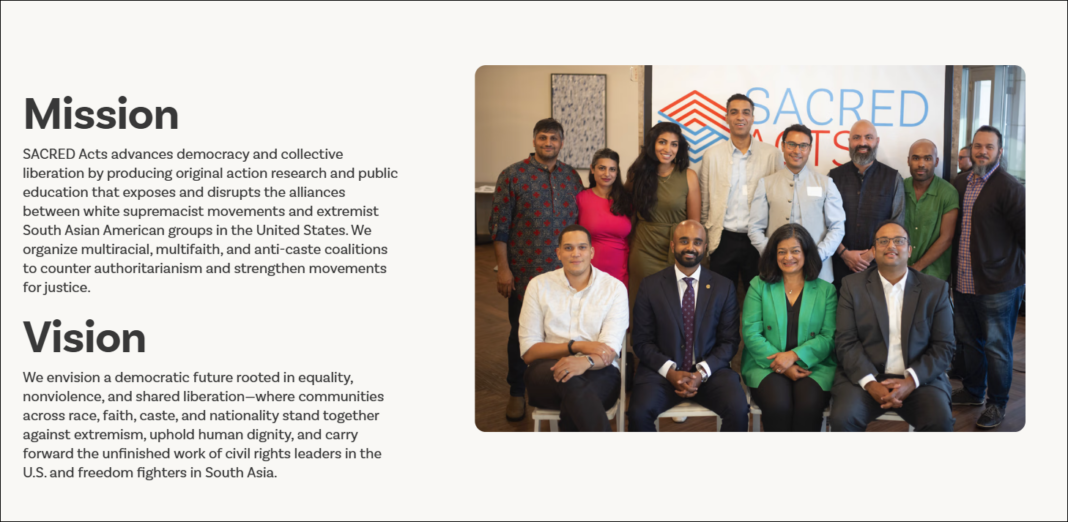
The South Asian American Coalition to Renew Democracy, also known as SACRED Acts, is a US-based organisation that claims to advance democracy and human rights by countering ‘extremism’ and political influence linked to ‘nationalist movements’.
Its stated mission is to “organize multiracial, multifaith, and anti-caste coalitions to counter authoritarianism and strengthen movements for justice.”
SACRED Acts first gained attention in 2023, when it introduced a six-page Nonviolence Pledge in Illinois, with the backing of the Islamist IAMC, Asian American Midwest Progressives, India Civil Watch International and Hindus for Human Rights.
Since its 2023 launch, the Nonviolence Pledge has secured signatures of around 90 officials and candidates across federal, state and local races. The ‘pledge’ boasts the endorsement of Tushar Gandhi, the great-grandson of Mohandas Karamchand Gandhi, as if his relation with MK Gandhi makes him an unquestionable authority of righteousness.
Pushkar Sharma, the Executive Director of SACRED Acts, claims, “Over the past decade, in Illinois alone, individuals tied to the RSS have funnelled at least $2.5 million into political campaigns across both parties [Democratic and Republican] promoting their anti-democratic, extremist agenda that does not represent the beliefs of the vast majority of South Asian Americans.”
Pramila Jayapal, Ro Khanna, Kshama Sawant, and more: Who the key signatories of the anti-RSS pledgeare
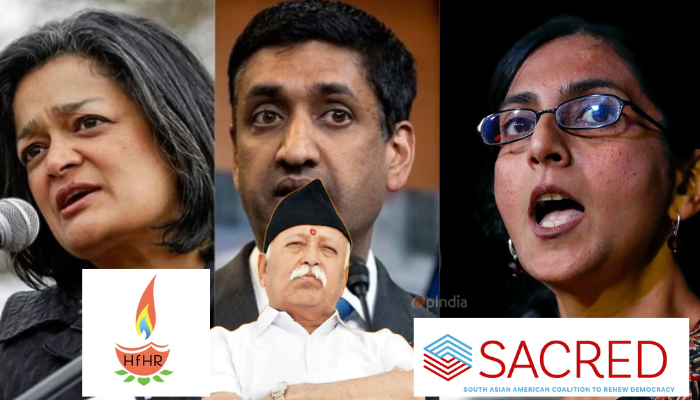
The Hindus for Human Rights Action and SACRED Acts orchestrated anti-RSS pledge has been signed by at least 100 American politicians, including members of Congress, state legislators, mayors, local elected officials and candidates from both Democratic and Republican circles.
Among the key signatories of this ridiculous pledge are members of the US House of Representatives Pramila Jayapal of Washington, U.S. Rep. Aisha Wahab (CA), Ro Khanna of California and Robin Kelly of Illinois, Michigan’s newly elected Democratic nominee for the Senate race Abdul El-Sayed, another Democrat congressional nominee Brad Lander, and socialist politician Kshama Sawant.
Pramila Jayapal: A rabid Hinduphobe and anti-India politician in the US
Pramila Jayapal is a notorious anti-India and anti-Hindu element infecting American politics. In December 2019, she brought a Congressional resolution urging India to end restrictions on communications in Jammu and Kashmir. Her stand against the Indian Government’s decision to abrogate Article 370 in the state made the Indian-American community feel betrayed, cheated and saddened.
Following her resolution, MEA Jaishankar famously cancelled his meeting with a group of United States lawmakers following their refusal to exclude anti-India Congresswoman Pramila Jayapal from the delegation that was scheduled to meet him. “Don’t think her report has a fair understanding of the situation in Jammu and Kashmir or a fair characterisation of what the Government of India is doing. I have no interest in meeting her,” the External Affairs Minister revealed after speculations of cancellation of the meeting came forth.
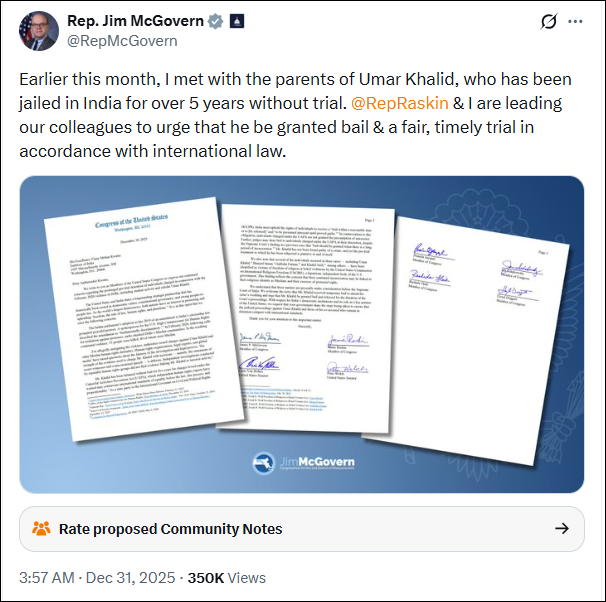
In January 2026, Pramila Jayapal joined 7 other US lawmakers in signing an open letter to the Indian government demanding bail and a free trial for 2020 anti-Hindu Delhi Riots accused mastermind Umar Khalid. Even as Khalid’s case remained sub judice, the US lawmakers declared him downright innocent. Jayapal and other signatories demanded that Umar Khalid be released from jail, claiming that the anti-CAA protests were ‘peaceful’ and even painted Muslims as the victims of the anti-Hindu riots in 2020.
Kshama Sawant: TheAnti-India lobbyist who brought resolution against CAA, Hindus in Seattle
An Indian American economist from Seattle and a former member of the Seattle City Council, Kshama Sawant has an opprobrious history of peddling anti-Hindu hatred and indulging in activism directly attacking the Hindu American community.
As a councilwoman, Kshama Sawant drafted and piloted a law to designate “caste” a protected category under the city’s non-discrimination policy – the first such law passed by a city in the United States – which placed Hindus under additional legal scrutiny and faced fierce opposition from the community leaders and groups. Furthermore, she protested against the Citizenship Amendment Act (CAA), which aimed to grant citizenship to persecuted minorities from Pakistan, Afghanistan and Bangladesh.
Sawant was the driving force behind a resolution passed by the Seattle City Council in February 2020 denouncing India’s CAA and NRC for “discriminating against women, Muslims, members of suppressed castes, indigenous and LGBT individuals.”
The resolution ridiculously framed the CAA as ‘discriminatory’ even as CAA had nothing to do with any existing Indian citizens, Muslim, LGBT, women or otherwise. It was a provision to grant citizenship to persecuted minorities from Afghanistan, Pakistan and Bangladesh who have already been living in India as refugees.
The resolution asked the Indian Parliament to ratify several United Nations (UN) refugee relief treaties, repeal the CAA and halt the NRC. It should come as no surprise that anti-Hindu, anti-Indian, and Islamist groups praised the action. The Indian American Muslim Council‘s (IAMC) president, Ahsan Khan, stated that Seattle’s decision should send a message to those who are threatening religious freedom and plurality. Thenmozhi Soundararajan of advocacy group Equality Labs also voiced support, characterising Seattle’s initiative as a component of a worldwide protest against the CAA.
In 2020, Sawant brought a resolution which called on workers, farmers, students, and other community members to participate in solidarity actions in support of the protesting farmers in New Delhi.
After Kshama Sawant sponsored a caste resolution, Seattle became the first city in the US to formally designate “caste” as a protected group under its non-discrimination policy in February 2023.
Aisha Wahab: The Senator who introduced the SB-403 caste discrimination bill
In 2023, California Senator Aisha Wahab tabled the SB-403 caste discrimination bill. The dubious organisation Equality Labs is one of the bill’s biggest supporters. The bill was completely based on the Cisco caste case, which later fell flat. In October 2022, California Governor Gavin Newsom returned the discriminatory and Hinduphobic Bill ‘SB403’, deeming it “unnecessary”.
Ro Khanna: The Islamist sympathiser
Rohit Khanna, commonly known as Ro Khanna, is a US Democrat Congressman of Indian origin. In August 2019, Ro Khanna joined the Pakistan Congressional Caucus, becoming the first Indian-American to do so. This move had raised eyebrows in the Indian-American community, while he was welcomed by the Pakistanis, including Pakistan’s ambassador to the US.
Over the years, OpIndia has extensively reported on Khanna’s anti-India activities.
On 24th March 2023, Khanna made unsolicited remarks about the internal political affairs of India. The development comes after Congress scion Rahul Gandhi was disqualified from the Lok Sabha following his conviction in a criminal defamation case.
In an X post, he claimed, “The expulsion of Rahul Gandhi from parliament is a deep betrayal of Gandhian philosophy and India’s deepest values.” The US politician further added, “This is not what my grandfather sacrificed years in jail for. Narendra Modi, you have the power to reverse this decision for the sake of Indian democracy.”
In August 2019, Ro Khanna courted controversy for presenting a distorted version of Hindutva to his American followers. He had tweeted, “Important article. It’s the duty of every American politician of Hindu faith to stand for pluralism, reject Hindutva, and speak for equal rights for Hindus, Muslims, Sikhs, Buddhist & Christians. That is the vision of India my grandfather Amarnath Vidyalankar fought for.”
Khanna created a false impression that Hindutva promotes inequality and discrimination against other religions. Contrary to Khanna’s framing, Hindutva (as defined by Veer Savarkar) is an inclusive term that represents everything ‘Indic’.
During the anti-farm law agitation in India in 2020, Ro Khanna tweeted, “India & the US share a rich tradition of democracy & peaceful protests. Farmworkers are the backbone of both our nations & must have their voices heard.”
India & the US share a rich tradition of democracy & peaceful protests. Farmworkers are the backbone of both our nations & must have their voices heard. I hope there's a peaceful and fair solution so they can provide for their families. I am encouraged by the ongoing dialogue.
Equality Labs, which is known for anti-Hindu propaganda, has worked with Congressman Ro Khanna to introduce a resolution in celebration of the 129th birth anniversary of B.R. Ambedkar. The founder of Equity Labs, Thenmozhi Soundararajan, has shared the stage with Khalistani terrorist Gurpatwant Singh Pannun, who is the founder of Khalistani terrorist organisation Sikhs For Justice or SFJ.
Unsurprisingly, Ro Khanna, who has a history of pushing Islamist narratives, also enjoys the backing of Islamist outfits like the IAMC. In 2023, he visited India and met the Muslim ‘victims’ of anti-Hindu Nuh violence. He also met anti-Hindu riots accused Umar Khalid, Gandhi’s great-grandson Tushar Gandhi, who is generally seen loitering around on Twitter spewing hate, and Kukis from Manipur; he did not meet Meities when he should have met both communities in the capacity of a foreign politician.
Interestingly, Ro Khanna has claimed that as a part of his commitment to the HfHR Action and SACRED Acts pledge to return or redirect funds received from RSS supporters, he is returning a $6,600 contribution he recently received “from a pro-MAGA, billionaire with ties to the RSS”. Questions are being asked as to why a MAGA supporter would donate to an Islamist-sympathising Democrat like Khanna.
Cockroach Janata Party (CJP) spokesperson Ashutosh Ranka has emerged as a prominent face of the group’s activism, regularly appearing in protests and public campaigns while billing himself as a voice on issues ranging from education and health to governance.
But a closer look at his professional background reveals a far wider network, one that runs through international public-health organisations, global philanthropic institutions and, during his second stint at Gavi, a former Pakistani senator and minister who had previously worked closely with Pakistan’s former Prime Minister Imran Khan.
The trail begins with Gavi
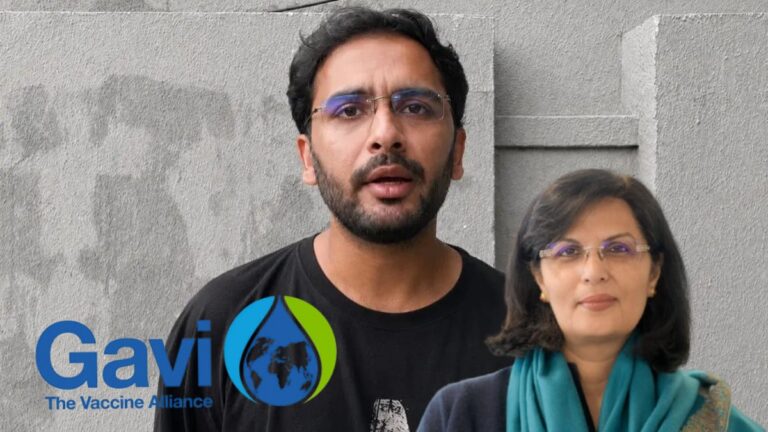
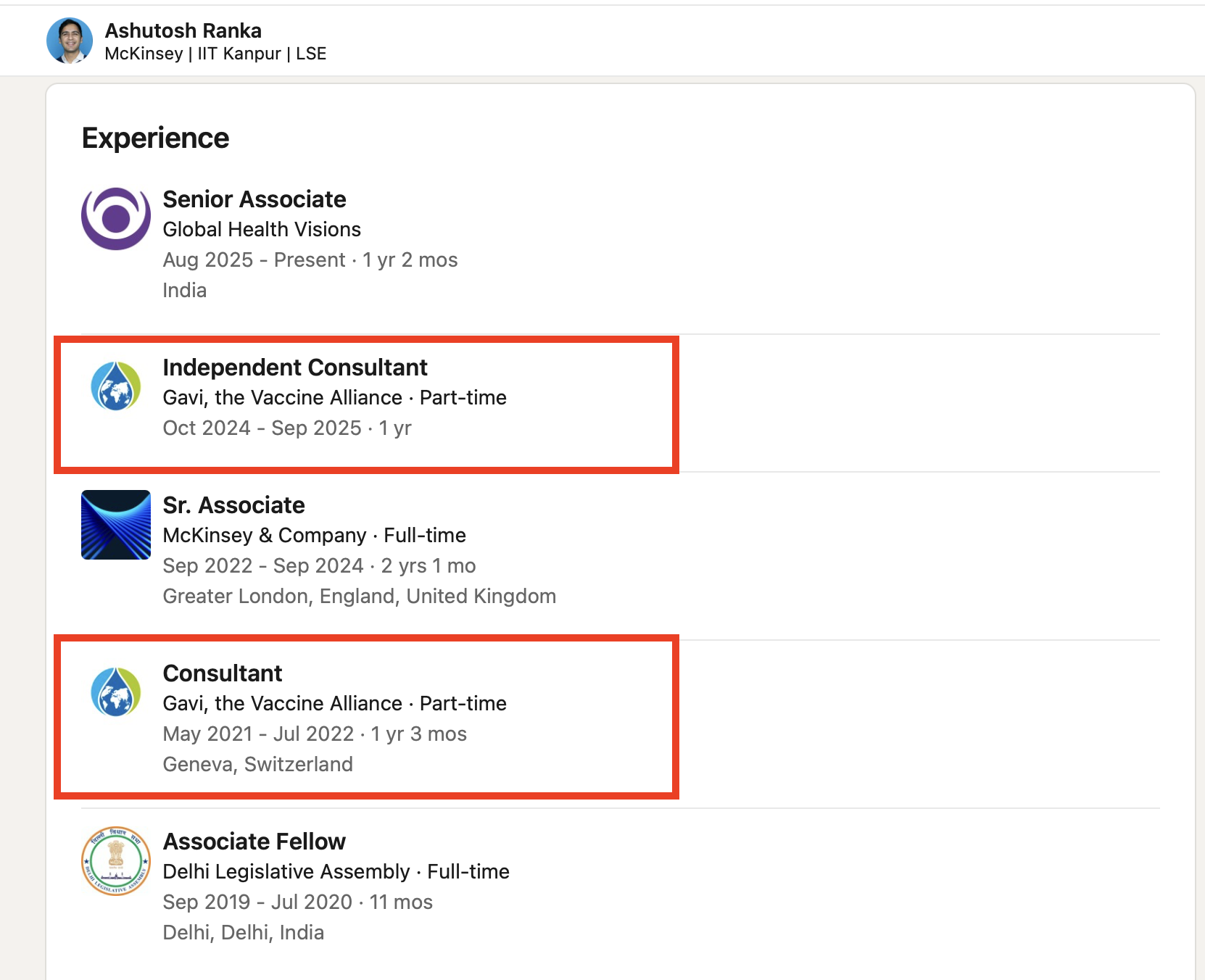
Ranka’s professional profile shows that he first worked with Gavi, the Vaccine Alliance, from May 2021 to July 2022. He returned to the organisation in October 2024 as an independent, part-time consultant, a position he held until September 2025.
Source: LinkedIn
The timing of his second stint is particularly noteworthy.
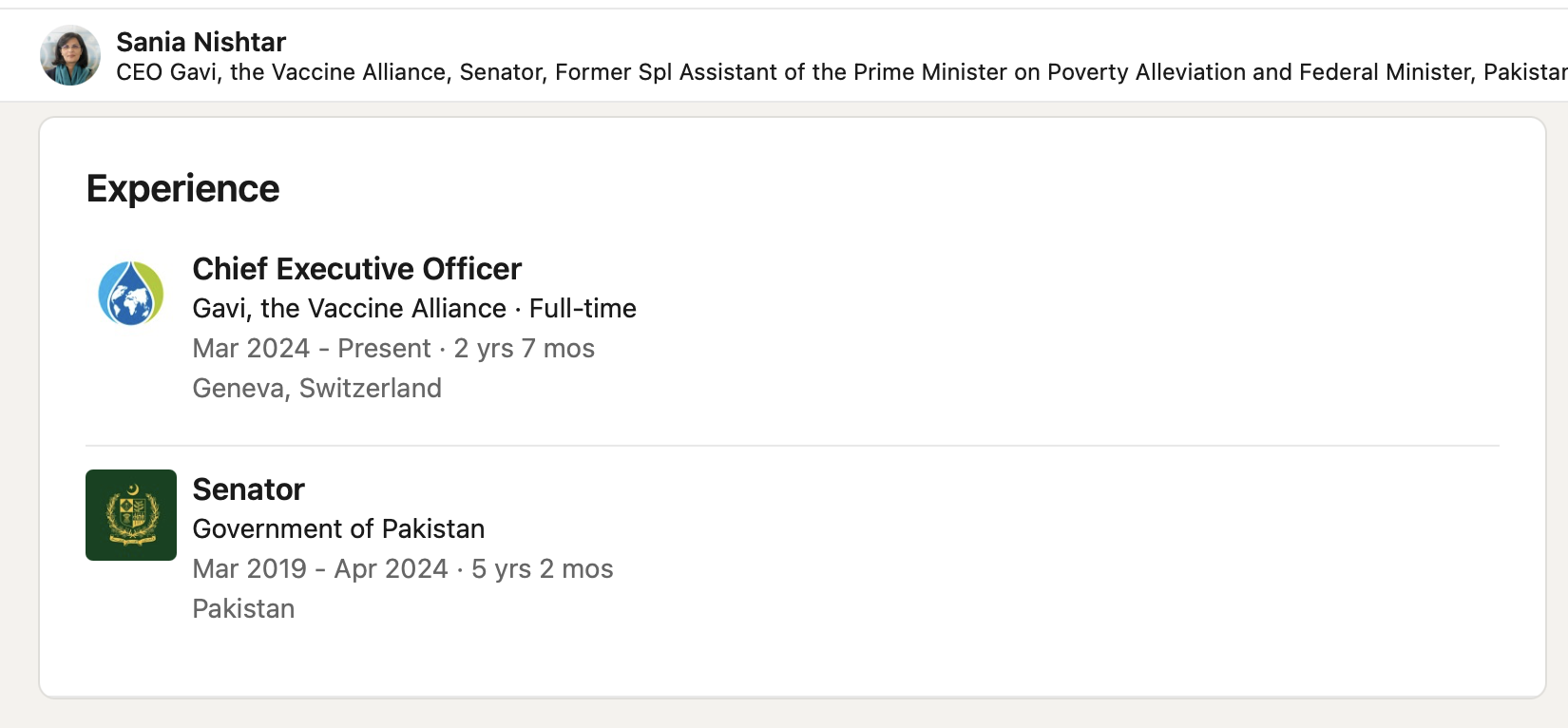
By October 2024, Gavi was being led by Dr Sania Nishtar, who had taken over as the organisation’s Chief Executive Officer on March 18, 2024. Nishtar was not simply a public-health professional who happened to come from Pakistan. Before moving to Gavi, she had been a Pakistani senator and had held a minister-rank position in the country’s federal government.
From 2018 to 2022, she served as Special Assistant to then Prime Minister Imran Khan on Social Protection and Poverty Alleviation, with the status of a Federal Minister. She had previously served as a Federal Minister during Pakistan’s caretaker government in 2013.
Source: LinkedIn
Thus, when Ranka returned to Gavi as a part-time consultant in October 2024, the organisation was headed by a former senior figure in Pakistan’s political establishment.
That fact does not establish a direct relationship between Ranka and Nishtar, nor is there evidence that she personally recruited or supervised him. But the chronology is important when examining the professional network through which Ranka operated.
Sania Nishtar and Imran Khan’s government
Nishtar’s role in Pakistan under Imran Khan was substantial.
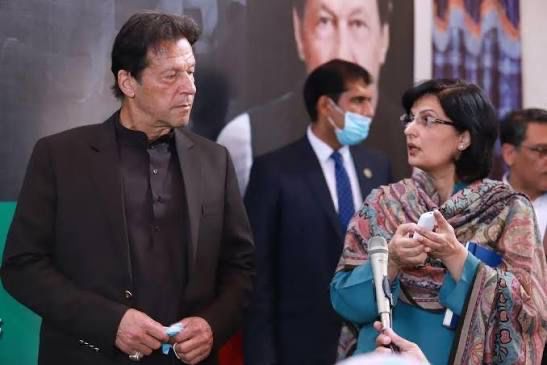
A 2020 Telegraph profile described her as Khan’s Special Adviser on Social Protection and Poverty Alleviation and identified her as the person tasked with building Ehsaas, the PTI government’s flagship social-protection programme.
Imran Khan and Sania Nishtar (Source: The Telegraph)
The programme was closely associated with Khan’s political vision. Following his 2018 election victory, Khan had spoken extensively about poverty, education, malnutrition and social protection, invoking the idea of a welfare state that would take responsibility for its weaker sections.
Nishtar was subsequently given the responsibility of translating that vision into government policy. Ehsaas became an umbrella programme covering social safety nets, education scholarships, healthcare, employment and poverty alleviation.
Nishtar therefore occupied a position at the intersection of public health, international development and Pakistani politics before eventually moving to the leadership of Gavi.
It was during her tenure as Gavi CEO that Ranka returned to the organisation.
Ranka was working for Gavi while actively associated with AAP
The Gavi connection becomes even more interesting when viewed alongside Ranka’s political activity.
His professional profile identifies his second Gavi stint as a part-time independent consultancy running from October 2024 to September 2025. During this same period, his Instagram account shows an active association with the Aam Aadmi Party and its leadership.
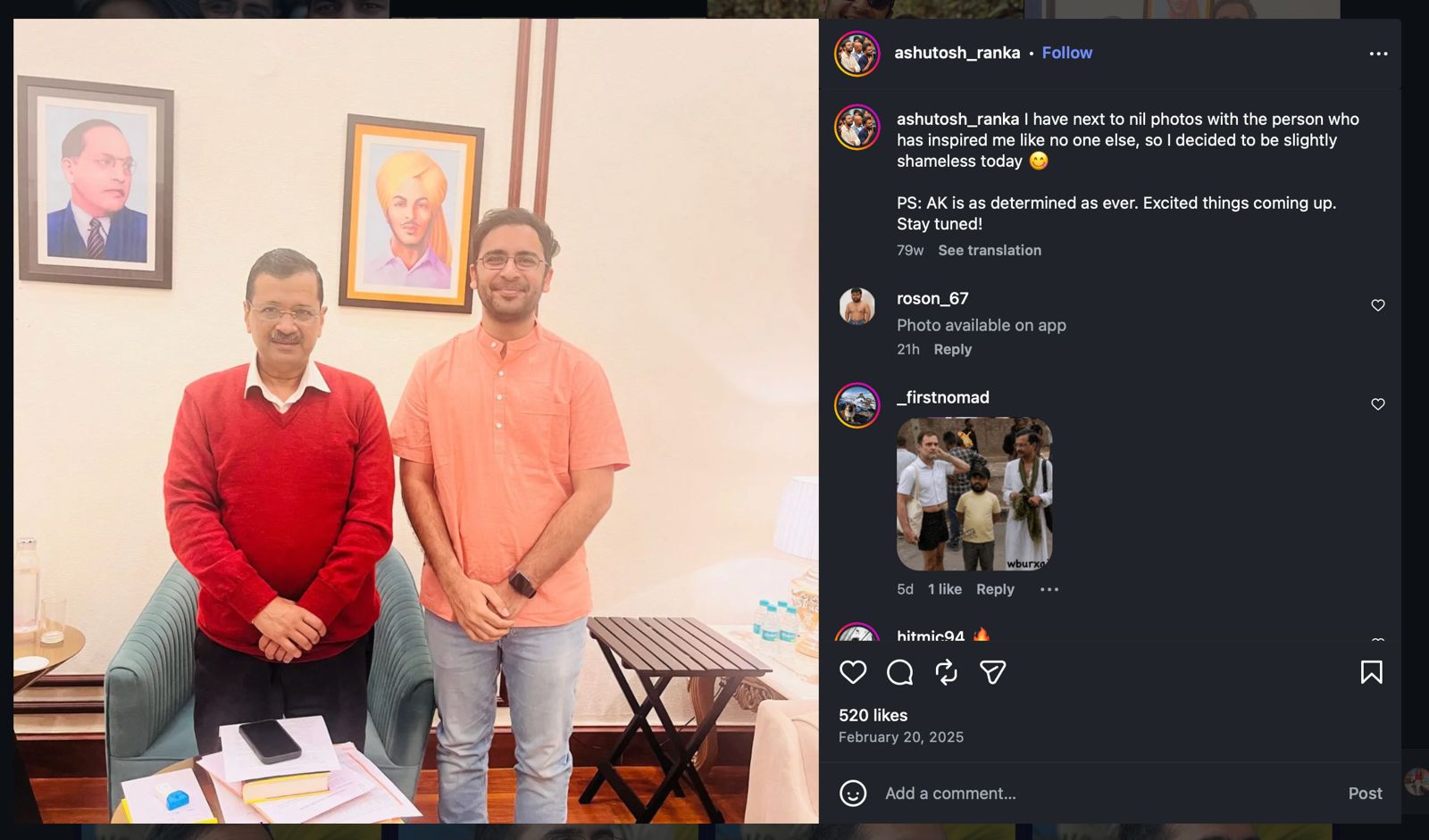
A post dated February 20, 2025 shows Ranka posing with AAP leader and former Delhi Chief Minister Arvind Kejriwal. In the accompanying caption, Ranka described Kejriwal as the person who had “inspired me like no one else” and said he had decided to be “slightly shameless” that day. He further wrote that “AK is as determined as ever” and told his followers that there were exciting things coming up.
Ashutosh Ranka posted a picture with AAP supremo Arvind Kejriwal
The post is significant because it does not present Ranka as a detached observer meeting a politician for a routine photograph. His own words indicate admiration for Kejriwal and suggest that he was personally invested in the political developments surrounding the AAP leader.
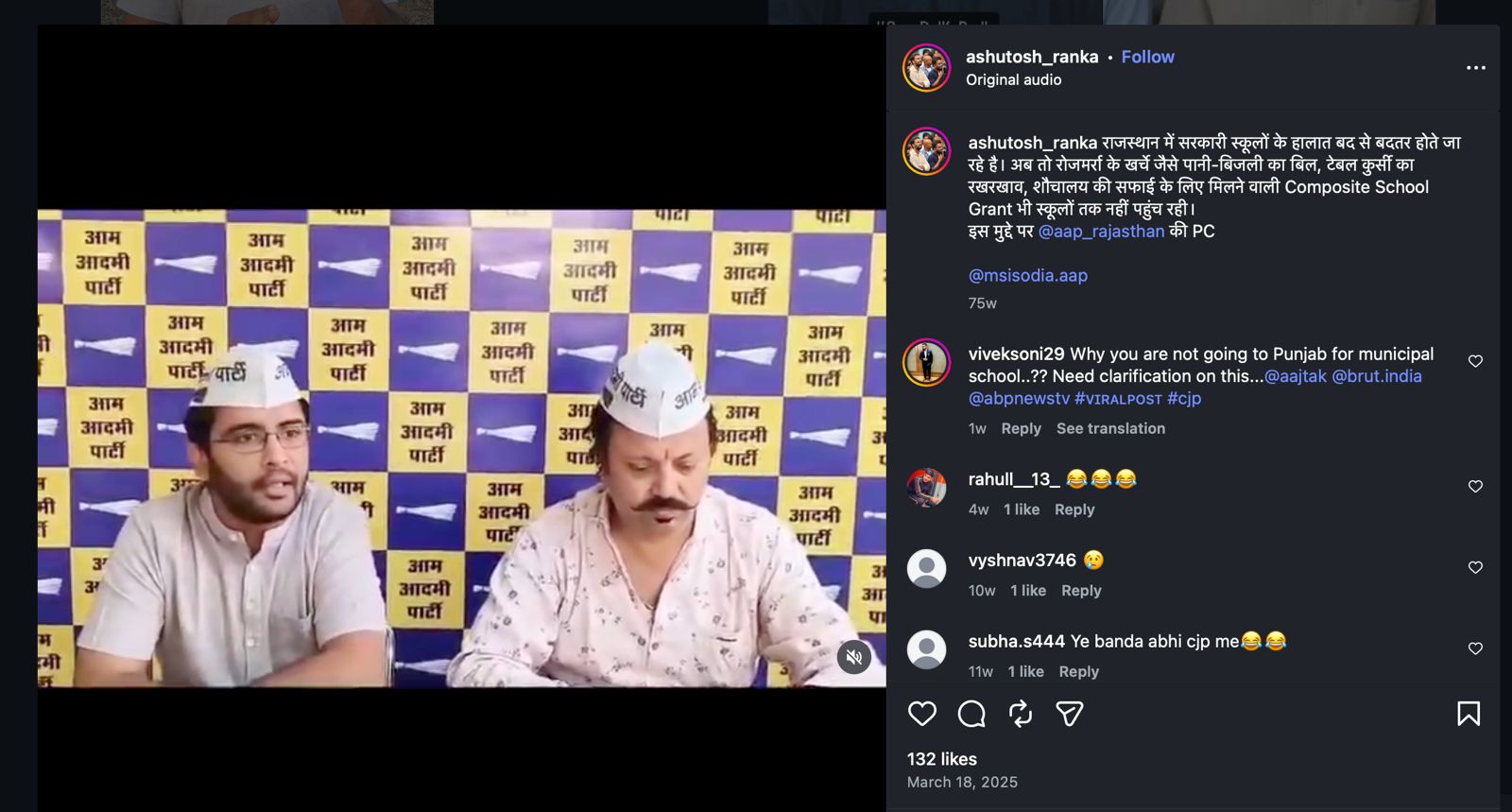
Another post dated March 18, 2025 shows Ranka participating in an AAP-related press interaction. The video has an AAP backdrop and Ranka’s caption discusses the condition of government schools in Rajasthan while tagging the AAP Rajasthan account and senior AAP leader Manish Sisodia.
Another post uploaded by Ranka in support of AAP
Both posts were made while Ranka was simultaneously listed as a part-time consultant with Gavi.
That does not mean Gavi endorsed AAP or that Ranka’s political activities were undertaken on behalf of Gavi. Nor does employment by an international organisation prevent an individual from engaging in politics in his personal capacity.
But it does raise a legitimate question about the boundaries between Ranka’s professional role and his political activism.
From AAP to CJP
Ranka’s political association with AAP also provides important context to his subsequent emergence as a CJP spokesperson.
A cursory examination of his social-media footprint shows that his political activism did not begin with CJP. He had already established a visible association with AAP and its leadership, including public appearances and expressions of admiration for Kejriwal.
His March 2025 appearance, in particular, shows him actively participating in an AAP political communication exercise rather than merely expressing a personal political preference online.
This matters because Ranka is now primarily known publicly through his CJP persona. His earlier political associations provide a broader picture of the trajectory that preceded it.
The relevant question is not whether moving from one political platform or movement to another is improper. Political activists frequently move between organisations.
The question is whether his professional affiliations and political engagements were adequately disclosed, especially during periods when the two overlapped.
The Soros connection runs through Gavi
Ranka’s first stint at Gavi also coincided with an important institutional relationship involving the Open Society Foundations.
In April 2022, Gavi entered into a roughly US$200 million COVAX risk-sharing facility with MedAccess and the Open Society Foundations. The arrangement involved procurement guarantees of up to US$100 million each from MedAccess and the Soros Economic Development Fund.
The purpose was to help facilitate additional COVID-19 vaccine procurement through COVAX.
There is no evidence that Ranka personally received any of this money or played a role in negotiating the arrangement. It would therefore be misleading to describe the Gavi–Open Society partnership as proof that Ranka was personally funded by George Soros.
But it is nevertheless part of the institutional ecosystem in which Ranka worked.
The broader chain is therefore documented: Ranka worked for Gavi; Gavi had an institutional financial relationship involving the Open Society Foundations; and the Open Society network is associated with George Soros.
Global Health Visions and Kinaura Partners
Gavi is not the only international organisation appearing in Ranka’s professional history.
Ranka has also been associated with Global Health Visions (GHV), subsequently renamed Kinaura Partners, a consultancy operating in the global-health sector. His professional profile identifies him as a Senior Associate at the organisation.
The consultancy’s work covers areas including immunisation, infectious diseases and health policy, and its public material has identified major international organisations and philanthropic foundations among those connected with its work.
Why did information about Ranka disappear?
The issue attracted greater attention after activist Vijay Patel highlighted Ranka’s professional affiliations.
Information about Ranka that had previously appeared on the concerned organisation’s website was subsequently reported to have been removed. His professional association, however, continued to appear on his LinkedIn profile.
The disappearance of a profile does not, on its own, establish wrongdoing. Websites are redesigned, employees leave and organisations routinely alter their public-facing pages.
But the timing inevitably raises questions when the individual concerned is a politically active public figure and the information disappears after his professional links are publicly highlighted.
If the professional association was entirely routine, the obvious solution would be transparency: identify the role, its duration, the nature of the work and any relevant disclosures.
The Pakistani link needs to be understood carefully
The most politically sensitive part of the story is undoubtedly the Pakistani connection.
Sania Nishtar was a senior figure in Imran Khan’s government. She was responsible for implementing one of his flagship welfare programmes and subsequently became CEO of Gavi.
Ranka, meanwhile, returned to Gavi as a part-time consultant after Nishtar had assumed the CEO’s position.
The larger network
What makes Ranka’s background noteworthy is not one isolated association but the combination of several different networks.
There is his association with AAP and Arvind Kejriwal, which is publicly visible through his own social-media posts. There is his professional association with Gavi, where he worked both before and during Sania Nishtar’s tenure as CEO. There is his association with Global Health Visions/Kinaura Partners, another player in the international public-health ecosystem. And there is Gavi’s institutional relationship with the Open Society Foundations.
Taken together, they raise questions that deserve straightforward answers.
What exactly were Ranka’s responsibilities at Gavi? Who paid him? What was the nature of his part-time consultancy? Were his political activities with AAP disclosed to his employer? What was his role at Global Health Visions/Kinaura Partners? And why was information about his professional association reportedly removed after it attracted public scrutiny?
These are questions of transparency and potential conflicts of interest.
The questions CJP and Ranka should answer
Ranka is now a political spokesperson and public campaigner. That makes his professional history relevant to the public, particularly when it includes employment with major international organisations and political activity during the same period.
The available record shows that he worked with Gavi, returned to it as a part-time consultant after Sania Nishtar became CEO, maintained an association with an international global-health consultancy, and was simultaneously visibly engaged with AAP and its leadership. His own Instagram posts provide evidence of that political association.
For someone who now presents himself as a political activist and spokesperson, the basic questions are simple: What were his professional relationships? Who funded his work? What political activities did he undertake while employed by international organisations? Were those activities disclosed? And are there any institutional or financial relationships that the public has not yet been told about?
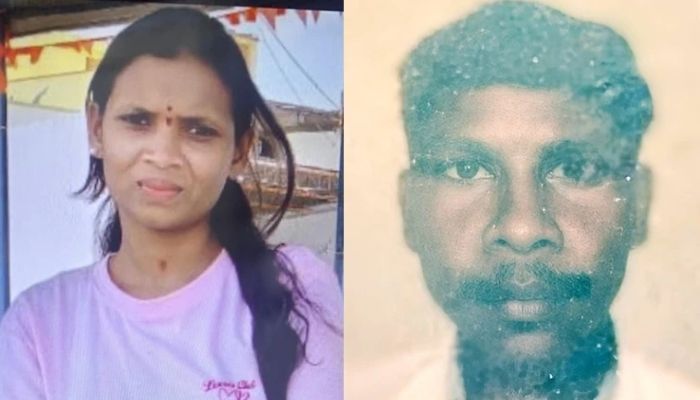
In the Rangareddy district of Telangana, a 21-year-old private hospital nurse, Sirisha, was allegedly raped and murdered by a bike mechanic named Mohammed Sanaullah on 28th August. The nurse, Uke Sirisha, was found dead in a pool of blood in her room in Thukkuguda. The deceased victim’s family has alleged that Sirisha was raped before being murdered.
Nurse Sirisha was found dead in her room
Sirisha was working as a nurse at Prime Care Hospital in Thukkuguda for the last seven months. She was staying in accommodation provided near the private hospital along with her fellow nurses.
Reports say that Sirisha went to her room at around 10 pm on Friday (28th August) after her shift ended. Sirisha did not respond to calls from her colleagues the next day.
Later, a colleague entered Sirisha’s room through a window and found her dead inside the room. The deceased nurse had injuries on her face. The police arrived at the scene and registered a murder case.
“When she did not turn up, we called her on her phone, but there was no response,” a hospital employee told the media.
‘A hammer was used…’: Nurse Sirisha’s family alleges rape and murder
Speaking to the media, a relative of the victim said that she received a call from Sirisha’s colleague on Saturday. The colleague informed the deceased nurse’s relative about Sirisha’s death. Sirisha’s colleague had knocked on the door several times; however, upon not receiving any response from Sirisha, the colleague decided to enter through the window. Sirisha was found lying dead in a pool of blood.
Meanwhile, Sirisha’s mother has alleged that her daughter was raped and murdered, as her body had multiple injuries, including to her head, knees, throat and chest.
She also alleged that the murderer used a hammer to attack Sirisha.
On Sunday (30th August), the Pahadishareef police shifted the victim’s body to Osmania General Hospital for postmortem and registered a murder case.
Initially, the police refused to confirm sexual assault claims, saying that anything about this offence can be confirmed only after the postmortem report is released. The deceased nurse’s body was shifted to Osmania General Hospital for postmortem on Sunday.
Postmortem report confirmed sexual assault
After the postmortem report was released, it was confirmed that nurse Sirisha was indeed raped.
“On being informed, we rushed to the crime scene along with the Clues teams and collected evidence. Doctors at the OGH mortuary confirmed that the victim had been raped. We also found multiple injuries on her body,” a Pahadishareef police officer said.
“There were bleeding injuries on her face. She is suspected to have been murdered by an unidentified person,” the officer added.
Bihar native Mohammed Sanaullah arrested
On 29th August, the police arrested bike mechanic Mohammed Sanaullah on charges of rape and murder of the nurse. The 34-year-old accused is reported to be from Bihar’s Begusarai. Sanaullah migrated to Telangana’s Thukkuguda about three years ago. He was working as a bike mechanic near the hospital where Sirisha worked as a nurse, before shifting to another workshop run by his employer around two months ago.
Sanaullah was stalking Sirisha for days before raping and murdering her
As per Shamshabad DCP B Rajesh, the arrested accused, Mohammed Sanaullah, used to watch Sirisha’s movements via the rear window of the mechanic shop. Sanaullah found out that Sirisha was working as a nurse at the nearby Prime Care Hospital and stayed in a hospital-provided room. Gradually, the police said, Sanaullah developed ‘sexual interest’ in Sirisha that drove him to raping her.
Through a reconstruction of the crime scene, the police found that Sanaullah entered Sirisha’s room via a window at 12:30 am on Friday. When the victim woke and screamed after seeing Sanaullah, the accused attempted to silence her by covering her mouth and overpowering her.
This led to a fierce struggle between the two, during which Sirisha bit Sanaullah’s left little finger and scratched his throat and the left side of his chest.
Following this, the police allege that Sanaullah attacked Sirisha on her face, pushed her down, and strangled her before raping her. After sexually assaulting her, the accused fled the room through the window and closed it.
On 29th August, after Sirisha did not pick up calls from her family members, her aunt grew suspicious and approached the Pahadishareef Police. Subsequently, the police launched a probe and arrested Sanaullah.
BJP and Hindu groups demand strict action
The rape and murder case of the 21-year-old nurse has stirred outrage in the state.
Criticising the law-and-order situation under the Congress government led by CM Revanth Reddy, Telangana BJP state president N Ramchander Rao said, “We demand that the police should take stern action against this guy who is responsible for such a heinous crime.” He also highlighted the rise in crimes against women in Telangana, stating, “Women are not safe in Telangana. Women are being attacked in Telangana day in and day out. The law-and-order situation in Telangana has failed, and women need protection.”
🚨 BREAKING: Telanganaʼs Pahadishareef Police ARRESTED MD Sanaullah (34), a bike mechanic, for the alleged RAPE & MURDER of 21-year-old nurse Sirisha in Thukkuguda, Rangareddy.
Sirisha’s family & BJP leaders protested yesterday, demanding an encounter & justice for the family.…
Meanwhile, Yamuna Pathak, National Mahila President of Visva Hindu Raksha Parishad, has also urged the authorities to ensure the harshest punishment for the perpetrator.
Telangana Nurses Association takes out candlelight march in Hyderabad to demand justice for nurse Sirisha
On 31st August, the members of the Telangana Nurses Association (TNA) held a candlelight protest at the Ambedkar Statue on Tank Bund in Hyderabad. The protestors sought accountability from Prime Care Hospital, where Sirisha worked as a nurse. They also demanded government intervention to ensure safe accommodation and adequate security for nurses and other healthcare workers, especially in private and corporate hospitals.
A 21-year-old Hindu nurse, Shirisha, was allegedly raped and murdered in her hospital room in Hyderabad after she resisted.
In addition, the TNA members also demanded suspension of the private hospital’s licence. The protestors allege that the hospital where Sirisha was employed failed to provide safe accommodation for its staff.
Furthermore, the TNA has demanded ex-gratia assistance for Sirisha’s family.
Russia is stepping up its defence push towards India, with the S-500 Prometheus air defence system and the Su-57 fifth-generation fighter at the centre of its latest offer. The move comes as India faces two major challenges: strengthening its air defence network and addressing the shortage of fighter aircraft in the Indian Air Force (IAF).
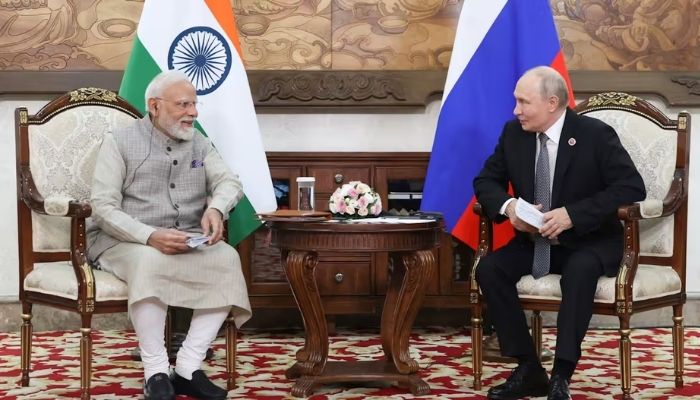
The renewed Russian pitch comes amid a fresh meeting between Prime Minister Narendra Modi and Russian President Vladimir Putin in Bishkek on Monday, 31st August, with the two leaders also expected to meet again in New Delhi. NDTV’s Shiv Aroor contends that, for Moscow, the discussions are an opportunity to build on decades of defence cooperation, even as India increasingly looks towards other suppliers and its own defence industry.
S-500 Prometheus Su-57 Felon
Can confirm that Team Putin is pushing 2 big weapon packages as prestige projects to take India-Russia defence ties to the next level.
The S-500 Prometheus is being presented by Russia as the next major step in its air and missile defence cooperation with India. Moscow’s pitch comes after the S-400 systems already inducted by India gained significant attention during Operation Sindoor last year.
India deployed its Russian-made S-400 systems against Pakistani aerial threats during the operation. An S-400 system was also reported to have brought down a Pakistani airborne early warning and control aircraft from a very long range, further strengthening the system’s reputation within the Indian military.
Russia appears keen to build on that experience. Just a day before the Modi-Putin meeting in Bishkek, Moscow reportedly submitted a proposal to supply India with five additional S-400 squadrons. If accepted, the deal could potentially double the number of squadrons already contracted.
However, the S-500 proposal is not a straightforward decision for India. New Delhi is already working on its own long-range air defence capabilities. Project Kusha is being developed as an indigenous system in the S-400 class, while India’s ballistic missile defence programme is also at an advanced stage.
This means India will have to examine whether the S-500 would fill an actual capability gap or simply overlap with systems that the country is already developing. Any purchase would also have to be considered in the context of India’s growing push for defence self-reliance.
Su-57 offer comes amid IAF fighter shortage
The second offer from Moscow is even more complicated for India. Russia’s second offer is the Su-57 Felon, its fifth-generation stealth fighter. The proposal comes at a time when the IAF is struggling with a shortage of fighter squadrons and India’s indigenous Advanced Medium Combat Aircraft (AMCA) is still years away from becoming operational.
Russia has indicated that technology transfer, greater localisation and even production in India could be part of a potential Su-57 arrangement. The IAF has also considered the Russian offer, with the aircraft being viewed as a possible “stopgap” until the AMCA becomes available.
That, however, highlights the difficult choice facing India. If New Delhi waits for the AMCA, the IAF could be left without an indigenous fifth-generation fighter for several years. But importing the Su-57 would bring its own financial, logistical and strategic complications.
The urgency has increased because India’s neighbours are also moving ahead with stealth aircraft. China is believed to have more than 500 J-20 fighters, while Pakistan is expected to receive Chinese J-35 fifth-generation fighters. This leaves India facing a difficult question: should it wait for the AMCA or acquire a foreign stealth fighter as an interim solution?
Another fighter type could add to IAF’s burden
Introducing the Su-57 would also add another aircraft type to an already diverse IAF fleet. India’s frontline fighter inventory includes the Russian Su-30MKI and MiG-29, French Rafale and Mirage 2000, Anglo-French Jaguar and indigenous Tejas.
Every new aircraft comes with its own requirements for pilot training, maintenance, spare parts, weapons, infrastructure and logistics. The Su-57 could therefore increase the complexity of fleet management at a time when the IAF is already trying to simplify and modernise its combat aircraft inventory.
There is also an uncomfortable history behind Russia’s current offer. India and Russia had earlier worked on the Fifth Generation Fighter Aircraft (FGFA) programme, which was intended to develop an Indian version of the aircraft that eventually became the Su-57. The project was eventually abandoned.
Russia is nevertheless offering India a wider package of defence cooperation. This includes the Voronezh strategic early-warning radar, which is designed to detect ballistic missile launches and other threats over very long distances. Moscow is also looking at upgrades for India’s large fleet of Su-30MKIs in cooperation with Hindustan Aeronautics Limited (HAL), along with modernisation of India’s Russian-origin Kilo-class submarines.
Russia faces growing competition in India
Moscow’s renewed push comes as India has spent years deliberately reducing its dependence on a single defence supplier. The country is increasingly buying military equipment from the United States, France, Israel and other partners while also investing heavily in domestic production.
The recent move towards procuring American Javelin anti-tank guided missiles, following a process that has lasted around 16 years, is one example. India is also moving towards a major additional purchase of 114 Rafale fighters from France.
At the same time, India’s own defence industry is becoming a stronger competitor. Programmes such as Tejas, AMCA, Project Kusha and the indigenous ballistic missile defence system reflect New Delhi’s long-term effort to build critical military capabilities domestically.
Still, Russia has one major advantage that newer suppliers cannot easily match. Decades of military cooperation have left Russian-origin equipment deeply embedded in India’s armed forces. Russian fighters, tanks, submarines, helicopters, missiles and air defence systems continue to form a significant part of India’s military inventory. Their maintenance, upgrades and eventual replacement will continue to create opportunities for Moscow.
The final decisions on systems such as the S-500 or Su-57 will not be made personally by PM Modi and Putin. However, political direction from the two leaders has historically helped push major India-Russia defence projects forward.
The latest Modi-Putin engagement is therefore about more than the familiar display of close ties between the two countries. Russia is trying to retain its position in India’s changing defence landscape at a time when Western suppliers and India’s own defence industry are competing for a larger share.
For India, meanwhile, the choices are becoming increasingly difficult. It must decide how much more foreign air defence capability is required when indigenous systems are moving closer to deployment. At the same time, the IAF must determine whether it can afford to wait for the AMCA while China and Pakistan rapidly expand their fifth-generation fighter capabilities.
“Murakh Hriday na chet ko, jau guru milahin Biranchi sam”. This couplet by Goswami Tulsidas means that a foolish heart does not gain wisdom even with a master as great as Lord Brahma. Such has been the story of Bollywood entertainer Swara Bhasker, who had stirred a row in 2018 with her “I felt like reduced to a vagina” open letter to Sanjay Leela Bhansali, the maker of the film Padmavat, over the Jauhar climax. Despite being told why her assessment of Jauhar was wrong, Swara Bhasker has reiterated her retarded take on Jauhar.
Swara Bhasker suggests Rajput women should not have committed Jauhar, as rape by Muslim rulers would not have meant the end of their lives
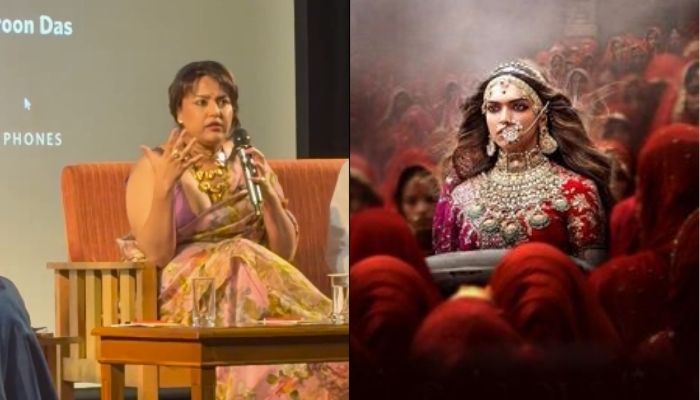
Speaking at the India International Centre event in Delhi on 31st August, Swara Bhasker recapped her 2018 open letter to film director Sanjay Leela Bhansali. Bhasker described watching hundreds of Rajput women, led by Rani Padmavati (portrayed by Deepika Padukone), walk into the fire in red as a visually spectacular, musically anthemic and emotions-heavy sequence that left her feeling “reduced to a vagina”.
“I was watching this…all these women committing Jauhar…I was like, you know, if, god forbid, been a rape survivor, what would this film tell me? I would feel like a coward. That I didn’t kill myself to save my honour. Is that what you want to tell in a society like ours, where I feel like anyway there’s a rape epidemic? Is this what you want to tell our survivors? That you don’t deserve to live. That if you were actually honourable before rape, you would have killed yourself,” Swara Bhasker said.
Swara Bhaskar speaks about her letter to filmmaker Sanjay Leela Bhansali on the scene of Jauhar in the movie Padmavat pic.twitter.com/6X4Z0SvFtC
“Are we saying that rape is the end of a woman’s life? I was particularly disgusted over the close-up scene of a pregnant woman’s belly, and she is heading towards the massive funeral pyre…you’re telling that the foetus that might be female doesn’t deserve to be born because she might be raped by a Muslim ruler? I was so mad. I came out…I wrote that letter, but The Wire made ‘felt like vagina’ its headline…” Bhasker added.
Swara Bhasker was wrong about Jauhar then, is wrong now
Swara Bhasker’s remarks are a reiteration of her 2018 open letter that contended that film Padmavat treats Jauhar as the honourable and dharmic choice rather than a ‘tragedy’. She describes the spectacular and courageous depiction of Jauhar by Rajput women as ‘glorification’ of a ‘misogynistic practice that somehow denies women individuality and personhood, in addition to the denial of the right to live after rape.
Bhasker made a 14th-century practice driven by necessity, about presentism and genital politics.
There is no doubt that a rape survivor has the right to live and live with dignity in society. Nobody expects a rape survivor to or forces them into committing Jauhar or self-immolation. The Jauhar climax of Padmavat did not send any message to the rape survivors in present times to commit self-immolation or kill themselves.
If we analyse Jauhar not with a reductive understanding but with a complete understanding of the context, then and only then would one be able to comprehend that Jauhar was not a regressive practice stripping women of their right to live.
Jauhar was not a random ‘purity’ ritual. Hindu women committed Jauhar during sieges when Rajput Hindu men had fallen against barbaric and bloodthirsty Islamic invaders like Alauddin Khilji. For Islamic barbarians, rape and sexual enslavement of non-Muslim women was a way of boasting religious dominance over Kafirs persistent humiliation of the faith of Kafirs, Hindus in this context.
The Scene which saved whole movie!!
Bhansali really fucked up in "Khilji vs Ratan Singh" climax fight scene but then this Jauhar scene saved film
"Hindu women preferred to die with dignity than to be devou®€d by mlechchhas
For Rajput women, the alternative was capture by invading Islamic fanatic armies, repeated mass rapes, enslavement in harems, forced conversion to Islam, and total stripping of their individuality and dignity, if they managed to survive the horrific cycle of repeated rapes.
What even makes Swara Bhasker think that Khilji’s campaigns were some polite occupations, that Islamic barbarians would take Kafir women as war booty in accordance with the Islamic concept of Maal-e-Ghanimat, rape them once, and then tell the rape survivors that ‘see we raped you, but this is not the end of your life’?
In fact, Rajput women not committing Jauhar and letting Muslim barbarians led by Alauddin Khilji would have amounted to them being reduced to a vagina. From the medieval era of Islamic invasions, destruction and rapes, to the present times wherein the fifth- or sixth-generation descendants of Hindus forcibly converted to Islam by Muslim invaders continue to harbour the dream of bringing back the era of enslaving Hindu women, throwing them in harems as concubines.
OpIndia has reported earlier how a section of Muslim men openly uses various social media platforms to express their rape fantasies involving Hindu women and even Hindu goddesses. They create images showing Hindu women wearing explicit religious markers like Sindoor, Mangalsutra, Bindi, Om tattoos or lockets, in intimate positions with Muslim men wearing Islamic skullcaps.
The online Muslim perverts pick images and videos of those actresses who have portrayed Hindu Goddesses in TV dramas based on the Mahabharat, Puranas or Ramayana, with their religious-sexual degradation-laden captions.
This Islamist mindset that women are mere objects for sexual pleasure and infliction of humiliation on Kafirs and their faith is what actually reduces women to just a vagina.
However, one cannot expect a performative ‘feminist’ like Swara Bhasker to criticise or question the Islamist mindset that reduced women, be it in the medieval era of Islamic invasions or modern times, to mere objects, rather, a vagina.
In 2024, Swara Bhasker and her Muslim husband Fahad Ahmed met Islamic cleric Sajjad Nomani, who publicly declared that sending girls to schools and colleges alone is forbidden (Haram) in Islam. The Taliban-loving maulana also opines that Muslim girls were somehow giving up on purdah and modesty and urged parents not to send their daughters to schools and colleges.
Rajput women embracing death of their choosing over the fate of being reduced to a sex slave of a foreign barbarian and losing their bodily autonomy was, as Bhansali rightly described, an act of war. Swara Bhasker or any ‘feminist’ treating this difficult but necessary choice as ‘nothing more than patriarchal vagina-policing’, its either indifferent to the civilisational stakes that Hindus in that time actually faced, or harbours a fetish for sexual enslavement.
Film Padmaavat released in 2018, would Swara Bhasker enlighten the world about how many rape survivors have since, watched the movie and committed Jauhar or self-immolation?
In contemporary times, the ISIS has been doing to Yazidi women what Islamic barbarians like Khilji wanted to do with Rajput women in the 14th century. During the 2014 Yazidi genocide, the Islamic terrorists belonging to the ISIS subjected Kafir Yazidi women to systematic, widespread sexual violence, enslavement, and torture.
There are documented accounts from aid workers and survivors indicating significant spikes in suicides among rape survivors and displaced women as they could not withstand the physical and psychological trauma inflicted by the horror they endured.
In the book The Last Girl by an ISIS survivor Nadia Murad, she described her experience as a “slow, painful death – of the body and soul”. Murad recounts that she was subjected to repeated rapes, humiliation and torture, including her body being burnt with cigarettes. She also mentions that many women captives killed themselves.
During the Yazidi genocide, numerous Yazidi women and girls chose to take their own lives, either by hanging, slitting their wrists, or jumping from buildings to escape impending rape, perpetual torture, and sexual slavery. Would Swara Bhasker sermonise to Yazidi women that the continuous cycle of rape and torture by ISIS Jihadis is not the end of their lives? Would she call their decision to embrace death over dying slowly and painfully in instalments every day ‘cowardice’?
Back in 2010, Tunisian street vendor Tarek al Tayeb Mohamed Bouazizi set himself on fire to protest police harassment, corruption, and the seizure of his cart. Bouazizi was not a coward; he knew that he lacked the resources to wage a fight against his oppressors alone. He thus chose the path of self-immolation in public to awaken the hibernating conscience of society. While Bouazizi died outside a government building due to self-immolation, he lit the fire that triggered the Arab Springs. If Bouazizi was a coward, by Swara Bhasker’s logic, would the European Parliament award him the Sakharov Prize posthumously in 2011? Would she turn his sacrifice into a paralogistic debate about his right to live?
A film about 1303 Chittor is not going to restart Jauhar in 2026. Swara Bhasker’s ‘vagina-only’ rhetoric is disgustingly reductive and is aligned with the broader Islamo-leftist pattern of critiquing the response of Hindus to Muslim atrocities as bigger problem than Muslim atrocities themselves. Basically, horrific action by Muslims is not subjected to criticism and scrutiny, but courageous self-defence by Hindus is labelled ‘misogynistic’, ‘cowardice’, ‘regressive’ and whatnot.
Honour, community survival, religious identity, and refusal of Hindu women to become trophies are not synonymous with being reduced to just a vagina. In fact, reducing the entire decision of committing Jauhar to genital ownership reflects the very objectification Swara Bhasker claims to oppose.
While suicide by any means is not encouraged in present times for rape survivors or anyone, in an era where Islamic barbarians weaponised sex slavery as a means of asserting religious dominance and humiliating enemies, Jauhar was not ‘cowardice’; it was not an escape, but a protest that demanded sacrifice.
The medieval era was not like modern times wherein women have the option to approach the police and seek legal remedy against their rapists; they lived in an era of siege warfare, wherein the fall of their dynasty in a war against Islamic barbarians meant total executions, destruction, plunder, subjugation, religious conversions, and mass rapes. Applying 21st-century individualist feminism to a medieval-era siege warfare-resulted decision is totally anachronistic.
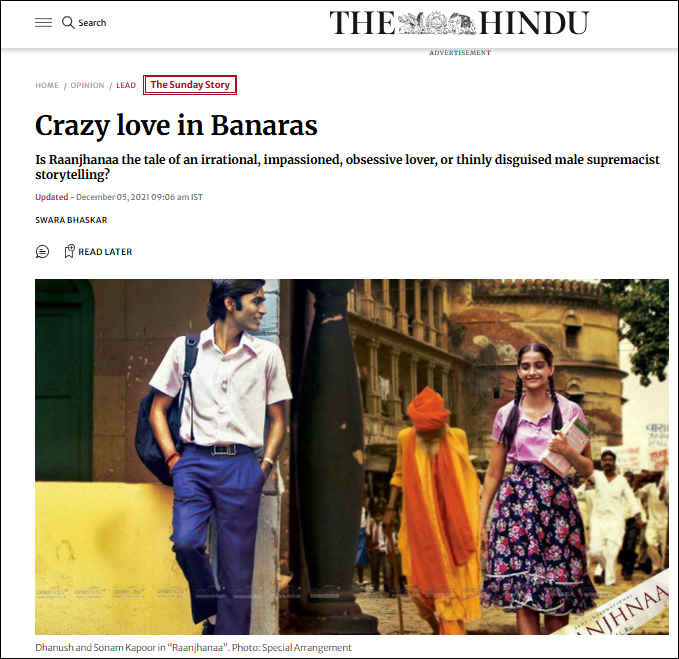
Hypocrisy comes naturally to performative feminists like Swara Bhasker. In 2021, she wrote an op-ed for The Hindu wherein she described the 2013 film Ranjhana as an “unapologetic celebration of crazy love”, even as the film glorified stalking and destructive one-sided obsession and portrayed the stalker, Kundan, as a tragic hero.
India International Centre and its knack for platforming Hinduphobic Islamo-leftists
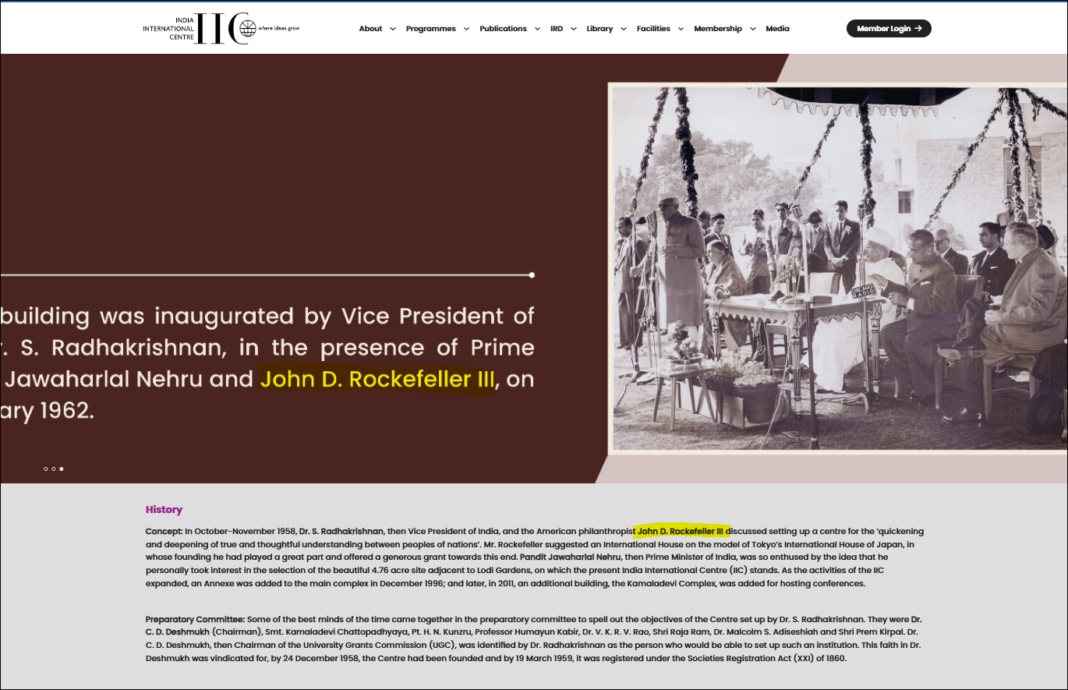
The India International Centre has long been in controversy over platforming notorious Hinduphobes and Islamo-leftists. Although the India International Centre, Delhi, is an NGO, it has been heavily supported and involved with the Indian Government since its inception in 1958 (Nehruvian-Congress era of politics).
Interestingly, the India International Centre was founded & funded by the Rockefeller Foundation. The Rockefeller Foundation & Rothschild Foundation are partners in many projects.
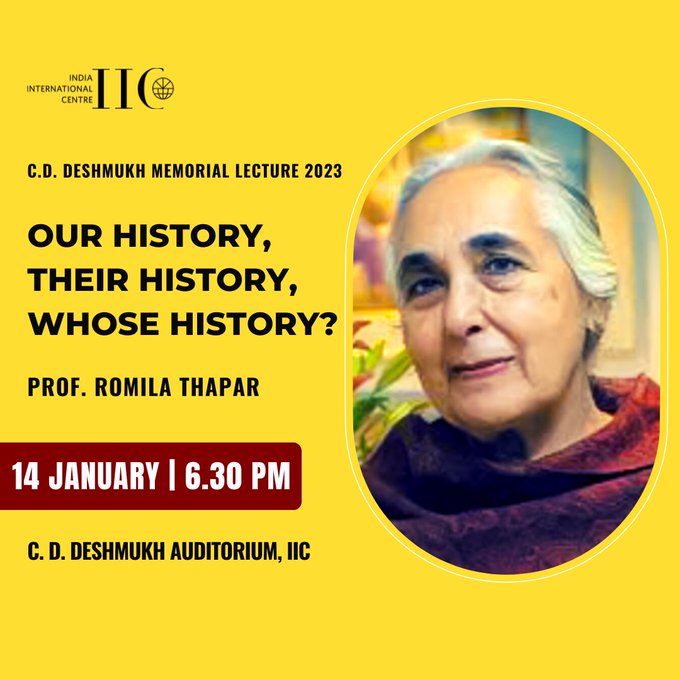
The IIC’s ‘About’ section lists its past and present Presidents, Vice Presidents, Life Trustees and Trustees mostly belonging to the elite coterie of ‘Lutyens’ and Khan Market cabal. The NGO hosts an annual C.D. Deshmukh Memorial Lecture on the birth anniversary, which is 14th January, in memory of its Founder President, C. D. Deshmukh.
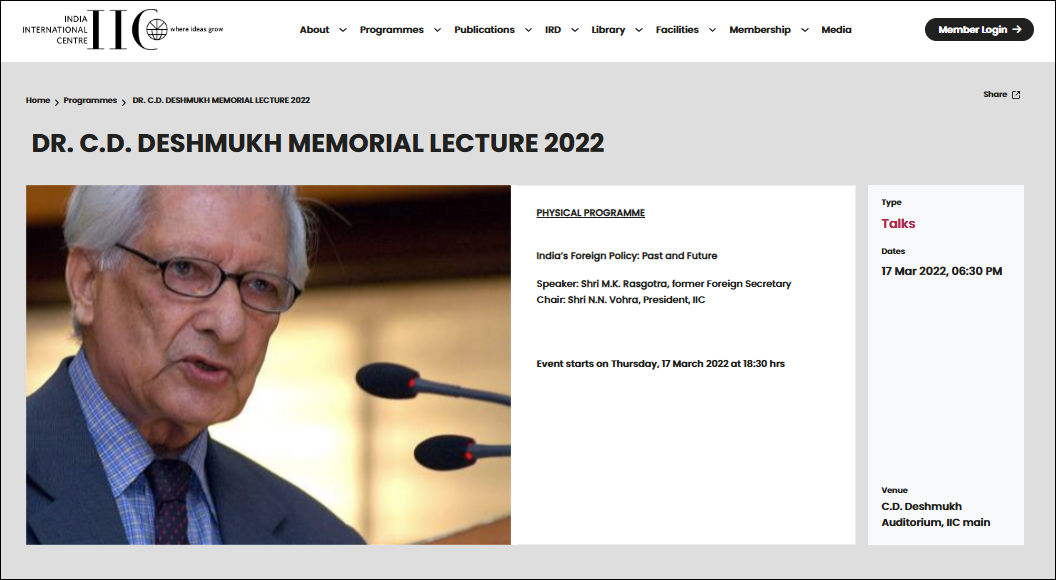
In 2022, the IIC invited MK Rasgotra, who was the Foreign Secretary during the Bhopal Gas Tragedy, who secured the release of accused Warren Anderson. Ironically, he spoke on “Foreign Policy: Past and Future”.
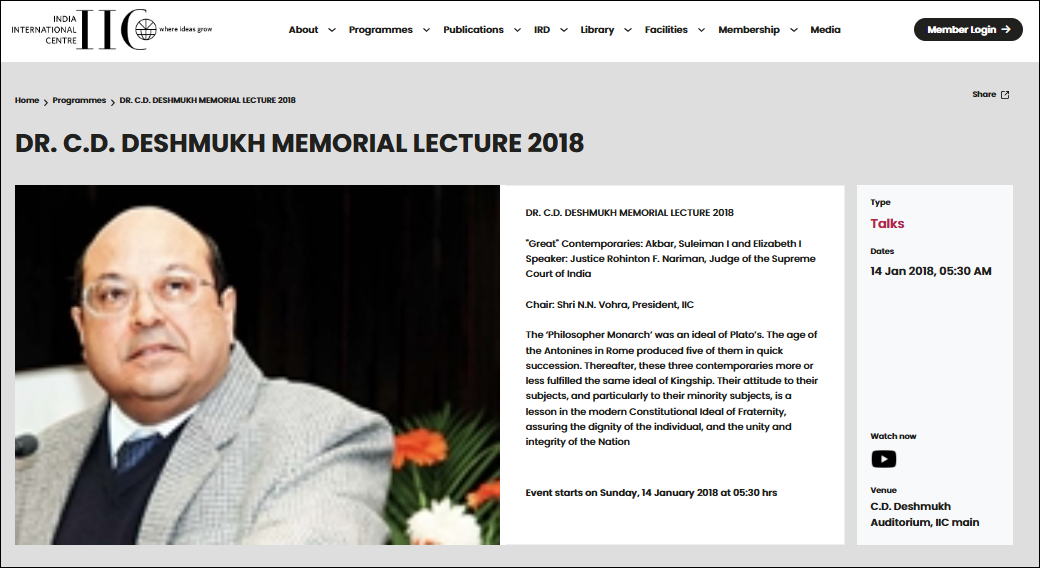
In 2018, the IIC invited Rohinton F. Nariman, who passed incorrect remarks on the Rig Veda & termed Babar and Akbar as secular. He spoke on, hold your breath, “Great” Contemporaries: Akbar, Suleiman I and Elizabeth I.” OpIndia has earlier reported on Nariman’s anti-Hindu comments over the years.
Back in 2012, the IIC invited judge B. N. Srikrishna, whose Srikrishna Report on Bombay riots of 1992-93 dragged on for more than 5 years and blamed the Shiv Sena as being largely responsible for it, to deliver a “Beyond Federalism” speech.
In fact, the IIC’s President Shyam Saran himself is a well-known Congress supporter & Nehru dynasty loyalist. In 2020, he criticised Prime Minister Modi for attending the Ayodhya event in an article in the Business Standard newspaper.
In 2023, Shyam Saran invited the infamous “distorian”, Romila Thapar, for a C.D. Deshmukh Memorial Lecture on “Our History, Their History, Whose History?” It claimed that there was some ‘current crisis that has engulfed the teaching and writing of history as reflected in the new syllabuses for educational institutions of all levels’.
Unsurprisingly, back in July 2021, when an IIC member, Dr Daksh Lohiya, requested that a colloquium be hosted by Indic scholar Sandeep Balakrishna to mark the centenary of the Moplah massacres, but lo & behold, the IIC refused to allow it even as a ‘private event’.
Marxist historiography in India emerged to defend the idea of Muslim separatism. It grew alongside the demand for a separate Muslim homeland. The Muslim League under Mohammad Ali Jinnah argued that if Muslims were not given a state of their own, the Hindu majority would sweep them away after the British left India. After the partition, over 3.5 crores of Muslims were left in India. Either they lacked the means to move from across India to Pakistan, or they did not want to leave their hearths and homes, built by their ancestors. Roughly 75 lakhs of Muslims left India for Pakistan.
The partition did not solve India’s Muslim problem. However, it provided a springboard for Marxist historians. They became their spokespersons. They tell us that those Muslims who did not migrate were as much Indians as their Hindu neighbours, thereby repudiating the two-nation theory. By this logic, the concessions given to them should not be withdrawn as a reward for their staying back.
The Congress party had made several compromises with Muslims to avoid being labelled a Hindu party. In 1937, for example, the party decided to chop off three stanzas from Vande Mataram, because Muslims found the verses sacrilegious. However, the effort to attract Muslims was unsuccessful. The 1937 and 1946 provincial elections showed that Muslims favoured the Muslim League rather than the Congress.
The failed compromises made towards Muslims to win them over to the Congress during colonial times persisted in independent India, and the very ideas that fuelled Muslim separatism received constitutional recognition. Vande Mataram should have been restored in its entirety, but the song continued in truncated form, with the same argument that Muslim sentiments were frayed by the full song.
Muslims continued to have their way, both in colonial India and in free India. The competitive compromises became a test of secularism.
As these events were unfolding, Marxist historians were quietly laying the groundwork to justify the concessions made to Muslims. Mohammad Habib of Aligarh Muslim University had turned to Marxism after the Anglo-Soviet Pact of 1941. Previously banned communist literature was allowed to enter India, and Habib was among the early influential converts. He was the first to propound the notion (Sultan Mahmud of Ghazanavi, 1927) that Muslim rulers of medieval India razed temples out of avarice and greed and that they had no religious duty to do so.
Habib was a friend of the Nehrus. He was a protégé of Motilal Nehru, as the Swaraj Party had roped him in to contest the 1926 elections from a reserved constituency. The ideas Habib set out in his 1927 monograph on Mahmud were echoed in Jawaharlal Nehru’s The Discovery of India (1945), where he described Mahmud as ‘far more a warrior than a man of faith’, interested in ‘encouraging cultural activities’, and, if he broke temples, it was mainly ‘to carry off building materials’ to his home town to erect big buildings.
After Nehru became prime minister, he relied on Marxist historians to justify his pro-Muslim policies. However, merely criticising colonial and nationalist historians was not enough; Marxist historians needed to develop theories to support their claims. Nehru had given them ample clues. The first praxis was to demand that class become the organising principle in India with socialism as a state goal.
In his presidential address to the Indian History Congress (1947), Habib called upon historians to use their pens to fashion a society based on class:
Most writers of Indian history in the past, it has to be frankly confessed, have belonged to the ‘bourgeois culture group’, and this fact has inevitably coloured their vision. Modern works on Indian history (show) their attitudeof uncriticall adulation towards the higher classes… The tendency towards socialism will gain in weight and volume as with every succeeding year the working classes strive to come to their own. The historian must not fail to do his duty (to lead India) to the shrine of her new-found, classless God.
The notion of class was as academic as it was political. Historians and leaders such as Nehru have increasingly argued that a class-based society had fewer fault lines, for poor Muslims and poor Hindus had more in common with each other than with an affluent Hindu. This would also help Hindus to seek more common ground with Muslims, and the horrendous past of Islam in India would pose no hindrance.
The second praxis is to explain Muslim presence in India after the partition. Romila Thapar took the lead here. She accused colonial historians of painting a bleak communal situation in India to perpetuate their stranglehold. In her essay, Communalism and Ancient India History (1969), she says:
The creation of Pakistan did not, however, solve the problem for the communal historian. The Hindu communalist still has to contend with the reality of Muslim culture. Hence the attempt to either belittle its importance or emphasise its foreignness.
According to her view, the past was not negative; Muslim rulers generally did not demolish temples. While there were some exceptions, things were mostly fine. Muslim governance rarely affected ordinary people’s lives. If Muslim rulers are criticised, it should also be noted that Hindu rulers destroyed temples and places of worship of other faiths. So, Hindus must not complain, for they themselves had blood on their hands.
Accusing Hindus, especially nationalist leaders, for the partition is the third praxis. Therefore, they insisted that it was Hindus who had cornered Muslims so much that they felt staying back in India would annihilate their culture and religion. It was Hindus who were originators of the two-nation theory, and the demand for Pakistan by the Muslims was an attempt to escape the inevitable Hindu rule. These historians plucked statements from Bankim, Tilak, Savarkar, and the shuddhi movement, and amplified them to provide cover for the prime accused.
Right after the British took over India, half a dozen orthodox Muslim organisations sprang up with the singular aim of weaning Muslims away from the social corruption that had become ingrained in them through their contacts with Hindus, and of driving away the new colonisers to hark back to the golden age of Islam in India. Syed Ahmed Khan chiefly put these orthodox concerns in language the British could understand.
There is plenty of literature to support the claim that the idea of Muslim separatism dates to the 1870s. But these documents, which contain unmistakable evidence of the Muslim skulduggery, have been hailed by Marxist historians as a colonial ploy to divide Hindus and Muslims.
A general survey of Marxist historiography in India substantiates that it has unabatedly offered its services to Muslim fundamentalism. The indomitable Sita Ram Goel has rightly (Stalinist Historians Spread the Big Lie, 1993) described their alliance:
Islam has never learnt to argue its case with facts and logic. All through its history, it has relied on the sword and street riots. In India, it used the sword for several centuries. After the loss of its political power, it has relied on street riots. The weapon has yielded and continues to yield rich results. It is, therefore, not an accident that Islam in India has always left it to Stalinists to argue its case.
The author’s latest book, India’s Rogue Historians (2026), explores Marxist historiography with reference to the Ram Janmabhoomi.
The Tamilaga Vettri Kazhagam (TVK) party swept the Tamil Nadu state assembly elections earlier this year, defeating the incumbent Dravida Munetra Kazhagam (DMK) government. The party led by actor-turned-politician Chandrashekhar Joseph Vijay, popularly known as Thalapathy Vijay, promised politics and policies different from conventional political parties; however, just four months in power, the CM Vijay-led government appears to be following the disastrous path of freebies and appeasement.
Free tuition for Muslim undergrad girls, Waqf scholarship expansion: Vijay government resorts to Muslim appeasement
The Congress-ruled Himachal Pradesh, erstwhile Aam Aadmi Party-ruled Delhi, and the AAP-ruled Punjab perfectly exemplify how unrealistic freebies exacerbate economic crisis, empty the state exchequer, and overburden the state with high debt. Despite the present cases, the TVK government led by CM Joseph Vijay is announcing religion-specific schemes.
On 27th August, the Minister for Minorities Welfare A M Shahjahan announced that the state government will cover the full Under-Graduate tuition fees for Muslim female students admitted under the government quota in government, government-aided, and self-financing colleges.
For this, the ministry has made an initial allocation of ₹20 crore.
Minister A M Shahjahan also announced the expansion of the Tamil Nadu Waqf Board scholarship for Muslim girls, from Classes 1-8 to Classes 9-10 at ₹2,000 per year. The scheme is expected to benefit 41,384 Muslim schoolgirls at a cost of Rs 8.28 crore.
A M Shahjahan said, “To further promote higher education access in the capital, the Tamil Nadu Waqf Board will establish a new dedicated Minorities Women’s Arts and Science College in Chennai with a starting grant of Rs 2.45 crore. The state will set up a Rs 100 crore revolving fund to offer interest-free loans aimed at developing income-generating assets such as commercial complexes and marriage halls on Muslim Wakf and Christian religious properties”.
An announcement has also been made about a ‘minorities’ women’s college in Chennai through the Waqf Board, with an initial grant of ₹2.45 crore.
Questions are rightly being raised: are only Muslim girls in need of financial support for their education? Are all Hindus in the state too rich to require state financial aid for the education of their daughters?
Why is the Vijay government providing full tuition fee support only for Muslim girls under the government quota rather than a means-tested expansion of higher-education support for all the girls regardless of their religion?
Why do Muslims get special treatment based on faith, while Hindus and others don’t? Doesn’t this mean that Muslims are being rewarded for being Muslims and the State is incentivising conversion to Islam in a way? Doesn’t this sort of religion-based policymaking amount to the State recognising Islam as a preferred religion, if not an official State religion?
It won’t be surprising if in the near future the government starts rewarding Muslim ‘minorities’ for even attending college.
A significant portion of the state’s wealth comes from Hindu taxpayers and temples. And yet, Hindus are neglected in such welfare schemes merely because of their faith and population size.
TVK government announces ₹100 crore revolving fund for Waqf and Christian properties, Waqf Board HQ construction
The Vijay government in Tamil Nadu has also announced a ₹100 crore interest-free revolving fund for loans to develop income-generating assets like marriage halls, commercial complexes, etc. on Muslim and Christian properties.
In addition, the state government will also construct a new headquarters for the Tamil Nadu Waqf Board at an estimated cost of ₹40 crore.
Moreover, reports say that the administrative grant for the state Waqf Board will be raised to ₹5 crore.
TVK’s expensive one-gram gold ring poll promise for babies born in government hospitals to add a new burden to the state exchequer
The most expensive promise made by TVK in its election manifesto was to give 8 grams (one sovereign) of gold to babies born in government hospitals. After forming the government, CM Vijay has crafted the Thaimaman Thanga Mothiram scheme to give a 1-gram 22-carat gold ring to eligible newborn babies of state residents, delivered in government hospitals.
This expensive freebie will be provided with an annual allocation of ₹756 crore for roughly 4.42 lakh rings. Applying from 22nd June 2026, the birthday of CM Vijay, and it will be formally launched on 15th September.
Vijay government dropped Chennai’s second airport
Portrayed as the ‘super CM’ and the ‘real-life Shivaji Rao from Nayak film’ in Instagram reels, CM Vijay is too busy squandering state funds to appease Muslims that he is apparently indifferent to the fact that Tamil Nadu’s overall debt stands at ₹13.18 lakh.
Recently, the Vijay government cancelled the Parandur greenfield airport project that was advanced under the previous DMK government even as land acquisition was already underway. With this, the TVK fulfilled its poll promise to the protesting farmers.
Notably, Chennai is in dire need of a second airport because passenger traffic and cargo movement are increasingly outpacing the capacity of the existing Chennai International Airport in Meenambakkam.
Currently, the Chennai International Airport handles about 30 million passengers every year. While future upgrades can raise capacity to around 35 or 55 million passengers, it would only be a medium-term fix.
Industrial growth and increasing travel demand will fully saturate the current facility in the near future. Thus, there is a serious need for a second airport.
By cancelling the Parandur airport project, which advanced to the stage of land acquisition after years of planning and clearances, CM Vijay essentially pushed Chennai’s second-airport project back to the initial site-selection phase.
Calling the cancellation a “setback that further delays Chennai’s quest for a world-class airport”, the Confederation of Real Estate Developers’ Associations of India’s (CREDAI) Chennai chapter said that Chennai is at risk of losing big investments, industrial relocation and talent to other competing hubs which already have better aviation infrastructure.
While the Vijay government has confirmed that the second airport project has not been fully abandoned and a search for an alternative site is ongoing, finding an alternative site, its feasibility tests, land acquisition, and environmental clearances from the Airport Authority of India (AAI) would take years before the construction could even commence.
White paper on Tamil Nadu Electricity Board’s health revealed ₹2.47 lakh crore outstanding debt, yet TVK says freebies shall be dolled out uninterrupted
In late June 2025, the Tamil Nadu Electricity Minister CTR Nirmal Kumar released a white paper on the condition of the state’s electricity board. The document stated that Tamil Nadu’s power sector carries an outstanding debt of Rs 2.47 lakh crore.
The total debt of Tamil Nadu’s power sector has exceeded Rs 2,47,130 crore. This accounts for 77.6% of the total debt accumulated by Tamil Nadu’s public sector undertakings, the white paper states.
The power sector-specific white paper was released days after the TVK government released a broader white paper revealing that the state overall debt stands at Rs 13.18 lakh crore.
Despite the massive debt burden, the TVK government said that there will be no electricity tariff hike and that the electricity scheme for farmers would continue.
This came despite the government’s own admission that the state’s power distribution company, the Tamil Nadu Power Distribution Corporation Limited (TNPDCL), is facing a “persistent monthly structural” cash shortfall of ₹2,500, which results in the annual liquidity gap of about ₹30,000 crore, financed via short-term borrowings, delayed payments to power purchase counterparties, and deferred capital expenditure.
Free cylinders, bus travel for women and more: For TVK, freebies are the way
In late August 2026, CM Joseph Vijay announced three free LPG cylinders a year for every family with an annual income below ₹2.5 lakh, under the Annapoorni Super Six scheme. While the scheme is likely to benefit 1.30 families, it will cost the state exchequer over ₹4,000 crore annually.
Moreover, the Tamil Nadu CM also announced free bus travel for transgender persons. CM Vijay also expanded the scope of the ‘Vettri Payana Thittam’ scheme for women. Now, women will not only be allowed to travel for free on ordinary buses but also on Express, LSS and Deluxe services.
Tamil Nadu’s financial health is deteriorating, but the Vijay government is prioritising freebies and appeasement
In June this year, the TVK government released a financial white paper. It covered the period from 2021-2022 to 2025-26. The document revealed that the total debt of Tamil Nadu has reached ₹13.18 lakh crore, including ₹10 lakh crore in direct state borrowings and ₹3.18 lakh crore in public sector undertaking (PSU) liabilities.
The per capita burden has also risen, with every Tamil Nadu resident effectively carrying a debt share of nearly ₹1.29 lakh.
Meanwhile, direct state debt has also nearly doubled from ₹5.13 lakh crore in April 2021 to about ₹10 lakh crore by March 2026.
The state’s revenue deficit, as per the white paper, has also hit a record high of ₹78,324 crore, making up to nearly 2.2% of the GSDP. In addition, the annual interest payments crossed ₹67,050 crore, surpassing the state’s total capital expenditure.
Despite the alarming numbers, the Vijay government is prioritising freebies and Muslim appeasement.
Indifferent to the struggling economy and an emptied state exchequer, the Congress government in Himachal Pradesh promised free electricity, monthly financial assistance for women, restoration of the Old Pension Scheme, government jobs and several subsidy-based schemes.
Following the initial chest thumping, now the situation for the government is such that it is trapped in the spiral of borrowing, higher charges, reduced subsidies or new taxes and cess. The Congress government in Himachal Pradesh called on even Hindu temple trusts to contribute funds towards welfare schemes. A notification encouraged temple trusts to provide money for programmes including the Mukhyamantri Sukh-Aashray Yojana and Mukhyamantri Sukh Shiksha Yojana.
After Congress’s ‘Khatakhat’ model of freebies destroyed the economy, the Himachal government is inventing unique cesses and taxes.
Similar is the state of affairs in AAP-ruled Punjab wherein outstanding liabilities have crossed ₹4.5 lakh crore, a debt-GSDP ratio around 44-46%, one of the highest in the country; in addition, the state is also struggling with revenue and fiscal deficits, and surging debt-servicing costs.
While Punjab’s plunge into the bottomless quagmire of economic crisis cannot solely be blamed on the AAP government, despite the financial challenges and dependence on borrowing, the AAP government doled out several freebies, including 300 units of free electricity.
Besides freebies, the AAP government in Punjab has also been accused of squandering taxpayers’ money, essentially the funds from the state exchequer for needless advertising and even for AAP’s electoral victory marches. Now the situation is such that the AAP government is struggling to clear even the Dearness Allowance of state employees and is playing delay tactics.
Tamil Nadu also runs a structural revenue deficit, with a massive share of its revenue already going to salaries, pensions, and interest. With new recurring commitments, be it gold rings or minority freebie packages, the Vijay government is overburdening the state.
While the TVK might give political justifications, including compulsion to fulfil poll promises, today’s freebies will tomorrow create an unbearable financial burden for the state’s future generations.
Rahul Gandhi has discovered a new political vocabulary: “Break the cage” and “smash the patriarchy.”
The Congress leader recently told a gathering of young women in Pune that women do not belong to their fathers, husbands or sons, but belong to themselves. He attacked what he called the “Manusmriti mindset” and argued that women must be free to build identities independent of men.
It is a superficially legitimate argument. Women should have agency. They should be free to study, work, participate in public life and determine their own futures.
But there is an obvious question that Rahul Gandhi and the Congress party would rather not answer:
Does this principle apply only when patriarchy can be associated with Hinduism?
Because Kerala has now presented Rahul Gandhi with precisely the sort of test that political slogans are supposed to withstand.
Kanthapuram AP Aboobacker Musliyar, one of Kerala’s most influential Sunni clerics and the tenth Grand Mufti of India, has defended the appalling proposition that women should remain confined to their homes and should not enter the public sphere. He explicitly attributed this position to the Quran and defended the purdah system as a means of preventing what he described as “great destruction.”
He even compared women to gold ornaments that need to be kept safely inside a box.
This was not some anonymous social-media account making an inflammatory post. This was a prominent religious scholar publicly defending a restrictive interpretation of women’s place in society.
And it came days after the Kanthapuram faction of Samastha directed Islamic institutions to ensure that Muslim women and girls do not participate in programmes on stages or in public spaces alongside men.
So where is Rahul Gandhi?
Where is the “smash the patriarchy” campaign?
Where is the lecture about women belonging to themselves?
Where is the demand that women should not be treated as possessions whose movements need to be controlled by men?
The silence is striking precisely because Gandhi has made women’s autonomy and opposition to patriarchal social structures a central part of his recent political messaging.
When discussing Manusmriti, Gandhi was categorical. He described its alleged prescription of women’s subordination as shameful and said the fight was against the mindset that seeks to control women and confine them.
But when a Muslim cleric makes an extraordinarily similar argument about restricting women’s public participation, and explicitly invokes Islam and the Quran, the Congress ecosystem suddenly becomes considerably more cautious.
That is where the charge of selective feminism becomes difficult to dismiss.
Congress’ glaring duplicity exposed
There is an important distinction that needs to be made.
Criticising a regressive interpretation of a religious text is not an attack on every person who follows that religion. Nor does opposing a cleric’s prescription for women require insulting Muslims or denying their right to practise their faith.
In fact, genuine reform requires precisely the opposite: treating Muslims as citizens capable of engaging critically with interpretations of their own religious traditions.
If Rahul Gandhi is justified in criticising Manusmriti over purportedly discriminatory provisions against women, then he should also raise his voice against provisions or verses in the Islamic text that the Grand Mufti of India is citing to defend confinement of women within the four walls of their homes.
In essence, the same intellectual standard that applies to Manusmriti should apply to the Quran when an Islamic cleric cites it to justify keeping women confined to their homes.
Otherwise, “smash patriarchy” begins to look less like a universal principle and more like a political weapon selectively deployed against one religious tradition.
And this is where Congress has a credibility problem.
The party frequently speaks the language of constitutional rights, women’s empowerment, secularism and social reform. Yet when the subject enters the politically sensitive terrain of Muslim personal law or conservative religious authority, its instinct has historically been far more cautious.
The Shah Bano episode remains the most obvious example. After the Supreme Court’s 1985 judgment in favour of maintenance for Shah Bano, the Rajiv Gandhi government enacted legislation in 1986 following intense opposition from sections of Muslim leadership. The episode remains one of the most consequential examples of the Congress party struggling to reconcile its commitment to reform with the demands of organised religious constituencies.
This is precisely why Congress cannot simply dismiss questions about its approach to reform within Muslim society as an attempt to “target Muslims”.
Reform is not targeting a community. Refusing to reform because a community’s religious leadership may be offended is.
Why is Manusmriti fair game, but religious conservatism within Islam treated with kid gloves?
The question Rahul Gandhi needs to answer is remarkably simple.
If a text or its interpretation is being used to tell women that they cannot be independent, should he oppose it?
If the answer is yes, then the principle cannot depend on the religious identity of the person citing the text.
If a cleric says women should stay inside their homes because “the Holy Quran says so”, a politician who has just made “smashing patriarchy” a political rallying cry should have something to say about it.
He could simply say:
No religious interpretation should be used to deny women their constitutional rights, freedom of movement, education, employment or participation in public life.
That would be entirely consistent with the argument he made in Pune.
But that is precisely the uncomfortable part.
It would require Congress to confront conservative Muslim clerics rather than merely invoking women’s rights when criticising Hindu texts.
The Congress’ secularism problem
There is a larger political pattern here.
For decades, Congress has presented itself as the party of secularism. Yet its version of secular politics has often involved treating religious communities differently depending upon the political consequences of confronting their conservative leadership. Minorities, especially Muslims, have often been treated with kid gloves, with Congress leadership often turning a blind eye to Islamic radicalism or contextualising crimes when committed in the name of Islam.
That is not secularism. It is political risk management.
A genuinely secular party should be willing to tell every community the same thing: your faith is your private right, but the Constitution is the common framework within which everyone lives.
If a Hindu priest says women should not work, challenge him.
If a Muslim cleric says women should not appear in public, challenge him.
If a Christian cleric makes a similarly regressive claim, challenge him.
The standard should be the same.
Otherwise, the woman whose freedom is supposedly being defended becomes secondary to the identity of the person restricting her.
And that is the ultimate irony.
Rahul Gandhi has told Indian women that they are not the property of their fathers, husbands or sons. He has urged them to reject a mindset that seeks to confine them and control their choices.
But, he cannot summon the same courage to call out the Grand Mufti of India who has relegated Muslim women to second-class citizens of the country.
A Muslim woman deserves precisely the same freedom.
Not a watered-down version of it.
Not freedom subject to the approval of a religious committee.
Not freedom that disappears whenever a cleric invokes scripture.
If Rahul Gandhi genuinely believes that women belong to themselves, he should have no difficulty saying so when the woman in question is Muslim and the person restricting her freedom is invoking Islam.
That is simply applying the same feminist principle to everyone.
And if Congress is unwilling to do that, people are entitled to ask whether its commitment to “smash patriarchy” is really about women, or whether, once again, electoral arithmetic decides which patriarchy is acceptable to criticise.
From India to the US, the Islamo-leftist cabal is rattled by the New York visit of Rashtriya Swayamsevak Sangh (RSS) chief Mohan Bhagwat. Khalistani terrorists and ‘liberal’ outfits like USCIRF to Democrat politicians, in the last few weeks the Islamo-leftist coterie has demanded US sanctions on the RSS, vilified Mohan Bhagwat and churned out Muslim victimhood propaganda. One of the key politicians to back this anti-RSS/Mohan Bhagwat campaign is Jim McGovern.
On 31st August, Massachusetts’s 2nd congressional district representative, Jim McGovern, published an X post amplifying a propaganda article authored by former USCIRF chairs Stephen Schneck and Nadine Maenza. Jim McGovern claimed that RSS contributed to making discrimination and violence against religious ‘minorities’ mainstream in India.
Demanding accountability from RSS Chief Mohan Bhagwat, Jim McGovern wrote, “Former USCIRF Chairs @StephenSchneck & @NadineMaenza are right: The Hindu nationalist RSS helped make discrimination & violence against religious minorities mainstream in India. Its chief, Mohan Bhagwat, should face accountability—not be given a platform to foment hatred.”
Stephan Schneck, Nadine Maenza, and the anti-India USCIRF
Notably, Stephan Schneck and Nadine Maenza are notorious anti-India propagandists, who contributed to several dubious reports published by the United States Commission on International Religious Freedom (USCIRF).
As USCIRF Commissioner, Stephan Schneck amplified the erstwhile Canadian Trudeau Government’s falsehoods that India was involved in transnational repression, particularly the killing of Khalistani terrorist Hardeep Singh Nijjar.
In 2023, Schneck said that India’s purported part “in the killing of Sikh activist Hardeep Singh Nijjar in Canada and the plot to kill Gurpatwant Singh Pannun in the United States was deeply troubling” in 2023. He added, “We call on the Biden administration to acknowledge the Indian government’s perpetration of particularly severe religious freedom violations and designate it as a country of particular concern (CPC).”
Later, Canada admitted that it had “no evidence” against India or the Indian government in the killing of Khalistani terrorist Hardeep Singh Nijjar.
Similarly, Nadine Maenza, the former Vice Chair of the USCIRF, has also demonstrated her anti-India leanings through her work during her time in the USCIRF and afterwards. Maenza had aggressively pushed for designation of India as a ‘Country of Particular Concern’ (CPC) during her vice chairship in the USCIRF.
During her tenure, Islamist lobbying against India was rampant. Maenza regularly attended anti-India and anti-Hindu events organised by the Indian American Muslim Council (IAMC).
Source: DisInfo Lab’s X handle
The Indian American Muslim Council is reported to have links with the banned Islamic terror outfit, Students’ Islamic Movement of India (SIMI). Besides, the Indian American Muslim Council has ties with Lashkar-e-Taiba (LeT) and Jamaat-e-Islami (JeI) through its founder Shaik Ubaid. The IAMC is a Jamaat-e-Islami-backed lobbyist organisation claiming to be a rights advocacy group.
The IAMC is also accused of collaborating with and even paying money to various groups in the USA to get India blacklisted by the USCIRF. OpIndia has reported on how the IAMC frequently publishes disinformation to peddle Muslim victimhood propaganda against India. The Indian government slapped the IAMC with the UAPA in 2021.
Predictably, the IAMC also backed New York Mayor Zohran Mamdani during his mayoral candidacy. Mamdani, a notorious Hinduphobe, had recently lamented not having the authority to cancel the RSS Chief’s event in the city.
During Nadine Maenza’s tenure as USCIRF Vice Chair, the International Religious Freedom (IRF) Roundtable, an informal alliance of NGOs working closely with the USCIRF, became a hub of anti-India elements.
The IRF Roundtable’s India Working Group was headed by IAMC Advocacy Director Ajit Sahi, HfHR’s Raju Rajagopal, and FIACONA’s John Prabhudoss.
Notably, HfHR was formed in the year 2019 by two Islamist advocacy groups: the IAMC and the Organization for Minorities of India (OFMI). The three organisations had formed another outfit called the Alliance for Justice and Accountability (AJA), which, alongside IAMC, had been at the forefront of leading demonstrations against the visit of PM Modi to Houston on September 22, 2019. HfHR ran Facebook ads to promote previous USCIRF reports.
HfHR chief Sunita Vishwanath, who was pictured alongside Rahul Gandhi, had tried to create hysteria and panic among Indian Muslims about the National Register of Citizens (NRC).
Meanwhile, FIACONA, or the Federation of Indian Christian Organizations in North America, has also been involved in fabricating data on atrocities on Indian Christians and is based in the United States. Founded by one John Prabhudoss, the factually incorrect annual reports by FIACONA, riddled with data duplication and other anomalies, have been cited in several news articles to suggest the increasing marginalisation of the Indian Christian community.
Interestingly, in 2022, Nadine Maenza was awarded by Justice for All for “Advocacy for all, especially Muslims.”
Notably, Justice For All is a Chicago-based NGO, which was recently at the forefront of the anti-RSS and Mohan Bhagwat campaign in the US. The Islamist outfit founded by Pakistani-origin Abdul Malik Mujahid, who had links to the Jamaat-e-Islami Pakistan, even launched an online campaign that urged people to put pressure on the US government to bar Bhagwat from entering the United States.
It is unsurprising that the USCIRF, a US bipartisan body dominated by explicitly anti-India elements, churns out propaganda reports every year, pushing the same ‘Hindu nationalism’, ‘democracy under threat’, ‘Muslim persecution’ bogey, to malign the Modi government, the RSS, and India’s global reputation.
More recently, the USCIRF, helmed by a Pakistan-born American Islamist, Asif Mahmood, actively contributed to the sinister Islamo-leftist campaign in the US to stop RSS Chief Mohan Bhagwat’s Madison Square event.
Jim McGovern: The US politician consistently involved in anti-India activism
Representing Massachusetts’s 2nd congressional district, James Patrick McGovern, commonly known as Jim McGovern, is more invested in championing Islamo-leftist causes related to India than his own country. McGovern has long been spewing venom against the Modi government and the Bharatiya Janata Party (BJP) that violates the limits of constructive criticism. McGovern has on multiple occasions claimed that human rights, religious freedom, and democracy are deteriorating under Prime Minister Narendra Modi’s leadership.
McGovern’s CAA disinformation
In January 2022, Jim McGovern, who co-chairs the Tom Lantos Human Rights Commission, addressed a Special Congressional Briefing called to commemorate India’s 73rd Republic Day.
Jim McGovern claimed that the Modi government has been promoting ‘Hindu nationalist’ policies even as no welfare schemes or any initiative has been launched in over a decade of PM Modi’s government, which exclusively benefits Hindus.
McGovern also claimed that religious freedom and human rights were backsliding. He also amplified the false and alarmist narrative peddled by the Indian Islamo-leftists that the Citizenship Amendment Act, when combined with the National Register of Citizens (NRC) proposal, would institutionalise discrimination against Muslims. This briefing was attended by Hamid Ansari, the former Vice President of India.
Amusingly, this briefing was organised by a coalition of 17 US-based ‘rights’ organisations, including IAMC, HfHr, Sikh Coalition, among others. Most of these organisations have earned notoriety by peddling anti-Hindu and anti-India narratives and indulging in lobbying activities in the US to undermine American Hindus.
“For the first time in 2019, a law was passed that links citizenship to religious identity. There is every reason to fear that this change, combined with the proposal for a National Register of Citizens institutionalizes discrimination against Muslims,” McGovern said.
Relying on the Muslim victimhood propaganda fed by the IAMC and other Islamo-leftist outfits, McGovern peddled alarmist disinformation against the CAA, even as the CAA had a connection with the NRC and had nothing to do with Indian Muslims.
Jim McGovern lied about the FCRA license cancellation of a Christian organisation founded by soul harvester ‘Mother’ Teresa, backed USCIRF recommendation to label India as ‘Country of Particular Concern’
McGovern had also framed the Modi government’s decision to refuse renewal of the foreign-funding license for the Missionaries of Charity, the Christian organisation founded by ‘Mother’ Teresa, as “discrimination against Christians”.
This blatant lie came even though the denial of FCRA license renewal was not an act of discrimination but because the organisation failed to submit some necessary documents. Within days of submitting complete documents, the license was restored.
Backing the USCIRF recommendation for designating India as a “Country of Particular Concern”, McGovern asserted, “The concern about discrimination based on religious identity [was] so great that the US Commission on International Religious Freedom has recommended that India be designated a Country of Particular Concern.”
McGovern criticised India’s UAPA law, but never demanded relaxation of anti-terrorism laws in the US
Jim McGovern also criticised the UAPA and other strict anti-terrorism laws enacted by the Modi government, falsely claiming that such laws are ‘misused’ to target journalists, activists, attorneys, and other civilians.
“This kind of misguided anti-terrorism legislation is not the sign of a healthy democracy. We cannot be silent when measures are taken that discriminate against whole populations or when inflammatory language is used that could incite violence against those populations,” McGovern said in condemnation of the so-called ‘targeting of journalists, activists and other dissenters, under the UAPA and other such laws.
McGovern’s comments came in complete neglect of the fact that journalists, activists, and any civilian, for that matter, are not immune to prosecution over anti-national activities. Those booked under the UAPA and other stringent provisions were not targeted for their journalistic work or activism but for alleged involvement in activities jeopardising India’s national security and/or territorial integrity.
Jim McGovern is a blue-eyed boy of the IAMC and extended Islamo-leftist coterie
In 2016, the IAMC testified before the Tom Lantos Human Rights Commission in Washington, DC, at the hearing titled ‘Challenges & Opportunities: The Advancement of Human Rights in India.’ McGovern echoed the IAMC’s propaganda about discrimination against religious ‘minorities’. McGovern, however, never questioned IAMC’s own lies with the banned Islamic terrorist outfit Students’ Islamic Movement of India (SIMI) and LeT ties.
McGovern cried hoarse over abrogation of Article 370 and 35A
Back in 2019, when the Modi government repealed Article 370 and 35A, discontinuing Jammu and Kashmir’s “special status”, McGovern claimed that India was indulging in “massive human rights violations by detaining politicians, restricting ground access to journalists, and using ‘brute force’ against protestors.”
McGovern was joined by Jamie Raskin, Jan Schakowsky, and Lloyd Doggett in co-sponsoring a House resolution “Urging the Republic of India to end the restrictions on communications and mass detentions in Jammu and Kashmir as swiftly as possible and preserve religious freedom for all residents.”
Jim McGovern advocated for designating India as a ‘Country of Particular Concern’
In June 2025, the IAMC-founded HfHR group member Ria Chakrabarty advocated for designating India as a Country of Particular Concern for religious freedom. At that time, Jim McGovern came out in support of Khalistani separatist terrorist Gurpatwant Singh Pannu, who repeatedly threatened violent attacks against India. He claimed that India orchestrates ‘transnational repression’. The Democrat leader made mention of the anti-India activities of Khalistanis and projected the situation as India ‘persecuting’ Sikhs.
McGovern signed letter demanding ‘fair trial’ for 2020 anti-Hindu Delhi Riots accused Umar Khalid
In January 2026, 8 US lawmakers signed a letter to the Indian government demanding bail and a free trial for Umar Khalid, the accused mastermind of the 2020 anti-Hindu Delhi Riots. Jim McGovern was a signatory of this trashy letter alongside rabid anti-India Islamist Ilhan Omar, Rashida Tlaib, Pramila Jayapal, Jim McGovern, Jamie Raskin, Chris Van Hollen, Peter Welch, Jan Schakowsky, and Lloyd Doggett.
While Umar Khalid’s case is sub judice, the US lawmakers gave their own verdict on Khalid, declaring him innocent. They demanded that Umar Khalid be released from jail. They claimed that the anti-CAA protests were ‘peaceful’ and even painted Muslims as the victims of the anti-Hindu riots in 2020.
Jim McGovern even called the CAA, the provision to grant citizenship to persecuted minorities from Islamic or Muslim-majority neighbouring countries, “fundamentally discriminatory” merely because the law excludes Muslims. McGovern, however, failed to explain how Muslims can be persecuted in Islamic countries for being Muslims.
The letter amplified the Indian Islamo-leftist propaganda that Umar Khalid has been deliberately stuffed in jail without a trial for years. However, Contrary to the false narrative peddled by Islamo-leftists to garner support and sympathy for Umar Khalid, OpIndia has reported earlier that out of the 14 adjournments in 2023 and 2024, 7 delays and adjournments were sought by Umar Khalid himself. It therefore becomes evident that the withdrawal was certainly not due to the famed “delay” in the hearing. While the Islamo-leftists in India and abroad continue to cry ‘injustice’, it is the alleged failed forum shopping attempts of the accused’s lawyer that have Khalid rotting in jail for so long.
Clearly, Jim McGovern is a part of the global Islamo-leftist coterie actively pushing anti-India narratives and contributing to the manoeuvers to tarnish India’s image by relying on fake Muslim victimhood propaganda, ‘minorities under threat’ bogey, and turning a blind eye to the religious hate-driven anti-Hindu crimes.