The Madras High Court rejected a petition contesting the recruitment notice that stated that being a Hindu is mandatory for employment in institutions run by Hindu temples. The High Court ruled that Hindu Religious and Charitable Endowments (HR&CE) Act only permits the appointment of Hindus to positions at a college founded with temple funds alone.
It further declared that the instant such appointees stopped proclaiming to be Hindu, they would be considered to have resigned from their positions. According to the recent ruling by Justice Vivek Kumar Singh, the temple established the college and therefore a religious establishment subject to the HR&CE Act’s regulations.
A. Suhail, a Muslim candidate for the position of Office Assistant at Chennai’s Arulmighu Kapaleeswarar Arts and Science College, filed a writ petition in 2021, but, the court denied it asserting that a self-financing organization that does not receive government assistance would not be considered a “state” to ensure equal opportunities in public employment. “As per Section 10 of the Act, any appointment to the college shall be a person professing the Hindu religion,” Justice Vivek Kumar Singh pronounced.
Suhail had contested the Kapaleeswarar Arts and Science College’s announcement regarding hiring several employees. He claimed that he was denied the equality of employment provided by the Constitution because he could not become qualified for an appointment. However, according to the court, Articles 16(1) and (2) of the Constitution, forbidding discrimination based on religion in public employment, would not apply to a self-financing college set up with temple funds and whose ongoing costs were covered by student fees.
It noted that it would instead be covered under Article 16(5), which allows religiously motivated appointments in some denominational institutions. The judge also emphasized that any officer or servant designated to carry out the Act’s purpose must be a practising Hindu, as required by Section 10 of the HR&CE Act. He dismissed the arguments of the petitioner’s counsel that Articles 16(1) and (2) would apply since a college, even if it started with temple monies, could only be regarded as an educational institution and not a religious one.
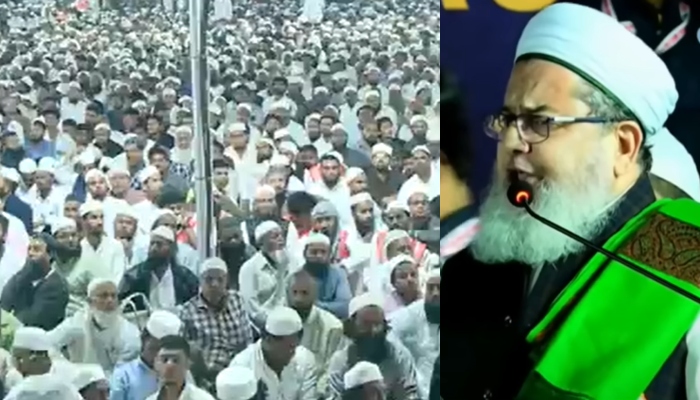
Last week on Sunday, 24th of November, the All India Muslim Personal Law Board (AIMPLB) conducted a two-day conference in Karnataka’s Bengaluru to oppose the Waqf (Amendment) Bill and call it ‘undemocratic’ and ‘unconstitutional’. After the conference, a public meeting was further organized where the Islamist leaders called for a ‘civil war’. The Islamist leaders targeted Prime Minister Narendra Modi and stated that his government was deliberately targeting the Madarsas and doing injustice to the Muslim community. The leaders also incited the Muslim community by saying that they must come down to the streets to oppose the ‘contentious’ Waqf (Amendment) Bill and the Uniform Civil Code (UCC).
The leaders also claimed that the Modi-led government is eyeing to grab the properties of Muslims. Hence, the centre is trying to pass the Waqf Bill in the Parliament winter session that began on November 25th. “This Hindustan is our land. In 1947 the land was divided, today in 2024, the minds of the people are divided. We won’t let this happen,” Maulana Rahmani, one of the Islamist leaders said.
"Now, we won't listen to the courts. If you own the Parliament, we will show you that we own the streets."
He further slammed PM Modi and said that he was acting like an ‘estate broker’ and allegedly creating a divide between Hindus and Muslims. “He doesn’t have a wife and also no kids. Why is he trying to grab the Muslim properties that are being operated for charities? I know why. Because the king now doesn’t want to look after the country. He wants to run the business of real estate,” he claimed.
Maulana further made calls for a ‘civil war’ against the government by inciting hatred and fear in the minds of the Muslim addresses. He said that the Muslims should no longer tolerate the power of PM Modi over the Constitution. “We should show them what our power is. We will now not beg for justice in the Indian courts. We should show them that if the Parliament is theirs, the streets are ours. You people just be ready. We just have to show them that we are alive and that we can fight for our rights,” he said.
Further, Maulana Syed Taqrir Hashmi addressed the meeting and called India the land of Tipu Sultan who was one of the most ruthless Islamic invaders in India. Maulana said that in India, which is the ‘land of Tipu Sultan’, injustice is happening to Muslims. “The Muslims living in India can tolerate anything but not an insult to Allah and the Shariah law. We will protect our law and the Indian Constitution at any cost. The Muslims in India can sacrifice their lives but they won’t give up,” he added.
As per AIMPLB spokesperson Syed Qasim Rasool Ilyas, in the two-day conference, the Board addressed issues causing ‘trouble’ to their community. “We discussed the Waqf (Amendment) Bill, 2024, explaining our opposition to it and outlining our next steps. We also talked about the Uniform Civil Code, which has already been enacted in Uttarakhand. We have decided to challenge this act in the High Court,” he said while talking to the ANI.
He additionally voiced alarm over the country’s alleged escalating hate speech, citing ‘troubling statements’ made by numerous leaders concerning Prophet Mohammad and emphasizing that such sentiments are unacceptable to Muslims around the world.
“Every day, a new dispute arises at the (name) Mosque, followed by court orders for a survey. If the Worship Places Act exists, it must be enforced. Hate speeches are also on the rise in the country, with several leaders making disturbing statements about Prophet Muhammad, which are unacceptable to Muslims worldwide,” he added.
During the meeting, the Islamist leaders and the addresses raised the slogans of Allah-hu-Akhbar and pledged that they would fight against the ‘injustice’ imposed by the Modi-led government. They also expressed solidarity for ‘victims’ in Gaza and Palestine and demanded the immediate withdrawal of all Israeli troops from Gaza, and Lebanon.
“Exchange of hostages from both sides. Release of all Palestinian hostages. All humanitarian aid must be immediately restored. The rebuilding and reconstruction plan of Gaza must be undertaken by the UN at the earliest and the cost of it must be borne by Israel, the US, Western Countries, and all Muslim Countries who are mute spectators. It is high time that the state solution be implemented,” the Board demanded.
— All India Muslim Personal Law Board (@AIMPLB_Official) November 25, 2024
Amid the event in Karnataka’s Bengaluru, Chief Minister Siddaramaiah’s political secretary, Naseer Ahmed also extended support to the Muslim community saying that it has been left with no option but to fight back against the Waqf (Amendment) Bill.
“We being the representatives of the minorities and Muslim community in India. We are all asking the Central Government to have a discussion over the Waqf Amendment Bill. Along with the government, the JPC (Joint Parliamentary Committee) is also trying to impose instead of supporting the Muslim community this legal barrier,” Ahmed said.
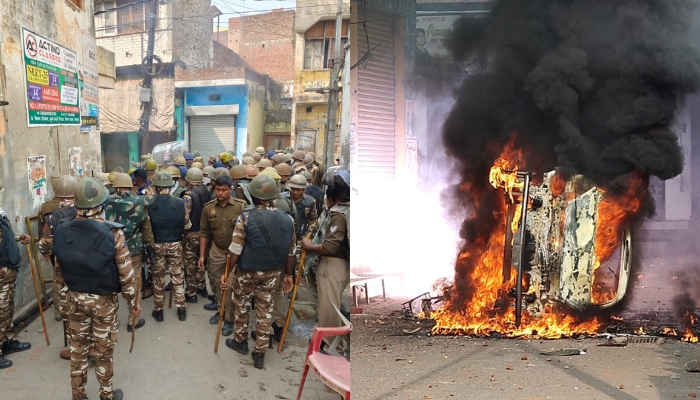
On 24th November, violence broke out in Sambhal, Uttar Pradesh, when a team of local authorities went to Jama Masjid to conduct the second round of a court-ordered survey. Thousands of Muslims gathered outside the mosque. When the police asked them to leave, they became irked and started pelting stones. The mob set several vehicles ablaze and opened fire at the police using locally made guns. More than 20 police personnel were injured, and at least four mobsters were killed in friendly fire. As per media reports, seven FIRs have been registered in the matter. In one of the FIRs…
Source: UP Police
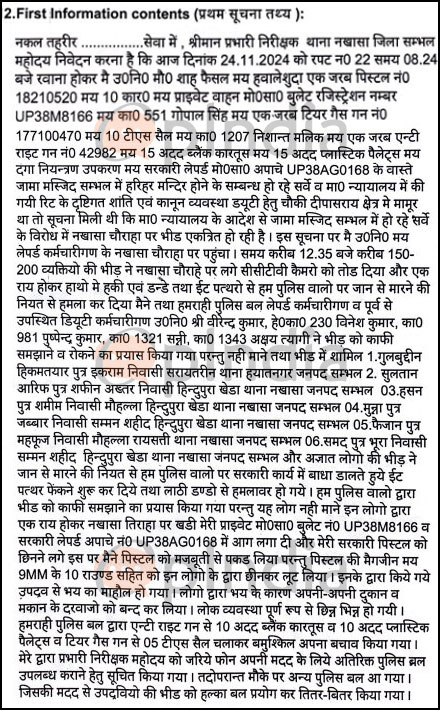
All the FIRs have been registered under Sections 191(2), 191(3), 190, 109(1), 121(1), 324(5), 326(g), 309(4), 223, and 132 of the Bharatiya Nayay Sanhita, 2023, Section 7 of the Criminal Law (Amendment) Act, 1932, and Sections 2 and 3 of the Prevention of Damage to Public Property Act, 1984. This particular FIR was registered based on the complaint of Sub-Inspector Mohammad Shah Faizal. The FIR has been registered against six named individuals (Gulbuddin Hikmatyar, Sultan Arif, Hasan, Mujya, Faizan, and Samad) and 150–200 unidentified persons.
Details of the FIR
According to the FIR, SI Mohammad Shah Faizal stated that he was deployed to maintain law and order at Jama Masjid, Sambhal, in relation to the court-ordered survey at the Hair Har Mandir, along with Constable Gopal Singh, Constable Nishant Malik, and other police personnel. They were stationed in the Deepasarai post area. During that time, SI Faizal received information that a crowd was gathering at Nakhasa crossing to protest against the survey. They acted upon the information and reached the location with other police personnel and Leopard staff.
At around 12:25 PM, a crowd of about 150–200 persons gathered at the Nakhasa crossing and vandalised the CCTV cameras installed in the area. They attacked police personnel with sticks, rods, and stones with intent to kill. Despite the efforts of SI Faizal and the accompanying police force, including the Leopard personnel and duty staff present at the spot—such as SI Virendra Kumar, HC Vinesh Kumar, Constable Pushpendra Kumar, Constable Sunny, and Constable Akshay Tyagim the mob did not relent.
Additionally, unidentified individuals from the crowd, with the intent to kill, began throwing stones and assaulting the police with sticks and rods, obstructing their official duties. Despite repeated attempts to reason with them, they did not stop. Acting in unison, the mob set fire to SI Faizal’s private motorcycle (Bullet No. UP38M8166) and the government Leopard motorcycle (Apache No. UP38AG0168). They attempted to snatch his government pistol, which he managed to hold onto tightly. However, the mob succeeded in snatching the magazine of the pistol, including 10 rounds of 9mm ammunition.
SI Faizal was able to identify six persons in the crowd and mentioned there were 100–200 unidentified persons along with the identifiable ones. The incident caused widespread panic in the area, and residents closed the doors of their shops and houses out of fear. SI Faizal added that public order was completely disrupted because of the mobsters engaging in violence.
To control the mob, the police force had to use 10 blank cartridges and 10 plastic pellets from the anti-riot gun. Furthermore, five tear gas shells from the tear gas gun were fired by the police personnel to defend themselves. As the present police force was unable to disperse the crowd, SI Faizal informed the Station House Officer (SHO) via phone and requested additional police force for assistance. Soon, additional police personnel arrived at the spot and helped disperse the mob using mild force.
According to the complaint filed by SI Faizal, the unidentified mob violated Section 163 of the BNSS imposed by the District Magistrate of Sambhal. During the attack, SI Faizal, Constable Gopal Singh, and Constable Nishant Malik sustained injuries. He noted that the actions of the unidentified mob were of a highly serious nature.
Court-ordered survey at Jama Masjid in Sambhal
On 19th November, a court-mandated survey was conducted at Jama Masjid in Sambhal, Uttar Pradesh. The court ordered the survey in response to a petition filed by Supreme Court Advocate Vishnu Shankar Jain, and seven co-plaintiffs, asserting that the mosque occupies the site of a temple dedicated to Bhagwan Kalki. The site in question is a protected monument under the Ancient Monuments Preservation Act of 1904. The survey was carried out under the supervision of Advocate Commission. A heavy police force was deployed in the area to ensure the survey proceeded peacefully.
However, on 24th November, during the second round of court-mandated survey at Jama Masjid, Islamist mobsters gathered outside the mosque and engaged in violence. They pelted stones at police, opened fire at police personnel and set ablaze vehicles and shops. At least 20 police personnel were injured during violence and four mobsters were killed in the mayhem, likely from illegal guns carried by rioters.
In the aftermath of the Sambhal violence on 24th November, police have clarified that the deaths of three individuals occurred due to firing by rioters, not by the police. Post-mortem reports revealed that two victims were shot with country-made pistols, while the a 315-bore bullet was found inside the body of another victim, a type not used by Uttar Pradesh Police. Sambhal SP Krishna Kumar Bishnoi stated that the police initially fired tear gas and rubber bullets to disperse the mob but were fired upon by rioters.
During the survey, however, Muslims living in the area gathered outside the Jama Masjid and raised religious slogans. The District Magistrate of Sambhal confirmed that the survey was completed in around two hours and stated that a report would be submitted to the Civil Court, which will review it on the next date of hearing, 29th November 2024. OpIndia accessed the petition filed by the plaintiffs in the case.
OpIndia’s detailed report on petition filed at the court can be checked here.
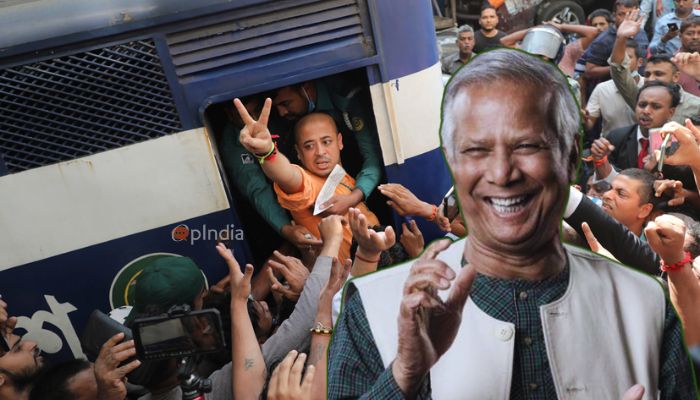
After the Indian External Affairs Ministry urged the government of Bangladesh to ensure the safety and security of Hindus, Bangladesh has ‘refuted’ India’s statement regarding the arrest of ISKCON priest Sri Chinmoy Krishna Das. In a press release published by the Ministry of Foreign Affairs in Dhaka on Tuesday, Bangladesh voiced “utter dismay and deep hurt” over the statement, stressing that Sri Chinmoy Krishna Das was arrested on specific accusations. It condemned certain sections for misrepresenting the arrest, claiming that these claims weaken the facts while mischaracterising the Bangladeshi government’s commitment to religious tolerance.
“It is with utter dismay and deep sense of hurt that the Government of Bangladesh notes that the arrest of Sri Chinmoy Krishna Das has been misconstrued by certain quarters since Sri Chinmoy Krishna Das has been arrested on specific charges. The Government of Bangladesh maintains that such unfounded statements not only misrepresent facts but also stand contrary to the spirit of friendship and understanding between the two neighboring countries,” the Bangladeshi government’s statement reads.
The statement highlighted Bangladesh’s ‘commitment ‘to promoting harmony among all religious communities. It emphasised the Bangladeshi government’s continuous efforts to defend the rights of religious minorities and promote communal harmony in the country. The celebration of Durga Puja last month was hailed as an example of the government’s commitment to promoting inclusivity. While the Bangladeshi government claimed that there was a “peaceful observance” of Durga Puja, OpIndia reported how Hindus and their temples were attacked, Durga Puja pandals were vandalised by Islamists and even a Mukut gifted by Prime Minister Narendra Modi to a Bangladeshi temple was stolen.
Advisor to the Bangladesh govt blames supporters of Chinmoy Krishna Das for death of a lawyer in Chattogram. Calls them ‘communal terrorists’. Despite India raising a red flag over arrest of Das and attack on Hindus, such statements show which path B’desh govt has chosen… https://t.co/t52ehUZnBipic.twitter.com/g2w0WlMOHR
“The statement also does not reflect the harmony that exists among the peoples of all faiths and the commitment and the efforts of the government and the people in this regard. It also completely disregards that the Government of Bangladesh is determined to conclusively end the culture of impunity to the perpetrators of gross human rights violations against the people of Bangladesh, thus treating the religious majority and minorities alike. Bangladesh reaffirms in the strongest terms that every Bangladeshi, regardless of his or her religious identity, has the right to establish, maintain or perform respective religious rituals and practices or express views without hindrance. Ensuring safety and security of all citizens, particularly the members of religious minorities remains a duty of the Government of Bangladesh,” the Bangladeshi government said.
“This was yet again vindicated by the peaceful observance of Durga Puja throughout Bangladesh only last month. The Government of Bangladesh would like to reiterate that the country’s judiciary is fully independent and it does not interfere in the work of the judiciary. The matter under question is at present being dealt with by the court of law,” the statement adds.
While the Mohammad Yunus-led government expressed concerns over the reports of violence amid the arrest of Chinmoy Krishna Das, the leader of “Sammilita Sanatani Jot” and claimed to have stepped up the security to uphold religious harmony, the visuals of Islamists on the streets expose its lies. Notably, Das was arrested on Monday from Dhaka airport on multiple charges including sedition.
Chilling calls by the Muslim majority in Bangladesh to ban ISKCON. To eliminate it. The idea is to slowly cut off Bangladeshi Hindus from their religion and culture. That is always the first step in any concerted push towards ethnic cleansing.
Besides, the Islamists are demanding a ban on ISKCON in Bangladesh, with a clear intent to cut Hindus off from their culture and religion.
#BREAKING: Kali Mandir attacked at Hazari Goli in Chittagong Municipality of Bangladesh this evening. A few days ago, the Bangladesh Army had tortured Hindus in this Hazari Goli. This is a Hindu majority small area. Many Hindu boys were abducted and arrested. pic.twitter.com/IeCRGew1ed
On Tuesday, Islamists attacked Kali Mandir at Hazari Goli in Chittagong Municipality of Bangladesh. Just days back, it was reported that Hindus in this area were arrested and tortured.
In Chhattogram, a Hindu temple was reportedly set ablaze by the Islamists. The temples targeted by Islamist mobs have been identified as Lokonath Temple in Firangi Bazar, Mansa Mata Temple, and Kali Mata Temple in Hazari Lane.
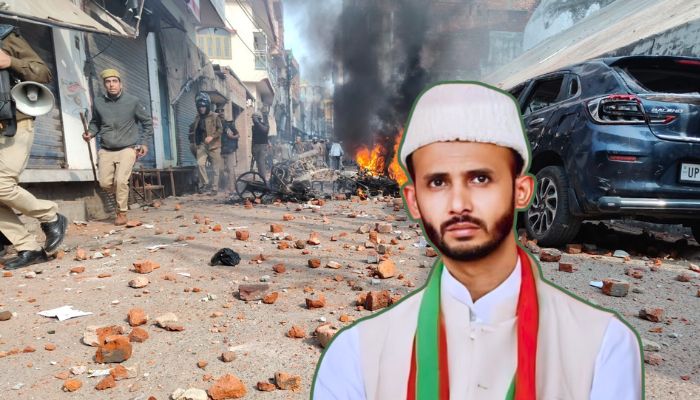
On 24th November, violence broke out in Sambhal, Uttar Pradesh, when a team of local authorities went to Jama Masjid to conduct the second round of a court-ordered survey. Thousands of Muslims gathered outside the mosque. When the police asked them to leave, they became irked and started pelting stones. The mob set several vehicles ablaze and opened fire at the police using locally made guns. More than 20 police personnel were injured, and at least four mobsters were killed too in the mayhem.
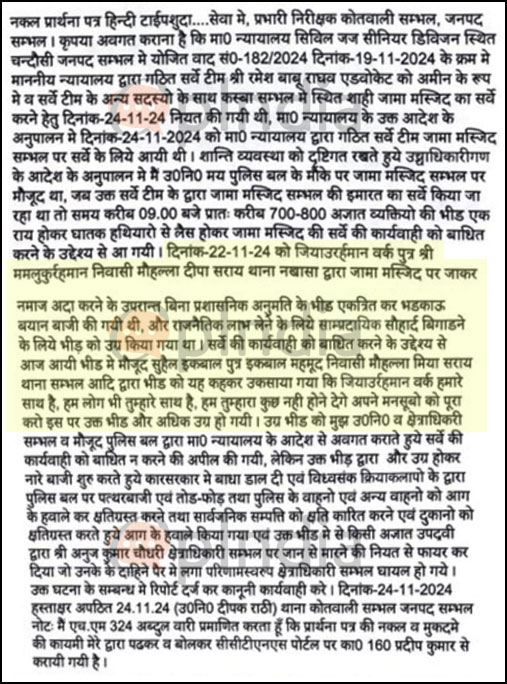
As per media reports, seven FIRs have been registered in the matter. In one of the FIRs, Sambhal MP and Samajwadi Party leader Zia Ur Rahman Barq has been named as the prime accused. OpIndia accessed the FIRs registered in the case.
Details of the FIR that named Barq as the prime accused
All the FIRs have been registered under Sections 191(2), 191(3), 190, 109(1), 121(1), 324(5), 326(g), 309(4), 223, and 132 of the Bharatiya Nayay Sanhita, 2023, Section 7 of the Criminal Law (Amendment) Act, 1932, and Sections 2 and 3 of the Prevention of Damage to Public Property Act, 1984. Zia Ur Rahman Barq has been named as the prime accused in the FIR. Suhail Iqbal has been named as the second accused along with 700–800 unnamed persons. The FIR in which Barq has been named as the prime accused was registered on the complaint of Sub Inspector Deepak Rathi.
FIR in Sambhal Violance named SP MP as prime accused. Source: UP police
In his complaint, SI Rathi said that a court-ordered survey was conducted under the supervision of Advocate Ramesh Babu Ragha as court commissioner and other team members on 19th November 2024 at Jama Masjid, Sambhal, Uttar Pradesh. They visited the mosque again for the survey on 24th November 2024. To ensure law and order, SI Rathi was present at the mosque with other police personnel as per the directions of the senior officials.
When the survey team was conducting the survey at around 9 AM, a mob of around 700–800 unidentified individuals armed with deadly weapons gathered with the intent to disrupt the survey proceedings. Despite repeated appeals from SI Rathi, the Sambhal Circle Officer, and the police force present not to obstruct the court-ordered survey proceedings, the mob became even more violent.
SI Rathi stated that the mob started raising slogans, obstructing government work, and engaging in destructive activities. They pelted stones at the police force, vandalised police and other vehicles, set them on fire, and caused significant damage to public and private property. They also set ablaze shops in the area. During the chaos, an unidentified rioter fired at Circle Officer Arun Kumar Chaudhary with the intent to kill. The bullet hit CO Chaudhary on his right leg, resulting in injuries.
Role of Zia Ur Rahman Barq
According to the FIR, SI Rathi mentioned in his complaint that on 22nd November, Sambhal MP Zia Ur Rahman Barq, who is a resident of Mohalla Deepa Sarai under Nakhasa Police Station area, visited Jama Masjid to offer prayers without taking prior permission from the administration. He subsequently incited a crowd with inflammatory speeches. SI Rathi alleged that the speech was given to create communal discord for political gain.
On the day of the violence, when the mob arrived to disrupt the survey proceedings, Suhail Iqbal, son of local MLA Iqbal Mahmood, who is a resident of Mohalla Miya Sarai under Sambhal Police Station, incited the mob by stating, “Zia Ur Rahman Barq is with us. We are with you. Nothing will happen to you. Fulfil your intentions.” The provocative statements by Suhail made the mob more aggressive, and they started pelting stones at the police personnel present at the scene.
Who is SP MP Zia Ur Rahman Barq?
Zia Ur Rahman Barq, born on 13th July 1988 in Sambhal, Uttar Pradesh, belongs to a prominent political family. His grandfather, Shafiqur Rahman Barq, was a former MP from the same constituency. Zia pursued higher education at Chaudhary Charan Singh University and Aligarh Muslim University (AMU), earning degrees in Law and Arts. Active in student politics, he was associated with the AMU Students’ Union in 2005–06.
Initially aligned with AIMIM, Zia joined the Samajwadi Party in 2017, later becoming an MLA (2022–2024) and MP from Sambhal in 2024. His career is marred by controversies, including six FIRs for electoral violations and a 2024 case involving incendiary remarks about gangster-politicians. Most recently, he has been accused of inciting communal unrest during the Sambhal violence. Zia denies these allegations, claiming a conspiracy by the UP Police against him. His detailed profile can be checked here.
Court-ordered survey at Jama Masjid in Sambhal
On 19th November, a court-mandated survey was conducted at Jama Masjid in Sambhal, Uttar Pradesh. The court ordered the survey in response to a petition filed by Supreme Court Advocate Vishnu Shankar Jain, and seven co-plaintiffs, asserting that the mosque occupies the site of a temple dedicated to Bhagwan Kalki. The site in question is a protected monument under the Ancient Monuments Preservation Act of 1904. The survey was carried out under the supervision of Advocate Commission. A heavy police force was deployed in the area to ensure the survey proceeded peacefully.
However, on 24th November, during the second round of court-mandated survey at Jama Masjid, Islamist mobsters gathered outside the mosque and engaged in violence. They pelted stones at police, opened fire at police personnel and set ablaze vehicles and shops. At least 20 police personnel were injured during violence and four mobsters were killed in friendly fire. In the aftermath of the Sambhal violence on 24th November, police have clarified that the deaths of three individuals occurred due to firing by rioters, not by the police. Post-mortem reports revealed that two victims were shot with country-made pistols, while the a 315-bore bullet was found inside the body of another victim, a type not used by Uttar Pradesh Police. Sambhal SP Krishna Kumar Bishnoi stated that the police initially fired tear gas and rubber bullets to disperse the mob but were fired upon by rioters.
During the survey, however, Muslims living in the area gathered outside the Jama Masjid and raised religious slogans. The District Magistrate of Sambhal confirmed that the survey was completed in around two hours and stated that a report would be submitted to the Civil Court, which will review it on the next date of hearing, 29th November 2024. OpIndia accessed the petition filed by the plaintiffs in the case.
OpIndia’s detailed report on petition filed at the court can be checked here.
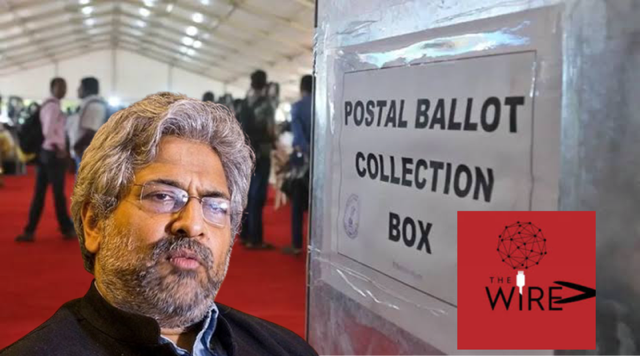
Maharashtra’s Chief Electoral Office slammed the anti-India propagandist media house The Wire for spreading fake news over the recently concluded assembly election in the state which witnessed the Bharatiya Janata Party-led Mahayuti storm to power with a resounding majority. Naturally, the development did not sit well with the ‘news’ organization, which, in an attempt to feed its confirmation bias, on 25th November published an article titled, “5,04,313 ‘Additional’ Votes? Maharashtra Data Mismatch Between Votes Polled and Counted” to claim that the BJP’s victory was the product of some sort of rigging in their favour and fuelled apprehensions against the constitutional body.
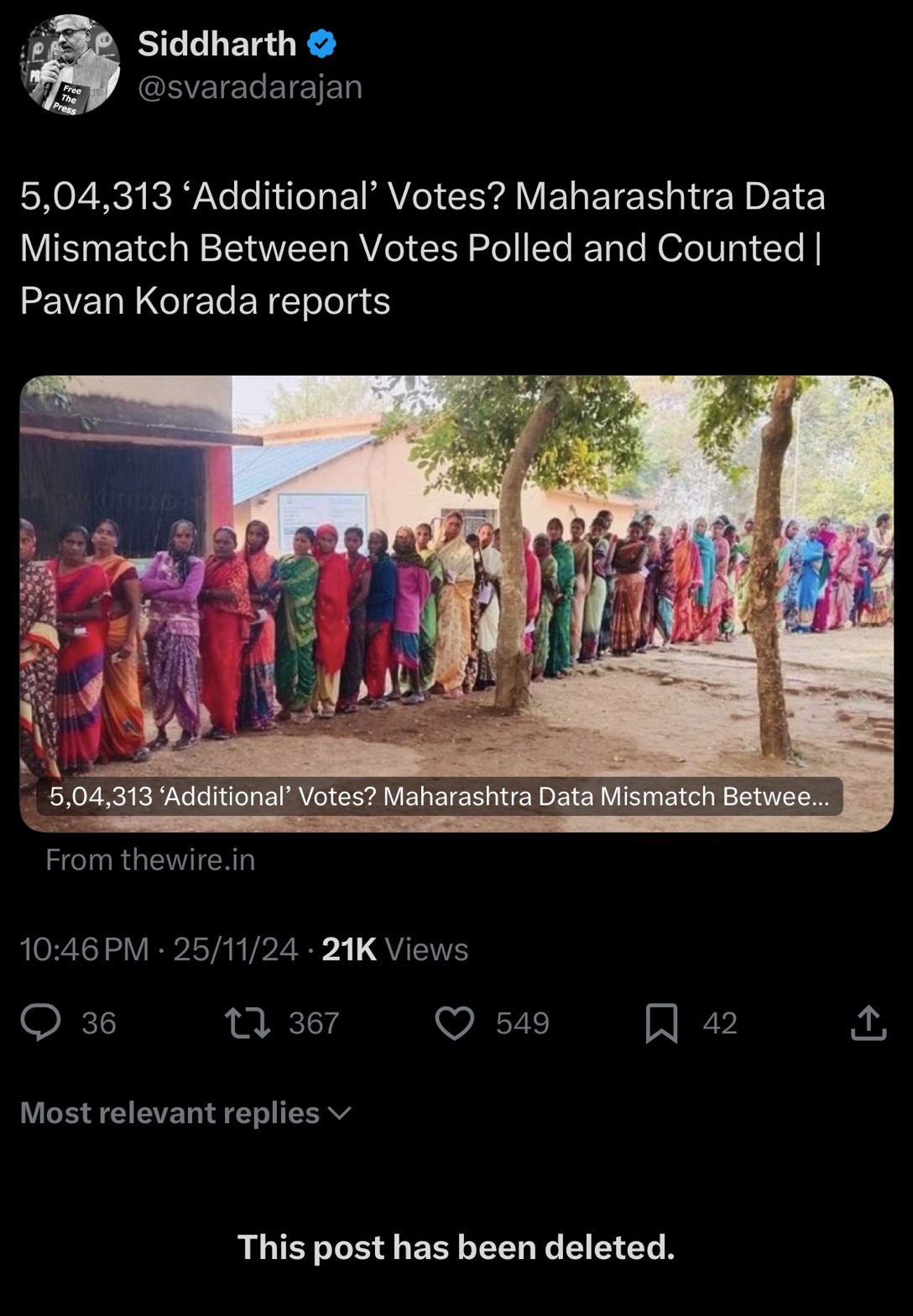
Notably, it is unavailable on desktop after CEO Maharashtra addressed a letter to Siddharth Varadarajan who is the founding editor of The Wire and pointed out the factual inaccuracies in the piece and called it misleading while exposing their biased agenda. Varadarajan also deleted a tweet in which he shared the same fearing action from the Election Commission for spreading falsehoods. However, the fraudulent report continues to be accessible through mobile.
The official statement referred to the report and stated, “In this regard, it is brought to your notice that the report is misleading and inaccurate, written and published in haste without accounting for the accurate details. The report has attempted to mislead readers by mischievously comparing two different parameters, as the report has included 5,38,225 postal ballots in the votes counted which was not part of the votes polled data released by CEO Maharashtra. The results portal of ECI displays ‘EVM votes’ and ‘counted valid postal votes’ separately for each AC (assembly constituency). The story has chosen not to add postal ballots in the figure of polled votes on the voter turnout APP (VTA), which was verifiable and thus sensationalised an imaginary mismatch.”
It highlighted that 6,40,88,195 votes were cast in all 288 Assembly seats in the state’s EVM, which has been “mischievously” displayed as the overall number of votes cast and noted, “The fact is that 5,38,225 valid postal ballots were not added in this figure. When we add the 5,38,225 valid postal ballots to the 6,40,88,195 votes polled in EVM; the total votes polled comes out to be 6,46,26,420. The total votes counted on the day of the counting including postal ballots is 6,45,92,508. Hence, the total votes counted are not more than the total votes polled.”
CEO Maharashtra also explained why, in certain ACs, fewer votes were counted than those required by the established procedure and clarified, “The EVM counting is not taken up if Mock Poll Data was not cleared from the Control Unit of the Polling Station before actual start of Poll or if there is non-display of result in the display panel of Control Unit or there was mismatch in data reported in Form 17C and votes recorded in EVM due to clerical or typing human error. In such cases, as the winning margin was higher than the total votes polled in these Polling Stations, counting of VVPAT Slips of these Polling Stations was not done as per instructions contained in Para No.7(iv)(b) of ECIs letter dated 19.07.2023.”
The statement then added, “Election Duty Certificates are issued to the Polling Officers on Poll Duty who are voters of the same Assembly Constituency but the number of EDC (Election Duty Certificate) votes are not included while entering data. Additionally, regarding 02 Assembly Constituencies, viz.231-Ashti and 242-Osmanabad ACS mentioned in your report where vote difference is alleged as 4538 and 4330, respectively are also misleading and irresponsible reporting.”
The press release also provided the official numbers recorded in the EVMs at AC 231 Ashti which were 282246, total postal votes were 5013 while 475 postal votes were rejected after which 4538 valid postal votes were counted. On the other hand, the total EVM votes at AC 242 Osmanabad were 238840, total postal votes were 4330 while 175 postal votes were rejected after which 4155 valid postal votes were counted.
“Given the above details, the conclusion in the article published in ‘The Wire’ that more than 5 lakh votes have been counted in excess is inaccurate and mischievous. It is expected that the above factual position will be reflected prominently in your story to avoid any misinformation to readers. The hastily drawn conclusions without due diligence have the potential to create false narratives which can not only vitiate the electoral atmosphere but can also give credence and paint a sense of authenticity to false & mischievous narratives,” the statement concluded with a stinging attack on the disinformation disseminated by the news platform.
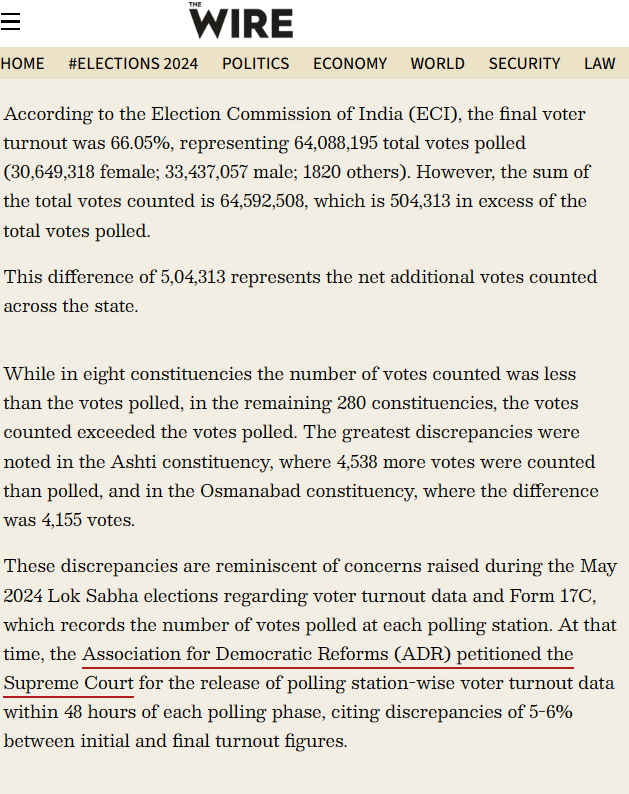
“According to the Election Commission of India (ECI), the final voter turnout was 66.05%, representing 64,088,195 total votes polled (30,649,318 female; 33,437,057 male; 1820 others). However, the sum of the total votes counted is 64,592,508, which is 504,313 over the total votes polled. This difference of 5,04,313 represents the net additional votes counted across the state,” the article claimed to cast aspersions on the constitutional body and added, “This difference of 5,04,313 represents the net additional votes counted across the state.”
It continued its deliberately flawed assessment and stated, “While in eight constituencies the number of votes counted was less than the votes polled, in the remaining 280 constituencies, the votes counted exceeded the votes polled. The greatest discrepancies were noted in the Ashti constituency, where 4,538 more votes were counted than polled, and in the Osmanabad constituency, where the difference was 4,155 votes.”
The article even stressed its equally distorted evaluation of the voter turnout during the latest Lok Sabha election which was debunked earlier and claimed, “These discrepancies are reminiscent of concerns raised during the May 2024 Lok Sabha elections regarding voter turnout data and Form 17C, which records the number of votes polled at each polling station. At that time, the Association for Democratic Reforms (ADR) petitioned the Supreme Court for the release of polling station-wise voter turnout data within 48 hours of each polling phase, citing discrepancies of 5-6% between initial and final turnout figures.”
Now, that the fake news vendor The Wire has been exposed for what it is, it opted to cowardly delete the post quietly rather than rectify it or issue an apology for deceiving the public.
Siddharth Varadarajan, the cofounder of the far-left propaganda portal, quietly pulled down the tweet where he shared the article riddled with falsehoods.
Siddharth Varadarajan deleted the tweet after being called out for sharing fake news and casting aspersions on the electoral process in Maharashtra
The Wire spread falsehoods with its Meta, Tek Fog stories
Incidentally, this is not the first time that The Wire has suffered the ignominy of being caught shamelessly peddling fake news. In November 2022, The Wire was forced to withhold its series of reports that said BJP IT cell head Amit Malviya had some superpowers to remove posts from Meta-owned Instagram. The claims were found to be baseless and premised on fabricated evidence, following which The Wire had to retract its stories. The Wire had then claimed to have launched an ‘internal review’ after the reports were found to be completely fake, the findings of which are yet to be released to the public.
Similarly, The Wire also suspended another fake story from January 2022 that spoke about the existence of a fictitious and mysterious app named ‘Tek Fog’, which it claimed allowed the BJP to bypass all security measures available in top social media platforms like Twitter, Facebook, WhatsApp, Instagram, Telegram etc, and create and delete dozens of accounts at the click of a button. They claimed the BJP could hijack social media trends and target hatred towards journalists using the app. They claimed that the app can bypass email and OTP verifications required to log on to those platforms to create temporary accounts.
Similar to the Meta story, netizens had exposed the massive loopholes in the Tek Fog story too. That story also entirely relied on ‘screenshots’ of the so-called app, and didn’t have any other verifiable evidence. It was fiercely contested by independent tech analysts, many of whom were ridiculed as BJP supporters by The Wire and its supporters. However, ultimately, The Wire had to retract its stories after it was exposed for running a hit-job against the Modi government.
After Toyota, Ford, John Deere, and Boeing, the world’s largest retailer Walmart has announced its decision to roll back its ‘Diversity, Equality and Inclusivity’ or DEI policies. Walmart announced on the 25th of November that it will no longer consider race and gender to increase diversity when awarding supplier contracts, and it will stop collecting demographic data when determining financing eligibility. It would cease using the word “DEI” in its official correspondence. It will also reduce racial justice training for employees, discontinue participation in prominent rankings by LGBTQ advocacy group the Human Rights Campaign, and reconsider its support for Pride and other events.
It is worth noting that DEI programs have grown common in companies, schools, and institutions across the United States. A 2023 Pew Research Centre study found that more than half of all U.S. workers had received some type of DEI training. Moreover, institutions overall spend about $8 billion every year on these activities. Thus, the impact of DEI training on people, particularly, employees working in companies with DEI training facilities and students undergoing DEI training cannot be dismissed as diminutive.
There have been concerns that contrary to the supposed purpose of DEI to foster an environment of more inclusive, respectable and equitable towards diverse communities, DEI training programs are instilling racist and hateful thoughts in the minds of the trainees.
DEI training programs fostering bias and prejudices against Brahmins
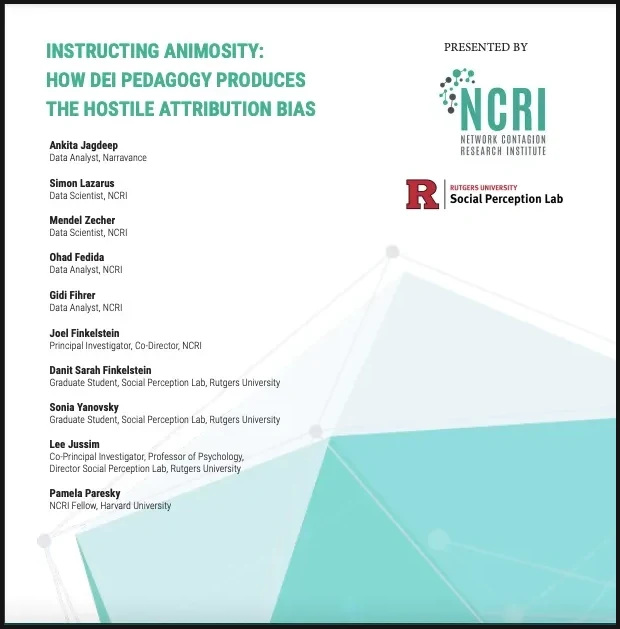
A joint research report published by Rutgers University and the Network Contagion Research Institute (NCRI) titled INSTRUCTING ANIMOSITY: HOW DEI PEDAGOGY PRODUCES THE HOSTILE ATTRIBUTION BIAS, revealed that DEI programs are causing adverse psychological and social impact instead of fostering inclusivity and addressing racial and religious discrimination. Published on Monday (25th November), the research findings indicated that some DEI programs are spreading negative stereotypes and animosity against certain religious, racial and caste groups like the Brahmins.
Rutgers report on DEI
Describing the methodology used in the study, the report says, “The study used caste sensitivity training materials from Equality Labs as the experimental condition, designed to evaluate the effects of DEI rhetoric. For the control condition, NCRI compiled together an academic essay on caste from the works of well-published scholars from institutionssuch as Berkeley, Cambridge and elsewhere. The control essay was deliberately chosen to provide a neutral, academic perspective, free from sensationalized or accusatory language. This control allowed us to measure the specific impacts of highly charged DEI narratives while controlling for the topic of caste itself, providing a clearer assessment of how anti-oppression narratives can shape attitudes and the inclination to be punitive.”
The report further mentions the “intervention” and “control” texts it provided to the respondents. Here the intervention text was an excerpt from Equality Labs which read, “Shudras and Dalits are caste-oppressed; they experience profound injustices, including socioeconomic hardship and brutal violence at the hands of the upper castes. Dalits live in segregated ghettos, are banned from temples, and are denied access to schools and public amenities. The 2,500-year-old caste system is enforced by violence and maintained by one of the world’s oldest, most persistent cultures.”
Meanwhile, the control text, or the neutral text based on scholarly works read, “Jāti and varna are concepts from India that describe ways people might identify and interact socially. Jāti refers to groups with common characteristics, including clan, class, language, family background, region of origin, religion, and occupation. Varna describes a philosophy in Hindu scripture of understanding human diversity and purpose.”
In the experiment, researchers took 850 individuals and gave one group a neutral essay on the caste system, while the other received caste-sensitivity training material from anti-Brahmin Equality Labs. After both the respondent groups read the assigned texts, they were given a neutral scenario with no explicit caste indicators to measure their perceptions of caste-based bias, the study said. This scenario was “an admissions process and names of characters were reversed in a counterbalanced fashion between respondents to avoid artifacts that might be associated with the names themselves: “Raj Kumar applied to an elite East Coast university in Fall 2022. During the application process, he wasinterviewed by an admissions officer, Anand Prakash. Ultimately, Raj’s application was rejected.”
Rutgers paper on DEI
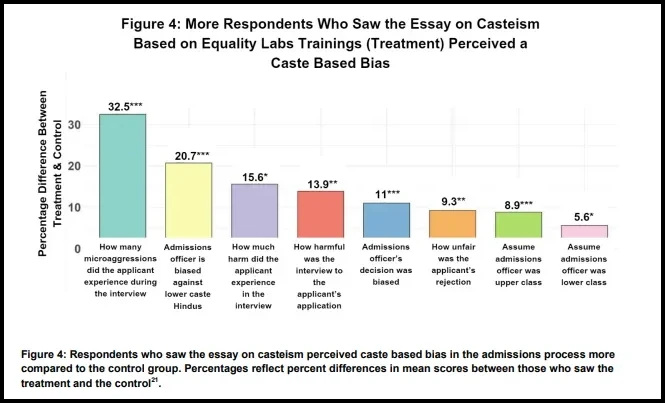
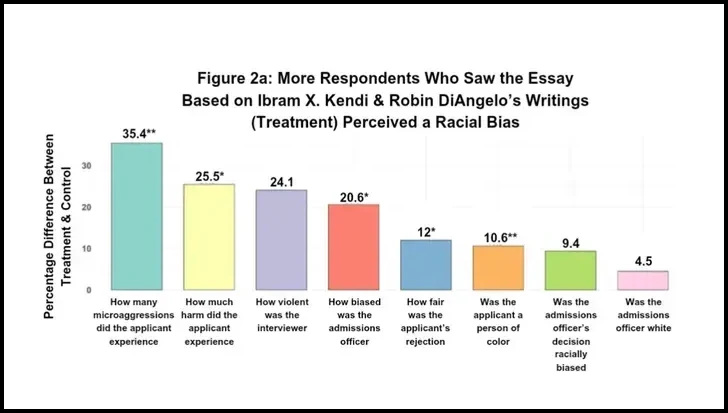
The respondents were then presented with questions to evaluate the presented scenario to understand the extent to which they perceived casteism. The study found that exposure to the Equality Labs intervention led to significantly higher perceptions of microaggressions, perceived harm, and assumptions of bias during the interview process (increases of 32.5%, 15.6%, and 11%, respectively) compared to the control condition. Further assessment found that participants who read the Equality Labs text showed more willingness—19%— to punish the administrator in the fictional scenario provided to them and about 47% of them perceived Hindus as “racist” compared to the participants who read the neutral text. This indicates that DEI content instead of eliminating, is actually creating prejudices against Hindus, particularly the so-called “upper-caste” Hindus like Brahmins, who are already at the receiving end of hate campaigns of the anti-Hindu elements.
“These results suggest that caste sensitivity training, along with other training delivered within an anti-oppressive DEI framework, may create hostile attribution biases that negatively distort perceptions of interpersonal interactions and promote rather than ameliorate intergroup hostilities,” the report says.
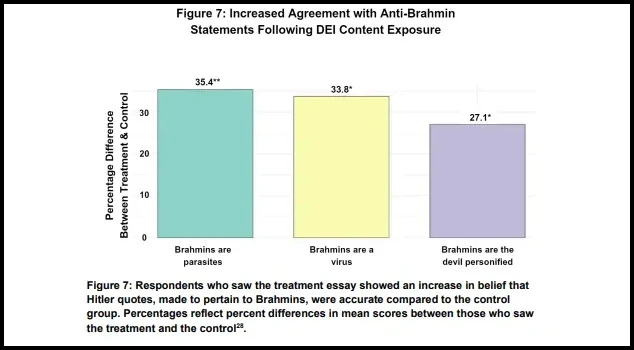
Similarly, when the participants who read the DEI-inspired material looked at modified past statements from German despot Adolf Hitler that replaced the word “Jew” with “Brahmin,” they were more likely to agree that Brahmins were “‘parasites’ (+35.4%), ‘viruses’ (+33.8%), and ‘the devil personified’ (+27.1%).”
Rutgers report on DEI
The findings of the NCRI-Rutgers report suggest that some anti-oppressive DEI narratives can lead to hostile attribution bias, racial suspicion, prejudicial attitudes, authoritarian policing, and support for punitive behaviours without evidence. The extent to which DEI training programs can instil biases, prejudices, and hatred in people’s minds is so profound that Hitler’s rhetoric becomes acceptable and worth implementing against specific caste groups, Brahmins in this context. And it is not an exaggeration to say that the dissemination of “Hitlerean” rhetoric against Brahmins or other upper caste Hindus will culminate in fostering a mindset that yearns for a holocaust of Brahmins.
Anti-Brahmin Equality Labs
Notably, Equality Labs is a prominent anti-Brahmin Caste activism group in the United States. had collaborated with the Organisation for Minorities in India (OFMI), among other organisations, for a report titled ‘Caste in the United States: A Survey Of Caste Among South Asian Americans’. The OFMI was founded by Bhajan Singh Bhinder, a known ISI operative, and his puppet Pieter Friedrich was part of the organisation too. Equality Labs also campaigned hard against Amit Jani, who had worked in the Joe Biden campaign, accusing him of supporting ‘Hindu Fascism’. It had also inserted a ‘Dalit’ angle to the anti-farm law protests even though the demonstrations were clearly an attempt by the dominant caste groups in Punjab and Haryana to preserve their privilege. Moreover, Jack Dorsey, the former CEO of the erstwhile Twitter, had once stoked a massive controversy when he held an anti-Brahmin placard that said ‘Smash Brahminical Patriarchy’, a poster designed by Thenmozhi Soundararajan, the executive director of Equality Labs.
Mainstreaming of “caste” in the US
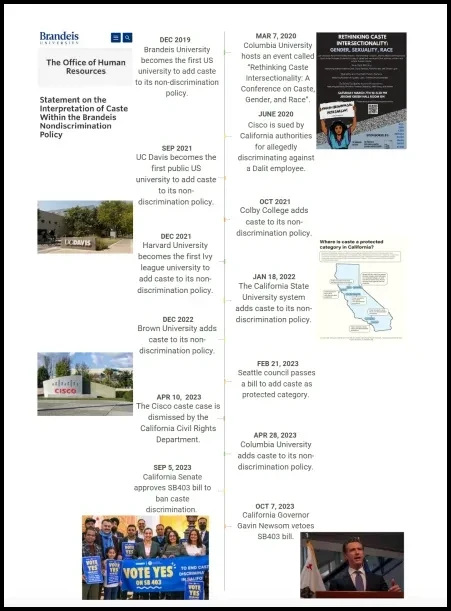
The Rutgers-NCRI report traces a timeline of the mainstreaming of non-existent caste discrimination in the US which gave a push an imaginary need to protect “caste” as a category requiring protection from ‘discrimination’ in various sectors across the United States. The timeline states begins with Brandeis University in Massachusetts adding caste to its non-discrimination policy in December 2019 and includes the CISCO caste discrimination case, Harvard University, Colby College, Brown University, and California State University adding caste to its non-discrimination policy, the dismissal of CISCO case, Seattle council passing a bill to add caste to protected category, California Senate approving the outrageous SB403 bill, and it eventually getting vetoed by California governor Gavin Newsom.
Hatred against Brahmins, false victimhood for Muslims: DEI training programs or How to be a Hindu-hating Islam apologist 101?
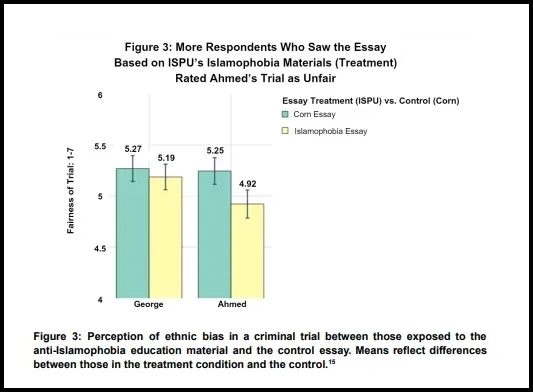
Besides fostering bias and prejudices against Brahmins, the DEI programs are also capable of causing people to assume unfair treatment of Muslims despite there being no evidence of bias or discrimination. To assess the impact of anti-Islamophobia narratives, the NCRI presented the case of two criminals Ahmed Akhtar and George Green, both of whom were convicted of similar terrorism charges. Akhtar’s case was assessed for perceived fairness while Green’s case was served as a comparative measure.
In this experiment, the participants were recruited from Amazon Prime Panels and there were two groups—Control and Ant-Islamophobia Treatment Group. As the names suggest, the control group participants were exposed to neutral information and they found Akhtar’s trial just as fair as that of Green, however, the second group rated Ahmed Akhtar’s trial as less fair compared to that of George Green despite their situation being similar with no unfairness during the trial.
Regarding this the researchers said, “This effect highlights a broader issue: DEI narratives that focus heavily on victimization and systemic oppression can foster unwarranted distrust and suspicions of institutions and alter subjective assessments of events. In the effort to improve sensitivity to genuine injustices against people from designated identities, such trainings may instead create a hostile attribution bias. This could, in turn, undermine trust in institutions, even in the absence of bias or unfair treatment (as in our scenarios). These findings are particularly concerning given that ISPU’s [Institute for Social Policy and Understanding] educational efforts include training Federal Agents on Islamophobia sensitivity.”
DEI training programs furthering racism
The Rutgers-NCRI research also included an experiment wherein they shared anti-racist DEI materials from authors such as Ibram X. Kendi and “White Fragility” author Robin DiAngelo with participants. The NCRI concentrated on materials that emphasised knowledge of and opposition to “systemic oppression,” as popularised by books like Kendi’s “How to Be an Antiracist.” In the study, those who were exposed to anti-racist texts showed higher levels of racial bias. Participants were also more willing to favour punitive measures against perceived perpetrators of “microaggressions”, despite a clear lack of evidence.
All images via NCRI
New York Times and Bloomberg killed their stories on Rutgers-NCRI research on DEI training programs
To no surprise, leftist propaganda outlets like the New York Times and Bloomberg, who had their stories on the Rutgers-NCRI research on the impact of DEI training programs ready, decided at the eleventh hour not to publish them citing ‘editorial concerns’. It, however, is quite obvious that propaganda outlets like NYT, notorious for downplaying violence against Hindus and romanticising Islamic and Khalistani terrorists would not want to publish a story exposing how the DEI initiatives are perpetuating hatred against Hindus given. OpIndia had reported how NYT downplayed Islamist violence against Hindus in Bangladesh as ‘political revenge’. It is their ideological imperative to suppress the materials or studies exposing how much-hyped DEI training amplifies racism, biases and prejudices against Brahmins or “upper caste” Hindus and evokes unwarranted sympathy for Muslims.
Conclusion
With it becoming clear that the DEI training programs foster bias and prejudices against specific caste and racial groups while generating sympathy for a specific community even when there is no explicit bias or discrimination, contrary to its supposed objective of fostering inclusivity and alleviating prejudices, it is paramount that the businesses and institutions scrutinise their DEI policies and if required scrap them just as Walmart has done. Otherwise, the “DEI-trained” people in the US will end up hating and possibly turning violent against Brahmins and other communities due to their far-from-reality perceptions about specific groups as oppressive or inherently privileged.
From 21st to 23rd February 2025, Mumbai will witness a one-of-its-kind “Halal Muslim Carnival.” The organisers of the event claim that it will be a blend of Islamic principles with contemporary trends. The event will take place at Millat Ground, Andheri, and has sparked discussion on social media because of its unconventional offerings, which include “halal dating,” “Islamic fashion showcases,” and more.
Viral video highlights ‘halal dating’ concept
A promotional video of the event has gone viral on social media, featuring two hijabi influencers. In the video, the women enthusiastically introduce the event, which has been named “Salam Ramadan 3.0.” They describe it as India’s first modest fashion and award show. The influencers emphasise that the carnival will allow unmarried Muslim individuals to participate in “halal dating” sessions under the supervision of the girl’s family.
They further explain that “halal dating” ensures adherence to Islamic guidelines, with meetings conducted in the presence of a mehram or wali. For those who are unaware, a mehram refers to a family member with whom marriage is forbidden in Islam, while a wali acts as a guardian overseeing such interactions. This distinction underscores the organisers’ attempt to balance modern relationship practices with traditional Islamic values.
Carnival promises a blend of tradition and modernity
Multiple institutions, such as Islamopedia and Heena Dawood’s event management company, are behind the carnival. Apart from “halal dating,” the event will also feature various other “attractions,” such as Islamic fashion showcases and networking opportunities with Muslim influencers. Organisers have ensured that entry to the event remains free to encourage better participation.
Controversy surrounding ‘halal dating’
The concept of “halal dating” has reignited debate on social media about the appropriateness of “dating” within Islamic guidelines. Some Muslims criticised the concept, saying that it is un-Islamic.
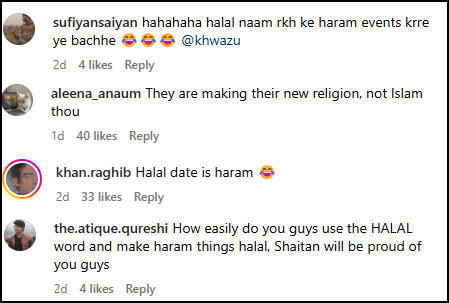
Source: Instagram
A user on Instagram laughed at the reel shared by the organisers and said, “They are using the name ‘halal’ and organising ‘haram’ events.” Another user said, “They are making their own religion, not Islam.” A user called halal dating “haram” and laughed. Another user asserted that the way they used “halal” for “haram” things, “Shaitan” would be proud of them.
While some Islamic scholars are against it, calling it haram or forbidden, others claim that if such interactions are structured and supervised as per Islamic laws, they could be a permissible way for unmarried individuals to explore potential relationships within a religious framework.
Notably, according to the Islam QA website, having a girlfriend or a boyfriend is “haram” in Islam. The website reads, “It is haram for a man to have a girlfriend, and it is haram for a woman to have a boyfriend. The evil consequences and misery caused by such relationships are obvious to anyone who observes real life. For more, see the detailed answer.”
However, Muslim scholar Mufti Menk claimed that there are certain rules for halal meetings, such as seeking a long-term partner, informing parents about it, conducting meetings in a public setting, having a third person during online chats, and more.
On 26th November, the Supreme Court of India dismissed a Public Interest Litigation (PIL) filed by evangelist Dr K.A. Paul, where he had sought a return to ballot paper voting in India. He had also called for the disqualification of candidates found guilty of distributing money, liquor, and other inducements during election campaigns.
Supreme Court questions petitioner’s motives
While dismissing the plea, the apex court questioned the motives of the petitioner. Dr Paul, who appeared in person, had claimed that he had the support of 180 retired IAS/IPS officers and judges. He cited his humanitarian work during the argument, where he claimed to have “rescued” over three lakh orphans and 40 lakh widows. However, his plea to return to ballot paper voting met with scepticism from the Supreme Court bench comprising Justice Vikram Nath and Justice P.B. Varale. Commenting on the plea, Justice Nath remarked, “You have filed PILs earlier. How do you get such brilliant ideas?”
Nath J: How do you get these brilliant ideas?
Paul: I am just coming from Los Angeles from a wonderful global peace summit. We have about retired IAS IPS and judges. They are supporting me.
Nath J: Why are you entering to this politics arena?
During the hearing, Dr Paul argued that physical ballot voting was essential to ensure democracy. He cited examples of voting in 180 countries and declared, “Every democracy in the world, if you see [has physical ballot paper]. Unless dictators, because they do not have elections.”
Paul: 18 political parties have supported this. ECI announced that they have seized around 9000 crores. 180 out of 197 countries are following physical ballot system. Why should we follow everybody? Let us be different
Nath J: Ok. Why you should follow other countries?
Furthermore, he claimed that the electoral process in India is corrupt and necessitated this change. He asked, “Election Commission announced this year in June that they have seized nine thousand crore, more than one billion dollars, cash and gold. What is the consequence?” To this, Justice Nath refuted his claims, saying, “There is no corruption. Who says corruption?”
Dismissal with remarks on EVM tampering
Dr Paul claimed that EVMs are vulnerable to tampering. He cited social media posts from politicians like Chandrababu Naidu and Jaggan Mohan Reddy and claimed endorsements from figures like Elon Musk. He said, “Even during my global peace summit, Elon Musk had clearly stated that EVM technology can be tampered.” Though he claimed that Elon Musk attended his summit, Opindia found no such evidence. There were no videos or reports that suggest that Musk attended the “global peace summit” of Dr KA Paun in LA.
Petitioner: Even political leaders like Chandrababu Naidu and Mr Reddy have said that EVM can be tampered. Even during my global peace summit, @elonmusk had clearly stated that EVM technology can be tampered
While Dr K.A. Paul mentioned Musk, interestingly, the billionaire recently lauded India’s voting system while criticising California’s inability to finish the counting of votes even after over 25 days.
Justice Nath dismissed the allegations and stated, “What happens is, if you win the elections, EVMs are not tampered. When you lose elections, EVMs are tampered.” Before dismissing the petition, the bench remarked, “What happens is, if you win the elections, EVMs are not tampered. When you lose elections, EVMs are tampered. When Chandrababu Naidu lost, he said EVMs can be tampered. Now, this time, Jaggan Mohan Reddy lost, he said EVMs can be tampered.”
Nath J: When Chandrababu Naidu or Mr Reddy lost, they say that EVMs are tampered when they won, they don't say anything. How can we see this? We are dismissing this. This is not the place where you argue all of this.
Justice Nath further remarked that political parties do not have objections to the voting system. He observed, “Political parties have no problem with this system. You have a problem.” The bench concluded that the current system does not warrant the changes suggested by the petitioner.
On 9th November Uttar Pradesh Police recovered a huge consignment of beef in Greater Noida. This exposed a network in which cows were slaughtered in West Bengal and brought to Noida through containers and stored in cold storage to be supplied in Delhi-NCR (National Capital Region) and Uttarakhand. According to the authorities, 185 tons of cow meat were found. However, according to Ved Nagar, the National President of the Gau Raksha Hindu Dal, nearly 250 tons were recovered. Furthermore, he mentioned that the Gau Rakshak Dals of Mewat provided him with information regarding the supply of beef via the container.
Nand Kishore Gurjar, the Bharatiya Janata Party MLA from Loni, stated that the consignment of beef that was impounded indicated that at least 8,000 cows must have been killed. Additionally, he accused two high-ranking officials in Lucknow of being involved. However, their names have not been disclosed. 9 people have been taken into custody by the police. There is also a demand to take bulldozer action on the cold storage unit and impose the National Security Act (NSA) on the accused.
The vehicle had Haryana’s number
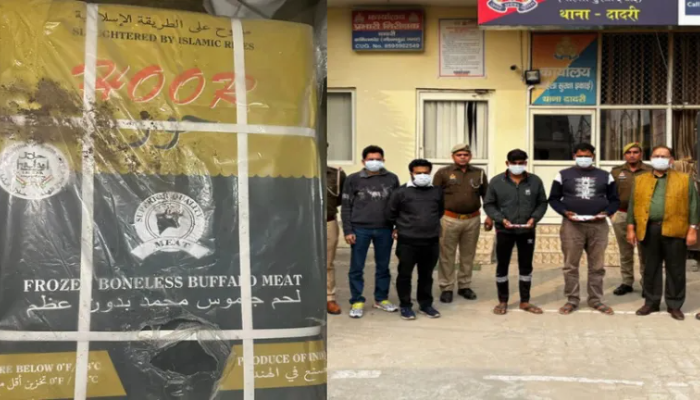
The incident took place in Dadri police station area of Noida. The members of the Gau Raksha Sangathan had received information about beef arriving from West Bengal. The members of the group assembled, based on the information. A truck with the number HR 38 AE 9185 was stopped and searched after which the banned meat was found in it. The police were informed about the matter. They reached the spot, took samples and sent them for analysis which revealed that it was cow meat.
Shiv Shankar, a resident of Uttar Pradesh’s Etah district was the truck driver. His assistant, Sachin was also from the same area. Both have been arrested. They confessed to bringing the meat from West Bengal, during interrogation. It was bought from Habibar Mullah in large quantities. They were taking the truck to SPJ Cold Storage which is in Nagla Kirani village of Gautam Buddha Nagar district.
9 arrested, cold storage unit sealed
OpIndia has a copy of the First Information Report (FIR). The case has been registered under section 325 of the Bharatiya Nyaya Sanhita (BNS). Cold storage unit owner Puran Joshi, director Mohammad Khurshidun Nabi and manager Akshay Saxena have also been arrested. The facility and truck have been seized. On 23rd November, the cops also nabbed Delhi resident Salimuddin Ansari who was also involved in the smuggling.
The involvement of Shoaib Haqani, Rakesh Singh and Avinash Kumar was also discovered during the inquiry. All three work for a company called Toro Primary Private Limited which is charged with purchasing and reselling cold-stored beef. The three were apprehended and thrown behind bars on 24th November and section 325 of BNS was invoked along with 318 (4) 61 (2) and 3/8 of the Cow Slaughter Act.
According to Noida Police, a total of 185 tons of beef has been recovered out of which 153 tons was kept in chamber number 5 of the cold storage unit. The remaining beef was found in a container that came from West Bengal. The police estimated that the beef amounted to roughly Rs 4 crore. It didn’t have any bones. Such meat is separated from the boneless portion of the animal. The remaining meat has been disposed of in accordance with regulations and its samples have been preserved.
Buffalo meat was written on the packets
The beef was packed in black and yellow colored packets and the brand name “Hoor” was written on the packets with “Frozen Boneless Buffalo Meat” displayed in English and Arabic. The name of the person who did the packing was printed as “Murad Karbala Food.” The polythene in which the meat was rolled also had many words written in the Arabic language on it.
Cow protection activist Ved Nagar told OpIndia that Mewat’s cow protection groups had informed him about the beef’s arrival. He informed that this was India’s largest beef seizure. He also highlighted that political protection is being given to those who smuggle cows. He has called for the guilty to be held accountable under the Gangster Act and the National Security Act (NSA). A Hindu Mahapanchayat had been announced by him in the instance that administrative action was not taken promptly. Speaking to a media organization, he declared that if the administration did not run a bulldozer on the establishment then the locals would demolish it. He expressed apprehension that its owner, Puran Joshi, already converted to another religion.
More than 8 thousand cattle were slaughtered: BJP MLA
Nand Kishore Gurjar stated that Dadri has been an area of cow protectors since ancient times and the recovery of such a large quantity of beef is a matter of shame for everyone. He also accused the local police of negligence in this matter. He added that some officers were not working with the right intentions and estimated that 8000 cows were slaughtered. He announced that he would meet Chief Minister Yogi Adityanath and inform him about the entire incident.
आक्रोशित हूं! मन व्यथित है!
हमारे मा. @myogiadityanath जी गौरक्षा के लिए कान्हा गौशाला बनवाकर गौमाता के संरक्षण और संवर्धन के कार्य कर रहे है लेकिन वहीं दूसरी तरफ गौतमबुद्धनगर में पुलिस की नाक के नीचे गौतस्करो के सिंडिकेट के द्वारा 300 टन यानी 8 हजार से ज्यादा गौमाताओं का कत्ल… pic.twitter.com/8bKKba4iwN
The lawmaker asserted that two senior officials sitting in Lucknow were involved in cow slaughter in the state and kept the proceeds. He accused these two officials of pressuring the lower staff and ruining the image of the government. He demanded a Central Bureau Of Investigation (CBI) probe into the matter.