Home Blog Page 74

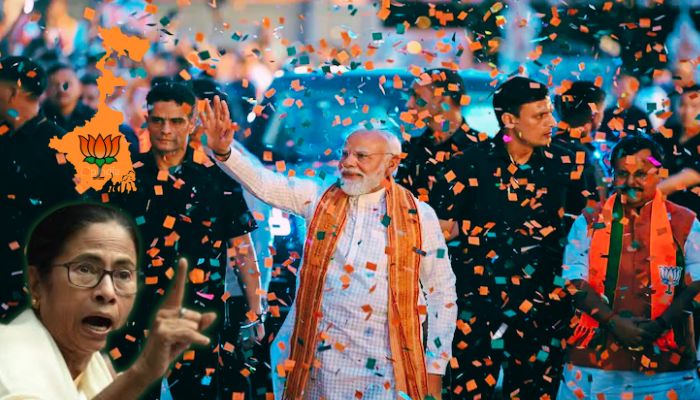
Mamata Banerjee’s undignified rejection of electoral defeat and brazen insult to Bengal’s public mandate exposes the real face of fascism that the Left always pretended to oppose

For years, India’s political discourse has been dominated by one accusation hurled repeatedly at Prime Minister Narendra Modi and the BJP by the Congress-Left ecosystem: fascism. Every electoral victory of the BJP was portrayed as a “threat to democracy”, every assertion of state authority was painted as authoritarianism, and every attempt to enforce political accountability was equated with the rise of dictatorship. Yet, when genuine displays of authoritarian behaviour emerge from leaders aligned with the anti-BJP camp, the same ecosystem suddenly discovers the virtues of silence, nuance, and selective outrage.

The conduct of outgoing West Bengal Chief Minister Mamata Banerjee following the BJP’s landslide victory in the 2026 Bengal Assembly elections is perhaps the clearest demonstration yet of this hypocrisy.

Mamata Banerjee’s “stolen mandate” rhetoric mirrors Donald Trump’s post-2020 playbook

The BJP’s victory in Bengal was decisive and emphatic. With 207 seats in the 294-member assembly, the electorate delivered an unmistakable verdict against the Trinamool Congress and ended Mamata Banerjee’s 15-year reign over the state. In any functioning democracy, such a result would have compelled an outgoing chief minister to concede defeat gracefully, congratulate the winning side, and facilitate a smooth constitutional transition.

Instead, Mamata Banerjee chose confrontation over constitutional propriety.

At her press conference on May 5, Banerjee struck a defiant tone and declared that she would not resign because she did not “believe” that her party had lost the election. She further alleged that the Election Commission worked at the behest of the BJP and implied that the electoral process itself had been compromised. Predictably, no substantial evidence accompanied these allegations.

The parallels with Donald Trump and the aftermath of the 2020 US Presidential election are impossible to ignore.

Following his defeat to Joe Biden, Trump repeatedly claimed that the election had been “stolen” by Democrats through institutional manipulation and voter fraud. Despite courts rejecting those claims and officials finding no evidence of widespread fraud capable of overturning the result, Trump continued fuelling suspicion among his supporters. Critics and media observers argued that this relentless narrative helped convince a significant section of his voter base that he had been denied power through collusion between the Democratic Party and the American establishment.

Four years later, Trump returned politically stronger, powered by a support base that believed he had been wronged.

Mamata Banerjee appears to be attempting a similar political script in Bengal.

Her refusal to accept the verdict is not merely a political denial. It is an attempt to delegitimise democratic institutions when those institutions produce an outcome unfavourable to her party. The message being sent to TMC workers is dangerous and unmistakable: the BJP did not truly win, the Election Commission cannot be trusted, and therefore the transfer of power lacks moral legitimacy.

The Congress-Left ecosystem’s selective outrage over “fascism”

This is precisely how genuinely authoritarian political movements behave.

Ironically, these are the same behavioural patterns that the Left-liberal ecosystem has spent a decade attributing to Modi and the BJP without evidence. Yet when Mamata Banerjee openly questions the legitimacy of a democratic verdict and signals reluctance to vacate office, the outrage is either muted or absent.

That silence is not accidental.

Mamata Banerjee represents a political tendency that much of the Left ecosystem is unwilling to criticise because she occupies the same anti-BJP ideological camp. Her authoritarian tendencies, political violence, and institutional subversion have long been tolerated because she serves as a counterweight to Modi politically.

This is why Bengal’s record of post-poll violence rarely receives the scrutiny it deserves from the same commentators who routinely speak about democratic backsliding elsewhere.

Bengal’s long record of political violence is conveniently ignored

The aftermath of the 2021 Bengal Assembly elections should have permanently shattered the moral pretensions of the so-called secular-progressive ecosystem. Reports emerged of systematic attacks on BJP workers and their families. Several Hindu women and female relatives of BJP supporters allegedly faced abduction, sexual assault, and gang rape. Entire localities witnessed targeted violence. Families fled villages in fear.

Yet these stories never received sustained national outrage from the same media establishment that amplifies every allegation against BJP-ruled states. There were no prime-time morality lectures every evening. No coordinated celebrity activism. No sustained international concern about democratic collapse in Bengal.

The victims simply did not fit the preferred political narrative.

The same pattern was visible in Sandeshkhali, where women came forward with disturbing allegations against a TMC strongman and his network. The allegations involved land grabbing, intimidation, sexual exploitation, and terror carried out under political protection. Yet even such horrifying testimonies failed to trigger the kind of moral panic the Left ecosystem routinely manufactures over far smaller allegations elsewhere.

Then came the Murshidabad riots, where attempts were allegedly made in sections of the commentary space to invert victimhood itself, portraying aggressors as victims and victims as aggressors in service of ideological convenience.

None of this is surprising when viewed through the lens of Mamata Banerjee’s political conduct over the years.

Constitutional morality requires defeated leaders to step aside

A leader who repeatedly demonstrates contempt for institutional accountability eventually creates a political ecosystem in which party workers come to believe they are above constitutional limits. Political violence becomes normalised. Administrative neutrality collapses. State machinery begins functioning as an extension of partisan interests.

Her refusal to accept electoral defeat is therefore not an isolated emotional reaction. It is a culmination of a political culture that has steadily undermined democratic norms in Bengal.

The Indian Constitution, as envisioned by B. R. Ambedkar, was never merely a legal document. It depended fundamentally upon constitutional morality, the willingness of political actors to respect democratic verdicts, institutional processes, and peaceful transfers of power, even when outcomes are personally humiliating.

That moral framework requires defeated leaders to step aside.

Mamata Banerjee’s refusal to do so signals exactly the opposite. By suggesting that the mandate itself lacks legitimacy, she is effectively encouraging party cadres to treat constitutional transition as negotiable rather than binding.

The implications are serious.

In a state already scarred by decades of political violence, such rhetoric can embolden TMC workers and local strongmen to resist administrative transition, undermine law and order, and justify intimidation under the belief that they are protecting a “stolen” government. Once leaders communicate that a democratic defeat is illegitimate, political extremism among supporters becomes easier to rationalise.

Other defeated chief ministers accepted the public mandate with grace

What makes Mamata’s conduct even more indefensible is that Indian politics offers multiple examples of leaders accepting defeat with maturity and constitutional grace.

Down in Tamil Nadu, M. K. Stalin suffered an electoral setback at the hands of actor-turned-politician Vijay. Yet Stalin did not declare the election fraudulent or refuse to step down.

In Kerala, Pinarayi Vijayan and the Left government lost a crucial electoral contest to the Congress-led UDF. There was no melodrama about constitutional illegitimacy. Ironically, the Congress party and its ecosystem, which routinely cast aspersions on the integrity of the Election Commission, celebrated victory in Kerala with no complaints whatsoever.

Back in 2017, Akhilesh Yadav accepted defeat after the BJP swept Uttar Pradesh. He publicly acknowledged the verdict and stated that his party would introspect on the reasons behind the loss.

Similarly, after the 2025 Bihar elections, Tejashwi Yadav did not accuse institutions of conspiracy merely because the results were unfavourable to the RJD.

Naveen Patnaik showed the democratic civility Mamata Banerjee lacks

Perhaps the sharpest contrast comes from Odisha.

Naveen Patnaik had governed Odisha for over 24 years before the BJP defeated the BJD in the 2024 elections. Few regional leaders in India enjoyed the longevity, control, and political stature that Naveen Patnaik possessed. Yet after his defeat, he accepted the people’s mandate with composure.

More significantly, Naveen Patnaik personally attended the BJP swearing-in ceremony and congratulated Laxman Majhi, the relatively lesser-known BJP MLA who defeated him from Kantabanji. That is what democratic civility looks like. That is what constitutional maturity looks like.

The contrast with Mamata Banerjee could not be starker.

One accepted defeat with dignity after nearly a quarter-century in power. The other appears unwilling to acknowledge defeat after 15 years.

Mamata Banerjee today embodies the very authoritarianism the Left warns about

For all the rhetoric about “saving democracy” and “fighting fascism”, it is Mamata Banerjee today who most visibly embodies the authoritarian instincts that India’s Left-liberal establishment claims to fear. A leader unwilling to accept electoral defeat, eager to delegitimise institutions, dismissive of constitutional morality, and politically enabled by a partisan ecosystem that refuses accountability. That is not resistance to fascism; it is its textbook expression.

The tragedy is not merely Mamata Banerjee’s conduct. The greater tragedy is the intellectual dishonesty of those who spent years weaponising the language of democracy while remaining silent when actual anti-democratic behaviour emerged from within their own ideological camp.

Bengal’s verdict was not merely a defeat for the TMC. It was also a rejection of a political culture built on intimidation, selective outrage, institutional erosion, and ideological impunity.

Whether Mamata Banerjee accepts it or not, the people already have.

TCS Conversion Scandal: Nashik court rejects Nida Khan’s anticipatory bail, says prima facie material shows her involvement in organised attempt to convert victim to Islam; Read details

On 2nd May, a Nashik Court rejected the anticipatory bail plea of Nida Ejaz Khan in the TCS Conversion Scandal. The court held that the material collected during investigation prima facie showed that she was involved in a wider and organised effort to influence the victim, hurt her religious sentiments, and push her towards religious conversion. The court added that the plea was not a fit case for pre arrest protection and found that her custodial interrogation is necessary to get to the root of the matter.

The order was passed by Additional Sessions and Special Judge KG Joshi of the Nashik Road Court. Nida Khan was booked at Deolali Police Station under Sections 69, 75, 299 and 3(5) of the Bharatiya Nyaya Sanhita (BNS) and several provisions of the SC/ST Act. OpIndia’s detailed report on the FIR can be checked here.

What Nida Khan argued before the court

The defence argued that Nida and the victim worked in the same office and knew each other. However, the defence completely denied any wrongdoing on her part. It was claimed that she was falsely implicated and that the main accusations were against co accused Danish and Tausif, not her. The defence also argued that there was no material evidence against Nida to prove caste based humiliation within public view.

Nida Khan’s counsel further claimed that there is no specific law in Maharashtra dealing with religious conversion. He argued that Section 299 of the BNS concerns hurt to the religious sentiments of a community, not conversion. He also argued that casual talk about religion cannot be turned into an offence and that, at the highest, only a bailable provision could apply.

The defence further argued that Nida was pregnant and claimed that arrest would cause irreparable loss to the unborn child.

What the prosecution told the court

Nida’s anticipatory bail plea was strongly opposed by the prosecution, as the court was informed that from July 2023 to 2026, the accused persons, including Nida Khan, influenced the victim towards conversion. It was further argued that Nida Khan hurt the victim’s religious sentiments. Furthermore, the prosecution pointed out that the FIR itself specifically mentioned the name and role of Nida Khan and that the investigation has pointed towards a conspiracy involving communication among the accused.

The prosecution informed the court that Nida Khan was not a passive bystander. She used to talk to the victim in the office during breaks, brainwash her into converting to Islam, and played a role in compelling her to follow specific religious practices. Furthermore, the prosecution relied on the statements given by the victim, her mother, and brother.

The investigating officer informed the court that Nida Khan had provided the victim with a burqa and books related to Islam. An application was also found on the victim’s phone that was installed with the intent of converting her religion. The officer further added that Nida Khan sent her YouTube and Instagram links containing religious teachings. The officer added that further investigation was needed into the source of those materials and her wider links.

Notably, the prosecution informed the court that Nida Khan visited the victim’s home, trained her in namaz, instructed her on wearing hijab and burqa, and was involved in a plan to change her name to Haniya. The prosecution also said the victim was to be sent to Malaysia and that documents were to be prepared with the help of a “Malegaon party”, making custodial interrogation necessary to investigate whether a larger network, including possible foreign links, was involved.

What the victim’s side told the court

During the hearing, the victim’s counsel stated that the victim was brainwashed by the accused, including Nida Khan, into following their religion. Furthermore, Nida Khan’s and the other accused’s positions in the company were used to exert undue influence on the victim, force her to follow Islam, and even compel her to eat non veg food. It was also submitted that the accused made obscene remarks against Hindu deities and humiliated the victim regarding her caste in the office.

Furthermore, it was stated that Nida Khan attempted to convert the victim’s family using threats and intimidation.

Court says prima facie role of applicant is visible

After hearing both sides, the court drew a distinction between the role attributed to the co accused and that of Nida Khan. The Judge observed that the other two accused were prima facie involved in offences under Sections 69 and 75 of the BNS, while Nida Khan appeared to be involved in the offence under Section 299 of the BNS and the provisions of the SC/ST Act.

The judge specifically noted that the FIR itself mentioned the applicant by name and assigned her a role. The court said the material showed that the accused persons told “objectionable stories” about Hindu deities and hurt the victim’s religious feelings. The order also records that the applicant gave the victim a burqa, that the accused provided a book on the life of Prophet Muhammad titled “The Holy Life of Prophet Muhammad (PBUH)”, and that the applicant used to visit the victim’s house to impart religious training.

Court finds investigation points to organised attempt

The court observed that the interaction over faith between the victim and Nida Khan was not a casual one. The material on record showed a structured and organised effort directed at the victim. The court stated that the offence appeared to be “multi dimensional and multi layered”.

The court also took serious note of the material suggesting that the accused wanted to change the victim’s name and send her to Malaysia. The judge said the victim certainly has a constitutional right to profess any religion and choose any name, but added that this does not mean she can be brainwashed into doing so through an organised plan.

Court says custodial interrogation is necessary

The court observed that police custody was necessary for proper investigation. According to the judgment, the court found the case to be complicated and requiring a probe into the role of the “Malegaon party” and the names of the cities and countries that surfaced during the investigation. It was further necessary to probe possible links to persons outside India, including a person named Imran who is said to be based in Malaysia.

Pregnancy plea did not persuade the court

One of the main arguments of the defence was that Nida Khan was pregnant and that arresting her would have an irreversible effect on the unborn child. However, the prosecution argued that there is no separate rule in law for a pregnant accused where serious offences and a complicated investigation are involved. The court agreed with the argument and held that anticipatory bail is an extraordinary remedy to be used sparingly and only in exceptional cases. In this case, the court found no such exceptional circumstance.

On this basis, the judge held that the application was devoid of merit and rejected anticipatory bail plea.

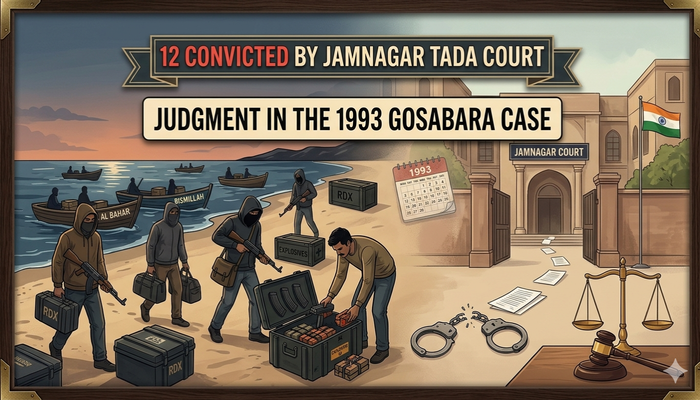
‘Conspiracy against Hindus to avenge Babri demolition’: TADA court sentences 12 convicts in the 1993 Gosabara arms case linked to Dawood Ibrahim and associates. Full details

A Special TADA court in Jamnagar on Monday (4th May) convicted 12 persons in connection with the 1993 Gosabara cross-border arms smuggling case. The decision comes three decades after Pakistan-backed smuggling of arms into India via the Gujarat coast led to the 1993 Mumbai serial blasts and other communal discord across the country.

A Special Terrorist and Disruptive Activities (Prevention) Act Judge Robin P Mogera convicted Osman alias Usman Umar Koreja, Mamad Alimamad alias Mamdu, Harun Adam Sanghar Vagher, Ahmed Ismail Oliya, Aarif Abdul Rehman alias Aarif Lambu Memon, Iftekhar Mohmmad Yunus Ansari, Mohammad Ayub Abdul Kayum Sati alias Ayub Taklo, Ahir Lakhman Hardas, Mohammad Salim alis Salim Kutta, Umarmiya alias Mamumiya Ismilemiya alias Panjumiya Saiyad Bukhari, Istiyaq Ahmad Mohammad Yunus Ansari, and Kadir Ahmad Amim Ahmed Shaikh. The court acquitted 17 accused, and declared 15 other accused, including Dawood Ibrahim, Tiger Memon (Ibrahim Abdul Razak), Anees Ibrahim Kaskar, Chota Shakeel, Anwar Samba, whose last known location was Karachi (Pakistan), as proclaimed fugitives under Section 8(3)(A) of TADA.

Terror plot to avenge Babri Masjid demolition hatched at Dawood Ibrahim’s Dubai residence

The case relates to a terror conspiracy hatched by fugitive terrorist Dawood Ibrahim and his associates at his Dubai residence to avenge the demolition of the Babri Masjid on December 6, 1992. A large cache of weapons and explosives, including RDX, was smuggled into India via the Gosabara coast in Porbandar, Gujarat, using boats like Sada Al Bahar and Bismillah. The decision in the case comes nearly 33 years after an FIR was registered at the Jamnagar B-division police station in July 1993. The investigation in the case, which lasted several decades, was carried out by now-retired IPS officers P K Jha and Satish Verma, and current CBI Special Director Manoj Shashidha.

In its verdict, the special TADA judge held that a conspiracy was hatched by the conspirators against the Hindu community to avenge the demolition of the Babri Masjid. “…it clearly appears that the conspiracy was hatched to do away with the Hindu community for taking revenge for the Babri Mosque demolition, and as a part of it, launches of Mustafa Majnu were sent to Pakistan and prohibited arms and ammunition were obtained,” the special TADA judge noted.

“Thus, based on the above discussion, it clearly appears that the prosecution has successfully proved that a criminal conspiracy was hatched by the absconding accused Daud Ibrahim in connivance with deceased accused Mustafa Majnu and Osman @ Usman (A1), Mamad (A2) and Harun (A3), who went in Sada-Al-Bharar launch of Mustafa Majnu and procured arms and ammunition from Pakistan and were then landed at Gosabara in Sada-Bahar launch and thus, the prosecution successfully proved the charge of conspiracy against the above referred accused persons and hence,” the judge added.

Convictions and sentences of the accused

While sentencing the accused, the special TADA court considered the mitigating factors like the long period of trial, lack of subsequent criminal acts by the accused, their ages and health conditions. The court convicted – Osman @ Usman Umar Koreja (A1), Mamad Alimamad @ Mamdu Sap (A2), Harun Adam Sanghar Vagher (A3), Ahir Lakhman Hardas (A28) and Umarmiya @ Panjumiya Saiyad Bukhari (A34) under Section 3(3) TADA read with Section 120B IPC.

The court convicted Ahemad Ismail Oliya (A12) under Section 3(3) of the TADA Act, read with Section 120B of the Indian Penal Code, together with Section 25(1A), 25(1B)(b) of the Arms Act. Accused Aarif Abdul Rehman @ Aarif Lambu Memon (A21) was convicted under Section 25(1A) of the Arms Act, while Iftekhar Mohammad Yunus Ansari (A23) was convicted under Section 25(1A), 25(1B)(b) of the Arms Act.

Accused Mohammad Ayub @ Ayub Taklo (A24) was found guilty of offences punishable under Section 25(1A) of the Arms Act. Accused Mohammad Salim @ Salim Kutta (A30) was convicted for the commission of an offence under Section 25(1B)(a)(c)(f) of the Arms Act. Section 3(3) of TADA Act r/w Section 120B of Indian Penal Code together with Section 25(1A), 25(1AA), 25(1B)(b) of the Arms Act. Istiyak Ahmed Mohammad Yunus Ansari (A35) was convicted under Section 25(1A), 25(1B)(b) of the Arms Act. Accused Kadir Ahmad @ Kadir Haji Shekh (A37) was convicted by the court under Section 25(1A) of the Arms Act.

The court directed that the time already spent by the accused in jail will be set off against the period of sentences given to them. Here are the details of the sentences granted to the accused by the court:

Osman @ Usman Umar Koreja (A1), Mamad Alimamad @ Mamdu Sap (A2), Harun Adam Sanghar Vagher (A3), Aarif Abdul Rehman @ Aarif Lambu Memon (A21), Mohammad Ayub @ Ayub Taklo (A24), Ahir Lakhman Hardas (A28), and Kadir Ahmad @ Kadir Haji Shekh (A37) were granted rigorous imprisonment for 5 years and a fine of ₹5000 each by the court for offences committed by them under the TADA Act and the Arms Act. In default of payment, they will have to undergo simple imprisonment for 2 months.

The court granted Ahemad Ismail Oliya (A12) rigorous imprisonment for 5 years and a fine of ₹5000 for his conviction under Section 3(3) of the TADA Act, read with Section 120B of the IPC, rigorous imprisonment for 5 years and a fine of ₹5000 for the offence punishable under Section 25(1A) of the Arms Act and rigorous imprisonment for one year and a fine of ₹1,000 for the offence punishable under Section 25(1B)(b) of the Arms Act. All his sentences are to run concurrently, and in default of payment of fine, he will have to undergo simple imprisonment of one or two months as directed in the order.

Iftekhar Mohammad Yunus Ansari (A23) was granted 5 years rigorous imprisonment and a fine of ₹5,000 for the offence punishable under Section 25(1A) of the Arms Act, 1 year rigorous imprisonment and a fine of ₹1,000 for the offence punishable under Section 25(1B)(b) of the Arms Act and 1 year rigorous imprisonment and a fine of ₹1,000 for the offence Section 25(1B)(b) of the Arms Act. In default of the payment of a fine of ₹5,000, he is directed to undergo two months’ simple imprisonment, and on failing to pay the ₹1,000 fine, he will undergo one month’s simple imprisonment. His sentences are also directed to run concurrently by the court.

Mohammad Salim @ Salim Kutta (A30) was sentenced to undergo 5 years of rigorous imprisonment for five years and a fine of ₹5,000 for the offence punishable under Section 25(1A) of the Arms Act, 7 years of rigorous imprisonment and a fine of ₹3,000 (Rupees Three Thousand Only) for the offence punishable under Section 25(1AA) of the Arms Act, and 1 year of rigorous imprisonment and fine of ₹1,000 for the offence punishable under Section 25(1B)(b) of the Arms Act. His sentence was also ordered to run concurrently, and in default of the payment of the fine, he will have to undergo simple imprisonment of one or two months, depending on the fine amount.

Umarmiya @ Panjumiya Saiyad Bukhari (A34) was given 5 years rigorous imprisonment for 5 years, and a fine of ₹5000 for the offence punishable under Section 3(3) of TADA Act read with Section 120B of the Indian Penal Code, 5 years rigorous imprisonment for five years and fine of ₹5,000 for the offence punishable under Section 25(1A) of the Arms Act, 7 years of rigorous imprisonment and fine of ₹3,000 for the offence punishable under Section 25(1AA) of the Arms Act, and 1 year rigorous imprisonment and fine of ₹1,000 for the offence punishable under Section 25(1B)(b) of the Arms Act. His imprisonment is to run concurrently. In default of payment, he will have to undergo imprisonment of one or two months for the fine amount.

Istiyak Ahmed Mohammad Yunus Ansari (A35) was granted 5 years’ rigorous imprisonment and a fine of ₹5,000 for the offence punishable under Section 25(1A) of the Arms Act, and 1 year rigorous imprisonment and a fine of ₹1,000 for the offence punishable under Section 25(1B)(b) of the Arms Act. The court directed his sentences to run concurrently. If he fails to pay the fine amount, he will have to undergo imprisonment of one or two months as directed in the court order.

Lies, fearmongering, and distortions: How foreign media outlets, including NYT, Al Jazeera, The Guardian, pushed falsehoods on the BJP’s Bengal and Assam wins

The historic victory of the Bhartiya Janata Party in West Bengal has given heartburn not just to the Trinamool Congress and its supporters but to the entire Islamo-leftist cabal globally. Several foreign media publications covered the BJP’s thumping victory, though not without peddling propaganda about the victorious party’s ‘Hindu nationalist’ ideology, ‘Muslim minority under threat’ bogey and falsehoods about the pre-poll SIR exercise.

The New York Times frames the BJP’s Bengal ‘conquest’ as an expansion of Hindu nationalism

The New York Times, a US-based newspaper with a track record of pushing anti-India and anti-Hindu narratives through Indian brown sepoys, covered the BJP’s 206 out of 294-seat victory on 4th May. The Islamo-leftist newspaper, however, could not hold back its anguish over the “conquest” of West Bengal by “Modi’s Hindu Nationalists”.

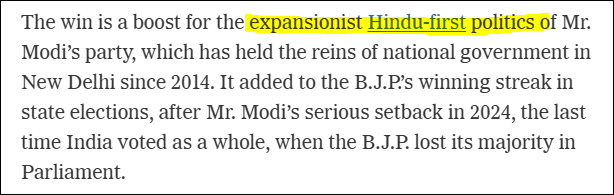
In an article headlined, “Modi’s Hindu Nationalists Conquer a Bastion of India’s Opposition”, the NYT described the BJP’s victory in Bengal as a big boost to Prime Minister Narendra Modi’s supposed expansionist “Hindu-first” politics.

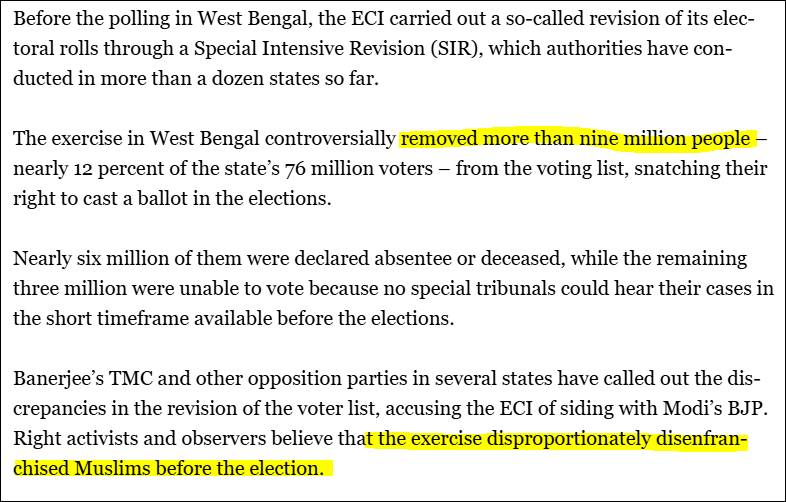
Predictably, the newspaper amplified the opposition’s falsehoods around the Special Intensive Revision (SIR) of electoral rolls in West Bengal. It claimed that the SIR struck nine million voter names out of the electoral roll with “many of them Muslim”. The NYT not only framed the SIR as some sort of anti-Muslim electoral engineering in the BJP’s favour but also cast aspersions on the integrity of Chief Election Commissioner Gyanesh Kumar.

Without offering a shred of evidence but the opposition’s baseless rhetoric, the New York Times claimed that CEC Kumar has ‘close ties’ to PM Modi.

“Nine million names, many of them Muslim, were struck from the voter rolls in an audit by the Election Commission ahead of the election…. The Election Commission had rejected earlier versions of similar complaints. The commission, a formally independent body, is currently led by an official with close ties to Mr Modi,” the NYT piece reads.

It is essential to note that, contrary to the NYT’s framing that the ECI conducted SIR in Bengal right ahead of the elections, the ECI deleted 58.25 lakh voters who were found to be deceased, absent, shifted, or had duplicate entries in the draft rolls in December 2025. This slashed the total voter base down from 7.66 crore to 7.04 crore. Subsequently, an additional 5 lakh names were removed from the final rolls on 28th February, taking the overall number of deletions to just under 91 lakhs.

Of 60.06 lakh voters who were initially put under adjudication, nearly half were found ineligible. The highest number of deletions was recorded in Muslim-dominated Murshidabad, where more than 4.55 lakh voters were found ineligible out of 11 lakhs marked for adjudication. Murshidabad district shares a border with Bangladesh. Muslim mob violence and Bangladeshi Muslim infiltration are major issues here.

Contrary to the propaganda peddled by anti-BJP parties, their ideological allies in India and abroad, the official ECI breakdown demonstrated that the vast majority were standard clean-up categories like dead, absent, permanently shifted, untraceable at registered addresses, or bogus. 

Pertinently, while the Indian and foreign Islamo-leftist media coterie has been framing the SIR exercise as a conspiracy by ECI and BJP to disenfranchise Muslims, it is Hindus who comprised 63% of the deletions in absolute terms.

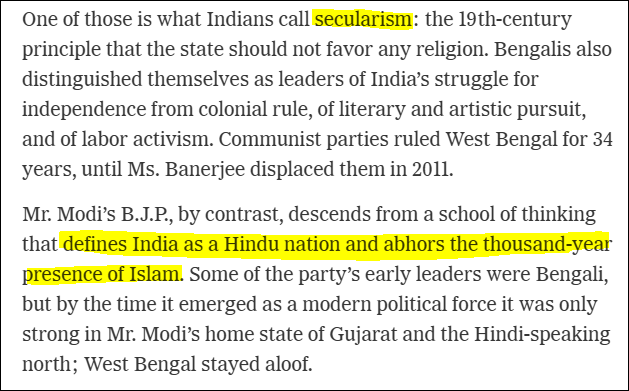
Furthermore, the NYT attempted to contrast how PM Modi comes from the ideological background that defines India as a Hindu nation and loathes the presence of Islam, while the Bengali people uphold ‘secularism’ and intellectual superiority.

“Mr Modi’s B.J.P., by contrast, descends from a school of thinking that defines India as a Hindu nation and abhors the thousand-year presence of Islam,” the article claims.

The subtlety of this apocryphal framing is amusing. Quite conveniently, the New York Times painted Narendra Modi as ‘anti-secularist’ and what the Islamo-leftist cabal describes as ‘Islamophobe’. India is a Hindu nation. This is a civilisational reality, and Indians don’t need to subscribe to the BJP’s political ideology to acknowledge this fact. Moreover, the BJP or its ‘Hindu nationalist’ ideology does not abhor the ‘thousand-year presence of Islam’; it only abhors the glorification of Islamic barbarians and invaders, who brutalised, killed, converted Hindus and non-Muslims to Islam and destroyed Hindu temples.

It is interesting how the NYT and similar Islamo-leftist propaganda outlets frame ‘Hindu nationalists’ as bigots but never highlight the hatred for idolaters like Hindus mandated by Islamic texts.

Moving ahead, the NYT framed Mamata Banerjee as a champion of the poor and downtrodden who resisted “corporate interests while heralding welfare schemes and playing up her credentials as a secularist, which made her especially popular among Muslims and liberals.”

Contrary to the NYT’s framing, Mamata Banerjee is neither a secularist nor a leader who boosted Bengal’s economic growth through welfare schemes. In her 15-year rule, Banerjee pushed an industrial powerhouse of Bengal into the quagmire of a debt trap. Under the TMC regime, West Bengal’s share in national GDP dwindled, per capita income slumped below the national average, and thousands of companies have moved out of the state.

Indeed, Banerjee ran many populist welfare schemes; however, these resulted in Bengal’s entanglement in a cycle of borrowing to pay for day-to-day expenses rather than building assets that could generate future income, taking its debt to over ₹7.7 lakh crore. The TMC regime ruined Bengal’s industrial environment with its “syndicate raj” to such an extent that since 2011, more than 6,600 companies, including 110 listed firms, have moved their registered offices out of West Bengal. 

OpIndia has documented numerous incidents wherein Mamata Banerjee demonstrated blatant neglect, rather, humiliating suppression of Hindus, while going out of the way to appease Muslims. It was reported in 2023 that a Durga Mandir was found blocked and barricaded in Kaliachak town in Malda district of West Bengal. The development came a day before the Islamic month of Muharram. Before this, CM Mamata Banerjee imposed restrictions on the immersion of Durga idols in 2016 and 2017 to make way for Muharram processions.

In fact, Banerjee took pride in not being a Kafir and fighting Kafirs (infidels as per Islam). But since Banerjee appeased Muslims and suppressed Hindus, she and her party remained ‘secular’ and ‘liberal’ in the eyes of liberals.

The Bengali Hindus, who trusted and voted for the TMC, have had enough of the party’s oppression and misrule and decided to give the BJP the long-awaited claim to power. This is how democracies function. But the New York Times cannot fathom that the so-called Hindu nationalist party has swayed Bengali voters with its issues-based grassroots-level poll campaign.

Reuters reduces the BJP’s poll successes in Bengal and Assam as a result of appealing to the Hindu majority

The foreign legacy media has this habit of describing the BJP as a ‘Hindu nationalist’ party, ‘Hindu hardliner’, ‘Hindutva outfit’ and whatnot, essentially to instil readers with the idea that it is a religious bigot, and fringe that has gained prominence and power by walking a linear path of aggressively appealing to India’s Hindu majority. In this vein, a Reuters report claimed that PM Modi’s supposed strategy of appealing to the country’s Hindu majority has become a sure-fire winner.”

“The gains also underline that Modi’s strategy of ‌pushing economic development, giving generous handouts and appealing to the country’s Hindu majority has become a sure-fire winner, including in regions long seen as opposition strongholds,” the report reads.

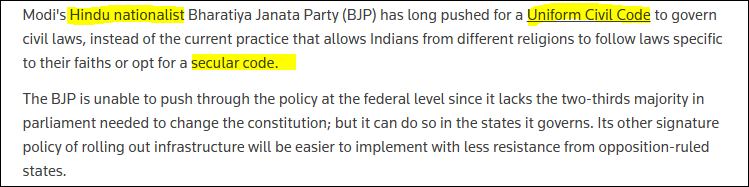
Ironically, the BJP is abhorred by Islamo-leftists for supposedly being opposed to ‘secularism’, but when the same party wants to implement a secular Uniform Civil Code, somehow the same anti-Hindu cabal advocates communal narratives.

Interestingly, much like Reuters, almost all foreign legacy media outlets covering Bengal elections quoted Rahul Verma, a ​fellow at the anti-India propaganda factory, Centre for Policy Research, which is run by the daughter of Congress leader Mani Shankar Aiyar. It has been under scrutiny for non-compliance with the Foreign Contribution Regulation Act (FCRA) rules.

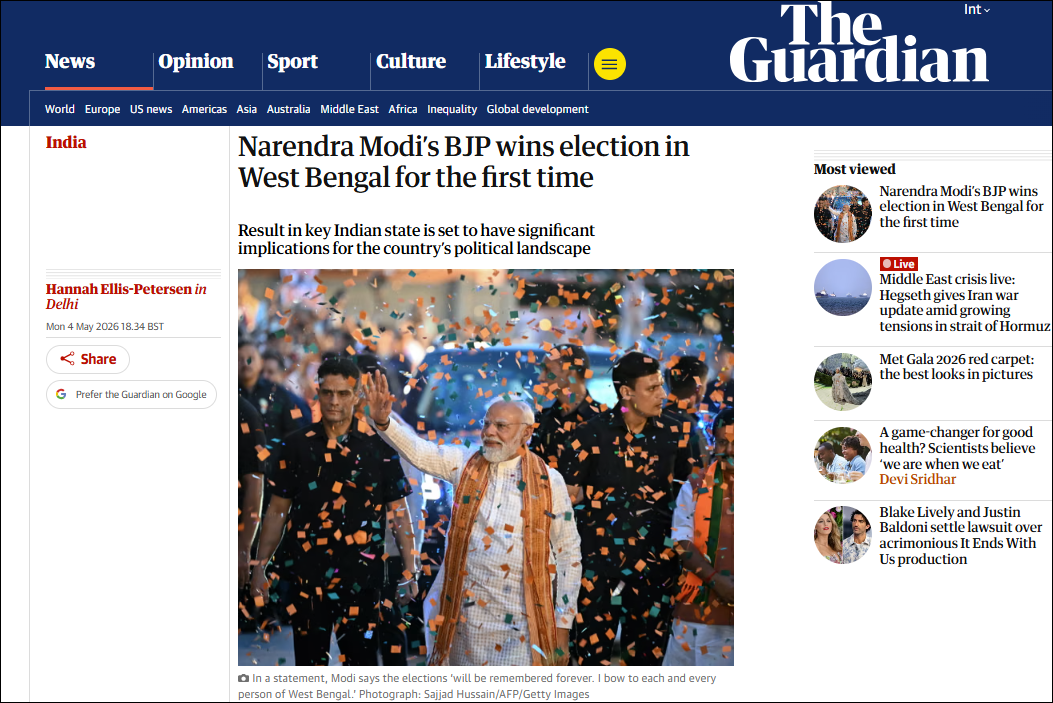
The Guardian fails to hide frustration over the ‘Hindu Nationalist’ BJP’s Bengal and Assam victories

From the 2020 Delhi Riots to the 2022 Leicester violence coverage, the UK-based newspaper, The Guardian, has been infamous for its blatant anti-Hindu and pro-Jihadist bias. In continuation of the same trait, The Guardian deployed Hannah Ellis-Petersen to recycle the same old ‘Hindu nationalism’, ‘minorities oppressed’ and ‘secularism in danger’ bogey as the BJP registered maiden victory in Bengal and retained Assam.

“Over the past 15 years, the state has been ruled by Trinamool Congress (TMC), a key opposition party, under the leadership of Mamata Banerjee, the state’s female chief minister. Banerjee had been one of the most outspoken critics of Modi and his religious nationalist agenda over his 12 years in power,” The Guardian article says.

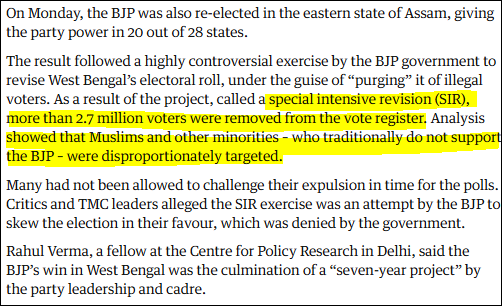
The Guardian also amplified the already debunked lies regarding the SIR and its supposed targeted impact on Muslims.

“The result followed a highly controversial exercise by the BJP government to revise West Bengal’s electoral roll, under the guise of ‘purging’ it of illegal voters. As a result of the project, called a special intensive revision (SIR), more than 2.7 million voters were removed from the vote register. Analysis showed that Muslims and other minorities – who traditionally do not support the BJP – were disproportionately targeted,” the report reads.

Contrary to the narrative pushed by The Guardian, the 2.7 million or the 27,16,393 voters, to be precise, were not arbitrarily removed. These were flagged for discrepancies and reviewed by around 705 judicial officers under the Calcutta High Court monitoring, as well as Supreme Court oversight. Of the 60.06 lakh cases, 32.68 lakh were retained as eligible, while 27.16 lakh were ruled excludable.

The Guardian claimed that the SIR in Bengal “disproportionately targeted Muslims”; however, 3% of the deletions in absolute terms involved Hindus. Even some Hindu-dominated areas like Paschim Bardhaman and the Matua community pockets in North 24-Parganas witnessed significant deletions. It was the Supreme Court’s decision that people whose cases are still pending cannot be allowed to vote in the elections. Apparently, the foreign media would update its reportage as soon as the opposition updates its rhetoric from “ECI is compromised” to “ECI and the Supreme Court both are compromised”.

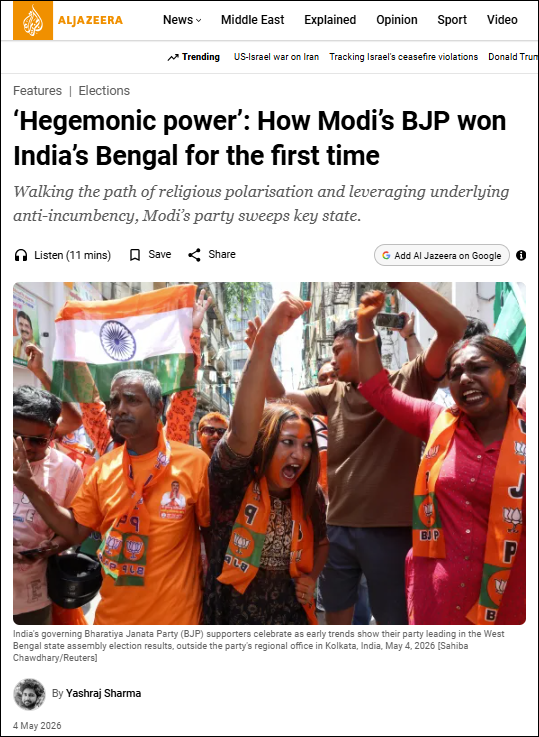
Al Jazeera credits the BJP’s victory to ‘religious polarisation’, fails to highlight the TMC’s Muslim appeasement

Al Jazeera, the Qatar-based Islamic Jihadist propaganda outlet, which has consistently been pushing anti-Hindu narratives, attributed the BJP’s Bengal victory to its strategy of ‘religious polarisation’.

Citing a Bengali Hindu voter’s statement, “Didi has lost the track and only appeases Muslims to stay in power”, Al Jazeera claimed: “That’s an accusation that Prime Minister Narendra Modi’s Hindu majoritarian Bharatiya Janata Party has long levelled against the TMC, which emphasises religious pluralism and the protection of minority rights.”

“Yet it is the outcome in West Bengal that analysts say is by far the most consequential of the results that were declared on Monday, with the BJP walking the trails of religious polarisation and leveraging underlying anti-incumbency to win…” it added.

Much like The New York Times, Al Jazeera also whitewashed Mamata Banerjee’s anti-industrial growth policies as some sort of ‘push back’ against corporate interests.

Unsurprisingly, Al Jazeera also amplified the disinformation peddled by the opposition parties and Islamists online regarding the imaginary ‘anti-Muslim’ nature of the Special Intensive Revision.

Rejected by Indian voters, opposition finds takers in Pakistan: Pakistani media amplifies Rahul Gandhi-Mamta Banerjee’s ‘election rigging’ propaganda

From Pakistani ISPR bots pushing propaganda in favour of Congress leader Rahul Gandhi, former minister Fawad Chaudhary supporting Gandhi over his haranguing regarding Ayodhya Ram Mandir Pran Pratishtha, receiving media support for echoing Pakistan’s falsehoods during Operation Sindoor, the Gandhi scion enjoys more support from the hostile neighbour than his home country, India.

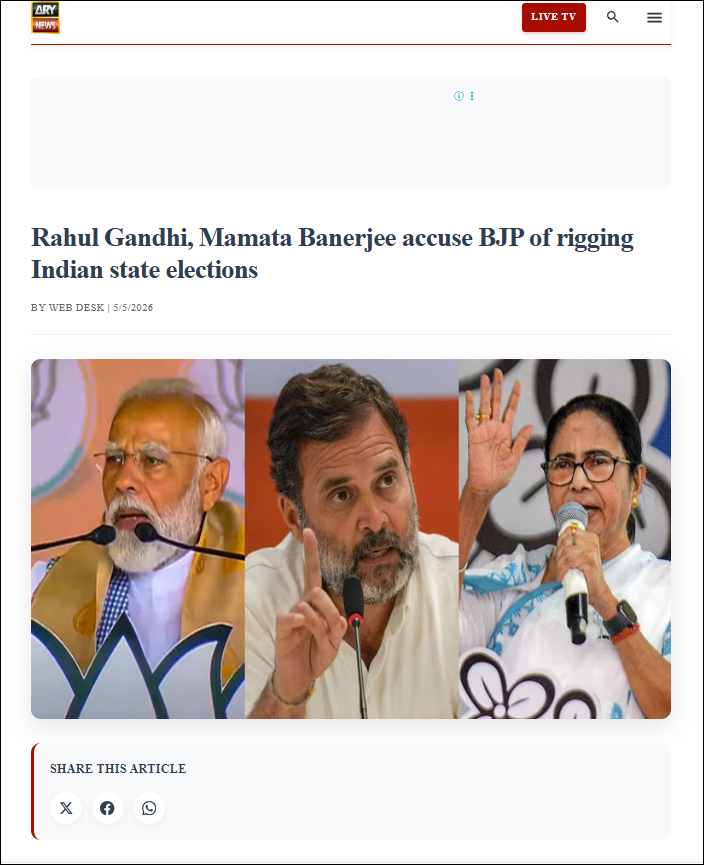
In a fresh demonstration of this limerence, Pakistani media has amplified Gandhi’s ‘election rigging’ and ‘ECI is compromised’ bogey. ARY Digital, a leading Pakistani Islamist propaganda outlet, published a report headlined, “Rahul Gandhi, Mamata Banerjee accuse BJP of rigging Indian state elections.”

This article, published on 5th May, amplified the claims by Rahul Gandhi and Mamata Banerjee that more than 100 seats were “stolen” by the BJP through the Election Commission.

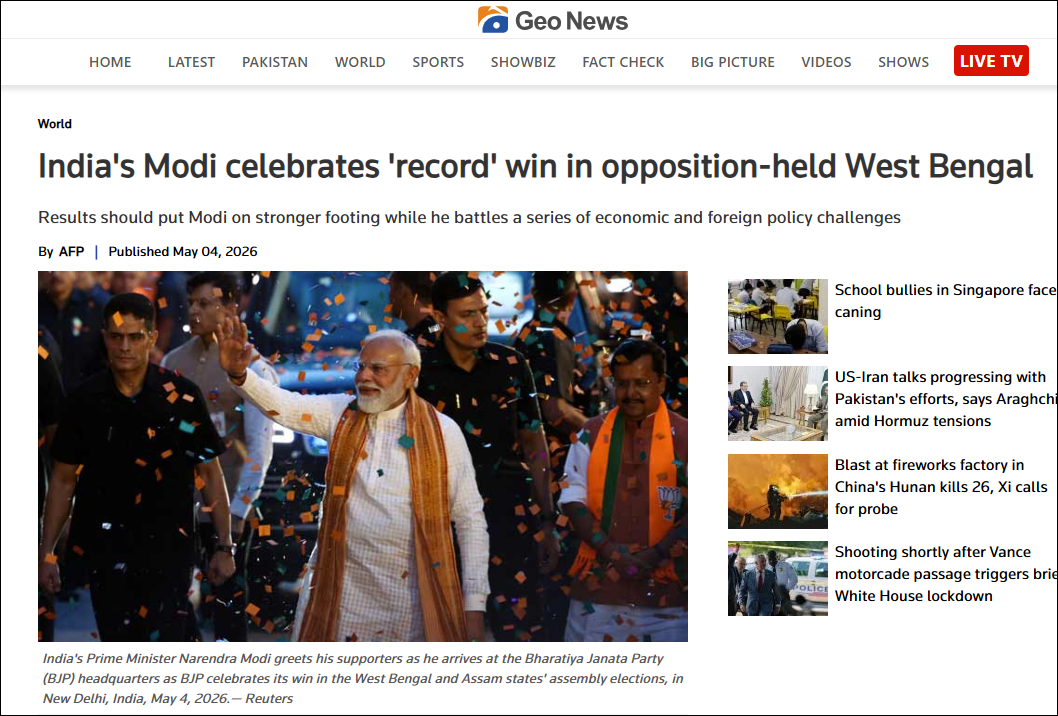
On 4th May, Geo News, Dawn and other major Pakistani news outlets ran wire stories by the AFP about the recently-concluded multi-state elections. The wire report amplified the usual lies about the SIR and the imaginary targeted disenfranchisement of Muslims in Bengal.

How the RSS rewired Bengal’s social consciousness and played a pivotal role in the BJP’s historic electoral breakthrough

The 2026 West Bengal Assembly election will be remembered not merely as a political upset but as a structural shift in the state’s political consciousness. To reduce the Bharatiya Janata Party’s (BJP) victory to campaign optics, charismatic speeches, or anti-incumbency would be analytically shallow. What unfolded in Bengal was something far deeper, a carefully engineered, long-duration socio-political transformation in which the Rashtriya Swayamsevak Sangh (RSS) played a decisive, if understated, role.

At the surface, the headlines celebrated leaders like PM Modi and Amit Shah. Strategists like Sunil Bansal were credited with electoral precision and booth-level execution. But beneath this visible layer lay an invisible architecture, the Sangh’s disciplined, decentralised network, which quietly did what conventional politics often fails to achieve: reshape the very instincts of an electorate.

For decades, West Bengal operated under a unique political grammar in which ideology trumped identity. The legacy of Left politics ensured that class consciousness overshadowed religious mobilisation, and even when identity politics gained prominence in other parts of India, Bengal remained relatively resistant to overt religious consolidation.

The RSS recognised this anomaly early. Bengal was not just another state; it was the land of Syama Prasad Mookerjee, the ideological fountainhead of the Bharatiya Jana Sangh, the BJP’s precursor. The inability of the BJP to dominate this terrain was therefore not merely an electoral gap but an ideological incompleteness.

What the RSS embarked upon was not an election campaign but a civilisational project. It sought to replace Bengal’s fragmented Hindu identity, divided by caste, class, and sub-regional loyalties, with a cohesive political consciousness. It did so not through spectacle but through persistence. Lakhs of micro-level engagements, ranging from voter awareness meetings to Lokmat Parishkar sessions, were conducted across constituencies. These were not rallies designed for television optics; they were conversations designed to recalibrate perception and embed a new framework of political thinking. 

The most significant achievement of this effort lies in what Bengal had historically resisted: Hindu consolidation beyond caste lines. Unlike states where caste arithmetic dictates electoral outcomes, Bengal’s Hindu society had never voted as a unified bloc. The Sangh’s intervention gradually altered this equation.

Through sustained outreach that blended religious, cultural, and social messaging, it normalised the idea of collective identity without making it appear abrupt or externally imposed. Festivals like Ram Navami evolved into platforms for reinforcing shared identity, while grassroots outreach ensured that these signals penetrated rural, tribal, and semi-urban regions. The process was incremental, almost imperceptible, but cumulatively transformative.

What made this strategy particularly potent was its framing. It was not presented as political mobilisation in the conventional sense but as cultural awakening. That distinction is crucial because when identity is internalised rather than instructed, it becomes far more resilient. The RSS’s work operated at precisely this psychological level, embedding a sense of shared belonging that eventually translated into political alignment.

Modern elections are typically dominated by spectacle, mass rallies, aggressive media campaigns, and high-decibel rhetoric. The RSS inverted this paradigm in Bengal by relying on what can best be described as a “silent campaign.” Its strategy centred on hyper-local engagement, where volunteers and swayamsevaks held small meetings in homes, temples, tea stalls, and community spaces. The objective was simple yet effective: build trust through familiarity and maintain continuous contact with voters. This approach bypassed media scrutiny, avoided counter-narratives, and allowed for highly customised messaging tailored to local concerns.

Winning elections, however, requires more than shaping opinion; it demands converting that opinion into actual votes. Here again, the RSS played a pivotal role by ensuring high voter mobilisation. Campaigns emphasising participation were not merely symbolic slogans but operational frameworks. Volunteers tracked voter engagement, followed up through local networks and digital communication, and ensured that turnout among sympathetic demographics remained high. At the same time, efforts were made to minimise vote leakage by discouraging NOTA voting and strengthening booth-level coordination. This is where the synergy between the RSS and the BJP became particularly evident: the Sangh built social capital, and the BJP converted it into electoral outcomes.

The organisational backbone of this effort was the RSS’s expansive network of shakhas and affiliated bodies. Over the past decade, this network has grown significantly in Bengal, allowing it to penetrate regions that were once beyond the BJP’s reach. From tribal belts and border districts to tea garden communities and urban peripheries, the Sangh ecosystem created multiple points of engagement across social strata. This multi-layered presence enabled it to operate not as a single campaign entity but as a coordinated system of interventions, each tailored to specific demographics and local realities.

Equally important was the role of narrative construction. The RSS’s outreach consistently contextualised local electoral choices within broader civilisational concerns. Discussions around the condition of Hindus in neighbouring Bangladesh, particularly amid political instability, were used to frame the election as more than just a contest over governance. By linking voting behaviour to questions of identity and security, the stakes of participation were elevated. Voting was no longer perceived as a routine democratic act but as a decision with deeper cultural implications.

Beyond voter outreach, the RSS also played a crucial role in managing the BJP’s internal dynamics in Bengal. The party had long struggled with factionalism, particularly between established cadres and newer entrants. The Sangh, with its institutional authority and perceived neutrality, acted as a mediator. Coordination meetings helped align competing interests, resolve disputes, and maintain organisational cohesion during a high-stakes election. This internal stability proved essential, as even the most sophisticated electoral strategies can falter in the face of internal discord.

While the RSS built the socio-cultural foundation, leaders like Sunil Bansal provided the strategic architecture necessary to translate groundwork into votes. Bansal’s emphasis on data-driven micromanagement, booth-level strengthening, and candidate selection complemented the Sangh’s grassroots efforts. His coordination with the RSS ensured alignment between ideological mobilisation and electoral execution. This convergence of structure and strategy was instrumental in delivering the BJP’s breakthrough.

Bengal’s transformation is particularly significant because of the challenges it historically posed. The state’s strong regional identity, intellectual traditions, and legacy of Left politics made it resistant to the Sangh’s ideological framework. That this resistance was gradually overcome suggests that long-term, decentralised mobilisation can succeed even in environments that appear structurally hostile. It also signals a broader shift in Bengal’s political axis, from ideology-driven politics to identity-centric mobilisation.

To characterise the RSS’s role as merely supportive would therefore be misleading. In Bengal, it functioned as the foundational force that enabled the BJP’s electoral success. What became visible in the election results was the culmination of years of groundwork, an intricate web of relationships, narratives, and organisational structures that shaped voter behaviour long before polling day. 

The implications of this model extend far beyond Bengal. It demonstrates that electoral success in complex political landscapes requires sustained social investment, culturally rooted narratives, and decentralised organisational strength. For the BJP, Bengal represents a replicable template. For its opponents, it represents a far more complex challenge because they are no longer confronting just a political party, but a transformed social consciousness.

Ultimately, the BJP’s victory in Bengal was not an isolated event but the culmination of a long-term process. At the centre of this process stood the RSS, whose quiet, methodical, and deeply embedded mobilisation redefined the contours of the state’s politics. By reshaping identity, strengthening organisation, and ensuring participation, the Sangh did what high-voltage campaigns alone cannot achieve: it altered how an electorate thinks, and therefore how it votes.

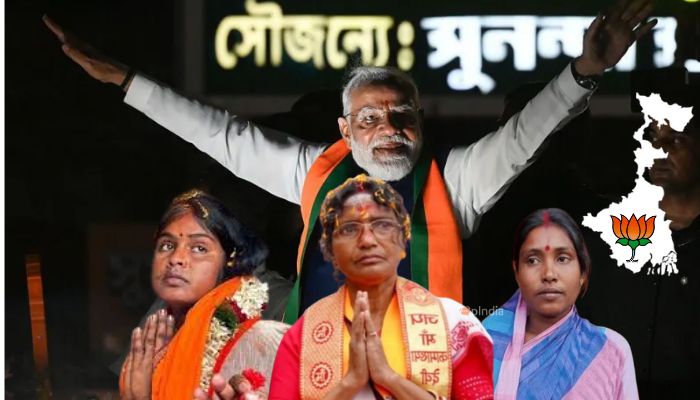
A househelp, a survivor of sexual harassment and a mother of a rape victim: Meet Kalita Majhi, Rekha Patra and Ratna Debnath who are the women stars of BJP’s West Bengal triumph

The 2026 West Bengal assembly elections have proven to be historic in many ways. This is the first time that the Bhartiya Janata Party has registered a victory in the state. Beyond the opposition’s ‘ECI is compromised’ noise, it is the BJP’s candidate selection and focus on real issues that propelled the party to 206 seats for its maiden triumph. BJP’s women candidates brought their own grassroots stories, carried pain and yearning to bring change that resonated with Bengali voters.

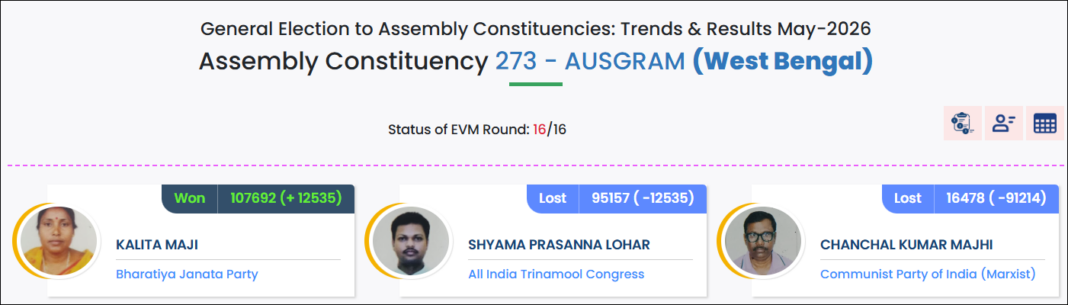
From house help to MLA: BJP candidate Kalita Majhi defeated TMC candidate by a margin of 12,535 

The BJP fielded a former house help, Kalita Majhi, from the Ausgram seat. Majhi secured 107692 votes and defeated the Trinamool Congress candidate Shyama Prasanna Lohar by a margin of 12535 votes.

Before entering politics in 2021, Kalita Majhi worked as a domestic help earning around Rs 2,500 monthly from four households in the Guskara municipality. The BJP had fielded Majhi in the 2021 assembly elections, but she lost against the TMC candidate Abhedananda Thander back then.

The BJP, however, did not abandon or sideline Majhi; rather, the party renominated her this time, and she defeated her TMC rival by an impressive margin. Majhi lost the 2021 election; however, she enjoyed a connection with the local people, which the BJP knew would translate into an electoral victory with the right campaigning and political messaging.

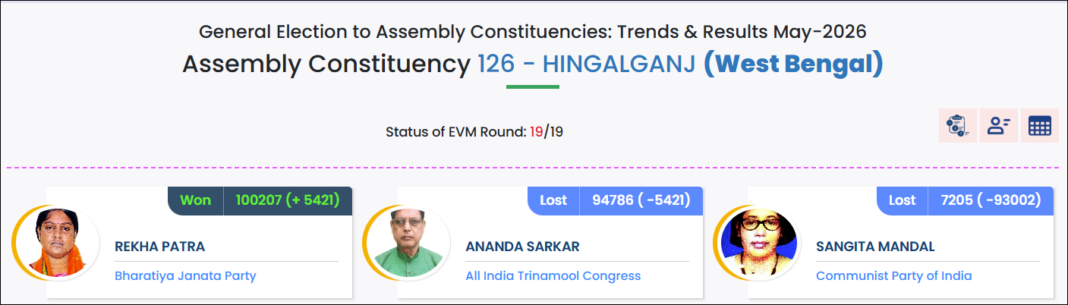
Rekha Patra: From being the face of Sandeshkhali protests, losing the 2024 Lok Sabha election amidst TMC’s personal attacks, to winning Hingalganj in 2026

In electoral politics, a candidate’s winnability is the main factor in determining their nomination. However, some seats, some candidates and their stories are above the prospects of poll victories and defeats. BJP’s Rekha Patra has been one such candidate. Contesting from Hingalganj against TMC’s Ananda Sarkar, Rekha Patra won by a margin of 5421 votes, securing 100207 votes.

 It must be recalled that Rekha Patra was the first woman in Sandeshkhali in North 24 Parganas, who had raised her voice and spearheaded the protests accusing TMC strongman Sheikh Shahjahan and his aides of land grabbing and sexual assault in 2024. In February 2024, hundreds of women in Sandeshkhali took to the streets to protest against land grabbing, non-payment of wages and sexual violence committed by Trinamool Congress goon Sheikh Shahjahan and his two aides, Shiba Prasad Hazra and Uttam Sardar.

When Rekha Patra, a victim herself, came forward and led the protests against TMC goons, she was targeted by the party’s supporters. Later, when the BJP fielded her from Basirhat for the Lok Sabha election, the TMC leaked her sensitive personal information.

Patra had lost the Lok Sabha election to her TMC rival, but she did not lose her party’s trust and commitment to support her fight against the TMC-linked perpetrators in the Sandeskhali land grabbing and sexual abuse matter.

Fast forward to 2026, the BJP nominated Rekha Patra from the Hingalganj seat, and she defeated her TMC opponent.

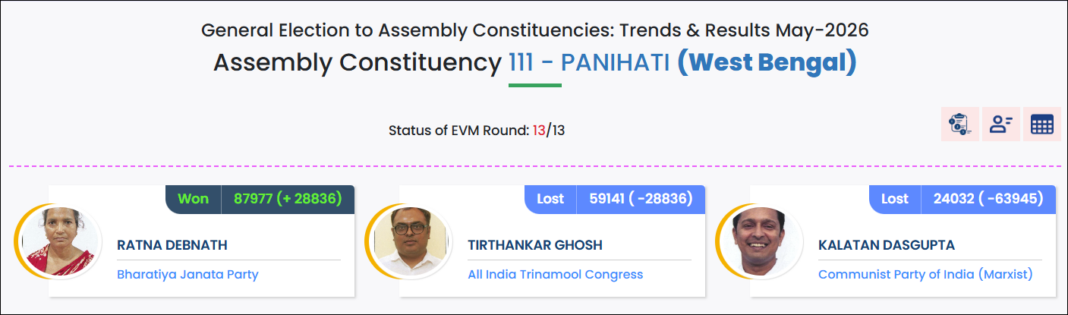
Ratna Debnath: The inspiring saga of the mother of the RG Kar College rape and murder victim, turning her pain into power

In the Panihati seat, the BJP fielded not a seasoned politician, not a celebrity, but a mother who sought justice for her daughter but received disappointment from the TMC regime. The party nominated Ratna Debnath, the mother of the RG Kar rape-murder victim, from the Panihati seat. Debnath won by a wide margin of 28836 votes against TMC’s Tirthankar Ghosh. She received 87977 votes in total.

In March this year, Ratna Debnath, the mother of the RG Kar rape-murder victim, spoke to the media and expressed her wish to contest the upcoming West Bengal Vidhan Sabha election on a BJP ticket.

Debnath’s chagrin stemmed from the TMC government’s failure to secure justice for her daughter, a junior doctor, who was brutally raped and murdered at the RG Kar Medical College and Hospital.

Addressing the media, Ratna Debnath had said that “women’s safety and security, and the well-being of people, are greatly compromised here in Bengal.”

Ratna Debnath had vowed to uproot Trinamool Congress from West Bengal. After over a month, Debnath witnessed the fulfilment of her vow as both she and her party registered a thumping victory by demolishing the TMC’s evil empire.

BJP did not politicise the women’s safety issue; it gave voice to the victims of TMC’s misrule and facilitated their quest to change the ‘system’ that failed them

In over a decade of the Trinamool Congress’s rule in West Bengal, the besmirching of the dignity of women, political murders and brutalities, riots, and overall collapse of law and order, became the new norm. From crimes against women after the 2021 elections, Sandeskhali horror to the RG Kar rape-murder case, not only the people of Bengal but the entire India saw the systemic failure under Chief Minister Mamata Banerjee’s leadership.

While TMC functionaries committed crimes with impunity, the party leadership gave them cover. It must be recalled how Mamata Banerjee attempted to downplay the harassment and sexual exploitation of women at the hands of Trinamool Congress goons.

During a public meeting at Birbhum in February 2024, she dubbed the unrest in Sandeshkhali as a ‘minor incident’ and blamed the BJP and the media for amplifying the issue in the public discourse.

At about 55:15 minutes into the programme, the West Bengal Chief Minister remarked, “An incident has happened or rather made to happen. First, they sent the ED (Enforcement Directorate), then its friend BJP, entered the scene.”

In May 2024, Banerjee went on to claim that BJP “scripted” the Sandeskhali incident. “The entire Sandeshkhali incident was preplanned. The BJP had scripted it. The truth has been exposed. I have been saying this for a long time,” Banerjee said back then.

In fact, Mamata Banerjee has a history of politicising, downplaying and victim-blaming in cases of sexual assault against women. In 2012, Banerjee dubbed the Park Street rape case involving an Anglo-Indian woman, Suzette Jordan, as ‘shajano ghotona‘ (concocted incident), which was allegedly ‘designed to malign the government.’ While TMC leaders kept casting aspersions on the victim’s character, a Kolkata Court upheld the rape charges and found the three accused guilty.

In 2013, Banerjee blamed rising population and modernisation for rapes in West Bengal. In April 2022, Mamata Banerjee courted controversy after she tried to downplay allegations of brutal rape and murder of a 14-year-old girl as a ‘love affair’ gone wrong.

In October 2025, a second-year MBBS student from Odisha was allegedly gang-raped by Apu Bauri, Firdos Sekh, Sekh Reajuddin and two others in a jungle area near Durgapur city. The failure of the TMC regime to safeguard women and even evoke trust that they will get justice can be understood from the fact that the rape survivor’s father had expressed fear that his daughter was not safe in West Bengal. “Trust has been lost. We don’t want her to stay in Bengal. She will pursue her education in Odisha,” he said.

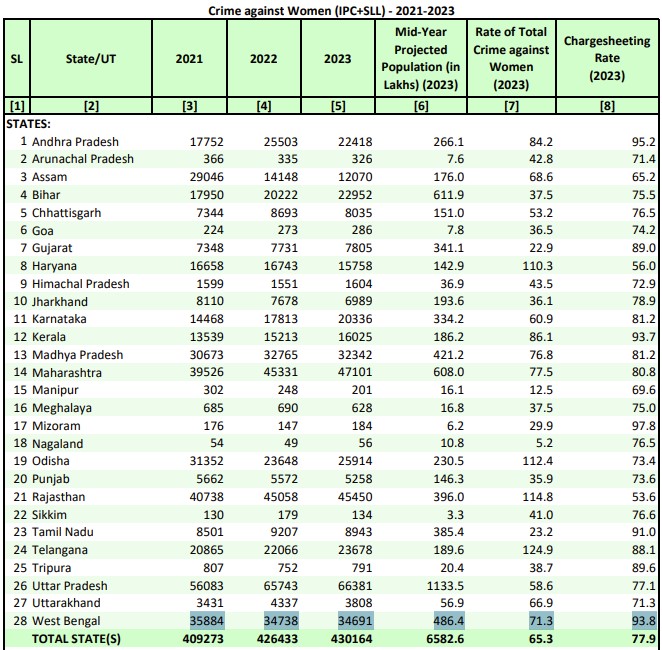
The NCRB report released in October 2025 highlighted how West Bengal, under a woman chief minister, had become highly unsafe for women. The report revealed that West Bengal recorded 34,691 cases of crimes against women under the Indian Penal Code (IPC) and Special and Local Laws (SLL). While this marked a marginal decline from 34,738 cases in 2022, the number is one of the highest in the country. The statistics translate to a crime rate of 71.3 cases per lakh female population. In the category of kidnapping and abduction of women – others (Sec. 363A, 365, 367, 368, 369 IPC), West Bengal recorded the highest, 2054 incidents out of the 7964 cases nationwide.

Despite all this, the left liberal cabal hailed Mamata Banerjee as an icon of women’s empowerment, and covered her neglect of women’s issues with the “only woman Chief Minister” rhetorical shield.

With such an opprobrious record of victim-blaming, Mamata Banerjee hardly took women’s safety seriously. No wonder Banerjee did not even take the protests by RG Kar doctors in 2024 seriously. In fact, the TMC government persecuted junior doctors, who led protests against the gruesome rape and murder case at RG Kar Medical College and Hospital. The doctors who participated in protests faced legal, financial and professional troubles. They faced undue transfer, court cases and police FIRs for seeking justice and accountability. They were booked for ‘causing grievous hurt to police personnel’ and ‘unlawful assembly.’

After all this, when Ratna Debnath announced her BJP candidature and vow to uproot TMC from Bengal, she was called ‘India’s Erika Kirk’ by pro-TMC trolls online. However, Debnath’s victory showed that the people of Panihati understood her pain, her fight, and the BJP’s honest intentions beyond electoral winnability.

Undoubtedly, TMC has a symbolic female leadership, but the party failed women at the grassroots. For political gains, the TMC government allowed a culture of impunity in several pockets across the state. The victories of Kalita Majhi, Ratna Debnath and Rekha Patra demonstrate that the TMC had a clear disconnect with reality; their arrogance and past effectiveness of intimidation tactics blinded them to the widespread anger women had towards the party. BJP did not miss the bus and fielded the victims of TMC’s misrule as faces of resistance. The BJP challenged the notion that only the elite can represent women’s issues by fielding women from humble backgrounds and with first-hand experience of TMC’s misrule, paving their way to the legislature.

Call it poetic justice that while these women with no political background won big and BJP’s overall women candidates hit a strike rate of 65%, Mamata Banerjee lost her home turf of Bhabanipur to BJP leader Suvendu Adhikari by a margin of 15,000 votes. After the final round of counting, Adhikari secured 73,463 votes, while Banerjee trailed with 58,349.

Supreme Court slams the Indian Young Lawyers Association over the 2006 Sabarimala reference: A detailed breakdown of the top court’s concerns over petitioners’ locus and legal grounds

There have been times in India’s judicial history when the Supreme Court has delivered a moral verdict on individuals who have abused its hallowed grounds rather than simply adjudicating a legal case. May 5, 2026, was one such day.

The India Young Lawyers Association (IYLA), the petitioner organisation whose initial 2018 writ petition sparked a ten-year storm over Lord Ayyappa’s sacred temple at Sabarimala, suffered a humiliation from which it will be difficult to recover with any professional dignity on the eleventh day of arguments before the nine-judge Constitution Bench hearing the Sabarimala reference.

The bench, which was led by Chief Justice of India Surya Kant and included Justices BV Nagarathna, MM Sundresh, Ahsanuddin Amanullah, Aravind Kumar, Augustine George Masih, Prasanna B. Varale, R. Mahadevan, and Joymalya Bagchi, revealed what many legal observers had long suspected: that the IYLA’s involvement in these proceedings is a planned, driven, and legally futile exercise that has wasted the apex court’s valuable time.

The bench asked the IYLA’s counsel, who was representing a group whose president is Naushad Ali, a series of scathing questions that made it clear how seriously the court took the organisation’s standing, objectives, and conduct during these proceedings.

A PIL built on newspaper clippings

Perhaps the most startling moment of the day’s proceedings occurred when the IYLA’s counsel revealed to the court the intellectual foundations of the original public interest litigation that dared to challenge Lord Ayyappa’s centuries-old tradition of celibate worship. Those foundations were four newspaper stories published in June 2006. This is neither theological research nor constitutional research. Four newspaper stories, including ‘The Sex Slump Felt Sabarimala’ and ‘Touching Feet and Attracting Touches.’

Chief Justice Surya Kant’s answer was scathing, clinical, and precise. The CJI’s statement, ‘Okay, so it was based on press reports,’ sums up the intellectual gravity of the petition that disrupted millions of people’s devotional lives in just four words.

This is something worth contemplating. The Indian Young Lawyers Association filed a writ suit with the Supreme Court of India, aiming to overturn an old, unbroken, theologically founded religious tradition observed by tens of millions of Lord Ayyappa devotees, based on sensationalist tabloid journalism. The petition lacked a genuine comprehension of the rights of believers, the philosophical relevance of Naishtika Brahmacharya (celibate devotion), or the Ayyappa tradition. It was based on news stories intended to incite anger rather than reveal the truth. Every IYLA member who linked their name to this exercise should be deeply ashamed of this one disclosure.

An abuse of the process of law: The court’s own words

What followed was much more awful. ‘This is nothing but an abuse of the process of law, that too before a nine-judge Constitution Bench,’ declared Justice MM Sundresh from the bench in response to the IYLA’s counsel’s attempt to raise procedural arguments contesting the maintainability of the nine-judge bench reference, claiming that the original speaking order had referred the matter to a seven-judge bench rather than nine. Go through issues and get them done. We don’t want to humiliate you any further. 

A sitting Supreme Court judge does not use these words lightly. An ‘abuse of the process of law’ is one of the most serious charges that a court can bring against a party before it. It signifies that the court has determined that the actions are being undertaken not for a valid legal purpose, but rather to harass, delay, or meddle. The Supreme Court of India’s nine-judge Constitution Bench has finally come to define the IYLA. This is not a small criticism; it is a court statement.

Nevertheless, the counsel continued. There were mentions of dubious procedural details. An attempt was made to use newspaper stories as proof. CJI Kant intervened directly after a comparison to the Khajuraho temple was made. If you do not know about a temple, please do not refer to all of them. Don’t waste our time, please. Simply continue and complete.

Throughout the morning’s proceedings, the same pattern emerged: a bench that was clearly irritated by the calibre of arguments being made, the irrelevant content being quoted, and the counsel’s seeming ignorance of the seriousness of the constitutional issues at hand.

Who is Naushad Ali, and why does it matter?

‘Who is your president?’ was the crucial question posed by Justice Aravind Kumar. Naushad Ali was IYLA’s counsel’s response.

Judge BV Nagarathna then brought out what is arguably the most significant and little-discussed issue about the entire Sabarimala PIL, ‘This is for an individual, how can a legal body such as yours have a belief? You lack morality.’ Then, sharply, ‘How is he a believer?’ Justify your explanation of the legal position.

The legitimacy of the PIL that sparked this debate is at issue when it comes to locus standi, or who has the moral and legal right to contest a religious practice. The president of a group that filed a writ petition to enter a Hindu temple worshipping a celibate deity, a temple whose customs have been upheld for generations by devout followers of that tradition, is Naushad Ali. Therefore, Justice Nagarathna’s inquiry was more than just procedural. What authority does this organisation and this person claim to advocate for, on behalf of, or against the devotional rights of Lord Ayyappa’s devotees? This was a fundamental challenge.

The answer appears to be none whatsoever. The organisation’s membership did not vote on a resolution approving the PIL’s file. Justice Aravind Kumar enquired directly, ‘Has your organisation passed a resolution to file a PIL? Has your President signed it?’ There was no such resolution; the counsel’s response was revelatory in its insufficiency. The PIL was submitted without the petitioner organisation’s own internal democratic approval.

A pattern of targeting the Hindu religion alone

Selective targeting is the underlying question raised by today’s proceedings and by millions of Hindu devotees since 2018. There is no arbitrary gender discrimination in the Sabarimala ritual. Because Lord Ayyappa is Naishtika Brahmachari, an immortal celibate, the tradition of celibacy linked with his form at Sabarimala is a sacred mandate. It is a differentiation based on the particular and distinctive nature of worship at that temple rather than the unworthiness of women. Devotees are aware of this. Practitioners are aware of this. The guardians of the tradition are aware of this.

During today’s proceedings, Justice BV Nagarathna made an observation that echoed this issue strongly. The court stated unequivocally: ‘Those who have faith in the deity will perform all that is required.’ However, this court cannot support anyone who claims to be willing to break all Niyam (rules). We are not superstitious. You are suggesting that people who do not have faith or belief in that deity are welcome to enter. You are not a true believer.

It is difficult to express the essential conflict more accurately. An organisation that had no believers among its petitioners attempted to overturn millions of believers’ deeply held convictions. Non-devotees marched into the Supreme Court, headed by a president who has no claim to be an Ayyappa devotee, to impose their will on a centuries-old religious tradition. They dressed it up in the rhetoric of constitutional rights, which they claimed out of ideology rather than actual faith.

Conclusion

Today was a quiet moment of vindication for the millions of devotees of Lord Ayyappa who walk barefoot through the Western Ghats forests, observe 41-day fasts, wear the Mala (rudraksha garland), and dedicate every part of their lives to their devotion during the pilgrimage season. The Supreme Court of India’s nine-judge panel stated unequivocally that the IYLA had squandered the court’s time, abused the legal process, and failed to present any genuine standing or argument for its case.

The Sabarimala case is far from over, and the nine-judge court will issue a decision with constitutional implications for religion, gender, and institutional autonomy. But what happened on Day 11 was a reckoning, a time when the court looked at the petitioners who sparked the debate and found them inadequate in every way, standing, sincerity, scholarship, and respect for the legal process. There are eighteen holy steps on the way to Sabarimala. The IYLA was a complete failure from the start.

West Bengal Assembly Election 2026: As opposition and left liberals blame SIR for TMC’s defeat, data shows Mamata’s party won 13 of 20 seats with highest deletions; read details

On 4th May, Bharatiya Janata Party (BJP) wrote history in West Bengal by defeating Mamata Banerjee’s Trinamool Congress (TMC) on its home turf. BJP won 208 out of 296 seats in the State Assembly Elections after a historic 91% voting during polls held in two phases. As the results started to come in on Monday, the opposition and left liberals started blaming the Special Intensive Revision (SIR) conducted by the Election Commission of India (ECI) in the state for TMC’s defeat.

However, the numbers tell a completely different story. In the 20 Assembly seats that recorded the highest number of voter deletions after adjudication, Mamata Banerjee’s party won 13, while the BJP won six of them and Congress managed to grab one.

These numbers are significant, as the narrative on social media projected the ECI as the villain behind TMC’s poor performance.

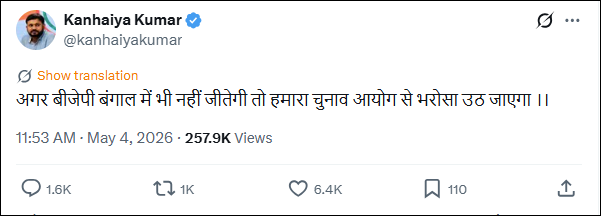
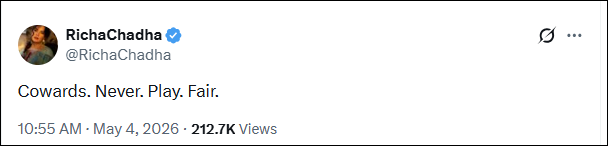
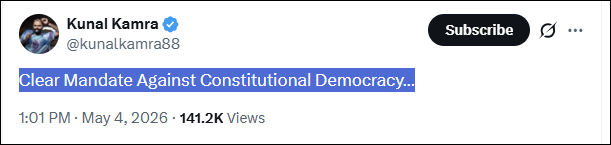
Opposition and the left liberals targeted the Election Commission after the results

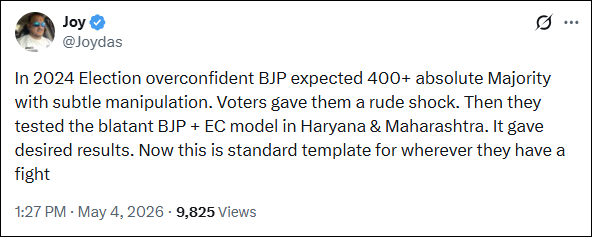
Throughout the day, sections of the opposition and the usual left liberal ecosystem began attacking the Election Commission and the SIR process.

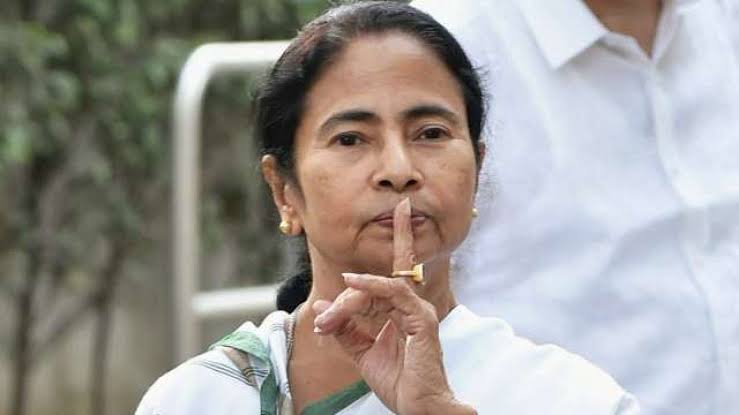
TMC chief and now-defeated caretaker CM of West Bengal, Mamata Banerjee, cried foul and claimed that BJP stole 100 seats in West Bengal.

Leader of Opposition and Congress leader Rahul Gandhi followed the suit and supported her claim of BJP “stealing” 100 seats from TMC in Bengal with the support of the Election Commission.

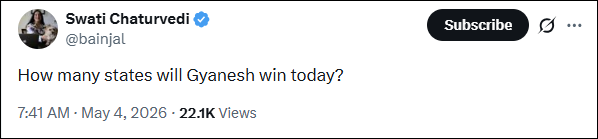
Controversial RJ of Radio Mirchi, Sayema, posted on social media platform X, “Election Commission won”, hinting that it was the ECI that led to the BJP’s win.

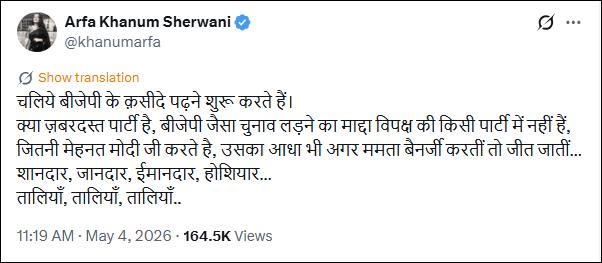
Propagandist posing as journalist, Arfa Khanum Sherwani of The Wire, sarcastically congratulated the ECI for conducting “the most free and fair elections in the history of independent India”, again blaming the agency for TMC’s performance. However, she completely ignored the fact that the numbers are not in favour of the narrative.

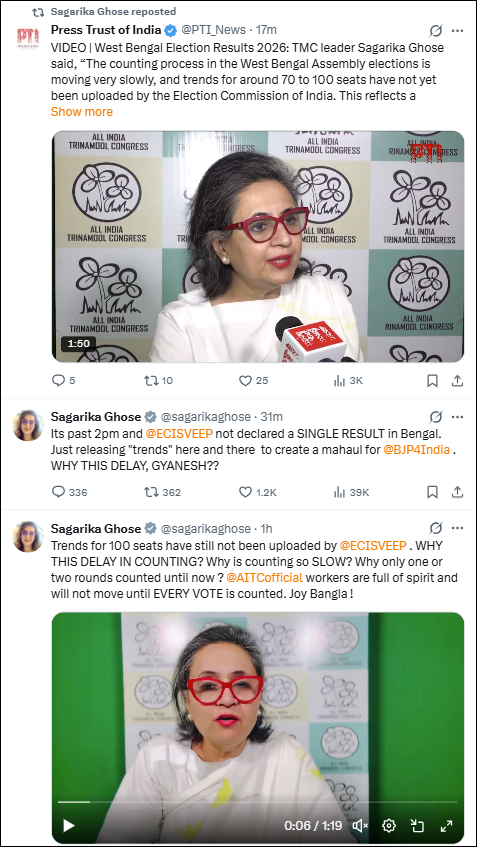
Rajdeep Sardesai, journalist and husband of former journalist turned TMC MP Sagarika Ghose, shared a video from India Today where Swaraj India’s co-founder Yogendra Yadav claimed that 27 lakh people were wrongfully denied voting rights and questioned how six lakh votes were added after publication of the final list.

AAP leader Sanjay Singh too attacked the ECI and claimed 27 lakh voters had been deprived of their franchise.

However, the actual seat-wise numbers contradict the claims that deletions under SIR simply cost the TMC the election.

TMC won most seats with the highest deletions

According to the data cited in The Indian Express, the 20 seats with the highest deletions after adjudication included Samserganj, Lalgola, Bhagabangola, Raghunathganj, Metiaburz, Suti, Mothabari, Goalpokhar, Malatipur, Chopra, Sujapur, Rajarhat New Town and Basirhat Uttar. All these seats were won by the TMC.

Farakka, which recorded 38,222 deletions, was won by the Congress. The BJP won Jangipur, Ratua, Karandighi, Ketugram, Manickchak and Monteswar.

In simple terms, of the 20 constituencies where deletions were the highest, 13 were won by Mamata Banerjee’s party. That alone punctures the propaganda that SIR deletions uniformly damaged the TMC while benefiting the BJP.

What the broader numbers show

In broader terms, in 187 seats where more than 5,000 voters were deleted, the BJP won 119 while the TMC won 65. The Congress managed 2 seats and AJUP won 1.

Out of these 187 seats, the number of deleted voters was higher than the margin of victory or lead in 47 constituencies. Within the BJP’s 119 seats, 28 had deletions greater than the victory margin. Of these, 26 had been won by the TMC in 2021. At the same time, among the 65 seats won or led by the TMC, 18 too recorded deletions higher than the victory margin.

This shows that while deletions and margins overlapped in several closely fought seats, the opposition’s attempt to reduce the entire Bengal result to one slogan around SIR is plainly misleading.

How SIR was carried out in Bengal

The SIR exercise was different from routine electoral roll revision. Registered electors were required to fill fresh enumeration forms and submit documents to establish eligibility, including citizenship. The Election Commission began the exercise in June last year, starting with Bihar and later extending it to nine other states, including West Bengal, and three Union Territories.

In Bengal, 60.06 lakh electors, or 8.5 per cent of those in the final roll published in February, were placed under adjudication. After cases were examined by around 700 judicial officers, 27.16 lakh electors were deleted. Appeals filed by those deleted are now pending before 10 Appellate Tribunals.

The propaganda versus the data

The post result reaction from opposition politicians, armchair journalists and television commentators tried to create the impression that voter deletion under SIR was behind TMC’s poor performance and proof of wrongdoing by the ECI. However, the seat-wise data, especially from the 20 constituencies with the highest deletions, neutralised the claims.

If SIR deletions alone were the magic explanation being projected by the usual ecosystem, the TMC would not have won 13 of the 20 seats where deletions were the highest. It is evident that there is an attempt to weaponise SIR as a one-line excuse for the Bengal result and they will continue to use it for months to come.

How BJP went from 0 seats to winning the West Bengal election in 15 years: A closer look at the architects who made it possible

4th May 2026 will go down in history as one of the defining moments in India’s electoral history. The corrupt Pishi-Bhaipo regime of Mamata Banerjee and Abhishek Banerjee finally ran its course. The Bharatiya Janata Party (BJP) overcame one of its last remaining frontiers by winning the West Bengal election with a large mandate.

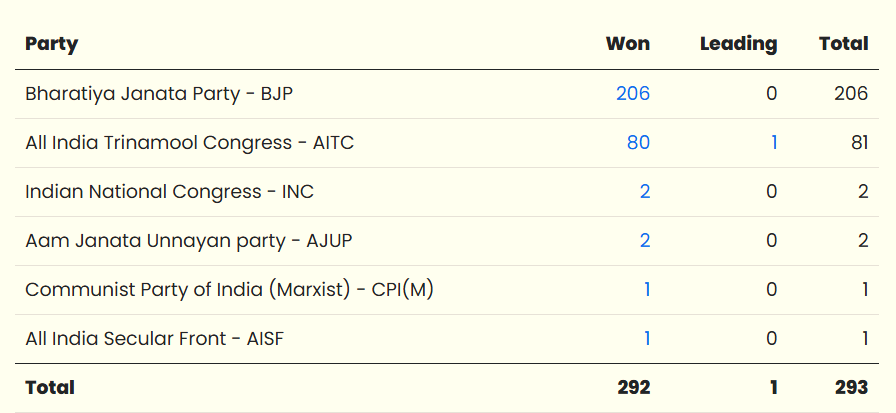
As I glance at the website of the Election Commission of India (ECI), I still find myself in a state of disbelief. The BJP won a whopping 206 constituencies out of 293, and TMC was relegated to just 81 seats. To my personal delight, Mamata Banerjee lost from her Bhabanipur constituency. A decade ago, such a sight was unimaginable and practically impossible.

While it is true that no one is invincible in politics and that the downfall of the TMC was inevitable at some point, the meteoric rise of the BJP from 0 seats in 2011 to winning the 2026 Vidhan Sabha election tells a different story. It did not happen by sheer chance. The party was built brick by brick by its State Presidents and its cadres in the past 15 years.

Screengrab of the 2026 West Bengal Vidhan Sabha election result, image via ECI website

In the 2000s, the BJP’s political performance in West Bengal was dismal. The party secured only 2 seats in the 2001 Vidhan Sabha election and none in the 2006 election. BJP also fared poorly in the national elections in the State. It secured 0 seats in the 2004 Lok Sabha election and managed to win 1 seat during the crucial 2009 election in Bengal.

The same year, Rahul Sinha was appointed the President of the West Bengal unit of the BJP. He steered the party during the Mamata wave of 2011. BJP was again left with 0 seats during the Vidhan Sabha election. The ascent of PM Narendra Modi to the power corridors of Delhi in 2014 left a mark on the State as well. Under the leadership of Rahul Sinha, the BJP was able to raise its vote share in Bengal from 6.15% to 16.84%, but could increase its seat count to only 2.

The massive foundational change began later that year when RSS ideologue Dilip Ghosh was roped into the BJP and made the General Secretary of the West Bengal unit. He had a distinct personality, which made him stand out immediately.

Ghosh was a match for Mamata’s aggressive style of politics. He was outspoken, cared little about political correctness and dared to look the TMC into the eye. His IDGAF attitude instilled confidence into the demoralised party cadre. Ghosh was rewarded soon with the leadership of the West Bengal BJP in 2015.

He led the party during the 2016 West Bengal Vidhan Sabha election. For the first time in the BJP’s electoral history in the State, the party won 3 seats. It was certainly not up to the mark, but the foundation was set. And the results spoke for themselves in the 2019 Lok Sabha election.

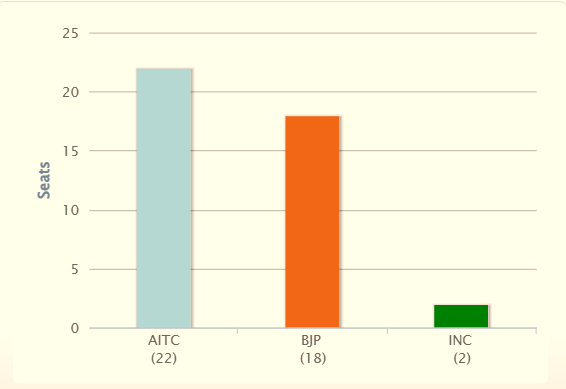
The party’s seat tally went from 2 in 2014 to 18 in 2018. At the same time, the BJP was able to clinch a whopping 40.6% of the vote share. It was an unprecedented swing in the mood of the voters. The message was clear: The party is in the right direction. In the run-up to the 2021 Vidhan Sabha election, many were convinced that it was the end of the TMC raj.

But many were shocked at the results. While the BJP was able to increase its seat count from 3 to 77, it fell short of the majority mark by 71 seats. The central leadership felt that a change was needed to take the fight to the next level. It was then that a two-pronged strategy was used.

Suvendu Adhikari was made the Leader of the Opposition in the West Bengal Vidhan Sabha. He had a calm, strategic demeanour with unmatched popularity, so much so that he defeated Mamata Banerjee in the crucial seat of Nandigram. At the same time, Sukanta Majumdar (who also had an aggressive style like Dilip Ghosh) was roped in as the BJP President.

The party focused on taking the fight against Mamata Banerjee with a missionary zeal. Issues affecting various strata of society, ranging from unemployment to demographic change, were highlighted consistently. Social media was galvanised to create public awareness and develop the movement for change. All of this, coupled with people’s fatigue of the Pishi-Bhaipo regime, created the perfect platform.

4th May 2026 saw Suvendu defeating Mamata Banerjee in her constituency of Nandigram. There should be no doubt in anyone’s mind that his personal popularity played a key role in securing the large mandate. He is likely to be the Chief Ministerial candidate of the BJP as well. And, he deserves all of the fame and applause for making the unthinkable possible.

Suvendu Adhikari took the party to 206 seats, but the foundation was laid by Dilip Ghosh with 40% vote share in the 2019 Lok Sabha and 77 seats in the 2021 Vidhan Sabha election. In our sudden rush to salute the rising sun, we must not forget those who played has played a major role in making the BJP a household name in West Bengal.

‘Bhadroloks’ who were once apprehensive of the BJP due to consistent fearmongering by the TMC regime also saw the good governance of the Modi government in different States of India. The public awakening, the right messaging and the desire to bring glory back to Bengal became the key forces of change. Yesterday’s victory is thus a collective fight of BJP leaders against corruption, appeasement politics and attempts by TMC to erase Hindu culture.

As BJP heads towards a historic win in West Bengal, liberals suffer a massive meltdown, ignore 15-years of anti-incumbency and declare BJP victory ‘unfair’

Such is the beauty of democracy that even the strongest of fortresses crumble when the public decides to get rid of them. In West Bengal, the Bhartiya Janata Party has pulled off the unthinkable and is set to register a historic victory in the elections. As the saffron party is heading towards the 200 mark, the left liberal cabal is having a monumental meltdown. The anti-BJP brigade has recycled its formulaic ‘Hum hare nahi humein haraya gaya hai’ bogey by casting aspersions on the integrity of the Election Commission, instead of gracefully accepting the Janadesh.

In this vein, Congress leader Srinivas BV wrote on X on 4th May, “When there’s ‘Gyanesh’ in your pocket… then even before the counting begins, preparations for a lavish feast kick off.”

Suffering yet another ‘zakhm’ inflicted by the BJP, leftist rag The Wire’s Arfa Khanum Sherwani attempted to a piece of sarcasm, but ended up exposing her bewilderment.

“Let’s start singing praises of the BJP. What a tremendous party it is; no opposition party has the guts to fight elections like the BJP does. If Mamata Banerjee put in even half the effort that Modi ji does, she would have won… Splendid, spirited, honest, clever… Claps, claps, claps…,” Sherwani wrote.

Meanwhile, student leader-turned-Congress politician, Kanhaiya Kumar, directly accused the Election Commission of ‘match fixing’ in the BJP’s favour.

“If the BJP doesn’t win in Bengal either, our trust in the Election Commission will be shaken,” Kumar posted.

Meanwhile, Bollywood entertainer Richa Chadha, who often comments on politics for some reason, tried to insinuate that the BJP did not pose a fair fight before the TMC and thus is set to win West Bengal. “Cowards. Never. Play. Fair,” she wrote.

Similarly, ‘comedian’ Kunal Kamra wrote, “Clear Mandate Against Constitutional Democracy…”

TMC leader Sagarika Ghose has come up with a rather peculiar coping mechanism as she is repeatedly asking the ECI why no results have been announced and only trends are being displayed on ECI’s website.

“Its past 2pm and @ECISVEEP not declared a SINGLE RESULT in Bengal. Just releasing “trends” here and there to create a mahaul for @BJP4India. WHY THIS DELAY, GYANESH??” Ghose wrote.

‘Journalist’ Swati Chaturvedi directly targeted Election Commission Chief Gyanesh Kumar, and wrote, “How many states will Gyanesh win today?”

Hinduphobe Joy Das claimed that after a shocker in the 2024 Lok Sabha elections, the BJP tested the supposed ‘BJP + EC’ model in Haryana and Maharashtra, and after its success, has made it a template for other states.

“In 2024 Election overconfident BJP expected 400+ absolute Majority with subtle manipulation. Voters gave them a rude shock. Then they tested the blatant BJP + EC model in Haryana & Maharashtra. It gave desired results. Now this is standard template for wherever they have a fight,” Das wrote.

Meanwhile, Ranting Gola, notorious for her politically biased, unfunny, and raucous commentary videos, described the West Bengal elections as not a contest between the BJP and the TMC, but TMC versus ECI, TMC versus the Enforcement Directorate, and TMC versus 90 lakh deleted voters.

The Islamo-leftist side of X and other social media platforms is replete with such posts throwing shade on CEC Gyanesh Kumar, accusing BJP of rigging, and abusing Bengali voters who chose the BJP after 3 terms of TMC rule. They have even refused to consider that the majority of voters may have wanted a change after 3 terms of Mamata Banerjee’s government, and anti-incumbency of 15 years is expected to have played a major part.

It has become a ritual for the anti-BJP parties and their supportive ecosystem to question the transparency of the entire election process, cast aspersions on the integrity of the Election Commission, and blame the BJP’s imaginary ‘match fixing’ for their own defeats. First, they alleged EVM hacking after the BJP won the 2019 general elections, then they alleged EVM hacking and VVPAT tampering during the 2024 Lok Sabha elections, then in the Haryana and Maharashtra state elections, wherein the BJP won, they concocted the ‘voter inflation’ and ‘fake voters’ bogey.

However, the same EVMs, VVPATs and Election Commission worked perfectly fine when Congress won Himachal Pradesh, Telangana and Karnataka. Now, Congress-led UDF is set to win Kerala assembly elections, but none of the self-declared defenders of democracy will allege EVM fraud, VVPAT tampering, ‘BJP+ECI’ model of election rigging since the ‘secular’ side won there. One wonders what sort of EVM hacking and voter roll manipulation the BJP and ECI do that it never works in Kerala and Tamil Nadu. If there was any scope for poll rigging, wouldn’t the so-called ‘Modi-Gyanesh’ duo have engineered the Tamil Nadu and Kerala elections in the BJP’s favour?

Wouldn’t they have ‘managed’ at least a clear majority for the BJP in the 2024 Lok Sabha elections, wherein the NDA had given the slogan of ‘Abki baar 400 paar’? If the BJP and ECI colluded to ‘fix’ elections, would the Aam Aadmi Party have had three consecutive terms in Delhi? If EVMs could be hacked, VVPATs could be tampered with, and ECI could be bent to will, would BJP have lost Ayodhya?

It was also seen how the opposition parties cried hoarse over the Special Intensive Revision (SIR) of electoral rolls in Bihar and West Bengal and slammed it as some sort of ‘anti-Muslim’ engineering, almost as if to protect a certain votebank which even they knew was illegal. These allegations came even as the Election Commission stated that the SIR exercise was only to weed out illegal, deceased, and voters who have moved away and not to delete voter names based on their religious identity. From EVMs, VVPATs to SIR, the Supreme Court has repeatedly upheld that the ECI has been conducting elections fairly and transparently, and yet, the anti-BJP cabal throws ‘rigging’ and ‘Gyanesh is compromised’ allegations, making a constitutional institution a victim of their partisan hypocrisy.

Under Mamata Banerjee, West Bengal saw it all: the departure of big companies, unemployment, anti-Hindu violence, post-poll violence by TMC goons, Sandeskhali horror, TMC’s insensitivity in the RG Kar College rape case, CM Banerjee’s consistent suppression of Hindus and appeasement of Muslims, her obsession with not being a Kafir and fighting the Kafirs, political killings of BJP workers, and even the gherao and harassment of Judicial officers on SIR duty. Democracy never came under danger when TMC ran its evil empire, but when the people of West Bengal delivered a decisive Janadesh in BJP’s favour, democracy is under threat. ECI and CEC Gyanesh Kumar are compromised; it was never a ‘fair fight’.

While the overzealous online supporters may turn a blind eye, the political parties, be it TMC or Congress, know very well that their ‘Election Commission is compromised’ claim is devoid of any factual merit. They even know that the public is not buying their hollow narrative, and hence, they are only keeping this manufactured outrage alive to keep the supporters united and deflect their anger towards the ECI. If the 2021 Bengal elections were TMC democratically defeating the ‘divisive’ BJP, then the 2026 elections are about the people of Bengal, especially Hindus, democratically teaching the TMC and Mamata Banerjee the ultimate lesson that they are not to be taken for granted or suppressed anymore. The end of TMC’s tyrannical rule in Bengal is not Gyanesh Kumar’s ‘script’ but a revolution brought by the Bengali voters.

Clearly, it is once again that ironic moment in India’s electoral-democratic history that democracy and constitution are ‘collapsing’ in states where the BJP won, but are thriving in states where Congress or any other anti-BJP party won, if one goes by the illogical claims of the usual suspects. As per the left liberal coping mechanism, the anti-BJP parties either win elections or are conspiratorially defeated; they don’t really lose elections due to unfavourable Janadesh anymore.