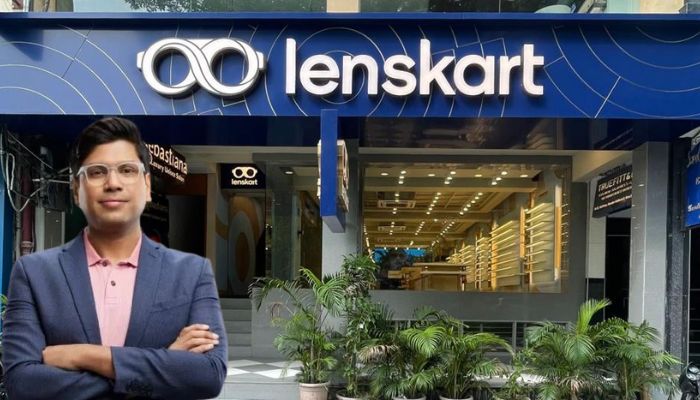
Lenskart founder and CEO Peyush Bansal has finally broken his silence on the firestorm surrounding a viral company document that discriminated against Hindu religious symbols. The controversy, which has been trending across social media, centres on a ‘style guide’ that prohibited the use of bindis and tilaks while explicitly permitting the hijab.
As the backlash intensified, Peyush Bansal took to X on Wednesday night, 15th April to clear the air. He initially wrote, “Hi, all. I’ve been seeing an inaccurate policy document going viral about Lenskart. I want to speak directly that this document does not reflect our present guidelines. Our policy has no restrictions on any form of religious expression, including bindi and tilak… outdated versions do not represent who we are today.”
Hi, all. I’ve been seeing an inaccurate policy document going viral about Lenskart.
I want to speak directly that this document does not reflect our present guidelines.
Our policy has no restrictions on any form of religious expression, including bindi and tilak, and we…
However, his attempt to dismiss the document as “inaccurate” was quickly challenged with a Community Note on X, which served as a digital reality check. The note clarified that the Lenskart Style Guide (v1.1/11) was dated February 2, 2026, and clearly bore company branding. This directly challenged the claim that the document was “outdated” or “inaccurate,” as it was essentially current.
Recognising the mounting pressure, Bansal issued a follow-up statement, shifting his stance from calling it “inaccurate” to admitting it was a genuine, albeit “incorrect,” training document: “The document currently circulating is an outdated internal training document. It is not an HR policy. That said, it contained an incorrect line about bindi/tilak that should never have been written and does not reflect our values… When we discovered this on February 17, well before this became a public conversation, we immediately removed it.”
I have listened to your concerns and I understand your sentiment around this. I want to add more context to my earlier post.
The document currently circulating is an outdated internal training document. It is not an HR policy.
He concluded by taking personal responsibility: “As Founder and CEO, I take responsibility for such mistakes. Lenskart does not, and never will, prohibit any form of respectful religious expression.”
Nevertheless, Bansal’s attempt to “manage” the situation by labeling the document “inaccurate” only added fuel to the fire, as a community note later showed that the document was not “inaccurate” as Bansal’s subsequent tweets confirmed.
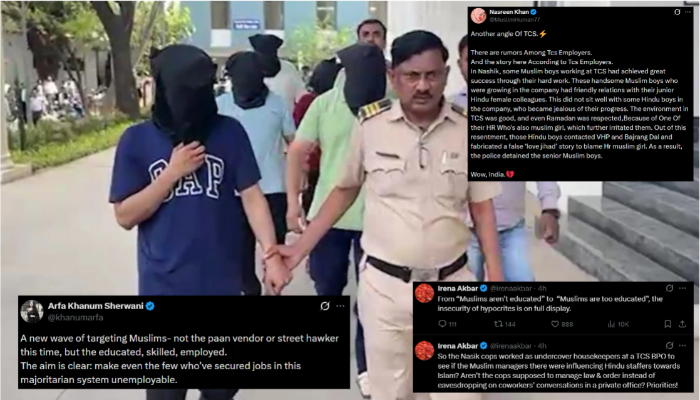
The Lenskart saga is yet another example, after the Nashik TCS ‘corporate jihad’ controversy, of an ecosystem that seems increasingly inclined to accommodate the Muslim community while marginalising traditional expressions of faith in a Hindu-majority country. The disparity in treatment, where one religious garment is labeled a right and another a “grooming violation”, has left a bitter taste in the mouths of consumers.
Inside the leaked “Lenskart Style Guide”
The controversy exploded when a 23-page document titled “Lenskart Staff Uniform and Grooming Guide“ surfaced online. Issued by the Lenskart Academy, the guide was designed to provide “cleanliness and well-groomed” rules for all store employees. However, the details on page 7,10 and 11 triggered immediate outrage.
Page 11 of the Style Guide
Page 7 of the document states that Lenskart employees are prohibited from wearing sacred threads (kalava) and bindis (bindis), while they may wear hijabs.
It states, “If you wear a hijab/turban, it must be black. The hijab should cover moderately up to the chest. Rings with colored stones (such as black, blue, green, red, etc.) are not permitted. Bindis and clutches are also prohibited. Religious threads or wristbands must also be removed.”
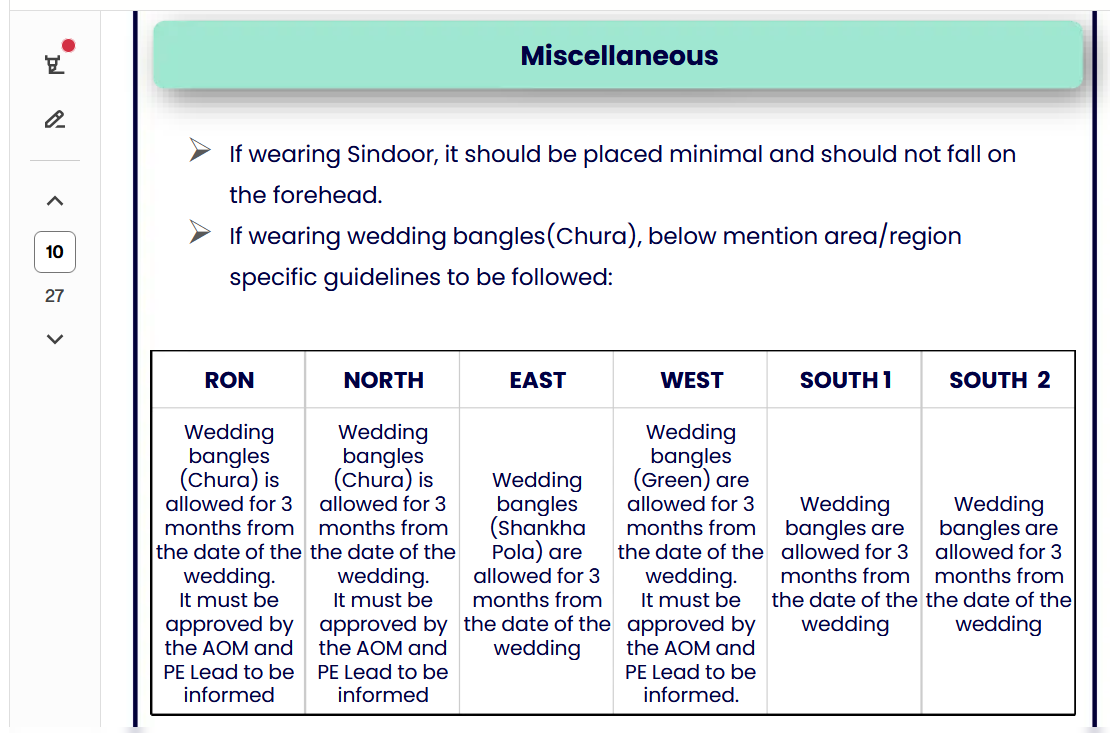
This document also specifies what types of things workers should and should not wear, such as shoes, clothing, watches, and other items. Another part of this document is controversial. On page 10, it also comments on the use of vermilion. It states that if someone applies vermilion, they should apply it sparingly and should not spread it across the forehead.
Page 10 of the Style Guide
Unanswered questions and the logic of bias
Despite the apology, the matter remains deeply complicated. If the document was indeed “removed” on February 17th, it begs the question: why was a version dated February 2026 still being circulated to staff?
Furthermore, the issue of transparency remains; if the policy was updated, Lenskart has yet to make the “correct” version public to restore consumer trust.
The core of the frustration lies in the perceived religious asymmetry. Lenskart is a leading Indian brand, founded by a Hindu, operating in a country where the vast majority of its employees and customers are Hindu. While safety regulations in technical areas like labs might necessitate the removal of loose threads (kalava) or jewelry, there is no logical reason why a bindi or a tilak would interfere with selling eyewear at a retail store, especially when Muslim religious attire was acceptable.
The irony is hard to ignore: in an effort to appear “inclusive,” the brand seemingly excluded the very symbols that represent the cultural fabric of its primary consumer base. While Bansal claims they simply “forgot to remove” the offending lines, the existence of such a policy in the first place suggests a deep-seated bias that an apology alone may not fix.
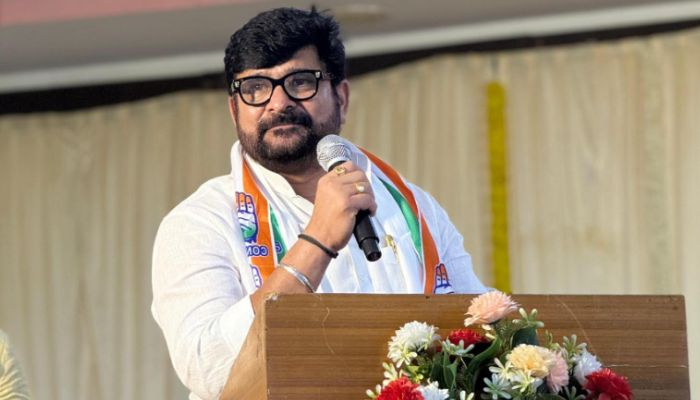
On 15th April, the Special Court for MLAs and MPs in Bengaluru held Congress MLA Vinay Rajashekharappa Kulkarni and others guilty of murdering Bharatiya Janata Party (BJP) leader and Zilla Panchayat member Yogesh Gowda in 2016. The sentencing will be announced on 17th April. Additional Solicitor General SV Raju, appearing for the Central Bureau of Investigation (CBI), sought the harshest punishment for the convicts.
Notably, since June 2025, a “brand protection” firm representing Kulkarni have been threatening OpIndia with legal consequences over three reports published against him in regard to his involvement in criminal cases. In 12 emails sent to OpIndia in less than three months, Kulkarni’s representatives tried to force OpIndia to take down articles based on court judgments where OpIndia was not even a party.
Court found Kulkarni guilty of conspiracy
The Special Court held Kulkarni and others guilty of criminal conspiracy in the 2016 murder case. Kulkarni, who is currently serving as the Chairman of the Karnataka Urban Water Supply and Drainage Board, was named as accused number 15 in the case. The verdict came after a prolonged trial, as the CBI had taken over the case in 2020.
ASG states abuse of power and system manipulation
While arguing the case, the ASG stated that the accused had hatched a cold blooded conspiracy to eliminate a political rival. He informed the court that Yogesh Gowda, a public figure, was targeted due to political rivalry. He further accused the convicts of misusing police machinery, fabricating documents, and attempting to destroy evidence.
He also described the manner in which Gowda was killed, stating that chilli powder was thrown into Gowda’s eyes before he was brutally murdered. He emphasised Kulkarni’s role in the crime as a legislator and contended that he had violated constitutional principles by orchestrating the crime.
Approver expresses guilt, seeks strength
While speaking to the media, Basavaraj Muttagi, one of the accused who turned approver in the case, said that he was haunted by the guilt of his role in the conspiracy, and said the real struggle would begin now.
Multiple accused convicted in long running case
The CBI had named 21 accused in the case, out of which 17 have been found guilty. Two of the accused turned approvers. The court has ordered the release of the other two. The CBI also moved to re accuse one of the approvers who turned hostile.
How a firm managing Kulkarni’s ‘reputation’ online threatened OpIndia
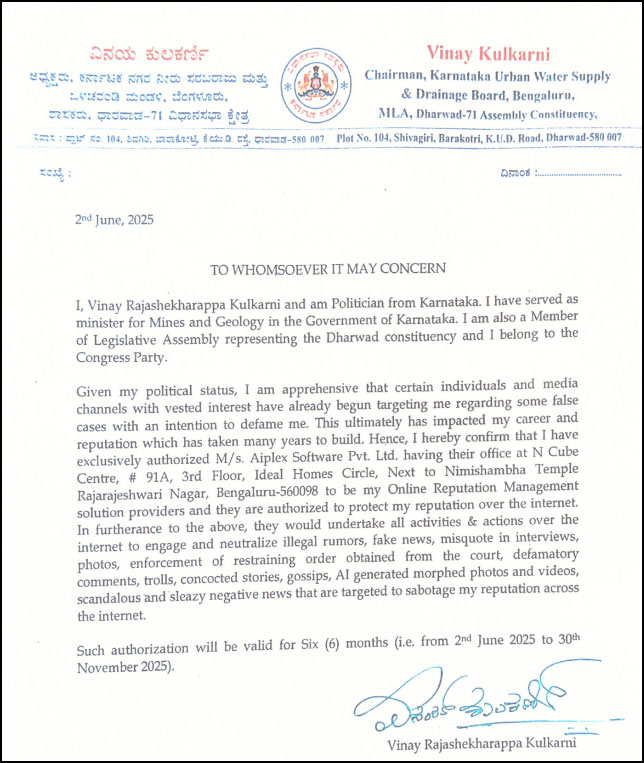
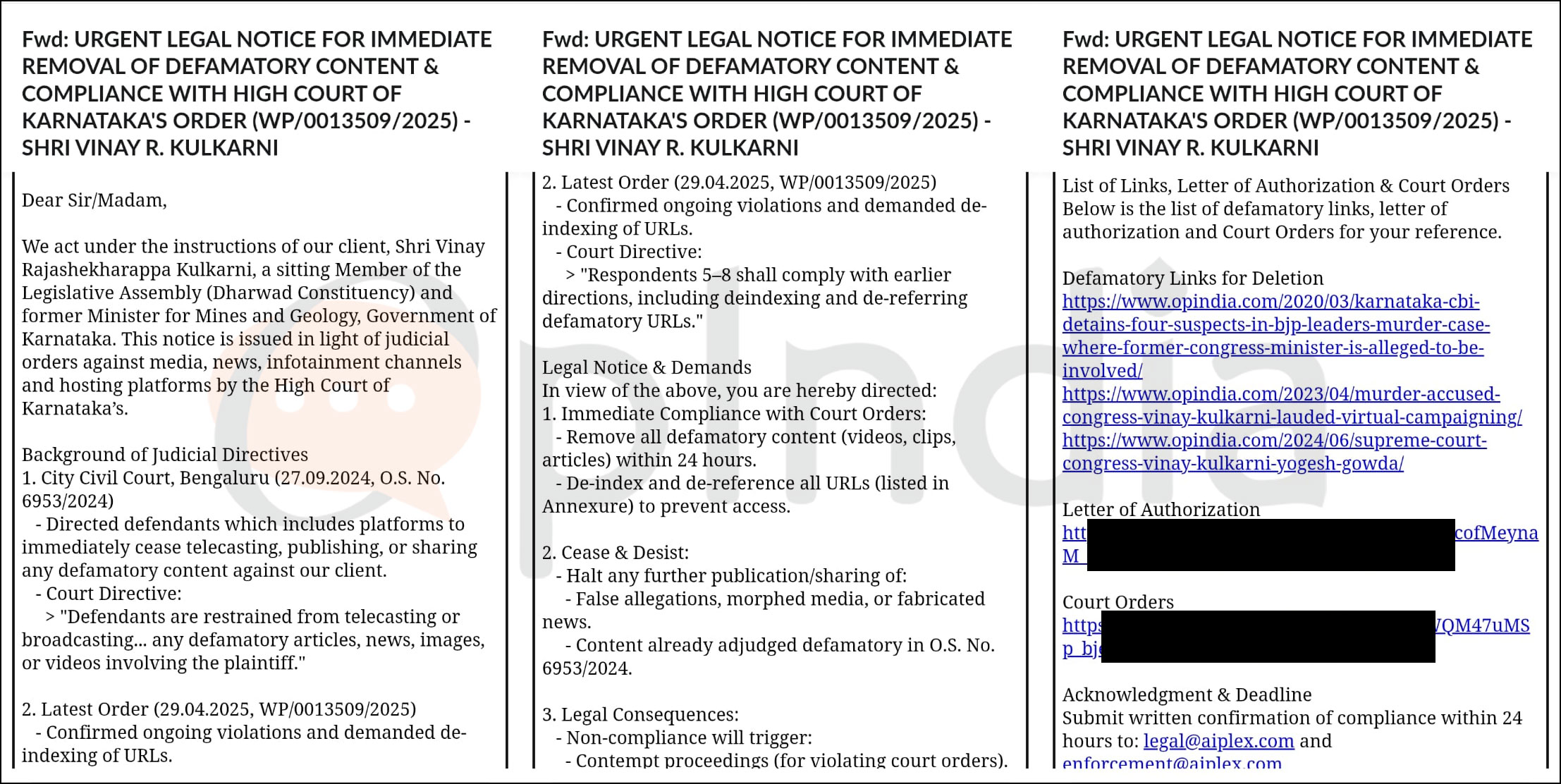
OpIndia received the first email on 20th June 2025 from a digital marketing and brand protection firm named Aiplex Software Private Limited. In the email, AiPlex shared an authorisation letter from Kulkarni allowing them to engage with media houses and individuals to “protect” his “online reputation”. In the authorisation letter, Kulkarni claimed that, given his political stature, certain individuals and media channels with “vested interests” had been targeting him with an intent to defame him.
Source: OpIndia
According to him, such targeted reports were impacting his career and reputation, which he had built over the years. Thus, he authorised the company to manage his online reputation and take action over the internet to “engage and neutralise” illegal rumours, fake news, misquoted interviews, AI generated images, and more, along with enforcement of restraining orders obtained from the court.
In that email, three links to articles and a drive link to court orders were shared. OpIndia was asked to remove them within 24 hours. Interestingly, when OpIndia checked the court order, it was not a party in the case. Furthermore, the email did not come from a law firm but a “brand protection” firm. Hence, OpIndia decided not to act on it. The articles Kulkarni wanted to get removed can be checked here, here and here.
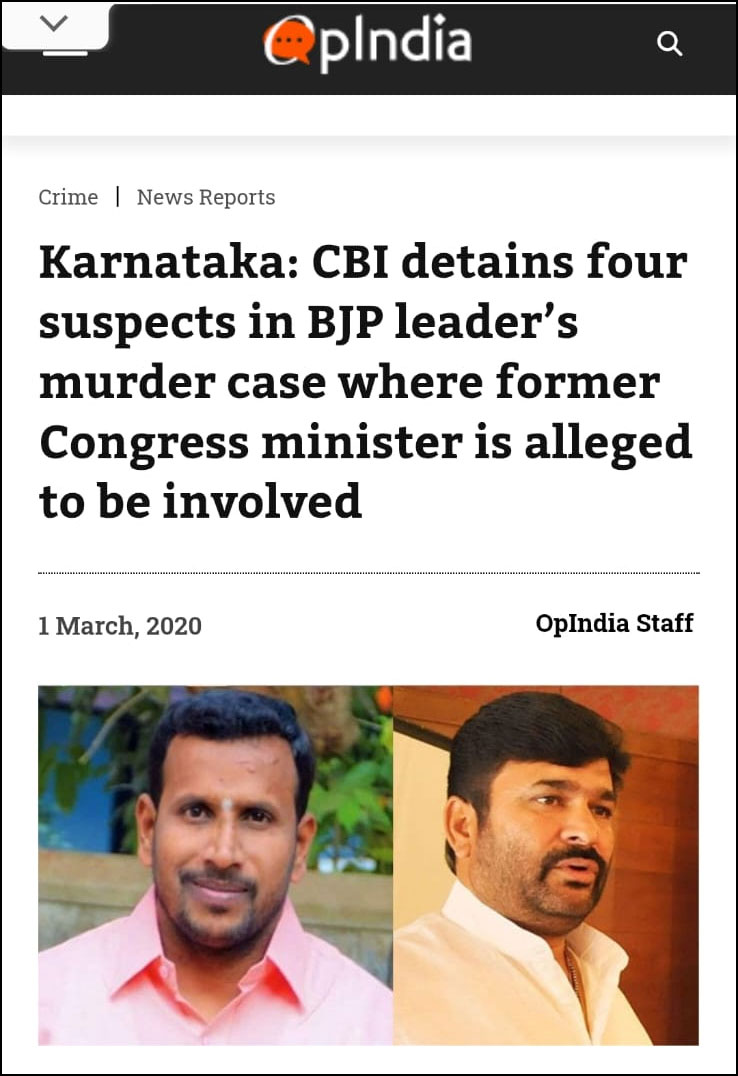
The first report that Kulkarni’s representatives wanted to get removed was published back in March 2020. It talked about the CBI detaining four accused for questioning. Furthermore, it briefly discussed the case and how the police had concluded under the Siddaramaiah government that the murder was due to personal rivalry motivated by a land dispute.
Source: OpIndia
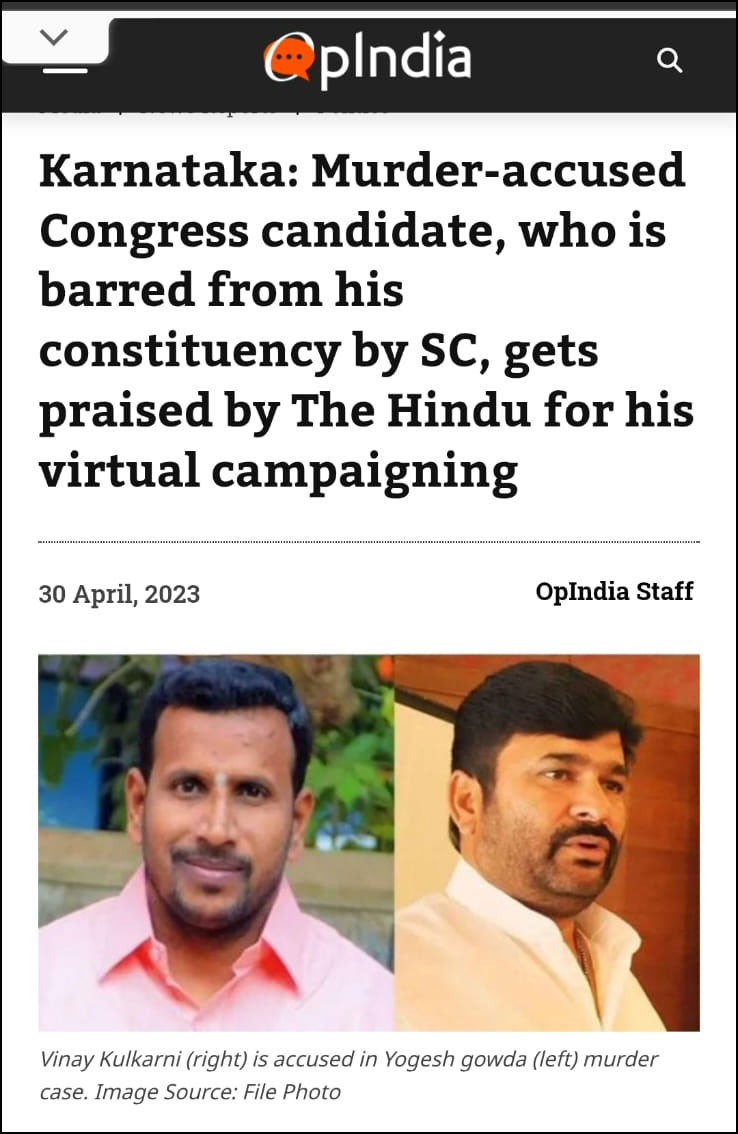
The second report was published in April 2023. The report talked about how The Hindu newspaper had praised Kulkarni for using technology, Augmented Reality (AR) to be precise, for campaigning during the elections. The publication, while doing so, completely ignored the murder case against Kulkarni.
Source: OpIndia
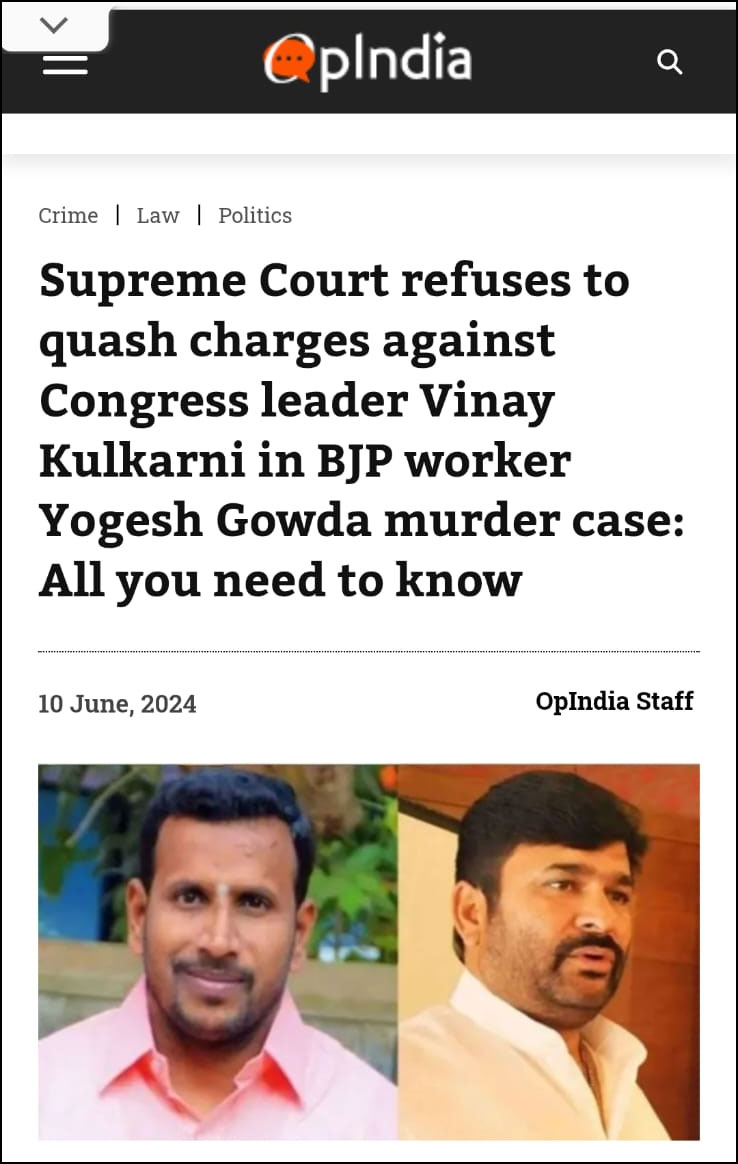
The third and last report that Kulkarni’s representatives wanted to get removed was published in June 2024. The report talked about the Supreme Court’s judgment rejecting Kulkarni’s plea to quash charges against him in the Yogesh Gowda murder case. Earlier, the Karnataka High Court had refused to quash the charges, after which Kulkarni had approached the apex court. The report also provided brief details about the murder case and how it progressed over time.
Source: OpIndia
In the email, the company stated that if OpIndia did not remove the articles within 24 hours, they would be left with no choice but to take legal action against it.
Source: OpIndia
Two days later, on 25th June, the company sent OpIndia another email seeking removal of the content within 24 hours. More reminders followed on 26th June, 30th June, 4th July, 8th July, 14th July, 22nd July, 24th July, 28th July and 2nd August. Notably, from 22nd July, only one article was linked in the email. For some reason, they seemed to have stopped treating the other two articles as “defamatory” in nature against the Congress leader.
The basis of the demand raised by the “brand reputation” firm was a Karnataka High Court order directing YouTube, Facebook, WhatsApp and X to remove “defamatory” content against Kulkarni. The Ministry of Home Affairs, the Ministry of Information and Broadcasting, the Bengaluru Police Commissioner, and the Cyber Crime Police Station, North Division, Bengaluru, were also made parties in the case. OpIndia checked the court orders attached in the email and found that it was not a party in the case. The firm was trying to get standard news reports removed based on an order where OpIndia was not directed to remove any content by the Hon’ble High Court.
Background of the Yogesh Gowda murder case
Yogesh Gowda was a Zilla Panchayat member and BJP leader from the Hebballi constituency. On 15th June 2016, he was brutally murdered at his gym in Saptapur, Dharwad. Six accused were arrested by Dharwad Police and charged with murder. Gurunath Gowda, brother of Yogesh, demanded a CBI probe in the matter. When the BJP led government came to power in the state, the case was transferred to the CBI.
The investigation agency took over the case on 24th September 2019. Eight additional accused were arrested by the CBI. The charge sheet was filed on 20th May 2020. On 5th November, Congress leader Vinay Kulkarni was arrested by the investigation agency. His bail plea was rejected twice, first by a lower court and later by the High Court. During that period, he remained in judicial custody at Hindalga Jail in Belagavi.
During the trial, the CBI informed the court that Kulkarni had travelled to Delhi before and after the murder. Records showed he travelled to Delhi on 12th June 2016 at around 11.30 am and came back the next day at 10.40 am. He again went to Delhi on 16th June evening, a day after the murder, and returned on 18th June. The CBI stated that the tickets were booked on the day of travel and the purpose was to create an alibi.
According to the CBI, the reason behind the murder was political rivalry. Kulkarni had asked Yogesh not to contest the Zilla Panchayat elections, but he refused.
In August 2021, the Supreme Court of India had granted bail to Kulkarni. However, in June 2024, his bail was cancelled by the apex court. A Bench comprising Justice Sanjay Karol and Justice Satish Chandra Sharma said that there was credible material suggesting that the accused made attempts to contact or influence witnesses during the course of the ongoing trial, and accepted the CBI’s plea asking for cancellation of the MLA’s bail.
In June 2024, the Supreme Court had refused to entertain Kulkarni’s plea to quash charges against him. A bench of Justices PV Sanjay Kumar and Augustine Masih rejected the MLA’s Special Leave Petition against the Karnataka High Court order, which sustained the Special Court’s charges against Kulkarni and twenty other accused persons.
The Supreme Court held that Vinay Kulkarni had ‘bought over’ the deceased victim’s widow. Given that the Court was unlikely to consider the plea, Senior Advocate Siddhartha Dave, who represented Kulkarni, moved to withdraw it. This, however, enraged Justice Kumar, who said, “This court has become a gambling court.”
Justice Kumar observed that the case was not fit for quashing. “This is not a case for quashing, 57 phone calls between you and A1 within the ambit of 5 months,” the Judge said.
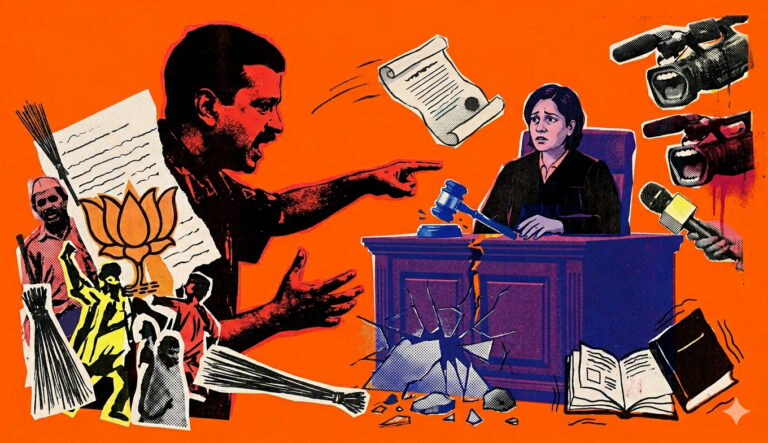
On April 13, 2026, Arvind Kejriwal entered the Delhi High Court not as a petitioner seeking regular relief, but as a man attempting something unusual and risky, he stood before a judge and informed her, effectively, that he did not trust her. In person before Justice Swarana Kanta Sharma, the former chief minister of Delhi filed a plea requesting her recusal from hearing the CBI’s challenge against the trial court’s ruling in the Delhi liquor policy case, which the CBI was now contesting at the High Court level after the trial court had dismissed Kejriwal and his Aam Aadmi Party coworkers.
The legal plea itself, recusal applications are not unheard of, was not what made the hearing unusual, rather, it was the way it was presented. Kejriwal informed the court that he had observed a pattern in the judge’s directives, stating that every petition has been turned into a judgement and that every argument of the CBI and ED has been supported. Then he explicitly stated that Justice Sharma’s attendance at activities of the Akhil Bharatiya Adhivakta Parishad (ABAP), an organisation of advocates linked with the RSS, made him question whether he would receive justice. Opposing the petition, the CBI went further, characterising the request as based on ‘frivolous and baseless averments,’ calling these accusations an attempt to scandalise the court and lower its authority, and claiming that the behaviour amounted to contempt of court.
The case at the centre of it all
One must first understand the true nature of this situation in order to comprehend why it matters. The Delhi liquor policy saga, also referred to as the excise policy scam, involves claims that the AAP government’s 2021-2022 excise policy was created to favour specific liquor dealers in exchange for payments, with the purported earnings going back into the AAP’s Goa election campaign. Senior AAP leaders were accused of a huge criminal conspiracy by the CBI and the Enforcement Directorate, and Kejriwal was arrested in March 2024.
However, the trial court found insufficient evidence to bring charges against Kejriwal and a number of co-accused in the CBI’s case. The Delhi High Court’s Justice Sharma has heard a challenge from the CBI about this discharge order. As a result, Kejriwal’s recusal plea comes at a crucial moment when the High Court is being asked to rule on whether or not he needs to stand a trial. The timing is not an accident, it is the whole purpose.
The law of contempt: A line he may have crossed
Any act that scandalises or tends to scandalise, or lowers or tends to lower the authority of, any court, or prejudices, or interferes or tends to interfere with, the due course of any judicial proceeding, is considered criminal contempt under the Contempt of Courts Act, 1971. This is not a small or obscure provision, it is the legal safeguard for the judiciary’s institutional dignity. Historically, courts have made a clear line between personal attacks on the character or ideological suitability of a sitting judge, which may be considered contempt, and valid criticism of court orders, which is permitted by the constitution.
The Act’s Section 12 stipulates a maximum sentence of six months in simple imprisonment, a fine of ₹2,000, or both. A protection is added by Section 13, which states that contempt cannot be punished unless it substantially interferes, or tends to substantially interfere, with the due course of justice. In E.M.S. Namboodiripad v. T.N. Nambiar (1970), the Supreme Court ruled that even remarks that undermine public trust in the judiciary’s impartiality might be considered criminal contempt. In this case, the Kerala Chief Minister had publicly claimed that judges served class interests. The statement’s impact on public trust is more important than whether it was said inside or outside of the courtroom.
Although Kejriwal’s remarks were delivered in court during a formal legal application, such protection is not unrestricted. When a plaintiff states, I fear you will not give me justice because of your ideology, in front of everyone in an open courtroom, using language that links the judge to a political organisation, the speech ceases to be only a legal submission. The CBI counsel’s description of the plea as ‘forum shopping‘ is not without merit, courts have consistently ruled that dissatisfaction with a judge’s decisions does not warrant recusal, and that combining adverse orders to claim bias is just that.
The bias question: Real law, reckless use
This is where things become really tricky, and intellectual integrity requires admitting that the concept of judicial prejudice exists, is acknowledged, and is significant in administrative law. The law recognises a number of different forms of bias that might taint legal proceedings.
Pecuniary bias occurs when a judge has a pecuniary interest in the outcome, traditionally, even a minor investment in a company before the court has disqualified judges. When a judge and a party or their legal counsel already have a close or hostile relationship, personal bias is present. When a judge has previously spoken strong, public views on the very legal issue at hand, this is known as Subject matter bias. The most complex and contentious of them all is pre conceived notion bias, which raises the question of whether a judge’s larger worldview might influence their judicial function in a particular case.
The last category is effectively invoked in Kejriwal’s argument. He points to Justice Sharma’s exposure to RSS-affiliated legal circles indicates an ideological bias that would hurt his case by pointing to his attendance at ABAP events. The issue is that practically every Indian judge may be recusable if this reasoning were widely accepted. Judges participate in a wide range of cultural events, religious gatherings, legal seminars, and bar association events.
The glasshouse problems
However, the story revealed an inevitable truth that every judge carries a part of themselves to the bench, including expectations from the society, a family’s ideological weight, their social network, and their political background. Pretending otherwise is dishonesty in and of itself.
Usha Ramanathan, a technology law and privacy rights expert who is well known for her critical work on Aadhaar, state surveillance, and civil liberties, positions often associated with a progressive liberal ideological orientation is Justice Muralidhar’s wife. Because of his wife’s intellectual commitments, no one seriously claimed that his decisions in support of riot victims were unconstitutional. However, those connections were constantly in the forefront of the political controversy.
The situation of former CJI N.V. Ramana is much more spectacular. In a letter to then CJI S.A. Bobde in October 2020, Andhra Pradesh Chief Minister Y.S. Jagan Mohan Reddy alleged that Justice Ramana was swaying the AP High Court’s roster in favour of the Telugu Desam Party. Ramana was reportedly a member of the Telugu Desam Party and was even considered for election to the Nandigama constituency in 1994, prior to his appointment to the bench, so the accusation held biographical weight that is hard to dismiss. After conducting an internal investigation, the Supreme Court rejected the allegations in March 2021, allowing Ramana to become India’s 48th Chief Justice.
Why Kejriwal is still wrong
The fact of previous issues regarding judicial ties does not justify Kejriwal’s approach, rather, it makes it much more necessary to oppose it. The entire history of such episodes demonstrates that the proper remedy for credible judicial bias is institutional. In-house court proceedings within the Supreme Court, collegium oversight, higher court appeals, and, as a last resort, formal proceedings that establish accountability through the law. What it is not, however, is a politician publicly expressing distrust before a sitting judge in the middle of a case, while cameras roll outside.
Every time a party leader stands up and declares, I cannot get justice here, a section of the public internalises that message, not as a legal submission, but as an outcome. The institution becomes the accused. And the accused gets away with something quite valuable, a victimhood narrative that exists fully outside of the courtroom, regardless of what transpires inside.
The law of recusal has a very particular and tough criterion because the alternative is chaos. If any plaintiff could disqualify a judge based on that judge’s attendance at events organised by organisations that the litigant dislikes, the right to a fair hearing would be replaced by the right to choose your own judge. That is not a legal principle, it is forum shopping dressed up as justice. The CBI was forthright about this, noting that a judge’s viewpoint in a judicial decision cannot be used to infer bias, and that Kejriwal’s application did exactly that.
Conclusion
If the court had decided to treat Kejriwal’s actions as criminal contempt, it might have begun Suo motu proceedings under Section 15 of the Contempt of Courts Act or submitted the case to the Attorney General for consent to prosecute. The punishment, up to six months in prison, would have been less severe than the symbolic weight of a contempt ruling against the very person attempting to avoid a criminal prosecution. The court shown restraint. It has not ruled out that option.
Finally, a bigger lesson emerges that goes beyond the facts of this case and this judge. The judiciary’s independence is not only a convenience to be invoked when it rules in your favour and attacked when it does not. A political leader who uses the recusal doctrine today establishes a precedent that can be used against any judge, liberal or conservative, activist or deferential, by anyone with a grievance and a microphone. The institutions Kejriwal promised to improve are only as strong as the culture of respect that surrounds them. What he is destroying, one news conference disguised as a legal plea at a time, is not Justice Sharma’s reputation. It is his own claim to be different.
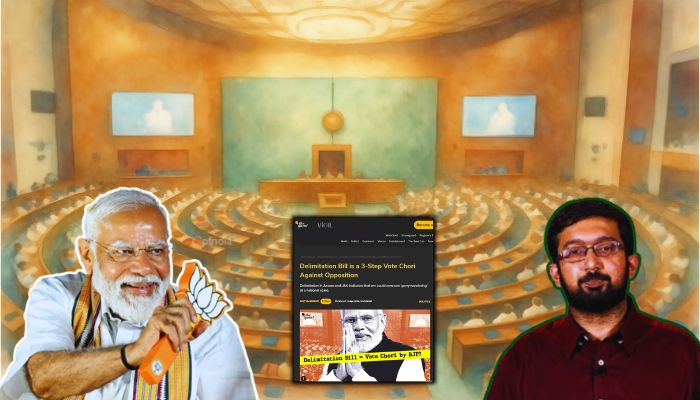
The Modi government is set to table the Constitution (131st Amendment) Bill, 2026, in a Special Session of Parliament scheduled for 16th and 17th April. The bill aims to raise the strength of the Lok Sabha from 543 to 850. Even before being brought on the floor of the parliament, the Bill’s delimitation proposal has outraged anti-BJP parties and the leftist media cabal. While parties like Congress and DMK have claimed that delimitation in its proposed form would reduce the seats of southern states, the leftist propaganda outlet The Quint has declared it a “3-step vote chori”.
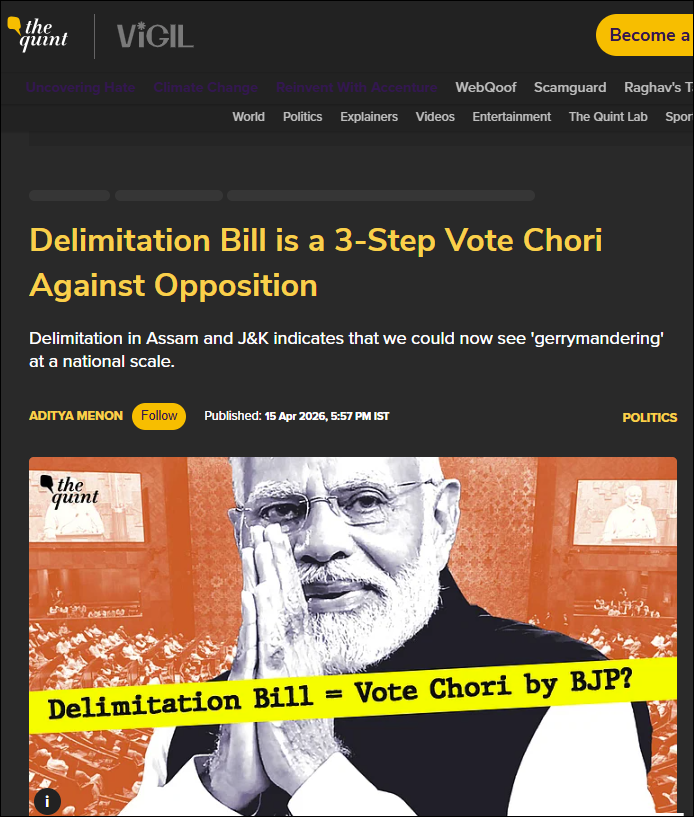
In The Quintarticle headlined, “Delimitation Bill is a 3-Step Vote Chori Against Opposition”, ‘journalist’ Aditya Menon dubbed the proposed delimitation as 3-step vote theft by the Modi government, claiming that the conspiracy involves selective use of population, nationwide gerrymandering, and targeted reduction of seats wherein the BJP has electorally struggled, especially in southern states. The converted Islamist draws on examples from delimitation exercises in Assam and Jammu and Kashmir to claim that somehow the entire delimitation process is going to be conducted to empower BJP strongholds.
Menon cites The Hindu projections, which indicate that Uttar Pradesh’s seats will rise from 80 to 138, Bihar’s seats rise from 40 to 72, Tamil Nadu’s seats from 39 to 50, and Kerala’s from 20 to 23, to argue that the proposed delimitation will cause reduction in the proportion of seats not only in southern states but also “where the BJP performs poorly.”
“Uttar Pradesh, which has 80 seats in the 543-member Lok Sabha at present, should have had 125 seats in the new 850-member Lok Sabha. It will now have 138 seats due to a higher population growth rate. Bihar, which should have had 62 seats, will now have 72. Rajasthan, which should have had 39, will have 47. In contrast, Tamil Nadu, which should have had 61 seats in the increased Lok Sabha, will have 50. Kerala will have 23 instead of 31. Andhra Pradesh will have 34 instead of 39,” The Quint article reads.
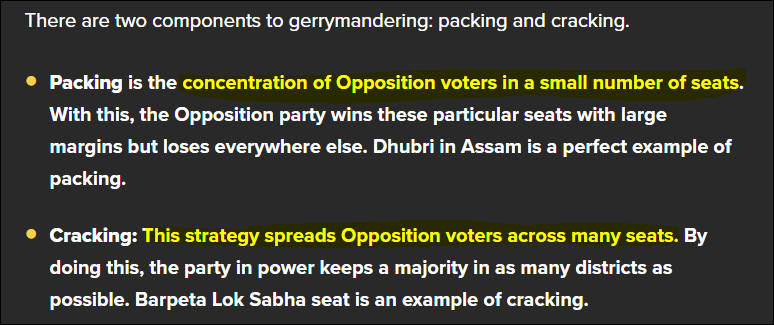
The propaganda piece pivots to the Muslim victimhood narrative, arguing that if the ‘one person, one vote’ principle was actually respected, Muslim-majority seats in Assam, like Dhubri, 10 lakh extra voters from Barpeta would not have been added to Dhubri to make it a “Hindu-majority seat overnight” during the 2023 delimitation exercise.
Aditya Menon relies on the tried and tested tactic of Islamo-leftist propagandists of cherry-picking numbers and blending them with a victimhood narrative to villainise the Modi government and create panic.
The entire ‘gerrymandering’ narrative, that too, to disempower Muslim voters, is bogus and only a panic-triggering term that The Quint is throwing. In Assam, the Election Commission used the 2001 Census data as well as population density categories A/B/C districts, with an allowed ±10% deviation from the state average.
Densely populated districts, like a Muslim-majority Dhubri, received adjustments to project smaller, indigenous, tribal communities in low-density areas like Kokrajhar. The ECI’s goal was equitable voter load and to protect indigenous communities. The ’10 lakh extra voters’ in Dhubri was a practical density-based math and not deliberate packing. Population density is a key aspect of the delimitation process, but the delimitation process does not rely on or target religious demographics.
Neither the existing laws nor the proposed delimitation bill makes any mention of religion-based “packing and cracking”.
Source: The Quint article
Similarly, in the 2022 delimitation exercise in Jammu and Kashmir, the Delimitation Commission considered population, border proximity, administrative factors, and geography. Anantnag was merged with Rajouri and Poonch areas across Pir Panjal, creating the Anantnag-Rajouri Lok Sabha constituency that bridges the Pir Panjal range, connecting Anantnag in the Valley with the Rajouri-Poonch border districts in the Jammu division.
Although the delimitation process does not involve religious demography as a deciding factor, the merger did result in creating a new diverse and competitive electoral landscape wherein Muslim Muslim-majority districts of Rajouri-Poonch were combined with South Kashmir. If Aditya Menon’s chagrin is about the process resulting in the dismantling of the Muslim electoral veto, then coping and seething is the only option he has.
In addition to the Muslim victimhood propaganda, Aditya Menon also claimed that the proposed delimitation exercise will “penalise” southern states and even Punjab for better family planning, resulting in the reduction of the proportion of seats.
The Quint did not stop at the Muslim victimhood, and the ‘south will lose seats’ fear mongering. The leftist rag even invoked a ‘linguistic minority’ angle while arguing that the Modi government is supposedly making selective use of the population and census.
“In Assam, the government went for delimitation as per the 2001 census and not the latest figures, citing the need to “protect smaller communities”. These also happen to be communities that have tended to vote for the BJP in the past few elections. This could have be used to preserve the interests of linguistic minority states such as the South or Punjab, which will lose out as per the latest population figures. But the government chose not to do it. Clearly, population as a criterion and choice of census is being done in a way that benefits the BJP and harms the Opposition,” The Quint article reads.
This whole ‘chose not to preserve the interests of linguistic minority states’ is a blatant misrepresentation of not only the constitutional framework but also the explicit provisions of the proposed amendment bill.
The government has stated that seats in every state will increase by 50% on a pro-rata basis, essentially preserving their current proportional strength in the Lok Sabha. Neither any southern state nor Punjab nor West Bengal will lose even a single seat in absolute terms. Contrary to the fear-mongering narrative and a deliberate misrepresentation, the proposed pro-rata expansion is not a simple population-proportional model.
It is factually correct that southern states have fared well with regard to population control measures and economically. This commendable performance is rewarded by granting absolute gains proportional to their current share. The number of seats in absolute terms is only going to increase.
The Indian Constitution demands population-based seats. The 1971 freeze was a temporary measure to ensure population control measures were implemented without the fear of states losing political representation. This freeze, however, cannot become a perpetual southern entitlement.
Article 81 explicitly requires Lok Sabha seats to be allocated to states “as far as practicable” in proportion to population. The 42nd Amendment froze allocation on 1971 figures simply as a short-term incentive for family planning and other population control measures. The 84th Amendment extended this freeze only until the first Census after 2026. Thus, continuing the freeze indefinitely would violate the “one person, one vote” principle.
Gerrymandering requires deliberate partisan manipulation, as it happens in the US. However, in India, the Delimitation Commission is quasi-judicial, independent, and faces judicial review.
While the opposition is portraying the delimitation proposal as ‘punishment’ for the South, in reality, Northern voters are systematically under-represented. The fact is, more than the fear of southern states losing seats, the anti-BJP cabal is opposing delimitation because the most populous states in the country would be getting more representation. They are interpreting the delimitation exercise and its outcome in terms of the division of seats between pro-BJP and anti-BJP voter pockets across the country.
Although the BJP has enjoyed power in Karnataka earlier and is a part of the ruling coalition in Andhra Pradesh, southern states are portrayed as historically against the BJP, while the northern states, many of which are ruled by the BJP at present, are portrayed as pro-BJP states. The entire outrage comes across as an attempt to secure an equal number of seats for southern states as northern states by disregarding the population criteria.
This whole ‘south states are being punished’ for better implementation of population control measures narrative collapses if we look at the population dynamics.
Delimitation is a constitutional process of redrawing electoral boundaries and reallocating seats in the Lok Sabha to ensure roughly equal population per constituency. North Indian states are highly underrepresented, while South Indian states are overrepresented to some extent.
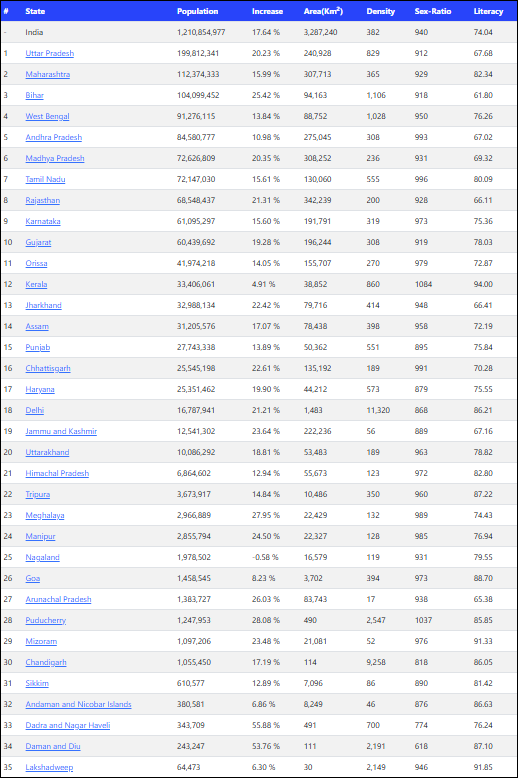
The population of Rajasthan, as per the 2011 Census, is 6 crore 85 lakh, and the number of Lok Sabha seats is 25, while Karnataka’s population, as per the 2011 Census data, is 6 crore 11 lakh. Despite having around 75 lakhs more population, Rajasthan has three seats fewer.
Similarly, Madhya Pradesh’s population as per the 2011 Census is 7 crore 26 lakh. The state has 29 Lok Sabha seats at present. However, Tamil Nadu, with a population of 7 crore 21 lakh, has 39 seats.
If we do the math and calculate per-Member of Parliament population, an MP in Rajasthan represents around 27.42 lakh people, while an MP in Tamil Nadu represents 18.50 lakh people. An MP in Uttar Pradesh represents roughly 24.98 lakh people, and an MP in Kerala represents 16.70 lakh people.
This essentially means that an MP from Kerala, for example, represents nearly half as many people as an MP from Uttar Pradesh. Does that not mean that a Kerala voter’s vote is 1.6 times more valuable than that of an Uttar Pradesh voter? Is this not a mockery of the “one person, one vote” principle?
This disparity can also be traced in the Member of Parliament Local Area Development Scheme. Every MP gets Rs 5 crore allocated for local area development, irrespective of the constituency’s population. Result? Per-capita spending is significantly higher in smaller-population constituencies compared to higher population constituencies. The proposed delimitation exercise is designed to address these disparities.
The Central government has assured that the number of seats will go up, essentially on a pro-rata basis, using the latest published Census. Even if the Delimitation exercise happens after the 2026 census, the population difference in Southern vs Northern states will be in expected lines of the 2011 census.
To fulfil its repeated assurance that southern states will not lose a single seat, the Modi government’s amendment bill proposes altering the definition of population from the “last preceding census” to “population as ascertained at such census, as Parliament may by law determine”. This essentially hands the Parliament broader options while allotting seats. There is also a possibility that the Centre would come up with a one-cycle hybrid formula. However, The Quint, Aditya Menon and the extended anti-BJP ecosystem are deliberately peddling alarmist narratives to cause panic and stir unrest in the country.
Aditya Menon: The master of fake news and anti-BJP propaganda
This, however, is not the first time that The Quint’s Aditya Menon has peddled anti-BJP propaganda and fake news. Back in January 2022, when a breach in Prime Minister Narendra Modi’s security occurred in Punjab, Menon wrote an article for The Quint, in which he blatantly downplayed the seemingly deliberate security lapse that led to PM Modi being stuck for 20 minutes not too far away from the Pakistan border. Menon claimed that earlier, PM Modi was stuck for 2 hours in traffic in BJP-ruled Uttar Pradesh, yet no one was outraged, whereas when a similar situation happened in Congress-ruled Punjab, people were outraged since they somehow harboured some sort of hatred for Punjabis. The fact, however, was that PM Modi’s convoy was stuck in traffic in Uttar Pradesh only for 2 minutes, not 2 hours as claimed by The Quint.
In 2020, Aditya Menon, a Hindu who converted to Islam, attempted to rationalise Shaheen Bagh mastermind Sharjeel Imam’s secessionist and violent remarks by equating them with the ISI propaganda of blockades imposed in Kashmir by Hindu organisations in 2008.
Downplaying 2020 anti-Hindu Delhi Riots violence-accused Sharjeel Imam’s anti-India remarks, Menon contended that the former JNU student had simply asked for a “chakka jam or a blockade of the highways and railways leading to Assam”. However, in his pursuit to defend Imam, Menon cunningly drew a parallel with the Amarnath agitation in 2008 when Hindu organisations had allegedly blocked the Jammu-Srinagar highway. Menon had argued that if that wasn’t considered sedition, then the Imam’s call to block the roads and railways leading to Assam should not be considered separatist either.
Aditya Menon’s fear-mongering narrative that the delimitation exercise will somehow benefit the BJP electorally is rooted in his hatred for the BJP and its voter base. A significant section of India’s middle class, despite its own complaints with the Modi government, has remained a loyal BJP voter, is nationalist, and thus is also hated by the likes of Aditya Menon.
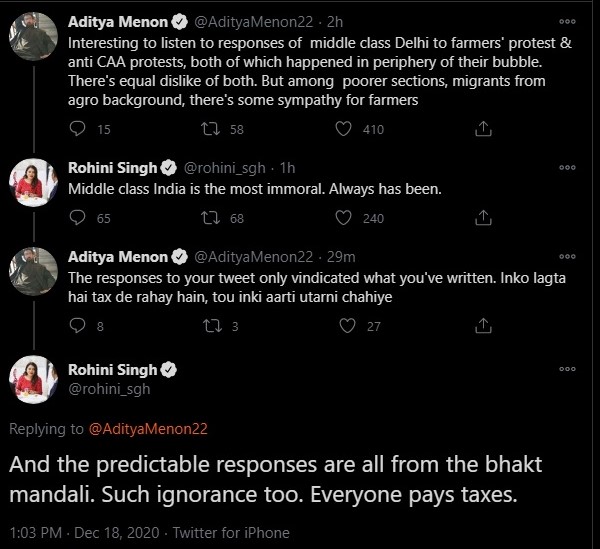
Back in December 2020, Menon had published an X post villainising the Delhi’s middle class, for their non-support to the anti-CAA and farmers’ protest. He received support from propagandist Rohini Singh, who called the Indian middle class “most immoral”.
In 2019, when Hindu activist Kamlesh Tiwari was brutally murdered by jihadis for his remarks against the Muslim prophet, Aditya Menon had joined fellow Islamists to deflect attention from the brutality of the Hindu activist’s murder. While a Hindu man was murdered, Menon accused the ‘Hindutva Brigade’ of spreading ‘hatred’ against Muslims, making the social outrage in reaction to Tiwari’s murder and the imaginary ‘compassionate’ Muslim response to the same, a bigger and more concerning issue than the murder itself.
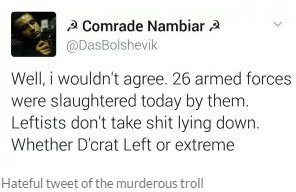
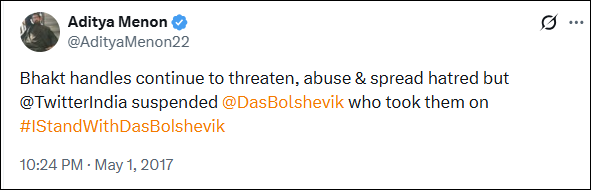
In 2017, Aditya Menon had supported a murderous social media troll “Comrade Nambiar” who celebrated the death of 26 CRPF men who were killed by Maoists.
“Bhakt handles continue to threaten, abuse & spread hatred but @TwitterIndia suspended @DasBolshevik who took them on #IStandWithDasBolshevik,” Menon posted in May 2017.
In 2016, Menon, who then worked as a Catch News journalist, posted with the caption that said a picture of a young girl closing the eyes of a dead man with the claim that said the picture was taken from Kashmir. The picture, however, was from 2012 and not from Kashmir but Syria.
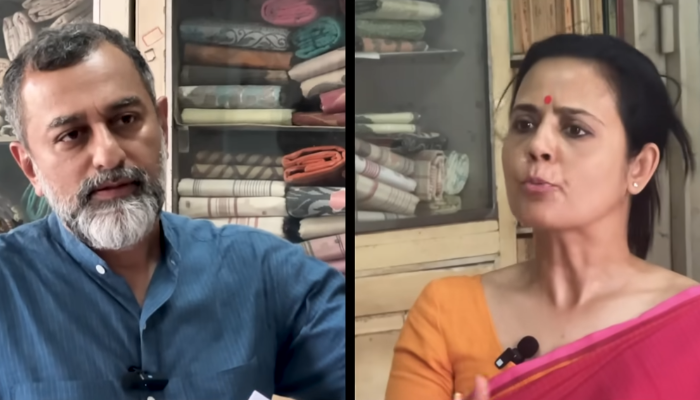
All India Trinamool Congress (AITC or TMC) Lok Sabha MP Mahua Moitra has once again drawn strong ire due to her misleading comments over the acute shortage of industries in West Bengal during an interview with Sreenivasan Jain for Newslaundry, which was published on 14th April (Tuesday). The state is undergoing assembly elections with voting scheduled to occur on 23rd and 29th April.
“How many new investments and new projects have taken off in the past five or 15 years? I’m not talking of proposals or MoUs (Memorandum of Understandings) but actual implementations,” Jain asked, to which she replied, “Now remember one thing that Bengal has never been a hub for large manufacturing and cannot be. It is a partition state it is still an agrarian economy with very small land holdings.”
“It is not possible for us to give a thousand acres or 2,000 acres or you know very large tracks of land which is possible in many other states where they’re not that dependent on agriculture. Bengal is a very fertile land. People are still dependent on agriculture. So, this is something that stands in the way of very large manufacturing investments,” Mahua added.
However, the falsehoods were promptly dismantled not just by the Bharatiya Janata Party but also by the netizens, who emphasised that the region was historically a manufacturing giant, and the current industrial landscape is a direct outcome of the policies of the ruling party.
BJP and netizens remind Moitra of the actual cause for the decline of industries in Bengal
BJP retorted that the “truth cannot be changed for convenience” and pointed out how the state was the nation’s production powerhouse, which housed Hindustan Motors, the makers of the iconic Ambassador cars, Bengal Chemicals & Pharmaceuticals Limited (BCPL), India’s first pharmaceutical business, engineering firm Burn & Company and the major tire manufacturer, Dunlop, alongside multiple others industries and a vast network of jute mills and foundries.
This large-scale industrial dominance contributed 20% of the country’s production. BJP remarked that the state is not devoid of potential or industry but rather dearth of a willing leadership under the “dictatorial TMC government.” It charged that “corruption, strikes, violence, lack of Ease of Doing Business (EoDB) and a broken business climate under Chief Minister Mamata Banerjee pushed 6,688 companies out of Bengal between 2011 and 2025. First, they destroyed the industrial backbone. Now, they deny it ever existed. They lie. They deflect. They deny. But Bengal remembers. And Bengal will respond.”
𝐓𝐌𝐂’𝐬 𝐬𝐡𝐚𝐦𝐞𝐥𝐞𝐬𝐬 𝐥𝐢𝐞 𝐞𝐱𝐩𝐨𝐬𝐞𝐝!
“Bengal was never a manufacturing hub and never can be.”
Then how do you explain the legacy of Hindustan Motors, Burn & Company, Bengal Chemicals & Pharmaceuticals, Dunlop India and more?
Amitabh Chaudhary referred to Moitra’s claims as a “big lie” and noted that Bengal’s manufacturing sector declined from 20% in 1920 to 5% in 2025. Her declaration of inability to provide 2000 acres of land for manufacturing was similarly exposed by him.
“Tata motors has to shut down its Singur plant because of Mamata Banerjee. JSW (formerly Jindal South West) alone is holding 4300 acres of land in Salboni. They are not able to expand, and Mamata has asked them to return the land. No one is willing to invest because of corruption and cut money. Panagarh Industrial Area is approximately 2000 acres, with hardly any investors,” he stated.
Motor mouth Mahua saying that “West Bengal was never a manufacturing hub” ; is a Big lie.
West Bengal manufacturing share in India:
1960: 20% 2025: 5%
West Bengal cannot provide 2000–3000 acres of land for manufacturing? Another lie.
Raghunath AS expressed that Kolkata transitioned from the commercial capital of India to ceding its position to Mumbai and then to Delhi/NCR (National Capital Region). The primary factors contributing to this drop comprised labour militancy, frequent strikes and policy uncertainty during the 1970s and 1980s. He also highlighted tolabaji (extortion) along with poor industrial policies of both the Left and the subsequent TMC governments.
“Many companies either closed down, became sick units, or relocated manufacturing, or their corporate headquarters and decision-making centres,” he conveyed and proceeded to name the entities that migrated the state including Hindustan Unilever, Bata India, Hindustan Fertiliser Corporation, Mackinnon, Mackenzie Andrew Yule & Company, Tata Steel and Birla Group among several others.
Kolkata went from being India’s commercial capital to losing ground to Mumbai and later Delhi/NCR. Labour militancy, frequent strikes, and policy uncertainty in the 70s–80s and later tolabazi, bad industrial policies of during post CPM rule are the key reasons. Many companies…
Sougat Chakraborty mocked that Moitra’s fabrications could be disproven with just a Google search and then illustrated that it identified Bengal as a manufacturing hub, which accounted for nearly 27% of the country’s overall output in 1950-51.
Similar sentiments were reiterated by another individual who accused Moitra’s party of expelling the companies from the state, after which she asserts that it has consistently fallen short of manufacturing.
First, drive out all the manufacturing and then claim that Bengal has never been a hub. Hindustan Motors, Chittaranjan Loco, Durgapur Steel and many more disagree …
Bengal had emerged as a major industrial region during the British Raj, and sectors like Jute, Tea, Coal mining, Engineering and heavy industries, Iron and steel, Paper, Leather and Chemicals had flourished. Even before the British rule, Bengal had major industries in the sectors of cotton and silk textiles, shipbuilding, salt, indigo dye production and others.
Post independence, steel and other metals, heavy engineering, jute, tea, coal, chemicals, fertilisers and other sectors continued to grew in the state. But the state has regressed a lot in the last couple od decades under left and TMC rules.
How industries were pushed to move away from the state
More than 6,000 enterprises quit Bengal during the past 14 years, according to information shared by the Modi government in the Parliament in July 2025. Over 2,000 of these, including 39 listed, transitioned in the past five years. Many of the firms relocated to Gujarat, Delhi, Uttar Pradesh and Maharashtra. This industrial migration took place while the TMC was in power.
Moreover, the centre mentioned that only a few modest investments had been promised, presenting a grave and worrying scenario for the nation’s fourth most populous state. Over 2200 businesses, or one-third, abandoned Bengal since 2019. Importantly, this pattern persisted after the TMC was elected in 2011. 110 of the 6688 corporations featured on the stock market.
According to the government, the companies gave a variety of justifications for shifting their headquarters, such as cost effectiveness, improved management control and administrative and operational convenience. Bengal stood 2nd after Maharashtra in relation to the number of registered companies until the 1970s, but it slid to the 9th place by 2021.
Moitra’s grand statements fall apart under unbiased analysis
Moitra’s assertions related to the job prospects in West Bengal also crumbled when subjected to analysis. She boasted about 14 lakh employment opportunities per year in the state, but Jain highlighted, “When you talk about jobs, Mamata Banerjee last month said that 84 lakh unemployed youth registered for a dole scheme (Banglar Yuba Sathi) for 21 to 40 age group, of your government. They get Rs 1,500 a month. We did the math. 84 lakhs amount to 40% of the working population between 21 and 40.”
“You promised five lakh new jobs a year in 2021 and you’re saying you’ve actually created three times that amount. Is that correct? Is that a credible claim,” he earlier inquired. However, Moitra enthusiastically answered, “Of course, it is. It’s something that has been placed in our assembly. Do you think that the data report card and the economic numbers that we place in the West Bengal assembly as part of the budget report is going to be a lie?”
However, her responses were soon shown to be more grounded in political narrative than concrete numbers. The entire episode primarily served as her desperate endeavour to mask the overwhelming shortcomings of the TMC government.
Conclusion
The state has been inching towards its industrial decline since the Communist Party of India (Marxist)-led front governed for 34 consecutive years, and the momentum only accelerated after the TMC ascended to power, promising a new beginning and blaming the “openly anti-industry policies” of the former administration for the precarious situation.
The government clearly failed to fulfil its commitments, and its leaders have shamelessly opted to rewrite the history of the state, denying its manufacturing roots. The blatant disregard for reality and the effort to disseminate disinformation could either be an awful move on Moitra’s part to cover up the disastrous policies of her government or she could be actually ignorant of the legacy of the state she purports to represent.
Regardless, both instances reflect her shocking disconnect from facts, whether it was intentional or artificial. However, the BJP’s attack and the public’s reaction have shown that there are no safe spaces for these political deceptions, which, conversely, have illuminated the outrageous actions of TMC against the industry sector.
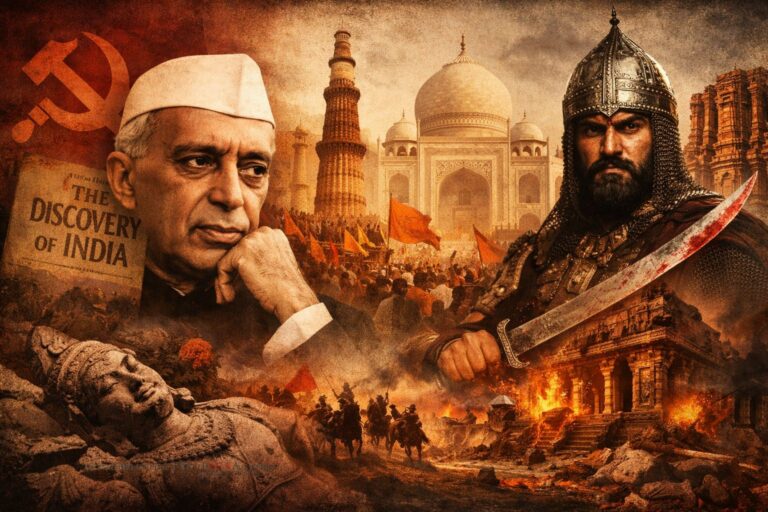
No other book serves as the theoretical foundation of Marxist historiography as much as Jawaharlal Nehru’s The Discovery of India (1945). The oft-quoted Nehruvian doctrines—such as the idea of India, the substance of composite culture, the role of Islam as a social revolution, and the amalgamation of all, secularism—have formed fundamental beliefs in contemporary India and are drawn from this work.
Nehru held a vision based on Marxist universalism that required religious scepticism as a prerequisite. In contrast, he found no intellectual solace in the Hindu cultural values that Gandhian ideals claim to promote, and were part of Congress’s political programme. Nehru dismissed these values as obscurantist and revivalist. When his turn came, Nehru obstinately omitted the Hindu ethos from shaping India’s state, effectively secularising India’s national life.
There are many instances in the book highlighting his cynical approach to India’s past. For Nehru, spirituality was nothing but squalor. ‘We’ve had enough of Ram and Krishn,’ he had said, and Indians had nothing to gain from them. Although spiritualism fascinated him, it had no practical use. It was like a stagnant pond. He warned Indians not to ‘lose themselves in a sea of speculation unconnected with the day-to-day problems of life’ and that they ‘must hold to their anchor of precise objective knowledge tested by reason, and even more so by experiment and practice.’
Nehru did not know what religion the people of the Indus Valley civilisation followed, but still he proclaimed it as a ‘predominantly secular civilisation.’ He was against Hindi because it shared the script, devanagari, with Sanskrit; ‘so it has become difficult to use in its larger and more natural significance.’ Again, Nehru confessed that he knew nothing about art or sculpture and reacted to it as a layman would. Yet, the Buddha statue at Anuradhapura (Sri Lanka) moved him greatly, and Nehru claimed he carried a picture of it for many years. But the architecture of some famous temples in South India, ‘heavy with carving and detail’, disturbed and filled him with unease. Elsewhere in the book, Nehru explained why the temples made him uneasy.
South India was a stronghold of Hindu orthodoxy, Nehru surmised. The repeated invasions of northern India led to many people migrating to the south, including craftsmen and artisans. As a result, South India became a centre for preserving old artistic traditions; hence, the elaborate carvings found on its temples. While the invaders introduced new ideas and architectural styles—evident in ‘the noble and beautiful buildings of Delhi and Agra’—South India ended up becoming a bastion of Hindu orthodoxy.
For Nehru, Islam’s appearance is always an‘advent’; it comes ‘i enters, and it arrives’ in India and goes in the same fashion elsewhere. So, when Islam ‘came’ to Iran, thousands of the followers of the Zoroastrian faith ‘migrated’ to India. The why and how of the collapse of the Sassanid Empire and what happened in its wake did get a word.
There is a whispering, reluctant reference to the devastating impact of Islamic bigotry and iconoclasm. Islam came to India as a new religious faith, and its frequent intercourse with indigenous faiths inevitably led Indians to become acquainted with the new religion. No objection was raised by either the state or the people, nor were there any religious conflicts. But when it came as a political force, it created many new problems. Nehru did not specify what these problems were, except that ‘there were many such raids, and they were bloody and ruthless.’ Yet those who led these ‘bloody and ruthless raids’ were unequivocally glorified in his account.
This is how Nehru has described the invasion of Mahmud of Ghazni. He was ‘far more a warrior than a man of faith, a brilliant captain,’ and India for him was ‘just a place from which he could carry off treasure and material to his homeland’ to build great edifices because ‘buildings interested him.’ He was interested in ‘encouraging cultural activities’ and anxious to ‘make his own city of Ghazni rival the great cities’ of central and western Asia.
So, he carried off ‘from India’s large numbers of artisans and master builders.’ Mehmud was enamoured with the great edifice of Mathura, exclaiming that it would have taken at least 200 years to build it. What Nehru did not tell us was that Mehmud was relating the magnificence of the Vasudev temple, and the fanatic ordered his troops to use naphtha and fire to burn the temple down after smelting silver and golden statues of Hindu gods b, but not before decapitating thousands of Hindus.
Though, as Nehru avers, Mahmud took away with him a vast quantity of treasure, ‘he touched and despoiled only a part of north India’, and the whole of central, eastern, and south India escaped him completely. His raids were considered ‘a big event in Indian history,’ but politically, India as a whole was not greatly affected by these bloody raids, and ‘the heart of India remained untouched.’
In Nehru’s estimation, Babur was an adventurer, a gallant knight, and a delightful, cultured man, typical of a Renaissance prince, a better one than the European kind that was common in those days. Babur was no fanatic like his ancestors, and there was no sectarianism, no bigotry, and he destroyed no temples. When once grave danger threatened him—thus Nehru described Babur’s pledge before the battle of Khanwa (1527)—Babur refused to retreat, as he was ‘made of sterner stuff’, and offered to give up drinking. Nehru paints the picture as if the Rajput army were predatory.
And whom did Nehru blame for the destruction? Not the rapacious ideology, not the gory-loving faith, but the people who were victims. The migration of Zoroastrians took place due to ‘the decay of the states in western and central Asia’, and the subjugation of Hindus occurred because of ‘the weakness and decay of north India’, because the Indian culture had become ‘old and tired and had lost its vitality’, while the invaders were ‘far more cultured and advanced in ways of living.’
However, ‘this new approach’ of Islam, the ‘advanced ways’ of the invaders, ‘produced powerful psychological reactions among the people and filled them with bitterness.’ Nehru quickly dwelt on how this new approach was salubrious, to say the least, because ‘it pointed out and showed up the abuses that had crept into Hindu society and the idea of Islamic brotherhood and made a powerful appeal, especially ‘to those in the Hindu fold who were denied any semblance of equal treatment.’ Nehru was repeating the argument of Mohammad Habib, who had described Islam’s ‘arrival’ in India as the beginning of social revolution in his monograph on Sultan Mahmud of Ghazni (1927).
Such a person, carrying cynicism and disdain for Hindu culture and repulsively oozing endearment for Muslim culture and icons, happened to preside over India’s destiny at its most crucial period. His ideas, variously referred to as Nehruvian ideals, Nehruvian secularism, or Nehruvian consensus, or Nehruvian whatnots, formed the raison d’être of the Indian state. That these ideas found resonance in the Marxian approach was not incidental.
Although India comprises diverse parts, it has remained united through its innate cultural bonds. Despite lacking a single unifying political authority to enforce homogeneity throughout its history, India and its people managed to stay together thanks to the inherent cultural consistency of Hinduism.
However, in official narratives, India became a land of many ideas, and its primaeval Hindu ethos, that inseparable glue, was dismissed as redundant and regarded with contempt. Talking about the past injuries and setting the house in order became a communal approach.
The accent of Nehru coincided with the emergence of Marxist historians in India. Therefore, it was not very difficult to integrate these Marxist interpretations of history into the Indian State’s philosophy. In a remarkably short span, Marxist historians, riding the wave of Nehruvian benediction, changed the story of India.
[The quotes are from The Discovery of India and Glimpses of World History, while Marxist historiography is explored in the author’s latest book, India’s Rogue Historians(2026).]
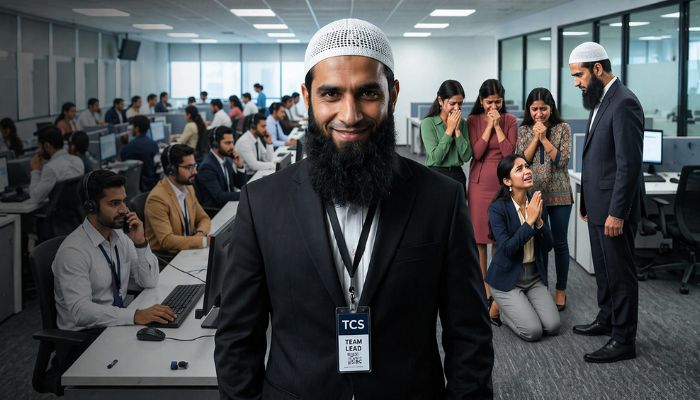
The scandal centred around the Business Process Outsourcing (BPO) office of Tata Consultancy Services (TCS) in Nashik has only intensified with alarming revelations emerging regularly amid the investigation. The distressing accounts of how young Hindu women, including a Dalit, were subjected to sexual harassment, blackmail, abuse and targeted by their team leaders to convert to Islam for several years, while their complaints were dismissed by the Muslim Human Resources (HR) Manager, have raised broader concerns regarding the effectiveness of internal accountability mechanisms at the facility.
Nevertheless, as fresh developments unfold in the case, so too do the efforts to sanitise the crimes perpetrated by the jihadi syndicate. In the wake of the convenient silence maintained by the Dalit warriors and the victimhood narratives propagated by the Islamo-leftist cabal, it was the liberal media’s moment to partake in the whitewashing of the perpetrators, and they certainly did not fail to deliver.
The media house tries to trivialise the crime by using an accused’s wife
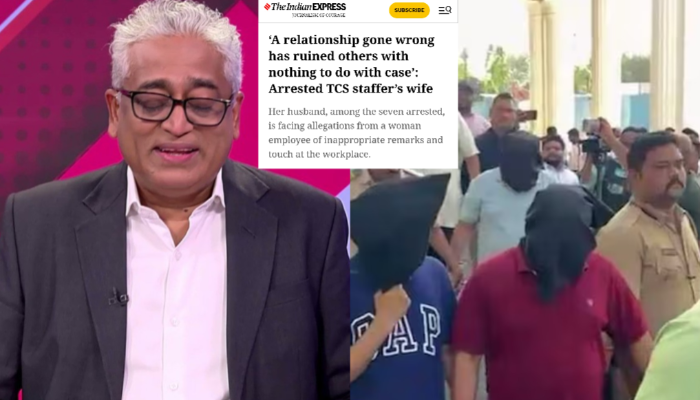
On 15th April (Wednesday), The Indian Express published a piece by Mohamed Thaver, quoting a spouse of one of the offenders to claim that the victim has destroyed the lives of others due to her unsuccessful office affair with 34-year-old rape-accused Danish Shaikh. “It was a relationship gone wrong between Danish Shaikh and one of the complainants that has ruined the lives of all the others,” she declared. He was arrested after a 23-year-old Dalit staff member filed a First Information Report (FIR) against him.
“They were not involved. Cases not linked to each other have been clubbed,” the wife insisted. Her husband is among the arrested accused while a female HR manager is reportedly at large. “Everyone in the office knew about Danish and the woman being in a relationship,” she reiterated.
The woman added that she was aware of the breakup between Danish and “his friend” in February, “and her parents approached some politicians,” who persuaded her to submit a police report. “It was in all of this that those other men, including my husband, were caught, in spite of having nothing to do with the case,” she alleged.
Danish had preyed upon the woman alongside Tausif Attar, who made inappropriate advances towards her. She eventually resolved to end their vicious cycle and take action against both men alongside HR manager, Nida Khan. The three also insulted and mocked Hindu deities.
Nine FIRs, spanning from serious accusations of sexual abuse to religious conversion, have been registered against by the authorities. The women who endured years of sexual exploitation, blackmail, religious slurs and intimidation were compelled to seek assistance from outside, as their repeated complaints to Khan were met with dismissal. More importantly, the suffering would have persisted had the female police officers not spent 40 days undercover at the unit and exposed the truth.
The persistent denial of his actions in spite of the alarming complaint
According to a complainant, she joined the aforementioned accused’s team in 2023 and was subjected to “double-meaning” statements and inappropriate touch. She notified her seniors, but they informed her that similar complaints had previously been made against him and advised her to exercise caution.
She also mentioned that he asked her private questions in relation to her honeymoon and whether she drank alcohol when she got married in 2025 and went to request leave because she was travelling to Goa. She stated that he increased her workload after finding out about the complaint.
Nevertheless, his wife’s sole concern was to stress his innocence, contending that he had no close relationship with Danish and had been entangled in the case, entirely disregarding the heinous accusations levelled against him.
“My husband was on leave when he was called in March last week and told that the police were investigating the FIR against Danish. He did not know Danish and their interaction was limited to exchanging pleasantries. On 1st April, police said their investigation was complete and called my husband to sign as he was in a senior position,” she argued.
“We had a family function at home, but he still went to the office around 6:30 pm. An hour later, when I called him, he said several colleagues had been taken to the Mumbai Naka Police Station to sign documents, and that he would leave from there in a bit. At 11:30 pm, he called me informing police were arresting him,” she added.
She asserted to have rushed to the police station and expressed, “I said they should tell me on what grounds my husband was being arrested. It was at 2:30 am that they told me it was not on the Danish FIR but that a few other women had complained and that they were registering more FIRs in the matter against him and others.”
“My husband only took vegetarian food in his tiffin. He told me some of his colleagues may be uncomfortable with him eating non-vegetarian food. Why would such a person talk down another religion,” she questioned, peddling the propaganda already circulated by Islamo-leftists to allege that a “good Muslim” can never participate in such actions, quite contrary to reality.
“One of them was only recently hired during college recruitment. He was in the company for barely three months,” she conveyed, highlighting that they are engineers as if it would reduce the severity of their atrocious deeds.
Ashiwini Chainani purportedly apprehended to silence others
Ashiwini Chainani, the Pune-based operations manager under police custody, was also defended by the wife as “fair” and “supported the arrested men.” She alleged that the arrest was aimed at stifling others, contending, “She was also arrested, so no one will have the courage to come forward.”
According to police, a complainant stated to have contacted Chainani about the sexual harassment “orally,” but was discouraged from pursuing it instead of helping her as a member of the office’s Prevention of Sexual Harassment committee which resulted in the legal proceedings.
“Since these were serious offences, we spoke to the women and assured them to speak without fear. It was based on their complaints that FIRs were registered against those named by them,” the police outlined and added that the statements had been documented in the presence of a magistrate. “We will investigate all the allegations and, depending on our findings, file charge sheets,” they pointed out.
It is not astonishing for the family members or relatives of the accused, particularly Muslims, to downplay the crimes and assert innocence despite the evidence. However, liberals also jumped on the same bandwagon over an arbitrary report, but who can ever fault them, given that their agenda invariably prevails, with facts always compromised to cater to their chosen audience.
The liberals, Islamists accept the IE report as factual development in the case
The liberal ecosystem, as anticipated, announced the report as gospel and began to assert a “twist” in the case, not grounded in any proof, but rather on a sob story from a family member of an accused. It is normal for families of accused to defend their family member in criminal cases, but this was turned into a ‘big twist in the case’.
Rajdeep Sardesai shared the article, terming it a significant development and stated, “All the more important to have a proper, transparent inquiry and not an investigation driven by social media outrage.” Afterwards, the leading proponent of agenda-driven campaigns demanded that justice must be founded on facts, not on the agenda.
IMPORTANT: twist in Nashik TCS story? All the more important to have a proper, transparent inquiry and not an investigation driven by social media outrage. JUSTICE must be done based on FACTS and not an AGENDA. https://t.co/zX7VuxUjD5
Another element of this ecosystem asserted that she “believed” everything until the accusations of “forcing girls to fast or offer namaz” arose, as Islam does not coerce anyone into actions, not even those who are born into the religion. The irony is clearly lost on them.
I believed everything until got to know "Forced girls to fast or offer namaz". Islam never force anyone anything, not even to Muslims by birth. Strict action should be taken against culprits. https://t.co/c9ZHG0kl91
A person stated that they have been voicing this since the issue was first revealed adding, “It’s always one person who digs a grave for the whole community.” They then peddled the imaginary victimhood of discrimination in interviews, corporate roles and other sectors. However, their main concern was that people had begun to protest against namaz in the workplace.
Saying this since the beginning.
It’s always one person who digs a grave for the whole community. Muslim were already facing discrimination in interviews, corporate jobs, and more. Now WhatsApp is flooded with such messages, people have started objecting to namaz at workplace. https://t.co/7Tp1VMpggq
Netizens call out the attempt to gloss over the radicals
Interestingly, the desperate initiative to further misleading claims by this group was shortly uncovered and rejected by the people. Smita Deshmukh remarked that “puff pieces” concerning the family members of the accused in the case generate no interest and the media should concentrate on identifying “victims to understand the nexus and provide support. Listen to former employees who witnessed the corruption firsthand. Emphasise the narratives of those who genuinely require a voice.”
She urged, “The victims merit your support and journalistic integrity,” pointing out that human interest stories should focus on the affected rather than whitewashing the perpetrators, a malicious practice that the media repeatedly engages in, such as the infamous “headmaster’s son” narrative used to humanise neutralised Kashmiri terrorist Burhan Wani.
A request to the media covering the TCS Nashik BPO scandal: If you are looking for the human interest stories, stop focusing on the families of the accused. We do not need puff pieces. None of us are interested whether any parent of the accused is a school teacher, while they…
Entrepreneur Abhishek Asthana, recognised as Gabbar on social media, joked that a wife defending her accused husband indeed introduces an unprecedented turn to the case, as it is uncommon for individuals to defend their family members.
Relative says culprit is innocent. That has never happened before. Completely flips the case.
A person indicated that generally Rajdeep and his ilk are very skilled at concealing the misdeeds of their “favourite victim group,” but are unable to achieve this in this specific matter due to its transparency and therefore have been forced to choose “dumbery.”
Culprit's wife says that culprit is innocent.
Rajeep : Twist in the case !!
I knew people like him were evil but thought they were smart. Normally, they do lot of wordcelling and sophistry to whitewash crime of their favourite victim group but since this case is very… https://t.co/M4AVNV2oyT
— Rāma Śēṣan Chandraśēkaran (@maa_bhaishiiH) April 15, 2026
Gone are the times when this ecosystem dominated narratives, even utilising deception to trick the public which now readily denounces their duplicitous actions.
Conclusion
A subjective report, stemming from a conversation with the wife of the accused, laden with emotional appeals and lacking any substantiation, was accorded greater weight than the mounting evidence in the case. The IE also granted her a platform with the intention of disseminating the contrived victimhood narrative, as the stark facts leave no uncertainty about the trials encountered by the Hindu women subjected to the Muslim fanatics.
Of course, the legal proceedings must be completed to bring the case to its logical conclusion, but the liberals and Islamists have this problematic propensity to misrepresent the facts and draw hasty judgements to protect the perpetrators because of their faith while Hindus are perpetually painted as guilty or accountable. It is propaganda, not facts, that fuels their assertions of “objectivity” and “impartiality.”
Want a job? Then offer Namaz first… Want a salary hike or promotion? Then eat beef first – these were the allegations made by Hindu girls and women who were victims of corporate jihad by Muslim extremists in Nashik, Maharashtra. Let us understand what the controversy was about and also shed light on my experience working in the same field.
Recently, a case of ‘corporate jihad’ has come to light in Nashik, Maharashtra. There is a discussion going on about how Hindu women employees were targeted in a BPO office of TCS and lured into Islamic jihad. All the accused are Muslims and were working in good and responsible posts in the company. Since this controversy came to light, there has been a discussion about the working system of BPO (Business Process Outsourcing) and KPO (Knowledge Process Outsourcing), in which my experience may also be useful for society.
My experience
In the darkness of night, when the entire city is asleep, thousands of young people are awake in these gleaming glass buildings. Today, I will expose what goes on here in the name of corporate lifestyle and modernity. Today on OpIndia, I am sharing my personal experience.
I have worked in the BPO and KPO sectors for years. I have seen the environment, the network and the mentality firsthand. The arrest of 6 Muslim team leaders by the Maharashtra Police in Nashik is just the beginning. Today, I will talk about how the real game is played inside these offices.
The reality inside the BPO-KPO sector
No major degree is required to get a job in this sector. Knowing a little English can get you a job worth 20-30 thousand. There are mainly two categories of people working here. On the one hand, those who are not very educated and want to stay in one place for a long time. On the other hand, college-going Hindu youths work at night to meet their expenses.
I too used to work in one such BPO at night to earn some extra money during my college days. I have seen firsthand that when a Muslim person reaches a position like Team Leader (TL), Trainer or HR, he changes the entire ecosystem. He easily gets the youth of his religion to pass the interview and get them into the system.
Hindu youth usually study for 2-3 years and move to other fields. But these people stay in one place for years because they do not need to study further. As a result, they occupy positions from training to management, and when power comes into their hands, their real target starts. That target is the newly joined Hindu girls.
‘Secret Muslim WhatsApp group’
The most shocking revelation in the police investigation into the TCS case in Nashik was that these jihadis had created a secret Muslim WhatsApp group inside the office. In this group, photos of Hindu girls in the office were shared. Discussions took place there – ‘Whose turn is it today?’, ‘Which girl is weak and will soon fall into the trap?’ ‘How to blackmail whom?’
The girl who considered her team leader as her protector, the same team leader would bid for that girl in the digital group. This was a ‘digital mandi’ where deals were made for the dignity of Hindu girls.
Team outing and blackmail tactics
I remember when I was working, these people used to insist a lot on ‘team outings’ or ‘team dinners’. The same thing happened in the Nashik case. These jihadis would take the entire team on outings, where Hindu girls would be physically abused, their objectionable photos and videos would be taken and then blackmailed for conversion would start.
The complaint filed at Nashik’s Ambad police station contains details that will make your blood boil. The Muslim team leaders and managers of this company had made it a rule that if you want a salary hike or promotion, you have to offer namaz and eat beef.
Hindu men also targeted
These people target not only girls but also Hindu boys. They get them drunk, break their faith and gradually convert them to Islamic ideology, all from the comfort of their office AC cabins.
At night, when no one is watching, these jihadis turn the office into their propaganda hub. The biggest advantage they get from working the night shift is that the world is asleep at night. Taking girls out in the name of a break, going to hotels – all this has become commonplace. CCTV is on the office floor, but no one cares what happens in the parking lot or outside.
The girls are afraid because their social connections are cut off. Team leaders threaten to take away their jobs if they complain.
This is not a one-off incident; it is a network spread across the country…
The Nashik police sting operation proves that this is not an isolated incident, but a well-planned network spread across the country. Maharashtra police have so far arrested 6 jihadis, but is this enough? This game continues even today in thousands of companies from Gujarat to Delhi.
In fact, the HR and management of such companies should also be investigated. There should be Hindu representatives in the Prevention of Sexual Harassment Committee of every company so that daughters can get real justice.
Parents are requested to keep a check on which company your son or daughter works for, who their team leader is, and what their background is. Save your children from sacrificing their dignity in the name of corporate culture. I have seen this filth from the inside. If you also have any such information, then definitely tell us. Your one voice can save someone’s life.
(This article is a translation of the original article published on OpIndia Gujarati.)
The Central government is set to table the Constitution (131st Amendment) Bill, 2026, in a Special Session of Parliament scheduled for 16th and 17th April, to raise the strength of the Lok Sabha from 543 to 850. While the move would mark roughly a 56% increase in the Lok Sabha seats, several opposition parties and ‘activists’ have begun protesting against the proposed amendment.
What is delimitation and what the Modi government’s Constitution (131st Amendment) Bill proposes?
Delimitation is a constitutional process of redrawing electoral boundaries and reallocating seats in the Lok Sabha. This process is conducted to ensure roughly equal population per constituency. Under this process, seats for each state are allocated based on its population share, and boundaries within states are adjusted accordingly.
To carry out the process, the government will set up a Delimitation Commission through a notification. This Commission will be led by a current or former Supreme Court judge, and will include the Chief Election Commissioner (or a nominated Election Commissioner) and the State Election Commissioner as members. Each State will also have ten associate members, five MPs and five MLAs, but they will not have voting rights.
The Commission will use the latest Census data to decide the number of Lok Sabha seats for each State and Union Territory, the strength of State Assemblies, and the number of seats reserved for Scheduled Castes and Scheduled Tribes. It will also redraw constituency boundaries, keeping them compact and considering administrative limits, connectivity, and public convenience.
At present, Lok Sabha seat allocation is still based on the 1971 Census, while constituency boundaries rely on the 2001 Census.
The 2001 census was used to redraw several electoral boundaries in the last delimitation. However, since the delimitation in 1972, the number of seats in state assemblies, the number of members in the Lok Sabha, and the number of seats assigned to each state have not changed. The number of Lok Sabha seats was set at 543 based on the 1971 census, suggesting that each MP represented about a million Indians.
Even after the 2001 adjustments to constituency boundaries and SC/ST reservations, the 543 Lok Sabha seats and 250 Rajya Sabha seats continue to be based on the 1971 census. 129 out of the 543 Lok Sabha seats are now held by southern states, with Telangana having 17 seats, Andhra Pradesh 25 seats, Kerala 20 seats, Karnataka 28 seats, and Tamil Nadu 39 seats. These roughly account for 24% of representation in the Lok Sabha.
While there have been delimitation exercises in 1952, 1963, 1973, and 2002, the total number of Lok Sabha seats allocated to each state has been frozen since the 1970s through the 42nd Amendment in 1976, which was extended by the 84th Amendment in 2001. This freeze is now set to be discontinued.
What are the provisions in the Bill to ‘unfreeze’ the seat allocations?
The bill proposed for introduction in the special Parliament session carries four main provisions. These include the expansion of Lok Sabha, lifting the constitutional restriction on readjusting state-wise seat allocation, which was previously tied to the 1971 Census. In addition, it provides for setting up a Delimitation Commission to reallocate seats between states proportionally to population and redraw constituency boundaries. This will also apply to state assemblies. Moreover, the Constitution (131st Amendment) Bill, 2026, proposes fast-tracking the 33% women’s reservation to ensure that it can be implemented from the 2029 Lok Sabha elections onward, without having to wait for the post-2026 Census cycle.
A major part of the amendment is the change to Article 82. Currently, delimitation is tied to the first Census conducted after 2026. The new proposal removes this condition, allowing delimitation to take place even before the 2026-27 Census.
The rationale behind the introduction of the bill is to fix longstanding population-based imbalances, expand electoral representation, and deliver women’s reservation sooner.
Even as the Central government has assured that no state, particularly, southern states, will lose even a single seat in absolute terms and that any increase will be allocated on a pro-rata basis, several anti-BJP parties and political ‘activists’ have started outrage.
Stop spreading FAKE propaganda against #Delimitation
Is South India being punished for implementing population control measures? Opposition accuses Centre of creating deliberate political imbalance
Several political parties, especially from South India, have come out in strong opposition to the proposed delimitation rules. They argue that if the delimitation exercise is conducted based on population alone, southern states will lose out on a significant number of seats compared to northern states, wherein population growth has consistently been higher than in southern states. They contend that southern states should not be punished for having implemented population control policies more successfully than northern states.
Tamil Nadu Chief Minister and DMK supremo, M K Stalin, has opened a front against the proposed delimitation. Stalin threatened of a massive agitation that would “bring the State to a standstill” if the delimitation proposal handed more power to northern states than southern.
#Delimitation: The sword that hung over our heads has now descended upon us.
In consultation with our DMK MPs, we are reaching out to Members of Parliament across states and devising a coordinated strategy to counter this grave danger.
— M.K.Stalin – தமிழ்நாட்டை தலைகுனிய விடமாட்டேன் (@mkstalin) April 15, 2026
“I am not only the Chief Minister but also the leader of the DMK, a massive political movement. You will see a Tamil Nadu you have not seen before. India will once again see the DMK of the 1950s and 1960s… Every family will take to the streets. I say it in the name of Ambedkar: if Tamil Nadu is affected, we will draw India’s attention. Prime Minister [Narendra Modi], this is the final warning from Tamil Nadu. Tamil Nadu will fight. Tamil Nadu will win,” Stalin said.
It is essential to note that the DMK has a knack for opposing almost all of the Centre’s key policies and invoking Tamil regional and linguistic pride. This pattern was seen in the Tamil Nadu government’s opposition to the New Education Policy 2020 and the three-language framework, alleging that the Centre was “imposing Hindi”.
Revanth Reddy, the Chief Minister of Congress-ruled Telangana, also rose in opposition to the Centre’s delimitation proposal, and urged CM Stalin to lead a united front of southern states. On 14th April, Reddy wrote an open letter to Prime Minister Narendra Modi registering his opposition to the delimitation proposal.
Similarly, Karnataka CM Siddaramaiah questioned the timing of the delimitation proposal and accused the centre of attempting to undermine the importance of southern states where the BJP has had limited electoral success.
“States that will benefit from the increase in Lok Sabha constituencies are the northern Indian states. States like Karnataka, which have prioritized and achieved population control, will face injustice because of this. Our demand is that the voice of the southern states in Parliament should not weaken due to delimitation,” he posted on X.
ಲೋಕಸಭಾ ಕ್ಷೇತ್ರಗಳ ಹೆಚ್ಚಳದಿಂದ ಲಾಭ ಪಡೆಯುವವರು ಉತ್ತರ ಭಾರತದ ರಾಜ್ಯಗಳು.
ಜನಸಂಖ್ಯಾ ನಿಯಂತ್ರಣವನ್ನು ಆದ್ಯತೆಯಾಗಿಟ್ಟುಕೊಂಡು ಸಾಧನೆ ಮಾಡಿದ ಕರ್ನಾಟಕದಂತಹ ರಾಜ್ಯಗಳಿಗೆ ಇದರಿಂದ ಅನ್ಯಾಯವಾಗಲಿದೆ. ಕ್ಷೇತ್ರ ಮರುವಿಂಗಡಣೆಯಿಂದ ಸಂಸತ್ತಿನಲ್ಲಿ ದಕ್ಷಿಣದ ರಾಜ್ಯಗಳ ದನಿ ಕ್ಷೀಣಿಸಬಾರದು ಎನ್ನುವುದು ನಮ್ಮ ಆಗ್ರಹ.
Congress leader and former Madhya Pradesh CM Digvijaya Singh has alleged that the Modi government is expanding the size of the Lok Sabha to 815 by lifting the 1971 census freeze, without providing any safeguards.
“But, contrary to the assurance of the PM and ministers, there is nothing in this bill to ensure that the present proportion of seats for each state would be maintained. It lifts the existing freeze (based on the 1971 census, extended to post 2026) completely without any safeguard the government was promising. Worse, the decision about which Census would be the basis for reallocation is taken away from the constitution and placed in the domain of law (ie, simple parliamentary majority),” the Congress leader wrote in a Facebook post.
“Actual reallocation and determination of boundaries would be done by the Delimitation Commission, on which the constitution is silent. And this cannot be challenged in a court of law,” Singh added.
It is interesting that the same Congress party that advocates “Jitni aabaadi utna haq” to extend caste-based benefits, including reservations, has been the most vehement opposer to the delimitation proposal, crying over population imbalance.
In addition to the fear-mongering about a supposed reduction in the political power and influence of southern states due to a feared curtailment in the number of seats in the South in absolute terms, the opposition and its ideological propaganda allies are also accusing the BJP-led Central government of gerrymandering.
Protestor-for-hire, Yogendra Yadav, who has been involved in pushing false EVM hacking, VVPAT tampering narratives, indulging in fear mongering about SIR exercise, has come up with a ‘calculation’ indicating a political pattern of losers and gainers maps in the proposed expanded Lok Sabha, “almost perfectly on areas of BJP’s weakness and strength.”
Yadav described the proposal as “worse than feared” and claimed that it completely lifts the 1971 freeze without offering explicit safeguards to maintain current state proportions, opening doors for full reallocation and gerrymandering. He shared projections showing Tamil Nadu losing 11 seats while Uttar Pradesh gaining 13 seats
Sharing a ‘gainers and losers’ table, Yadav wrote on X, “Here is my revised calculation of how the delimitation proposed in the bills today would affect the share of states in the Lok Sabha. The political pattern of losers and gainers maps almost perfectly on areas of BJP’s weakness and strength. Assumptions: Total seats: 850 (of which 35 for UTs). Rest allocated as per population share in Census 2011. The column on Gains/Losses is critical as every state would get more seats in 850 seat house. Here gains and losses are compared to seats every state would have had if their present share was respected: e.g. Kerala would get 23 seats (additional 3) but should have got 31 if its present share was maintained. Hence it’s a loss of 8 seats. UP should have had 125 but would have 138, gain of 13.”
Here is my revised calculation of how the delimitation proposed in the bills today would affect the share of states in the Lok Sabha. The political pattern of losers and gainers maps almost perfectly on areas of BJP’s weakness and strength. Assumptions: Total seats: 850 (of… https://t.co/iZyzXqzQ0rpic.twitter.com/QmR1Fm3JFU
However, Tamil Nadu BJP leader Annamalai has refuted the claims made by Stalin. He said that if population alone were the criterion, Tamil Nadu’s seats would have slumped from 39 to 31; however, in reality, the number is expected to increase to 59 post-delimitation process.
“If it were done strictly on population, Tamil Nadu’s seats would have come down from 39 to 31. The Prime Minister is ensuring that the southern States are not affected. Only if the strength is increased can a 33 per cent reservation for women be implemented. The total number is likely to be expanded. The number of MPs from Tamil Nadu may go up from 39 to 59,” Annamalai said.
While the opposition parties and the extended anti-BJP ecosystem is framing the delimitation proposal as an ‘assault on federalism’, a ‘demographic punishment’, a power grab, gerrymandering and whatnot, the reality is different.
Reality: Frozen allocation vs perpetual entitlement
The Indian Constitution demands population-based seats. The 1971 freeze was a temporary measure to ensure population control measures were implemented without the fear of states losing political representation. This freeze, however, cannot become a perpetual southern entitlement.
Article 81 explicitly requires Lok Sabha seats to be allocated to states “as far as practicable” in proportion to population. The 42nd Amendment froze allocation on 1971 figures simply as a short-term incentive for family planning and other population control measures. The 84th Amendment extended this freeze only until the first Census after 2026. Thus, continuing the freeze indefinitely would violate the “one person, one vote” principle.
While the opposition is portraying the delimitation proposal as ‘punishment’ for the South, in reality, Northern voters are systematically under-represented. If an MP in Tamil Nadu or Kerala represents 1.5 million people, an MP in Uttar Pradesh represents 3 million people. The Central government has assured that the number of seats will go up, essentially on a pro-rata basis, using the latest published Census. It, however, is true that northern states will absorb a significant portion of the new growth-driven allocation, but this does not mean the South gets nothing or that there will be no absolute seat gains.
The anti-BJP political parties are turning the delimitation exercise into an issue of regional pride and power. More than the fears of the South losing some seats post-delimitation, these political parties are opposing delimitation because the most populous states in the country would be getting more representation. Are the anti-delimitation political parties seeking reward against northern states as a recognition for better population control? There, however, is no law that provides for more political power and representation as a reward for population control. Per capita debt, income, government expenditure and welfare allocations also depend upon the population of a state.
Additionally, even if the Delimitation exercise happens after the 2026 census, the population difference in Southern vs Northern states will be in expected lines of the 2011 census.
The seats gap between north and south might increase if seats are allocated based on the 2011 Census, while if the number of seats is increased proportionately across states, then the size and population of constituencies in states would differ. However, the Centre’s amendment bill proposes altering the definition of population from the “last preceding census” to “population as ascertained at such census, as Parliament may by law determine”. This essentially hands the Parliament broader options while allotting seats.
It is apparent that the Modi government is relying on this mechanism to fulfil its repeated assurance that southern states will not lose a single seat. In a nutshell, the Modi government has attempted to create a legal tool to expand the Lok Sabha massively while also protecting southern representation without violating Article 81.
Since the potential usage of 2011 census data is a major flagged concern, it is also likely that the Centre would come up with a one-cycle hybrid formula to deliver its political ‘no seats lost’ commitment and respect the “as far as practicable” clause simultaneously.
The conversion and sexual harassment racket at TCS (Tata Consultancy Services) BPO (Business Process Outsourcing) located in Nashik, Maharashtra, has disturbed the nation and raised concerns about such potential conspiracies currently underway in the country, targeting unsuspecting Hindu women and men. Danish Sheikh, Tausif Attar, Raza Memon, Shahrukh Qureshi, Asif Ansari, Shafi Sheikh and Ashwini Chanani have been arrested as 9 FIRs (First Information Reports) were filed in the case. However, Nida Khan has been evading capture.
Troubling details about the case are surfacing every day, emphasising the extent to which these Islamists were active within the company to prey on their targets. Nevertheless, as the accused are Muslims, the Islamo-leftists have crawled out of their hideouts to defend their co-religionists and ideological allies, akin to all similar incidents in the past.
It is not unexpected for them to stand by the indefensible, considering their history of even sanitising terrorism. Therefore, every crime committed by Muslims is whitewashed, minimised and outright denied at the expense of Hindu lives, as the latter are merely stepping stones for their nefarious agenda, with the perpetrators serving as the executioners. Islam-leftist
Islmo-leftist cabal joins forces to belittle the plight of Hindu victims and shield the jihadis.
“The Wire,” which engages with every convenient issue to turn it into a divisive plank to attack Hind, us failed to release a single report on the major event, mirroring the stance of other “liberal” media houses, including The Quint and Scroll. On the other hand, its leading propagandist, Arfa Khanum Sherwani, swiftly invoked the religious identity of the accused to assert victimhood. However, to their credit, this tendency is a hallmark of this ecosystem, where every offence is analysed based on religion to decide whether it warrants being denounced or downplayed.
She displayed a startling indifference towards the victim and asserted that the issue was a plot to “make even the few who’ve secured jobs in this majoritarian system unemployable.” Her contention is not about the trauma and torture inflicted by Muslims on Hindu women but rather about challenging the consequences that they rightfully deserve for their actions.
Should predators from her community be permitted to continue abusing Hindu women with impunity? Arfa seems to be slyly advocating for it.
A new wave of targeting Muslims- not the paan vendor or street hawker this time, but the educated, skilled, employed. The aim is clear: make even the few who’ve secured jobs in this majoritarian system unemployable.
Faye D’Souza, the beloved source of information for liberals and leftists, eventually decided to rouse from her deep slumber of ignorance to report on the issue without the customary gravitas or shock that accompany even the most trivial happenings in her posts. She unsurprisingly concentrated on obscuring the names of the accused, as loyalty to ideology takes precedence,e and the dignity or safety of Hindus, both male and female, is of no importance or concern to this faction.
Nasreen Khan crafted a story suitable for a low-budget film, disguised as rumours among TCS employers,” with the intent to not only glorify but also to allege conspiracy against the Muslim men. “Some Muslims at TCS had achieved great success through their hard work. These handsome boys who were growing in the company had friendly relations with their junior Hindu female colleagues. This did not sit well with some Hindus in the company, who were jealous of their progress,” she insisted.
She then wrote that the environment at the company was commendable and Ramzan was respected under the Muslim Human Resources(HR) manager, but it agitated the male Hindu staff. They contacted the Bajrang Dal and the Vishva Hindu Parishad (VHP) in the name of love jihad and attacked the manager, after which the accused were nabbed. Her lousy storytelling might have been amusing if the issue were not as serious, or if her objective to exonerate her Muslim brethren were not equally devious.
Another angle Of TCS.⚡
There are rumors Among Tcs Employers. And the story here According to Tcs Employers. In Nashik, some Muslim boys working at TCS had achieved great success through their hard work. These handsome Muslim boys who were growing in the company had friendly… pic.twitter.com/DHMJIw9XiO
A tattoo artist transforms into an authority on Islam to whitewash the offenders.
Tattoo artist Shyamli Panda seamlessly joined the same campaign,n first asking, “What exactly do they gain from this forced conversion,” and then announcing, “In Isl, there is no compulsion in religion, whether by coercion or force.” She then proceeded to argue that the invitation for conversion could have been dismissed and stressed that offering namaz is a complicated affair, requiring specific attire, steps aversessus that the victims needed to follow.
She questioned how it was feasible for the offenders to pressure them into it while they were simultaneously preparing to perform their prayers within a limited period. “Third, eating beef doesn’t make you Muslim, nor does it take you out of the Hindu faith. Not to mention, it’s increasingly hard and almost dangerous to obtain beef in the countryside,y so why would they waste this food on people who don’t want to eat it?” she further proposed.
Shyamli suggested that sexual assaulters can belong to any religion and are bad actors. The self-proclaimed Islamic expert, or at least that is how her statements appeared, added that those who engage in “Dawah” (inviting non-believers to Islam) are “chaste and never harass women.”
She stated that, therefore, the culprits were either bad Muslims, “in which case, why would they bother with the conversion nonsense, or they’re bad men who behaved reprehensibly,y” and should be held legally accountable. However, she soon revealed her true colours behind her preposterous and nauseating buildup to express, “This is yet another attempt at dehumanising Muslims in this country.”
Do you see the amount of whitewashing going on in this comment, anon? Imagine how dumb and doomed one has to be to do such wordcelling in defense of those people. pic.twitter.com/xKBcPws3iM
Shyamli could be living under a rock to be this oblivious to the history of Islamic invasions or how highly religious individuals have created dreaded terror organisations, such as Islamic State, Jaish-e-Mohammed (JeM) and Lashkar-e-Taiba (LeT), whose chief, Hafiz Muhammad Saeed, also runs “Jamaat-ud-Dawa” (JuD).
They are using Islam to murder innocents and perpetrate terrorism, or is it also a conspiracy, and they are good people with profound adherence to their religion? Likewise, the minorities in Bangladesh, Pakistan and Afghanistan must have somehow vanished, as their declining numbers surely cannot be attributed to oppression or forced conversions in the country by the radicals.
Moreover, the jihad in Kashmir, the exodus of Kashmiri Pandits, the gang rape of Girja Tickoo and other atrocious crimes might be fabrications aimed at tarnishing the image of the Muslim community. In all sincerity, her purposefully spiteful comments are not even worthy of a response.
Similarly, confronting Islamo-leftists with the truth is similar to trying to awaken someone who is feigning sleep. They are already aware, yet their minds are predisposed to solely endorsing the propaganda, regardless of the insanity or imbecility reflected in their reasons.
Hollow arguments and a plethora of victimhood rhetoric
Faheem Khan, who claimed to be in the field of Information Technology for 5 years, remarked, “Muslim men in IT are among the most disciplined, hardworking, and resilient professionals. They stay calm under pressure and consistently deliver at a high level.” He mentioned that they only wish for time and space to perform namaz and even remain late to guarantee that the work is finished if the schedule is tight.
“In return, companies get people with strong integrity, reliability, and long-term commitment,” Khan added. Afterwards, he pointed out that a Special Investigation Team (SIT) has been formed and that the truth will surface after the inquiry. However, in contrast to others who hastily proclaimed the accused innocent, he astutely absolved them of their offences, lauding Muslims as the best employees based on a contrived narrative stemming from his own “personal experience,” which cannot be verified. On the other hand, the facts of the conversion network did validate how Hindu women were subjected to pressure and abuse over several years.
Been in IT for 5 years, and I’ll say this clearly:
Muslim men in IT are among the most disciplined, hardworking, and resilient professionals. They stay calm under pressure and consistently deliver at a high level.
Their only consistent ask? Time and space for Namaz. And if…
Irena Akbar, a former “journalist,” sought to misrepresent the incident by implying that Muslims are being unfairly singled out for their education and taking job opportunities, which is not unusual for an extremist, who is known for distorting reality to suit her goal. She also criticised the female police personnel who went undercover at the firm to bust this syndicate, mocking that their attention should be on maintaining law and order rather than eavesdropping on private office discussions.
The police’s actions have derailed the conversion bogey before it could reach its final station and exposed the perpetrators, which has clearly frustrated Akbar, leading to such nonsensical statements.
Another account labelled the arrest of the accused as a conspiracy to “target Muslims in the private sector just as they were discriminated against in government sector jobs.” The person obviously had no evidence to support his allegations, which directly oppose the blatant appeasement of the community by both the personal law and the special programs extended by the government to facilitate minorities. However, facts are irrelevant in propaganda.
It was then charged that HR policy would be governed by Hindutva and Muslims would be penalised,d similar to the issues they encounter in the housing sector, which is completely manufactured, and would not even exist if they directed their efforts towards finding accommodation within their own community instead of concentrating on portraying a faux perception of discrimination.
Moreover, it was indicated that educated Muslims would endure the repercussions in the days ahead. The prohibition of sexual harassment or the coercion of others to adopt Islam is apparently a severe injustice for these elements who demand the liberty to commit such crimes; otherwise, they are going to cry Islamophobia and claim that the entire system is rigged by Hindutva.
Muslims will be targeted in private sector just as they were discriminated in Govt sector jobs
Now HR policy will be dictated by hindutva & muslims will be punished similarly how they face problems in housing sector
The Islamo-leftists, just as the caste warriors, have always been notably selective in their outrage against crimes and criminals. They react strongly even to a minor, albeit false, reference to Hindus, which is fabricated in many instances to tarnish the reputation of the community. However, they either choose to stay silent or embark on a mission to absolve the offenders when presented with real instances. This pattern has been evident repeatedly, and its latest illustration was the murder of 28-year-old youth Tarun Kumar in Delhi, where this group attempted to attack his character following his brutal lynching.
This is a time-tested strategy for them, and they are unlikely to deviate from it. The conviction is based on judicial procedure and further probe in the present case, but they refuse to acknowledge the existence of workplace sexual harassment, even after the truth was revealed by undercover officers.
The truth will continue to be a casualty in the face of their disinformation,n and they will persist in projecting themselves as victims while providing clean chits to the accused from their cherished community. This ecosystem has never hesitated to support terrorists or criminals, even after their guilt has been established. Hence, it is unreasonable to expect them to turn over a new leaf and support Hindus, which they will always refuse because of their perpetual and shared animosity towards the religion and its adherents.
Every piece of content, whether a social media post or a news article, is scrutinised through an ideological lens that assesses its relevance to the interests and goals of this gang.