Home Blog Page 101

Supreme Court slams the Indian Young Lawyers Association over the 2006 Sabarimala reference: A detailed breakdown of the top court’s concerns over petitioners’ locus and legal grounds

There have been times in India’s judicial history when the Supreme Court has delivered a moral verdict on individuals who have abused its hallowed grounds rather than simply adjudicating a legal case. May 5, 2026, was one such day.

The India Young Lawyers Association (IYLA), the petitioner organisation whose initial 2018 writ petition sparked a ten-year storm over Lord Ayyappa’s sacred temple at Sabarimala, suffered a humiliation from which it will be difficult to recover with any professional dignity on the eleventh day of arguments before the nine-judge Constitution Bench hearing the Sabarimala reference.

The bench, which was led by Chief Justice of India Surya Kant and included Justices BV Nagarathna, MM Sundresh, Ahsanuddin Amanullah, Aravind Kumar, Augustine George Masih, Prasanna B. Varale, R. Mahadevan, and Joymalya Bagchi, revealed what many legal observers had long suspected: that the IYLA’s involvement in these proceedings is a planned, driven, and legally futile exercise that has wasted the apex court’s valuable time.

The bench asked the IYLA’s counsel, who was representing a group whose president is Naushad Ali, a series of scathing questions that made it clear how seriously the court took the organisation’s standing, objectives, and conduct during these proceedings.

A PIL built on newspaper clippings

Perhaps the most startling moment of the day’s proceedings occurred when the IYLA’s counsel revealed to the court the intellectual foundations of the original public interest litigation that dared to challenge Lord Ayyappa’s centuries-old tradition of celibate worship. Those foundations were four newspaper stories published in June 2006. This is neither theological research nor constitutional research. Four newspaper stories, including ‘The Sex Slump Felt Sabarimala’ and ‘Touching Feet and Attracting Touches.’

Chief Justice Surya Kant’s answer was scathing, clinical, and precise. The CJI’s statement, ‘Okay, so it was based on press reports,’ sums up the intellectual gravity of the petition that disrupted millions of people’s devotional lives in just four words.

This is something worth contemplating. The Indian Young Lawyers Association filed a writ suit with the Supreme Court of India, aiming to overturn an old, unbroken, theologically founded religious tradition observed by tens of millions of Lord Ayyappa devotees, based on sensationalist tabloid journalism. The petition lacked a genuine comprehension of the rights of believers, the philosophical relevance of Naishtika Brahmacharya (celibate devotion), or the Ayyappa tradition. It was based on news stories intended to incite anger rather than reveal the truth. Every IYLA member who linked their name to this exercise should be deeply ashamed of this one disclosure.

An abuse of the process of law: The court’s own words

What followed was much more awful. ‘This is nothing but an abuse of the process of law, that too before a nine-judge Constitution Bench,’ declared Justice MM Sundresh from the bench in response to the IYLA’s counsel’s attempt to raise procedural arguments contesting the maintainability of the nine-judge bench reference, claiming that the original speaking order had referred the matter to a seven-judge bench rather than nine. Go through issues and get them done. We don’t want to humiliate you any further. 

A sitting Supreme Court judge does not use these words lightly. An ‘abuse of the process of law’ is one of the most serious charges that a court can bring against a party before it. It signifies that the court has determined that the actions are being undertaken not for a valid legal purpose, but rather to harass, delay, or meddle. The Supreme Court of India’s nine-judge Constitution Bench has finally come to define the IYLA. This is not a small criticism; it is a court statement.

Nevertheless, the counsel continued. There were mentions of dubious procedural details. An attempt was made to use newspaper stories as proof. CJI Kant intervened directly after a comparison to the Khajuraho temple was made. If you do not know about a temple, please do not refer to all of them. Don’t waste our time, please. Simply continue and complete.

Throughout the morning’s proceedings, the same pattern emerged: a bench that was clearly irritated by the calibre of arguments being made, the irrelevant content being quoted, and the counsel’s seeming ignorance of the seriousness of the constitutional issues at hand.

Who is Naushad Ali, and why does it matter?

‘Who is your president?’ was the crucial question posed by Justice Aravind Kumar. Naushad Ali was IYLA’s counsel’s response.

Judge BV Nagarathna then brought out what is arguably the most significant and little-discussed issue about the entire Sabarimala PIL, ‘This is for an individual, how can a legal body such as yours have a belief? You lack morality.’ Then, sharply, ‘How is he a believer?’ Justify your explanation of the legal position.

The legitimacy of the PIL that sparked this debate is at issue when it comes to locus standi, or who has the moral and legal right to contest a religious practice. The president of a group that filed a writ petition to enter a Hindu temple worshipping a celibate deity, a temple whose customs have been upheld for generations by devout followers of that tradition, is Naushad Ali. Therefore, Justice Nagarathna’s inquiry was more than just procedural. What authority does this organisation and this person claim to advocate for, on behalf of, or against the devotional rights of Lord Ayyappa’s devotees? This was a fundamental challenge.

The answer appears to be none whatsoever. The organisation’s membership did not vote on a resolution approving the PIL’s file. Justice Aravind Kumar enquired directly, ‘Has your organisation passed a resolution to file a PIL? Has your President signed it?’ There was no such resolution; the counsel’s response was revelatory in its insufficiency. The PIL was submitted without the petitioner organisation’s own internal democratic approval.

A pattern of targeting the Hindu religion alone

Selective targeting is the underlying question raised by today’s proceedings and by millions of Hindu devotees since 2018. There is no arbitrary gender discrimination in the Sabarimala ritual. Because Lord Ayyappa is Naishtika Brahmachari, an immortal celibate, the tradition of celibacy linked with his form at Sabarimala is a sacred mandate. It is a differentiation based on the particular and distinctive nature of worship at that temple rather than the unworthiness of women. Devotees are aware of this. Practitioners are aware of this. The guardians of the tradition are aware of this.

During today’s proceedings, Justice BV Nagarathna made an observation that echoed this issue strongly. The court stated unequivocally: ‘Those who have faith in the deity will perform all that is required.’ However, this court cannot support anyone who claims to be willing to break all Niyam (rules). We are not superstitious. You are suggesting that people who do not have faith or belief in that deity are welcome to enter. You are not a true believer.

It is difficult to express the essential conflict more accurately. An organisation that had no believers among its petitioners attempted to overturn millions of believers’ deeply held convictions. Non-devotees marched into the Supreme Court, headed by a president who has no claim to be an Ayyappa devotee, to impose their will on a centuries-old religious tradition. They dressed it up in the rhetoric of constitutional rights, which they claimed out of ideology rather than actual faith.

Conclusion

Today was a quiet moment of vindication for the millions of devotees of Lord Ayyappa who walk barefoot through the Western Ghats forests, observe 41-day fasts, wear the Mala (rudraksha garland), and dedicate every part of their lives to their devotion during the pilgrimage season. The Supreme Court of India’s nine-judge panel stated unequivocally that the IYLA had squandered the court’s time, abused the legal process, and failed to present any genuine standing or argument for its case.

The Sabarimala case is far from over, and the nine-judge court will issue a decision with constitutional implications for religion, gender, and institutional autonomy. But what happened on Day 11 was a reckoning, a time when the court looked at the petitioners who sparked the debate and found them inadequate in every way, standing, sincerity, scholarship, and respect for the legal process. There are eighteen holy steps on the way to Sabarimala. The IYLA was a complete failure from the start.
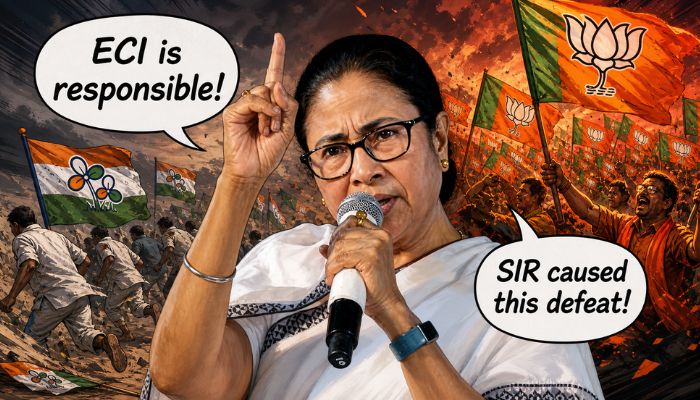
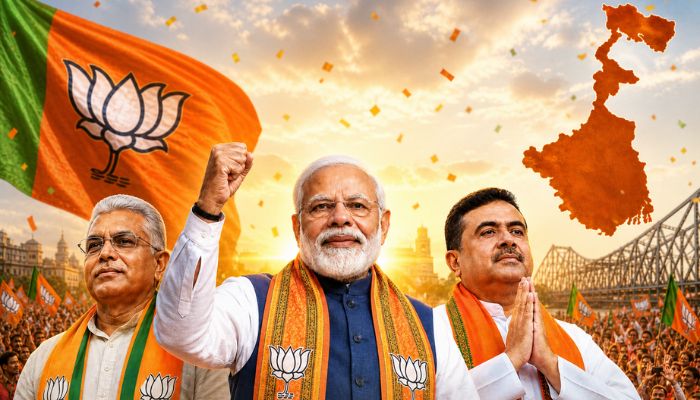
West Bengal Assembly Election 2026: As opposition and left liberals blame SIR for TMC’s defeat, data shows Mamata’s party won 13 of 20 seats with highest deletions; read details

On 4th May, Bharatiya Janata Party (BJP) wrote history in West Bengal by defeating Mamata Banerjee’s Trinamool Congress (TMC) on its home turf. BJP won 208 out of 296 seats in the State Assembly Elections after a historic 91% voting during polls held in two phases. As the results started to come in on Monday, the opposition and left liberals started blaming the Special Intensive Revision (SIR) conducted by the Election Commission of India (ECI) in the state for TMC’s defeat.

However, the numbers tell a completely different story. In the 20 Assembly seats that recorded the highest number of voter deletions after adjudication, Mamata Banerjee’s party won 13, while the BJP won six of them and Congress managed to grab one.

These numbers are significant, as the narrative on social media projected the ECI as the villain behind TMC’s poor performance.

Opposition and the left liberals targeted the Election Commission after the results

Throughout the day, sections of the opposition and the usual left liberal ecosystem began attacking the Election Commission and the SIR process.

TMC chief and now-defeated caretaker CM of West Bengal, Mamata Banerjee, cried foul and claimed that BJP stole 100 seats in West Bengal.

Leader of Opposition and Congress leader Rahul Gandhi followed the suit and supported her claim of BJP “stealing” 100 seats from TMC in Bengal with the support of the Election Commission.

Controversial RJ of Radio Mirchi, Sayema, posted on social media platform X, “Election Commission won”, hinting that it was the ECI that led to the BJP’s win.

Propagandist posing as journalist, Arfa Khanum Sherwani of The Wire, sarcastically congratulated the ECI for conducting “the most free and fair elections in the history of independent India”, again blaming the agency for TMC’s performance. However, she completely ignored the fact that the numbers are not in favour of the narrative.

Rajdeep Sardesai, journalist and husband of former journalist turned TMC MP Sagarika Ghose, shared a video from India Today where Swaraj India’s co-founder Yogendra Yadav claimed that 27 lakh people were wrongfully denied voting rights and questioned how six lakh votes were added after publication of the final list.

AAP leader Sanjay Singh too attacked the ECI and claimed 27 lakh voters had been deprived of their franchise.

However, the actual seat-wise numbers contradict the claims that deletions under SIR simply cost the TMC the election.

TMC won most seats with the highest deletions

According to the data cited in The Indian Express, the 20 seats with the highest deletions after adjudication included Samserganj, Lalgola, Bhagabangola, Raghunathganj, Metiaburz, Suti, Mothabari, Goalpokhar, Malatipur, Chopra, Sujapur, Rajarhat New Town and Basirhat Uttar. All these seats were won by the TMC.

Farakka, which recorded 38,222 deletions, was won by the Congress. The BJP won Jangipur, Ratua, Karandighi, Ketugram, Manickchak and Monteswar.

In simple terms, of the 20 constituencies where deletions were the highest, 13 were won by Mamata Banerjee’s party. That alone punctures the propaganda that SIR deletions uniformly damaged the TMC while benefiting the BJP.

What the broader numbers show

In broader terms, in 187 seats where more than 5,000 voters were deleted, the BJP won 119 while the TMC won 65. The Congress managed 2 seats and AJUP won 1.

Out of these 187 seats, the number of deleted voters was higher than the margin of victory or lead in 47 constituencies. Within the BJP’s 119 seats, 28 had deletions greater than the victory margin. Of these, 26 had been won by the TMC in 2021. At the same time, among the 65 seats won or led by the TMC, 18 too recorded deletions higher than the victory margin.

This shows that while deletions and margins overlapped in several closely fought seats, the opposition’s attempt to reduce the entire Bengal result to one slogan around SIR is plainly misleading.

How SIR was carried out in Bengal

The SIR exercise was different from routine electoral roll revision. Registered electors were required to fill fresh enumeration forms and submit documents to establish eligibility, including citizenship. The Election Commission began the exercise in June last year, starting with Bihar and later extending it to nine other states, including West Bengal, and three Union Territories.

In Bengal, 60.06 lakh electors, or 8.5 per cent of those in the final roll published in February, were placed under adjudication. After cases were examined by around 700 judicial officers, 27.16 lakh electors were deleted. Appeals filed by those deleted are now pending before 10 Appellate Tribunals.

The propaganda versus the data

The post result reaction from opposition politicians, armchair journalists and television commentators tried to create the impression that voter deletion under SIR was behind TMC’s poor performance and proof of wrongdoing by the ECI. However, the seat-wise data, especially from the 20 constituencies with the highest deletions, neutralised the claims.

If SIR deletions alone were the magic explanation being projected by the usual ecosystem, the TMC would not have won 13 of the 20 seats where deletions were the highest. It is evident that there is an attempt to weaponise SIR as a one-line excuse for the Bengal result and they will continue to use it for months to come.

How BJP went from 0 seats to winning the West Bengal election in 15 years: A closer look at the architects who made it possible

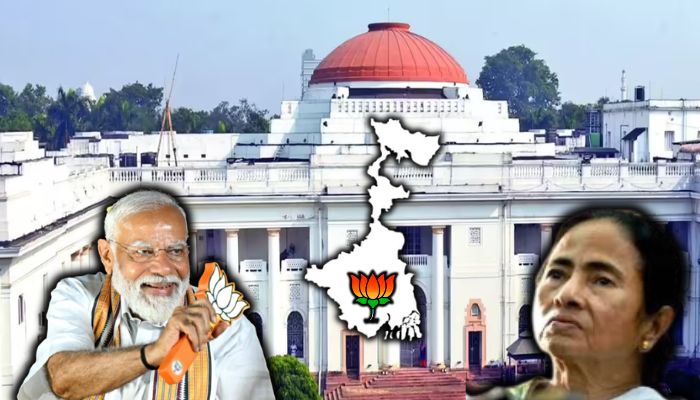
4th May 2026 will go down in history as one of the defining moments in India’s electoral history. The corrupt Pishi-Bhaipo regime of Mamata Banerjee and Abhishek Banerjee finally ran its course. The Bharatiya Janata Party (BJP) overcame one of its last remaining frontiers by winning the West Bengal election with a large mandate.

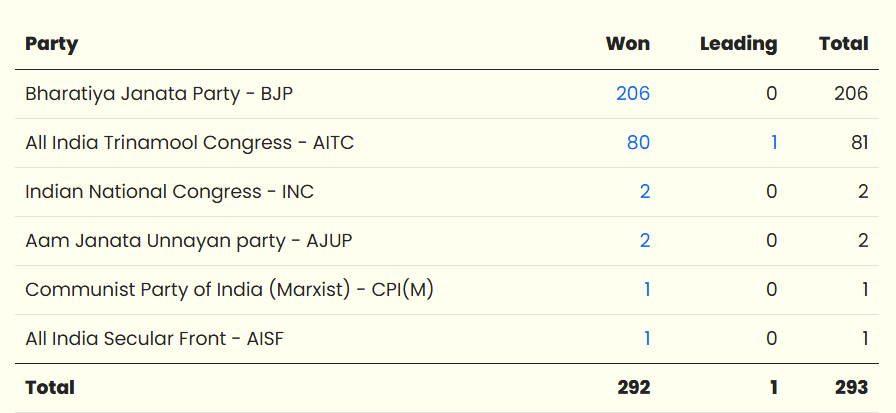
As I glance at the website of the Election Commission of India (ECI), I still find myself in a state of disbelief. The BJP won a whopping 206 constituencies out of 293, and TMC was relegated to just 81 seats. To my personal delight, Mamata Banerjee lost from her Bhabanipur constituency. A decade ago, such a sight was unimaginable and practically impossible.

While it is true that no one is invincible in politics and that the downfall of the TMC was inevitable at some point, the meteoric rise of the BJP from 0 seats in 2011 to winning the 2026 Vidhan Sabha election tells a different story. It did not happen by sheer chance. The party was built brick by brick by its State Presidents and its cadres in the past 15 years.

Screengrab of the 2026 West Bengal Vidhan Sabha election result, image via ECI website

In the 2000s, the BJP’s political performance in West Bengal was dismal. The party secured only 2 seats in the 2001 Vidhan Sabha election and none in the 2006 election. BJP also fared poorly in the national elections in the State. It secured 0 seats in the 2004 Lok Sabha election and managed to win 1 seat during the crucial 2009 election in Bengal.

The same year, Rahul Sinha was appointed the President of the West Bengal unit of the BJP. He steered the party during the Mamata wave of 2011. BJP was again left with 0 seats during the Vidhan Sabha election. The ascent of PM Narendra Modi to the power corridors of Delhi in 2014 left a mark on the State as well. Under the leadership of Rahul Sinha, the BJP was able to raise its vote share in Bengal from 6.15% to 16.84%, but could increase its seat count to only 2.

The massive foundational change began later that year when RSS ideologue Dilip Ghosh was roped into the BJP and made the General Secretary of the West Bengal unit. He had a distinct personality, which made him stand out immediately.

Ghosh was a match for Mamata’s aggressive style of politics. He was outspoken, cared little about political correctness and dared to look the TMC into the eye. His IDGAF attitude instilled confidence into the demoralised party cadre. Ghosh was rewarded soon with the leadership of the West Bengal BJP in 2015.

He led the party during the 2016 West Bengal Vidhan Sabha election. For the first time in the BJP’s electoral history in the State, the party won 3 seats. It was certainly not up to the mark, but the foundation was set. And the results spoke for themselves in the 2019 Lok Sabha election.

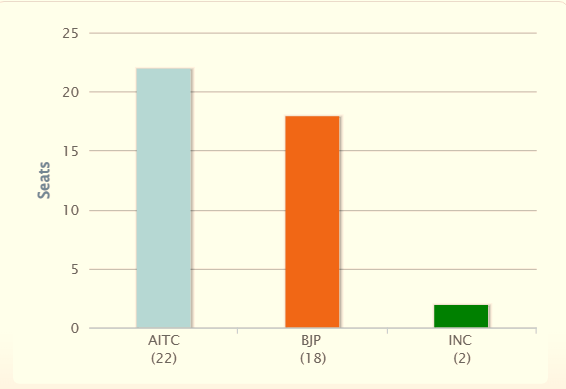
The party’s seat tally went from 2 in 2014 to 18 in 2018. At the same time, the BJP was able to clinch a whopping 40.6% of the vote share. It was an unprecedented swing in the mood of the voters. The message was clear: The party is in the right direction. In the run-up to the 2021 Vidhan Sabha election, many were convinced that it was the end of the TMC raj.

But many were shocked at the results. While the BJP was able to increase its seat count from 3 to 77, it fell short of the majority mark by 71 seats. The central leadership felt that a change was needed to take the fight to the next level. It was then that a two-pronged strategy was used.

Suvendu Adhikari was made the Leader of the Opposition in the West Bengal Vidhan Sabha. He had a calm, strategic demeanour with unmatched popularity, so much so that he defeated Mamata Banerjee in the crucial seat of Nandigram. At the same time, Sukanta Majumdar (who also had an aggressive style like Dilip Ghosh) was roped in as the BJP President.

The party focused on taking the fight against Mamata Banerjee with a missionary zeal. Issues affecting various strata of society, ranging from unemployment to demographic change, were highlighted consistently. Social media was galvanised to create public awareness and develop the movement for change. All of this, coupled with people’s fatigue of the Pishi-Bhaipo regime, created the perfect platform.

4th May 2026 saw Suvendu defeating Mamata Banerjee in her constituency of Nandigram. There should be no doubt in anyone’s mind that his personal popularity played a key role in securing the large mandate. He is likely to be the Chief Ministerial candidate of the BJP as well. And, he deserves all of the fame and applause for making the unthinkable possible.

Suvendu Adhikari took the party to 206 seats, but the foundation was laid by Dilip Ghosh with 40% vote share in the 2019 Lok Sabha and 77 seats in the 2021 Vidhan Sabha election. In our sudden rush to salute the rising sun, we must not forget those who played has played a major role in making the BJP a household name in West Bengal.

‘Bhadroloks’ who were once apprehensive of the BJP due to consistent fearmongering by the TMC regime also saw the good governance of the Modi government in different States of India. The public awakening, the right messaging and the desire to bring glory back to Bengal became the key forces of change. Yesterday’s victory is thus a collective fight of BJP leaders against corruption, appeasement politics and attempts by TMC to erase Hindu culture.

As BJP heads towards a historic win in West Bengal, liberals suffer a massive meltdown, ignore 15-years of anti-incumbency and declare BJP victory ‘unfair’

Such is the beauty of democracy that even the strongest of fortresses crumble when the public decides to get rid of them. In West Bengal, the Bhartiya Janata Party has pulled off the unthinkable and is set to register a historic victory in the elections. As the saffron party is heading towards the 200 mark, the left liberal cabal is having a monumental meltdown. The anti-BJP brigade has recycled its formulaic ‘Hum hare nahi humein haraya gaya hai’ bogey by casting aspersions on the integrity of the Election Commission, instead of gracefully accepting the Janadesh.

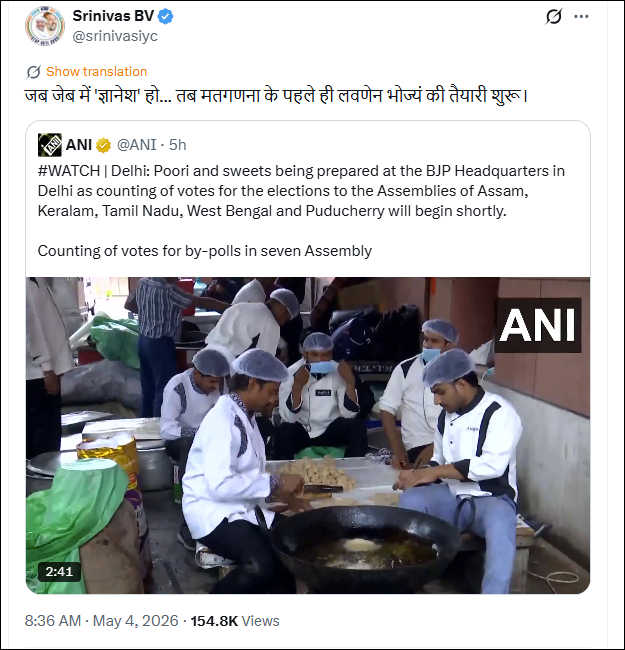
In this vein, Congress leader Srinivas BV wrote on X on 4th May, “When there’s ‘Gyanesh’ in your pocket… then even before the counting begins, preparations for a lavish feast kick off.”

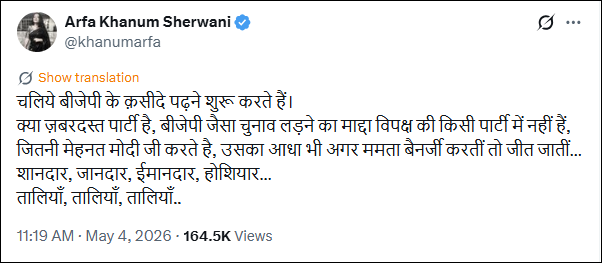
Suffering yet another ‘zakhm’ inflicted by the BJP, leftist rag The Wire’s Arfa Khanum Sherwani attempted to a piece of sarcasm, but ended up exposing her bewilderment.

“Let’s start singing praises of the BJP. What a tremendous party it is; no opposition party has the guts to fight elections like the BJP does. If Mamata Banerjee put in even half the effort that Modi ji does, she would have won… Splendid, spirited, honest, clever… Claps, claps, claps…,” Sherwani wrote.

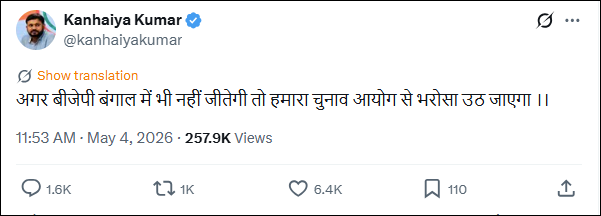
Meanwhile, student leader-turned-Congress politician, Kanhaiya Kumar, directly accused the Election Commission of ‘match fixing’ in the BJP’s favour.

“If the BJP doesn’t win in Bengal either, our trust in the Election Commission will be shaken,” Kumar posted.

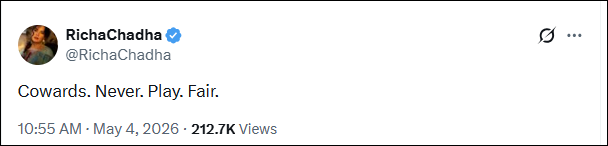
Meanwhile, Bollywood entertainer Richa Chadha, who often comments on politics for some reason, tried to insinuate that the BJP did not pose a fair fight before the TMC and thus is set to win West Bengal. “Cowards. Never. Play. Fair,” she wrote.

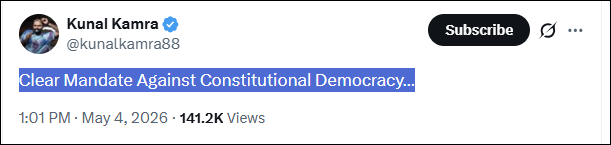
Similarly, ‘comedian’ Kunal Kamra wrote, “Clear Mandate Against Constitutional Democracy…”

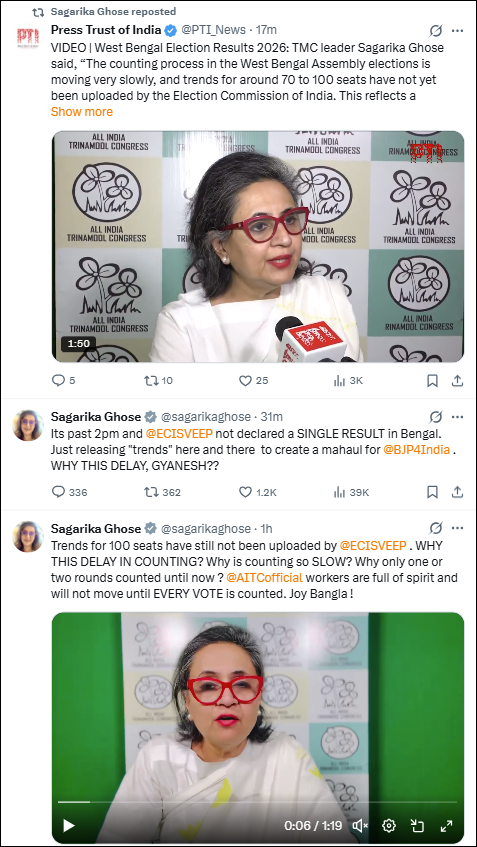
TMC leader Sagarika Ghose has come up with a rather peculiar coping mechanism as she is repeatedly asking the ECI why no results have been announced and only trends are being displayed on ECI’s website.

“Its past 2pm and @ECISVEEP not declared a SINGLE RESULT in Bengal. Just releasing “trends” here and there to create a mahaul for @BJP4India. WHY THIS DELAY, GYANESH??” Ghose wrote.

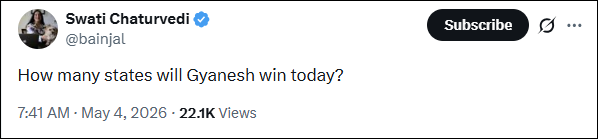
‘Journalist’ Swati Chaturvedi directly targeted Election Commission Chief Gyanesh Kumar, and wrote, “How many states will Gyanesh win today?”

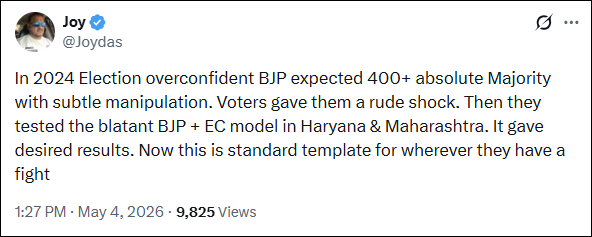
Hinduphobe Joy Das claimed that after a shocker in the 2024 Lok Sabha elections, the BJP tested the supposed ‘BJP + EC’ model in Haryana and Maharashtra, and after its success, has made it a template for other states.

“In 2024 Election overconfident BJP expected 400+ absolute Majority with subtle manipulation. Voters gave them a rude shock. Then they tested the blatant BJP + EC model in Haryana & Maharashtra. It gave desired results. Now this is standard template for wherever they have a fight,” Das wrote.

Meanwhile, Ranting Gola, notorious for her politically biased, unfunny, and raucous commentary videos, described the West Bengal elections as not a contest between the BJP and the TMC, but TMC versus ECI, TMC versus the Enforcement Directorate, and TMC versus 90 lakh deleted voters.

The Islamo-leftist side of X and other social media platforms is replete with such posts throwing shade on CEC Gyanesh Kumar, accusing BJP of rigging, and abusing Bengali voters who chose the BJP after 3 terms of TMC rule. They have even refused to consider that the majority of voters may have wanted a change after 3 terms of Mamata Banerjee’s government, and anti-incumbency of 15 years is expected to have played a major part.

It has become a ritual for the anti-BJP parties and their supportive ecosystem to question the transparency of the entire election process, cast aspersions on the integrity of the Election Commission, and blame the BJP’s imaginary ‘match fixing’ for their own defeats. First, they alleged EVM hacking after the BJP won the 2019 general elections, then they alleged EVM hacking and VVPAT tampering during the 2024 Lok Sabha elections, then in the Haryana and Maharashtra state elections, wherein the BJP won, they concocted the ‘voter inflation’ and ‘fake voters’ bogey.

However, the same EVMs, VVPATs and Election Commission worked perfectly fine when Congress won Himachal Pradesh, Telangana and Karnataka. Now, Congress-led UDF is set to win Kerala assembly elections, but none of the self-declared defenders of democracy will allege EVM fraud, VVPAT tampering, ‘BJP+ECI’ model of election rigging since the ‘secular’ side won there. One wonders what sort of EVM hacking and voter roll manipulation the BJP and ECI do that it never works in Kerala and Tamil Nadu. If there was any scope for poll rigging, wouldn’t the so-called ‘Modi-Gyanesh’ duo have engineered the Tamil Nadu and Kerala elections in the BJP’s favour?

Wouldn’t they have ‘managed’ at least a clear majority for the BJP in the 2024 Lok Sabha elections, wherein the NDA had given the slogan of ‘Abki baar 400 paar’? If the BJP and ECI colluded to ‘fix’ elections, would the Aam Aadmi Party have had three consecutive terms in Delhi? If EVMs could be hacked, VVPATs could be tampered with, and ECI could be bent to will, would BJP have lost Ayodhya?

It was also seen how the opposition parties cried hoarse over the Special Intensive Revision (SIR) of electoral rolls in Bihar and West Bengal and slammed it as some sort of ‘anti-Muslim’ engineering, almost as if to protect a certain votebank which even they knew was illegal. These allegations came even as the Election Commission stated that the SIR exercise was only to weed out illegal, deceased, and voters who have moved away and not to delete voter names based on their religious identity. From EVMs, VVPATs to SIR, the Supreme Court has repeatedly upheld that the ECI has been conducting elections fairly and transparently, and yet, the anti-BJP cabal throws ‘rigging’ and ‘Gyanesh is compromised’ allegations, making a constitutional institution a victim of their partisan hypocrisy.

Under Mamata Banerjee, West Bengal saw it all: the departure of big companies, unemployment, anti-Hindu violence, post-poll violence by TMC goons, Sandeskhali horror, TMC’s insensitivity in the RG Kar College rape case, CM Banerjee’s consistent suppression of Hindus and appeasement of Muslims, her obsession with not being a Kafir and fighting the Kafirs, political killings of BJP workers, and even the gherao and harassment of Judicial officers on SIR duty. Democracy never came under danger when TMC ran its evil empire, but when the people of West Bengal delivered a decisive Janadesh in BJP’s favour, democracy is under threat. ECI and CEC Gyanesh Kumar are compromised; it was never a ‘fair fight’.

While the overzealous online supporters may turn a blind eye, the political parties, be it TMC or Congress, know very well that their ‘Election Commission is compromised’ claim is devoid of any factual merit. They even know that the public is not buying their hollow narrative, and hence, they are only keeping this manufactured outrage alive to keep the supporters united and deflect their anger towards the ECI. If the 2021 Bengal elections were TMC democratically defeating the ‘divisive’ BJP, then the 2026 elections are about the people of Bengal, especially Hindus, democratically teaching the TMC and Mamata Banerjee the ultimate lesson that they are not to be taken for granted or suppressed anymore. The end of TMC’s tyrannical rule in Bengal is not Gyanesh Kumar’s ‘script’ but a revolution brought by the Bengali voters.

Clearly, it is once again that ironic moment in India’s electoral-democratic history that democracy and constitution are ‘collapsing’ in states where the BJP won, but are thriving in states where Congress or any other anti-BJP party won, if one goes by the illogical claims of the usual suspects. As per the left liberal coping mechanism, the anti-BJP parties either win elections or are conspiratorially defeated; they don’t really lose elections due to unfavourable Janadesh anymore.

The year India buried the red: From Naxalism in hinterland to Communist Party in Kerala, read how 2026 marked the end of India’s Left

History, when it turns, rarely does so in fragments. It moves in arcs: political, ideological, and civilizational. And in 2026, India appears to be witnessing one of those rare moments where two parallel arcs have converged into a single, decisive conclusion: the collapse of Communist political power and the near-extinction of Maoist violence.

On the one hand, Kerala, the last functional bastion of parliamentary communism, is slipping decisively out of the hands of the CPI(M)-led Left Democratic Front. On the other hand, the Indian state is declaring the endgame of left-wing extremism, meeting a self-imposed deadline of March 31, 2026, to eradicate Naxalism.

One ballot. One bullet. Both are now spent.

The fall of Kerala: When arithmetic became an ideological verdict

The ongoing Kerala assembly results are not merely unfavourable for the Left; they are catastrophic. The Congress is leading in 63 out of 140 seats, the CPI(M) is reduced to around 25, and the Indian Union Muslim League is holding 23. The Congress-led United Democratic Front is comfortably heading toward a sweeping victory, while the BJP remains marginal with just two leads.

This is not a routine alternation of power that Kerala is known for. This is a breach of ideological territory.

For decades, Kerala was the exception that kept the Left politically relevant even as it collapsed elsewhere. The re-election of Pinarayi Vijayan in 2021 had been projected as proof that communism in India could still adapt, still govern, still win.

Five years later, that argument stands dismantled.

The campaign led by V. D. Satheesan has not just defeated the Left, it has outflanked it. By setting an ambitious 100-seat target and aggressively pushing into traditional LDF strongholds, the UDF has done what few thought possible: convert anti-incumbency into ideological displacement.

The Congress’s historical Muslim appeasement and its alliance with a party like IUML has further solidified its standing in Kerala elections, ensuring that the UDF emerges as a coalition with a comfortable majority to keep the Left at the bay.

Kerala, in short, has delivered a verdict that goes beyond governance. It has questioned relevance.

The long decline: From Jyoti Basu to political marginality

To grasp the magnitude of this moment, one must revisit the heights from which the Left has fallen.

In 1996, Jyoti Basu was poised to become Prime Minister, a moment that could have altered India’s political trajectory. The CPI(M)’s refusal, later termed a “historic blunder” by Basu himself, symbolised an enduring tension within the Left: ideological rigidity over political opportunity.

By 2008, the Left was powerful enough to destabilise the United Progressive Alliance government led by Manmohan Singh over the Indo-US nuclear deal. It held sway in West Bengal, Kerala, and Tripura simultaneously.

And then came the collapse.

West Bengal fell in 2011 to Mamata Banerjee, exposing the contradictions of a regime that had drifted from its grassroots origins. Tripura followed in 2018, with leaders like Manik Sarkar unable to withstand the BJP’s expansion.

Kerala remained the last redoubt until now.

Parallel arc: The rise and fall of Maoist violence

While the electoral Left was losing ground, another, more violent manifestation of the same ideological spectrum was also unravelling: the Maoist insurgency.

The story of Naxalism begins in 1967, in the village of Naxalbari in West Bengal, led by figures like Charu Majumdar. What started as a localised peasant uprising soon evolved into a decades-long insurgency that spread across central and eastern India, forming what came to be known as the “Red Corridor.”

At its peak, this corridor spanned over a dozen states and affected millions of people. Entire regions, like the dense forests of Dandakaranya, were effectively outside the writ of the Indian state. Maoists ran parallel administrations, enforced their own justice systems, and sustained themselves through extortion, violence, and ideological indoctrination.

The human cost was staggering. Since 2000 alone, over 12,000 lives have been lost. Civilians, security personnel, and even tribals were coerced into the insurgency. 

And yet, for years, the response remained hesitant.

The policy shift: From appeasement to annihilation

The turning point came post-2014, when the Modi government reframed Naxalism not as a socio-political grievance but as a national security threat. This was not merely a rhetorical shift; it fundamentally altered the state’s operational doctrine.

Under the leadership of Amit Shah, a multi-pronged strategy was deployed: intelligence-driven operations, infrastructure expansion, financial crackdowns, and rehabilitation programs.

The results were cumulative and decisive.

Between 2015 and 2025, the number of Naxal-affected districts shrank dramatically from 106 to just 18, with only a handful remaining severely impacted. Leadership decapitation accelerated, with top commanders like Nambala Keshav Rao (Basavaraju) eliminated in 2025. Surrenders surged, crossing 2000 in a single year. 

Operations like “Kagar” and “Black Forest” dismantled Maoist strongholds, destroyed bunkers, and recovered massive caches of explosives. Simultaneously, development initiatives like roads, telecom networks, and bridges began integrating previously inaccessible regions into the national mainstream.

Perhaps the most symbolic shift was psychological. Where once the Indian state sought ceasefires, Maoists were now reportedly seeking them, an inversion of power dynamics that underscored the insurgency’s collapse. 

By March 31, 2026, the government declared that Naxalism, as an organised threat, had been effectively eliminated.

Abujhmadh: From no-man’s land to state presence

No region illustrates this transformation better than Abujhmadh in Chhattisgarh, a vast, unmapped forest that once served as the ideological and operational headquarters of Maoists.

For decades, there were no roads, no hospitals, no administrative presence. Maoists ensured isolation, destroying infrastructure and preventing development to maintain control. They ran their own “Janatana Sarkar,” enforced their own laws, and turned the region into a fortress of insurgency.

Today, that fortress is collapsing.

Security operations have penetrated deep into these areas. Roads are being constructed, mobile towers installed, and governance restored. The very geography that once shielded Maoists is now being reclaimed by the state.

The ideological link: Ballots and bullets

It would be analytically simplistic to equate parliamentary communism with Maoist insurgency. One operates within democratic frameworks; the other rejects them entirely.

And yet, both draw from a shared ideological lineage, a belief in class struggle, a scepticism of the Indian state, and an aspiration, however differently expressed, to fundamentally restructure society along Marxist lines.

What 2026 demonstrates is that this broader ideological ecosystem is in retreat.

The voter has rejected it at the ballot box. The state has dismantled it on the battlefield.

The collapse of the “Urban Ecosystem”

An often overlooked dimension of this story is the role of what has been termed the “urban Naxal” ecosystem, academics, activists, and commentators who provided ideological cover, legal aid, and narrative support to Maoist groups.

For years, this ecosystem framed Maoists as rebels with a cause, often downplaying or justifying their violence. But as the insurgency weakened and its excesses became harder to obscure, that narrative began to lose traction.

The state’s refusal to engage in ceasefire theatrics or narrative battles further marginalised these voices. The focus remained on outcomes, not optics.

Two Ends, One Message

The simultaneous decline of the CPI(M) in Kerala and the eradication of Maoist violence across India is not coincidental; it is convergent.

It reflects a deeper shift in Indian society: from grievance to aspiration, from ideology to delivery, from revolution to integration.

The Indian voter today is not interested in dismantling the system; he wants to succeed within it. The Indian state, for its part, has demonstrated that it will no longer tolerate armed challenges to its authority.

The year an idea lost its constituency

2026 may well be remembered as the year when an idea, once dominant, often disruptive, occasionally transformative, finally ran out of both voters and fighters.

The CPI(M), staring at a wipeout in Kerala, faces an existential question: what does it stand for in modern India?

Maoism, reduced from a sprawling insurgency to scattered remnants, faces a harsher reality: it no longer stands at all.

History will record this not as a sudden collapse, but as the end of a long decline, accelerated by political missteps, ideological stagnation, and a changing nation that simply moved on.

And as India steps into its next phase, the message from 2026 is unambiguous: The age of the Red, both electoral and insurgent, has come to an end.

Approval granted for the upgradation of the Kudankulam Nuclear Power Project: Read details about the major step towards achieving self-reliance in energy

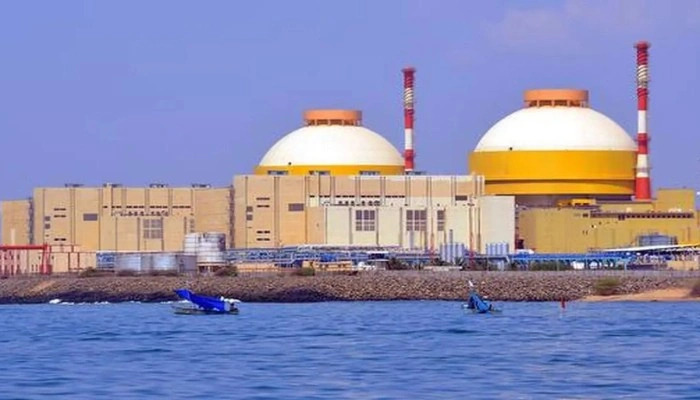
India has made a crucial step toward boosting its nuclear energy program after the Atomic Energy Regulatory Board (AERB) sanctioned “major equipment erection” at Units 5 and 6 of the Kudankulam Nuclear Power Plant (KKNPP). The permission which was granted on 30th April (Thursday) marked a significant shift from civil construction to core plant development by allowing the Nuclear Power Corporation of India Limited (NPCIL) to install vital reactor components, such as the reactor pressure vessel, steam generators and coolant pumps.

“Landmark progress at Kudankulam. India’s nuclear energy programme achieves another decisive milestone,” the public sector enterprise hailed the move of social media. It also informed, “The approval followed from comprehensive multi-tier safety reviews by AERB, reaffirming adherence to stringent national regulations and global benchmarks, including IAEA (International Atomic Energy Agency) standards.”

“Kudankulam Units 5 & 6 stand as a testament to India’s commitment to safe, clean and reliable nuclear power, driving energy security and sustainable growth,” NPCIL added.

Units 5 and 6 are now progressing into one of the most technically challenging stages before commissioning after receiving the nod which was given following a review of safety regulations and the status of civil construction under previous license for the “First Pour of Concrete” stage that was cleared in April 2021. The forthcoming units include upgraded safety features that satisfy AERB’s safety code for light water reactor-based nuclear power facilities.

Kudankulam, India’s largest nuclear power plant, is located in the Tirunelveli district of Tamil Nadu. It is designed to house 6 pressurised water reactors using Water-Water Power Reactor (VVER) technology, which was developed in partnership with Russia. The capacity of each unit is 1,000-megawatt (MW). Its total expense is ₹1.11 trillion ($16.3 billion) of which Units 5 and 6 will cost roughly ₹50,000 crore ($7.3 billion).

While Units 3 and 4 are in advanced stages of construction, Units 1 and 2 have been operational since 2013 and 2015, respectively. Units 5 and 6 now enter one of the most technically challenging phases ahead of commissioning with the latest consent. The commencement of “spillage to open reactor,” a procedure used to flush and clean coolant systems before the operation, on 28th April brought Unit 3 one step closer to commissioning.

According to NPCIL, Units 1 and 2 have collectively produced more than 121 billion units of power, preventing the emissions of around 104 million tonnes of carbon dioxide. The facility will have an aggregate capacity of 6,000 MW if all 6 units are completely installed. Meanwhile, New Delhi’s collaboration with Moscow in civil nuclear energy remains crucial for the growth in its capacity.

India leaps towards energy independence

The decison has important strategic and economic ramifications that extend beyond construction progress. The Kudankulam project will produce 6,000 MW of dependable baseload power when it is totally operational, offering a consistent supply of electricity that is vital to India’s booming industrial and urban demand.

Nuclear energy provides continuous power generation, which helps stabilise the system and provide energy reliability, in contrast to renewable energy sources like solar and wind. Given that nuclear power is still a low-carbon substitute for fossil fuels, the increase further encouraged India’s clean energy transition. The Modi government has pledged to reach net-zero emissions by the year 2070.

The massive country could meet its rising electricity needs while reducing emissions and reducing its dependence on coal by broadening its nuclear output. The venture simultaneously improves energy security via minimising reliance on key fuels and protecting the economy from fluctuations in global energy prices.

Kudankulam is an essential element of Indo-Russian nuclear partnership in terms of technology, providing access to innovative reactor equipment while fostering the progression of domestic capacity in high-end manufacturing and engineering.

External Affairs Minister S Jaishankar in March expressed, “Russia is our foremost partner in civil nuclear energy and the Kudankulam nuclear project is a stellar example. As India aims to increase its nuclear energy generation capacity to 100 gigawatts by 2047, I am confident that it will find a trusted and reliable partner in Russia for peaceful uses of nuclear energy.”

KKNPP was discussed when Russian President Vladimir Putin visited India in December of last year. “We’re conducting a flagship project to build the largest Indian nuclear power plant, Kudankulam. 2 out of 6 reactor units have already been connected to the energy network, and four are still under construction. Getting this nuclear power plant to full power output will make an impressive contribution to the energy requirements of India,” he highlighted.

On the other hand, employment, industrialisation and regional upliftment in southern India are anticipated positives of the project. Kudankulam Units 5 and 6 have reached a significant milestone with AERB’s endorsement, showing India’s steady advancement toward a cleaner, safer and more independent energy future while balancing development with strict safety supervision.

When “foreign funded and orchestrated” protests impeded the program

Kudankulam has been plagued by obstructions from its inception in 1979. A rally even witnessed over 10,000 individuals in 1989. The onset of an away-from-reactor (AFR) facility for units 3 and 4 alongside a port to offer sufficient facilities to handle floating ships, among other activities have been the subject of agitation even after it started commercial operations on 31st December 2014.

A similar proposal to build an AFR facility for the first two units had already been put on hold indefinitely due to resistance. The central government and intelligence agencies disclosed the true motivations and masterminds of these uprisings.

4 non-governmental organisation were accused by the Indian National Congress-led UPA (United Progressive Alliance) government of using foreign funds to promote demonstrations against the nuclear unit in 2012. The action was taken a few days after then-prime minister Manmohan Singh accused American NGOs of postponing its commissioning. A German national, Sonnteg Reiner Hermann, was also deported by the authorities for supporting these rallies. He was in the country on a tourist visa.

The commissioning of two 1,000-MW nuclear reactors had “gone into difficulties because these NGOs, mostly I think based in the United States, don’t appreciate the need for our country to increase the energy supply,” Singh told the esteemed Science journal. He noted that “there are NGOs, often funded from the United States and the Scandinavian countries, which are not fully appreciative of the development challenges that our country faces.”

“There is a clear case of foreign money being misused by some NGOs in Koodankulam. The protests are obviously engineered,” likewise charged Minister of State in the PMO (Prime Minister’s Office) at the time, V Narayanasamy.

The People’s Movement Against Nuclear Energy (PMANE) was at the forefront of this opposition. Its coordinator, SP Udayakumar, constantly grabbed spotlight from September 2011 to July 2013 due to his relentless objection to the plant. The Intelligence Bureau (IB) report titled “Concerted Efforts by Select Foreign Funded NGOs to ‘take down’ Indian development projects” also featured his name.

“In 2011, anti-nuclear activism stalled the nearly commissioned Russian-assisted, Kudankulam Nuclear Power Project in Tamil Nadu. The protests were spearheaded by Ohio State University-funded, SP Udayakumar, and a host of Western-funded NGOs,” it read.

The report revealed, “The larger conspiracy was unravelled when a German national provided Udayakumar with a scanned map of all nuclear plants and uranium mining locations in India. The map included contact details of 50 Indian anti-nuclear activists, revealing an intricate network aimed to ‘take down’ India’s nuclear programme through NGO activism.” The communication was signed by former IB Joint Director SA Rizvi and was dated 3rd June 2014.

A possible damage to the plant: The dangerous shades of anti-KKNPP agitation

Scientists warned in 2011 that blockades might gravely harm the project and make it difficult to ensure that the plant systems functioned at a minimal level. “In a recent road blockade, work on the plant was halted. It is not a plant which can be just switched on and off. We have done the hot run. We can’t go from hot run to a freeze condition. It is not possible,” stated late Srikumar Banerjee while talking to the media.

He was serving as the chairman of the Atomic Energy Commission (AEC) and Secretary of the Department of Atomic Energy (DAE). He outlined, “We have to have a minimal operational system. A plant cannot have a stagnant water cooler system. Therefore, we have to run the plant in a manner which is completely safe. There is a serious concern about the damage to our programme.”

He termed the demonstrations as “unfortunate” specifically during a critical phase of its operations and added, “We can recover even now. A delay of a month can cause a (setback) of several months. But even now we are hopeful that we will be able to push it and make the plant operations as fast as possible.”

Similarly, then-NPCIL Chairman SK Jain complained that they were unable to access the location and sustain the systems due to the blockade. The computer, electronics and ventilation systems could be seriously harmed owing to this as these require maintenance and monitoring personnel even though the plant was no longer under construction.

He stressed, “The systems have to be kept running. In the last six to seven days, we have not been able to send people to the plant. If there is damage, the NPCIL might have a big penalty to pay. It is not a car factory where you can switch off the systems and close the gate. You have simulators, ventilators, computer and electronic systems.”

“Once you have installed all these, you have to maintain the surrounding system. You cannot switch off. We were ready for the fuel loading in September. We had mobilised large numbers of our engineers to do the work. Many government staff have duty at the site, for which they get salaries. There are local contractors employed for maintenance work. We have 800 people on the rolls and they would be affected,” Jain submitted.

He also indicated that environmentalists from Finland, Australia, France and the US manipulated locals and capitalised on their sentiments, observing, “Foreign nationals are simply sitting there. They, along with a splinter group led by Uday Kumar, are exploiting the sentiment created by a rumour of evacuation. There are 27 villages in Kudankulam and 22 villages have not participated in the protests. We have their total support.”

Personnel hindered from entering the premises of the facility, engineers threatened, workers made to flee: Banerjee calls the protest “unexpected”

Work at the plant was “halted” that same year because employees were “unable to go inside.” According to Banerjee, this circumstance occurred “when we need several thousand people to work inside during the last phase of work” of commissioning the first reactor there, reported The Hindu.

On 11th September, hundreds of residents of the coastal communities surrounding the KKNPP, headed by the PMANE began a relay fast at Idinthakarai hamlet for the project’s termination. Due to these limitations and threats from the villagers, the engineers and other staff were forbidden to step inside the plant for months. This intimidation forced approximately 3,000 contract workers from Jharkhand, Bihar, West Bengal and Orissa to escape to their home states.

The PMANE leadership desired the cessation of the before the centre’s 15-person expert panel can speak to the locals and alleviate their concerns on the safety of the Kudankulam reactors.

“Physically, work has been halted. But it is not advisable to do that. If the agitators meant that not a single person should enter the Kudankulam plant when they demanded that work on the project should halt, we are allowing a major asset of the country to degrade and that is not something acceptable,” Banerjee expressed.

He informed, “So it is not a matter of switching off the whole system and bringing it to a standstill. Whenever you have a coolant in a circuit and you make it stagnant, then there is the possibility of some undue corrosion effect on some of the components. Obviously, this is not normally done. You always run the coolant, and this process requires the attention of the technicians as well as the supporting people.”

The reactor was predicted to reach criticality in October, and the Nuclear Power Corporation of India Limited was awaiting confirmation to put fuel into the reactor.

“So essentially this has been halted. There is no big dispute on this, but you must run the essential facilities for the safety and long-term service of the equipment. India is an impoverished country in terms of power supply. Tamil Nadu even today had a serious power shortage. It is also a state which is aspiring for major industrial growth. This industrial growth will happen only when you have power,” Banerjee conveyed.

The two Kudankulam plants were prepared to deliver 2,000 MWe (Megawatt electrical) with Tamil Nadu receiving 925 MWe as its share. However, this unrest prevented the same. He added, “Basically, this is a step towards decelerating the economic growth process, the growth of livelihood of people or their quality of life.

Banerjee stated that “a cordial relationship existed all along” between the KKNPP staff and the local villagers, making the unrest at Idinthakarai “a little unexpected.” The engineers frequently took part in the local social and educational endeavours. “We were actually looking forward to enriching our relationship with the people around because nuclear power reactors nowadays had a lifespan of 40 years to 60 years. So, it is a big surprise for me that the agitation had broken out,” he voiced.

Notably, these alarming scenes eventually subsided after 2015, and India is presently on track to augment its clean energy capacity and curtail its dependency on fossil fuels.

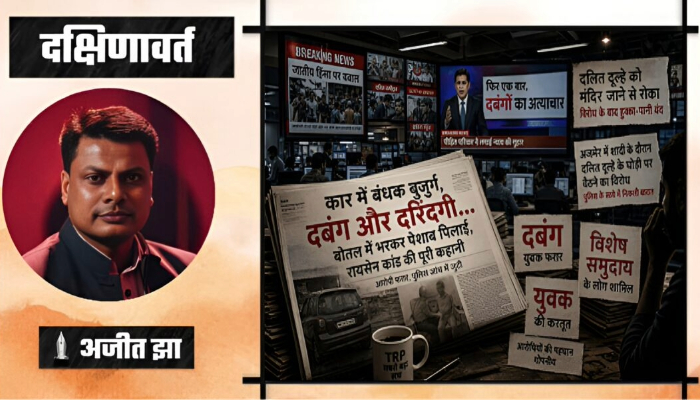
How Indian mainstream media frames an ‘upper-caste villain’ in every crime

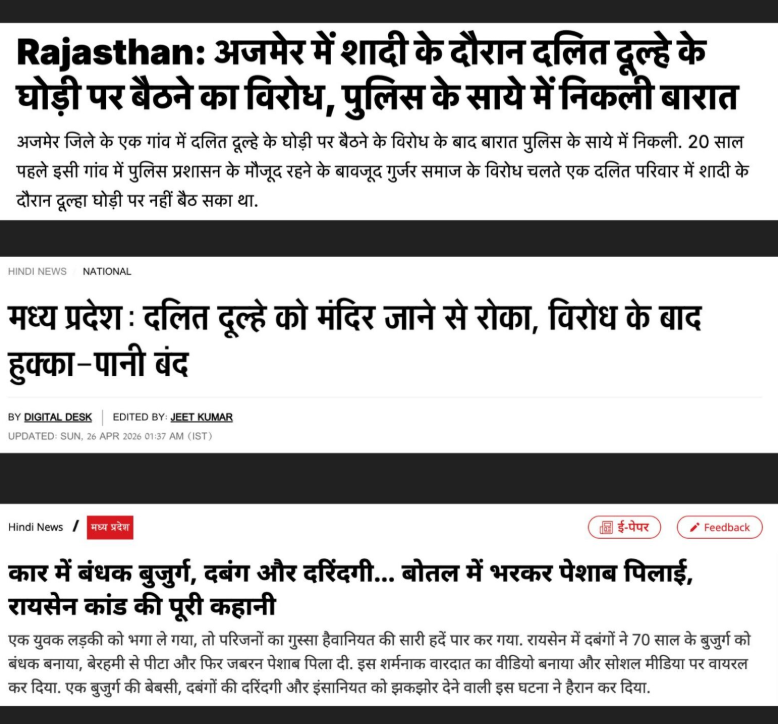
Headline 1: An elderly man held hostage in a vehicle – brutality and atrocity; forced to consume urine from a bottle: The complete account of the Raisen incident
Headline 2: Dalit groom prohibited from entering the temple; social boycott enforced after protest
Headline 3: Opposition to Dalit groom riding a horse during the wedding procession in Ajmer; baraat moves forward under strict police protection

You likely encounter such news regularly. Whether in Hindi or English media, these stories are everywhere. What immediate image forms in your mind? You assume the accused belong to the so-called “upper castes.”

It is essential to briefly investigate the veracity of these three headlines prior to moving forward.

The reality of Headline 1

This event transpired in Raisen of Madhya Pradesh. It happened following the elopement of a young man with a minor girl from the village. Both are members of the Scheduled Tribes (ST) community.

The reality of Headline 2

The individuals that the Dalit couple accused of obstructing their entry into the temple are categorised as Other Backwards Class (OBC). The group that convened the Panchayat (village council) and imposed a social boycott on the pair also included members from Dalit families. This Panchayat was called after the Dalit groom used abusive language. According to the villagers, the temple doors were closed at the time of their arrival, and hence they were refused entry.

The reality of Headline 3

Lavera, situated in Ajmer, is the village where this incident took place and is primarily inhabited by Gujjars, who are categorised as OBC. No person from the upper castes of the area objected to the Dalit groom riding a mare during the procession nor did the Gujjars. This entire occurrence had no relation to caste whatsoever. Police were deployed as a preventive measure because of an incident that happened in the village 20 years ago.

For many years, the Indian media has systematically portrayed every such incident, whether it involves Scheduled Castes (SC) against SC, ST against ST, or Dalit against OBC, in a certain way. Their aim is to solidify leftist propaganda that whenever individuals from the SC, ST or OBC groups are perceived as victims, it should be presumed that the alleged offenders are from the so-called “upper castes.”

The animosity currently directed at the general category, along with phrases like “Down with Brahminism,” are direct outcomes of this agenda that the Indian media has been advocating for decades. This is exactly similar to how, if a Maulana, an Alim, or a Christian father engages in criminal activity, terms such as “Pujari” or “Priest” are intentionally used in the headlines to influence your perception. The images featured in these pieces are also chosen to create the impression that the accused is indeed a Hindu priest or sage.

Even when the caste identity of the individuals is not distinctly evident in the news, the media presents the headlines in such a way that it leads the reader to instinctively presume that the accused are part of the so-called “upper castes.” This issue transcends mere linguistics and embodies a well-established modus operandi within the Indian media for shaping narratives.

When the factual elements of a story correspond with the intended narrative, caste identity is disclosed openly. However, when it does not align or needs to be obscured, then terms like “strongman,” “youth,” “miscreants,” “mob,” or “members of a specific community” are invoked instead.

It is likely that you must have observed that when the offenders are from the Brahmin, Thakur or any other upper-caste community, multiple media outlets readily include this information in their headlines:

  • Thakurs attacked Dalit youth
  • Brahmin family harasses Dalit woman
  • Upper-caste people did not permit entry into temple

We are not implying that such occurrences should go unreported. Nor do we propose that facts should be hidden in these cases. However, it becomes problematic when this same criterion is not employed for other incidents of a similar nature.

Every day, we come across news articles where, if the perpetrator is from an OBC, SC/ST, or a politically sensitive group, the media avoids mentioning their caste identity in the headlines. This is applicable whether the incidents pertain to honour killings, electoral violence or unrest provoked by religious factions.

Efforts are made to associate these incidents with upper castes by using terms like “Dabang” (strongman), or alternatively, the identities of these elements are concealed through vague descriptors such as “mob,” “specific community,” “friends,” or “locals.” On the contrary, the media promptly points out religious identity if the accused is a Hindu, even in matters of trivial disputes.

In any event, “Dabang” does not function as a designation for any particular group. Moreover, it is not a legal term utilised to define or classify a crime. It is, in fact, a term that often arises from bias rather than from actuality. An effort is made to evoke a specific social image in the reader’s perception via these descriptions.

The reader is misled to believe that the accused is probably a prominent individual from the neighbourhood, from the upper caste who enjoys political clout. Nevertheless, the truth is quite different, as the previously mentioned examples have already illustrated.

Now, the question is: What motivates the Indian media to partake in such practices? The main reason for this is the tight grip that the “Left-Liberal” cabal has over the mainstream media. They function within established ideological frameworks, through which every occurrence is filtered and portrayed as a fixed narrative of “oppressor versus victim,” a form of propaganda that is applied to every instance.

They intentionally avoid explicitly identifying certain communities. Moreover, journalists operating from air-conditioned newsrooms in urban areas often lack a true comprehension of the intricate social realities that exist on the ground. In addition, clickbait journalism plays a role in sustaining this narrative, as sensational language tends to attract greater engagement.

Consequently, readers are left with insufficient information about events. This leads to an increase in social mistrust. Issues at the grassroots level are neither properly recognised nor adequately addressed. Furthermore, the integrity of journalism is compromised. It is crucial that the caste or community identity of individuals is revealed only when it is pertinent to the event’s context.

For example, in a disagreement between two neighbours regarding a water pipe, it is inappropriate to refer to the victim as a “Dalit-Muslim” and the accused as a “Dominant-Caste Hindu” since the dispute did not arise from caste or religious issues. Therefore, the media should implement a policy that ensures that it clearly states the caste and religion of the accused in every instance, rather than selective revelations.

Ultimately, the fundamental role of journalism is to convey facts, not to construct social narratives or participate in appeasement. The nation is already filled with political parties that consider themselves the self-designated guardians of these agendas. Thus, journalism should not permit itself to be reduced to a mere tool in its hands.

Read the original report in Hindi here.

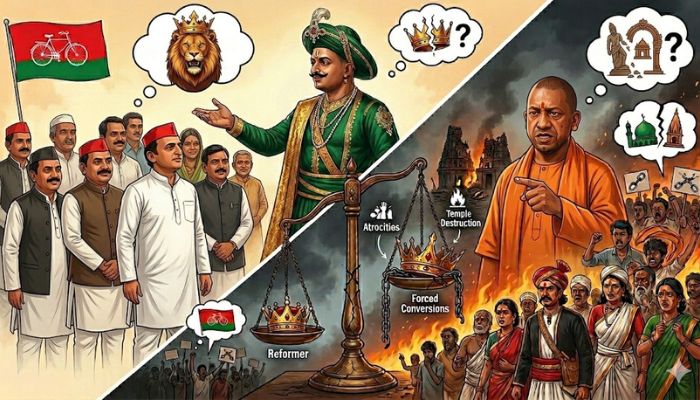
Tipu over Truth: SP MP’s ‘Tipu gave women the right to cover breasts’ remark during debate sparks a row. Read about the ‘Breast Tax’ myth and what the facts say

Samajwadi Party MP Toofani Saroj made a statement in the special session of the Uttar Pradesh Legislative Assembly on Thursday, 30th April, which once again made it clear that the sole objective of his party is to defame Hindu history and Hinduism.

Toofani Saroj said, “Tipu Sultan gave women the right to cover their breasts. There was a law against covering breasts. This hasn’t been the case since ancient times. You should check it out.”

This statement by the SP MP not only ignores historical facts but is also a part of a well-planned political strategy in which Muslim rulers are being presented before the public as ‘heroes’ by blaming Hindu kings and Hindu society.

Trying to tell the truth by shouting lies

Toofani Saroj’s claim is a half-truth presented in such a way that it becomes a complete lie. Yes, Tipu Sultan ordered women in Kerala to cover their breasts in public. But calling this a “right” is a historical dishonesty. It was a decree steeped in Sharia law, not an attempt at social reform.

In Kerala at that time, given its climate and cultural traditions, women, regardless of caste, did not wear upper garments. Even the 17th-century Dutch traveller William van Nieuhoff wrote in his memoirs that Queen Umayamma of Travancore herself only wore clothing below the waist, leaving the upper part uncovered.

This was a natural and accepted cultural tradition in the region. Tipu Sultan issued a decree, based on Islamic Sharia, to break this tradition. His intention was not to empower women, but rather, it was part of a policy.

Under this policy, he wanted to impose his Islamic values ​​in Malabar and Kodagu. Toofani Saroj misled the people by calling this decree a “grant of rights. “

Breast tax myths have been turned into political weapons

Behind this statement by Toofani Saroj and the Samajwadi Party lies the controversial history of the “breast tax,” or “Mulakkaram,” which has been repeatedly used as a weapon against the Travancore dynasty. Let’s understand the reality of this “tax.”

Mulakkaram literally means “breast tax,” but a large section of historians considers this name misleading. According to the renowned historian and author Manu Pillai, this tax was not related to women’s breasts, but rather to a gender-based census tax.

The tax on men was called “Talakkaram” (head tax), and the tax on women was called “Mulakkaram” (breast tax). This was merely a naming convention; the tax had no direct connection to breasts. It was a caste-based “poll tax” levied on communities such as Nadars and Ezhavas, along with other avarna (lower caste) communities.

The story of Nangeli is the most famous one regarding this tax. However, its historical authenticity remains in doubt. Several researchers have established that there is no contemporary historical documentation of Nangeli’s story. References to this story have emerged, particularly in the last two decades.

All sources in the Wikipedia article on Nangeli are recent, and there are no contemporary historical records. The person who popularised this story is a Malayali painter named ‘Chitrakaran’ T. Murali. His blog contains extremely negative views about Hindu gods and Hindu culture.

It is important to note that granting the right to wear upper garments and implementing Mulakkaram were two separate issues. They were conflated into a new narrative by propaganda media channels and politicians.

The Channar Rebellion (1813-1859) was for the right of Nadar women to wear upper garments, and Christian missionaries and the British government played a role in this struggle. It was a genuine social struggle.

Linking this to the story of ‘Breast Tax’ and calling the Hindu kings of Travancore villains is not history but the politics of leaders like Toofani Saroj of the Samajwadi Party.

Another fact that uproots this entire narrative is that in many tribes in Africa and the Indian subcontinent, women still do not wear upper garments. This is part of their cultural tradition, not evidence of any kind of oppression.

Kerala’s 18th- and 19th-century cultural traditions also fell into this category. Samajwadi Party leaders deliberately ignore this fact because their goal is not facts but anti-Hindu propaganda.

SP’s ‘hero’ Tipu Sultan is actually South India’s ‘villain’

Now let’s talk about Tipu Sultan, whom the Samajwadi Party and its leaders call a “great warrior.” Throughout South India, especially in Karnataka, Kerala, and Kodagu, a large community still remembers Tipu Sultan as a cruel and religious fanatic. 

The atrocities committed by Tipu Sultan against the Kodava tribe in Kodagu (Coorg) are recorded in history. In 1788, Tipu invaded Kodagu and burned entire villages.

According to his own court biographer, Mir Hussain Kirmani, many places were burned, including Kushalnagar, Talakaveri, and Madikeri. Tipu himself wrote in a letter to Ranmast Khan, the Nawab of Kurnool, that he had captured 40,000 Kodava people and converted them to Islam.

The Kodava Muslims who were forcibly converted are today known as “Kodava Mapplas,” and their surnames remain Hindu. This is the most telling evidence of the forced nature of their conversion.

Furthermore, Tipu’s army committed widespread atrocities against the Nair community in Malabar. Tipu ordered his army to burn every person in the district and forcibly convert them to Islam.

Nair temples were burned, Brahmin girls were abducted, and women were abused. Of the 30,000 Nair captives, only a few hundred returned alive.

Next, in Karnataka, the history of Melukote (Melukot) is the most poignant testimony to Tipu’s cruelty. On the day of Diwali, Tipu’s army surrounded 700 to 800 families of the Mandayam Iyengar Brahmin community.

When these people gathered at the temple for Diwali puja, Tipu’s soldiers massacred them. This included women and children. Melkote was devastated overnight and became a ghost town. Even today, 200 years later, the Mandayam Iyengar community does not celebrate Diwali. The grief of that massacre lives on.

Tipu Sultan’s atrocities didn’t stop at just Hindus. The Catholic Christians of Mangaluru also suffered his wrath. Father Paulinus, who lived in Kerala at the time, wrote in his book that Tipu’s army tied Hindus and Christians to the legs of elephants and dragged them, women were forcibly married to Muslims, and anyone who refused to convert to Islam was immediately executed.

Samajwadi Party’s agenda in question

SP MP Toofani Saroj forgot that Tipu Sultan implemented Sharia law in his kingdom. His government was called ‘Sarkar-e-Khudadad’. The question naturally arises: Does the Samajwadi Party advocate a similar regime in Uttar Pradesh?

Tipu Sultan, whom Akhilesh Yadav’s party is calling a ‘hero’, imposed Sharia on Hindus, forced conversions, and demolished temples. So, is this the ‘socialism’ that Akhilesh Yadav is dreaming of?

This is part of the SP’s tradition of turning every controversial issue in history into an anti-Hindu angle. Mulayam Singh Yadav has openly stated on several occasions that he ordered the firing on Ram devotees in Ayodhya, and that he is proud of it. This legacy is being carried forward by leaders like his son, Akhilesh Yadav and Toofani Saroj.

The Yogi government is exposing the double standards of the leftists

The Yogi government has attempted to uncover facts that leftist historians suppressed for decades. From the Ram Temple movement to the reassertion of Hindu cultural heritage, this government is honouring the history that parties like the Samajwadi Party seek to erase.

When a leader calls Tipu Sultan a “saviour of women” and, in the same breath, attempts to portray the Hindu kings of Travancore as oppressors, this isn’t just ignorance; it’s a well-planned political conspiracy. The Yogi government counters this conspiracy with facts.

The politics of false heroes must end

This character of the Samajwadi Party is nothing new. Whenever an issue arises, its leaders twist it into an attack on Hinduism and Hindu history. Akhilesh Yadav’s “socialist” politics consists solely of raising the controversial and unverified myth of the breast tax, portraying Tipu Sultan as a saviour, and demonising the Hindu kings of Travancore.

Whether Samajwadi Party leaders are educated or not, when they distort history and present it to the public, it impacts many sections of society. Therefore, it becomes essential to respond appropriately. The people of Uttar Pradesh are aware and recognise this false narrative.

Under the leadership of the Yogi government, Uttar Pradesh is on a path where history is respected, not false heroes, and this is the difference that is the real divide between the SP and the BJP.

(This article is a translation of the original article published on OpIndia Hindi.)

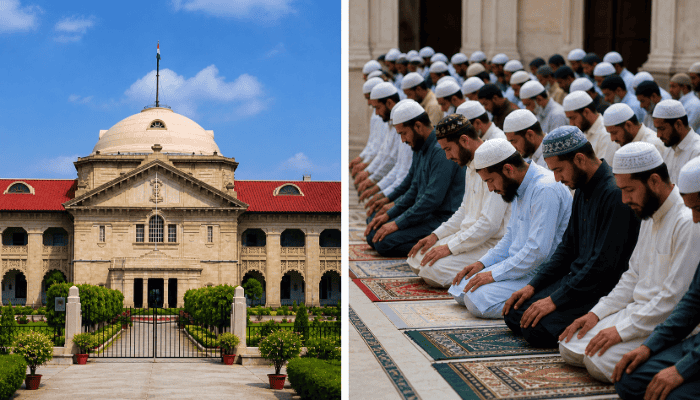
Allahabad HC rules that offering namaz on public land is not a religious right, gatherings on private property should be strictly private, not disruptive: Details

On 6th April (Monday), Allahabad High Court noted that no individual or organisation can be allowed to utilise public land exclusively for large-scale religious gatherings, including namaz. It pointed out that public order, morality and health are tied to the fundamental right to freedom of religion.

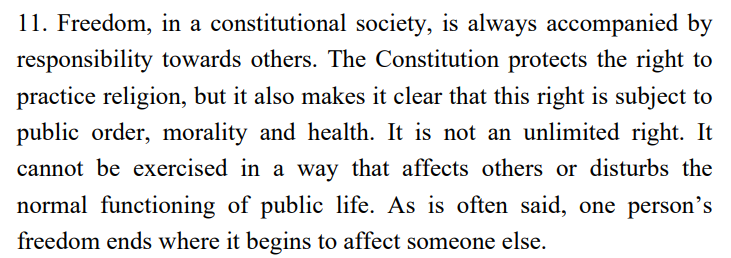
“It is not an unlimited right. It cannot be exercised in a way that affects others or disturbs the normal functioning of public life. As is often said, one person’s freedom ends where it begins to affect someone else,” pronounced a division bench of Justices Garima Prasad and Saral Srivastava.

The court made these statements while rejecting a request for authorisation to perform namaz on land in the Sambhal district of Uttar Pradesh’s Ikona village in Pargana Rajpura of Gunnaur Tehsil. It dismissed the plea, which was filed by a man named Aseen, claiming the spot was his own property and demanded protection from authorities to execute Islamic prayers there.

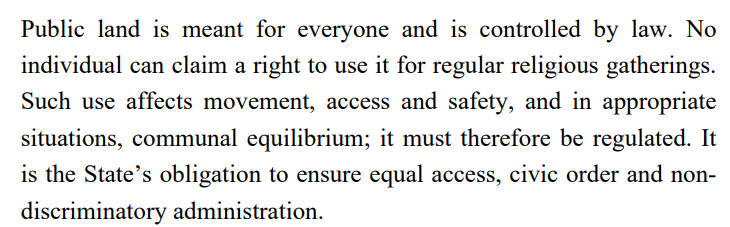
The court highlighted that public property is governed by law and is intended for everyone. Hence, no one is entitled to employ it for routine religious events. “Such use affects movement, access and safety, and in appropriate situations, communal equilibrium; it must therefore be regulated. It is the state’s obligation to ensure equal access, civic order and nondiscriminatory administration,” the court observed.

The bench cited earlier judgements and referenced the Supreme Court’s emphasis on upholding social harmony, civic peace and the rule of law. It urged that courts must consider the practical implications of their decisions. “Where a claim to hold religious congregation on public land has the potential to create social tension, the constitutional court must ensure that the conditions necessary for peaceful coexistence are maintained,” the court mentioned.

The state is duty-bound to act

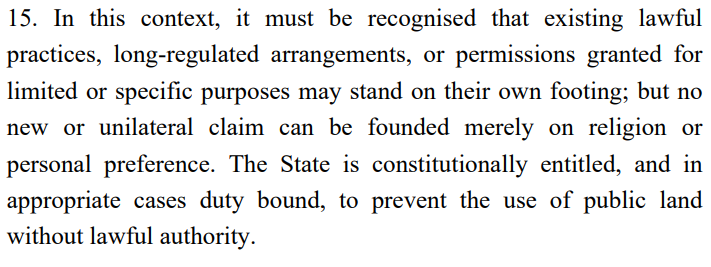
According to the verdict, it must be acknowledged that established legal procedures, long-standing agreements, or concessions given for particular or restricted purposes might stand independently, but no new or unilateral assertion could be predicated only on personal preference or religion. “The state is constitutionally entitled, and in appropriate cases duty bound, to prevent the use of public land without lawful authority,” the court further emphasised.

‘Private properties can be used for strictly private events, when they become congregational, it will be subject to law and order’

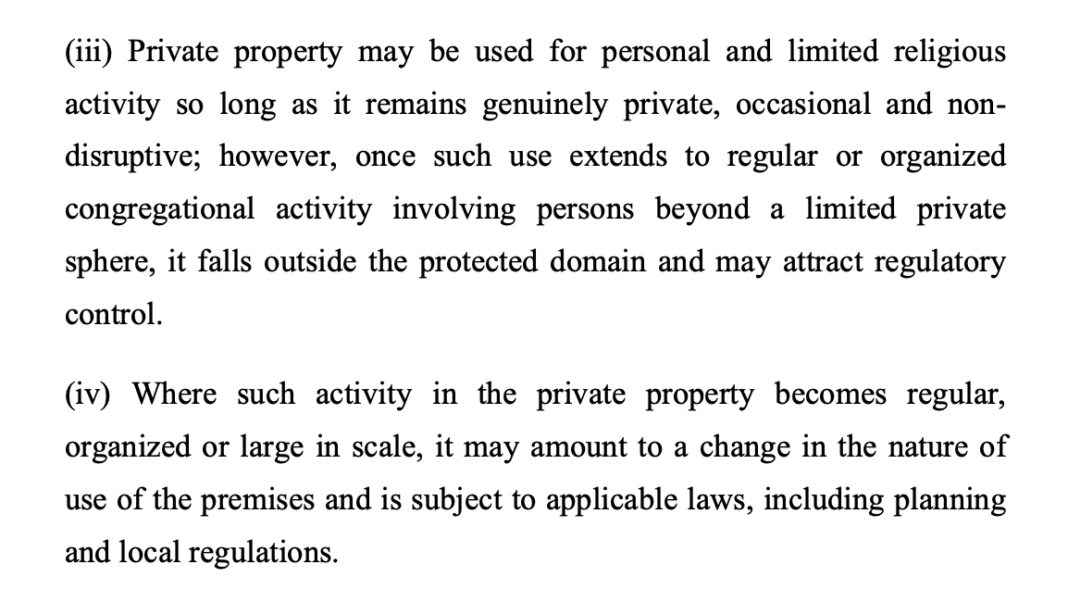
The judges declared that the context with regard to private property is distinct and expressed, “Private prayer, family worship and such limited devotional activity as remains genuinely internal to the premises ordinarily fall within the protected domain of Articles 25 and 26.” However, this protection is limited to truly private, infrequent and non-disruptive activities. It excludes converting any private space into a de facto public place of worship.

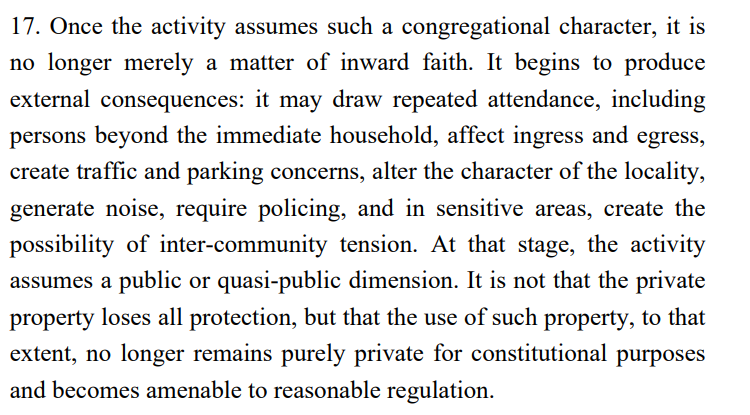
“Once the activity assumes such a congregational character, it is no longer merely a matter of inward faith. It begins to produce external consequences: it may draw repeated attendance, including persons beyond the immediate household, affect ingress and egress, create traffic and parking concerns, alter the character of the locality, generate noise, require policing, and in sensitive areas, create the possibility of inter-community tension,” the court stated.

It underscored that the activity then takes on a public or quasi-public aspect. Private property is not completely unprotected, rather, its use, to that extent, turns liable to reasonable control and is no longer solely private for constitutional considerations. “This position is consistent with the decisions relied upon by the petitioner,” the bench stressed.

‘No unequivocal right to repeatedly organise religious functions even on private property’

The court invoked previous rulings to convey that although bona fide religious practices on private grounds are protected and cannot be arbitrarily interfered with, it does not equate to “absolute carte blanche” for periodic or structured religious activities by a community.

It stated, “They recognise a limited protection, namely where prayer remains confined to a private, non-disruptive setting. Where the activity extends beyond that sphere and begins to affect the public domain, lawful regulation follows. These decisions do not confer a right to convert private premises into an unregulated congregational space.”

The order read that the authorities are not required by law to wait for an actual disruption to happen. The state has the right to take preventive steps when an activity has the potential to have an impact on public order. The examination is not the religious character, but its effects on society.

“This approach is consistent with the constitutional principle of secularism, which requires equal treatment of all religions and equal application of law. While the State must permit private worship, it is equally bound to regulate activities that affect public order, whether on public land or on private premises. Maintaining this balance is essential to the working of Articles 25 and 26 in a constitutional system,” the court highlighted.

The court calls out the flimsy submission

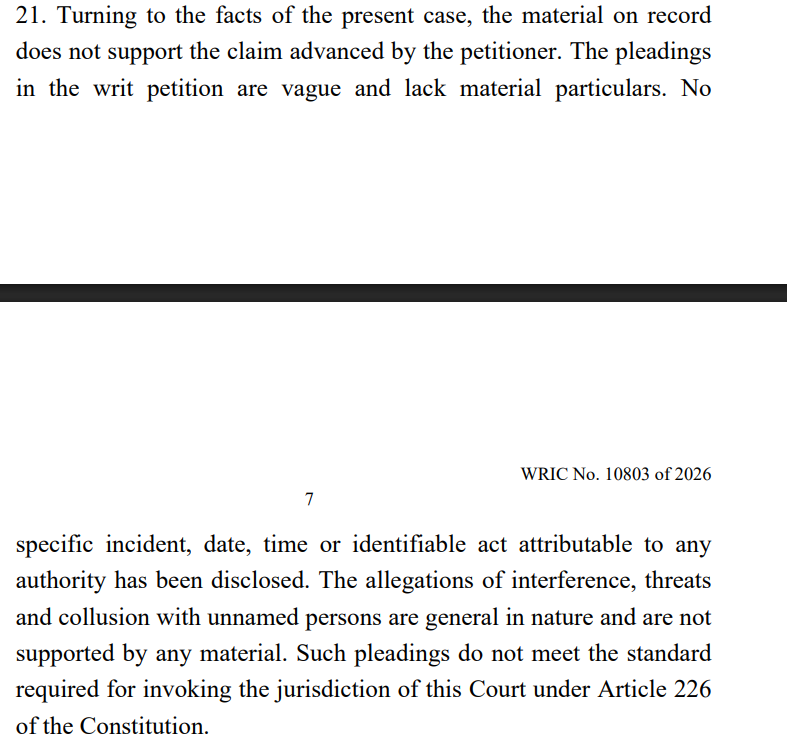
The court specified that the petitioner’s argument is not supported by the facts provided in the record. The writ petition’s contents are ambiguous and devoid of important details. It countered, “No specific incident, date, time or identifiable act attributable to any authority has been disclosed. The allegations of interference, threats and collusion with unnamed persons are general in nature and are not supported by any material.” According to Article 226 of the Constitution, such declarations do not satisfy the prerequisites necessary to seek the court’s jurisdiction.

This court determined that the land in dispute is marked as public land pursuant to the provided materials. The ownership claim relies entirely on an alleged gift deed that is centred exclusively on ambiguous border descriptions and lacks key land details like Gata or Khata numbers “Such a document does not establish any identifiable title and cannot displace the revenue record,” it added.

“Even otherwise, if the land is assumed to be private, the petitioner is not entitled to the relief sought. The record shows that he is not protecting an existing practice, but seeking to introduce regular congregational gatherings, including persons from within and outside the village,” the bench and remarked that it has been accepted that in the past, namaz was only performed on special occasions like Eid. This extension outside of a narrow private domain is not protected and is vulnerable to oversight.

“In these circumstances, no enforceable legal right is made out. This court cannot grant relief on such a basis, particularly where the matter has implications for public order and social harmony. Accordingly, the writ petition is dismissed. No order as to costs,” the judges concluded.

It is noteworthy that the Sambhal administration outright banned namaz on public highways and areas last year.

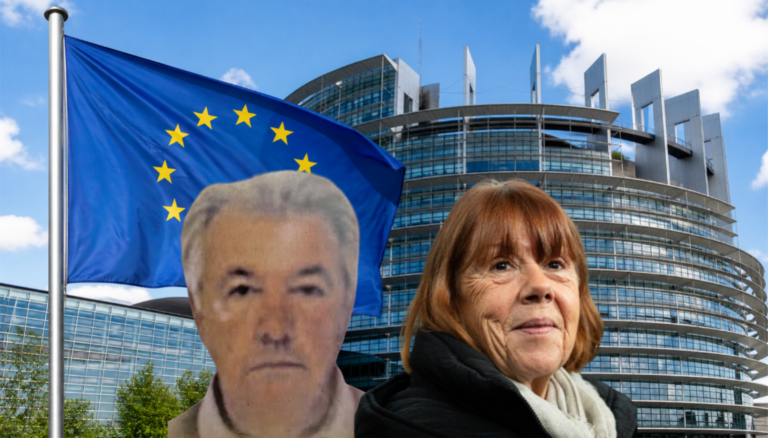
As EU votes to define rape and consent, read how sexual abuse of Gisele Pelicot and the revelation of chats discussing rape of drugged spouses led to the development

The European Parliament has urged the European Union to develop a uniform consent-based definition of rape, describing it as a critical step toward correcting the complicated set of rules, including a few inadequate ones, that currently exist across the bloc. A report advocating for a single definition of rape centred on “only yes means yes” was approved by 447 of the 720 MEPs in the parliament on 28th April (Tuesday).

A vote took place after which the parliament declared, “Silence, lack of resistance, the absence of a ‘no’ previous consent, past sexual conduct or any current or previous relationship must not be interpreted as consent.” The action aims to alter the conventional “no means no” rule, which campaigners argue does not sufficiently protect victims, as it does not demand clear and affirmative agreement before participating in sexual activity.

The statement highlighted the “demand for adequate support and protection for victims and survivors across the EU.” It mentioned, “Consent must be assessed in context, including in cases involving violence, threats, the abuse of power, fear, intimidation, unconsciousness, intoxication, chemical submission, sleep, illness, disability or vulnerability.”

The official release conveyed that gender-based violence should be included in the list of crimes classified as EU crimes and added that trauma responses such as “freeze” or “fawn” must be represented in legislation and court practice.

It further pressed, “Only consent-based rape legislation can ensure access to justice,” and “EU needs an intersectional and victim-centred approach, including the provision of immediate medical care, sexual and reproductive healthcare, safe and legal abortion, trauma care, psychological support and legal assistance.”

An appeal was made for free specialised support services, including 24-hour emergency rooms that offer medical, psychological and legal aid. “The report calls for regular and tailored mandatory training for professionals likely to come into contact with rape victims, including law enforcement officers, judges, prosecutors, lawyers, healthcare professionals and frontline workers,” the statement noted.

The commission is asked to present EU guidelines on comprehensive sexuality and relationship education, as well as measures to debunk rape myths, anti-gender content and incel propaganda on the internet, along with awareness drives on consent, relationships, sexual integrity, and bodily autonomy throughout the bloc.

The 27 EU nations failed to come to a settlement for decades over a specific definition of rape under criminal law. The European Commission was advised to redefine the legal ground for this by a cross-party attempt in the European Parliament. Presently, rape laws in Europe often follow one of two models: coercion-driven, which requires sexual activity to have occurred by force or consent-based, which views rape as a sexual deed without permission.

A commitment to decisively address the issue of rape and affirm consent

According to Joanna Scheuring-Wielgus, a Polish MEP (Member of the European Parliament) who was a key proponent of the effort, a uniform definition would encourage member states that continue to employ violence or force in their laws to conform to international norms.

She said, “We can’t have the meaning of rape change as we cross from one border to another. We can’t have a situation where a rapist who has raped a woman in Germany can go to Hungary and isn’t prosecuted because the law is different. And that’s what this report is about.” However, the resolution is only the beginning of the political process. It must now be put up as law for the vote of EU countries.

Consent-based definitions of rape have been incorporated into the criminal laws of most EU member states in recent years. 8 nations, from Italy to Hungary and Romania, are exceptions though and victims need to prove to a certain extent that they were coerced, vocally resisted or resorted to fight physically.

European Council unveiled that over half of all women in the region had experienced sexual harassment at least once since turning 15. Afterwards, the EU enacted a variety of initiatives to shield women and girls from sexual assault in a stronger manner. It joined the Istanbul Convention, the most extensive set of guidelines for preventing gender-based violence in the world on 1st October 2023.

The bloc passed a law in 2024 that makes cyberstalking, workplace sexual harassment and the unapproved sharing of private photos illegal throughout that part of the world. Now, deepfakes, cyberviolence and digital violence against women are especially targeted under the new EU Gender Equality Strategy. Every year, European nations spend hundreds of millions of dollars on schemes focused on preventing violence and protecting victims.

What instigated the key development

The move appears to have its origins in a historic trial in which 50 men were charged with mass rape of Gisław Pelicot. Her former husband, Dominique Pelicot, drugged her and arranged the horrific torture with men he found online. After years of protest, France amended its criminal code in October 2025 to specifically define rape as any sexual conduct carried out without consent. The action came after a public reckoning following the case.

Scheuring-Wielgus stated, “The case of Gisele Pelicot has shaken the whole world”, and asserted that the event exposed the flaws in defining rape by relying just on force or resistance rather than consent. She added, “Her courage to speak out has opened the eyes of even the most conservative opponents of this change.”

Dominique drugged Gisele nightly for a period of ten years, from 2011 to 2020, and orchestrated her rape by several men. He also captured the cruel treatment of the woman, who was constantly under the influence of drugs and was unaware that she was being exploited. The two were married for more than 50 years and had three children.

Gisele suffered violations on 92 occasions by at least 72 men while she was unconscious due to the effects of drugs administered to her. 51 people, between the ages of 26 and 73 had been convicted in the case. Dominique added Lorazepam, an anti-anxiety medication, to his wife’s dinner, after which she would fall asleep. He then allowed the “guests” into their Mazan house to indulge in sexual activity. He recorded them and stored the videos on a USB drive in a file named “Abuses.”

The police discovered the tapes while investigating Dominique in September 2020, following reports that he had illegally filmed women in changing rooms of a shopping mall with hidden cameras. This earned him an 8-month suspended sentence. However, the authorities uncovered thousands of images and videos of his unconscious wife and her rape when they searched and seized his hard drive, laptop and phones.

A deviously constructed strategy

Dominique met the men on a secret online forum called “a son insu” (without him or her knowing), where participants talked about performing non-consensual sex with their drugged, ignorant partners. According to investigators, he took rigorous steps, such as prohibiting the use of perfume and tobacco, to keep his wife from being awakened by overpowering smells.

He also instructed the men to park their automobiles near a school and enter the house at night to avoid raising the suspicions of the neighbours. Likewise, he asked them to take off their clothes in the kitchen to avoid dropping garments in the lavatory and wash their hands in hot water to avert an abrupt shift in temperature.

According to Gisele’s testimony, she had no inkling of her circumstances, but routine sedation and sexual assault started to have a negative physical impact. The court filings mentioned that she talked about memory loss and pelvic pain during multiple doctor appointments with her husband.

Some offenders claimed that they did not realise Gisele was not taking part in the act of her own accord. “It’s his wife, he does what he likes with her,” a man argued, denying that it was rape. “I am a rapist, like everyone else in this courtroom. I recognise the facts in their totality. They all knew, they cannot say the contrary,” Dominique admitted during the trial.

“Today, I maintain that, with the obligations we all have, I am a rapist, like everyone in this room. They cannot say otherwise. I am accused of many things. We are not born perverts, we become them. Even if it is paradoxical, I have never considered my wife as an object,” he submitted.

15 people, including him, entered guilty pleas to rape, and others stated that they believed a husband’s approval was sufficient. Caroline Darian, the daughter of Dominique and Giselle, testified in court that her father was “one of the greatest sexual predators” in recent memory.

On 19th December 2024, all 51 men received sentences for their crimes. Dominique was thrown behind bars for 20 years over aggravated rape, while many others received shorter prison time than what the prosecution had requested. Some were even released with suspended sentences.

“For me, it is difficult to hear it. For 50 years, I lived with a man who I would never have imagined for a single second that he could do these acts. I had complete confidence in this man,” Gisele expressed after her husband’s confession. She suffered despair and had a severe emotional breakdown after discovering the existence of the videos. She then applied for divorce.

Dominique used an anonymous online platform to recruit rapists

Dominique regularly took part in the “without her knowledge” forum on Coco.fr, a website with multiple chatrooms that promote sexual violence. Men of many ages and backgrounds interacted with him, including firefighters, journalists and nurses. The couple’s home was less than 50 kilometres (31 miles) away from each of the men on trial in Avignon.

According to the police records, discussions migrated to Skype after the first contact was made on Coco. Dominique made introductory video conversations with the men, turning the camera to reveal his oblivious spouse. Additionally, he posted private images and videos of Gisele, some of which depicted her being sexually abused.

Several guys revealed their appreciation for Dominique and their wish to treat their partners the same way. He would ask the men to interact through text after their Skype conversation. Notably, a defendant on trial was found guilty of drugging and raping his own wife, but he was not charged with sexually attacking Gisele.

What is Coco.fr: The chat site used by Dominique

CNN unearthed a Telegram group in 2024 where almost 1,000 men discussed detailed plots on drugging and abusing their partners. This group was a part of a larger network of non-consensual image sharing. Dominique was able to openly discuss sexual violence and encourage his wife’s rapes on a purported dating website. They sent each other thousands of messages via text, Skype and chat rooms.

Coco was founded in 2003 and advertised as a dating site. According to Le Parisien, it had 778,000 monthly visitors at its height in 2023. The site’s completely unmoderated chat rooms fostered explicit conversations about generally prohibited subjects. Shortly, a sizable portion of Coco users started complaining they had been assaulted during get-togethers organised via the website.

The French media revealed that contacts booked on Coco were connected to at least two murders in the country. Michel Sollossi, a 55-year-old accountant, was fatally stabbed by a guy he met there. The incident happened in 2018, and prosecutors classified it as a homophobic hate crime. The Paris prosecutor stated that 480 victims lodged over 23,000 lawsuits against Coco between January 2021 and May 2024.

On the other hand, its domain was transferred from France to Guernsey in 2022 and the founder, Isaac Steidl, renounced his French citizenship and relocated to Bulgaria with his business. It is noteworthy that French non-governmental organisations (NGOs) had identified Coco as a cause for concern as early as 2013.

They had unsuccessfully persuaded the government and internet service providers to take it down. However, it was argued that the platforms themselves are responsible for regulating websites such as Coco and a court order or an injunction from French authorities is imperative to initiate action.

The French cybercrime unit finally launched a probe with the help of NGOs that had been monitoring the website for years in 2023. It was closed, and Steidl was questioned in Bulgaria’s capital, Sofia, the next year. However, no criminal charges were brought against him. NGOs and attorneys also warned that inadequate safeguards could allow other websites to replace it.

Similar and well-publicised cases of drug-induced sexual abuse (DFSA) have also surfaced throughout Europe. A German man was convicted in December of drugging, raping and recording his unconscious wife over a period of years. According to a 2014 study based on interviews with 42,000 women in the EU, 1 in 10 women had been sexually abused since they were 15 years old and 1 in 20 have been raped.

“1 in three women in the EU has experienced gender-based violence. 1 in twenty has been raped,” Scheuring-Wielgus voiced, highlighting, that “there are countless victims, many who will never see justice.” She explained the step as a bid to “actively improve” the status of women, extending beyond antiquated legislation to ensure that they have the same level of protection throughout the EU.