Home Blog Page 1414

Love Jihad in Bareilly: Shehzad pretends to be Hindu to entrap a minor girl, kidnaps and rapes her for 10 days before selling her for Rs 10,000

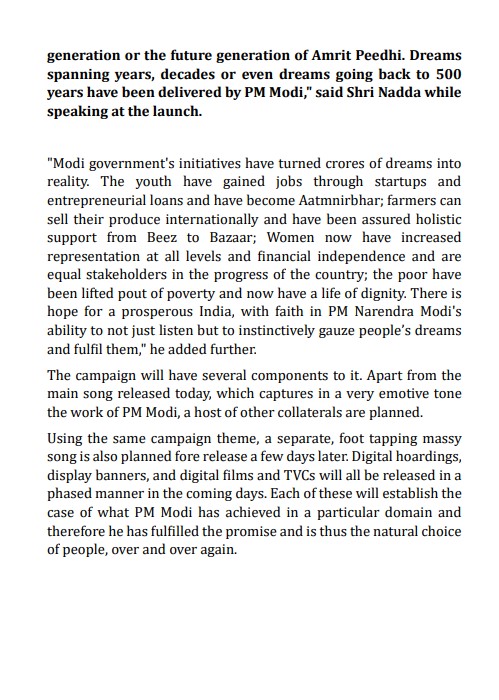
An instance of love jihad has surfaced from Uttar Pradesh’s Bareilly where one Shehzad Baig pretended to be Hindu and befriended a minor girl. Afterwards, he deceived her into a romantic relationship with him and kidnapped her on 21st December. She was then held captive and sexually assaulted repeatedly for ten days. Furthermore, he sold her to his friend for a mere Rs 10 thousand. The victim was rescued by the authorities on 31st December and a perpetrator named Anish has been arrested. However, police are searching for other main accused.

The incident reportedly transpired in the area of the Bithri Chainpur police station. The family members of the girl charged the cops with negligence in the occurrence while the police registered a case and are looking for the offenders. They assured that the others would be found soon. They are persistently conducting raids on suspected locations. Meanwhile, Circle Officer (CO)-3 Anita Chauhan informed that the adolescent’s family had reported her missing at the same time. She was saved and one of the offenders was taken into custody. A probe into the matter is underway.

According to reports, the girl’s brother notified the police about her disappearance but they responded carelessly at the beginning of the investigation and didn’t even open a case. He later sought help from Hindu organisations such as Karni Sena who put pressure on the cops after which the female was found and handed over to her family.

He revealed a group of people abducted his sister after tricking her on the fateful day. “Later, we filed a formal complaint against the unidentified individuals, but the police did not follow through. We were then promised action when we later demonstrated in front of the Chainpur police station. Manoj, the police station in charge attempted to stifle the case by extorting money from the accused.”

Hindu groups, in the meantime, have voiced their discontent with the attitude of the cops and called for discipline against the relevant personnel. They have also warned of laying siege to the police station if no measures are executed. Her father submitted a First Information Report (FIR) based on the information provided by the police who claimed that they didn’t begin the inquiry until the case was officially filed.

108 feet long Agarbatti made in Vadodara reaching Ayodhya ahead of Ram Mandir consecration ceremony

0

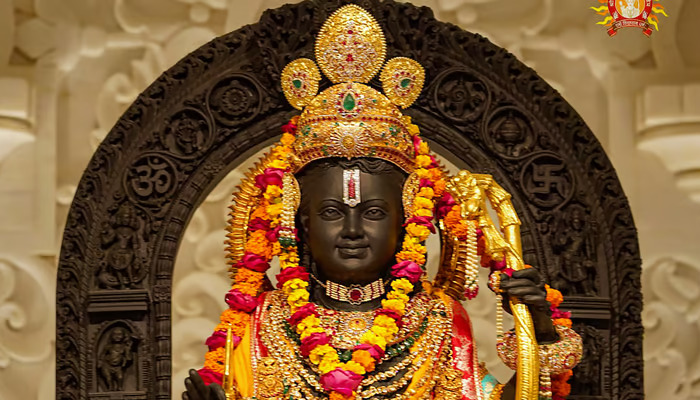
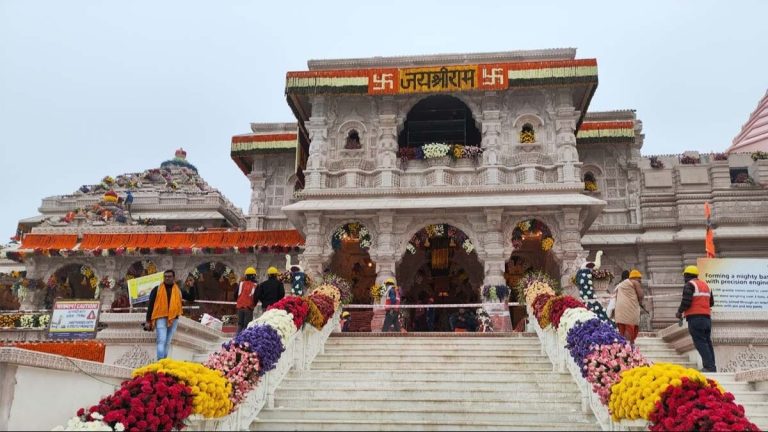
As the “King” is set to return home to Ayodhya, the emotions of the devotees of Lord Ram are running high. Ram Bhakts across the country are doing unique things to express their love and devotion to Lord Ram. A colossal 108 ft long, 3.5 ft wide incense stick (Agarbatti) is being sent to Ayodhya from Vadodara for the Pran Pratishtha (Consecration) ceremony of Ram Mandir on 22nd January. This one-of-a-kind creation, weighing 3500 kgs, stands out for its grandeur.

The visuals of the grand Agarbatti being taken from Vadodara to Ayodhya on a trailer have surfaced online. Around ten tripod stands have been placed to hold the grand Agarbatti. Saffron flags, chants in the glory of Lord Ram and eternal devotion to the supreme deity can be witnessed in the videos showing the journey of the incense stick to Ayodhya.

Vihabhai Bharwad, a resident of Tarsali in Vadodara, has spent the last six months crafting this massive incense stick outside his home. Bharwad’s craftsmanship reflects his dedication to this unique endeavour, having previously created a 111-foot-long incense stick.

This special incense stick is made up of 3000 kg of Gir cow dung, 91 kg of Gir cow ghee, 280 kg of Devdar tree wood, 376 kg of Gugal, 280 kg of Tal, 280 kg of Jav, 370 kg of Kopra crush, and 425 kg of Havan materials.

It is worth noting that the Ram Mandir in Ayodhya has been receiving special offerings from across the world. Back in January 2023, Nepal sent two Shaligram (non-anthropomorphic representation of Lord Vishnu in Hindu religion) stones to India’s Ayodhya for the construction of idols of Ram and Janaki expected to be placed in the main temple complex of the under-construction Ram Mandir.

Moreover, a massive 620 kg bell from Rameshwaram in Tamil Nadu is set to be installed at the Ram Temple in Ayodhya. The bell, engraved with “Jai Sriram,” will be installed after the temple’s construction wraps up.

An 8-foot-tall gold-plated marble throne has also been sent to Ayodhya by artisans of Rajasthan. According to Anil Mishra, a member of the Shri Ram Janmabhoomi Teerth Kshetra Trust, the throne will be placed in the sanctum sanctorum of the Ram temple.

In August 2023, Satya Prakash Sharma, an Aligarh native famous for his handmade locks, crafted a 10 feet high, 4.5 feet wide, and 9.5-inch thick lock that opens with a 4-foot-long key that weighs 30 kg for Ram Mandir. Sharma invested his life savings in the endeavour, which cost him approximately Rs 2 lakh, and worked tirelessly for months to make the “world’s largest lock.” An ardent devotee of Lord Ram, Sharma stated that the lock was a labour of love and that his wife Rukmani assisted him in crafting it.

Last year, a Surat-based diamond merchant offered a necklace adorned with over 5,000 American diamonds. This magnificent neckpiece is a generous gift to the Ram Temple.

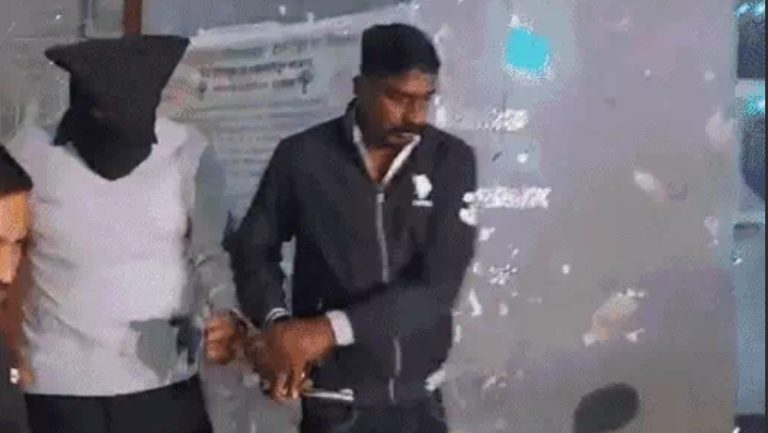
As the preparations for the consecration ceremony of Maryada Purushottam Shri Ram Temple are going on at a fast pace, the ritual process will continue on a large scale for seven days in Ayodhya, which will start from January 16. The deity of Shri Ram Lalla (Lord Ram in his childlike form) will be consecrated on 22nd January. On January 22, Shri Ram will be seated in his divinely grand temple in the presence of Prime Minister Narendra Modi.

‘Satyameva Jayate’: Gautam Adani posts after SC refuses to order SIT probe on allegations made by short-seller Hindenburg

On Wednesday (3rd January), India’s business tycoon Gautam Adani expressed his contentment after the Supreme Court ruled that it could not interfere with the regulatory framework or use the Hindenburg report as a justification for launching an SIT investigation. SEBI will proceed with its investigation in accordance with the law, the court said. 

Following this, Gautam Adani took to X, formerly known as Twitter, and said that his humble contribution to India’s growth story would now continue. “The Hon’ble Supreme Court’s judgment shows it. Truth has prevailed. Satyameva Jayate. I am grateful to those who stood by us. Our humble contribution to India’s growth story will continue. Jai Hind,” Adani was quoted as saying.

Earlier today, the Supreme Court stated that its jurisdiction to enter the regulatory framework of SEBI is restricted. There are no valid grounds for directing SEBI to withdraw its revisions to the FPI and LODR regulations. “SEBI has concluded investigations in 20 of 22 cases. The investigation into the remaining two cases will be completed within three months,” the order stated. 

“Allegations of conflict of interest of expert committee members are unsubstantiated and rejected,” a bench led by Chief Justice of India DY Chandrachud said.

The order stated that the Organised Crime and Corruption Reporting Project (OCCRP) report could not be used to cast doubt on the SEBI probe. It stated that reliance on the OCCPR report is rejected and that reliance on a third-party organisation report without any verification cannot be relied on as proof.

In March of last year, the Supreme Court formed a six-member committee to “investigate if there was a regulatory failure in dealing with the alleged violation of securities market laws about the Adani Group or other companies.” It also requested the SEBI to investigate whether there was a violation of the minimum public shareholding standards in public limited companies, a failure to report transactions with linked parties, and stock price manipulation.

On November 24, 2023, a panel of three judges consisting of Chief Justice of India D Y Chandrachud, Justices J B Pardiwala, and Manoj Misra reserved its verdict on the petitions, objecting to claims of conflict of interest leveled against members of the committee it had constituted. 

It is notable here that during the hearing, the SC bench had rejected advocate Prashant Bhushan’s attempts to take Hindenburg’s claims as truth on face value. “We don’t have to accept the Hindenburg report as ipso facto factually correct. That is why we asked SEBI to investigate…”, CJI had said.

In January last year, Hindenburg Research accused the Adani Group of fraud and stock price manipulation. The charges were denied by Gautam Adani who claimed that no regulatory failure was found by the expert committee which was constituted by the Supreme Court.

In May of last year, a 6-member expert panel had failed to find any wrongdoing on SEBI’s part regarding Adani Group. The committee concluded that the Adani Group has disclosed the information of all the beneficial owners of the business. The report also listed all the details of these beneficial owners as obtained from SEBI.

The Adani Group had trashed the Hindenburg Research report as a ‘malicious combination of selective misinformation and stale, baseless and discredited allegations’. The court reportedly refused to order an SIT probe on the allegations made by short-seller Hindenburg. It added that there is no evidence that SEBI was negligent in taking action and no reason to suggest any conflict of interest on SEBI’s part.

Uttar Pradesh: Mohammad Wasim of Ghaziabad arrested for using derogatory language, threats for CM Yogi Adityanath

On Tuesday (2nd January), Ghaziabad police arrested a person named Mohammad Wasim for spreading hatred in society. A video of Mohammad Wasim of Ghaziabad had gone viral on social media in which he was seen using derogatory language and issuing threats to the state’s chief minister Yogi Adityanath. He was booked on 23rd December by Kotwali Masuri police station under the Ghaziabad police commissionerate (rural zone) under sections 153A and 295A of the Indian Penal Code. He has been on the run since then. Now he is arrested.

In this viral video, Mohammad Wasim was interacting with a media person. During this interaction, he said, “We are Muslims. Will he (Yogi Adityanath) finish all the Muslims? His 90 generations cannot eliminate us. Has Yogi landed from the skies?”

The reporter then asked him, “Has Yogi not ended hooliganism in the state?” Answering this, Mohammad Wasim said, “Yogi himself is a goon. Yes, I am saying this. Register a case against me. Yogi himself is a goon. See his history. See his records. See FIRs against him. My name is Mohammad Wasim. I live in the Masuri village in the Ghaziabad district.”

Then the reporter asked him, “The 2024 general elections are approaching. What is the public opinion?” Answering this, the accused said, “Do you have the courage to ask questions to the Prime Minister?”

The reporter asked Mohammad Wasim about the performance of Yogi Adityanath on the completion of his six years in power, to which he replied, “He has done a great job. All he has done is Hindu-Muslim, Hindu-Muslim, Hindu-Muslim. We were developing from 1947 to this time.

The police sub-inspector Rajiv Kumar of the Masuri police station in the Ghaziabad district took cognizance of this viral video and registered an FIR against the accused. He was evading the arrest for many days. On 2nd January, a team from the Masuri police station apprehended him. In a video, he was seen in police custody.

Mohammad Wasim is booked under sections 153A and 295A of the IPC. A copy of the FIR is with OpIndia.

‘SEBI is capable of looking into allegations against Adani, no need for SIT’: SC says OCCRP report, Hindenburg’s claims cannot be held as truth

In a major relief to the Adani Group, the Supreme Court ruled on Wednesday (3rd January) that it could not interfere with the regulatory framework or use the Hindenburg report or anything similar as justification for launching a new investigation. The SEBI will proceed with its investigation in accordance with the law, the court said. 

The Supreme Court further added that there is no evidence that SEBI was negligent in taking action and no reason to suggest any conflict of interest on SEBI’s part. The Supreme Court also refused to order an SIT probe on the allegations made by short-seller Hindenburg.

The court stated in its ruling that the Supreme Court’s jurisdiction to enter the regulatory framework of SEBI is restricted. There are no valid grounds for directing SEBI to withdraw its revisions to the FPI and LODR regulations. “SEBI has concluded investigations in 20 of 22 cases. The investigation into the remaining two cases will be completed within three months,” the order stated. 

“Allegations of conflict of interest of expert committee members are unsubstantiated and rejected,” a bench led by Chief Justice of India DY Chandrachud said.

The order stated that the Organized Crime and Corruption Reporting Project (OCCRP) report could not be used to cast doubt on the SEBI probe. It stated that reliance on the OCCRP report is rejected and that reliance on a third-party organization report without any verification cannot be relied on as proof.

“Reliance on newspaper reports and third-party organizations to question the statutory regulator does not inspire confidence. They can be treated as inputs but not conclusive evidence to doubt the SEBI probe,” the order said.

In March of last year, the Supreme Court formed a six-member committee to “investigate if there was a regulatory failure in dealing with the alleged violation of securities market laws about the Adani Group or other companies.” It also requested the SEBI to investigate whether there was a violation of the minimum public shareholding standards in public limited companies, a failure to report transactions with linked parties, and stock price manipulation.

On November 24, 2023, a panel of three judges consisting of Chief Justice of India D Y Chandrachud, Justices J B Pardiwala, and Manoj Misra reserved its verdict on the petitions, objecting to claims of conflict of interest leveled against members of the committee it had constituted. 

It is notable here that during the hearing the SC bench had rejected advocate Prashant Bhushan’s attempts to take Hindenburg’s claims as gospel truth on face value. “We don’t have to accept the Hindenburg report as ipso facto factually correct. That is why we asked SEBI to investigate…” CJI had said.

“Mr. Bhushan, I do not think you can ask a financial regulator to take something printed in the newspaper. This does not discredit SEBI. Should SEBI now follow journalists?”, the CJI had asked Bhushan during the hearing.

In January this year, Hindenburg Research accused the Adani Group of fraud and stock price manipulation. The charges were denied by Gautam Adani who claimed in July that no regulatory failure was found by the expert committee which was constituted by the Supreme Court.

In May this year, a 6-member expert panel had failed to find any wrongdoing on SEBI’s part regarding Adani Group. The committee concluded that the Adani Group has disclosed the information of all the beneficial owners of the business. The report also lists all the details of these beneficial owners as obtained from the SEBI.

The Adani Group has already trashed the Hindenburg Research report as a ‘malicious combination of selective misinformation and stale, baseless and discredited allegations’. The Group stocks lost Rs 46,000 crores in market cap after Hindenburg claimed that the Indian giant had participated in a clear stock manipulation and accounting fraud scheme over decades. The report was published on 24th January 2023.

Govt to end Free Movement Regime with Myanmar to reduce illegal immigration, says FMR misused by insurgent groups to attack Indians

0

The Free Movement Regime (FMR), which allows persons living on either side of the India-Myanmar border to go 16 kilometers into each other’s territory without a visa, may expire soon.

According to reports, the Centre has decided to begin bidding for an advanced smart fencing system for the whole India-Myanmar border. “We are going to end the FMR along the Indo-Myanmar border soon. We are going to put fencing along the entire border. The fencing will be completed in the next four and a half years. Anyone coming through will have to get a visa,” the government sources were quoted as saying. 

“The idea is to not only to stop the misuse of the FMR, which is used by insurgent groups to carry out attacks on the Indian side and flee towards Myanmar, but also put a brake on the influx of illegal immigrants, drugs and gold smuggling,” they added.

Earlier, in September 2023, Manipur Chief Minister N Biren Singh requested the Centre to permanently close the FMR along the Indo-Myanmar border in order to reduce “illegal immigration.” He also stated that the state was working on establishing a National Register of Citizens and fortifying the border with Myanmar. Manipur and Myanmar share a 390-kilometer porous border, with only approximately 10 kilometers of it fenced.

The boundary between India and Myanmar stretches for 1,643 km across Mizoram, Manipur, Nagaland, and Arunachal Pradesh. The FMR is a bilateral agreement that permits tribes living along the border to travel up to 16 km inside the other country without a visa. Under the FMR, any member of the hill tribes, who is either an Indian or a Myanmar citizen, and a resident of any location within 16 kilometers on either side of the border, can cross across with a border pass valid for one year. The persons traveling is also permitted to stay beyond the border for two weeks. 

The FMR was implemented as part of the Narendra Modi government’s Act East policy in 2018, at a time when diplomatic relations between India and Myanmar were improving. The FMR was supposed to come into effect in 2017, but it was postponed due to the Rohingya refugee crisis that began that August.

Notably, several illegal immigrants have entered India since the ethnic conflict between the Meitei and Kuki communities in Manipur that took place in May last year. It was reported that in July 2023, armed Kuki militants comprising of the Kuki National Army (KNA) and People’s Defence Force (PDF) of Mynamar and security personnel arrived in India paving way for a major clash between Kukis and Meiteis in the border town of Moreh in Manipur’s Tengnoupal district.

The Manipur authorities had then launched an investigation in the case to learn that a significant number of attackers had arrived from Myanmar. Later, more than 700 illegal immigrants had reportedly entered from Myanmar to the Indian side and orders had been given to deport them.

“718 fresh illegal migrants from Myanmar have come. The Manipur government has asked the Assam Rifles to deport them. This is a separate development,” Wasbir Hussain, a senior journalist had informed then.

“On the other side of Moreh is the Burmese town of Tamu which is connected by an India-Myanmar friendship bridge where Indians and Myanmar citizens can come and go within a distance of about 10 to 20 kilometers. There are no real documents necessary. Just an entry at the gate. You are allowed to go inside Tamu and come back. This is the situation in the border town,” he had added.

The ethnic conflict between the Meitei and Kuki communities in the northeastern state of Manipur resulted in several fatalities and thousands of displaced residents. The first clashes occurred on 3rd May 2023 following a “Tribal Solidarity March” organised by the All Tribal Students Union of Manipur (ATSUM) in the hill areas to oppose the Meitei community’s demand for Scheduled Tribe (ST) status. Tensions had increased in April as a result of a Manipur High Court decision ordering the state administration to send a recommendation for Scheduled Tribe status for Meiteis.

Harvard University president Claudine Gay resigns following antisemitism testimony and plagiarism charges, plays ‘racism card’ while stepping down

On Tuesday, 2nd January, Claudine Gay, the president of Harvard University resigned after worldwide criticism over controversial congressional testimony refusing to condemn the calls for the genocide of Jews on the varsity campus and allegations of plagiarising her 1997 PhD thesis.

Claudine Gay’s presidency was the shortest of any Harvard president since the institution was founded in 1636. She was the university’s second woman president and the institution’s first Black president.

In her resignation letter, Claudine Gay played the victim card alleging ‘racial attacks’.

“It is with a heavy heart but a deep love for Harvard that I write to share that I will be stepping down as president,” Gay wrote.

“My deep sense of connection to Harvard and its people has made it all the more painful to witness the tensions and divisions that have riven our community in recent months, weakening the bonds of trust and reciprocity that should be our sources of strength and support in times of crisis. Amidst all of this, it has been distressing to have doubt cast on my commitments to confronting hate and to upholding scholarly rigor-two bedrock values that are fundamental to who I am and frightening to be subjected to personal attacks and threats fueled by racial animus.”

“I believe in the people of Harvard because I see in you the possibility and the promise of a better future. These last weeks have helped make clear the work we need to do to build that future to combat bias and hate in all its forms…” the letter added.

Interestingly, in her resignation letter, Gay is invoking ‘racial animus’ and ‘personal attacks’ to claim victimhood. Claudine Gay said that she finds it distressing that people are doubting her ‘commitment’ to confront hate even though she blatantly refused to condemn calls for violence against Jews in the varsity. This comes after she ‘apologised‘ for her opprobrious refusal to take a clear and firm stand against rising anti-semitism on campus.

In an interview with Harvard Crimson on December 8, Gay said, “I am sorry. Words matter. When words amplify distress and pain, I don’t know how you could feel anything but regret.”

It is worth recalling that Gay’s apathy towards surging antisemitism on campus and her detrimental congressional testimony caused Rabbi David Wolpe, a visiting professor at Harvard Divinity School, to resign from a panel formed by Gay to advise on antisemitism since there was “no sense of urgency, no sense of anger, no sense of disgust” at the “urgent crisis” before them.

Despite this, Claudine Gay stated in her resignation letter that she hoped to represent all and make everyone feel welcome as president.

The Harvard president has been the target of plagiarism allegations for the past month, raising concerns about her qualifications to lead the Ivy League school and further entangling the university in the debate over whether Harvard holds both its president and its students to the same standards. Interestingly, while Claudine Gay played the victim card over the backlash she faced and demands for her resignation, she did not mention anything about the allegations of plagiarising her PhD thesis.

After what some perceived as the university’s initial unwillingness to strongly denounce the Oct. 7 Hamas attack on Israel and certain pro-Palestinian student responses, Gay’s fledgling presidency started to erode.

Gay, a political science professor, will now return to her regular faculty position after a six-month tenure as a professor. Alan Garber, Harvard Provost and Chief Academic Officer, will serve as interim president. Interestingly, reports say that despite her resignation, Gay will still earn nearly $879,079 salary. Gay earned $879,079 as a Faculty of Arts and Sciences Dean in 2021 and $824,068 in 2020 before being named president just six months ago, according to Harvard Crimson. It remains unclear that how much of the presidential salary of roughly $1 million Gay would be entitled to after only serving in the post for six months. Gay’s predecessor, Lawrence Bacow, earned around $1.3 million annually before his departure.

Meanwhile, Congresswoman Elise Stefanik has reacted to Gay’s resignation and said that Gay’s resignation letter and the Harvard Corporation’s statement did not include an apology for the disastrous congressional testimony. Moreover, there was no mention of the varsity’s failure to protect Jewish students.

“Neither the resignation from Claudine Gay nor the statement from the Harvard Corporation included any apology for the morally bankrupt testimony. Neither statement included any mention of their failure to protect Jewish students on campus or a pledge to combat antisemitism. As I said, this is just the beginning of a reckoning,” Stefanik wrote on Wednesday on X (formerly Twitter).

This comes after a massive controversy erupted on 5th December, during the first hearing on “Holding Campus Leaders Accountable and Confronting Antisemitism” in Washington, DC. As reported earlier, Congresswoman Elise Stefanik confronted the Presidents of Harvard, MIT, and UPenn during the hearing over the issue of rising cases of antisemitism on their campuses.

During the hearing, Harvard University President Claudine Gay, MIT University President Sally Kornbluth, and UPenn President Elizabeth Magill refused to condemn the calls for the genocide of Jews on their respective campuses as bullying and harassment. When asked to offer a simple “yes” or “no” answer on whether advocating for the murder of Jews would violate the University’s bullying and harassment policies, Harvard president Claudine Gay was seen giving bizarre excuses of ‘context’.

Taking to X, Bill Ackman, CEO of Pershing Square, has expressed his disappointment over people defending Gay as he wrote, “I am not right wing. I operate only in good faith, and am I am not a bully. I just pay attention to the facts and see where they take me. And Harvard didn’t roll over if you have been paying attention. She had the board’s publicly stated unanimous support only two or so weeks ago. It is sad that you see the world in such a way that those you disagree with must somehow be right-wing and/or operating in bad faith. I find it hard to understand how one could conclude that Claudine Gay should have remained President of Harvard. What is the basis for your support for Gay? That calling for the genocide of the Jews is not bullying or harassment? Please explain.”

Notably, Ackman earlier had announced that his companies would not hire those students who signed the pro-Hamas statement. As many prominent firms announced their decision not to consider hiring the signatories of the said joint statement, several of the signatories withdrew their signatures from the statement.

‘I am a proud Karsevak, was there in Ayodhya when disputed structure was demolished’, says Devendra Fadnavis

On Tuesday (2nd January), Maharashtra’s deputy chief minister Devendra Fadnavis inaugurated a Ram Rath in Mumbai. The chariot made for visiting people from door to door calling them to celebrate the consecration of Ram Mandir in Ayodhya at their respective local places is commissioned by BJP leader Shweta Shalini. In a media interaction on this occasion, Devendra Fadnavis said that he is a proud Karsevak and has attended all three Karsevas for Ram Mandir.

Fadnavis said that he is proud that he was present in Ayodhya when the disputed structure at Ram Janmabhoomi was being demolished. He said that the blot imposed by Babur on the Indian culture is now removed.

Devendra Fadnavis said, “We all know that the Shri Ram Janmabhoomi Temple will be consecrated on 22nd January. The whole of India is currently riding on the Ram Wave. And not everyone can go to Ayodhya at this moment. But everyone wishes to have some form of Darshan of the Shri Ram Mandir. Therefore, this ‘Ram Rath’ (Ram Chariot) has been prepared here in Mumbai. I congratulate Shweta Shalini for making this beautiful Ram Rath. Rohit Shetty, myself and Girish Mahajan are here to inaugurate this Ram Rath. We will flag off this Ram Rath, just after the Puja rituals are done. This Ram Rath will go to people from door to door. People who cannot go to Ayodhya will get a Darshan of Ram Darbar in this Rath.”

He added, “Lord Shri Ram is for everyone including those who believe in him and those who don’t. Nobody is stopped from believing in him. You can worship Shri Ram. This is a very important occasion. After 500 years of struggle in the country, the temple of Lord Shri Ram is being built. We are working to remove the stigma that Babur had imposed on us. The idol of Lord Ram, who is revered by this country, will be in the temple. So, doing politics on this occasion is of a very low standard. This is the time when all differences should be forgotten and hands should be folded before Rama and see how the entire country will become congruent with Ram.”

Sharing about the celebrations of the consecration ceremony in all the temples of Maharashtra, he said, “It is apt to perform puja rituals in 150000 temples in the state on the consecration day because very few people can go to Ayodhya on that day. For us, wherever there is a temple, our Ram Ji will be there. For us, wherever there is a temple, our Ayodhya Ji is there. So, we will get the Darshan of Lord Ram in our Ayodhya that we see in those temples. And this is not only in Maharashtra. There would not be any temple in the country where there would not be a celebration of the consecration ceremony of the Shri Ram Janamabhoomi Temple in Ayodhya. We will celebrate it everywhere. I think it should be celebrated in every state in Maharashtra and the whole country.”

Devendra Fadnavis also shared his experience about the Karseva and the demolition of the disputed structure on Shri Ram Janmabhoomi on 6th December 1992. He said, “I don’t care about the people who criticised us for the disputed Babri structure demolition incident because they are the ones who were hiding in their houses at the time of Karseva. None of them went for a Karseva. Why should I talk about them? We are Karsevaks and we are proud of that. I attended all the three Karsevas. I was even jailed in Badaun. I am very proud to share that I was there in Ayodhya when that disputed structure which was a blot on us was razed to the ground. Some people are jealous of us because they did not go there at that time. They were afraid and sitting safely inside their houses. So, why should I answer to the criticism of such people?”

Devendra Fadnavis further said, “The temple of Lord Shri Ram is a temple of faith and identity of the country. This occasion is not about any one party or ideology. This festival belongs to the entire country, to every Hindu person in the country, to everyone who believes in Indian culture in the country – irrespective of which religion they belong to. Because the blot imposed on the Indian culture is now gone. It’s about re-establishing our identity. Those who do politics over it have a small acumen. I don’t want to answer their little acumen. It’s everyone’s occasion. Every person who thinks I am an Indian, who thinks I am a Hindu, who thinks that I have won a battle for identity, will celebrate this festival.”

The consecration of the Shri Ram Mandir on the Shri Ram Janambhoomi in Ayodhya will take place on 22nd January 2024. Prime Minister Narendra Modi will perform the Puja rituals on this occasion and establish the idol of Lord Ram in the sanctum sanctorum of the Ram Mandir on this occasion.

ED raids Jharkhand Chief Minister Soren’s associates in alleged money laundering case

0

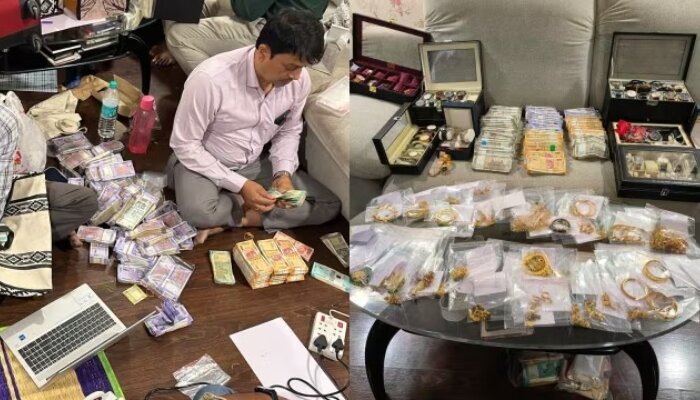
The Enforcement Directorate on Wednesday morning raided the premises of the press advisor to Jharkhand Chief Minister Hemant Soren in Ranchi in connection with the ongoing alleged money laundering case, agency sources said.

The search operations were carried out at the premises of Abhishek Prasad, Soren’s press advisor.

According to the agency sources, searches were carried out at 12 locations including the residences of Abhishek Prasad and Deputy Commissioner of Sahebganj.

Chief Minister Soren was issued a “last opportunity” by the Directorate of Enforcement (ED) on December 30 last year, to record his statement in an alleged land scam. Soren said the summons was ‘illegal’.

It was the 7th summons issued to Soren by the ED under the provisions of the Prevention of Money Laundering Act, 2002 asking him to record his statement.

He has so far skipped six summons.

Soren was first summoned by the ED earlier in mid-August in connection with a land ‘scam’ case. However, the CM ignored the summons, claiming that he was busy with the state’s Independence Day celebrations. (ANI)

(This news report is published from a syndicated feed. Except for the headline, the content has not been written or edited by OpIndia staff)

Modi govt follows Sardar Patel’s realism, not Nehru’s ‘romanticism’ when dealing with China: EAM Jaishankar

0

External Affairs Minister S Jaishankar has reiterated that India should deal with China on the basis of realism and asserted that the relationship should be based on the three mutual understandings- respect, sensitivity, and interest.

In an interview with ANI, Jaishankar reassessed India’s approach of engaging with China with realism in order to checkmate its aggressive measures, while also hitting out at the “romanticism” of the Nehruvian era with China.

“I argue for dealing with China from a basis of realism — that strain of realism, which I feel — strains all the way from Sardar Patel to Narendra Modi — that is the strain of realism which I feel should allow us to have a certain approach,” said Jaishankar.

The External Affairs Minister also lauded Prime Minister Narendra Modi for his pragmatic approach on China.

“I would say that the Modi Government has been very much more and in conformity with a strain of realism, which originated from Sardar Patel,” he said.

Explaining the difference in the approach of India’s first Home Minister and Deputy Prime Minister, Sardar Patel and first Prime Minister, Jawaharlal Nehru, Jaishankar highlighted the difference of opinion among the two stalwarts.

“Even when it came, for example to the UN Security Council seat, it’s not my case that we should have necessarily taken the seat, it’s a different debate, but to say that we should first let China — China’s interest should come first, it’s a very peculiar statement to make,” said Jaishankar while dealing with the approach of Nehru and Sardar Patel’s realism.

Early into Nehru’s tenure, Sino-Indian relations were characterised by what was perceived as friendship and cordiality that covered both bilateral and regional and international issues however, India got a rude awakening when China launched a war in 1962 that gave decision makers in New Delhi a reality check on their China policy.

“It takes two hands to clap. I pose the issue in this manner if you look at the last 75 plus years of our foreign policy, they have a strain of realism about China and have a strain of idealism, romanticism, non-realism. It begins right from day one, there is a sharp difference of opinion — how to respond to China between Nehru and Sardar Patel,” said Jaishankar while responding to a question on whether the two nations will bury the hatchet in 2024.

Jaishankar also dwelt on the “Chindia policy” and said, “The alternative strain which starts from Nehru’s China’s first policy — first let China take seat, then we will see for India. From China’s first policy, it ends up as Chindia policy.”

“Chindia”, an idea that projects the joint rise of China and India and was promoted by Congress leader Jairam Ramesh who called for constructive cooperation and competition between the Asian giants in 2014.

“You should ask the inventor of the term,” said Jaishankar.

About the pivot India took on China, the union minister said, “I don’t believe it’s a pivot we have taken, we have tried to construct a relationship which is based, as I say on three mutuals, and the fact is, unless that mutuality is recognised — this relationship will find very difficult to progress. Today, part of our problem is exactly — because in 2020 agreements were disregarded and the mutuality on which this whole relationship is predicated has not been followed — we have the situation, we have. So, when you ask me, where will it go — I would say, lot of it will depend on what is the Chinese policy.”

Jaishankar emphasized that the development of India-China relations is guided by three mutuals of respect, sensitivity, and interest.

The minister also spoke about the various mind games played by diplomats and politicians while dealing with other countries.

Regarding playing mind games with China, the EAM said, “I don’t think we always lost, but I would argue that at various points of times, we could have — when we talk about the past, today would be very difficult for someone to understand. The Panchsheel Agreement is another such example.” (ANI)

(This news report is published from a syndicated feed. Except for the headline, the content has not been written or edited by OpIndia staff)