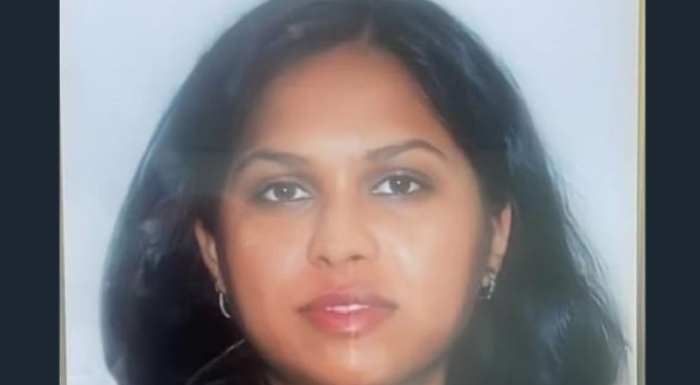
Almost 10 days after Priyadarshini Patil, the 40-year-old hapless mother, fighting a legal battle with the Australian authorities for the custody of her two children ended her life by committing suicide, officials in Sydney have reportedly said that they are reviewing the case now, and assessing whether custody can be returned to the children’s father or grandparents.
Priyadarshini Patil an NRI based in Australia died by suicide on August 20 in Karnataka’s Belgavi district amid a prolonged custody battle for her children in Australia. The lady had been fighting a legal battle with the Australian authorities for the last three years. However, she ended her life on the fateful day on August 20 after she allegedly learned that an online hearing for the custody battle of her two children was postponed to November.
Priyadarshini alleged in her suicide note that her family had been harassed by Australian officials and locals in a Sydney neighbourhood. The letter detailed the distressing circumstances that led her to take this step as well as her family’s legal dispute over the custody of her children.
According to media reports, the recovered suicide note had Patil accusing the New South Wales Department of Communities and Justice and a section of her neighbours of messing up her life.
The case
After her engineering studies, Priyadarshini married Lingaraj Patil who hailed from Kalyan Nagar in Dharwad. They were settled in Sydney. The couple had two children: a son Amartya Patil and a daughter Aparajita, both Australian citizens owing to their birth there.
According to reports, Patil’s eldest kid, Amartya, has been suffering from ulcerative colitis, an immunological illness that causes chronic inflammatory bowel disease. Over time, his illness got worse, necessitating his hospitalization.
It had been six months and the health condition of her son did not improve. Patil accused the doctors of not providing adequate care and lodged a legal complaint against them.
The doctors responded by accusing Patil of providing the kids with inadequate care at home, which they claimed was the cause of the illness, in a complaint to child welfare.
Three years ago, both kids were placed in the Department of Communities and Justice’s custody. The New South Wales officials accused Patil and her husband of “improper care” and separated the children.
The Patils subsequently launched a campaign to get their kids back. Priyadarshini Patil started an internet petition accusing the children’s public hospital of “corruption” and “forcibly” detaining her son. On July 28, 2023, the Patils contacted the Indian Consulate in Sydney after losing custody of both children.
Priyadarshini Patil’s family claimed that she returned to India earlier this month “deeply disturbed and losing all hope of getting her children back.” Her body was found in the backwaters of the Malaprabha river in Belagavi district on August 20.
In an interview with NDTV, child rights attorney Suranya Aiyar emphasized the need for an international system that recognizes the United Nations Convention on the Rights of the Child in cases involving children who are either Indian citizens or whose parents are recent immigrants in a foreign country. Aiyar is leading the campaign in India to ensure that the children are returned.
“So far as I am aware, no concrete steps have been taken. The request for the children to be returned to India is quite old… it was made several months before this tragic suicide but there has been no response…” Ms Aiyar said.
“What we are seeing, again and again in these cases, is that the system is not able to respond to the plight of families, and particularly children, who are either Indian citizens or are new arrivals in a foreign country. And once they are taken away from the parents or, as in this case, once the parental rights have been severely constrained, there have nowhere to go… and the children are, essentially, held hostage by foreign child services authorities.”
Aiyar underlined the fact that “India is conscious of the existence of crimes against the child” and that the government is a signatory to the UN’s convention on child rights.
“If you can have an international system for the exchange of prisoners based on country of origin… and a system where even someone accused of the worst crimes will have consular access… there is no reason why such children can’t be returned to India when a foreign government assesses parents to be incapable (of caring for the children) in any way.”
The woman’s sombre tale serves as a reminder of the ongoing Ariha Shah case in Germany, where parents are fighting authorities to get their two-year-old child back from foster care, as well as numerous other similar tales of persecution that have emerged over time as a pattern where Indians and newcomers of Indian origin to rich G-20 countries are persecuted by their child services due to cultural differences.
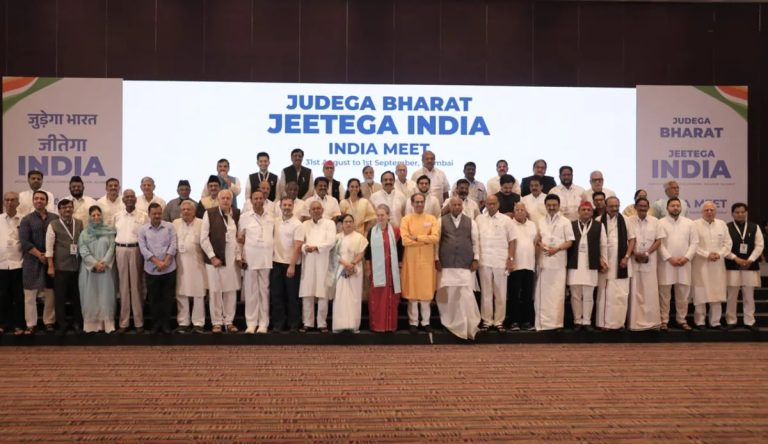
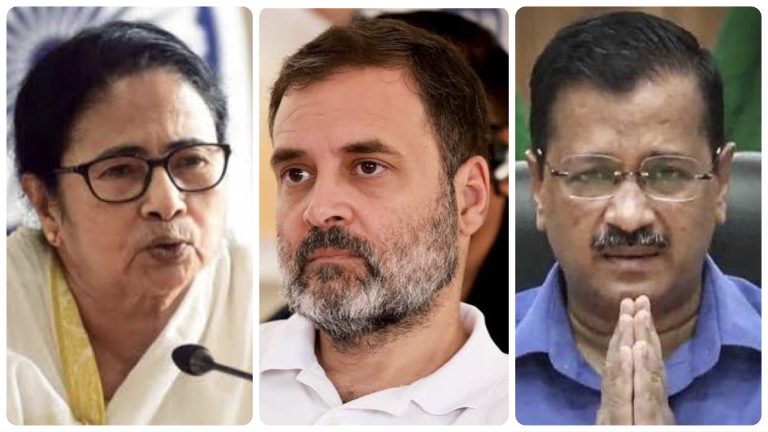
The next key meeting of the Opposition INDIA alliance will be held in the National capital, Nationalist Congress Party (Sharad Pawar faction) leader Supriya Sule said after the conclusion of the third meet in Mumbai on Friday.
When NCP MP Supriya Sule was asked where the next meeting of the INDIA alliance will be held, she said, “In Delhi.”
When questioned again about dates for the meeting, she said, “When do you (media persons) want it to be held, we will hold it on those dates.”
The two-day meeting of the INDIA alliance concluded today.
Moreover, Shiv Sena (UBT) MP Sanjay Raut said that a resolution has been passed and four main committees have been formed.
The 14-member Coordination Committee and Election Strategy Committee includes KC Venugopal (INC), Sharad Pawar (NCP), TR Baalu (DMK), Hemant Soren (JMM), Sanjay Raut (SS-UBT), Tejashwi Yadav (RJD), Abhishek Banerjee (TMC), Raghav Chadha (AAP), Javed Ali Khan (SP), Lalan Singh (JDU), D Raja (CPI), Omar Abdullah (NC), Mehbooba Mufti (PDP), one more member from CPI(M) to also be announced.
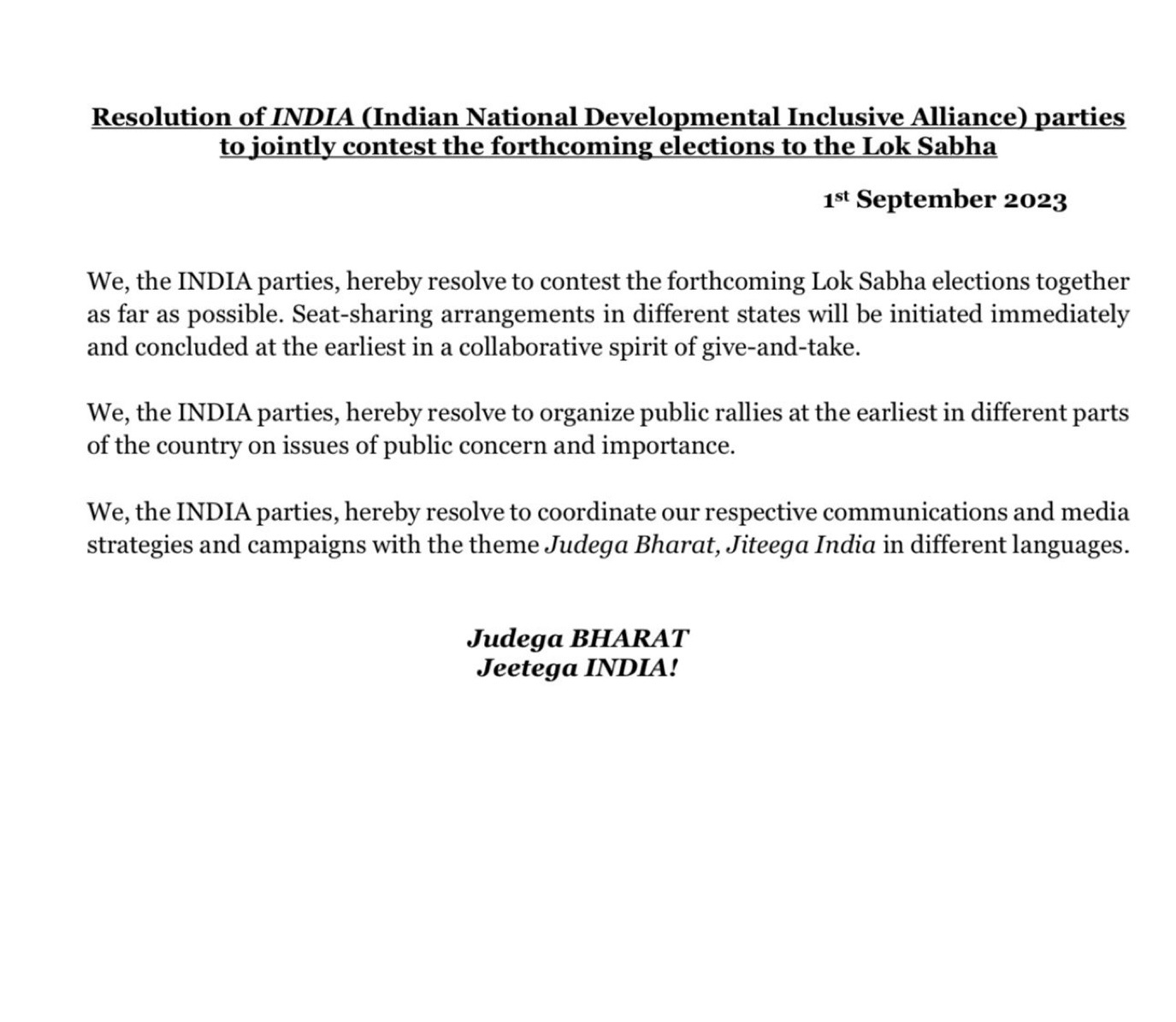
Earlier, the constituent parties in the Opposition INDIA alliance on Friday decided to contest the 2024 Lok Sabha election together “as far as possible”, said the alliance’s resolution taken during its third strategic meeting being held in Mumbai.
The third formal meeting of the opposition bloc INDIA alliance began with the aim of coming up with an action plan for the next Lok Sabha Polls.
The first meeting of the joint opposition was held in Patna on June 23 and the second meeting was held in Bengaluru on July 17-18.
(This news report is published from a syndicated feed. Except for the headline, the content has not been written or edited by OpIndia staff)
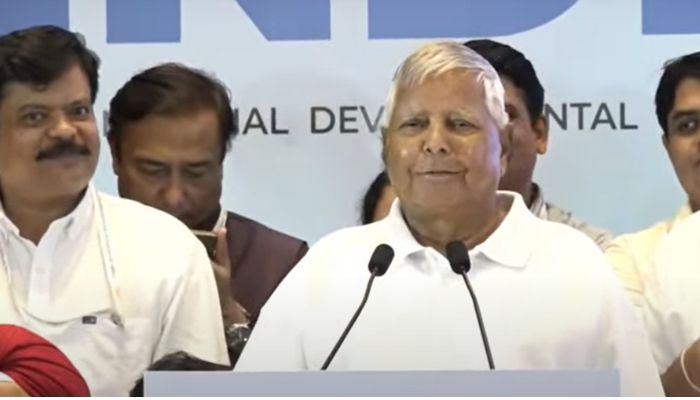
On 31st August 2023, Rashtriya Janata Dal chief Lalu Prasad Yadav congratulated Indian scientists for sending men to the moon through Chandrayaan 3. Lalu Prasad Yadav also claimed that the men sent to the moon by ISRO roamed a lot on the lunar surface. Lalu Prasad Yadav made these bizarre claims in his speech after the meeting of the opposition alliance I.N.D.I.A. took place in Mumbai.
Lalu Prasad Yadav said, “Now, many praises should be heaped upon the scientists. People went to the moon by Chandrayaan. They roamed a lot there.”
He added, “I appeal to the scientists of ISRO that they should take Narendra Modi along in their next mission and send him to the Sun.”
On 23rd August 2023, Chandrayaan 3 launched by ISRO successfully touched down its lander Vikram on the lunar surface. Since then, so many bizarre reactions have been seen by Indian politicians from various parties who seldom know anything about space missions. Chandrayaan 3 is an unmanned mission of ISRO.
Lalu Prasad Yadav is not the first such Indian politician. Earlier, Rajasthan’s Sports and Youth Affairs Minister Ashok Chandna believed that the Chandrayaan-3 is a manned mission and India has sent astronauts to the moon. He said, “We became successful and we landed safely. I salute the astronauts who went there. With this success, our country will advance a step ahead in space science and research. I congratulate all the countrymen.”
OP Rajbhar, the leader of the Suheldev Bharatiya Samaj Party (SBSP), inadvertently made a similar mistake when extending his congratulations to ISRO scientists for the triumphant mission of Chandrayaan-3, which successfully touched down on the lunar surface. He said, “I congratulate them on this. When it is time tomorrow for its safe arrival on earth, the whole country should welcome it.”
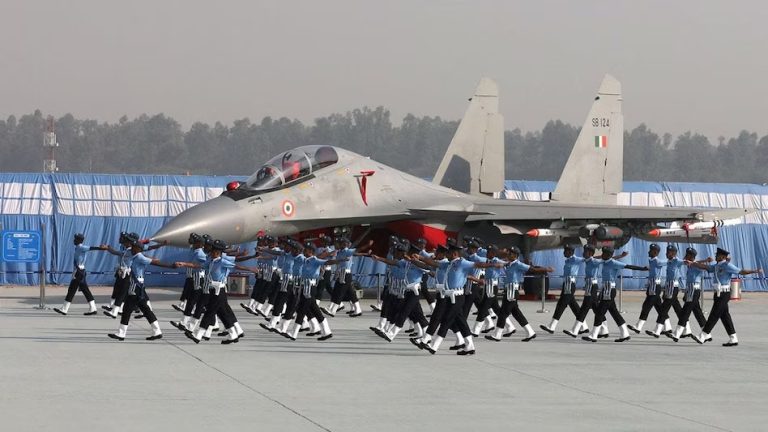
Ahead of the G20 Summit in New Delhi, the Indian Air Force has launched an elaborate training exercise recognized as ‘Trishul.’ Interestingly, the exercises will take place in the northern region, close to China and Pakistan’s borders.
According to the reports, the training mission will be a massive event, with large fleets of fighter aircraft participating, including the Rafale, Mirage 2000, and Su-30MKIs.
The military drills will also include heavy-lift transport planes and choppers such as the Chinook and Apache. Garud Special Forces are also participating in the drills, in which all elements of air power are expected to be used.
The drill is scheduled to take place from September 4 to 14, overlapping with the G20 meeting, which will take place from September 9 to 10. The drills will take place in the northern sector, which includes Ladakh, Himachal Pradesh, Jammu & Kashmir, and Punjab.
The current assertion comes as the IAF prepares to conduct Tarang Shakti, a multi-lateral exercise, in October and November. Fighter planes, military transport aircraft, mid-air refuellers, and airborne warning and control system (AWACS) aircraft will also be participating in the event.
Six air force units from different countries will take part in the event, with numerous others serving as observers. The air forces of the United States, the United Kingdom, France, and Australia are among those expected to participate in the exercise. Previously, the Indian Air Force participated in the INIOCHOS exercise, which was hosted by the Hellenic Air Force at the Andravida air base in Greece.
It also held a joint military exercise with the United States in April under the guise of Cope India 2023. The drills took place at three bases across the country- Kalaikunda, Panagarh, and Agra.
The current event will take place along the borders of China and Pakistan from September 4 to 14 ahead of the G20 Summit in New Delhi. A report by News18 states that Operation Trishul has been deliberately planned ahead of the G20 Summit to showcase its power and strength on all fronts.
It says that the effort is intended to counter any border misadventure. These regions pose special threats. “China has been on high alert on the Leh-Ladakh border for the past three years, with substantial deployment. Every day, drones carrying weapons and drugs approach the Punjab border. Meanwhile, there is an infiltration worry along the Line of Control (LoC) from Pakistan,” the report said quoting government sources. The event will be monitored by the National Security Advisor.
It was reported earlier that China on August 28 released the 2023 edition of its territorial map as per its imagination, claiming Indian territories such as Arunachal Pradesh and parts of Ladakh (Aksai Chin region) as its own. Apart from Indian territories, China also included Taiwan and the contentious 9-dash line in the South China Sea.
India is all set to host the G20 Summit on 9th September and 10th September. China is one of the G20 countries. Chinese President Xi Jinping is set to visit Delhi for the G20 Summit.
Reportedly, the Trishul exercise will be one of the most significant air maneuvers conducted by the IAF in recent years. It will also include the deployment of critical assets from the Western Air Command, as well as resources from other commands, making it an extensive and comprehensive training event.
A week after Islamists ran riots in Nuh district (Mewat region) of Haryana, ‘journalist’ Meer Faisal posted a photo essay on the ‘communal violence’ in the State on August 7, 2023.
The contentious story conveniently ignored the killing of 5 people (most Hindus) and presented Islamists as the victims. As expected, Meer Faisal attempted to shield his radical co-religionists by falsely blaming the outbreak of violence on the likes of Gaurakshak Monu Manesar, who was not even present in Nuh.
“Four people, including two cops, were killed in the violence. Moreover, scores of vehicles were set on fire by the rioters,” he shrewdly refused to identify the perpetrators.
Meer Faisal, who is infamous for spewing vitriol against non-Muslims, works for The Observer Post. He has written extensively for Islamist propaganda news portals such as Maktoob Mediaand Al Jazeeraand leftist outlets such as The Wire.
Anti-Hindu propaganda of Meer Faisal featured in ISIS magazine ‘Voice of Khurasan’
The ‘journalist’ also holds the distinction of being featured by the ISIS-run magazine ‘Voice of Khurasan,’ which has repeatedly called for the annihilation of Hindus in India.
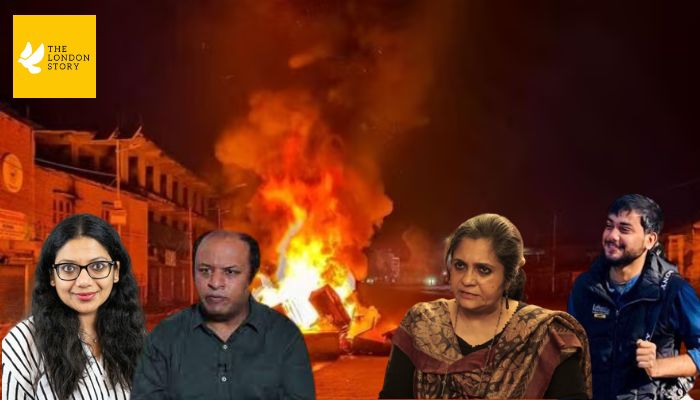
Interestingly, his ‘photo story’ on the Nuh violence was posted on the website of a Netherlands-based ‘think tank’ called ‘Foundation The London Story (TLS)’ on August 7 this year. Meer Faisal wrote on X (formerly Twitter), “My photo story on the recent communal violence in Haryana for The London Story.”
My photo story on the recent communal violence in Haryana for The London Story. https://t.co/AjEvFpMJy1
Foundation The London Story and anti-CAA/NRC propaganda
Coincidentally, TLS came into existence during the protests against the Citizenship Amendment Act (CAA), which aimed to fast-track the citizenship of religious minorities who entered India illegally from the neighbouring Islamic nations of Afghanistan, Pakistan and Bangladesh.
The Netherlands-based think tank claims to investigate ‘misinformation’, ‘disinformation’ and ‘hate speech’, although it has collaborated with individuals and institutions that are accused of the same.
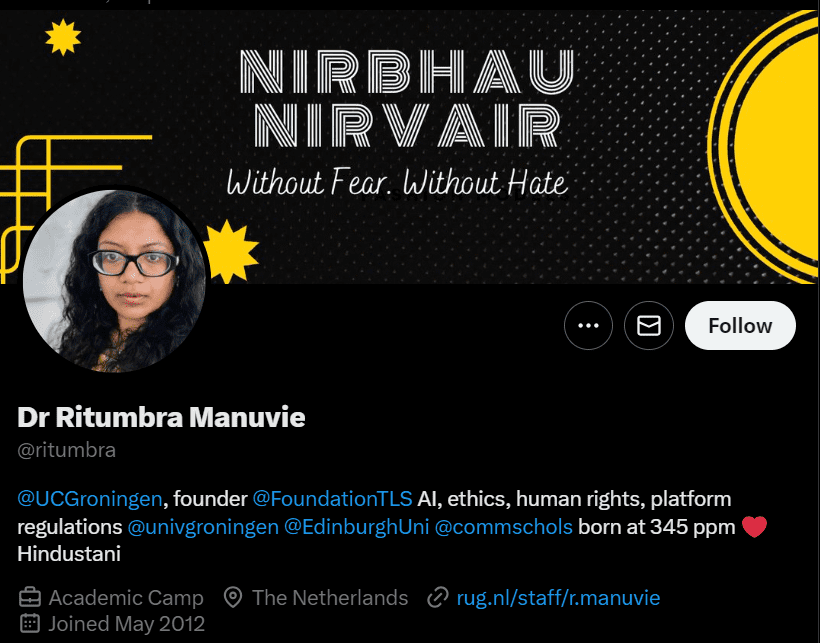
TLS was co-founded by one Ritumbra Manuvie, a climate researcher and a lecturer of law at the University of Groningen. She has cast aspersions on India and its human rights record through multiple propaganda pieces for The Quint and The Print.
Screengrab of the Twitter profile of Ritumbra Manuvie
Ritumbra Manuvie was one of the organisers of anti-CAA protests outside the Peace Palace in the Hague city of Netherlands.
“When the government puts the onus to prove citizenship on the individual, a lot of the marginalised will be left stateless and disenfranchised,” she attempted to create hysteria surrounding the CAA and the National Register of Citizens (NRC).
Ritumbra Manuvie dubbed the Citizenship Amendment Act as ‘homeland purification’, encouraged the intervention of the European Parliament in India’s internal matters and misled people about Assam’s detention camps.
In the state of Assam, immigrations has remained contentious on ethno-lingual ground. BJP has twisted the Assameese narrative into a Hindu Muslim agenda. And this is exactly how CAA and NRC will push Muslims in India to detention camps. Have no doubthttps://t.co/O46v8PV0TA
The propaganda artist was also seen endorsing the likes of Teesta Setalvad, who falsely tried to implicate erstwhile Gujarat Chief Minister Narendra Modi in the 2022 Gujarat case.
She carried out her disinformation campaign about CAA and NRC on the platforms of Oxford Law Faculty and the Indian American Muslim Council (IAMC), well until November 2020.
“NRC is an inhumane project bound to end in persecution & extermination of Indian Muslims,” Ritumbra Manuvie was quoted as saying. According to the Hindu American Foundation (HAF), IAMC has links [pdf] with the banned Islamic terror outfit, Students’ Islamic Movement of India (SIMI).
Besides, the Indian American Muslim Council has ties with Lashkar-e-Taiba (LeT) and Jamaat-e-Islami (JeI) through its founder Shaik Ubaid.
The IAMC is a Jamat-e-Islami-backed lobbyist organisation claiming to be a rights advocacy group. In the past, it had reportedly collaborated with and even paid money to various groups in the USA to get India blacklisted by the USCIRF (United States Commission on International Religious Freedom).
➡️IAMC's terror angle
IAMC has close ties with terror organizations like SIMI, Lashkar-e-Taiba and Jamaat-e-Islami.
Infact, Mohammad Siddiqi, the founder of SIMI, was once hosted as a guest at IAMC.
‘Activist’ Ritumbra Manuvie, who disseminated Meer Faisal’s false narrative on Nuh violence through her think tank, had also been at the helm of shielding Islamists who unleashed mayhem on the streets of northeast Delhi in February 2020.
While downplaying their actions as ‘mere protests,’ she had claimed, “Ofcourse the Supreme leader has to do the lip service, while Delhi police witch hunt muslim boys and girls who have been protesting against CAA!!”
Ofcourse the Supreme leader has to do the lip service, while Delhi police witch hunt muslim boys and girls who have been protesting against CAA!! https://t.co/aup7NDYdcz
Ritumbra also gave the false impression that the Muslim community was unilaterally targeted during the 2020 Delhi riots in conjunction with the Indian American Muslim Council (IAMC).
She aided in the strategic amplification of this dubious narrative in the Netherlands. As expected, the gruesome murders of Dilbar Negi, Rahul Solanki, head constable Ratan Lal, Rahul Thakur and Intelligence Bureau Ankit Sharma found no mention.
This was the photo which relayed in every police department in Netherlands. When we went out to protest outside the Indian embassy the Dutch Police complimented us for standing up for rights of a stranger who we don't know who is far away. And I can assure you there were tears! https://t.co/pijgjOwSRF
The official Twitter handle of IAMC also posted about ‘Foundation The London Story’ and its co-founder Ritumbra Manuvie about the latter’s participation in an event called ’10 Stages of Genocide & India’s Muslims.’
Register now to hear Ritumbra Manuvie, Professor, University of Groningen, The Netherlands speak about 10 Stages of Genocide & India’s Muslims tomorrow at 4 PM EST
Close knitted nexus and propaganda surrounding ‘human rights’ in India
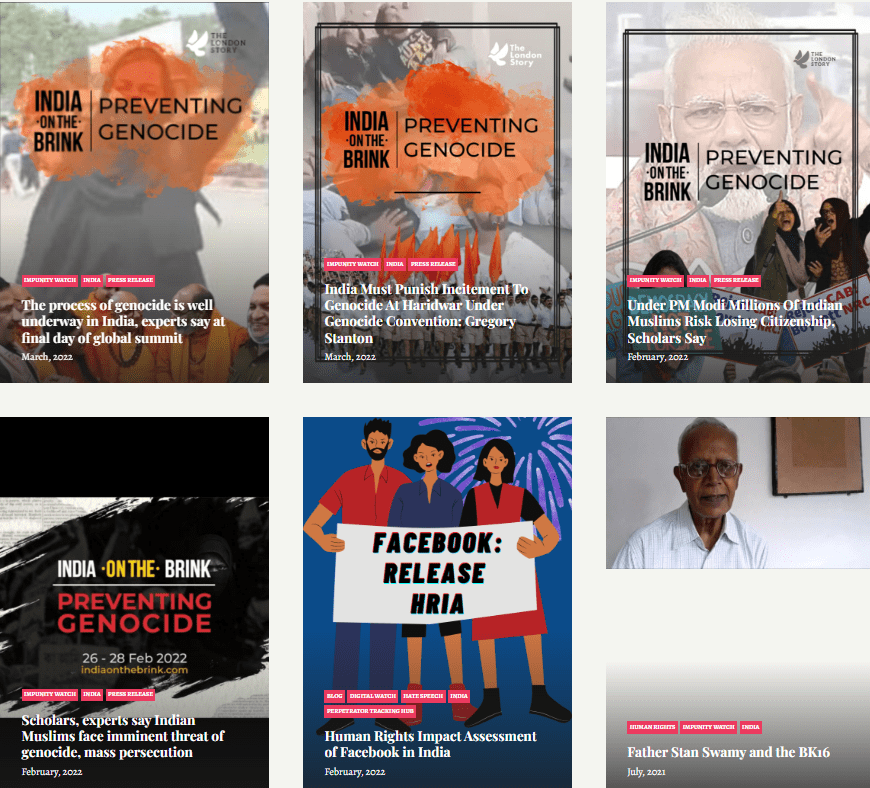
‘Foundation The London Story’, co-founded by Ritumbra Manuvie, has been scaremongering about India and insinuating that a genocide against Muslims is underway in the country. Opindia found 6 such contentious articles, published on the ‘India’ page of the website of the Netherlands-based think tank.
The headline of an article published on March 2, 2022, read, “The process of genocide is well underway in India, experts say at final day of global summit.” Interestingly, it has been copy-pasted verbatim from the website of the Indian American Muslim Council.
The close nexus of TLS with the Jamaat-e-Islami, LeT-backed organisation is clear. As evident from the articles on the website of ‘Foundation The London Story’, it has been misleading its readers about the National Register of Citizens and shielding deceased urban naxals such as Stan Swamy.
Screengrab of the articles on India by TLS
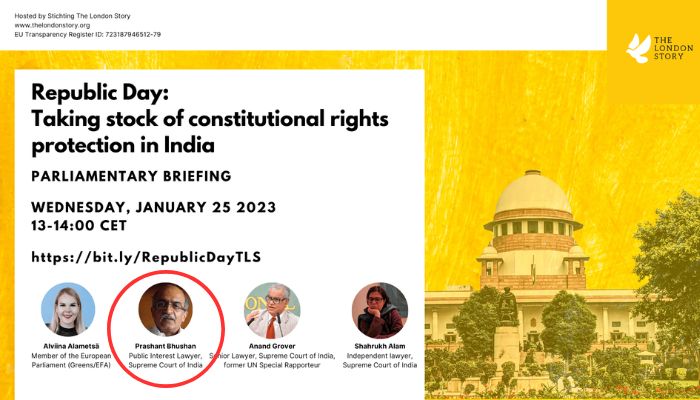
The think tank had also platformed the likes of Prashant Bhushan, who is known for thwarting India’s COVID-19 vaccination programme by repeatedly posting fake news about it on social media (here, here and here).
Bhushan had been also infamous for shielding Islamists in Bangladesh after they killed several members of the Hindu community and vandalised Durga Puja pandals in 2021 on false allegations of blasphemy.
Prashant Bhushan was invited as a panelist by Foundation The London Story
In November 2021, ‘Foundation The London Story’ also invited The Wire columnist Paranjoy Guha Thakurta for a discussion on supposed ‘hate speech on Facebook in India.’
Thakurta is the same leftist ‘journalist’, who was slapped with a defamation suit by the Adani Group for claiming that the Modi government tweaked Special Economic Zone (SEZ) rules and benefitted the Indian conglomerate to the tune of ₹500 crore.
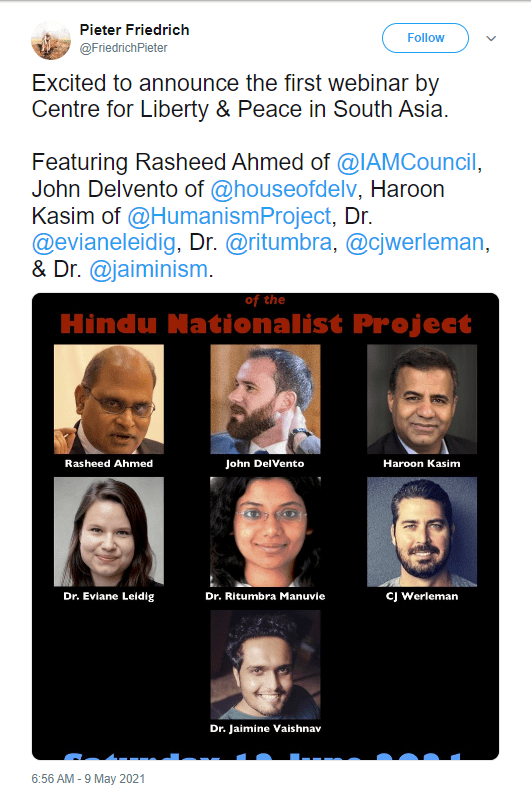
In June 2021, Ritumbra Manuvie was part of a webinar dubbed ‘Perilous Progress of the Hindu nationalist project.’ CJ Werleman, known for peddling fake news against Hindus on a global scale, also participated in the said webinar.
Not to forget the case of Rasheed Ahmed, the Executive Director of the Indian American Muslim Council. was the former executive director of the Islamic Medical Association of North America (IMANA). IMANA’s Director of Operations is Zahid Mahmood, an ex-Pak Navy official.
Interestingly, the details of the event was shared by ‘activist’ Pieter Friedrich on Twitter (archive), who later deleted the tweet.
‘Foundation The London Story’ had also hosted far-left activist Kavitha Krishnan, who had unabashedly shielded Islamists by drawing false equivalences to ‘Sanghis’ (supporters of RSS) and followers of ‘Hindutva.’
In September 2022, Krishnan compared the brutal torture of Mahsa Amini, caused due to her choice of not wearing a hijab in Iran, to the opposition by Hindu groups to selectively entertain Muslim religious attire in government schools.
She had also drawn criticism in the past for participating in the contentious ‘Dismantling Global Hindutva’ conference and mainstreaming Hinduphobia by comparing ‘Hindutva’ with the white supremacist outfit ‘Ku Klax Klan.’
As part of its EU-India People’s Summit, Ritumbra Manuvie had invitedThe Hindu ‘journalist’ N Ram to speak on disinformation and hate speech.
Ahead of the 2019 Lok Sabha elections, he desperately tried to create an anti-Modi wave by manufacturing a ‘defence scam’ in the Rafale deal. In an act of amplifying disinformation, N Ram cropped a vital part of a Ministry of Defence (MoD) document to suggest an ‘internal disagreement over the defence deal.
He was also at the helm of accusing the Modi government of snooping on ‘142 prominent individuals’ using Israeli spyware Pegasus, without any evidence. Ironically, N Ram was asked by ‘Foundation the London Story’ to address a session on ‘Age of Disinformation and Hate Speech.’
Screengrab of the poster of the event
One of the speakers of the event was the serial fake news peddler and #MeToo accused, Pratik Sinha. He is the founder of ‘Alt News,’ which uses dubious fact-checking methods and acts as an Islamic propaganda website. Sinha has been part of multiple sessions, hosted by ‘Foundation The London Story.’
On May 8, 2021, Ritumbra Manuvie was spotted discussing ‘climate change’ and governmental policies with an ‘activist‘ by the name of Harjeet Singh. Sweden-based troll Ashok Swain, known for carrying out disinformation campaigns against Hindus and India, was also part of the event.
On Twitter, the same Harjeet Singh was seen endorsing ‘motivated protests’ against the three farm laws, enacted by the Modi government, in the Glasglow city of the United Kingdom.
In 2016, the climate ‘activist’ had insinuated on Twitter (now X) that Prime Minister Narendra Modi is supposedly involved in ‘communalism’, ‘cow-ism’, ‘casteism’ and ‘crony capitalism.’
My plea to PM #Modi on his B'day to stay away from 5Cs: 1 Cake 2 Communalism 3 Cow-ism 4 Casteism 5 Crony capitalismhttps://t.co/ZB2HLFmAma
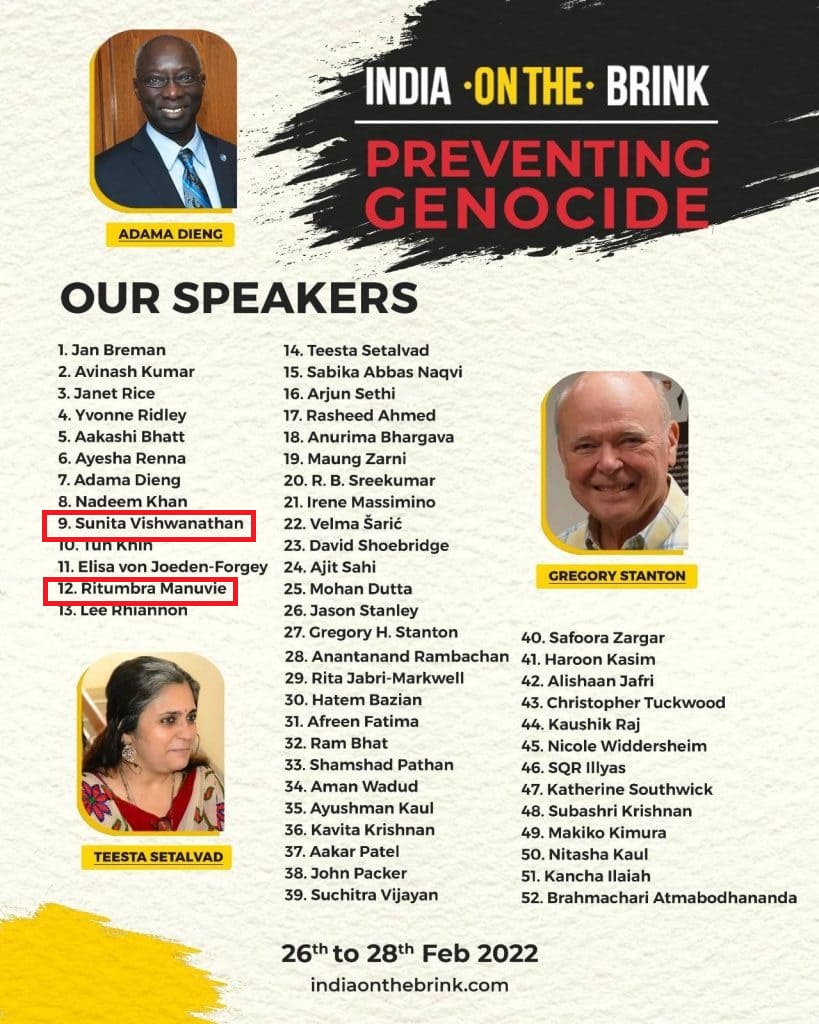
In February last year, Ritumbra Manuvie was listed as one of the speakers at an event dubbed ‘ India on the Brink: Preventing Genocide.’ The event was organised to mark the 20th anniversary of the 2002 Gujarat riots.
Sunita Vishwanath, the co-founder of Hindus for Human Rights (HfHR), also participated in the event. OSINT handle ‘Disinfo Lab’ had earlier informed that the HfHR was actively promoting the misleading narrative of ‘Hindu Vs Hindutva’.
The same organisation was also seen endorsing the ‘Dismantling Global Hindutva’ conference. As per Disinfo Lab, HfHR was formed in the year 2019 by Indian American Muslim Council (IAMC) and the Organization for Minorities of India (OFMI).
Interestingly, the three organisations had formed another outfit called the Alliance for Justice and Accountability (AJA). As per an article in The Hindu, the Alliance for Justice and Accountability had been at the forefront of leading demonstrations against the visit of PM Modi to Houston on September 22, 2019.
Just like Ritumbra Manuvie, Sunita Vishwanath had also tried to create hysteria and panic among Indian Muslims about the National Register of Citizens (NRC) in 2019.
“We are especially appalled by the most recent nightmare of the Kashmiri people, and the situation of 1.9 million people in India who are rendered stateless due to the imposition of the travesty called the National Register of Citizens”
What else does HfHR do?
Other than collaborating with IAMC – it runs Facebook ad campaigns to amplify USCIRF’s annual report & its recommendation to blacklist India! It also runs FB ads for Bhima Koregaon convicts.
Vishwanath is also the co-founder of an organisation named ‘Women for Afghan Women’, which is funded by George Soros’ Open Society Foundations (OSF)/ Open Society Institute (OSI).
In January 2020, Soros committed $1 billion to start a global university to “fight nationalists” and climate change, calling them twin challenges that threaten the survival of our civilisation. He and his Open Society Foundations is influencing civil society and ‘distorting’ public perspectives across different nations.
Interestingly, ‘Foundation The London Story’ had organised a webinar on ‘Minority Rights in India’ on June 26 this year. The think tank had invited Kavita Srivastava, the national secretary of the People’s Union for Civil Liberties (PUCL) as one of the speakers.
The webinar, which tried to create the impression that minority rights have been eroded in India, saw Ritumbra Manuvie acting as the ‘moderator.’
People’s Union for Civil Liberties or PUCL has extensive links to Maoists and ‘Urban Naxals’, who were arrested in the Elgar Parishad case and for the alleged assassination plot against PM Modi.
The PUCL and its associate organisations have a history of ties to Naxals and separatists in Kashmir as well as Manipur. The controversial outfit had earlier extended support to terrorist Afzal Guru and notorious gangster Atiq Ahmed.
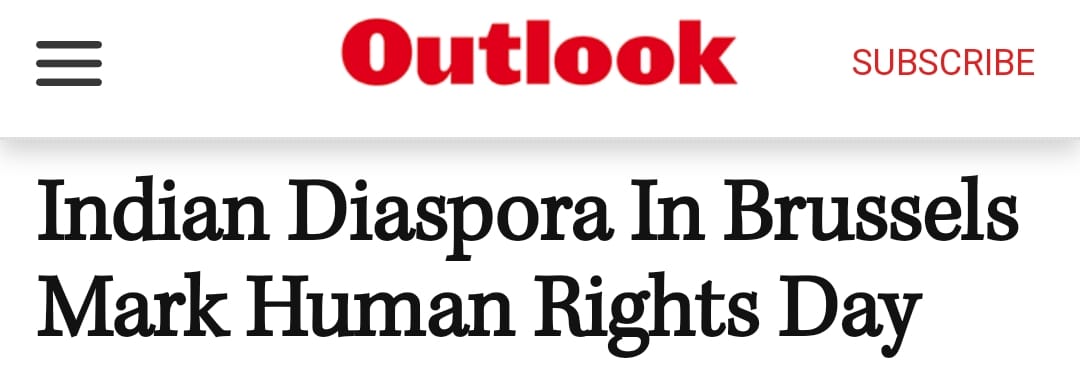
Screengrab of the news report
In December last year, the co-founder of ‘Foundation The London Story’ created a spectacle in Brussels on the occasion of International Human Rights Day. Ritumbra Manuvie along with other activists conducted a 3-day tour of the city and fear mongered about ‘attacks on religious minorities’ in India.
They, in fact, admitted that Brussels was chosen for their activism as it is the headquarters of the European Union. As such, it provided a platform to the likes of Ritumbra to internationalise isolated incidents of violence in India and paint them as ‘targeted attacks on India’s minorities.’
“India must remember that it was built on tolerance, secularism, diversity, and equality…On today’s Human Rights Day, we call on the Indian government to ensure dignity, freedom, and justice for all people, including its religious minorities,” she was quoted as saying.
Manipur ethnic clash presented as ‘Christian persecution’
The violent conflict between two ethnic groups ‘Meiteis’ and ‘Kukis’, which started on May 3 this year, left over 140 dead in Mainpur. The situation was further exacerbated by political vultures sharing old, misleading and graphic content & falsely attributing it to the North-Eastern State.
One set of vested interest groups sought to change the narrative from an ethnic clash to a ‘Christian genocide’ in the hopes of drawing the ire of Christian-majority European nations and the United States towards India.
They also sought to lay a precedent that gave other nations a free pass to interfere in the internal matters of India. Former BBC journalist, David Campanale was tasked to produce a fact-finding report [pdf] on the Manipur violence by the International Religious Freedom or Belief Alliance (IRFBA).
Interestingly, the US State Department serves as the Secretariat of IRFBA. It had recently come under scanner for working with media houses and ‘fact checkers’ to peddle deep-state propaganda.
As such, it was anticipated that the 33-page report by David Campanale on the ‘Manipur conflict’ would be anything but an objective analysis of the situation. The ex-BBC journalist went a step ahead and attempted to present the situation as ‘persecution of the Christian community’ by ‘Hindutva groups.’
“Meiteis who follow the indigenous religion i.e. Sanahamism (and even Hinduism) want to get rid of Christianity from their community. They want to revive their own religion. Many Meitei Christians have been threatened with their life and have been given an ultimatum to renounce their Christian faith and accept Sanahamism,” he made outlandish claims on page 22 of the report [pdf].
Screengrab of the dossier
The global ecosystem then amplified the report of David Campanale as the ‘gospel truth’ and changed the narrative of the ‘Kuki-Meitei’ conflict to ‘religious persecution.’ ‘Foundation the London Story’ also seized the opportunity and even released a background dossier [pdf] on ‘Ethno-religious violence and human rights abuses in Manipur’.
Page 3 of the dossier stated, “To understand and confirm the ongoing human rights violations in Manipur, The London Story interviewed sources from different backgrounds: David Campanale, an international journalist who conducted a thorough fact-finding investigation, one renowned human rights defender in Manipur, and members of the Manipuri community.”
The 7-page document published by TLS, co-founded by Ritumbra Manuvie, has 8 mentions of the former BBC journalist and 7 citations of his misleading report. It clearly shows the shoddy nature of the TLS’ dossier, which itself is based on a dubious report on the Manipur conflict.
TLS and support for Rohingyas
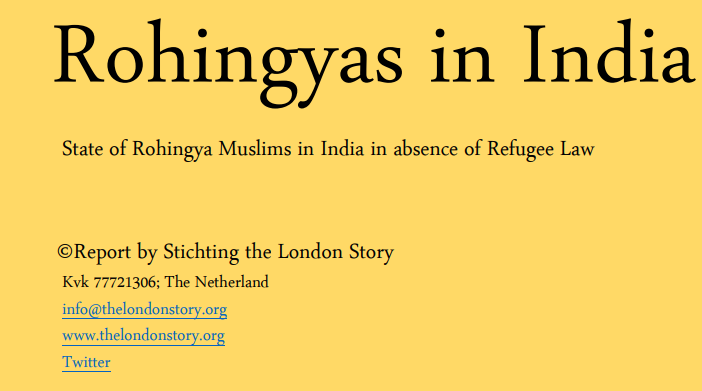
The influence of ‘Foundation The London Story’ is remarkable, to say the least. Its propaganda-laden report, attempting to humanise Rohingyas and negate their security risk in Indian society, is featured on the official website of the Office of the United Nations High Commissioner for Human Rights (OHCHR).
“Religious right-wing Hindutva trolls have accused Rohingyas to be an agent of Islamic terrorism and have been accused of carrying out militant attacks in parts of India (Chaudhury, 2018),” the Netherlands-based think tank attempted to present Rohingyas as victims.
Interestingly, it also hit out at Opindia for documenting the crimes committed by the community in this country. Just last month, the Haryana police arrested 25 Rohingya Muslims for their involvement in the violence that took place in the Nuh district (Mewat region) of Haryana.
Screengrab of the report
In November 2019, even the Bangladeshi PM Sheikh Hasina conceded that Rohingyas were a threat to the security of the entire region. She had therefore appealed to the international community to help resolve the issue.
Hasina had said, “In terms of regional security, I would like to say that more than 1.1 million Rohingya citizens of Myanmar fled to Bangladesh in the face of persecution and they are a threat to the security of not only Bangladesh but also the entire region.”
In June this year, the National Commission for Backward Classes (NCBC) found that Rohingyas and illegal Bangladeshi immigrants had received Other Backward Classes (OBC) certificates in the State of West Bengal.
Conclusion
The well-coordinated, close-knitted ecosystem of leftist-islamisofascists has left no stone unturned in downplaying the violence in Nuh, presenting the aggressors as victims in Delhi (2020 riots) and distorting the underlying reasons that led to the conflict in Manipur.
It is interesting to note how a one-sided story by Hinduphobic ‘journalist’ Meer Faisal about the Nuh carnage was given a platform by a Netherlands-based think tank, which in turn is connected to radical outfits such as the Indian American Muslim Council.
‘Foundation the London Story’ is, in turn, connected to a web of urban naxals, leftist propagandists, dubious fact-checkers and influential/ powerful donors.
All of them have been unabashed in shielding extremists, normalising Hinduphobia, presenting Hindu victims as perpetrators and creating hysteria about an ‘impending genocide in India.’ Their outlandish claims do not need the backing of evidence to be considered credible.
Their assertions are taken at face value and are assumed to be true. The lack of accountability, both at the academic level and public discourse, has bolstered their courage to continue peddling lies and presenting them as ‘reality.’
The I.N.D.I.A. alliance parties on Friday passed a resolution in its Mumbai meeting, resolving to fight the upcoming general elections slated for May 2024 ‘together’ but with a loaded caveat: ‘as far as possible’.
“We, the INDIA parties, hereby resolve to contest the forthcoming Lok Sabha elections together as far as possible,” the resolution passed by a motley collection of opposition parties, united not by ideological convergence but by political compulsions, and which identified itself as I.N.D.I.A., an acronym selected to possibly deflect people’s attention from their internal disagreement and dubious antecedents said.
“Seat-sharing arrangements in different states will be initiated immediately and concluded at the earliest in a collaborative spirit of give-and-take,” the resolution further read, even though it did not offer a resolution for the internecine conflicts and clashes that routinely flare up between regional units of the member parties.
The bloc also vowed to organise public rallies in different parts of the countries on issues of public rallies in different parts of the country on issues of public concern and importance.
“We, the INDIA parties, hereby resolve to coordinate our respective communications and media strategies and campaigns with the theme Judega Bharat, Jiteega India in different languages,” the resolution concluded.
Fissures and internal dissensions define the loosely formed I.N.D.I.A. alliance
Even as existing fissures continue to cast a pal over the opposition’s I.N.D.I.A. alliance, the coalition members aren’t shying away from expressing their ambitions that run counter to existing partners. While they remain mealy-mouthed about the PM candidate for their alliance, for fear of provoking other coalition partners, every political party in the bloc seems to harbour the ambition of installing their head in the office of Prime Minister.
Recently, Shiv Sena UBT’s Priyanka Chaturvedi batted for the candidature of party head Uddhav Thackeray for the post of PM candidate for the I.N.D.I.A. alliance. When asked who according to her would be the Prime Ministerial candidate for the general elections that are slated to take place in May 2024, Chaturvedi responded by saying she would want to see Uddhav Thackeray as the PM candidate of the I.N.D.I.A. alliance.
Ms Chaturvedi’s utterances underscored the widening differences between the expectations and aspirations of member parties, where every party head is harbouring the dream of being the leader of the opposition alliance and using its attendant heft to catapult themselves on the national stage.
Nevertheless, the opposition parties have tried to mask or at least pretend to hide their fundamental differences, personal aspirations, and alliance expectations in an attempt to project unity. However, political analysts believe that the alliance may soon unravel as the expectations clash and elections approach, forcing regional parties to reconsider their commitment to the broader coalition which has so far failed to highlight how it plans to address internal differences.
Recently, Arvind Kejriwal’s face was missing from the new I.N.D.I.A. poster launched by the alliance, fuelling suspicions that the AAP’s exit from the coalition may be imminent. Even within the Congress party, clamour for snapping ties with the AAP has been on the rise. Punjab Congress leader Pratap Singh Bajwa recently expressed his disapproval over the party allying with its rival AAP in the I.N.D.I.A. alliance.
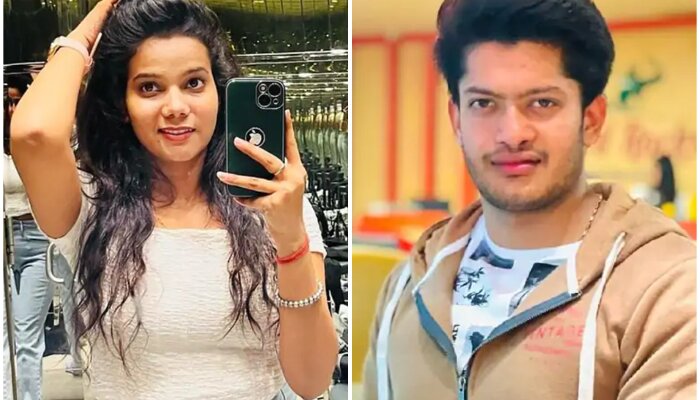
A girl named Pinki Gupta living in a live-in relationship with a man named Shakib in Uttar Pradesh’s Ghaziabad died under suspicious circumstances. Her body was found hanging after which her family members accused her live-in partner Shakib of the crime as well as trapping their daughter in love jihad. Police are presently investigating the matter and arrested the man after a complaint was filed against him.
The tragic incident took place on the night of 31 August when the victim was discovered in her Vaishali home swinging from a noose. Reportedly injury marks were also found on her head. Her boyfriend and his family members were charged with murder by her family after they learned about the horrifying occurrence.
Her mother stated that Pinki Gupta was living in a live-in relationship with a boy named Shakib, from Ghazipur in Delhi. “He coerced her into a relationship by tricking her. It was at his instigation that she ended her life,” she alleged. When the police arrived at the location, they discovered a diary from the room. Its details have not been made public yet. The accused was absconding but was nabbed by police later.
Pinki Gupta was a resident of Vaishali and lived in a rented house in Sector 3. She was employed at a gym as a receptionist and her partner Shakib used to visit the facility regularly. Their friendship developed there and the couple lived together for four years.
Her family revealed that on the night of 31 August, they received information about the instance and hurriedly rushed to the spot. The culprit was not present there and their daughter’s body was hanging from the fan in the room. They informed the police about the same. Police reached the scene and sent the dead body for postmortem.
OpIndia spoke to the complainant, Raju Gupta, the brother of the victim. He said that Shakib used to come to exercise at the Red Rocks Gym where his sister worked in Shoprix Mall, Kaushambi. It was here that both of them got acquainted which later led to a live-in relationship.
Raju Gupta disclosed that Shakib used to torture and it drove her to commit suicide. She narrated her ordeal to them, he said. He alleged that Shakib not only tortured his sister on a daily basis but also instigated her to commit suicide. Moreover, his father Mustafa Khan also had a hand in harassing her, as he used to tell her to kill herself and leave their son, and she committed suicide because she grew tired of these things, Raju Gupta added.
He added that Pinky had revealed this to her family a few days ago. Her mother cried, “Shakib should be hanged. We want justice. Shakib’s family members should also be jailed.” Shakib reportedly fled from the spot after carrying out the crime.
Her brother said that when he reached the offender’s house in Ghazipur with the police team, his family members and people nearby surrounded the police team. Afterwards, a police unit was also dispatched from the vicinity of the Ghazipur police station, however, Shakib had already escaped from there. But the cops managed to nab him later, and was formally arrested.
Assistant Commissioner of Police Swatantra Kumar Singh unveiled, “The girl’s brothers Shivam Gupta and Raju Gupta have filed a case against a person named Shakib in Kaushambi police station. Kaushambi police station received information about a girl committing suicide on Thursday night around 11.30 pm.”
थाना कौशाम्बी क्षेत्रान्तर्गत एक युवती द्वारा आत्महत्या किये जाने की सूचना के सम्बन्ध में एसीपी इन्दिरापुरम की बाइट- pic.twitter.com/Q5UiQ9Nf12
— DCP TRANS HINDON COMMISSIONERATE GHAZIABAD (@DCPTHindonGZB) September 1, 2023
He further added, “Police reached the spot, removed the body from the noose and sent it for postmortem. We found a diary of the girl after searching the room. She has been maintaining the journal since 2021. Further probe is ongoing and we are investigating all aspects.” The ACP added that there are a large number of pages in the diary and the police team is reading it to find more clues about the incident.
थाना कौशाम्बी क्षेत्रान्तर्गत एक युवती द्वारा आत्महत्या किये जाने के संबंध में परिजनो से प्राप्त तहरीर के आधार पर अभियोग पंजीकृत कर मुख्य आरोपी को गिरफ्तार किया गया। अन्य वैधानिक कार्यवाही की जा रही है। उक्त के संबंध में एसीपी इन्दिरापुरम की बाइट। pic.twitter.com/YNSqN2zIJN
— DCP TRANS HINDON COMMISSIONERATE GHAZIABAD (@DCPTHindonGZB) September 1, 2023
The police officer said that the body has been handed over to the family after the post-mortem was conducted. He further added that the accused Shakib has been arrested after a case was registered on the complaint of the victim’s family.
OpIndia has accessed the FIR filed in the case, which shows that Shakib and his father Mustafa Khan have been booked under section 306 (abetment of suicide) of the IPC. While Shakib has been arrested, his father has not been nabbed yet.
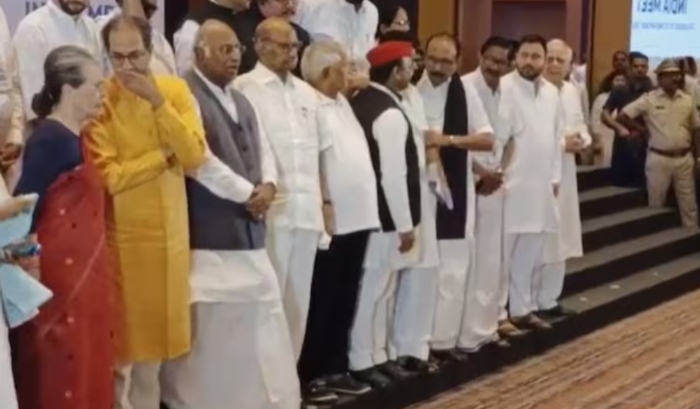
On Friday, September 1, the leaders of the opposition’s I.N.D.I.A. bloc gathered in Mumbai’s Hyatt Hotel on the second day of the two-day mega meeting, but it turned out to be nothing less than a thrilling Bollywood drama movie. According to reports, former Congress supporter Kapil Sibal showed up at the meeting ‘uninvited’, attracting the wrath of his ex-colleagues present there.
A video from the Grand Hyatt, Mumbai where leaders of the so-called alliance gathered ahead of the I.N.D.I.A. bloc meeting, showed senior Congress leader KC Venugopal complaining about Sibal’s presence to ex-Maharashtra minister Uddhav Thackeray before a photo op of opposition leaders. Uddhav Thackeray’s Shiv Sena UBT is hosting the INDIA bloc meeting.
Visuals of Rajya Sabha MP Kapil Sibal, NCP working president Supriya Sule, Shiv Sena (UBT) chief Uddhav Thackeray and Shiv Sena (UBT) leader Sanjay Raut at Grand Hyatt, Mumbai ahead of the INDIA alliance meeting. pic.twitter.com/vNIZshXMlz
As can be seen in the video shared by news agency PTI, as soon as Kapil Sibal enters the premises, he is greeted by NCP working president Supriya Sule. Right at that moment, someone from the background can be heard calling out to the security personnel in an irate tone. Further, the same voice can be heard saying, “Isko bhagao yaar” (someone shoo him away).
Just then, Shiv Sena (UBT) chief Uddhav Thackeray and Shiv Sena (UBT) leader Sanjay Raut are seen talking to Congress leader KC Venugopal. Although they are not audible in the video, it is clear from their body language that the other two Shiv Sena (UBT) leaders are attempting to calm Venugopal down while he is complaining to them about Sibal’s unexpected appearance.
Reportedly, Farooq Abdullah, the chairman of the National Conference, and Akhilesh Yadav, the leader of the Samajwadi Party, tried to step in and convince Venugopal to allow Sibal to attend a meeting intended to bring together all opposition figures ahead of the 2024 Lok Sabha election that will take place next year.
Rahul Gandhi, meanwhile, expressed no objection to Kapil Sibal’s presence in the meeting.
Meanwhile, India Today shared a video of a photo op, where Kapil Sibal was seen posing on the dias with other leaders of the so-called alliance. However, he was seen positioned directly across from Congress bigwigs Sonia Gandhi and Mallikarjun Kharge.
Notably, Kapil Sibal quit the Congress to join the Samajwadi Party in May last year. While filing the Rajya Sabha nomination in the presence of SP Chief Akhilesh Yadav, Sibal said that he had resigned from the Congress party on May 16.
Sibal had reportedly developed close relationships with many SP leaders, including Akhilesh Yadav and Azam Khan. He recently represented jailed Khan in the Supreme Court and helped him secure interim bail. He also helped Akhilesh Yadav retain the party’s bicycle symbol in the year 2017. On May 20, as Khan was released on interim bail from Uttar Pradesh’s Sitapur jail, he had said that Sibal had done a huge thing by securing bail and that he had no capacity to pay him the fees.
Tensions between Kapil Sibal and the Congress Party
It is important to note that there were escalating tensions between the former Congress leader and the party. He had been vocal against the policies and principles adopted by the Gandhi family for the Congress party. On September 29, 2021, Congress party members staged a protest against him for criticising the party leadership over various issues including the handling of the internal conflict in the party in Punjab. The party workers had accused him of allying with BJP for his statements against the Gandhi family.
Sibal had also stated that the G-23 group within the Congress party was not Ji Huzoor 23. Criticising the delay in appointing a full-time party president, Sibal had said, “In our party, there is no president. So we don’t know who is making these decisions. We know and yet we don’t know.”
Also, last year on March 15, after losing the hope of revival, the senior leader demanded to give control of the Congress party to someone other than Gandhis. He had said that the party was ‘sab ki Congress’ and not only ‘Ghar ki Congress’. Sibal had further said that there was no decentralization of the power in Congress. “They don’t have direct contact with them. In this power structure, therefore, the organization is bereft of any vision,” he had said. The senior leader therefore quit the party on May 16, 2022.
However, before the fallout, Kapil Sibal was considered to be a staunch loyalist of the Gandhi scions. He has, in fact, represented Rahul and Sonia Gandhi and the Congress in various legal battles. Since he had been in Congress for a long time and had handled many important ministries in the previous UPA governments.
The Delhi High Court on August 29 made it possible for a lesbian couple to continue living together by disregarding the objections raised by the family of one of the partners.
A division bench of Justices Suresh Kumar Kait and Neena Bansal Krishna ruled that the woman, whose parents raised objections over the relationship between two girls is an adult of 22 years.
The Court had previously ordered counseling for both of her parents, but the Court was told that after reading about homosexuality, the parents found it hard to accept the relationship involving two women.
As a result, the Court disregarded the parents’ objections and held that the woman cannot be forced to go anywhere against her will and that she may reside with anyone she wants and wherever she wants.
The Court also stated that the two of them can spend their life in society as they see fit.
“The petitioner and survivor are at liberty to live their lives in the society as per their own style…We hereby make it clear that the parents, relatives, and their associates shall not extend any threat in whatsoever manner directly or indirectly or undue pressure upon the petitioner as well as survivor,” the Court ordered.
The Court was hearing a habeas corpus petition filed by the spouse of a woman who was reportedly taken away by her parents. Her family was said to have problems with her relationship with a woman.
The High Court, in a decision issued on August 22, ordered counseling for the parents of the woman in order to make them accept her “as per her wishes.” The woman had also been ordered to attend counseling by the Court.
When the case was heard in court on August 29, the woman’s family claimed that her lover had brainwashed her and that they tried reading about homosexuality but found it difficult to accept.
Meanwhile, the woman confirmed that she wanted to stay with her partner and did not want to return to her family.
As a result, the Bench ruled that the couple be allowed to live together at the petitioner’s residence and told the local Station House Officer (SHO) to share the contact information of the lady sub-inspector and beat constable with them.
A similar case was reported from Kerala’s Malappuram district where a lesbian woman reunited with her partner after she was kept apart by the latter’s family. The partner of the woman was taken away by her family who did not approve of their relationship. However, the duo were united after they sought help from the Malappuram Women’s Police Station.
The petitioner in the current case was represented by attorneys Amritananda Chakravorty, Mihir Samson, Asawari Sodhi, Vaishnavi Prasad, and Pradip K Singh. Meanwhile, Sanjay Lao, Additional Standing Counsel (Criminal), and attorneys Abhinav Kumar Arya and Priyam Agarwal represented Delhi Police.
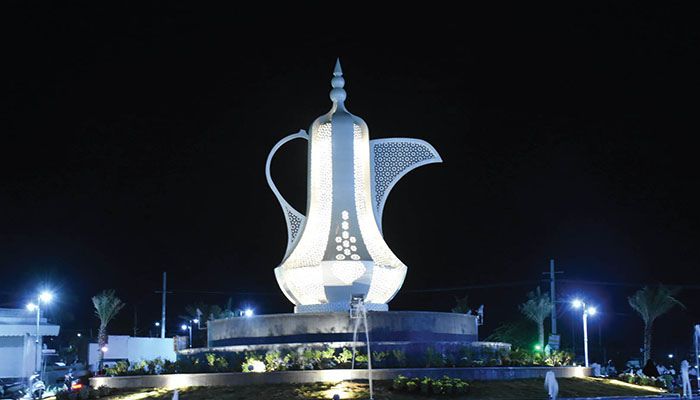
On 30th August 2023, Karnataka’s chief minister Siddaramaiah inaugurated the redeveloped Al Badr Circle in Mysore. The intersection close to Al-Badr Mosque in Rajiv Nagar Second Stage of Mysore has recently undergone a redevelopment that draws inspiration from iconic landmarks in Dubai. As some media reports from Karnataka are calling it a new attraction of Mysore city, it is necessary to know the Islamic understanding of the term Al Badr and how fanning the sentiments around it is fundamentally against Hindu interests.
ಮುಖ್ಯಮಂತ್ರಿ @siddaramaiah ಅವರು ಮೈಸೂರು ನಗರ ಪಾಲಿಕೆ ವತಿಯಿಂದ ರಾಜೀವ್ ನಗರದಲ್ಲಿ ಆಯೋಜಿಸಿದ್ದ ಸಮಾರಂಭದಲ್ಲಿ ಅಲ್ ಬದರ್ ಸರ್ಕಲ್ ಅನ್ನು ಉದ್ಘಾಟಿಸಿದರು. pic.twitter.com/qjWIw0XbVi
Mysuru takes pride in its distinguished roundabouts including Chamarajendra Wadiyar Circle, Krishnaraja Wadiyar Circle, and Jayachamaraja Wadiyar Circle. These meticulously designed and visually appealing intersections were conceived by the Wadiyar Maharajas. More recently, additional junctions have been revitalized in localities like Saraswathipuram, Kuvempunagar, Vivekanandanagar, Ramakrishnanagar, and Sharadadevinagar.
Constructed with an expenditure of Rs. 2.47 crore, the Al-Badr Circle features a prominent centrepiece in the form of a large kettle, drawing significant attention, particularly during the evening hours when the entire junction is adorned with illumination. Many people identifying themselves with the Al Badr Circle flock to the location daily, seeking to experience a sense reminiscent of Dubai, something alien to India, Karnataka, and Mysore.
At the heart of the Al Badr Circle stands a decorative kettle, towering at a height of 8.25 meters, positioned on a raised pedestal, and encompassed by a pool and graceful fountains. To enhance the overall visual appeal of the environment, ornamental plants and trees have been thoughtfully arranged in symmetrical patterns. Haseeb ur Rahman, a skilled architect from Teamwork Architects located in Bengaluru is the brain behind this design. While everything in the circle appears so beautiful to the eyes of a common Hindu passing by, what is the most dangerous with this circle is the fact that not every Hindu knows the historic significance behind the name of the circle and the way it is strategically placed in the Mysore city that witnessed the havocs of Islamic tyrant Tipu Sultan in the eighteenth century.
What about Badr?
Al Badr means ‘The Badr’. Badr, situated within the Al Madinah Province in Al-Hijaz, Saudi Arabia, rests approximately 130 km away from the sacred Islamic city of Medina. This town gained historical significance as the site of the Battle of Badr, a pivotal clash that transpired between the polytheistic Quraishi forces and the Muslims, who were led by Muhammad – the Islamic Prophet.
On March 13, 624 CE (corresponding to 17 Ramadan 2 AH in the Islamic calendar), the historic Battle of Badr unfolded, pitting a group of 313 men against a vastly outnumbered Meccan force led by the Quraish army, degraded and dehumanised by their Arab Muslim counterparts as the ‘Army of Pagans’. This momentous engagement culminated in a resounding victory for the Muslims, who were led by Prophet Muhammad.
It is notable that the Battle of Badr is the first battle fought by the companions and the followers of the Islamic Prophet Muhammad after he received a ‘divine revelation’ that authorised the Muslims to launch attacks on the polytheists (read non-Muslims) without being attacked first. This was the first time that Muslims following Prophet Muhammad were ordained to attack the idol-worshippers of Mecca because they did not subscribe to the faith of Muslims.
This was the first attack on ‘Kafirs’ by ‘Momins’. Any remembrance of the battle of Badr thus gives soothing instances to the minds of practising Muslims, whose religious scriptures sanction them to slaughter Kafirs without any good reason but just so because they are non-Muslims- the battle of Badr being the legitimate religious citation of the same.
India has historically been a homeland of different faiths. The motherland of faiths like Sanatan Hindu Dharma, Sikhism, Buddhism and Jainism, India is the most tolerant country in the world. Therefore, anything like the battle of Badr which revives the memories of Muslims killing ‘Kafirs’ (read non-Muslims) just because of what they are—is a grotesque commemoration of an event where Kafirs were slaughtered and provides encouragement to Islamists to continue dehumanising and degrading the non-Muslims.
What Siddaramaiah could be looking for by inaugurating this Badr circle in Mysore?
Siddaramaiah inaugurating the Badr Circle in Mysore essentially has Islamo-apologetic connotations. It is an attempt to appease the Muslims in the Kannada state who demanded deputy chief ministerial posts and important ministries to be given to Muslim leaders immediately after Congress was voted to power. Such projects play right into the hands of Islamic fundamentalists who not only idolise Tipu Sultan, infamously known as the ‘Butcher of Mysore’ but also harbour deep and visceral contempt for non-Muslims, most notably Hindus.
Medieval Islamist tyrant Tipu Sultan forcefully converted thousands of Hindus to Islam. The previous Siddaramaiah government had celebrated Tipu Sultan’s birth anniversary for two consecutive years. The BJP had cancelled these celebrations after returning to power and has been consistently raising questions about eulogizing the Islamist tyrant.
Badr, Mysore, Tipu Sultan—all these things together form a complete course of the support extended by Congress to such anti-Hindu symbolisms and concepts, whose historical significance and religious undertones often go unnoticed by an average unsuspecting Hindu. The entire exercise is touted as an exercise into embracing inclusivity, whereas in reality, it is nothing short of the appeasement of Islamists.
Initially, there’s a mosque named after Badr. Subsequently, a neighbouring circle identified by the prominent mosque comes up. Gradually, the name Badr is mainstreamed into local psyche without the majority realising its religious significance, especially in an Islamic context. Then, the government releases substantial funds to beautify the square with Middle-eastern embellishments—an Arabic-style decorative kettle— perhaps to win over the local Muslim community. All of this takes place even as an average Hindu passerby, who remains busy in his daily life, could not grasp the subtle implications of Islamism associated with the landmark.
Muslim appeasement has been the policy of the Siddaramaiah government from Day 1.
One must not forget that this fanning of Muslim religious sentiments is no different than what the Congress chief minister had guaranteed in the very first meeting after taking the oath. On Tuesday, 23rd May 2023, Karnataka’s chief minister Siddarmaiah gave instructions to the state police to initiate “ruthless action” against provocative posts on social media in the state. Was this action against Hindus posting something on social media? While Siddarmaiah talked about not tolerating hooliganism, he initially kept unclear what is going to be his government’s stand against the Islamists in the state. But his actions in the next two months made it clear what he meant.
Muslim religious public figures vocally asking the Congress government to give important ministries to Muslim leaders in exchange for the dedication the Muslim vote bank showed towards the party was perfectly in line with the appeasement policies offered in the manifesto of the Congress. Congress had vowed to ban Bajrang Dal in the state to appease the Muslims. However, the government has yet to pass an order proscribing the Hindu advocacy group.
Siddaramaiah government allegedly collaborated with leftwing propaganda website Alt News to ‘debunk’ fake news
Within two months of forming the government, Chief Minister Siddaramaiah directed the Departments of Information Technology, Biotechnology and Home Affairs to take action against those who supposedly post fake news. On 24 July 2023, a report published by the Kannada newspaper Vijayvanisaid that the Karnataka government will seek help from dubious fact-checking portal ‘Alt News’ to fight misinformation.
Earlier in June, Congress MLA Priyank Kharge publicly displayed his camaraderie with Alt News co-founder Mohammed Zubair by referring to the latter as ‘chief.’ Interestingly, Kharge heads the same IT and biotechnology Departments, which are now entrusted to set up the ‘fact-checking unit.’
Will do Chief
— Priyank Kharge / ಪ್ರಿಯಾಂಕ್ ಖರ್ಗೆ (@PriyankKharge) June 16, 2023
Alt News is anything but a fact-checking agency
The ‘fact checking’ portal, run by Pratik Sinha and Mohammed Zubair, has disseminated and amplified fake news on several instances. This is without accounting for the numerous lies peddled by the founders of the Alt News themselves. Moreover, Mohammed Zubair is known for sharing a cropped video of a TV debate in which BJP’s former spokesperson Nupur Sharma made allegedly insulting remarks against Islamic Prophet Muhammad. The mobs of Muslims came to the streets in protest in various cities across the country.
These protests turned violent causing damages to the properties worth crores. Besides, 6 innocent Hindus were beheaded in India for extending support to the freedom of speech of Nupur Sharma in their social media posts. This whole mess was initiated after Mohammed Zubair dog-whistled Islamists by sharing the clipped video. The Siddaramaiah Government is collaborating with Mohammed Zubair’s ‘Alt News’ for ‘fact-checking’.
It is essential to highlight that the Congress party received support from the SDPI, which is the political arm of the banned Islamist extremist group PFI. The PFI has expressed a desire to transform India into an Islamic nation by 2047 and has advocated for policies that have raised concerns about the safety of Hindus. Additionally, Siddaramaiah has previously celebrated Tipu Jayanti with great enthusiasm. Now, he has participated in the inauguration of a redeveloped circle named after the battle of Badr.
If the Chief Minister celebrates Islamic tyrants like Tipu Sultan and inaugurates circles named after the battle of Badr, known for the Islamic slaughter of innocent non-Muslims, it is a message to Hindus, especially in Karnataka, that a Congress rule in the state stands for polarising figures and incidents—a stark contrast to the historical and civilisational plurality of India.