Home Blog Page 218

‘Maarna nahi chaiye tha, jo ho gaya woh ho gaya’: Chilling conversation of minor Muslim student who stabbed his Hindu senior to death in Gujarat

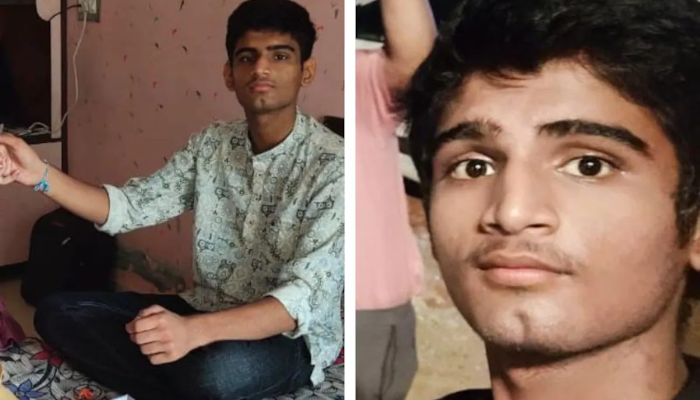
An 8th grade Muslim student killed his class 10th senior, in a school in Seventh-Day Adventist Higher Secondary School in Khokhra of Gujarat’s Ahmedabad. Nayan Santani was stabbed on 19th August and died from his wounds while receiving medical attention during the night at a private hospital. The murder which happened right outside the school has caused widespread protests throughout the city.

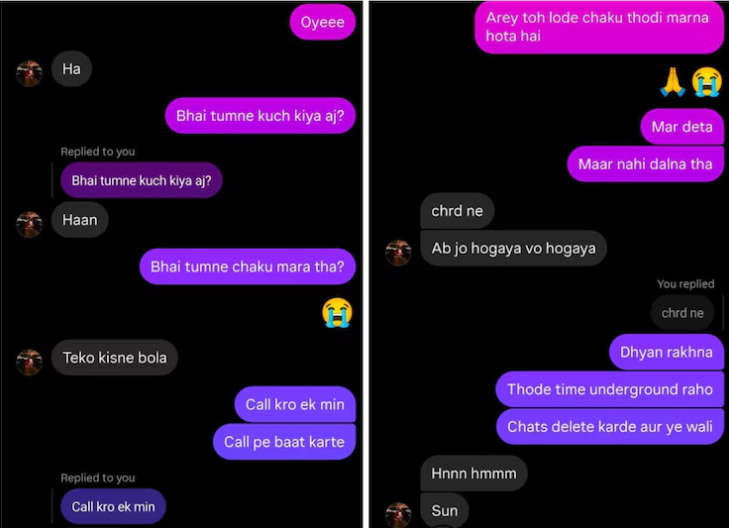
According to the investigators, the accused confessed to his heinous act to his friend. A conversation between the two transpired on Instagram during which the perpetrator admitted to the crime. It was discovered during an initial police inquiry. The exchange also revealed what provoked him to unleash the brutal attack which claimed the life of the Hindu student.

The friend asked, “Did you do something,” to which he replied, “Yes.” The former then asked him if he stabbed anyone and he responded, “Who told you?”. The friend requested the accused to call him because they should not talk about this over chat and stated, “Your name came to my mind first so I texted you.” However, he claimed that he was with his brother and added, “He doesn’t know what happened today.” Afterward, the friend informed him that the victim had passed away.

The culprit enquired as to how his friend knew about the attack. The latter clarified that he had learnt about it via a mutual acquaintance he had met on the road. “Tell him (the common friend) that I killed him. He knows me, tell him right now,” the person said.

Image via India Today

The friend demanded, “What really happened?” According to the accused, the victim challenged him with statements like, “Who are you and what will you do?” However, the friend told him that he cannot stab someone to death over this. “You could have just beaten him up, not killed him,” he added but the offender non-chalantly retorted, “Whatever happened has happened now.”

Afterward, the friend told him to take care of himself and conveyed, “Go underground for some time. Delete these chats,” as he answered with an “ok.”

On his way home from school, 10th standard student Nayan was surrounded by Class 8 students. This resulted in a violent altercation as the accused attacked him with a knife and fled. CCTV showed him staggering back into the school while holding his palm over his stomach wound while the assailant ran to the back of the building.

The security officer saw the victim and alerted the police as well as school administration. The attack took place on the premises of the school.

Hundreds of people, including members of the Sindhi community, parents of other kids, and family members of the deceased, stormed the school grounds the following morning and demanded that the management take action.

With around ₹20,000 crore lost annually in online betting, govt to ban real money games, e-sports and creative gaming to be promoted – Read details about the Online Gaming Bill

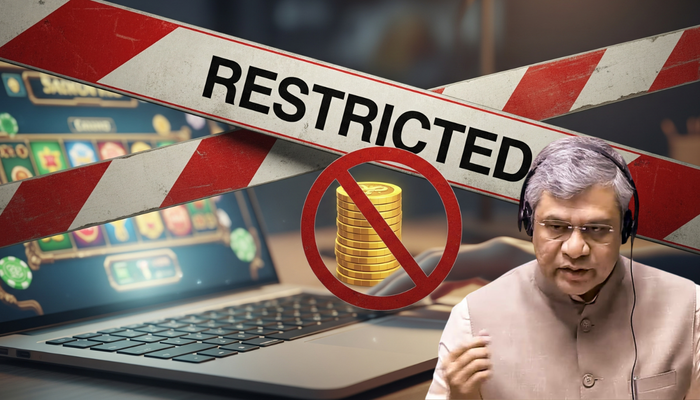
In a move to promote the online gaming industry while also curbing harmful financial practices associated with it, the government introduced the Promotion and Regulation of Online Gaming Bill, 2025, in the Lok Sabha yesterday (August 20). The Bill was passed in the Lower House after I&B Minister Ashwini Vaishnaw introduced it. It will now be tabled in the Upper House, where on being passed, the Bill will become a law.

Amid the rising incidents of gambling, addiction, financial losses and extreme consequences like suicides linked with online gaming, the government has been prompted to take this significant step to regulate the online gaming industry, which is said to be valued at around $3.8 billion currently. The bill intends to clamp down on money-based online games, which allow gambling, including poker, rummy, and other card games.

Misled and lured by false promises of getting massive and quick paybacks, people end up losing their hard-earned money on these online gaming platforms, leading to financial and emotional distress. About 45 crore people lose around ₹20,000 crore annually in online games, including gambling and betting games, as reported by NDTV. After the Bill becomes law, popular money-based online gaming applications such as Dream11, Games24x7, Winzo, GamesKraft, 99Games, KheloFantasy, and My11Circle are likely to be impacted.

The Bill also addresses the financial fraud, money laundering, and terror financing activities undertaken by several online gaming platforms. “The government believes that the harms of addiction, financial loss and even extreme consequences such as suicides associated with online money gaming can be prevented by prevention of such activities,” read a media statement released by the government. “Additionally, online money gaming platforms are often misused for financial fraud, money laundering, terror financing and messaging activity that compromise national security,” it added.

Here is how the Promotion and Regulation of Online Gaming Bill, 2025, aims to promote India’s fast emerging online gaming market while curbing the harmful financial activities linked with it.

Promotion of e-sports

The Bill promotes and recognises e-sports as a legitimate form of competitive sport. The guidelines and standards for conduct in this respect will be framed by the Ministry of Sports.

Image via AI Gemini

For the growth of e-sports, the government plans to establish training academies, research centres, and technology platforms. In addition to that, the government will also launch incentive schemes, awareness campaigns, and integrate e-sports into broader sports policy initiatives.

Prohibits harmful financial practices linked with online games

Departing from previous regulatory interpretations, the Bill imposes an absolute ban on online gaming platforms offering or facilitating real-money transactions, regardless of whether the games are skill-based or chance-based. This is intended to bring the online game operators, which have been allowing gambling activities under the garb of skill-based games, within the purview of the bill. Even the promotion of such games on any form of media is prohibited under the Bill. And, banks and payment systems have been barred from processing transactions relating to such games.

Image via AI Gemini

Currently operational online money games will be blocked under the Information Technology Act, 2000.

Promotion of social and educational games

The Bill empowers the union government to recognise, categorise, and register online social games. It provides for facilitating online gaming platforms offering age-appropriate social and educational games.

Image via AI Gemini

Through the Bill, the government aims to use online games for skill development and digital literacy. It will also promote cultural and educational gaming content aligned with Indian values.

Constitution of an online gaming regulatory authority

The Bill envisages a national online gaming authority to oversee the online gaming platforms. The authority will be tasked to categorise and register online games, determine if a game qualifies as a money game and address complaints and grievances related to online games. Additionally, the authority will issue guidelines, orders and codes of practice to ensure compliance with the laws of the land.

Offences and penalties under the Bill

The government preferred an absolute ban on online platforms offering gambling opportunities instead of the regulation of such platforms for the reason that these platforms often use manipulative design features and addictive algorithms to evade accountability.

As a result, the Bill criminalises facilitation or involvement in online money gaming. Imprisonment up to three years and/or a fine of up to ₹1 crore is prescribed in the Bill for entities involved in online money gaming. Advertisement of such games will attract a penalty of 50 lakh or up to 2 years of imprisonment under the Bill.

Besides, any financial transaction linked with such online money games can attract a fine of up to ₹1 crore, and/or up to 3 years of imprisonment. A repeated offence will be punishable with enhanced penalties, including 3-5 years of imprisonment and a fine of up to ₹2 crore.

Gaming industry representatives write to Amit Shah

Before the introduction of the Bill in the Parliament, the All India Gaming Federation (AIGF) wrote to Union Home Minister Amit Shah, requesting his intervention in the Bill.

The AIGF expressed the apprehension that a blanket ban on money-based online games will severely damage the online gaming sector. Urging for a “progressive regulation” rather than outright prohibition, the federation claimed the Bill, if passed, might push crores of legitimate gamers toward illegal gambling networks and unregulated operators.

Money-based online games have pushed several households into debt and poverty. In some cases, people addicted to gambling activities in online games committed suicide after losing money. The devastating effects of money-based online games compelled the central government to introduce the Bill, even though this would cost the government an estimated revenue loss of about Rs 15,000 crore to Rs 20,000 crore.

Maharashtra: Two FIRs filed against psephologist Sanjay Kumar of CSDS for creating fake voter data used by Congress to attack the Election Commission

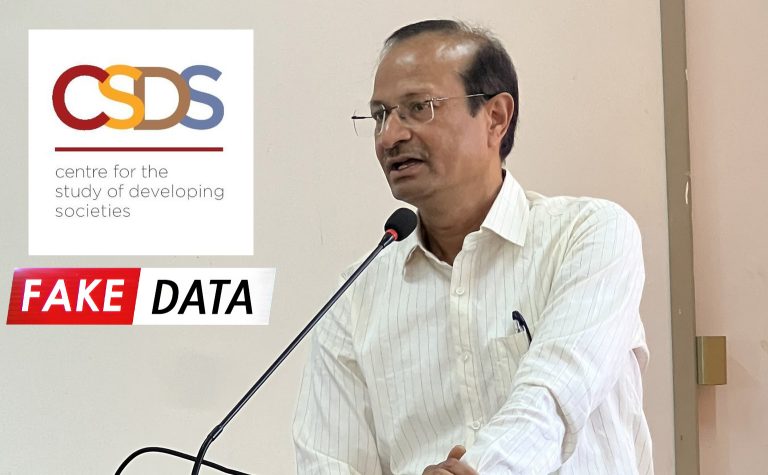
Authorities in Maharashtra have filed two FIRs against senior psephologist Sanjay Kumar of the Centre for the Study of Developing Societies (CSDS) after he posted wrong information about voter numbers on social media. The Congress party had used the fake data to attack the Election Commission of India as part of its ongoing assault on the world’s largest election machinery.

According to media reports, one case was registered in Nagpur on the complaint of the Ramtek tehsildar, and another in Nashik by the district election officer. Both FIRs mention that the false data had the potential to mislead people during the 2024 Lok Sabha and Maharashtra Assembly elections.

Kumar has been booked under several provisions of the Bharatiya Nyay Sanhita, such as 175 (false statement about an election), 353(1)(B) (statements inducing public mischief), 212 (furnishing false information to a public official), and 340.

The Election Commission (EC) has issued a stern warning that any move to circulate unverified figures will be taken seriously and addressed with legal measures. The EC has also cautioned voters and political parties to use only the official EC portal for credible information and not believe or post unverified figures. 

Background: How the fake data fiasco unfolded

The row started on 18th August, when Congress spokesperson Pawan Khera posted a graphic on X (formerly Twitter), showing huge discrepancies in the 2024 Lok Sabha and Maharashtra Assembly voter rolls.

He quoted Sanjay Kumar and Lokniti-CSDS data to say that constituencies such as Ramtek and Deolali saw their electorate dwindle by almost 40% in six months, whereas Nashik West and Hingna recorded unusually high jumps of more than 40%.

A day earlier, on 17th August, Sanjay Kumar himself had posted numbers suggesting bizarre jumps in the Nashik West and Hingna constituencies, claiming a 47% and 42% increase in voters, respectively. His figures quickly spread across social media and were picked up by opposition leaders to attack the credibility of the Election Commission.

But within 48 hours, on 19th August, Kumar deleted his post and issued a public apology. He admitted that the data was wrong, blaming his ‘data team’ for misreading rows in the datasets. He clarified that there was ‘no intent to spread misinformation,’ but the figures had already circulated widely, adding to political tensions.

Later, Opindia fact-check confirmed based on official Election Commission numbers showed that Kumar’s claims were grossly inflated. For instance, Nashik West saw a modest 6% rise in voters (around 27,400 people), not the huge jump of 1.5 lakh that Kumar had claimed. Similarly, Hingna’s rise was just over 25,000 voters, not the 43% surge he reported.

On 19th August, the Indian Council of Social Science Research (ICSSR), a body under the Ministry of Education which funds the Centre for the Study of Developing Societies (CSDS), strongly criticised the fake data fiasco.  ICSSR said that Kumar’s false claims on Maharashtra’s electoral rolls and their subsequent amplification against the Election Commission of India (ECI) amounted to a “gross violation of the Grant-in-Aid rules”. The council announced that a show cause notice would be issued to CSDS for its conduct.

Amid Trump’s tantrums on tariff and US pressure on trade deal, India advances in FTA talks with Russia-led Eurasian Economic Union

0

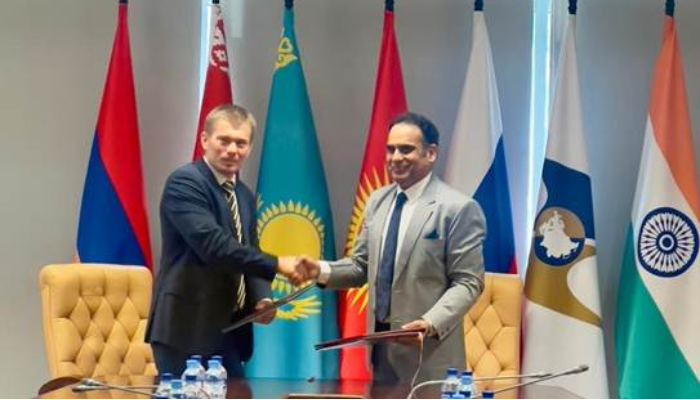
On 20th August, India and the Eurasian Economic Union (EAEU), headed by Russia, started trade talks after United States President Donald Trump referred to India and Russia as “dead economies“. Donald Trump also increased tariffs on Indian goods to 50% for buying Russian Oil, among the highest in the world.

EAEU, which consists of Russia, Armenia, Belarus, Kazakhstan and the Kyrgyz Republic, has a GDP of $6.5 trillion. Furthermore, Cuba, Moldova and Uzbekistan have been granted observer status. Russia is India’s top trading partner in the bloc.

The Terms of Reference (ToR) to begin free trade agreement (FTA) negotiations were agreed in Moscow. “With a combined GDP of $6.5 trillion, the proposed FTA is expected to expand market access for Indian exporters, support diversification into new sectors and geographies, enhance competitiveness against non-market economies, and deliver significant benefits to Micro, Small, and Medium Enterprises (MSMEs),” informed Commerce Department.

According to the statement, the Terms of Reference (ToR) offers the framework for talks and is anticipated to boost investments, open up unrealised trade potential, and create a more robust and long-lasting India-EAEU economy. Mikhail Cherekaev, Deputy Director, Trade Policy Department of Eurasian Economic Commission (EEC) and Ajay Bhadoo, Additional Secretary for Commerce, signed the deal.

Bhadoo also met Andrei Slepnev, the EEC’s Minister in Charge of Trade. India and the EAEU’s expanding trade turnover which was USD 69 billion in 2024 and represented a 7% rise over 2023 was also highlighted by both parties. The early completion of the agreement and the establishment of a long-term institutional framework for trade cooperation were reaffirmed by both sides.

The official statement noted, “The heads of negotiation groups apprised the Minister about the milestone achieved with the signing of the ToR and discussed next steps to formally launch the negotiation process, including organisational aspects of the future trade deal.”

The Covid-19 pandemic forced the suspension of talks on the proposed free trade agreement (FTA) between India and the EAEU which had begun in early 2020. After the pandemic ended, discussions on the FTA then restarted, although formal talks are still pending. On 9th January chief negotiators from both sides convened virtually.

Meanwhile, External Affairs Minister S Jaishankar will meet with Russian colleague Sergei Lavrov on 21st August in Moscow. The former previously spoke at the India-Russia Inter-Governmental Commission on Trade, Economic, Scientific, Technological and Cultural Cooperation (IRIGC-TEC) and met with Denis Manturov, Russia’s first deputy prime minister.

Jaishankar’s trip to Russia took place barely two weeks after Ajit Doval, India’s national security adviser, travelled to Moscow for a high-level visit aimed at fostering closer relations between the two countries.

The recent developments and the bustling engagement in the relationship between Russia and India, along with the positive attempts to restore relations with China have transpired amid the harsh criticism aimed at the Modi administration by the United States for purchasing Russian oil to protect Indian interests.

The Trump administration not only accused New Delhi of being responsible for the war in Ukraine but also imposed a 50% tariff while preparing to introduce further tariffs on India. On the other hand, they exempted China, the largest purchaser of Russian oil and even defended this apparent hypocrisy.

Moreover, the United States started to cultivate closer ties with Pakistan in an effort to provoke India and started attacking Indian businessmen especially, Gautam Adani and Mukesh Ambani.

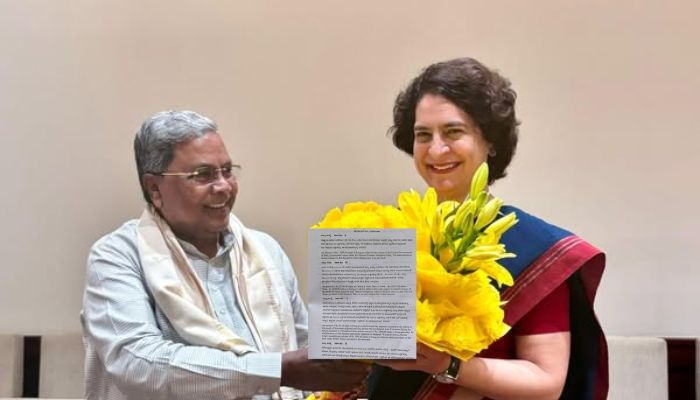
Karnataka govt grants Rs 10 crore for Priyanka Gandhi’s parliamentary seat Wayanad in Kerala, BJP asks ‘why’

In Karnataka, a controversy has erupted after the Congress government announced that it is granting Rs 10 crore for the rehabilitation of the families affected by the last year’s landslides in Kerala’s Wayanad district.

The BJP has alleged that the CM Siddaramiah-led Karnataka government is allocating funds for Kerala’s Wayanad because Wayanad Lok Sabha constituency is the parliamentary seat of senior Congress leader Priyanka Gandhi. 

The grant, which is being provided through the State Disaster Response Fund (SDRF), will help 100 families severely affected by the landslide.

It must be recalled that a landslide caused by heavy rains in Meppadi, Wayanad district in July 2024 caused massive loss of life and property. Hundreds of families lost their homes, livelihoods and property in this disaster.

Now the Karnataka government has decided to allocate Rs 10 crore from its State Disaster Management Fund for rehabilitation work.

The Karnataka government has mentioned in its supplementary estimates for the year 2024-25 that it will provide Rs. 10 crores as a grant to the victims of the Wayanad landslide. This grant will be transferred to the Kerala government through SDRF, which will help in providing financial assistance, housing, and livelihood reconstruction to the affected families.

Attacking the Karnataka government over this move, the BJP has alleged that CM Siddaramiah has given more priority to constructing houses for the landslide victims of Wayanad constituency in neighbouring Kerala than for the poor people of Karnataka. It has been alleged that the Congress government in Karnataka is granting Rs 10 crore for Wayanad rehabilitation to please Priyanka Gandhi.

Taking to X, BJP Karnataka said, “Sell the house, be kind to Priyanka! This is a proverbial saying directed at the state Congress government. There is no money for development works in the state, no money for government employees’ salaries, no money to provide grants to MLAs’ constituencies, no money for the infrastructure of schools and colleges. But, to please its high command, the great Congress government is generously giving 10 crores to build houses for the people of Wayanad in neighboring Kerala, the constituency of MP Priyanka Vadra. CM @siddaramaiah, stop immediately the expenditure of Kannadigas’ tax money to save your chair. #CongressLootsKarnataka.”

Notably, in February 2024, BJP Karnataka had criticised the state government’s aid worth 15 lakh released for a man who died in an elephant attack in Wayanad. The money was released after Rahul Gandhi instructed to do so, stating the elephant that attacked the deceased man was originally from Karnataka. Rs 15 lakh then and Rs 10 crore now, it seems that Karnataka Congress government’s top priority is pleasing the Gandhi family than serving its own people.

Cindy Rodriguez Singh, on the ‘ten most wanted fugitives’ list of FBI, arrested from India, had killed her 6-year-old son

0

The Federal Bureau of Investigation has arrested Cindy Rodriguez Singh, one of its ‘Ten Most Wanted Fugitives,’ from India. She was wanted in the United States for the murder of her 6-year-old son, Noel Rodriguez Alvarez.

According to a report by Fox News, Cindy Rodriguez Singh was facing two active warrants, a federal one for ‘unlawful flight to avoid prosecution’ and a Texas state warrant for ‘capital murder of a person under 10 years of age.’

Cindy Rodriguez Singh had fled the U.S. to avoid trial in the case. On 3rd October, 2024, INTERPOL issued a Red Notice against her, alerting all member countries, including India. Soon after, an extradition request was sent. Acting on this, the FBI, along with Indian authorities and INTERPOL, managed to capture her.

She has now been taken back to the U.S. and handed over to Texas authorities, where she will face the murder charges.

FBI’s statement on the arrest

FBI Director Kash Patel called this arrest a major success. “The FBI’s Ten Most Wanted list exists for cases just like this, where a dangerous fugitive thought she could run, hide overseas, and escape justice. Thanks to relentless FBI work and our international partnerships, Cindy Rodriguez-Singh is back on American soil to face accountability for the horrific murder of her child,” Patel told the media. 

He added: “Justice has no borders, and today the American people can see that we will never stop pursuing those who prey on the most innocent among us.”

The disappearance of Noel

The case dates to March 2023. On 20th March, the Texas Everman Police Department was requested to make a welfare check on Noel, who had not been sighted since October 2022. The boy had multiple life-threatening health conditions including chronic lung disease, bone complications, and developmental disorders.

When police visited, officials say Cindy Rodriguez Singh lied about his whereabouts. She told investigators that Noel had been in Mexico with his biological father since November 2022.

Just two days later, on 22nd March, Cindy Rodriguez Singh, her husband, and six other children boarded a flight to India. Investigators confirmed that Noel was not with them and had never boarded the plane.

Murder charges and extradition

By 23rd October, 2023, Rodriguez Singh was formally charged with capital murder in Tarrant County, Texas. Soon after, on 2nd November 2023, a federal warrant was issued for her arrest on charges of fleeing prosecution.

In July 2024, she was added to the FBI’s ‘Ten Most Wanted Fugitives’ list. Now, after nearly two years on the run, she has been caught.

This makes her the fourth fugitive to be arrested under the leadership of FBI Director Patel.

Ahead of Vidhan Sabha election, infiltration-prone West Bengal witnesses spike in new voter registration in bordering districts: Details

The bordering districts of infilitration-prone West Bengal have witnessed a sharp increase in new voter registrations ahead of the upcoming 2026 Vidhan Sabha elections, reported The Economic Times.

The development was confirmed by the office of the Chief Electoral Officer (CEO) in West Bengal.

In the past 3 months, new voter registration through Form-6 has increased 9 times in Muslim-dominated Malda and Murshidabad, Nadia, Uttar Dinajpur, Cooch Behar, North 24 Parganas and South 24 Parganas.

The jump is as high as nine-fold, from around 100 per assembly constituency to nearly 900 a month,” the report stated.

Interestingly, all the aforementioned districts share a border with Bangladesh. The BJP in West Bengal has raised alarms about increasing infiltration and demographic changes in the bordering districts of the State for a long time.

ECI directs West Bengal govt to take action against officers who added fake voters to electoral rolls

Earlier this month, the Election Commission of India (ECI) suspended four election officials in West Bengal, who reportedly allowed fake voter applications to be registered by misusing their authority.

Their actions were exposed during a sample checking of voter application forms (Form 6) for routine updates to the electoral roll by the West Bengal Election Commission.

Two Electoral Registration Offices (EROs), namely Debottam Dutta Choudhary and Biplab Sarkar and two Assistant Electoral Registration Officers (AEROs), namely Tathagata Mondal and Sudipta Das, were suspended by the ECI with immediate effect.

Besides, the ECI also directed an FIR to be lodged against the casual Data Entry Operator, Surojit Haldar.

The ECI has also ordered disciplinary proceedings against the officers without delay. The Commission said that the actions of the officers amount to criminal misconduct and, therefore, also ordered the filing of FIRs against all four officials.

Later, it gave a 7-day deadline to take action against state election officials accused of adding fake voters to the voter list. 

Large-scale infiltration in West Bengal

West Bengal is said to be among the states with the highest numbers of illegal Bangladeshi immigrants. In the last three years, 2688 Bangladeshi nationals were apprehended and sent back to Bangladesh.

The claims were further strengthened by a recently published research paper, which revealed that West Bengal may include around one crore excess voters, recording an inflation of whopping 13.69%.

The research paper tiled: “Electoral Roll Inflation in West Bengal: A Demographic Reconstruction of Legitimate Voter Counts (2024)”; is authored by Dr. Milan Kumar, Assistant Professor at the Indian Institute of Management Visakhapatnam and Dr. Vidhu Shekhar, Assistant Professor at SP Jain Institute of Management & Research, an alumnus of IIT Kharagpur and IIM Calcutta.

Published on 7th August 2025, the paper relies on official data from electoral rolls, census, and civil registration systems to estimate the surviving voters from the 2004 base roll, additions through new cohorts (1986-2006 births), and adjustments for net permanent migration.

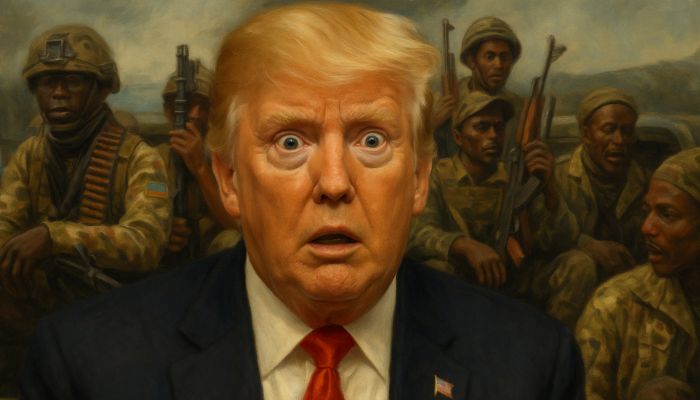
Trump claimed he brought peace between Congo and Rwanda, but over 300 people have been killed by militias since then; Read details

A month after the President of the United States, Donald Trump, claimed he played a vital role in brokering peace between Congo and Rwanda, the violence in eastern Congo intensified, leading to hundreds being murdered in militia attacks.

On 20th August, Human Rights Watch reported that Rwandan-backed M23 rebels killed 141 villagers across 14 villages in North Kivu province between 10th and 30th July. Most of the victims of these attacks were ethnic Hutu civilians. They were targeted amid the group’s military campaign against the Hutu extremist Democratic Forces for the Liberation of Rwanda (FDLR).

According to the United Nations, the death toll is higher. In early August, UN rights investigators announced that at least 319 people have been killed. Rwandan soldiers have allegedly participated in M23’s attacks. However, both the rebels and Rwanda have denied the allegations.

Trump’s repeated claims of success

Despite these massacres, President Donald Trump has repeatedly declared that his administration “settled” the decades-long conflict between the two countries. Speaking to Fox News, he claimed that he ended a war that had cost “8 million people dead with machetes” while insisting on the importance of the peace accord signed in Washington on 27th June to bring the resolution between Congo and Rwanda. All this is being done so that Trump can claim his right to get Nobel Peace Prize.

The ground reality, however, in North Kivu offers little evidence of peace. Clashes between Congolese forces and M23 rebels have not only continued but escalated since then. The Congolese army has accused M23 of “incessant attacks” calling them a violation of the Washington agreement and a follow-up Doha declaration that was signed in late July. On the other hand, M23 has accused Congo’s military of targeting populated areas with heavy artillery and drones.

History of conflict and failed peace

The conflict between Congo and Rwanda has been going on for over three decades. It escalated in the aftermath of the 1994 Rwandan genocide, leading to the displacement of millions of Hutu refugees, including extremists, into Congo. The M23 rebellion, which has roots in earlier Tutsi-led militias, has long been accused of acting as a Rwandan proxy in the region. Notably, the region is rich in critical minerals.

The deal signed in Washington included the withdrawal of Rwandan forces and the dismantling of the FDLR in Congo. However, the attacks that have happened since then suggest that neither side has meaningfully adhered to the agreement.

A fragile process

The foreign ministry of Congo acknowledged on 20th August that the massacres “cast a grave shadow over the sincerity and commitment of stakeholders to the Washington peace agreement and the ongoing Doha talks.”

Furthermore, the parallel talks with M23 initiated in Doha added to the uncertainty. The two sides signed a “declaration of principles” meant to lead towards a ceasefire. However, civilian killings mounted, which has put the Washington peace accord and the Doha process under strain.

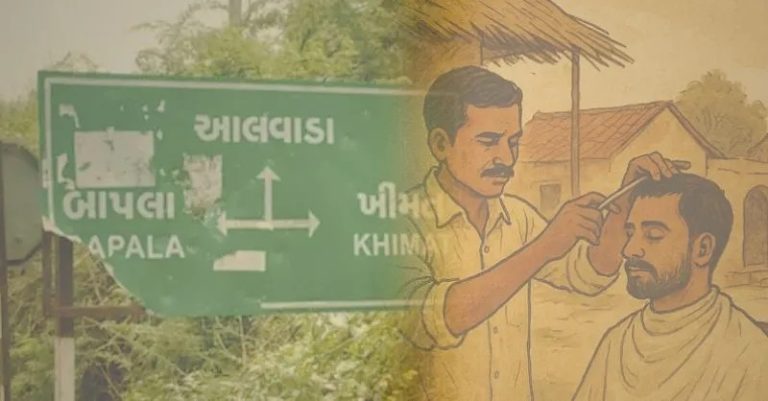
Media reports claimed that Dalits couldn’t get their hair cut in a Gujarat village, OpIndia found a completely different story when it reached the village

Recently, a claim about discrimination against Dalits in Gujarat went viral in the media and also on social media. The claim was that after decades, in Alwada village of Dhanera in Banaskantha, Dalits were finally allowed to get their hair cut in the village barber shop.

The Times of India was the first to publish the report. After the TOI report, the issue was also highlighted by other national media outlets. Later, Gujarati newspapers also gave space to the news and wrote about discrimination against Dalits for haircuts.

The TOI report mentioned a person named ‘Kirti Chauhan’ and said that he became the first Dalit to get a haircut in the village. Writing that ‘it was an Independence Day-like atmosphere for the community’, TOI writes that all the five barber shops in the village were opened for Dalits for the first time.

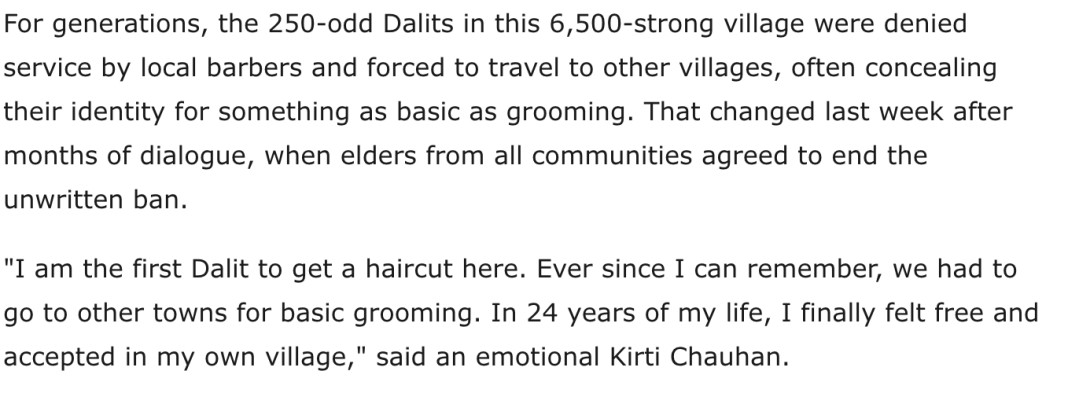
It is further written in the report – ‘For generations, the 250 Dalits in a village of 6,500 people were denied access to the local barber and had to travel to another village, sometimes hiding their identity, for a haircut. But all this changed last week, when leaders from all the communities agreed to remove this unwritten ban.’

The report quotes an ‘emotional’ Kirti Chauhan, who says, “I am the first Dalit to get a haircut here. Ever since childhood, we had to go to another village to get a haircut. For the first time in my 24 years of life, I am feeling liberated and accepted in my village.”

The report then names activist Chetan Dabhi and a few others who are said to have stopped this ‘generations-old practice’. Village sarpanch Suresh Chaudhary is quoted as saying, “As sarpanch, I regret the earlier practice. I am proud that it ended during my tenure.”

The report quotes a man named Chhoghaji Chauhan as saying that he used to walk for miles to get his hair cut and that his father had also endured all this before independence. Referring to Pintu Nai, it was said that he said that he only followed the rules of society, but when the elders agreed, he also relaxed this alleged restriction and he said this is good for business as well.

After the Times of India published the report, other media organizations also immediately published reports with similar headlines. But an example of the quality of media reporting can be discerned from the fact that in some reports, Kirti’s name has been changed to Kiran, while in others, Kirti has been described as a woman. Some reports say that Dalits were allowed to cut their hair in the village for the first time after independence. Gujarati newspapers also published similar reports verbatim later.

BBC Gujarati has also published a report, in which they wrote, quoting some Dalit youths and the village barber, that Dalits were not allowed to cut their hair in the village and they had to go to another village. In the report, the local barber says, “We did not cut the hair of Dalits because there was a problem with the people of the village, but now a settlement has been reached and everyone’s hair is cut.”

What the sarpanch told OpIndia

When OpIndia contacted the village sarpanch and the local police officer, they denied these things and said that there was no question of caste discrimination. A Dalit youth from the village had a fight with the barber, due to which he had filed a complaint at the police station. Later, a settlement was also reached in the presence of the police and the sarpanch, and there is no question of discrimination, nor was there before.

The media has called Suresh Chaudhary the sarpanch, but in reality the sarpanch is his wife. Suresh told OpIndia that the reality is completely different from what has been written in the news reports. In fact, this was just an argument between two people, which was quickly resolved. It had nothing to do with any community or caste discrimination. Dalits in the village could always get their hair cut in the local shop.

According to the information given by Chaudhary, some time ago, a Dalit youth in the village called a barber at 10 pm and asked him to cut his hair, but the barber refused, due to which a fight broke out between the two. Later, the matter reached the police. After that, the sarpanch’s husband intervened and settled the matter. Later, the barber cut the youth’s hair. The matter was over right there.

There is no question of discrimination: Police

When OpIndia contacted PI Mahesh Chaudhary of Dhanera police station, he also gave the same information and completely dismissed the reports. He said that there is no such issue, Dalits have also been getting their hair cut in the village like everyone else. There was a small dispute between two youths, which was also resolved. The barber may have refused to cut the hair due to some personal dispute, but it was resolved later. There is no such thing as caste discrimination.

The police officer also said that he had also met people from the Dalit community and the people from the community also told him that they neither face any discrimination nor have any other problems. According to the PI, he also has videos of these statements with him.

The original Gujarati report can be read here.

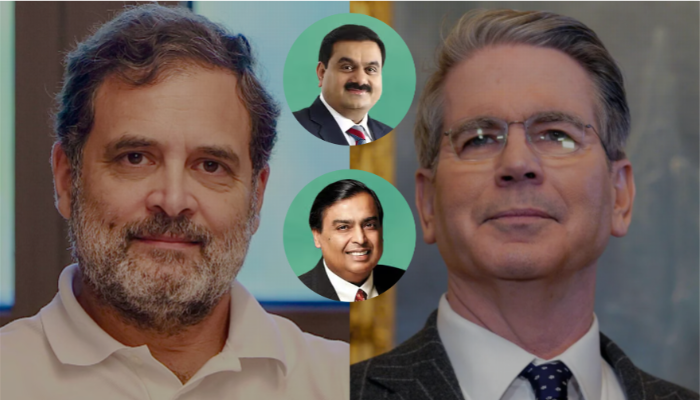
Rahul Gandhi’s Adani-Ambani jibe imported from the US? Treasury Secretary Scott Bessent charges ‘India’s richest families’ are profiteering from Russian oil

Rahul Gandhi has persistently criticized businessmen Gautam Adani and Mukesh Ambani in order to attack the Modi government over past many years. He has repeatedly accused the nation’s wealth creators, associating them with every decision made by the government to assert that Prime Minister Narendra Modi is colluding with them and formulating policies that favor their interests, even in the face of no evidence.

The Gandhi scion’s determination without any substantiation appears to have a foreign link that recently came to the fore. On 19th August the United States Treasury Secretary Scott Bessent accused the wealthiest families in India of profiting from the significant rise in Russian oil purchases during the Ukraine conflict. He even stated that it was “unacceptable” to the Washington.

“If you go back and look now, I believe India had less than 1% of their oil. And now I believe it’s up to 42%. So, India is just profiteering. They are reselling. They made $16 billion in excess profits. Some of the richest families in India. So, this is a completely different thing. What I would call the Indian arbitrage, buying cheap Russian oil, reselling it as product has just sprung up during the war, which is unacceptable,” Bessent declared in an interview with CNBC.

“We have planned to up the tariffs on India, these are secondary tariffs for buying the sanctioned Russian oil,” Bessent threatened. He, similar to the hypocrisy displayed by US Secretary of State Marco Rubio regarding the exemption of China from tariffs, insisted that the nation has “diversified input of oil.”

Peter Navarro, the White House’s trade adviser even wrote an article in the “Financial Times” to defend the blatant dishonesty of his administration. He blamed “India’s oil lobby” for buying Russian oil.

Notably, China stands as the leading buyer of Russian oil, acquiring approximately 2 million barrels daily. However, the United States provides weak justifications to mask its double standards as it unsuccessfully tries to establish that Beijing is not financing the conflict in Ukraine, unlike New Delhi.

Rahul Gandhi’s redundant Adani-Ambani rhetoric

According to the Lok Sabha MP, the two billionaires are behind everything in India, ranging from demonetization and GST to Make in India and now-scrapped farm laws as well as purchase of Rafale fighter jets. Their names are also mentioned in Parliament. “Two industrialists are controlling the country. If I cannot take their names in the house, then I will have to say something, I will just say A1 and A2. I will call Adani and Ambani A1 and A2 in Lok Sabha, this is acceptable, right,” he mocked.

“Union minister Kiren Rijiju is defending A1 and A2, he will do it because he is compelled to do so. He has orders from the top,” Gandhi alleged in a veiled attack on PM Modi.

He alongside Priyanka Vadra also spearheaded opposition protests against Gautam Adani, raising slogans on the Parliament grounds to call for a joint parliamentary investigation and discussion regarding Adani’s indictment in a United States court. He additionally urged PM Modi to address the Parliament on the matter.

It is important to note that Gandhi jumped the opportunity to target Adani following the proceedings in a US court, initiated by individuals connected to George Soros, without considering the merits of the case or the reality that the laws of a foreign nation have no bearing on India.

The animosity of Soros towards the Modi government and his ambition to establish a puppet administration of his preference in New Delhi is well-known as he has openly expressed his malicious intentions regarding India on public forums.

The Hungarian-American investor has leveraged his wealth to regularly undermine India, its democracy and its institutions through groups such as Ford Foundation, ADR (Association for Democratic Reforms) and Open Society Foundations, among others. These also promote the misinformation propagated by Gandhi and the left-liberal ecosystem as recently evidenced in relation to the Bihar Special Intensive Revision (SIR) initiative.

Furthermore, Gandhi even trivialized the matter of defense procurement to his petty accusations in the context of the Rafale deal, claiming “crony capitalism” after which he had to eventually apologise in Supreme Court for peddling falsehoods and associating them with the apex court.

Rahul Gandhi parrots nefarious narrative of foreign powers

The former Congress chief has repeatedly advanced the agenda of foreign powers by championing their causes and criticizing Indian businesses and the government on multiple occasions. The infamous Organised Crime and Corruption Reporting Project (OCCRP) published articles to hurt the image of the Adani Group and the hit pieces were celebrated as gospels truth by Gandhi to attack the mogul and the central government, resulting in a scathing reaction from the Bharatiya Janata Party.

Interestingly, the non-governmental organization is financially supported by American government agencies, especially USAID (United States Agency for International Development) which is notorious for its regime change operations globally, including in Bangladesh and for destabilizing countries to further the interests of Washington. The US government agency even aimed for a color revolution in India but their wicked designs could not materialise.

These credentials should have been sufficient to highlight their “unbiased” operations concerning India or the Adani Group. Nonetheless, Gandhi took it upon himself to serve as their extended arm in the country and peddled their narrative.

Likewise, Gandhi used the US-based short-seller Hindenburg Research reports to attack Adani, the Modi government and even the Securities and Exchange Board of India (SEBI) with charges of “gravely compromising integrity of the securities regulator,” which were later exposed.

On the other hand, the Israeli intelligence service “Mossad” discovered a connection between Hindenburg Research, Rahul Gandhi and Sam Pitroda, the leader of the Indian Overseas Congress (IOC), in a startling revelation. According to the report, the agency unearthed connections between Gandhi and the Hindenburg research team which was working to against Prime Minister Narendra Modi and the Adani Group.

Hindenburg Research accused the Adani Group of stock manipulation and accounting fraud in its January 2023 report, “Adani Group: How The World’s 3rd Richest Man Is Pulling the Largest Con in Corporate History.” It resulted in significant financial losses for the Adani Group due to statements made against the company and its founders.

However, the Indian conglomerate received a clean chit from the Supreme Court in 2024. Afterward, Hindenburg Research abruptly stopped operations in January 2025, ending Gandhi’s attempts to tarnish the reputation of Indian firms with its aide.

Gandhi joins Washington’s agenda to hamper India’s interests

The parliamentarian offered his two bits in light of the ongoing tariff dispute between New Delhi and Washington, not to support India but to encourage the Western power to investigate Adani to disrupt the Modi administration’s acquisition of Russian oil. He might have conveniently overlooked or purposefully incited Trump, knowing that such remarks could only harm Indian interests.

Earlier, he also supported Trump’s claims of mediation between India and Pakistan which were at odds with his own government’s statements. Hence, the fresh commnets made by Bessent, consistent with Gandhi’s allegations on Adani-Ambani have brought new insight into the Congressman’s recurring actions. Both Washington and Gandhi have set their sights on Indian businesses and want to weaken them.

As expected, in his frantic attempts to bring down the Modi government, Gandhi does not even hesitate to jeopardize the interests of his country. He always seems to have joined forces with those who seek to either hurt India or push it into submission, treating it as a vassal state akin to Pakistan.

This instance is no exception. The assertiveness and sovereignty of India have not been well received by these powers which are intent on punishing the country for it. Meanwhile, the Congress leader is apparently siding with the opposing side for trivial political ambitions, thus endangering the long-term interests of India.

Gandhi, rather than questioning the moral corruption of Washington has aligned himself with them to confront India. Having been out of power for more than a decade, with no foreseeable opportunity for a return has only intensified his antagonism. He remains undeterred by the prospect of being associated with India’s rivals as he relentlessly attacks Indian interests, ironically, all in the hope of regaining power in the same country.