The family of 23-year-old Christian girl Sona Eldos from Kothamangalam, Kerela has made serious allegations against her muslim boyfriend Ramis and his family after the girl committed suicide on Saturday, 9th August, in Kochi district of Kerala.
They said Sona was pressurised to convert to Islam for marriage and was subjected to harassment.
According to a report by News 18, Sona and Ramis, a native of Paravoor, fell in love during college. Later, Ramis’s family told her she would have to leave the church and convert to Islam if she want to marry him. Sona had reportedly agreed at one point, but her family says she was still treated cruelly.
Her brother told News18 that after their father passed away 40 days ago, the family had planned to hold the wedding for a year. However, he said that Ramis took Sona to his house, where she was locked in a room and beaten in the presence of family and friends.
The brother also claimed that in the past, Ramis had been involved in immoral activities but Sona had forgiven him. On the day of the incident, she was reportedly told again to register the marriage and change her religion. When she refused, Ramis told her she was “better off dead.”
Sona’s brother said she left a note saying she was being forced to convert to Islam. Soon after, she took her own life.
The family has called for a thorough investigation into the case, saying Sona’s death was the result of mental torture and religious pressure from her boyfriend and his family.
The Special Intensive Revision of the electoral roll in poll-bound Bihar has opened a Pandora’s box, exposing how illegal voters backed by forged documents and political patronage have infested Indian democracy. The Election Commission of India uncovered over 60 lakh unverified voters during the SIR exercise in Bihar. However, the opposition parties have stirred a political storm, claiming that the SIR exercise is a ‘conspiracy’ to disenfranchise a specific group of voters, especially Muslims.
First, RJD and Congress opposed the SIR exercise and raised questions over the integrity of the ECI, claiming that it is functioning at the behest of the BJP. Now, they are crying hoarse over the SIR findings as well as the nationwide crackdown on illegal Bangladeshi immigrants.
Notably, a research paper by professors from the prestigious IIM institutions had already cautioned about the same and indicated that there are more than 70 lakh bogus voters in Bihar.
Interestingly, the drive disclosed that 35 lakh people were either untraceable or had permanently relocated, 22 lakhs were labelled as deceased, and 7 lakh voters were enrolled in multiple locations, while about 1.2 lakh forms are pending.
What started as ECI’s efforts to weed out fake voters from the electoral roll in Bihar has renewed the vigour of the ongoing anti-illegal immigrant campaign across several states.
Predictably, the drive to detect, detain and deport illegal Bangladeshi and Rohingya Muslim immigrants has anguished the ‘secular’ political parties in the country.
Mamata Banerjee ‘reminds’ BLOs that they work for the state government, not the ECI
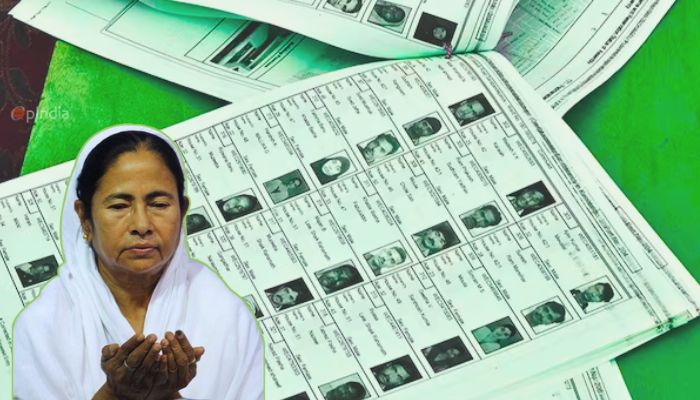
Amidst a crackdown on illegal immigrants in Haryana and other states (BJP ruled) and the SIR in Bihar, West Bengal Chief Minister Mamata Banerjee, whose government has been accused of aiding illegal infiltration to increase its vote bank, has opened a front against the BJP.
CM Banerjee, who once vowed to never allow implementation of the NRC in West Bengal, has repeatedly been attacking the Modi government over the detention of suspected Bangladeshi and Rohingya illegals, claiming that they are Bengali migrants.
The West Bengal Chief Minister has ‘reminded’ the Booth Level Officers (BLOs), who are presently undergoing training for summary revision by the Election Commission of India, that they work for the state government and not the ECI. She said authoritatively that the names of voters should not be excluded from the electoral process arbitrarily.
Addressing an administrative meeting in Birbhum in July this year, CM Banerjee said, “The ECI takes over only after the poll dates are announced. Until then, and even after that, the administration lies with the state government. You are employees of the state government. Do not harass any individual needlessly.”
Her supposed ‘reminder’ for BLOs came across more as a threat. Further casting aspersions on the integrity of the Election Commission and accusing the body functioning at the behest of the BJP, Banerjee said, “The (voters’) list is being prepared by people sitting in Gujarat. An agency of the BJP is doing this. I know its name. You will see chhau dance (a tribal dance) and face the music of drums and conch shells if you dare to strike off names from the voters’ list in Bengal. I won’t allow the NRC to be implemented and set up detention camps till I am alive.”
West Bengal is the state with the highest number of illegal Bangladeshi immigrants living with forged documents and local help
Apparently, the Trinamool Congress supremo fears that if and when a Special Intensive Revision is conducted in West Bengal, lakhs of fake voters, especially illegal immigrants who have obtained forged documents, would be weeded out. It is not a secret that West Bengal is among the states with the highest numbers of illegal Bangladeshi immigrants. In the last three years, 2688 Bangladeshi nationals were apprehended and sent back to Bangladesh.
On 8th August, the TMC government sought a ‘clarification’ from West Bengal Chief Election Officer (CEO) over reportedly writing to the Election Commission of India that the state is “ready” to undergo the SIR exercise. Last week, the ECI published the 2002 SIR voters’ lists for 293 Assembly Constituencies (ACs) except one.
Notably, the last SIR in West Bengal occurred in 2002, forming the foundation for the 2004 electoral roll. It is, thus, highly likely that an SIR will be conducted in West Bengal later this year. It is notable here that updating the electoral roll and crossing out mistakes, deceased persons, and other discrepancies is one of the basic duties of the Election Commission.
While a ‘secular’ government (read Muslim-appeasing) in West Bengal is already ‘reminding’, ‘threatening’ and is outraged over the possible SIR exercise in the state, electoral roll inflation in the politically and communally charged state is real.
Research paper by IIM professors finds 1 crore excess voters in the 2024 West Bengal electoral roll
The findings of a research paper tiled: “Electoral Roll Inflation in West Bengal: A Demographic Reconstruction of Legitimate Voter Counts (2024)”; authored by Dr. Milan Kumar, Assistant Professor at the Indian Institute of Management Visakhapatnam and Dr. Vidhu Shekhar, Assistant Professor at SP Jain Institute of Management & Research, an alumnus of IIT Kharagpur and IIM Calcutta, reveal that the 2024 electoral roll of West Bengal may include approximately one crore excess voters, recording an inflation of whopping 13.69%.
The research paper published on 7th August 2025, relies on official data from electoral rolls, census, and civil registration systems, to estimate the surviving voters from the 2004 base roll, additions through new cohorts (1986-2006 births), and adjustments for net permanent migration. The researchers employed a conservative methodology at each stage.
“We assume full registration among all eligible youth, apply high survival probabilities, and model migration based on decadal trends rather than recent acceleration. This allows us to generate a lower-bound estimate of the legitimate voter population. We then compare this figure to the official electoral roll published by the ECI for 2024,” the research paper states.
Highlighting its central finding that West Bengal’s 2024 voter list may contain more than one crore excess entries, representing a 13.69% inflation over the estimated legitimate electorate, the IIM professors raised concerns that such massive discrepancy, and its potential to affect electoral outcomes in a highly competitive state, “the implications for electoral integrity are significant.”
The research presents the empirical estimates of the legitimate voter population in West Bengal as of 2024, in three stages: (i) estimation of survivors from the 2004 roll, (ii) additions from new voter cohorts born between 1986 and 2006, and (iii) adjustments for net permanent migration. The researchers then synthesised the results to compute the estimated surplus in the electoral roll.
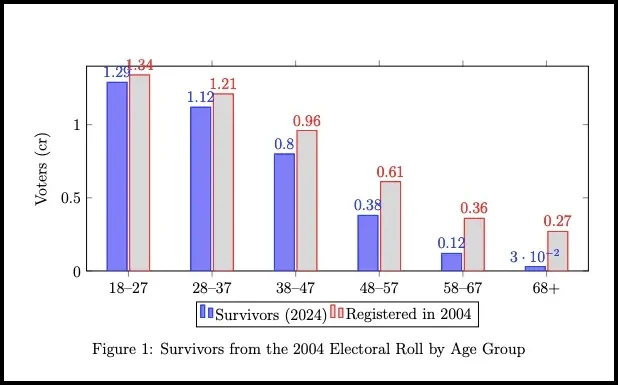
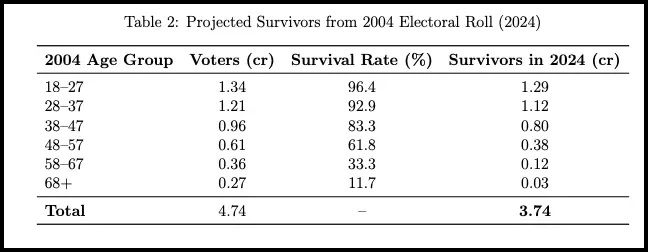
The 2004 electoral roll recorded 4.74 crore registered voters. The research disaggregated this population into six age groups and applied age-specific 20-year survival rates, using Census 2001 data. These projections yield an estimated 3.74 crore surviving voters from the 2004 roll.
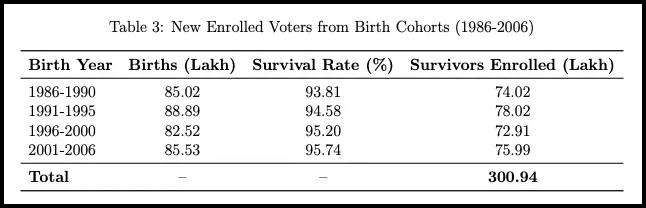
Further, the researchers estimated that approximately 3.01 crore newly eligible individuals would have enrolled between 2004 and 2024.
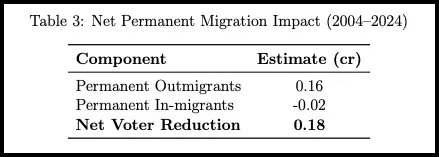
The research then proceeded to estimate permanent outmigration and in-migration using Census 2001 and 2011 data. The analysis found that West Bengal experienced a decline in the absolute number of immigrants between 2001 and 2011.
Using Census 2001 and 2011 data and extrapolating via CAGR, the researchers estimated net permanent outmigration from West Bengal to be 17.86 lakh individuals during this period.
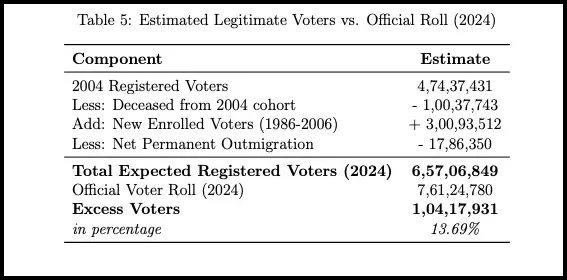
The researchers then combined all components to synthesise the data and to arrive at the final estimate of the legitimate voter population in West Bengal in 2024. The number of 2004 Registered Voters stood at 4,74,37,431. Deceased from 2004 cohort -1,00,37,743. The number of New Voters (1986–2006) is 3,00,93,512. Meanwhile, Net Migration estimates stood at -17,86,350.
The analysis states that the estimated number of legitimate voters (2024) is 6,57,06,849, while the number of voters per the official electoral roll (2024) is 7,61,24,780. This marks an estimated surplus of 1,04,17,931 voters, which in percentage translates into 13.69%.
The research emphasises that its final findings are a lower-bound estimate and the actual inflation may be significantly higher.
“These results imply that approximately 1.04 crore names, or 13.69% of the 2024 electoral roll, may not correspond to legitimately registered resident voters in the state. As noted throughout, our assumptions deliberately overestimate the legitimate count, suggesting that actual roll inflation may be even higher,” the research paper reads.
It further points out that a massive surplus of over 1 crore names raises questions over the credibility of electoral administration in the Trinamool Congress-ruled West Bengal. The report stresses that the scale of over-registration exceeds the margin of victory in numerous constituencies and “creates scope for fraud, impersonation, and political manipulation.”
“The study suggests an urgent need for tighter integration of electoral data with civil registration databases, Aadhaar, and interstate migration records. Algorithmic checks for implausible entries, such as centenarian clusters or multi-located registrations, coupled with quarterly demographic audits, could significantly improve roll accuracy and restore voter confidence,” the research paper reads.
The research also recommends an urgent Special Intensive Revision in West Bengal and other states, which have not had one in the last two decades, saying that a fresh SIR would enable door-to-door verification, linkages with death records, and targeted purging of inflated pockets at the constituency level.
Senior Chinese diplomat Liu Jianchao was detained as soon as he returned from a foreign tour in late July 2025. According to the Wall Street Journal report, 61-year-old Liu Jianchao was detained for questioning by Chinese authorities after returning to Beijing. The reason for his detention remains unclear.
According to reports , Liu has been the head of the Communist Party’s International Liaison Department since 2022, which maintains relations with foreign political parties. He has visited more than 20 countries and met more than 160 global leaders. His meeting with former US Secretary of State Antony Blinken brought him into the forefront as the next foreign minister.
Notably, China’s State Council Information Office and the Communist Party have not commented on the action . Experts say the action could be a sign of strict discipline and internal changes in China’s diplomacy. It is believed to be the biggest diplomatic investigation since the removal of former Foreign Minister Qin Gang in 2023.
In July this year, Liu had slammed the United States’ defence defence chief, accusing him of “inciting confrontation and conflict” by calling on American allies to bolster their militaries to counter China.
Liu led a CPC delegation that attended the Liberation Movements Summit in South Africa on 28th July. His detention comes ahead of the Shanghai Cooperation Organisation (SCO) summit scheduled to take place from 31st August to 1st September.
The Special Intensive Revision (SIR) campaign by the Election Commission in the election-bound state of Bihar has been relentlessly targeted by the opposition and its ecosystem. From threatening to boycott the elections to labeling the process as voter fraud, various allegations have been directed at the EC by the anxious leaders of the Mahagathbandhan and their supporters.
Notably, these accusations have been repeatedly debunked by the relevant authorities. Nevertheless, this controversy doesn’t seem to be subsiding any time soon.
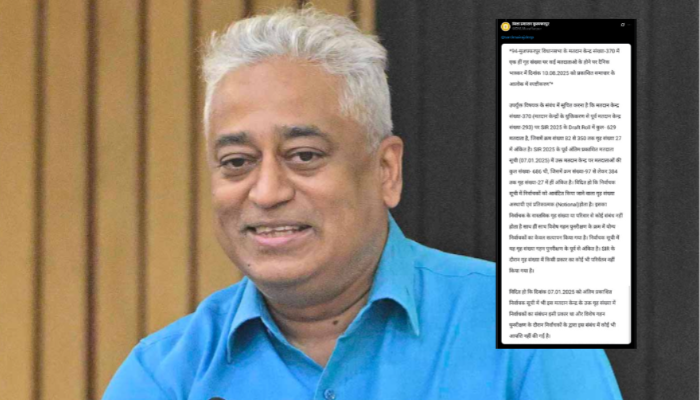
Now, India Today journalist Rajdeep Sardesai quoted a Dainik Bhaskar report to assert that the entire procedure is being conducted in a rushed manner.
Sardesai wrote, “We need a ‘purification’ of electoral rolls but a hastily done revision is not the solution,” on social media. He also lauded the media outlet for its “fine reporting” and for being the only “Hindi mainstream newspaper consistently raising the issue.”
The report was published on 10th August concerning polling station number 370 in 94-Muzaffarpur assembly, stating the presence of several voters at the same residential address.
However, the Muzaffarpur district administration swiftly countered Rajdeep’s attempt to question the crucial campaign. “Concerning the aforementioned report, it is important to note that in the Draft Roll of SIR 2025, there are 629 voters registered at polling station number 370 (which was polling station number-293 prior to the rationalization of polling stations)”, they stated
“Within this group, serial numbers 82 to 350 are listed under house number 27. In the most recent voter list published on 07.01.2025, before SIR 2025, the total number of voters at this polling station was 686, with serial numbers 97 to 384 recorded solely under house number 27,” Muzaffarpur administration further conveyed and highlighted that the house number assigned to voters in the electoral list is provisional and notional.
The administration mentioned that it is not derived from the actual house number or the voter’s identification number. There is no connection to the family and during the special intensive revision only the verification of eligible voters was conducted. They further said that the house number appears in the electoral list prior to the intensive revision. No alterations of any sort have been made to the house number during the drive.
The authorities further added, “It is noteworthy that in the final submission electoral list dated 07.01.2025, the voters in the specified house number of this polling station was similar and no objections were raised by the voters concerning this matter during the special intensive revision.”
The SIR drive is designed to eliminate fraudulent voters and ensure that only eligible individuals retain the right to participate in elections. Members of various political parties have also been invloved throughout the process.
According to the updated list, around 65 lakh names have been struck off the rolls in the state. The struck-off names primarily consist of deceased persons or those who could not be located at their registered addresses. But what’s surprising is the large-scale deletion of names in some districts, particularly in Muslim-dominated Kishanganj. Here, a record 1.45 lakh names have been removed from the list. This amounts to an astonishing 11.8% of the district’s total voter base. It can easily tip an election in which even a 4–5% margin can make a difference.
On 3rd August, the Election Commission of India (ECI) revealed that it has received 941 claims and objections related to Bihar’s draft electoral roll. However, not a single complaint out of the 941 has been filed by any political party including the Indian National Congress and Rashtriya Janata Dal (RJD).
On 11th August, the Supreme Court of India directed the authorities in Delhi to pick up all stray dogs, especially from vulnerable localities. The court passed the order while hearing a suo motu case on the rising number of dog bite cases and rabies fatalities caused by stray dog bites in the National Capital. The court warned that strict action will be taken against any and all organisations and individuals who obstruct the process. The order will extend to outskirts that is Noida, Ghaziabad and Gurugram.
Order: The aforesaid directions shall be complied with and implemented strictly. Any hindrances that may be caused in smooth and effective implementation of aforesaid directions would be viewed as contempt of this Court and we shall be proceed to take appropriate action. Notify…
‘Will they be able to bring back those who have fallen prey to rabies?’
A Bench comprising Justice JB Pardiwala and Justice R Mahadevan expressed alarm over recent reports, including a Times of India article, highlighting how elderly people and children remain the most affected by rabies. Justice Pardiwala emphasised that the matter was being pursued in the public interest and sentiments should not cloud decisive action. He directed, “Pick up dogs from all localities and shift them to far-off places.”
Order: We heard Mr. Gaurav Agarwal, learned Amicus and Tushar Mehta Learned Solicitor General. What we have been able to gather …the situation is grim. Immediate steps need to be taken.
In the course of hearing, learned Amicus provided us with some information.
Additional Solicitor General Tushar Mehta thanked the Bench and stated that parents he had spoken to appreciated the court for taking action and stressed the need to safeguard children’s lives. He flagged grave concerns about the situation in several parts of Delhi and its outskirts and noted that previous relocation efforts were stalled due to a stay order obtained by a dog rights activist.
This prompted Justice Pardiwala to pointedly ask whether these activists could bring back those who had lost their lives to rabies.
Strict directives for shelters and dog-free localities
In its order, the Court directed the NCT of Delhi, MCD and NDMC to create dog shelters with adequate staff for sterilisation and vaccination. The court ordered the installation of CCTV cameras to ensure no dogs are released back onto the streets. Furthermore, the court told the authorities to begin picking up stray dogs immediately, giving priority to vulnerable localities, and to create a dedicated force if needed.
“The first and foremost exercise must be to make all localities free of stray dogs,” the order stated, adding that there must be no compromise in carrying out the exercise. It warned that individuals or organisations obstructing the rounding up of stray dogs would face legal action.
“Any hindrances that may be caused in smooth and effective implementation of aforesaid directions would be viewed as contempt of this Court and we shall be proceed to take appropriate action,” The court said.
OpIndia is doing a series on the stray dog menace in India which can be checked here.
On 6th August, the Delhi High Court stressed the urgent need to remove stray dogs from the streets and rehabilitate them in institutional shelters. The Court stated that measures must go beyond sterilisation and said that the ABC programme has failed in the National Capital despite being “touted for decades” as the solution.
Justice Mini Pushkarna was hearing a matter related to stray dog activist Pratima Devi, whose shanty was demolished by the MCD in 2023. Pratima Devi was providing food and shelter to around 200 stray dogs at that time, leading to massive outrage among animal lovers.
The Court observed that dogs are “the most loved animals of the world and a great friend of humans. It should be ensured that they are protected and treated with dignity”. She further highlighted the problem of the increasing number of stray dogs in the city by stating, “either dogs should be at home, or at a shelter. Not on roads eating garbage. Humans and dogs both are suffering. Neither humans are safe, nor dogs due to this.”
Sterilisation centres non-functional
The Court noted that the Delhi Government’s only proposal so far was sterilisation, which falls in line with the Animal Birth Control Rules, 2023. However, the ABC centres in the city, as the Court observed, are non-functional and the objective behind them is not being met. The Court remarked, “Sterilisation isn’t working at all. It’s not the solution,” and brought the ABC Rules under scrutiny as they have failed to control the stray dog population in the country.
The Court also recorded in its order that 78 veterinary hospitals in Delhi are currently non-operational. During the hearing, it was revealed that around 200 dogs housed in a temporary shelter were to be released back onto the streets as the shelter was to be demolished by the MCD. It raised serious concerns, as more stray dogs mean a higher possibility of stray dog attacks and animal–human conflict.
Data shows thousands bitten in Delhi
As per data presented in the Lok Sabha, Delhi recorded 17,874 dog bite cases in 2023 and 25,210 dog bite cases in 2024. In January 2025 alone, the city saw 3,196 cases. There is a clear spike in stray dog bite cases in the National Capital. The figures underline the scale of the problem, with the High Court’s observations reinforcing that the current ABC framework is failing to control the menace.
The Supreme Court of India recently took suo motu congnisance of the stray dog menace in the country after a Times of India report highlighted death of a young girl child due to rabies.
OpIndia is doing a series on the stray dog menace in India which can be checked here.
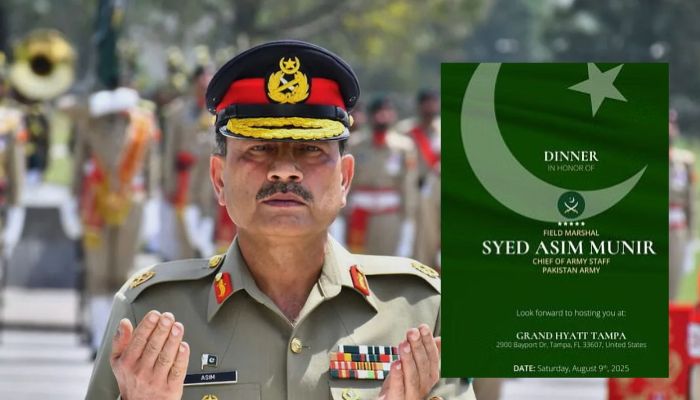
On 9th August (local time), Pakistan’s military chief, Field Marshal Asim Munir, has reportedly issued a nuclear threat against India while speaking at a dinner in Florida, United States. According to a report in The Print, Munir warned that if Pakistan faced an existential threat in a future war, “we are a nuclear nation, if we think we are going down, we’ll take half the world down with us.”
Nuclear warning from US soil
This is the first time a Pakistani military leader has issued such a nuclear threat from US soil against a third country. The dinner, where the remarks were made, was hosted by businessman Adhnan Asad, who is the honorary consul of Pakistan in Tampa. Munir also commented on India’s suspension of the Indus Waters Treaty and warned that it would starve 250 million people.
He reportedly threatened to blow up the dam India is building. He said, “We will wait for India to build a dam and when it does, we will destroy it with 10 missiles.” Munir emphasised that Pakistan had “no shortage of missiles” and claimed the Indus River was “not the Indians’ family property.”
Notably, the Indus Waters Treaty was suspended by India following the Pahalgam terrorist attack that claimed the lives of 26 Hindus. Terrorists linked to The Resistance Front (TRF), an offshoot of Pakistan-based terror outfit Lashkar-e-Taiba, killed Hindus after confirming their identity.
Islamic verses and war references
According to the report, Munir referred to a previous social media post which he admitted to having got done, which featured Surah Fil and a photograph of Indian business tycoon Mukesh Ambani, to signal what Pakistan would “do the next time.” Surah Fil recounts a Quranic story where birds dropped stones on enemy war elephants and destroyed them. It was a direct threat to the life of the Indian businessman.
Munir reportedly said Pakistan would “start from India’s East, where they have located their most valuable resources, and then move westwards.” Notably, Bangladesh’s interim chief Muhammad Yunus had also threatened to occupy the Seven Sisters, the seven states of Arunachal Pradesh, Assam, Manipur, Meghalaya, Mizoram, Nagaland and Tripura, in India’s northeast.
Mocking India and using analogies
Munir did not stop there and went on to mock India for its refusal to publicly reveal its losses during the “Four-Day war” of May. He said, “Sportsman spirit is a virtue.” He compared India to a “shining Mercedes” and Pakistan to a “dump truck full of gravel,” suggesting that a collision would hurt the car more than the truck. However, while doing so, he inadvertently admitted that Pakistan stands nowhere when it comes to comparison on economic levels with India.
Religious justification for Pakistan’s destiny
Munir described Pakistan as one of only two states founded on the basis of the Islamic profession of faith, alongside the Prophet Muhammad’s Medina. He incorrectly claimed that Medina was renamed Tayyiba, and said God had rewarded Medina with resources, just as Pakistan would be blessed with rare earths, minerals, and hydrocarbons.
The guests at the event were not allowed to carry mobile phones. This report is based on a reconstruction of the speech by The Print, based on statements by several guests.
A F-35B fighter jet of the British Navy made an emergency landing at an airport in Japan after facing technical issues. As per a report by Japanese broadcaster NHK, the jet landed at Kagoshima Airport in Kirishima City just after 11.30 AM on 10th August.
The airport office said that the fighter pilot contacted air traffic control stating that he was experiencing a possible mechanical problem and wishing to make an emergency landing. Accordingly, the jet was allowed to land at the airport.
As a result, the airport’s runway was closed for around 20 minutes, and some scheduled flights were delayed. However, after the jet was moved to a taxiway and safety at the airport was confirmed, airport operations resumed.
Reportedly, the fighter jet is part of the British aircraft carrier, the HMS Prince of Wales. The British military is currently deploying several ships, including the Prince of Wales, to the Western Pacific. They are conducting a joint training with the Japan’s Maritime Self-Defense Force and the U.S. military until the 12th.
This is the second such incident with the F-35B of the British Navy, that too from the same carrier. Earlier in June, a F-35B made an emergency landing at Thiruvananthapuram in Kerala after facing bad weather and hydraulic system failure. The aircraft could not take off after landing on 14th June, and several teams of technicians failed to repair it at the airport for weeks.
After over three weeks, a Royal Air Force (RAF) transport aircraft carried equipment and experts to fix the jet. The jet finally left India on 22 July, after being stranded for five weeks.
While F-35 is one of the most advanced and complex fighter jet, its naval variant, the F-35B, is even more complex. This is because of the short takeoff and vertical landing capability.
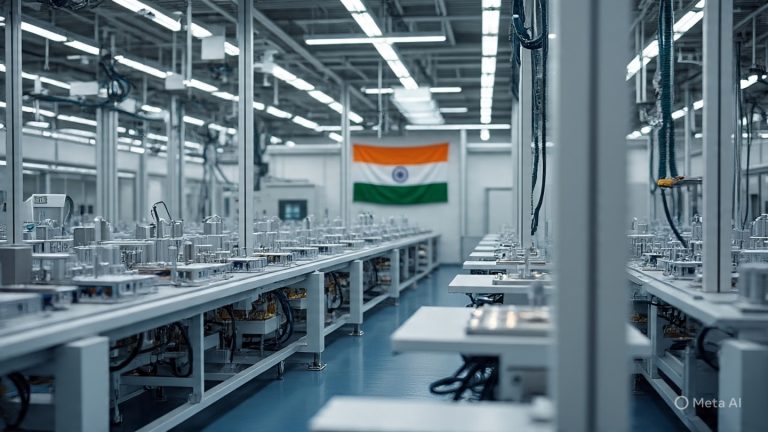
Union Information and Technology Minister Ashwini Vaishnaw on Sunday said that India’s first made-in-India chip will be rolled out “very soon” as six semiconductor plants are under construction in Gujarat, Assam and Uttar Pradesh. Addressing the ‘Next-Gen Mobility for a Next-Gen City’ programme here, the Minister said, “Today there are six semiconductor plants under construction in our country and very soon we’ll see the first made in India chip roll out of these factories.”
Emphasising government’s resolve for the easy accessibility of Artificial Intelligence (AI) technologies, Vaishnaw said, “AI is shaping our world today. Our Prime Minister’s vision is of democratising technology. It should be accessible to all. It should not be limited to a few. It should be available to all. That’s why we have done the India AI mission in which 34,000 GPUs (Graphics Processing Units) are available today as a common compute facility for all our innovators.”
“The price of these GPUs is just less than USD 1 per hour. And this is the most affordable common computer facility in the entire world,” the Minister added.
Speaking at the same event, Prime Minister Narendra Modi also emphasised India’s priority to become “self-reliant” in the technology sector, stating that the country will soon have its “Made in India” chip as the semiconductor mission gains momentum. PM Modi stressed that the journey of “Viksit Bharat” will move forward hand in hand with the Digital India initiative. He noted that with the India AI Mission, the country is advancing towards global AI leadership.
“Our next big priority should be becoming self-reliant in technology. The journey to a Viksit Bharat will move forward hand in hand with Digital India. Through initiatives like the India AI Mission, India is advancing toward global AI leadership. He added that the Semiconductor Mission is also gaining momentum, and India will soon have its own Made-in-India chip”, PM Modi said.
In May, the Union Cabinet approved India’s sixth semiconductor manufacturing unit in Jewar in western Uttar Pradesh. It will be established near Jewar Airport through a joint venture between the HCL Group and Taiwanese electronics giant Foxconn.
The sixth unit is expected to generate employment for around 2,000 people and will help significantly in strengthening India’s semiconductor ecosystem. The unit at Jewar will have a 20,000 wafers per month capacity, and the chips will have 36 million (3.6 crore) per month.
Among other five semiconductor plants, four are in Gujarat: Tata Electronics–PSMC Semiconductor fab, CG Power–Renesas–Stars Microelectronics ATMP unit, Micron Technology’s ATMP unit and Kaynes Semicon ATMP unit, while the Tata Semiconductor Assembly and Test (TSAT) Unit is in Assam.
In 2024, the Government of India launched a comprehensive initiative called the India AI Mission aimed at positioning India as a global hub for artificial intelligence (AI) research, innovation, and adoption. The mission focuses on developing AI solutions across key sectors such as healthcare, agriculture, education, smart cities, and infrastructure to drive socio-economic growth.
The strategy includes capacity building, development of research ecosystems, and partnerships between government, industry, and academia. The government has also approved the Semicon India programme with a total outlay of Rs 76,000 crore for the development of a semiconductor and display manufacturing ecosystem in the country.
On the other hand, to promote the semiconductor ecosystem, the central government, in June, introduced pioneering reforms in the Special Economic Zones (SEZ) rules. The reforms aim to address the specialised needs of the semiconductor and electronics component manufacturing sectors.
Since manufacturing in these sectors is highly capital-intensive, import-dependent and involves longer gestation periods before turning profitable, rule amendments have been carried out to promote pioneering investments and boost manufacturing in these high-technology sectors.
Going further, Vaishnaw informed that India has become the top supplier of smartphones to the United States, with electronics manufacturing now worth Rs 12 lakh crore. He said that India’s electronic production has grown six times in the last 11 years.
The Minister further pointed out the exponential rise in electronic exports, which have increased eightfold to reach 3 lakh crore rupees. Vaishnaw also noted India’s position as the world’s second-largest manufacturer of mobile phones, underscoring the country’s expanding role in the global electronics market.
“Our electronic production has grown 6 times in the last 11 years. Today, electronics manufacturing has touched 12 lakh crore rupees. Electronic exports have increased by 8 times… Today, it has grown to 3 lakh crore rupees. India has become the second-largest manufacturer of mobile phones in the world” he said.
According to official government data, India has made significant progress in mobile and electronics manufacturing, becoming the world’s 2nd largest mobile manufacturing country. In 2014, India had only 2 mobile manufacturing units, but fast forward to today, the nation boasts over 300 manufacturing units, underscoring a significant expansion in this vital sector.
In 2014 -15 only 26 per cent of the mobile phones which were being sold in India were made in India, the rest were being imported. It is worth mentioning that today, 99.2 per cent of all mobile phones which are sold in India are made in India. The manufacturing value of mobile phones has surged from Rs 18,900 crore in FY14 to a staggering Rs 4,22,000 crore in FY24.
A team of researchers from Tezpur University has created an affordable, portable device that can detect Tuberculosis (TB) using a smartphone, offering new hope for early and accessible diagnosis in rural India.
Designed for rural healthcare
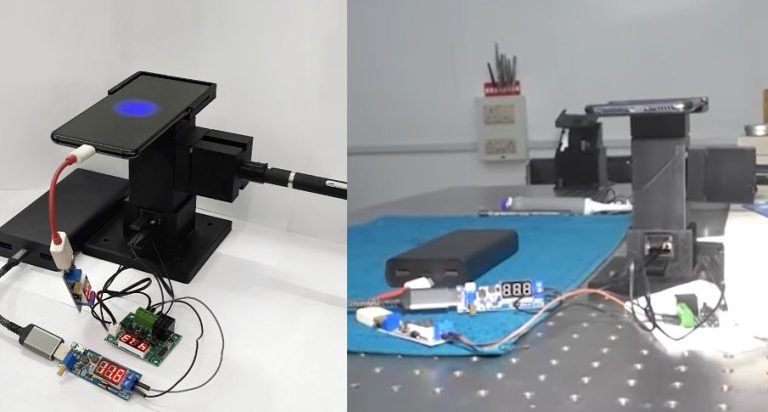
Developed under the leadership of Prof Pabitra Nath from the Department of Physics, the device is specifically tailored for areas with limited medical infrastructure. Unlike conventional TB testing, it does not require chemical dyes or expensive laboratory facilities. Instead, it harnesses the natural glow (autofluorescence) of TB bacteria for detection, supported by a built-in heating system that improves accuracy.
Weighing less than 300 grams and costing under ₹25,000, the device is light, cost-effective and easily portable. These features make it a practical solution for regions where advanced healthcare facilities and trained technicians are scarce.
Overcoming challenges of current methods
Currently, the World Health Organisation and India’s National TB Elimination Programme recommend LED fluorescence microscopy (LED-FM) as the gold standard for TB screening. However, as Prof Nath explained, LED-FM has limitations due to its reliance on costly equipment, chemical staining agents such as auramine-O, and trained personnel for sample preparation. Its dependence on laboratory settings makes it unsuitable for many rural areas.
“The device we developed leverages the principle of autofluorescence, a natural property of certain microbial cells, including Mycobacterium tuberculosis. By integrating a heating element within the sensor system, the device amplifies the natural fluorescence signal, enabling trace-level detection without stains or dyes,” Prof Nath said.
Team effort and recognition
The project team includes research scholars Biprav Chetry and Chunuranjan Dutta, Dr JP Saikia and Santanu Goswami from the Department of Molecular Biology and Biotechnology, and Abhijit Gogoi from Labdig Innovations and Systems Pvt Ltd. A patent has already been filed (Indian Patent Application No. 202431035472), and the findings have been published in the international journal Biosensors and Bioelectronics.
Congratulating the researchers, Vice Chancellor Prof Shambhu Nath Singh said the innovation has the potential to make a significant impact in the fight against TB, particularly in underserved rural communities.