On Saturday, Iranian actress and model Mandana Karimi slammed Hindustan Times for misquoting her in the news article related to filmmaker Sajid Khan joining Bigg Boss season 16. Recently, the actress expressed her displeasure towards the makers of the TV show Bigg Boss for inducting Sajid Khan as a contestant in its 16th season.
Karimi, who had accused Sajid Khan of harassment during the MeToo movement, said that there was no respect left for women in the film industry and that the makers of the show were supporting sexual predators. However, Hindustan Times happened to report that the actress had decided to quit Bollywood after Khan joined Bigg Boss 16.
“Mandana Karimi quits Bollywood after #MeToo accused Sajid Khan bags Bigg Boss 16: This is no place to work, it has no respect for women”, the title of the news article read including her opinion on Khan being inducted in Big Boss. “For people, life has become like if it’s going to benefit me and I can make money, who cares? The industry is a place where someone is someone’s mum, boyfriend, girlfriend, or husband. It’s like, you scratch my back and I will scratch yours”, she said in her interview.
Mandana Karimi also added that she has no desire to work in the Bollywood industry anymore. “I didn’t go for any auditions. I don’t want to work in Bollywood. I don’t want to be associated with an industry where there is no respect for women”, she said. However, the news organization misreported that the actress didn’t desire to work in Bollywood after Sajid Khan joined Bigg Boss 16.
The actress took cognizance of the incident and slammed the newspaper for misquoting her. “Shame! @htTweets“, she tweeted while sharing her conversation with the newspaper’s journalist.
Mandana Karimi alleged in 2018 that when she had gone to meet Sajid Khan for the movie Humshakals, he had asked her to remove her clothes. He had allegedly told her, ‘If I like what I see, you might get the part’. Along with Mandana, several other celebrity women have expressed their displeasure towards the makers of Bigg Boss for inducting Sajid Khan as a contestant in Bigg Boss 16. The list includes model Urfi Javed, author Mohua Chinappa, film critic Sucharita Tyagi and singer Sona Mohapatra.
Hindus in Pakistan being subjected to discrimination, forced conversions, rape and murder is an everyday story in the Islamic Republic of Pakistan. In yet another horrific incident exposing deep-routed Hinduphobia in Pakistan, a Hindu man was stripped, brutally assaulted by a police constable, and chased to the drain well where he died.
The heart-wrenching incident took place in the Tando Mohammad Khan area of Sindh in September. A 35-year-old Hindu man named Alam Kohli was brutally thrashed by a police constable named Qadir. Kohli’s family has accused constable Qadir of throwing him into the drain well, however, the police have registered an FIR of death by suicide. Notably, the accused has not been arrested yet.
35 yrsold man, Hindu Man named Alam Kohli, was beaten up by Muslim police constable Qadir in Pakistan and later chased to the drain well from which his body was later discovered.#hindulivesmatterspic.twitter.com/EEYVaw6zdY
Alam Kohli who was a resident of Pandhi Wah had visited the civil hospital in the area where he got into a heated argument with on-duty police constable Qadir.
According to reports, the constable brutally assaulted Alam, and the act was recorded on CCTV. Alam managed to escape the hospital in an attempt to hide from the policeman. Reportedly the victim’s family has said that Alam was thrown into the well by the cop, which caused the death.
According to a report by Dawn, the victim’s family has claimed that Alam Kohli took the drastic step after he was beaten up by Qadir. Following the incident, Alam’s family blocked the Hyderabad–Sujawal road in protest and said that Alam had been visiting the hospital for two days due to a fever.
In another case of atrocities on Hindus in Pakistan, When a Hindu woman went to her Muslim landlord Mohammad Akram for pay, he stripped her, tormented her, and gang raped her. The incident happened in Pakistan’s Punjab province of Bhawalpur after the woman asked Muslim landlord Mohammad Akram for payment. Akram afterward returned to the woman’s residence and threatened her with guns. Then he kidnapped her, tortured and raped her. All she did was ask for payment of her salary, and in return, she was tied upside down with her face covered, beaten up, and gang-raped.
The victim reiterated her ordeal saying, “He kidnapped me and took me to an unknown place. Over there they stripped me naked and kept beating me.”
Despite the fact that Pakistani Hindus are subjected to such discrimination and torture, they have always been compassionate and helpful citizens. Amidst the ongoing floods in Pakistan last month, a Hindu temple, Baba Madhodas Mandir in Jalal Khan village in Balochistan opened its doors for providing food and shelter to roughly 300 flood-hit people, mostly Muslims.
Even such humane gestures fail to melt the hearts of the Hindu-hating lot in Pakistan depriving Hindus of food in a flood relief camp in Mirpur Mathelo, Sindh. The local flood relief camp had refused to even accept them as flood victims and expelled them from the relief camps.
#Hindu Bhagri community in Mirpur Mathelo, #Sindh province alleged that the local administration expelled them from the flood relief camp and told them that they were not flood victims. pic.twitter.com/degzAs4iMa
Nasrallah Gaddani, a local journalist who covered the plight of Pakistani Hindus in Sindh province was arrested in Ghotki.
It should be noted that a large section of the Hindu population in Pakistan’s Sindh region is among the country’s poorest. They face human rights violations in cases regarding land grabbing, abduction, and conversion. Fewer job opportunities are available to them, and many of them continue to work as bonded labourers for Muslim landlords. Hindus are frequently exploited as well, but they are afraid to report it to the authorities, and even if they do, the police do not take any strict actions.
On Wednesday (October 5), the Indian American Muslim Council (IAMC) pleaded with lawmakers from New Jersey to ban BJP leader Sambit Patra from entering the United States. The Islamist outfit accused Patra of being ‘Islamaphobic’ and hoped that the US government would revoke his visa.
“IAMC leaders urged the New Jersey lawmakers to ask the JoeBiden admin to revoke the visa of Sambit Patra, an Islamophobic leader from India’s ruling BJP, who was the grand marshall at the August 14 parade,” it said in a tweet on Thursday.
IAMC leaders urged the New Jersey lawmakers to ask the @JoeBiden admin to revoke the visa of @sambitswaraj, an Islamophobic leader from India’s ruling BJP, who was the grand marshall at the August 14 parade +++ 5/
— Indian American Muslim Council (@IAMCouncil) October 6, 2022
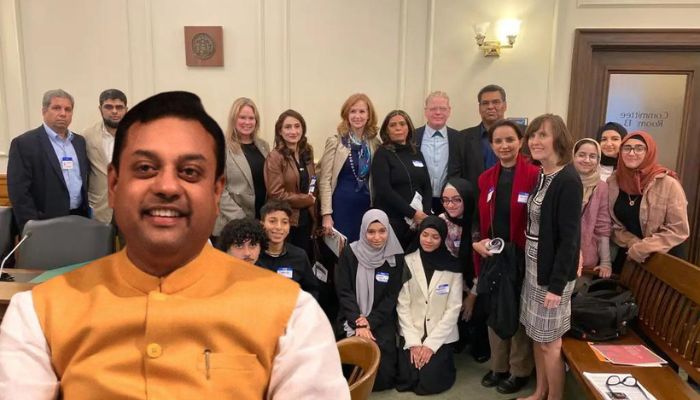
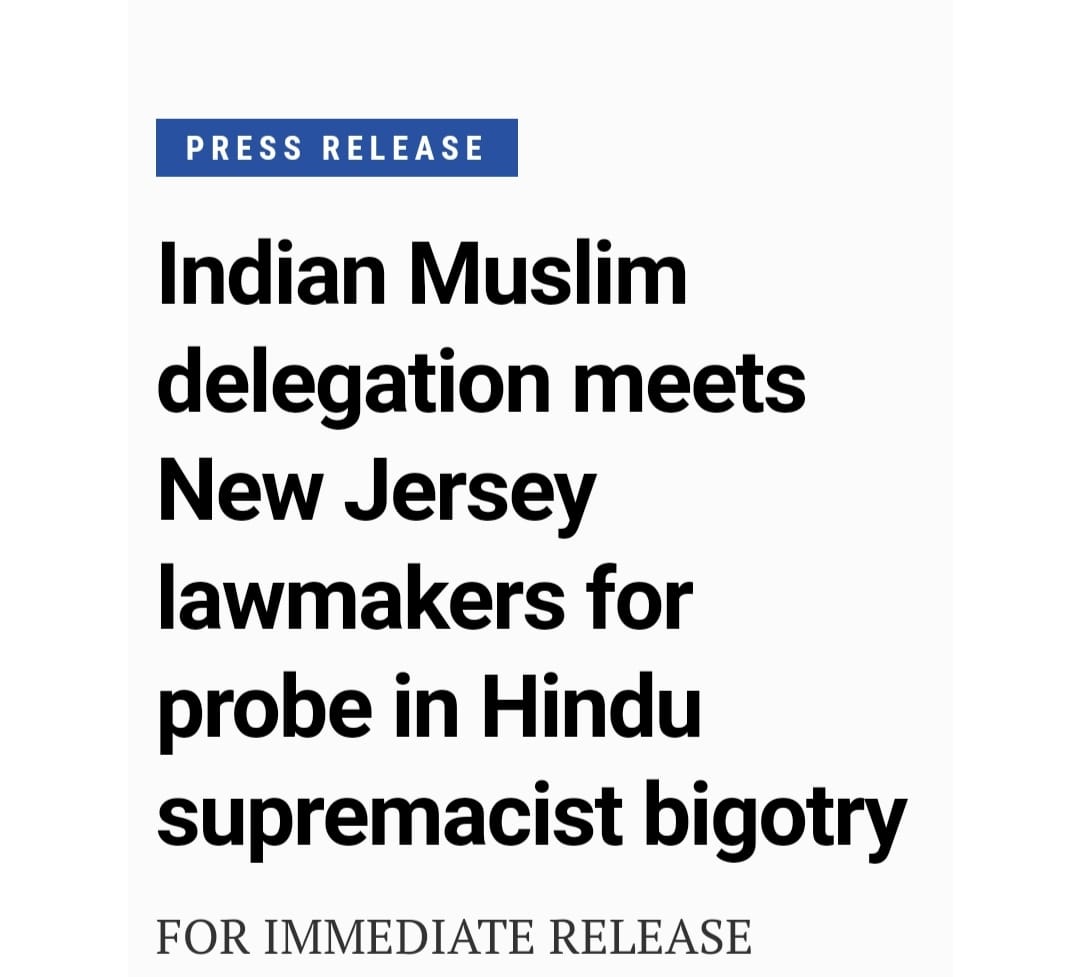
In a press release on October 5, the Indian American Muslim Council said that a delegation met lawmakers from the New Jersey General Assembly and Senate and supposedly handed them ‘evidence’ of Hindu supremacist organisations in India and the US.
The Islamist outfit sought a probe into organisations such as Overseas Friends of the BJP (OFBJP) and Rashtriya Swayamsevak Sangh (RSS). The meeting of the IAMC delegation with New Jersey politicians was part of ‘outreach programme’ to strengthen the relationships of Muslims in the State with the lawmakers.
“New Jersey’s lawmakers have a duty towards their constituents to ensure that the alien hate ideology of Hindu supremacism is stopped at the state’s borders and not allowed to vitiate the peace here,” claimed IAMC (New Jersey) President Mohammad Jawad.
Screengrab of the press release by IAMC
The Background of the Controversy
The Jamaat-e-Islami-backed organisation has been seeking the revocation of Sambit Patra’s visa since August this year. On August 14, the Indian Business Association (IBA) took out a parade in Edison township of New Jersey in the United States.
In the visuals shared on social media, Indians were gathering in large numbers and waving the Tricolour with pride. Assemblyman for New Jersey District 18, Rob Karabinchak, also joined the Indians to celebrate Edison’s 18th India Day parade.
Today, I was honored & happy to attend the 18th annual India Day Parade in Edison.
The Indian American community in Edison & throughout New Jersey is so vibrant and vital to our district, I am proud to support for the local community and the growing number of Indian American.?? pic.twitter.com/wD0L4LaqYh
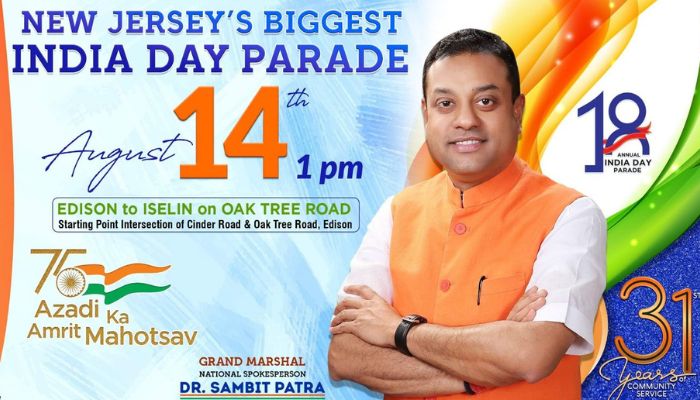
The National spokesperson of the BJP, Sambit Patra, was invited to be the Grand Marshal of the parade.
Screengrab of the poster
In visuals shared by the parade attendees, Sambit Patra was seen interacting with Indians in Edison and clicking pictures with them.
Some Indians were seen leading the parade with bulldozers, adorned with pictures of Prime Minister Narendra Modi and Yogi Adityanath. “Baba ka Bulldozer,” read one such banner.
While the purpose of such a display was to congratulate the swift action by the Modi government, Islamist outfit IAMC cried foul over it. “Hindu right-wing in Edison, New Jersey marched with bulldozers, which have become a weapon in the hands of the BJP government to destroy Muslim homes and livelihoods.”
Today, the Hindu right-wing in Edison, New Jersey marched with bulldozers, which have become a weapon in the hands of the BJP government to destroy Muslim homes and livelihoods. pic.twitter.com/3M3GKj8kcq
— Indian American Muslim Council (@IAMCouncil) August 15, 2022
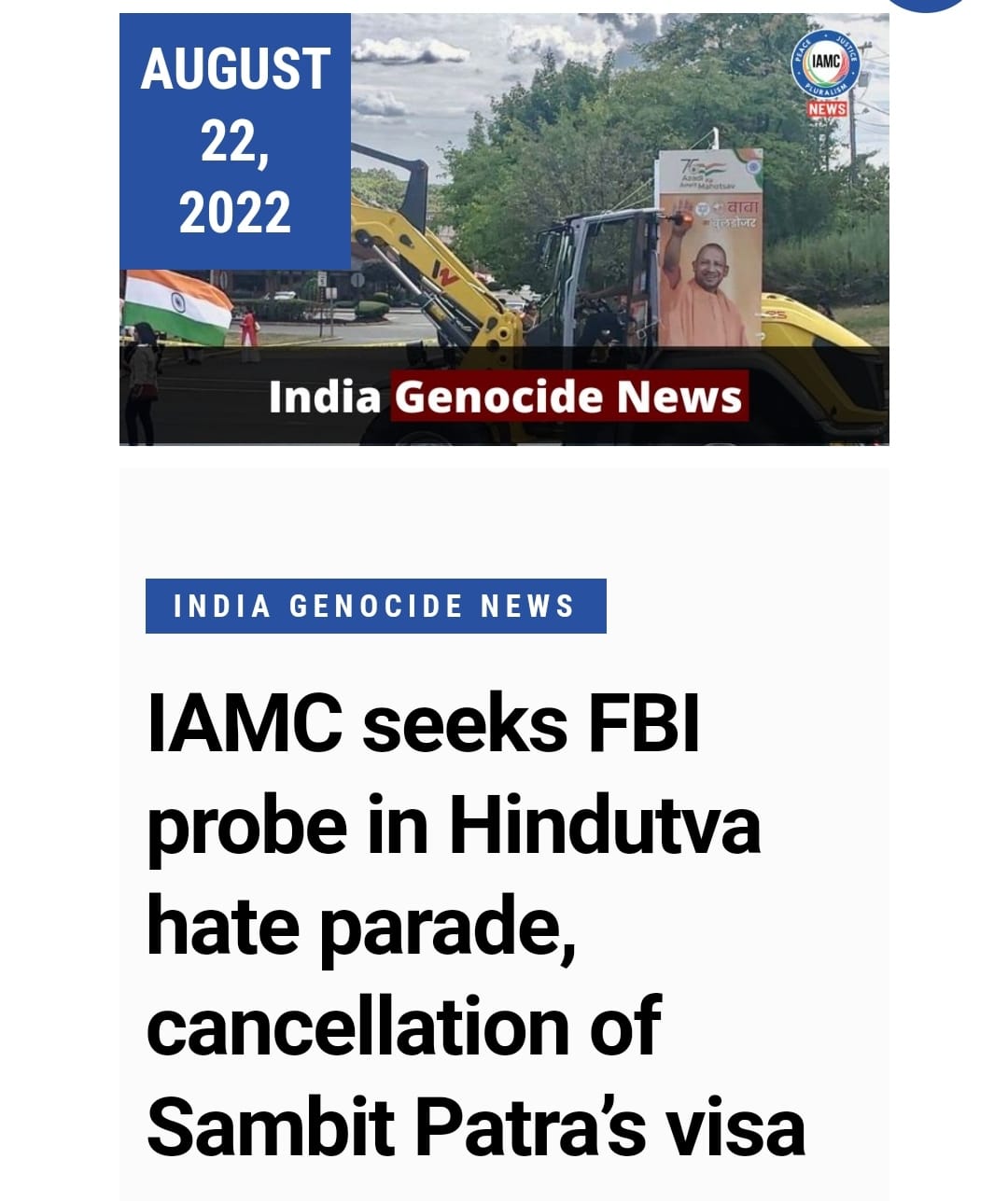
In a press release dated August 22, IAMC claimed that ‘Baba Bulldozer’ was a “reference to Adityanath’s illegal and criminal usage to use bulldozers to demolish homes, businesses and places of worship of Muslims and Christians.”
The Islamist outfit roped in the Christian community in the hopes of making a stronger appeal to the New Jersey lawmakers, many of whom identify as Christian. However, none of these allegations are rooted in reality.
The bulldozers have been used to destroy illegal structures, irrespective of the Faith or political affiliations of the accused. Recently, the Uttarkhand government demolished the resort owned by son of ex-BJP minister Pulkit Arya in connection to the murder of 19-year-old Ankita Bhandari.
Screengrab of the press release by IAMC
Despite this, IAMC has remain fixated on the display of bulldozer in the India Day parade in Edison, where BJP leader Sambit Patra was the grand marshal.
“IAMC also wrote to the US Secretary of State urging for an immediate cancellation of the visa to Sambit Patra, a Hindu extremist hate leader from India and a non-US citizen, who led the hate parade in Edison and Woodbridge as its grand marshal,” the press release read.
On Monday (October 5), the Indian American Muslim Council (IAMC) again met New Jersey lawmakers and begged them to communicate to the Biden administration about revoking the visa of Sambit Patra.
What is IAMC and what does it do?
The IAMC is a Jamat-e-Islami-backed lobbyist organisation claiming to be a rights advocacy group. In the past, it had reportedly collaborated with and had even paid money to various groups in the USA to get India blacklisted by the USCIRF (United States Commission on International Religious Freedom).
A detailed report by Disinfo Lab has exposed its links with terror outfit Jamat-e-Islami. IAMC founder Shaik Ubaid and member Abdul Malik Mujahid have headed the Islamic Circle of North America (ICNA), the US front for Jamaat-e-Islami, Pakistan.
According to DisInfo Lab, ICNA has established links with Pakistan-based terror groups like the Lashkar-e-Taiba. Rasheed Ahmed, who heads the IAMC currently was the former executive director of the Islamic Medical Association of North America (IMANA). IMANA’s Director of Operations is Zahid Mahmood an ex-Pak Navy official.
IAMC has been caught spreading fake news and misinformation to further the Islamist cause in India. It was also slapped with UAPA in 2021. The Islamist outfit also awarded cash prizes to journalists from ‘The Wire’, ‘Newslaundry’ and Scroll to further their anti-India agenda.
Bhojpuri actress Sahar Afsha has quit the entertainment industry for Islam, as her profession is not allowed in her religion. She has shared this information from her Instagram account. She is not the first actress to prefer her religion over art. In fact, earlier actresses Zaira Wasim and Sana Khan have also quit showbiz, citing their inclination to become devote Muslims.
In her Instagram post, Sahar Afsha wrote, “I want to communicate to all of you that I have decided to quit the film industry and I will not be associated with it anymore. I will be spending the rest of my life according to Islamic teachings and the rules of Allah. I beg pardon from Allah for whatever way I have lived my life in the past.”
Sahar Afsha added, “Even after getting grand success and wealth, I was not content. Because I did not dream of this kind of life even in my childhood. It was all by accident that I came into this industry and kept marching ahead. But now I have decided to end this all. I intend to spend the rest of my life according to the orders of Allah. I request you all wish that Allah bestows me an honest life. I expect that I shall be known to this world not by the life I have lived so far, but by the life I will live hereafter.”
Commenting on this post by Sahar Afsha, ex-actress Sana Khan wrote, “MashAllah my sister so happy for you. May Allah give you success in every step of your life, and may you inspire everyone around you and become zaziya-e-khair for mankind.”
It is notable that actress Zaira Wasim quit acting in June 2019 citing her religious commitment to Islam. In October 2020, actress Sana Khan left showbiz citing her love for Allah. Now Sahar Afsha has announced that she is also leaving the film industry for similar reasons.
Pakistani singer Abdullah Qureshi also took a similar decision recently, as he announced on the 6th of October 2022 that he has quit the music industry for Islam.
On Friday, the Gujarat police chief ordered an investigation into an incident in which cops were allegedly captured on camera openly flogging a few members of the Muslim community who hurled stones at a Garba event in the Kheda district. This is after a voluntary group named Minority Coordination Committee (MCC) served legal notices on the Chief Secretary and the Director General of Police (DGP) over the matter.
According to the reports, the incident happened on October 3 in Undhela village of Kheda district when a mob of Islamists attacked a Garba event in the village. The Garba event was organized outside a temple in the chowk which is also very close to a madarsa. The Islamists objected to the Garba music being played on the loudspeaker in the chowk near the madarsa and then attacked the participants of the Garba event.
Seven persons including a policeman were injured in the attack which was launched by the Islamists. The Islamists hurled stones and attacked the Garba dance participants and organisers. The next day, the Police identified and arrested around 13 Islamists who disrupted the event and flogged them in the chowk, the video of which went viral over the internet.
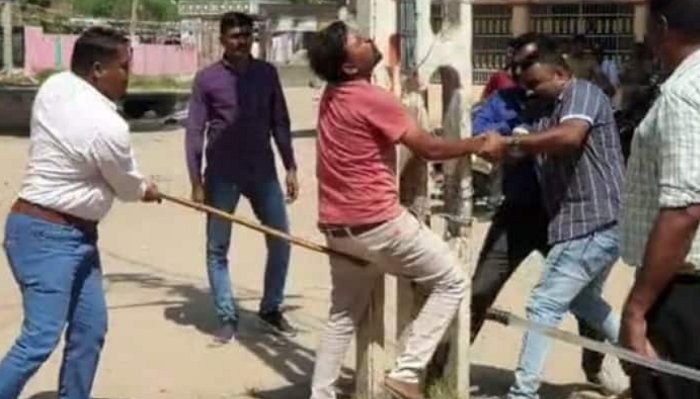
The viral video recordings showed three individuals being escorted out of a police vehicle near the event site before being carried to an electric pole and restrained against it by a police officer. Another officer could be seen beating them with a baton below the waist.
Police action against Peacefuls ? who did STONE Pelting on Garba Night in Gujarat’s Kheda.
The Police requested the remand of three of the 13 accused apprehended for stone pelting. On Wednesday, a court in Kheda remanded them to two days in police custody, while ten others have been sent to judicial custody.
DGP Ashish Bhatia took cognizance of the viral videos and ordered a probe into the incident. He has asked Kapadvanj Deputy Superintendent of Police V N Solanki to conduct an inquiry into the matter and submit a report at the earliest. “Late last night, I was given the responsibility of conducting the inquiry into the incident. I will submit my report as soon as possible”, Solanki confirmed.
Earlier, the Police had filed a complaint against around 150 persons who attacked the group performing Garba with stones. The Police said that the event was organized by the sarpanch (head) of Undhela village and that the Islamist crowd sought to interrupt it since it was being hosted at a temple which is near a mosque.
The probe was reportedly ordered after a voluntary organization in Gujarat named Minority Coordination Committee (MCC) issued legal notices to Chief Secretary and the DGP complaining over the flogging incident. “The state government should take appropriate and suitable departmental, disciplinary, punitive and criminal action against the erring police officials forthwith who have openly violated all rights of the victims by way of flogging”, Convenor of the Minority Coordination Committee (MCC) Mujahid Nafees said in the notice.
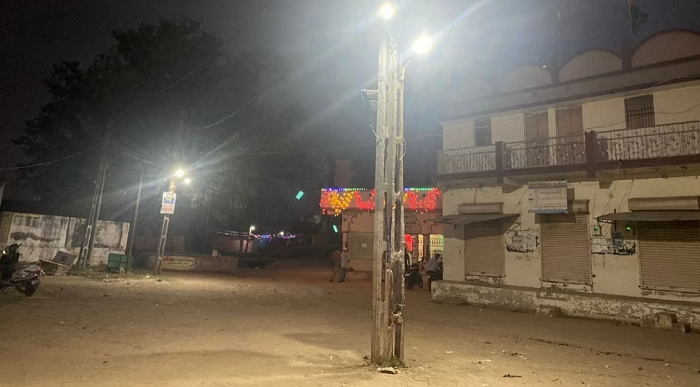
The chowk in which the Islamist were flogged by the Police (Source- The Print)
“Those who were flogged belong to the minority Muslim community. Such open and brazen violation is not only against the protected right under Article 21 but against the whole constitutional spirit of a civilized society”, the organization added. It also said that the flogging incident could in no way be justified by the stone-pelting incident that happened earlier. “There is no section in any police manual or the Indian Penal Code that allows police to indiscriminately assault citizens”, the outfit stated.
Meanwhile, one of the victims of the stone pelting incident, Dilip Patel said that there has always been a divide between the communities of the village. “On the night of 3 October, they allowed people to gather and started attacking us at around 11 pm. See now, their part of the village is dark, most of them have fled”, he said.
Also, the sarpanch of the village has confirmed that the violence that happened on October 3 was well-planned by the Islamists and that it was intentional. “Many people involved in the violence are absconding. They attacked our children and wives, didn’t even spare cops who rushed to the spot”, said Indravadan Patel, the sarpanch of Undhela village.
DGP Ashish Bhatia of the Gujarat Police has ordered a probe into the matter and has asked Kapadvanj Deputy Superintendent of Police V N Solanki to conduct an inquiry into the matter and submit a report at the earliest. Investigations in the case are underway.
On Friday, October 7, two Madhya Pradesh Congress MLAs were booked for allegedly molesting a 32-year-old woman on board a train. The Congress leaders in question are Siddharth Kushwaha, an MLA from Madhya Pradesh’s Satna constituency and Sunil Saraf, an MLA from Madhya Pradesh’s Kotama. The woman alleged that both these leaders came to her berth inebriated and misbehaved with her.
The incident reportedly happened on the Rewanchal Express, in between Katni and Damoh stations, at roughly 11.50 pm on Thursday, October 6. The woman was travelling to Bhopal from Rewa.
Based on her complaint, the Madhya Pradesh police have booked the two Congress leaders under Indian Penal Code (IPC) section 354 (assaults or uses criminal force on any woman, intending to outrage or knowing it to be likely that he will thereby outrage her modesty).
According to reports, the woman in her police complaint said that she was sitting on her berth in the AC coach with her 7-month-old infant when both MLAs approached the berth in front of hers at around 11:50 pm. They subsequently sat on the side berth and started eating their dinner. While eating, the duo conversed with each other in filthy language.
As per the Hindi daily Dainik Bhaskar, the woman further said in the complaint, “The MLAs pulled me by my hand and asked me to eat with them. They were inebriated and were giving me filthy glances. I felt uneasy, but I did not respond. One of them kept his hand on my shoulder. They were both speaking loudly and in filthy language. I urged them to stop speaking so loudly since it was disturbing my newborn. When they refused to listen, I called up my husband and told him what had happened.”
Following this, the woman’s husband, who is an advocate by profession, reported the matter to the Sagar railway police and tweeted about the same to the Railway Minister. Upon receiving the complaint, Sagar railway police rushed a GRP team to the woman late at night and she was transferred to another seat.
“At around 1 AM, when the train reached Sagar, a sub-inspector and two constables entered the coach in connection with the complaint. We have booked Saraf and Kushwaha under Indian Penal Code section 354,” said Sub Inspector Pramod Ahirwar of Sagar railway police.
Sunil Saraf, according to the victim, remarked as she was leaving, “Why are you going, why are you upset?” The woman complained about the same to the TTE and the Sagar railway police officials and demanded that the MLAs be immediately deboarded from the train. That, however, did not happen so far.
MLAs Siddharth Kushwaha and Sunil Saraf call the allegations baseless
Satna MLA Siddharth Kushwaha responded to the incident by saying, “The charges that I was intoxicated are baseless, there is nothing like that. Those who know me well know that I do not consume alcohol. We weren’t drunk on that day. We hadn’t even turned on the lights in our compartment because the child was fast asleep and we did not want to disturb him. In fact, we even offered our berth to the woman.”
Saraf, who boarded the train at Katni, also refuted the allegations. He said that the woman was sleeping on the berth allotted to Siddharth Kushwaha, which they pointed out and asked her for her berth number. He said that apart from this, they did not ask her anything. He also said they ate dinner in dim light to make sure the woman and her newborn do not get disturbed.
“If the woman has said such things, it is a shame,” said Congress MLA Sunil Saraf. “We didn’t even see her face. All of this appears to be a conspiracy, otherwise, how would the woman mention our age and which assembly constituency we represent in her complaint,” he added.
BJP lambasts Congress
It is worth noting that, following the complaint, a case of molestation under section 354 of the IPC was registered at the Sagar police station against the two Congress MLAs and further action is underway. Meanwhile, the BJP’s state president has chastised the Congress, alleging that this incident has exposed the party’s true colours. He claimed that although Congress MLAs molested a woman on the train, Congress party’s general secretary Priyanka Gandhi, who otherwise lectures about women’s empowerment, has not come up with a word of condemnation. He asserted that she should now explain why she isn’t fighting for the rights of this woman.
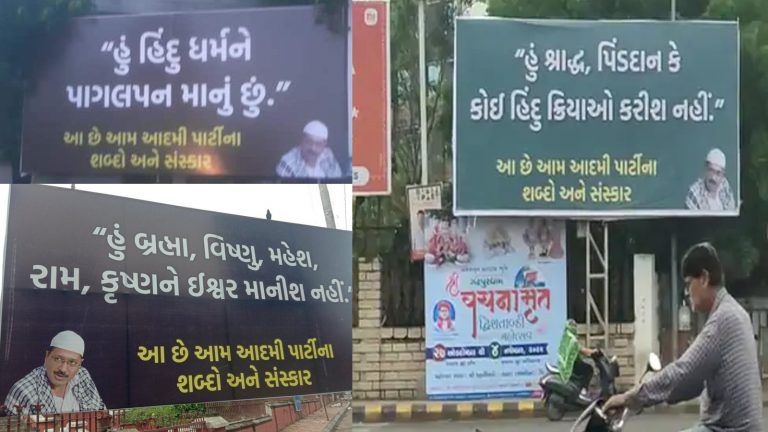
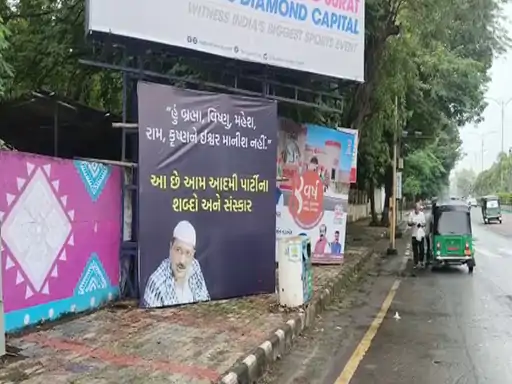
Countless black hoardings have surfaced on roads and intersections in major cities of Gujarat, depicting Aam Aadmi Party (AAP) convener and Delhi Chief Minister Arvind Kejriwal as a Muslim wearing a skullcap with quotes such as, “I do not believe in Brahma, Vishnu, Mahesh, Rama and Krishna as God” and “These are the words and rituals of Aam Aadmi Party.”
गुजरात में आम आदमी पार्टी के ख़िलाफ़ काले होर्डिंग लगाये गये हैं, इन हॉर्डिंग्स पर केजरीवाल को मुस्लिम वेश में दिखाया गया है, और लिखा है “मैं हिंदू धर्म को पागलपन मानता हूँ”, साथ ही लिखा है “मैं ब्रह्म, विष्णु, महेश और राम और कृष्ण को ईश्वर नहीं मानता हूँ” #RajendraPalGautampic.twitter.com/ffV4jv1FtG
In another poster having AAP Convener Arvind Kejriwal dressed as a Muslim, which seems to be set up on a road, it is written, “I consider Hinduism as madness” and “These are the words and rituals of Aam Aadmi Party.” These posters pop up as Punjab CM Bhagwant Mann and Delhi CM Arvind Kejriwal are scheduled to visit Gujarat for two days starting from today.
Poster in Surat.
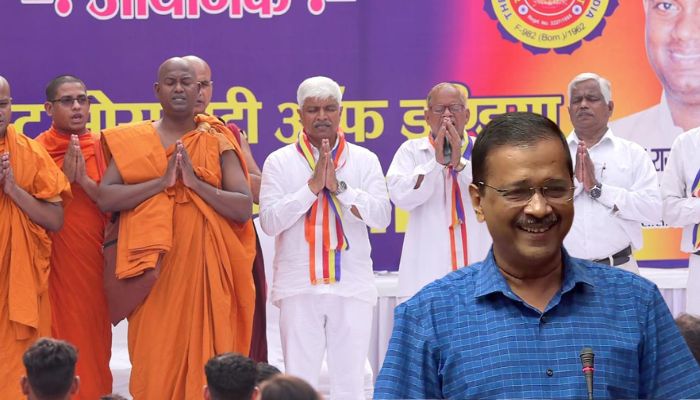
This comes after AAP MLA Rajendra Pal Gautam was sighted at a ceremony wherein 10,000 Hindus were converted to Buddhism on Wednesday. The Buddhist Society of India hosted the acrimonious event in the Dr BR Ambedkar Bhavan in Jhandewalan, New Delhi. During the occasion, a saffron-clad individual delivered an oath to the audience that closely mirrored BR Ambedkar’s infamous 22 vows. The person exhorted Hindus to separate themselves from their ancient faith and stop worshipping deities.
“I shall have no faith in Brahma, Vishnu and Maheshwara, nor shall I worship them. I shall have no faith in Rama and Krishna who are believed to be the incarnation of God nor shall I worship them,” he was heard as saying. AAP Minister Rajendra Pal Gautam was observed repeating the contentious pledges and sharing the platform with the person during the ceremony.
The Bharatiya Janata Party (BJP) filed a complaint against AAP minister Rajendra Pal Gautam on Friday. The BJP accused AAP minister Rajendra Gautam of inciting riots, violence, and public disturbance by making remarks at Ambedkar Bhavan and posting them on social media platforms.
कोई भी धर्म यह नही सिखाता कि किसी दूसरे धर्म का अपमान किया जाए।
आज AAP के कैबिनेट मंत्री द्वारा हिन्दू देवी-देवताओं को अपमानित करने के विरुद्ध संसद मार्ग थाने में @DCPNewDelhi से मिलकर शिकायत दर्ज कराई।@ArvindKejriwal में यदि जरा सी भी शर्म है तो वे उन्हें तुरंत बर्खास्त करें! pic.twitter.com/z4jC9r3NSa
The complaint accused Arvind Kejriwal of collaborating with Gautam, saying, “Arvind Kejriwal in conspiracy with Rajendra Pal Gautam and other unknown persons used social media platforms to build a tensed situation by spreading such videos. It can be made out that the posts quoted above are prima facie acts of criminal nature with criminal motive of dividing the country on the basis of religion resulting in violence, riots and the overall spread of enmity between various religions.”
A bus on route 46 hit and killed three people, including two women, in a road accident on Wednesday night on the Sealdah flyover. Police have taken the driver into custody and seized the bus after filing a complaint under non-bailable sections. Around 1:20 am on Wednesday, six people, including a woman, were strolling along the Vidyapati Setu, also known as the Sealdah flyover, towards Rajabazar.
Aditi Gupta, 18, an Ekbalpore resident, died on spot. Rahul Kumar Prasad, 30, also from Ekbalpore, and Nandini Kumari,15, from Howrah, died in the hospital a few hours later, the police informed.
The same family’s three other members sustained injuries. They were Rishi Gupta, 15, Nilesh Gupta, 15, and Rahat Gupta, all from Ekbalpore. They have been admitted to a hospital with severe injuries.
Rahul worked at a private company that sells mobile phones, while Aditi and Nandini were students. According to a family member, Rahul is survived by his mother, his wife, and a month-old child.
An investigating officer said, “The incident took place around 1:20 am when the bus on Route 46 was heading towards Rajabazar on its way to the airport. By then, the six members of the family were crossing the bridge to the location where their car was parked. Despite shouting and raising hands for the driver Bablu Khan to stop the bus, he did not slow down, mowing down six of them in front of Mala Hotel.”
Bus driver Bablu Khan, conductor Nuruddin Khan and a helper Arman Khan have been arrested. “We have charged them under IPC sections of rash driving, culpable homicide not amounting to murder, also attempt to culpable homicide act endangering life or personal safety of others and causing grievous harm,” DC traffic police, Sunil Yadav stated.
The bus has been seized and will be sent for a mechanical test to determine if there was a snag that caused the accident, the police informed.
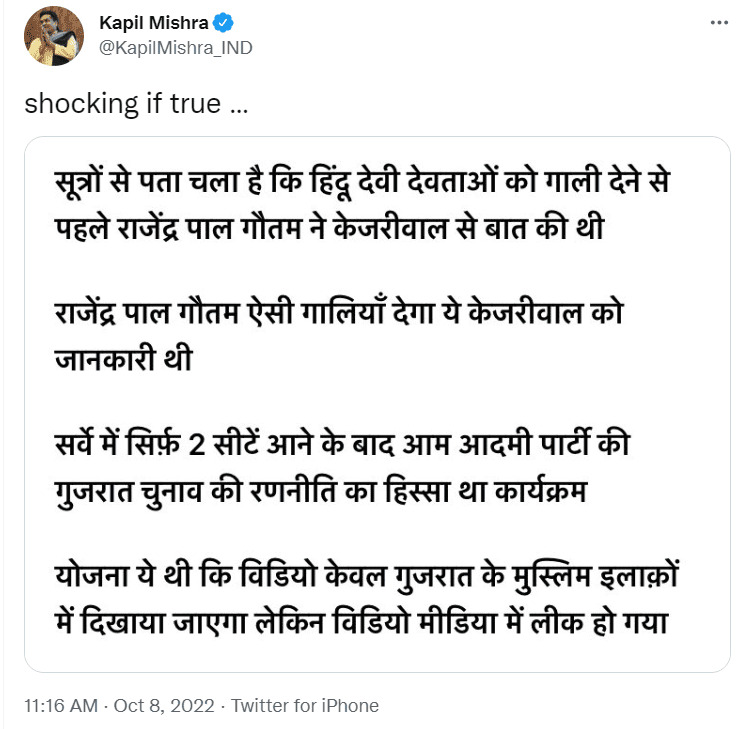
On Saturday (October 8), BJP leader Kapil Mishra accused Delhi Chief Minister Arvind Kejriwal of supporting the decision of Aam Aadmi Party (AAP) Minister Rajendra Pal Gautam to attend the mass conversion event of Hindus to Buddhism in the National Capital.
Citing sources, Mishra said, “Rajendra Pal Gautam had talked to Kejriwal before going about his way to abuse Hindu Gods and Goddesses. Arvind Kejriwal knew that Gautam would hurl abuses at Hindu deities.”
He further alleged that the mass conversion exercise was a part of AAP’s strategy to win elections in the State of Gujarat. “The original plan was to showcase it to Muslims in Gujarat. But, the video got leaked to social media,” the BJP leader emphasised.
Screengrab of the tweet by Kapil Mishra
On October 5, AAP MLA (Seemapuri) Rajendra Pal Gautam was spotted at an event where 10,000 Hindus were converted en masse to Buddhism. The controversial event, organised by the Buddhist Society of India, was conducted at the Dr BR Ambedkar Bhavan in Jhandewalan in New Delhi.
Gautam, who serves as the Social Welfare Minister in the Delhi Cabinet took to Twitter to gloat over the mass conversion of Hindus. The event coincided with the Dusshera celebrations during which the Hindu community celebrates the victory of Lord Ram over Ravana.
The AAP leader wrote, “With the support of Mission Jai Bhim”, more than 10,000 intellectuals took a pledge to make a caste-free and untouchable India by converting to the Faith of Gautam Buddha.”
चलो बुद्ध की ओर मिशन जय भीम बुलाता है।
आज “मिशन जय भीम” के तत्वाधान में अशोका विजयदशमी पर डॉ०अंबेडकर भवन रानी झांसी रोड पर 10,000 से ज्यादा बुद्धिजीवियों ने तथागत गौतम बुद्ध के धम्म में घर वापसी कर जाति विहीन व छुआछूत मुक्त भारत बनाने की शपथ ली।
During the event, AAP Minister Rajendra Pal Gautam was seen delivering a speech wherein he urged Hindus to renounce their Faith and tread the path of Dr Ambedkar.
“If you don’t want to be called a traitor, then, we need to spread this message of BR Ambedkar to every household,” Gautam said. He also lamented how BR Ambedkar died within a month of converting to Buddhism and failed to convert the whole nation.
Later, a case was filed against him and AAP supremo Arvind Kejriwal by the BJP for trying to incite riots.
We are working to make India a Buddhist country & our target is to convert atleast 10 crore people by October 2025 : Kejriwal’s minister @AdvRajendraPalpic.twitter.com/tXpbR9i3fe
It is worth noting that in a 2020 interview, Pal revealed that they are working to turn India into a Buddhist country. “It is time to turn India into a Buddhist country. We are working to convert India into a Buddhist nation. Our target is to convert 10 crore people to Buddhism by October 2025,” he had said.
A Hindu man belonging to the Dalit community was assaulted by members of the Muslim community in Firozabad, Uttar Pradesh, while he was returning from Maa Durga’s idol immersion function on Wednesday, October 6. Not only that, but these miscreants also hurled casteist slurs and insults at him, snatched his money, and threatened to kill him if he reported them to the police.
Ankur Kumar, a resident of Nagla Jhamman of Linepar in the Thana Tundla area of Firozabad district, stated in his police complaint that on 6 October 2022 (Wednesday), while returning home after Goddess Durga immersion, Naeem, son of Laik, a resident of Nagla Masjid, his two brothers, and five-six other aides accosted him.
They then abused him with casteist insults. When Ankur objected, the miscreants beat him up and stole the money from his pocket in broad daylight. Not only that, but the accused threatened the victim with death if she reported him to the police.
प्रभारी निरीक्षक टूण्डला को आवश्यक विधिक कार्यवाही करने हेतु निर्देशित कर दिया गया है ।
The accused threatened Ankur and claimed that anyone who came to speak on Ankur’s behalf would be killed. Ankur has filed a complaint with the Tundla police station, citing the threat to his life. According to the UP Police, legal action is being taken in this matter.
This year too, Islamists in various parts of the country attacked the recently concluded celebration of the feminine divine during Durga Puja/Navratri besides attacking Hindu festivals such as Hanuman Jayanti, Ram Navami, and Saraswati Puja. Several such cases have come to the fore where Islamists have either forcefully or by concealing their identity entered the Navratri Garba event and created a ruckus. Even incidents of stone pelting and violence at Garba venues have been reported from many parts of the country.
OpIndia tried to chronicle the wanton attacks carried out by Islamists during the year’s Navratri festival. This year, the annual nine-day festival of Navratri, wherein Hindus across the world celebrate and worship the Hindu goddess Durga, commenced on September 26 and ended on October 5.