On July 23, a detailed account of a monkeypox patient was published by The Guardian, who happened to be Division Director at George Soros headed Open Society Foundation. In the report by The Guardian, Sebastian Kohn revealed he not only contracted monkeypox but also Gonorrhea, a sexually transmitted disease (STD), after having sex with multiple men during pride weekend.
One of the directors for George Soros’ Open Society Foundations who specializes in public health, Sebastian Köhn, shares in the Guardian how he had sex with multiple men in a weekend for NYC Pride & contracted both #monkeypox & gonorrhea. He blames the system for failing him. pic.twitter.com/De1KQBDRUl
Kohn said that when the pride festival kicked off in New York on June 24, he was aware that monkeypox was a matter of concern, especially for gay men like him. However, pertaining to the low number of cases, he went on to have sex with multiple men, which was indeed in clear violation of the guidelines issued by the Centre for Disease Control (CDC).
After a week, he started to feel tired and developed a rash along with other symptoms of monkeypox. Kohn said, “I’m a 39-year-old man from Sweden, living in Brooklyn and working in philanthropy. For the past decade, my work has primarily focused on sexual and reproductive health and rights, so I followed the outbreak from the very beginning.” Even then, he decided to go ahead and enjoy having sex with unknown men over the pride weekend.
After getting tested at the healthcare centre, Kohn found he contracted not only monkeypox but also another STD, Gonorrhea. Kohn went on to explain how the disease progressed, and he was unable to get the treatment he desired or required. Interestingly, when he was far ahead on the path of recovery, he received a call from a healthcare professional who told him he might have monkeypox. When informed that he had already got tested and was being treated for the same, the person on the call did not bother to ask about the people whom he came in contact with after contracting the disease.
What is monkeypox?
Monkeypox is a rare disease that is caused by infection with the monkeypox virus. It belongs to the same family of Orthopoxvirus viruses that also includes smallpox and cowpox viruses. In 1958, two outbreaks of a pox-like disease occurred in colonies of monkeys kept for research in the Democratic Republic of Congo. The Monkeypox virus was first discovered among these monkeys and thus derived its name from the same. Experts have said that gay men or men who have sex with other men are more prone to the disease.
The primary symptom of monkeypox is the virus that causes visible bumpy rash or pox all over the body. Apart from the pox, monkeypox can result in fever, and severe body aches. Other symptoms include fever, headache, muscle rashes, swollen lymph nodes, chills and exhaustion.
Rashes in the form of pox or blisters develop all over the body distinctively that look like chickenpox or syphilis. The rash often begins on the face and then spreads to other parts of the body, including the genitals. The rash develops all over the body and goes through different stages. It finally develops into a sab and eventually falls off. Those infected with the virus show symptoms within five days, and the infection generally lasts for 21 days.
The Monkeyvirus has two major strains, namely the fatal Congo strain with up to 10% mortality and the West African strain, which has a fatality rate of 1% in the total cases. The cases detected in the UK are of the West African strain. Australia is currently investigating its first case. Case fatality rates are found to be higher among children. WHO says that in certain recent incidents, the case fatality rate has been found to be 3% to 6%.
Monkeypox cases in India
So far, India has reported four cases of monkeypox, out of which three had travel history to the countries where the outbreak has been reported. However, one case that was reported on July 24 in Delhi did not have any travel history to such countries, which shows he might have come in contact with someone who had the disease.
CDC has asked to limit the number of sex partners
In its guidelines, CDC has clearly mentioned that people should limit their sex partners. Also, it has asked people to avoid having physical sex with those who have or might have the disease. It has also asked to avoid going to places with large crowds, avoid getting close to people who have developed an unexplained rash and avoid sharing items such as towels, sex toys and toothbrushes etc. Though the guidelines revolve a lot around people getting intimate, it has to be noted that the disease does not spread only by sexual contact. It can spread through direct contact with the rash, body fluids, touching objects that came in contact with infected patients and more.
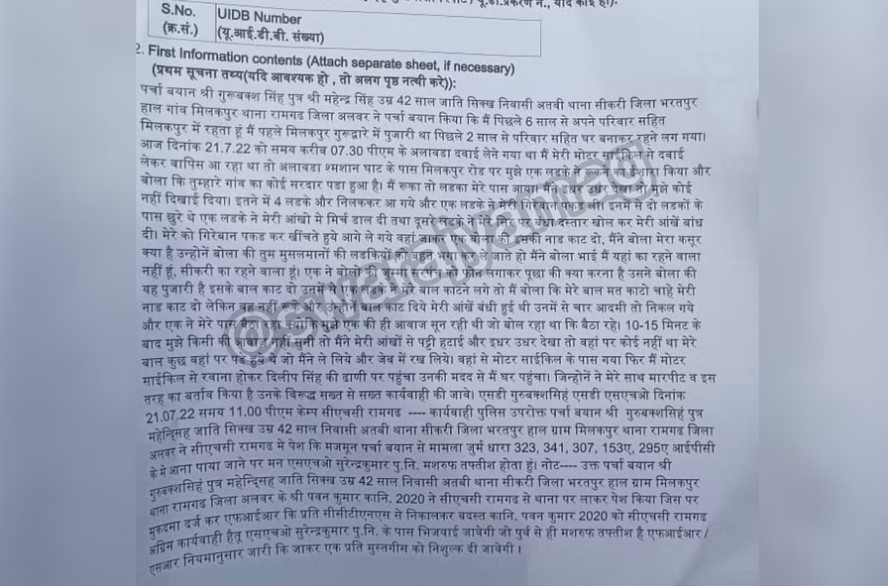
In Alwar, Rajasthan, on the night of Thursday, July 21, 4-5 Muslim youths allegedly harassed and assaulted one Gurbaksh Singh, a former granthi of a Gurudwara. The miscreants reportedly accosted the victim, beat him up, threw red chili powder in his eyes, and cut his hair, something Sikhism prohibits its followers from doing. According to a report by Swarajya, the root cause of the attack is an interfaith love affair between a Sikh man and a Muslim woman.
Alwar: “4 people stopped a man in bike, they threw red chilli powder in his eyes n wanted to cut his head. But when they found out that biker is a sikh n works in Gurudwara, They called a man named Jumma n they cut his hair n coz it is an equal punishment” pic.twitter.com/XSovcQcUXe
As per the Swarajya report, Gurbaksh Singh in his statement recorded in the first information report (FIR), alleged that around 7.30 pm on Thursday, he was on his way from his home in Milakpur to Alavada to buy medicines when the miscreants allegedly waylaid him. A youth asked him to stop his bike and park it on one side of the road, saying that a Sikh man was lying injured. As Singh halted his bike, the youth was joined by his four aides, who dragged Gurbaksh Singh, threw red chili powder in his eyes, and covered his eyes with a cloth. Two of them were carrying knives.
The miscreants, then, pinned him down and put a knife on his neck. They started discussing a plan to behead Singh but the latter started pleading with them, urging the miscreants to tell him his offence. To this, the miscreants said that men like him were eloping with Muslim girls.
Gurbaksh Singh told the miscreants that they were mistaken and that he was not a native of Alwar but of Sikri, and he was a granthi (priest) at a gurdwara.
Upon learning that the victim was a Sikh priest, the miscreants decided against killing him and called one man named ”Jumma”, who asked them to instead cut off his keshas (unshorn hair). Singh urged them to cut his throat instead of cutting his hair since it is strictly prohibited under Sikhism, but the miscreants still continued. The miscreants then fled leaving Gurbaksh Singh in an injured state.
Around 15 minutes later, when Gurbakh Singh regained consciousness and got a hold of himself, the men had left.
Gurbaksh Singh’s statement in the FIR (Source: Swarajya)
Based on Singh’s complaint, the Ramgarh police filed an FIR (number 417/2022) on July 21 and booked “Jumma” and four unidentified men under IPC sections 323 (causing hurt), 341 (wrongful restraint), 307 (attempt to murder), 153A (promoting enmity), and 295A (deliberately hurting religious sentiments).
According to the Swarajya report, Jumma Khan is the Sarpanch of the Alawada village, which is predominantly a Muslim-dominated village.
Swarajya spoke to a resident of Alwada village, who, on conditions of anonymity, told the news portal over the phone that a Sikh man and a Muslim woman belonging to their village had eloped in April to get married. He added that both the individuals are adults and their affair was also consensual.
“The Meos saw it as an affront to their community. They staged protests. Eventually, Jumma intervened and made the police recover the woman. From the police station, Jumma brought the woman back home despite her wish to go with the Sikh man,” the villager told Swarajya.
“Since then, that Sikh family has been living under threat. They have not been going out much,” he added.
The villager confirmed that Jumma Khan was the sarpanch of Alwada village in Alwar, which is predominately occupied by Muslims. In contrast to the “400 votes” of Sikhs, he said that Muslims make up “1500 votes” in Alawada. Notably, Muslims are predominantly Meo converts in Alwar. The majority of Sikhs are Rai Sikhs, who belong to the backward castes.
According to the report, Alwar Superintendent of Police Tejaswani Gautam was quoted by PTI as saying that it appears that Singh was singled out because of long-standing animosity between Sikhs and Meo Muslims in the village of Alawada over alleged love affairs.
Meanwhile, on July 22, the enraged villagers, including Hindus, gheraoed the police station and demanded an expeditious investigation into the incident. They demanded that the miscreants who had fled the scene of the crime after the incident, be apprehended quickly and dealt with strictly.
Alwar, close to Mewat- Haryana’s ‘Mini Pakistan’, is the hotbed of organised crimes
Alwar in Rajasthan borders the state of Haryana and is part of what is called the Mewat region. Over the years, Alwar has emerged as a hotspot for rapes and crimes against women. Mewat, characterized as Haryana’s Mini Pakistan, has been known to be a hotbed of organised crime, cattle smuggling, and illegal Rohingyas.
In an affidavit, the then-director general of police for Haryana, Manoj Yadava, stated in 2019 that the police officers in Mewat worked in a hostile environment and were in danger of their lives and safety.
In response, the court noted that Mewat’s cow slaughter and smuggling offences were “being committed by hardcore smugglers fully trained and that too in a well-planned manner on large scale in an organised way.”
In the year 2020, an investigation report by a 4-member team headed by former Justice Pawan Kumar asserted that Mewat is gradually turning into a graveyard for Hindus, especially Dalits. The report said that the rapes of girls, the kidnapping of women, thrashing and killing of Dalit residents with impunity, and forced religious conversions have become par for the course.
The investigation team led by former justice Pawan Kumar made scathing observations on the plight of Dalits at the hands of Muslims in Mewat. Kumar observed that the plight of Hindus, especially Dalits left in Mewat might be worse than the minorities living in Pakistan.
OpIndia had reported about the horrific atrocities being inflicted on the Hindus of Mewat as well after a press release related to Justice Pawan Kumar’s 4-member team’s investigation report came to light. OpIndia got in touch with a few journalists who visited Mewat and spoke to many of the victims. These reporters briefed us about quite a fewshocking incidents, which they were given an account of, and with their due permission, OpIndia sharedthose details.
Mewat has a history of atrocities being committed against Hindus
Over the years, many Hindu organisations have raised their voices against the rampant atrocities committed against Hindus, especially Dalits in Mewat. Not only the RSS and VHP activists, but other institutions have also raised their concerns against the rising number of criminal incidents happening in Mewat.
A 2013 report of the Hindu Janajagruti Samiti states that these incidents happening in Mewat are not a matter of today. Rather, the attitude of the Muslim majority of people has been continuing for a long time due to which many activists were forced to call it a “mini-Pakistan”. The report states that the way Hindus in Pakistan are persecuted and stripped of their basic rights, similarly, the Dalits and Hindus in Mewat are subjugated by the Muslim majority, and atrocities are committed against them.
The report of the committee mentioned that the people of Tablighi Jamaat in Mewat motivated members of the local Muslim community to wage love jihad, jihad, and forced conversion. Also, this report mentioned an incident where Veer Singh, while making a statement on his father-in-law’s conversion to Islam, states that his father-in-law was converted to Islam a while ago and was later sent out for 4 months. However, when he returned, he once again started practicing Hinduism, due to which he received death threats.
The condition became so dire that he had to go into hiding to escape retribution from fanatic Muslims. His wife and children were also harassed. He was accused of tearing the Quran, which later proved to be false. Apart from this, when his daughter was about to get married, some Muslims reached the wedding venue and started shouting that the girl cannot marry by Hindu customs because her father had converted to Islam and that she would have a “nikah” and that too only with a Muslim man. However, the girl’s mother later objected to this and eventually the marriage was completed under police protection.
The reports of the Hindu Janajagruti Samiti and former justice Pawan Kumar’s investigation team make it beyond clear that the spread of Muslim fundamentalism in Mewat has been deep-rooted and firmly ingrained. The former judge while in conversation with OpIndia said that out of the 500 villages in Mewat, only 103 continue to be Hindu, and there are only 4-5 families of Hindus left in 84 villages.
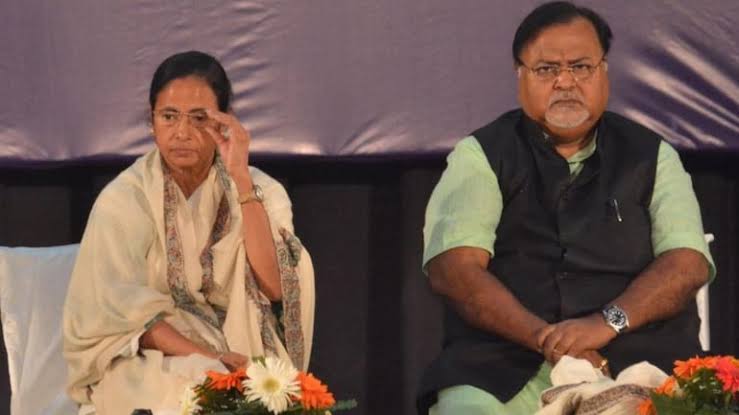
West Bengal minister Partha Chatterjee, arrested by Enforcement Directorate on Saturday, called the state chief minister Mamata Banerjee four times, but his call went unanswered.
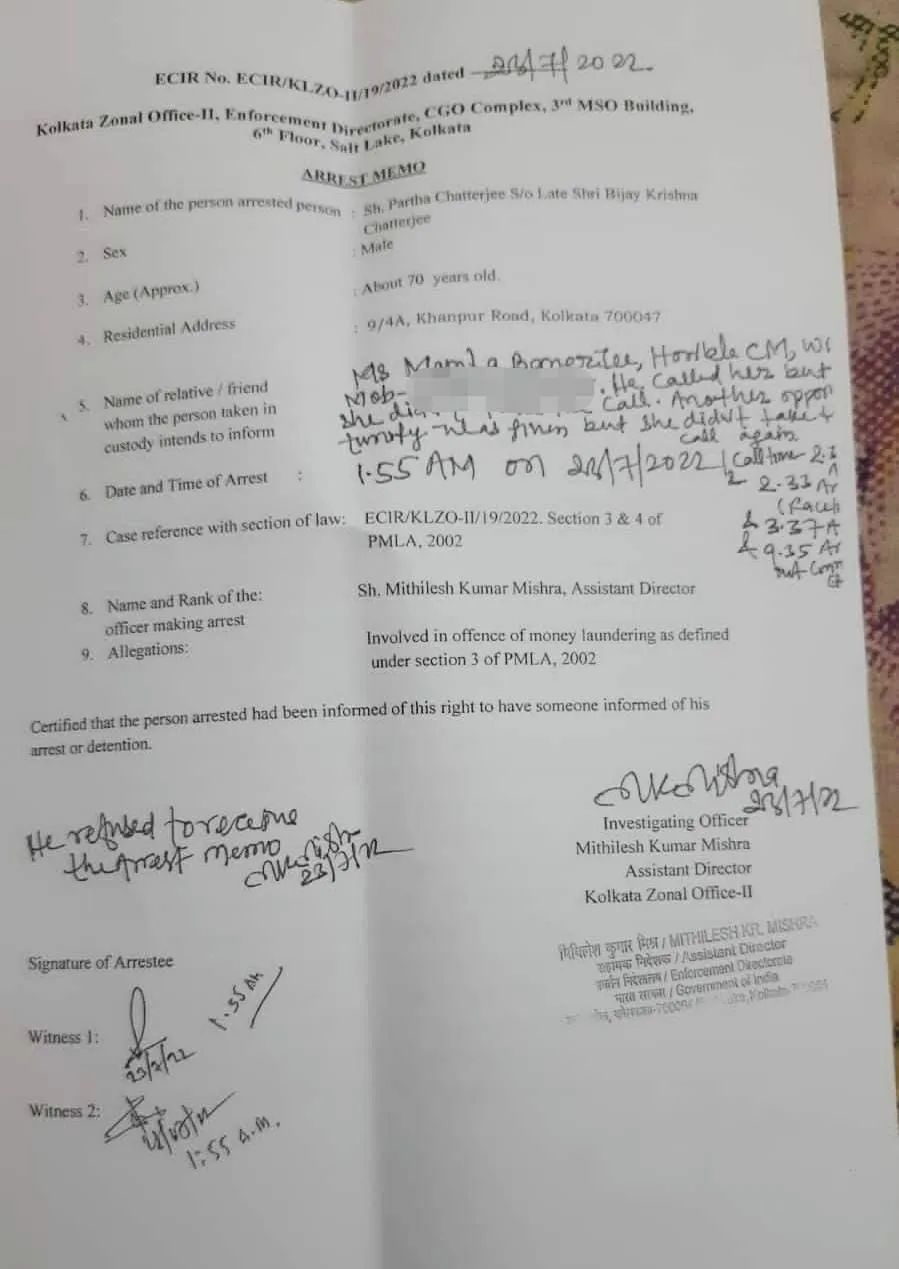
As a part of a process, when a person is arrested, he/she can inform one person who could be a family member or relative or friend. When the ED officials came to arrest him, Chatterjee told them that he wished to speak to the West Bengal chief minister Mamata Banerjee about his arrest. He made four calls—at 2.31 am, 2:33 am, 3:37 am, and 9:35 am, but none answered them.
Source: Republic TV
The West Bengal chief minister’s snub assumes significance, highlighting the party’s reluctance to stand behind Partha Chatterjee in the light of piles of cash recovered from his close aide. According to reports, while the party’s old guard wants Partha to continue in party positions and as a minister, the young guns want him removed.
ED nabs Partha Chatterjee
On July 23, officials of the Enforcement Directorate arrested Partha Chatterjee and later produced him before the Bankshall court. He was sent to judicial custody for a period of 2 days. Aripta Mukherjee also has been arrested after recovery of huge stash of cash from her flat.
The arrest came a day after the Enforcement Directorate began search operations at various premises linked to the recruitment scam in the West Bengal School Service Commission (WB-SSC) and West Bengal Primary Education Board.
Prior to the arrest, Partha Chatterjee was questioned for around 26 hours in connection with the SSC scam case. The Enforcement Directorate also raided 13 locations belonging to the TMC Minister.
A day before his arrest, ED raided the house of Arpita Mukherjee, a close aide of Partha Chatterjee, in connection with the money laundering aspect of those allegedly involved in the SSC scam. It recovered a huge pile of cash, approximately 20 crore rupees, from Mukherjee’s place. The money is allegedly the profits of the SSC Scam, according to a statement from the central agency.
The recently married Bollywood actors Katrina Kaif and Vicky Kaushal have approached the Santacruz police station to lodge a complaint after the couple has received death threats from an unknown person on social media. As per the complaint filed by actor Vicky Kaushal, the accused has been stalking his wife and threatening the couple on Instagram for several days. Based on the complaint a case has been registered at Santacruz Police Station and a probe has been initiated.
Maharashtra | Police register a case against an unidentified man and initiate an investigation for allegedly giving life threats to actors Katrina Kaif and Vicky Kaushal through social media. Case registered at Santacruz Police Station: Mumbai Police
According to reports, based on actor Vicky Kaushal’s complaint, the Santacruz PS registered a case against an unidentified man under sections 506(2),354(D) of the IPC, and section 67 of the IT Act.
Vicky Kaushal who was recently in the Maldives with Katrina Kaif to celebrate her birthday alleged that one person has been posting threatening messages on Instagram targeting him. He stated that the accused had also been stalking his wife and threatening her.
Complaint filed against Katrina Kaif and Vicky Kaushal during their wedding celebration
Notably, the actors tied a knot at Six Senses Fort Barwara, Sawai Madhopur on December 9, 2021. Though the wedding had been a grand affair, a police complaint had been filed against the couple and the hotel management.
In the complaint with the District Legal Services Authority Sawai Madhopur, a Rajasthan-based advocate Netrabind Singh Jadoun said that for the couple’s wedding, the hotel management had closed the road leading to the Chauth Mata temple from December 6 to 12. The road was closed as the hotel is located on the way to the temple, causing hardships for worshipers. In light of the public opinion, the advocate has requested that the route be made active.
Bollywood actor Salman Khan receives a death threat
Last month, Bollywood actor Salman Khan and his father Salim Khan also received threats in the form of a letter. The letter addressed to the actor and his father read, “Salim Khan, Salman Khan bahut jald aapka moosewala hoga KGBLB” (Salim Khan, Salman Khan, very soon y’all will end up like Moosewala).
After the letter was received, the Maharashtra police sprung into action. The Bandra police also registered an FIR against unknown people under IPC sections 506-II (Criminal intimidation), based on a complaint lodged by Salim Khan. Mumbai Police had traced the links of the threat to the Lawrence Bishnoi gang.
In the wake of the threat, Salman Khan has applied for a gun license for self-protection.
On the 23rd of July 2022, Congress plummeted itself to a new low where they decided to attack Smriti Irani’s 18-year-old daughter with false allegations. In a press conference broadcast by INC’s official handles, Pawan Khera (who is trying to prove his ‘Tapasya’ to his political masters – The Gandhi family) and Jairam Ramesh, who is well past his expiry date and looking for political oxygen by pleasing his masters (again, the Gandhi family), made sensational allegations against Smriti Irani’s daughter – allegations that seem to have no basis in reality.
As the press conference commenced, Pawan Khera claimed that it is not Congress’ political style to attack the family members of political opponents, however, since the allegations of “corruption” are against a Union Minister, Congress has decided to discover new lows.
Calling the bar a “sanskari bar”, Congress alleged that Smriti Irani’s 18-year-old daughter attempted to get a fake bar license. They alleged that the license was taken in June 2022, in the name of a man who had died in May 2021, 13 months prior to the license being taken. They further alleged that the restaurant had received two licenses, whereas a restaurant is allowed to get only one bar license according to Goa laws.
While making these false allegations (as would be clear as the article proceeds), Pawan Khera made insinuations about the upbringing of Zoish Irani, claiming that the name of the restaurant was “Silly Souls” and not “Tulsi Sanskari Bar”. “Your supporters play Lulu mall Lulu Mall and fight over Hanuman Chalisa and Namaz while your kids study abroad and under your patronage, indulge in such illegal activity”, Khera said.
While demanding answers from Smriti Irani, however, Pawan Khera slipped up and ended up revealing the real reason behind attacking Smriti Irani’s daughter. He said that the same Smriti Irani who was attacking Sonia Gandhi and Rahul Gandhi, asking them questions, should now answer why “Bar wale” has a problem with “Akhbaar wale”, claiming that the restaurant in question was surrounded by bouncers enduring that no media person could enter the premises. Before posing questions to Prime Minister Narendra Modi over the same issue, Khera, in his inimitable style (that appeared sleazy at best), also said that Smriti Irani is the “most favourite minister” of PM Modi.
Their ultimate demand in the press conference was that PM Modi remove his “favourite minister” from her position because she was an “illegal bar wali”.
During the press conference, Pawan Khera waved certain papers in the air while making scurrilous allegations against Irani’s daughter, claiming that the allegations he was levelling were based on an RTI response and a show cause notice that had been served to Zoish Irani, however, a perusal of the documents summarily expose the lies being peddled by Congress.
Who is Aires Rodrigues and how did this fiasco against Zoish Irani, Smriti Irani’s daughter start
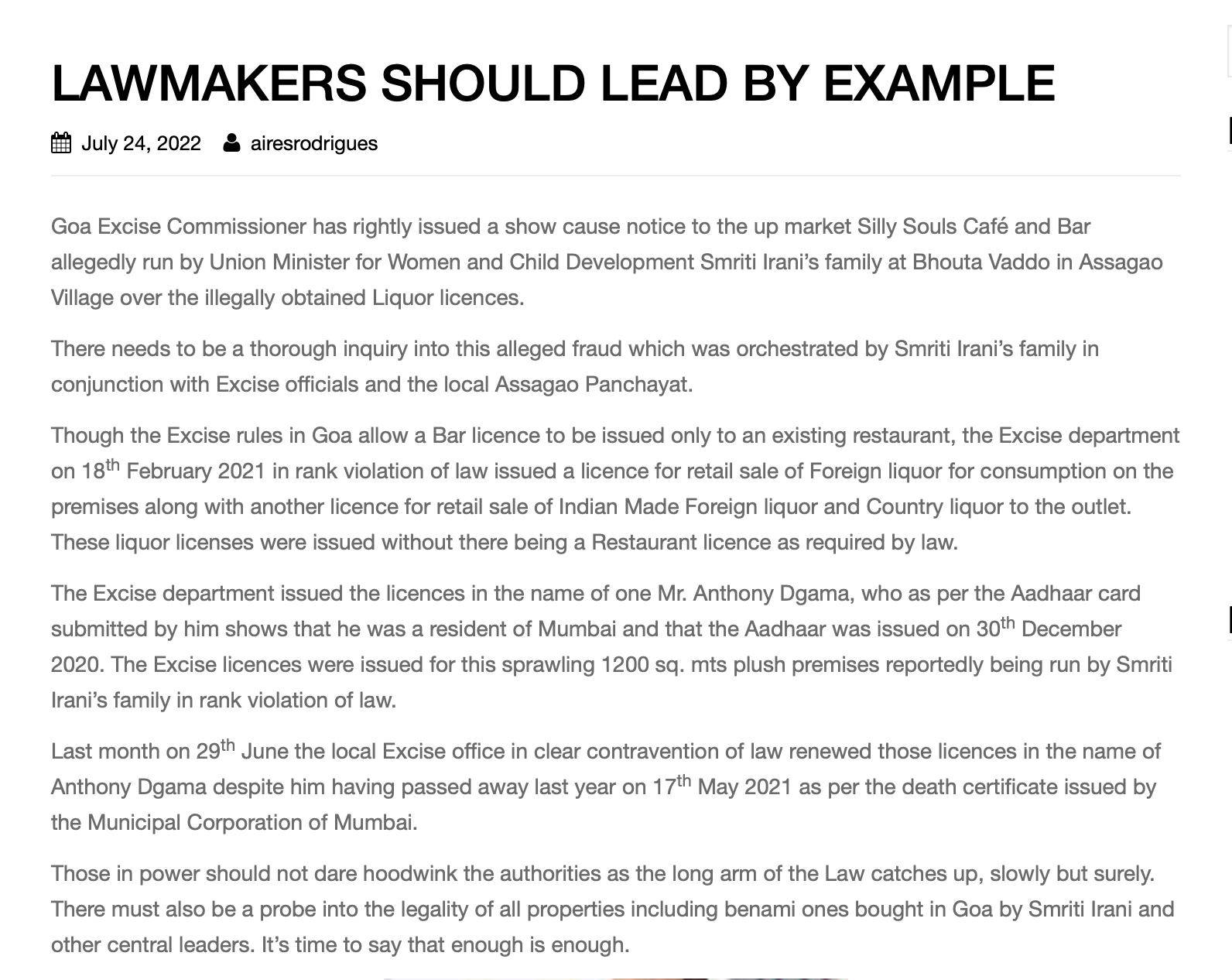
The fiasco started with Goa “activist”, Aires Rodrigues, filing an RTI application in June 2022 asking for information on the Excise License issued to Silly Souls Goa Cafe and Bar. After receiving the pertinent information, Rodrigues took to his website to issue a statement about the restaurant, claiming that an excise license was falsely issued to the restaurant and it indicates widespread corruption by the Irani family. After the complaint was filed by him, the excise department of Goa issued a show cause notice to the restaurant.
Rodrigues first issued a statement where he insinuated that fake documents were provided to procure a liquor license by the restaurant. After the Congress press conference, 2 more notes were issued by him.
In a 24th July note, claiming that a license was issued to the restaurant in the name of a person who had passed away, Rodrigues wrote, “Those in power should not dare hoodwink the authorities as the long arm of the Law catches up, slowly but surely. There must also be a probe into the legality of all properties including benami ones bought in Goa by Smriti Irani and other central leaders. It’s time to say that enough is enough”. In this statement, while he made allegations against the Irani family, the name of the daughter was not mentioned anywhere and no proof of these “benami properties” were provided.
Statement by Aires Rodrigues on his website
On the 25th of July, he issued another statement where he played victim claiming to be hounded first by Congress and now by the BJP for his “exposes”, however, even in this note, Zoish’s name was not mentioned anywhere.
On his Twitter account, however, Rodriguez played along with Congress. On the 24th, after the press conference by Congress, he posted a picture of Smriti Irani’s 18-year-old daughter insinuating that the restaurant was “run” by Zoish Irani.
Goa authorities will decide on legality of Silly Souls Café and Bar run by Union Minister Smriti Irani’s family, but one has to fairly concede that it’s a very Secular place. A perfect hideaway for savoring pork & Beef dishes. Magnanimous feat to achieve for a BJP leader. Jai ho pic.twitter.com/WLi4WPN2No
It is pertinent to note that Aires Rodrigues is often referred to as an “activist” who indulges in rampant blackmail in Goa and has a colourful history that hardly covers him in glory. In 2017, Aires Rodrigues was accused in a case of sexual harassment and his pre-arrest bail was denied by the court of law.
A woman had accused Rodrigues of `sexually harassing’ her and outraging her modesty by posting her picture on Facebook and linking her to an alleged sex scandal involving state minister Vinod Paliencar. Paliencar had denied involvement in the scandal.
The woman lodged a case with Anjuna police on November 27, which was later transferred to the Crime Branch. Reportedly, the woman had said that after Rodrigues circulated her pictures on WhatsApp, she was unable to leave her house and was getting threats as well.
This is not all. Rodrigues has also been charge sheeted in a case of dual citizenship in the past where he was charge sheeted for holding citizenship of Lisbon, Portugal.
He had also tried to play the victim by alleging that he was attacked by 6 persons and had alleged a “threat to life”, however, all individuals were acquitted by the court.
Even with this colourful past, Rodrigues seems to have played safe and not named Zoish Irani in his press notes. In fact, other than his tweet that came after the Congress press conference, there is no mention of Irani’s daughter. If Zoish Irani had indulged in any illegality, it is pertinent to ask why Aires Rodrigues did not mention Zoish before the scurrilous allegations by the Congress party. In fact, the allegation that he makes against the Iranis of holding “benami property” in Goa also has no evidence to back it up except a conversation that he relays, where he claims that Zubin Irani had once asked him about properties he could buy in Goa. Logic dictates that someone who is looking to purchase benami properties, like a certain Congress son-in-law, for example, would not ask an RTI activist about properties that he can legitimately buy, however, these logical fallacies do not stop Aires Rodrigues from tarnishing the reputation of the Irani family.
More pertinently, however, it is amply clear that the name of Zoish Irani, the 18-year-old daughter of Smriti Irani, was dragged in by the Congress because they believe that the easiest way to exact revenge from Irani, who has been exposing the corruption by Sonia and Rahul Gandhi, is to call her teenage daughter a “bar wali”.
Facts of the case and how Congress lied to tarnish Zoish and Smriti Irani
In the allegations levelled by Aires Rodrigues, a man accused of sexual harassment, the main contention was that a liquor license was illegal acquired by the Silly Could Cafe, which is run by the Iranis (According to Congress, it is run and owned by Zoish Irani – the 18-year-old daughter of Smriti Irani).
Before we talk about the involvement of Zoish or the Iranis in general, it is pertinent to note that the RTI response that was received by Aires Rodrigues made no mention of Zoish Irani at all. OpIndia perused the documents that were waved by the Congress party and found no mention of any member of the Irani family in the RTI response that was received by Aires Rodrigues.
It is, therefore, safe to say that not just Aires Rodrigues, but even the Congress dragged the name of the Iranis without any proof, given that the Congress claimed their allegations were based on the RTI response.
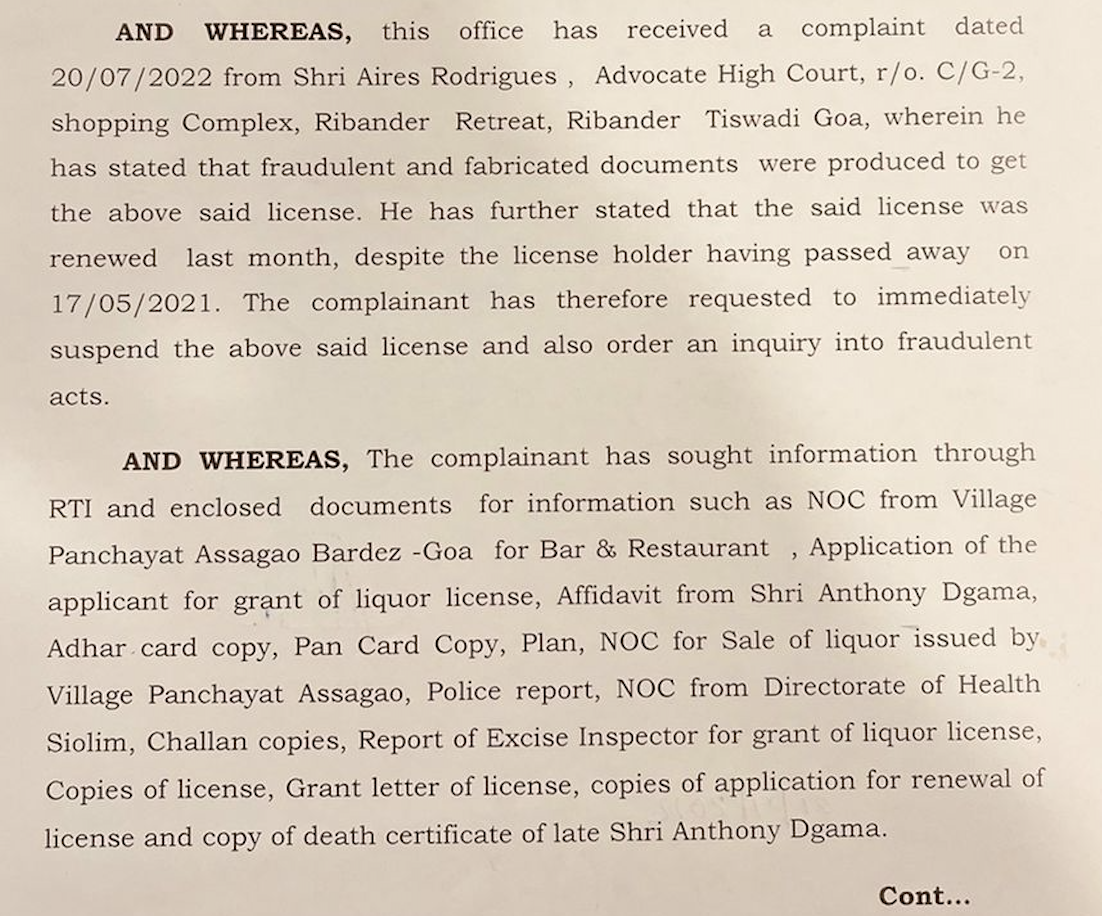
The other document that was mentioned by the Congress and Aires Rodrigues, was the excise department show cause notice that was served on the restaurant. It is on the basis of this that they made allegations about the liquor license being obtained illegally by providing fake documents. They had also claimed that the license was illegally issued in the name of the person who had died 13 months ago in 2021.
Show cause notice issued to restaurant
The ONLY allegation in the complaint by Aires Rodrigues, the same being mentioned in the excise show cause notice, is that fabricated documents were produced to acquire a license in the name of Anthony Dgama, who had already died on 17th May 2021.
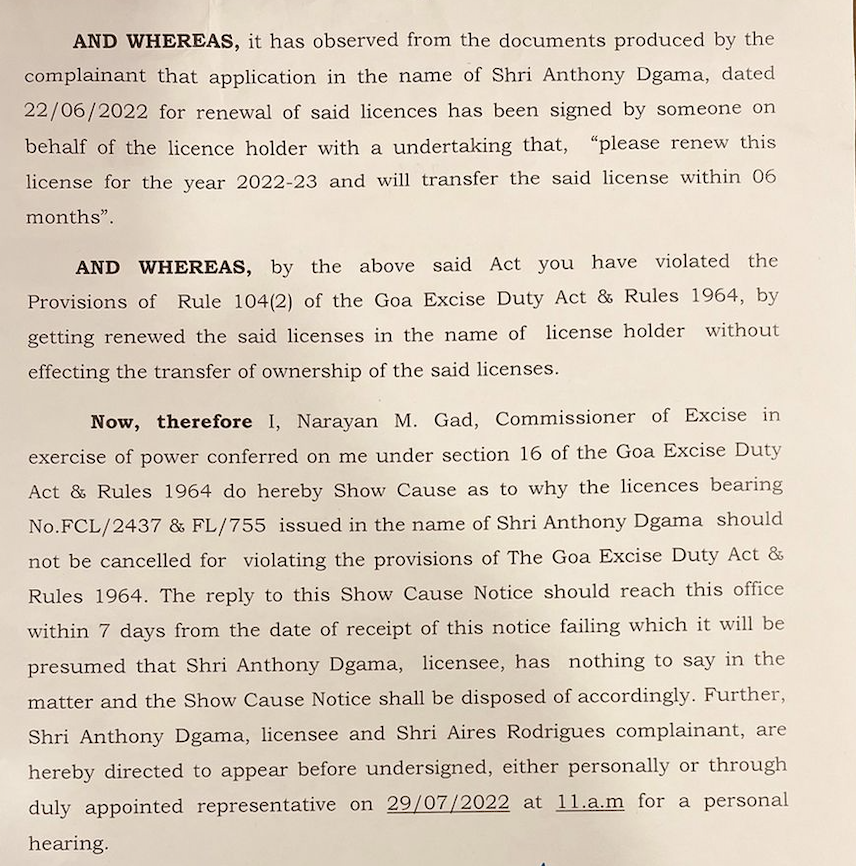
However, in the very next page of the excise notice, the reason for this has been amply explained and the owner of the restaurant has been asked to explain the reasons behind the alleged irregularity.
Show cause notice issued to restaurant
The license was earlier in the name of Mr Anthony Dgama who passed away in 2021. It was his legal heir, his son, who had requested for the license to be renewed in his name, promising to affect the transfer of the license name to his own within 6 months.
The allegation that false documents were produced or that the restaurant is an “illegal bar” is false, even by the facts mentioned in the show cause notice. Now whether technically it was in contravention of the law, would be established only after the hearing by the authorities, however, for Congress or even Aires Rodrigues to insinuate that the Iranis, specifically, Zoish Irani, is running an “illegal bar” is false and malicious.
As for the other allegations about the restaurant not having a licence to function, there is no proof that has been provided by Aires Rodrigues or the Congress party. The only documents that Congress has relied on make no mention of the Iranis and certainly no mention of Zoish Irani.
What is the involvement of the Iranis and specifically, Zoish Irani, in the restaurant in question
The earliest mention of Zoish Irani can be found in a hit job published by The Wire on the 21st of July 2022, 2 days before the Congress press conference. In the report, TheWire claims that the restaurant is run by Zoish Irani, based on a video segment with food critic Kunal Vijaykar. In the video, that the Congress is using now to lie about the Iranis, Zoish Irani, wearing a Chef’s jacket, said that though Goa was a huge tourist hub, it lagged in high-end dining of international calibre and she hoped Silly Souls would become the “food destination” of Goa.
Article by The Wire
According to Zoish Irani’s lawyer, she was only interning at the Silly Souls Cafe and she had given the interview as an interning chef. “She has interned at 4 places before Silly Soul’s Cafe”, a source close to the family said.
Based on her internship, the Congress and TheWire have alleged that the cafe was owned and run by Zoish Irani.
The Wire in its report has repeated the allegations levelled by Aires Rodrigues without doing their own due diligence. What is worse is that they have gone a step further and dragged Irani’s 18-year-old daughter into the controversy based on a YouTube video, without trying to find out what her association with the cafe was, to begin with.
The same allegations were then repeated by the Congress party who made value judgements against a teenage girl because they wanted to exact revenge from Smriti Irani for exposing the Gandhis.
The truth of the matter is that Smriti Irani’s husband, Zubin Irani, who has been a businessman his entire adult life, co-founded the cafe along with Mr Dgama, who expired in 2021. The restaurant is owned by his legal heir, his son, after his death, and it is in his name that the liquor license is to be transferred.
It is pertinent to note that the cafe is a completely legitimate business interest that Zubin Irani holds, as he is a businessman by profession. Congress has managed to unearth nothing of consequence that puts the Iranis in the eye of the storm. In fact, there is no political influence or public fund that has been used in setting up the business and therefore, attacking a legitimate business interest of Zubin Irani, and dragging in their 18-year-old daughter with moral judgements, only shows that the Congress party is desperately trying to shift the focus from the corruption of the Gandhis and us using a teenage girl to settle scores.
The saga of Congress morphing a picture of Smriti and Zoish Irani, in which Zoish was only 16 years old
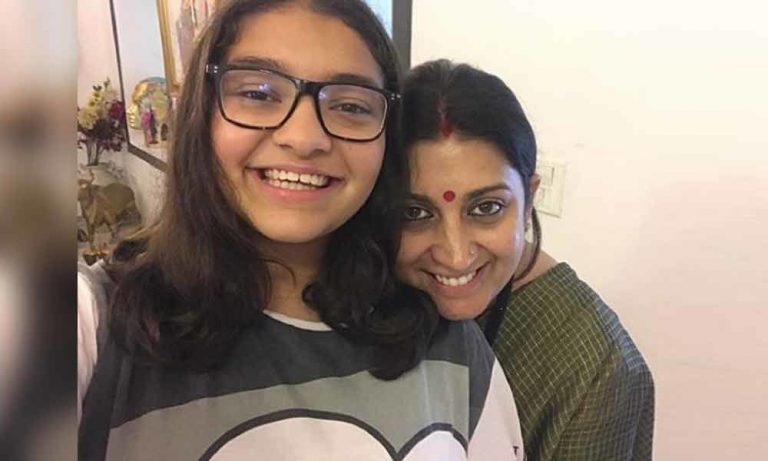
As the Congress party was attacking the teenager, a picture was widely circulated by its supporters that showed Zoish Irani hugging her mother, outside the board of the restaurant that had the word “bar” in it.
— Suby #ReleaseSanjivBhatt (@Subytweets) July 22, 2022
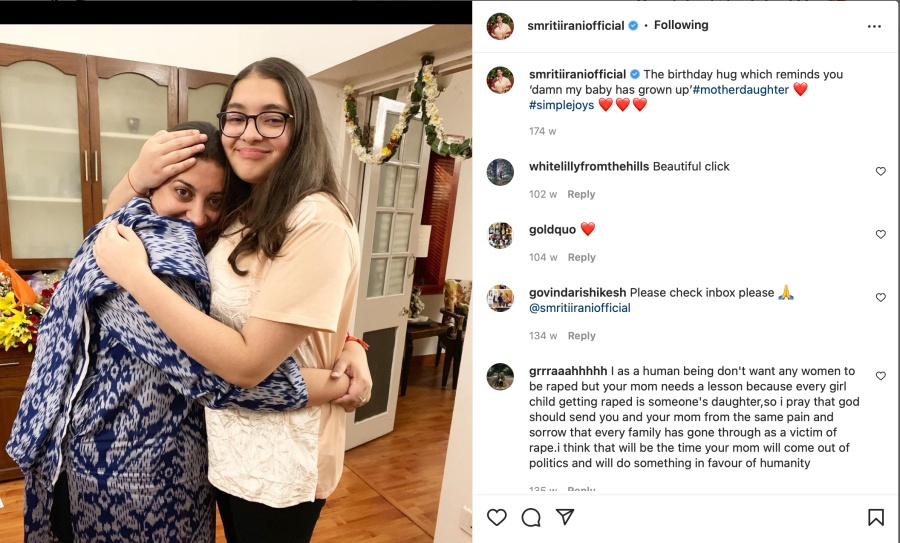
As it turns out, the image in question is from 2019 and was morphed by the Congress party to make its allegations appear believable.
If one checks the Instagram account of Smriti Irani, the 2019 image is a picture celebrating Smriti Irani’s birthday and is probably taken at their residence, not at the restaurant in Goa at all.
Smriti Irani’s Instagram post from 2019
This image was taken by the Congress party and morphed in front of the restaurant board. The image was then used widely to substantiate the lies that the Congress party was peddling about the teenager.
There appears to be a reason why Congress chose to attack Zoish Irani and not Smriti Irani or even Zubin Irani directly. The most effective way to shut a woman up seems to be either to attack her children or her character. Smriti Irani has been a vocal critic of the Gandhis and she defeated Rahul Gandhi in Amethi, a family bastion that the Congress took for granted. It was her, because of whom, Rahul Gandhi had to contest from “safe seat” Wayanad, where he knew the Muslim majority would save him electorally. Braving the attacks that have been mounted against her and her character, Smriti Irani has emerged as a leader that the Congress fears – especially the Gandhis.
With the Enforcement Directorate’s investigation into Rahul and Sonia Gandhi, Smriti Irani has been at the forefront of asking pertinent questions to the Congress party that has presided over scams worth crores while they were in power. As Irani shows no signs of cowering because of her character being assassinated constantly, Congress seems to have decided that the most effective way to make her back off, would be to hunt down her teenage daughter. With the burden of these allegations, the life of a teenager would be made miserable and any mother would be forced to take a step back, so her children are not affected by the political mudslinging that Congress seems to be a master at. The moral insinuations made by Congress during the press conference bear testimony to the fact that Congress, shamelessly, tried to character assassinate a teenager because they wanted to intimidate her mother, who has proved to the nation that the Gandhis can be defeated in their own bastion.
Tesla and SpaceX boss and world’s richest man Elon Musk has denied the news reports that he had an affair with Google co-founder Sergey Brin’s wife, leading to their divorce earlier this year. Musk has called the reports that he had an affair with Nicole Shanahan in December 2021 ‘Total BS’. Sergey Brin and his second wife Nicole Shanahan separated on 15th December 2021, before filing for divorce in January 2022.
Taking to Twitter to deny the report, Musk tweeted, “This is total bs. Sergey and I are friends and were at a party together last night! I’ve only seen Nicole twice in three years, both times with many other people around. Nothing romantic.”
This is total bs. Sergey and I are friends and were at a party together last night!
I’ve only seen Nicole twice in three years, both times with many other people around. Nothing romantic.
Elon Musk further went on to share that he hasn’t even had sex in a long time, forget about having an affair with Brin’s wife. Billionaires Elon Musk and Sergey Brin are long-term friends, with Brin even helping out Musk with $500,000 to keep Tesla afloat at the peak of the financial crisis in 2008. Brin was also one of the first persons to get a Tesla car when production for the electric car started.
Musk also tweeted that Wall Street Journal has run a number of hit pieces on him and his company Tesla.
WSJ has run so many bs hit pieces on me and Tesla I’ve lost count! It’s embarrassing for them, frankly.
They once wrote an article saying FBI was about to arrest me, so I called FBI to ask what’s up and they said WSJ article was total bs.
WSJ reports that Elon Musk and Sergey Brin’s friendship fell apart over Musk’s affair with Brin’s wife
Earlier, Wall Street Journal reported that Elon Musk and Sergey Brin’s friendship is over and they are no longer on talking terms after Musk had an affair with Brin’s wife, Nicole Shanahan. As per WSJ, the alleged affair took place in early December 2021, at the Art Basel event in Miami. Art Basel is a multiday, annual festival that draws wealthy attendees from around the world.
The report further added that at a party. Elon Musk dropped to one knee in front of Brin and apologised profusely for the transgression and begged for forgiveness. Sergey Brin and his wife separated shortly afterward on 15th December 2021 citing irreconcilable differences.
Brin, who is worth 90 Billion Dollars, and Nicole, who is the founder of legal technology company ClearAccessIP and the Bia-Echo Foundation, are currently negotiating a divorce settlement expected to be around one Billion Dollars.
At the time of the alleged affair, Elon Musk was “semi-separated” from his girlfriend Grimes, with whom he had a daughter via surrogacy in December 2021.
On Friday (July 22), Hindus in Bangladesh held a peaceful demonstration in the Chittagong Division against the recent atrocities committed in Narail and the increase in targeted attacks by Islamists.
Bangladesh news agency, Hindu Sangbad, tweeted, “A protest march is held today in Chittagong against the barbaric attacks on Hindus in #Narail, Bangladesh and the ongoing killing of Hindu teachers and rape of Hindu women.”
In a video shared by the news agency, the Hindus were seen demanding justice for the victims of the Narail attack. They were seen marching peacefully with torches and banners and raising slogans in unison.
A protest march is held today in Chittagong against the barbaric attacks on Hindus in #Narail, Bangladesh and the ongoing killing of Hindu teachers and rape of Hindu women. pic.twitter.com/xp6IuDPz21
— Hindu Sangbad – হিন্দু সংবাদ (@sangbad_bd) July 22, 2022
Amidst the targeted attacks on the Hindu community, the Bangladesh National Human Rights Commission (NHRC) has called upon the country’s Home Ministry to intervene and prevent persecution of religious minorities.
Despite this, none of the culprits involved in the Narail attack was arrested. “The state is responsible for failing to stop this growing communal mindset in society. When perpetrators go unpunished despite attacking the Hindu community time and again, it only encourages the fundamentalists,” read a report in The Daily Star.
Bangladesh: The Narail attack case
On July 15 this year, a Muslim mob vandalised a temple, a grocery store and several houses belonging to members of the Hindu community in the Sahapara area of Lohagara, Narail.
Following the Friday prayers (Jumma Namaz), the extremists attacked properties belonging to the Hindu community. They claimed that an 18-year-old Hindu college student named Akash Saha has hurt their religious sentiments through a Facebook post.
Under the pretext of blasphemy, the vicious mob set out to destroy the livelihood of the 108 Hindu families. According to an ex-member of Dighalia Union Parishad, Beauty Rani, a large number of Hindus have left the Sahapara village after the onslaught by Islamists.
”Almost all houses are locked. Only the elders of some families are home. They too are scared,” she informed. Rani lamented, “When we were being attacked, the police were there. They were watching from a distance and no one came to our rescue. The police can no longer be trusted and that is why people are leaving the village.”
One of the victims of the dastardly attack was 62-year-old Deepali Rani, whose house was burnt down in front of her eyes. “After one group looted all our valuables, another group came and found our door open. As there was nothing left to loot, they set our home on fire,” she told The Daily Star.
Deepali Rani is not related to Akash Saha in a way. Despite this, her shelter was not spared by the Islamist mob. “Only because the student is Hindu and I too am Hindu, my house was burnt down,” she emphasised.
The 62-year-old stated, “I don’t know how long this threat of violence will haunt us. Who will give us justice? Who will give us security? … If I were in the house while they set it on fire, I would have died. God saved me. But is this any way to survive? All I have now is the sari on my body.”
What is the easiest way to punch a woman down? Especially when she has taken on the high and mighty and defeated the ones everyone thought were infallible at their home turf? Go for her family, especially her young daughter and while you’re at it, indulge in casting aspersions on her character and question the ‘sanskar’ and her upbringing.
Smriti Irani has been on the receiving end of humiliation since she ‘dared’ to challenge Rahul Gandhi in 2014 itself. There has been constant misogynist, sexist attacks on her, many of which involved sexual innuendos – from all opposition quarters.
In 2015, Congress leader Nilamani Sen Deka the former Assam state Agriculture minister said at a public meeting in Nalbari that many people refer to Smriti Irani as the second wife of Prime Minister Narendra Modi. In 2019, Congress leader had shared an image of Irani with Hukumdev Narayan saying that Smriti is bowing in obeisance in front of a “Rape Guru” while Rahul Gandhi is asked to apologise for his rape remarks. Indrani Mishra had insinuated that Smriti is paying respect to rape accused Swami Chinmayanand, while it was actually veteran MP Hukumdev Narayan Yadav.
Another Congress leader Shashank Bhargava, during a rally in 2020, made another such comment filled with sexual innuendos against Irani. “The hike in fuel prices must be rolled back. In the past, Smriti Irani would roam around with a lot of bangles in her hand. She is close to the Prime Minister and can give her bangles and a lot many other things. I will request her to gift the Prime Minister her bangles and whatever else he wants and ask him to roll back the price hike,” he had said.
Of course, now with the general elections sneaking up on us in less than 2 years’ time, Congress leaders have decided to up their ‘tapasya‘ quotient and take the misogynist attacks a notch higher. Since they could not shake Irani with their jibes, they now decided to attack a woman’s weak point – her children.
Easiest way to ‘show a woman her place’, eh? After all, how dare their beloved Prince be defeated, that too by a woman. Pawan Khera, who was snubbed and overlooked for the Rajya Sabha post, decided to shoot his shot once more to prove his loyalty. He invoked whether her daughter, 18 year old Zoish Irani, ‘running an illegal bar’ in Goa was ‘sanskar’.
Before we get into how this is problematic behaviour, let us get facts straight.
Zoish interned at Silly Soul restaurant and bar in Goa back in 2019 when she was an intern. An intern does not become an owner of the bar, just as how Pawan Khera, despite all his ‘tapasyas’ is unlikely to ever become Congress President. Further, the licence of the bar was in name of the restaurant owner, one Anthony D’Gama. Upon his demise in 2021, the licence would have passed on to his legal heir after appropriate procedure. This year when Anthony D’Gama’s son applied for renewal of licence, he mentioned that the transfer of title shall be concluded in 6 months period. However, the Goa Excise commissioner sent him a show cause notice for the same.
In the reply to RTI, the document on which Congressis have decided to attack Irani, does not mention Zoish Irani or Smriti Irani at all. So Zoish was dragged into controversy because at some point in past, when she was 16 year old, she interned at some place and that place, three years later, may have some irregularity. Images of Zoish when she was 16 were flashed on social media platforms. She may be 18 year old now, but she was a minor girl then.
Now, things get worse. Questions were raised on where were Irani’s ‘sanskar’ that her daughter was running an ‘illegal bar’. Here, the clear intention was to insinuate that the young girl was a person of disrepute because she was ‘running an illegal bar’, a place which serves alcohol. Let me clarify things upfront that any work, as long as it is not illegal, deserves respect and dignity. Just because a woman (not necessarily Zoish) works or worked at a bar, that is in no way a certificate of her character.
So, @IYCGoa Workers visited Tulsi Sanskari Bar & removed the tapes concealing the identity of BAR after the Exposé. pic.twitter.com/iqkiE8d47L
See how ‘BAR’ is in all caps? This same Congress worker is being hailed as some sort of messiah of humanity for his so-called work during oxygen crisis during the pandemic. But here he is, attacking an 18 year old, assassinating her character. Imagine the emotional scars Zoish would have to face because her mother defeated Rahul Gandhi in democratic elections.
Congress workers have graduated from outraging modesty of a woman to settle political scores to outraging modesty of 18-year-old daughter. This when the party is led by a woman. The party that has given India first and only Prime Minister. That party has now stooped this low to make ‘bar’ jokes about an 18 year old. Disgusting.
They say politics is a dirty place, after all, it is a man’s world there. Naturally, it is harder for a woman to not only carve a place for herself but defeat really powerful politicians, like fourth generation politicians, whose father, grandmother and great grandfather have been the Prime Ministers of India. The one who has grown up believing he is the natural heir to the seat of India’s Prime Minister.
In 2014 general elections, Smriti Irani took on Rahul Gandhi, the then 2 time MP from Amethi, a constituency that has sent many members of his family to the Lok Sabha. Rahul Gandhi won the elections but Irani gave him a tough fight. Rahul Gandhi got 4,08,651 votes with 46.71% vote share while Irani clocked in 3,00,748 votes with 34.38% vote share. The previous term, in 2009, Rahul Gandhi had got 4,64,195 votes with 71.78% vote share. So, while Irani may have lost, she gave a tough fight to the crown prince.
For next five years, Irani worked hard and when she again took on Rahul Gandhi in Amethi that year, she had increased not only the vote count but also vote share. Irani got 4,68,514 votes with 49.71% vote share against Rahul Gandhi’s 4,13,394 votes with 43.84%. Rahul Gandhi’s vote share had gone down. Deep down Rahul Gandhi had sensed he was losing Amethi, which is why he chose a second ‘safe seat’ Wayanad in Kerala to contest elections. Yes, Rahul Gandhi had contested from two constituencies and lost the family bastion to Smriti Irani, someone his party leaders including his sister have mocked, ridiculed.
But now when they haven’t been able to break her by attacking her, they have now taken it up a notch higher. They have sent hordes of abusive, mean comments, misogynist attacks and disgusting and vulgar ‘bar’ jokes towards an 18 year old. They want Irani to break and hence are attacking a woman’s weakness, her children. But Irani seems defiant. She has since sent a legal notice and has made up her mind to not let this bog her down.
The grit and determination that she has shown over the years, one hopes has been inculcated in her children as well and they grow up to be as fierce individuals as their mother is. And for Irani herself, here’s hoping she contests 2024 from Amethi as well as Wayanad and emerge victorious from both the seats.
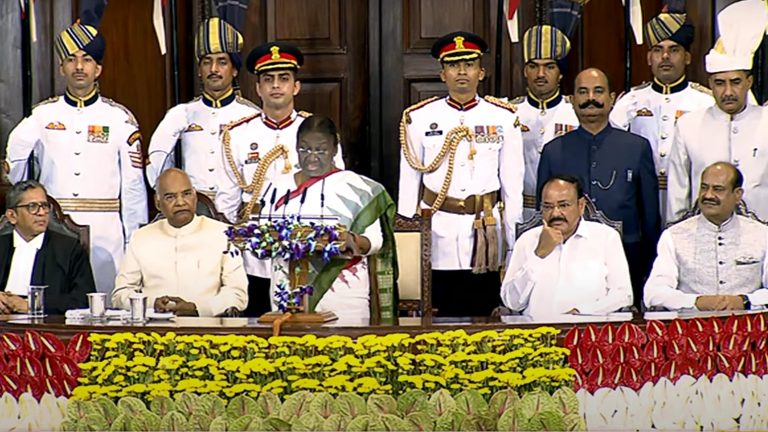
Draupadi Murmu is now the 15th President of the Republic of India. She was sworn to the highest constitutional post at the Central Hall of Parliament in New Delhi earlier today. In her first speech addressing the people of India as the President of India, President Murmu greeted all Indians and stated that the trust and support of the countrymen would be the greatest strength in fulfilling her new responsibility.
The official Twitter handle of the Rashtrapati Bhawan tweeted the remarks made by President Murmu. President Murmu started her speech by saying, “Johar! Namaste! I humbly greet all the countrymen from this holy Parliament, a symbol of the hopes and aspirations and rights of all the citizens of India. Your affinity, your trust and your support will be my greatest strength in fulfilling this new responsibility for me.”
जोहार ! नमस्कार !
मैं भारत के समस्त नागरिकों की आशा-आकांक्षा और अधिकारों की प्रतीक इस पवित्र संसद से सभी देशवासियों का पूरी विनम्रता से अभिनंदन करती हूँ।
आपकी आत्मीयता, आपका विश्वास और आपका सहयोग, मेरे लिए इस नए दायित्व को निभाने में मेरी बहुत बड़ी ताकत होंगे।
— President of India (@rashtrapatibhvn) July 25, 2022
It is interesting to note that President Murmu started her speech with Johar, a word that is a salutation spoken by tribal people in the tribal regions of Chhattisgarh, Jharkhand and Odisha. Johar signifies “victory to all living and nonliving components of nature.” “Johar” means “victory to the wellbeing of all.” In this context, “Johar” means “Jai for the welfare of all,” i.e., Johar is the spirit of absolute commitment to nature.
President Murmu also conveyed her gratitude to the Members of Parliament and Members of Legislative Assemblies for electing her to the highest constitutional post.
भारत के सर्वोच्च संवैधानिक पद पर निर्वाचित करने के लिए मैं सभी सांसदों और सभी विधानसभा सदस्यों का हार्दिक आभार व्यक्त करती हूं। आपका मत देश के करोड़ों नागरिकों के विश्वास की अभिव्यक्ति है।
— President of India (@rashtrapatibhvn) July 25, 2022
She said that it is also a coincidence that her political career started when the country was celebrating its 50th year of independence in 1997. And today in the 75th year of independence, she has got this new responsibility.
ये भी एक संयोग है कि जब देश अपनी आजादी के 50वें वर्ष का पर्व मना रहा था तभी मेरे राजनीतिक जीवन की शुरुआत हुई थी। और आज आजादी के 75वें वर्ष में मुझे ये नया दायित्व मिला है।
— President of India (@rashtrapatibhvn) July 25, 2022
She further mentioned that she is the first President of India to be born in the independent India.
मैं देश की ऐसी पहली राष्ट्रपति भी हूँ जिसका जन्म आज़ाद भारत में हुआ है।
— President of India (@rashtrapatibhvn) July 25, 2022
She stated that in order to live up to the demands that our freedom fighters placed on us as citizens of an independent India, we must move swiftly in this Amritkal. “We have to work at a fast pace in this Amritkal to fulfill the expectations that our freedom fighters had made from us citizens of independent India. In these 25 years, the path to the accomplishment of Amritkal will proceed on two tracks – everyone’s effort and everyone’s duty,” she stated.
हमारे स्वाधीनता सेनानियों ने आजाद हिंदुस्तान के हम नागरिकों से जो अपेक्षाएं की थीं, उनकी पूर्ति के लिए इस अमृतकाल में हमें तेज गति से काम करना है।
इन 25 वर्षों में अमृतकाल की सिद्धि का रास्ता दो पटरियों पर आगे बढ़ेगा- सबका प्रयास और सबका कर्तव्य।
— President of India (@rashtrapatibhvn) July 25, 2022
According to President Murmu, it is a testament to the strength of our democracy that a daughter born into a low-income family or a daughter born into a remote tribal region may hold the highest constitutional position in India.
ये हमारे लोकतंत्र की ही शक्ति है कि उसमें एक गरीब घर में पैदा हुई बेटी, दूर-सुदूर आदिवासी क्षेत्र में पैदा हुई बेटी, भारत के सर्वोच्च संवैधानिक पद तक पहुंच सकती है।
— President of India (@rashtrapatibhvn) July 25, 2022
In concluding the speech, President Murmu said. “With the spirit of world welfare, I will always be ready to work with full devotion and dedication to live up to the trust of all of you.”
जगत कल्याण की भावना के साथ, मैं आप सब के विश्वास पर खरा उतरने के लिए पूरी निष्ठा व लगन से काम करने के लिए सदैव तत्पर रहूंगी।
— President of India (@rashtrapatibhvn) July 25, 2022
At 10:15 AM on Monday, the Chief Justice of India N V Ramana administered the oath of office to the President, after which she swapped seats with outgoing President Ram Nath Kovind. Murmu signed the oath register presented to her by the President’s secretary. Following the new President’s consent, the home secretary issued the proclamation of appointment of the new president.
Prime Minister Narendra Modi, the Council of Ministers, governors of individual states, chief ministers, chiefs of diplomatic missions, Members of Parliament, and senior civil and military officials from the government were present at the event.
On Sunday (July 24), the Uttar Pradesh police arrested two miscreants for dressing up as Hindus and desecrating a Mazar in Bijnor city of Uttar Pradesh.
As per reports, the two accused were identified as Kamal and Adil. The duo tied a saffron-coloured cloth around their heads and ransacked the Jalal Shah Mazar.
They also set several ‘chadars’ on fire. On receiving information, the cops rushed to the crime scene and nabbed the two men.
Bijnor, UP| A big communal conspiracy was prevented (on July 24) under Sherkot PS limits; info was received about 2 people ransacking Jalal Shah Mazar & burning several ‘chadar’. Police reached the spot & got to know that a similar incident happened at Bhure Shah Mazar: ADG (L&O) pic.twitter.com/lCEwG5bswK
“A big communal conspiracy was prevented (on July 24) under Sherkot PS limits; info was received about 2 people ransacking Jalal Shah Mazar & burning several ‘chadar’,” informed ADG (Law and order) Prashant Kumar.
“No damage done to religious texts,” he emphasised. According to Kumar, the two accused are brothers by relation and had earlier desecrated the Qutub Shah Mazar in Sherkot.
With their arrest, the cops foiled the criminal conspiracy by the duo to defame the Hindu community.
This whole matter shows attempts to soil the atmosphere amid the Kanwar Yatra… Field officers instructed to be more alert; continuous social media monitoring also underway: Prashant Kumar, ADG, Law & Order
“This whole matter shows attempts to soil the atmosphere amid the Kanwar Yatra… Field officers instructed to be more alert; continuous social media monitoring also underway,” ADG Kumar emphasised.
Islamists, and Congress leaders spread fake news that Hindus posing as Muslims to offer Namaz
Earlier, the Lucknow police arrested 4 people for performing Namaz without authorisation at the Lulu mall on July 12 this year. The accused were identified as Mohammad Rehan, Aatif Khan, Mohammad Lokman, and Mohammad Noman.
It is worth noting that Islamists and Congress leaders intentionally propagated false information claiming that Hindus posing as Muslims had offered namaz at Lulu Mall. They were using the arrest of Hindus in another case to claim that individuals offering namaz inside the mall were not Muslims.
Arfa Khanum Sherwani, Rohini Singh, and RJ Sayema were among the left-leaning ‘liberals’ who had helped amplify the misinformation.