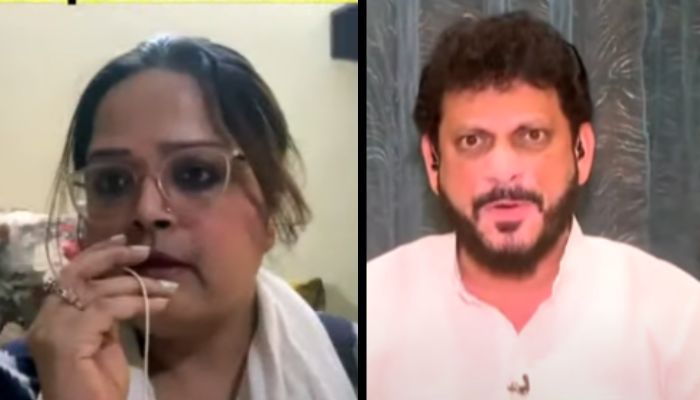
On Monday (June 13) night, AIMIM leader Waris Pathan was schooled by a Muslim panellist named Subuhi Khan during a debate on the recent violence orchestrated by Islamist mobs over alleged ‘blasphemy’.
During the debate titled ‘Stop the Riot Culture’ on Republic TV, Pathan was seen crying foul over the demolition of illegal houses of Muslim rioters in Uttar Pradesh. Instead of answering the questions posed to him, the AIMIM leader remained fixated on his monologue.
“He will keep on repeating the same things,” a co-panellist named Subuhi Khan noted. At that point, Pathan responded aggressively, “You don’t teach me what I have to repeat. I never interjected when you were making a point. Khamosh (Silence).”
“Apni zabaan sambhal ke baat kijiye (Hold your tongue),” she remarked. The AIMIM leader replied, “Aree app sambhal ke baat karo. Mujhe tumhare se tameez nahin sikhna. (You, hold your tongue. I do not need to learn manners from you.)”
Subuhi Khan then requested Arnab Goswami to reduce the volume of Pathan’s microphone while the latter threatened to leave the debate. “This is not 1984 and I am not Shah Bano. And you are Waris Pathan. Stay within your limits,” she emphasised.
On hearing this, a red-headed Waris Pathan said, “Shut up and sit down. You and your entire lineage are 2-faced. Speak with respect.” He then went on to claim that she had not been made a spokesperson by the BJP because she is a Muslim.
“Your name is Subuhi khan. You have not been made the spokesperson by the BJP despite licking its feet,” he continued with his tirade. The Muslim panellist said, “I am not in active politics unlike you.” “Stop dreaming and come back to reality. You will get nothing… Sit down silently,” Waris Pathan replied in a crass tone.
Co-panellist objects to the indecent behaviour of Waris Pathan
At about 45 minutes into the debate, RSS ideologue and co-panellist Ratan Sharda asked Waris Pathan to apologise to Subuhi Khan for his unsavoury remarks. “You are a useless, bad person… You are an idiot, a lunatic,” the AIMIM leader told Sharda.
At that point, Arnab Goswami interjected and directed Waris Pathan to mind his language. He also instructed him against making personal remarks about any panellist. Subuhi Khan responded, “These men have the habit of mistaking every Muslim woman for Shah Bano… This is not 1984 but 2022. He has forgotten that this is a nationalist government.”
Today on @republic#StopTheRiotCulture AIMIM Spokie Waris abuses a Muslim lady shouting about her khandan, insulted her self respect talking of shoe licking. Shame. Same fellow goes under water when asked about his MP calling for hanging of #NupurSharma ?
— Ratan Sharda ?? रतन शारदा (@RatanSharda55) June 13, 2022
“I will insult her if she does not stop,” Waris Pathan threatened. Khan questioned, “Why are you hurt? Is your fragile male ego and manhood coming in the way of debate?”
Towards the end of the show, Subuhi Khan told Pathan that the Indian law will not work per his whims and fancies. She rubbished his claims of punishment accorded for hurting religious sentiments.
At that point, in a rather childish manner, the AIMIM leader tried to mock his Muslim co-panellist by imitating her expressions. “What do you even know? Chal, Chal?” he was heard as saying.
15 crore Muslims can dominate over 100 crore Hindus: Waris Pathan
The AIMIM leader is not new to controversies. In February 2020, Waris Pathan was seen inciting Muslims at an anti-CAA rally in Gulbarga, Karnataka, in the presence of AIMIM chief Asaduddin Owaisi.
In a veiled threat to the Hindus, Pathan resorted to inciting Muslims by stating that the time had come for the Muslims of the country to unite and ‘achieve freedom’. He added that even though Muslims were just 15 crores in the country, they could still dominate over 100 crore Hindus.
Speaking at an anti-CAA protest rally in Gulbarga of Karnataka, Pathan warned Hindus to be scared of Muslims and reminded them of the consequences if Muslims united.
Waris pathan says
“We (minority) are only 15 crore of the population but if we take streets then we are bhari on majority of population
“We need to work together, we need to snatch our Azadi. The time has now come to achieve Azadi, if we cannot achieve it, we should snatch it. They were mocking us for hiding behind women (during anti-CAA protests),” he had said.
Pathan continued, “Do not forget, these are lionesses who have come out and you are already afraid of these women. Be aware and know what happens if we all (Muslims) unite together.”
“We are 15 crores but be aware we can still dominate over 100 crore Hindus and imagine what we can do to you,” he had threatened.
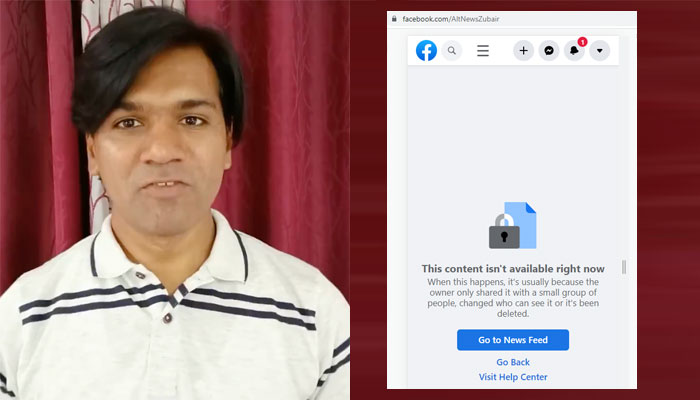
On June 13, Mohammed Zubair, co-founder of propaganda website AltNews, deleted or deactivated his Facebook profile (AltNewsZubair) after his Hinduphobic posts went viral on several social media platforms. He removed the page from the platform allegedly after a Twitter user, the hawkeye, posted a thread about how Zubair had been posting blatantly Hinduphobic posts.
Interestingly, Zubair has been a frontrunner in fanning the controversy around alleged derogatory remarks on Prophet Muhammad by former Bharatiya Janata Party (BJP) spokesperson Nupur Sharma. However, his parody page ‘Unofficial: Subramanian Swamy’ is still active.
Zubair deleted/deactivated Facebook after his Hinduphobic posts got viral. Source: Facebook
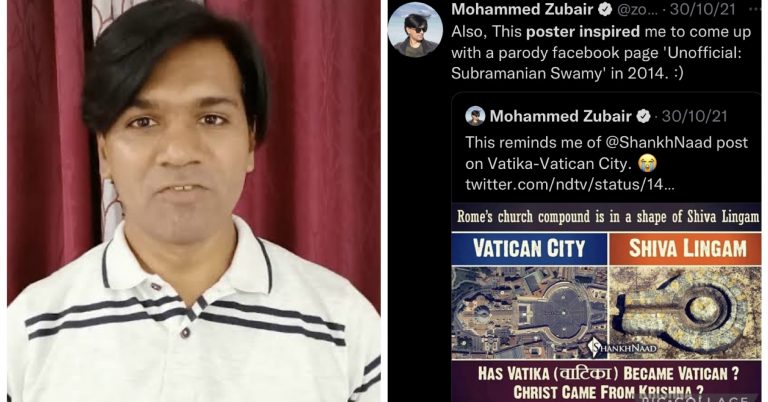
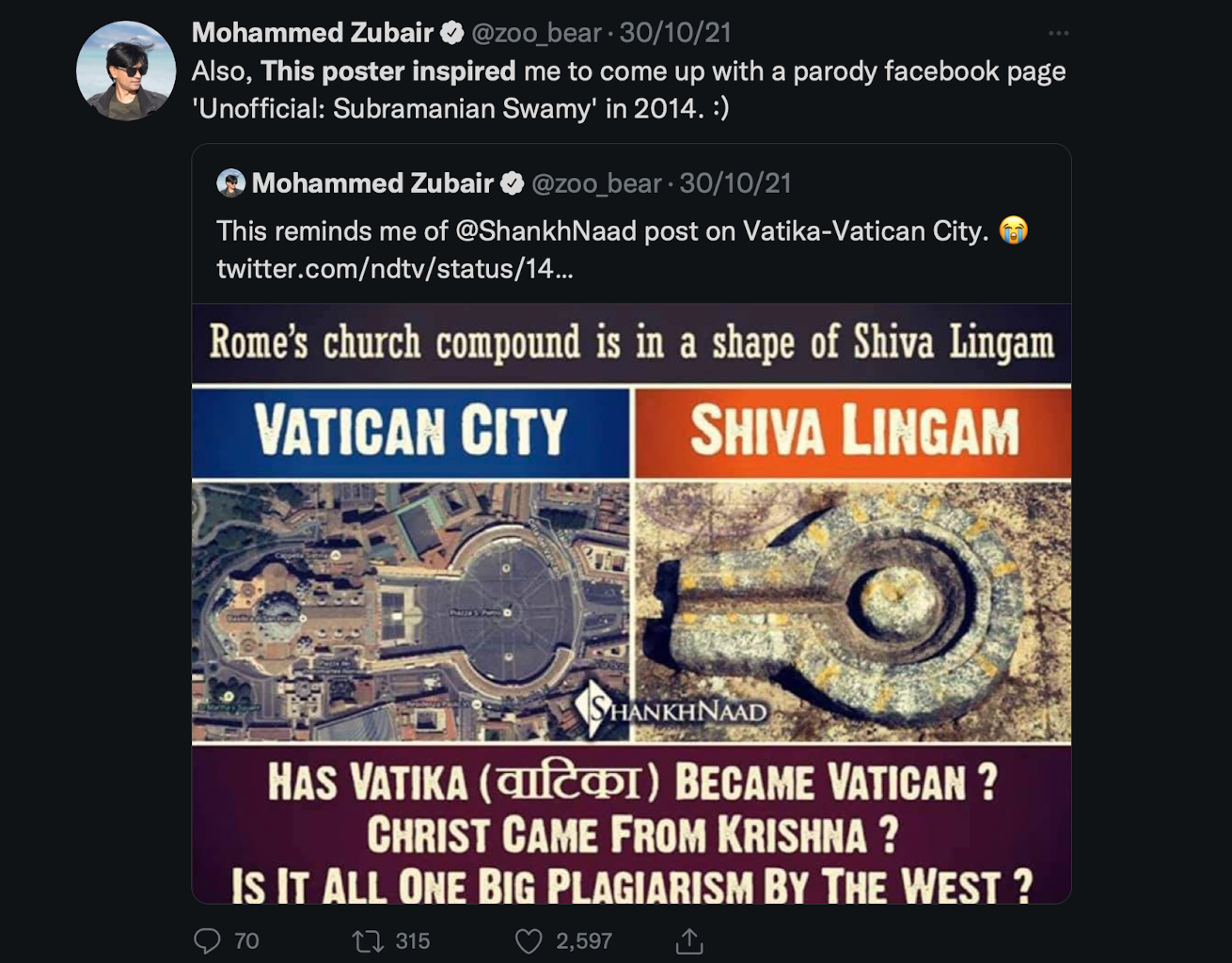
OpIndia had reported on Sunday that Zubair had himself mocked Hindu Gods and beliefs while leading an online campaign accusing people of insulting Islamic beliefs. In one of the tweets shared by The Hawk Eye, Zubair is seen mocking Shivling and comparing it with the top view of the Vatican City. He said the post comparing Shivling with the Vatican City inspired him to come up with a parody Facebook page, ‘Unofficial: Subramanian Swamy’ in 2014.
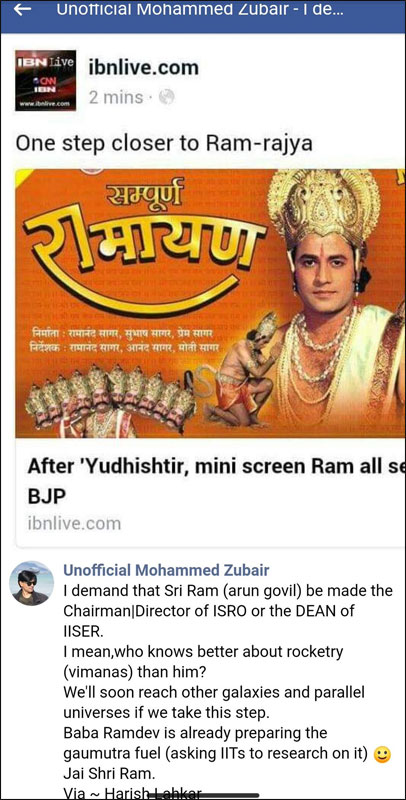
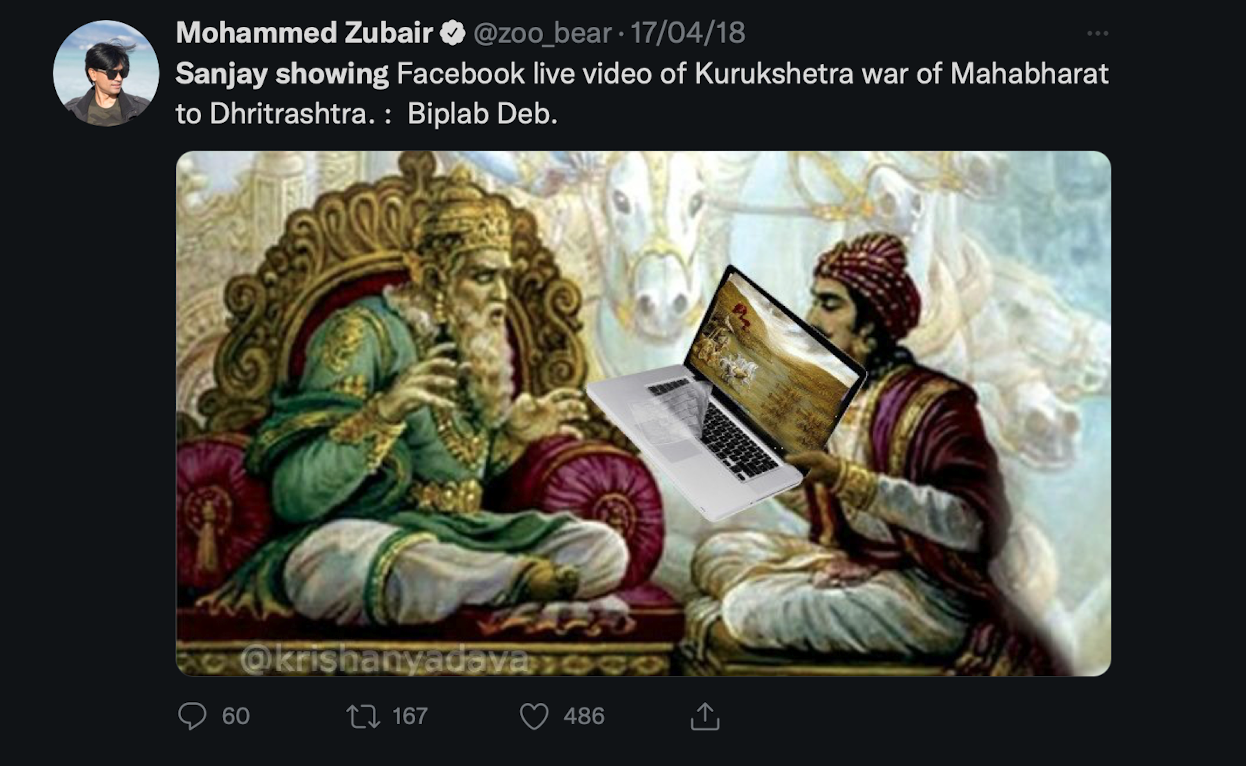
Apparently, one of the posts on the Facebook page ‘Unofficial Mohammed Zubair‘ mocks Arun Govil to take a swipe at Lord Ram, suggesting that ISRO must consult the actor because he would know more about the rocketry.
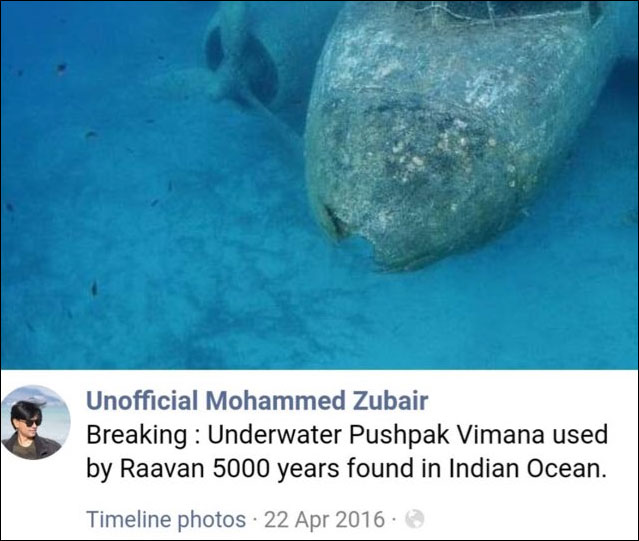
Another post by ‘Unofficial Mohammed Zubair’ shows an aeroplane under water with the caption: “Breaking: Underwater Pushpak Vimana used by Raavan 5000 years found in the Indian Ocean.”
Source: Twitter/TheHawkEye
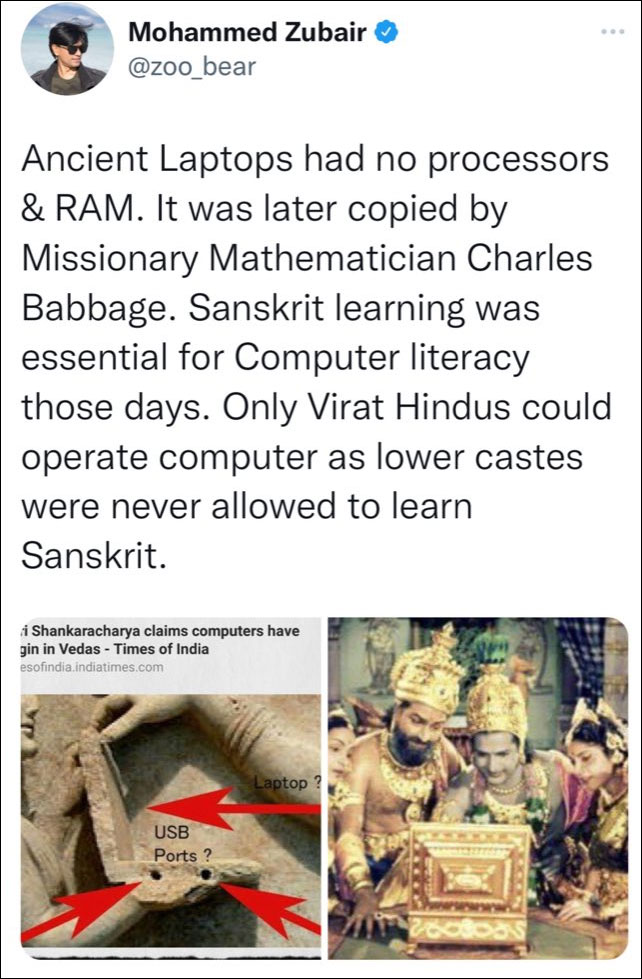
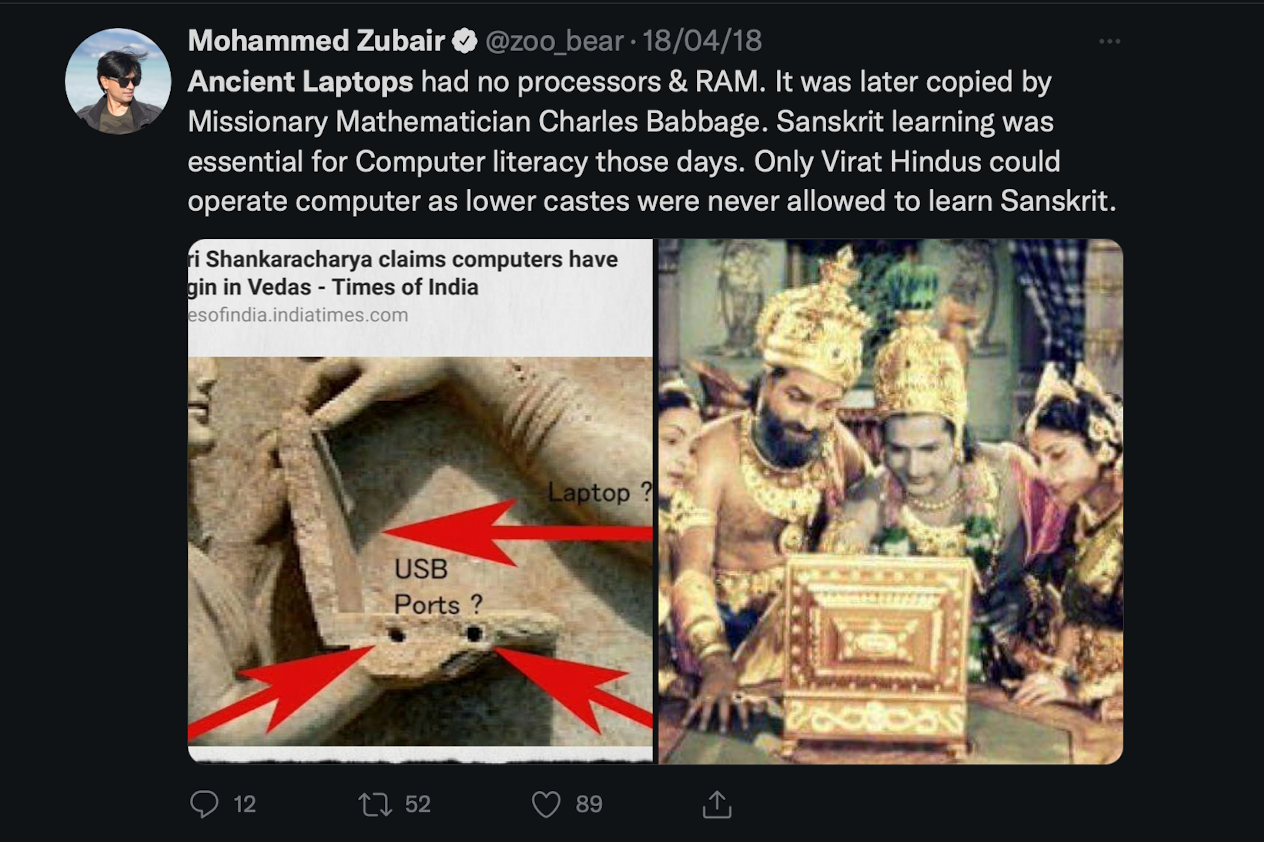
Besides ridiculing Hindu Gods, Zubair has also poked fun at Hindu beliefs and even mocked Sanskrit, the ancient language that forms the basis of Hindu texts.
Source: Twitter/TheHawkEye
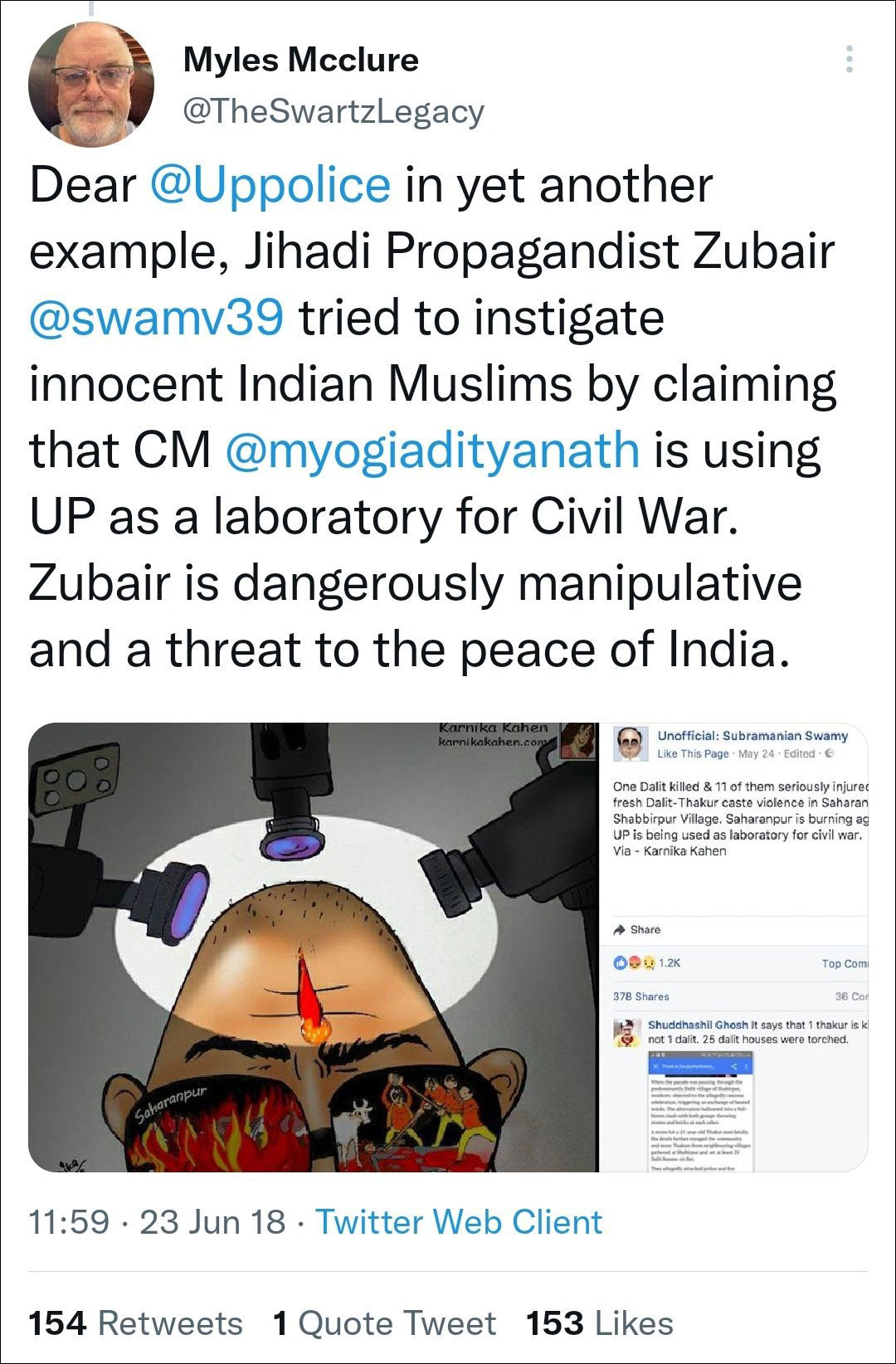
Interestingly, this is not the first time someone has pointed out how Zubair has been fanning hate and posting Hinduphobic posts. In 2018, a Twitter user TheSwartzLegacy posted a few tweets alarming authorities about his posts but no action was taken against him. In a now-deleted post TheSwartzLegacy wrote, “Dear UP Police in yet another example, Jihadi propagandist Zubair tried to instigate innocent Indian Muslims by claiming that CM Yogi Adityanath is using UP as a laboratory for Civil War. Zubair is dangerously manipulative and a threat to the peace of India.”
Now-deleted post by TheSwartzLegacy. Source: Twitter
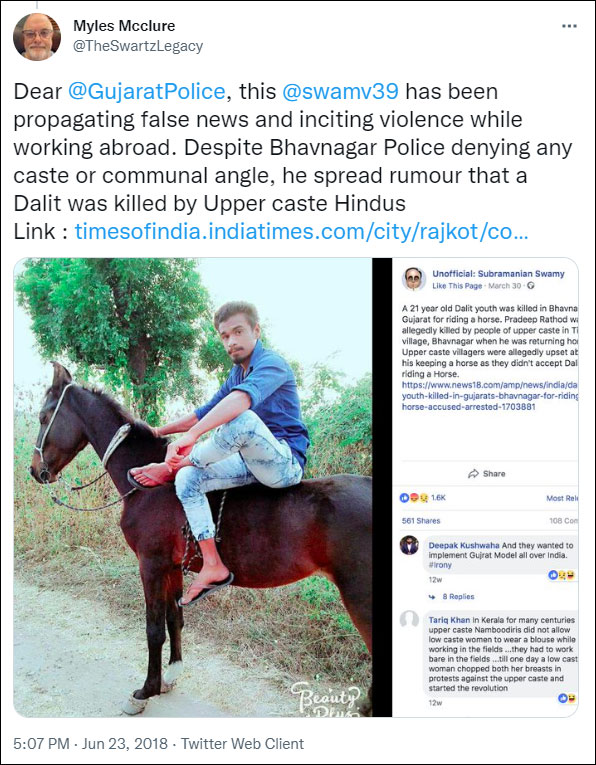
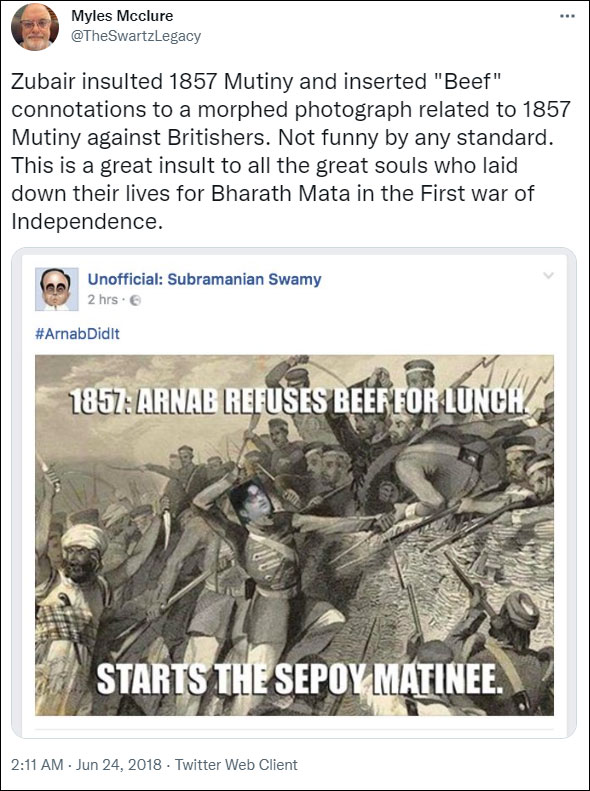
In other posts, TheSwartzLegacy demonstrated how Zubair, through his troll page “Unofficial: Subramanian Swamy” attempted caste-based propaganda in Gujarat and insulted the 1857 Mutiny. Zubair not only mocked and insulted Hindus but also the freedom fighters of India.
Zubair tried to insert caste in a case where police categorically denied it. Source: Twitter
Zubair’s propaganda-filled campaign against Nupur Sharma
It is ironic that the posts by Zubair came to light days after he dog-whistled Islamists over alleged ‘blasphemy’ committed by former BJP spokesperson Nupur Sharma against the Islamic prophet. Sharma was at the receiving end of online harassment as indoctrinated Islamists on social media descended on her timeline, abusing her and issuing death threats to her and her family.
A few days later, the propaganda spread to Islamic countries, with many Gulf nations, which themselves have a poor record in religious freedom themselves, sanctimoniously protesting against the remarks on Prophet Muhammad that were derived from Islamic Hadiths.
The controversy culminated with widespread violence across different parts of India as Islamists in several towns and cities across the country took to the streets, going on a rampage and indulging in violence, vandalism, and arson.
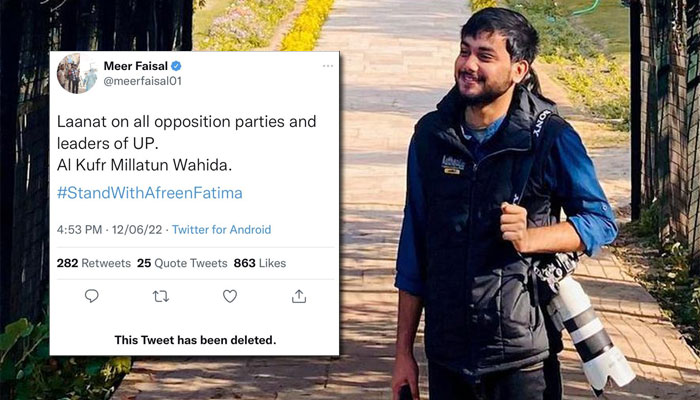
On June 12, a young 21-years-old columnist with leftist propaganda portal The Wire, Meer Faisal, tweeted one highly derogatory and problematic tweet in support of ‘activist’ Afreen Fatima. Faisal is currently associated with Maktoob Media, an Islamist propaganda portal, and is a regular contributor to various media houses, including Al Jazeera, The Wire, Nikkei Asia, First Post and The Quint.
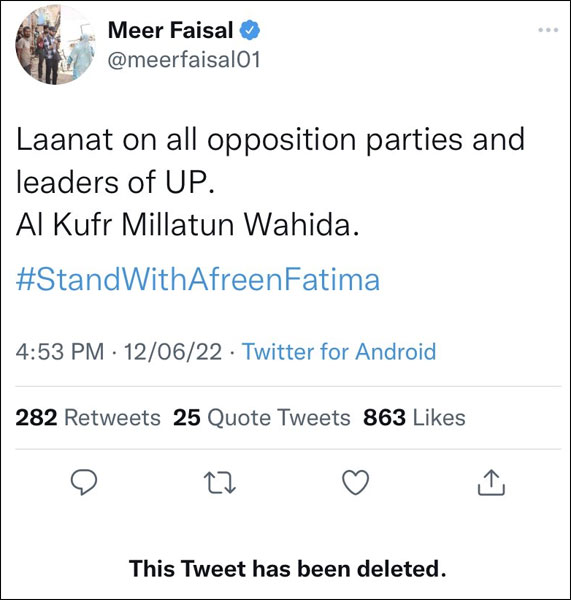
In his tweet, visibly angry Faisal was not pleased with the action taken by the Uttar Pradesh state government against Prayagraj riots accused Javed Pump’s illegally constructed house. Fatima is Javed Pump’s daughter. He wrote, “Laanat on all opposition parties and leaders of UP. A kufr Millatun Wahida” followed by a hashtag #StandWithAfreenFatima.
In a now-deleted tweet, Faisal said ‘All disbelievers and enemies of Islam are the same’. Source:
Notably, Fatima’s father, Javed Mohammed ‘Pump’, was arrested by the UP Police as he had emerged as the mastermind behind Prayagraj violence. The violence took place on Friday during a protest against alleged derogatory remarks by Bharatiya Janata Party’s former spokesperson Nupur Sharma on Prophet Muhammad.
The line that followed the ‘laanat’ ‘A kufr Millatun Wahida’ translated to ‘All non-Muslims are the same i.e. Kaafir’. Shortly after the rant, Faisal deleted the tweet, but by then, his anger and frustration towards Kafirs or Kufrs (or Non-Muslims/Hindus who do not believe in ‘One God’) was all over the social media.
Meaning of Al-kufr millah wahida’ is that All non-Muslims are the same.
If we look at the history of Meer Faisal’s social media (Twitter) account, this is not the first time he has spoken against non-Muslims (especially Hindus). Faisal was also booked by Delhi Police for allegedly cooking up a story against Hindus and Delhi Police a few months back.
Delhi Police booked Meer Faisal for publishing a fake story
On April 4, Delhi Police booked Faisal and news portal Article 14 for disseminating false information using the social media platform Twitter. The false information was shared regarding The Hindu Mahapanchayat event organised by the Save India Foundation at the Burari ground in Delhi on April 3.
Deputy Police Commissioner Northwest Usha Rangnani said in a statement, “An FIR under Indian Penal Code’s Section 505 (2) has been registered at Mukherjee Nagar Police Station against some Twitter handles for tweets in circulation having content which could incite enmity, hatred, and ill-will between two communal groups. The investigation in the case has been taken up.”
On April 3, Faisal claimed that five Muslim journalists, including him, were ‘assaulted’ at an event by a “Hindu” mob. News portal Article 14 had also tweeted, “5 journalists, 4 of them Muslim,1 on assignment for @Article14live, have been taken by police to the Mukherji Nagar police station in Delhi after a mob at #Hindu#dharamsansad (for which the police had declined permission) discovered their religion, attacked them & deleted videos”.
The claims were refuted by DCP. She said, “Some of the reporters, willingly, on their own free will, to evade the crowd which was getting agitated by their presence, sat in PCR Van stationed at the venue and opted to proceed to Police Station for security reasons. No one was detained. Due police protection was provided.” DCP added that necessary action would be taken against those who spread the misinformation.
Faisal claimed Hindus attacked Muslims in Kanpur violence
On June 3 he claimed that it was a “Hindu mob” that pelted stones when poor Muslims were merely shutting shops to protest against “blasphemous” statements by Nupur Sharma. To put things into perspective, a report has revealed that after Friday prayers, the Muslim mob began forcing Hindus in the Beconganj district to close their shops. When they objected, the enraged mob began throwing stones at Hindus. The Islamists insisted on knowing the names of the people, and those who were Hindus were attacked.
Violence broke out in #Kanpur during shutdown called by Muslim community protesting against @NupurSharmaBJP blasphemous comments against Prophet Muhammad SAW. When Muslim shopkeepers were closing their shops after Friday prayers, the Hindutva mob started pelting stones at them. pic.twitter.com/MdEfRuQBwr
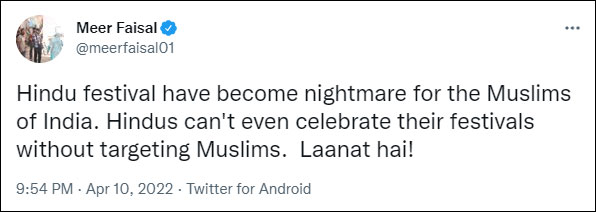
On April 10, he claimed that Hindus target Muslims during Hindu festivals and such festivals had become a ‘nightmare’ for Muslims. He said, “Hindu festival have become a nightmare for the Muslims of India. Hindus can’t even celebrate their festivals without targeting Muslims. Laanat hai!”
Faisal declared Hindu festivals nightmare for Muslims. Source: Twitter
On April 10, Hindus celebrated Ram Navami, the birthday of Bhagwan Ram. On this day every year, Hindus take out Shobha Yatras across the country to celebrate the birth of their beloved Bhagwan.
This year on Ram Navami, multiple Shobha Yatras were attacked and Islamists indulged in pelting stones, throwing petrol bombs and attacking Hindus with swords. At some locations, they even fired bullets at innocent Hindus. Such reports came from Jharkhand, Madhya Pradesh, West Bengal, Gujarat, Karnataka and Rajasthan.
The left-liberals and Islamists on social media, news media and other platforms tried to paint Hindus in a bad light and claimed it was Hindus who attacked and provoked Muslims by ‘chanting provocative slogan of Jai Shri Ram’. People like Meer Faisal ran a propaganda-filled campaign to malign the image of peace-loving Hindus. He shared several tweets blaming Hindus for arson and attacking Muslims. He conveniently missed the details of Hindus who were peacefully taking out Shobha Yatra and were attacked by the Muslim mob.
Faisal fear mongered about a peaceful Bajrang Dal rally in Mewat, the ‘mini Pakistan’
In December last year, Faisal took to Twitter to post a host of videos about a Bajrang Dal rally in Mewat to fearmonger about Hindu outfits trying to create a “communal divide” between Hindus and Muslims of the area.
Meer Faisal stated in his Twitter thread that on the 12th of December, Bajrang Dal member Jeet Vashisht took to Facebook to post videos of a saffron rally in Nuh, the Muslim-majority area in Mewat. He said that Jai Shree Ram slogans were raised in front of Muslim households and that the rally was carried out with over 500 cars filled with “Hindutva supporters” who had entered the area to saffronise Mewat.
On the contrary, the police also confirmed that the rally was completely peaceful and no untoward incident was reported. Interestingly, the rally had happened with due permission of the Police which Faisal ignored.
Support for anti-India forces
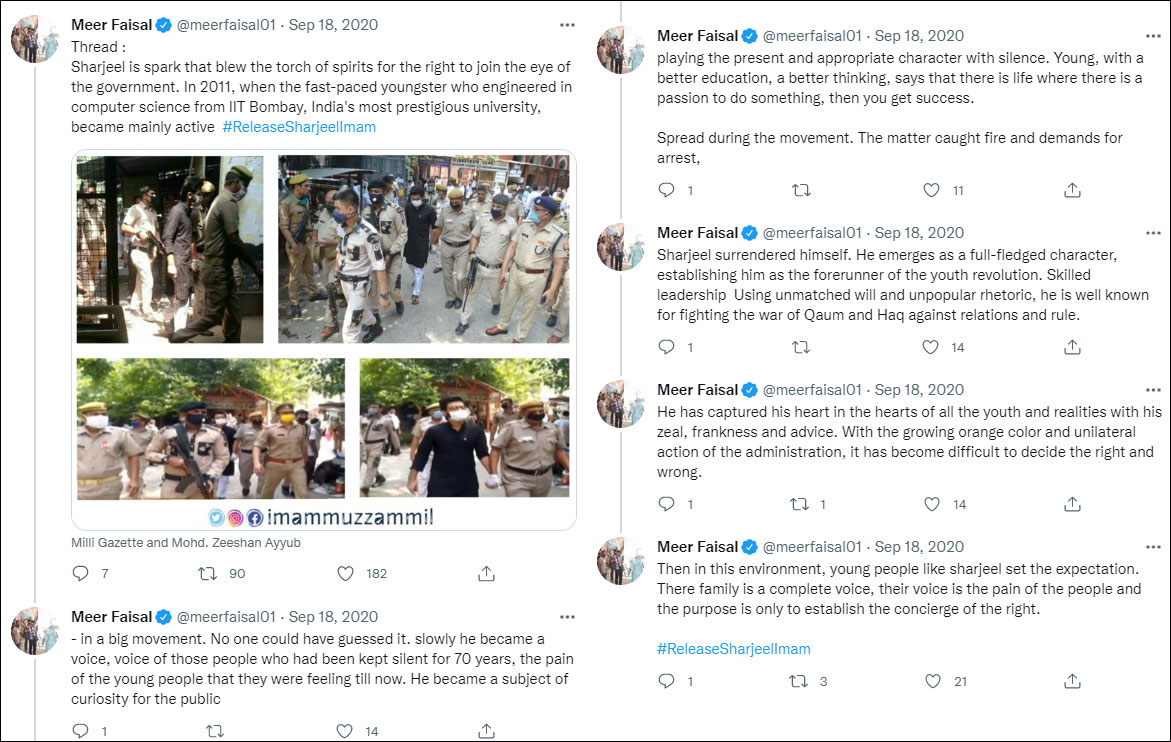
On several occasions, Faisal showed his support for anti-India forces. In 2020, he posted a thread in support of Sharjeel Imam where he called him the ‘spark that awakened the public that was sleeping for over 70 years. Completely ignoring the fact that in his provocative speeches, Imam had talked about cutting the Northeast part of India, Faisal demanded the release of Imam.
Thread in support of Sharjeel Imam (Source: Twitter)
Faisal inadvertently rightly said that “he [Imam] is well known for fighting the war of Qaum”.
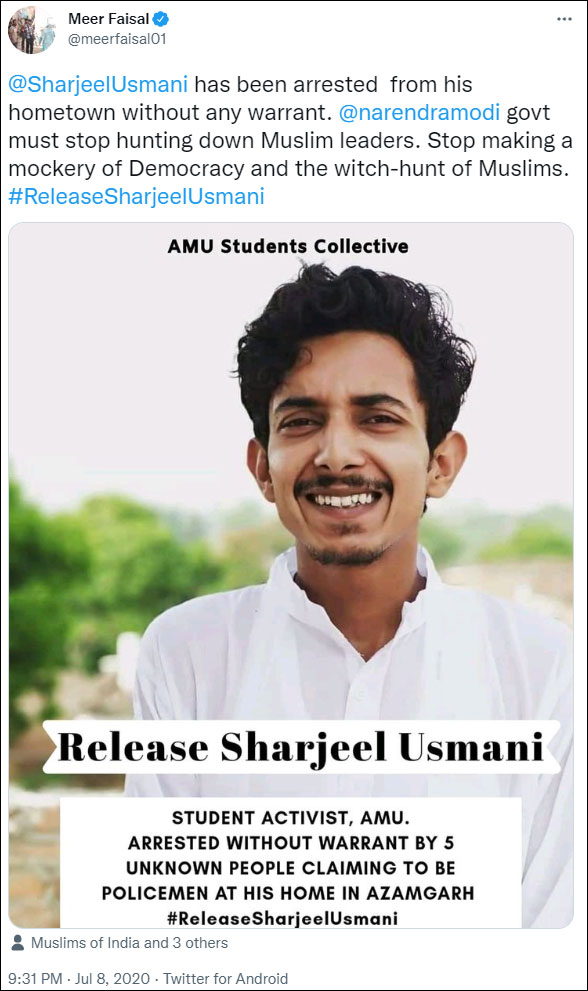
He also came out in support of Sharjeel Usmani and demanded his release while calling him a student leader. Though he kept supporting Usmani, Faisal ignored the fact that Usmani was booked and arrested for instigating riots and giving provocative speeches.
Faisal supported Sharjeel Usmani on several occasions. (Source: Twitter)
This is not even the tip of the iceberg. Faisal has countless posts against Hindus targeting Hindutva and blaming Hindus for “atrocities against Muslims”.
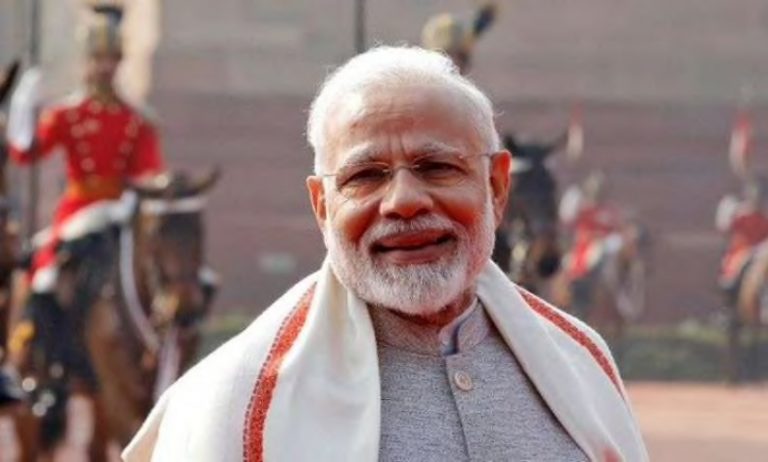
The government of India is all set to hire a whopping 10 lakh people in the next 1.5 years. As per PMO India, PM Modi has asked for the positions to be filled to meet human resource requirements across all departments and ministries of the government.
PM @narendramodi reviewed the status of Human Resources in all departments and ministries and instructed that recruitment of 10 lakh people be done by the Government in mission mode in next 1.5 years.
In a tweet, the PMO India shared, “PM Modi reviewed the status of Human Resources in all departments and ministries and instructed that recruitment of 10 lakh people be done by the Government in a mission mode in next 1.5 years.”
It is notable here that large-scale employment generation was a key poll promise of the Modi government and the Department of Personnel and Training, the government of India’s department for hiring human resources for its various administrative divisions, comes directly under the PMO.
It recruits staffers through 2 organisations, the Union Public Service Commission (UPSC) and the Staff Selection Commission (SSC). The UPSC recruits officers for higher civil offices while the SSC hires the subordinate staff.
Mohammed Zubair, the co-founder of propaganda AltNews, who had dog-whistled against former BJP spokesperson Nupur Sharma over remarks on Prophet Muhammad, precipitating an international diplomatic crisis for India and triggering a spate of violent protests in India, had himself mocked Hindu Gods and beliefs, past tweets from the ‘fact-checker’ revealed.
Days after India witnessed violent protests that saw Islamists running riot, indulging in violence over the alleged insult of Prophet Muhammad, Twitter user The Hawk Eye (@thehawkeye) shared a collage of past tweets by Mohammed Zubair mocking Hindu Gods and beliefs.
“Its easy to make fun of other’s god, religion, culture & scriptures, because there is no consequences. Ironically it’s coming from the same person who triggered an event that took the entire nation on ransom, and the violent mayhem is still on.. Ever tried this for own …?” The Hawk Eye tweeted along with screenshots of Zubair’s tweets.
Its easy to make fun of other’s god, religion, culture & scriptures, because there is no consequences.
Ironically its coming from same person who triggered an event that took entire nation on ransom, and the violent mayhem is still on..
In one of the tweets shared by The Hawk Eye, Zubair is seen mocking Shivling and comparing it with the top view of the Vatican City. He said the post comparing Shivling with the Vatican City inspired him to come up with a parody Facebook page ‘Unofficial: Subramanian Swamy’ in 2014.
Source: Twitter
Apparently, one of the posts on the Facebook page ‘Unofficial Mohammed Zubair‘ mocks Arun Govil to take a swipe at Lord Ram, suggesting that ISRO must consult the actor because he would know more about the rocketry.
Another post by ‘Unofficial Mohammed Zubair’ shows an aeroplane under the water with the caption: “Breaking: Underwater Pushpak Vimana used by Raavan 5000 years found in the Indian Ocean.”
Besides ridiculing Hindu Gods, Zubair has also poked fun at Hindu beliefs and took a dig at Sanskrit, regarded as one of the most important languages of Hinduism and the means of communication by the Hindu Gods.
Source: TwitterSource: Twitter
Death threats to Nupur Sharma, Diplomatic nightmare for India in the Middle East, and violence across India: Fallout of Zubair’s dog-whistling on alleged ‘blasphemy’ against Prophet Muhammad
Ironically, Zubair’s insulting tweets for Hindu Gods and beliefs come days after he had dog-whistled Islamists over alleged ‘blasphemy’ committed by former BJP spokesperson Nupur Sharma against the Islamic prophet. Sharma was at the receiving end of online harassment as indoctrinated Islamists on social media descended on her timeline, abusing her and issuing death threats to her and her family.
A few days later, the propaganda spread to Islamic countries, with many Gulf nations which themselves have a poor record in religious freedom themselves, sanctimoniously protesting against the remarks on Prophet Muhammad that were derived from Islamic Hadiths.
However, the controversy culminated with widespread violence across different parts of India as Islamists in several towns and cities across the country took to the streets, going on a rampage and indulging in violence, vandalism, and arson. Thousands of Islamists came out on the streets in protest against the alleged ‘blasphemy’ against Prophet Muhammad, issuing vile death threats to the former BJP leader and causing law and order problems in their respective places.
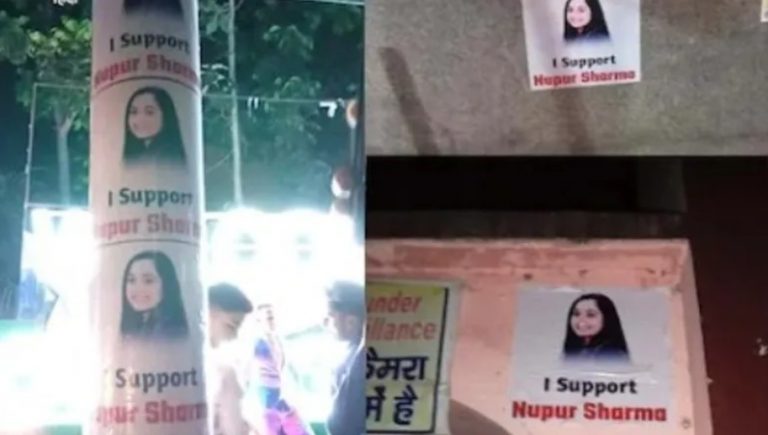
Three days after Islamists went on a rampage across the country against ex-BJP spokesperson Nupur Sharma, several posters supporting her have appeared in the Gopalganj district in Bihar. The posters have reportedly been put up in strategic locations in the city around marketplaces, educational institutions, parks, and temples on the intervening night of June 12 (Sunday) and June 13 (Monday).
The posters read “I support Nupur Sharma”. It also featured a photo of the former BJP spokesperson, who has been the target of a vicious campaign by rabid Islamists since Alt News co-founder Mohammed Zubair shared a video of her comments on Prophet Muhammad last month.
गोपालगंज : बीजेपी से निलंबित नेत्री नूपुर शर्मा के सपोर्ट में लगाए गए पोस्टर। शहर के कई जगहों पर चौक चौराहों पर लगाए गए हैं पोस्टर। लिखा ‘आई सपोर्ट नूपुर शर्मा।’ विवादित बयान के बाद अब गोपालगंज के लोग सपोर्ट में आ गए हैं।#gopalganj#NupurSharma#isupport#news#newsalert
Since these posters have emerged, the state’s Intelligence Department and the Police Department have been on high alert.
According to media reports, these posters have been put up by Hindu organizations in Bihar.
Permission denied for a match against Nupur Sharma
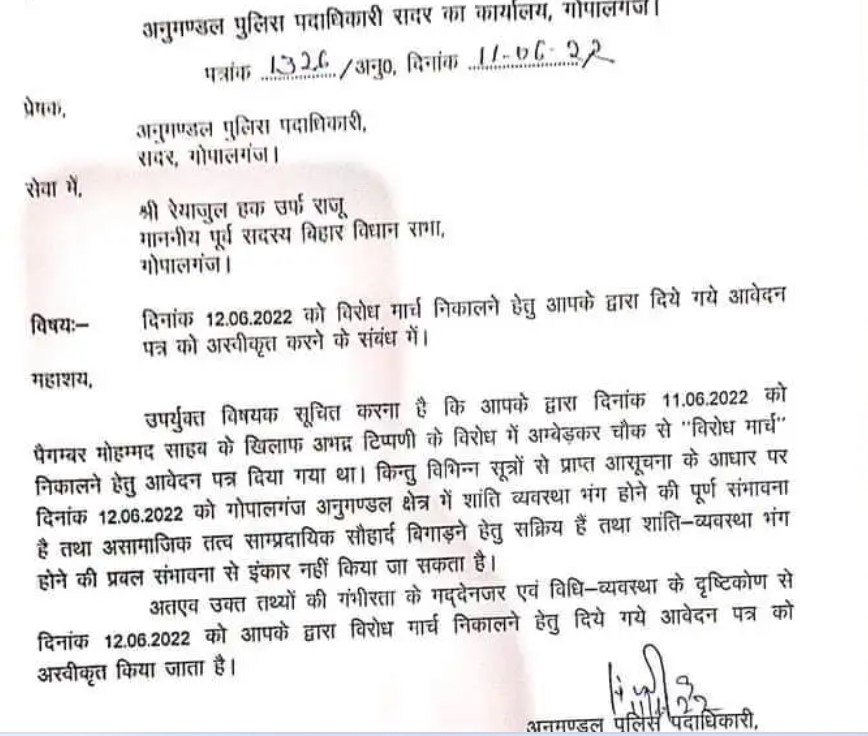
Meanwhile, the police in Gopalganj have refused to grant permission for a ‘protest march’ against Nupur Sharma. Reyazul Haque, a former RJD MLA, had sought police permission to take out the rally on June 12.
Letter sent by Gopalganj police to Reyazul Haque denying permission to take out a protest rally against Nupur Sharma
Dubbed a ‘protest march’, Reyazul Haque had said that the rally would start from Ambedkar Chowk on June 12. The police, however, denied permission saying that it would endanger social harmony. On being denied permission for the rally, Haq began spreading bizarre conspiracy theories. He said that the district administration suspected that the RSS would incite riots and violence if he was given permission to hold the rally.
He said, “We, along with Ulema and others, have agreed to call off this protest. We don’t want authorities to take any sort of action against our people. We will write to the President of India seeking strict action against the former BJP spokesperson Nupur Sharma. I implore Rasool’s followers to remain calm and patient wherever they may be.”
Meanwhile, a Muslim organization has filed a formal complaint with a police station in Gopalganj, requesting that an FIR be registered against Nupur Sharma. Simultaneously, the administration is compiling a list of those who are attempting to destabilize communal harmony via social media. So far, 70 such persons have been identified, according to the police.
How and why Islamists have been targeting the ex-BJP spokesperson
Islamists have continued to hound and threaten the ex-BJP spokesperson Nupur Sharma and her family since the time Alt News co-founder Mohammed Zubair shared her video with a commentary on Prophet Mohammad to encourage trolls to attack her. In the last week of May 2022, during a news debate on the disputed Gyanvapi structure, Nupur Sharma asked what if she makes offensive remarks about Islam the way people were making offensive remarks about Shivling and Hinduism.
Since then, the intimidation campaign against the former BJP spokesperson has continued unabated, with domestic and foreign Islamists baying for her blood. Multiple death and beheading threats have come her way. A number of FIRs have also been filed against her in different states of India. Despite her suspension from the BJP over her alleged ‘blasphemy’ and subsequent apology, Islamists have continued to target her with threats. There are multiple bounties on her head as well now ranging from Rs 20 lakhs to 1 Crore.
The worsening situation over the remarks reached rock bottom on the 10th of June 2022 as Islamist mobs ran riot in numerous parts of the country following the Friday Namaz. In some places, the enraged mob set fire to Nupur Sharma’s effigy and posters, while in others, stones were thrown, injuring cops and citizens, and causing property damage.
Hindus come out in large numbers in support of Nupur Sharma
However, since the time Islamists have run a vile campaign against Nupur Sharma, many Hindus have also come out in support of suspended BJP spokeswoman Nupur Sharma. OpIndia reported how Gujarat’s Naari Gaurav Suraksha Samiti (Women Pride Protection Committee) held a rally in Ahmedabad on Sunday, June 12, in support of Nupur Sharma. Moreover, a video had gone viral wherein thousands of Hindus from Nepal came out in support of Nupur Sharma following the death threats she received.
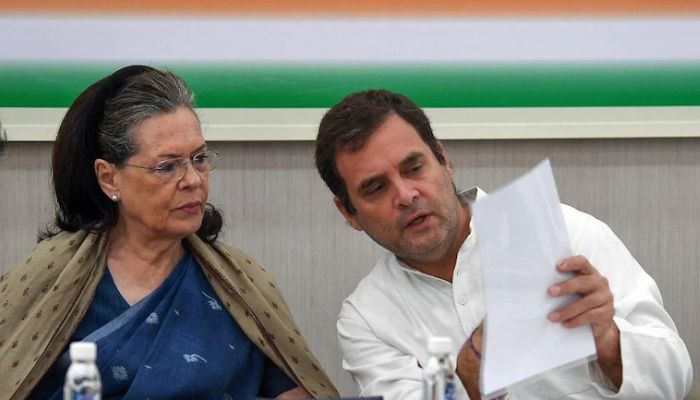
On Monday (June 13), Congress scion Rahul Gandhi appeared before the Enforcement Directorate after he was issued summons by the central agency in connection to a money laundering case related to the National Herald case.
He was interrogated for several hours and his statement was recorded under the Section 50 of the Prevention of Money Laundering Act (PMLA). Reportedly, the Congress leader was quizzed by the Assistant Director of the ED and the questioning was supervised by a Deputy Director.
Gandhi’s statement was typed out by another officer. He may be summoned for further questioning on Tuesday (June 14). It must be mentioned that the ED had recorded the statements of all those involved in the case, with the exception of Rahul Gandhi and Sonia Gandhi.
#WATCH | Congress leader Rahul Gandhi accompanied by party leaders and workers marches to the Enforcement Directorate office in Delhi to appear before it in the National Herald case pic.twitter.com/8sd7VctfEG
Although Sonia Gandhi was asked to appear before the central agency on June 8, she had to be hospitalised for Covid-19. She has now been asked to appear before the Enforcement Directorate on June 23, 2022.
Rahul Gandhi was summoned by ED on Monday (June 13) in relation to a case that was lodged 9 months ago. The case sought to investigate financial irregularities under PMLA associated with National Herald.
Citing sources, India Today reported that the Congress scion was quizzed about his association with two key companies, namely, Young Indian Limited (YIL), and Associated Journals Limited (AJL). He was asked about the Congress’ keenness to revive National Herald and the loans sanctioned to keep it afloat.
The publishing company of the National Herald goes into debt
National Herald was started by India’s first Prime Minister Jawaharlal Nehru in 1938 to convey the concerns of Congress’ liberal brigade. Following India’s independence, it metamorphosed into the mouthpiece of the Congress party.
The Associated Journals Limited (AJL) was the publishing company of the National Herald newspaper. It was also involved in the publication of the Urdu newspaper Qaumi Awaz and Hindi paper Navjivan. By April 2008, AJL was in huge debt and owed the Congress party a whopping sum of ₹90.26 crores.
The party had sanctioned loans to the company from time to time at 0% interest to keep it afloat. When it became unsustainable, AJL formally drew curtains over the printing and publication of its newspapers in 2008. The number of shareholders was down to 1000 in 2010 from 5000 at the time of its establishment.
Debt owed to Congress party transferred to Gandhi-owned company
Another company by the name of Young Indian Limited (YIL) was created in 2010 as a private, not-for-profit charity under Section 25 of the Companies Act of 1956. The Gandhis (including Rahul and Sonia) owned 83.3% of the shares in YIL (as per Income Tax records).
Congress leaders Motilal Vora and Oscar Fernandes owned 15.5% and 1.2% of the shares respectively. YIL paid ₹50 lakhs to the Congress party and transferred the debt of ₹90.26 cr owed to it by AJL to itself.
Given that AJL was not in a position to clear its debt, the Young Indian Limited acquired a majority of its share equities and eventually the whole company. As such, all assets of the Associated Journals Limited were incorporated into the Gandhi-owned Young Indian Limited.
This included real estate assets, worth over 2000 crores, which are located in posh localities of Mumbai, New Delhi, Lucknow, Bhopal, Indore, Patna and others. After acquiring AJL, Young Indian Limited announced that the publication of newspapers was not the objective of the not-for-profit charity.
Nonetheless, in 2016, YIL relaunched the 3 newspapers, including the National Herald, in a digital format.
Allegations levelled by Subramanian Swamy
In 2011, BJP leader Subramanian Swamy claimed that YIL was floated by the Gandhis to acquire the real-estate assets of AJL. He also accused Rahul Gandhi and Sonia Gandhi of defrauding their own party and approached the trial court in 2013.
He claimed that YIL was able to write off debt totalling ₹90.26 crores for just ₹50 lakhs. Swamy said that the decision of the Congress party to extend loans to AJL for commercial purposes was illegal.
The BJP leader alleged that the land, on which the National Herald House is built, was given at a concessional rate by the government to carry out the publication of newspapers. He claimed that the building was being illegally used by the Gandhis for renting and commercial purposes.
Progress of the National Herald scam case so far
In 2013, Subramanian Swamy approached the trial court in Delhi against Young Indian Limited. Metropolitan Magistrate Gomati Manocha noted that the evidence suggested that YIL was a cover to ‘convert public money to personal use’.
The trial court held that a prima facie case was made out against the accused for cheating, criminal conspiracy, criminal breach of trust and misappropriation of property. The judge noted that the accused in the case “acted in consortium with each other to achieve the said nefarious purpose/design”.
The Metropolitan Judge, however, added that the accused would be able to refute the allegations levelled against them. When the Gandhi family was summoned by the trial court, they got a stay on the order from the Delhi High Court.
A probe by the Enforcement Directorate (ED) was initiated in August 2014, then closed in the following year owing to a technical problem and resumed again in September 2015. The trial court also took into consideration an investigation conducted by the Income Tax Department.
The Gandhis and other accused in the National Herald scam case were granted unconditional bail by the Patiala High Court in December 2015. However, the court refused to quash the proceedings against them citing ‘no political vendetta.’
It also noted that it was one of the exceptional cases where national leaders of the Congress party were under scrutiny. The court pointed out that it would be ‘preposterous’ to deny criminality in the transactions involved in the case.
The Gandhi family then approached the Supreme Court, which directed them to face criminal proceedings for a free and fair trial. In 2020, Subramanian Swamy approached the Delhi High Court against a trial court order dismissing his petition to lead evidence.
The Delhi High court stayed the proceedings of the trial court and issued notices to all the accused in 2021.
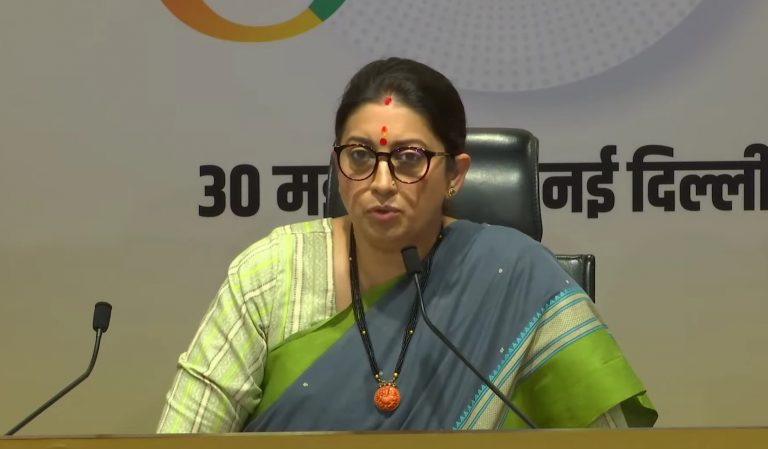
Union minister Smriti Irani on Monday criticised the Congress party’s ‘Satyagraha’ march to show support for Rahul Gandhi, who is being questioned by the Enforcement Directorate in the National Herald case. During a press conference, Smriti Irani characterized the march as a “blatant attempt” by the Gandhi family to intimidate investigative agencies. Never before has a political family attempted to hold a government investigation agency hostage, she added.
Smriti Irani stated that Congress is not protesting to safeguard democracy but to save Rahul Gandhi’s 2,000 crore properties. She said, “Congress leaders have taken to the streets to pressurize an investigating agency openly because their corruption has been exposed… It’s an attempt to protect the assets of the Gandhi family.”
While detailing the ED’s case to the media, the Minister stated that in 1930, a firm called Associated Journals Limited (AJL) was created with the intention of printing a newspaper. Its stockholders included 5,000 freedom fighters. “Today, a company that was to be run by freedom fighters has been usurped by the Gandhi family,” Smriti Irani remarked.
“In 2008, this company incurred debts of 90 crores and decided to enter the real estate market. Another business, Young India, was established in 2010 with an initial capital of five lakh, and Congress General Secretary Rahul Gandhi was appointed as its Director. Mr Gandhi owned 75% of the firm, with the remainder owned by his mother Sonia Gandhi and Congress leaders such as Motilal Vora and Oscar Fernandes,” Smriti Irani went on to elaborate about the scam.
“Young India received nine crore shares of AJL, representing 99 per cent of the entire shares of AJL. The Congress Party then lent AJL 90 crore, which was never repaid,” she further said, adding that people who donated funds to Congress for welfare works ended up funding the Gandhi family.
This firm, as Irani stated, was not founded to conduct social work. It obtained a licence under Section 25 of the Companies Act at the time of its formation, allowing it to undertake purely charitable activities. However, Young India admitted in 2016 that it has done no charitable activity in its six years of existence.
She alleged that Rahul Gandhi has business dealings with Dotex Merchandise Private Limited. Dotex Merchandise Private Limited is connected to a Havala entry operator in Kolkata who exchanges cheques for cash. According to the union minister, the Financial Intelligence Unit has flagged this company’s financial operations.
“Is it true that this company has relations with companies that are owned by Rahul Gandhi, Sonia Gandhi and Priyanka Gandhi Vadra?” Smriti Irani advised Congress workers to ask this question from the Gandhi family.
She also quoted a phrase from a 2019 Delhi High Court verdict, “The entire transaction of transferring of shares of AJL to Young India was nothing but a clandestine and surreptitious transfer of the lucrative interest into the premises of Young India.”
Congress leaders creating a ruckus at the ED office
Earlier in the day, before Congress leader Rahul Gandhi went for interrogation at the Enforcement Directorate office in Delhi in connection with the National Herald money laundering case, Congress leaders and workers caused a ruckus and opposed the authorities outside the ED office.
Several other Congress leaders were held by police for attempting to cause unrest before Rahul Gandhi’s attendance in the ED office. Along with other workers, police detained Congress spokesperson Randeep Singh Surjewala, senior leader Harish Rawat, and Congress leaders Rajni Patil, Akhilesh Prasad Singh, L. Hanumanthaiah, and Thirunavukkarasar Su.
Monday, 13 June, saw Rahul Gandhi reaching the Enforcement Directorate office for questioning after the agency summoned him over money laundering charges in the National Herald case. In a reaction to this development, the Congress party workers staged protests in Delhi and other cities as part of ‘Satyagraha’ against the inquiry.
Meanwhile, Delhi police detained several other Congress leaders for trying to foment trouble before Rahul Gandhi’s appearance in the ED office. Along with other workers, Congress spokesperson Randeep Singh Surjewala, senior leader Harish Rawat, Congress leaders Rajni Patil, Akhilesh Prasad Singh, L. Hanumanthaiah, and Thirunavukkarasar Su. were detained by the police.
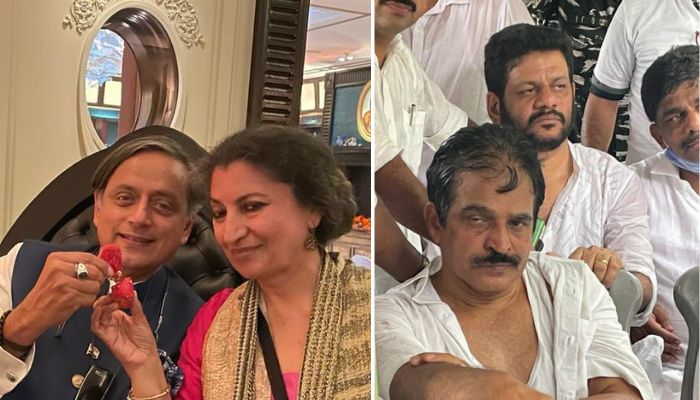
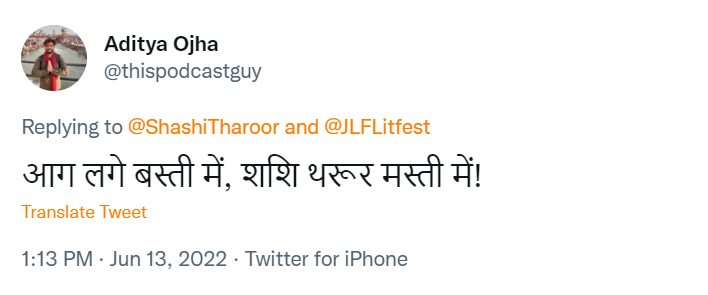
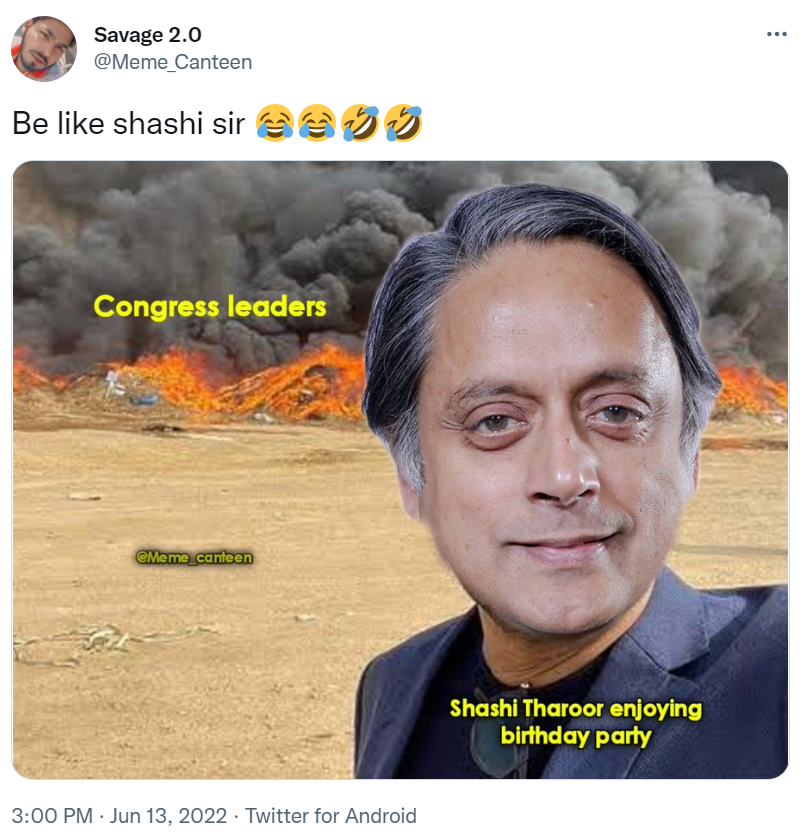
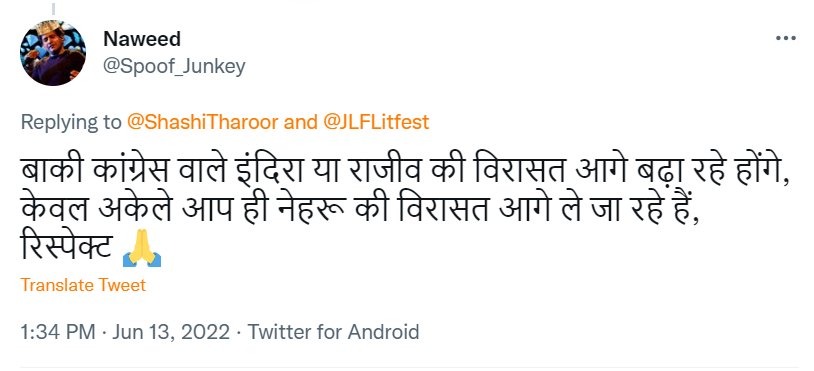
At a time when senior Congress leaders were holding agitations and demonstrations in support of Rahul Gandhi, one Congress MP was conspicuously absent. Shashi Tharoor was in the United Kingdom, to preside over the London event of the Jaipur Literature Festival. While other Congress leaders were being detained by police, Tharoor was sharing a picture with Geetanjali Shree, author of the recent Booker Prize winner ‘The Tomb of Sand’ (English translation of the Hindi original Ret Samadhi by Shree). Sharing the image, Tharoor tweeted, “Toasting birthday girl novelist Geetanjali Shree with a strawberry in London last night as @JLFLitfest comes to a celebratory end!”
Toasting birthday girl novelist Geetanjali Shree with a strawberry in London last night as @JLFLitfest comes to a celebratory end! pic.twitter.com/udZQcZwfhI
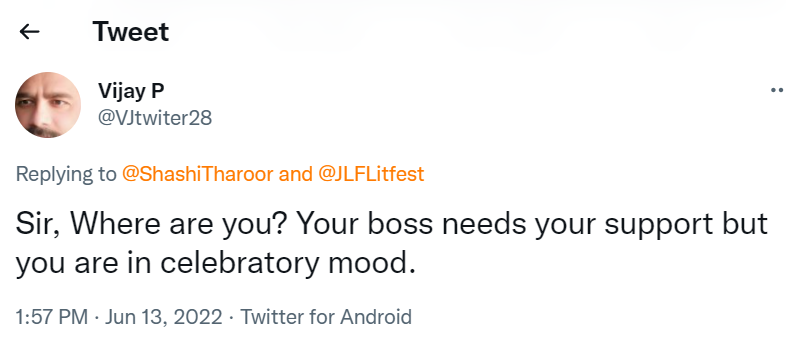
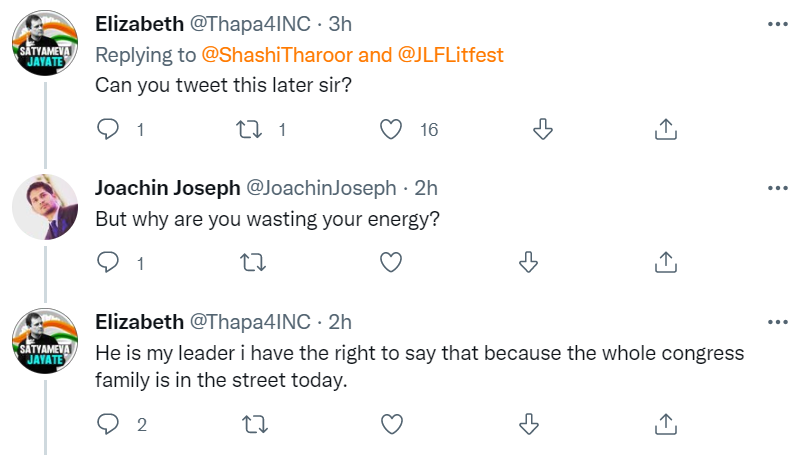
After the tweet from Tharoor, Congress supporters were miffed with Tharoor regarding the timing of his tweet. Many Congressis on Twitter questioned Tharoor’s loyalty towards the party while his fellow Congress leaders were staging protests and getting detained in support of Rahul Gandhi.
Screengrab of a Tweet from @VJtwiter28
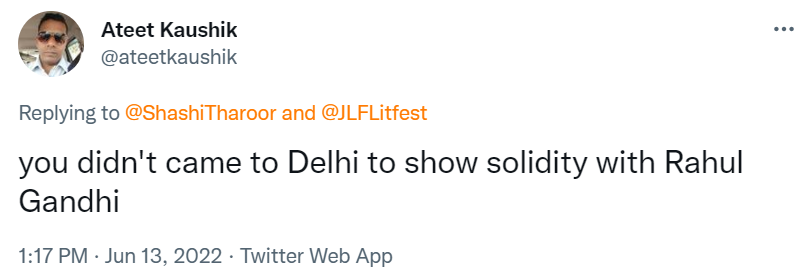
‘Solidarity’, he means. Screengrab of a Tweet from @ateetKaushik
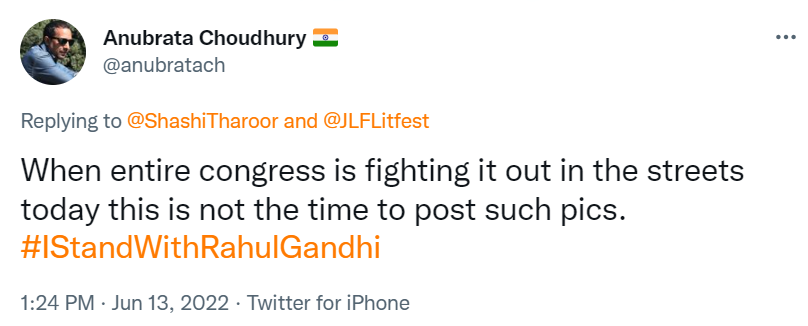
Congress workers asking Shashi Tharoor over his absence on Twitter
Screengrab of a Tweet from @anubratach
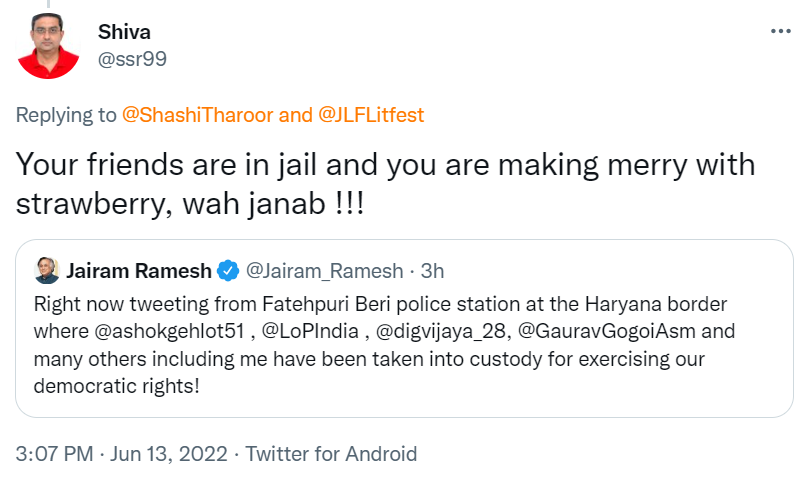
Screengrab of a Tweet from @ssr99
After Congress loyalists questioned Tharoor over the timing of his tweet, other Twitter users also decided to pull his leg with memes and jokes.
Screengrab of a Tweet from @thispodcastguy
Screengrab of a Tweet from @Meme_Canteen
Screengrab of a Tweet from @Spoof_Junkey
Meanwhile, earlier today, before Congress leader Rahul Gandhi appeared for questioning at the Enforcement Directorate office, the Congress leaders created a ruckus in the capital and protested against the normal functioning of the agency.
Nupur Sharma, the former BJP spokesperson, has been caught in a dangerous storm after she made certain innocuous comments during a TimesNow debate. After Indian Muslims like AltNews’ co-founder Mohammad Zubair dog-whistled against her, she was declared a ‘blasphemer’ and several Islamist outfits, including Taliban and Al Qaeda, are now demanding her head on pike. Amid the death threats, Indian Islamic outfits have come out to demand a law that punishes those who speak ‘against’ Islam.
Darul Uloom Deoband, an Uttar Pradesh-based Islamist outfit, has demanded that Nupur Sharma be punished for her statements against Islam. They said that those who make objectionable statements against the symbols of Islam “to spread hatred in the country” need to be punished severely.
But these are the statements one expects from Islamist outfits. However, the statement by Maulana Mufti Abul Qasim, the VC of Darul Deoband, is a telling sign of the things to come. Qasim issued a statement on Wednesday demanding a special law that strictly punishes those who insult Islam.
Reportedly, Maulana said, “I strongly condemn the insulting remarks against our beloved Prophet. Religious sentiments of the followers of any faith cannot be provoked in the name of freedom of expression. Insulting the Prophet will not be tolerated by Muslims in India or abroad”. According to reports, he further said that the Indian government should enact a special law “to deal with cases where religious symbols of Muslims are targeted”.
The Maulana further spoke about communal harmony while talking about how the Muslim community deserves a special law. He said, “India is a secular country and people here have been living together for centuries. These communal and extremist elements are not only harming the country’s social harmony but also disturbing the nation’s secular fabric and ethos”.
At the very outset, let us marvel at how the Islamist’s hate is also dressed up as harm to the “social fabric” caused by their victim. Essentially, they fracture the harmony and social fabric with arson, rioting, protests, and slogans like “Gustakh-e-Rasool Ki Saza, Sar Tan Se Juda”, and then blame their victim, who they want to behead for hurting their fragile emotions just enough to send them down the path of violence. This sleight of hand is almost amusing as it keeps repeating itself over and over again. They take offence to just about anything, run riots, commit violence and then, blame the person exercising their freedom of speech for fracturing social fabric and harmony. It almost appears as a blackmailing tactic. Do as we please or we will burn your country and blame you for it.
Besides this oft-repeated pattern, what was carefully tucked away in his statement, was the demand for a “special law” meant only to protect the frangible feelings of the Muslim community. While blaming the victim for the violence unleashed by the Islamists, Maulana Mufti Abdul Qasim demanded that the state enact a special law that outlaws hurting the sentiments of Muslims and insulting their religious symbols. The demand has come from several other Islamic quarters as well. In fact, Bollywood actor Naseeruddin Shah also said that in Islamic nations, the crime of Blasphemy would be punishable by death, however, in India, no action has been taken. While he did not directly ask for a special law or for the death penalty, his insinuations were rather clear – the ‘moderate Muslim’ would be more than happy if a special law was enacted that specifically punished, in the harshest terms, those who hurt feelings of the Muslim community.
The demand for a special law may seem innocuous and an impossibility that we must summarily ignore, however, one has to acknowledge that what is happening now is a dangerous repeat of the events that led to the breaking up of India.
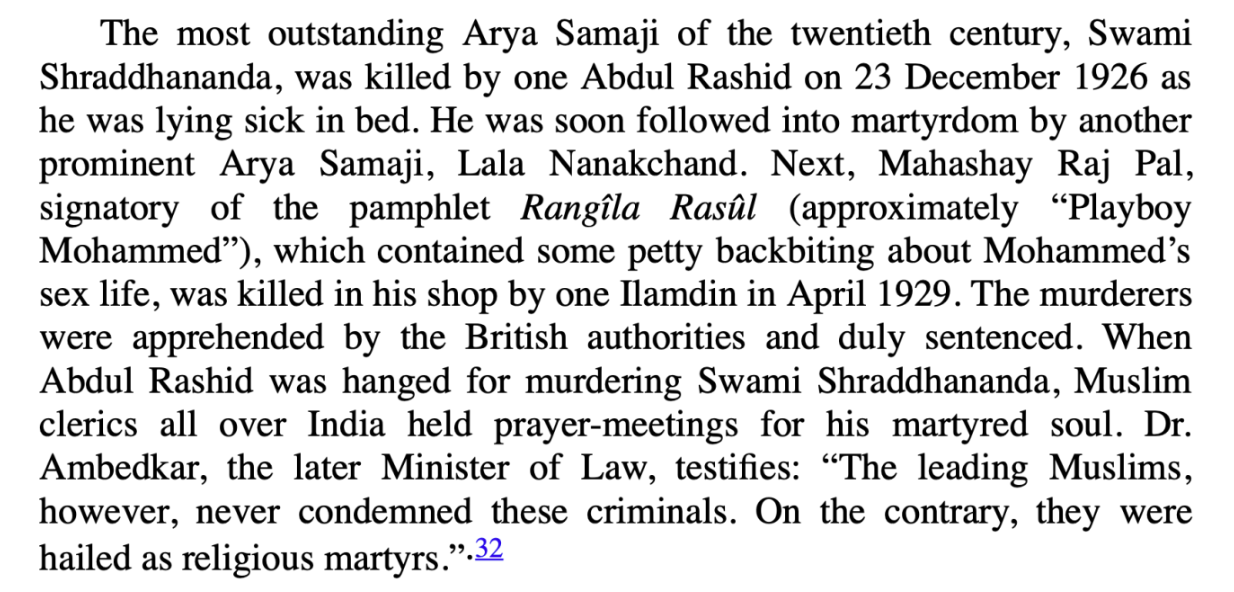
In this regard, it would bode well to remember the case of Mahashay Rajpal, who published Rangeela Rasool and was ultimately assassinated for it. We mostly hear that Mahashay Rajpal was assassinated for publishing satirical work on Prophet Muhammad called Rangeela Rasool, but we seldom hear why he chose to publish the book. In 1923, Muslims published two particularly offensive books to Hindus. “Krishna teri geeta jalani padegi” used derogatory and vulgar language against Shri Krishna and other Hindu deities and “Uniseevi sadi ka maharshi” which contained derogatory remarks on Arya Samaj founder Swami Dayanand Saraswati (incidentally written by an Ahmadi).
We must bear in mind that this was an era before the existence of Section 295A, therefore, thankfully, the conversation around the law cannot be used to skirt the issue of radical Islam and how its street power not only affects change in policy and law, but also has scant regard for the law of the land when they decide to eliminate those who do “gustakhi” against “Rasool”.
In response to this provocation by Islamists, Pandit Chamupati Lal, a close friend of Mahashay Rajpal, wrote a short biography of the Islamic Prophet, Mohammed. “Rangeela Rasool” was a short pamphlet which satirised the life of the Prophet of Islam. Pandit Chamupati made Mahashay Rajpal promise that he would never reveal the name of the author – he knew the consequences of it. Anonymously published under the name “doodh ka doodh aur panee ka panee”, the book enraged Muslims.
Staying true to the values of one-way brotherhood, Mohandas Karamchand Gandhi wrote in his pamphlet “Young India”, condemning Rangeela Rasool. While Gandhi ignored the provocation by Muslims, by the end of June 1924, the colonial government banned the book. The Muslim community, partly emboldened by MK Gandhi’s endorsement of their hurt sentiments and whitewashing of the provocation against Hindus, filed multiple cases against the book under 153A. In May 1927, Mahashay Rajpal, who published the book, was acquitted of all charges with the court observing that commentary based on facts on historical figures, including the prophet of Islam, cannot be said to promote enmity between groups. As soon as the verdict was delivered, Muslim mobs went into a frenzy. They rioted and demanded the head of Mahashay Rajpal. They were chants about how the murder of Rajpal was acceptable because, under Sharia, the punishment for blasphemy is death.
With the Muslim mobs going on a rampage, 295A was passed to assuage the feelings of the mobs and in the same year, there were two unsuccessful attempts at Mahashay Rajpal’s life.
On April 6th, 1929 a 19-year-old carpenter named Ilm ud din stabbed Mahashay Rajpal on his chest eight times while he was seated in the outer verandah of his shop. Though he was offered to give up the name of the author, Pandit Chamupati Lal, during the court proceedings, he refused and did not yield. He paid the price for it. He paid the price for publishing that book despite the court acquitting him and the Muslims getting a special law to protect their fragile feelings.
Not too long after India was torn apart by those who were convinced that the Muslim community could be placated. Before the Rangeela Rasool controversy, Hindus saw the Khilafat movement, the support it got from Congress and Mohandas Karamchand Gandhi and after that, Hindus saw the rise of a Muslim leader like Mohammad Ali Jinnah, leading India’s partition.
While Rangeela Rasool did not cause the partition, there was a common thread – a clear, stark, unmissable thread. Mahashay Rajpal’s murderer was represented in the court of law by Mohammad Ali Jinnah and Iqbal, who is eulogised today by the Left Liberals, wrote a song in his honour. Pakistan gave him the honour of Ghazi.
The partition of India happened on religious lines. It was not because Hindus did not concede to the demands for concessions made by Muslims or because Muslims felt persecuted in syncretic India – it was because the Muslim community came together and proclaimed that they were a nation unto themselves and that they could not coexist with Kafirs, ie Hindus. The idea of Islamic religious nationalism significantly impacted the psyche of the Muslim community where their allegiance to the Ummah, the global Muslim brotherhood, far outweighed their allegiance toward India. The Muslim community asserted that the Muslims of India were a “nation” with their distinct religious, cultural, and political ideology and could not possibly survive with Hindus, who they considered a separate nation, per se.
Did the Two-Nation Theory result from the feeling of persecution and alienation by the Muslim community as so many Left historians would have us believe? Was it first propagated by Veer Savarkar as they claim? Certainly not. Syed Ahmad Khan, the founder of Aligarh Muslim University said in 1876, “I am convinced now that Hindus and Muslims could never become one nation as their religion and way of life was quite distinct from each other.” Seven years later, he voiced similar sentiments. He said, “Friends, in India, there live two prominent nations which are distinguished by the names of Hindus and Mussalmans…To be a Hindu or a Muslim is a matter of internal faith which has nothing to do with mutual relationships and external conditions…Hence, leave God’s share to God and concern yourself with the share that is yours…India is the home of both of us…By living so long in India, the blood of both have [sic] changed.”
Twelve years later, he stated, “Now, suppose that the English community and the army were to leave India, taking with them all their cannons and their splendid weapons and all else, who then would be the rulers of India?… Is it possible that under these circumstances two nations—the Mohammedans and the Hindus—could sit on the same throne and remain equal in power? Most certainly not. It is necessary that one of them should conquer the other. To hope that both could remain equal is to desire the impossible and the inconceivable. But until one nation has conquered the other and made it obedient, peace cannot reign in the land.”
Jinnah had later famously said, “It is a dream that the Hindus and Muslims can ever evolve a common nationality,” he said. “Hindus and Muslims belong to two different religious philosophies, social customs and literary traditions. They neither intermarry nor eat together, and indeed they belong to two different civilisations which are based mainly on conflicting ideas and conceptions.” This was said by Jinnah in 1940 in an address to the Muslim League at the time, only a few years after he represented the killer of Mahashay Rajpal.
The murder of Mahashay Rajpal was the Two-Nation Theory being written with the blood of a man in painful detail. The Muslim community truly believed that Hindus and Muslims were too distinct in their faith and way of life to ever live together peacefully. In the case of Rangeela Rasool, those who had written provocative books about Hindu Devi and Devatas were never harmed. Their initial provocation was glossed over completely by MK Gandhi and the intelligentsia at the time, so much so, that most people don’t even know today that Rangeela Rasool was a response to the Hindu faith being satirised and not a product of blind hate.
In that situation, the Muslim community itself thought that the insult to Hindus was acceptable, naturally, since insulting the faith of the Kafirs is par for the course in the Islamic faith, however, Gustakh-e-Rasool invited a death penalty, whether the law of the land endorsed that punishment or not. The Muslim community wanted to live by Sharia and whether the state granted their wish or not, they were more than willing to snatch it, enforce it, and do what it takes – which meant taking a knife and murdering Mahashay Rajpal.
The fact that Jinnah defended the killer of Rajpal also makes evident that the murder itself was an act of bravery for the Islamic world. He was defended by the very leader who would, a few years later, create a “land of the pure” for the Musalmans because according to their divine law, the death penalty was justified for the Kafir. Koenraad Elst mentions this in his book ‘Decolonising the Hindu Mind’.
Koenraad Elst’s book ‘Decolonising the Hindu Mind’.
Today, when there are demands for a special law to protect the easily-hurt sentiments of the Muslim community as a result of the comments by Nupur Sharma on TimesNow, one must look back and take lessons from history.
Nupur Sharma, who seems to have shaken the foundation of several Islamic nations, not just the Islamists back home, made the comments she did after Muslim panellists on TimesNow and other channels repeatedly mocked the Shivling found in the disputed Gyanvapi structure. There were Maulanas who mocked why Hindus worship a penis, others who pointed to random structures in the middle of the road to tell Hindus to go worship that structure as well, and overall, the painting of the Hindu community as a barbarian cult simply because they wanted their places of worship back, once demolished by Muslim invaders. Much like the Rangeela Rasool controversy, the initial provocation against the Hindu community was forgotten, however, Nupur’s response to the comments was turned into an international rallying point for the Islamic world, with ‘Gustakh-e-Rasool ki saza sar tan se juda’ slogans, enactments of her beheading, her effigies being hung in the middle of the road and more.
The Islamist mobs that took the street have scant regard for the law of the land, much like the mobs that rioted after Rangeela Rasool’s first edition sold out quickly, and they truly believe that their Islamic laws are above the laws of the land – the laws made by Kafirs living in a Kafir state.
If the Rangeela Rasool controversy and the murder of Mahashay Rajpal was the Two-Nation Theory in action, then, the Nupur Sharma incident is its action replay.
Karl Marx, the Father of Communism, stated in 1854, “The Koran and the Mussulman legislation emanating from it reduce the geography and ethnography of the various people to the simple and convenient distinction of two nations and of two countries; those of the Faithful and of the Infidels. The Infidel is “harby,” i.e. the enemy. Islamism proscribes the nation of the Infidels, constituting a state of permanent hostility between the Mussulman and the unbeliever.”
Back then, we had the likes of Mohandas Karamchand Gandhi who condemned Mahashay Rajpal and not the frenzied Muslim mob. Back then, we had Gandhi embrace the Moplah Muslims and blame the Hindus for their own genocide after he gave his support to the Khilafat movement. Back then, we saw a new law promulgated simply to spare the delicate feelings of the Islamists.
Today, we hear the Liberals condemn Nupur Sharma instead of the frenzied Muslim mob. Today, we have political leaders ousting Nupur Sharma and asserting that she affected our relationship with the Islamic world, resulting in the Muslim mobs taking to the streets and rioting after Jumma Namaz. Today, we have those who deny the very existence of radical Islam and the challenges that India faces and those, who called the Delhi anti-Hindu riots an ‘anti-Muslim pogrom’. Today, we see the demands for a special law to spare the feelings of the Islamists.
Bharat stands at a delicate precipice. We refused to recognise the Two-Nation Theory in action back then and if we choose to close our eyes today, if we choose to repeat the mistake of fixating on the idea of brotherhood, pluralism, syncretic culture and all the other punch words that politicians like to mouth, Maa Bharati will see a time soon, where her very existence would be under threat yet again. We would see a time where we would wish we had learnt our lessons from the first partition of India – and that day, we would look at our children and find it onerous to explain why we did nothing when we could stop what appears to be an eventuality today.