Home Blog Page 3179

Madhya Pradesh: Communal clashes break out in Neemuch after row over installation of Hanuman idol near a mosque

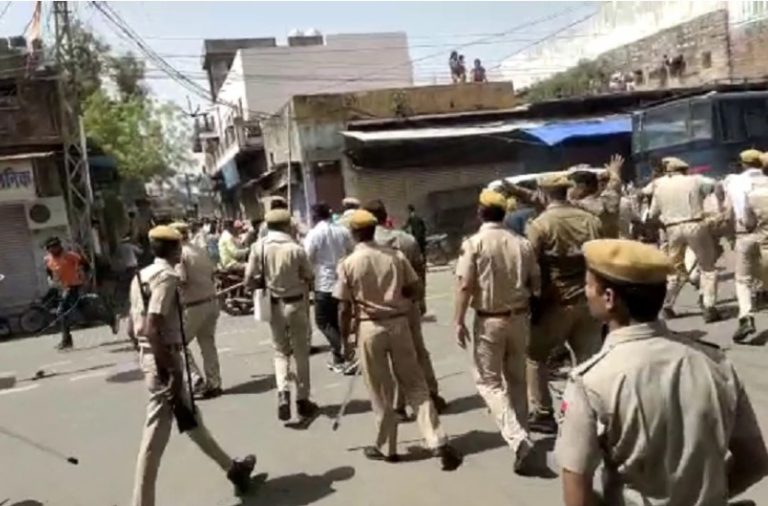
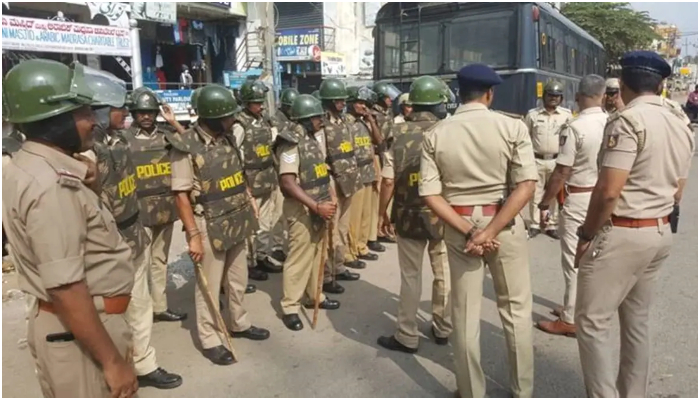
Communal tension gripped Neemuch town in the Malwa region in Madhya Pradesh after an incident of fierce stone-pelting and arson was reported on Monday, May 16. According to reports, Hindus and Muslims living in the area came face to face on Monday night after Muslims opposed the installation of a Hanuman idol near a mosque in the area.

According to reports, a new Hanuman statue was installed near the mosque following which, people from both the communities gathered at the spot and an altercation ensued. The matter soon escalated and took a violent turn. People from both sides began pelting stones at each other. Many vehicles were vandalized and incidents of arson were also reported.

While no fatalities have been reported so far, a person is reported to have been injured in the clash and is currently undergoing treatment. To control the situation, prohibitory orders under section 144 have been implemented in the area. Police used tear gas to disperse the crowd.

Neemuch Superintendent of Police (SP) Suraj Kumar Verma was quoted by ANI as saying, “Some people had placed an idol of Lord Hanuman near a dargah which lead to a clash between the two groups in the old Kachari area. During the clash, some persons pelted stones damaging 3-4 motorcycles, but nobody was injured. The adequate police force has been deployed.”

“By identifying the miscreants through CCTV cameras and other means, the police will take action. Strict action will be taken on those who spread rumors,” he added

The SP also confirmed that a total of 4 FIRs have been registered, one on the complaint of the Muslim community, 2 from the Hindu community, and a suo moto FIR in the case.

When asked about the mosque being desecrated in the ensuing ruckus, as claimed by some media houses, SP Verma said that the police hadn’t ascertained that as yet. “We are looking at the CCTVs to identify the miscreants who desecrated the mosque,” said SP Verma.

Congress senior leader Digvijaya Singh uses the communal clash in Neemuch, Madhya Pradesh to play dirty politics

Congress leader Digvijaya Singh, against whom multiples FIRs were registered for spreading fear and hysteria by sharing a fake Tweet in the aftermath of the Khargone violence, has once again taken to Twitter on Tuesday to use the aforementioned incident to malign the BJP govt in the state and score political brownie points.

Essentially, in his long series of Tweets, the Congress leader sought to imply that the Hanuman statue was erected illegally near the mosque and that the Hindus in the area were to be blamed. He also used the opportunity to attack the district administration, implying that it is not performing to its full potential due to state government pressure.

FIR registered against Congress’ Digvijaya Singh for fake tweet on Khargone violence

Prior to this, another incident of communal clashes was reported from Khargone in Madhya Pradesh where, on April 10, Islamists unleashed mayhem on Hindu devotees during the Ram Navami procession. The Congress Rajya Sabha MP Digvijaya Singh had then too, posted pictures on Twitter showing youths hoisting a saffron flag at a mosque and had falsely claimed that they were part of the violence that broke out in Khargone during a Ram Navami procession. Along with the image, Digvijaya Singh questioned whether the “Khargone administration allowed a procession with weapons?”

Following his Tweet, a total of nine first information reports (FIR) had been registered against the former Madhya Pradesh chief minister under Indian Penal Code (IPC) Sections 153-A (promoting enmity between different groups on grounds of religion, race, place of birth etc.); 295-A (deliberate and malicious acts intended to outrage religious feelings), 465 (forgery) and other counts.

IMF, which predicted India cannot become a $5 trillion economy before 2028-2029, changes its forecast: Reports

The International Monetary Fund (IMF), which predicted in April this year that India can not become a $5 trillion economy until 2028-2029, has reworked its forecast in the World Economic Outlook database, reported Swarajya.

As per the latest revision by IMF, India will reach its $5 trillion economy target by 2026-2027 i.e. two years earlier than they initially predicted. The new forecast also claims that India will become a $5.5 trillion economy in 2027-2028.

Swarajya reported that the change in forecast is due to the assumption that the rupee will depreciate to ₹84 against the US dollar and not ₹94.

Change in IMF forecast for India, graph via Swarajya

“This turnaround is to the Fund’s credit, for it suggests an open-mindedness and willingness to correct its assumptions. This is more in sync with assumptions about growth, inflation differentials between India and the US, and exchange rates,” the report emphasised.

The International Monetary Fund did not consider the growth of the Indian economy in nominal or real terms and focused primarily on the dollar-rupee exchange rate.

“Anyone who has monitored the behaviour of the rupee’s exchange rates in the past two decades will note two things: one, there are years of relative stability and then a year or two of sharp fall, followed again by a period of stability. The current exchange rate fall of the rupee against the dollar is an example of the latter. We can expect stability to return before the year is out,” Swarajya reported.

While speaking about the development, columnist and author Abhishek pointed out, “IMF has officially taken back its forecast saying India will be 5 trillion economy only in 2029. Now IMF revised prediction says India will reach $5T in 2026. At the time IMF made the wrong forecast, the media mocked Modi. Will they apologize now?”

He further added that the contentious claim that Bangladesh has overtaken India in terms of GDP per capita has also been revised by IMF. The international financial institution has now claimed that the per capita GDP of India will remain ahead of Bangladesh till 2027.

“Bangladesh having higher per capita GDP than India is now officially fake news. IMF has revised all its predictions. Ind > BD from 2021 till 2027.2020 was just a random exception due to the pandemic. Imagine the media frenzy over just 1 random year,” he emphasised.

Screengrab of the news report by Bussiness Standard
Screengrab of the news report by the Economic Times

It must be mentioned that several media publications such as Business Standard and The Economic Times had earlier covered the news about IMF predicting a delayed timeline for India to achieve the $5 trillion economy target. At the time of writing, both publications had not covered the story of revised IMF predictions about India.

Manhar Singh sentenced to CCO for his role in Harris Park Khalistani brawl, Australian Hindu Association reveals ‘unpublished details’

On Tuesday, an investigation report by the Australian Hindu Association revealed the unpublished details of the Harris Park Khalistani attack in which the accused Manhar Singh pleaded guilty to dangerously driving a car and assaulting Hindu nationalists. Singh has been sentenced to a Community Corrections Order for 18 months in Sydney, Australia.

According to the reports, the incident dates back to 2020 when a band of Hindu nationalists clashed with a group of Khalistanis at Harris park in an organized brawl following a quarrel that ensued over an argument over TikTok. It was broadcast through social media platforms. The fight started after Khalistani had posted pro-Khalistani and anti-India content on TikTok.

One Haryanvi individual took objection to the video and soon, the matter escalated to a point where both sides convinced their friends to gather for a gang fight at Harris Park. When they gathered, the Khalistanis raised pro-Khalistan slogans as well before the two sides clashed with each other. People from both sides were injured in the process and Jassi, the main culprit who had posted anti-India videos was badly injured. Videos had circulated on YouTube regarding the matter.

Videos that went viral showed rioters with cricket bats and iron rods creating ruckus in Harris Park. The Police in a quick action then dispersed the crowd and arrested the three main accused, Manhar Singh, Baljinder Singh Thukral, and Avon Kanwal in the case.

The investigation report by the Australian Hindu Association on May 17 stated that Singh had also hit the person who was recording a video of the entire incident. In the police statement, the bystander victim said that around 50 Khalistani men chanted ‘Khalistani Jindabad’ and drove close to the Hindu group in Harris Park.

The accused Manhar Singh was driving the black Audi car and asked the person to stop recording the video. Singh then mercilessly hit the bystander when he refused to stop recording the incident. “He hit me on my forearm, causing the phone to drop. The driver of the Audi (Singh) got back into the car and kept driving backwards and forwards into the group of males fighting and then he drove away”, the bystander was quoted.

Reports mention that the two accused named Manhar Singh and Baljinder Singh Thukral were immediately arrested however, the third accused Kanwal was arrested two weeks after the incident. Thukral was accused of allegedly threatening or inciting violence on grounds of religion (Section 93Z of the Crimes Act) and Kanwal was charged with allegedly using a carriage service to cause the menace. Later in August 2021, Manhar Singh who says he never used TikTok pleaded guilty to his involvement in the brawl.

The Paramatta Police had also falsely accused an Indian student named Vishal Jood of allegedly attacking the Khalistani extremists in Sydney. He was arrested on April 16, 2021, also on the charges of damage to property, affray, and assault. He was accused of three crimes that allegedly occurred on 16 September 2020 and 14 and 28 February 2021.

However, on September 2, the Court ordered the release of the Indian student lodged in a jail in Australia. As per reports, in a plea bargain, NSW’s Department of Public Prosecutors dropped eight charges that included the racial hate crime charges against Jood.

Vishal reportedly pleaded guilty to two minor charges of altercations that happened between September 16, 2020, and February 14, 2021. During the final hearing, Vishal’s lawyer presented video evidence to prove that Jood was provoked by a group of Khalistanis that led to the altercation. For the charges he pleaded guilty to, Jood was sentenced to six months in Jail starting from the day of his arrest, April 16, 2021.

CBI raids Congress leader Karti Chidambaram, accused of facilitating visas to Chinese nationals during UPA-2

On May 17, the Central Bureau of Investigation (CBI) conducted raids at multiple locations, both residential and commercial, linked to Congress MP Karti Chidambaram, the son of former Finance Minister P Chidambaram. Reports suggest a fresh case has been filed against Chidambaram for allegedly facilitating visas for Chinese nationals in exchange for illegal gratification worth Rs 50 lakh.

The Chinese nationals were supposed to work on a project in Punjab. Around nine locations spread over Mumbai, Odisha, Chennai, Karnataka, and Punjab are being raided.

Chidambaram and others have been accused of facilitating around over 250 visas during UPA-2. The new case is believed to be an off-shoot of the ongoing probes against him. Republic quoted a guard identified as Birbal Singh at P Chidambaram’s residence. He said seven CBI officials had arrived in the morning and inquired about Karti Chidambaram. Notably, P Chidambaram handled portfolios like Home and Finance during UPA-2.

Ongoing cases against Karti Chidambaram

Several agencies are probing cases against Karti Chidambaram. In February 2018, he was arrested by CBI in the INX media case. An FIR was registered in May 2017, where CBI had alleged there were irregularities in Foreign Investment Promotion Board (FIPB) clearance granted to INX media for foreign funds worth Rs 305 crore.

Indrani Mukerjea, owner and founder of INX media, had alleged that one of Karti Chidambaram’s companies benefitted in exchange for the approval. P Chidambaram had spent over 100 days in custody in a money laundering case filed by Enforcement Directorate (ED) based on FIR by CBI. The father-son duo were also named as accused in Aircel Maxim Scam.

Petrol stock for single day, 15 hrs a day power cuts expected: Sri Lanka PM’s series of tweets should be cautionary tale for ‘freebie politicians’ in India

On Monday, Ranil Wickremesinghe, the newly designated Prime Minister of Sri Lanka, announced that his goal is to save the country from the present economic crisis and that the next two months will be the most difficult of all. After becoming Prime Minister of Sri Lanka last week, the 73-year-old United National Party (UNP) leader delivered his first speech to the country.

PM Wickremesinghe shared excerpts of his address on Twitter in a series of tweets, stating that foreign reserves were at USD 7.5 billion in November 2019 but now challenging for the Treasury to locate USD 1 million. He went on to say that Sri Lanka only had enough petrol for one day.

However, PM disclosed in a subsequent tweet that he managed to bring in a diesel shipment yesterday. Two more diesel shipments under the Indian credit line are due on 18/5/22 and 1/6/22. Two petrol shipments are due on 18/5/22 and 29/5/22. He also stated that the officials are working to obtain dollars in the open market to pay for these shipments.

In regards to energy security, the PM noted that because a quarter of electricity is generated by oil, power outages might climb to 15 hours per day. As a solution, he added that three ships carrying crude oil and furnace oil have been moored within the SL maritime zone for more than 40 days and the treasury has secured funds to prevent the energy crisis.

Sri Lanka is experiencing its worst economic crisis ever, with inflation hitting a record high of 17.5% in February 2022. The island nation’s citizens are facing severe food and cooking gas scarcity.

The island nation’s problem exemplifies how freebie politics undermines a state in the long run. It should be taken as an admonition for the leaders and political parties whose influence is built on promises of free commodities, whether social or physical.

The main cause of the current economic crisis in Sri Lanka, according to policy analyst K Don Vimanga, was trade liberalisation in 1977. He said that Sri Lanka has been affected by a number of reasons, including huge budget deficits, tax cuts, and macroeconomic insecurity. The present crisis, according to analysts, is the outcome of policy mistakes committed by the Rajapaksa rule between 2005 and 2015.

During that ten-year period, Sri Lanka accumulated significant debt with the intention of transforming the country like Singapore. The government lavished money on large-scale infrastructural projects. However, most of them, including Hambantota Port and the Ceylon Electricity Company, failed to attract private investment and were forced to halt.

In order to bring relief to the public ahead of parliamentary elections in 2020, the government proposed tax cuts in 2019, which lowered the number of registered Sri Lankan taxpayers by over 35%. Following the move, revenues fell to an all-time low of 9 per cent of the GDP.

In the midst of Sri Lanka’s economic turmoil, India has offered assistance to the island nation. India has provided a credit line of $1.5 billion for the purchase of 40,000 tonnes of diesel. Additionally, Sri Lanka requested an extra $1 billion credit line for necessary imports. You can read in detail about the Sri Lanka crisis here.

Scratch a ‘vivadit dhancha’, find a Mandir: A list of Hindu temples destroyed over centuries of Islamic rule where masjids and dargahs stand now

On May 16, the court-ordered survey of the disputed structure at Gyanvapi, Varanasi reported that they have found an ancient Shiva Lingam inside the premises. In the case of Gyanvapi, the evidence is visible to the naked eye that it was a temple earlier, and a mosque was constructed on it. There are many such Muslim constructions in the form of mazar, mosques, dargah, forts, eidgahs and others where it is evident that they were on temple sites and/or used temple materials in the construction.

However, there are many such constructions across the country where the evidence is not that obvious. In 1990, Historian Sita Ram Goel, along with other authors Arun Shourie, Harsh Narain, Jay Dubashi and Ram Swarup, published a two-volume book named ‘Hindu Temples: What Happened To Them’. In the book, Goel traced over 1,800 Muslim structures that were constructed over existing temples and/or using materials from destroyed temples. From Qutub Minar to Babri Masjid, Gyanvapi, Pinjor Gardens, and others found mentioned in the book.

The methodology used by the authors

The book is a collection of previously published articles in newspapers by the authors with additional chapters. In Chapter Six, ‘Historians Versus History’, Ram Swarup mentioned that the details of the destruction of Hindu Temples found their place in the writings of both British and Muslim historians. In the case of British Historians, they wrote about the cruelty and vandalism done by Mughal emperors to justify their presence in India. On the contrary, Muslim historians detailed how Temples were destructed to glorify Islam and their immediate patrons.

Many inscriptions available at the Islamic sites across the country invoke Allah and the Prophet quoting the Quran. These inscriptions provide details by whom, how and when these structures were constructed. The book states, “The inscriptions have been deciphered and connected to their historical context by learned Muslim epigraphists. They have been published by the Archaeological Survey of India in its Epigraphia Indica – Arabic and Persian Supplement, an annual which appeared first in 1907-08 as Epigraphia Indo-Moslemica.”

In an article published on February 5, 1989, by Arun Shourie, he talked about Maulana Hakim Sayid Abdul Hai, a well-known and influential figure. He wrote several books, among which one of the books had a 17-page chapter, ‘Hindustan ki Masjidein’ or ‘The Mosques of India’. In the chapter, Shourie said, short descriptions of mosques were written. Though for Hai, those were only descriptions, he provided a brief of how Hindu Temples were destructed to build Mosques.

For example, about Babri mosque, it read, “This mosque was constructed by Babar at Ayodhya, which Hindus call the birthplace of Ramchanderji. There is a famous story about his wife, Sita. It is said that Sita had a temple here in which she lived and cooked food for her husband. On that very site, Babar constructed this mosque in H. 963.” Here H 963 means Hirji Calendar year 963, which converts to the year 1555-1556 of the English Calendar.

State-wise list of the Islamic sites

There are over 1,800 sites mentioned in the book from different states. Reclaim Temples, an organization dedicated to the reclamation and restoration of Hindu temples, has done extensive work on the lists provided in the book by Sita Ram Goel. The PDFs of the state-wise list can be found here.

Andhra Pradesh

In Andhra Pradesh, the book by Sita Ram Goel and others mentions that the material collected after demolishing temples was used in constructing mosques, dargah, gateways and forts. 142 sites were recognized by the author from Andhra Pradesh alone, including Jami Masjid in Kadiri, Anantpur, Sher Khan Masjid in district Penukonda, Babayya Dargahin Penukonda, that was built by converting Ivara Temple, Idgah in Tadaptri, Datgiri Dargan in Gundlakunta, Datgir Swami Dargah built over Jangam temple in Janalapalle and others.

Notably, the Dargah of Mumin Chup in Aliyabad, Hyderabad, dates back to 1322, and it was built on a temple site. Similarly, Jami Masjid in Rajamundri was built in 1324 by converting Venugopalaswamin Temple. The destruction of temples continued in Andhra Pradesh for centuries. Gachinala Masjid, built-in 1729 was noted as the latest mosque in the state. It stands on a temple site.

Assam

In Assam, the book noted two temple sites that were converted into mosques that were Poa Mosque and Mazar of Sultan Ghiyasuddin Balban. Both Islamic structures stood on temple sites in Hajo, district Kamrup.

West Bengal

102 sites were recognized in West Bengal where the mosques, dargahs, muslim structures, and forts were built on demolished Temple sites or material collected after destroying temples was used. These structures include Ghazi Ismail Mazar in Lokpura, which was built over Venugopala temple, Makhdum Shah Dargah in Birbhum Siyan (1221), where temple materials were used, Sayyid Shah Shahid Mahmud Bahmani Dargah in Suata was built using Buddhist temple material, Alaud-Din Alaul Haqq Masjid built-in 1342 in Bania Pukur used temple material and others.

A Muslim city was built in Gaur using the ruins of Lakshma Navati, a Hindu capital destroyed by Muslims towards the end of the twelfth century AD. Multiple Muslim structures including Chhoti Sona Masjid, Tantipara Masjid, Lattan Masjid, Makhadum Akhi Siraj Chishti Dargah, Chamkatti Masjid, Chandipur Darwaza and other structures were built over two centuries at the city using temple material.

Bihar

In Bihar, 77 sites were recognized where Mosques, Muslim structures, Forts, etc. were made on Temple sites and/or using material collected from destructed Temple sites. In Bhagalpur, the Dargah of Hazrat Shahbaz was built in 1502 on a Temple site. Similarly, in Champanagar, several Mazars were constructed on the ruins of Jain Temples. The Muslim Graveyard in Amoljhori, district Monghyr stands on a Vishnu Temple site. In Gaya, Shahi MAsjid in Nadirganj was built in 1617 on a Temple site.

In the Nalanda district, Biharsharif, the Muslim capital, was built after destroying Udandapura, a famous Buddhist Vihara. Majority of the Muslim structures built on the site used Temple material, including the Dargah of Makhdumul Mulk Sharifuddin of 1380, Bada Dargah, Chhota Dargah, and others.

In Patna, Dargah of Shah Jumman Madariyya was built on a temple site. Dargah of Shah Mur Mansur, Dargah of Shah Arzani, Dargah of Pir Damariya and others were built on Buddhist Viharas.

Delhi

A total of 72 sites were recognized in the book in Delhi. The Islamic invaders destroyed Indrapat and Dhillika along with their suburbs to build seven cities. Temple materials were used in many monuments, mosques, mazars, and other structures, including Qutab Minar, Quwwatul Islam Masjid (1198), Maqbara of Shamsud-Din Iltutmish, Jahaz Mahal, Alal Darwaza, Alal Minar, Madrasa and Maqbara of Alaud-Din Khalji, Madhi Masjid and more.

Diu

One site that is Jami Masjid, constructed in 1404, was recognized by the book. It was built on a Temple site.

Gujarat

In Gujarat, 170 sites were recognized in the book. Temples at Asaval, Patan and Chandravati were destroyed, and the material was used to build Ahmadabad, a Muslim city. Some of the monuments that used Temple material in Ahmadabad were Palace and Citadel of Bhadra, Jami Masjid of Ahmad Shah, Haibit Khan ki Masjid, Rani Rupmati Ki Masjid and more.

In district Dholka, Masjid and Mazar of Bahlol Khan Ghazi and Mazar of Barkat Shahid were built of Temple sites. Similarly, in Sarkhej, the Dargah of Shaikh Ahmad Khattu Ganj Baksh was built in 1445 using Temple material. In 1321, Jami Masjid was built using materials after demolition of Hindu and Jain temple sites in Bharuch.

In Bhavnagar, Mazar of Pir Hamir Khan in Botad was built at a Temple site. In 1473, Masjid was built in Dwarka at a Temple site. In Bhuj, Jami Masjid and Gumbad of Baba Guru were built on Temple sites. Jains were expelled from Rander and the temples were converted into mosques. Some of the examples include Jami Masjic, Nit Nauri Masjid, Mian Ki Masjid, Kharwa Masjid and others. In Somnath Patan, Bazar Masjid, Chandni Masjid and Qazi Ki Masjid were built on Temple sites.

Haryana

A total of 77 sites were recognized in Haryana by historians. In Pinjor, Ambala, Temple materials were used to build the Garden of Fidai Khan. Fidai Khan Garden, which was later renovated by a Sikh Emporer and popular by the name Yadavindra Gardens or Pinjor Gardens, was built using Temple materials. In Faridabad, Jami Masjid was built in 1605 at a Temple site. In Nuh, a Mosque was built in 1392 using Temple materials.

Mosques in Bawal and Jami Masjid in Farrukhnagar, district Gurugram, were built on Temple sites. In Kaithal, Dargah of Shaikh Salahud-Din Abul Muhammad of Balkh was built in 1246 using Temple materials. Madrasa on the Tila in Kurukshetra and Kali Masjid in Jhajjar were built on Temple sites. Hisar was built by Firuz Shah Tughlaq using Temple materials brought from Agroha. The city of Agroha was built by Maharaja Agrasen, a descendant of Bhagwan Ram’s son Kush. Maharaja Agrasen was born in the 35th generation after Bhagwan Ram. The city was destroyed by Muhammad Ghauri in 1192.

Himachal Pradesh

One site was recognized in Kangra, Himachal Pradesh, in the book. The Jahangiri Gate was built using Temple materials.

Karnataka

A total of 192 sites were recognized in Karnataka. Dargah of Muhiud-Din Chisti of Ajodhan in Dodda Ballapur, Bangalore, was built using Temple materials. Dargah of Makhdum Shah Wali in Kudachi and Mazar of Shaikh Muhammad Sirajud-Din Pirdadi were built on Temple sites. Masjid and Idgah in the ruins of Vijayanagar, Hampi, were built using Temple materials.

A Muslim Capital was built by transforming the ancient Hindu city of Bidar. Sola Khamba Masjid, Jami Masjid, Mukhtar Khan ki Masjid, and other structures were built on Temple sites or used Temple materials.

Kalyani was the capital of Later Chalukyas. The temples in the city were either demolished or converted into Mosques. Jami Masjid, Masjid in Mahalla Shahpur and others stand on Temple sites. Bijapur used to be an ancient Hindu city. It was transformed into a Muslim capital. Jami Masjid, Karimud-Din Ki Masjid, Chota Masjid, etc were built on Temple sites and/or used temple materials. In Tonnur, Mysore, Sayyid Salar Masud’s Mazar was built using Temple materials.

Kerala

In Kerala, two sites were recognized. Jami Masjid in Kollam and Fort built by Tipu Sultan in Palghat used Temple materials.

Lakshadweep

Two sites were recognized in Lakshadweep. Muhiud-Din-Palli Masjid in Kalpeni and Prot-Palli Masjid in Kavarati were built on Temple sites. Notably, Lakshadweep is now a 100% dominating Muslim region.

Madhya Pradesh

The book mentioned 151 sites in Madhya Pradesh. Jami Masjid, built by Qudsia Begum in Bhopal, was built where once Sabhamandala Temple stood. Dargah of Ghazi Mian in Damoh was previously a Temple site. Dhar used to be the Capital of Raja Bhoja Paramara. It was converted into a Muslim Capital. Kamal Maula Masjid, Lat Masjid, Mazar of Adbullah Shah Changal etc used Temple materials and/or built on Temple sites.

Mandu was an ancient Hindu city. It was also converted into a Muslim capital. Jami Masjid, Dilawar Khan Ki Masjid, Choti Jami Masjid etc. were built on Temple sites and/or used Temple materials. Chanderi, a Muslim city was built using materials from Budhi Chanderi. Moti Masjid, Jami Masjid and other structures used Temple materials. In Gwalior, Dargah of Muhammad Ghaus, Jami Masjid, and Masjid near Ganesh gate were built on Temple sites.

Maharashtra

143 sites were recognized in the book from Maharashtra. Among those, Amba Jogi fort in Ahmadnagar used Temple materials. Idgah in Gogh, which was built in 1395, stands on a Temple site. Akot’s Jami Masjid was built in 1667 on a Temple site. Astan Masjid in Karanj was built in 1659 on a Temple site. Aurangzeb’s Jami Masjid in Ritpur was built on Temple site. Dargah of Hazrat Burhanud-Din Gharib Chishti was built on a Temple site in Khuldabad in 1339.

Mazar of Maina Hajjam was built by converting Mahalakshmi Temple in Mumbai. Jami Masjid in Mumbai was built on a Temple site. Namazgah near the Talav in Paranda was built by converting Manakevara Temple. In Latur, Minapuri Mata temple was converted into Dargah of Mabsu Sahib, Somevara Temple was converted into Dargah of Sayyid Qadiri, and Ramachandra Temple was converted into Qadimi Masjid of Paunar.

Odisha

12 sites were recognized in Odisha. Jami Masjid in mahalla Sunhat in Baleshwar was built on the Shri Chandi Temple site. Shahi Masjid and the masjids of Odia Bazar in Cuttack along with the masjid in Kendrapara were built on Temple sites.

Punjab

The book recognized 14 sites in Punjab. Mazar of Baba Haji Rattan was built by converting a Temple in Bathinda. Badshahi Sarai of Sultanpur, Jalandhar, was built on Buddhist Vihara. Dar and Masjid of Ali Sarmast in Ludhiana was built on a Temple site. Masjid in the Fort in Bahadurgarh, Patiala, was built on a Temple site.

Rajasthan

There were 170 sites of Rajasthan mentioned in the book. Ajmer used to be a Hindu capital that was converted into a Muslim city. Adhai-Din-Ka-Jhonpra was built in 1199, Dargah of Muinud-Din Chisti was built in 1236, and other mosques etc. were built on Temple sites and/or used Temple materials. Bhartari mazar in Tijara was built by converting a Temple. Nohara Masjid in Bayana was built by converting Usha Temple. In Masjid of Bhitari-Bahari Mahalla, materials from Vishnu Temple were used.

Kamyakesvara Temple was converted into Chaurasi Khamba Masjid in Kaman. Parvantha Temple’s materials were used in Topkhana Masjid in Jalor, which was built in 1323. Materials from Hindu, Buddhist and Jain Temples were used in Shergarh, the fort of Sher Shah Suri. Dargah of Pir Zahirud Din in Loharpura was built on Temple site. In 1625, Masjid in Salawtan was built on a Temple site. Mazar of Pir Zahirud-Din and Dargah of Baba Badr in Nagaur was built on temple sites.

Tamil Nadu

There were 175 sites mentioned from Tamil Nadu in the book. Mazar of Shah Ahmad in Acharwak, Chingleput, was built on a Temple site. Dargah of Malik Bin Dinar in Kovalam was built on a Temple site. Hill of Pancha Padyamalai was renamed Maula Pahad. The central hall of an ancient Cave Temple was turned into a masjid. In Coimbatore, Tipu Sultan used Temple materials to repair Annamalai Fort. Masjid of Tipu Sultan was also built on a Temple site.

In Tiruchirapalli, the Dargah of Natthar Shah Wali was built by converting a Shiva Temple. The Lingam of the Temple was used as a lamp-post.

Uttar Pradesh

In Uttar Pradesh, the book mentioned 299 sites that were built using temple materials and/or on temple sites. Kalan Masjid of Agra was built using Temple materials. In the fort of Akbar, the Riverside part was built on Jain Temple sites. Maqbara of Akbar stands on a Temple site. Fort of Akbar in Allahabad was built on Temple sites. Mazar of Mian Maqbul and Husain Khan Shahid was built on Temple sites. Masjid in Patthar Mahalla was built by converting Lakshmi Narayan Temple.

In Ayodhya, Babri Masjid was built on Ram Janmbhoomi Temple site. The disputed structure has now been demolished, and Bhavya Ram Mandir is being constructed at the site. Swargadvara Temple and Treta Ka Thakur Temple were demolished, and mosques were built at those places by Aurangzeb.

Mazar of Shah Juran Ghuri was built at a Temple site. Mazars of Sir Paighambar and Ayub Paighambar were built at a Buddhist Temple site that had footmarks of Buddha. Imambara in Gorakhpur was built on a Temple Site. Similarly, Karbala in Pava was built on the ruins of a Buddhist Stupa.

Tilewali Masjid was built on a Temple site in Lucknow. Jama Masjid in Meerut stands on the ruins of a Buddhist Vihara. Dargah in Nauchandi was Nauchandi Devi Temple. In Varanasi, Masjid at Gyanvapi was built on the Temple site using Vishweshara Temple material. A survey was ordered by the court at the disputed structure recently, and the team that did the survey has reportedly found a Shiva Lingam. The site was sealed by the court after the discovery.

Just a ‘tip of the iceberg’

Goel wrote in his book that the list mentioned by him was incomplete. It was just a brief summary. The list had mosques and dargahs where evidence existed of the temple site and/or temple materials being used. He wrote, “We have tried our best to be exact in respect of locations, names and dates of the monuments mentioned. Even so, some mistakes and confusion may have remained. It is not unoften that different sources provide different dates and names for the same monument. Many Muslim saints are known by several names, which creates confusion in identifying their mazars or dargahs. Some districts have been renamed or newly, created and a place which was earlier under one district may have been included in another. This is only a brief summary.”

Kannada actress Chethana Raj dies at 21 after undergoing ‘fat-free’ cosmetic surgery in Bengaluru, parents accuse doctors of negligence

Kannada actress Chethana Raj, best known for her roles in daily soaps like Geetha and Doresani breathed her last at a private hospital in Bengaluru, where she was admitted on May 16, Monday to undergo a ‘fat-free’ plastic surgery. She was 21-years-old.

According to reports, the actress was operated upon in the morning hours on May 16. Reportedly, she never informed her parents about the surgery and went along with her friends to the hospital. In the evening, the actress started facing some post-surgery complications as fluid began to accumulate in her lungs. The doctors were unable to save the actress, who died shortly after.

The parents of the 21-year-old actor have accused the doctors of negligence, which they alleged led to the untimely death of their daughter. Chethana Raj’s parents have lodged a complaint against the hospital authorities in the nearby police station.

Meanwhile, Chethana’s body is currently in the hospital and will be transferred to Ramaiah hospital tomorrow morning for a post-mortem.

Surgeries and diet regimes to lose weight might on some occasions turn fatal, as was the case of actress Mishti Mukherjee, who had died of a kidney failure caused by the keto diet she was following.

On October 2, 2020, Mishti Mukherjee who has worked in several films and music videos, had died in a hospital in Bengaluru. As per the reports, she was suffering from a kidney ailment. She made her Bollywood debut with the film Life Ki Toh Lag Gayi in 2012. According to a representative of the actress, her kidney failure was caused by the keto diet she was using.

The Keto diet regime is based on a high-fat, moderate-protein, and low-carb diet. The main aim of this diet plan is to lose weight by achieving ketosis. Though the weight loss is definite, several studies have indicated that this diet can have an adverse effect on the health as it puts a lot of stress on the kidneys. Stones in kidneys are common among those who follow the Keto diet for a longer duration. Those who already have kidney disease are not recommended to follow the Keto diet.

‘Excited to be interviewed by the one who interviewed notorious militant Bitta Karate’, Vivek Agnihotri to speak with journalist Manoj Raghvanshi on the new ‘Khul Ke’ platform

Filmmaker Vivek Agnihotri has shared his enthusiasm at being interviewed by Manoj Raghvanshi, the journalist who reported from the ground in Kashmir in 1991 during the Kashmiri Hindu genocide, on the brand new social networking platform ‘Khul Ke’. Vivek Agnihotri has been winning accolades for his recent venture The Kashmir Files, a movie which depicts the atrocities and brutality inflicted on Kashmiri Hindus that had been denied all these years.

Vivek Agnihotri has said that he is looking forward to this free-wheeling conversation with Manoj Raghvanshi, who happens to be the one who interviewed Farooq Ahmed Dar alias Bitta Karate, the butcher of Kashmiri Hindus. He has not just witnessed but had actually put his life at risk to report from the valley, said the filmmaker in a press statement hours before the one-on-one conversation with the journalist on the ‘Khul Ke’ app.

On May 17 at 4 pm, Khul Ke, the new social networking app, will conduct a round table titled ‘Kashmir Konversations’ on their platform, in which the filmmaker Vivek Agnihotri and journalist Manoj Raghuvanshi will engage in an explosive conversation that will uncover the unheard and hidden facts about the Islamist onslaught on Kashmiri Hindus in the valley.

In a press release, The Kashmir Files director said, “I am quite excited to be interviewed by Manoj, who is one of India’s most noteworthy journalists and also happens to be the one who interviewed the notorious militant ‘Bitta Karate’ who is accused of the gruesome killing of the pandits. Manoj has reported from on ground in Kashmir in 1991, when the genocide happened. He has not just witnessed but had actually put his life at risk to report from the valley. So, I am looking forward to this free-wheeling conversation where we can discuss some unheard incidents and facts from the era and how The Kashmir Files came about.”

He further stated, “Khul Ke is a platform for anybody who wants to have uninhibited conversation, share opinions or be a part of discussions without hesitation. It is a delight for conversation lovers and I am really looking forward to interact with Manoj and also the audiences.”

To attend this RoundTable, visit https://m.khulke.com/3PnIqUB and register using the invite code KASH1234.

About the ‘Khul Ke’ app

Khul Ke is a brand new social networking platform. According to the developers, it is a one-of-a-kind platform to empower the audience to have deeper, impactful, and meaningful conversations. It is a revolutionary social media platform which gives its users a 360-degree approach to discuss their varied interests.

As per the makers, ‘Khul Ke’, will be the only platform to allow video, audio and text-based conversations amongst panellists as well as the audience. The platform claims to stand out from the crowd of varied social apps since it is the only one that supports all forms of communication, including voice, video, and text, and encourages users to network while doing so.

The Khul Ke platform offers several features like RoundTable, Townhall and Yapp to help the audience engage better with others. Another attractive feature of the platform is that it enables one-to-one, one-to-many and many-to-many audio and video conversation.

The RoundTable, a moderated discussion forum, is the app’s key feature. RoundTable, as the name implies, is a virtual conversation platform. Users can host a RoundTable and invite friends and other Khul Ke app users to participate as panellists, moderators, or simply as audience members. Five panellists and a moderator can be present at a RoundTable. The number of persons who can attend RoundTable as an audience is currently unlimited. RoundTable allows panellists to express themselves via audio, video, and text.

Khul Ke is available on the Play store and App store. One can also access the Khul Ke platform through its website www.khulke.com

‘We only censor the Right but not the Left, nobody liked capitalist Musk taking over’: Twitter engineer admits in viral video

In a video that has now gone viral on social media, a senior engineer from Twitter could be heard confessing that the micro-blogging platform is aligned with the far-Left and how it clamps down on Right-wing accounts.

The engineer, identified as Siru Murugesan, had made the revelations while speaking to a journalist working with Project Veritas on April 28 this year. The video was shared on Twitter on Tuesday (May 17) by journalist Tim Pool.

“Twitter does not believe in free speech. Elon believes in free speech. He’s a capitalist and we weren’t really operating as capitalists, more like very socialist. Like we’re all commie as fu*k,” Murugesan was heard as saying.

“Ideologically, it does not make sense, because we’re actually censoring the Right and not the Left. So, everyone on the right-wing will be like, ‘bro, it’s okay to stay, just gotta tolerate it. The left will be like, no, I’m not gonna tolerate it. I need it censored or else I’m not gonna be on the platform,” he was heard as saying.

“So, it does that on the right. It’s true. There is bias. I don’t know how two parties can truly co-exist on one platform,” the Twitter engineer continued. Siru Murugesan informed that his ‘Leftist colleagues’ hated the idea of a Twitter takeover by ‘capitalist’ Elon Musk.

“Oh my God. I am at least like okay with it. But some of my colleagues are like super left, left, left, left, left. They are like this would be my last day if this happens,” he emphasised. Murugesan added how a ‘lot has changed’ in the company’s culture ever since the Twitter deal had been in progress.

“We did all we could, to like a revolt against it. A lot of employees revolted against it.’But at the end of the day, [the] board of directors have the say, and then they acted in their best interests cause they didn’t wanna get sued,” he pointed out.

The Twitter engineer highlighted the laxity in the work environment. He confessed how he went to the office only 4 hours a week in the last quarter.

“Essentially like everyone gets to do whatever they want, no one really cares about like (operating expenses), like capitalists, they care about numbers or care about how to make the business more efficient,” he emphasised.

“But in Twitter, it is like mental health is everything, like if you are not feeling it, you can take a few days off. People have taken months off, they will come back. But you always like, like do your best at any time. And that is the culture and you know we will run the business as much as possible,” he informed.

He also pointed out how working for Twitter has even impacted his own political views. “Like I started working at Twitter and became Left. I think it is just like the environment like you are there and you become like this commie,” the Twitter engineer continued.

Elon Musk and the ‘Twitter deal’

Elon Musk, who was already the largest individual shareholder of Twitter holding 9.2% of the company, had earlier stated that he had no faith in the management and couldn’t fulfil Twitter’s true potential under them. He aimed to make the company private so that he could have complete control over it and could direct Twitter to achieve its full potential.

Twitter’s board had tried its best to resist Elon Musk’s takeover bid, including trying to trigger the poison pill strategy. However, the price Musk offered coupled with the mood of the majority of Twitter shareholders eventually forced the Twitter board’s hand.

Elon Musk, who is already the CEO of electric vehicle giant Tesla and SpaceX, had sealed the fate of the micro-blogging platform in a 44 billion dollar deal. Following the takeover, Twitter Inc. has locked changes to its source code to prevent disgruntled employees from making unauthorised changes to the platform.

Recently, Musk announced that the deal had been temporarily put on hold, subject to the estimate that less than 5% of users on the micro-blogging platform were spam/fake. This led to a sudden crash in the value of the Twitter stock.

‘We still prosecute temple heritage loot as house theft, need strict antiquity laws’: Vijay Kumar, the co-founder of India Pride Project speaks to OpIndia

The India Pride Project is a global organisation dedicated to restoring India’s lost heritage. It’s a network of art lovers who use historical documents and social media to track down stolen sacred artefacts from Indian temples and facilitate their return. It was created in 2014 and now has activists from all around the world as associates.

The India Pride Project (IPP here onwards) was launched by Anuraag Saxena and S Vijay Kumar. Anuraag is a Singapore-based CA & MBA. IPP’s work has been recognised by foreign governments and agencies, and universities and institutions all around the world are impressed with it and have invited the founders to speak on various occasions. S Vijay Kumar, Co-Founder of the India Pride Project, was interviewed by OpIndia to learn more about the project’s objectives.

How did India Pride Project start?

The seeds of the initiative were sown in 2006, long before I met Anuraag in 2014. I’ve been doing this since 2006, essentially recording India’s heritage locations. After reading a historical fiction work in Tamil, I became fascinated by historical art and began visiting ancient monuments and temples, as well as blogging about them, in order to better appreciate them. The blogging was more about how I perceived the site as a whole, rather than simply the spiritual and holy aspects. So, in this way, I met other readers and formed a team in 2007, after which we began visiting additional sites together. It was more about recording previously unexplored places.

That’s when I realised there were inconsistencies, as well as artefacts and antiquities gone from numerous historical places. That’s when I started paying attention to the antiquities market and discovered that many Indian artefacts were aggressively being traded openly. Even though India has its own antiquity legislation from 1878, it was useless. However, UNESCO has had a regulation against the illegal trade of antiquities since 1970, but India was not serious about any of this. This is when we understood the urgency of the situation and began collaborating with people to recover the stolen and smuggled items.

How did you come up with the team?

It’s only that when I started going to locations with a few individuals, additional volunteers showed up and joined in. People from other nations, in addition to Indians, became interested in this and began to work with us. I met Anurag Saxena and Sanjeev Sanyal in 2013 through a mutual friend in Singapore. Because, while I was working and the Delhi red tape bureaucracy was not reacting, we decided to give a name to the work I was doing with the team, and that is how the official India Pride Project was formed in 2014.

It was more about putting a face to the work we’d been doing for a long time than starting a new effort. We had been engaging with several groups and law enforcement agencies since 2009, but it was more of a consultative and volunteer position. When we became a face, agencies all around the world began to recognise us and our work.

Vijay Kumar.

What about the collaboration with the law enforcement agencies? How the IPP currently works in association with them?

For the last 15 years, we have collaborated with law enforcement authorities all around the world. When worldwide organisations needed to check on an Indian artefact, they contacted Indian officials such as the Archaeological Survey of India and the customs, but the response from the Indian side was quite weak. So, after that, they began to approach us when they discovered that there is a group that has specific information and operates as a non-profit entity. It was particularly so because we were well familiar with many artefacts in India and overseas. We can know a lot about a statue or artefact merely by looking at it or the material used to make it. We inform the agencies about the article’s or region’s origin.

Following that, we are collaborating with a number of international organisations to halt the unlawful trading of ancient sculptures and return them to India. Subash Kapoor, an Indian American artefact smuggler, was apprehended by INTERPOL in September 2011 after we aided processes against him. There have been several such arrests to date. The United States recognised the gravity of the situation in 2009, but India did not until 2013.

What has been the Indian approach to the artefact smuggling issue? Are the authorities concerned? Or there are any barriers in their way of action, whether political or not.

India has been lenient on this issue for a long. Even though India has its own antiquity legislation from 1878, it has not been invoked to get a satisfactory outcome. Moreover, much has been lost since the British left the Indian soil in 1947. The system was not cooperative till 2013 but a slight change was discernible after that. However, it was not substantial enough to change the landscape of the issue.

In fact, there are attempts being made to dilute the already toothless antiquities law in India. There is a lobby which is constantly working to dilute the application of The Antiquities and Art Treasures Act 1972. We need proper antiquity laws as we don’t even have a proper section for heritage crimes. We still prosecute temple thefts under Section 380, law for housebreaking theft. Notably, Egypt and China have gone for capital punishment for heritage crimes.

What is the Modus Operandi of IPP?

Our way of working is simple. We have a developing list of stolen and missing arts and artefacts and our volunteers are present worldwide. We keep our eyes on public and private auctions and the moment we find something unusual about an article, we reach out to the concerned authority with proper proof and validation. Once it is proved that the article is a stolen or missing one, the restitution becomes easy. However, sometimes it is tough to prove the claim. It all depends on the concerned body we are seeking an article from. If it is a government body, it is different and if it is a private body, things go a different way. It is just that the Gods want to be back home and they have just chosen us as a medium.

Are things going on well with the project?

The initiative has gathered momentum and will continue to do so. We were successful in recovering around 300 stolen artefacts. However, much more is on the way. A considerable portion of the colonial plunder is still to be returned since not a single piece looted prior to independence has been returned to India. We are currently collaborating with the Indian High Commission in London. In Glasgow, there is a museum that has opted to return some colonial loot. They have identified certain things, and this will be the first time that something stolen during the colonial era will be returned to India. A lot of other work is also in the pipeline.

What is your advice to people and how can they contribute to the project?

A basic piece of advice and request is that people must visit their villages and local temples and document the existential proof of the deity or a sculpture. Snap a photo of the statue or if not allowed, at least ask the priest and the management to take a photo and preserve it with them. This way we will be able to have proof of all the statues that we have.

In case a statue is stolen, report the theft to the local police station and reach out to us. Even if the case is 50 years old, report it to us and we will try our best to bring it back. Acknowledging the theft is the first step to its recovery. And, in case one finds a statue or an artefact in a museum or for sale and doubts that it is stolen, get a photo of it and reach out to us. We have our volunteers worldwide and we will try to trace the article and facilitate its return.

Note: The interview was conducted virtually.