China has banned the gay dating app ‘Grindr’ which is popular among networking apps among the circles of the LGBTQ community across the globe. The removal came as a part of the clean-up campaign during the Lunar New Year holidays in late January this year.
China bans gay dating app Grindr, encroaching LGBT rights: Thinktank – Big News https://t.co/9myamCy6mP: China has removed one of the most popular gay dating apps Grindr from several of its app stores further encroaching upon the basic rights of the … https://t.co/xrFWEnF5sg
Sources say the location-based dating app started disappearing from several app stores available in China after its cyberspace authority launched an internet clean-up campaign to ensure a “healthy, festive and auspicious online environment”. The app was removed from Apple’s I-store in the last week of January while Grindr users in China kept on complaining about failures in sending and receiving messages and loading pictures on the app.
The Cyberspace Administration of China removed the dating platform two days after it announced the renewal of a month-long round of campaigns conducted by the police over what it considers illegal and inappropriate content. Apps and Accounts violating national law on online rumours, pornography and superstitions and disseminating problematic content were punished during the campaign.
In 2017, The Chinese government had deleted a similar dating app – Zank, after accusing it of hosting pornographic content. In July 2021, a number of prominent WeChat LGBTQ accounts and groups were deleted enmasse. In a move that has been seen as threatening the rights of the LGBTQ community in China, Homosexual marriages continue to remain illegal in the country. China decriminalized Homosexuality in 1997 but it remains a stigmatised subject even today.
With the constant banning of apps, China has become a challenging business and legal environment with many top multinational firms including Yahoo, Microsoft’s LinkedIn and Epic Games Inc.’s Fortnite closing their operations in the country.
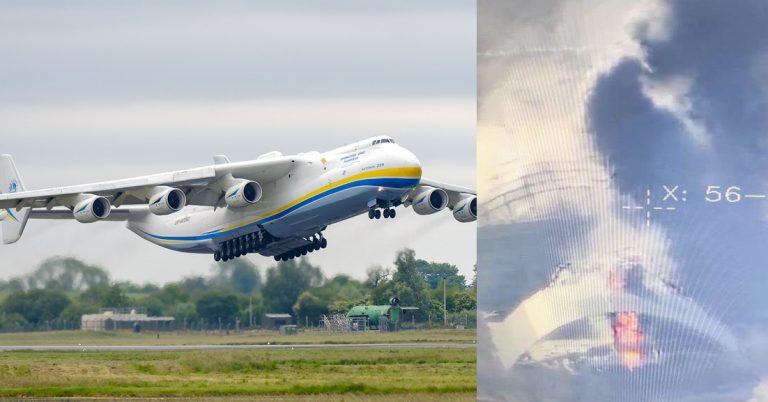
In a significant development in Russia’s ongoing attack on Ukraine, the world’s largest aircraft AN225 has been destroyed in the war. After speculations of the incident were being made on social media, the Ukrainian Foreign Minister confirmed the unfortunate news that the one of a kind six-engine cargo plane has been destroyed by Russia.
Dmytro Kuleba, Minister of Foreign Affairs of Ukraine, posted on Twitter today evening, “This was the world’s largest aircraft, AN-225 ‘Mriya’ (‘Dream’ in Ukrainian). Russia may have destroyed our ‘Mriya’. But they will never be able to destroy our dream of a strong, free and democratic European state. We shall prevail!”
This was the world’s largest aircraft, AN-225 ‘Mriya’ (‘Dream’ in Ukrainian). Russia may have destroyed our ‘Mriya’. But they will never be able to destroy our dream of a strong, free and democratic European state. We shall prevail! pic.twitter.com/TdnBFlj3N8
Antonov, the company that built and operated the AN225 aircraft, said that until the AN-225 has been inspected by experts, they cannot report on the technical condition of the aircraft.
Update on the information of #AN225 "Mriya" aircraft: Currently, until the AN-225 has been inspected by experts, we cannot report on the technical condition of the aircraft.
Earlier in the day, it was being speculated that AN-225 has been destroyed, based on a grainy image showing an aircraft in a hanger getting bombed, it is being speculated that the aircraft in the photograph is the legendary AN225, the six-engine cargo plane. Only one aircraft of the model was built by the Antonov aircraft manufacturing company based in Ukraine.
? Reports that the unique Antonov An-225, the largest plane in the world is on fire at Hostomel Airport. pic.twitter.com/8iFu8EG3UY
The photograph shows a large aircraft under a hanger with a curved roof on fire. It also makes it clear that a missile hit the plane, which had pierced through the sheet-metal curved roof. The aircraft was last parked at the Hostomel Airport near the capital Kyiv, which is also known as the Antonov International Airport. It is located in a town named Hostomel or Gostomel in the north-western suburb of the capital city of Kyiv. The airport is owned by the Antonov aircraft manufacturing company.
Social media users had compared the photograph with the known hanger of the AN225, and found that they match. The hanger has a curved roof with an open back, which is also shown in the photograph. Moreover, it appears that the aircraft under fire has three engines on one of the wings, and AN225 is the only current aircraft with six jet engines in the configuration seen in the photo.
Satellite imagery matches the paneling type of the hanger, and ground level photo’s match the open back and from the of hanger. I believe we can confirm the #An225 has been destroyed pic.twitter.com/uStFnD5IWb
Antonov, which also operates the aircraft, had said that they no information about the accurate status of the aircraft. Reacting to the speculations on Twitter earlier in the day, the company neither confirmed nor denied that AN225 has been destroyed, and had asked to wait for official information.
The reason that the company does not have the information is that the airport is under the control of Russians. Russian forces had seized the Antonov Airport on February 25th after an failed attempt on 24th. As the airport has a runway allowing landing of heavy lift transport planes, it means Russia will now be able to airlift troops and heavy military machinery directly to the outskirts of capital Kyiv.
On February 26, the company had said that it does not don’t have accurate information about the AN225, which is named Mriya. They had said that according the latest information on 24th, before the Russian attack on the airport, the aircraft was intact.
However, as the airport is already under Russian control, it raises the question how the AN225 transport plane parked at its hanger in the airport was damaged, if the speculations about it are right. Some netizens have theorised that it may have been unintentionally hit by a Ukrainian missile.
Looks like the #AN225 is destroyed, most likely by an unintentional hit from the Ukrainian missile (airport occupied by RU). In the memory of this jaw-dropping airplane, a short clip from my archive, when I had a pleasure to see it with my own eyes at @ILA_Berlin 2018#ILA_Berlinhttps://t.co/2FJczYxpOzpic.twitter.com/Z4rcJcb4p3
As the Ukrainian forces are trying to recapture the airport, one of their missiles may have landed on the AN225 hanger, it was being speculated. Although it is also possible that Russians may have destroyed the aircraft, and now the Ukrainian foreign minister had said that the Russians are responsible for it.
The Antonov AN225 Mriya aircraft was built in 1985 by Antonov in Ukraine SSR in the USSR at that time. It is the heaviest aircraft ever built, and has the longest wingspan. The massive aircraft has six turbofan engines and 32 wheels. It is also known for its enormously wide twin tail.
The aircraft was originally built to transport the launch vehicles of the planned Buran spacecraft, but that space program didn’t see the light of the day. Therefore, the aircraft was converted to a cargo plane, mainly used for strategic cargo airlift purposes, to transport big and heavy machinery that other planes can’t carry. While a second AN225 was partially built, the project was abandoned after the fall of the USSR. Efforts to restart the project have been not successful due to financial issues and also due to Ukraine-Russia conflicts, as the plane needs many parts from Russia.
The lone AN225 being destroyed in the war will mark the sad end of a glorious chapter in aviation history.
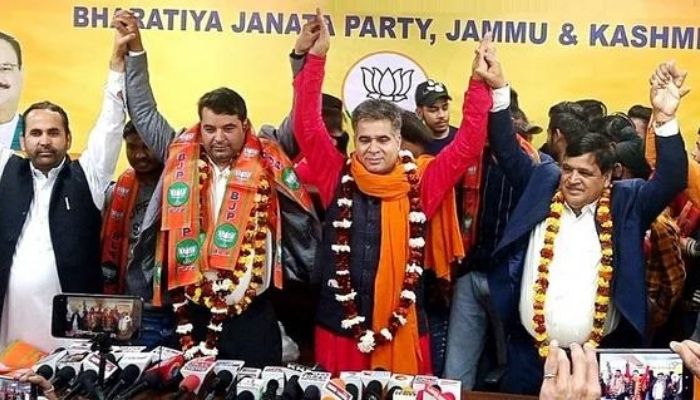
Veteran Congress leader Ghulam Nabi Azad’s nephew Mubashir Azad has left Congress and joined the BJP on Sunday 27th February 2022. He formally joined the BJP at the party headquarters in Jammu.
Mubashir Azad is the son of Liaqat Ali Bhat who is the youngest brother of Ghulam Nabi Azad. Mubashir Azad has been an active member of the Congress party. It is being speculated that the elections may take place in Jammu and Kashmir by the end of this year. This party switch by Mubashir Azad is therefore important.
Prominent political persons joining BJP in presence of J&K BJP President Sh. @ImRavinderRaina and other leaders at BJP Headquarters, Trikuta Nagar, Jammu.https://t.co/YWLsIKuEBy
While joining the party, Mubashir Azad has said, “The Congress party is marred in infighting… while under the leadership of Modi the work for the welfare of the people is taking place on the ground.” He has also mentioned that his uncle was disrespected by the Congress leadership. He said, “The way the Congress treated (Ghulam Nabi) Azad, one of the charismatic leaders of the party and former chief minister, has hurt the sentiments of the common masses. He was praised by the prime minister for his service to the nation but was sidelined by the party.” However, he has made it clear that he had not discussed with his uncle about his intentions of joining the BJP.
Jammu and Kashmir BJP president Ravinder Raina has welcomed Mubashir Azad into the party. He has said, “Mubashir Azad joining the party is a turning point that will pave the way for more young activists from the Doda, Kishtwar, and Ramban districts of the Chenab Valley region to join the party.”
He further added, “The BJP is growing fast with the joining of political leaders from opposition parties, social workers from all communities whether Hindus, Muslims, Gujjars, Bakarwals, and Paharis.”
Earlier in April 2009, Ghulam Nabi Azad’s brother Ghulam Ali had also joined the BJP.
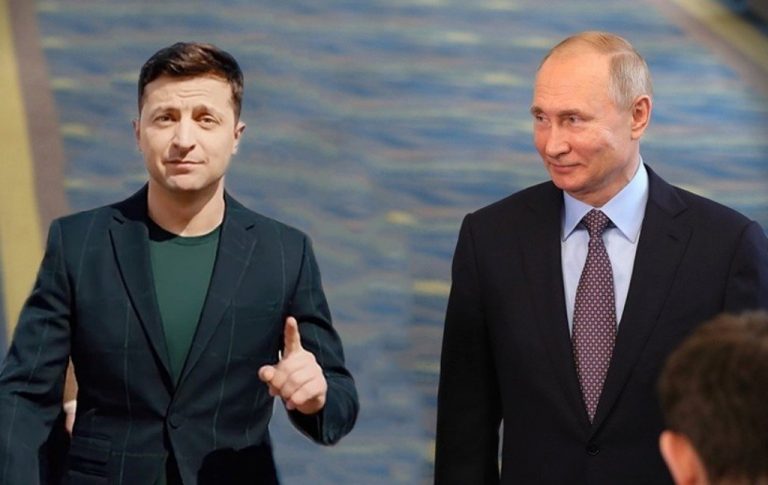
Ukraine President Volodymyr Zelensky has denied the proposal by the Russian delegation to hold peace talks in the Gomel city of Belarus. Zelensky has cited that Russia had attacked Ukraine from Belarus and he has cleared it that he is open to talks only in locations that are not showing aggression towards his country. The locations suitable to the Ukrainian president include Warsaw, Istanbul, and Baku.
BREAKING: Ukraine’s President Zelenskyy says the country is ready for peace talks with Russia but not in Belarus, which was an invasion staging ground. https://t.co/5weL8LosWM
Earlier, Dmitry Peskov – spokesman of the Russian president Vladimir Putin – had said, “Russia is already ready for talks in Gomel. Now Moscow is waiting for the Ukrainians.” In response to this, Ukraine President Zelensky has said, “I am ready for negotiations in any country from where missiles do not fly.”
The Kremlin says a Russian delegation has arrived in the Belarusian city of Homel for talks with Ukrainian officials. There was no immediate comment from Ukraine. https://t.co/bRHe7h53w7
Moreover, Ukraine President Zelensky has said on Sunday that the Russian attacks had been ‘brutal’ in which civilian infrastructure had been bombed by Russian forces. He said, “Last night was brutal. They attacked civilian areas where there is no military infrastructure. The occupying forces are attacking everything, including ambulances.”
The developments come as the conflict between Russia and Ukraine has transformed into war. The Russian President Vladimir Putin, on 24th February 2022, had attacked Ukraine. In a televised address, Russian President Vladimir Putin had declared for the special operation to be conducted in East Ukraine.
It is notable that Russia has sent in Belarus a team of delegates from Moscow to begin first negotiations with their Ukrainian counterparts. The group includes high-ranking officials from foreign, defense ministries and Russian President Vladimir Putin’s office.
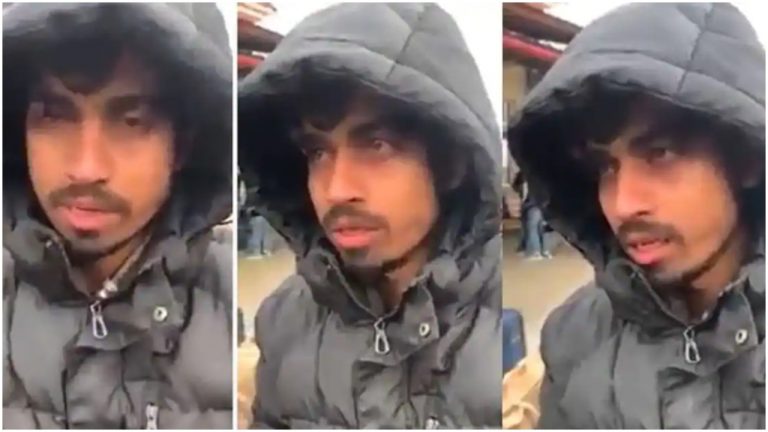
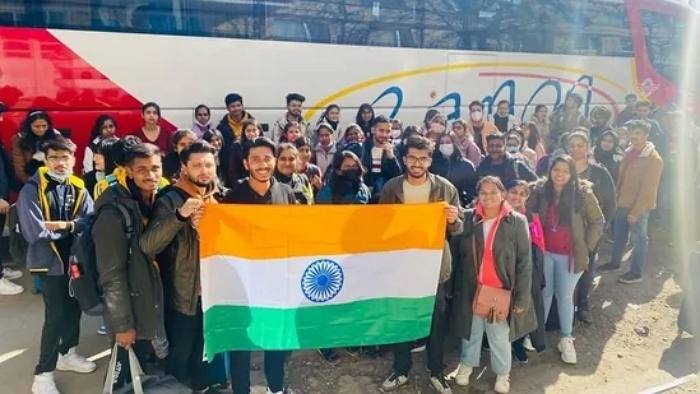
A video went viral on social media recently, in which an Indian student allegedly stranded in Ukraine was seen expressing his anger against the Indian government for not evacuating him from the war-torn country.
The student identified as Rashid Rizwan claimed that a few students were allegedly stuck in war-torn Ukraine for more than ten hours near the border, and no official has contacted them. Rizwan claimed the group of students left for the border last afternoon, but no official has either responded to their help or they have made contact about their evacuation process.
Listen to this Indian Student Stuck at Ukraine -Hungry border . Rizwan is from Gopalganj in Bihar .He is losing his will and hope . @MEAIndia@NitishKumar@PMOIndia .Please Speed up the process of evacuation.
The student, who was seen crying, said he preferred to die rather than be in his current situation. Attacking the Modi government, the student questioned the credibility of the Indian government and its officials, as he tagged many officials and Indian government accounts for help.
The video of Rizwan abusing the Indian government over its alleged ‘failure’ to evacuate Indians went viral on social media platforms. The left-liberals and the opposition party supporters picked up the purported claims made by Rizwan to discredit the Modi government’s efforts to evacuate over 18,000 students stuck in Ukraine.
The videos were aggressively shared to misinform the public that the Indian government had left the Indian students studying in Ukraine on their own and claimed that the Indian government did not have any plans to evacuate them.
It is pertinent to note that such misleading claims were made even as the Indian government launched ‘Operation Ganga’ to bring back the stranded Indian public in Ukraine. As a result, more than three flights carrying 710 Indians have already left Romania and Hungary, the neighbours of Ukraine, by boarding Air India flights. Many more are being planned and coordination efforts are on.
Rashid Rizwan – an avid supporter of rioters and Islamists
Amidst these scare-mongering and misinformation campaigns, netizens have found out more details about Rashid Rizwan and his antecedents.
According to social media users, Rashid Rizwan is from the Gopalganj district of Bihar. In the past, Rizwan has been allegedly part of several anti-India propaganda on social media platforms. Rashid Rizwan, who had posted the video from Ukraine from his Twitter handle “@rshdrizwan’, had put up fake propaganda against the Indian government.
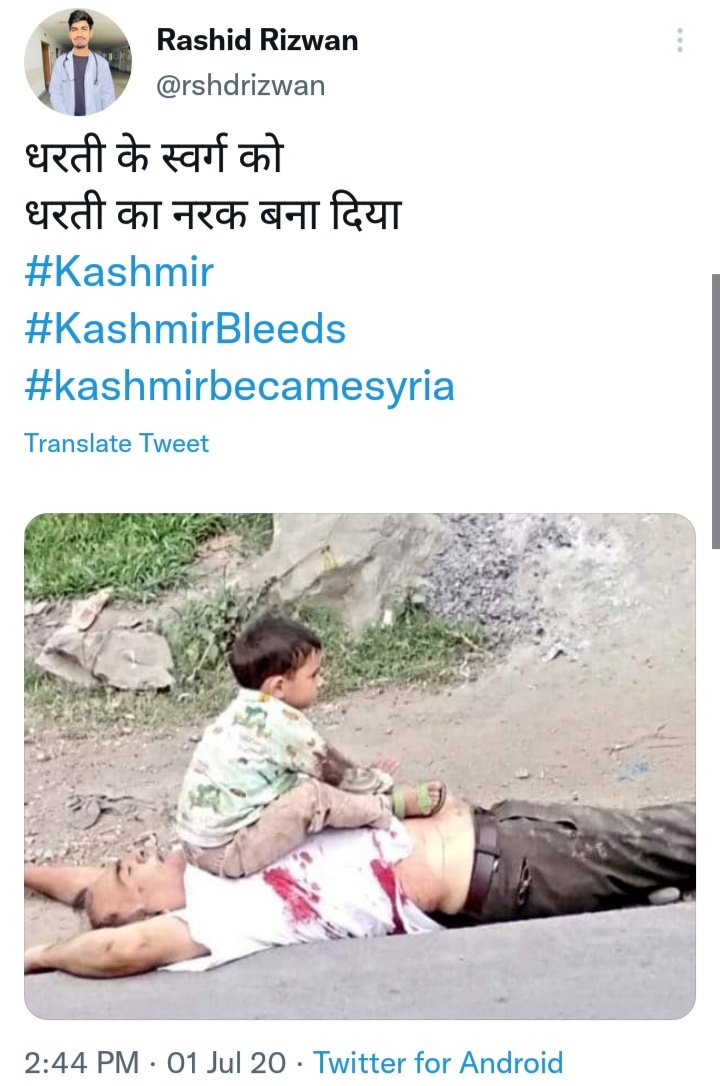
In 2020, Rizwan had posted a heart-wrenching image of a three-year-old child, sitting on the blood-splattered body of his grandfather, killed by the Pakistan sponsored terrorists. By posting the misleading image, he had tried to propagate a dangerous narrative that Kashmir had become Syria.
Without naming the Modi government, Rizwan had insinuated that the government had converted the ‘heaven’ Kashmir into a ‘hell’.
Rashid Rizwan propagated misinformation about the Indian government and Kashmir/ Image Source: Koustuv/Twitter.
The netizens reminded the social media users that Rizwan had a rich history of peddling misinformation to spread propaganda against the Indian government.
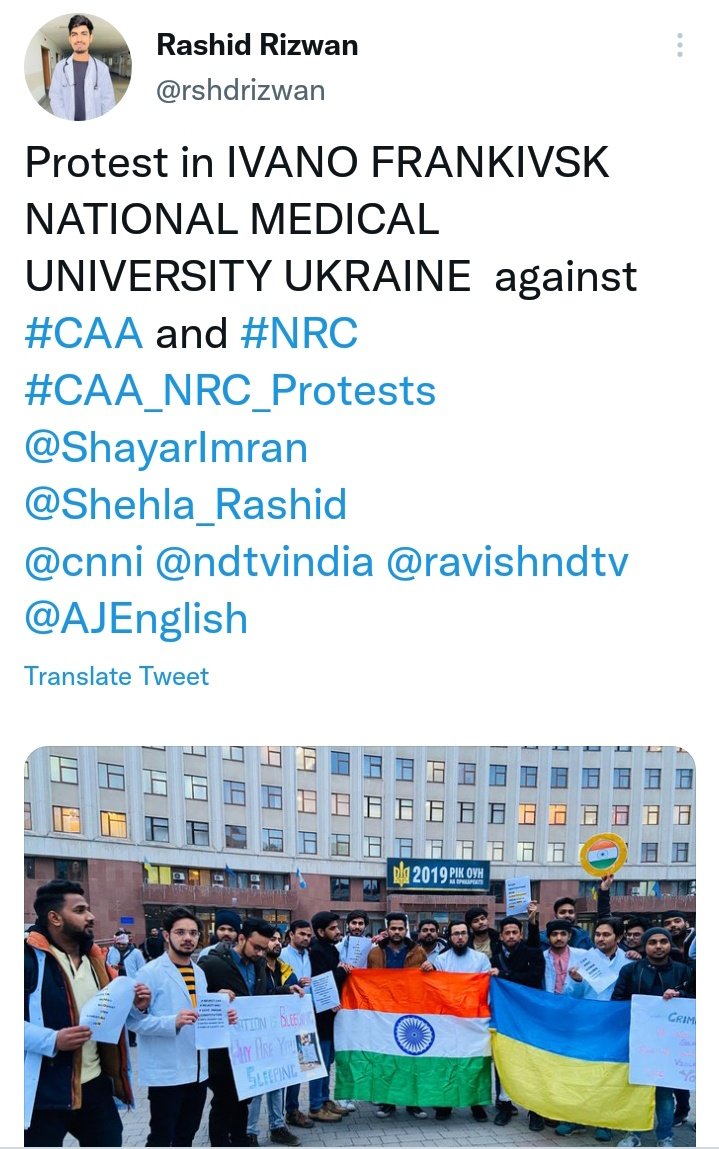
Another screenshot of a tweet put out by Rizwan has also gone viral. In the tweet, Rizwan was seen protesting against the Citizenship Amendment Act outside his college in Ukraine. The Citizenship Amendment Act was a domestic issue that granted citizenship to the six most persecuted minorities of three Islamic countries – Pakistan, Bangladesh and Afghanistan.
Netizens accused Rizwan of involving in protests against a law that was passed by a democratically elected government, that too on foreign soil.
Rashid Rizwan protesting in Anti-CAA protests in Ukraine/ Image Source: Koustuv/Twitter
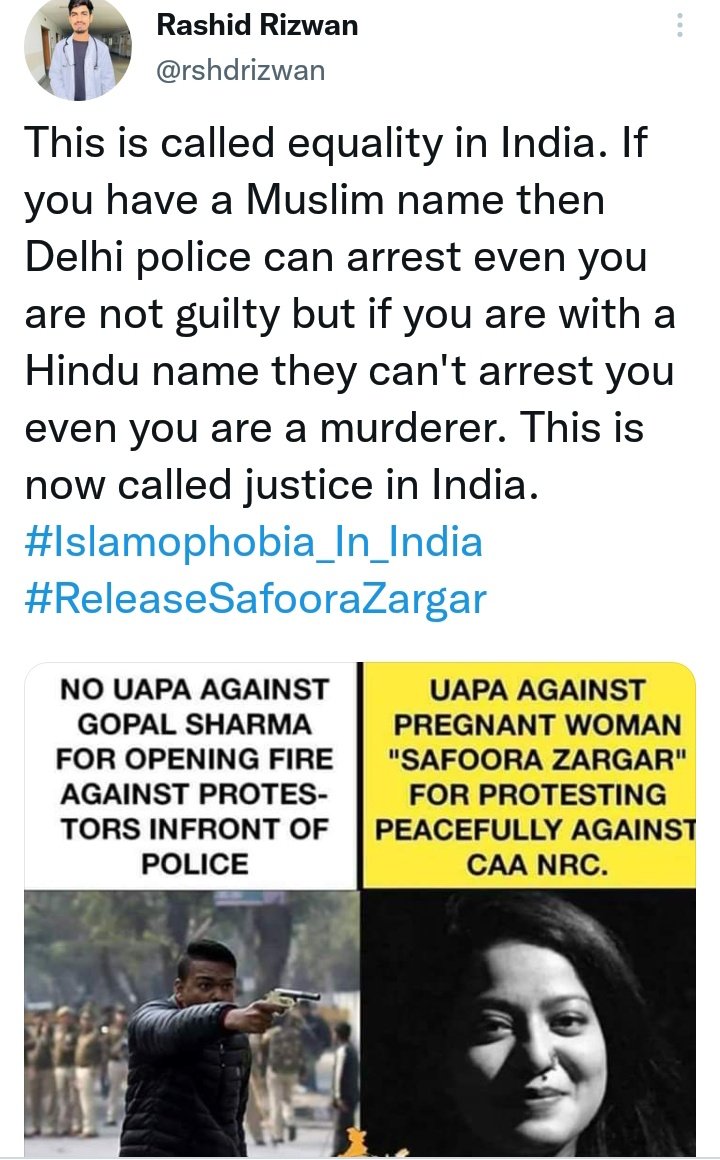
Not just that, Rizwan was also seen supporting radical Islamist, and Anti-Hindu Delhi riots accused Safoora Zargar.
In a tweet, Rizwan had claimed that Zargar, who is accused in a UAPA case for orchestrating the Anti-Hindu Delhi Riots, was arrested because she was a Muslim. He claimed that Delhi police arrested only Muslims and did not act against Hindus even they were murderers.
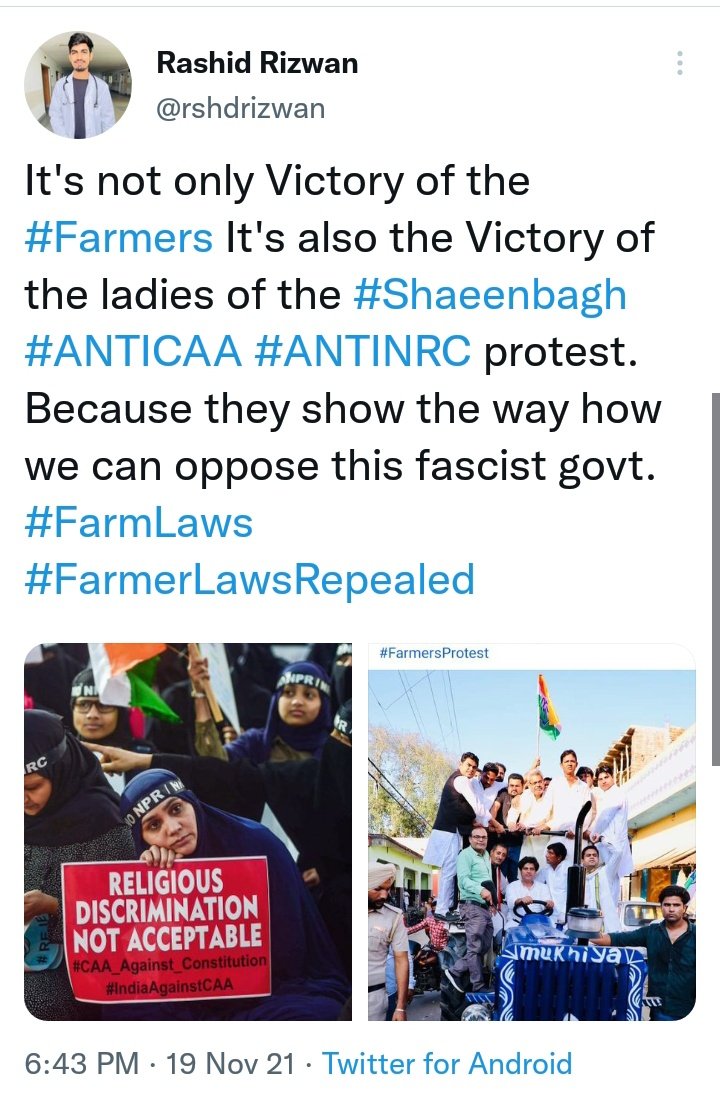
Rizwan, who stays in Ukraine, very much actively propagated misinformation about political events that took place in India. After the Modi government decided to scrap the farm laws, Rizwan said on Twitter that it was not just the victory of farmers but also the victory of Shaheen Bagh Anti-CAA protests. He said that these protestors knew how to oppose the fascist government.
Image Source: Koustuv/Twitter
Adding fuel to his anti-India views, he has now claimed that the Indian government is not doing anything to evacuated stranded Indians even as one can see the government has working round the clock to bring back Indians.
Amidst the ongoing clashes, the Indian government is putting all its efforts to bring back the Indian citizens residing in Ukraine. Slowly, the Indians are being brought back, thanks to quick intervention from the Indian governmnet. The Indian government has launched ‘Operation Ganga’ to run rescue flights, and so far, over 700 people have been brought back safely to India from Ukraine.
It is estimated that more than 18,000 Indians are waiting to return to India, and the Modi government has been working with several countries, including Ukraine’s neighbours such as Russia, Bulgaria, Romania, Hungary, Poland, etc., to evacuate Indians in a quick time. So the likes of Rizwan should perhaps be criticising the Indian government less and patiently be waiting for their turn to return to India.
The Embassy of India in Ukraine has issued a fresh advisory for the Indian nationals and students in Ukraine. The Embassy has advised Indians to use nearby railway stations for movement out of the regions of active conflict and move towards the Western regions.
The Embassy, in its advisory, advised the Indian Nationals to move out only when the curfew is lifted, and they notice the considerable movement of people in their respective neighbourhoods. The Embassy also requested the Indian Nationals to travel together, and if any of them were alone, it was advised to identify other fellow Indian Nationals and travel together with them.
Advised to take trains
The Embassy said travelling using the trains would be the safest option to move out of the conflicted regions, and informed that train services are operating in the country. They added the tickets, if available, might be booked. Also, the Ukrainian Railways is operating special trains to evacuate people without any cost on a first-come, first-serve basis. For such trains, as per the Embassy, the preference was being given to children, women and elderly people.
Ukraine Railways is additionally organising emergency trains at no cost, first come basis from Kyiv. Schedule can be found at train stations. ??n diaspora is advised to move away from conflict zones to the Western region subject to security situation and the extant regulations.
The Embassy further suggested the Indian Nationals check the Digital Boards at the Railway Stations for the most recent updates on trains. Also, regular announcements are being made at the Railway Stations in real-time with the latest information that would make it easier to commute.
As of now, the Indian citizens are being evacuated from Ukraine via Romania and Hungary, and arrangements are being made to evacuate Indians through Poland and Slovakia borders, all on the Western side of the country. The Indian authorities are also exploring more routes to evacuate stranded Indians in the war-hit Ukraine.
?? Citizens have successfully been evacuated from Ukraine through Romania and shortly through Hungary. Working to open up more borders with neighbouring countries for our citizens. Please stay patient and safe
It is notable that Poland is allowing Indians from Ukraine to enter the country without Visa. This was announced by the Polish ambassador to India Adam Burakowski on Twitter today.
Poland is allowing to enter without any visa all Indian students who escape from Russian aggression in Ukraine.
Ukraine shares its border with Russia to the East, Belarus to the north, and Poland, Slovakia, Hungary, Romania and Moldova to the West. Among them, at present Poland, Slovakia, Hungary, Romania and Moldova are considered safe for evacuation from Ukraine as they are away from the eastern zone where the Russian attack is taking place.
So far, Indian officials have made arrangements to evacuate Indians using land routes from Ukraine through Zahony / Kpp Tysa border crossing on the Hungary border, Suceava border crossing on Romania border, Vysne Nemecke border crossing on Slovakia border and Krakowiec border crossing on Poland border with Ukraine. From the border posts, they are being taken to the nearby international airports to be airlifted to India free of cost. Foreign Affairs minister S Jaishankar has also talked to Moldova foreign minister over evacuation through the country.
Indian Nationals facing problems at Poland border
Since Russia declared military action against Ukraine on February 24, hundreds of Indian Nationals have moved to the Poland border for evacuation. However, reports suggest that the Ukrainian authorities are discriminating against Indian students and allegedly had put them in a hostage-like situation. Meanwhile, over 600 Indian students have already been evacuated from the war-hit region, and more arrangements are being made to safely bring the Indians back home. African nationals have also alleged racial discrimination while trying to evacuate.
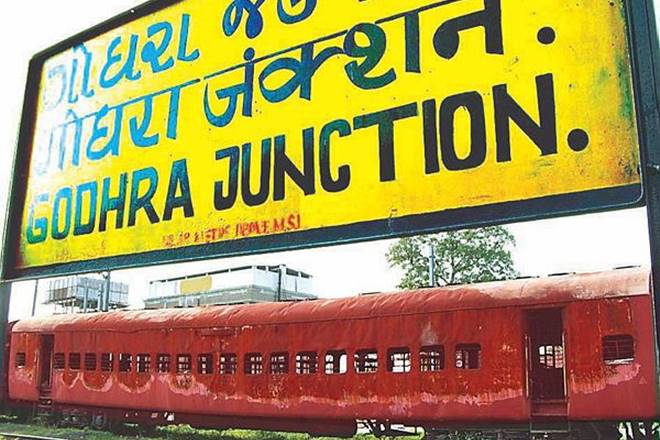
20 years ago, 59 Hindus were brutally burnt alive in Godhra, Gujarat. Not only were the Hindus burnt alive, but history also forgot their names, forgot that the bloodthirsty Muslim mob came back to inflict more damage after murdering 59 Hindus and that the entire ecosystem meticulously tried to invalidate accounts of eyewitnesses and victims so they could save the Muslim mob.
When 59 people, including women and children, were burnt alive on 27 February 2002 inside a train by a riotous Muslim mob, it was because they were returning from Ayodhya. A place where they wanted to build Ram Mandir. A place where an illegal structure called ‘Babri Masjid’ stood. Those burnt alive were all Hindus.
For the media and the activist who tried to whitewash the Godhra carnage, it was almost justified that these men, women and children were murdered simply because they were Hindus, because they were returning from Ayodhya and because they chanted Jai Shree Ram while returning from a place where they wanted their Ram Mandir built.
The media, which should ideally have been reporting how a Muslim mob burnt Hindus to death, was far more bothered about being politically correct than standing with the unvarnished truth of how Hindus had been massacred.
OpIndia CEO and author Rahul Roushan in his book ‘Sanghi Who Never Went To A Shakha’ talks about his time as a young journalist associated with Aaj Tak, where he briefly interned. He was there in the studio when the news of the train coach being set on fire had started trickling in. He talks about how things were handled in the newsroom on how to break the story for the viewers. Here is a snippet from his book about the incident:
“‘Pata chala kaun kiya?’ (‘ Do we now know who did it?’), asked the copy editor to the input guy, who immediately replied ‘Musalmaan sab aur kaun?’ (‘ The Muslims did it, who else?’) in a hushed but disgusted tone. After a brief pause, the copy editor said, ‘Ab yeh toh nahi likh sakte na.’ (‘ Now, we can’t really write this.’) I furtively tried to have a look at the input guy. He didn’t say anything after this. Anger was discernible on his face and so was the disgust. His eyes met mine and I immediately averted them, lest he thought I was trying to spy. He then walked away, leaving some fax or photocopies at the desk of the copy editor, presumably the raw reports sent by the reporters from the ground. I too walked back to my desk, silently. This conversation of barely ten seconds, which would include some uncomfortable pauses, too, revealed so much in retrospect. The mainstream can write headlines like ‘Frenzied Hindu mob brings down sixteenth-century mosque’ and ‘Dabang Rajputon ne Dalit dulhe ko ghodi se utaara’ (when some men from the Rajput community force a Dalit groom to alight from the horse during a wedding procession), mentioning the religion or caste of the perpetrator of a reported crime in some cases, but it feels greatly uncomfortable about mentioning the religion when the perpetrator of the crime is a Muslim—this when religion was clearly the main element in the crime committed at Godhra. ‘Muslim mob sets a train carrying Hindu pilgrims on fire’ is not seen as a legitimate or ‘responsible’ headline, even though it is factual.”
The concept of ‘responsible reporting’ is skewed such that it has now become ‘hateful’ to mention in the headline or give further details of the crime if the perpetrator is a Muslim. As one can see, twenty years back, the guys at Aaj Tak did not want to specify that a murderous Muslim mob trapped Hindus inside a train compartment and set it on fire killing 59 people.
‘Responsible reporting’, however, went for a toss when subsequent riots broke out and it was all about the ‘Hindu mob’ that set shops of Muslims on fire. There were fantastical reports published by newspapers that a ‘Hindu mob’ raped a pregnant Muslim woman, Kausar Bano, ripped open her tummy with a sword and flung the foetus in the air. It has been 20 years and this myth has been perpetuated for a generation now. There are different variations, sometimes even more gruesome fate of the foetus is depicted, but the basic premise remains the same.
However, the postmortem of Kausar Bano told a different story. A 2010 report states that the doctor who conducted a post-mortem on Kauser found the foetus intact. Dr J S Kanoria, who had conducted the autopsy on 2nd March 2002 presented supporting documents to the special court and said that the foetus was intact in the woman’s womb. The foetus weight 2,500 gms and was 45 cms long.
March 2010 article on postmortem of Kausar Bano
But as we see, the lie had already been perpetuated.
Nothing justifies the riots. And nothing justifies the burning alive of those Hindus, who were killed specifically because they were Hindus.
What was worse was, these Hindus were then blamed for their own deaths. And their killers were given a ‘clean chit’ by secular media because ‘no one knows how the fire was lit’.
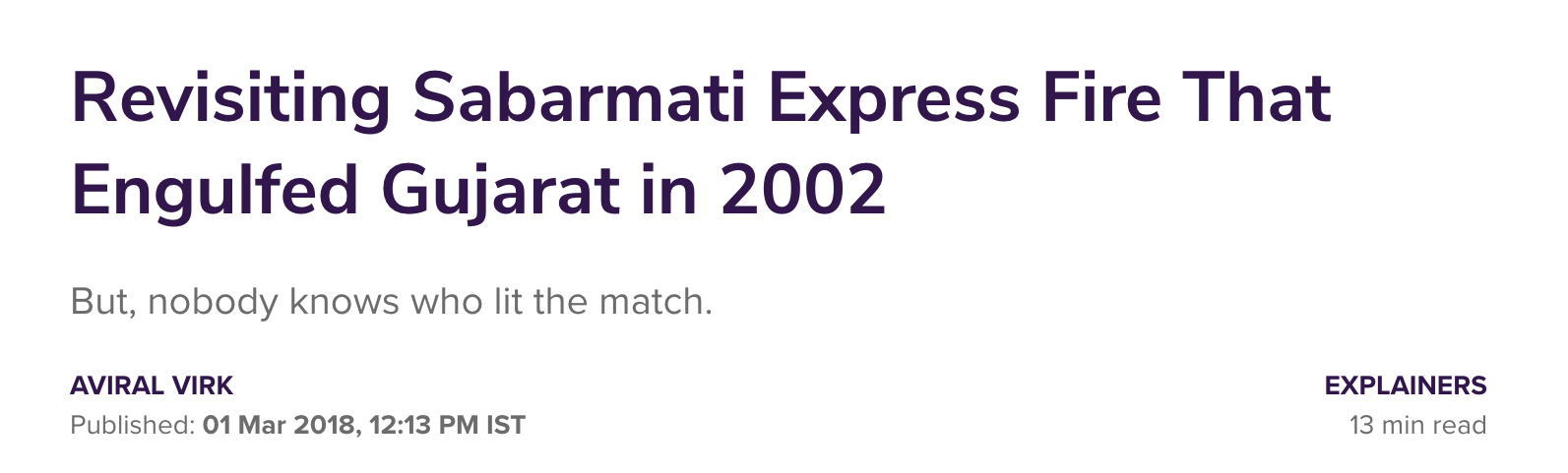
Quint ‘Explainer on Godhra carnage
In 2018, Raghav Bahl’s The Quint published an ‘explainer’ on the Godhra carnage and subsequent riots. It claims ‘no one knows who lit the match’. Let me help you: A riotous Muslim mob did it. Say it in as many words.
In July 2002, India Today in its report claimed that on the Godhra platform a ‘scuffle’ broke out between karsevaks and tea vendors, most of whom were Muslims. When the train started to move, the train was stopped after the alarm chain was pulled. A crowd gathered and pelted stones on the train. Now, the karsevaks ran for their lives and got back into the coach. Doors, windows shut, the train started moving. A kilometre further, it stopped again because of ‘technical glitch’. The mob, now of 1000 strong Muslims, now descended and pelted stones on the train again and set it on fire.
You see, the reason Hindus were set on fire by a rioting Muslim mob was because the ‘scuffle’ with Muslim tea vendors provoked them. But even if it were true, what does it say about a community that gets triggered by anything from a scuffle to cartoon to just about any ‘gustakhi’ that they just want to then go about killing everyone?
Justice Nanavati-Mehta Committee report [pdf] talks about how the Godhra carnage took place. Right after the Godhra platform and boundary, there is a road and a locality named ‘Signal Falia’. “It extends up to the culvert and goes further towards A cabin. It is a locality mainly inhabited by Ghanchi Muslims,” the report mentions. When the train had arrived, a lot of unauthorised vendors, mainly Ghanchi Muslims, would come on the platform and sell snacks, cold drinks, bidis, etc.
The report further states that the train arrived at the platform at 7:43 AM as it was running about 5 hours late and there was a halt of about 5 minutes. In its evidence portion, the report cites media reports from 28th February 2002, the day after the carnage, where leading mainstream media had reported that a mob has set Hindus on fire. They mentioned how Hindus were returning from karseva and how the mob set the train coaches on fire with petrol.
The Times of India had mentioned how the train was stopped at Signal Falia where someone had pulled the chain and after initial pelting of stones on coach S6 and S7, windows were broken and petrol bombs were thrown inside. The Indian Express, too, carried eyewitness statements on how the mob had set the coach ablaze after pelting stones.
How did the conspiracy theories come to be, denying justice to Hindu victims?
As evident, barring the usual whitewashing, there was consensus that it was a mob that had set fire to the train, causing the brutal massacre of 59 Hindus. While the media might not have put the details in the headline to be politically correct, there was no other theory that was peddled about how the Hindus died. It was only later that these theories emerge.
Even someone like Vir Sanghvi, at the time, had conceded that it was indeed a Muslim mob that had set fire to the train, causing the brutal death of the 59 Hindus.
Sanghvi, at the time, wrote:
It will be some time before we can establish the veracity of these versions, but some things seem clear. There is no suggestion that the kar sewaks started the violence. The worst that has been said is that they misbehaved with a few passengers. Equally, it does seem extraordinary that slogans shouted from a moving train or at a railway platform should have been enough to enrage local Muslims, enough for 2,000 of them to have quickly assembled at eight in the morning, having already managed to procure petrol bombs and acid bombs. Even if you dispute the version of some of the kar sewaks – that the attack was premeditated and that the mob was ready and waiting – there can be no denying that what happened was indefensible, unforgivable and impossible to explain away as a consequence of great provocation.
So what was the genesis of these conspiracy theories that denied the truth 5 months after even individuals like Vir Sanghvi admitted that it was indeed a Muslim mob that murdered the Hindus? On what basis did The Quint claim that nobody really knew who lit the match and how the Hindus were burnt to death when even Vir Sanghvi, the quintessential “liberal” who would just as easily deny the genocide of Hindus, admitted that the violence was not started by the Hindus and that there was a mob that set the train on fire.
Mukul Sinha’s Jan Sangharsh Manch and other ‘liberals’ and ‘activists’ fought tooth and nail to call the eyewitnesses of Godhra carnage liars, as evidenced in the Nanavati-Mehta Commission Report. They went to lengths to create various narratives like ‘fire was started from inside’, ‘short circuit’, ‘spontaneous scuffle’, ‘Karsevaks rose provocative Jai Shri Ram slogans’ (20 years later, Jai Shri Ram is ‘Hindu terrorist war cry’ and Allahu Akbar is ‘voice of courage’ as per the same set of ‘liberals’). Mainstream media and politicians were complicit in making the world think that the Hindus burnt alive in the train did not matter.
“No person had suggested for quite a long time that fire in coach S/6 of Sabarmati Express train was caused in any other manner,” the Commission report said. Except, in response to this, a member of Jan Sangharsh Manch, a ‘civil rights organisation’ started by ‘activist-lawyer’ Mukul Sinha, filed a statement and questioned the criminal conspiracy angle of state government and claimed that after the ‘evidence’ collected by him, it “appeared to him that burning of coach S/6 was because of the spontaneous scuffle and fight that had taken place between Ramsevaks and Muslim vendors on the platform of Godhra railway station and not because of any conspiracy hatched earlier.” Mukul Sinha’s son, Pratik Sinha, now runs the propaganda website ‘Alt News’ which regularly whitewashes crimes committed by Islamists.
Mukul Sinha was a scientist turned “activist”. He was a physicist, working with the Physical Research Laboratory in Ahmedabad. In 1988, he obtained a law degree and founded ‘Jan Sangharsh Manch’, a ‘civil rights organisation’ along with his wife Nirjari Sinha. The leadership of Jan Sangharsh Manch also founded the New Socialist Movement which was registered as a political party with the Election Commission in 2007. Mukul Sinha had also contested elections in the past and lost.
Mukul Sinha, along with his son Pratik Singh used to run an online rag called “Truth of Gujarat” which basically spread lies about the carnage of Hindus and tried to blame the victims for their own death. Essentially, Sinha senior with a bunch of ‘like minded’ propagandists would float theories on the 2002 Godhra carnage and subsequent riots in Gujarat.
In 2004, pro-Congress ‘activist’ Shabnam Hashmi organised a seminar in Delhi “Rebuilding Justice and Hope in Gujarat: The Agenda Ahead”. Amongst those present in the seminar were: actresses Sharmila Tagore and Nandita Das, lawyers Indira Jaisingh and Nitya Ramakrishnan, and journalists Praful Bidwai and Rajdeep Sardesai along with many known critics of the then Gujarat CM Narendra Modi. They all tried to figure out ways to ‘fix’ Modi legally where Sinha gave a presentation to ‘prove’ the Muslim mob setting the train to fire was ‘false’ and that the fire was an ‘accident’.
This kind of propaganda was seeded through ‘truthofgujarat’ by Mukul Sinha along with his son Pratik.
Pratik Sinha, as mentioned earlier, now runs another propaganda outlet AltNews that whitewashes the murder of Hindus. Nirjari Sinha (Wife of Mukul Sinha and mother of Pratik Sinha), Pratik Sinha and Murlidhar Deomurari – all associated with Alt News are members of Jan Sangharsh Manch. Nirjari and Murlidhar are directors of Alt News.
It gets worse.
RJD chief Lalu Prasad Yadav was the Union Railway Minister in UPA 1 and he formed UC Banerjee Committee to ‘investigate’ the Godhra carnage. The UC Banerjee Report claimed that the fire that killed 59 karsevaks was ‘accidental’. Its interim report was released in 2005 which Lalu had used in the 2005 Bihar state election polls. Banerjee, however, never explained what could have caused the fire. Maybe some Karsevaks used the stones pelted at them by the Islamsits and were trying to see how man invented fire in the Stone Age.
See how suddenly the narrative went on to karsevaks who ‘got into a scuffle’ with tea vendor. Shame on the karsevaks for ‘getting into spontaneous scuffle’ which manifested a spontaneous mob armed with stones and inflammable materials which decided to kill them instead.
Gujarat High Court, in 2014, about a decade after Banerjee Committee declared the fire ‘accidental’, said that such a panel was a “colourable exercise of power with mala fide intentions”, and its argument of accidental fire “opposed the prima facie accepted facts on record”.
Remember, Congress-led UP wanted to tarnish the victims of Godhra carnage likely because the perpetrators were Muslims.
Nanavati-Mehta Commission report on Godhra carnage
“Till July 2002 neither Jan Sangharsh Manch nor Gujarat Pradesh Congress Committee nor anyone else had suggested that the Godhra incident had not happened in the manner reported by the media and as stated by the State Government and others including the concerned railway personnel and the passengers but it had happened in a different manner,” the Nanavati Mehta Commission stated.
Regarding the ‘scuffle’, Nanavati-Mehta Commission had concluded, “From the evidence of all these witnesses and other material on record it becomes clear that except overcrowding in the train and occasional raising of slogans inside the train and on platforms of the intervening stations, the Ramsevaks had not done anything and no incident had happened earlier which could have led to the incident which later on happened at Godhra. In absence of any evidence whatsoever indicating any incident on the way, the Commission has no hesitation in coming to the conclusion that the suggestion made by JamiateUlma-E-Hind that a quarrel had taken place between Ramsevaks and vendors at Ujjain railway station is without any basis. Its journey from Ayodhya to Godhra was trouble-free.”
There were another allegations that the karsevaks ‘attempted’ to abduct a Muslim woman, after the ‘scuffle’ that angered the mob. After careful scrutiny of her evidence, the Commission comes to the conclusion that the version given by her does not appear to be true. If they had really gone to the station for going to Vadodara, they would have boarded the Sabarmati Express train as it would have taken them to Vadodara earlier, but they had not done so. The alleged attempt to abduct her was made while they were near the bookstall. That would mean that they were almost in the middle of the covered portion of the platform and very close to the offices of the railway staff. The evidence discloses that there were many persons on the platform. Apart from passengers, many Muslim vendors were there. The railway staff was present in their offices. Some policemen were also present. If she had raised shouts to save her then they would have been heard at least by some persons who were near about but not a single vendor or anyone else has come forward to support her version. According to her evidence, they had then gone inside the office of the booking clerk. They did not inform anyone there about what had happened. When inside that office, they had no reason to be afraid of anything thereafter and return immediately to their relative’s place instead of waiting for the Memu train which was about to arrive. Her explanation that she was much frightened and had giddiness and, therefore, they had decided not to go back to Vadodara on that day, does not appear to be true,” the Nanavati Mehta Commission report stated.
It mentions that the theories of ‘accidental fire’ were floated after Forensic Science Lab in its report dated 7th May 2002 mentioned how the windows of the train were too high for anyone to have thrown inflammable liquid inside. The Nanavati-Mehta Commission report found this evidence during the course of their investigation regarding the FSL report. The FSL had prepared four reports on the basis of their examination. Some samples were also sent to the lab and a report on it was also made.
“Two more reports were prepared by the Chemistry Division of their laboratory of which Shri D.V. Talati, was the head. He has stated that the opinion expressed in report no. 1 that a person standing outside coach S/6 could not have applied force to the bars of the windows was in the context of the query viz. whether a man standing on the ground could have applied force to the bars of the windows. He has stated that if a man had tried to raise himself or if he was lifted by somebody then he could have applied force on the bars. His examination of the coach had indicated that inflammable material must have been thrown while standing in the passage between seat no.72 and the eastern door of the coach,” The Commission report states.
Regarding the fire and its origin, D V Talati had told the Nanavati-Mehta Commission, “About 60 litres of inflammable liquid must have been used in burning that coach. The floor of the coach at some places was totally burnt. After explaining the difference between a fire in an open space and a fire in a confined place, he has stated that the phenomenon of flashover can happen in a place that is small and completely closed. The size of S/6 was quite big. The total area of it was 5000 sq.ft. Therefore, there was no possibility of flashover in that coach unless the fire was big. The fire had not started from below the coach. The total quantity of liquid that was required for burning the coach could not have been thrown from outside, nor the fire which took place in S/6 could have been caused only by the burning rags thrown in it. As there was more damage in the eastern part of the coach, he had come to the conclusion that the fire had originated in the eastern part of that coach.”
Dismissing the claims by some websites, ‘activists’ that the fire happened inside the compartment after some inflammable liquid from a stove spilt after some karsevak tried to cook a meal in the compartment, the Commission report said, “He has denied that such fire could have taken place in the coach as a result of inflammable liquid in a vessel getting spilt in the coach. This witness has produced photographs taken by his office at the time of examination of that coach.”
Further, Mukesh Joshi, Scientific Officer at FSL had gone to Godhra thrice in 2002 and he had observed, “n hit marks on the outer side of coach S/6 caused by stones hitting the coach. There were burn marks also on the outer side of coaches S/6 and S/7.”
The Nanavati-Mehta Commission report then talks about the statements of various eyewitnesses. Multiple eyewitnesses narrate how the mob started pelting stones from the left side of the compartment as the train started to move away from the platform. “Sajjanlal Raniwal has stated that as soon as the train had moved out of the platform, a mob standing on the left-hand side had started throwing stones on it and for that reason he was required to close the door and shutters of the windows of their compartment. If really that had not happened, there was no other reason for Sajjanlal to say so. He would not have closed the windows unless he was compelled by the circumstances to do so. The passengers have also said that as the persons on the left-hand side of the train had started throwing stones on the train, they were required to close the windows of their coach. Some of the witnesses have stated that stones which were thrown on the train had a broken glass of one or two windows and therefore, the passengers in the coach were required to close the tin/metal shutters of the windows on that side. Hariprasad has also clearly stated that right from the time the train had moved out of the station, pelting of stones on the train had started and because of that passengers had closed the windows of their coach. There is no reason to doubt this part of their evidence. Hariprasad and other witnesses would not have said so unless it was true as they had nothing to gain by saying something that which was not correct.”
Mukul Sinha’s Jan Sangharsh Manch opposed this version of the eyewitness and claimed how “neither driver Rajendrarao nor assistant driver Mukesh Pachori has stated anything with regard to the attack on the train with stones while it was moving towards ‘A’ cabin.” To this, it was clear that since the driver had to focus on the track, he would do not have any reason to look towards Signal Falia, from where the mob had come. “Rajendrarao has stated that his attention was fixed on the track ahead and therefore, he had not noticed any mob or movement of persons near the Signal Falia. This conduct of Rajendrarao is quite natural. He was moving out from the station and had to keep an eye on the tracks ahead. Moreover, he had to exchange the “all right” signal with the staff at ‘A’ cabin and therefore also it is likely that his attention was towards ‘A’ cabin. They had no reason to look towards the Signal Falia side. The evidence is that persons were chasing the train in small groups. They were not standing near the track,” The Nanavati-Mehta Commission report stated.
As per the statement, the mob was not near the track, they had come near the track a little while later. “Their having not seen any mob does not provide a good reason to raise any doubt regarding reliability and truthfulness of the evidence of TTE Sajjanlal and the passengers. In view of the false rumour spread that a Ghanchi Muslim girl was being taken away, what the passengers have said regarding the mob is more likely to have happened. The Commission is of the view that on the basis of this evidence it is quite safe to record a finding that the train was attacked with stones while it was running between the station and ‘A’ cabin,” the report states.
Another conspiracy theory about the fire that was floated by Mukul Sinha’s Jan Sangharsh Manch was ‘short circuit’. The Nanavati-Mehta Commission had this to say about this, “A short circuit is another probability canvassed by the Jan Sangharsh Manch. No evidence has been led and no material has been produced before the Commission to show the possibility of a short circuit having occurred in the coach. The reason given in support of this possibility is that there was smoke in the coach first and flames were seen after sometime. Not a single passenger of coach S/6 examined by the Commission was asked if anything like short-circuit had happened in the coach.”
Further, the report said, “During the inspection by the Commission in presence of advocates appearing for the parties it was noticed that the electric wires were in the upper parts of the coach. If there was a fire because of a short circuit the passengers who were near that place would have immediately come to know about it. In that case, the passengers who were sitting on the lower seats would not have climbed up on the upper berths to protect themselves. On the contrary, those who were sitting on the upper berths would have immediately come down for saving themselves from fire and electric shock. The passengers would have left the coach immediately through all the four doors and so many persons would not have lost their lives.”
Jan Sangharsh Manch by Mukul Sinha then called an eyewitness a liar. One Savitaben Sadhu, who was a few compartments away, saw the horrifying scenes unfold in front of her eyes. “She has stated that because of the attack by the mob with stones and other articles, windows of their coach had broken down and that she was hit by some stones. She has also stated that a window on the southern side was broken by some persons in the mob. When questioned about the details of the attack she has stated that she had seen persons in the mob throwing stones and burning rags inside the coach through those open windows.”
“The burning rags and some liquid which was also thrown in the coach. She was able to see all that as the shutters of the window near which she was sitting had given way and the window had become open. She had also seen persons throwing some liquid in the coach that had led to smoke and fire in the coach. First, there was smoke and after some time flames were seen. Her shawl had got burnt and she had received some burn injuries,” she had said.
Except, Mukul Sinha’s Jan Sangharsh Manch called her a liar. They claimed that all other evidence shows that first there was smoke and after some time there was fire and hence, what she said burning rags were thrown inside the train was a lie. Except, the Nanavati-Mehta committee report stated, “A careful reading of her evidence shows that what she wanted to say was that the burning rags which were thrown inside the coach had remained burning after falling in the coach and that had led to the fire and smoke in their coach.”
So, if an eyewitness that saw a murderous mob setting a train on fire and barely managed to escape, says something that is slightly unclear to interpret, it is termed a lie. As we can see in Mukul Sinha’s case, the apple hasn’t fallen far from the tree when it comes to whitewashing crimes of Islamists and dehumanising Hindus, even if the Hindus are dead and cannot defend themselves.
The others who dismissed the massacre of Hindus
It is not only Mukul Sinha through his Jan Sangharsh Manch who dismissed the carnage. Seasoned ‘liberal’ Arundhati Roy once claimed that the karsevaks who were burnt alive were returning from Ayodhya after demolishing the disputed structure often referred to as Babri Masjid at Ram Janmabhoomi.
Roy, with all confidence and conviction, claimed Babri was demolished in 2002. Further, she also had the gall to claim ‘no one knew’ how the ‘train caught fire’. No, Roy, train ‘did not catch fire’, it was set on fire, by a murderous mob of Islamists specifically to kill Hindus returning from Ayodhya after karseva. There is ample evidence provided above and a court of law has actually sentenced the accused, many of them to death.
Gujarat riots also proved as a very fertile ground for ‘NGOs’ and ‘human rights activists’ to make a name as well as money for themselves. One such ‘activist’ is Teesta Setalvad.
Setalvad has been accused of embezzling funds meant for Gujarat riot victims. She had allegedly collected funds for the 2002 riot victims and instead used it for personal luxury and expenses. The allegations had come to light after one of the residents of the Gulbarg Housing Society filed a complaint against her alleging that she had embezzled funds collected for the 2002 riot victims through her NGOs Sabrang Trust and Citizens for Justice and Peace.
It is alleged that she had used the funds collected in the name of riot victims for liquor, movies, gadgets and personal goods. Further, it was also found that her NGO has violated FCRA norms. The Sabrang Communications and Publishing Pvt Ltd had allegedly received Rs 2.9 lakhs from the Ford Foundation even if it was not registered under FCRA.
Setalvad has had several allegations against her including luring and misguiding a key witness into giving false testimony in the aftermath of Godhra carnage.
As one can see above, Mukul Sinha’s Jan Sangharsh Manch and other ‘liberals’ and ‘activists’ fought tooth and nail to call the eyewitnesses of Godhra carnage liars. They went to lengths to create various narratives like ‘fire was started from inside’, ‘short circuit’, ‘spontaneous scuffle’, ‘Karsevaks rose provocative Jai Shri Ram slogans’ (20 years later, Jai Shri Ram is ‘Hindu terrorist war cry’ and Allahu Akbar is ‘voice of courage’ as per same set of ‘liberals’). Mainstream media and politicians were complicit in making the world think that the Hindus burnt alive in the train did not matter.
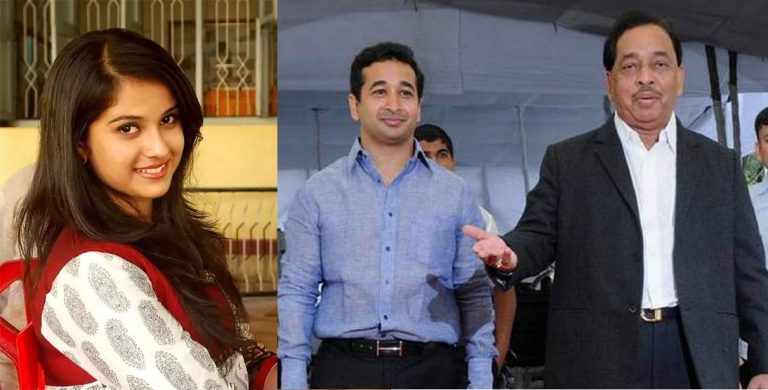
A case has been registered against BJP leader and Cabinet Minister Narayan Rane and his son Nitesh by the family of late Disha Salian, former manager of Sushant Singh Rajput. In the complaint filed in Malwani Police station in Mumbai, the Rane Father-Son duo is accused of character assassination of Disha Salian by her parents. Disha was the former manager of Sushant Singh Rajput who died under mysterious circumstances a few days before the actor’s death.
The case against Rane and his son was registered by Disha Salian’s mother under sections 500, 509 of IPC and Section 67 of the Information Technology Act. The complaint alleges that Narayan Rane and his MLA son Nitesh Rane are spreading false information about the death of Disha Salian.
Since the Sushant Singh Rajput saga erupted, BJP leader Nitesh Rane has been at the forefront to expose details linked to the case. As of the latest on February 18, 2022, Cabinet Minister Narayan Rane announced on Twitter that a ‘new enquiry’ will be taking place to prove that Sushant Singh Rajput and Disha Salian were murdered. He also reiterated that Disha Salian was gang-raped before her death, a version that is dismissed by her parents.
खासदार विनायक राऊत यांच्यासाठी खास बातमी लवकरच सुशांतसिंग व सामुदायिक बलात्कार करून तिची हत्या केली त्या दिशा सालियन या दोघांचीही आत्महत्या नव्हे हत्या झाली त्यांचीही चौकशी परत होईल एवढेच नाही तर मातोश्रीच्या चौघांवर ईडीची नोटीस तयार असल्याचे कळाले.
On the next day, Rane was seen speaking on the issue at a press conference in Mumbai. “(Disha) was forcefully invited to the party against her wish. When she tried to escape, she was asked to stay. Who was present at the party while she was being raped with Police protection? he asked. He further asked as to why so much time was taken to prepare the post-mortem report of Salian. “The visitor’s record of Disha Salian’s apartment on 8th of June was destroyed. Why is the CCTV footage of the same day not available?” he further asserted. Stating that Sushant Singh Rajput’s ‘murder’ is linked with Disha Salian’s death, Rane claimed that a new investigation will be taking place on this case.
दिशा सालियान आणि सुशांत सिंह राजपूत यांची हत्याच! दिशाच्या हत्येचा पर्दाफाश सुशांत करणार होता : केंद्रीय मंत्री श्री @MeNarayanRane जी. pic.twitter.com/0oiNPdSvSv
Following this, Mumbai Mayor Kishori Pednekar along with two members of the State Women’s Commission sought a meeting with Disha Salian’s mother on February 22. During the meeting, Disha’s mother Vasanti Salian requested that politicians should not ‘defame’ Disha Salian while she has lost her only daughter.
Taking cognizance of the allegations, Maharashtra State Women’s Commission Chief Rupali Chakankar demanded a report from Mumbai Police related to the case. As per the documents submitted by the Police, no evidence of rape was found as stated in Disha Salian’s post-mortem report. A case was then registered by Disha Salian’s parents with Mumbai Police against the Rane duo for ‘maligning the image of Disha Salian’ today.
While there are lots of controversies around the death of Disha Salian, like the death of Sushant Singh Rajput, Maharashtra police and her parents have been maintaining that she had committed suicide and there was no foul play in the matter. They are also rejecting any further probe in the matter, saying that this will only defame their daughter.
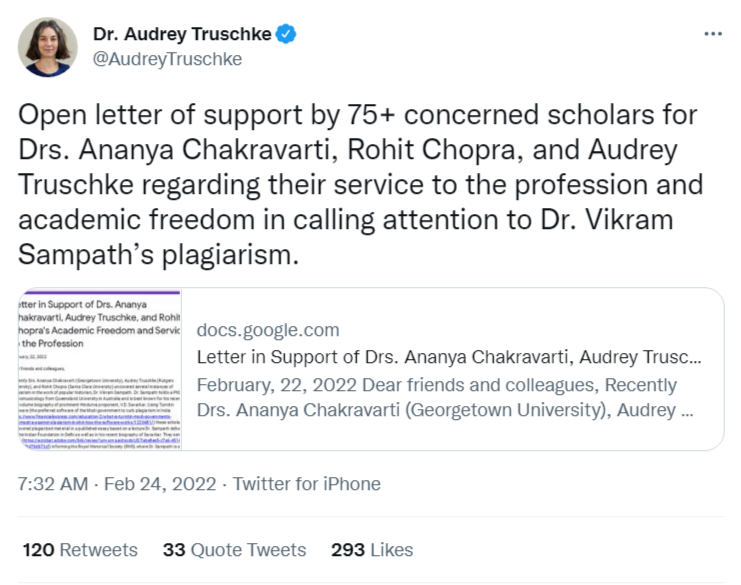
On Thursday (February 24), ‘historian’ and Rutgers’ professor Audrey Truschke took to Twitter to claim that more than 75 ‘concerned scholars’ had signed an open letter wherein they expressed their support for her and 2 other ‘historians’. She alleged that the signatories drew the attention of the academics to unfounded accusations of plagiarism against celebrated historian Vikram Sampath.
Her tweet read, “Open letter of support by 75+ concerned scholars for Drs. Ananya Chakravarti, Rohit Chopra, and Audrey Truschke regarding their service to the profession and academic freedom in calling attention to Dr Vikram Sampath’s plagiarism.”
Screengrab of the tweet by Audrey Truschke
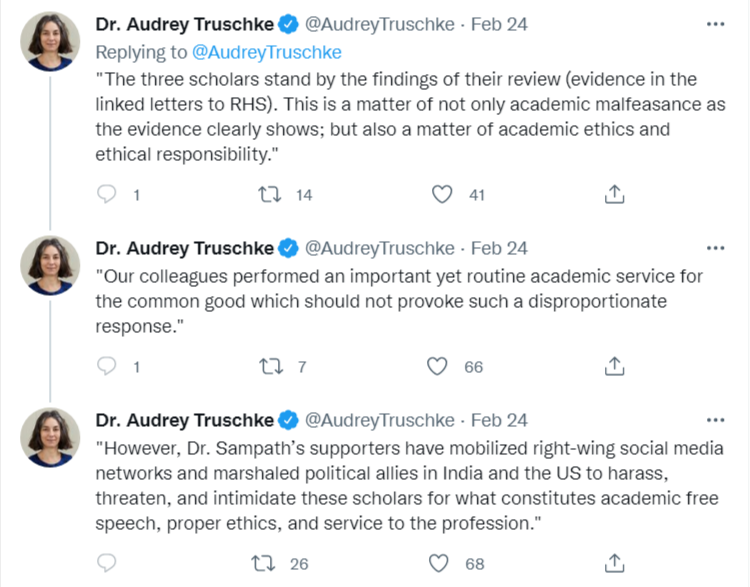
In a series of tweets, ‘historian’ Audrey Truschke quoted excerpts from the open letter. “The three scholars stand by the findings of their review (evidence in the linked letters to RHS). This is a matter of not only academic malfeasance as the evidence clearly shows; but also a matter of academic ethics and ethical responsibility,” the letter claimed.
It further added, “Our colleagues performed an important yet routine academic service for the common good which should not provoke such a disproportionate response.”
Screengrab of the tweet by Audrey Truschke
Allegedly signed by over 75 ‘concerned scholars’, the purported letter claimed that Audrey Truschke, Rohit Chopra and Ananya Chakrabarti were being intimidated by ‘right wing social media networks.’
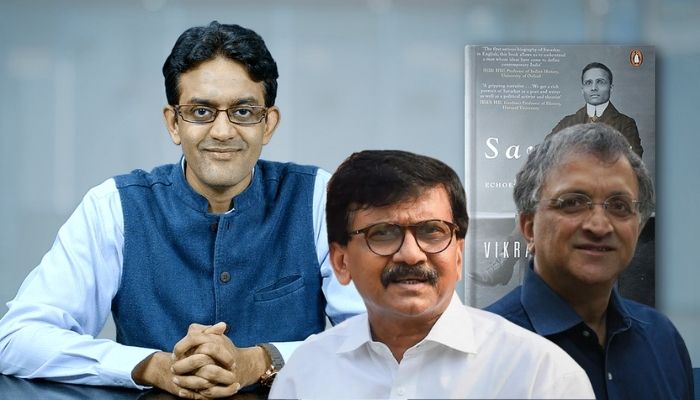
Ramachandra Guha, Sanjay Raut deny signing any letter against Vikram Sampath
Three days after Audrey Truschke posted the link of the purported letter, popular Twitter user Savitri Mumukshu pointed out that many signatories of the letter do not have any academic credibility.
In a tweet on Sunday (February 27), she wrote, “After Dr. @vikramsampath’s legal response, Audrey Truschke is panicking & eliciting support letters by concerned scholars. Great scholars Sanjay Raut & Zakir Naik have signed it. That’s real academic credibility for you!”
Prominent Shiv Sena leader and Rajya Sabha MP, Priyanka Chaturvedi, was quick to dismiss the claim that her party colleague Sanjay Raut had extended any support to Audrey Truschke. The letter referred to Raut as an academic from ‘Shiv Sena Institute.’
Senior leader Sh @rautsanjay61 ji hasn’t signed any such petition. I have spoken to him on this and he has confirmed the same .
After discussing the issue with Raut, she tweeted, “Senior leader Sanjay Raut ji hasn’t signed any such petition. I have spoken to him on this and he has confirmed the same.”
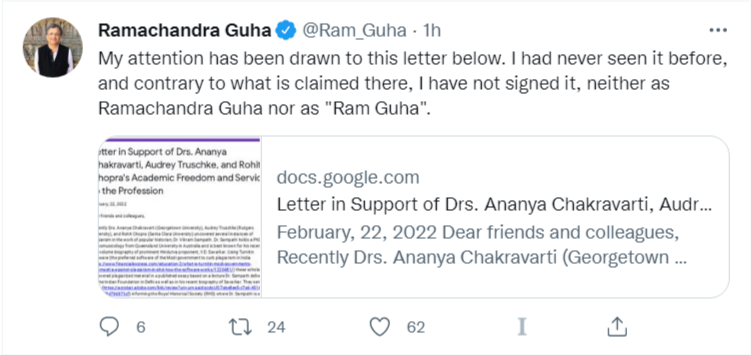
The open letter, originally shared by Audrey Truschke on her Twitter timeline, also bore the signature of ‘historian’ Ramachandra Guha. He too distanced himself from the controversy. “My attention has been drawn to this letter below. I had never seen it before, and contrary to what is claimed there, I have not signed it, neither as Ramachandra Guha nor as Ram Guha,” he tweeted.
Screengrab of the tweet by Ramachandra Guha
Interestingly, the letter also found alleged signatories in the form of fugitive hate preacher Zakir Naik (listed as an academic from Islamic Research Foundation) and Maulana Muhammad Miya (listed as an academic from Pakistan Research Repository). Shiv Sena’s Sanjay Raut’s name was sandwiched between the two ‘learned’ men.
Vikram Sampath slams nefarious agenda of Audrey Truschke
After ‘historian’ Ramachandra Guha and politician Sanjay Raut distanced themselves from the letter of support to Audrey Truschke, Vikram Sampath lashed out at the motivated lobby on Twitter.
He wrote, “Misrepresenting a politician Sanjay Raut & surreptitiously adding his signature without his knowledge along with a bunch of rabid Islamists & Pakistani organizations is “academic integrity” indeed. All the eminent signatories need to see what they’ve signed up for!”
Yet another retraction, this time from Ramachandra Guha. I leave it now to ppl to judge what sort of credibility these “academics” have, having forged ppl’s signatures! @RutgersU do u have any stds of honesty & integrity & endorse such a fraudulent person serving as ur faculty? https://t.co/CRILvfVYMPpic.twitter.com/bzC7VtZK00
Without naming Audrey Truschke, Sampath questioned her employer aka Rutgers University about its standards.
“Yet another retraction, this time from Ramachandra Guha. I leave it now to ppl to judge what sort of credibility these “academics” have, having forged ppl’s signatures! Rutgers University, do you have any standards of honesty & integrity & endorse such a fraudulent person serving as ur faculty?” he further inquired.
Delhi HC orders Audrey Truschke to take down defamatory tweets against Vikram Sampath
On Thursday (February 24), the Delhi High Court had ordered controversial historian Audrey Truschke to take down her defamatory tweets against Vikram Sampath within a period of 48 hours. The court was hearing an application by Sampath, filed against those ‘academics’ who tried to tarnish his image through baseless allegations of plagiarism.
The Delhi High Court on February 18, had passed an interim order restraining Audrey Truschke, Jo Chopra and Ananya Chakravarti from publishing defamatory online content against Sampath.
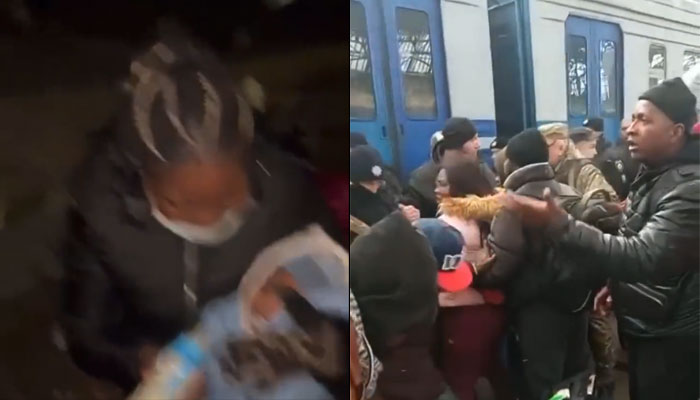
Nigerian students trying to escape war-hit Ukraine have alleged that there is racial discrimination among evacuees trying to leave the country via neighbouring countries. Journalist Stephanie Hegarty of BBC published a series of tweets explaining the ordeal of the students. She said that a Nigerian medical student told her that while she was waiting to cross the border, the Ukrainian soldiers did not allow black people to cross and sent them back. She said, “They have to let ‘Ukrainians’ through first”.
A Nigerian medical student at Poland/Ukraine border (Medyka-Shehyni) told me she has been waiting 7hrs to cross, she says border guards are stopping black people and sending them to the back of the queue, saying they have to let ‘Ukrainians’ through first.
Poland border force spokesperson had said they were allowing anyone to enter Poland from Ukraine. A similar problem was faced by Indian students stranded at the Poland-Ukraine border. Reportedly, the Indian students have not been allowed the cross the border and were told, “When your govt has not cooperated with us, why should we cooperate with you?”
A Twitter user Damilare_arah shared a video that showed African people being stopped by Ukrainians from boarding a train. He said, “The official visuals of Ukrainians blocking Africans from getting on trains.”
Another user Nzekiev said Africans were the last to be allowed to board any train. He said, “In the train stations here in Kyiv, children first, women second, white men third, then the remaining is occupied by Africans. This means that we have waited for many hours for trains here & couldn’t enter because of this. The majority of Africans are still waiting to get to Lviv.”
In the train stations here in Kyiv, children first, women second, white men third, then the remaining is occupied by Africans. This means that we have waited for many hours for trains here & couldn’t enter because of this.
Majority of Africans are still waiting to get to Lviv.
In another video, he said the Ukrainian security agencies threatened to shoot them. The Africans could be heard saying, “We do not have guns,” in the video.
Watch how they are threatening to shoot us!
We are currently at the Ukraine -Poland border. Their Police and Army refused to let Africans cross they only allow Ukrainian. Some have slept here for 2 days under this scorching cold weather, while many have gone back to Lviv. pic.twitter.com/47YG4gxFC4
Dr Ayoade Alakija, Special Envoy, ACT WHO, said in a tweet that the Black Africans were facing racism in Ukraine. She said, “Black Africans are being treated with racism and contempt in Ukraine & Poland. West cannot ask African nations to stand in solidarity with them if they cannot display basic respect for us even in a time of war. Ignored in a pandemic and left to die in war?!! UNACCEPTABLE.”
Black Africans are being treated with racism and contempt in Ukraine & Poland. West cannot ask African nations to stand in solidarity with them if they cannot display basic respect for us even in a time of war. Ignored in a pandemic and left to die in war?!! UNACCEPTABLE.
On February 24, Russia announced military action against Ukraine. Notably, Ukraine is one of the most famous destinations for students of developing nations, including Africa. There have been several social media posts suggesting Africans and people of other ethnicities are facing racial and political discrimination.