Home Blog Page 4444

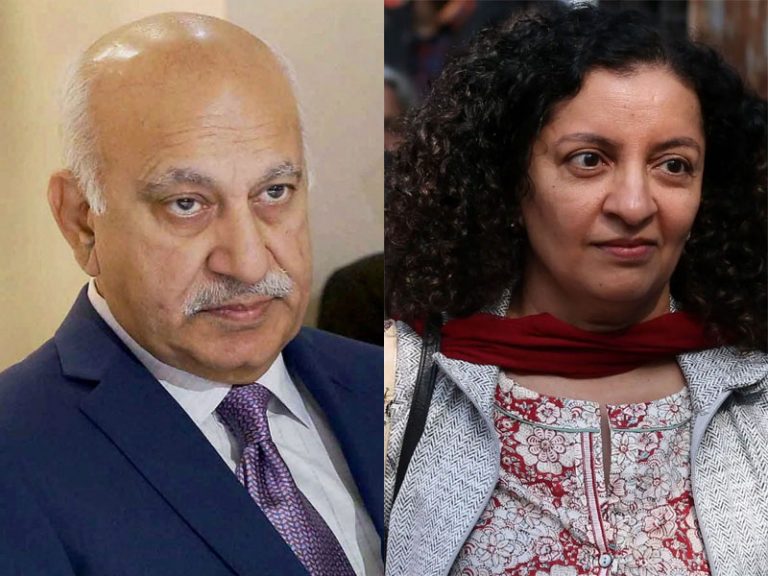
#MeToo and defamation case: MJ Akbar challenges Priya Ramani’s acquittal in Delhi High Court

Former Union Minister MJ Akbar has appealed in the Delhi High Court challenging the acquittal of journalist Priya Ramani in the defamation case. Akbar filed the case against Ramani in 2018 in connection to the sexual harassment allegations against him. The High Court will hear the matter on Thursday.

Acquittal of Priya Ramani

On February 17 this year, a Delhi Session Court had acquitted Ramani in the defamation case. During the judgment, the court observed that a man of social status could also be a sexual harasser. It further added that the woman has the right to put her grievance even after decades. Additional Chief Metropolitan Magistrate Ravindra Kumar Pandey said during delivering the judgement that sexual abuse takes away dignity and self-confidence. Thus, the right to reputation cannot be protected at the cost of the right to dignity.

The court said The society must understand the impact of sexual abuse and harassment on its victims.” It added that the defendant had the rights under Article 21 that is guaranteed under the Constitution, and she has the right to put up her case on the platform of her choice.

The case against Priya Ramani

In 2018, during the #MeToo moment, journalist Priya Ramani alleged that Akbar sexually harassed her when she was 23. Akbar, then serving as MoS, resigned from the Union Cabinet on October 17, 2018. Akbar filed a defamation case against her in 2019, to which Ramani had pleaded not guilty.

UK university faces criticism for installing £24,000 bronze statue of Swedish protestor Greta Thunberg

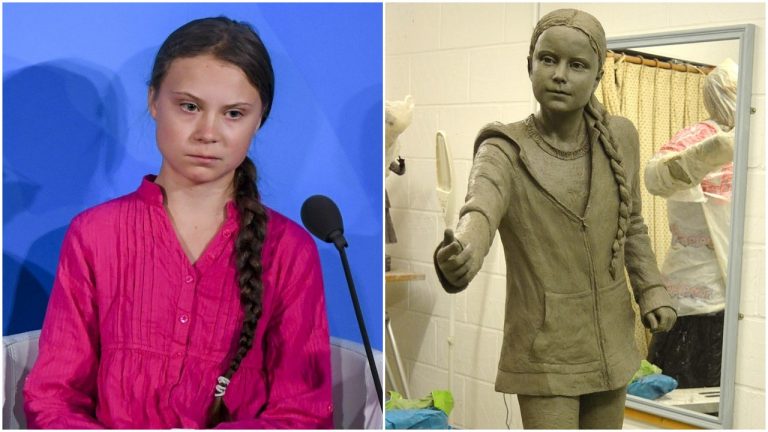
A British university is facing criticism for its plans to instal a life-sized statue of 18-year-old Swedish Andolanjeevi Greta Thunberg on its Hampshire campus. Local residents have stated that she has nothing to do with the city.

According to the reports, the Winchester University in the UK had commissioned a life-size bronze statue of the controversial ‘activist’ Greta Thunberg at the cost of £24,000. The bronze design sculpture of the alleged activist – named ‘Make a Difference’ – was commissioned by the University as an “inspiration for all students”.

The statue that was commissioned by the university in 2019 was created by British artist Christine Charlesworth. The statue is set to be unveiled on March 30.

“The university wanted a sculpture of Greta because it is a very ‘green’ university, and they feel that Greta will be an inspiration to all the students,” Charlesworth said.

The statue is the first life-sized depiction of the 18-year-old Swedish school drop-out, who gained international attention after protesting against climate change in 2018 with the help of a widespread PR campaign.

Locals, students criticise university for commissioning statue of Greta

The decision to install the statue of Greta Thunberg within the university campus has not gone well both with the locals and the students of the university.

“What a total waste of money,” local resident Simon Dixon said, according to the Hampshire Chronicle. “Total waste of money. I wonder whose bright idea that was,” he added.

Another University student Henry Osbourne said he wondered why he and others at the school were not given a vote to decide on whose statue should be installed inside the campus.

Michelle Coombs, another resident said, “I think the statue sculpture itself is very good. But Greta has no connection with Winchester, or am I wrong?” he added.

Some locals also suggested that the university could have commissioned a statue as a tribute to Kev, the local Big Issue seller, who is more popular than Greta.

Anne Goodchild said someone else who could have been immortalised in statue form, saying, “Kev the guy who sells the homeless paper, definitely a Winchester icon”. Gary Shotter said, “How about a statue of the legendary Murray Walker, a Hampshire man!”

Kev Collick is a local activist in the city who has been raising funds for children in need.

Greta Thunberg and her attempts to create chaos inside India

Last month, the so-called ‘activist’ Greta Thunberg had created a massive controversy by trying to mobilise violent protestors who have been opposing India’s farm reforms. The controversial activist had expressed her support in favour of rioters who had stormed iconic Red Fort and desecrated the Indian national flag to protest against the three farm laws passed by the democratically elected Indian government with a majority vote in the parliament.

Greta Thunberg had also accidentally released a toolkit that her supporters could use to propagate lies and misinformation about farmer protests. In a follow-up tweet, she shared a document that she called a ‘toolkit’ that can be used to understand what the protests are about and how her followers can support the cause.

The Toolkit, however, revealed how certain people, political parties, media agencies, national and international organizations and Khalistani sympathizers are using the farmer protests to propagate their agenda under a Global conspiracy against India.

Rakesh Tikait booked for provoking farmers to lay siege to Bengaluru like they did in Delhi

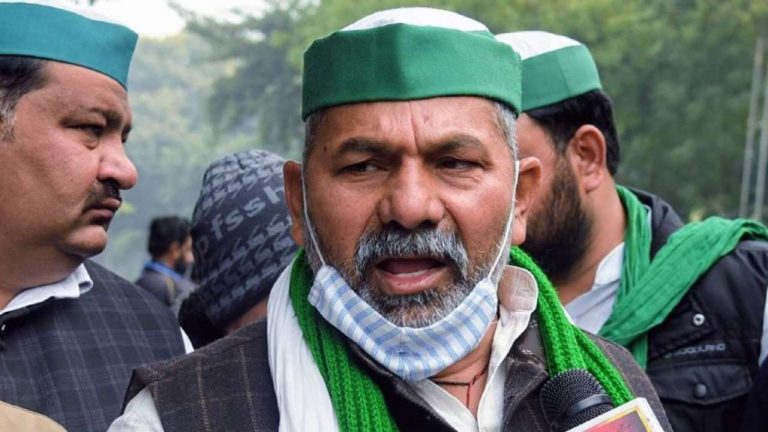
Bharatiya Kisan Union (BKU) leader Rakesh Tikait has been booked by the Karnataka police for provoking farmers during a Mahapanchayat in Shivamogga March 20 to lay siege to Bengaluru similar to what was done in Delhi. A case has reportedly been filed against Tikait at Kote police station under section 153 (wantonly giving provocation with the intent to cause riot) of the Indian Penal Code.

“An FIR was filed against Rakesh Tikait for giving a speech that could have incited violence in the state and was filed by Shivamogga police”, Shekhar HT, Assistant Superintendent of Police, Shivamogga said. Urging the farmers to intensify the agitation against the three farm laws enacted by the central government last year, Tikait asked farmers to ‘make a Delhi in Bengaluru’. “You have to make a Delhi in Bengaluru…and surround the city from all directions”, he said during the Mahapanchayat in Shivamogga. However, the organisers of the Mahapanchayat termed it an act against the principles of democracy. The organisers alleged that the BJP is suppressing the voices against the Centre.

Protestors mainly from Punjab, Haryana and parts of Uttar Pradesh have been agitating against the three farm laws at three Delhi border points- Singhu, Tikri and Ghazipur- for more than three months. They have been demanding repeal of the farm laws. Several rounds of talks between the central government and the ‘representatives’ of the ‘farmers’ have ended in deadlock with ‘farmer representatives’ being adamant on getting the laws repealed.

Delhi was engulfed in riots following a tractor rally by ‘farmers’ on Republic Day

In January, the ‘farmer representatives’ had called for a tractor rally on Republic Day to intensify the protest against the three farm laws. Despite the ‘farmer representatives’ agreeing to restrict the tractor rally to the routes approved by the police, the protestors in the rally broke barricades and entered the national capital. What followed was an unprecedented situation. The protestors barged into the red fort, insulted the tricolour hoisted religious flags atop it. Armed protestors unleashing violence on the streets of Delhi clashed with police personnel who were trying to stop them. Nearly 400 police personnel injured in the clashes with some of them being admitted to the ICU.

Several FIRs have been registered by the police in connection with the Republic Day violence and many persons have been arrested including Khalisant supporter and actor-turned activist Deep Siddhu.

One more riot? Tikait gives a call to break barricades and enter Delhi again

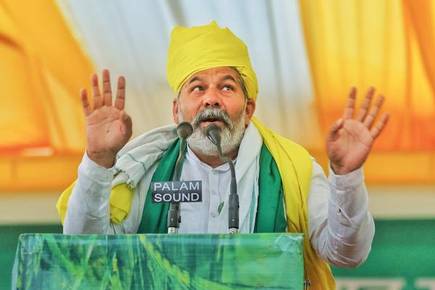
BKU leader Rakesh Tikait's Bharat Yatra seems to have one thing in common and that is a call for violence. While addressing a rally in Jaipur, Rakesh Tikait on Tuesday asked the gathering to be ready with tractors to break the barricades and enter Delhi once again. In a clear case of advocating violence, Rakesh Tikait tweeted the same through his official Twitter handle. 

“You would need to go to Delhi when asked and have to breach barricades again,” Tikait said in Jaipur while addressing the crowd. The BKU leader, confident that his rally would attract at least 1 lakh farmers, witnessed a crowd of less than 5000, as per a report in Bhaskar. Moreover, the rally was disrupted by bad weather, and one youth was injured in a mild stampede caused due to the damage of tents on the protest site. Rakesh Tikait seemed visibly upset with the number and said this will just help the Centre to implement the laws in full force. In another attempt to create chaos, Rakesh Tikait has given a call for Bharat Bandh on March 26.

Using misinformation as armor to fuel the protests, Tikait had earlier said, “we need to start such protest in every city until these three black laws are taken back and the law on MSP is not brought.” He was addressing a rally in Shivamogga, Karnataka last week. He also encouraged the farmers in Karnataka to organize a protest in the state similar to the violent rally in Delhi. He said the farmers should ‘gherao’ (surround) Bengaluru from all sides. In a tweet, he appealed to manufacture a Delhi-like violent protest that shook the entire nation on January 26, in Bengaluru.

However, the local police have registered a case under Section 153 (giving provocation with intent to cause riot) against Rakesh Tikait for inciting the crowd.

To this, he responded on Twitter saying that no case can compel him to stop his agitation and that his aim is to fight against the brute force.

Rakesh Tikait and his brother Naresh Tikait have been constantly giving calls for protests and violence through their verified Twitter accounts.

The another tweet, which was retweeted by Rakesh Tikait, asked the farmers to make protests a part of their routine.

The self-acclaimed Annadata has declared that all roads, public transport, markets, and other public spaces will remain shut on March 26 from 6 am to 6 pm as a mark of Bharat Bandh.

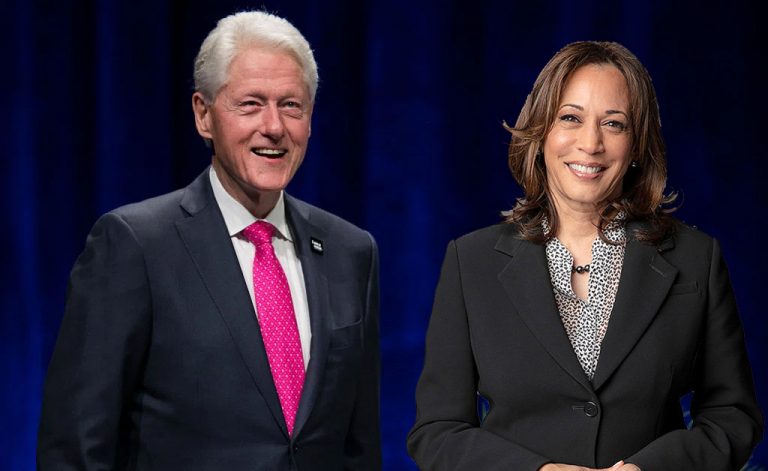
Paedophile Jeffrey Epstein’s friend and rape accused Bill Clinton to host “women empowerment” program with VP Kamala Harris

U.S. Vice President Kamala Harris and Former U.S. President Bill Clinton will be speaking together at an event on Friday organized by the Clinton Foundation. The theme of the event in question is “empowering women” in the United States and across the world.

The event in question, part of the Clinton Global Initiative (CGI), will feature the U.S. politicians focusing on the challenges women facing especially in the context of the Coronavirus pandemic, and then on how to “empower women” around the world.

It is interesting to note that Kamala Harris is scheduled to talk with Bill Clinton on women issues, despite Bill Clinton being credibly accused of sexual assault by multiple women over the years, including but not limited to sexually harassing Paula Jones, of raping Juanita Broaddrick, of sexually assaulting Kathleen Willey, and of repeatedly sexually assaulting Leslie Millwee. Clinton has denied all of these allegations.

Bill Clinton was also an associate of notorious billionaire paedophile Jeffrey Epstein and took flights with Epstein on his infamous “Lolita Express” private jet, where Epstein offered underage girls for sex. In January 2020, pictures of Bill Clinton emerged with Epstein’s “pimp” Ghislaine Maxwell and another woman described as a “sex slave” on Epstein’s aircraft. More pictures of Bill Clinton with alleged Epstein victims have emerged, including one where Clinton receives a shoulder rub from an alleged Epstein victim.

The event with Bill Clinton is hosted at Kamala Harris’s alma mater Howard University, not to be confused with the more famous Harvard University. Other speakers including former Secretary of State Hillary Clinton, Democratic activist Stacey Abrams, and American author Wes Moore.

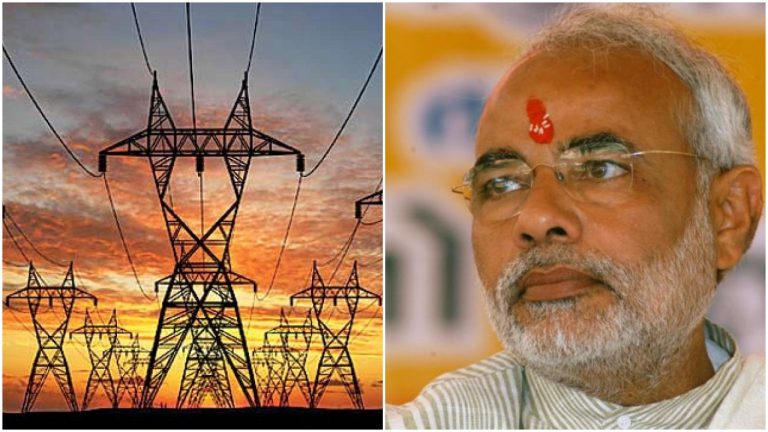
The success of Gujarat model: How Narendra Modi pioneered reforms to restructure the ailing power sector in Gujarat

In early 2000, Gujarat’s power sector was in shambles just as any other state in the country. The villages and the cities barely had access to a continued supply of electricity. A decade later, Gujarat ensured that its 18,000 villages and 9,700 hamlets had access to the round-the-clock three-phase power supply.

The fascinating turnaround story of Gujarat’s power sector over the last two decades, first under Narendra Modi and then under various other Chief Ministers, is often cited as a model for power sector reforms in the country. Today, Gujarat has more power than it needs, with low tariffs and an uninterrupted power supply.

So how did the turnaround really happen? Here is the story:

Before 2001, electricity in a rural village was a rare commodity. The state’s electricity sector was loss-making as it was riddled with extreme inefficiencies and corruption. When Narendra Damodardas Modi took over as chief minister of Gujarat in October 2001, he found the state’s power situation grim. The Gujarat State Electricity Board, or GSEB, was in deep distress with a mounting loss of over Rs.2,200 crore in 2001. The GSEB paid interest costs of about Rs 1,227 crore in the fiscal year.

In addition to that, the transmission and distribution losses were as high as 35.27 per cent, and load shedding was a frequent phenomenon. The GSEB was also suffering from a fund crunch to produce its own power, and it could not persuade the private sector to invest in the state.

Several issues, such as power generation problems, higher fuel cost, mounting losses, and loss of power to unmetered supply, had plagued the Gujarat power sector. However, in his first term as the Chief Minister, Modi took up the challenges and initiated a series of reforms to revive the state’s power sector.

Holistic reforms in Gujarat’s power sector

The then Chief Minister Modi’s first major decision was to appoint Manjula Subramaniam, a joint secretary in the prime minister’s office, as the Chairperson of GSEB and Principal Secretary, Energy and Power. Soon, the officer was authorised with full powers needed to tackle the crisis that had hit the state. Manjula Subramaniam initially concentrated on two areas: reinforcing the power utility’s finances and raising employee morale. 

At first, a debt restructuring initiative was taken up, by which banks and financial institutions were persuaded to lower their interest rates. Next, the GSEB renegotiated the power purchase agreements or PPAs signed with private players and brought down the rates for power procurement, which resulted in savings of Rs. 500 crore in the next year and another Rs.1,000 crore in the next.

Following year, the Modi government began to plug the leakages in the distribution sector by acting on power thefts in Gujarat that ranged between 20 per cent in urban areas and 70 per cent in rural regions. The government passed a law against power thefts and set up five police stations across the state to act on power thieves. The government acted strictly on firms with large pending bills, including disconnecting their supply if they failed to clear the arrears.

In rural areas, unmetered power supply was stopped altogether. As the tariff for power used for agricultural purposes was much lower, many stole from this subsidised supply for their household needs as well, resulting in huge losses for GSEB. To tackle this, the GSEB joined hands with the Asian Development Bank to fund the installing of meters.

Jyoti Gram Yojna – the flagship scheme of Gujarat government

One of the most important reforms introduced was to separate the feeder line that supplied power to the rural areas into two. The supply power for agricultural needs and non-agricultural usage for the household was differentiated. This was part of the Jyoti Gram Yojna, a scheme Modi announced in 2003 to supply round-the-clock power to villages. The success of the scheme was such that after Narendra Modi was elected as the Prime Minister, the scheme was scaled up at the national level as “Deen Dayal Upadhyaya Gram Jyoti Yojana”.

The Jyoti Gram Yojana (JGY) was launched in September 2003 to provide three-phase round-the-clock quality power to domestic and commercial users of villages and their hamlets.

Under the scheme, a parallel rural distribution network of 78,454 km of new lines, 2,257 JGY feeders, 18,724 new transformer centres and 4,530 special design transformers were set up. The JGY controlled power theft and losses, thus freeing the distribution companies from suffering major financial losses. The financial health of these Discoms became better year-after-year.

Continuing, in May 2003, the Gujarat government also passed the Gujarat Electricity Industry (Reform and Reorganisation) Act, which divided the GSEB into a holding company, a power generation company, a power transmission company and four distribution companies to bring better management and efficient operations.

Thinking ahead of its time, the Modi government had also set up a state electricity regulator – a first in the country. The regulator was made truly independent of political pressures, thus giving them the freedom to revise power tariffs every year to avoid any losses to the exchequer.

Another lowkey reform, but that had a tangible outcome on the restructuring of the state’s power sector was restoring the employees’ confidence. Manjula Subramaniam was tasked to understand the concerns of many employees, who had feared for their job loss due to the widespread reforms. The GSEB reached out to the employees and started training programmes at all levels to skill them for redeployment. The state government ensured that no one was laid off. The success was evident within weeks, as now employees took more interest in reforms, and they themselves began to implement the necessary reforms.  

The several reforms initiated by the Modi Government to re-configure the power state in the state created wonders. The losses were stopped, and efficient usage of electricity without any leakages was made the norm. The major upgradations and clear cut policies pertaining to the power sector also boosted investor confidence, who were ready to bring in private capital for power generation.

Within three years, the massive power sector reforms undertaken by the state Government yielded results, making Gujarat into a power surplus state by 2003. The erstwhile GSEB, which has now been rebranded as Gujarat Urja Vikas Nigam Ltd (GUVNL), had posted a loss of Rs. 2,246 crores in 2000-01, on revenue of Rs. 6,280 crores. In 2019, GUVNL posted a profit of Rs.928 crore on total revenue of Rs 50,959 crore.

If one takes a closer look at the necessary reforms initiated by Gujarat, especially in the areas of capacity addition, restructuring power distribution companies – reveals how the leadership took breathtaking reforms to make a power deficit to a surplus state within a decade.

Several states have initiated such reforms in the past few years to improve their power generation capacities and Discoms by replicating the Gujarat story. However, not all states have achieved major success. As Prime Minister Modi took the reigns of Delhi in 2014, he introduced holistic reforms to restructure the power sector across the country. As Electricity is a concurrent subject, states too have equal responsibility to carry out such reforms that the centre has incentivised. There has been a slight improvement in the power sector in the country, however, much needs to be done.


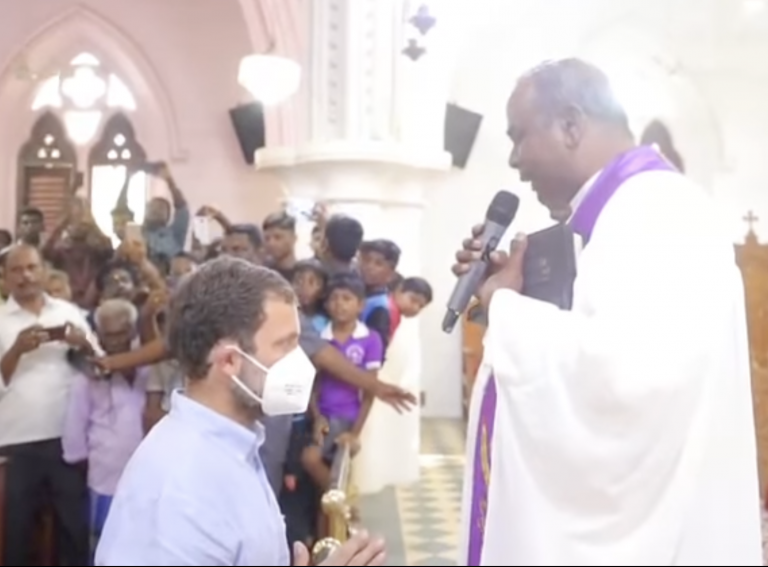
Rahul Gandhi condemns ‘attack’ on Kerala nuns in UP, here is what he said on rape of nuns in Kerala churches and Palghar lynching

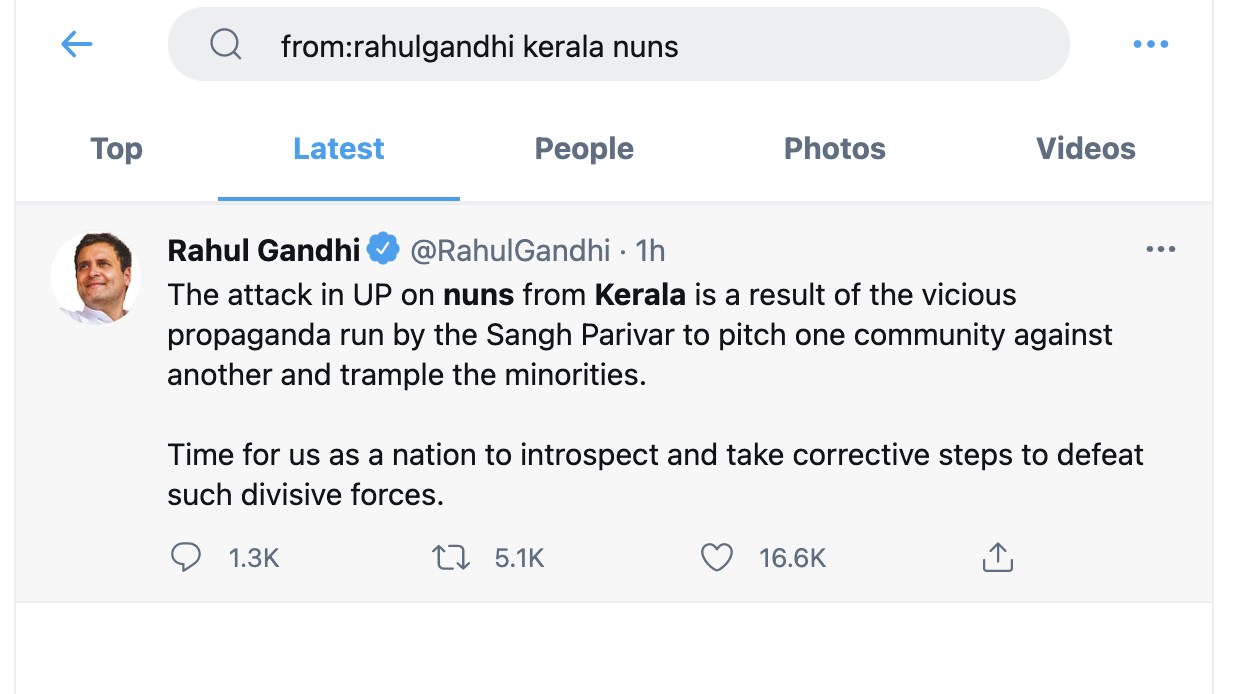
In a tweet posted today, Congress leader Rahul Gandhi condemned the ‘attack’ of Kerala nuns allegedly by Bajrang Dal activists in a train near Jhansi, Uttar Pradesh.Rahul Gandhi attributed the harassment to “vicious propaganda run by the Sangh Parivar”.

The ‘attack’ Rahul Gandhi is talking about is questioning of the two nuns over suspicion of forceful religious conversion. The incident happened in Jhansi. The railway police authorities questioned them and upon finding no basis for the complaint, they were let off. The incident took place on March 19. However, senior Congress leader chose to express his concern only after five days and that too after Home Minister Amit Shah had already assured action against the culprits who allegedly harassed the nuns.

Any kind of harassment is indeed condemnable and Rahul Gandhi’s concerns are appreciated. He has earlier expressed concerns for the nuns who were raped by priests and bishops in Kerala church as well. As can be seen through his series of tweets on Kerala nuns.

Rahul Gandhi’s concerns on crimes perpetrated against nuns in Kerala.

Whilst there are umpteen cases of Kerala nuns being sexually abused, the heinous case of Father Franco Mulakkal, largely because of the Church’s systematic role in trying to suppress the nuns from speaking out.

Bishop Franco Mulakkal, Archdiocese of Jalandhar, Punjab, was arrested by the police officials on September 21st, 2018 after the investigating team found evidence that linked him in the sexual harassment case. A nun from Kerala had accused a Bishop from Jalandhar of raping her. The accused, Franco Mulakkal, Bishop of the Roman Catholic Diocese of Jalandhar, is said to have raped her at a guest house in Kuravilangad in May 2014 and exploited her sexually on several other occasions.

On 16th  January 2019, four out of the five nuns who had supported the rape survivor nun were asked to leave the Kuravilangad convent, and go to convents, previously assigned to them. The letter accused nuns of  ‘issuing malafide statements’, and spreading baseless stories to ‘tarnish the image’ of the Missionaries of Jesus congregation. Sister Anupama, one of the four nuns served transfer notice, had slammed the notice and alleged that this is a ploy to break a unity of nuns to save Bishop Franco, who is facing rape allegations from one of their colleagues.

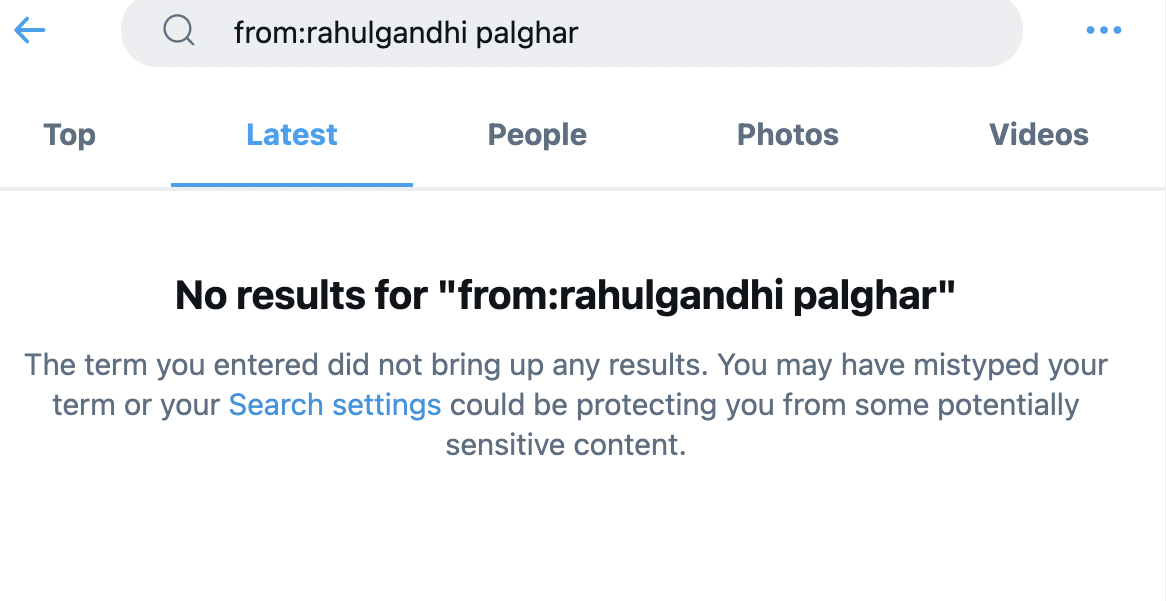
Rahul Gandhi has similarly expressed concerns over the sadhus from Palghar, Maharashtra, who were lynched to death last year even as Maharashtra police officials watched as they were killed.

Rahul Gandhi’s tweets on Palghar lynching

The concern of Congress leaders was so much that when Republic TV’s Arnab Goswami questioned Congress president Sonia Gandhi’s silence over the same, he was hounded by the Mumbai Police and accused him of making ‘communal comments’. Congress is part of the ruling alliance, Maha Vikas Aghadi, in Maharashtra along with NCP and Shiv Sena.

West Bengal Election Opinion Polls: Mamata Banerjee may lose Nandigram, BJP projected to form the government

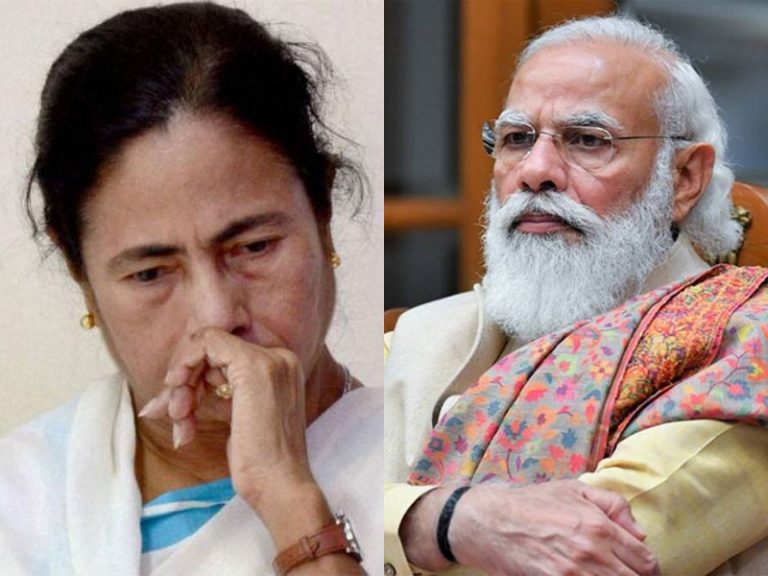
West Bengal is all set to cast its vote for 294 assembly seats in eight phases spread between March 27 and April 29. If the numbers are to be believed in the recent opinion polls by different agencies, Mamata Banerjee’s Trinamool Congress will face a major setback. The WB elections are expected to put a big smile on the faces of BJP supporters in the state. On the other hand, the grand alliance between Congress, ISF and the Left is not expected to grab any major vote share.

India News-Jan Ki Baat Opinion Poll

On March 23, India News and Jan Ki Baat released their opinion poll for the upcoming West Bengal elections. The survey was conducted by a team of 300 field researchers and analysts led by psephologist Pradeep Bhandari. The sample size of the survey was over 40,000. One of the biggest points that the opinion poll made was a possible setback for Mamata Banerjee in Nandigram.

As per the survey, BJP will get approx 44.8% vote share while TMC will get 44.10 vote share. Grand Alliance and others will get 7.5% and 3% vote share respectively.

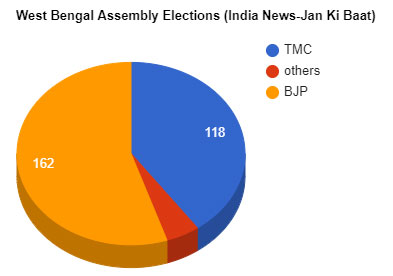
As per the survey, TMC will come down to 134-118 seats from 211 seats in the 2016 assembly elections. On the other hand, BJP, which was at three seats in the last elections, may win anywhere between 150-162 seats in the state. The grand alliance will have to be satisfied with 10-14 seats.

Projected seat share in West Bengal

Talking about the polls in West Bengal, Jan Ki Baat founder Pradeep Bhandari told OpIndia, “There is anti TMC sentiment in Bengal because of corruption, political violence and appeasement that I observed with my team in our 294 constituency travel. If voting happens in free and fair manner, BJP will form govt, and Mamata Banerjee may also lose Nandigram”.

ABP-CNX opinion poll

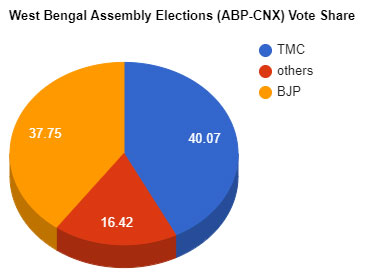
The ABP-CNX opinion polls were released on March 23. According to the survey, TMC and BJP will lock horns in the assembly elections as it will be a tough battle. Their survey showed 42.05% of voters inclined towards TMC while 43.61 voters had preferred BJP. The grand alliance will get close to a 6.74% vote share.

Vote Share prediction according to ABP-CNX survey

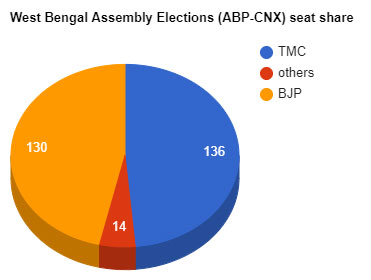
Coming to the seat share, TMC may win anywhere between 136-146 seats, while BJP may grab 130-140 seats. It has to be noted that it is a major jump for BJP from three seats in the previous assembly elections.

Seat share prediction according to ABP-CNX survey

The opinion polls make it clear that the two parties that are in the actual race to form government in West Bengal are BJP and TMC. Other parties that have formed the grand alliance stand nowhere in the contest.

ABP-CVoter opinion poll

ABP commissioned another opinion poll with CVoter, a snap poll, and it came up with significantly different results. According to this poll, TMC is set to remain the single largest party in West Bengal, despite BJP making significant gains in the state.

As per the snap poll by CVoter, TMC is set to win 160 seats, down from 211 last year. BJP has been projected to win 112 seats, while the Congress alliance may win 22 seats. The vote shares for TMC, BJP and the grand alliance have been projected as 42.1%, 37.4% and 13.0%.

Competition Commission of India orders probe into new privacy policy of WhatsApp, says it is ‘abuse of dominance’

The Competition Commission of India has ordered a probe into the new privacy policy of WhatsApp, which had raised concerns about data privacy and security risk. The CCI ordered the probe after finding that the new policy violates the Competition Act, 2000.

The CCI observed that the privacy policy terms on sharing of personalised data with other Facebook-owned companies was “neither fully transparent nor based on specific, voluntary consent of users”. The order issued by the CCI said that “WhatsApp has prima facie contravened the provisions of Section 4 of the Act through its exploitative and exclusionary conduct, in the garb of policy update”.

Section 4 of the Competition Act forbids abuse of dominance by an entity commanding dominant position in relevant market. According to the CCI, WhatsApp is in the dominant position in the messaging App market for smartphones in India.

The Commission has directed the Director General to initiate a probe against the company under the provisions of Section 26(1) of the Competition Act. The Commission has asked the DG to complete the probe and submit the report with 60 days.

On a careful and thoughtful consideration of the matter, the conduct of WhatsApp in sharing of users’ personalised data with other Facebook Companies, in a manner that is neither fully transparent nor based on voluntary and specific user consent, appears prima facie unfair to users. The purpose of such sharing appears to be beyond users’ reasonable and legitimate expectations regarding quality, security and other relevant aspects of the service for which they register on WhatsApp,” the CCI order said. It further added that “one of the stated purposes of data sharing viz. targeted ad offerings on other Facebook products rather indicates the intended use being that of building user profiles through cross-linking of data collected across services. Such data concentration may itself raise competition concerns where it is perceived as a competitive advantage.”

Competition Commission of India observed that prima facie these acts by WhatsApp violates the Section 4 of the Competition Act. “The impugned conduct of data-sharing by WhatsApp with Facebook apparently amounts to degradation of non-price parameters of competition viz. quality which result in objective detriment to consumers, without any acceptable justification. Such conduct prima facie amounts to imposition of unfair terms and conditions upon the users of WhatsApp messaging app, in violation of the provisions of Section 4(2)(a)(i) of the Act”, the commission said.

The CCI has overserved that the terms and conditions set up by the messaging platform is “unfair and unreasonable”, as it does not give the users much information and forces the users to accept the new rules, without which the users can’t use the service. It said that such “consent” can’t be considered as voluntary agreement for use of their personal data. The CCI said that the users have not been provided with appropriate granular choice to to object to or opt-out of specific data sharing terms, which prima facie appear to be unfair and unreasonable for the WhatsApp users.

The CCI observed that “a thorough and detailed investigation is required to ascertain the full extent, scope and impact of data sharing through involuntary consent of users”. The order was issued by a CCI bench comprising Chairperson Ashok Kumar Gupta and members Sangeeta Verma and Bhagwant Singh Bishnoi.

The union government has also opposed the new policy of WhatsApp. The Ministry of Electronics and Information Technology approached the Delhi High Court on Friday to restrain WhatsApp from rolling out its new privacy policy. The ministry has said that the WhatsApp privacy policies do not align with appropriate standards of security and data protection, and the company must be stopped from implementing the same.

The new policy and terms of service of the Facebook-owned messaging platform are to take effect from May 15, after it was postponed earlier following massive outrage against it. Earlier it was to be implemented from February 8. The new policy makes it mandatory for users of WhatsApp to share their data with its parent company Facebook. The company has not provided an opt-out option, means the users have to agree to the new policy if the want to continue using the service. This means, after May 15, users who don’t click agree on the new policies will not be able to use WhatsApp.

Update: WhatsApp reached out to OpIndia after the publication of this report, saying that they look forward to engaging with CCI. A statement sent by a WhatsApp spokesperson said, “We look forward to engaging with the CCI. WhatsApp remains committed to protecting people’s personal communications with end-to-end encryption and providing transparency about how these new optional business features work.”

Maharashtra and Punjab witness massive surge in COVID-19 cases, Centre expresses ‘grave concern’

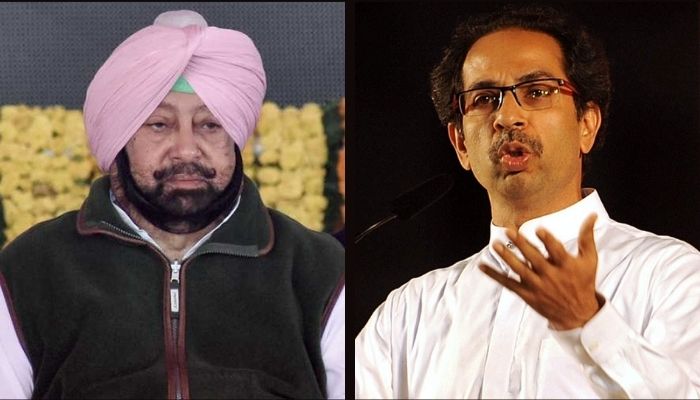
On Wednesday, the Union Health Ministry expressed ‘grave concern’ over the rising cases of COVID-19 in the Congress-ruled states of Maharashtra and Punjab.

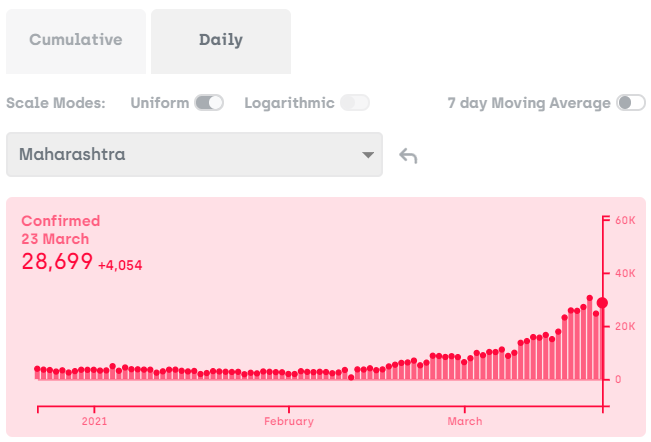
In a statement, Health Secretary Rajesh Bhushan said, “Two states are of grave concern, that has shown a recent surge in cases – Maharashtra, that reported more than 28,000 cases in the last 24 hours and Punjab, that is reporting a huge number of cases in proportion to its population.”

It is important to note that Maharastra accounts for a total of 9 out of 10 districts, which have reported the highest number of COVID-19 cases. They include Nagpur, Mumbai, Pune, Thane, Nashik, Aurangabad, Nanded, Jalgaon and Akola. As of March 23, Maharashtra has 2,30,641 active cases while the total confirmed cases stand at 25,33,026. The city of Pune has reported 4.81 lakh cases so far while Mumbai has accounted for 3,69,451 confirmed cases.

Screengrab of the confirmed Coronavirus cases as of March 23, graph via https://www.covid19india.org/

The State of Maharashtra has witnessed 53,589 cases. Between March 16 and March 23, the number of new cases has grown by an average of 1.1% every day. It must be pointed out that for every 100 confirmed cases, approximately 2 people have succumbed to the Coronavirus infection.

Rising Coronavirus cases in Punjab

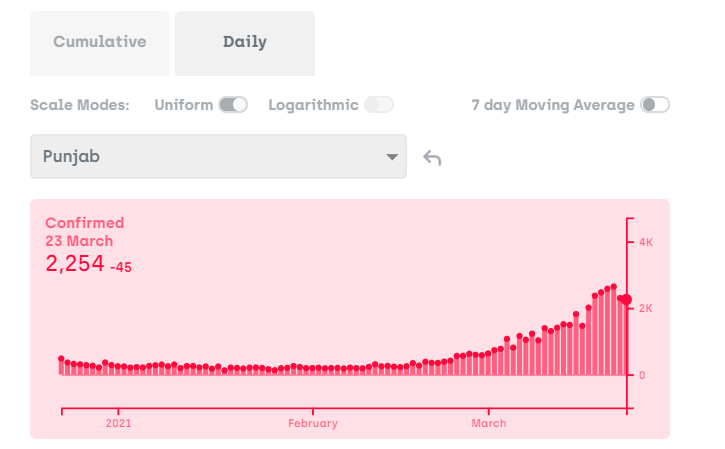
With a population of about 3 crores, the State of Punjab has reported 2,17,663 confirmed cases of Coronavirus infection. As of March 23, the Congress-ruled State has reported 19,403 active cases and a total of 6,435 fatalities. On Tuesday alone, Punjab accounted for a whopping 59 deaths due to the Wuhan virus. In light of the state of the pandemic in Punjab, the Union Ministry of Health has expressed grave concerns. It has emphasised that the cases in the State are increasing, disproportionate to its population.

Screengrab of the confirmed Coronavirus cases as of March 23, graph via https://www.covid19india.org/

Coronavirus variants and its impact on India

The Union Health Ministry informed that 88% of people dying due to Coronavirus in India fall in the age group of 45 years and above. Dr SK Singh, the Director of the National Centre for Disease Control (NCDC), had informed that a total of 771 cases of Coronavirus variants have been identified in a total of 18 States. The majority of them include the UK variant (736 cases) while the South African and Brazilian variant accounts for 34 and 1 case respectively.

The Union Home Ministry however clarified that the Coronavirus variants are not responsible for a sudden spike in the number of cases in certain States. “Though VOCs and a new double mutant variant have been found in India, these have not been detected in numbers sufficient to either establish a direct relationship or explain the rapid increase in cases in some states,” it added.