Home Blog Page 4452

Congress party fields Bindhu Krishna – the organiser of anti-Hindu ‘beef festival’ from Kollam

Ahead of the 2021 assembly election, the Congress party has fielded a party leader who had organised controversial anti-Hindu ‘Beef festivals’ across Kerala in 2017.

The Congress party has fielded one of their party leaders – Bindhu Krishna, from the Kollam constituency as the joint UDF candidate.

In the list of 86 candidates that was released by the Congress party ahead of the Kerala Assembly elections, Bindhu Krishna, who was instrumental in organising anti-Hindu beef festivals in Kerala to provoke Hindus, was named as the party candidate from Kollam in the 2021 Kerala elections.
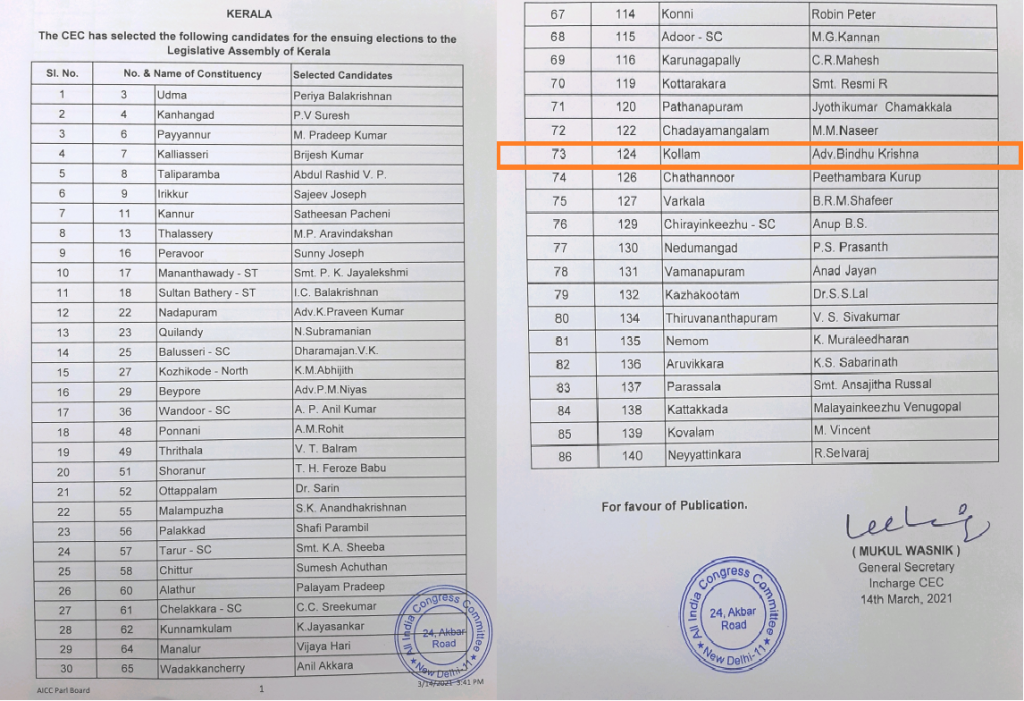
Candidate List of Congress for Kerala Assembly Elections 2021

It is worth mentioning that Congress leader Bindhu Krishna, who is also the District unit chief of Congress party in Kollam was the face of Beef festivals that were organised across Kerala to protest the Centre’s ban on the sale and slaughter of cattle. Led by Bindhu Krishna, the Congress party workers cooked beef in front of the DCC office.

Indulging in the shameful act, the Congress leader Bindhu Krishna had claimed that the Modi government had no right to interfere with people’s livelihood. “This is nothing but an intrusion into the fundamental rights of the citizens of this country,” she had said.

Not just that, the Congress leader from Kollam had organised a similar protest against the centre and indulged in the provocative act yet again in 2018. Brazening it out, Bindu Krishna had claimed that the “beef delicacy would be packed and sent to head post office for delivery to Modi Ji.”

Not just Bindhu Krishna for 2021 Kerala Assembly elections, Congress party has a penchant for anti-Hindu politics

It is no surprise that the Congress party has openly fielded candidates who have often shared anti-Hindu hatred in the past. It is pertinent to note that the Congress party is in alliance with Indian Union Muslim League (IUML) for the 2021 Kerala assembly elections. Indian Union Muslim League (IUML), which claims to be born after Indian Independence in 1948, is actually an off-shoot of Pakistan founder and Islamist Mohammad Ali Jinnah’s All India Muslim League (AIML). 

The Indian Union Muslim League has been notoriously known for flaring up communal incidents in the state of Kerala. The party was found involved in the planning as well as the execution of the brutal Marad massacre in Kerala in 2003 as per the report of Justice Thomas P Joseph Commission which was set up to investigate the incident. The report had declared the massacre as “a clear communal conspiracy, with Muslim fundamentalist and terrorist organisations involved”.

Further, in 2017, the Central Bureau of Investigation (CBI) had registered a fresh First Information Report (FIR) in connection with the probe and had named Indian Union Muslim League leaders P.P. Moideen Koya and Moyeen Haji as an accused of funding, conspiring and executing the riots.

The victory of Rahul Gandhi in the 2019 Lok Sabha elections in Wayanad Lok Sabha constituency is largely attributed to the alliance of Congress party with the IUML, who consolidated Muslim votes in favour of the Gandhi-scion.
Harappan people ate multigrain “laddoos”, used them in rituals on the banks of River Saraswati, says new ASI study

0

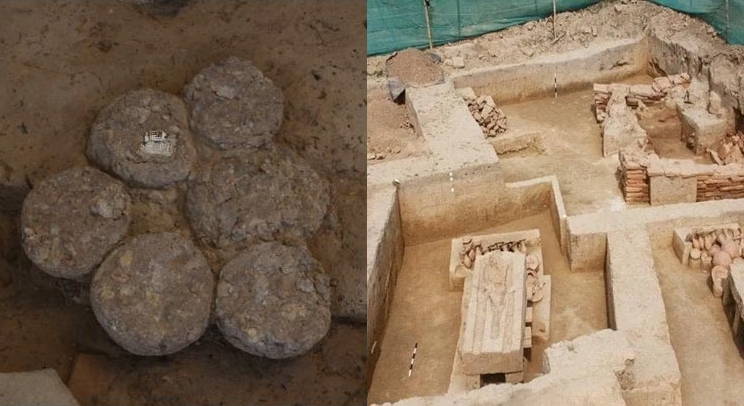
According to a new scientific study of material found at a Harappan site, 4MSR Bijnore, in Rajasthan, the Harappan people used to consume high-protein multigrain “laddoos” around 4,000 years ago. The study was jointly conducted by the Birbal Sahni Institute of Palaeosciences (BSIP), Lucknow, and Archaeological Survey of India (ASI), New Delhi, and published in the ‘Journal of Archaeological Science: Reports’ by Elsevier, a world-renowned publisher of science information. The study also points to these “laddoos” being a part of some sort of ritual on the banks of the now-extinct River Saraswati.

A scientist working for BSIP, Rajesh Agnihotri, said, “Seven similar big-size brown ‘laddoos’, two figurines of bulls and a hand-held copper adze (a tool similar to an axe, used for cutting or shaping wood) were excavated by the ASI at the Harappan site in Anupgarh district of Rajasthan.”

“These laddoos, dating back to around 2600 BCE, were found well preserved since a hard structure had fallen in such a manner that it acted as a roof over them and prevented them from getting crushed. Had they been broken, the ‘laddoos’ would have decayed entirely but since these were in contact with the mud, some of the internal organic matter and other green constituents remained protected.” the scientist added.

According to the scientist, the most peculiar aspect about the “laddoos” was the purple slurry it formed through coming in contact with water.

The “laddoo” samples were excavated by the ASI in 2017 and were given to the BSIP for scientific analysis. The BSIP scientist Rajesh Agnihotri explains further, “At first, we thought that these laddoos, excavated near the banks of Ghaggar (erstwhile Saraswati), had some connection with occult activities since figurines and adze were also found in close proximity. We were intrigued by their shape and size as they were clearly man-made. This curiosity led us to explore their composition. We initially presumed it could be a non-vegetarian food.”

However, an analysis by senior BSIP scientist Anjum Farooqui revealed that the “laddoos” were composed of barley, wheat, chickpea, and a few other oilseeds. “These laddoos had cereal and pulses, and moong dal dominated the ingredients,” added Anjum Farooqui. As the Harappans were agriculturists, the high-protein multigrain composition of these “laddoos” makes sense.

A team of consisting of nine scientists from both the BSIP and the ASI concluded that the presence of seven laddoos along with typical Harappan tools/items hinted that Harappan people made offerings, performed rituals and consumed multi-nutritive compact ‘laddoos’ as a food supplement for instant nutrition.

The scientist team further concludes that the presence of bull figurines, adze and a Harappan seal in the vicinity of these seven food balls signifies that humans revered all these items due to their utility and importance to them.

Use of the “laddoos” in rituals on the banks of the River Saraswati

The archaeological discovery of the “laddoos” in concert with figurines of bulls and copper adze gives rise to the suggestion that the Harappan people used these instruments for the purpose of performing rituals.

According to the Director (Excavations) of the ASI, Sanjay Mujul, these “laddoos” are a milestone discovery. “After the scientific study, we can say that this is the first evidence to show that Harappan people performed some rituals on the banks of river Saraswati (now extinct). Though the nature of the ritual is not clear, it could be akin to ‘pind daan’ (offering of homage and food to ancestors).”

“When we found the food balls at 4MSR Bijnor, it appeared to be a site where rituals were performed. We found terracotta bulls, painted pots, bones, and adze from there,” Manjul added.

Jammu and Kashmir police opposes passport renewal of PDP chief Mehbooba Mufti citing an ‘adverse report’ by CID

0

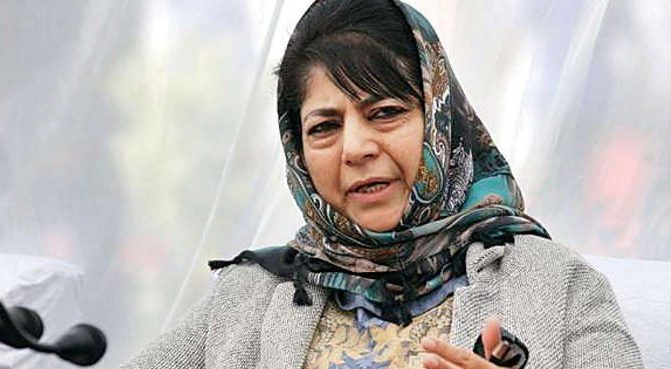
The Jammu and Kashmir police have opposed the issuance of a passport to PDP chief Mehbooba Mufti citing an “adverse report” filed against her by the Criminal Investigation Department (CID). The police submitted a report to the Jammu and Kashmir HC in which it mentioned the CID’s report, describing the former CM in a negative light.

The Jammu and Kashmir High Court is hearing a petition filed by Mehbooba over the delay in clearing her passport application.

Mufti had applied for a fresh passport on December 11 last year after the previous one expired on May 31, but the application has not been cleared till date. According to reports, the Jammu and Kashmir police have withheld the police verification report because of which the new passport has not yet been issued to the PDP chief.

Speaking about the issue, Police officials said that “an adverse report” has been filed against her by the Criminal Investigation Department (CID), but refused to elaborate saying the matter would be taken up before the high court.

Mehbooba’s counsel submitted to the court that according to instructions issued by the Ministry of External Affairs, the passport of an individual is to be issued within 30 days but in Mufti’s case, despite lapse of three months, passport has not been issued due to the pending police verification.

Last month the PDP chief had gone hammer and tongs against CID for keeping her close aide and party’s youth wing president, Waheed Para, in “inhuman conditions” and accused the department of implicating him in a “fraudulent and politically motivated” case.

Responding to the allegations, Jammu and Kashmir Police, without naming Mehbooba, said that the comments with regard to CID’s investigations made on social media were “unfortunate” and increased the risk of “adversely influencing witnesses”.

Para has been in the custody of Counter Intelligence (Kashmir) at Srinagar since January 9, the same day that he was granted bail in a separate case filed by the NIA.

Yesterday, the NIA revealed that the arrested Peoples Democratic Party leader and Mehbooba Mufti’s close aide Waheed Ur Rehman Para ran a “stone-pelting” racket and smuggled weapons for terrorists in South Kashmir. The NIA said that Waheed-ur-Rehman Para misused his position and government machinery to smuggle AK-47 Rifles and ammunition by using his official vehicle.

On October 13 last year, the Peoples Democratic Party (PDP) Chief Mehbooba Mufti was released from detention. She was detained with several other political leaders from Jammu and Kashmir on August 2019 when Home Minister Amit Shah announced the abrogation of Article 370.

Karnataka High Court dismisses FIR against Kangana Ranaut over her tweets on farmer protests

Karnataka High Court on Thursday quashed an FIR registered against actor Kangana Ranaut for her Tweets on the farmer protests. A single bench of Justice HP Sandesh was hearing the petition against the order passed by Judicial Magistrate First Class, Tumkur Vinod Balnaik on the complaint of Advocate Ramesh Naik. Naik had sought FIR against the actor for the offences under Sections 153A, 504, 108 of the Indian Penal Code for her tweets posted on September 20th, 2020, regarding the farmer protests.

While setting aside the order, Justice HP Sandesh observed that Magistrate Tumkur Vinod Balnaik acted mechanically, without examining if the offences are cognizable in nature. Saying so, Justice HP Sandesh remitted back the matter to the Magistrate for fresh consideration.

On October 9, 2020, the Judicial Magistrate First Class, had directed the jurisdictional Police Station (Kyathasandra) to lodge an FIR against actress Kangana Ranaut for her tweet on the recent farmer protests.

The complainant had alleged that the Tweet posted by Ranaut has a clear intention to injure the people who are opposing the Farm Bills. It was further alleged by the complainant that the Tweet gives provocation with the intention to cause riots and promote the culture of non-violence in the young minds of society. The complainant had also questioned the government for not taking action on it and said that the government was waiting for some dangerous consequences before taking appropriate action. It was argued by the complainant that if such content was allowed, incalculable and irreparable damage will be caused to the farmers of the country.

Earlier this month, the Queen actor had moved the Karnataka High Court seeking to quash the FIR registered against her for her tweet on farmers opposing the farm laws.

Tweet by Kangana Ranaut

Calling out the people spreading misinformation about the Farm laws, Kangana Ranaut had posted a tweet on September 20. Comparing the farmer protests with the anti-CAA protests, the actress had called the people misleading the farmers as “terrorists”.

Antilia bomb scare case: NIA custody of Sachin Vaze extended till April 3, Vaze claims he is being made a scapegoat

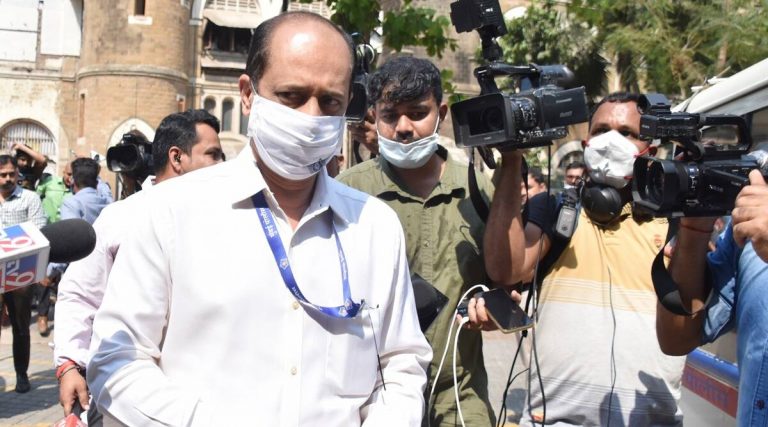
Special NIA court today extended suspended cop Sachin Vaze’s custody till April 3, 2021, with connection to his role in the Antilia bomb scare case. During the hearing, the counsel for NIA informed the court that the accused has destroyed 7 to 8 crucial Digital Video Recorders and had stayed in a 5-star hotel days before the incident using a fake Aadhaar card, reported Republic.

ASG Anil Singh who appeared for NIA to seek Vaze’s extended custody for an additional 15 days citing his non-cooperation, said that 62 unaccounted bullets have been recovered from Sachin Vaze’s residence during the investigation. He added, 25 of the 30 bullets officially allotted to him are missing.

NIA also told the court that a businessman had paid approximately Rs.12 lakh to book a room for in a five-star hotel for Sachin Vaze stayed for 100 days. Vaze had stayed in the hotel before the incidence using fake identity card.

Vaze however claimed that he is nothing but a scapegoat in the case.

His lawyer, Abad Ponda argued that, “NIA has to satisfy the court on invoking sections of UAPA in this case.” He further pleaded that his actions were simply what was expected out of him as an investigative officer.

The Thane Court had ordered Maharashtra ATS to immediately stop investigations and hand over the case and all the related documents to NIA.

The significance of spitting in Islam: How spitting can ‘ward off Satan’

In today’s world, spitting is considered an unclean and unhygienic act. There are laws against spitting in public places in many countries around the world carrying huge fines, especially Singapore, where the monetary fine for spitting can go up to $1000. Especially in the post-Coronavirus world, where spitting can also be a vector for the spread of COVID-19, the act of spitting, especially in public places, is looked down upon throughout the world. However, in Islam, spitting carries a special meaning, especially, to ward off the ‘evil spirit’ or ‘Satan’.

According to various Hadiths, spitting in a particular manner can ward off bad dreams and even the interference of Satan (Shaitaan) himself. According to Sahih al-Bukhari, Volume 4, Book 54, Number 513, spitting to your left is a way to be safe from bad dreams. It says that the Prophet of Islam said that “A good dream is from Allah, and a bad or evil dream is from Satan; so if anyone of you has a bad dream of which he gets afraid, he should spit on his left side and should seek Refuge with Allah from its evil, for then it will not harm him.”

This also gets credence in Sahih Muslim, Book 026, Number 5463 which says that spitting to your left three times stops the interference of Satan.

Uthman b. Abu al-‘As reported that he came to Allah’s Messenger and said: Allah’s Messenger, the Satan intervenes between me and my prayer and my reciting of the Qur’an and he confounds me. Thereupon Allah’s Messenger (may peace be upon him) said: That is (the doing of the Satan) who is known as Khinzab, and when you perceive its effect, seek refuge with Allah from it and spit three times to your left. I did that and Allah dispelled that from me.

In many cultures around the world, spitting on someone else is seen as the sign of ultimate disrespect. A person spitting on somebody else is usually reason enough for a brawl or physical fistfight to take place. However, in Islam, this is not the case. There are multiple references to Prophet Muhammad spitting on people in order to bless them.

These references are listed below:

1. Narrated Mahmud bin Ar-Rabi’: I remember Allah’s Apostle and also the mouthful of water which he took from a bucket in our house and ejected (on me). … (Sahih Bukhari: Volume 1, Book 12, Number 801)

2. … Urwa returned to his people and said, “O people! By Allah, I have been to the kings and to Caesar, Khosrau and An-Najashi, yet I have never seen any of them respected by his courtiers as much as Muhammad is respected by his companions. By Allah, if he spat, the spittle would fall in the hand of one of them (i.e. the Prophet’s companions) who would rub it on his face and skin; if he ordered them, they would carry out his order immediately; if he performed ablution, they would struggle to take the remaining water …(Sahih al-Bukhari: Volume 3, Book 50, Number 891)

3. Narrated Jabir bin ‘Abdullah: … So I came (to my house) and Allah’s Apostle too, came, proceeding before the people. When I came to my wife, she said, “May Allah do so-and-so to you.” I said, “I have told the Prophet of what you said.” Then she brought out to him (i.e. the Prophet) the dough, and he spat in it and invoked for Allah’s Blessings in it. Then he proceeded towards our earthenware meat-pot and spat in it and invoked for Allah’s Blessings in it. (Sahih al-Bukhari: Volume 5, Book 59, Number 428)

4. In the Islamic hadiths, there is also reference to people using the water Prophet Muhammad used to clean himself on themselves. (According to Sahih al-Bukhari: Volume 1, Book 8, Number 373)

5. Narrated Abu Juhaifa: I saw Allah’s Apostle in a red leather tent and I saw Bilal taking the remaining water with which the Prophet had performed ablution. I saw the people taking the utilized water impatiently and whoever got some of it rubbed it on his body and those who could not get any took the moisture from the others’ hands.

Chicago City Council votes against resolution criticising CAA, alleged human rights situation in India

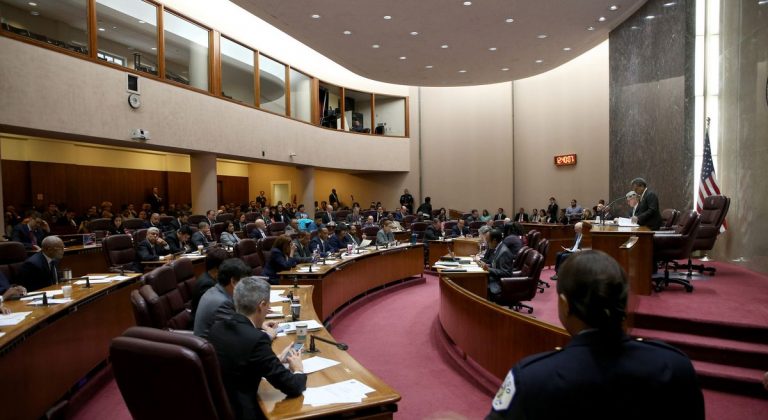
A proposed resolution in the Chicago City Council, which called for action to interfere in the affairs of India, was soundly defeated in an 18-26 vote yesterday. The Anti-India resolution characterized the security measures in Kashmir, which have dramatically reduced terrorism in J&K., as “restrictions on dissent”. Additionally, the resolution was critical of India’s Citizenship (Amendment) Act. Most importantly, the resolution called upon “our congressional delegation and new federal administration” i.e. the Joe Biden administration to “support legislation and other action” in order to “promote tolerance” in India.

The Anti-India resolution also gave reference to the U.S. Government’s Commission on International Religious Freedom (USCIF) ill-advised recommendation to designate India as a “country for particular concern” for “engaging in and tolerating systematic, ongoing, and egregious religious freedom violations, as defined by the International Religious Freedom Act (IRFA)”. The USCIF had also recommended targeted sanctions against Indian government officials and citizens, challenging India’s sovereignty. The U.S. Government and the Ministry of External Affairs both vehemently rejected the USCIF recommendations.

The resolution, ironically titled “Chicago Resolution Honoring India’s Republic and Democracy”, failed to pass in the Chicago City Council, with credit being given to both the Indian Consulate General in Chicago and local Indian-Americans in ensuring its defeat. According to a member of the voting Council, Ald. Sophia King, the Indian Consulate General reached out to her, raising the possibility of India issuing a resolution condemning Chicago’s violent crime epidemic.

Some of the members of the City Council rightfully recognized the futility of passing resolutions on the internal matters of sovereign foreign nations. “If we take this on, why not take on the Chinese ethnic cleansing debate?” said Ald. George Cardenas. “Why not deal with the Israeli-Palestinian conflict?

“We are a global city, I consider us a global city. But we have many pressing issues here at home that need our attention,” Ald. Cardenas added.

Ald. Raymond A Lopez said regarding the resolution, “I am not in support of this item. This is a very divisive issue.”

“My office was reached by thousands of people communicating with us overwhelmingly in opposition to this resolution. The Consul General of India has reached out to me. That is how much it impacts the broader community and broader discussion. I ask my colleagues to vote ‘No’ in this item,” Lopez added.

Some Indian-Americans living in the Chicago area had expressed grave concerns about the resolution. A local retail businessman from Chicago, Nirav Patel said, “The resolution was presented in June 2019, which made false narratives about issues such as the Citizenship Amendment Act (CAA), National Register of Citizens (NRC) and Kashmir, under the guise of congratulating India’s 72nd independence. This resolution can lead to severe effects against India and the Indians living in the US. We opposed the bill and it has been over an 8-month-long marathon, but the truth has won in the Council.”

According to the US-India Friendship Council, the bill was sponsored by the Centre of American-Islamic Relations, a designated terrorist organization in the United Arab Emirates (UAE) because of its association with terrorist groups. CAIR is an organization which has knowingly hosted and supported Kashmiri separatists.

Among the concerns expressed by Indians living in Chicago towards the resolution, a rise in hate crimes against Indians was the chief concern. According to Amitabh Mittal, an Indian living in Chicago, the resolution was feeding into a narrative casting Hindus as the perpetrators of “genocide” which is “creating disharmony among the Indian diaspora”.

The resolution in question was a scaled down version of an even more outrageous resolution explicitly condemning India for exercising its sovereignty. In a previous draft of the Anti-India resolution, the Council called upon India to “uphold the Indian Constitution” by “repealing the Citizenship Amendment Act”. The original draft went as far as to explicitly condemn PM Modi, referring to the Indian Government as being “extremist” and “repressive and discriminatory”.

Furthermore, the original draft resolution took the extreme step of calling upon the Joe Biden administration to, “support legislation censuring the Republic of India for adopting discriminatory policies such as the National Register of Citizens, the Citizenship Amendment Act, and military occupation and communications blockade of Kashmir”. In other words, the draft called upon the Biden administration to pass legislation in order to directly interfere in India’s internal affairs and the will of India’s elected democratic government. This is a fundamentally imperialistic tendency and needs to be addressed as such.

The original draft of the resolution was introduced to the Chicago City Council in July 2020, prompting the Indian Consul General to oppose the resolution and involve the Chicago Mayor’s office. This caused the original Anti-India resolution to be amended down to half its original size.

This marks the first ever defeat of a resolution attempting to interfere in Indian affairs in a major U.S. city. Prior to this, similar resolutions condemning India had passed in the City Councils of San Francisco, Seattle, Albany, New York, and St. Paul, Minnesota.

The sound defeat of this Anti-India resolution, made possible due to efforts of the Indian Consul General and Indians living in locally in Chicago working together to protect India’s image from being tarnished. This diplomatic victory could potentially serve as a blueprint to counter similar Anti-India resolutions in the future.

‘Shiv Sena has no right to give suggestions as it is not a part of UPA’: Congress fumes over Sanjay Raut’s unsolicited advice

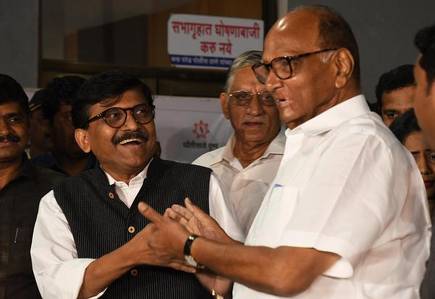
Shiv Sena MP Sanjay Raut’s unsolicited advice to make Sharad Pawar as UPA chief in place of Sonia Gandhi has not gone down well with his Maha Vikas Aghadi alliance members.

Sanjay Raut in a recent interview to Aaj Tak had suggested that UPA should be led by Sharad Pawar to regain its dominance in national politics. He further stated that UPA needed restructuring and support of all the regional parties to take the BJP head-on. To this, Congress Spokesperson, Sachin Sawant has commented that Shiv Sena is not a part of UPA, Sanjay Raut has no right to make any suggestions, as per a Lokmat report. He added that Shiv Sena first needs to be a part of UPA and then make demands or suggestions.

Congress leader, Nana Patole questioned if Sanjay Raut is NCP supremo Sharad Pawar’s spokesperson and suggested he should not comment on things he is not involved in. The Shiv Sena leader was also attacked by NCP’s Nawab Malik who questioned Sanjay Raut’s authority to make such comments.

Sanjay Raut in his interview had claimed that this was not his demand alone but there have been talks in the political circle that UPA should be led by a non-Congress leader. In another media conference, Raut had claimed that Sonia Gandhi has done a good job till now as UPA leader but it is now time for Sharad Pawar to take over. He added that Sonia Gandhi has been unwell and been staying away from politics, because of which Pawar should now take over.

These remarks have not gone down well with the Congress and NCP leaders.

It must be noted that Shiv Sena is in alliance with NCP and Congress for the Maharashtra government as “Maha Vikas Aghadi”. However, Shiv Sena is not part of the United Progressive Alliance, led by Sonia Gandhi and Congress. NCP is part of the UPA as well. Essentially, Raut was advising about an alliance his party is not even part of.

Maharashtra opposition leader, Devendra Fadnavis too refused to answer a question pertaining to Sanjay Raut in a press conference yesterday stating he is no big politician that all his questions or allegations should be answered. He took a jibe at the Sena politician saying that he has ample of time to make such allegations.

Sanjay Raut had questioned how BJP managed to get call recordings of officers and leaders allegedly involved in the transfer racket gate. While his worry was obvious, he suggested that the entire controversy is frivolous. To this Devendra Fadnavis replied that if the allegations are baseless then why the MVA is worried.

Meanwhile, the MVA concluded a cabinet meeting last evening which witnessed the presence of all ministers including Home Minister Anil Deshmukh who was seen taking a back door entry. The Maha Vikas Aghadi ministers have questioned the whistleblowers’ role and have alleged that she tapped into phones illegally. They have demanded an inquiry into how Rashmi Shukla procured permissions for phone tapping.

Madurai candidate promises mini-helicopter, trip to moon and robot in his election manifesto

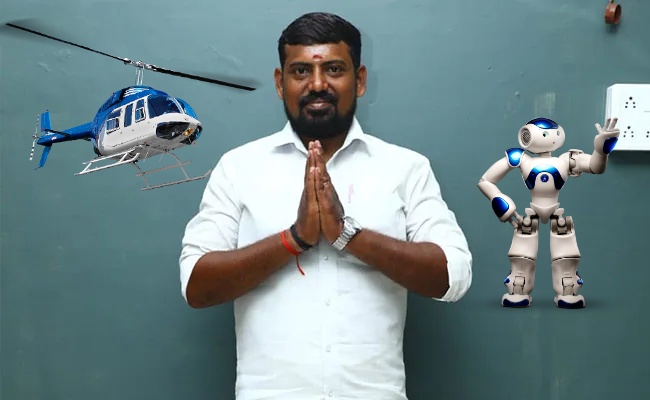
With elections closing in, politicians across party lines are making huge promises, most of which they unlikely to keep, unless they have the political will. An independent candidate from Madurai, however, has taken the promises to another level by promising mini-helicopters, trip to moon and robots, should he be elected.

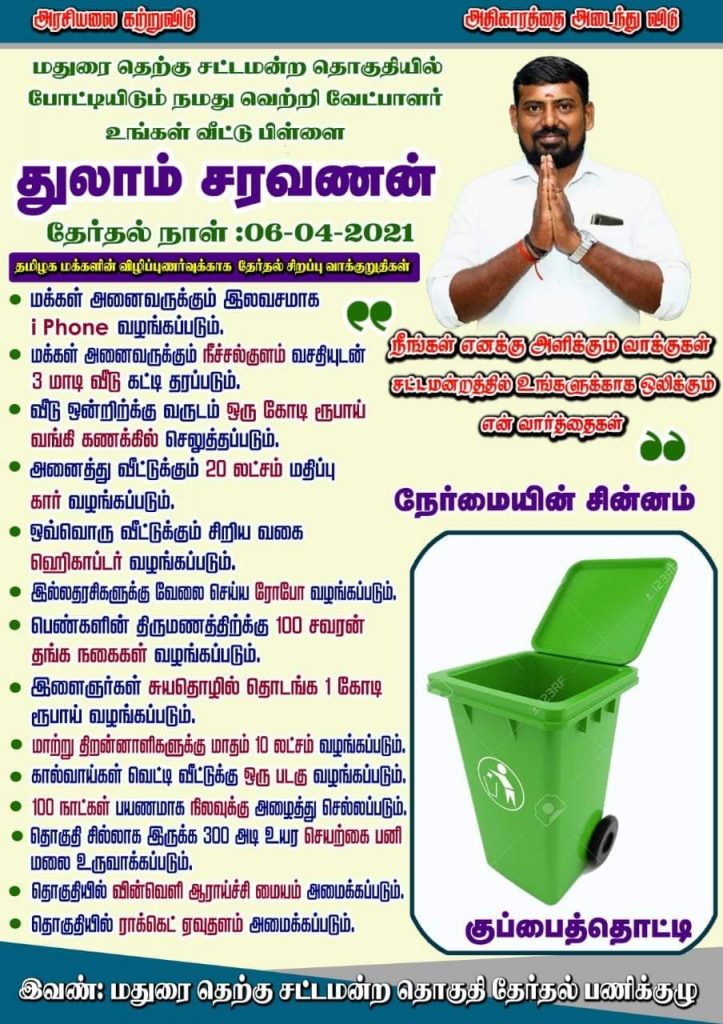
That’s not all. Thulam Saravanan, an independent candidate from Madurai South constituency, has also promised an annual deposit of ₹1 crore for every home, gold jewelry for weddings, a 3-storey house, boat for every family, 300-foot high artificial snow mountain to keep the constituency cool, a space research center and a rocket launch pad, if voted to power.

The candidate has promised free iPhones too as suggested in his manifesto.

Manifesto released by Thulam Saravanan

However, the 33-year-old candidate’s aim was simply to spread awareness and to caution voters against voting for political parties which lure people by offering vague freebies. “I want them to choose good candidates who are ordinary humble people”, he said in a TV interview.

Unhappy with political parties not working for the welfare of people, Saravanan has taken a loan of Rs 20,000 to contest elections, as per a Times Now report. Mindful of the fact that he might not win, Saravanan said, “But my WhatsApp message has gone viral and people are thinking about my tall promises and the thought behind it.”

Social media is going abuzz with his claims and Twitteratis suggesting that they will be voting for him this elections, basis his promises.

The 234-seat Tamil Nadu Assembly will go to polls on April 6, with results to be declared on May 2. The ruling AIADMK has joined hands with the BJP to fight the Congress-DMK alliance in the assembly elections. It will be worthy to track if Saravanan’s awareness campaign works for him or not.

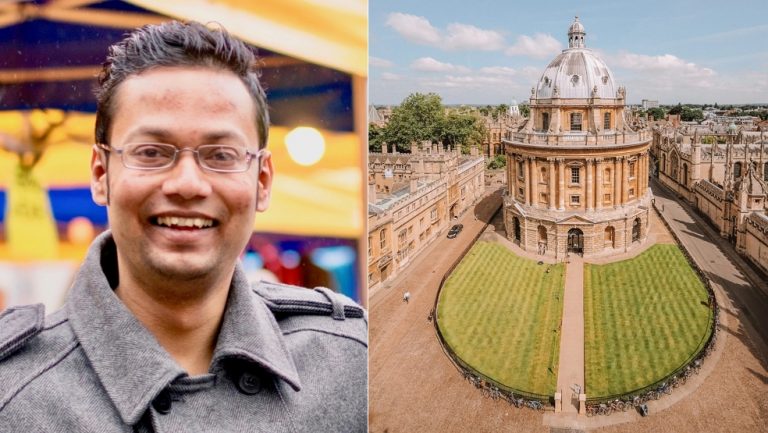
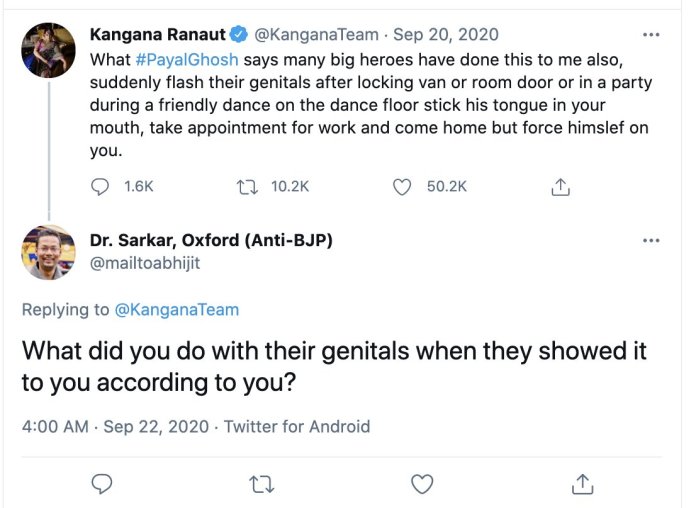
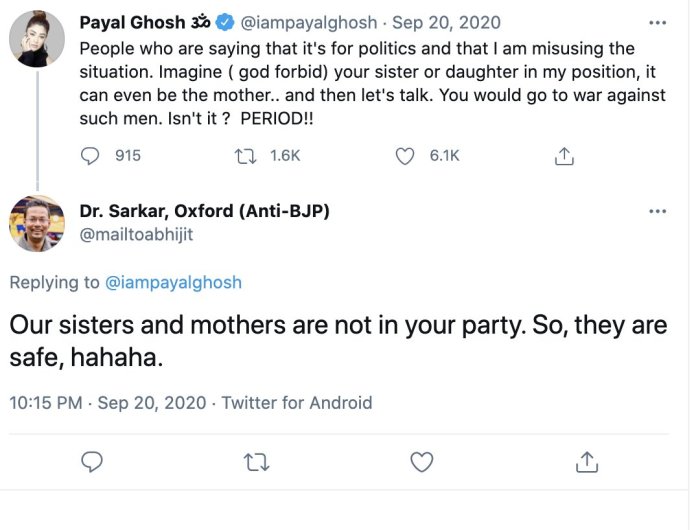
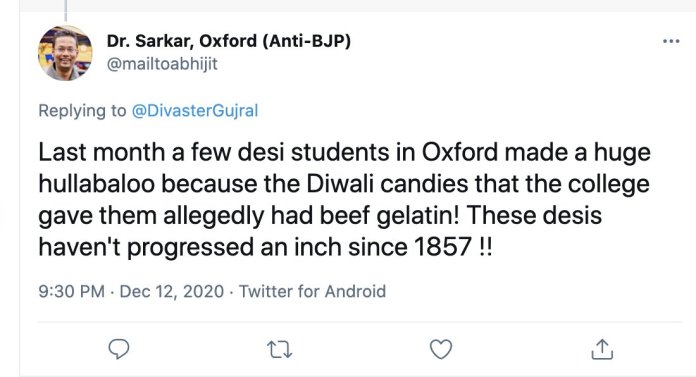
Oxford faculty Abhijit Sarkar accused of hate speech against Hindus, Netizens urge the university to take action. Read details

Abhijit Sarkar, an Oxford university faculty who had unleashed the ‘Hinduphobic’ attack against Rashmi Samant, the first female Indian student to be elected as President of the Oxford University Student’s Union, is now facing the heat from netizens. An online petition against Abhijit Sarkar has gone viral on Twitter. The petition demands that Oxford University should investigate Abhijit Sarkar’s nasty demeanour on social media and suspend him till the investigations are done. The campaign is being supported by author Dr. David Frawley.

The campaign started by a British Hindu on the online petition platform Change.org specifies that “the Hindus of Britain and India are very aggrieved and appalled by the racist, abusive and offensive attacks by Abhijit Sarkar on our community and the completely unhinged and disturbing social media outbursts of this extremist and misogynistic member of the University of Oxford staff. We the British Hindu Community will not rest until the University takes appropriate action against this extremist and zealot in academic plumes. Sarkar should be brought and held to account without further delay.

In what the Hindu community is seeing as a brutal racial attack, the petition says that “the Hindu Community are tired of being labelled “soft”, being an easy target and a tired of being taken for granted.  We will no longer tolerate racist attacks against us. We have had enough.

The petitioner has slated out three demands, that is to hold Abhijit Sarkar accountable for his hate speech on social media, initiate an investigation and suspend him till it reaches a conclusion; that the University must reflect upon its tolerance for Hindu hatred and Hinduphobic staff and to identify trollers who are spreading Hindu hate.

The petition has received more then 31,000 signatures within two days.

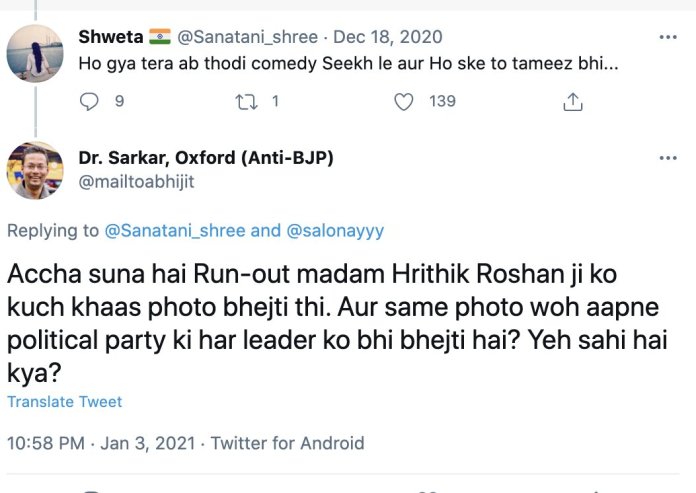
Rashmi Samant isn’t the first victim of Abhijit Sarkar’s misogynist, sexist and bigoted attack. He is infamous for crawling into timelines of celebrities and politicians to troll them overlooking the fact that he is an “academician” at Oxford University and not a troll.

Meanwhile, the UK police and Oxford University have initiated a probe basis a complaint filed by Pt. Satish K. Sharma, director of the Global Hindu Federation, on Samant’s behalf accusing Sarkar of bullying and harassment.

Abhijit Sarkar who proudly identifies himself as anti-BJP and Modi hater, continues to spread hatred and misinformation against Hindus through his social media platforms. He was seen spending the entire month of February pushing his propaganda of “Hindu communalism through food distribution during a humanitarian crisis during Great Bengal Famine of 1943–1944”. Sarkar was seen attaching his article on every tweet that mentioned Churchill and related events and then declared that his article received phenomenal reception.

Rashmi Samant on the other hand is recovering and continuing her one-year masters online from India despite having paid the fees.