Home Blog Page 4523

New public enemy no. 1? Twitter censors account for Pepe the Frog meme citing ‘hateful imagery’

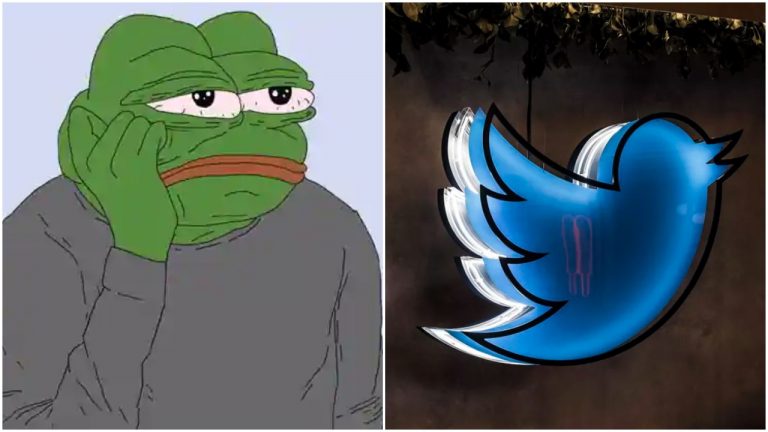
Twitter appears to have found its new public enemy no.1 and the unfortunate target of its wrath if ‘Pepe The Frog’.

Shoe (@shoe0nhead), a Twitter user with more than 400k followers on Twitter, was censored because the account had a Twitter header with Pepe the Frog on it.

Twitter told the user, “You may not use hateful images or symbols in your profile image or profile header.” The user’s Pepe header apparently violated rules against posting ‘hateful imagery’.

What is ‘Pepe The Frog’ meme?

‘Pepe The Frog’, one of the most popular internet memes of all time, was originated in the non-political comic “Boy’s Club” by Matt Furie in 2005. The comic featured Pepe along with his three roommates, all living together and hanging out. In 2008, Pepe made it into internet stardom, however, it was mostly non-political.

In the following years, more and more social users started using Pepe, and many were coming up with their own version of memes. Pepe became a versatile meme, showing all sorts of emotions and became one of the most used memes on the internet.

As Pepe grew stronger and reached mainstream status, the memes took a political turn. The memes of ‘Pepe The Frog’ were used by varied section across the internet but was mostly associated with conservatives and right-wing social media users. Conservatives and right-wing users aggressively used the Pepe meme to put out their content on social media platforms.

Soon, ‘Pepe The Frog’ had to face the left-liberals’ wrath in the United States, who categorised these memes as ‘an alt-right campaign’ to associate Pepe with ‘white nationalism’. With Donald Trump tweeting an image of ‘Pepe The Frog’ in the run-up to the Presidential elections, the comic began to receive more hate from ‘left-liberals’ in the US.

In 2016, Hilary Clinton’s campaign website denounced Pepe and called it “a symbol associated with white supremacy.” In September 2016, the Anti-Defamation League officially added Pepe The Frog to its database of hate symbols. Since this designation, the social media platforms have found urgency in deleting posts that feature the ‘Pepe The Frog’ meme.

Ironically, the liberals had hailed the protesters in Hong Kong, who used the ‘Pepe the Frog’ as a symbol of their resistance to rally against police brutality and Hong Kong’s extradition bill in 2019. Interestingly, nobody opposed the usage of the symbol of ‘white nationalism’ – the ‘Pepe The Frog’ by the Hong Kong protestors as it supported their political narrative then.

However, with Twitter now openly censoring contents that features ‘Pepe The Frog’, the conservatives and right-wing users have now condemned the actions of Twitter to accuse the micro-blogging site of deliberately silencing their voices on its platform.

Twitter displays its left-bias, censures contents posted by nationalists, conservatives

Concerns regarding Twitter’s left-wing bias regarding censorship have been a dominant concern for quite some time. The platform has been accused of engaging in politically motivated censorship to censor political opinions it does not agree with. Twitter has time-and-again stated openly that it posses a left-wing bias and has been actively targeting users who post nationalistic contents or expose the lies of left-liberals.

In the run-up to the US elections, Twitter played a significant role in censoring content inconvenient to Democratic Presidential candidate Joe Biden. Following the elections, Twitter conveniently banned Donald Trump and his supporters from the platform, citing their alleged role in the Capitol Hill violent protests in January and spreading ‘misinformation’ related to the presidential elections.

Not just in the US, Twitter has also displayed its own bias towards left-wing accounts and has often targeted nationalist accounts. A few days back, Twitter had forced a user in India to delete a tweet highlighting Hindu victims of the Godhra massacre. The arbitrary diktat to the users to delete tweets highlighting the Hindu victims of the Godhra massacre came just a few days after the platform had refused to block accounts and tweets that peddled incendiary fake news capable of inciting law and order unrest in the country during the farmer protests.

A major controversy has erupted in the country after Twitter disrespected Indian laws by refusing to follow orders passed by an elected government asking them to ban anti-India and pro-Khalistani accounts that incited violence on the platform.

Ironically, Twitter’s decision not to impose similar bans on accounts that peddled hate speech and incited violence using fake news in India had come after it had permanently banned former POTUS Donald Trump for his alleged incitement of violence in the United States. Perhaps, Twitter interprets its own rules based on its ideological convenience.
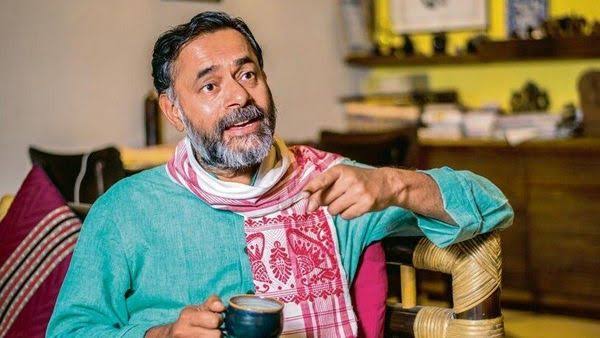
 

Icchadhari protestor Yogendra Yadav finally admits that farmers’ protest is political and is about defeating PM Modi: Read how

Ever since Prime Minister Modi came to power in 2014, the opposition has fuelled a constant cycle of outrage, often culminating in violence. The latest cycle was the farmers’ protest, which erupted after the central government passed three laws that would actually benefit farmers and free them from the deathly grip of middlemen. The involvement of Congress, the Communist organisations and parties, Khalistanis and even oversees elements that sought to interfere in India was as stark as day. However, for the longest time, the trope that the protests were organic and apolitical by the ‘annadaatas’ of the nation was vociferously peddled by the ‘liberals’.

Now, however, about 4 months after the farmers protest erupted and a month after the Republic Day violence, icchadhari protestor Yogendra Yadav, whose tentacles were visible in every single cycle of protest and violence, has come out to admit that the farmers’ protest was indeed political, as it supposedly should be, and has the explicit aim of defeating the Modi government.

Yogendra Yadav wrote an article in The Print headlined, “Farmers’ movement can’t and shouldn’t be apolitical. That’s not a democracy”.

In the article, Yogendra Yadav explicitly makes the claim that the farmers’ protest is not apolitical. He then goes on to claim that it should not be apolitical and that any demand that it should be apolitical is against the basic tenet of democracy.

The article, as is evident, was written with the explicit intention to paint the decision of the Samyukta Kisan Morcha (SKM) to campaign in poll-bound states as a grand act of political dissent by apolitical farmers. Whatever that means.

Yogendra Yadav starts by talking about the decision by SKM do go to poll-bound states and campaign against BJP. He writes, “We have decided to appeal to the voters in Bengal, Assam, Kerala, Tamil Nadu and Puducherry to electorally punish the Bharatiya Janata Party (BJP) for its anti-farmer laws, for its outrageous attacks on the movement, for its use of state machinery to suppress and criminalise the movement and, above all, for its imperious arrogance. It is for the voters to decide how they wish to mete out this punishment to the BJP.  It is not for SKM to suggest who they should vote for”.

Essentially, here Yogendra Yadav tries to say that the farmers are politicised just to the ‘right’ degree and not to a point where the entire ‘movement’ must be discredited. They only want to ‘defeat’ BJP and have no stake in who wins. They are ok even with Abbas Siddiqui winning Bengal, essentially, as long as Modi and BJP are kept out of power. That is the ‘right’ amount of democracy.

While droning on about how politicians are making ‘politics’ a dirty word by demanding that farmers remain ‘apolitical’, he says that farmers themselves are doing a great disservice by calling their organisations “Arajnaitik”. He further admits that most farmer organisations are affiliated to some political party or the other and it is true even for the SKM, which has several organisations within itself that are affiliated with political parties.

Interestingly, what he fails to mention, maybe because he assumes that everyone would know, is that he himself is a member of the coordination committee of SKM – Yogendra Yadav, who runs a political party called Swaraj Abhiyaan. Others include those associated with Congress and even the Communists.

Further, the legal cell that was created by SKM has 4 members –  Colin Gonsalves, Dushyant Dave and Prashant Bhushan, H S Phoolka.

Who are these people, one might ask? Prashant Bhushan is a notorious lawyer who was one of the founders of AAP. HS Phoolka is himself an AAP leader who quit recently. Dushyant Dave is a lawyer of many laurels, one of them being fighting against the Hindu rights on Ram Janmabhoomi and Colin Gonsalves is the founder of HRLN, appeared in the Supreme Court demanding a judicial inquiry into the Police action at Jamia. The HRLN receives a significant amount of funding from George Soros’ Open Society Institute as well. The combination of PUCL and HRLN was also involved in the ‘Civil Society’ attack on Akshaya Patra.

From Rakesh Tikait of BKU, who fought elections on an RLD ticket, an ally of Congress, to Darshan Pal who was a founder of Maoist PDFI and the involvement of elements like Yogendra Yadav, those from Congress, AAP etc, the farmers protest have been political.

While Yogendra Yadav says that being ‘political’ is a part of democracy, and one agrees, it is also true that when the very same elements appear in every outrage cycle. And when they lie blatantly to foment trouble, it is their political agenda that is the central reason for protest and not some grand values of dissent or even the issue that they claim is the reason.

During the anti-CAA riots, we saw the very same people get involved claiming that the law was anti-Muslim. It was not. During the farmers protest, the same elements are involved yet again claiming that the farmers laws are against the interests of the farmers – it is not. In both cases, the international community of global Left got involved to fan propaganda against India and specifically, Hindus and the Modi government. In both cases violence erupted in the capital city of Delhi.

While Yogendra Yadav is not wrong in saying that every protest and in fact, every individual has a political preference and that is indeed the very foundation of a democracy, when the same group of vested political interests starts to burn the country because they wish to ensure that a democratically elected government is thrown out of power by violence and propaganda, it is not democracy that the political interests serve. It is political interests of the political parties they serve.

Yogendra Yadav craftily tries to pass off a deeply political agenda as one that is a part and parcel of democracy. Violence is not and groups with vested political interests lying and leading an insurrection to seize power from a democratically elected government, with the help of foreign vested interests is also, certainly not democracy.

With this opinion piece in The Print, Yogendra Yadav has made one thing extremely clear – The farmers protest, that led to an attempted insurrection against a democratically elected government and is now campaigning against one party in state elections is not about the farm laws at all – they are about seizing political power – by hook or by crook.

What are the farm laws that Yogendra Yadav and his political hacks are protesting against?

One of the biggest factors plaguing the growth of agriculture sector in the country is the inability of the farmer to find a market and to get a fair price to his produce. To address the issue, the erstwhile governments of different states enacted the Agricultural Produce Market Regulation Acts (APMC Acts), which authorised them to set up and regulate marketing practices in wholesale markets. 

The objective of these markets was to ensure that farmers get a fair price for their produce. However, with each passing year, the APMCs turned out to be inefficient with increasing cartelisation of middlemen, ban on private players to enter the trade, increasing corruption etc. 

The Modi government recently introduced three bills to promote much easier trade for the farm produce and to provide a competitive market for the producers outside the existing APMC system. The three laws were

  1. The Farming Produce Trade and Commerce (Promotion and Facilitation) Bill, 2020: This law aims at creating additional trading opportunities outside the APMC market yards to help farmers get remunerative prices due to additional competition
  2. The Farmers (Empowerment and Protection) Agreement on Price Assurance and Farm Services Bill, 2020: This law relates a framework for contract farming through an agreement between a farmer and a buyer prior to the production or rearing of any farm produce. 
  3. The Essential Commodities (Amendment) Bill, 2020: This law aims to regulate the supply of certain food items only under extraordinary circumstances.

It is pertinent to mention that the farm laws are set of three laws that allow farmers to sell their products outside APMC act (most states make it compulsory for the farmers to sell at APMC mandis). It also allows farmers to directly have a contract with corporate houses.

That farm laws don’t do away with APMC, and if someone is not willing to trust markets outside the current system, they are free to stick to the ongoing system. It doesn’t do away with MSPs either. However, the prevalent narrative that seems to be motivated by political concerns falsely claims that APMCs and MSP are being done away with. 

They also allege that due to these laws, big corporations would have the upper hand in a deal with farmers, however, that again is a lie. In fact, The Farmers (Empowerment and Protection) Agreement on Price Assurance and Farm Services Bill, 2020 ensure that a contract is agreed upon and gives the farmer the power to even cancel contracts.

Convicted prisoner’s conspiracy to kill two accused jailed in Delhi riots case foiled by Delhi police: Details

The Special Cell of Delhi police has reportedly foiled a conspiracy hatched by a convicted prisoner to kill two accused imprisoned in the Delhi riots case. As per information shared by journalist Raj Shekhar Jha, the convicted prisoner had planned to kill the two accused lodged in the jail by administering them mercury.

According to Jha, the two accused targeted by the convicted prisoner were arrested last year in relation to a case of murder and desecration of a mosque. The police have seized the mercury and two people have been arrested including an outsider.

The anti-Hindu riots that engulfed Delhi last year

The national capital was engulfed by horrific anti-Hindu riots in the last week of February last year. The riots broke out on February 24 following prolonged violent protests against the Citizenship Amendment Act (CAA). The chargesheets filed by the Delhi Police and the Special Cell investigating the case detail a malicious plan to instigate Muslims against Hindus that resulted in the outbreak of riots.

Around 53 people reportedly died in the riots including an IB officer named Ankit Sharma and a migrant worker from Uttarakhand named Dilbar Negi. More than 200 people were reported to have been injured in the riots. Public and private property worth crores including shops were set on fire during the riots.

Delhi police special cell has filed multiple chargesheets in the Delhi riots case which is still being investigated. The list of alleged key conspirators in the riots have names like former AAP councillor Tahir Hussain and former student union leaders Umar Khalid and Sharjeel Imam. Several far-left protestors including Natasha Narwal, Devangana Kalita and former Congress leader Ishrat Jahan have also been named in connection with the anti-Hindu Delhi riots.

The Delhi anti-Hindu riots that started on the 24th of February had a definite precursor to it. While the organisation of the riots started in January, on the 23rd of February, an incident in Jafrabad can be considered the first incident of violence that started the Delhi riots of February. In the charge-sheet, it categorically mentioned that it was the anti-CAA Muslims who had started pelting stones and indulging in violence at those who were demanding re-opening of the roads blocked by the anti-CAA protestors.

A group of individuals who were demanding the opening of the 66-Foot road near Jafrabad had assembled at Maujpur Chowk around 3:00 PM on 23rd February. The Maujpur Chowk where they had assembled was about 750 M away from the Jafrabad Metro Station. 

The charge sheet then reveals that the residents of Jafrabad and Kardampuri who were supporting the blockage of the Jafrabad metro station congregated in the thousands and started pelting stones from all quarters at the group that was demanding the re-opening of the roads. While the violence against Hindus was planned carefully right from the month of December and January, after the violence erupted on the 23rd, by the evening of 24th and early 25th, Hindus had retaliated to the violence as well.

Bihar: Minor girl goes missing in Madhubani a month ago, family alleges ‘love jihad’ by Shoaib and family

An incident of the kidnapping of a minor Hindu girl has come to light in Balarahi under Khirhar police station in Madhubani district in Bihar. The incident reportedly took place on January 28, 2021, when the minor girl, who is a student of 9th standard, did not return from her tuition. Her family started looking for her but she could not be traced.

An FIR was filed by the mother of the girl stating that she was informed by some people that her daughter was last seen on a bike with a person named Mohammad Shoaib, son of Mohammad Tahir. Shoaib is a resident of village Jhitki. The mother said that when she went to Shoaib’s house to inquire about Shoaib, his father Tahir said that he had gone out. She alleged that when she shared her apprehension of a possible kidnapping of her daughter, Tahir and his family got angry.

Shoaib’s family misbehaved with the girl’s family

The FIR stated that Tahir and his family misbehaved with the girl’s family and said that if Shoaib had eloped with the girl, he would marry her. It further stated that Shoaib’s family threatened to kill the girl’s family if they informed the police about it. His family offered to resolve the matter in the village panchayat. Tahir assured the panchayat that the girl would be back within 2-3 days. However, the girl is nowhere to be found. The girl’s mother said that this was the reason for the delay in approaching the police.

Shoaib’s father and mother not interrogated despite being named in the FIR

The girl’s family has alleged that Shoaib has run away with the girl with the intention of marrying her. Shoaib’s father, mother and sister are also allegedly involved in the matter. OpIndia contacted a local journalist to find out more on the incident. The local journalist informed that the FIR was lodged on February 8, 2021 and the police have not taken any action as yet. The journalist said that Shoaib’s father and mother are named in the FIR and still they have not been interrogated by the police. He apprehended that Shoaib’s family might be aware of the whole matter. He said, “This seems like a case of love jihad (grooming jihad). Minor girl had gone to tuition, he bluffed her and ran away with her. There was a delay in filing the case owing to the assurance given by Tahir in panchayat but no action has been taken so far. Her family is struggling for justice.

The girl’s father threatened to consume poison if his daughter not found

Head of Jhitki village Laltu Mandal has a different opinion on the matter. Initially he refrained from commenting but after much insistence he said that both the families used to take part in each other’s celebrations. Therefore, there was a possibility that they might have resolved the matter. A woman relative of the girl’s family said, “A Muslim man had taken the girl. He might get her converted. We are receiving threats to withdraw the case”. The girl’s aggrieved father has threatened to consume poison if the girl is not found. “Please find her else I will kill myself by consuming poison. Fulfil your duty as a Hindu. He might sell her”, the father of the girl said.

The girl’s family alleges police inaction

The girl’s family has alleged that Tahir and his family are showing them the power of money. They said that the police had not taken any action so far. They said that they would protest if the girl was not found. SHO Harlakhi Anjesh Kumar has denied the allegations of police inaction. He said that the police are making every effort to trace the girl. When asked whether Tahir has been interrogated in the matter, he said that he would be interrogated when required. He assured that the girl would be traced soon, however, the police have found no clue so far.

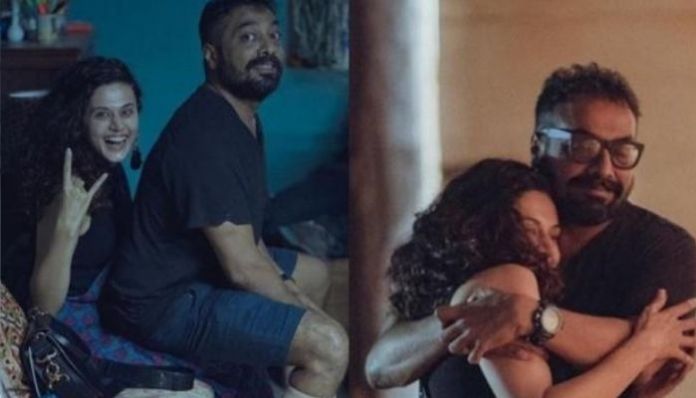
As I-T raids continue on Anurag Kashyap, Tapsee Pannu, and Kwan, politicians and ‘liberals’ call them brave, ‘pro-farmers’

On March 4, The Income Tax raids on properties linked to filmmaker Anurag Kashyap, actress Taapsee Pannu and others continued for the second day. The Income Tax department started carrying out raids on 22 locations on March 3 on the properties linked to Kashyap, Pannu, Vikas Bahl, filmmaker Madhu Mantena and others in Mumbai, Pune and other locations. The raids are in connection to the allegation of tax evasion by Kashyap’s Phantom Films that was dissolved in 2018.

As per the reports, properties linked to Shibhashish Sarkar (CEO of Anil Ambani’s Reliance Entertainment), Afsar Zaidi (CEO Exceed) and Vijay Subramaniam (CEO Kwan talent management agency) were also searched by the IT department.

Times Now has reported that the IT Department has interrogated Anurag Kashyap and Taapsee Pannu for long hours on March 3. It is unclear if they will be interrogated today again.

As per reports, when Phantom Films was operational, several shell companies were floated. The funds were then parked in these companies. The I-T Department also suspect that Kashyap and other directors of Phantom films used the money for investing in properties and other assets. Taapsee’s role in the alleged tax evasion case is yet to be revealed.

Kwan’s name has emerged in high profile cases

Notably, Kwan Talent Management Agency‘s name has appeared in high profile cases in recent times. After the death of actor Sushant Singh Rajput in 2020, several aspects of the case were investigated. During the investigation, evidence of excessive usage of narcotics in Bollywood led to an investigation by NCB. In September 2020, the CEO of Kwan was summoned by Narcotics Control Bureau in connection to cases related to drug usage in Bollywood.

Madhu Mantena, who has been under IT scanner in current raids, was also summoned by NCB. Once Kwan’s name emerged in the news, its alleged dark side started to make headlines. Suchitra Krishnamoorti and Sharlyn Chopra made a series of allegations against the company. Actress Deepika Padukone’s NGO reportedly had a connection to Kwan. Anirban Das Blah, ex-owner of KWAN Entertainment, was associated with Deepika’s NGO. When his name first appeared in the “Me Too” movement in 2018, both KWAN and TLLLF issued a statement that they have removed Anirban from his respective positions in the organization.

Maha government, AAP supporters and ‘liberals’ start hailing Kashyap and Pannu

Amidst the IT department’s crackdown on Anurag Kashyap, Taapsee Pannu and others, the opposition parties and liberals have come forward in their support. Maharashtra government has come out openly in their support. Maharashtra cabinet minister Yashomati Chandrakant Thakur said those who speak against BJP is considered a traitor.

Maharashtra minister Ashok Chavan the raids are because they are ‘outspoken celebrities’.

AAP MLA Saurabh Bharadwaj called them ‘brave and rare’.

Rashtriya Janata Dal (RJD) leader Tejashwi Yadav called the raids a “condemnable act” and alleged that the central government is threatening artists for ‘calling spade a spade’.

Congress Prince Rahul Gandhi did not name Kashyap or Pannu. He shared what he probably thought was a sarcastic tweet mentioning some Hindi proverbs. He claimed the raids are the government’s attempt to harass ‘pro-farmers’.

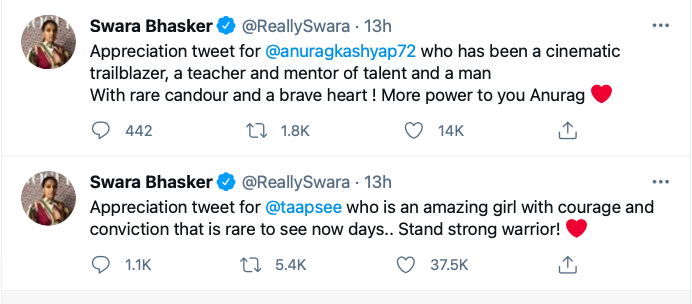
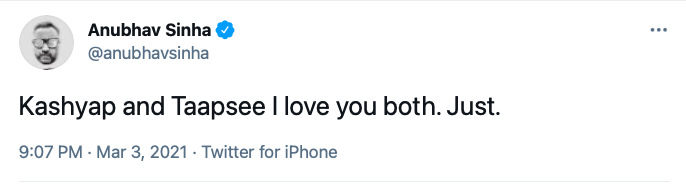
Entertainer Swara Bhasker and movie maker Anubhav Sinha commented on the issue too. While Bhasker called Tapsee and Kashyap brave, Anubhav Sinha said he just loves them both.

Swara Bhasker on Twitter
Anubhav Sinha on Twitter

The raids are expected to continue on Friday, and more celebrities may get summoned by the IT department in the case.

Canadian MP Jagmeet Singh’s co-brother Jodhveer Dhaliwal seen leading attacks against Indian diaspora during ‘Tiranga-Maple’ rally

On Monday, members of the Indian diaspora residing in Canada had organised a tiranga (tricolour) and Maple Car rally in Brampton to celebrate India-Canada ties. More than 100 cars had participated in the rally carrying flags of India and Canada on their vehicles.

Amidst all the positivity shown during the rally, the intrusion by pro-Khalistani elements became a significant problem as they not only abused the attendees and jammed traffic but also assaulted them for praising India. The car rally by the Indian diaspora did not go down well with pro-Khalistani supporters, who bullied people of Indian origin and abused them.

A series of videos had surfaced on social media platforms exposing the Khalistani members, who bullied and pushed down members of the pro-Indian rally. The pro-Khalistan elements infiltrated in the car rally hurled abuses at them and asked them to “go drink urine” while insulting the Indian National Flag.

In one of the videos, a pro-Khalistani supporter can be heard abusing, “Go and drink urine. Are you happy now (after he got hit)? Go and drink urine? Drinking urine will not make you strong you b*st*rd.”

In another video, Khalistani goons were seen confronting the peaceful rally of the Indian diaspora and hurling derogatory words against Indians and PM Narendra Modi. The videos shared by a group called REACH also showed how a member of the Hindu community living in Canadian MP and pro-Khalistani sympathiser Jagmeet Singh’s constituency shared her ordeal of the abuses, threats they face by pro-Khalistani elements in Canada.

Following the attacks by pro-Khalistan elements in Canada, the members of the Indian-diaspora, who had participated in the rally, have alleged that the attacks were carried out by people closely related to Khalistan sympathiser and NDP leader Jagmeet Singh. One of the masterminds of the attacks on the Indian diaspora has been identified as Jodhveer Dhaliwal.

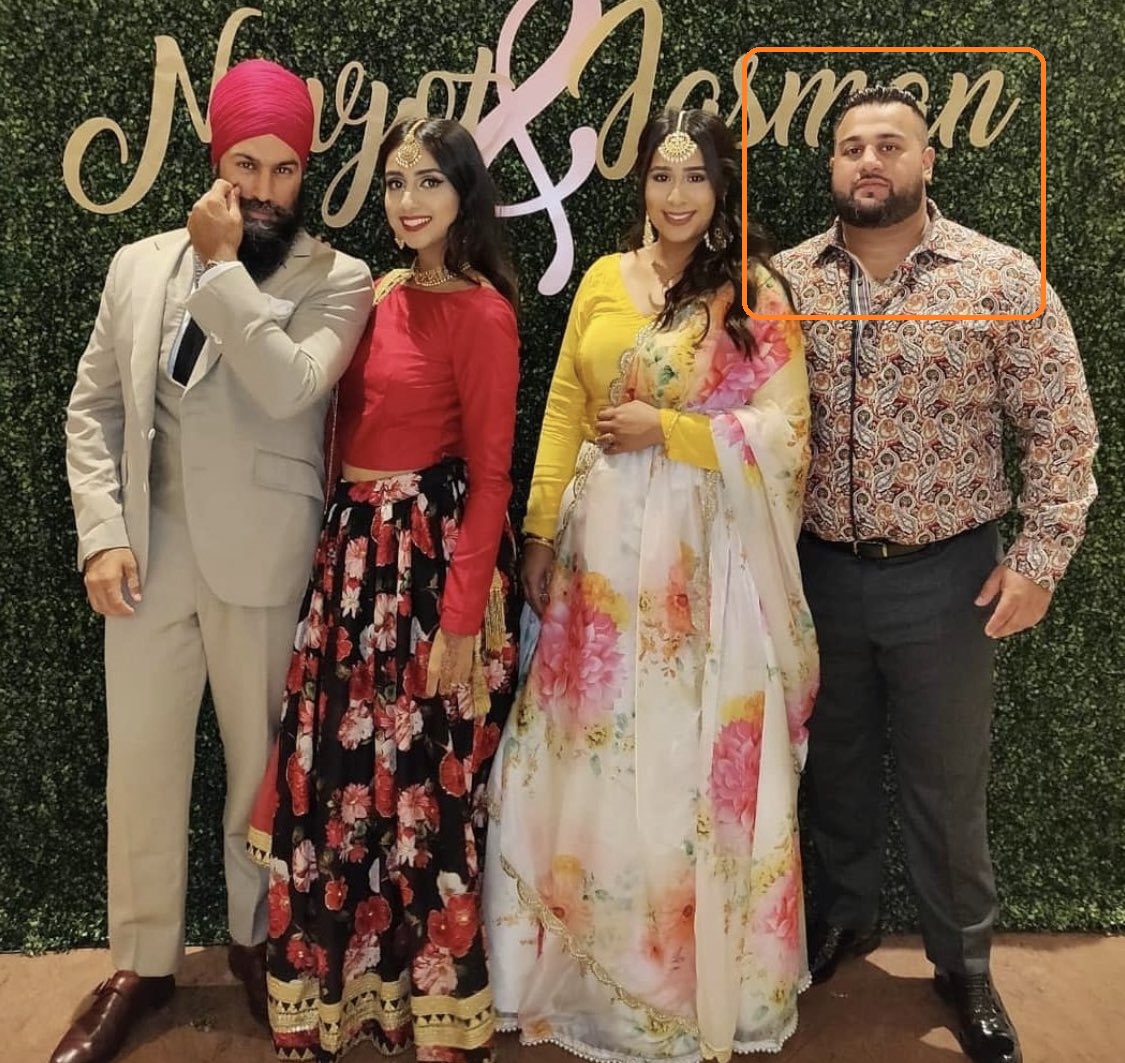
Jodhveer Dhaliwal is the co-brother (wife’s sister’s husband) of Jagmeet Singh and considered to be a close-confidante of the NDP leader.

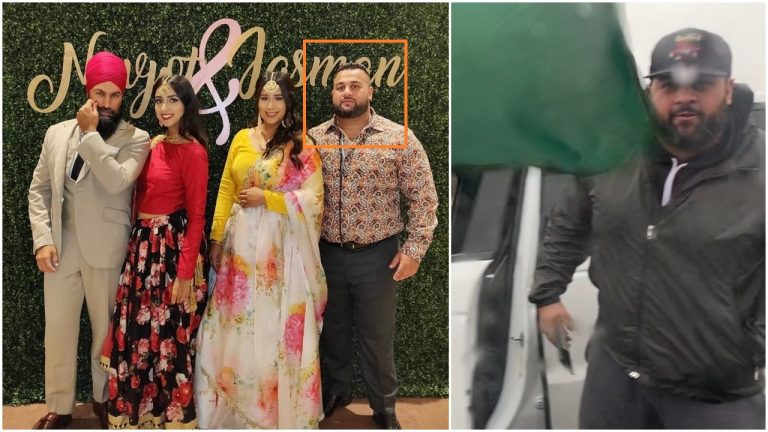
Jodhveer Dhaliwal(circled) and his wife Manjot Dhaliwal with Khalistani sympathiser Jagmeet Singh/ Image Source: REACH

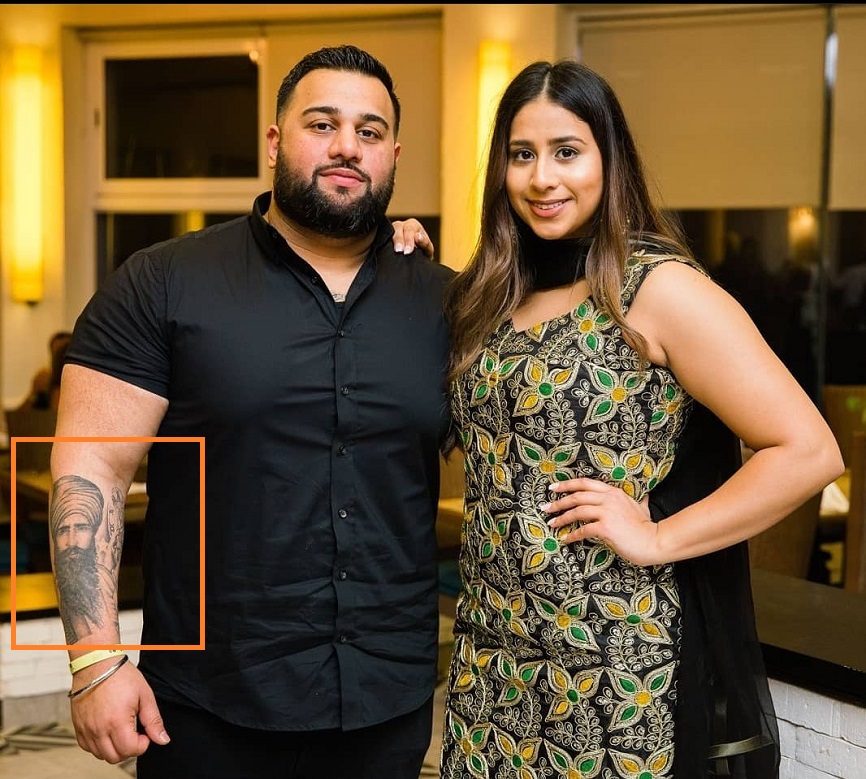
According to REACH, Jodhveer Dhaliwal himself is a rabid Khalistani sympathiser who glorifies Khalistani terrorists such as Jarnail Singh Bhindranwale. In one of the images shared by REACH on social media, one can see Dhaliwal’s fascination for terrorists, who carries a tattoo of Bhindranwale on his arm.

Jodhveer Dhaliwal carrying a tattoo of terrorist Jarnail Singh Bhindranwale/ Image Source: REACH

According to REACH, Dhaliwal and other supporters of Jagmeet Singh were forefront at the anti-India attacks in Brampton last week.

In the videos shared by the participants of the rally, Jodhveer Dhaliwal can be seen spitting on the Indian flag carried by one of the NRIs during the Brampton car rally. In the video, Dhaliwal and his wife Manjot were seen abusing Indians and Prime Minister Modi, as members of the Indian diaspora took out a car rally to support the ties between the two countries.

According to REACH, the number plate of the car also confirms that the attacker was Jodhveer Dhaliwal himself.

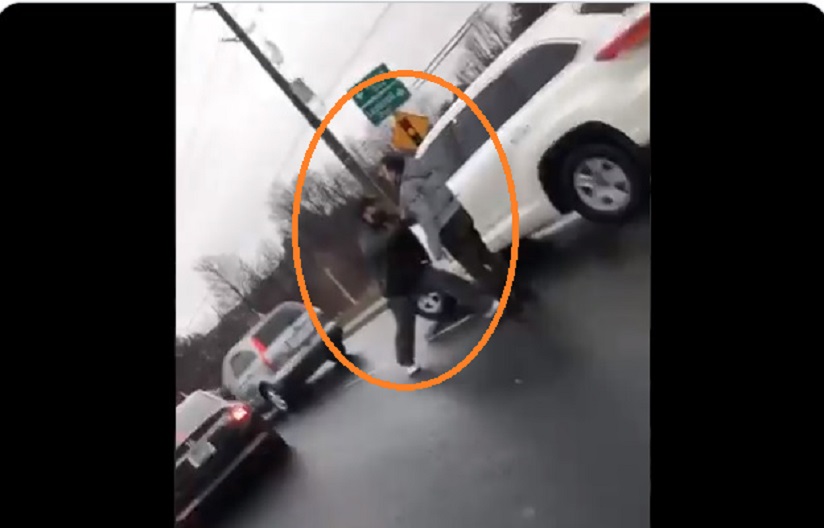
Later, Jodhveer Dhaliwal and the other Khalistani sympathisers who had infiltrated the rally were also seen attacking the members of the Indians diaspora who participated in the car rally. In the video, Jodhveer Dhaliwal can be seen pushing one of the pro-India car rally participants.

The black-jacket clad goon pushing an Indian-origin person participating in the rally/ Image Source: REACH

The damning evidence has now proved that the Khalistani elements, led by Jagmeet Singh, had attempted to disrupt the pro-Indian rally in Brampton. The supporters of Jagmeet Singh descended on the streets to attack and abuse not just Canadian-Indians but also desecrate the Indian flag as retaliation for standing up for the cause of India-Canada ties.

Did Jagmeet Singh incite attacks against Indian diaspora for protesting against him?

Perhaps, the angry reaction by Khalistani sympathiser Jagmeet Singh against Indian-origin Canadian, particularly Indians, comes amidst the ongoing campaign against him in Canada by several persons of Indian origin, who have accused him of inciting Khalistani elements to target the Indians living in Canada.

Last week, several persons of Indian origin had staged a protest outside Khalistani-terror sympathiser Jagmeet Singh’s office in Burnaby, Canada, alleging that Khalistan supporters are targeting them due to ongoing farmers’ protest in India. Protestors had thronged at Jagmeet Singh’s office carrying Canadian flags and protested against fuelling hatred against communities during the ongoing farmer protests in India.

The protests outside Jagmeet Singh’s office come at the backdrop of his repeated attempts to incite Sikhs and other protesters in India to create chaos on the streets of India. Jagmeet Singh, who is notoriously known for supporting Khalistan separatism, has been trying to meddle into India’s affairs and has been at the forefront of carrying global propaganda against the elected Indian government.

Singh is not only accused of funding the farmer protests in the country but also believed to be the man behind song-writer Rihanna’s anti-Indian propaganda. Rihanna had stoked a massive controversy by not only interfering in India’s domestic politics but also by endorsing violence in the name of supporting ‘farmer’ protests.

In the light of these allegations, the NRIs had gathered outside Jagmeet Singh’s office to protest against fuelling tensions between communities in the name of farmer protests. Perhaps, angered by the growing protests against him, Jagmeet Singh orchestrated violence on the Indians during Brampton’s carry rally.

Jagmeet Singh – the notorious Khalistani-terror sympathiser

Jagmeet Singh, also known as Jimmy Dhaliwal, was born in 1979 to immigrant Indian parents in Canada. A lawyer-turned-politician, Singh is currently serving as leader of the New Democratic Party (NDP) since 2017 and as a Member of Parliament since 2019.

However, Jagdeep Singh is known for his support for Khalistani terrorists and has openly voiced his support for the anti-Indian Khalistanis in Canada, earning him the tag of being ‘Pro-Khalistan’.

In 2014, the Indian government had denied Singh a visa to visit India for criticising human rights record of India. Denying him a visa, the Indian government had accused him of misusing the human rights cause to pursue his “insidious agenda of disturbing the social fabric of India and undermining the peace, harmony and territorial integrity of India”. He also became the first western legislator ever to be denied entry into the country.

In June of 2015, Singh, who was then just an NDP member of the Ontario legislature, appeared on stage at a Khalistan rally in San Francisco which had featured a large poster of Jarnail Singh Bhindranwale, the Khalistani terrorist, who led an armed movement against India and had occupied the Golden Temple.

In 2016, NDP Leader Jagmeet Singh had participated in a pro-Khalistani seminar and had even endorsed the use of political violence as a “legitimate form of resistance” to achieve an independent Sikh homeland in India.

Tamil Nadu: Advantage AIADMK after Sasikala steps aside from politics, asks followers to unite against DMK

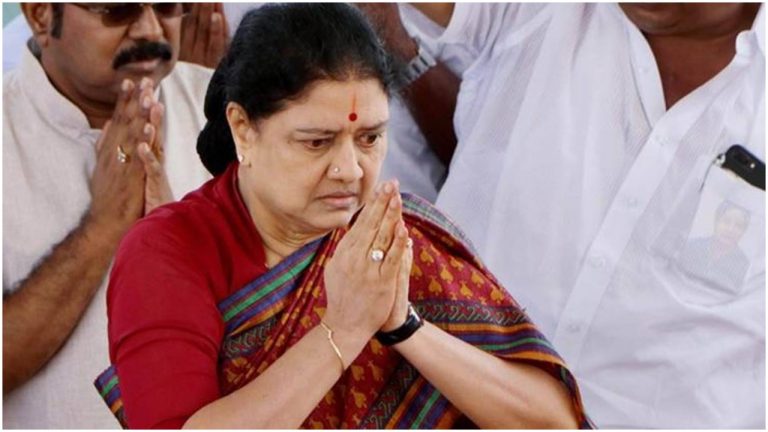
In a sensational twist, J Jayalalithaa’s close aide and former interim general secretary of the All India Anna Dravida Munnetra Kazhagam (AIADMK) – VK Sasikala on Wednesday announced that she has decided to “step aside” from politics.

Just a month before the much anticipated Tamil Nadu elections, VK Sasikala, who was released from a Bengaluru prison on January 27, announced a surprising decision to step aside from politics and support the AIADMK to retain power in the April 6 election.

In a two-page statement, Sasikala did not state any reason for her decision. However, she urged all the “true followers” of Jayalalithaa to “remain united, act wisely and work hard” during the upcoming Assembly election so that the ‘common opponent and evil force, as identified by Amma [Jayalalithaa] – the Dravida Munnetra Kazhagam (DMK) did not return to power and the golden rule of Amma (Jayalalithaa) is established in Tamil Nadu’.

“I will stay away from politics and keep praying my sister Puratchi Thalaivi (Jayalalithaa), whom I consider as God, and the Lord Almighty for the establishment of the golden rule of Amma,” Sasikala said in a statement.

Big boost for BJP-AIADMK alliance

The decision comes as a surprise as Sasikala had earlier wrestled with the AIADMK leadership and aggressively took up the legal battle to regain her control over the party. She had termed the move to expel her from AIADMK as illegal. However, in a u-turn, Sasikala has now extended the support to the ruling AIADMK in their fight against the DMK in the upcoming state elections.

Reportedly, the decision to step aside comes even as the BJP, which is allied with the AIADMK in Tamil Nadu, has been mounting pressure on the AIADMK to work with Sasikala and the AMMK. Amma Makkal Munnetra Kazagam (AMMK) is a political party founded by former AIADMK leader TTV Dhinakaran. AMMK is considered to be a breakaway faction of the AIADMK after Jayalalithaa’s demise.

Sasikala’s call for party members to unite against the DMK may act as a catalyst in the upcoming elections in Tamil Nadu. The ruling EPS-OPS led AIADMK has now got a big boost ahead of the elections, as it is now regaining some momentum in the state and may also end up victorious in the elections.

The 234-seat Tamil Nadu Assembly will go to polls on April 6, with results to be declared on May 2.

Afghanistan: ISIS kills three female media workers who used to translate Indian dramas into local languages

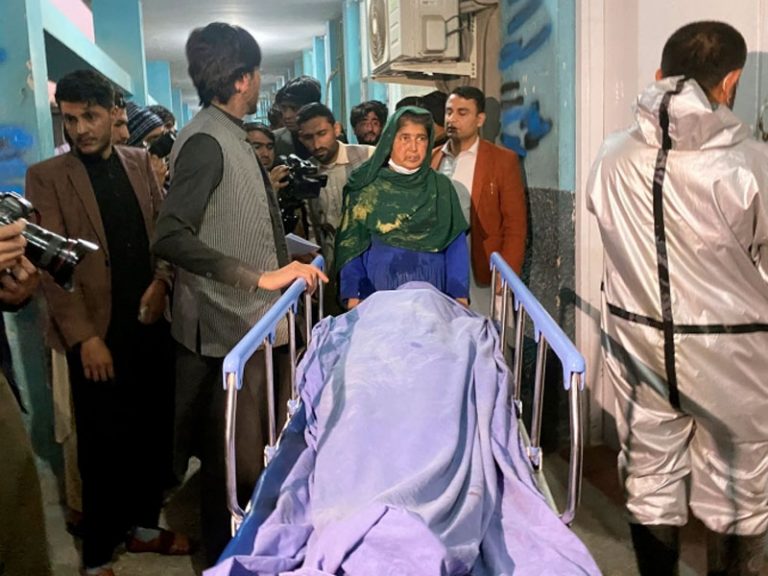
On March 2, the ISIS gunned down three female Afghanistan journalists who used to translate Indian and Turkish dramas to local languages. Three of them died while the fourth one was severely injured and currently lodged in hospital for treatment.

While talking to AFP, Zalmai Latifi, director at the TV station, said four female media workers were attacked in two separate incidents after they left the office. He said, “They are all dead. They were going home from the office on foot when they were shot.”

According to the SITE Intelligence Group, an American NGO which tracks the online activity of extremists and jihadist organizations alleged that the attack was targeted towards the employees at the Privately-owned Enikas TV station in the eastern city of Jalalabad. All victims were aged between 18 and 20. In the last six months, 15 media professionals have been killed in Afghanistan, including these three journalists. 

They used to translate Indian and Turkish dramas

Shokrullah Pasoon, the news editor at the TV station, told Al Jazeera that the three women used to dub Indian and Turkish dramas in Dari and Pashto that are local languages of Afghanistan. Ashraf Ghani, President of Afghanistan, has condemned the killing. He said, “Attacks on innocent compatriots, especially women, are contrary to the teachings of Islam, Afghan culture and the spirit of peace.”

According to journalist Lotfullah Najafizada, the three women killed were named Mursal Waheedi, Sadia Sadat and Shehnaz Raufi.

Series of attack in the war-torn country

As per reports, peace talks began between the Taliban and the Afghan government last year with the intervention of the United States. NATO troop numbers are also decreasing in the country, and only 9,000 of them are left. Former President of the United States had ordered last year to withdraw US troops from Afghanistan by May 2021.

However, since the talks began, Afghanistan has seen a series of targeted attacks that have led to increasing fear among women working in the urban regions.

In a similar attack in December 2020, ISIS terrorists had gunned down Malalai Maiwand in Jalalabad. She was Enikas Radio and TV presenter in the eastern province of Nangarhar. Her driver was also killed in the attack. In an attack in January 2021, 28-year-old Bismellah Adel Aimaq, the editor-in-chief of Sada-e-Ghor (Voice of Ghor) radio station, was killed near Firoz Koh city in the province of Ghor. Two female judges working for Afghan Supreme Court were also killed in Kabul in January 2021.

Shaharzad Akbar, head of the Afghan Independent Human Rights Commission, condemned the attack and said, “Afghan women have been targeted and killed too often. his must stop. Stop killing civilians and destroying (Afghanistan’s) future.”

The US embassy in Kabul issued a statement in which they said, “These attacks are meant to intimidate, they are intended to make reporters cower. The culprits hope to stifle freedom of speech in a nation where the media has flourished during the past 20 years. This cannot be tolerated.”

“Are you so creatively bankrupt”? Director of ‘Yeh Ballet’ slams Deepika Padukone starrer new Levi’s ad for plagiarising design ideas

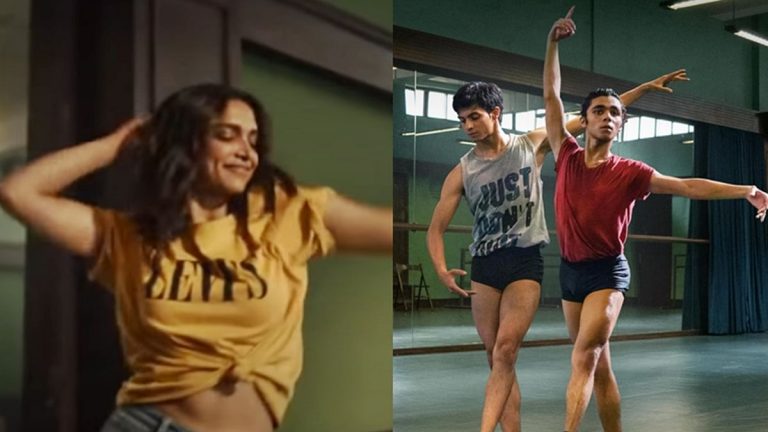
Netflix film Yeh Ballet director Sooni Taraporevala has accused the makers of new Deepika Padukone starrer Levi’s Jeans ad of plagiarism.

Taking to Instagram, Taraporevala said that she was shocked to see the film Yeh Ballet studio used in the Levi’s ad starring Deepika Padukone. She said that the studio for Yeh Ballet was created by Shailaja Sharma from scratch as there was no such studio anywhere in Mumbai. “Basically @nadiaeye (the director of this ad) saw Yeh Ballet and decided to plagiarize our set down to the very last detail,” she wrote in her post.

“Would Levi’s and the director ever think of doing that in the west without permission / acknowledgment, and passing it off as their own creative work? This is not homage this is intellectual theft! It’s SO unfair to our wonderful production designer @shalzoid to have her work ripped off like that,” she said in her post.

“Copycat culture in India needs to be called out and cancelled. You would think a foreign production company and director would know better. Are you so creatively bankrupt? What were you thinking? @levis_in @nadiaeye @offroadfilms rupinsuchak @newland.tv,” Taraporevala said.

Deepika Padukone starrer Levi’s ad was released on February 26, 2021.

Yeh Ballet was released on Netflix last year. Here is the trailers.

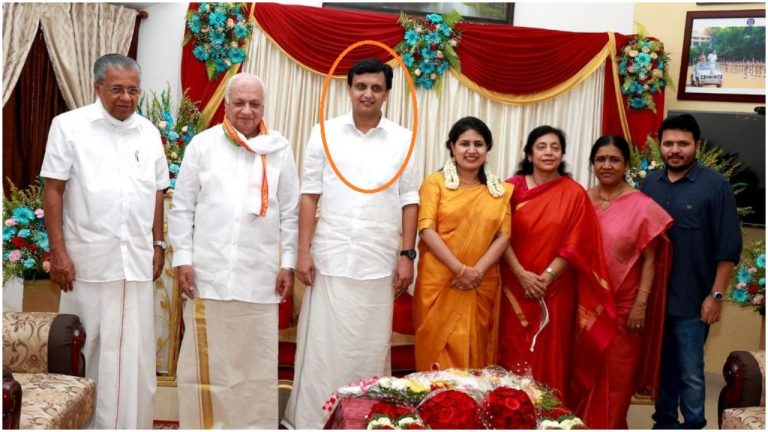
Kerala CM Pinarayi Vijayan’s son-in-law Mohammed Riyaz, CPM MLA TV Rajesh sent to judicial custody in violence case

In a major embarrassment to Kerala Chief Minister Pinarayi Vijayan, a local court in Kerala sent his son-in-law and Democratic Youth Federation of India President Muhammed Riyaz and CPM MLA TV Rajesh to judicial custody for 14 days in connection with a case in 2009.

According to the reports, on Tuesday, the Judicial First Class Magistrate P Vinod sent Riyaz and Rajesh on judicial remand for orchestrating a violent march near the Air India office in Kozhikode to protest against the air tariff hike and reduction in the flight services by the national carrier. A case was registered against four people, including Rajesh, for breaking the law after the DYFI protests had turned violent.

The accused, including Pinarayi Vijayan’s son-in-law Mohammed Riyaz were out on bail and wanted to get it extended. The accused had taken bail in the 2009 case and then failed to appear before the court even after many notices and warrants were served.

Accused granted bail

Later, they had approached the JFCM court as per a direction by the High Court to get the bail extended by the trial court. However, the JFCM sent them to judicial remand.

DYFI leader KK Dinesan was also detained in the case till March 16. Another accused in the case did not attend the proceedings on Tuesday.

However, all the accused who were remanded earlier, including Vijayan’s son-in-law Riyaz were granted bail on Wednesday.

Mohammed Riyaz, the DYFI national president, married Pinarayi’s daughter Veena last year in a private ceremony. Riyas is infamous for leading ‘beef cooking’ protests after the centre sought to regulate cattle purchase and sale. He had also unsuccessfully contested for the Kozhikode Lok Sabha seat in 2019.