The Enforcement Directorate has registered a money laundering case against the Tablighi Jamaat Chief Maulana Saad Kandhalvi and nine others on Thursday under the Prevention of Money Laundering Act (PMLA) based on predicate offence that is registered by Delhi police.
Nine people including Maulana Saad are reported to be on radar on Enforcement Directorate. The agency will also investigate the trust and the transactions of the trust that belongs to Tablighi Jamaat chief.
9 people including Maulana Saad (Tablighi Jamaat Chief) is on Enforcement Directorate (ED) radar. ED will also investigate the trust of Maulana Saad and transactions of trust will also be investigated: Sources https://t.co/cG8jJ5ydxm
Maulana Saad booked under Section 304 and Epidemics Act
Earlier on Wednesday, the Delhi police booked Maulana Saad Kandhalvi for culpable homicide not amounting to murder. The charges of culpable homicide added to the FIR that was already lodged against the Maulana Saad right after he absconded on March 31.
The police had booked Maulana Saad under the Epidemics Act 1897 for allowing religious congregation in the month of March despite repeated warnings from the center and the state government. He had allegedly disregarded the guidelines issued by the government in the light of the Wuhan coronavirus epidemic which is spreading rapidly.
Thousands of people from across the country and many from abroad attended the religious congregation, the event has now emerged as a hotspot for the maximum cases of coronavirus.
Maulana Saad still absconding
The Tablighi Jamaat chief is still absconding. The Delhi Police crime branch had sent two notices to Saad under Section 91 of the Criminal Procedure Code. The police have asked Maulana Saad to provide some documents. The second notice was sent after the first notice was found “unsatisfactory”.
While Maulana remained untraceable Delhi police slapped another notice with 36 questions at his farmhouse in Shamli near Delhi.
There were reports that the head of the Tablighi Jamaat, Maulana Saad, who claims to have quarantined himself in the wake of the Wuhan Coronavirus outbreak was reportedly using his time to gather support and mobilise the Jamaatis. Saad, a resident of Zakir Nagar is allegedly hiding on the outskirts of Delhi at a supporter’s house. Reportedly, the Islamic cleric had hidden in a densely populated area, knowing well that it could help evade arrest.
On the 4th of April, a Hindu man named Revant Singh (called Rewat Singh in certain places) was assaulted in Jaisalmer, Rajasthan by a group of Muslim youths for lighting a lamp on the occasion of Ram Navami. He had succumbed to his injuries five days later. Now, accusations of negligence on the part of the police has surfaced, Swati Goel Sharma of Swarajya Mag has reported. It is reported that the police station in-charge Shankar Lal recorded an “incorrect statement”.
Karan Singh, a cousin of the victim, told Swarajya Mag, “None of us elders was available to go to the police as we were busy with hospital formalities. Only our nephew went to the police station. We later found out that the FIR skipped the mention of the physical assault. It was an incorrect statement. The sections applied were bailable.” According to Karan, it was only due to the pressure created by the Kshatriya Samaj that top cop in the jurisdiction intervened in the matter.
“It is only thanks to our Kshatriya samaj, which put pressure on the police, that the case has been made stronger,” he said. “Our family is not even looking at the case now. The Kshatriya samaj is handling it.” On the 11th of April, Jaisalmer SP Kiran Kang who had acknowledged negligence on the part of the station-in-charge Shankar Lal and said section 307 (attempt to murder) should have been invoked but wasn’t.
*गाँव माडवा में हुई घटना पर थाना भणियाणा में 302 भादस में प्रकरण दर्ज, आरोपी दिलबर गिरफतार*
In its latest update on the 14th of April, Jaisalmer Police said that a second accused Iqbal had been arrested and the motorcycle used by the accused had also been seized. Earlier, on the 10th of April, it was stated that one of the accused Dilbar alias Dildar had been arrested by the Police.
*जिला पुलिस अधीक्षक जैसलमेर डॉ किरन कंग सिध्दू के निर्देशन में
A case of assault was lodged against Dildar Khan, Feroz Khan and Iqbal at Bhaniyana police station by Revant Singh’s nephew. Singh was attacked when he was returning from a ration shop. Being financially weak, local Hindu families and Karni Sena members pooled in money and admitted Singh to a local hospital where he died on April 9 after remaining in a state of coma for 5 days.
In a conversation with OpIndia, Hindu organizations said that Revant Singh had no enmity with anyone. His only fault was to observe the Hindu festival of Ramanavami by lighting a lamp. The incensed Muslim neighbours, who were already holding a grouse against him for supporting PM Modi’s call to applaud the healthcare workers from one’s balcony/terrace on March 22 during the Janata curfew.
While talking to Opindia, Sang Singh (District President of Rashtriya Rajput Karni Sena Jaisalmer) and Mool Singh Rathore (Madwa President, Rashtriya Rajput Karni Sena) said that Revant Singh’s had an extremely poor background and his wife was suffering from a mental ailment for which she had to be taken to a hospital for treatment. Besides his wife, he is survived by a brother, whose mental condition was also not well. Being the only breadwinner in his family, Singh also had the responsibility of raising his four small children.
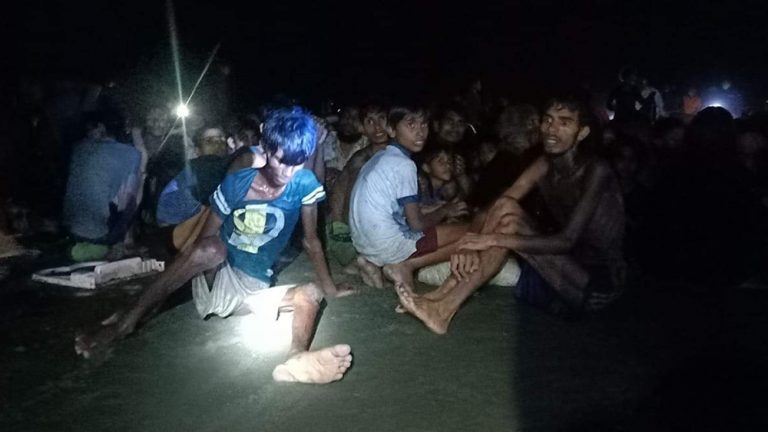
28 Rohingya refugees have been reported dead of starvation after they were stranded in the sea for almost two months after they left Bangladesh to Malaysia two months ago. As per reports, more than 400 Rohingyas had started sailing to Malaysia in January, but they were stranded in the sea after Malaysia refused entry due to restrictions because of the novel coronavirus pandemic. The boat drifted in sea for days without food and water and later the survivors were rescued by the Bangladesh Coast guard.
All the Rohingyas were the residents of Ukhiya-Teknaf refugee camps located in Cox’s Bazar, Chittagong in Bangladesh.
Lt Cdr M Sohel Rana of Teknaf Station Coast guard confirmed that Bangladeshi Coast Guard rescued 382 Rohingyas from the Jahazpur Ghat on Wednesday night.
Coast guard spokesman Lt Shah Zia Rahman said that they were floating for last 58 days and for the last seven days the boat was drifting in the territorial waters of Bangladesh. He said that they have rescued at least 396 Rohingya from a big overcrowded fishing trawler and brought them to a beach near Teknaf.
Rahman added that they had launched an operation to locate the boat after getting information about it, and it was spotted off the south-east coast after a three-day search.
One of the refugees, Md Jobair claimed that the Rohingyas sailed for Malaysia some two months ago but couldn’t make it to port there because of hard and fast restriction due to the recent coronavirus epidemic. He said, “since then we were adrift on the sea and without food and water, some 28 people have died on the boat.”
— Rohingya Women’s Education Initiative (@RWEI_Women) April 15, 2020
One refugee told a reporter that the group had been turned back from Malaysia three times and at one point there was a fight on board between the passengers and the crew.
The rescued people have been cordoned off at the place where they have landed. They were not questioned by authorities due to the fear that they may be carrying the coronavirus infection. At present they have been handed over to UNHCR, and they will be kept in a quarantine facility for 14 days. After that, they will be sent to their camps in Bangladesh.
“They will be kept inside medical facilities established in the Rohingya camps. If none of them show COVID-19 symptoms in the next two weeks, they will be sent to the transfer centre and subsequently to their homes inside the camps in Bangladesh,” UNHCR spokesperson Louise Donovon told Al Jazeera, confirming that they have received the rescued refugees from the coastguard authorities.
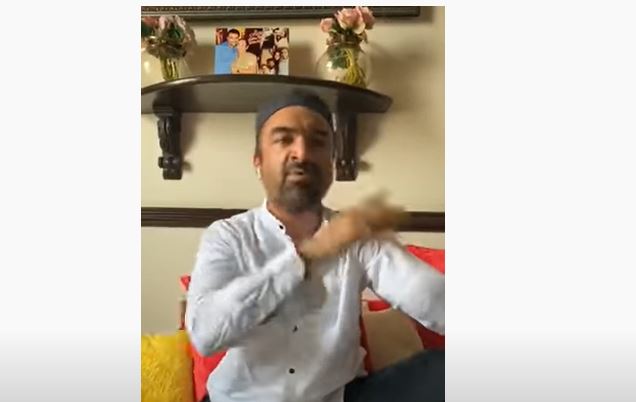
In a shocking video, abusive actor Ajaz Khan can be seen abusing journalists Arnab Goswami, Rajat Sharma and Sudhir Choudhary and wishing that they had their respective families get infected with coronavirus.
— ट्विटर मिनिस्टर Reetu (@Ritu_Victoriaa) April 16, 2020
In his rant, Ajaz Khan alleges that the BJP is “blaming Muslims” to hide its own fallacies during coronavirus. “Dogs of BJP have bought these pimps in the media like Arnab Goswami, Rajat Sharma, whom I used to respect once. Allah willing you get coronavirus, your wife gets coronavirus, Arnab Goswami gets coronavirus, his entire family gets infected with coronavirus. The mother and father of that Zee TV reporter, hope she also gets coronavirus. Hope everyone in his family gets coronavirus,” he says.
On April 15, the serial abuser went live on his Facebook account, and in his 8.26 long video, he not only blamed BJP and PM Modi for being biased against the Muslims of the country but hit out at senior journalists like Arnab Goswami, Rajat Sharma and Zee News editor Sudhir Choudhary for being BJP stooges. He tried to provoke the Muslims by saying that their community is being targeted and hexed for every transgression happening anywhere in the country.
Speaking about the recent incident where huge crowds of migrant workers burst onto the streets in Bandra and Mumbra in Mumbai on Tuesday demanding to go home amidst the nationwide lockdown imposed in the wake of the Wuhan Coronavirus pandemic, Ajaz insinuated that this incident was also pre-planned by BJP to defame Muslims and in turn defame Maharashtra Chief Minister Uddhav Thackeray and Aditya Thackeray. He says that the BJP is trying to snatch Maharashtra from Uddhav Thackeray by playing communal politics.
“All this is a conspiracy to defame Uddhav Thackeray. This is being done on instructions of ex-chief minister Devendra Fadnavis,” Khan alleges. He then blames chief ministers of other states to come forward and help Maharashtra instead of criticising Uddhav Thackeray as Maharashtra is a big state and has a lot of people and less space. To the Thackerays, he says that all the Muslims and people of Maharashtra are with them.
“Remember, this is a huge conspiracy against Maharashtra government and Uddhav Thackeray. They want to snatch power from Uddhav Thackeray and come back to power and carry out atrocities against Muslims like how they do everywhere. And do not forget the media. Rajat Sharma, Arnab Goswami, Zee TV fellow, Rubika Liyaqat, they are all pimps,” he concludes by doing a ‘thoo’ on media.
Ajaz Khan, repeat offender:
Abusive actor Ajaz Khan, who had once said that he considers the Quran above the Indian Constitution and was arrested for inciting communal tension through his video on TikTok propagating revenge on Tabrez Ansari’s death. In a hate speech video on Facebook, Ajaz Khan was seen blatantly inciting communal violence. He was found urging the Muslim community to come out on roads for avenging Ansari’s death.
Recently, hardcore Islamist Ajaz Khan menacingly threatened actor Payal Rohatgi that one day, the entire world will become Muslim. In a misogynist attack against Payal, Ajaz Khan had referred Payal Rohatgi as a C grade actor. He had threatened that if 40 crore Muslims of the country, including legal and illegal residents, came out on the streets the whole country would be shut down.
Ajaz Khan is known for his anti-democracy views which was evident from the fact that he once tweeted that he would choose the Quran over the constitution. He was arrested by Anti-Narcotics Cell of Navi Mumbai for possessing drugs. He later got out on bail. He was arrested in 2016 too for sending lewd and vulgar messages to a hair stylist. In the past too, Ajaz Khan has indulged in promoting hate speech through his Facebook account which could disturb the communal harmony in the country.
On the 5th of April 2020, the United States President Donald Trump requested for the release of US order of Hydroxycholroquine which is considered as a possible relief drug for fight against COVID-19. On the very next day of request the release of excess drug was approved by the Indian government. One of the observations that one could make from such dealing is that it was not a usual diplomatic exchange between two countries. It was an exchange of special nature wherein personal rapport between the leaders of both countries has yielded a positive outcome while the fight against Covid-19 pandemic is still continuing in a collective manner globally. Due to proactive diplomatic decision making of the government India has offered a helping hand to United States which would create a mark for the country in the global diplomacy and politics. Such diplomatic exchange is a big achievement for the country which has adopted the Hindu philosophy of “Vasudhaiva Kutumbakam“.
While on the face it might appear that United States must have put some conditions for accepting such delivery but in this situation India was in a position to put conditions while making the delivery of relief drug. This exchange might also appear unilateral at first glance but if one observes some patterns in the Indian pharmaceutical industry then it would not be wrong to say that some dealings indeed took place which is beneficial for country’s economy and exports. Some of the major pharmaceutical exporting companies got United States Food and Drug Administration (USFDA) approval which would benefit these companies in selling their drugs in the US pharmaceutical market, earlier these drugs were not allowed by USFDA to be sold in the US markets. Interestingly, one of the major pharmaceutical exporter and manufacturer named as Aurobindo Pharma Ltd. got USFDA approval on 9th of April 2020 as per its press release. The approved drug which was allowed by US authority is “fluoxitine” which is used for the treatment of major depressive disorders. It is a widely consumed across United States as a prescription drug and it is one the most popular drug for treatment of depressive disorder.
The timing of such press release is important because possibly such approval had come during the release of hydroxychloroquine relief drug from India. Similarly, on the same date i.e. on 9th of April other major pharmaceutical companies like Cipla got final approval from USFDA for marketing its generic version of “Proventil Inhalation Aerosol” which is commonly used for treating respiratory diseases. Granules India Ltd. which is also a major manufacturer of pharmaceutical formulations got approval from US Food & Drug Administration (USFDA) of Colchicine Tablets used for the treatment of Familial Mediterranean Fever (FMF) on the same day i.e. 9thApril. Another pharmaceutical company which was not allowed to market their drug in the US is IPCA Labs. It is a major manufacturer of hydroxychloroquine which did not have USFDA approval before the export ban was lifted by the government for making the delivery of the drug.
Furthermore, as per a recent report the USFDA has cleared four Indian manufacturing plants in past 10 days. This development has come amid supply-chain disruptions due to Covid-19 induced drug shortages. On 13th April, Lupin one of the largest generic drug supplier in the US and Dr. Reddy’s Laboratories received their inspection report where they were allowed to manufacture and market their formulation in the US market. Another Bangalore based Strides Pharmaceutical Company received manufacturing clearance after an inspection in March. Such positive developments for the Indian pharmaceutical industry are beneficial for the country’s economy and exports and it again reinforces the belief that some diplomatic dealings were on the table while India lifted the export ban on hydroxychloroquine, which is considered a drug that can help Covid-19 patients.
The appreciation made by the US president Donald Trump via twitter after successful receipt of the drug projects India as a global leader in combating this pandemic situation. It highlights that the diplomatic prowess of Prime Minister Modi has yielded positive results for the country and its economy. Similarly, the humanitarian help rendered by the country to Israel and Brazil has earned appreciation and applauds across globe and it has projected India as a key player during the time of crisis. Amusingly, the Brazilian President Jair Bolsonaro invoked Ramayana reference when he appreciated the Prime Minister while drawing Lord Hanuman metaphor of procuring life saving drug by acting on time with dedicated efforts. The government is also planning to supply the relief drug to neighboring countries like Nepal, Sri Lanka, Mauritius and Bangladesh in the near future which would help in building country’s towering image in the South Asian region. The extraordinary complexity of the Corona virus outbreak is urgent for nations across the world to quench the spread of the disease and rising mortality rates. Within this initiative, the Indian pharmaceutical industry will certainly play a key role, not only because of its traditionally growing medicinal and research abilities, but also because of its current promising strides within seeking a viable long term virus vaccine.
As per a recent report, the Serum Institute of India (SII) in collaboration with American-based Company Codagenix has announced the production of a possible Coronavirus vaccination, which could be viable and hopefully market-ready by 2022. While this is one of a small number of companies working on a feasible virus vaccine, there are high expectations from the SII, considering its years of experience in the field: the company is the world’s largest producer of vaccines, and is a prominent producer of many widely used and successful vaccines worldwide, including for polio, tetanus, diphtheria, and measles among several others. To sum up the entire discussion it could be clearly observed that the supply of hydroxychloroquine drug would be a step towards projecting the country as a global leader during the time of crisis and the joint efforts for developing vaccine by both countries (US and India) would project robust global partnership between India & US for the fight against Covid-19 pandemic.
Widely acknowledged as a propagandist, Saba Naqvi has once again indulged in shielding Muslims and demonising Hindus through a video that has now gone viral. She accused the entire Hindu community of spreading hatred against the Muslim community while remaining silent on the reprehensible conduct of significant sections of the Muslim community. In a video widely circulated on Twitter, Saba Naqvi asks Hindus ‘what do you want us to do’?
Saba Naqvi and her viral video shielding Muslims while demonising Hindus
The bigoted Hindu supremacists, the communalists are not buying vegetable from Muslims. How sick are you? All the medicine you take come from a Muslim manufacturer.
In her video message, Saba Naqvi cites the examples of a few good Muslims while accusing the Hindu community of indulging in hatred. While Saba Naqvi takes care to use the example of a few good Muslims to whitewash the crimes of a great many more in her viral video, she does not offer the Hindu community the same courtesy. Playing the victim card, Saba Naqvi paints the entire Hindu community as intolerant.
Saba Naqvi makes preposterous insinuations in her video and asks Hindus repeatedly, “What do you want us to do?”, the ‘Us’ being Muslims. Again, Saba Naqvi ought to be careful about not painting the entire Hindu Community in poor light because if the favour is returned, she will be the first to cry victim. Since she answers her own question by saying “Should we all leave?”, we decided it would be a good idea to reverse the gaze for a moment. There are certain things that the Hindu Community would want from the Muslim community. And these are not some unrealistic demands that the deviant sections of the Muslim community would have to try too hard to fulfill.
1. Don’t defend those who spit on doctors or sexually harass them
Members of the Tablighi Jamaat have engaged in despicable behaviour ever since the Markaz Nizamuddin was busted by the administration and the Police. Once they were admitted into the hospital and people from other parts of India who had attended the event in Delhi were sent to hospitals, some of them spat on doctors and roamed naked in their wards and made lewd gestures at the female healthcare staff. If Muslims, and their allies, could stop defending such people just because they happen to be from their own community, that would be great.
2. Stop spreading fake news on TikTok and calling the Wuhan Coronavirus “Allah’s NRC”
A deluge of videos were shared on TikTok that spread dangerous ideas about the Wuhan Coronavirus. Some claimed that Namaz was a cure for the virus while others claimed that Allah and Islam will protect them from it. The most distasteful, however, were the ones that were celebratory over the spread of the pandemic and called it “Allah’s NRC“. If Muslims could stop making such disgusting videos for TikTok, that would be great.
3. Stop throwing tantrums in hospitals and stones at doctors
Again, members of the Tablighi Jamaat have been throwing tantrums at the healthcare staff for quite some time. They wouldn’t take their medicines, demand ‘spicy beef biryani‘ on occasions and refuse to obey social distancing guidelines within the hospital premises. Simultaneously, Muslims in hotspots and elsewhere have been attacking medical teams and the police when they visit Muslim dominated areas in order to check on Muslims infected with the Wuhan Coronavirus. At Balbhoonpura in Uttarakhand, Muslims came out in large numbers and surrounded the medical team which had come to quarantine an Imam. So, if Muslims could stop engaging in such behaviour, that would be great.
4. Don’t put your religion above national interests
Ever since the advent of the Wuhan Coronavirus pandemic, a significant section of Muslims has indulged in gross violations of government guidelines to combat the pandemic. They have continued to gather in Mosques and thus, jeopardizing the health of the nation. And this as they contained spreading fake propaganda on TikTok and elsewhere. If Muslims could stop indulging in such antics, that would be great.
5. Don’t play the victim card when Islamic terrorists are the biggest aggressors
The Muslim community has made it a habit of indulging in victimhood politics, all the while as Islamic terrorists continue to pose the greatest threat to peace and stability. While the crimes of Islamic terrorists elicits the popular ‘Not True Muslims’, other religious communities are continuously portrayed in poor light and demonized and portrayed as oppressors. Even right after an Islamic terror attack, the immediate concern does not go out to the victims themselves but potential victims of ‘Islamophobic hate crimes’ that somehow never takes place. The victim card has been played so often and so thick and fast that it has lost its utility. So, if Muslims could stop playing it, it would be great.
6. Stop glorifying genocidal maniacs just because they were Muslim
The Muslim community has a penchant towards glorifying Islamic tyrants who committed genocide of Hindus. Khilji, the Mughals, Tipu Sultan, all such tyrants who committed genocides of Hindus are glorified still and painted as liberal and secular and what not. Simultaneously, the sins of these tyrants are whitewashed and ‘recontextualized’ in order to absolve them of their crimes. If Muslims could stop glorifying such maniacs, that would be great.
7. Stop putting the Ummah above communal harmony
A significant section of the Muslim community on social media has organized in a targeted campaign against Hindus living in Islamic countries in the middle east. They captured screenshots of the comments made against Tablighi Jamaat and Islamic terrorists by Hindus on social media and reported them to local authorities in order to get them fired or worse, arrested. Such antics do not bode well for Muslims in India and are bound to cause great harm to communal relations in our country. If Muslims could stop such antics, that would be great.
8. Hand over the Temples which were demolished in order to build Mosques over them
It is an established historical fact that innumerable Hindu Temples were demolished by Islamic tyrants in order to build Mosques on top of them. In many cases, the material used to construct the Temples were reused for the construction of the Mosque. Hindus reclaimed the Ram Janmabhoomi after centuries of effort and decades of spending time in the Indian Courts. If Muslims could hand over the remaining Temples including Kashi-Mathura, which number in hundreds, as a gesture of goodwill, it would go a long way in repairing Hindu-Muslim relations. And, needless to say, that would be great.
The Delhi police have booked Tablighi Jamaat Chief Maulana Saad Khandalvi for culpable homicide not amounting to murder on Wednesday. The charges of culpable homicide under Section 304 of the Indian Penal Code was added to the FIR that was already lodged against the religious leader on March 31.
Delhi police had registered FIR against Maulana Saad under the Epidemics Act 1897 for allowing religious congregation in the month of March despite repeated warnings from the center and the state government. He had allegedly disregarded the guidelines issued by the government in the light of the Wuhan coronavirus epidemic which is spreading rapidly. Thousands of people from across the country and many from abroad attended the religious congregation, the event has now emerged as a hotspot for the maximum cases of coronavirus. However, Maulana Saad is still absconding.
Two of his relatives found positive for coronavirus
Two relatives of the Tablighi Jamaat Chief who are residents of Saharanpur, Uttar Pradesh have been tested positive for coronavirus.
Saharanpur District Magistrate Akhilesh Singh said that the patients have been shifted to a Level-1 hospital in Fatehpur. The locality Mohalla Mufti in which they resided has been categorized as a hotspot and containment zone.
The DM said, “In the investigation, it has been revealed that both were a part of the Nizamuddin Markaz event in Delhi last month. They were quarantined and tests were conducted, which came out positive.” The police had conducted surveillance and also checked their mobile details.
The District Magistrate said that the close contacts of Saad’s relatives will be identified, quarantined and will be tested for Coronavirus.
A total of 19 areas in the Saharanpur district have been declared hotspot and 44 people have been tested positive so far.
The state of Uttar Pradesh has reported 735 positive cases of coronavirus so far. 51 patients have been recovered and discharged while 11 succumbed to the disease.
Maulana still absconding
The Tablighi Jamaat chief is still absconding. The Delhi Police crime branch has sent two notices to Saad under Section 91 of CrPC. The police have asked Maulana Saad to provide some documents. The second notice was sent after the first notice was found “unsatisfactory”.
As Muhammad Saad remained untraceable, the Delhi police slapped a notice with the 36 questions at his farmhouse in Shamli near Delhi. After the first notice was found unsatisfactory, the Delhi police slapped the second notice. The police say that they are closing in on the Maulana.
Earlier, there were reports that the head of the Tablighi Jamaat, Maulana Saad, who claims to have quarantined himself in the wake of the Wuhan Coronavirus outbreak was reportedly using his time to gather support and mobilise the Jamaatis. Saad, a resident of Zakir Nagar is allegedly hiding on the outskirts of Delhi at a supporter’s house. Reportedly, the Islamic cleric had hidden in a densely populated area, knowing well that it could help evade arrest.
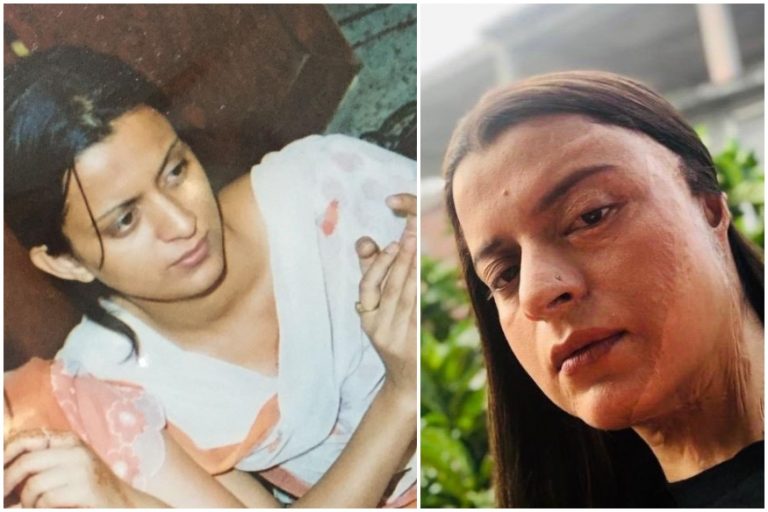
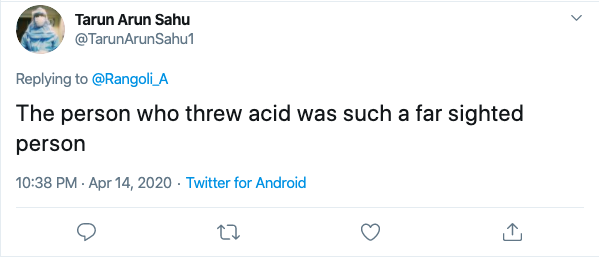
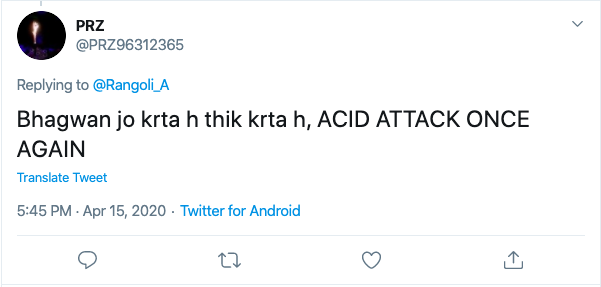
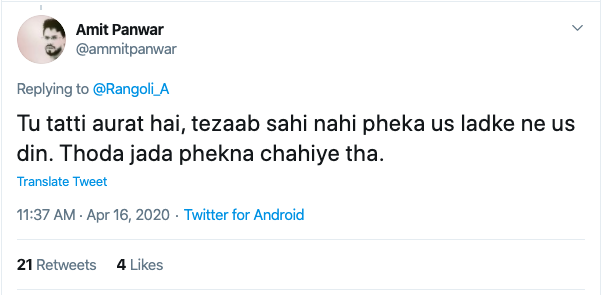
Kangana Ranaut’s sister Rangoli Chandel, who has been an acid attack surviver herself, was on the receiving end of abuses where hateful netizens not only said that she deserved the acid attack but some also wished for another acid attack on her.
Hateful tweets against Rangoli
Rangoli was on the receiving end of the abuses after she tweeted an angry message against ‘mullahs’ who are attacking the doctors, nurses and cops.
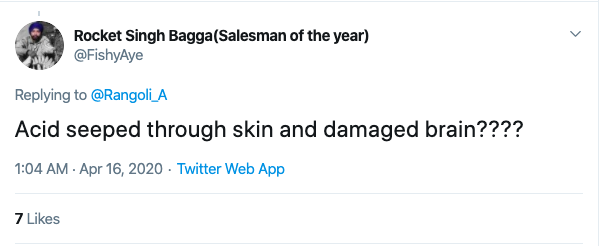
This hateful tweet against the acid attack survivor got 7 ‘likes’ on Twitter
Many tried to justify the acid attack on her.
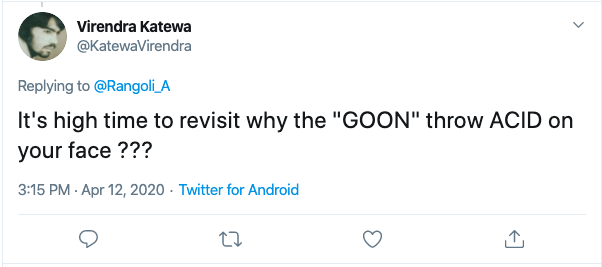
Virendra Katewa also justifying the acid attack.A Twitter user justifying acid attack.
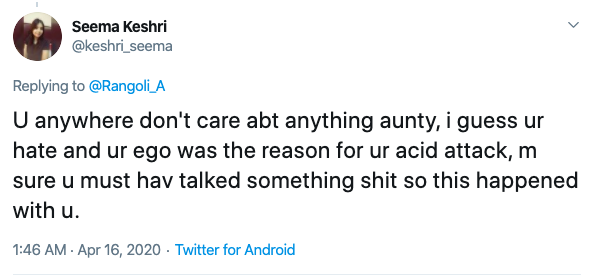
Not only did some people mock the acid attack on Chandel, some even ‘justified’ it and indulged in victim-blaming. As per Twitter profile of Seema Keshri, she appears to be a woman herself. A woman is not only justifying the acid attack but also blaming Rangoli for it.
Hailing the culprit who threw acid on Rangoli
While some thought is is a good idea to hail the culprit who threw acid on Rangoli.
Tweet to Rangoli
One person even wished that she should be thrown acid at again.
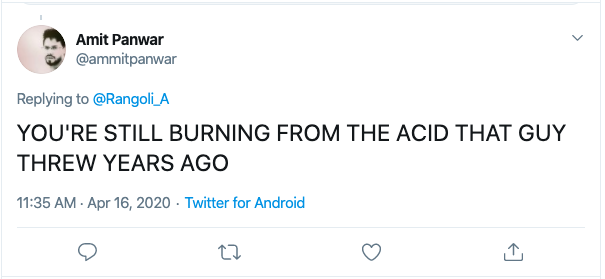
Amit Panwar was really angry at Rangoli to constantly tweet to her
One Amit Panwar also justified acid attack on Rangoli and wished that he should have thrown some more acid on her.
Acid attack on Rangoli Chandel
Rangoli Chandel was attacked with acid after she rejected proposal of a man who wanted to marry her. She underwent 54 surgeries. Despite that, doctors could not reconstruct her ear. She had also lost one eye and her one breast was severely damaged because of which she faced problems while breastfeeding her new born child. “Even now I can’t stretch my neck sometime itching in grafted skin is so bad that I wish I was dead… shockingly acid victims numbers are very high in India, the culprit was out on bail within few weeks, it was too painful to see him roam around freely,” Chandel had tweeted in October last year.
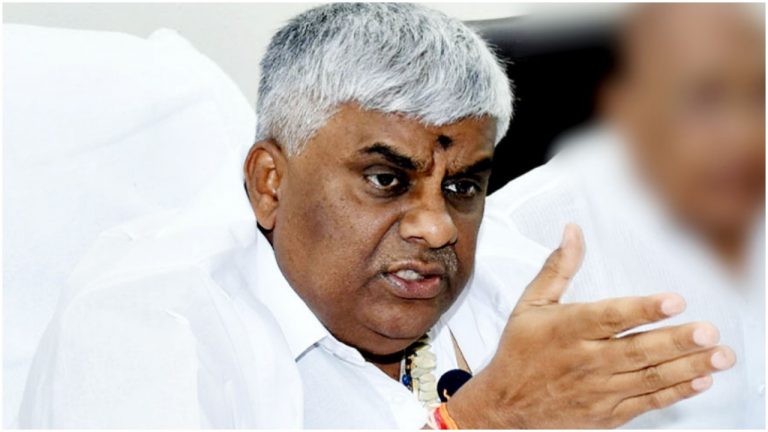
Former Karnataka minister and senior JDS leader HD Revanna has stoked a controversy after he asserted to defy lockdown rules on Thursday after he claimed that he will not be wearing protective masks despite the advisory by authorities.
On Thursday, Minister JC Madhuswamy, who is also the in-charge of Hassan district had called for a meeting in the city to discuss the ongoing coronavirus crisis. During the meeting, Madhuswamy had issued orders to the district authorities to strictly follow the lockdown guidelines and asked the officials to arrest people who are found to be violating rules by not wearing masks.
Arrest me, Will not wear mask: HD Revanna
However, HD Revanna, who was present at the meeting challenged the Minister-in-charge JC Madhuswamy and other authorities by claiming that he will not be using masks in public and also dared them to arrest him for violating the rules.
Further, HD Revanna also mocked the officials by stating that he would be happy to get arrested as he would get better food inside the jail.
“I will not wear any mask. You can arrest me. Due to the corona epidemic and lockdown, there is not enough food available outside, I will be happy to stay inside Jail,” said HD Revanna during the meeting.
Revanna follows brother HD Kumaraswamy to defy lockdown:
HD Revanna’s statement comes on the same day when his brother HD Kumaraswamy has also received criticism for deciding to go ahead with his son Nikhil Kumaraswamy’s wedding ceremony.
Defying the nationwide lockdown, HD Kumaraswamy has decided to go ahead with his son’s wedding in Ramanagara district. The Janata Dal-Secular leader announced that while Bengaluru has been declared a ‘Red Zone’, Ramanagara falls under ‘Green Zone’. Hence, the wedding will be held in a farmhouse near Ramanagara on April 17.
Rising positive cases in Karnataka
Meanwhile, 34 new coronavirus cases have been reported on Thursday in Karnataka, the total number of positive cases stands at 313 in Karnataka. This is so far the largest increase in a day so far in the state.
Out of the 34 cases, 17 patients who were tested positive on Thursday are from Belagavi. Reports say that all are linked to the Tablighi Jamaat event.
In the Christian church denominations of the Catholic orders, there is a tradition of confessing anonymously to a parish member for sins that the confessor commits. Scenes of mafia killers confessing were made popular in the popular TV show The Sopranos and countless movies linked to the Italian origin mafia. One media outlet it seems has just done that in a tacit manner, while trying to hide the intentions and the origins of the confession. The Print has seemingly lapsed into its old habits of creating news out of nothing. In a summary piece published the ‘Editorial Staff’ of The Print, it has published nothing short of a calumny when it claims that the Prime Minister Modi is unhappy over how the Indian media has been praising China response despite the pandemic originating there.
What makes it quite ironic is the fact that the story quotes a press release on the Prime Minister’s interaction with the media of the print industry, and fail to mention an even more important part completely missing from the Print’s coverage to say the least. Quoting the press release:
“He said that newspapers carry tremendous credibility and the local page of a region is widely read by people. It is therefore imperative that awareness about coronavirus is spread through articles published in this page. It is essential to inform people about where the testing centres are, who should get tested, whom to contact to get tested and follow home isolation protocols. This information should be shared in newspapers and web portals of the paper, the Prime Minister said. He also suggested that information like location of availability of essential items during lockdown can also be shared in the regional pages.”
Conveniently though the Print seems to ignore the fact that this was not the sole interaction with media. Prime Minister Modi had also interacted with the electronic media and the radio fraternity, and pretty much echoed the same message with them. For instance, with the radio fraternity, the PM had exhorted the Radio Jockeys to disseminate positive stories and case studies, particularly of those patients that have fully recovered from coronavirus infection, and also inter-play such stories in different parts of the country, thus bringing the entire country together. To the news channels, the PM had suggested the need to counter pessimism and panic through positive communication, highlighting the necessity to keep the doctors and health care workers motivated since they are at the forefront of this fight.
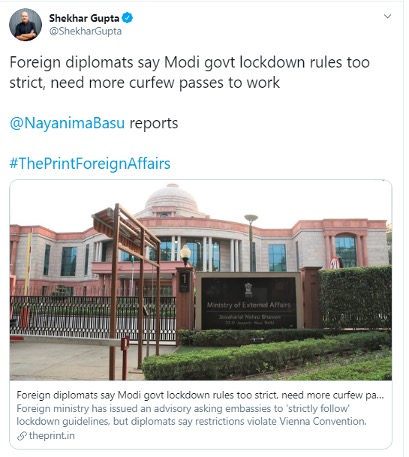
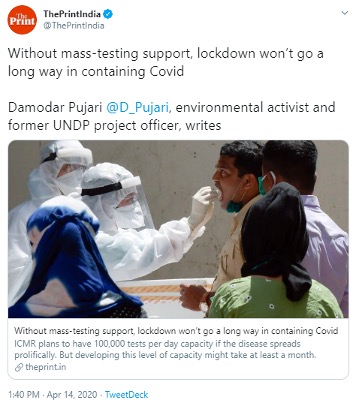
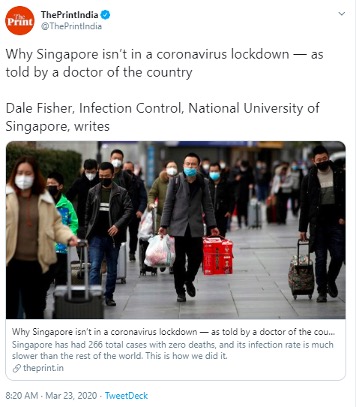
However, all that we have seen from The Print so far is obsessively sceptical coverage, questioning of official figures, and rumour mongering and panic creation by continuous harping on the underreporting and undertesting. Further, it even castigated the need for a lockdown, citing examples of countries only to end up with egg on its face subsequently on every occasion.
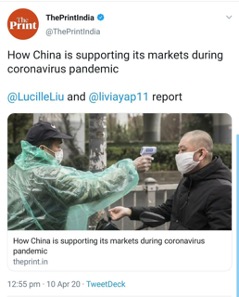
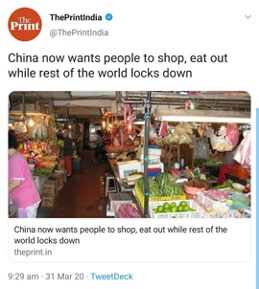
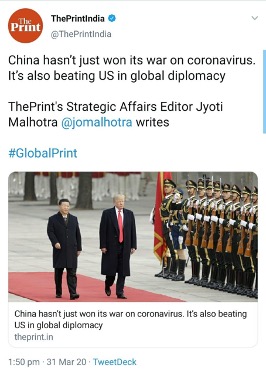
Article by The Print
Article by The Print
Article by The Print
This mainstream media habit by The Print of discovering ‘sources’ and quoting to tell the readers that ‘the Prime Minister Narendra Modi is unhappy’ reads straight out of the UPA Era, when a certain National Advisory Council chairperson would often be unhappy about the government’s decisions rather frequently. Be that as it may, the piece seems to read more and more like a confession statement to church parish done anonymously, the difference being that the parish here is the reader of the Print. While other media houses have covered China, the so-called praise has been conspicuous by its absence in most of the media coverage barring the confessor.
Picture in Contrast: Is The Print reading more and more like the new mouthpiece of China in India?
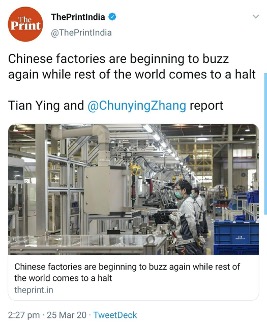
The man behind the organization, Shekhar Gupta of the coup theory infamy, and his team at The Print have been caught with his literal pants down for reporting fake news. However, a cursory glance through the ‘news’ belted out by the site on the COVID-19 issue makes one wonder – is the team at The Print being more than an apologia for the Chinese Communist Party (CCP) in India? The question arises as one goes through their coverage of China and the stark contrast with the coverage of India’s response – it is not only premised on fake news, but also reeks of malevolence to a degree of fault.
While coverage of the Chinese response to the COVID-19 pandemic is perfectly legitimate – many other organizations have also done the same – the sheer volume of webspace, time, energy and resource expended in painting a rosy picture of China flies in the face of public perception and anger not just within India but across the world. The gung-ho coverage of how China has gone about the pandemic crisis seems as if all is well is baffling to say the least. But for the print logo, one could be mistaken to see it as the coverage provided by Xinhua, China Cable Television (CCTV) CCTV Global Television Network (CGTN) or the Global Times or People’s Daily, all of which are essentially mouthpieces of the CCP and will always toe the line of the government, come what may.
Article by The Print
Article by The Print
Article by The Print
Article by The Print
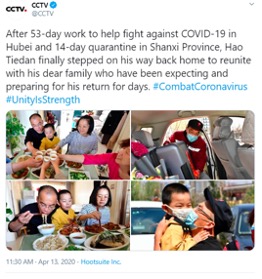
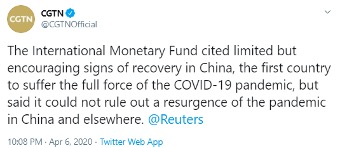
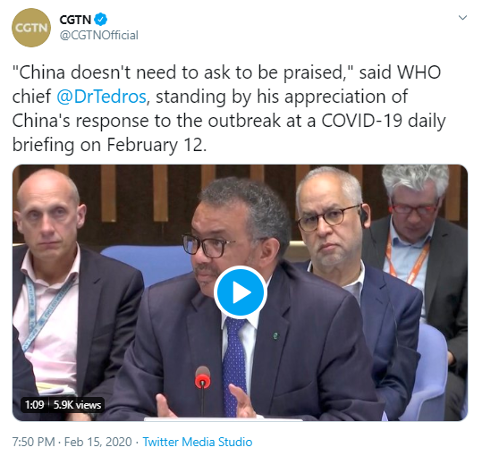
Compare it with the kind of tweets the propaganda machinery of China has been putting out on the subject, and the eery similarity of the tone cannot be missed by even the most uninformed person.
Article by China mouthpiece
Article by China mouthpiece
Tweet by China mouthpiece
Article by China mouthpiece
During the horrific era of China’s Cultural Revolution, people were forced to indulge in self-criticism and self-denunciation as a form of repentance. Media outlets controlled by the government would regularly publish lists of petty bourgeoise who were worthy of public condemnation, and many tragically died as a result. Propaganda has since only become stronger and more sophisticated for the CCP, as it continues to pay outlets to publish large paid advertisements across the world in an almost newspaper like fashion; only that bit is conveniently not told.
Many people have always believed that there exists a famous media house in Chennai that often acts as the unofficial Chinese consulate in that city. One would be compelled to believe, going by the coverage, that another media outlet, this time based in Delhi has seemingly joined the bandwagon.
And while on the surface it seems harmless, putting it in context makes you raise questions of credibility on the organization and the journalism it chooses to print. The only request one could make in such a scenario is to at least not create fake news or belittle efforts of a resource constrained country like India doing all within its reach to control the COVID-19 pandemic. The virus did come from China, and the sooner the facts get ‘print’ed, the better it would be for your own conscience, judging by your tacit confessions.