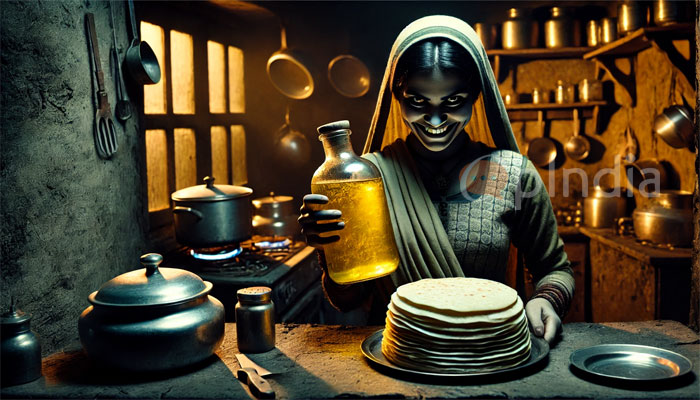
On Monday, 14th October, a shocking incident came to light in Ghaziabad where a maid was found to have been feeding roti (flatbread) mixed with her own urine to a family for years. The maid, identified as Reena, had been working as a cook for the family of a real estate businessman for the past eight years. A recording of her urinating in a bowl and then kneading flour with it has gone viral on social media. OpIndia has accessed the FIR in the matter, which was registered after a complaint was filed by the family.
Source: UP police
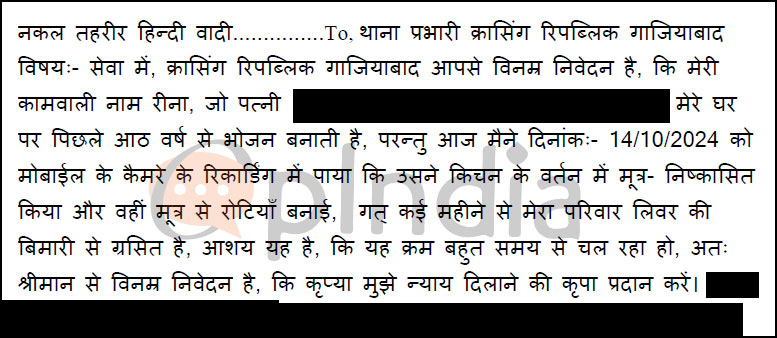
On Monday, a woman from the Crossing Republic police station area approached the police to file a complaint against her maid. In her complaint, she told the police that her maid, Reena, had been working for her for the past eight years. On 14th October, she discovered, through a mobile recording, that the maid had urinated in a bowl in the kitchen and used the same bowl to knead the flour. She added that her family had been suffering from liver disease for several months. She suspected that the maid had been doing this for a long time. Based on her complaint, an FIR under Section 272 of the Bharatiya Nayay Sanhita (BNS) was registered by the police.
UP के ग़ाज़ियाबाद में 8 साल से घर में काम करने वाली नौकरानी रीना पर आरोप है की वह किचन में ही बर्तन के अंदर मूत्र विसर्जन करके मूत्र में ही आटा गूंथ रोटी बनाती थी। वीडियो सामने आने के बाद नौकरानी रीना को गिरफ्तार कर लिया गया है बताया जा रहा है की पूरा परिवार कई साल से बीमार है।… pic.twitter.com/Zp8mxrzJCx
According to media reports, the family had been suffering from liver disease for the past few months. The doctors were unable to determine the reason behind the health issues they were facing. Moreover, there were incidents of theft of food items from the kitchen in recent times. Suspecting the maid, the woman placed a mobile phone with the camera running in video mode in the kitchen to record what was happening there.
When she checked the footage, the family was shocked to see the maid mixing urine in the dough for roti. In the video, the main can be urinating in a kitchen utensil and then using it to make dough.
Speaking to the media, the family said they had trusted Reena wholeheartedly. She had been with them through thick and thin, and they regarded her as a family member. There had been some incidents of theft in their house, but they had never suspected Reena.
As per reports, the maid has been arrested by the police. DCP Surendra Nath Tiwari said, “Based on the complaint, a case has been registered at Crossings Republik police station. The accused maid Reena has been arrested. Investigation and further action are being taken in the matter.”
During the initial interrogation, Reena denied the allegations. She even swore that she could not even think of doing anything like this. But when the police showed her the footage, she refused to say anything. It is yet to be known why she was doing this and for how long.
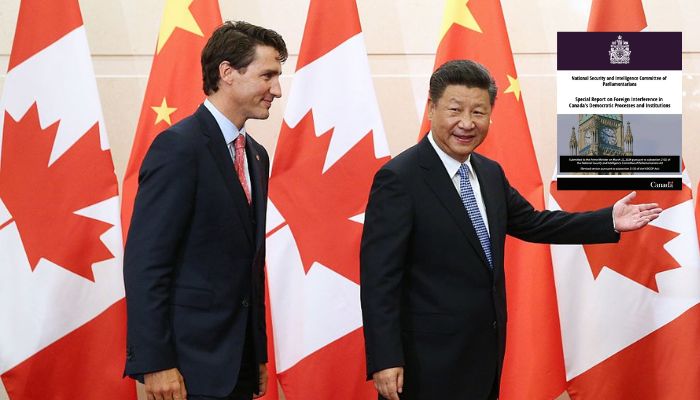
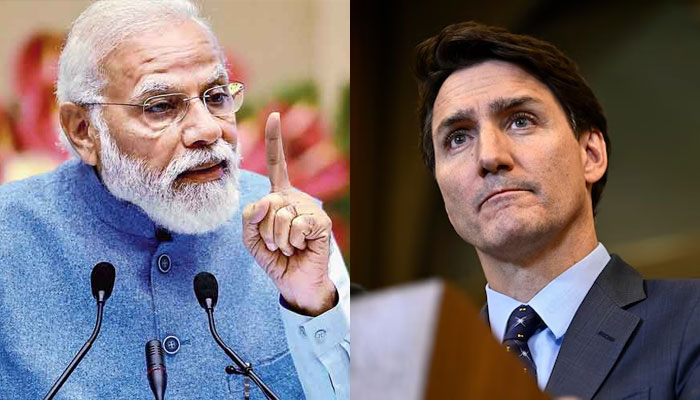
The diplomatic tensions between Canada and India are at an all-time high as Prime Minister Justin Trudeau launched a fresh tirade against the Indian government and accused Indian diplomats in Canada of being linked to ‘criminal activities’ including the murder of Khalistani terrorist Hardeep Singh Nijjar. While Canada and India have expelled their diplomats in a tit-for-tat move, it has emerged that Trudeau’s fresh anti-India statements are an attempt to divert domestic attention from allegations of Chinese interference in the past few elections in Canada.
A federal inquiry has been going on into the allegations of foreign interference in Canadian elections. During a recent public hearing of the inquiry, Public Safety Minister Dominic LeBlanc claimed that it is ‘irresponsible and partisan exaggeration’ to claim that traitors are sitting in the Canadian parliament based on the findings of the report published by intelligence watchdog National Security and Intelligence Committee of Parliamentarians (NSICOP).
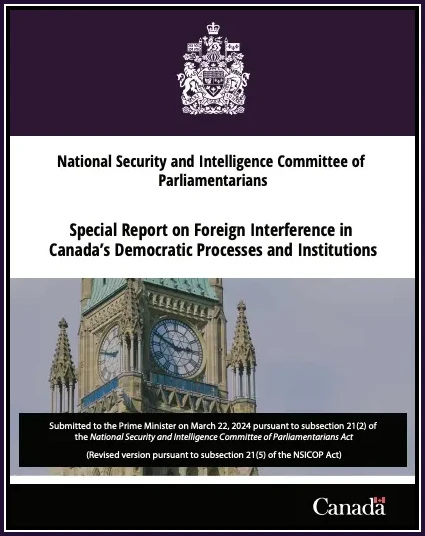
In June this year, the NSICOP report titled: Special Report on Foreign Interference in Canada’s Democratic Processes and Institutions uncovered the extensive interference of China in Canada’s electoral and legislative affairs. The redacted report mentions how certain Canadian MPs colluded with China.
NSICOP report (Redacted version)
China expanded its influence over Canadian governance and economy
The report said that some Chinese nationals, supported by the Chinese Communist Party, have and continue to engage in sophisticated efforts to break into and influence all levels of the Canadian governance and economy.
The NSICOP report emphasises the serious consequences of Chinese influence actions in Canada, which include illegal attempts to intervene in elections, bribe Canadian officials, and use covert techniques to exploit Canada’s indigenous people for resource extraction, as mentioned in the non-redacted 2019 version of the report.
“Between September 1, 2018, and November 7, 2023, foreign interference targeting democratic institutions and processes remained largely consistent with the broader trends the Committee identified in its previous review. Most notably, the PRC remained the largest foreign interference threat to Canada, including to its democratic institutions and processes,” the 2024 redacted NSICOP report states adding that the Chinese interference efforts are most sophisticated, persistent and multi-dimensional.
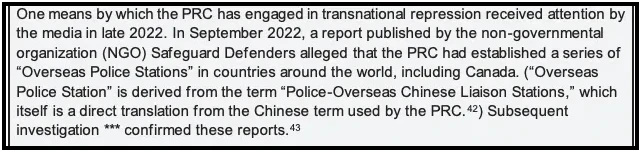
Highlighting China’s transnational repression, the NSICOP report stated that China had set up Overseas Police Stations in Canada and other countries. “In September 2022, a report published by the non-governmental organization (NGO) Safeguard Defenders alleged that the PRC had established a series of “Overseas Police Stations” in countries around the world, including Canada. (“OverseasPolice Station” is derived from the term “Police-Overseas Chinese Liaison Stations,” which itself is a direct translation from the Chinese term used by the PRC. 42) Subsequent investigation confirmed these reports,” the report reads adding that by March 2023, there were about 7 such Chinese Overseas police stations—3 in Toronto, 2 in Vancouver and 2 in Montreal.
Media to social media: China exploited all means at hand to manipulate public opinion against Canada’s Conservative Party
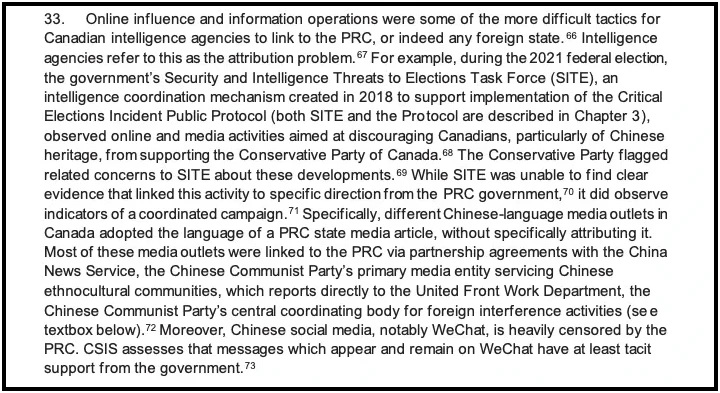
Elaborating on the tactics used by foreign actors like China to influence the opinions of Canadian voters, ethnocultural groups and parliamentarians, China used social media alongside the legacy media.
“According to the intelligence community, the PRC was the most capable actor in this context, interfering with Canadian media content via direct engagement with Canadian media executives and journalists.62 [Six sentences were deleted to remove injurious or privileged information. The sentences described examples of the PRC paying to publish media articles without attribution, sponsoring media travel to the PRC, pressuring journalists to withdraw articles and creating false accounts on social media to spread disinformation],” the NSICOP report states.
During the 2021 federal election in Canada, the Security and Intelligence Threats to Elections Task Force (SITE) noted that mainstream media and social media activities aimed at discouraging voters from supporting the Conservative Party. While a direct link to the Chinese government did not emerge, the pattern indicated a coordinated campaign orchestrated by China.
United Front Work Department: CCP’s machinery to bolster Chinese influence and interests on foreign soil
The NSICOP report detailed how CCP’s United Front Work Department (UFWD) operates through several front organisations in foreign nations to serve China’s interests and expand its influence. These front organisations do not overtly declare their affiliation to the CCP. Front organisations tasked state-owned enterprises, Chinese-registered private companies, Chinese student organisations, foreign cultural organisations, foreign media, members of Chinese ethnocultural communities, and prominent businesspeople and political figures to support the CCP’s goals through democratic institutions and processes.
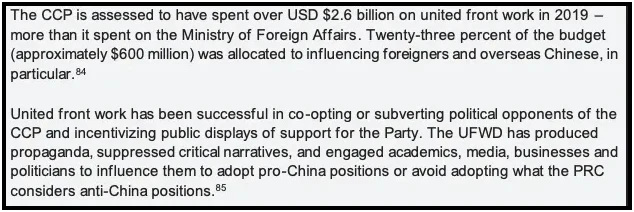
Notably, the UFWD is a well-funded department of the CCP. So much so, that in 2019, China spent over USD $2.6 billion on United Front Work, this amount is way more than it spent on China’s Ministry of Foreign Affairs.
“United front work has been successful in co-opting or subverting political opponents of the CCP and incentivizing public displays of support for the Party. The UFWD has produced propaganda, suppressed critical narratives, and engaged academics, media, businesses and politicians to influence them to adopt pro-China positions or avoid adopting what the PRC considers anti-China positions,” the report stated.
China targeted Canadian MPs for coercion or suppression
Based on the findings of the Canadian intelligence agency CSIS, the NSICOP report said that foreign actors have targeted federal parliamentarians to collect information to support potential future efforts to coerce them. Foreign actors have also intimidated or pressured parliamentarians who they perceived as having taken political positions counter to theirs.
The report mentioned that there were 11 candidates and 13 political staffers involved, “some of whom appeared to be wittingly working for the People’s Republic of China.”
The report also mentioned that a now-former MP used their position to develop a friendship with a foreign intelligence official. “According to CSIS, the member of Parliament sought to arrange a meeting in a foreign state with a senior intelligence official and also proactively provided the intelligence officer with information provided in confidence,” the report said.
According to the research, MPs frequently exchanged information about their own colleagues with foreign countries, recognising that the material would be used to pressure a fellow MP to alter their stand.
“Providing foreign diplomatic officials with privileged information on the work or opinions of fellow Parliamentarians, knowing that such information will be used by those officials to inappropriately pressure Parliamentarians to change their positions,” the report said.
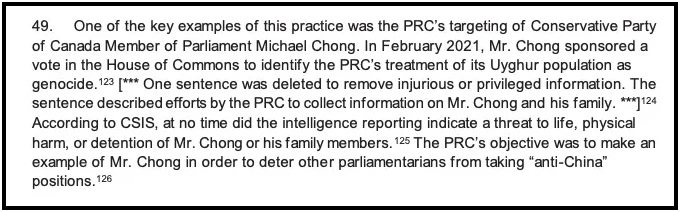
The Chinese influence over Canadian parliamentarians magnified to such an extent that it began rewarding and punishing Canadian MPs based on their pro or anti-China opinions expressed in the House. The report mentions the case of Conservative PM Michael Chong and said that Chong had in February 2021, sponsored a vote in the House of Commons to identify the PRC’s treatment of its Uyghur population as genocide. However, it was only in May 2023, that he was made aware by the Canadian intelligence agencies about the Chinese threat to him and his family for his ‘anti-China’ stance.
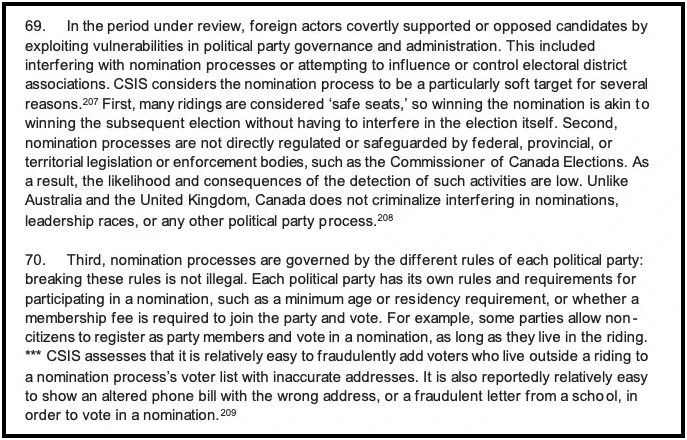
China also interfered in the electoral nomination process and supported or opposed candidates by exploiting loopholes in the political party governance and administration. The report detailed how targeting the candidate nomination process benefitted China as some seats were considered safe seats, meaning that winning a nomination in a way ensured victory, thus not requiring China to directly meddle in the election itself. This was facilitated by the fact that nomination processes are not directly regulated or safeguarded by federal, provincial, or territorial legislation or enforcement bodies. Moreover, since nomination processes are governed by the different rules of each political party: breaking these rules is not illegal.
All excerpts taken NSICOP Canada report published in June 2024
Ever since the redacted version of the NSICOP report came out in June this year, political turmoil has been unfolding in Canada with the Conservative leaders demanding that the identities and roles of the 11 ‘traitor’ MPs be publicly disclosed and action be taken against them.
Back in 2022, it was reported how the Canadian Security Intelligence Service (CSIS) had briefed Justin Trudeau about covert funding to 11 federal candidates in the 2019 elections. Earlier in 2011, a Conservative MP named Bob Dechert came under the scanner over his relationship with a Xinhua News reporter, Shi Rong. A former Chinese spy Li Fengzhi informed that the “act of striking up a relationship with an elected official fits the modus operandi of Chinese spies”. It is said that the interference of the Chinese deep State in the federal elections of 2021 led to the defeat of the Conservative camp.
In addition to political interference, China has also been employing espionage and operating police stations to strengthen its interests in Canada. In 2022, an electric vehicle battery researcher named Yuesheng Wang was booked for sending trade secrets of Hydro-Québec to China. Interestingly, China’s official response regarding the police stations it has set up in Canada is that the stations are set up to help expats renew their IDs or driving licences. However, these stations have been used for suppressing alleged anti-China sentiments.
As the NSICOP report revealed how China had influenced the 2019 and 2021 elections in Canada and how certain Canadian MPs colluded with a foreign power for electoral gain, instead of addressing the issue and demonstrating accountability, PM Justin Trudeau shifted focus toward India, making unfounded ‘trust me bro’ level allegations against Indian diplomats and alleging their involvement in the killing of Khalistani terrorist Nijjar. This is a blatant attempt by the Liberal Party leader to divert domestic attention from the real threat to the Canadian people, the country’s democratic processes posed by China and the Trudeau government’s failure to prevent Chinese influence on Canadian elections and governance.
By targeting India, Trudeau appears to be eyeing minting both the Khalistani vote bank and also not upsetting China given that the CCP mostly targeted Conservative Party leaders. The Trudeau government, however, is not realising that it is harming the Canadian interests from two sides. On one side, Canada is losing a key ally like India and on the other, China is tightening its grip on Canada.
The Supreme Court on Wednesday rejected the former Bihar legislator Munna Shukla’s plea seeking time to surrender in the 1998 Brij Bihari Prasad murder case. A bench led by Justice Sanjiv Khanna dismissed the plea by Vijay Kumar Shukla alias Munna Shukla.
On October 3 the Supreme Court upheld the trial court order convicting and awarding life imprisonment to former MLA and RJD leader Vijay Kumar Shukla alias Munna Shukla and one other accused in connection with the 1998 murder of former minister Brij Bihari, while acquitted six others.
Munna Shukla and Mantu Tiwari have been asked to surrender within 15 days to the concerned jail authorities/court to serve the remainder of their respective sentences, while former parliamentarian Surajbhan Singh and six others have been acquitted for lack of evidence.
“In case of failure to surrender, the authorities shall take appropriate measures to arrest and detain them under law,” the top court clarified in its October 3 order.
The trial court in 2009 sentenced the eight accused to life imprisonment. But the Patna High Court in 2014 acquitted them for lack of evidence. An apex court bench of justices Sanjiv Khanna, Sanjay Kumar and R Mahadevan delivered the verdict on October 3, which brought relief to Surajbhan Singh, and partially upheld the Patna High Court decision acquitting six accused.
“In so far as Suraj Bhan Singh, Mukesh Singh, Lallan Singh, Ram Niranjan Chaudhary, and Rajan Tiwari are concerned, we give them benefit of doubt and uphold their acquittal,” the top court said.
“The conviction and sentence awarded to Mantu Tiwari and Vijay Kumar Shukla alias Munna Shukla by the trial court under Sections 302 and 307 read with Section 34 of the IPC are affirmed and restored,” it added.
On August 22, the Supreme Court reserved the order on the appeals filed by Brij Bihari Prasad’s wife Rama Devi and the Central Bureau of Investigation (CBI). Rama Devi and the CBI have challenged the Patna High Court decision in 2014 whereby it acquitted the accused for lack of evidence.
On October 3, the top court found that the charge under Section 302 (murder) read with Section 34 of the IPC against Mantu Tiwari and Munna Shukla for the murders of Brij Bihari Prasad and Lakshmeshwar Sahu is proven and established beyond reasonable doubt. It also held the charge under Section 307 read with Section 34 of the IPC against Mantu Tiwari and Munna Shukla for attempting to murder is proven and established beyond a reasonable doubt.
“Consequently, Mantu Tiwari and Vijay Kumar Shukla alias Munna Shukla shall have to undergo imprisonment for life,” the top court said. The court also slapped a fine of Rs 40,000 on both convicts.
The top court said that regarding the question of conspiracy and the evidence against Suraj Bhan Singh, Mukesh Singh, Lallan Singh, and Ram Niranjan Chaudhary, there is no direct ocular evidence implicating them.
“Since the charge of conspiracy is not substantiated,” the court said.
“We will not interfere with the judgment of the High Court acquitting them (six accused), and they are entitled to the benefit of the doubt,” the court added.
Rama Devi and the CBI have challenged the Patna High Court decision in 2014 whereby it acquitted the accused for lack of evidence. Eight accused including former MP Surajbhan Singh, former legislators Vijay alias Munna Shukla, and Rajan Tiwari were acquitted by the Patna High Court.
(This news report is published from a syndicated feed. Except for the headline, the content has not been written or edited by OpIndia staff)
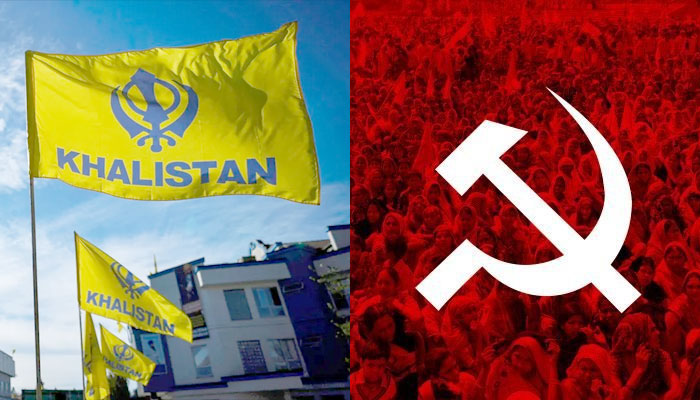
On Tuesday, 15th October, the Communist Party of India (Marxist) issued a statement in support of the Government of India amid the India-Canada row over the allegations made by Canada against India that Indian agents and officials were using a criminal syndicate to target pro-Khalistani Sikhs on Canadian soil. These recent allegations were an extension of those made by Canadian Prime Minister Justin Trudeau in September 2023, claiming that India was behind the murder of Khalistani terrorist Hardeep Singh Nijjar. In its statement, CPI(M) called anti-India Khalistani elements operating in Canada a matter of “serious concern” and added that the Government of India is duty-bound to protect the national interest.
The statement read, “The activities of anti-India Khalistani elements operating in Canada have been a matter of serious concern and have a direct impact on national security. The Government of India is duty-bound to protect the national interest, for which it has support across political parties in India. The allegations levied by various official authorities of the Canadian government against India have been rejected by the Government of India. It is to be expected that the Government of India will take the opposition parties into confidence on these issues, including the allegation made about the role of the Lawrence Bishnoi criminal gang.”
While the statement from CPI(M) supporting the central govt might have appeared surprising to many, as other opposition party leaders are targeting the Indian Government over the allegations by Canada, it should be noted that Communist Party leaders were among those killed by Khalistani terrorists during the insurgency in Punjab.
Communist leaders targeted during the insurgency in Punjab
During the 1980s insurgency in Punjab, Communist Party leaders were among the most vocal opponents of the Khalistani movement and paid a heavy price for it. As noted by India Today in a report in 1986, communist leaders and workers, particularly from CPI, became targets of Khalistani terrorists for their outspoken condemnation of violence and separatism.
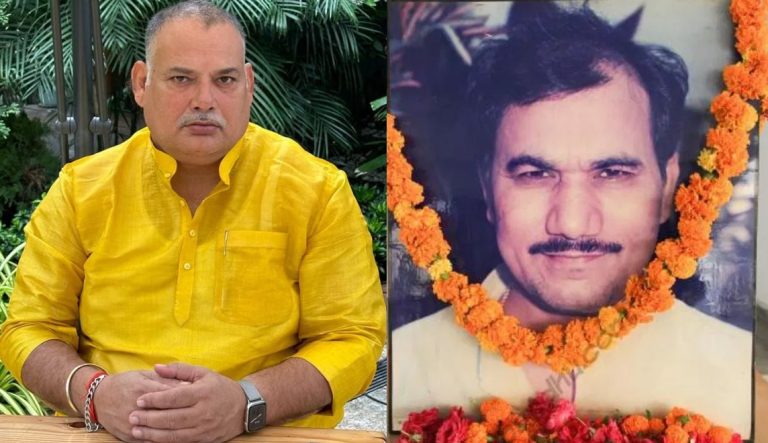
Murder of Darshan Singh Canadian
At least 17 communist leaders were hacked to death by Khalistani terrorists between 1984 and 1986, including prominent figures like Darshan Singh Sangha, alias ‘Canadian,’ a former state secretary of the CPI, and Naxalite leader Baldev Singh Mann. They were targeted because of their public campaigns and efforts to organise resistance against Khalistani terrorism in rural areas of Punjab.
Darshan Singh Canadian was an eyesore for the Khalistani terrorists. He was gunned down while riding a bicycle in his village in 1986. The terrorists who killed him left a note that read, “We are silencing this voice opposed to Khalistan. It is a lesson for others.” The brutal murder of Canadian was just a glimpse of how terrorists dealt with ideological resistance at that time.
Murder of Baldev Singh Mann
Baldev Singh Mann was the Amritsar district secretary of the CPI(ML) Chandra Pulla Reddy group and editor of the party magazine Hirawal Dasta. He was part of the communist camp that challenged Khalistani terrorism. Mann was born on 9th July 1952 and lived in the village of Bagga Kalan, Tehsil Ajnala, Amritsar, for most of his life. During his college days at Khalsa College, Amritsar, he came into contact with the CPI(ML) of Chandra Pulla Reddy-SN Singh.
He revived a left-wing association named Naujawan Bharat Sabha in his village, which had been popular during the Indian independence movement. During the insurgency, he led many public rallies and addressed several meetings calling for communal harmony in the state. On 26th September 1986, he was gunned down in his native village. Mann was survived by his wife and one-week-old daughter.
Communists’ resilience and the wider political context
When their leaders were being hacked to death in brutal fashion, CPI and CPI(M) leaders used these events to strengthen their determination to fight extremism in the state. Balbir Kaur, the widow of Canadian, encapsulated this spirit when she proclaimed at his funeral, “We are neither Hindus nor Sikhs but Indians. Down with terrorism. Long live India.”
Leaders like Canadian, Satya Pal Dang, and Gursharan Singh continued their public rallies despite receiving threats of violence from the terrorists. They lashed out against the terror tactics of Khalistani terrorists in their speeches. However, this “bravery” did not last long as they were systematically wiped out.
Given this historical context, CPI(M)’s current position in support of the Government of India against Khalistani elements in Canada is not an outlier. The Left has borne the brunt of Khalistani violence in the past as they opposed separatism and extremism, and they continue to maintain this stance even if it means siding with a government they often oppose on other issues.
One support does not wipe out past ‘crimes’
The support for the Government of India by CPI(M) seems deeply intertwined with the historical memories of Khalistani violence against communist leaders, something of which many in the current generation may be unaware. However, their current stance does not erase the ‘crimes’ communist parties have committed and continue to commit in India. Their support for the Naxal movement, siding with China, and repeated attacks on the Government of India on various issues cannot be overlooked.
One cannot forget how (CPI-M) shared a post on social media on the occasion of the 130th birth anniversary of China’s greatest mass murderer, Mao Zedong in his remembrance and indicated that he was the greatest revolutionary who helped people carry out a democratic revolution. Or, it should not be forgotten that late CPI(M) leader Sitaram Yetchury refused to acknowledge atrocities on Uyghur Muslims, defended lack of free speech in China, and had praised dictators Xi Jinping and Nicolae Ceausescu.
While CPI(M) has garnered support for the Indian government on this one issue, it is expected that, as an opposition party, they will stand on other matters that concern the national security and sovereignty of the country.
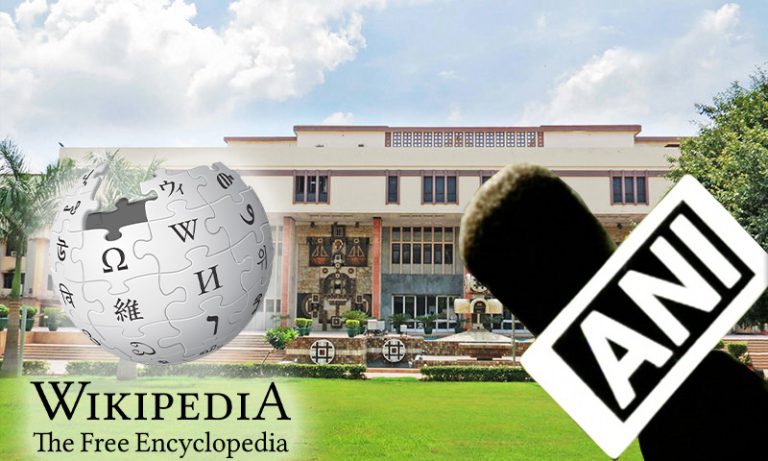
Delhi High Court on Wednesday ordered Wikipedia to take down a page on the ongoing defamation case filed by Asian News International (ANI) against the online encyclopaedia, calling it prima facie contemptuous.
A division bench comprising of Chief Justice Manmohan and Justice Tushar Rao Gedela noted that the page titled “Asian News International vs. Wikimedia Foundation” has comments against the court in relation to the case which can be considered contempt of court, and therefore ordered it to be taken down.
The concerned Wikipedia page claims that “the judge in the case has threatened to order the government of India to shut down Wikipedia in the country.” The court said, “First take down the Wiki page on this matter then we will hear.”
The order came while hearing a plea filed by the Wikimedia Foundation against an order of a single judge bench of the court directing an authorised representative of Wikipedia to be personally present in Court for the defamation case, and to disclose the identity of editors who added defamatory content to ANI’s wiki page.
Earlier on Monday, the two-judge bench objected to the creation of the Wikipedia page on the ongoing case, saying that the page will have to be taken down for the case to proceed, and the single judge cannot be put in fear or be threatened.
During the hearing on Wednesday, ANI Advocate Siddhant Kumar told the court that after the last hearing, observations of the division bench were opened up for discussion on the page. The bench said that this “compounds the contempt.”
The court said, “The said description of the impugned order and of the single judge is prima facie contemptuous and amounts to interference in the court proceedings and that too by an entity whose editors are defendants in the suit.“
Wikipedia Counsel Akhil Sibal argued that the page and its discussions were not created by Wikipedia, adding that if the court orders its deletion, the it will be complied with. “Accordingly, in the interim, this Court directs that the pages on Wikipedia pertaining to the single judge as well as discussion of the observations of division bench be taken down or deleted within 36 hours,” the Court ordered.
Notably, ANI has filed a defamation case against Wikipedia for adverse comments made in its wiki page. The agency objected to the comment saying that ANI “has been criticized for having served as a propaganda tool for the incumbent central government, distributing materials from a vast network of fake news websites, and misreporting events.”
The news agency has also sought ₹2 crore in damages from Wikipedia. In its plea, ANI said that Wikipedia has published false and defamatory content with malicious intent of tarnishing the news agency’s reputation and to discredit its goodwill.
On 20 August, the court ordered Wikipedia to disclose the identity of three editors who made those edits within two weeks. However, when Wikipedia failed to comply with the order, the Delhi High Court issued a notice to it after ANI filed a contempt petition. The court came down heavily on the foundation for not complying with the order, saying that their business transactions will be closed in India. The court had also asked Wikipedia not to work in India if they didn’t like India.
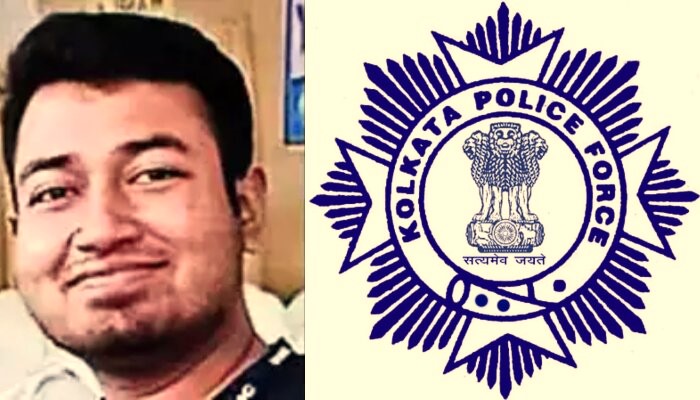
On Tuesday (15th October) evening, the Kolkata Police arrested an on-duty doctor participating in the West Bengal government’s Durga Puja Carnival because he was wearing a badge supporting the protesting junior doctors.
As a member of the medical team from Kolkata Municipal Corporation, Dr Tapabrata Roy was assigned to emergency duty during the Durga Puja Carnival on Red Road from 2 pm.
He was arrested by the police and brought to the Maidan police station for reportedly wearing a badge that read “Justice for Abhaya” and “Pratiki Anasan (Symbolic hunger strike).” He is a medical officer with KMC’s urban primary health centre 123. He was released four hours later following a demonstration organized by a group of doctors and others.
He mentioned that after being escorted off by the authorities, his phone was confiscated. “I kept asking why I was being taken to the police station, but cops could not cite any reason. They made me sign an arrest warrant while being released. I have been on a symbolic fast as a response to the call by the IMA (Indian Medical Association). I believe my wearing the badge was the reason for this harassment,” Ray unveiled.
According to a protesting doctor, he called them and informed them about the instance. “I asked him to share his live location, but his mobile phone was taken away. We managed to track his GPS and could locate it outside the Maidan police station after which we reached there. Police are not cooperating with us and not giving us the details on charges for which he has been detained,” the media reports stated.
“We protest the detention of the doctor which is completely unethical. People who were part of the ‘Droher Carnival’ are going to Maidan police station to protest and free him,” another demonstrator named Dr Kinjal Nanda expressed. He declared that until the doctor was released, they would keep staging protests in front of the Maidan police station. However, Ray was let go by the authorities after the protest intensified.
Junior doctors staged their “Droher Carnival” (protest carnival) from Rani Rashmoni Road in the city’s Esplanade neighbourhood. This came just after the Calcutta High Court overturned restrictions on some places close to the Durga Puja Carnival on Red Road. People from all walks of life joined doctors at the march to demand justice for the 32-year-old RG Kar Medical College and Hospital trainee doctor who was brutally raped and murdered on 9th August.
Police action on peaceful protesters
Notably, the police under Chief Minister Mamata Banerjee have been trying to quell the protests even by violent means. A protest march named “Nabanna Abhijan” was organised by the student group Paschim Banga Chhatra Samaj and the dissident state government employees’ platform Sangrami Joutha Mancha on 27th August.
The demonstrators marched in the direction of the state secretariat building, demanding the resignation of Mamata Banerjee for her failure to take decisive action against the perpetrators in the case. However, in order to drive away peaceful protestors and prevent them from reaching the State Secretariat, the Kolkata Police employed water cannons, lathi charges and tear gas cannons, wounding several students.
A day after the Kolkata Police targeted the protesters, the leaders of the Bharatiya Janata Party in West Bengal, announced a 12-hour strike on 28th August. However, in the midst of the “Bangla Bandh,” many BJP leaders and party supporters were attacked by All India Trinamool Congress (AITC or TMC) members in the presence of authorities. Bombs were thrown and bullets were fired at the opposition leaders, resulting in critical injuries as the cops acted like mute spectators.
Months have passed since the trainee doctor in Kolkata was raped and killed, sparking demonstrations throughout West Bengal. The government’s will to use excessive force to suppress protests, suspicious conduct and the case’s lack of progress have all contributed to the agitation. The state government and police were also slammed by the Supreme Court and High Court for their dubious response and negligence in the case.
On Tuesday, 15th October, over 10 domestic and international flights were affected following hoax bomb threats on the anniversary of Talwinder Singh Parmar, the main accused in the Kanishka bombing. The hoax threats started pouring in on 14th October and continued on the 15th. The Ministry of Civil Aviation has called a high-level meeting on 16th October over the matter.
WION News quoted unnamed sources in the ministry suggesting that the Minister of Civil Aviation, Ram Mohan Naidu, held a meeting with the Bureau of Civil Aviation, CISF, and other senior officials regarding the bomb threats.
CISF sources confirmed that they received 10 bomb threats on social media within 24 hours. A senior police officer said, “We have identified and suspended several accounts that were posting threats on social media regarding bombs in airplanes. It has been reported that some threats originated from London and other countries.”
List of flights affected by bomb hoaxes
Most of the threats were issued on the social media platform X by an unverified account.
Delhi-Chicago Air India Flight AI 127: Following the hoax threat, the flight was diverted to Iqaluit airport in Canada. According to Air India, the flight took off from Delhi at 3 AM and landed at Iqaluit airport as a precautionary measure.
Dammam-Lucknow IndiGo flight 6E 98: Following the hoax threat, the flight made an emergency landing in Jaipur. An IndiGo spokesperson said in a statement, “We are cognisant of a situation involving flight 6E 98 from Dammam to Lucknow. The safety and security of our passengers and crew is our highest priority, and we are working closely with the relevant authorities and taking all necessary precautions as per the guidelines.”
Jaipur-Ayodhya Air India Express flight IX 765: Following the hoax threat, the flight made an emergency landing in Ayodhya around 2 PM.
Mumbai to New York Air India flight AI 119: The flight made an emergency landing in New Delhi following the hoax threat on Monday.
Jaipur-Bengaluru Air India Express
Akasa Air flight from Bagdogra to Bengaluru QP 1373
Darbhanga-Mumbai SpiceJet flight
Siliguri-Bengaluru Akasa Air flight
Alliance Air Amritsar-Dehradun-Delhi flight 9I 650
Air India Express flight from Madurai to Singapore IX 684
An airport officer was quoted by the media as saying, “In the last 24 hours, we have received several bomb threats in various sectors. We are responding to all the calls and have also informed the concerned police officers regarding the threats in order to identify the individuals behind them.”
A senior officer in airport security was also quoted by the media, stating that every threat is treated seriously and cannot be ignored as it concerns the safety of passengers. He said, “After receiving a threat, we inform airlines and the relevant security officer at the airport to follow the necessary procedures.”
Connection between hoax calls and Khalistani terrorist Talwinder Singh Parmar
Most of the hoax calls were made on 15th October, the death anniversary of Khalistani terrorist Talwinder Singh Parmar, who was the mastermind behind the Kanishka bombing. Parmar was born on 26th February 1944 to a Sikh family in Panchhat, district Kapurthala, Punjab. In May 1970, he migrated to Canada and became a naturalised citizen of the country. Talwinder Singh Parmar was the founder of the Khalistani terrorist organisation Babbar Khalsa International, along with Sukhdev Singh Babbar. The organisation was founded in 1978.
Assassination of Lala Jagat Narain
Talwinder Singh Parmar claimed responsibility for the assassination of Lala Jagat Narain, the founder of Hind Samachar and a former Punjab MLA and MP, who was killed on 9th September 1981. Jagat Narain was well-known for his criticism of Khalistani terrorist Jarnail Singh Bhindranwale and the Khalistani movement.
On the day of his assassination, Lala Jagat Narain was travelling in his grey Fiat from Patiala towards Jallandhar. An unmarked Royal Enfield Bullet motorcycle tailed him but went unnoticed by both driver Som Nath and Narain who was sitting in the back seat. Four kilometres outside Ludhiana, the motorcycle came alongside the car and the pillion riders fired shots at the vehicle. The driver slammed the brakes and attempted to turn the vehicle but a bus blocked the path. The pillion riders jumped off the bike. One of them had a 0.45 calibre revolver and the other had a 0.32 calibre weapon. They both fired point-blank at Narain and the driver. Som Nath sustained a bullet injury but survived.
Lala Jagat Narain, however, was not lucky enough. He was shot thrice by the attacker. He fell on the seat immediately and soon after died. Narain’s death was among the first prominent murders that sparked uproar among Hindus across Punjab.
Assassins were not lucky enough themselves. Their bike broke down after the attack. One of the attackers identified as Nachhatar Singh, a self-proclaimed Naxalite, was arrested by the bystanders while the other two Dalbir Singh and Swaran Singh were listed as accused. Dalbir Singh was involved in the murder of Baba Gurbachan Singh murder case. Swaran Singh was relative of Bhindranwale. Notably, Jarnail Singh Bhindranwale was also listed as one of the ‘conspirators’ in the murder case.
Following the assassination, Jarnail Singh Bhindranwale was accused of being involved in the murder. He offered to surrender, but only after delivering a speech at a Gurdwara in Amritsar on 20th September 1981. Shortly after his arrest, two motorcycle-borne members of Babbar Khalsa opened fire with a machine gun in a busy market in Jalandhar. Four people were killed and 12 were injured.
Arrest in Germany and extradition request of Talwinder Singh Parmar turned down by Canada
In 1983, Parmar was arrested and tried in Germany for the murder of two Punjab police officers in 1981. However, he was acquitted by German authorities. Soon after his release, he returned to Canada. India submitted a formal request to extradite him, but Canada turned it down. At that time, current Canadian Prime Minister Justin Trudeau’s father, Pierre Trudeau, was the Prime Minister of Canada.
In his book ‘Blood For Blood’, Canadian journalist Terry Milewski wrote about his incident. He said, “Canada can’t be compared to Pakistan as a springboard for Khalistani militants in the past forty years, but it has offered them the great advantage of a congenial legal and political environment. The meek Canadian response to the Khalistani challenge was a frequent target of Indian politicians as far back as 1982 when Prime Minister Indira Gandhi complained about it to Prime Minister Pierre Trudeau.”
“Not much came of it. Quite the reverse, in fact. Pierre Trudeau’s government refused the 1982 Indian request to extradite Talwinder Parmar to India for murder on the quaint grounds that India was insufficiently deferential to the Queen. That is not a joke. Canadian diplomats had to tell their Indian counterparts that the extradition protocols between Commonwealth countries would not apply because India only recognized Her Majesty as Head of the Commonwealth and not as Head of State. Case closed!” he added.
Kanishka bombing
On 23rd June 1985, the then deadliest aviation oriented terrorist attack occurred in the world. It would remain the deadliest of its kind until the 9/11 attacks in 2001. It was the bombing of Air India Flight 182 Kanishka by Khalistani terrorists which led to the death of 329 people, that is, everyone aboard the flight. The plane was blown in midair off the coast of Ireland. Out of 329 casualities, 268 were Canadian citizens.
Pierre Trudeau is vastly blamed for the Kanishka bombing, as it was only after the Trudeau-led government saved Parmar he started preparing for the bombing. In 1984, Parmar told his fellow Khalistanis that “Indian planes will fall from the sky”. In the same year, Ajaib Singh Bagri, a close associate of Parmar, pledged to kill 50,000 Hindus. He said at the founding convention of the World Sikh Organization, “Until we kill 50,000 Hindus, we will not rest!” It was reported by Milewski, who extensively covered the Khalistani movement in Canada and abroad.
Despite of his role in Kanishka bombing killing mainly Canadians, he is a “celebrated personality” among Canadian pro-Khalistani Sikhs.
On Tuesday, October 15th, a novel video related to one of the most violent attacks on Hindus during Navratri in Bahraich, Uttar Pradesh that happened on Sunday, October 13th came to the fore. In the said attack an Islamist mob mercilessly murdered 22-year-old Ram Gopal Mishra. However, Mishra alone did not face the brutal assault; he was joined by Sudhakar Tiwari, who fortunately survived the attack.
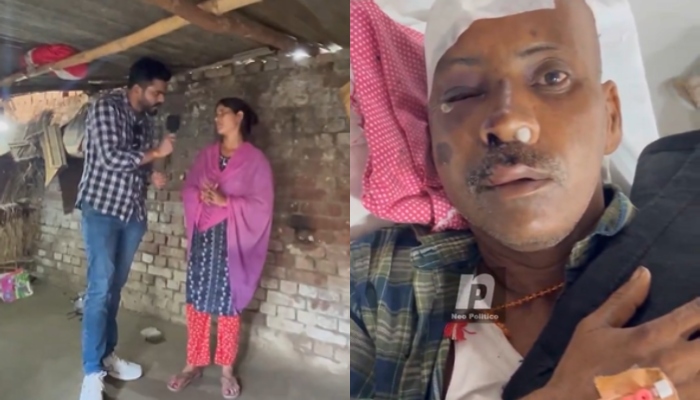
Sudhakar at present is admitted to a local hospital where he is undergoing treatment to cure severe injuries he obtained as a result of the attack. As per the reports, he has incurred head trauma and is hardly able to speak.
A video of Tiwari hospitalized was shared on X by Shubham Sharma of NeoPolitico, a media outlet. In the video, Tiwari can be seen confirming that some people from the Mosque initiated the attack on the Hindus.
“People from the mosque attacked us. I don’t remember much as they attacked us. I was injured on my head and moved unconscious. The police brought me here,” Tiwari could be heard saying as he recalled the horrific attack that happened in Bahraich on 13th October.
With #GopalMishra in #Bahraich Sudhakar Tiwari was also attacked. Watch this video as he tells, "People from Mosque attacked us…."
A clash broke out between two communities during the immersion of the Devi Durga idol in Rehua Mansoor village in the Hardi police station area of Bahraich in Uttar Pradesh on Sunday, after Muslims objected to DJ music played in the procession. One person was shot dead during the violence while several others were injured from stone pelting. The deceased was later identified as 22-year-old Ram Gopal Mishra, who was part of the idol immersion group. Mishra was rushed to the medical college hospital after the firing, but he died there during treatment.
As per reports, the incident took place at Rehua Mansoor village on Sunday evening, when the idol of Maa Durga was taken out for immersion. When the procession heading towards Gauriya Ghat was passing in front of a mosque in the Maharajganj area chanting religious slogans, Muslims gathered near the mosque and asked the procession to stop the DJ music.
This led to an argument between the two sides, and amid the chaos, some people started pelting stones at the procession and the idols. The Hindus asked the police present to arrest the culprits, but in the meantime, more people from the Muslim community arrived there.
Uttar Pradesh: A disagreement over DJ music in Bahraich turned violent when one side opened fire. After the fight, a young man died from his injuries in the hospital.
It is believed that during the turmoil, Mishra climbed onto the roof of Abdul Hamid’s house and replaced an already flying green flag with a saffron one, while cries of ‘Jai Maa Durga’ and ‘Jai Hanuman’ roared in the air.
Amid the mayhem caused by the stone pelting, some miscreant opened fire. As per reporters, someone from Abdul Hamid’s residence in the area fired shots. Ram Gopal Mishra, son of Kailash Nath of Rehua Mansoor village was shot from a close range. He was shifted to the Medical College in Bahraich, but he succumbed to injuries during treatment.
What followed was much more terrifying. The Islamists carried Mishra into a house, locked him inside, and tortured him brutally. They used pliers to remove his nails, sliced his neck with a knife, and then shot over 15 bullets at him. After killing him, the mob resumed their attack by pelting stones at his motionless body, demonstrating an immense hatred towards the Hindu community.
#बहराइच : जिस घर में रामगोपाल मिश्रा की हत्या की गई
OpIndia spoke to Harimilan Mishra, brother of the deceased Ram Gopal, in connection with this video. Harimilan said that Muslims murdered his brother by dragging him into their house. Some Hindu youths involved in the immersion procession somehow reached there and tried to bring the body out. The youths bringing the body were also attacked with bullets and stones. Some stones also hit Ram Gopal’s dead body. According to Harimilan, his brother’s body could only be brought out from the roof of another house.
When OpIndia asked whether the police did not help in bringing the body out, Harimilan replied, “My brother was killed because of the police.” He said that as long as the Hindus were united, they were not attacked, but as soon as there was a stampede due to the lathi charge by the police, the attack took place and bullets were fired. Ram Gopal Mishra became the victim of these bullets.
Brother Harimilan said that the police neither helped in saving Ram Gopal, nor in removing his body after the murder. Now, Ram Gopal Mishra has been cremated. Before the cremation, there was a long argument between the family of the deceased and the administration. Ram Gopal’s brother Harimilan said that he had cremated his brother on the basis of the assurance given by Bharatiya Janata Party MLA Sureshwar Singh.
As the news of the death of Ram Gopal Mishra spread across the state, his sister Preeti, who lives in Lucknow, rushed to Bahraich. She expressed her grief saying, “They killed my brother like an animal. They sliced his throat and removed his toenails. His entire body had been wounded by gunfire, and his stomach had many knife cuts. They shot him fifteen times,” she said.
See the big bungalow of late Gopal Mishra. How he was living his lavish lifestyle in this hut. The brother of Gopal Mishra told us that police had not given their vehicle to take Gopal to the hospital. Later, his body with 20 bullet shots was taken on a splendor bike. Police was… pic.twitter.com/QALliZymJP
Journalist Sharma also visited Mishra’s house to reveal that the deceased stayed in the most vulnerable economic conditions. Sharma also revealed that Mishra was just married and that he stayed with his wife in a single room that didn’t even have proper walls or roofs.
While Ram Gopal Mishra unfortunately succumbed to the brutal attack by Muslim radicals, Sudhakar Tiwari continues to receive medical attention and is no longer in danger.
Mishra’s death is extremely sad for his family. He was the youngest of three brothers; his two older brothers had previously died, one from suicide and the other from drowning. Gopal was his family’s last earner, and he too has now died. Ram Gopal was married only two months before the Muslim radicals killed him on 13th October during a visarjan procession of the Goddess Durga idol in the Bahraich district of Uttar Pradesh.
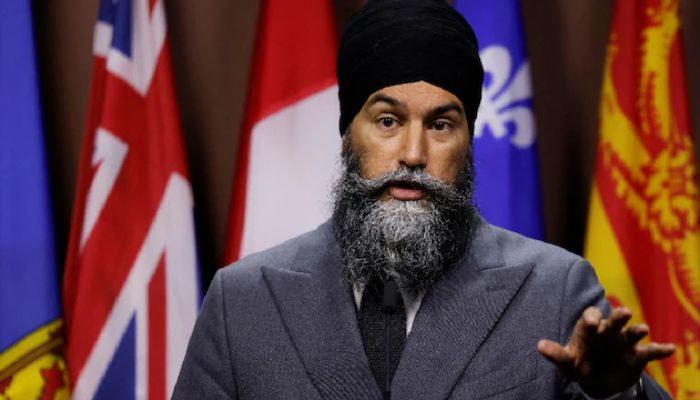
Amid the escalating diplomatic tensions between India and Canada, New Democratic Party leader Jagmeet Singh, notorious for his anti-India and pro-Khalistan views, triggered jeers and laughs from the journalists during a press conference in Ottawa. Exposing his absolute lack of understanding of diplomatic protocols, the NDP leader called for imposing sanctions against Indian diplomats.
“We support today’s decision to expel India’s diplomats and we’re calling on the Government of Canada yet again to put diplomat sanctions against India in place, ban the Rashtriya Swayamsevak Sangh Network (RSS) in Canada, and commit to pursuing the most severe consequences for anyone found to have participated in organised criminal activity on Canadian soil,” Jagmeet Singh said on 15th October.
Instead of taking media questions regarding his ‘sanction Indian diplomats’ statement, Jagmeet Singh walked out of the press conference. As Singh left the room, journalists started mocking Singh for the sheer absurdity of his statement with one of the reporters saying “That’s not how it works.”
HAPPENING NOW: Jagmeet Singh calls for "sanctions on Indian diplomats" and then exits the room to the sound of reporters laughing at him. One yells "that's not how it works" as her colleagues continue mocking Singh for another disastrous press conference. pic.twitter.com/Y7WqcDRkyw
Notably, on 14th October, the Royal Canadian Mounted Police (RCMP) issued a statement during a press conference on Monday accusing India of involvement in criminal activities in Canada. The agency claimed to have uncovered “direct links” between Indian diplomats in Canada and violent acts, including homicides. The RCMP claimed that these diplomats used their official positions to engage in clandestine activities, collecting intelligence on South Asian Canadians to target them through criminal proxies. The intelligence, according to the RCMP, was gathered through coercion, with some Canadian individuals and businesses threatened into cooperating with the Indian agents.
As reported earlier, the RCMP inadvertently admitted that Canada has become a safe haven for pro-Khalistan elements when they clarified that India’s actions are not targeting Sikhs as a whole, but specifically focusing on pro-Khalistani individuals. By acknowledging this, Canada inadvertently exposes the influence of Khalistani elements within its borders, while India continues to uphold its stance against terrorism, not a community.
India, in response, strongly rejected the Canadian claims and said that Canadian Prime Minister Justin Trudeau made certain allegations in September 2023. However, the Canadian government has not shared a single piece of evidence with the Indian government despite many requests from them.
Citing the outrageous allegations levelled by the Canadian authorities against the Indian government, Jagmeet Singh launched a direct attack on the Modi government. He said: “It confirmed some of the background of how we got here. Really what it highlighted is that we’ve got the Indian government, specifically the Modi government, that is engaged through diplomats in Canada, criminal elements that have then gone on to shoot at Canadian homes, to shoot at Canadian businesses, to kill Canadians. That is very serious. As the RCMP mentioned, the briefing also mentioned, that there are deep concerns for Canadian safety, and that’s why I really believe it is our responsibility if we believe in protecting our country, I love this country, we need to do everything possible to keep people safe and to keep our democracy safe…,” Singh said.
On the India-Canada row, Anil Trigunayat, a former Diplomat said that Canadian Prime Minister Justin Trudeau is responsible for the worsening relationship between both countries.
Trigunayat said that Trudeau cultivated and “pandered to the anti-India extremists, terrorists and separatist groups.”
Talking to ANI, he said, “I think that the relationship between India and Canada has hit rock bottom and the complete credit for this goes to the current Prime Minister, Justin Trudeau, who has made it a point to cultivate and to pander to the anti-India extremists, terrorists and separatist groups and is supporting them and unnecessarily has been making various blatant allegations against India and the killing of a terrorist called Nijjar and since then they have not provided any evidence,” he said.
Former IFS officer and President of India Habitat Centre, Bhaswati Mukherjee said that the statement by Canada is extremely provocative.
She said, “The sharp statement that came from the Canadian side, was extremely provocative. It said that our high commissioner to Canada was the representative of the President of India to Canada and is a suspect in our murder assassination case, which implies that they are neither respecting the Indian convention nor are they giving any indication that they will issue his safety,” he said.
Mukherjee further said that India reacted sharply as it is an independent sovereign country.
“Since we are not a banana Republican, but a proud, democratic, independent, sovereign country, we reacted sharply because no country in the world, unless it was a banana republic, would have reacted in any other way,” she said.
India and Canada have been dealing with an unprecedented diplomatic crisis after Canadian Prime Minister Justin Trudeau alleged that Indian government agents were involved in the killing of Nijjar in Canada. India has rejected Canada’s allegations, terming it “absurd” and “politically motivated.”
(This news report is published from a syndicated feed. Except for the headline, the content has not been written or edited by OpIndia staff)