

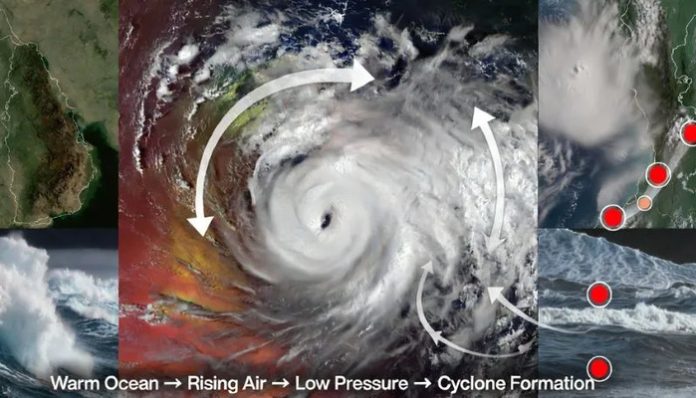
Ditwah, a powerful cyclonic storm that formed in the Bay of Bengal, struck neighbouring Sri Lanka, causing unprecedented devastation. More than 120 people died in the country due to the cyclone, which caused extensive damage. The cyclone is now reportedly moving toward India’s coastal areas, including Tamil Nadu, Puducherry, and southern Andhra Pradesh. The Indian Meteorological Department (IMD) has issued a red alert for heavy rain and gusty winds in these states, and residents have been advised to stay indoors.
#WATCH | Rameswaram, Tamil Nadu | Strong winds, rain and rough sea conditions in Pamban as a result of cyclonic storm 'Ditwah' moving north-northwest across Sri Lanka and the southwest Bay of Bengal.
— ANI (@ANI) November 28, 2025
'Ditwah' expected to cross near the coast by early November 30th, says IMD. pic.twitter.com/laSbb10ZOP
What is a cyclone and how is it formed?
A cyclone is a large and powerful storm that forms over an ocean, caused by a strong low-pressure centre and inward-spiralling winds. It is like a wind machine, bringing with it strong winds, torrential rain, and high waves. These storms typically form over warm waters like the Indian Ocean and cause massive destruction upon reaching land.
Here is how a cyclone typically forms over an ocean. For a cyclone to form, the ocean surface water must be very warm (about 26.5°C or higher). This heat is what powers the storm. When the water has reached the ideal temperature, the air above it also heats up, becomes lighter, and begins to rise rapidly. The rising air creates a void near the ocean’s surface, reducing the pressure in this area. This is the “centre” where a storm brews up.
To fill this void created near an ocean’s surface, cold air from the surrounding area rushes in at a fast rate. Gushing winds approach this ‘centre’, and the Coriolis force (resulting from the Earth’s rotation) causes them to spin in a circular motion. This swirling air continues to rise, transforming into steam and forming large clouds. When the speed of these winds exceeds 119 kilometres per hour, it becomes a full-blown cyclone. Cyclone Ditawah formed similarly over the Bay of Bengal, which first hit Sri Lanka and is now approaching the coast of India.
Why are cyclones so dangerous?
A cyclone isn’t just wind and rain; it is a formidable combination of wind and rain moving at reckless speed. The winds in a cyclone are so powerful that they can uproot trees, destroy houses and buildings. They can even topple electricity poles, plunging cities into darkness.
Cyclones bring heavy rainfall, so much so that flooding occurs within hours. Floodwaters inundate homes and farmland, causing significant damage. Strong winds raise ocean waters to great heights, and these high waves (like a moving wall) rapidly approach land. This can submerge coastal areas in an instant, causing significant loss of life and property. Cyclones can wreak havoc on agriculture, livestock, and the entire region’s economy. Therefore, as soon as the weather department issues a “red alert,” people in affected areas should immediately move to safety.
Cyclone Ditawah has a devastating impact on Sri Lanka
Cyclone Ditawah struck Sri Lanka, causing a major disaster. The government described it as “destruction like never before.” More than 120 people have died, and 130 are still missing. Heavy rainfall caused flooding in many areas and landslides in hilly areas and mudslides.
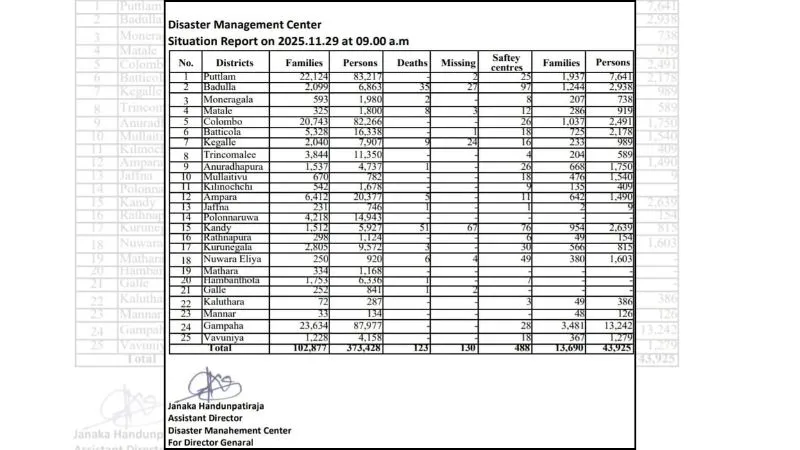
The situation was so alarming that the government had to evacuate around 44,000 people from their homes and send them into camps set up in schools and other safe places. Water level rose significantly in Sri Lanka’s capital, Colombo, and surrounding areas, prompting immediate evacuation there as well. Schools were closed, trains were halted, and even the stock market was forced to close early due to the storm.
‘Operation Sagar Bandhu’ linked to PM Modi’s vision ‘SAGAR’
At a time when Sri Lanka is dealing with such a massive disaster, India launched “Operation Sagar Bandhu” to assist in relief and rescue work. The operation demonstrates how India is a trustworthy friend to its neighbours. With Operation Sagar Bandhu, India has proved that it is always willing and prepared to help its neighbours during difficult times.
India’s benevolent gesture has further strengthened its relationship with Sri Lanka. This demonstrates India’s strong capabilities in providing Humanitarian Assistance and Disaster Relief (HADR). In this relief operation, India deployed its large and modern warships, such as INS Vikrant, showcasing India’s maritime prowess and alertness.
#OperationSagarBandhu unfolds. @IAF_MCC C-130 J plane carrying approx 12 tons of humanitarian aid including tents, tarpaulins, blankets, hygiene kits, and ready-to-eat food items lands in Colombo.
— Dr. S. Jaishankar (@DrSJaishankar) November 29, 2025
?? ?? pic.twitter.com/btzlnZeO8x
Whenever a neighbouring country faces a crisis, China also attempts to utilise the opportunity to establish its influence there. However, China’s expansionist ambitions were foiled by India’s swift action of sending aid to Sri Lanka in time. Operation Sagar Bandhu is linked to Prime Minister Modi’s larger vision of “SAGAR” (Security and Growth for All in the Region). The vision signifies that India is always ready to ensure the security and progress of the entire Indian Ocean region.
What will be the impact of Cyclone ‘Ditwah’ on India?
After wreaking havoc in Sri Lanka, Cyclone Ditvaah is now moving toward India. The Indian Meteorological Department (IMD) predicts it could reach coastal areas in northern Tamil Nadu, Puducherry, and southern Andhra Pradesh by the morning of November 30, 2025. The Meteorological Department has issued a red alert in several Tamil Nadu districts, including Cuddalore. Heavy downpour is expected in these regions, which could cause flooding and submerge low-lying areas over the next couple of days. Wind speeds could reach 70 to 90 kilometres per hour, which could cause downed trees, power poles, and damage to homes.
Additionally, Chennai and the surrounding districts will experience heavy rains, disrupting flight services and daily activities. An orange alert has been issued, and the local administration has geared up to deal with this threat. In Cuddalore district alone, 233 relief camps have been set up to accommodate 150,000 people. Motors and teams are also ready to pump out water, and doctors are working 24 hours a day in all government hospitals.
#WATCH कुड्डालोर, तमिलनाडु: चक्रवात 'दितवाह' पर जिला कलेक्टर सिबी अधित्या सेंथिल कुमार ने कहा, "चक्रवात दितवाह को देखते हुए IMD ने कुड्डालोर जिले के लिए बहुत भारी बारिश की चेतावनी जारी की है। जिला प्रशासन ने तैयारी के लिए कई कदम उठाए हैं…हमने 233 राहत सेंटर भी पहचाने हैं जहां… pic.twitter.com/YOMBX4DZ0S
— ANI_HindiNews (@AHindinews) November 28, 2025
People have been advised to remain indoors for the next few days. Fishermen who venture out into the sea have been strictly advised to avoid going near the sea til December 1, 2025. Flights between Chennai and Sri Lanka have also been affected. Anyone experiencing any concerns can call the government helpline number 1077.
(This is a translation of the original article published on OpIndia Hindi.)


