The conflict between the United States, Israel, and Iran has disrupted the global energy supply. The vital Strait of Hormuz has been seized by the Islamic Republic in an attempt to impose an unbearable economic burden on the United States and its associates. However, the fallout has reached far and wide, impacting nations with no involvement in the war, such as India. Nevertheless, there appears to be a solution to this energy crisis that has generated global concerns.
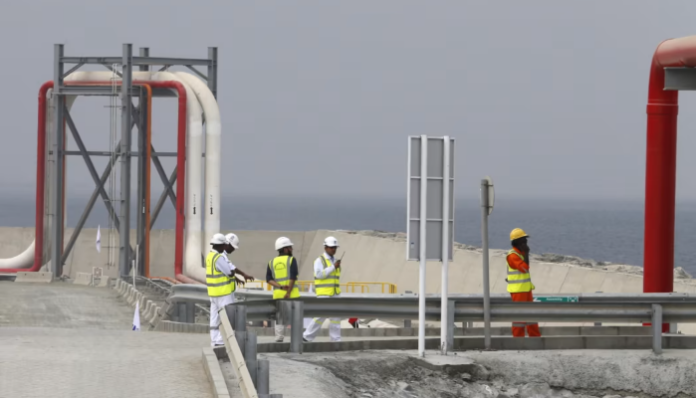
Two pipelines have been constructed specifically for this purpose, one located in Saudi Arabia and the other in the United Arab Emirates, which are designed to circumvent the strait. They are the sole means of transporting an extensive amount of Persian Gulf oil into international markets. They cannot completely replace the flows conveyed by tanker ships, but their use serves as a single factor stopping an even more dire situation from emerging.
Saudi Arabia is moving as much crude as it can through its pipeline to Yanbu, a port on the Red Sea. It was constructed 45 years ago in the early 1980s when shipping in the Persian Gulf was at risk due to the Iran-Iraq War. “While we have faced disruptions in the past, this one by far is the biggest crisis the region’s oil-and-gas industry has faced,” informed Amin Nasser, Saudi Aramco’s chief executive, as quoted by The Wall Street Journal.
He added, “The shipping blockage has made Saudi Arabia’s East-West pipeline one of the most critical pieces of infrastructure in the world economy. The state oil producer expects to send a maximum of 7 million barrels of oil through the 746-mile-long pipeline within a few days.”
Saudi Arabia has one real bypass — the Petroline, a 1,200 km pipeline across the Arabian desert that exits at Yanbu on the Red Sea. The UAE has a pipeline to Fujairah, just outside the Gulf's mouth. But both are already running near full capacity. Together, in a pinch, they might… pic.twitter.com/iGseLJWBYO
— Markets by Zerodha (@zerodhamarkets) March 4, 2026
The pipeline takes oil from massive sources in eastern Saudi Arabia to the nation’s Red Sea Coast, winding over dunes, mountains and lava fields. Its length is similar to that of the Trans-Alaska Pipeline.
Two years after the initial shipment, in 1983, an internal Aramco newsletter stated that over 7,000 individuals worked on the four-year project, which was supervised by a subsidiary of Mobil Oil. 2,000 tonnes of explosives were used to blast a trench across the Arabian Peninsula for a parallel conduit intended for the byproducts of natural gas. The artery was designed to avoid the Persian Gulf and strengthen the proximity of Saudi goods to markets in the West.
The kingdom’s refiners use about 2 million barrels of oil every day, leaving 5 million barrels that could be sold to other countries. According to the International Energy Agency (IEA), that is equivalent to the majority of its crude shipments over the strait before the standoff. However, the pipe has never operated at maximum capacity for a prolonged period of time.
Additionally, it cannot resolve the entire issue because Aramco cannot reroute the 800,000 barrels of petroleum products that are sent via the strait every day. Furthermore, oil is also stuck in Bahrain, Iraq and Kuwait. The strait is a chokepoint for over 20 million barrels of oil and refined items each day, accounting for one-fifth of global consumption. The Saudi pipeline would not be able to counteract all of that. However, it can offer an alternative for up to 5 million barrels per day.
For 1.5 million barrels, a pipeline maintained by the United Arab Emirates provides a second bypass option. It can be employed to transfer crude from Abu Dhabi to the port of Fujairah on the Gulf of Oman. Moreover, the country could likely raise the figure to over 2 million in an emergency, reported Bloomberg.
What role can the pipelines play?
These two together can slow the skyrocketing prices of petroleum if enough tankers arrive at the loading ports. Presently, roughly 25 supertankers, each with a capacity of 2 million barrels, are headed toward the new pickup locations after diverting from their original courses.
On 8th March (Sunday), three very large crude carriers or VLCCs were loaded simultaneously at the Yanbu and Al Muajjiz terminals on the Red Sea by Saudi Aramco. Similarly, a VLCC was stocked at Fujairah by state-controlled Abu Dhabi National Oil Company (ADNOC). These three locations have been functioning at an unparalleled magnitude.
According to Vikas Dwivedi, global energy strategist at Macquarie, daily shipments from Yanbu have boosted by two million barrels per day over the previous week. He believed that the pipe was utilising between 50% and 60% of its capacity as of 9th March (Monday).
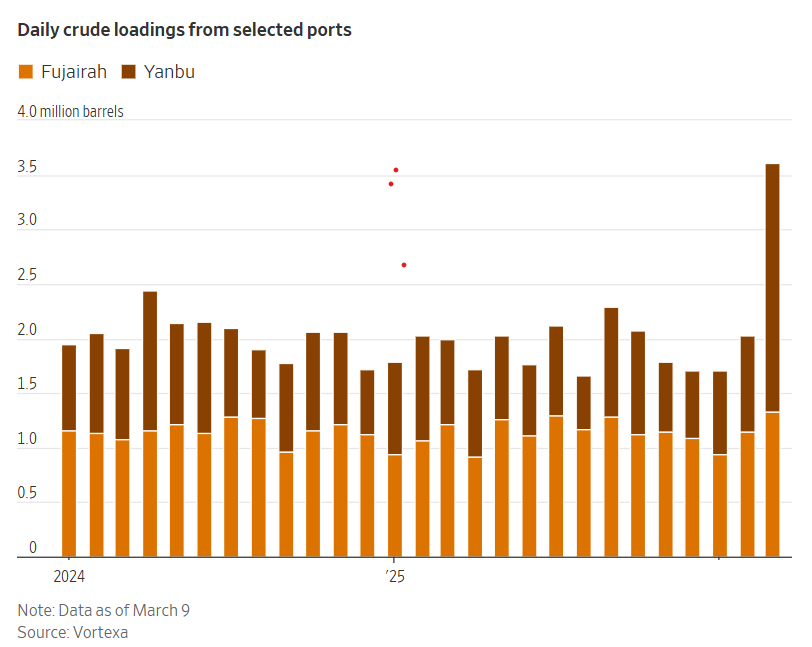
The smaller, more recent Emirati pipeline connects Habshan in Abu Dhabi to Fujairah on the Gulf of Oman. It was primarily developed by a subsidiary of the state-run China National Petroleum Corp. The IEA pointed out that it can carry up to 1.8 million barrels per day and was already passing through roughly 1.1 million barrels before the outbreak of violence in the region.
Both Yanbu and Fujairah have experienced a surge in crude loadings. Petrobras announced that Saudi Arabia has fulfilled its obligation by pouring oil through the pipeline. It is a state-backed oil firm of Brazil. The company’s top executive highlighted that the problem is the hike in shipping expenses.
According to analytics company Sparta Commodities, an approximate evaluation suggested that around 10 million barrels are going to stay trapped in the Persian Gulf despite pipeline movements. Neil Crosby of analytics platform Sparta observed, “We’ve basically solved half of the problem.”
How reliable are the alternative pipelines
Iran has attacked energy infrastructure in the Gulf, and experts feared that these pipelines might also meet the same fate, but at least some could reach customers, as over 1,000 tankers remained stranded in the Persian Gulf.
“If you suddenly see two very large crude carriers coming out of Yanbu and one out of Fujairah, there is a psychological effect that at least some oil is coming out,” mentioned former trader Adi Imsirovic, who currently teaches at Oxford University. He then voiced, “What really worries me is that it’s not particularly difficult to target those pipelines.”
It’s not risk-free to ship oil in the Red Sea and at Fujairah, even though it’s safer than embarking into the Persian Gulf. Last week, an attempted drone strike damaged the Emirati port, leading some gasoline suppliers to cancel contracts.
While Saudi Arabia can shift oil to the port of Yanbu along the Red Sea via the East-West Pipeline, oil tankers will need to transit the Bab al-Mandeb—running Ansarallah's proverbial gauntlet—to avoid the (very) long route around Africa via Suez and the Mediterranean to deliver… https://t.co/WAKfaZspbR pic.twitter.com/OZ5FQqbXPa
— Shahryar Pasandideh (@shahpas) March 4, 2026
In 2024, the Houthi militants in Yemen, who have ties to Iran, attacked numerous commercial vessels. Maritime security analysts at the United Kingdom-based Ambrey are warning ships affiliated with the United States and Israel to steer clear of the Red Sea, even though they haven’t revived the offensive during the present confrontation.