The tragic crash of an Indian Air Force (IAF) Tejas fighter jet during an aerial display at the Dubai Air Show has once again brought into focus the extreme risks associated with demonstration flying. The loss of a trained combat pilot is not just a statistic, but a deeply personal national tragedy.
Yet, amid the shock, grief and social media speculation, it is crucial to separate emotion from aviation reality. Airshow accidents, while rare, are not abnormal in military aviation across the world, even among the most technologically advanced air forces.
Unlike routine operational missions, airshow performances are meant to push aircraft to their visual and aerodynamic limits. These flights are not merely about flying from point A to point B but about executing tightly choreographed, high-stress manoeuvres at low altitudes and critical speeds. The margins for recovery during such performances are razor thin.
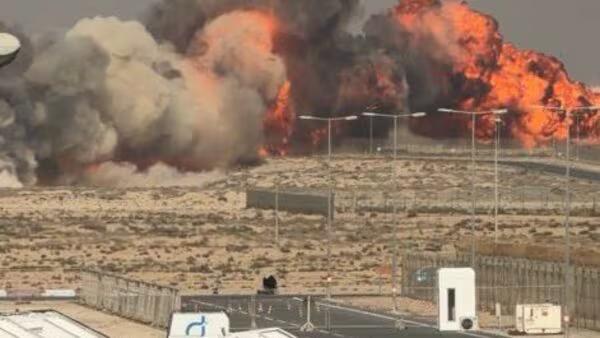
This makes demonstration flying one of the most dangerous tasks a military pilot can undertake, often riskier than actual combat sorties, because the aircraft is flown in deliberately unstable flight regimes to showcase its agility and capabilities. And such daredevilry can often lead to tragic fatalities as evidenced during one such airshows in Dubai on Friday, November 21, 2025.
Preliminary video footage and expert assessments indicate that the Tejas was performing a demanding aerobatic sequence when it began to lose altitude rapidly. While only a formal inquiry can establish the exact sequence of events, aviation experts have highlighted several plausible explanations based on visual evidence and known aerodynamic and physiological risks.
It must also be stated unequivocally that no individual, media outlet, or self-styled expert can claim with full authority to know the real cause of the crash until the Indian Air Force’s court of inquiry completes its investigation and formally presents its findings. Aircraft accidents, particularly those involving advanced fighter jets performing extreme aerobatic manoeuvres, are complex events that often result from a chain of mechanical, human, environmental, and procedural factors rather than a single obvious failure.
But it has brought to the fore the dangerous life an aviation professional lives, and the level of complexity their job involves, which could often lead to disastrous consequences, sometimes leading to their unfortunate deaths.
Negative G manoeuvre and pilot physiological limits
One of the most discussed possibilities is the physiological impact of a Negative G manoeuvre. Under normal flight, gravity pulls blood away from the brain. Negative G conditions do the opposite, forcing blood towards the head. This can lead to a phenomenon known as “red-out,” where vision becomes heavily distorted, or in extreme cases, a brief loss of consciousness.
During aerobatic loops and inverted segments, the human body can experience disorientation, delayed reflexes and momentary cognitive impairment. Even with advanced training and anti-G conditioning, no pilot is immune to these biological limits. In a high-speed, low-altitude environment, even a split second of incapacitation is enough to make recovery impossible. This explanation does not imply pilot error, but reflects the brutal reality that the aircraft may perform beyond what the human body can reliably tolerate.
Engine seizure or momentary power loss
Another possible technical factor could be engine seizure or transient power loss during the manoeuvre. Earlier, in the March 2024 Tejas crash near Jaisalmer, investigators traced the cause to an oil pump malfunction that led to engine seizure. While there is no evidence that the Dubai crash involved the same defect, the precedent shows how aggressively flown fighter engines can be vulnerable to lubrication or fuel system disruptions.
During Negative G or near-zero gravity phases, fuel and lubricating oil do not behave as they do in straight and level flight. Any momentary interruption in oil pressure or fuel feed can cause brief flameout or thrust loss. In typical operational flying, pilots have altitude and time to attempt relights or emergency procedures. In an airshow, where aircraft are flown deliberately close to the ground to maximise visual impact, there is often no margin to recover if thrust drops unexpectedly.
Fly-by-wire and control system sensitivity
The Tejas is a digitally controlled, fly-by-wire aircraft, meaning that the pilot’s inputs are interpreted and executed by flight control computers rather than direct mechanical linkages. This architecture allows the aircraft to fly in aerodynamically unstable regimes, dramatically improving agility and performance.
However, such systems rely on precise, real-time input from dozens of sensors. A rare sensor glitch, software logic conflict or data misinterpretation under extreme manoeuvring conditions can theoretically lead to unexpected control responses. These systems are heavily tested and certified, but airshow flying often explores the very edges of the flight envelope. At very low altitudes, even a fractionally delayed or incorrect control response can prove catastrophic. This is not unique to Tejas and has been seen in other advanced fighters worldwide.
Bird strike or foreign object ingestion
Environmental factors must also be considered. Airshows often take place near coastlines or urban areas, which naturally attract bird activity. A bird strike or foreign object ingestion into the engine can cause immediate and severe disruption to airflow, combustion stability or turbine operation.
Such incidents have historically caused crashes and serious incidents in aircraft belonging to some of the world’s most advanced air forces. A bird strike at cruising altitude may be survivable; the same event during a low-level aerobatic sequence can be unrecoverable due to time and height constraints.
Why airshow crashes or mishaps during military exercises are not unprecedented
It is critical to understand that airshow crashes are not unique to India or the Tejas programme. The United States, Russia, France, China and several European nations have all suffered fatal accidents involving frontline fighters during demonstration flights. Aircraft such as the F-16, Su-27, Mirage 2000 and MiG-29 have crashed during airshows despite decades of proven operational reliability.
These accidents occur not because the aircraft are unsafe, but because airshows deliberately compress safety margins to deliver tight, visually dramatic manoeuvres. Risk is an inherent part of such performances.
Recent global examples show that even the most technologically advanced militaries are not immune to mid-air and deck-related accidents. In October 2025, the United States Navy witnessed a rare twin-accident episode over the South China Sea, when an MH-60R Seahawk helicopter and an F/A-18F Super Hornet fighter jet crashed within half an hour of each other while operating from the aircraft carrier USS Nimitz.
A separate tragedy in the United States further illustrated how fragile aviation safety can be even in controlled airspace. A mid-air collision near Washington DC between an American Airlines regional jet and a US Army Black Hawk helicopter ended in disaster near Reagan National Airport. The civilian aircraft, carrying 60 passengers and four crew members, was on approach when it collided with the military helicopter, which was on a training mission.
Both aircraft plunged into the icy Potomac River, with authorities confirming that all 64 civilian occupants and the three soldiers on board were killed. Despite the US having among the most advanced air traffic management systems in the world, the cause was not immediately established, prompting a full National Transportation Safety Board (NTSB) investigation. The airport was shut down, flights diverted and rescue teams battled freezing, low-visibility waters for days, demonstrating that even the most sophisticated civilian and military aviation ecosystems remain vulnerable to human, technical and environmental failures.
Even within purely military environments, the United States Navy has suffered a series of serious incidents in recent years, underlining how operational intensity increases the risk of accidents. In April 2025, an F/A-18 Super Hornet, valued at nearly $60 million, fell off the deck of the aircraft carrier USS Harry S. Truman in the Red Sea along with its towing tractor while the vessel was executing an evasive manoeuvre. At the time, the carrier air wing was conducting active strike operations against Houthi targets, regularly facing hostile drones and missile threats.
Beyond the United States, China has also experienced fatal accidents during demonstration flying, such as the 2016 Danxia airshow crash in which aerobatic champion Michel Leusch was killed when he failed to recover from a vertical dive. Together, these incidents illustrate a sobering reality: high-performance aviation, whether in peacetime displays or combat-adjacent operations, operates permanently at the edge of human and mechanical limits, and no nation, however advanced, is immune to tragedy.
Tejas’ operational track record
The Tejas has been in IAF service since 2016 and has accumulated thousands of safe flying hours across operational patrols, exercises and training missions. The previous 2024 crash near Jaisalmer was traced to a specific, identifiable fault, an engine oil pump malfunction. The corrective process that followed demonstrated that India’s military aviation safety mechanisms are both active and transparent.
It is also significant that the Dubai crash occurred a day after viral claims about oil leaks were officially dismissed by the government. Prematurely linking unrelated claims to an active investigation distorts public understanding and undermines the professionalism of the inquiry process.
A tragedy, not a verdict
While this crash marks the ninth IAF aircraft loss since March 2024 and the second involving Tejas, raw numbers without operational context can mislead. The IAF operates in one of the most demanding flight environments in the world. Accidents, though heartbreaking, are an unfortunate reality of high-performance military aviation.
A Court of Inquiry has been ordered, and only its findings will provide definitive answers. Until then, speculation should be balanced with perspective and restraint.
It is worth noting that human tendency, by its very nature, wants to zero in on the exact cause of a failure, more so when it is as tragic as witnessed on the grim Friday afternoon at the Dubai airshow this week. But, often tragedies don’t have a single failure point and are the result of a combination of unknown factors, some of which may or may not be established even after the highest levels of inquiry by the most competent and experienced professionals.
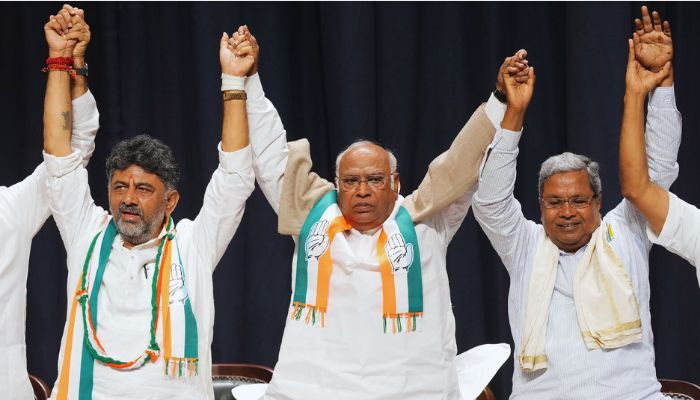
In Karnataka, a political storm is brewing as the ongoing power tussle between Chief Minister Siddaramaiah and Deputy CM DK Shivakumar has intensified. A group of Shivakumar loyalists is reportedly heading to New Delhi to urge the Congress high command to fulfil its ‘promise’ of sharing the CM post.
The imperative to remind Congress president Mallikarjun Kharge of the supposed power-sharing promise arose as the Congress government completes 2.5 years under Siddaramiah.
While CM Siddaramaiah has dismissed the reports of an internal power tussle in the party, saying that he will present the budget, around 10 Shivakumar loyalist MLAs arrived in New Delhi on 20th November, while several others are reaching there on Friday. The Shivakumar loyalist MLAs are likely to meet Mallikarjun Kharge and demand that the Congress party implement the 2.5-year-each power-sharing arrangement decided upon in 2023 between Siddaramaiah and Shivakumar factions.
So far, Minister N Chaluvarayaswamy, MLAs Iqbal Hussain, HC Balakrishna, SR Srinivas, Ravi Ganiga, Gubbi Vasu, Dinesh Gooligowda and others have arrived in the national capital. Meanwhile, Anekal Shivanna, Nelamangala Srinivas, Kunigal Ranganath, Shivaganga Basavaraju, and Balakrishna are also reportedly heading to New Delhi.
Siddaramaiah, though playing it cool, gets anxious when asked about the possibility of him having to step aside for Shivakumar to become Chief Minister. During a recent media interaction, Siddaramaiah said that the chatter around the supposed ‘power-sharing arrangement’ is just an “unnecessary debate”.
“It is only after it was said that the cabinet can be reshuffled after two and a half years, that the issue of changing the Chief Minister has come to the fore. The party leaders need to take a decision on the cabinet reshuffle. There is a total of 34 ministerial posts, out of which two posts are vacant. These vacant ministerial positions will be filled during the cabinet reshuffle,” the Karnataka Chief Minister said.
On one hand, Siddaramaiah is asserting his claim to the throne during his media interactions, social media posts and through his loyalist MLAs; on the other, Shivakumar is distancing himself from the movement of his loyalist MLAs to Delhi to press the demand of his ‘promised’ coronation.
An interesting point to notice here is that on Siddaramaiah’s side, the CM himself is playing on the front foot and asserting his five-year term, on Shivakumar’s side, his loyalists are doing the ‘needful’ while he claims to repeat the standard “whatever the party asks me to do I will do” response to media queries. Clearly, Shivakumar wants to become Chief Minister but is avoiding opening a front against Siddaramaiah publicly to avoid bad optics, while Siddaramaiah is asserting his five-year term to bolster his claim to the CM post and also send out an ‘all is well’ message to the public.
One openly asserting authority, the other bolsters claims to power covertly, the ‘game of thrones’ ongoing between Siddaramaiah and Shivakumar for months
It is obvious that neither Siddaramaiah nor Shivakumar will openly and absolutely deny or accept their ambitions about the Chief Minister’s post; however, to say that there is no power tussle at all is to think of the public as too naïve.
In just the last four months, four Congress leaders, including three sitting MLAs and a former MP from Mandya, have been issued notices by the party for openly backing Deputy Chief Minister D.K. Shivakumar as the next Chief Minister.
The notices, sent by the party’s disciplinary committee, accuse them of “causing embarrassment” and going against the instructions of the Congress high command.
Shivakumar loyalists are repeatedly raising demands for replacing Siddaramaiah with their leader. In addition, DK Shivakumar loyalist leaders are also, apparently as a pressure-building tactic, asserting that he will be promoted to the post before the end of the year.
In October, Kunigal MLA H.D. Ranganath and former Mandya MP L.R. Shivarame Gowda. Just a couple of months ago, Channagiri MLA Shivaganga V. Basavaraj and Ramanagara MLA Iqbal Hussain were issued notices for making similar remarks.
On 1st July, Iqbal Hussain, a close aide of Shivakumar and Ramanagara Congress MLA, had openly said that Siddaramaiah had already been given enough chances as Chief Minister, five plus two and a half years.
“D.K. Shivakumar has worked hard for the party and got the party 140 seats. He needs to be given a chance to ensure Congress comes back to power in 2028,” Hussain said.
Hussain went on to reveal that he has conveyed these views to Congress General Secretary Randeep Singh Surjewala, despite being told by the high command not to discuss leadership changes publicly.
Congress MLA from Mandya, Ravi Kumar Gowda, said the deputy CM deserves to be the Chief Minister, and when the time is right, he will definitely become the CM. “DK Shivakumar will become Chief Minister when the time comes. 138 MLAs support both DK Shivakumar and Siddaramaiah. When the time is right, DK Shivakumar too will become Chief Minister. When time and circumstance align, good things will happen. He definitely deserves to become Chief Minister, and he will become Chief Minister,” Gowda said.
Congress MLA Tanveer Sait not only hinted at a possible change in leadership but also backed DK Shivakumar. “I feel leadership can’t be stagnant. New leadership has to come and grow. Whenever the opportunity is given, it’ll happen. But individual giving out statements shouldn’t be considered as a protest,” Sait said.
Earlier, Congress MLA CP Yogeshwar from Channapatna also voiced his support for Shivakumar as Karnataka CM and said, “All our district MLAs are united that DK should become Chief Minister. There are no discrepancies about it. High command should decide on it.”
Basavaraj, a first-time MLA, followed in August by predicting that a “change of guard” was coming by December and that Shivakumar would become CM. His remarks were quickly dismissed by Shivakumar, who also promised disciplinary action against those speaking out of turn.
Similarly, Ranganath described Shivakumar as his “political guru” and credited him for Congress’s win in the 2023 Assembly polls. Just as fans of many South-Indian actors hype their favourites by highlighting their ‘pan-India’ appeal, Ranganath called DK Shivakumar a “rising star” and a “pan-India leader”. He said that Shivakumar deserved to be the Chief Minister one day.
Going a step ahead, Shivarame Gowda stated that Shivakumar’s elevation had already been decided and suggested that a decision would come as soon as November. He also claimed that a power-sharing deal of two-and-a-half years each for Siddaramaiah and Shivakumar had been assured by the party high command.
The Congress high command took these comments seriously and issued a notice stating, “Your media statements in this regard not only embarrass the party but also violate party discipline. We have taken your unruly statements seriously and seek an explanation. You are required to respond within one week of receiving this notice.”
In April this year, a caste survey report sparked an internal strife within the Congress party in Karnataka and laid bare the leadership aspirations of both Siddaramaiah and Shivakumar. The survey had revealed the actual caste-wise population in Karnataka, sparking anger among powerful communities like Lingayats, Vokkaligas, and even sections of Muslims, who felt the data could alter reservation politics in the state. Several Congress leaders who are close to Siddaramaiah and Shivakumar had publicly argued over the revelations and their political consequences.
Interestingly, while the JD(S) MLAs who left the party and moved to Congress twenty years back have been loyal to Siddaramiah and want him to complete the five-year term, DK Shivakumar, who is credited with having played a key role in bringing Congress back in power in the state, is not ready to relinquish his claim to power. Apparently, this is the reason why his supporting MLAs are freely giving media statements and reaching out to the party high command to stake his claim to the CM post. If there was any truth to Shivakumar’s claim of not having any leadership ambitions, he would have silenced his supporters; however, their open ‘fulfil the promise’ calls indicate Shivakumar’s tacit backing.
Besides, for months, Siddaramaiah loyalists have been pushing for getting DK Shivakumar removed from the post of Karnataka Pradesh Congress Committee’s president before the state’s local body elections.
Shivakumar was made KPCC chief in 2020, and after Congress won the assembly election in 2023, he was supposed to step down from the post of KPCC president after one year, as he became deputy CM. However, Shivakumar has held the position till now, apparently to ensure his control within the party. Reports said that Siddaramaiah was personally keen on having Shivakumar removed from the KPCC president post.
In a statement reminiscing Shivakumar’s helpless ‘What option do I have?’ remark, the Karnataka deputy CM said on 20th November, said that “I cannot hold the post permanently” while speaking about him holding the KPCC president post for over five years. While which side the tide will turn remains to be seen, Shivakumar loyalists lobbying for his coronation as Karnataka CM, and his talking about stepping aside from the KPCC president post, hint that Shivakumar may be prepping for replacing Siddaramaiah one step at a time, instead of doing an open rebellion.
Congress blames BJP and mediafor infighting between Siddaramaiah and Shivakumar factions
Playing a convenient blame game, Congress leader Randeep Surjewala, who earlier diffused the tensions between Siddaramaiah and Shivakumar factions, accused the BJP and the media of running a ‘maligning campaign’ against the Congress government.
“Had a discussion with Karnataka CM and Deputy CM and they agreed that a decisively defeated and faction ridden Karnataka BJP, alongwith a section of the media, are designedly running a maligning campaign against Karnataka and its Congress Government,” Surjewala wrote.
“The sole idea is to undermine the stellar achievements and 5 Congress Govt Guarantees, which have become an outstanding model of inclusive development and distributive justice. The needless Statements of some Congress leaders and MLA’s has also added to the speculation. INC has sternly warned them from making any public statements on the issue of leadership or falling for the agenda being propagated by the vested interests. The opinion of various party functionaries has been taken note of by the leadership,” he added.
While Congress boasts imaginary success of its ‘guarantee’ schemes, the Comptroller and Auditor General (CAG) report published in August this year revealed how the five freebies’ schemes– Gruha Lakshmi, Gruha Jyothi, Anna Bhagya, Shakti, and Yuva Nidhi– run by the Congress government have burdened the state’s economy.
Amusingly, Surjewala’s own statement exposes that his allegations against the BJP and media are bogus and only meant to deflect attention from the genuine infighting ongoing within the Karnataka Congress. For argument’s sake, even if it is assumed that BJP and the media are indeed colluding to malign Congress government, why are Congress party’s own MLAs picking sides between Siddaramaiah and Shivakumar and want their leader to be the Chief Minister? Are pro-Siddaramaiah and pro-Shivakumar MLAs also hand-in-glove with the BJP and the media?
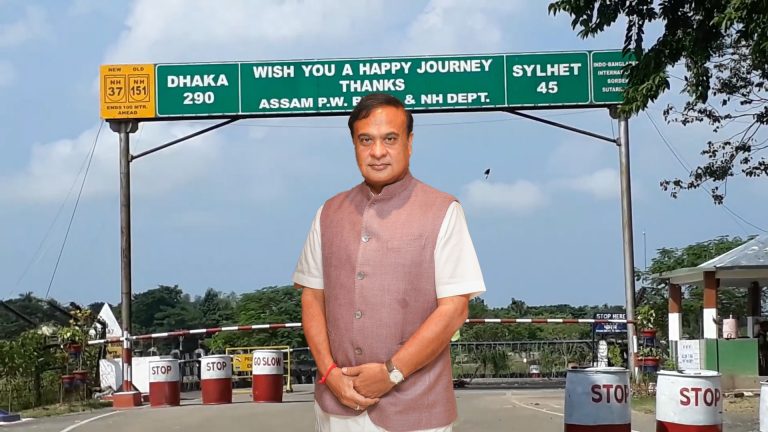
After issuing an expulsion order on 19th November against five foreigners, the administration of the Sonitpur district in north-central Assam is looking for them, as confirmed by officials on Thursday (20th November). The absconders were declared as foreigners earlier by a Freigners Tribunal, after which they have been asked to remove themselves from India under the Immigrants (Expulsion from Assam) Act, 1950, in what is possibly the first known invocation of the law after the 1950s. The expulsion order issued by Ananda Kumar Das, Sonitpur’s District Commissioner, gave a 24-hour deadline to the foreigners to leave the country, but the foreigners disappeared soon after.
The absconders have been identified as Hanufa, Mariyam Nessa, Fatema, Monowara, and Amjad Ali, all from the Dhobokata village of the district.
“…being a declared foreigner, your presence in India/Assam is detrimental to the interest of the general public and also for the internal security of the State,” the orders read, directing them to remove themselves “from the territory of Assam, India, within 24 hours from receiving this order via the Dhubri/Sribhumi/South Salmara-Mankachar route”. The foreigners are said to have entered India illegally through Bangladesh. “Further, you are intimated that in the event of any default in complying with this order, the government would be compelled to take appropriate action to remove you from the territory of the State of Assam, India, under the provisions of the above Act,” the orders read.
“I am expecting a report from the Superintendent of Police, who visited the location but did not find them. The case will continue until they are found,” the Sonitpur District Commissioner said. He added that the authorities have been asked to delete the names of the declared foreigners, in case they were beneficiaries of government schemes. The case of the five foreigners came up before the Sonitpur Foreigners Tribunal in 2006 based on a report filed by the Assam Police’s Border Wing. The Border Wing is tasked with the identification of the individuals suspected to be foreigners, while the tribunal decides their citizenship status.
What is the Act, and why was it invoked?
The Immigrants (Expulsion from Assam) Act, 1950, was approved for implementation by the Assam Cabinet headed by Chief Minister Himanta Biswa Sarma earlier this year. In September this year, the Assam Cabinet approved the framing of a standard operating procedure (SOP) under the 1950 Act. While the law was passed in 1950, its implementation was stopped soon after on the orders of PM Jawaharlal Nehru, and the law was ‘forgotten’ since then. However, the Supreme Court last year stated that the law still exists and the govt can use it, after which Himanta Biswa Sarma govt decided to use it, and issued the SOPs for its implementation.
Till now, every suspected illegal immigrants were presented before Foreigners Tribunals operating in Assam, and it takes years, even decades, for Tribunals to decide on individual cases. Many suspected illegals continue to be lodged in various detention centres in Assam due to this delay. But the The Immigrants (Expulsion from Assam) Act, 1950 empowers the administration to deport illegal immigrants directly and immediately, without the need to approach the tribunals.
CM Sarma said that the SOP largely nullify the role of the Foreigners Tribunal in deciding the status of suspected foreigners. He added that, as per the SOP, if a District Commissioner receives information from the police or any other source that a person is suspected to be an “illegal immigrant”, the official will direct the person to produce evidence of his citizenship within a period of 10 days. “If the District Commissioner finds that the evidence submitted is not satisfactory, he can pass an expulsion order by invoking the Immigrants (Expulsion from Assam) Act, 1950, ordering the removal of the undocumented immigrant from Assam by giving 24 hours and by the route so specified,” the Chief Minister said.
Only the cases that require further scrutiny will be sent to Foreigners Tribunals from now on, while the confirmed illegal immigrants will be deported immediately.
The Act was passed in 1950, at a time when the state was facing migration from East Pakistan (present Bangladesh), just like now. However, it was in force for a short period. After reports that many Bengali Muslims who were originally from Assam were also issued notices to leave Assam, Jawaharlal Nehru ordered CM Gopinath Bordoloi to stop all action under the law. The pact signed by Nehru with Pakistani Liaquat Ali Khan for protection of minorities in each other’s countries was another reason for halting the use of the law. After that, as the law as no longer used, it was gradually forgotten.
It is now being invoked by the Assam government to deport illegal immigrants from the state. The Act provides that if the Central Government is of opinion that the presence of any person or persons who come into Assam from outside is detrimental to the interests of the general public of India or of any section of the public or of any Scheduled Tribe in Assam, the Central Government may direct them to leave Assam, and issue orders to remove them from Assam. While the power has been given to the central government, the Act empowers the central govt to delegate the power to any officer of the central government or any officer of the governments of Assam, Meghalaya and Nagaland.
On 20th November, the Supreme Court overturned the deadlines it had previously established for the President and Governors to take action on bills passed by parliament and state legislatures. According to the Constitution Bench, imposing strict deadlines or establishing the concept of “deemed assent” amounts to exceeding judicial bounds and meddling with the authority granted to constitutional officials.
A bench led by Chief Justice BR Gavai was replying to a Presidential reference on its 8th April judgement regarding Tamil Nadu Governor RN Ravi and his friction with the Dravida Munnetra Kazhagam government. The court stated that it was merely serving in a “advisory” capacity when it started the fresh hearing in August. Afterward, it pronounced that the President or a Governor’s acts are not “justiciable” or subject to trial and judicial review can only be utilised when a bill transforms into law.
The court asserted that since Articles 200 and 201, which deal with the assent process for state bills, purposefully contain ambiguous language like “as soon as possible,” the court cannot turn this into rigid timetables.
Opposition parties lash out after the decision
After the decision was pronounced, the opposition along with its ecosystem and left-liberal faction expectedly expressed their anger and frustration. The cabal, which repeatedly accuses the ruling coalition led by the Bharatiya Janata Party of undermining and intimidating the judiciary, did not hesitate to reveal its fangs and attack the Supreme Court, as the verdict did not align with their preferred outcome.
The Chief Minister of Tamil Nadu, MK Stalin asserted that their struggle for “state rights” and “true federalism” will persist, declaring that they will not stop until the Constitution is amended to establish timelines for Governors to approve bills. He proceeded to outline some points from the latest order as well as other judgments which allegedly endorsed his argument.
“When even a high Constitutional Authority breaches the Constitution, the Constitutional Courts are the only remedy, and the doors of the Court must not be closed,” he added and claimed that otherwise it would promote constitutional violations by politically motivated governors and weaken the rule of law in “our Constitutional democracy.”
☀️ Our fight for State rights and true federalism will continue!
☀️ No rest until amending the Constitution to fix timelines for Governors to clear Bills!
The Supreme Court’s opinion in its answer to the Presidential Reference will have no impact on the April 8, 2025 judgment… pic.twitter.com/YHnD6pxs7c
— M.K.Stalin – தமிழ்நாட்டை தலைகுனிய விடமாட்டேன் (@mkstalin) November 21, 2025
Notably, the DMK is an integral part of the Congress-led I.N.D.I. Alliance which contested the 2024 Lok Sabha election by falsely accusing the BJP of attempting to undermine and alter the constitution to fit its agenda. However, the DMK leader now openly expressed its intention to modify the constitution to serve its objectives.
It appears that amending the constitution is only viewed illegal when it pertains to the saffron party, as demonstrated by the numerous changes to the constitution made by Congress-led governments to align with their agenda.
Any decision that does not cater to the political interests of the DMK which is notorious for prioritising language and regional politics at the expense of national unity and interests, likewise becomes a battleground for it where the opposing side is repeatedly charged with infringing upon the Constitution or state rights without any merit.
The communists were similarly displeased with the decision. The Communist Party of India conveyed its “disappointment” and referred to the Governor as “unelected authority” as well as his position position as “unelelcted colonial-era office.” It stated that the federal framework was under stress amid growing centralisation and even requested Parliament to regulate the Governor’s “interference.”
CPI Expresses Disappointment Over Supreme Court’s Opinion on the Presidential Reference on Governor’s Assent to Bills pic.twitter.com/4YtHl4e6VW
The office of the governor has allegedly transformed into a colonial burden and the BJP’s victory is accountable for the pressure on the federal structure, according to the party. Interestingly, these issues had not posed a problem until now as the opposition was in a position of power until 2014. The history of how the Governors were utilised as an extension of then centre governments is also well documented.
These statements are rife with glaring hypocrisy and double standards alongside a brazen strategy designed to exert pressure on the judiciary to yield to the opposition’s demands.
Likewise, M A Baby, the General Secretary of CPI (Marxist) described the decision as “deplorable and shocking.” He claimed that the courts should not be reluctant to play a significant role to maintain appropriate checks and balances between the Legislature, the Executive and the Judiciary.
The Supreme Court's answer in response to the Presidential Reference is deplorable and shocking. Courts shouldn't hesitate to play a meaningful role in ensuring proper checks and balances between the Legislature, the Executive and the Judiciary.
Baby wrote, “On the one hand, the SC says that a timeline cannot be set for granting assent to bills and on the other, they say that the court can exercise a limited power of judicial review to direct the Governor to decide in a time-bound manner.” He asked that who will now determine what constitutes a time-bound manner and added that the judiciary must uphold its constitutional obligations.
The audacious effort to influence the judiciary to operate according to the inclinations and desires of the opposition, under the pretext of obligations and duty, is truly astonishing.
Islamist apologist, liberal gang voice its indignation
Rajdeep Sardesai criticised the Supreme Court for evading the issue when governors are alleged to function as biased representatives of the central government. The proponents of independent judiciary clearly do not hesitate to reveal their true intentions when the courts don’t endorse their propaganda.
Big story: SC constitution bench does a classic ‘balancing’ act: says apex court cannot impose timelines on President/Governors to take decisions on pending bills but governors cannot sit on bills indefinitely. Clearly, no one wants to rock the boat even as governors are accused…
Jihadi propagandist and Islamist cheerleader Apoorvanand stripped away all pretense and directly accused the Chief Justices of the Supreme Court of issuing verdicts that favor the BJP. He suggested that the justices, including BR Gavai, are essentially puppets of the central government. This sinister group does not even shy away from humiliating the judiciary when it fails to conform to their agenda.
CJI after CJI: Make life easy for the BJP-led union govt, obstruct opposition-ruled govts. And then we ask why the opposition is weak!
RK Radhakrishnan of the Frontline (from the Hindu group) similarly accused BR Gavai, who will demit office on 23rd November, of acting on behalf of the center and added that the verdict was as a “parting gift” which has diminished the states to the extent of being at the mercy of Governors like RN Ravi. He even wrote an article on the same.
Gavai’s parting gift has weakened States to the point of being at the mercy of the RN Ravis of India. My piece for @frontline_india: Supreme Court ruling on Governor powers raises concerns over delays in State Bills https://t.co/7NupmEJxIc
Radhakrishnan took it a step further and retweeted a post further insulting the Chief Justice, asserting that he “tried to throw stones on the settled water feeding the socially marginalised SC/STs to give room for those awaiting to fish out of it. I think he’s has lost the stability after the chappal incident.”
Not only gifted to the weakened states but also tried to throw stones on the settled water feeding the socially marginalised SC/STs to give room for those awaiting to fish out of it. I think he's has lost the stability after the chappal incident. pic.twitter.com/XX5y16MI3z
These people seized every opportunity to claim casteism whenever there was any criticism or attack on the chief justice. However, the appearance of respecting the judiciary quickly dissolved in light of the agenda.
These responses were merely the tip of the iceberg, as the opposition parties and their supporters attacked the highest court and the judges without any regard for maintaining the dignity of such a crucial institution that they insist to hold in high esteem. All this vitriol directed at the Supreme Court was only because it adhered to its Constitutional role, refused to upend the Constitution and maintained the separation of powers.
Conclusion
The opposition has consistently claimed to support the judiciary and the courts, alleging that the BJP intends to subvert constitutional institutions. Nevertheless, they have not refrained from displaying their ugly face whenever the courts have declined to support the opposition’s agenda. This was evident in 2018 when the opposition sought to “clean up the judiciary” and accused the prime minister of repressing democracy.
“BJP has created a new record. They have created a situation where judges had to conduct a press conference, they triggered judicial mutiny. All this happened because Justice Loya death case bench was changed, and Loya was hearing a case in which BJP national president was involved,” senior Congress MLA K N Rajanna claimed, in that year.
The same story has recurred time and again, even regarding the judgment of Ram Mandir. The fundamental issue for the opposition and its supporters is this: the judiciary will only be respected if it submits to their demands and if the judges attempt to act independently and in accordance with the Constitution, they will not only be insulted and demeaned but also have aspersions cast on their impartiality. They will not show any reluctance in modifying the Constitution to fit their agenda.
The terms “independent judiciary” just like “neutral constitutional bodies” are employed by these parties and their supporters to mislead the public and voters and casting the BJP in a negative light. The courts akin to other institutions serve as mere stepping stones for them to impose their own agendas and political objectives. Consequently, these arms of Indian democracy are either celebrated or vilified based on whether the verdicts align with or contradict the opposition’s ideology.
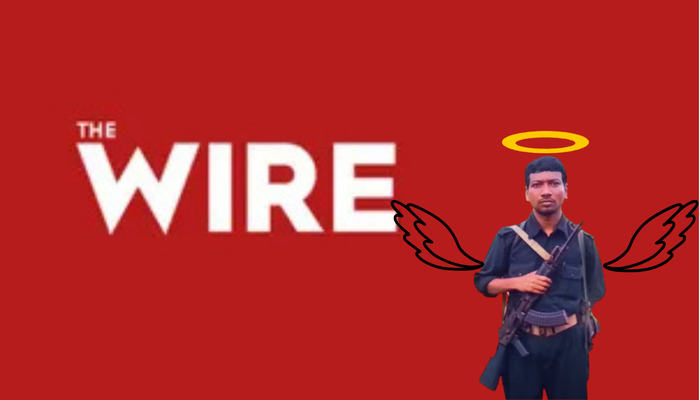
After the security forces neutralised the dreaded Maoist leader Madvi Hidma during a gunfight in Andhra Pradesh’s Alluri Sitarama Raju district on 18th November, the Wire, quite expectedly, was quick to whitewash the Naxal terrorist’s criminal past and paint him as the “hero of the masses”. Along with Hidma, security forces also eliminated 6 other Naxals, including his wife Madakam Raje.
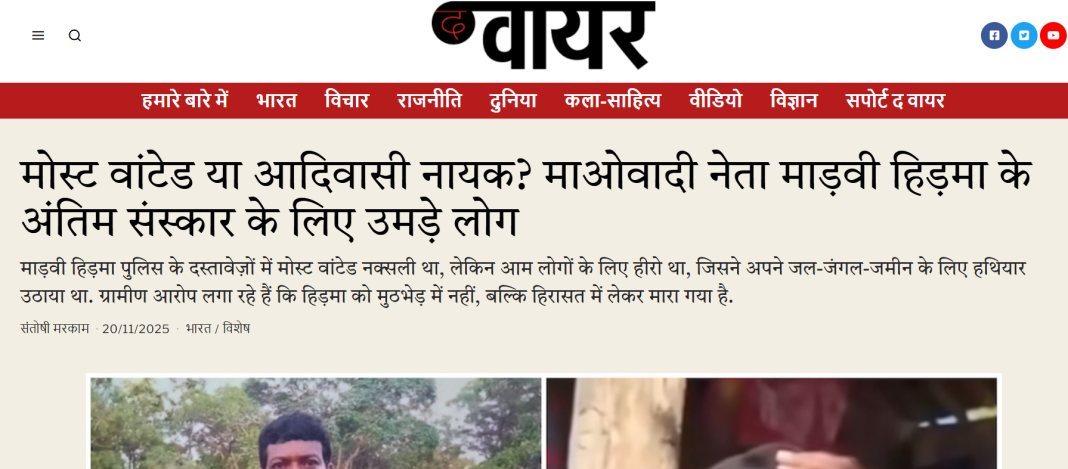
Hidma was a ruthless Naxal, who was associated with some of the most brutal attacks in the history of Left Wing violence. However, for the leftist portal, The Wire, facts fade into the narrative. Two days after the encounter killing of Hidma, The Wire published an article eulogising the Naxal leader who had the blood of several Indian security personnel on his hands. “The tribal man was the most wanted Naxalite in police records, but to the common people, he was a hero, having taken up arms to defend his land, water, and forests,” The Wire wrote, introducing Hidma in the article titled, “Most wanted or tribal hero? Crowds gather for the funeral of Maoist leader Madvi Hidma”.
Screenshot of the article (via The Wire)
The Wire, which conveniently omits to present the pain of the families of the security personnel killed in Naxal attacks, mentions how Hidma’s mother and other people from his native village mourned his death. “In a video viral on social media, in a small hut, reportedly Hidma’s home, his mother, Madvi Pojje, is sobbing, clutching her head. Several other women are sitting with her and crying. The entire village is mourning Hidma’s death. Women from the village are coming to his home to join in the mourning,” states the article in an attempt to garner public sympathy on the death of a terrorist, who ruined many families.
To further peddle its pro-Maoist propaganda, The Wire refers to an interview by the Bastar Junction, which showed some tribals, claimed to be locals from Hidma’s village, grieving his death. Speaking on camera, the villagers said that Hidma was not only ‘good’ towards the village but also for the entire country. The statement, clearly made in ignorance by the locals, is presented as the truth by the Wire. Ironically, the visuals of mud houses and unpaved roads laid bare the truth of the claim about the ‘goodness’ of the Naxal leader, and the Maoist ideology, which has deprived the people and the place of any kind of development for decades.
The article then refers to another statement of the villagers, who claimed that Hidma was not killed in an encounter but in custody. It further quotes the so-called tribal activists, Soni Sori and Degree Prasad Chauhan. While Sori termed the Hidma’s killing a “murder”, Chauhan absolved Hidma of his sinister life by referring to him as an “innocent Adivasi”. However, no amount of misleading portrayals of a relentless Naxal or peddling of lies by The Wire or the ‘tribal activists’ can change the truth that Left Wing extremism ruined the areas it controlled and deprived the tribal people of basic development and dignity.
Who was Madvi Hidma?
Madvi Hidma was born in 1981 in Sukma, then part of Madhya Pradesh. He joined the Maoist cadres as a teenager and rose through the ranks to head a battalion of the People’s Liberation Guerrilla Army (PLGA). His efficiency and intimate knowledge of the Bastar forest region earned him a place on the CPI (Maoist) Central Committee. He became the youngest and the only tribal leader from Bastar on the organisation’s apex body.
Hidma was behind some of the most barbaric Maoist attacks in recent history, including the 2010 Dantewada massacre in which 76 CRPF personnel were killed, the 2013 Jhiram Ghati ambush that claimed 27 lives, including several senior Congress leaders, and the 2021 Sukma–Bijapur attack where 22 security personnel were gunned down. Security officials say these high-casualty strikes showcased Hidma’s operational expertise, his mastery over guerrilla warfare, and his ability to command large rebel units across the dense forests of Bastar.
Hidma’s name is now among the list of Maoist leaders killed by the security forces over the last couple of years under an extensive anti-Naxal operation. With the Maoist leadership nearly wiped out, a large number of Maoist cadres are laying down weapons to join the mainstream. The Modi government’s commitment to completely eradicating Naxalism from the country is showing positive results.
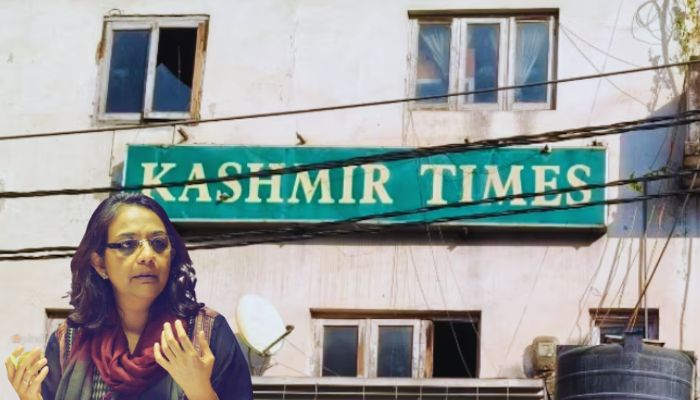
The State Investigation Agency (SIA) of the Jammu and Kashmir Police raided the Jammu office of Kashmir Times, a local English-language newspaper, on 20th November 2025. The raids came as part of the ongoing action against alleged terror funding, separatist networks, and the promotion of secessionist and Jihadist ideology.
Around 14 AK-47 cartridges, pistol rounds and three grenade safety levers were recovered during the searches at the newspaper’s office. The authorities have registered an FIR under the stringent Unlawful Activities (Prevention) Act (UAPA) against Kashmir Times, its promoters and Executive Editor Anuradha Bhasin.
#BREAKING: J&K Police SIA raids Kashmir Times newspaper office in Jammu for indulging in anti national activities and spreading disaffection against the country and threatening sovereignty. SIA FIR names Anuradha Bhasin, Editor of Kashmir Times who is likely to be quizzed for her… pic.twitter.com/4AIFSFrvKQ
The SIA has accused Bhasin and her newspaper of involvement in a “criminal conspiracy with secessionist and other anti-national entities” active in and outside Jammu and Kashmir. Anuradha Bhasin, who is currently reported to be in the US, is likely to be questioned by the SIA about her alleged role in a coordinated “publicity network promoting Jihadi terrorist and separatist ideology, disseminating inflammatory and fabricated narratives, and also attempting to radicalise youth.
The action against Kashmir Times comes at a time when investigations are currently underway into the massive car blast that took place near Delhi’s Red Fort on 10th November. The Jihadi terror attack killed 13 people. The prime accused behind the attack has been identified as Dr Umar un Nabi, a key member of a radicalised module of doctors and clerics that authorities say was planning larger acts of terror. Around 3000 kgs of explosives and weapons were recovered from several doctors linked to Jaish-e-Mohammed. The jihadi module was preparing to carry out a Hamas-style strike similar to the October 2023 assault in Israel.
During the investigation, the NIA also found video material showing Umar un Nabi speaking about suicide bombing, calling it a “profound religious act” rather than an act of violence. The probe agency continues to investigate links between the Delhi module and handlers in Jammu and Kashmir.
The investigators opine that the same network may have had connections with groups attempting to spread propaganda through certain media channels that are now under scrutiny by the SIA.
Anuradha Bhasin and Kashmir Times peddling anti-India propaganda under the pretext of ‘independent journalism’
Founded by veteran journalist Ved Bhasin and now run by his daughter Anuradha Bhasin, The Kashmir Times was under scrutiny earlier as well when its Srinagar office was sealed in 2020. The paper stopped its print edition a few years ago and has been operating solely in its digital format since.
It must be recalled that the Jammu and Kashmir government had allocated two properties to the Kashmir Times. One of them was used as office space while the other served as the residence of Ved Bhasin, the founder of Kashmir Times. Following his death in 2015, the administration had issued notices to the family to vacate the government-allocated residence. However, Anuradha Bhasin, who was supposed to hand over the government-allocated buildings after her father’s death, alleged that the administration had ‘locked down’ the newspaper’s office in Srinagar in an illegal manner.
In a joint statement issued on 20th November 2025, Anuradha Bhasin and her husband Prabodh Jamwal condemned the action taken by the SIA, dubbing it “yet another attempt to intimidate, delegitimise, and ultimately silence” independent journalism.
While the Kashmir Times editors played the usual victim card and said that “Criticising the government is not the same as being inimical to the state”, the newspaper and its editors blurred the line between criticising the government and going anti-national.
Anuradha Bhasin joined Kashmir Times in 1989 as a trainee reporter and took over as the newspaper’s Executive Editor in 2015 after Ved Bhasin’s demise.
Days after Article 370, which gave special status to Jammu and Kashmir, was abrogated by the Modi government on 5th August 2019, Anuradha Bhasin moved the Supreme Court against restrictions on media movement in Jammu and Kashmir. This came at a time when the authorities had shut down internet services and increased security curbs to maintain law and order.
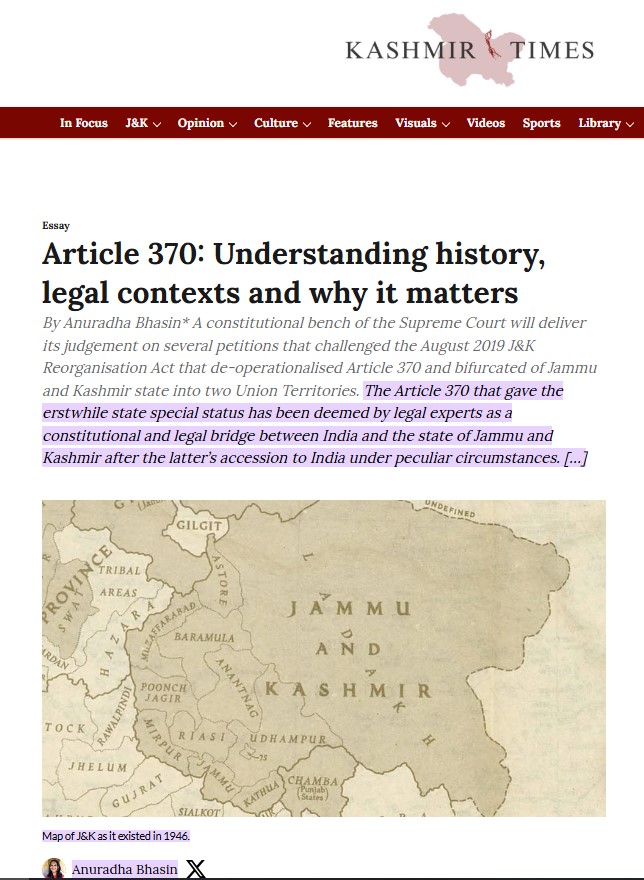
Back in December 2023, Anuradha Bhasin wrote an essay on Article 370, its history, legal contexts and significance. The article, however, argued that Article 370 or Jammu and Kashmir’s special status should not have been revoked and that Article 370 was not a temporary provision. Bhasin deemed the abrogation of Article 370 and Article 35a, which even the Supreme Court upheld, as some sort of political and constitutional ‘fraud’.
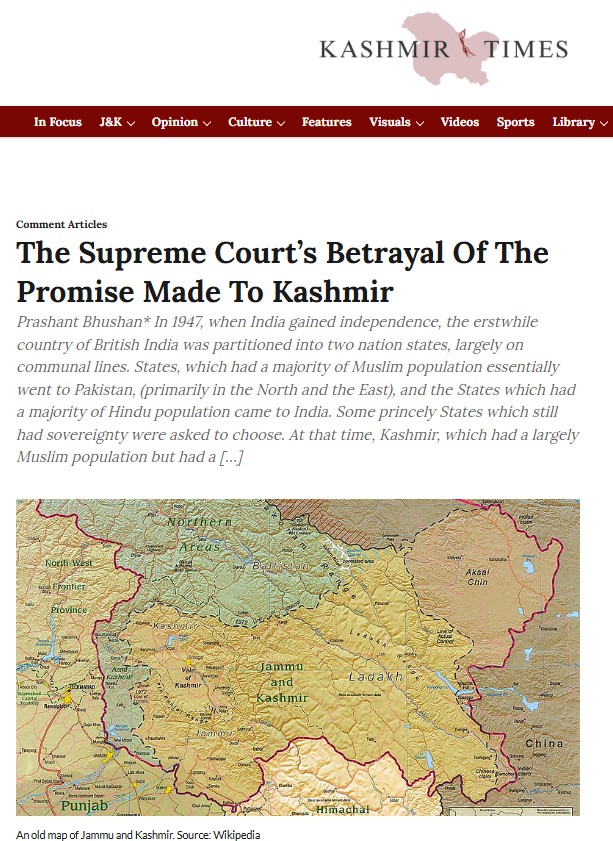
Kashmir Times also regularly platforms those who are dedicated to undermining Indian democracy and national interests. In December 2023, KT published an article by advocate Prashant Bhushan, who has been linked to the 2020 anti-Hindu Delhi Riots, wherein he accused the Supreme Court of ‘betrayal’, since the apex court not only noted that Article 370 was a temporary provision, but also upheld the Central government’s decision to repeal it.
In August this year, Anuradha Bhasin’s controversial book “A Dismantled State: The Untold Story of Kashmir After Article 370”, was banned by the Jammu and Kashmir government for propagating a false and secessionist narrative.
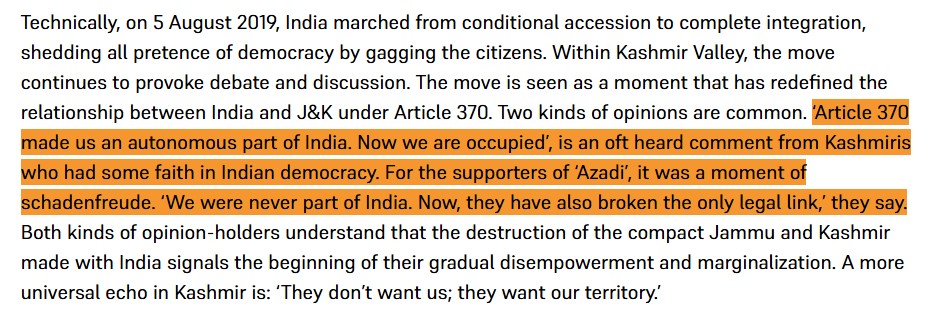
In her now-banned book, Bhasin wrote, “Two kinds of opinions are common. ‘Article 370 made us an autonomous part of India. Now we are occupied’, is an oft heard comment from Kashmiris who had some faith in Indian democracy. For the supporters of ‘Azadi’, it was a moment of schadenfreude. ‘We were never part of India. Now, they have also broken the only legal link,’ they say.
In March 2023, Anuradha Bhasin wrote an op-ed in the New York Times criticising PM Modi’s stance against the Indian media and its freedom of expression. She alleged that the Modi-led government had imposed ‘repressive’ media policies in the country and was deliberately targeting the media organisations that chose to voice opinion against the government or the Prime Minister.
In the article titled ‘Modi’s final assault on India’s Press Freedom has begun’, Bhasin, who has been a vocal critic of the Indian establishment that her outlet, The Kashmir Times, could not survive under Modi. She also blatantly alleged that the government was intimidating media outlets into serving as mouthpieces and creating an information vacuum in the UT.
“Journalists are routinely summoned by the police, interrogated, and threatened with charges such as income tax violations or terrorism or separatism. Several prominent journalists have been detained or sentenced to jail terms. We work under a cloud of fear. Many journalists self-censor or simply quit. Fearing arrest, some have fled into exile overseas,” she claimed.
“Journalism has always been hazardous in Kashmir. India and Pakistan both claim the mountainous region, which has been plagued by war and a separatist insurgency for decades. Journalists have been caught in the middle, threatened and intimidated by Indian security forces and militants, both of whom have wanted to control how the story is being told. At least 19 journalists were killed in Kashmir between 1990 and 2018,” she added. She also stated that the actions of the Indian government were a threat to Indian democracy.
Notably, Anuradha Bhasin has indulged in several anti-India activities and has connections with Pakistan’s ISI. Ved Bhasin, her father, was also a staunch supporter of the ISI’s anti-India operations in Kashmir. He blatantly supported the idea of Kashmir’s separation from India. Ved Bhasin also had links with the separatist outfit Jammu and Kashmir Liberation Front (JKLF). He also sympathised with JKLF founder Maqbool Bhat.
Ved Bhasin was a close friend of ISI mole Ghulam Nabi Fai in the United States. Fai, a Jamaat-e-Islami activist, also praised Ved Bhasin after his death, saying that he was the only person who believed that the solution to Kashmir’s problem would be establishing a separate state.
The Bhasin father-daughter duo have also been part of several ISI-sponsored conferences organised by Fai and his Kashmir American Council (KAC).
Back in 2011, Anuradha Bhasin extended support to Fai after he was accused of receiving money from the ISI for carrying out anti-India pursuits in Kashmir. Fai and one Zaheer Ahmed, a US citizen of Pakistani origin, were charged with using around $4m (£2.5m) in Pakistani funds to influence the US position in favour of Pakistan about Jammu and Kashmir.
“For the last 20 years, Mr Fai secretly took millions of dollars from Pakistani intelligence and lied about it to the US government,” US Attorney Neil MacBride said in a statement back then.
Fai had pleaded guilty to conspiracy and tax violations and admitted to having received funding from the ISI for pushing the Pakistani narrative and influencing the US government’s stance on the dispute of Jammu and Kashmir. Ghulam Nabi Fai was jailed for two years in the US in this case.
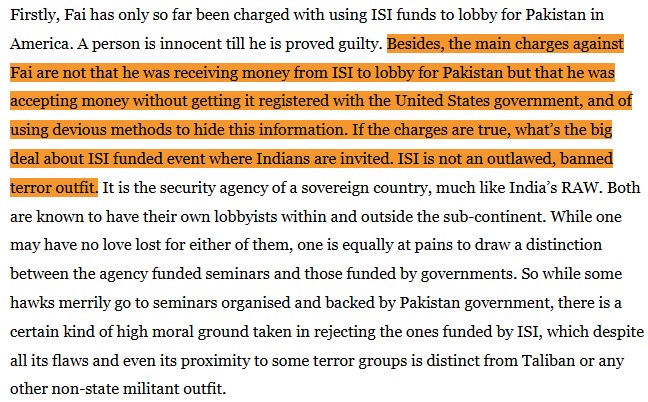
Anuradha Bhasin published a long rant against India and the Indian media for calling out Fai as being on a Pakistani payroll. In her July 2011 article published in Countercurrents, she not only downplayed Fai’s pro-Pakistan activities but also defended the ISI. “If the charges are true, what’s the big deal about an ISI-funded event where Indians are invited. ISI is not an outlawed, banned terror outfit,” she wrote, adding that despite its proximity to some terror groups, ISI is distinct from Taliban or similar ‘militant’ outfits.
Bhasin conveniently skipped mentioning the fact that ISI has orchestrated numerous terror attacks in India and pursues the policy of doing everything it possibly can to harm and destabilise India. ISI’s role in funding, arming and supporting Islamic terrorists for Jihad in Kashmir is not hidden. It is thus safe to conclude that only someone supportive of Pakistan’s illegal claim over the entire Jammu and Kashmir, as well as in favour of separating Jammu and Kashmir from India, would whitewash ISI.
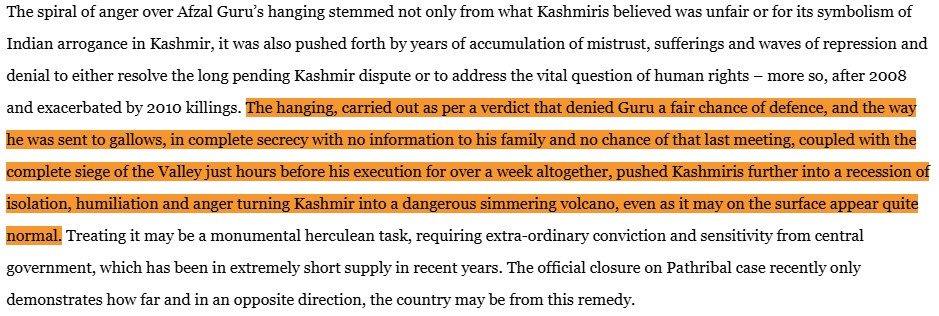
Unsurprisingly, Anuradha Bhasin also sympathised with Mohammed Afzal Guru, the 2001 Parliament attack convict was given the death penalty and executed at the Tihar Jail in 2013. A year after Afzal Guru’s hanging, Bhasin wrote a propaganda piece in Countercurrents, wherein she whitewashed Afzal Guru, portrayed him as a ‘martyr of India’s arrogance’, labelled him a victim and hero. She claimed that Afzal Guru was denied a ‘fair chance’ to defend himself. Moreover, Bhasin also sympathised with separatist and JKLF founder Maqbool Bhatt, who was hanged to death in 1984.
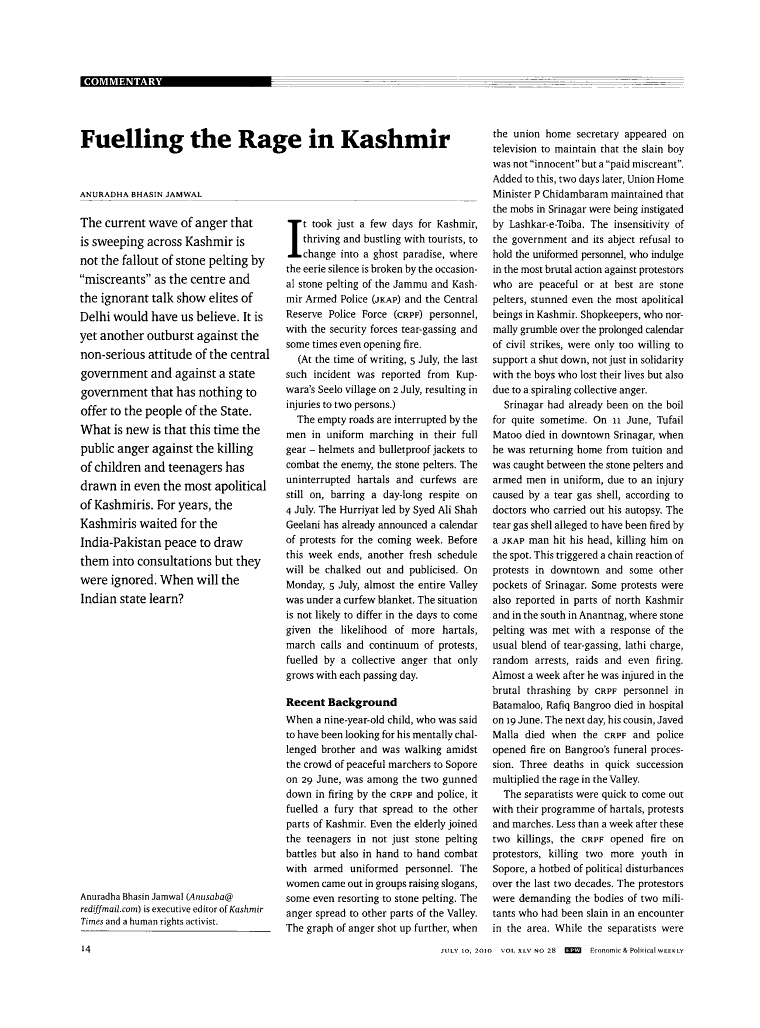
In 2010, Anuradha Bhasin published a research paper in the Economic and Political Weekly, titled: “Fuelling Rage in Kashmir”. In this paper, Bhasin painted the Indian security forces as oppressors killing Kashmiri children and youth, citing the death of a nine-year-old boy.
“The insensitivity of the government and its abject refusal to hold the uniformed personnel, who indulge in the most brutal action against protestors who are peaceful or at best are stone pelters, stunned even the most apolitical beings in Kashmir…” Bhasin wrote, suggesting that the armed forces should have endured stones and surrendered before the raging separatist mobs instead of acting against them.
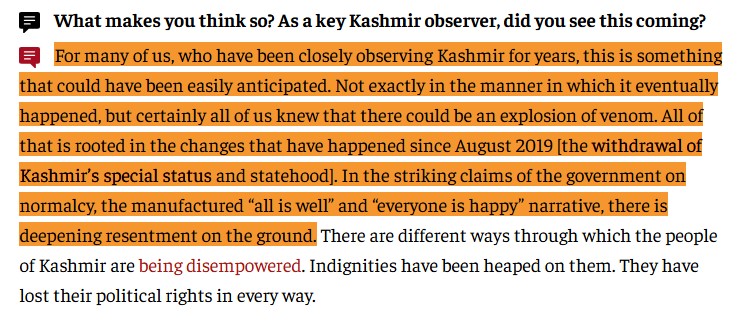
Days after the Islamic terror attack in Pahalgam in April this year, Anuradha Bhasin gave an interview to The Hindu, wherein she was asked about what could be the reason behind the ‘Pahalgam tragedy’. Responding to this, Bhasin said, “For many of us, who have been closely observing Kashmir for years, this is something that could have been easily anticipated. Not exactly in the manner in which it eventually happened, but certainly all of us knew that there could be an explosion of venom.”
In essence, Bhasin meant to say that the Pahalgam terror attack wherein Hindus were singled out for their religion, shot dead after failing to recite the Islamic Kalma, was an outburst of Kashmir’s brewing anger over the abrogation of Article 370, an expression of “deepening resentment ground.”
Bhasin, in her other interviews, has also echoed the Islamist narrative of ‘demographic change,’ saying that the BJP-RSS want to outnumber the local Kashmiri Muslim populace in jobs, businesses and voting patterns, by bringing in people from other regions of India. While the Kashmir Times editor has repeatedly expressed her apprehensions over any real or imaginary demographic change in Kashmir, she never raised similar concerns over the genocide of Kashmiri Pandits. She never spoke with the same intensity about how the Hindu demography of Kashmir was systematically altered.
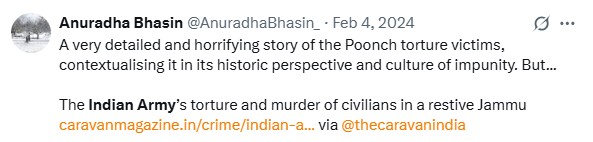
So much for ‘independent journalism’, ‘dissent’ and ‘criticising the government’ that Anuradha Bhasin amplified propaganda accusing the Indian Army of ‘torturing’ and ‘murdering’ civilians in Jammu.
In February 2024, Bhasin shared a propaganda piece by Caravan India, which claimed that the India Army tortures and kills civilians. No wonder Kashmir Times calls the Pakistan-occupied Jammu and Kashmir as Pakistan-administered Jammu and Kashmir. In its reports related to the PoK, Kashmir Times either writes ‘ PaJK’ or as “Pakistan Occupied Kashmir (PoK), which India calls it.”
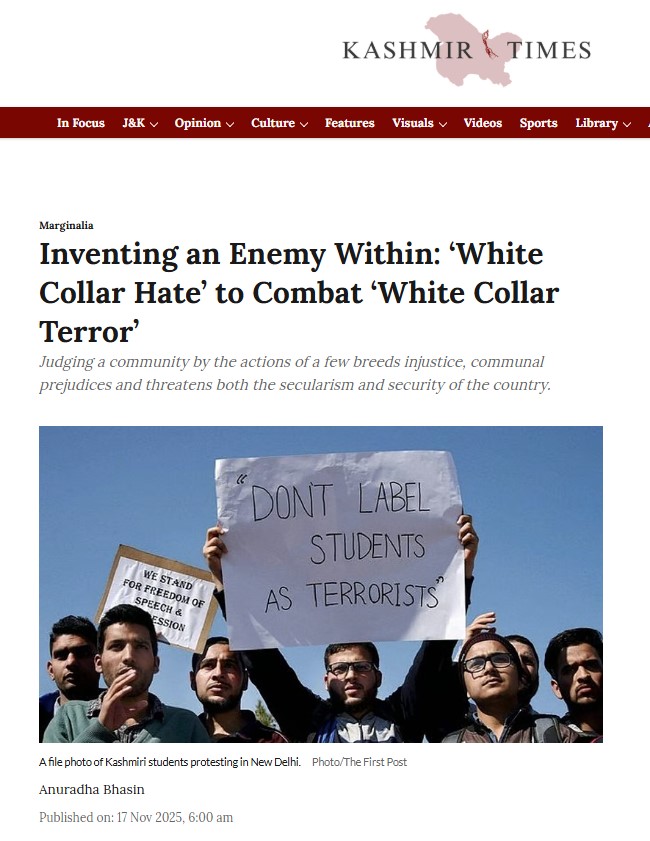
On 17th November, Anuradha Bhasin wrote an article reeking of a pro-Pakistan and pro-Islamist mindset. In her article headlined: Inventing an Enemy Within: ‘White Collar Hate’ to Combat ‘White Collar Terror’, Bhasin argued that, somehow, under the pretext of calling out “white collar terrorism” after the Delhi blast that killed 13 innocent people, Islamophobia is being pushed against all Muslims just because some Muslim doctors were involved in the Jihadi terror attack.
Anuradha Bhasin also asserted that Pakistan has not been explicitly blamed for the Delhi Blast so far since “India learned the hard way that the world has no appetite for nuclear brinkmanship in South Asia, and that Pakistan’s military capability can’t be undermined.”
Call it limerence for Pakistan or divorced-from-reality take by Bhasin, India has never indulged in nuclear brinkmanship; it is the Pakistani military and its subservient political leadership, which constantly issues nuclear war threats against India. By writing that ‘Pakistan’s military capability can’t be undermined’, Bhasin insinuated that somehow Pakistan had an upper hand during the May conflict. However, in reality, it was India that dominated Pakistan throughout the conflict, forcing the hostile neighbour to reach out to the Indian DGMO and leaders of several foreign countries, including the US, to seek a ceasefire.
Also, the only person to stand humiliated due to Trump’s claim of PM Modi requesting him to end the war is Donald Trump himself. Not only has the Modi government refuted Trump’s claims of stopping the India-Pakistan conflict, but it has also refrained from nominating Trump for the Nobel Peace Prize he so desperately sought and Pakistan nominated it for. The situation is such that Trump’s claims of stopping the India-Pakistan conflict and alleged downing of fighter jets are no longer taken seriously by the people.
She also argued that by declaring that every terror attack after the Pahalgam attack will be deemed an act of war, the Indian government has decreased the threshold of war and is thus not explicitly blaming Pakistan. Bhasin asserted that the Modi government has ‘thrived’ on terror attacks and wants to erect a villain for the public to vent out its anger against after the Delhi attack, and thus Muslims, especially educated Muslims, are being painted as a threat to India’s security and integrity.
While declaring anyone criticising the well-educated Jihadi perpetrators of the Delhi blast and raising concern over Islamic fanaticism even in educated Muslims as Islamophobia, she suggested no way in which people can distinguish between Jihadist Muslims and ‘peaceful’ Muslims.
Ironically, Anuradha Bhasin, who has been advocating against the UAPA, labelling it a weapon against dissenting voices, has ended up getting booked under the same UAPA. Unsurprisingly, the Islamo-leftist cabal has jumped to Bhasin’s defence and is whitewashing the alleged criminal and anti-India activities of Bhasin and her newspaper by peddling the narrative that the government was targeting the paper simply for being critical of its policies, even though firearms, pistols, and a grenade were reportedly recovered from the office of Kashmir Times.
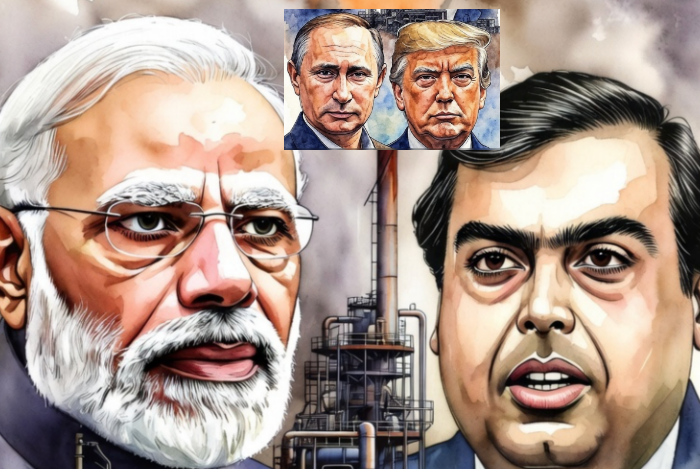
Reliance Industries declared on November 20, 2025, that it will immediately cease importing Russian crude oil into its export-focused refinery in Jamnagar. As of December 1, the facility will solely export petroleum products made from non-Russian crude. The company clarified that this move was made in order to promptly comply with upcoming sanctions from the United States and the European Union (EU) that target refined goods made from Russian raw materials.
Critics argue that the action shows India “bowing” to American pressure, although such a conclusion ignores the business realities facing both India’s largest non-state energy company and the largest refining complex in the world. Reliance is India’s biggest purchaser of Russian crude; its Jamnagar complex has a Special Economic Zone (SEZ) section focused on exports, with a significant portion of its output going to the US and EU markets. The decision reads more like prudent business risk management than diplomatic capitulation since it is acknowledged that Reliance’s export business generates substantial margins and international involvement.
Export markets, sanctions risk, and business prudence
Fuel exports to the US, EU, and other countries that offer premium margins and worldwide exposure are Reliance’s primary business drivers rather than just domestic refining. It has been reported that nearly half of India’s exports of Russian crude come from the Jamnagar SEZ refinery alone. In the meantime, the EU banned the import of petroleum products made from Russian crude starting on January 21, 2026. In a similar vein, the US imposed deadlines on Russian oil giants like Lukoil and Rosneft.
Given the situation, Reliance’s choice appears to be proactive risk mitigation. It honours pre-committed shipments while shifting future exports to non-Russian feedstock to avoid jeopardizing access to Western petroleum markets or inviting secondary penalties. Far from indicating ideological unity, the move demonstrates commercial discipline, ensuring that the export industry is unaffected by global sanction regimes.
Long term Russian deal Vsshort term export reality
It is true that Reliance negotiated a long-term agreement with Rosneft in recent years to purchase up to 500,000 barrels per day of Russian crude in a contract worth billions of dollars per year. However, corporate contracts need to take compliance risks and shifting international trade conditions into account. Contractual responsibilities are being fulfilled even as the business changes, as evidenced by the fact that Reliance is honoring pre-committed liftings until October 22 and that the last such cargo was loaded by November 12.
From the government’s point of view, this demonstrates practicality rather than weakness. Instead of abruptly changing its stance on Russia, India makes sure that important industry participants carry on doing business as much as possible while giving them time to adjust when international sanctions take effect. In this way, the Modi administration is helping to maintain strategic continuity with Russia through long-term contracts while allowing the private sector to react to changing pressure on international commerce through export-oriented strategies.
India and Russia continue to have deeper energy links that are structural rather than transactional. While Rosneft owns over 49% of Nayara Energy’s Vadinar refinery in Gujarat, Indian PSUs possess nearly half of Rosneft’s Vankorneft subsidiary, a substantial investment in Taas Yuryakh, and a longstanding position in the Sakhalin-1 project. Even if individual refiners like Reliance strategically modify their crude procurement in reaction to sanctions and market realities, these long-term upstream and downstream cross-holdings demonstrate that strategic continuity with Russia remains strong.
Energy security, domestic Vs export strategy and the Indian government’s role
One crucial distinction is that the shutdown only affects Reliance’s export focused SEZ refinery and not all of its domestic refining feedstocks. Thus, a segmented strategy is reflected in the decision. While local supply chains can continue to absorb a variety of crude sources, including Russian (subject to domestic tariff area limitations), exports shift away from Russian oil in order to preserve access to Western markets.
This split strategy makes sense from the perspective of the government. It guarantees that careless international maneuvers won’t jeopardize India’s internal energy security. In addition, it protects margins and raises the cost of energy by enabling private Indian refiners to keep taking advantage of cheap Russian oil while it is geopolitically possible. Therefore, it is possible to interpret the Modi government’s stance as empowering Indian companies to manage risk in the best interests of the country rather than as submission.
Maintaining strategic autonomy: Domestic suppliers, pricing and global alignment
Critics who claim that India “bowed” to American pressure are oversimplifying. What we witness is a market-driven recalibration by a significant private enterprise ahead of sanctions; the government has not declared a complete embargo on Russian oil imports. This indicates that the Modi administration maintains its strategic flexibility. It hasn’t publicly pledged to use no Russian oil, it has not compelled state refiners to cease importing Russian oil, and it has maintained its independent foreign policy stance.
In addition, India’s government protects high-value fuel markets, defends exporters, and maintains its own credibility in international trade negotiations by allowing Reliance to change course. Importantly, the domestic gain is real, importing discounted Russian oil in benign conditions has helped India obtain favorable feedstock costs and kept downstream fuel prices under control, indirectly benefiting ordinary consumers and the economy as a whole. When viewed in this context, the Modi administration seems to be striking a balance between commercial pragmatism and global alignment rather than just giving in.
Business imperatives, global markets and India’s Competitive edge
Global competitive imperatives must also be considered while evaluating Reliance’s choice. The largest refining facility in the world is the Jamnagar complex. Globally, there is intense competition for its export business. If Russian-derived feedstocks are still utilized for exported goods, Western sanctions could jeopardize its market access. In its release, the corporation emphasized that the transformation was finished ahead of EU deadlines, demonstrating operational discipline in the face of external shocks. From the Modi government’s perspective, aiding this operational change through regulatory clarity, coordinated industry messaging, and diplomatic caution displays a business-friendly governing culture rather than subservience. India continues to draw foreign investment, and demonstrating that Indian businesses can manage the danger of sanctions helps preserve the nation’s reputation abroad.
Why this move doesn’t undermine India-Russia relations
It is crucial to remember that Reliance’s change does not necessarily mean a strategic break with Russia. Long-term arrangements are still in effect, and India’s overall purchases of Russian oil are still substantial. The Modi administration is still interacting with Russia in the areas of energy, defence, and diplomacy. Instead of a unilateral change in foreign policy, what is taking place is an industry-led shift in one particular export node.
When seen in this light, the government’s response makes sense. It allows the private sector to adjust to international sanctions while maintaining more extensive strategic connections with Russia. India’s long-term foreign policy and economic goals are in line with this dual approach of alignment when needed and autonomy when feasible.
The bigger picture: Supporting the domestic value chain, protecting export earnings
India’s domestic value chain stands to gain in addition to crude sourcing. India’s downstream sector will remain globally competitive, generate foreign cash, and maintain high-value jobs if the Jamnagar refinery maintains its dominance in exports. By allowing this continuity, the Modi administration protects both industrial strategy and energy security. Additionally, the firm avoids the possibility of secondary sanctions or market exclusion, which might jeopardize Reliance’s future investment plans in petrochemicals, renewable energy, and international collaborations, by moving away from Russian crude in the export unit. This action essentially safeguards India’s strategic footprint as well as its worldwide corporate champions.
Conclusion
In conclusion, Reliance’s export-focused refinery’s decision to stop importing Russian crude should be viewed as a business-led recalibration made possible by a government that recognises the interplay of international sanctions, export markets, industrial competitiveness, and energy security rather than as India caving in to external pressure. The Modi administration has maintained strategic connections with Russia and did not publicly surrender or enforce a blanket stop. Rather, it has made it possible for the top private energy company to negotiate the shifting global landscape while safeguarding India’s export revenue, refining margins, and downstream value chain.
The underlying facts indicate that this is India’s system of strategic autonomy in action, mediated through economic pragmatism and global market realities, despite critics framing the decision as diplomatic surrender. That is precisely the kind of strategy India needs in this uncertain age of supply chain shocks, sanctions, and shifting alliances.
China’s dubious involvement in disseminating disinformation during India’s “Operation Sindoor” has recently come to light. The country launched a disinformation drive to prevent the sale of French Rafale aircraft in favour of its own J-35s during the Operation Sindoor in May following the Pahalgam terror attack. These actions were an element of its Grey Zone tactics (unconventional warfare methods).
China spread AI photos of purported “debris” from the planes that its weapons allegedly destroyed with the help of phoney social media accounts. The significant disclosure was made in US (United States)-China Economic and Security Review Commission report which was presented in the US Congress on 19th November.
A US report says after May India Pakistan conflict China 'initiated a disinformation campaign' to hinder sales of French Rafale aircraft in favor of its own J-35s, using 'fake social media accounts to propagate AI images of supposed “debris” from the planes' pic.twitter.com/APQ9ZCa8zR
According to the commission, China’s involvement in the 7th-10th May armed confrontation between India and Pakistan “drew global attention as Pakistan’s military relied upon Chinese weaponry and reportedly leveraged Chinese intelligence.”
Beijing was able to “test and advertise the sophistication of its weapons” due to Pakistan’s usage of Chinese technology as it supplied over 82% of Pakistan’s weaponry purchases between 2019 and 2023, making it the Islamic Republic’s major defence supplier.
China tried to exhibit effectiveness of its weaponry to attract more buyers
The report highlighted that the country attempted to increase sales of its weapons by showcasing the effectiveness of its systems during the dispute between the two neighbours. Likewise, the East Asian nation “opportunistically leveraged” the situation to exhibit its own weaponry.
The study stated, “While characterisation of this conflict as a proxy war may overstate China’s role as an instigator, Beijing opportunistically leveraged the conflict to test and advertise the sophistication of its weapons, useful in the contexts of its ongoing border tensions with India and its expanding defence industry goals.”
“This clash was the first time China’s modern weapons systems, including the HQ-9 air defense system, PL-15 air-to-air missiles and J-10 fighter aircraft were used in active combat, serving as a real-world field experiment,” it added. Chinese diplomats celebrated the “successes” of their systems in the fight between India and Pakistan in the weeks following the same, hoping to increase arms sales.
“The Indian Army claimed China helped Pakistan with live inputs on Indian military positions throughout the crisis and effectively used the conflict as a testing ground for its own military capabilities. Pakistan denied these allegations and China neither confirmed nor denied its degree of involvement,” the document noted.
The commission further insisted that “only three jets flown by India’s military were reportedly downed and all may not have been Rafales.” Interestingly, no proof has been provided to validate this thus far. There are merely manipulated images and doctored photographs, yet no authentic evidence exists to substantiate the assertion.
Meanwhile, China even persuaded Indonesia to halt a Rafale deal that was already underway, “furthering inroads into military procurements” of other “regional actors.” The Indonesian government announced last month that it is considering to buy Chinese-made J-10C fighter jets to add to its expanding fleet of military aircraft, even though the Rafale jet deliveries to Jakarta are scheduled to continue.
Increasing military ties between China-Pakistan
The report also mentioned, “China reportedly offered to sell 40 J-35 fifth-generation fighter jets, KJ-500 aircraft and ballistic missile defense systems to Pakistan in June 2025. Islamabad declared a 20% increase in its defence expenditure for 2025-2026.
“In November and December 2024, China and Pakistan held the three-week Warrior-VIII counterterrorism drills, and in February 2025, China’s navy participated in Pakistan’s multinational AMAN drills,” the study informed underscoring the growing military collaboration between the two sides. India perceived this as “direct security threats” to its regional positions.
The yearly analysis provides the US Congress with a bipartisan perspective on China policy. The current report made 28 suggestions in the areas of technology, trade and economy alongside national security as well examined how China has positioned itself through industrial strategy to have a competitive edge in emerging technologies.
The opening statement by the commission’s Chair Reva Price outlined, “President Xi (Jinping) has also been explicit that he wants to make the world more dependent on China. We can expect that China will continue massive, distortionary policy support for strategic sectors.”
The report was released months after French intelligence and military officials asserted that the dragon was engaged in a “disinformation” operation against its Rafale aircraft. According to a French intelligence assessment cited by the Associated Press, defence attachés at Chinese embassies spearheaded the effort to sabotage Rafale sales.
Congress, its leaders cast aspersions on Rafale during “Operation Sindoor”
The report exposed the role of Chinese propaganda to alter the narrative in its favor. However, it is important to mention that Congress, along with its leaders and members of its ecosystem were also busy criticising the government and doubting the military actions of the nation’s forces amid “Operation Sindoor.”
Rahul Gandhi who was at the forefront of this attack even distorted External Affairs Minister S Jaishankar’s remarks to give strength to the enemy’s agenda during this critical period. “Informing Pakistan at the start of our attack was a crime. EAM has publicly admitted that GOI (Government of India) did it. Who authorised it,” he questioned in addition to positing the union minister’s video, on 17th May.
The clip was already deemed fraudulent by the Press Information Bureau’s (PIB) fact-check. The centre even exposed a number of fake visuals that have appeared on social media, at the time. Furthermore, India previously clarified that “all strikes were carried out without any loss of Indian assets, highlighting the efficiency of our surveillance, planning, and delivery systems.”
Notably, Jaishankar actually expressed, “At the start of the operation, we had sent a message to Pakistan saying we are striking at terrorist infrastructure. We are not striking at the military. So, the military has an option of standing out, and not interfere at this process. They chose not to take this good advice.”
“The EAM had stated that we had warned Pakistan at the start, which is the early phase after Operation Sindoor’s commencement. This is being falsely represented as before the operation. This utter misrepresentation of facts is being called out,” the ministry outlined.
He clearly did not mention that Pakistan was informed beforehand and the sequence of events confirmed by the PIB and Indian defence officials suggested that the operation had already ended by the time the message reached the Islamabad.
However, the statement was twisted by the Leader of the Opposition in Lok Sabha who opted to continue promoting the Pakistani and Chinese lies concerning the downing of Rafale jets. He even continued to advance the enemy’s propaganda and relentlessly launched these unfounded allegations.
“EAM Jaishankar’s silence isn’t just telling, it’s damning. So I’ll ask again: How many Indian aircraft did we lose because Pakistan knew? This wasn’t a lapse. It was a crime and the nation deserves the truth,” the Gandhi scion shamelessly reiterated despite the striking absence of evidence to support his claims. Pakistan expectedly used his comments to declare victory and portray “Operation Sindoor” as a defeat for India.
Congress officials circulate lies about the destruction of Indian jets
Other Congress leaders also mirrored the outrageous sentiments of their chief leader. Its national spokesperson Pawan Khera described Jaishankar’s statement as “mukhbiri (acting as an informant).” He lashed out, “Prime Minister Narendra Modi and the Foreign Minister S Jaishankar will have to answer why this was done. The government should answer how many aircraft did India lose? What losses did the country suffer? How many terrorists escaped.”
Likewise, Telangana Chief Minister Revanth Reddy asked PM Modi how many Rafale fighter jets were lost at the hands of Pakistan. He voiced, “The soldiers of this (Secunderabad) Cantonment participated in the war. The war planes being manufactured in Telangana upheld respect for our country.”
“Rafale aircraft brought by Narendra Modi were shot down by Pakistan. There is no discussion on how many Rafales were shot down during the recent war. Narendra Modi should answer and give us the account,” Reddy demanded, triggering a massive row.
Congress Lok Sabha MP Manickam Tagore echoed the same falsehoods and insisted that ministers in parliamentary democracies have an obligation to address national security issues invoked by the opposition.
He charged, “Yet, the EAM has remained silent. This silence raises grave questions. Why was Pakistan informed in advance? Who authorised this breach of operational secrecy? What consequences did our armed forces face because of it?”
Another Congress parliamentarian, Amarinder Singh Raja Warring announced that the tail of a crashed Rafale jet was discovered at the Bhisiana Airforce station and claimed to possess images of the same.
"RAFALE CRASHED. Its tail was found in Bhisiana Airforce station. I've brought the pictures. ~ Air Marshal Bharti called it Unidentified. You FOOLED the country"?
Congress MP & Punjab unit Chief. You still think these are not Calibrated Scripts handed by the Gandhi family?? pic.twitter.com/C6PiLVjmn2
— The Analyzer (News Updates?️) (@Indian_Analyzer) July 29, 2025
The centre and even fact-checking agencies attempted to warn about this Pakistani and Chinese propaganda, but the country’s opposition and its several leaders persistently targeted its own government as well as defence forces. Now, the truth has been laid bare by the US Commission.
Congress supporters, Pakistan, Turkey social media accounts promoted bogus stories of shooting down Rafale aircrafts
Congress advocates also recited the same deceptions that were promoted by China, Pakistan along with their allies and were intensified by Rahul Gandhi alongside other opposition leaders. There was no difference between the remarks made by Congress, its ecosystem and the social media accounts of adversary nations in relation to the taking down of Indian jets, particularly the Rafale.
While the grand old party attempted to leverage this to undermine the central government and the security forces, the latter celebrated the fabrication to paint India in a weak light. A supporter of Congress wrote that $8.1 billion was wasted on inferior French equipment which was destroyed by Pakistan and added, “Now, even Indonesia has ditched them.”
Rafale SCAM:
$8.1B blown on French junk -one Smoked Downed in Op Sindoor, by China’s J-10s Flown by Pakistan.
“Calsh Report” uploaded some unverified images and videos from Aklian Kalan village, close to Bhatinda Air Force Station, alleging that a French MICA missile which equips Rafale remained attached to its launcher proving that Pakistan shot down the jet.
BIG: It appears India indeed lost a Rafale fighter jet tonight, shot down by Pakistan.
Locals in Aklian Kalan village, Punjab, filmed parts of a French MICA missile still attached to its launcher— just 20 km from Bathinda AFS, home to No. 17 Rafale & No. 380 NETRA squadrons. pic.twitter.com/ylTA6KGW3l
A Pakistani account similarly published unauthenticated visuals and announced the destruction of a Rafale jet.
M-88 engine of Rafale that was shot down by PAF J-10CE using PL-15 very long range BVR missile. pic.twitter.com/TyckCgEZTY
— Pakistan Strategic Prism (@StrategicPrism1) May 7, 2025
All handles propagated the same rhetoric without even a shred of evidence to support it. Numerous posts similar to these appeared on social media either from Pakistan and Turkey, rejoicing the fictitious victory or Congress backers who were denouncing Rafale and the government for their alleged shortcomings. The US commission has now disclosed that the source of this propaganda had been China.
How Congress, other parties vehemently fought against Rafale purchase
India purchased 36 Rafale fighter fighters from France in 2020 under a government-to-government deal and these aircraft played a crucial part in “Operation Sindoor.” Congress took a prominent stance against the move after former French President Francois Hollande alleged that Dassault Aviation was supposedly told by the Modi administration to work with Reliance Defence of India to adhere to its “offset policy.” The clause in Delhi’s defence procurement standards compels foreign corporations to contribute at least 30% of a deal’s value back in India.
PM Modi was accused by the Congress party of favouring an Indian enterprise and even practicing crony capitalism by endorsing Anil Ambani’s business. However, the BJP continuously denied these allegations, maintaining that the government signed the deal to meet the Indian Air Force’s combat requirements and had no involvement in choosing the French manufacturer’s local partner.
During the 2019 general elections, Rahul Gandhi even referred to the Rafale acquisition as a scam as part of the party’s enormous electoral campaign against the Modi government for moving forward with the transaction. The Supreme Court even chastised him for using its name improperly and spreading lies just to discredit PM Modi.
Afterward the Rae Bareli MP came up with the derogatory “chowkidar chor hai,” and former union minister Meenakshi Lekhi launched a contempt case against him for misattributing the phrase to the apex court’s initial decision in the Rafale case. He had apologised for misquoting the decision during the previous hearing. The court, however, had requested a formal apology because it was not convinced by his earlier affidavit.
On 14th December 2018, the Supreme Court pronounced that there were no irregularities in the price, decision-making process or off-set partner selection after the opposition and its supporters submitted an appeal for a court-monitored inquiry. The court even stressed that it had limited authority under Article 32 to evaluate defence contracts as it rejected the review applications on 14th November 2019.
According to documents that the Congress argued bolstered its charges of corruption against PM Modi and centre in 2021, large quantities of money were paid to middlemen in the transaction. However, BJP Lok Sabha member Sambit Patra had refuted, “The way Rahul Gandhi is behaving, it will not be an exaggeration to say that he is being used as a pawn by competing companies. He has been lying right from the beginning on the issue. Probably, he is acting as an agent or some member of Gandhi family has been for a competing company.”
MoU between China and Congress
Congress not only opposed the acquisition of Rafale jets but even reinforced Chinese claims, particularly during the standoff between the two nations. At that time, Rahul Gandhi chose to function as a mouthpiece for China and disparaged the government. The cause of this affection originated from the Memorandum of Understanding signed between the Congress party and the Communist Party of China (CPC) on 7th August 2008.
They struck the agreement in Beijing during UPA1 in 2008 for high-level information sharing and collaboration. It was signed by Rahul Gandhi, the general secretary of the Congress at the time, and Xi Jinping, then vice president of China and a standing committee member of the CPC’s politburo. Sonia Gandhi was also in attendance there. Additionally, the MoU also gave the duo “opportunity to consult each other on important bilateral, regional and international developments” under the same.
Sonia and her son had a lengthy discussion with Xi and other senior Chinese leaders prior to the signing ceremony to explore topics of shared interest. Sonia, Rahul, Priyanka and Robert Vadra with their two kids travelled to Beijing in 2008 to witness the inauguration of the Olympic Games. Sonia and Rahul had also led a Congress party team to China a year prior.
The strong ties between the Chinese leadership and the Congress party, specifically Rahul Gandhi, were brought to light during the Doklam standoff as well when he was secretly engaging with Chinese officials. Policymakers were suspicious of his intentions after he was spotted meeting with Chinese officials twice in 2017 and 2018.
His initial meeting was with Ambassador Luo Zhaohui, which Congress refuted. However, the party faced considerable embarrassment as China’s embassy verified that the pair had indeed met. Rahul Gandhi had his second meeting with a few Chinese ministers during his September 2018 visit to Kailash Mansarovar. At first, the meeting was likewise kept under wraps but he eventually disclosed the truth.
Chinese funds in Rajiv Gandhi Foundation
The connection between Congress and China runs even deeper as the latter donated Rs 10 lakh to the controversial “Rajiv Gandhi Foundation” in 2006 to provide “financial assistance” to its charitable activities. However, the flow of funds did not cease there, as additional contributions were made to the foundation, bringing the total amount to over Rs 1 crore within three years.
Rahul Gandhi and Priyanka Gandhi Vadra are the trustees of the Rajiv Gandhi Foundation which is chaired by Sonia Gandhi.
The foundation hosted two seminars on Chinese interests in 2008 and 2009 after receiving the money and even started two “projects.” It even investigated the viability of a free trade agreement between China and India between 2009 and 2010. The study essentially advocated for unrestricted economic collaboration between China and India.
The report simply served to highlight the Rajiv Gandhi Foundation’s persistent attempts to weaken India’s stand regarding China and demonstrate it as a superior power which could only be advantageous to India. To summarise, the foundation was involved in obtaining funds from the Chinese government from 2005 to at least 2008 and then carried out research that would have damaged India’s position.
Rahul Gandhi extols China
Considering the strong relationship between the two sides, Rahul Gandhi has seized every opportunity to laud China. His actions as a Chinese propagandist aimed at attacking the central government and casting doubts on the capabilities of the security forces are well documented. Furthermore, he did not hesitate to praise China on foreign platforms either.
“I don’t think India sees itself as leading the world. We are a large country, and we believe in partnerships. We are not arrogant enough to believe that we should lead the world. The idea that India should lead the world—India doesn’t view itself like this; perhaps China thinks of itself this way,” Rahul declared during his speech at EIA University in Colombia in October.
He claimed that India finds it difficult to control manufacturing while praising China’s capacity to execute the same in a non-democratic system. He even asserted that China dominates manufacturing figures and added that it is outperforming the US in the fight to manage the world’s energy transformation.
Rahul insisted that unemployment is a problem in the US, India and other Western countries but China is not dealing with this problem because it controls the majority of global production, while interacting students at the University of Texas in Dallas last year.
Speaking at a press conference in Brussels in 2023, he likewise commended China for its industrial prowess while asserting that the Indian government lacks a “alternative vision” for domestic industry.
“I’ve been saying in all my meetings that it is pretty clear that China is proposing a particular view of the planet, which is the Belt and Road Initiative. One of the reasons why they are able to do it is because they have become a center of global production. I don’t see an alternative vision coming from our side. What the Chinese have shown that it is possible to do production in a coercive environment. Can we provide an alternative vision by doing production with a democratic vision. A competent vision,” Rahul stated.
Rahul even promoted China’s growing influence in the Indian subcontinent and asserted that the country wanted the surrounding nations to succeed as well as fiercely defended the dragon, at a Cambridge University event in 2022. He lauded China’s Belt and Road Initiative and labeled the debt traps it perpetuates, targeting the weaker economies as “prosperity,” while asserting that India-US relations should adopt similar policies.
Conclusion
Rahul and his Congress have consistently supported China and has a clear history of close relations with the country. They have even continued to spread the same falsehoods peddled about Rafale during and even after “Operation Sindoor.” Now, the aforementioned report has busted China’s propaganda which India’s main opposition party blatantly promoted and raised questions not only about its own government but also the security forces, that too without any evidence.
It’s interesting how Rahul and Congress find themselves acting as puppets of China, particularly when India must present a united front against its enemies, especially during critical moments.
The Modi government has announced its intention to annihilate Left Wing extremism from India by 31st March 2026. The security forces, local administrations, authorities and the central government are collaborating effectively to realise the ambitious objective of a red terror-free country, yielding remarkable results. As the threat is being countered at an aggressive pace, a campaign has also been underway to dismantle the resources of these hostile elements, particularly by targeting illegal narcotics cultivation.
Notably, this unlawful practice is even financing militant groups in volatile regions such as Manipur, which experienced widespread violence in 2023. Furthermore, the state’s proximity to Myanmar which is the world’s biggest source of opium greatly exacerbates the problem. Hence, while this perilous industry is prevalent in poor and underdeveloped regions with low employment opportunities, it is not confined to a single area and is pervasive from south to northeast, including the former Naxal corridor region.
This not only creates an issue for the nation’s internal and national security but also poses a major environmental challenge, resulting in extensive deforestation within protected and reserved forests. However, the government is proactively working to address the epidemic of narcoterrorism.
Manipur’s crucial action to eliminate illegal poppy farming
On 17th November, 41 acres of illicit poppy production was wiped out in Manipur’s Tengnoupal and Kangpokpi districts. A joined team identified and uprooted the crops during the day-long operation which was conducted in the Khudei Khullen hill range under Tengnoupal Police Station.
A temporary irrigation system was taken down, seven bags of fertiliser and three chemical spray pumps were destroyed as well as eighteen huts used by the producers were demolished by the forces. Officials informed that over 278 kilogrammes of opium, valued at several crores of rupees, could have been produced from the fields that were obliterated
Afterward, strict inspections were conducted to prevent its replanting and to arrest the accused responsible for this activity. The move followed a series of coordinated operations that resulted in the destruction of over 500 acres of poppy plants in the state between 11th and 15th November.
Poppy fields of around 436 acres were removed in the Somdal, Lamlai Chingfei, and Litan hill ranges during the drive’s largest phase in the Ukhrul district. 51 huts that the farmers utilised as makeshift dwellings and storage facilities were set on fire. The action was implemented by teams of the Assam Rifles, Central Reserve Police Force (CRPF), Manipur Police and multiple government agencies.
Similarly, numerous acres of poppy crops, herbicides, pipes, spray pumps, salt bags and various farming tools along with huts were destroyed by the team in different villages. The authorities mentioned that these joint operations in the districts of Kangpokpi, Tengnoupal, Ukhrul and Senapati eradicated around 537 acres of illicit poppy farms, which would have led to 3,3583 kilogrammes of opium worth hundreds of crores.
Manipur’s relentless ‘War on Drugs’
The Manipur government launched the “War on Drugs” campaign in November 2018 and the Bharatiya Janata Party outlined that the campaign had outstanding accomplishments, including the removal of 3,420 acres of unauthorised poppy crops. Moreover, over 8,000 acres of poppy plantations have been found by the authorities on government and forest areas since 2020.
Destruction of poppy crops. (Source: ANI)
Approximately 1,700 acres of these were destroyed in the same year. Last December, the district administration in Ukhrul, the BSF and the forest department worked together to demolish about 45 acres of illegal poppy plantations which were grown in Phungyar’s Mapithel hill range. Two people were arrested for the crime. Additionally, such action has taken place over the course of multiple months and years.
The authorities announced that the government seized narcotics worth over 20 billion rupees and shut down five makeshift drug production factories in Manipur, during a period of two and a half years, reported Al Jazeera in April of last year. It also told about the destruction of 110 acres of poppy flourishing in the highlands, in 2022.
According to government data, 14,315 acres of illegal poppies primarily grown in the hills was eliminated between 2017 and 2021 during the previous Bharatiya Janata Party government’s “War on Drugs” program.
The state’s crucial intervention concerning this drug network was earlier underscored in a video by former chief minister N. Biren Singh in April 2024. “We have seized heroin, opium, tablets, etc. worth over Rs 60 thousand crores. Destroyed over 20 thousand hectares of poppy plantations. Number of persons arrested: 3066. Cases registered: 2461. Persons convicted under NDPS: 225. Only to save our Indian youths. We will continue,” he wrote.
The drugs menace poses a serious threat not only to the people of Manipur and the Northeast but to every youth of our Nation.
With massive public support, the War on Drugs campaign launched by the Manipur State Government has reaped many successes and brought positive changes… https://t.co/RRK5Ht7DZ7
“Manipur’s geographical proximity to the Golden Triangle (Myanmar, Laos, Thailand and Vietnam) made it a primary transit route for drug trafficking. It threatens to transform the state into a major poppy production and trafficking hub. Under the leadership of Chief Minister, N. Biren Singh, the BJP-led coalition government declared war on drugs. This will help eradicate the poppy plantation, drug trafficking, and abuse in the state,” the clip pointed out.
Notable decline in Manipur’s poppy production
According to a 2024 survey by the Manipur Remote Sensing Applications Centre (MARSAC) illegal poppy cultivation in Manipur has steadily declined over the previous four years. It was carried out between September 2023 and January 2024 and reported that the cultivation dropped from 16,632.29 acres in 2022-2023 to 11,288.07 acres in 2023-2024. Thus, it fell by 32.13% between 2022 and 2023.
Former Governor of Manipur Anusuiya Uikey also informed last year that the state eliminated 3,010 acres of illegal poppy growing. The state got rid of more than 19,135 acres of illicit poppy cultivation from 2017 to 2024.
The number of poppy fields has steadily decreased there over time as a result of this strict enforcement, demonstrating the effectiveness of the multi-level effort. This planting has long been linked to increased violence, funding of armed organisations and the ongoing ethnic tensions in Manipur, according to security and government officials.
The networks that sustain unrest in the hills frequently profit from the drug trade and its cultivation. The Assam Rifles has upheld a rigorous zero-tolerance stance against this kind of activity, taking decisive action against individuals engaged in its finance and growing.
873 Kuki-Chin persons, 1,083 Muslims, 381 Meiteis and 181 “others” were among the 2,518 arrests made in narcotics cases since 2017 in Manipur. The data was revealed by K Meghachandra, the police superintendent of the Bishnupur district and the former superintendent of narcotics and border affairs to Al Jazeera.
Officials even voiced that security forces are fostering hope for peace and stability in addition to dismantling a precarious source of income for criminal organisations, in the state’s hill districts by persistent action on poppy farms and hurting the narcocapitalism. The strong action is anticipated to continue in the upcoming days.
Narcoterrorism serves as catalyst of violence
The war on narcotics had an enormous effect on the state’s politics and it fanned the Manipur conflict. On 18th June, the Coordinating Committee on Manipur Integrity (COCOMI) declared that the main problem in the state is not the Meiti-Kuki conflict but rather the problem of Chin Kuki narco-terrorists, following a high-level conference on Manipur violence headed by Home Minister Amit Shah.
Its spokesperson, Khuraijam Athouba suggested that narco farming and smuggling is the fundamental problem that has led to the Manipur crisis. He added that it is contextually inappropriate for the central government to try to resolve the problem through negotiations between the Meitei and Kuki groups. He proposed that the actual struggle is between the Manipur government and Chin Kuki narco-terrorist organisations, in agreement with the centre.
There is a 400 kilometer stretch of the 1,640 kilometer border between India and Myanmar in Manipur where poppy planting is a major industry. The town of Moreh, characterised by its porous border was one of the locations most severely affected by the riots, in addition to Churachandpur.
Image via civilsdaily.com
A Manipur policeman and an Assam Rifles soldier were caught in Guwahati transporting prohibited yaba tablets (methamphetamine or meth) worth 200 billion rupees, in 2022. The consignment was reportedly trafficked from Moreh. This area is roughly 60 kilometres from the northernmost point of Myanmar’s Chin State.
A “very high” poppy crop density of more than six acres per square kilometre or around five football fields per square kilometre was found there by the United Nations Office on Drugs and Crime (UNODC). Similarly, Churachandpur is barely 65 kilometres from the Chin State border which is home to several poppy fields.
India took the initiative to begin fencing the 1,643 kilometer fragile border with Myanmar, in July. A source expressed, “Myanmar’s ongoing instability has further aggravated the situation, with a surge in smuggling, human trafficking, and movement of armed infiltrators. Drugs worth Rs 1,125 crore, for instance, have been seized along the border in the last six-seven months.”
Moreh, the border town of Manipur is only 60 kilometres away from poppy farms near the northern tip of Myanmar’s Chin state. (Source: NDTV)
The Kuki-dominated hills border Myanmar and serve as pathways for carrying drugs just as in other mountainous parts of Manipur and other states bordering Myanmar. Some northeastern states such as Mizoram, were also believed to be a key new conduit for drug trafficking from the country.
According to reports, these facilitate the smuggling of synthetic drugs and yaba tablets outside of the northeastern region. Some armed organisations in Myanmar have been shown to gain from drug smuggling. Importantly, India has repealed the Indo–Myanmar Free Movement Regime (FMR) where residents within 16 kilometre of the border had been allowed to cross without a visa, requiring simply a border pass.
Drug trade funds Manipur’s armed insurgency
There were just a few locations in Manipur where narcotics were sold in the 1990s and 1980s. According to Maibam Jogesh, co-convenor of the 3.5 Collective, a collaboration of eighteen civil society organisations fighting the drug and alcohol problem, “it is found everywhere” in the state these days. He added that their field workers located poppy planting in the hills of Manipur as long back as 2006.
“There is cultivation in the hills. Now in the valley, a lot of processing units have been established, particularly in the Thoubal and Bishnupur districts. The processing units (of brown sugar) are mainly in the Muslim areas,” mentioned K Meghachandra.
Insurgent groups require extensive sum of money for their activities. Due to the considerable push of welfare packages and strategic operations, most of these organisations are losing their base and people’s support in the region. Thus, they require a vital and continuous source of cash to support their structure and executing operations to achieve propaganda and political goals. Hence, they seek drug dealers in the Golden Triangle region for assistance.
Poppy plants at the budding stage. (Source: Rising Asia Journal)
The cadres of Chin Kuki Liberation Army (CKLA), United Tribal Liberation Army (UTLA), Kuki National Organisation (KNO) and Zomi Revolutionary Army (ZRA) among others have been implicated in drug trafficking. On 16th October 2023, the leader of a Kuki group that had agreed to a cease-fire with the Manipur government was nabbed on suspicion of dealing drugs in the state.
A few days later, security personnel detained two militants from Chaljang of Churachandpur district who belonged to CKLA. They also collected cash, 2.5 kilogrammes of opium alongside weapons and ammunition. Drug syndicates in Myanmar and militant organisations in Manipur are considered to have reached an agreement with the latter likely acting as drug couriers and intermediaries.
Therefore, these outfits which are based on ethnic ties have taken advantage of poppy farming to finance their activities. The Meitei community in the valley has accused the Kuki tribes who govern the hill regions of leveraging the money from poppy planting to arm themselves and impose territorial control. This has contributed to the cycle of violence between the two communities and increased ethnic tensions.
Poppy plants at the flowering stage. (Source: Rising Asia Journal)
Furthermore, many tribal farmers have been motivated to continue their unlawful poppy production because it guarantees buyback in which the financiers or middlemen who engage in this cultivation take back the extracted opium. A top cop noted, “If farmers grow fruits and vegetables, they make Rs 200,000 a year, when they grow poppy, they make Rs 1,000,000,” according to Rising Asia Journal.
Armed groups involved in the drug trade provide protection to poppy farmers for a share of the profits. This has created a parallel economy that undermines state authority and perpetuates instability. The involvement of transnational drug cartels and cross-border smuggling networks has further complicated the situation, making Manipur a crucial node in the regional narcotics trade.
Chhattisgarh-Jharkhand: Naxals exploit Tendu leaves production to fund their activities
The collection of tendu leaves (used essentially for making beedis) has been prevalent in Chhattisgarh, which Naxalites have tried to exploit for their financial benefit. They demanded money from tendu leaf contractors and workers which not only bolstered their economic resources but also employed these funds to acquire weapons and other supplies.
On the other hand, the authorities sharpened their vigilance as the tendu leaf harvesting began in the Rajnandgaon district. Searches escalated in these areas affected by Naxal activities. The police consistently patrolled the region and contractors were instructed to swiftly notify if they encountered any coercion or extortion attempts from Naxalites.
The tendu leaves sourced from the Rajnandgaon district are well-known for their superior quality and are highly sought after across the nation which has transformed the region into an important economic center for Naxalites who managed to extract considerable amounts of money.
Image via Navpradesh
Superintendent of Police Mohit Garg indicated that there was a collaborative effort underway with the Forest Department for joint monitoring. Continuous communication was maintained with Tendu leaf contractors and buyers who were provided with essential guidelines. A crucial meeting was scheduled to take place soon regarding this matter to avert any extortion.
The police escalated their search operations in border and forest regions. Additionally, intelligence agencies mobilized to ensure timely information regarding any Naxalite activities and to facilitate prompt action.
Tribal hamlets of Jharkhand used for poppy farming and smuggling
Bangladeshi intruders in the Santhal Pargana region of Jharkhand affected both the demographic composition as well as the law and order situation. They were uncovered to be involved in opium cultivation in the area, utilizing local tribal communities as a facade. The product was then trafficked.
Bangladeshi smugglers frequent the impoverished areas of Santhal Pargana region, masqueraded as vendors to connect with the local populace.
These smugglers gradually persuaded villagers in the name of earning substantial profits from a limited area and they consented. Afterwards, the locals were supplied with opium seeds, fertilisers and pesticides, and it was then trafficked from India to Bangladesh. The poppy seeds resulting from opium cultivation were also used for further profits.
Image via Wikipedia
This trade persisted for an extended period. These operations ceased for several days when cops intensified their efforts,. However, they promptly resumed their activities after police eased their strictness. The cultivation proliferated to such an extent that satellite surveillance was carried out in 2009.
These traffickers continued to infiltrate the border into West Bengal and Jharkhand furthering their operations. Notably, opium valued at around Rs 6 crore was confiscated in Chaibasa of Jharkhand in one operation. These fields were identified in 125 villages in June 2023, in Chatra of Jharkhand.
This trade was valued at Rs 100 crore. Satellite surveillance in Jharkhand did witness some success in this region. Nevertheless, opium was produced and sold in certain areas along the border. Jharkhand BJP state president Babulal Marandi also voiced his apprehension regarding the same. He stated that this represented a plot to destroy the youth of Santhal Pargana by trapping them into drug addiction and accused Jharkhand government of negligence.
Maoists produce cannabis to support operations
While Maoists utilised the opium to support their operations in Santhal Pargana areas, they were also trying to fund their operations through illegal cannabis (Ganja) farming in the Eastern Ghats areas, hills of Southern Odisha and Northern Andhra. Ganja cultivation had expanded to nine of the eleven mandals, in the Visakhapatnam Agency (hilly and forested tracts of the district) in 2019. It was happening with the support of the outlawed Communist Party of India (Maoist).
The police stated that there was a connection between the group, ganja producers and intermediaries or smugglers since the drug had grown to be an important source of funding to the prohibited CPI(M).
The Visakha Agency which encompasses the 11 mandals is made up of approximately 6,265 square kilometre of the district’s overall 11,161 square kilometre. The Department of Prohibition and Excise conservatively estimated that the crop was widely produced over 5,000 to 7,000 acres in roughly 150 villages.
Image via Deccan Chronicle
Documents that the security forces were able to retrieve clearly illustrated that the Maoists controlled the manufacture and transportation of weed. At least 1,000 pits could be accommodated on each acre. If Rs 100 was collected for each pit, the Maoists would make almost Rs 1 lakh per acre, or nearly Rs 50 crore for 5,000 acres, according to a calculation.
The average production from each plant was close to a kilogramme which translated to nearly 1,000 kilogrammes or 1 tonne per acre, according to the excise officers. Additionally, the average production were 5,000 tonnes if it took place on 5,000 acres. The yearly yield was almost 10,000 tonnes because ganja was produced twice a year.
The price ranged from Rs 7000 to Rs 15,000 per kilogramme when smuggled to cities like Hyderabad, Bengaluru, Goa and Delhi. However, the smugglers purchased from the farmers for Rs 2000 per kilogramme, leading to major proifts.
An officer asserted, “This indicates the scale of ganja business in the Visakha Agency area and why the Maoists take interest in allowing the Adivasis to grow them, despite their claim in their literature that they are against it.”
Andhra Pradesh Director General of Police Damodar Gautam Sawang reiterated in 2021 that Maoists were encouraging ganja cultivation in tribal areas of Vizag agency and along the Andhra-Odisha border (AOB) since it served as the primary source of income for them. He added that they were collecting protection money from ganja smugglers.
“Ganja cultivation is quite prevalent in the hilly areas of AOB. As Maoists are supporting the trade, enforcement agencies are struggling to put an end to cannabis cultivation and its smuggling. Coordination with police and enforcement officials of other states is crucial and can help in controlling the ganja menace. We discussed strategies to be adopted to curb the cultivation and smuggling of ganja at the meeting,” the former top cop voiced.
Ganja plantation at a village on the Andhra-Odisha Border in Visakhapatnam Agency. (Source: The Hindu)
The Special Enforcement Bureau (SEB) destroyed ganja growing on more than 7,500 acres in the districts of East Godavari and Visakhapatnam in 2022. They destroyed ganja rated at more than 9,000 crore in Vizag Agency and noted that 75% of cannabis and ganja were grown on the Andhra-Odisha Border (AOB) and Odisha, respectively. According to them, it had been procured in more than 20 districts in Odisha and 11 mandals in the districts of Visakhapatnam and East Godavari.
Last year, Dwaraka Tirumala Rao, Director-General of Police for Andhra Pradesh, conveyed that the government formed an Anti-Narcotic Task Force (ANTF) to combat the menace. The police department would provide a toll-free number for the public’s convenience once the ANTF went into effect.
“The movement of Maoists has come down, but we have been trying to remove their roots from the state,” Rao pronounced. The former state police chief stated that the main goal of the Narcotics Taskforce was to subdue the Ganja kingpins. He assured that police had been using drones, specialised surveillance cameras, sniffer dogs and other equipments to achieve their objective.
Authorities bust drug corridor from Odisha to Gujarat, kingpin arrested
Anilkumar Pandi alias Sitaram or Raja, a fugitive kingpin who spent more than ten years creating an interstate cannabis empire that stretched from Ganjam in Odisha to several districts around Gujarat was recently apprehended by Ahmedabad Police. A joint Gujarat–Odisha Special Task Force (STF) team caught him in a major 990 kilogramme cannabis case after he turned himself up before the Odisha High Court. He was taken into custody by the Ahmedabad Crime Branch.
Image via Bhaskar English
The 39-year-old is accused in at least 12 NDPS (Narcotic Drugs and Psychotropic Substances Act) cases in Surat, Rajkot, Junagadh, Ahmedabad and even railway jurisdictions. He is the “central spine” of Gujarat’s cannabis trade, according to police sources.
According to Ahmedabad Crime Branch Joint Commissioner of Police (JCP) Sharad Singhal, Pandi planted cannabis in Naxal-affected areas with limited law enforcement in Ganjam, a city 125 kilometres south of Puri. He operated secret godowns in Surat’s Pandesara, Udhna, Palsana and Kamrej, selling it to Ahmedabad’s Vatva and even bordering states like Madhya Pradesh, Rajasthan and Maharashtra.
Cash was transported by Odia labourers who frequently travelled between Surat and Odisha, leaving no digital trace. He employed railway networks and rented warehouses in Surat to move ganja from Odisha to several districts in Gujarat over the past ten years, including rural areas and Dindoli, Pandesara, Utaran, Udhna, Utkalnagar and Varachha.
The operation also involved his father Vrindavan Dandapani Pandi and his 32-year-old brother Sunil Pandi. Surat police had already detained the latter in 2021 for similar offences. Both his father and brother have been charged under the NDPS and PIT-NDPS (Prevention of Illicit Traffic in Narcotic Drugs and Psychotropic Substances Act).
Ten to twelve of Pandi’s properties valued at Rs 2.09 crore as well as vehicles valued at Rs 26 lakh were confiscated by Gujarat and Odisha Police. Additionally, cannabis valued at Rs 1.90 crore was collected. According to Crime Branch sources, trafficking is their family business.
NCB exposes drug trafficking networks
Illegal cannabis production transpired in the Naxalism-affected regions of Andhra Pradesh, Odisha, Jharkhand and West Bengal as well as in the challenging terrain of some of the hilly states. The contraband produced there is transported throughout the nation. The drugs from these areas makes its way to Delhi, Maharashtra, Rajasthan, Tamil Nadu and Kerala and other states. It is also trafficked across the sea to Sri Lanka.
However, various drug trafficking networks operating in different states were busted as a result of the Narcotics Control Bureau’s (NCB) intensive enforcement, in 2020. It confiscated 10,700.5 kilogram of Ganja across the nation from August to the first week of October.
Ganja (Source: Kerala Kaumudi)
1.18 kilogram of methylenedioxy-methamphetamine (MDMA), 58.5 kilogram of opium, 1,092.4 kilogram of poppy straw, 163 kilogram of hashish, 2 kilogram of cocaine and 29.7 kilogram of heroin were caught as well as 6,53,300 Tramadol tablets were captured in Rajasthan and Maharashtra, in just two months of that year.
Himachal Pradesh and Jammu and Kashmir are two of the main cannabis-growing regions and are well-known for producing high-quality charas illegally. Cannabis plants are the source of charas, commonly referred to as hashish. Rajasthan and Madhya Pradesh are the states where opium and poppy straw are traditionally trafficked. However, Jharkhand also emerged as the centre of supply for prohibited opium and poppy straw.
Narcotics finances Naxalism and terrorism
Union Home Minister Amit Shah acknowledged that the illegal drug trade represents a threat to the country, maintaining that the proceeds from this are used to fund terrorism as well as Naxalism and undermine the country’s economy.
He stated in August 2024, “Unless we demolish the entire network or chain, we cannot control the illegal trade of narcotics. It’s an international problem. In India, we need to create more awareness and fight against it. I would say even some nations have lost the battle against the illegal trade of narcotics. We need to use scientific methods in the investigation,” reported The Times of India.
Shah was speaking during the inauguration of Narcotics Control Bureau’s office in Raipur. He highlighted that drugs are not only destroying young people but also endangering national security. He added that Prime Minister Narendra Modi has decided to purge addiction by 2047, when the country celebrates “Azadi Ka Satabdi Samaroh” and that this will require a concerted effort.
Shah mentioned that synthetic narcotics are replacing natural drugs as they are accessible in small amounts but they are more expensive and dangerous. He stressed, “We need to use scientific methods in investigating drug trafficking and go to the root of the cases.”
The home minister conveyed, “In Chhattisgarh, sedative use has been reported more than the national average at 1.45%. It shares a boundary with seven states, making the situation challenging to fight the battle against narcotics and drug trafficking. West Bengal, Odisha and Andhra Pradesh have become transit routes for Ganja smuggling.”
He explained that the concern is about Chhattisgarh’s reported Ganja consumption of 4.98% which is substantially greater than the national average of 2.83%. Shah expressed, “I will again urge that investigation should be done scientifically. If a small pouch of Ganja or other such items is sold in a shop, we should find out its root – where it is produced, transported, etc. We need a bottom-to-top approach in investigation.” He added, “E-commerce platforms are being used for drug trafficking, and drones are being used to deliver drugs.”
Drug cultivation responsible for deterioration of environment, severe health problems
This issue of narcotics production extends beyond the country’s security and stability to include its environment. Soil erosion, loss of biodiversity, changes in local climate, contamination of water sources due to chemicals, and heightened risks of floods and landslides are adverse effects associated with the cultivation of these drugs.
The aforementioned video shared by former Manipur CM stated, “The drug issue was challenging and required more intensive actions. Drone footage of massive deforestation and extensive environmental damages caused by poppy plantations angered CM N Biren. During the period from March 2022 to March 2023, the campaign yielded impressive results.”
It further conveyed, “Drugs like cannabis, opium, and yaba have catastrophic environmental impacts that range from deforestation to land sinking. Poppy cultivation causes substantial harm to the environment. Mountain slopes deforested for illicit crops expose them to landslides, mudslides, and floods.”
A report by space analytics company Suhora unveiled that Manipur lost an astounding 52,000 acres of forest area in just four years between 2021 and 2025. One of the main causes of this was poppy farming, particularly in isolated highland regions which has resulted in extensive forest destruction.
The footage added, “With more public support, the war on drugs became intensified and more effective. Poppy planters were provided alternative crops and equipment by the state government.”
Manipur’s agricultural output has been impaired by the application of chemical pesticides and fertilisers, which have severely contaminated water supplies. Indigenous populations who depend on the land for their livelihoods have been disproportionately impacted by the environmental effects.
Drug addiction and associated health problems have increased in Manipur as a result of the poppy economy. Intravenous drug abuse contributes to the state’s one of the highest HIV/AIDS rates in India. Lawlessness and impunity have been perpetuated by the illegal drug trade’s influence on local institutions and undermining of governance.
Conclusion
Drug trafficking rackets, networks, accused among others have been dismantled in various regions of the country. Measures have been implemented against the unlawful cultivation of cannabis, poppy and other drugs which has historically been proven to be a significant source of narco-terrorism, whether through Maoists or other armed insurgents.
The governments, administrations and authorities have made substantial efforts to combat this threat and made considerable progress, yet it is not entirely resolved. Therefore, a concentrated effort is necessary to address this issue, not only for the security of the nation but also for the protection of our environment.
Michelle Bachelet, the former head of United Nations Human Rights received the Indira Gandhi Prize for Peace, Disarmament and Development for 2024 from Congress Parliamentary Party (CPP) chairperson Sonia Gandhi on 19th November. She also served as Chile’s only female president, from 2006 to 2010 and 2014 to 2018.
“Bachelet has seen, first-hand, loss, oppression, torture and exile in her early years. It is a remarkable coincidence how both these women were born and raised in times of strife. Their country, their people, their family and they themselves were victims of subjugation,” Sonia claimed while trying to draw parallel between the awardee and India’s former prime minister.
The event transpired in the presence of 1984 anti-Sikh riots accused Jagdish Tytler. Meanwhile, Bharatiya Janata Party promptly slammed the decision, emphasising Bachelet’s contentious history which is marked by consistent anti-India position under the guise of “minority rights” and “freedom of speech.”
Congress’s decision to award the Indira Gandhi Peace Prize to Michelle Bachelet is as revealing as it is predictable. Bachelet, the former President of Chile and UN Human Rights Commissioner between 2018 and 2022, built her tenure on a distinctly anti-India, pro-Islamist… pic.twitter.com/lTpyp6T568
“She believed that nations could prosper only if they lived in harmony with one another. This belief feels even more urgent in today’s fragmented world. One of the causes that deeply moved Indira Gandhi is also what inspired me to enter politics to improve the welfare of the people. Early in my life, I realised that people’s wellbeing is closely linked to respect for human rights,” Bachelet asserted on the occasion.
She added, “To be honest, at times when I look at the world today, I feel not so optimistic. That is why I think multilateralism is more needed than ever. We need to give global responses to global challenges; otherwise, humanity will not have a good time.”
Obsession with Kashmir
Bachelet gained a reputation for opposing India during her tenure at the United Nations and has consistently intervened in internal matters. Kashmir was featured in her opening statement after she assumed office in 2018, charging that the council’s recent report on the human rights situation “has not been followed up with meaningful improvements, or even open and serious discussions on how the grave issues raised could be addressed.”
“The people of Kashmir have exactly the same rights to justice and dignity as people all over the world, and we urge the authorities to respect them. The office continues to request permission to visit both sides of the Line of Control, and in the meantime, will continue its monitoring and reporting,” she conveyed.
India appropriately responded to how these issues are “addressed constructively with respect for national sovereignty and territorial integrity in a transparent and credible manner” and expressed regret over her statement.
Nevertheless, Bachelet’s attempts to interfere in India’s affairs persisted unabated and prominently emerged after India abrogated Article 370, which did not hold a permanent position in the Indian Constitution, on 5th August 2019.
“I am deeply concerned about the impact of recent actions by the government of India on the human rights of Kashmiris, including restrictions on internet communications and peaceful assembly, and the detention of local political leaders and activists,” she declared on 9th September of that year during the 42nd session of the council.
It is noteworthy that the article was discriminatory towards lower castes, women and various segments of society. It was solely manipulated by Kashmiri politicians, vested interests and pro-separatist factions to impede reforms, serve as leverage to blackmail New Delhi and prevent the state’s integration into the national mainstream. However, Bachelet appeared to be rather frustrated with the landmark decision.
She specifically asked India to lift the lockdown and curfew and consult “the people of Kashmir in the decision-making process.” The measures taken by the government prevented any extensive bloodshed and violence in the valley but her primary concern was the mainstreaming of Islamists in the name of all Kashmiris while she ignored the regular atrocities committed by the Pakistani government in Pakistan Occupied Kashmir.
As expected, then prime minister of Pakistan Imran Khan also praised her comment and urged the United Nations High Commissioner for Refugees (UNHCR) to establish an impartial commission to “probe” human rights abuses in the valley.
Bachelet also targeted India over the National Register of Citizens (NRC) in Assam. “The recent National Register of Citizens verification process in the North-East Indian state of Assam has caused great uncertainty and anxiety, with some 1.9 million people excluded from the final list published on August 31. I appeal to the government to ensure due process during the appeals process, prevent deportation or detention, and ensure people are protected from statelessness,” she added.
The government’s initiative to identify its citizens, aimed not only at fostering development but also at ensuring internal and border security was not well received by her either. Bachelet evidently wanted India to remain a center for infiltrators from neighbouring countries, particularly Bangladesh who not only alter demography and take over the rightful share of Indians over the nation’s resources but also perpetrate criminal activities.
She peddled the narrative of “Kashmiris under attack” after the Pulwama terror attack in 2019, utilising both India’s decisions and tragedies to portray the country negatively and deliver sermons to it.
Continuous rhetoric surrounding Kashmir and unwarranted aggression towards India
The former chief of human rights at the UN met with the Organization of Islamic Cooperation (OIC) contact group in Geneva concerning Jammu and Kashmir, in 2020. Afterward, she alleged that “human rights violations have worsened in the last year, characterised by excessive use of force” including “pellet guns, home demolitions, imprisonment of civilians, torture, demographic engineering, etc.,” in the state.
The nations where non-Muslims are deprived of fundamental rights and relegated to second-class citizenship as well as the worst violators of human rights accused India of imposing a serious human rights crisis in Kashmir and informed her about the same. Pakistan is also a member of the OIC and the human rights record of this nation, along with its treatment of minorities, is just as alarming as that of its peers.
Moreover, Bachelet was troubled by the potential loss of Muslim supremacy in Kashmir but advocated for India to welcome intruders into the country.
On 13th September 2021, she again sought to raise the issue of Kashmir amid the 48th session of the Human Rights Council. “The restrictions on public assembly and frequent temporary communication blackouts by Indian authorities continue in Jammu and Kashmir, while hundreds of people remain in detention for exercising their right to the freedom of expression, and journalists face ever-growing pressure,” she insisted.
Bachelet intentionally ignored the massive transformation of Kashmir following 2019 and focused on the Unlawful Activities Prevention Act (UAPA) cases in India during the same speech. She even made efforts to subvert India’s laws in line with her whims and wishes, deliberately failing to acknowledge the critical ground reality in the nation and the robust judicial apparatus in the country.
However, she was confronted with a suitable reply from India, but it did nothing to diminish her disdain for the nation or her nefarious intention to intrude into India’s issues.
“India’s approach to global promotion and protection of human rights is based on our own experience as a pluralistic and inclusive society and vibrant democracy. Any shortcomings in upholding human rights must be addressed in a transparent and impartial manner, anchored in respect for national sovereignty and non-interference in internal affairs of states,” countered the Ministry of External Affairs.
Cries of Muslim victimhood
How can any member of the leftist-liberal group refrain from attacking India on minority rights, particularly concerning Muslims, regardless of the truth? Hence, Bachelet also did not disappoint during her annual report to the UN Human Rights Council in Geneva in 2019.
“We are receiving reports that indicate increasing harassment and targeting of minorities – in particular, Muslims and people from historically disadvantaged and marginalised groups, such as Dalits and Adivasis,” she voiced.
Bachelet then called on the Indian government to review the “worrying” Foreign Contribution Regulation Act (FCRA) a year later and permit non-governmental organisations and “human rights” bodies to receive their funding and function freely in the nation.
“India has long had a strong civil society, which has been at the forefront of groundbreaking human rights advocacy within the country and globally. But I am concerned that vaguely defined laws are increasingly being used to stifle these voices,” she accused.
These entities had been involved in not only hindering developmental programs but also in religious conversions disguised as humanitarian aid. Therefore, this measure was intended to ensure transparency and accountability in the activities of these NGOs. The law introduced in 2010 by the Congress-led government was revised to prohibit the acceptance of foreign funds for any activities detrimental to the public interest.
“Violations of law, however, cannot be condoned under the pretext of human rights. A more informed view of the matter was expected of a UN body,” New Delhi retorted after Bachelet’s utterances. India maintained that it had a strong domestic grievance redressal system, an independent judiciary alongside category “A” National Human Rights Commission that complies with the Paris Principles as well as a dynamic and pluralistic democracy.
“These mechanisms are fully capable of addressing all allegations of violations of human rights anywhere in India. India has been at the forefront of the promotion and protection of human rights in line with its international obligations and remains committed to doing so in the future,” an official added, reported The Times of India.
Striking hypocrisy on CAA
Bachelet, who was “deeply concerned” about minority rights in India seemed to lack similar sentiments for the persecuted minorities of Bangladesh, Afghanistan and Pakistan as she approached the Supreme Court against the Citizenship Amendment Act at the beginning of March 2020. Her UN Human Rights Office filed a request for third-party status in a petition contesting the the act, ironically, in the name of human rights.
“The CAA is an internal matter of India and concerns the sovereign right of the Indian Parliament to make laws. We strongly believe that no foreign party has any locus standi (rights) on issues pertaining to India’s sovereignty,” the government lashed out at her move.
However, Bachelet continued her intrusion and alleged that the CAA’s religion-based standards run the risk of violating international commitments, as late as 2024. The oppression of Hindus and other non-Muslim minorities based on religion apparently does not breach any international obligations, but helping them does.
Another instance of her hypocrisy surfaced when Saudi Arabia sent hundreds of Rohingyas, including children, to Bangladesh and she remained silent but opted to attack India after the country deported just five.
Conclusion
Bachelet is a notably polarising figure and her tenure at the UN is marred by her actions driven by animosity towards India. Despite her grand statements and advocacy for human rights, her tenure and actions unmistakably showed that her concern was largely limited to the rights of a particular group of individuals of a specific religion.
Interestingly, George Soros received the Bernardo O’Higgins Order of Merit from Bachelet in 2009 in appreciation of his “unwavering commitment to democracy and open societies.” It is the highest civilian award given to non-Chilean citizens.
Soros’s malevolent agenda concerning India, which he has openly expressed on many occasions, is well-known to all. He is a leading instigator of engineered revolts in nations to set up his preferred puppet government and has been making efforts to do the same in India.
Now, for Congress, which has never hesitated to align itself with the detractors of India even during crucial moments, awarding Bachelet is clearly not a significant issue. Nevertheless, the BJP has rightly raised objections to the development as she has been quite critical of India unnecessarily and taken advantage of her position to interfere, influence and demean the country.