On Wednesday (27th), a 23-year-old trans identified as Robin Westman went on a shooting spree at the Annunciation Catholic Church and school in Minneapolis city of the United States.
According to reports, the carnage began at about 8:30 am on Wednesday. Westman fired through the windows of the church towards the children who were attending Mass.
Two kids aged 8 and 10 years were killed while 17 others (14 children and 3 adults) were injured during the targeted attack. As per Minneapolis Police Chief Brian O’Hara, two injured victims are in critical condition.
He confirmed that the mass shooter purchased the weapons (a rifle, a shotgun and a pistol) legally. Robin Westman died from a self-inflicted wound at the back of the church.
The targeted attack is now being investigated as an act of ‘domestic terrorism’ and ‘hate crime targeting Catholics.’
In a statement, Minneapolis Police Chief Brian O’Hara stated, “The sheer cruelty and cowardice of firing into a church full of children is absolutely incomprehensible.”
Updates on the shooting in Minneapolis, Minnesota:
The FBI is investigating this shooting as an act of domestic terrorism and hate crime targeting Catholics.
There were 2 fatalities, an 8-year-old and a 10-year-old. In addition, 14 children and 3 adults were injured.
— FBI Director Kash Patel (@FBIDirectorKash) August 27, 2025
In the meantime, the links of the mass shooter to trans activism have surfaced on social media. He was born a man and became a trans woman through sex change surgery when he was a minor.
Prior to going on a killing spree, he posted a YouTube video (which has now been deleted) showcasing his firearms and magazines that were used during the targeted attack.
Today’s killing of Christian children at a church in Minneapolis occurred in the context of a surge in far-left trans propaganda encouraging Trantifa and other leftists to take up arms to kill transphobes and “fascists.”
Messages including ‘Mashallah’, ‘Nuke India’, ‘Israel must fall’ were written all over his guns. At the same time, he made racist and antisemitic references and hailed another mass shooter named Anders Behring Breivik.
Minnesota shooter had “Mashallah” and “Nuke India” written on his gun.
He also wrote “Israel Must Fall”.
Clearly influenced by anti-Indian and Anti-Jewish Islamic propaganda.
Not really a shocker to see a person like this living in Ilhan Omar’s district kill Catholics.… pic.twitter.com/e8decaVYCl
Robin Westman left behind a ‘goodbye letter’ and a handwritten manifesto written in English and Russian.
One of the texts written by the mass shooter read, “People like me need to keep killing until the right people get fed up and decide to get involved and change the system. The current people in power need to be ousted. I call on you, those who want to kill, follow my and kill!”.
It also appears as if the killer at the Annunciation Catholic Church and school regretted his decision to undergo sex change surgery.
MINNEAPOLIS SHOOTER MANIFESTO TRANSLATED
We used AI to translate the shooter's manifesto to English.
Thread below (?) VIEWER DISCRETION ADVISED
— Trump White House Updates (@TrumpWHUpdates) August 27, 2025
“I am tired of being trans, I wish I never brain-washed myself. I can’t cut my hair of now as it would be embarrassing defeat, and it might be a concerning change (?) of character that could get me reported,” read one of the messages.
It has now come to light that the mass shooter’s mother, Mary Westman, used to work as an administrative assistant at Annunciation Church.
OpIndia has previously reported 4 mass shootings where trans and ‘non-binary’ assailants gunned down innocent people
In April this year, morning walkers stumbled upon a harrowing scene in the pre-dawn quiet of Chandigarh’s Sukhna Wildlife Sanctuary. A pack of around 20 feral dogs had attacked two sambar deer near the lakeside. A young one was killed while the other barely escaped with injuries. Despite the efforts of onlookers to intervene, the sambar succumbed to its wounds. This was not the first incident of a stray dog attacking wildlife and it will not be the last either. From the foothills of the Himalayas to the salt flats of Rajasthan, similar scenes are playing out with unsettling regularity.
India’s free-ranging and feral dogs have become a major crisis as they have turned into invasive species in natural ecosystems. Rajasthan’s Sambhar Lake, a Ramsar wetland once famed for its flamingos, has become a hunting ground for 30 to 40 packs of feral dogs hunting migratory birds with impunity. Packs of dogs have learned to encircle flocks resting on the exposed lakebed. Not all birds can take flight at once, and the coordinated attack of dogs kills many of them without much effort.
Every day, locals report two to three wild birds being killed by dogs at Sambhar. The wetland’s conservation plan exists only on paper. Illegal dumping of meat waste draws scavenging dogs, and authorities fail to act in time despite the clear and present danger to wildlife.
The story is same across India. Dogs, who have been defined as “community animals” in ABC Rules, 2023, have expanded their territories from cities and villages to forests and grasslands, creating ecological havoc. These dogs pose extreme threats to biodiversity. Policy response to these multifaceted threats have so far been inadequate.
The Scale of the Problem – Dogs on Nature’s Doorstep
There are over 60 million dogs in India, which is only an estimated number, and some experts believe the number can be far beyond 120 million. Of these, more than half are stray or free-ranging. They live on the streets and in the wild with no human supervision whatsoever. The situation has made dogs the country’s most abundant terrestrial carnivore, outnumbering any wild predator.
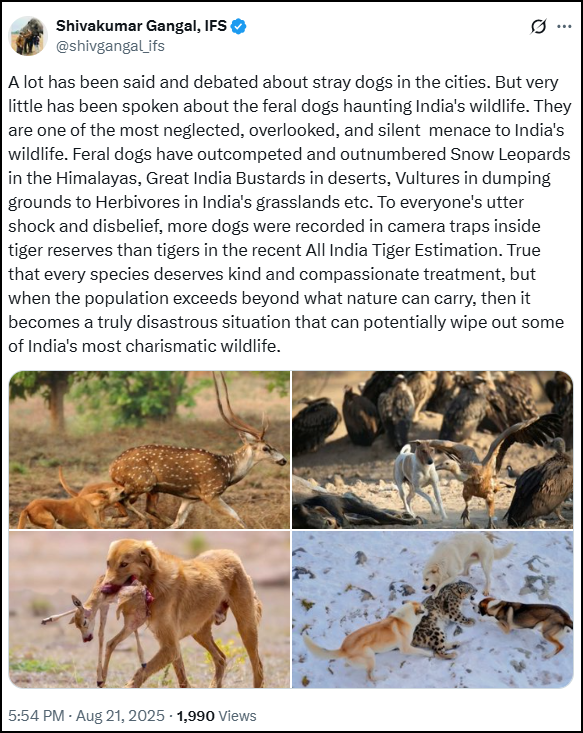
Source: X
A nationwide survey reported that these dogs attack 80 different species of India’s wildlife, 31 of which are classified as threatened on the IUCN Red List. Some of these are critically endangered species. The incidents of dog–wildlife conflict are not confined to remote jungles. Nearly half of them are reported in or around Protected Areas like wildlife sanctuaries and national parks.
Alarmingly, camera-trap studies have detected feral dogs in most of India’s 50 tiger reserves, which illustrates how dangerous the incursion has become. From the dense forests of Central India to the high-altitude cold deserts, dogs are appearing in habitats where they were never part of the native fauna. A government tiger survey confirmed dogs as a threat to both ungulates (which they hunt) and carnivores (as disease carriers) in these reserves.
Speaking to OpIndia, Indian Forest Service (IFS) officer Shivakumar Gangal, noted, “Dogs are showing up on camera-traps beyond what nature can carry and at a dangerous level”.
According to scientific assessments, there are alarming numbers of feral dogs in Ladakh’s Changthang Wildlife Sanctuary, where researchers documented an average of 310 dogs per 100 square kilometres in one sector (Hanle) and 61 per 100 square kilometres in another (Tso Moriri). Even in the sparsely populated Trans-Himalayan plateau, packs of dogs thrive around villages and nomadic settlements, ready to range into surrounding wildlife.
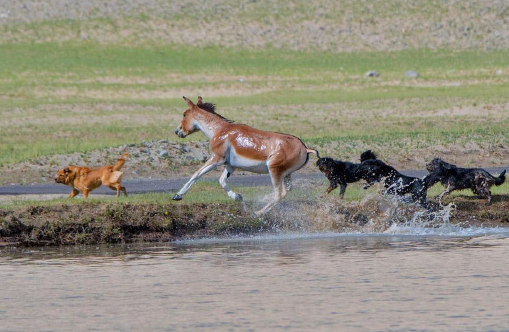
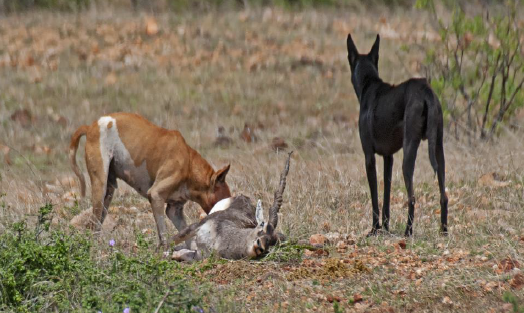
Pack of feral dogs hunting Kiang/Tibetan Wild Ass which is a Schedule I species in Ladakh. Photo: Bionotes/Saurabh Sawant
The point is clear. Free-ranging dogs exist at significant densities across diverse Indian ecosystems, often living subsidised by human waste and habitation. Their reach extends well into areas meant to be safe havens for wildlife.
These examples are a clear indication that the dogs are coming into direct conflict with native animals across the country. Be it cities, farming villages adjoining forests, or deep inside wildlife reserves, the presence of dogs and their threat to wild animals are being seen in large numbers.
For example, packs of dogs from villages routinely enter open fields in Hisar and Badopal districts of Haryana. Notably, black antelope often graze in these areas. Over a four-year period between 2016 and 2020, the Forest Department recorded that dogs killed 361 blackbucks, 1,641 nilgai, 25 peafowl, 29 chinkara gazelles, and 35 monkeys in just one division of Hisar district.
Research has shown that the threat is not anecdotal but well documented. A Bionotes paper pointed out that domestic dogs have already contributed to 11 vertebrate extinctions globally and threaten nearly 200 vertebrate species through predation, disturbance, competition, hybridisation, and disease transmission. In India, a national survey documented attacks on 80 species, 31 of them threatened on the IUCN Red List, with nearly half of such incidents occurring inside or near Protected Areas.
These are not small numbers. They show that dogs have become a leading cause of deaths for local wildlife. They have effectively become an apex predator in an area long devoid of native big cats. Across India, in the human-dominated areas, wolves, leopards or tigers exist only in small numbers. Dogs have taken advantage of the situation and become de facto apex predators with virtually no checks on their population or behaviour.
Stray dogs are subsidised scavengers, thriving on human waste, handouts, and indifference. They live on the streets but remain tied to human settlements. Feral dogs are different, they have reverted to the wild, forming packs, hunting wildlife, and behaving like invasive predators in ecosystems that never evolved with them. In India, the line between the two has blurred, as strays pushed out of towns and villages spill into forests, gradually turning feral and unleashing havoc on native species.
Direct Ecological Impacts – Predation and Competition with Wildlife
The most direct impact of stray and free-ranging dogs on ecology is through predation, that is, hunting, killing, or mauling wild animals. Unlike truly wild carnivores, dogs are not constrained by territory or prey availability alone. Their populations are heavily subsidised by human-provided food, including garbage, handouts, and livestock carcasses. This allows them to exist in unnaturally high densities.
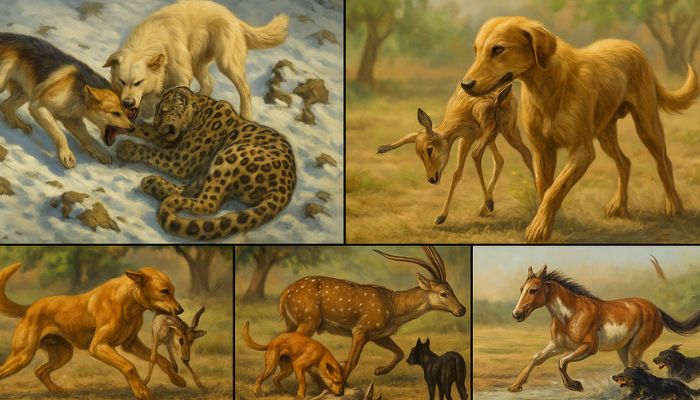
These numbers, combined with dogs’ instinct to hunt in packs, spell disaster for many native species. Large prey that might fend off a single wild predator can be overwhelmed by a mob of 10–20 dogs. In one extraordinary case, a pack of dogs was observed chasing away an entire pack of wolves from a kill in Ladakh. In another instance from Assam, dogs were photographed dragging down a hog deer fawn on the outskirts of Kaziranga National Park. These examples drive home the point that dogs, aided by human proximity, can deal out death to wildlife ranging from small birds and reptiles up to medium-sized ungulates, and even compete with India’s native carnivores at the top of the food chain.
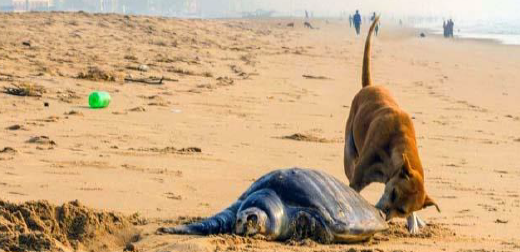
The list of wild species attacked or killed by dogs reads like a who’s who of Indian biodiversity. The birds who build their nests on the ground, for example, vultures, or threatened species like bustards, marine turtles like the Olive Ridley coming ashore to nest, high-altitude mammals like the Himalayan goral and Tibetan wild ass, rare primates like the golden langur of Assam, and iconic mammals such as red pandas, desert foxes, leopards, and even snow leopards have been attacked. Their nests have been destroyed and offspring killed by the dogs in large numbers.
Feral dog at a beach eating eggs of Olive Ridley Turtle which is a Schedule I specie. It visits beaches to lay eggs and during that time even human intervention is either banned or strictly controlled. Image: Bionotes/Arnab Chattopadhyay
The Great Indian Bustard is one of the most endangered birds in the world. There are hardly 150 individuals left in the wild. Most of them are in Rajasthan. Reports have suggested that packs of dogs roam on the fringes of Desert National Park and hunt bustard chicks. They disturb the nesting sites and have derailed breeding in the only remaining population of this species, making it hard for the species to survive anymore in the wild.
The Great Indian Bustard has been flagged in scientific papers as facing an “imminent threat” from feral dogs. With fewer than 150 individuals left, dogs predate eggs, chicks, and even nesting females, worsening the chances of survival for one of the world’s most endangered birds.
Killing wildlife is not the only problem. Dogs also inflict grave injuries and stress on wildlife. Every chase does not end in a kill. Some wild animals escape, wounded and exhausted, only to die later from infection or lose fitness due to chronic harassment. Persistent dog activity can effectively render habitat unusable for sensitive species.
For example, field scientists in Ladakh report that smaller wild cats like the Eurasian lynx and Pallas’s cat are “intimidated” by the presence of these dogs. There have been instances where packs of dogs have been seen driving snow leopards away from their kills. Dogs have been seen confronting brown bears, which indicates a high level of boldness among the canines. Dogs, which are supposed to be a domesticated species, are now behaving like an invasive super-predator in ecosystems that did not evolve with them.
The disease risk is equally severe. A study cited in Bionotes noted that camera traps captured more dogs than tigers in 17 tiger reserves, underlining how widespread the intrusion is. At Panna Tiger Reserve, serological and genomic evidence confirmed that both dogs and wild carnivores carried canine distemper virus and parvovirus, showing direct spillover potential.
Feral dogs killed a Blackbuck which is a Schedule I species at Jayamangali Blackbuck Conservation Reserve in Karnataka. Image: Bionotes/Sandeep Das
Experts suggest that dogs add a dangerous additional layer of challenge to already declining wildlife citing vultures as an example where dogs amplify existing pressures on the wild animals.
Gangal said, “Dogs are highly adaptive and resilient. They can literally eat anything, sleep anywhere, and survive in any condition. Wildlife, on the other hand, have very specific habitat and dietary needs. That is why dogs thrive, but wild species struggle.”
Furthermore, there is a serious issue of hybridisation of dogs. There have been examples in the wild where feral dogs were seen mating with wild canids including wolves and jackals. Though it is not as visibly violent as predation, such hybridisation can dilute the gene pool of endangered species. For example, if free-ranging dogs mate with Indian wolves or the Himalayan wolf in certain areas, there is a chance that it could threaten the genetic distinctiveness of these wild populations.
Such ecological impacts, predation, competition, disturbance, and hybridisation are a major cause of worry among wildlife experts. Together, these problems make free-ranging dogs one of the most pervasive and underestimated threats to India’s wildlife today.
Disease transmission – A looming biological time-bomb
Beyond the immediate carnage of teeth and claws, feral dogs pose a more invisible, but equally dire, threat to wildlife, that is, disease transmission. Domestic dogs are known vectors for a host of pathogens that can jump to wild animals. Some of these diseases have proven catastrophic to wildlife populations globally.
Rabies and canine distemper virus, or CDV, are among the most dangerous pathogens spread by dogs in the wild. Other pathogens, including parvovirus, have also created havoc in Indian wildlife. These diseases run rampant in stray dogs, which typically are not vaccinated and roam freely across the country, unlike in controlled pet populations. If these infected dogs come into contact with wildlife, the results become devastating in no time.
Gangal warned, “We often say that wildlife is the source of many zoonotic diseases. But the effect of those pathogens that humans and dogs are immune to, on wildlife, is rarely talked about. Pathogens from dogs and monkeys can jump silently to wildlife, which has no immunity to them.”
Global precedents underscore the danger. In Africa’s Serengeti-Mara ecosystem, a CDV outbreak originating from unvaccinated dogs caused a massive die-off of lions in 1994. Around 1,000 lions died because of the disease. In the late 2000s, Ethiopia’s highly endangered wolves suffered repeated CDV epidemics traced to dogs, which pushed that species closer to extinction. More recently, scientists have identified CDV as an emerging extinction threat for the Amur tiger in the Russian Far East.
India is not immune to these scenarios. There have been several instances where Indian wildlife had a close brush with disaster. For instance, in Gir Forest, Gujarat, which is known as the last refuge of the Asiatic lion, there was an outbreak of CDV in 2018. Dozens of lions were killed within weeks. The Indian Council of Medical Research confirmed the presence of CDV in the carcasses. The experts noted that the virus is widespread in the local dog population and poses a constant spillover threat to lions and other wildlife.
Ryan Lobo, founder of HPFA, said, “Gujarat has already lost a huge number of Asiatic lions to canine distemper virus. It’s an ongoing issue, but often state forest officials are too embarrassed or scared to admit it.”
Just two years after the Gir Forest disaster, 85 Asiatic lions died in Gir and surrounding areas between January and May 2020 from various diseases, including rabies. Just think about it. Decades of conservation went down the drain because we failed to keep stray dogs carrying rabies and other deadly diseases away from wildlife.
Other carnivorous animals, including tigers, leopards, foxes, and jackals, are similarly at risk. In recent years, diseases have jumped from canines to wild tigers and red pandas. Serological surveys suggest many wild carnivores carry antibodies, which is a sign of exposure to dog-borne viruses. Even herbivores are not entirely safe. Stray dogs can transmit parasites like sarcoptic mange, which is a skin disease in wild species. It is caused by mites.
In the Desert National Park of Rajasthan, there was a case of a severe outbreak of sarcoptic mange among foxes, which is believed to have been spread by dogs. Experts worry this could further endanger the fox and the park’s other inhabitants.
“Since dogs live in close contact with humans, they carry pathogens that we tolerate but wildlife cannot. Even a small bacteria alien to the wild can decimate populations that have no immunity,” Gangal remarked.
In summary, every free-ranging dog wandering near a tiger reserve or village woodlot is a potential disease vector on four legs. The continued prevalence of rabies in India’s dog population (which also causes human deaths every year) means species like the endangered striped hyena, wolf, or sloth bear could contract the virus from a bite and succumb unseen.
Meanwhile, the next CDV outbreak could imperil a whole subpopulation of lions or tigers before we even realise what is happening. This brewing epidemiological crisis adds urgency to controlling stray dog numbers and health status in and around wildlife areas. It is not just about bites and kills, but pathogens and pandemics, a “biological time-bomb” ticking away in India’s wilderness.
Policy and legal analysis – The so-called ‘good intentions’ that are killing the wildlife
If the ecological problem is clear, one might ask, why have India’s laws and policies not tackled the menace of stray dogs in the wild? The answer lies in a complex web of so-called well-intended, but totally misguided, regulations, chief among them being the Animal Birth Control Rules, 2023. Furthermore, the National Tiger Conservation Authority (NTCA)’s 2021 Standard Operating Procedure (SOP) on feral dogs must also be examined.
The ABC Rules 2023 – Prioritising dog rights over wildlife and people
India’s primary framework for stray dog management, the ABC Rules, was first notified in 2001 and revised in 2023. The core philosophy of the rules is to capture, sterilise, vaccinate, and release dogs back to the same location. The 2023 Rules even rename strays as “community animals”, affirming their right to occupy public spaces. Crucially, they forbid relocation or removal of any healthy stray, even if aggressive, harassing wildlife, or posing a public nuisance. At most, such dogs can be briefly held for sterilisation or observation before being returned.
The Rules also add bureaucracy. Only Animal Welfare Board of India-recognised entities can sterilise dogs, and monitoring committees, including welfare groups, must oversee the process. This centralisation has slowed sterilisation drives; municipalities now require approvals and NGO involvement, often causing inaction. Feeding is allowed only in designated areas, but enforcement is weak, and feeders frequently invoke the Rules to defend the practice.
“When you sterilise 50 dogs and put them back, you are essentially making a predator healthier to kill wildlife,” Lobo explained. “Across India, this is happening under the guise of ABC.”
The result is a legal environment where stray dogs enjoy strong protection, while threatened wildlife has no equivalent safeguard. Conceived as a humane solution to overpopulation and rabies, the Rules have coincided with rising dog bites and expanding stray populations, while obstructing effective management in ecologically sensitive zones.
Legal frameworks make the contradiction even starker. Under the Wildlife Protection Act, 1972, the state is duty-bound to protect all wild animals listed in Schedules I–IV, wherever they occur. Domestic dogs are not defined as wildlife, yet ABC Rules grant them unprecedented legal protection. This has created a paradox where a non-wild species is prioritised at the expense of protected wildlife, in direct contravention of WLPA obligations.
The NTCA’s Feral Dog SOP – A toothless attempt
In January 2021, the National Tiger Conservation Authority issued a Standard Operating Procedure (SOP) on “Stray/Feral Dogs in Tiger Reserves”, acknowledging the need to address the threat dogs pose to tigers, prey, and other wildlife. It called for identifying ingress points, capturing and sterilising dogs, vaccinating them, and crucially, never releasing them back inside reserves. Captured dogs were to be rehabilitated elsewhere, marking a departure from the ABC “neuter and release” approach.
The SOP has filled the policy void, but only on papers. Experts believe that it is inadequate as its scope is limited to tiger reserves and exclude habitats like grasslands, bird sanctuaries, and rural corridors where dog-wildlife conflict mostly occurs. It fails to tackle source populations in nearby villages and lacks a framework for disease surveillance, population monitoring, or robust community engagement. The definition of “feral” versus “stray” is also blurred, given that most free-ranging dogs are partly dependent on human-derived food.
Implementation has been patchy. Some reserves have initiated removals, but legal ambiguity under the ABC Rules and fear of backlash hamper action. The SOP is a fine example of a clash between welfare-centric and conservation-centric approaches. It is definitely a step forward, however, it remains ineffective without broader reforms, cross-sectoral coordination, and legal clarity to ensure wildlife is protected.
Ryan Lobo, founder of HPFA, pointed out, “The Wildlife Institute of India has released more than 800 stray dogs into Great Indian Bustard territory via ABC rules. Those dogs kill chicks, eat hatchlings, and destroy eggs. A sterilised dog can still kill wildlife.”
It is essential to understand why India has such a massive stray dog population that has expanded its presence into natural areas. The causes are overwhelmingly human-induced. Cultural practices, urbanisation patterns, and governance failures and dog-welfare centric rules played crucial role in population explosions of the stray dogs.
Wildlife experts argue that making a field director responsible for managing dogs is like making the victim responsible for handling his own problem. stressing that the root causes lie outside forests, in cities and towns where dog populations are fuelled by feeding and waste.
It is worth reflecting on why India has such a massive stray dog population spilling into natural areas. The causes are overwhelmingly human-induced, rooted in cultural practices, urbanisation patterns, and governance failures. The most significant driver is the abundance of food waste. In both cities and villages, inadequate waste management, from overflowing dumpsters to illegal dumping sites, provides a constant buffet for scavenging dogs. At the edge of forests, dogs gather around village dumps, slaughterhouse discards, fish offal, and tourist litter. At Sambhar Lake, meat waste from butchers attracted dozens of dogs, which then turned to hunting migratory birds. In hill stations and pilgrimage sites near wilderness, roadside trash sustains packs that regularly wander into adjacent woods.
Religious and cultural feeding practices further fuel the problem. In Hindu traditions, dogs are linked to deities like Bhairava and feeding them is considered meritorious. While well-intentioned, such practices allow populations to thrive beyond natural food limits. Well-fed dogs breed, roam further, and often end up in wildlife habitats, with feeders resisting their removal by invoking ABC Rules.
Peri-urban expansion and habitat encroachment have also brought human settlements, and their dogs, into closer proximity with wildlife. Infrastructure projects, new colonies, and agriculture in corridors seed these areas with dogs, sometimes through abandonment of pets.
Gangal said, “Dogs in the centre of cities push those on the periphery outwards, and eventually, they spill into forest areas. The problem begins in cities, but the innocent wildlife ends up paying the price.”
Finally, lax enforcement and lack of accountability mean illegal dumping, pet abandonment, and relocation of strays go largely unpunished. With culling no longer permitted and no robust alternative in place, bureaucratic inertia allows the crisis to worsen, a human-made problem demanding human-led solutions.
Experts say that forest departments alone cannot manage this crisis. The root causes lie in waste, feeding, and urban policies, yet other government departments rarely see stray dogs as a conservation challenge.
Solutions and strategies Putting wildlife first
Addressing the threat of stray and feral dogs to India’s biodiversity demands shifting from a scattered, dog-centric approach to a targeted, wildlife-first plan. Intensive spay-neuter-vaccinate campaigns should be concentrated in villages bordering wildlife habitats, creating buffers free from breeding dogs. Extending the NTCA SOP’s ban on reintroducing dogs into reserves to buffer zones would help, with captured animals relocated to shelters or pounds far from sensitive ecosystems. Amending the ABC Rules to allow exceptions in ecologically critical areas may be essential to give authorities the legal space to act decisively.
Preventing disease spillover requires a One Health approach, with vaccination drives in a 10-km radius around reserves and systematic wildlife disease surveillance. Training forest staff to test samples, deploying rapid response veterinary units, and funding programmes under wildlife health schemes can provide early warnings and curb outbreaks before they devastate vulnerable populations.
A joint, inter-agency framework between forest, municipal, veterinary, and district bodies is critical to break bureaucratic silos. Legal reforms should reconcile wildlife protection with dog control, granting powers for removal or humane euthanasia in notified habitats. Educating courts and policymakers on the conservation stakes is equally important.
Globally, the IUCN recognises feral dogs as alien invasive species. Its guidelines recommend eradication, containment, or control, not protection, inside biodiversity areas. Allowing feral dogs to proliferate within Indian ecosystems is inconsistent with the World Conservation Strategy 1980 and subsequent conservation frameworks that India has endorsed. Aligning domestic policy with international conservation standards is therefore essential.
Community engagement, responsible dog ownership, and incentives for control can reduce the influx of new strays. Securing garbage and enforcing waste rules in fringe areas will remove key attractants, while habitat protection and planned development can limit dog ingress. But it has to be done without intervention from the so-called “dog lovers” who believe dogs are above all species, including humans.
Ongoing research into control methods, deterrents, and movement patterns, combined with adaptive management, will ensure interventions remain effective and evidence-driven.
Conclusion – Conservation over dogma
Time is running out. For the child chased by a rabid stray in a town and for the fawn cornered by feral dogs in a sanctuary. India’s stray dog crisis is no longer just a civic or public health issue; it is a conservation emergency. Yet complacency, legal dogma, and misplaced priorities continue to shield free-ranging dogs at the cost of collapsing ecosystems. If this persists, we will have silent forests and worsening human–dog conflicts.
“In the Desert National Park alone, over 800 dogs share habitat with fewer than 50 Great Indian Bustards,” Lobo warned, “At this stage, unless hard measures like euthanasia are on the table, extinction is the only alternative.”
Bureaucratic inertia, poor inter-departmental coordination, half-hearted execution, and reluctance to amend failing laws like the ABC Rules have brought us here. After more than two decades, these rules have neither eradicated rabies nor curbed dog attacks, instead, they have undermined both public and wildlife safety.
Conservation over dogma means accepting that tough, humane measures are necessary. Laws must empower forest staff to remove or neutralise stray dogs in sensitive zones, and funding must match our claims of valuing species like tigers, bustards, and blackbucks.
As Gangal very well described, “Wild animals may look sturdy and unconquerable, but they are delicate and sensitive to even minute environmental changes. Unlike ancient times when “Nature took its own course,” the present times warrant the active intervention and management of wildlife populations which is exactly what the forest department is doing.”
Presence of feral dogs in the wild is a man-made problem, and the cost of inaction is measured in lost lives, human and wild. The choice is stark – act decisively now, or watch our natural heritage succumb to the unchecked dominion of feral dogs.
In a move aimed at addressing concerns over demographic changes and potential security risks, the Assam Cabinet has approved a new Standard Operating Procedure (SOP) for scrutinizing land transfers between individuals of different religions. Chief Minister Himanta Biswa Sarma, during a press briefing after a cabinet meeting on Wednesday, detailed the policy, emphasizing the need for caution in a “sensitive state like Assam” where land transactions must be handled carefully to prevent fraudulent activities and preserve societal harmony.
CM Himanta Biswa Sarma said that the SOP will not apply to land transfers between individuals of the same religion, allowing such deals to proceed without additional hurdles. However, for inter-faith transactions, such as those between Hindus and Muslims or vice versa, the process will go through involves multiple layers of verification.
He said, “Once the proposal is made to Sub Divisional officer and if it is within the same religion, then there is nothing to say. If it is inter-religion like transfer between Hindu and Muslim people and vice versa, the proposal will be scanned if the applicant is the real owner of the land and if the land is real or not, and after scanning, the same will be sent to Deputy Commissioner.”
He elaborated on the subsequent steps: “The Deputy Commissioner will send the proposal to the Revenue Department, and after the receipt of the proposal, the same will be sent to the Special Branch of Assam police. The Special Branch will see if the same is coercive, fraudulent or illegal transfer or not, what is the source of the buyer whether it is black or white money.”
Today #AssamCabinet has approved an SoP for land transfer between persons from two different religions. We will examine such proposals for
1️⃣ Source of funds 2️⃣ Threat to National Security 3️⃣ Possibility of Socio – demographic change pic.twitter.com/nFnytDQMzq
Feedback from local people will also be taken, whether they agree with the sale of the plot to a person of different religion or not. He added, “The Special Branch will also analyse if such a transfer has any adverse effect on the local social fabric or poses a national security concern. Their report will then be sent back to the DC, who will take the final call on whether to approve or decline the transaction.”
The Special Branch’s report will then be forwarded to the government, which will inform the Deputy Commissioner to make the final decision on approval or rejection. Sarma highlighted that this rigorous examination is necessary to probe for any fraudulent or illegal acts, the legitimacy of funding sources, the potential impact on the local social fabric, and national security implications. “According to the SOP, the Special Branch of the Assam Police will examine whether the transfer of land involves any fraudulent or illegal act, the source of funding of the buyers, impact on the social fabric of the locality where the land exists, and also the issue of national security,” he said.
He added that the policy will address several pending land transfer cases from the last six months, with decisions now to be expedited under the new framework.
The SOP extends beyond individual transactions to include non-governmental organizations (NGOs) from outside Assam seeking to purchase land for establishing various institutions too. Sarma expressed concerns over recent trends of NGOs purchasing land in the state. He said, “Recently, we have seen NGOs from Kerala purchasing land here. They have organized events which may in future result in a national security threat. If NGOs from outside the state purchase land for educational purposes or establish a medical or nursing college, they have to undergo the same procedure as stipulated in the SOP.”
He specifically mentioned instances in areas like Barak Valley, Sribhumi, and Barpeta, where external NGOs, often affiliated with a particular religion, have been acquiring large swathes of land under the guise of setting up schools or other facilities. “While they claim they want to set up educational institutions, the actual agenda can be different, and the police will probe these aspects,” the CM clarified.
Importantly, CM Sarma assured that the SOP does not apply to NGOs registered within Assam, focusing solely on entities from outside Assam to mitigate risks of undue influence or hidden motives. “In a sensitive state like Assam, the issue of land transfer needs to be handled very carefully,” he reiterated, underscoring the policy’s intent to protect the state’s demographic balance and prevent any threats to national security.
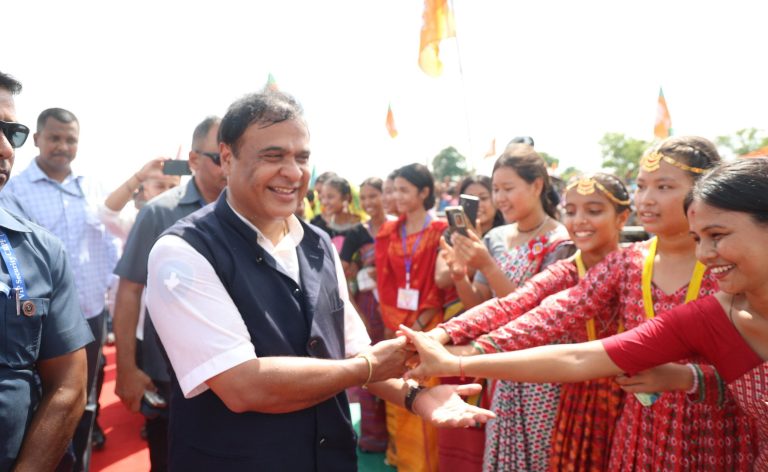
During the press conference, Himanta Biswa Sarma also announced that PM Narendra Modi’s Assam visit next month has been rescheduled due to Vice Presidential elections.
Hon’ble Prime Minister Shri @narendramodi Ji will visit Assam on September 13 & 14 to celebrate Dr Bhupen Hazarika’s birth centenary and dedicate various development projects. pic.twitter.com/U6mLZLI6tt
The PM was scheduled to visit Assam on 8th September, but as Election Commission has set 9th September as the date for the VP election, PM Modi will visit Assam on 13th September. He will return on 14th Day. Therefore, all programs scheduled on 8th September have been rescheduled on 13th and 14th September.
PM Modi will inaugurate the birth centenary celebrations of Dr. Bhupen Hazarika, and will take foundation stone for several major infrastructure projects.
Lord Ganesha, the beloved elephant-headed Hindu deity of beginnings, is prayed to before any significant event and is considered the remover of obstacles. His name holds profound significance – both as the “Lord of the People” and as the “Lord of the Ganas,” Lord Shiva’s attendants.
Ganesha symbolises strength and determination and is the deity of knowledge. His followers celebrate him every year with great zeal on Ganesh Chaturthi.
This year, Ganesh Chaturthi is being observed from 27th August, with Ganesh Visarjan to be conducted on 6th September. In every corner of the country, roads, temples, and houses are aglow with music, prayers, and stunningly decorated idols of Ganesha.
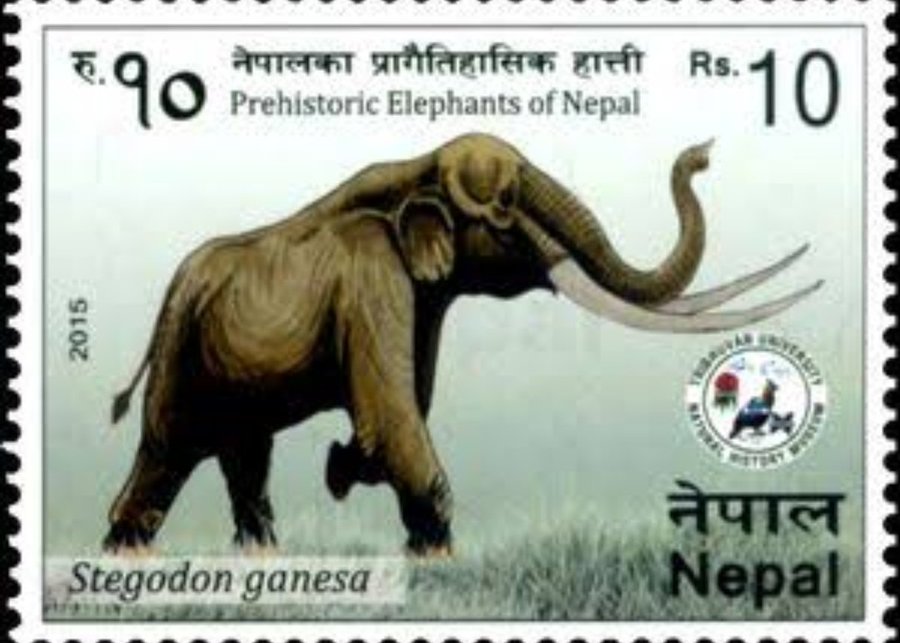
However, it is rather a little-known fact that a prehistoric giant that roamed in the Indian subcontinent thousands of years ago, is named after the beloved Ganpati Bappa, Stegodon ganesa.
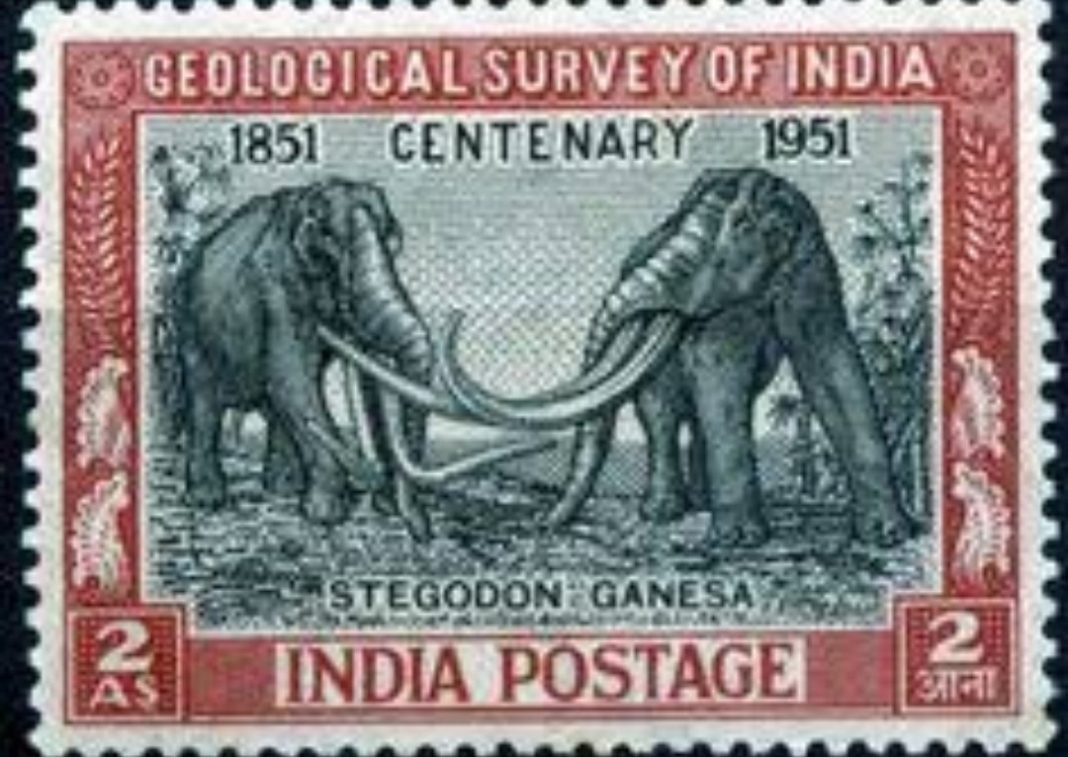
This ancient mastodon, usually considered a relative of the modern elephants, and part of the Stegodontidae family, roamed South Asia close to 25,000 years ago. So unique was it that India and Nepal both released stamps in its memory. Actually, as early as the year 1951, India had issued a commemorative postage stamp with an image of the Stegodon as part of the centenary celebrations of the Geological Survey of India. Later, Nepal also released its own version in 2015.
GSI centenary year postage stamp, with illustration by Marget Flinsch under Henry Fairfield Osborn’s guidance.
The Stegodon ganesa was one of the largest proboscideans that ever existed. It was some 3 to 4 metres tall at the shoulder and nearly 8 metres in length, larger than even existing African elephants. Its tusks were its most distinguishing feature, long immensely heavy and sometimes overlapping on each other. One specimen that has been discovered in India was 3.89 metres long and had a mass of about 140 kilograms, far larger than the tusks on living elephants today.
This giant animal once inhabited tropical forests and savannas of the Siwalik Hills and elsewhere in South Asia. The presence in India has been confirmed by fossil finds, one of which is quite important – a 3-metre tusk that was discovered in 1928 by Dr. D.N. Wadia, today housed at Jammu University.
Even in 2025, further fossil remains have been discovered alongside the Wardha and Penganga rivers in Chandrapur, Maharashtra, contributing to the records of its extensive presence in the subcontinent.
While previously thought to be a direct elephant ancestor, scientists now consider Stegodon to be a side branch of the extinct proboscideans. Later research has placed the huge tuskers in the family Stegodontidae, which is more closely related to modern elephants (family Elephantidae) than to mastodons.
Surprisingly, research indicates it could have lived alongside early humans, at least as recently as 4,100 years ago. This leaves open the possibility of it even playing a cultural or symbolic role within ancient civilisation.
Different species of the genus Stegodon reportedly roamed in India, China, the greater South East Asian region and even Japan.
From the divine form of present-day Ganesha worship to the massive Stegodon ganesa, which roamed this planet, the bond between elephants and human imagination is deep. On this Ganesh Puja, recalling both lends a deeper layer of awe to the festivities, one based on belief, and the other on the amazing history of life on our planet.
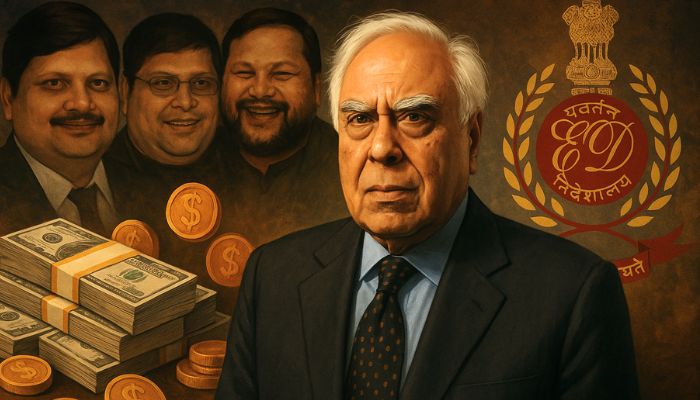
On 26th August, the Enforcement Directorate (ED) raided several locations linked to businessman Piyoosh Goyal of World Window Group and companies linked to the notorious Gupta brothers of South Africa, across Delhi, Mumbai and Ahmedabad. The raids were conducted under the Prevention of Money Laundering Act (PMLA). ED initiated the raids following a request from South African authorities investigating their infamous “State Capture” scandal.
While the fresh action has once again turned the spotlight on the Guptas and their links to India, it also brought back questions that OpIndia had raised years ago, questions that mainstream media conveniently ignored, and which involved none other than Congress leader and Senior Advocate at the Supreme Court, Kapil Sibal.
ED raid on Piyoosh Goyal and Gupta brothers-linked firms
The ED’s raids on Tuesday were significant not just because they targeted a controversial businessman like Goyal, but also because for the first time, they formally established the cross-border cooperation between India and South Africa in tackling financial crimes tied to the Gupta brothers.
According to officials, the searches were carried out simultaneously in New Delhi, Mumbai and Ahmedabad, covering multiple premises connected to Goyal’s World Window Group and other associated firms such as Sahara Computers and ITJ Retails Pvt Ltd. According to media reports, investigators said that one of the key aspects of the probe was the suspected money laundering across India, South Africa and the United Arab Emirates, which was facilitated through a complex network of shell companies.
During the operation, ED teams also intercepted and questioned Ram Ratan Jagati, who has been described as the “key player” in this network. Jagati is based in Ahmedabad and allegedly floated a Dubai-based front company, JJ Trading FZE. This company was instrumental in funnelling illicit funds for both the Guptas and Goyal.
Speaking to the media, one ED official said, “Financial records, electronic data and documents are being examined to trace the flow of money across India, South Africa and the UAE.” The ED raids once again threw a spotlight on the Gupta brothers, Ajay, Atul and Rajesh, originally from Saharanpur, Uttar Pradesh. They have been central figures in South Africa’s largest corruption scandal. Their ties with former President Jacob Zuma enabled them to secure contracts, influence political appointments and divert public funds. The arrangement became so infamous in South Africa that a new term was coined, “State Capture”, to describe it.
In 2018, the Guptas fled South Africa and relocated to Dubai. Atul and Rajesh were arrested in Dubai in 2022. However, the UAE later rejected South Africa’s extradition request and declared them fugitives. Ajay Gupta and his brother-in-law Anil Gupta were also arrested in Uttarakhand in May 2024, but in an unrelated case.
Officials said that these raids underline growing cooperation between New Delhi and Pretoria on financial investigations. An ED officer said, “Evidence gathered could lead to asset attachments, account freezes and further legal action against individuals and companies named in the probe.”
OpIndia was the first to flag Piyoosh Goyal and Gupta links
Long before ED formally stepped in, OpIndia had already flagged the dubious network of Piyoosh Goyal and his company World Window, and their close association with the Guptas. As early as 2018, when South African investigative journalists from Daily Maverick and amaBhungane were publishing their exposés on “State Capture” under Jacob Zuma, OpIndia picked up threads that directly connected this saga back to India.
Interestingly, mainstream Indian media either ignored or downplayed these revelations. On the other hand, OpIndia dug deeper. During the investigation, OpIndia highlighted how South African journalists discovered that money laundering through front companies such as Goyal’s World Window formed a crucial part of the Guptas’ international network of illicit transactions.
More importantly, OpIndia pointed out that this was not merely a case of a shady businessman abroad. It directly involved senior Indian politician, Congress leader Kapil Sibal. According to documents and corporate filings, he had financial dealings with Goyal, and his family was a beneficiary of opaque transactions.
Despite the gravity of the revelations, the silence from mainstream media outlets was deafening. Hindustan Times, for instance, cited the same South African investigative work when writing about Goyal and the Guptas, but conveniently omitted Kapil Sibal’s name from their coverage. OpIndia, on the other hand, connected the dots and asked the uncomfortable questions, questions that neither Sibal nor his political allies were willing to answer.
OpIndia’s early reporting thus ensured that the Indian public knew of the hidden ties between a controversial businessman like Goyal, the scandal-ridden Guptas and a senior Congress figure. The recent ED raids have only vindicated the ground OpIndia covered years ago. It has proved once again that investigative journalism cannot be brushed aside, no matter how inconvenient it is for the political establishment.
Details of OpIndia’s investigations
Over the years, OpIndia consistently exposed the shadowy web of connections between Goyal, the Guptas and Sibal. The coverage was not limited to a single report but formed a series of investigations that unfolded between 2018 and 2022. Each of these stories revealed new layers of the nexus and raised questions that have remained unanswered till date.
The Grande Castello deal – Kapil Sibal’s Delhi land for just one lakh rupees?
One of the most explosive reports focused on how Kapil Sibal and his wife, Promila Sibal, acquired 100% shares of a company named Grande Castello Private Limited. The firm was a subsidiary of Goyal’s World Window Impex. It owned a piece of prime land in Delhi which was valued at Rs 89 crore. However, through opaque accounting manoeuvres and a timely devaluation of assets, Sibal and his wife managed to take over the company by paying only the face value of its shares, that was, Rs 1 lakh.
Public records showed how Grande Castello, which had no business activity, managed to buy land worth over Rs 45 crore through interest-free loans of unclear origin. The company later revalued the land to Rs 89 crore, only to devalue it again a year later. Conveniently, it was right after this devaluation that the Sibals acquired the firm. OpIndia had raised the obvious question: was this a sophisticated shell company transaction designed to acquire prime property without paying market price?
The chartered flights and Cape Town stay – denied but documented
OpIndia revealed that the families of Sibal, Goyal and the Gupta brothers allegedly flew together on a chartered aircraft from Delhi to Mumbai to watch the 2011 Cricket World Cup final. The Guptas, according to South African reports, also allegedly paid for Akhil Sibal and his wife’s stay at the Queen Victoria Hotel in Cape Town later that year.
These allegations were denied by both Kapil and Akhil Sibal, and they claimed that they did not know the Guptas. They did admit knowing Goyal, whom Kapil described as a “friend” and Akhil as a “client”. What the Sibals insisted was Goyal’s hospitality was actually financed by Gupta-controlled companies.
The CBI bribery case – Goyal caught in SBI loan scandal
Even before the South African scandals hit headlines, Goyal’s reputation was already under question in India. In 2013, the CBI booked him in a bribe-for-loan case involving the then Deputy MD of State Bank of India, Shyamal Acharya. The allegations stated that Goyal provided bribes to secure a Rs 400 crore loan for his World Window group. Cash, gold and incriminating documents were seized from Acharya’s residence, which further deepened suspicions around Goyal’s methods of doing business.
Bank of Baroda’s letters – Guptas paying Goyal’s dues
OpIndia documented how Goyal’s companies received questionable financial favours. For example, Everest Global Metals, which is controlled by Goyal, had an overdraft facility of Rs 8.2 crore from Bank of Baroda. Interestingly, monthly interest payments on this facility were being made by companies belonging to the Guptas. A leaked communication from a Bank of Baroda manager in 2012 even directly addressed a Gupta company director regarding Goyal’s missed payments. This was perhaps one of the clearest indicators of how interlinked these cases were.
The Shiva temple laundering case in Saharanpur
In 2018, OpIndia reported that documents seized by the Income Tax department during raids at Gupta-owned properties in Dehradun and Saharanpur showed that over Rs 100 crore were spent on the construction of a large Shiva temple. The money was in fact routed as a laundering mechanism through “donations”. An employee of the Guptas, Sanjay Grover, had allegedly funnelled Rs 22.67 crore into the temple trust despite having a modest monthly salary. It raised suspicion that the temple project was more of a front for moving money into India.
The Gupta weddings in Auli – opulence amid allegations
In 2019, when Ajay and Atul Gupta’s sons married in back-to-back ceremonies in Auli, Uttarakhand, OpIndia questioned why a state government would extend red-carpet treatment to businessmen under investigation across continents. Around Rs 200 crore were reportedly spent on the weddings. The ceremonies sparked environmental concerns due to their location in the fragile Himalayan ecosystem. Another question raised at that time was why the state was enabling men deeply tied to international corruption scandals to flaunt wealth so brazenly on Indian soil.
BRICS summit and the failed attempt to embarrass PM Modi
In 2018, during the BRICS summit in Johannesburg, Islamist groups and separatist outfits attempted to file legal petitions to have Prime Minister Narendra Modi arrested for alleged “war crimes” in Kashmir. South African media later reported that the Guptas, angry after being snubbed by PM Modi in 2016, were suspected of fuelling these efforts. Once again, OpIndia highlighted the Guptas’ political manoeuvrings and exposed how their vendettas extended to attempts at embarrassing India’s leadership on the global stage.
Riots in South Africa and Indian community targeted
In 2021, after former President Jacob Zuma was jailed, riots broke out in South Africa. During that time racial attacks on Indian communities took place. Many locals used the crimes of the Guptas as an excuse to unleash violence against ordinary Indians. OpIndia interviewed South African MP Shameen Thakur-Rajbansi, who revealed a “toolkit” that specifically incited violence against Indians.
Speaking to OpIndia, Shameen Rajbansi revealed how there was a ‘toolkit’ to target Indians in Kwazulu-Natal province and how the charge that the violence was unleashed as retribution for the crimes of the Gupta brothers was completely unfounded. She further spoke about how the Indian government was corresponding with the South African government to ensure the safety of the Indian community and explained the roots of the racist violence in the country.
OpIndia reported how the Guptas’ corruption became a pretext for racist violence and how the Indian government had to step in to protect the Indian diaspora in South Africa.
Arrest of Atul and Rajesh Gupta in UAE
In 2022, when UAE authorities arrested Atul and Rajesh Gupta, OpIndia detailed the long arc of their corruption, their links with Zuma and their network’s spillover into India. While the arrests were celebrated, OpIndia cautioned that extradition would be difficult, as the brothers had the resources to exhaust every legal option.
The Kapil Sibal investigation
The Gupta scandal in South Africa exposed the rot of “State Capture”. Its Indian chapter revealed something just as troubling, the role of Congress leader Kapil Sibal in opaque financial dealings with Goyal.
Grande Castello – the company with crores of land, sold for a pittance
As described above, documents from March 2017 showed the Sibals owned 50% shares each in Grande Castello Private Limited, a 100% subsidiary of World Window Impex, which was controlled by Goyal. The major asset of Grande Castello was a piece of prime land in New Delhi which was priced at Rs 89 crore. However, thanks to timely devaluation, Sibal managed to take over the land piece as he acquired the company at its face value, that was Rs 1 lakh.
The pattern raised troubling questions. Why was the land devalued just before the Sibals acquired the company? Was it to bring the net worth to a negative so that the takeover could be justified at a negligible price?
Public denials and contradictory responses
When South African journalists first questioned Sibal in January 2018 about his role in Grande Castello, he flatly denied being a director of any such company despite the fact that official documents already listed him as a director from 2017. Only two months later, he publicly admitted to buying Grande Castello and called the transaction “legal”.
The series of contradictory statements, varying from denial to foreign journalists and acceptance in India, fuelled suspicions about the nature of the acquisition. Even his claim that Goyal was just a “friend” fell flat as there were multiple layers of business overlap between them.
Income Tax probe after OpIndia’s reports
OpIndia’s coverage had an impact. In March 2018, the Income Tax Department began investigating the transfer of Grande Castello shares from World Window Impex to the Sibals. Reports suggested that the deal was executed for just Rs 1 lakh. Later, it was revealed that Sibal had extended loans of over Rs 51 crore to Grande Castello, despite the company having no meaningful business operations. It raised further suspicions about whether these transactions were designed to avoid taxes.
According to Section 56(2) of the Income Tax Act, acquiring immovable property at below-stamp duty value is taxable under “income from other sources”. If Grande Castello was indeed transferred for far less than its real worth, questions about tax evasion and shell company structuring become unavoidable.
However, at every stage, Sibal stonewalled inquiries. He dismissed probing questions and even accused journalists of “mischievous intent”. His behaviour only deepened the mystery surrounding the deal.
Kapil Sibal’s threats to sue OpIndia
OpIndia sent a series of questions to Sibal. He did not answer but chose the familiar path of intimidation. After OpIndia published its investigative report on his acquisition of Grande Castello and raised questions about the opaque structuring of the deal, Sibal threatened to sue for defamation.
Threats instead of answers
Notably, OpIndia’s story did not level allegations. It laid out facts from publicly available documents and asked straightforward questions. Why was a company with land worth crores sold at a nominal value? Why was the land devalued just before the Sibals took over? Who funded the interest-free loans that helped the company buy such expensive property? Instead of addressing these, Sibal chose to issue threats.
His legal threats were not new. In January 2018, when South African journalists Craig McKune and Stefaans Brümmer confronted him with documents proving his directorship in Grande Castello, Sibal flatly denied any such role. Even when shown evidence, he evaded answers and abruptly cut off communication, accusing the journalists of harbouring a “mischievous intent”. Two months later, however, he admitted in India that he indeed owned the company, a complete U-turn that highlighted his evasiveness.
The missing clarity on price
Another layer of confusion was added by Goyal himself when he told Republic TV that the deal had been finalised for Rs 50 crore. However, when OpIndia pressed him to provide documentary proof, Goyal declined and refused to reply to a detailed questionnaire. The Sibals maintained silence. The contradiction between Sibal’s evasions and Goyal’s unverifiable claims only raised more doubts.
The bigger question – what was defamatory?
If the acquisition of the land was perfectly legal, as Sibal claimed, why did he repeatedly deny being associated with the company before finally admitting ownership? And if it was legal, what exactly was defamatory about OpIndia asking questions? Perhaps the answer lies in the discomfort that OpIndia’s reporting caused, as the matter was not allowed to slip into silence. On the other hand, sections of the mainstream media chose not to touch the story at all.
Instead of transparency, Sibal’s approach was to threaten journalists into silence. That, in itself, is revealing.
Why Kapil Sibal must be investigated
The ED’s raids on Goyal and Gupta-linked entities may appear to be just another financial crime story. However, the threads lead much deeper. They point towards a network that spanned continents, laundered money through shell companies, exploited religious trusts, flaunted ill-gotten wealth at luxury weddings, and even attempted to embarrass India on the global stage. At the centre of its Indian extension stood Goyal, whose name was repeatedly flagged by South African journalists and by OpIndia years before official agencies moved in.
However, the story does not stop at Goyal. Public documents, corporate filings and investigative work have shown that Sibal directly benefited from transactions structured by Goyal. His acquisition of Grande Castello Private Limited, with land worth crores changing hands for what appears to be a token sum, remains deeply questionable. His repeated denials, evasions and threats to sue journalists have only made the affair murkier.
The matter was either ignored or whitewashed by mainstream media. It was OpIndia that connected the dots and raised the right questions. It was OpIndia that forced the conversation into the public domain. When OpIndia was threatened with a lawsuit, we stood our ground, because investigative journalism is not about pleasing politicians but about holding them accountable.
The ED raids have vindicated OpIndia’s years of work. They show that what was once dismissed as inconvenient reporting now forms the backbone of official investigations. If there is genuine intent to unearth the truth, then Sibal’s dealings with Goyal must be probed with the same seriousness. Anything less would be an injustice not only to the law but also to the public that deserves answers.
After all, sunlight is the best disinfectant, and the light has only begun to shine in this case.
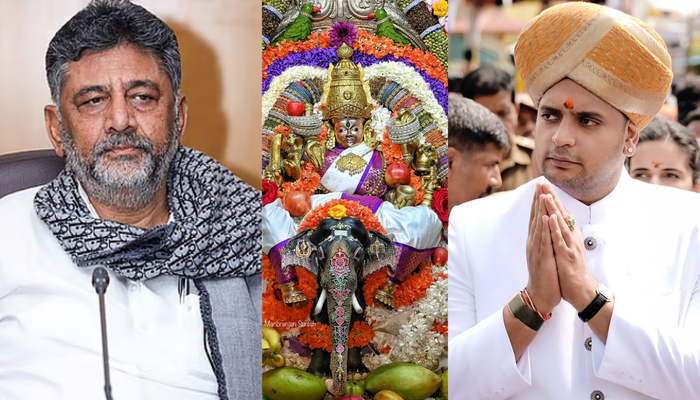
In a heated exchange on social media, Mysore royal and member of Parliament, Yaduveer Krishnadatta Chamaraja Wadiyar, schooled Karnataka Deputy Chief Minister DK Shivakumar, who attempted to secularise Chamundeshwari Devi and the Dasara festival by claiming that the goddess and the festival did not belong to any one religion.
On Tuesday (26th August), Congress leader Shivakumar claimed that goddess Chamundeshwari and her temple are not the properties of Hindus alone, and that they belong to all religions. His remarks came in response objections raised against the Karnataka government’s decision for invite International Booker Prize winner Banu Mushtaq to inaugurate the world-famous Mysuru Dasara-2025 festivities atop Chamundi Hills on September 22. Defending the state government’s decision, DK Shivakumar said that the goddess and her temple did not belong to Hindus only.
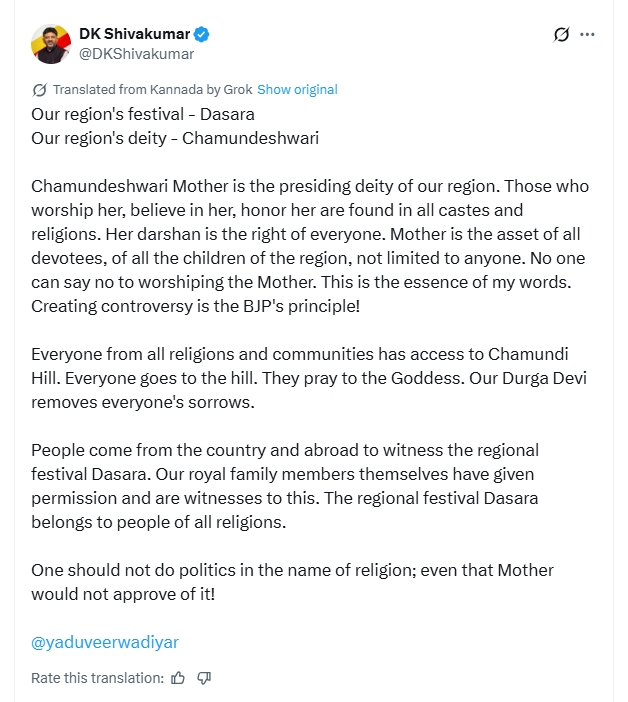
He later wrote a message on X claiming that the goddess Chamundeshwari Devi, whose temple is located atop the Chamundi Hills in Mysuru, Karnataka, is the presiding deity of the ‘region’ and belongs to all religions. He further claimed that the Hindu festival of Dasara (or Dussehra) did not belong to any one religion and is the festival of the ‘region’ as well.
Screenshot of machine translation of the Deputy CM’s post on ?
The Deputy CM accused the BJP of creating controversy and doing politics in the name of religion and reasoned that since people of all religions have access to the temple of the goddess, it meant that the goddess did not belong to any single religion. “Everyone from all religions and communities has access to Chamundi Hill. Everyone goes to the hill. They pray to the Goddess. Our Durga Devi removes everyone’s sorrows. People come from the country and abroad to witness the regional festival Dasara. Our royal family members themselves have given permission and are witnesses to this. The regional festival Dasara belongs to people of all religions. One should not do politics in the name of religion; even Mother would not approve of it!” Shivakumar wrote on X on Wednesday (27th August).
On the sacred day of Gowri Habba, DCM D.K. Shivakumar claimed that “Chamundi Betta and Chamundi Devaru are not Hindu property.” This remark is utterly condemnable.
Chamundi Betta is a Shakti Peetha – sanctified by the Shastras and revered by crores of Hindus. The temple was, is,… pic.twitter.com/08n2LHIWvL
Shivakumar’s attempts to dissociate Chamundeshwari Devi and the Dasara festival from the Hindu religion were countered by the Mysuru dynasty scion Yaduveer Krishnadatta Chamaraja Wadiyar, who reminded Shivakumar that the Chamundi Hill is a Shakti Peeth, a sacred, revered religious site of Hindus.
Condemning Shivakumar’s statement, Yaduveer Wadiyar said that the temple has always been a Hindu property and would remain so.
ಚಾಮುಂಡಿ ಬೆಟ್ಟ ಎಲ್ಲ ಧರ್ಮ–ಸಮುದಾಯದವರಿಗೂ ಮುಕ್ತವಾಗಿ ತೆರೆದಿದೆ. ತಾಯಿಯನ್ನು ಆರಾಧಿಸುವವರು, ನಂಬುವವರು, ಗೌರವಿಸುವವರು ಎಲ್ಲ ಜಾತಿ-ಧರ್ಮಗಳಲ್ಲಿದ್ದಾರೆ.
ಆದರೆ, ಚಾಮುಂಡಿ ಬೆಟ್ಟ ಒಂದು ಶಕ್ತಿಪೀಠ. ತಾಯಿ ಚಾಮುಂಡೇಶ್ವರಿ ಹಿಂದೂ ದೇವಿ – ಆಕೆಯ ಉಲ್ಲೇಖ ಹಿಂದೂ ಗ್ರಂಥವಾದ ಮಾರ್ಕಂಡೇಯ ಪುರಾಣದ ದೇವಿ ಮಹಾತ್ಮ್ಯದಲ್ಲಿದೆ; ಬೇರೆ ಧರ್ಮಗಳ… https://t.co/303zPivqnJ
Acknowledging that the Hill is open to people of all religions and communities who believe in her, Yaduveer Wadiyar asserted that Chamundeshwari Devi is a Hindu goddess, mentioned in the Hindu scripture Markandeya Purana’s Devi Mahatmya. He pointed out that the goddess is not mentioned in the scriptures of any other religion. Wadiyar highlighted that the daily worship and traditions at the Chamundeshwari temple are conducted in accordance with Hindu scriptures, and all those who visit the temple worship her as a Hindu goddess.
Taking a dig at Shivakumar and his party, Wadiyar said that Shivakumar has made one family (the Gandhi family) his God. “You have made a family your god. In this case, dare not deny the Hindu nature of the Goddess and the religious tradition of Dussehra. We are not doing politics. When you attack our religion for the politics of appeasement, we stand up to defend it,” Wadiyar said.
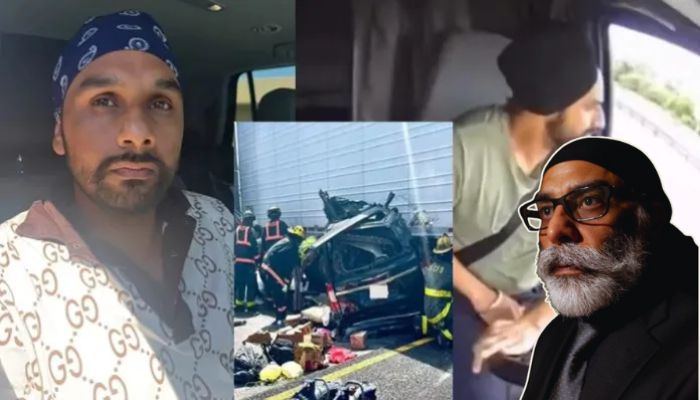
On Tuesday (26th August), wanted Khalistani terrorist Gurpatwant Singh Pannun said that he met Harjinder Singh, the 28-year-old Indian-origin Sikh truck driver arrested in the US following a fatal crash in Florida which resulted in 3 deaths.
Pannun held a press conference and claimed that Harjinder Singh, currently in St. Lucie County Jail in Florida, is ‘grieving’ and going through a mental anguish over the deadly incident. “I saw sorrow and suffering in his eyes,” Pannun said.
Defending the accused, Pannun claimed that Harjinder Singh exited the truck, went to the van, broke open the window, held the hand of someone and said help is on the way, please stay with me, right after his 18-wheeler trailer truck collided with the minivan as Harjinder took an illegal U-turn.
The incident transpired on 12th August. Singh, who entered the US illegally in 2018 and obtained a work permit in 2021, faces three counts of vehicular homicide and immigration violations, with a potential 45-year sentence.
The anti-India Khalistani terrorist asserted that Harjinder Singh did not intentionally slam his truck into the minivan, rather, it was case of ‘tragic misjudgement’. “To portray him as a malicious killer, it would be very unfair,” Pannun said.
In addition to garnering sympathy for accused Harjinder Singh, Pannun also announced that his Khalistani terrorist outfit, Sikhs for Justice, will contribute $100,000 in humanitarian aid to the families of the victims. Gurpatwant Singh Pannun, who threatens terror attacks on India every now and then, urged Americans to show fairness for Singh and seek justice guided by truth and not hate.
As reported earlier, accused Harjinder Singh is an ‘asylum seeker’ in the US. 28-year-old trucker Harjinder Singh hails from Tarn Taran, Punjab in India. He was denied bail following the incident. Singh has been labelled an “unauthorised alien” and a “substantial flight risk”. He now faces three counts of vehicular homicide which will put him in prison for decades and eventual deportation. Harjinder Singh participated in anti-India and pro-Khalistan rallies and events organised by Pannun’s Sikhs for Justice.
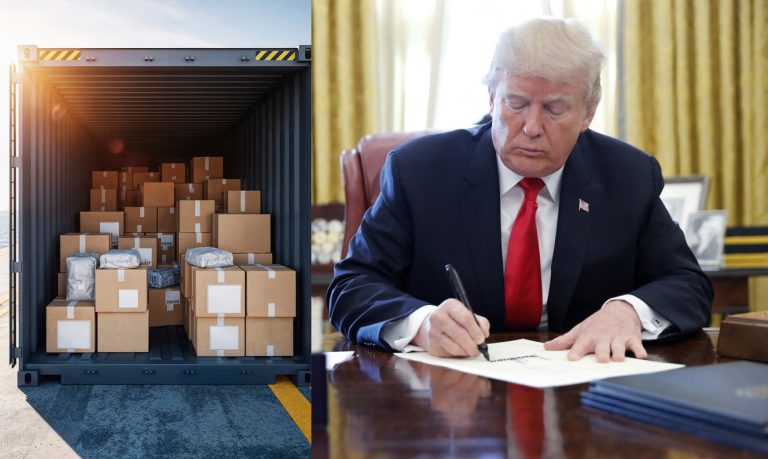
Japan, Australia, and Taiwan have now joined the list of countries that are stopping some parcel shipments to the United States. This comes after the Trump administration announced new rules that end tariff exemptions on small imports.
A long-running rule that allowed low-value goods to enter the country without customs duty, known as the “de minimis” exemption, is set to end on coming Friday. President Donald Trump signed an executive order on 30th July that shuts down this exemption, which for years allowed packages worth less than $800 to enter the U.S. duty-free. The order, which takes effect on 29th August, is part of his broader protectionist trade campaign.
For shoppers and companies alike, the regulation was a major deal. It facilitated cross-border online shopping as speedier, easier, and less costly. But with the exemption eliminated, millions of packages that used to move freely daily will now be subject to customs charges, forms, and delays. Delivery firms globally are already responding, and the impacts are set to hit American consumers.
The US government says this step is necessary to slow down the huge flow of cheap imports into the country and to protect domestic manufacturing. But this sudden move has caused disruptions in postal services and online shopping across the world.
However, letters/documents and gift items valued up to USD 100 will remain exempt from these new duties, according to the executive order.
Impact on global postal services
Several nations such as Thailand, South Korea, New Zealand, France and UK had previously suspended certain parcel services to the US. More and more countries in the Asia-Pacific region are now following suit, which is causing it to become increasingly difficult for small businesses and individuals to ship goods.
In Germany, DHL and Deutsche Post announced last week that they were halting parcel services to the U.S., citing unanswered questions about how duties would be collected, what data would be required, and how information would flow to U.S. Customs and Border Protection (CBP).
Japan Post has announced that it will stop delivering small packages worth more than $100 to the US from Wednesday, 27th August. Similarly, Australia Post said it will “partially suspend” postal services to the US and Puerto Rico from Tuesday, 26th August, until further notice.
Australia Post also pointed out that many postal operators around the world are taking similar steps. The suspension has caused serious problems for e-commerce businesses in the country.
Taiwan has also joined in. Chunghwa Post announced that it will stop delivering small parcels to the US from Tuesday, 26th August. The postal service explained that the global postal system still doesn’t have a way for senders to prepay customs duties, and its partner carriers have also suspended merchandise deliveries.
According to a BBC report, at least 25 countries have suspended parcel deliveries to the USA due to the withdrawal of the tariff exemption.
Who will be affected most?
This change will hit online sellers and platforms the hardest. Small businesses selling via Amazon Haul, TikTok Shop, Etsy, and Shopify to American consumers will be impacted. These platforms typically link small foreign companies directly with American consumers, and most depend on cheap shipping to remain competitive.
Big courier service DHL has also said it will stop accepting shipments to the US from 25th August. Several European postal operators have already done the same.
Australian broadcaster ABC reported that retailers are struggling because of the uncertainty. Laz Smith, co-founder of maternity wear brand Apéro, told ABC that the unstable decisions and the lack of quick solutions are making things very difficult. “It puts us, and the entire Australian fashion industry, in a really tough position,” she said.
India Post also suspended services to US
India has also joined the list of countries halting U.S.-bound shipments. On Saturday, 23rd August, the Department of Posts announced a temporary suspension of most international postal services to the U.S., effective from 25th August.
The move comes directly in response to Trump’s July 30 executive order. In a statement, India Post said beginning 29th August, 2025, all goods sent to the US, regardless of their value, will be subject to customs duties under the International Emergency Economic Power Act (IEEPA) tariff framework.
Air carriers that move U.S.-bound international mail have said they are not ready to meet the new requirements, including collecting duties and transmitting data to CBP. As a result, India Post has stopped booking most categories of items for the U.S., though it is working with American authorities to restore full service.
Although CBP released initial guidelines on 15th August, critical implementation details, such as the process for designating “qualified parties” and systems for collecting and remitting duties, have not yet been finalised.
Those customers who have already shipped goods that do not meet the qualification can claim a refund. “We apologise for the inconvenience,” the department stated, noting it plans to resume services in the near future.
What the data says
According to US Customs and Border Protection, more than 1.36 billion de minimis shipments entered the US in the last fiscal year. On average, about 4 million of these shipments were processed every single day.
Under the new order, importers could face an $80 fee per item if the exporting country has a tariff rate of less than 16%. If the rate is between 16% and 25%, the fee could go up to $160 per item, and for tariff rates above 25%, it could be as high as $200.
This means that sending even small packages to the US will now become much more expensive. For global businesses that depend on American buyers, this is likely to be a major setback.
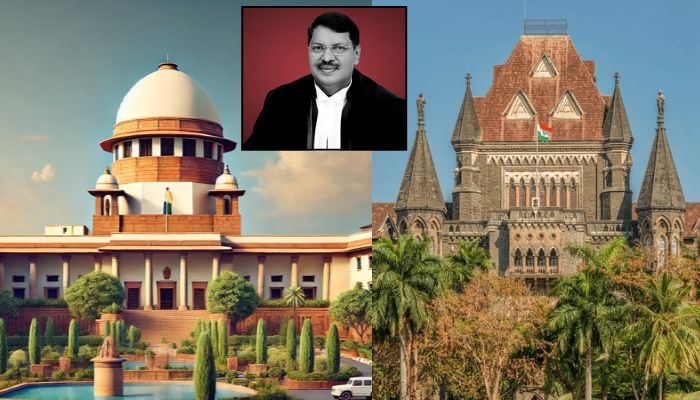
The Supreme Court Collegium has suggested 14 lawyers to be appointed as judges of the Bombay High Court on Tuesday, 26th August. One of them is Raj Damodar Wakode, who is reportedly related to Chief Justice of India (CJI) Bhushan R. Gavai.
Wakode is the son of the CJI’s cousin and is often described as his nephew. However, according to media reports, Dr. Rajendra Gavai, the CJI’s brother, said that Wakode should be seen as a “distant relative.”
Even so, his inclusion in the list has triggered fresh debate about how judges are appointed in India, the role of family connections, and the lack of reforms in the Collegium system.
Background of Raj Damodar Wakode
Raj Wakode graduated under the Maharashtra Board, obtaining distinction at Class 12 in 1996. He initially did science, even securing a gold medal for MSc in 2001, before switching to law. In 2004, he obtained an LLB degree from Amravati University.
After his law degree, Wakode began his career in the chamber of Justice Nitin Sambre, who is now a judge at the Delhi High Court. Over the next two decades, he built a diverse practice, handling civil and criminal appellate cases, writ petitions before the Bombay High Court’s Nagpur bench, and cases before district courts and statutory tribunals such as the Maharashtra Administrative Tribunal and the Revenue Tribunal.
Wakode has represented several public institutions as standing counsel, including Maharashtra National Law University (Nagpur), the Maharashtra State Electricity Distribution Company, the Union of India, the Union Public Service Commission, and the municipal corporations of Amravati and Nagpur. He has also served as the legal advisor to the National Co-Operative Consumers Federation.
Wakode has reportedly declined to comment on his name being proposed by the Collegium.
CJI Gavai recuses himself
Naturally, questions have been raised on whether CJI Gavai had any role in the recommendation of his relative. Supreme Court sources have explained that the CJI recused himself from Collegium meetings where candidates related to him were being considered. Still, Wakode’s name, along with those of two other lawyers who had previous professional links with the CJI, figured in the final list.
It is not the first time that family members of judges have reached the upper judiciary. Examples include Justice YV Chandrachud and his son, Justice DY Chandrachud, both of whom became Chief Justices of India, Justice HR Khanna and his nephew, Justice Sanjiv Khanna, and Justice ES Venkataramiah and his daughter, Justice BV Nagarathna, who is set to become India’s first woman CJI in 2027.
The bigger issue: Nepotism in Judicial appointments
Even when candidates such as Wakode are qualified and experienced, the true outrage is elsewhere: judicial appointments seem to mostly originate from a restricted set of families and networks. This creates the perception that the judiciary operates like a closed club.
The critics are of the view that the system tends to keep at bay those lawyers who do not have family connections in the profession, particularly those with less powerful and small-town backgrounds. This has drawn allegations of the higher judiciary gradually becoming a dynasty much like in politics. The lack of transparency in the manner in which names are shortlisted and recommended only fuels further criticism.
How the collegium system came into being
The present system of appointing judges is referred to as the Collegium system. Surprisingly, it was never a part of the original Constitution. Rather, it developed through three significant Supreme Court judgments, the First Judges Case (1981), Second Judges Case (1993), and Third Judges Case (1998).
Here, judges of the Supreme Court are appointed by a committee of the five senior-most judges of the Court. For the high courts, the three seniormost judges of the Supreme Court along with the senior-most judges of the relevant high court make the suggestions.
In reality, this means into sitting judges having the dominant voice in which individual to promote to the higher courts. The government has no choice other than to raise an objection or refer back a name for reconsideration. If the Collegium reaffirms its decision, the government is obligated to agree with it.
NJAC: A reform effort that has been rejected by the judiciary
The Supreme Court upheld the collegium system for judicial appointments in the case of Supreme Court Advocates-on-Record Association v. Union of India (2015), also referred to as the Fourth Judges Case. The proposed National Judicial Appointments Commission (NJAC) would have been in charge of hiring, appointing and transferring judges, attorneys and other legal staff under the Indian government as well as all of its state governments.
The commission was created by amending the Indian Constitution by the 99th Constitutional Amendment Act 2014, also known as the Constitution (Ninety-Ninth Amendment) Act 2014, which was approved by the Rajya Sabha on 14th August 2014 and the Lok Sabha on 13th August 2014.
It would have established a new mechanism for the nomination of judges in place of the collegium system, which the Supreme Court had activated through judicial fiat. The Indian Parliament passed the act in addition to the Constitution Amendment Act to govern the National Judicial Appointments Commission’s functions.
The Constitutional Amendment Bill and the NJAC Bill were approved by 16 Indian state governments before being enacted into law by Indian President Pranab Mukherjee on 31st December 2014. On 13th April 2015, the Constitutional Amendment Act and the NJAC Act went into effect.
Why the NJAC was struck down
Shortly after its inception, the NJAC was assailed in court by the Supreme Court Advocates-on-Record Association. In what became the Fourth Judges Case, a five-judge bench invalidated the NJAC in October 2015 by a 4:1 margin.
The majority ruling contended that the NJAC subverted judicial autonomy, which forms part of the Constitution’s Basic Structure. It was a significant worry that two “eminent persons,” who weren’t even required to be legally qualified, could vet the choice of the Chief Justice and senior judges. The Court referred to this situation as “outrightly obnoxious.”
The other concern was the inclusion of the Law Minister because the Union government is party to most cases in front of the courts. Judges claimed this was a conflict of interest in the most direct sense. The Court also lamented the lack of specificity in the manner in which “eminent persons” would be selected, placing too much authority in the hands of politicians.
CJI rescual is not enough, judiciary is lacking transparency in India
While CJI Gavai’s rescual may have followed procedure, it doesn’t resolve the larger trust deficit surrounding judicial appointments. The judiciary demands transparency and accountability from all other institutions but has resisted reforms in its own selection process.
Many people believe that the judiciary is the last stronghold of accountability, justice, and equity. However, this claim has always been disputed due to instances of corruption, self-preservation and a lack of transparency.
When an inquiry is commenced, it is carried out by other judges based on a framework they have set up, resulting in lingering uncertainties and a severe lack of desired impartiality and transparency. This privilege is not extended to anyone else. The judiciary requires and enforces standards of transparency and integrity from everyone except itself.
Moreover, efforts to address the problem, such as the NJAC Act or the accountability bill, never proceed to a logical conclusion which only exacerbates the issue. Several attempts to alter the collegium have been met with resistance from the judiciary, which is frequently denounced as self-empowerment but is justified as defending independence.
Due to the collegium’s opaque operations, decisions are not made public and no formal criteria are revealed and hence the collegium system has been accused of nepotism and bias, with arguments that it shields a judicial elite that is exclusive.
In a major crackdown on a vicious inter-state Islamic conversion racket in Bareilly, Uttar Pradesh, the police nabbed four individuals linked with the conversion racket on Monday (25th August). The arrested individuals have been identified as Abdul Majeed (35), Salman Raza (30), Mohammad Arif (29), and Mohammad Faheem(24). Another suspect named Mehmood Beg is said to be on the run.
According to the police, a tip-off was received at Bhuta police station from an Aligarh-based woman named Akhilesh Kumari, who said that some people have been luring her visually-impaired son Prabhat Upadhyay, with a marriage offer to convert him to Islam. She said that when she tried to stop the religious conversion of her son, she received death threats. On her indication, a team of police reached Faiznagar Madrassa and foiled the plan to convert the victim.
Inside the Madrassa, the police team found that the four accused were sitting around Prabhat Upadhyay, wearing skull caps, and were preparing to circumcise him to convert him to Islam. When the police team called the victim by his name, Prabhat, he said that his name was Hamid. On being questioned by the police, Prabhat Upadhyay revealed his real name. Police arrested all four accused and handed over Upadhyay to his family.
थाना भुता बरेली पुलिस द्वारा थाना भुता पर पंजीकृत मु0अ0सं0 377/2025 धारा 140(3)/351(3) बीएनएस व 3/5(1) उ0प्र0 विधि विरुद्ध धर्म संपरिवर्तन प्रतिषेध अधिनियम, 2021 से संबंधित 04 अभियुक्तों की गिरफ्तारी एवं बरामदगी के संबंध में सुश्री अंशिका वर्मा #SP South बरेली की बाइट।#UPPolicehttps://t.co/hOveW3QedXpic.twitter.com/YSnPOiNzS3
A case has been registered by the police under Sections 140(3)/351(3) of the BNS and Section 3/5(1) of the Uttar Pradesh Prohibition of Unlawful Conversion of Religion Act, 2021. The police seized several incriminating materials from the possession of the accused and the victim, including religious literature promoting conversion, CDs containing videos of fugitive Islamist preacher Zakir Naik, skull caps, garlands, and a first aid box containing blades, mobiles, laptops, and conversion certificates.
The gang converted an entire Hindu family to Islam
Addressing the media, SP Bareilly South, Anshika Verma, said that the conversion certificates found in possession of the accused revealed that an entire Hindu family was converted by the gang to Islam. The conversion certificates showed that a man named Brijpal Sahu was converted to Islam and renamed Abdullah. His mother, Usha Rani, was renamed Amina after conversion to Islam. His sister Rajkumari was converted to Islam, renamed Ayesha and married to a Muslim man. In addition to that, the police were led to a minor victim of religious conversion during the investigation of the case. However, the police were able to prevent the religious conversion of the minor victim by stopping his circumcision.
According to SP Verma, an examination of the bank accounts of the accused revealed that they had been running some scheme to collect funds. Abdul Majid, who is the prime accused in the case, ran a religious conversion scheme and travelled across India to collect funds. He is said to have travelled to Gujarat, Maharashtra, Madhya Pradesh, Karnataka and Tamil Nadu. All the arrested accused operated around 21 bank accounts.
Targeted vulnerable individuals and brainwashed them
The gang targeted vulnerable Hindus, particularly poor, unmarried youth, and those with disabilities, for religious conversion by luring them with marriage proposals and money. The gang’s operations are spread across 13 states and 30 districts. Their modus operandi included Salman, a tailor by profession, visiting Hindu families on the pretext of offering help or introducing them to Muslim girls. He was assisted by Faheem, a hairdresser, who identified potential targets out of people who visited his shop. Once they were able to influence a person, they would bring him to the madrassa and brainwash him with religious texts and CDs. The police suspect that the gang has converted a considerable number of people.
This is the sixth Islamic conversion racket busted by the authorities in Uttar Pradesh in this year. Earlier, the authorities, uncovered Islamic conversion rackets, Balrampur, Agra, Prayagraj, Kushinagar, and Aligarh.