Home Blog Page 3707

‘Sarod, not Sitar’, Shashi Tharoor gets corrected by netizens as he suspends his Sansad TV show in solidarity with suspended MPs

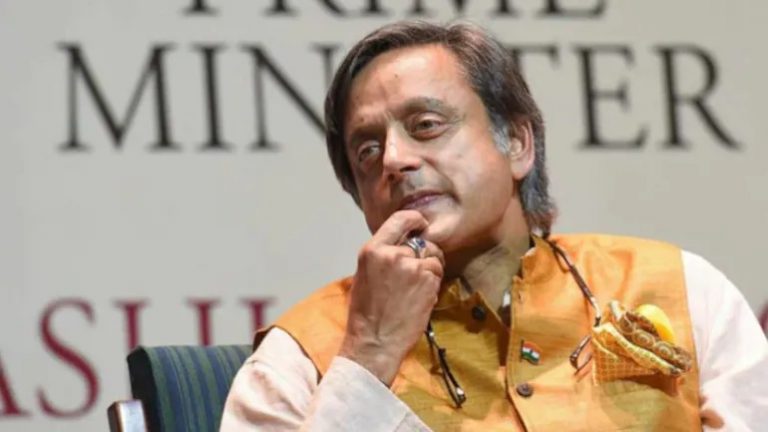
After Congress MP Shashi Tharoor referred to legendary sarod maestro Ustad Amjad Ali Khan as a sitar player, a number of Netizens turned to Twitter on Monday to brush up on his general knowledge.

The Congress MP goofed up in a statement he issued informing that he was stepping down as the host of a talk show on Sansad TV in solidarity with the 12 MPs who were suspended over unruly behaviour, manhandling security personnel in the last session. Tharoor has been hosting the talk show “To The Point” on Sansad TV.

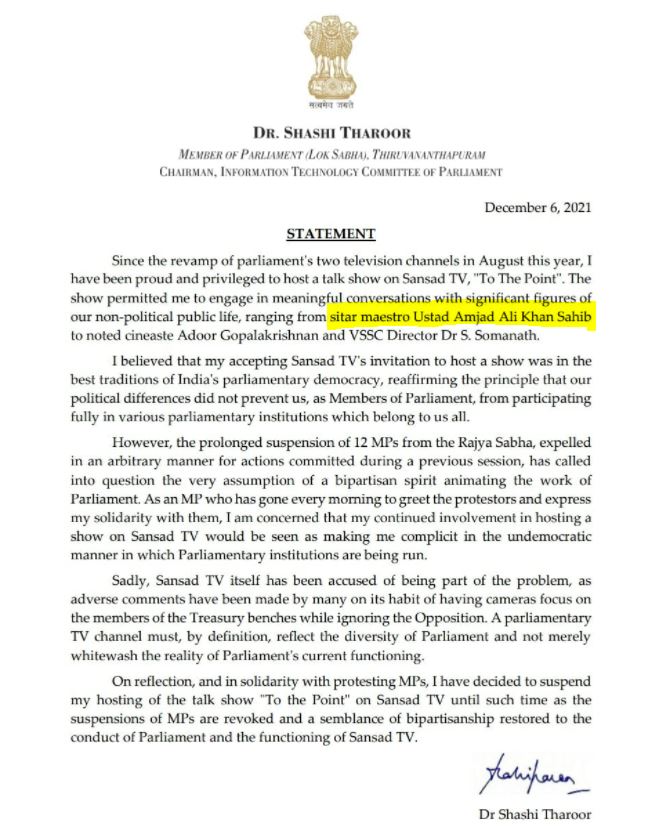
The Congress MP wrote, “Since the revamp of parliament’s two television channels in August this year, I have been proud and privileged to host a talk show on Sansad TV, ‘To The Point”. The show permitted me to engage in meaningful conversations with significant figures of our non-political public life, ranging from sitar maestro Ustad Amjad All Khan Sahib to noted dneaste Adoor Gopalakrishnan and VSSC Director Dr S. Somanath.”

The statement issued by Congress MP Shashi Tharoor

No sooner did the Congress MP issue the statement, many watchful netizens descended upon his timeline to school him. Many opined that if the Congress leader could not decipher between a Sitar and a Sarod it was better he quit from hosting the show.

“Ustad Amjad Ali plays Sitar.. And Rahul Gandhi is Batman. Good that he suspended himself”, one quipped.

Some opined that the day is not far when Tharoor will claim that Ustad Bismillah Khan, an Indian musician credited with popularizing the shehnai, plays the saxophone and not a shehnai.

One Twitter user opined that Shashi Tharoor was so engrossed in brushing up his English vocabulary that he missed working on his general knowledge.

Another Twitter user shared the picture of the two instruments- Sarod and the Sitar to educate the Congress MP.

Interestingly, Shashi Tharoor’s decision to step down as the host of the talk show “To The Point” on Sansad TV came after Shiv Sena MP Priyanka Chaturvedi said she was stepping down as the anchor of the Sansad TV’s show ‘Meri Kahaani’. She is among the 12 suspended Rajya Sabha MPs.

Chaturvedi, in a letter dated December 5 to Rajya Sabha Chairman Venkaiah Naidu, said, “After my arbitrary suspension, that has totally disgraced established parliamentary norms and rules, to stifle my voice, my party’s voice inside the chamber, I am unwilling to continue taking space on Sansad TV when my primary oath to the Constitution is being denied to me.”

Twelve opposition MPs were suspended from the Rajya Sabha last Monday for the entire Winter Session of Parliament for their “unruly” conduct in the previous session in August. According to reports, they were reprimanded for indiscipline during the monsoon session of the house, which had to be ended two days prior to the scheduled date after it witnessed a commotion in the Upper House on the last day of the session.

While six suspended MPs are from the Congress; two each are from the Trinamool Congress and Shiv Sena, and one each from the CPI and CPI(M).

At the time of this report, even after being corrected by netizens, Tharoor has not yet corrected that Ustad Amjad Ali Khan is a sarod player and not a sitar player.

Rakesh Tikait shares space with Khalistani sympathizers Mo Dhaliwal and Pieter Friedrich in an international webinar aimed at ‘continuing the protests’

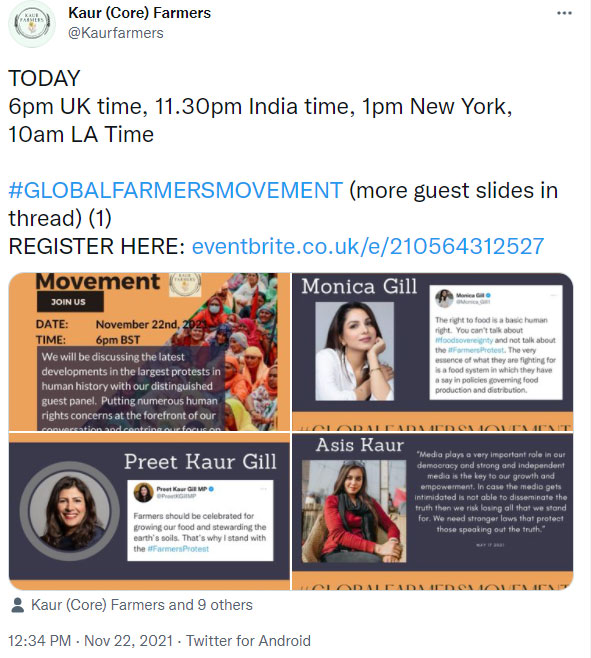
An organization named ‘Kaur (Core) Farmers’ organized a webinar on November 22 to discuss the announcement made by Prime Minister Narendra Modi on repealing the three Agriculture Laws.

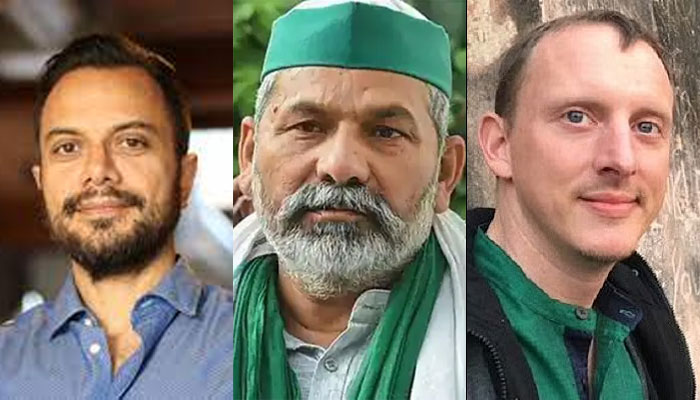
In the online meeting, Bharatiya Kisan Union’s leader Rakesh Tikait, Khalistani sympathizer Mo Dhaliwal and associate of ISI operative Pieter Friedrich were some of the speakers. Other speakers included Monica Gill, Preet Kaur Gill, Asis Kaur, Claudia Webbe and several others who had been pushing the anti-India narrative across the world in the backdrop of the farmer protests. OpIndia accessed multiple recordings of the meeting that is available online.

A Twitter handle named ‘where-is-proof’ had shared a screenshot of the zoom call. Upon investigation, OpIndia stumbled upon a recording of the webinar.

‘There are many more issues’ – Tikait urges to continue the protests

Raj Kaur, the host from Kaur Farmers, introduced Tikait as the leader who convinced everyone to continue the protests after the January 26 violence. When asked if Tikait was happy with the news of laws being repealed, he said, “It is okay that they are repealing the laws. But the other issues still persist. We have many other issues like MSP, the death of the protestors, and more. The talks with the government should begin. There is seed bill, milk policies, electricity bill and whatnot.” Tikait was quite adamant in his stance that he was not interested in letting the protests end and sending the protestors home.

Notably, on December 5, Tikait had announced that the next target the protestors were looking at was the privatization of the banks. The alleged farmer leader openly turned into a professional aandolanjivi. Earlier, he had announced that he would not let the protests fade away before Lok Sabha Elections in 2024, and it seemed his mind was clear that he would find one or the other way to keep the protests alive for his own greed for the limelight.

No mention of BJP supporters being killed at Lakhimpur

When speaking about Lakhimpur Kheri incident, Tikait said that as of now, they were satisfied as three judges were monitoring the Lakhimpur case under the supervision of the Supreme Court. He further added that his union had its own committee that was looking over the proceedings in the case, and they would go and stay in Lakhimpur from December 6 onwards for three days.

Interestingly, while both host and Tikait said they wanted justice for the protestors who were killed in the Lakhimpur incident, none of them mentioned the BJP supporters who were brutally lynched by the protestors. Nonetheless, it was expected they would not talk about BJP supporters getting justice as the Samyukt Kisan Morcha suspended their favourite aandolanjeevi Yogendra Yadav for merely visiting the house of the BJP support Late Shubham Mishra who was killed in the incident.

‘Farmer commits suicide as they do not get the right price’, claimed Tikait

When asked what the unions were doing for the farmers’ suicides that had been happening even before the farm laws, Tikait seemed a little clueless and caught off guard. Tikait claimed the main reason for farmer suicides was that they were not getting the right price for the produce. The expenses have increased, and farmers often have financial issues. “The inflation in the market and low income force them to commit suicide,” Tikait said.

This is an interesting point of view because if he had read the Agriculture laws that the government had brought but repealed because of these protests, they talked about giving farmers more options to sell their products and increase their income. Instead of talking to the government for amendments, the unions pushed the narrative as if the government was against the farmers. Sadly, these laws were on the same line as the reforms that these unions had demanded for decades. 

No separate efforts for women

The host asked Tikait if they were doing anything specific for the female farmers. As clueless on other issues, Tikait was fumbling while talking about women in the protests. He claimed there were no separate policies for women by the government. The union leader seemed to be unaware of the Mudra Loan, Pradhan Mantri Awas Yojna, Jan Dhan Yojna, Ujjwala Yojna, toilets, Beti Bachao Beti Padao and many others that largely benefit women of the country.

‘I do not know about Matthewara’

In 2020, Punjab Government bought around 400 acres of land near Mattewara forest, village Sekhowal Gram Panchayat, Ludhiana, to develop an industrial corridor in the area. The majority of the said land was owned by the Dalit community, and there has been resistance by the locals. As per reports, the Dalit community made a sizeable barren land cultivable after decades worth of effort since they moved there in 1996. However, as the government had decided to take over the land, the Dalit community in the region alleged they felt helpless and cheated.

When Tikait was asked if the unions were doing anything for these Dalit farmers in Punjab, he categorically denied any knowledge of it and asked to talk to the unions in Punjab. The host, who looked shocked, asked if the Kisan unions were doing anything for the Dalits and landless farmers at all. This is where the ‘landowner’ Tikait got irked by the question.

Tikait, who himself owned lands and properties in 13 different locations and has a worth of around 80 crores, alleged that there was no discrimination among landowner farmers and landless farmers in the villages. He further claimed that everyone helped each other in the villages. Interestingly, if that was the case, there would not have been farmer suicides at all across the country. There have been several reports of Zamindars or landowners exploiting the landless farmers who do not have a choice but to work on others’ lands.

On the other hand, the government of India is tirelessly working to improve the condition of landless and marginalized farmers. In the past, the majority of the benefits were going to the rich farmers, and the marginalized would not get the actual benefit of the schemes. From giving them ownership of land to neem coated urea and financial support, these marginalized farmers are slowly getting the benefits they deserve. But the union leader, as it seems, remain unaware of what has been happening as he feels there was no discrimination.

Associate of ISI operative introduced as historian and author

Pieter Friedrich, a known associate of ISI operative and the one who has been on security agencies’ radar for a very long time, was introduced in the meeting as a ‘historian and author’. Friedrich claimed that no one would have thought that a farmer movement could push back the Modi government. He compared the farm laws that the unions themselves had been demanding for decades as forced and poisonous.

He said, “The farmer protests is just one chapter. The real villain is still holding power. We have won the battle, but the war must go on.” He further questioned where would the tractors go next. Calling the Modi government fascist, he alleged that the Muslims, Christians and activists who talk against the government are being attacked. He urged the farmer protestors to support these communities. He called for “to move towards Azadi”. It is unclear what Azadi was talking about.

Notably, after Friedrich completed his ‘pre-prepared speech that he read during the meeting, the host very proudly confirmed that he had been spreading the narrative against BJP and RSS across the world. She further claimed that Hitler took inspiration from the RSS. The so-called intellectuals have been claiming that RSS was inspired by Hitler, but the host seemed to have a whole new theory.

‘The battle does not end with the repeal of farm laws’ Mo Dhaliwal

Mo Dhaliwal, a well known Khalistani sympathizer, said when he came to know about the protests in November 2020, he was sure that the protests would last long. He said, “We needed international attention for the protests.” Explaining how his organization Poetic Justice Foundation was involved in spreading the word about the protests, he claimed that reports of his connection with Rihana and Greta Thunberg were ridiculous. Interestingly, he claimed so while it was the toolkit that was made under his supervision which Greta had shared, and the whole nexus was exposed.

Mo further claimed that there were no efforts from the government for dialogue. He further alleged that the way the Modi government works could be described as ‘structural violence’ as all policies of the government were against the people of India. He also mentioned that the spark of anti-regime was seen in CAA protests.

Remembering his speech from early January 2020 where he said, “The battle does not end with the repeal of farm laws. It actually begins there,” Mo claimed he was misunderstood. Interestingly, in the same three-minute speech, he talked about Khalistan as well and how he was allegedly misunderstood, only he could know. He clearly called for continuous protests against the government to possibly cause unrest in India. He said, “The onus on us to continue the fight.”

The misinformation and fake news spread by groups like Poetic Justice Foundation and individuals like Rakesh Tikait and Pieter Friedrich not only forced the government to repeal the laws that were indeed for the benefit of the farmers, it has pushed India back several years in terms of reforms. It is noteworthy that Tikait has recently threatened of 26 January 2021 like violence again.

‘Some kids got angry’: Pakistan Defence Minister finds excuses for the lynching of Sri Lankan man over ‘blasphemy’ allegations

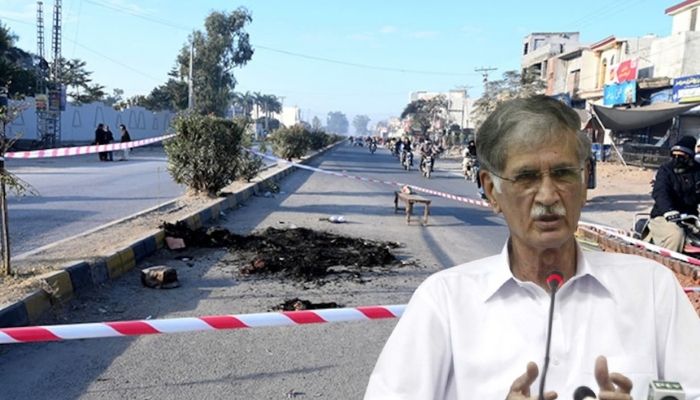
Two days after the brutal lynching of Sri Lankan national Priyantha Kumara in Sialkot in Pakistan over accusations of blasphemy, Defence Minister Pervaiz Khattak attempted to justify the heinous crime.

In a video shared on social media by journalist Hamza Azhar Salam, the Pakistani Minister was heard as saying, “There were children, adults who were influenced by the Islamic faith. They get agitated and take action out of passion. This does not mean that it was a reaction to an action. Everyone has their own thought process. They raised slogans that it was an act of blasphemy. They got angry and killed him. This doesn’t mean that the (social fabric) of the society has broken.”

He further added, “Please explain to people that it is a matter of Faith. Even I can come under its influence and commit a crime. But it did not mean that Pakistan is en route the road to destruction.” Pervaiz Khattak not only tried to downplay the brutality of the act of lynching but insinuated that taking life in the name of Faith was justified. He also suggested that the merciless killing of Priyantha Kumara did not mean anything significant (in terms of radicalisation) of the Pakistani society.

Sialkot mob lynching case and aftermath

On Friday, a Sri Lankan man Priyantha Kumara was tortured and burnt to death by a murderous Islamist mob over rumours of blasphemy. The incident took place on Wazirabad Road in Sialkot, where the workers attacked the export manager of a factory and burnt his body after killing him. In a video, the frenzied mob could be heard chanting “Nara e Taqbeer” and “Labbaik Ya Rasool Allah”. Other slogans that were heard included ‘gustakh-e-nabi ki ek hi saza, sar tan se juda sar tan se juda’.

Following diplomatic pressure from the Sri Lankan government, Pakistan was forced to act on the Islamists who killed Priyantha Kumara. With the help of CCTV footage, the police were able to apprehend 235 people for partaking in the heinous crime. According to reports, 900 workers of the Rajco Industries were booked under Sections 302, 297, 201, 427, 431, 157, 149 of the Pakistan Penal Code (PPC) and Sections 7 and 11WW of the Anti-Terrorism Act.

The arrests were made based on a complaint that was filed by Uggoki Station House Officer (SHO) Armaghan Maqt. Eyewitnesses had conceded that Priyantha did not commit any act of blasphemy and was fabricated by ‘mischievous’ factory workers.

It is notable here that murders, vandalism and arson over vague allegations of blasphemy is a regular phenomenon in Pakistan. Last year, a USA citizen named Tahir Naseem was killed inside a courtroom during the hearing of a blasphemy case. Naseem had been jailed over vague allegations of blasphemy and his murderer was hailed by Pakistanis as a hero.

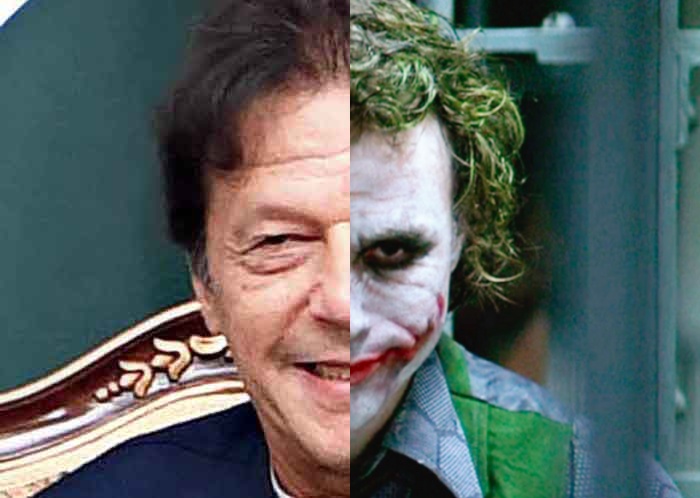
Imran Khan fighting blasphemy is Joker protecting Gotham: Here is why Pakistan will remain a hell hole

As Pakistan sinks further into the abyss of Islamism, will it ever rise from the grave and address the elephant in the room that ‘blasphemy’ is?

Earlier last week, a Sri Lankan man Priyantha Kumara was burnt alive by a murderous mob in Pakistan’s Sialkot on allegations of blasphemy. Disturbing visuals of Kumara’s body burning even as the mob gathered around to take selfies and video with the burning man had gone viral on social media.

Note: Disturbing visuals, reader discretion advised.

The mob can be heard chanting ‘Gustakh e Nabi ki ek hi saza, sar tan se juda, sar tan se juda’ chants. This chant loosely means the only acceptable punishment for saying anything audacious about Prophet Muhammad is beheading.

What is unfortunate is that this kind of barbarity coming from Pakistan has become so common that it does not shock one anymore. What is even worse is that Pakistan is playing down the horrifying incident. Let us analyse Pakistan government’s response to this barbarity.

On December 3, 2021, Pakistan Prime Minister Imran Khan referred to the attack on Priyantha Kumara as ‘vigilante attack’.

The mob that was chanting and calling for beheading of Kumara was ‘vigilante attack’. Khan, very curiously, skipped the part that Kumara was burnt alive on allegations of blasphemy. The police had admitted that the so-called vigilante mob had brutalized and tortured the Sri Lankan man before setting him on fire. Arman Maqt said that Priyantha Kumar was beaten to death by the mob on the Wazirabad Road before his body was set on fire. The SHO Maqt said that the police lacked staff and was ‘helpless’ in front of the mob of hundreds of fanatics.

The police stood mute spectator as mob chanting and calling for beheading of a man burnt him alive for ‘blasphemy’ because they were ‘helpless’. The post mortem report said that most of the body of Priyantha Kumara was burnt, and several bones were broken due to the torture by the mob.

Here is what Pakistan’s Foreign Minister said.

Shah Mahmood Qureshi, too, condemned the ‘killing of a Sri Lankan national’. Like his boss, he, too, skipped the part that Kumara was killed over allegations of blasphemy.

Dictionary defines blasphemy as “the action or offence of speaking sacrilegiously about God or sacred things; profane talk.” In Pakistan, ‘blasphemy’ is punishable by beheading/being burnt alive, while a murderous mob which believes this is just takes videos and selfies with the burning body.

Pakistan and blasphemy

Pakistan has stringent laws against blasphemy with punishment ranging from jail term to death penalty.

In October 2020, Pakistani bots had decided to boycott French products over French President Emmanuel Macron’s allegedly ‘Islamophobic’ comments. Subsequently, in a video statement at the UNGA, Imran Khan tried to justify what was happening back home. He had said, “The Prophet lives in our hearts. When he is ridiculed, when he is insulted, it hurts… We human beings understand one thing: The pain of the heart is far, far, far more hurtful than physical pain. And that’s why the Muslims react to this.” 

He further added that people from the west do not understand the sentiments attached to the Prophet. He also compared the pain suffered by the Jewish during the holocaust to the pain induced in Muslims by insulting Prophet Muhammad. Khan had thereby insinuated that killing of non-Muslims is justified if they ‘insult’ Prophet Muhammad because it hurts the sentiments of Muslims.

In April this year, workers and activists of Islamist group Tehreek-i-Labbaik Pakistan (TLP) ran riots in Pakistan on non-fulfilment of four demands it had put up for Imran Khan government. The demands were originally made in November last year, following the beheading of 46-year-old Samuel Paty by a teenage Jihadi terrorist in France and the subsequent criticism of Islamists by French President Emmanuel Macron. TLP also took offence to the display of caricatures of Prophet Muhammad in public in one city in France.

Islamists in Pakistan had taken to protesting against the French in Karachi. The former Ameer Allama Khadim Hussain Rizvi had even asked the Imran Khan government to launch a jihad against France. At that time, Imran Khan had said how there needs to be a worldwide campaign for more stringent blasphemy laws against Prophet Muhammad. “Inshallah, there will come a time that even in Western countries, people will fear making the mistake the insult the Prophet. A worldwide campaign is needed to achieve this,” he had said.

As recent as October 2021, at least four Pakistani policemen were killed after TLP rioters who were armed with AK47 rifles, running riots on street of Lahore during anti-blasphemy protests. TLP, a banned Islamists outfit in Pakistan, has been protesting against the Charlie Hebdo cartoon depicting Prophet Muhammad and have been demanding expulsion of France’s ambassador and release of their leader. This was part of their ongoing protests since 2017. The cartoon was first published by French satirical magazine Charlie Hebdo in 2006. In 2015 January, Islamists led a suicide attack on their office for the caricature/blasphemy.

Pakistan: A nightmare for minorities and sane, non-radical individuals

Tales of atrocities against non-Muslims in Pakistan are as old as time. The country was established on the principle of two nation theory that Hindus and Muslims cannot live together peacefully. In 1876, Aligarh Muslim University founder Syed Ahmed Khan said, “I am convinced now that Hindus and Muslims could never become one nation as their religion and way of life was quite distinct from each other.” 

In 1929, Mahashay Rajpal was murdered for publishing Rangeela Rasool, a satirical take on the domestic life of prophet Mohammed. Mahashay Rajpal ji in 1912 started “Rajpal and Sons” from Lahore. He would publish Hindi, English, Urdu and Punjabi books on social, political and religious topics. The pamphlet was originally published anonymously under the name “doodh ka doodh aur panee ka panee”. On the surface, Rangeela Rasool had a laudatory tone of Mohammed’s life but at the same time pointing out uncomfortable truths about his domestic life.

Muslims of modern day Lahore, then a part of British India, were outraged at Rangeela Rasool. When Mahashay Rajpal was acquitted of his charges three years later, Jinnah was upset. In a provocative speech at the Jama Masjid in July 1927 Jinnah warned that should the judgement not be reversed, Muslims would be compelled to take the law in their own hands. Even avowed secularists like Motilal Nehru remarked to his son that “the Musslmans of India have all gone mad”.

In 1927, the same year he was acquitted, there were two unsuccessful attempts on Mahashay Rajpal’s life — a wrestler named Khuda Baksh attacked him in September 1927 when he was sitting in his shop but Khatri Rajpal ji caught him and handed him over to the authorities. Khuda Baksh was convicted and sentenced to ten years in prison.

The next month, a Muslim man named Aziz Ahmed attacked Swami Satyanand ji mistaking him to Khatri Rajpal. Luckily, the attack was not fatal and Swami ji recovered after a couple of months. On April 6th, 1929 a 19 year old carpenter named Ilm ud din stabbed Mahashay Rajpal on his chest eight times while he was seated in the outer verandah of his shop. Mahashay Rajpal did not survive the attack succumbed to the injuries.

His murderer was defended in Court by Jinnah himself and Muhammad Iqbal, a raging favourite among Indian liberals today, eulogised him. Today his grave is a religious site in Pakistan and Pakistani textbooks eulogize him with the title of “Ghazi”.

In 2011, Pakistani leader Governor of Punjab in Pakistan, Salman Taseer was assassinated for having ‘liberal’ views on blasphemy. Salman Taseer was murdered because he believed a hapless Christian woman should not be executed for alleged blasphemy. He believed that the woman is innocent of the charge and came out strongly in her support in public. Except, on 4th of January, 2011, Salman Taseer was assassinated by his bodyguard Mumtaz Qadri for his position on Pakistan’s blasphemy law.

The assassination instantly turned Qadri into a hero, as one would expect from a Jihadist state. He was showered with rose petals as he was dragged into the Court. “Death is acceptable for Muhammad’s slave,” his many supporters chanted.

Qadri had significant support from the Pakistani masses. The ordinary citizens of Pakistan were baying for Asia Bibi’s blood. Some offered rewards for anyone who could summon the courage to murder her, others wondered why she hadn’t been murdered yet. Others wept with joy when the Pakistani court awarded her the death sentence, the first woman to receive the death penalty in the country. One Maulvi said, “We had been worried the court would award a lesser sentence. So the entire village celebrated.”

When a seemingly moderate Salman Taseer decided to put human life above ‘blasphemy’, he paid for it with his own life.

Pakistan has become even more radical than it has ever been

It has been almost 100 years to that day and in the year 2021 in Pakistan a man was burnt alive because he ‘blasphemed’. What is unfortunate is that the godforsaken country seems to have reached a point of no return as far as radical Islamism has concerned. We have all seen how Imran Khan, who was once the poster boy of liberals especially in India for his ‘good looks’ and ‘cricketing charm’, has ended up being a sidekick of radical elements in the country.

When Islamist group Taliban took over Afghanistan, things became much clear when Pakistanis cheered for the ummah. Over the years, after Taliban regime was toppled by US invasion, it was Pakistan that gave shelter to the leaders of radical group and nourished them so that when US pulled out of Afghanistan, the Taliban, with reinforced strength, can take over. Pakistan has been harbouring terrorists, some of who have ‘kill the ones who drink cow urine’ as sole purpose in life. ‘Cow urine drinker’ is the jibe often used to refer to Hindus because they consider cows holy.

The level of radicalisation is so staggering that now even the Pakistani leadership is too afraid to call out radicals for their radical views on blasphemy.

The way Joker in Batman wanted to watch the world burn, Pakistan, too wanted to do that till hell came home and their own country started feeling the burn. Which is why it has turned into the hell hole that it is.


Wasim Rizvi becomes Jitendra Narayan Swami: Former Shia Waqf Board chief reverts to Hinduism at Dasna temple

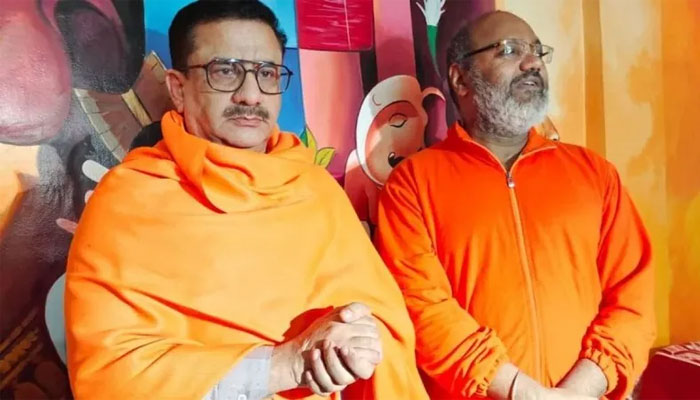
Former Shia Waqf Board chief Wasim Rizvi has reverted to Hinduism by renouncing Islam. He has been a frequent target of fundamentalists because of his statements. He converted to Hinduism in the presence of Mahant Yati Narasinghanand Giri at Dasna Devi temple in Ghaziabad. Rizvi was welcomed back into the faith of his ancestors in a series of rituals, after which he was named Jitendra Narayan Swami.

Several media reports suggest that he has been named Harbir Narayan Tyagi, but while talking to OpIndia, Mahant Narasinghanand confirmed himself that Rizvi’s name is now Jitendra Narayan Swami. After converting to Hinduism, Rizvi said, “Mughals have given the tradition of defeating Hindus. Muslims vote unanimously for the party that defeats Hindus. Muslim voters are only for defeating Hindus.” He further added, “I was thrown out of Islam. Every Friday, they announce more rewards for my head. Today I am accepting Sanatan Dharma.”

Earlier, Rizvi had announced that he would be accepting Sanatan Dharma on Monday. He was in regular touch with the temple’s Mahant for several days. A few days ago, he had expressed his wish that whenever he dies, he should be cremated and not buried. He had given the right to light his pyre to Mahant of the Dasna temple and Mahamandaleshwar of Juna Akhara Yati Narasinghanand Saraswati.

Rizvi said that fundamentalists had announced no place would be given for his dead body in a graveyard after his death. He added there should be no unrest in the country, so he expressed the desire to be cremated and not buried in his will. He said he should be cremated as per Hindu customs and sent a copy to the administration as well in this context.

It is notable here that Indian Muslims had been Hindus once. Most of them had been forcefully converted into Islam during the centuries of Islamic invasion and Mughal rule.

The anger against Rizvi

Recently, Rizvi launched his book ‘Muhammad’ in the presence of Dasna Mahant. After that, AIMIM chief Asaduddin Owaisi himself filed a complaint against him. In his complaint, Owaisi alleged that Rizvi wrote the book to hurt the sentiments of the Muslim community. Earlier, Rizvi had made headlines when he had filed a PIL to remove 26 verses from Quran, stating those verses allegedly encourage terrorism. As the head of the Shia Waqf Board, Rizvi had supported the struggle for the Ram Mandir at Ram Janmabhoomi, Ayodhya.

Nagaland: BJP State President rubbishes media reports that said 12 of their MLAs are about to join TMC

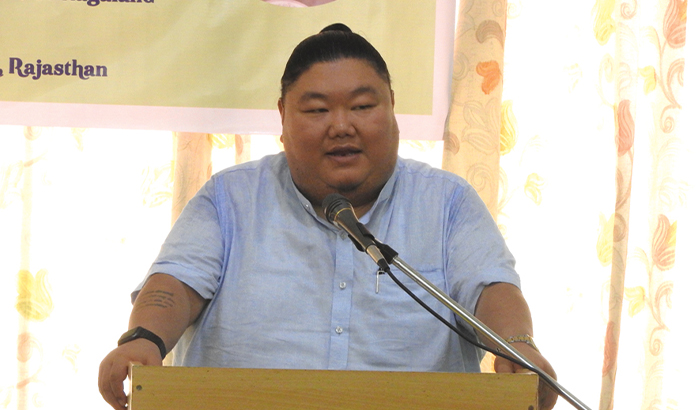
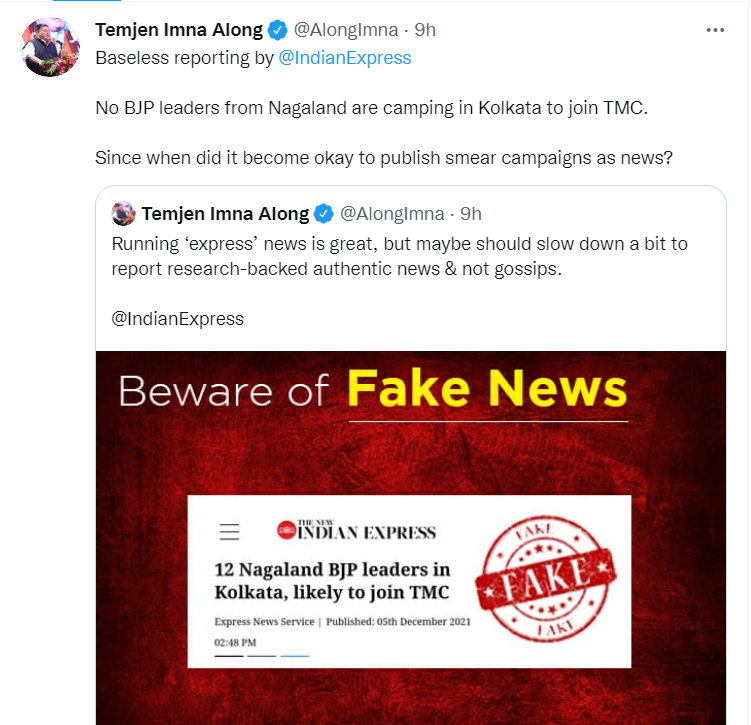
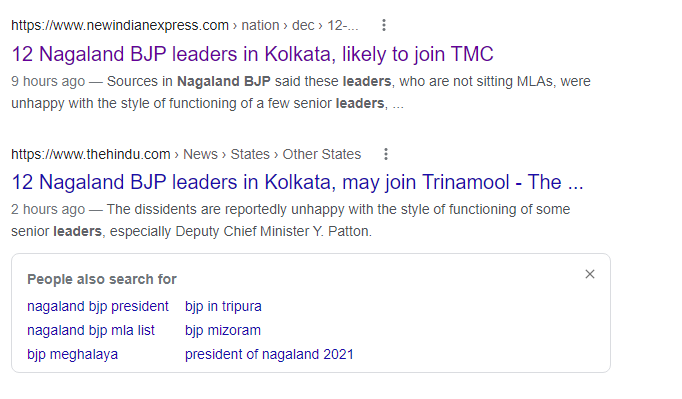
On Sunday (December 5), the state president of BJP (Nagaland) dismissed media reports which claimed that 12 BJP leaders from the State were joining the Trinamool Congress (TMC). The misleading news was carried by The Hindu and the New Indian Express.

In a tweet, BJP leader Temjen Imna Along wrote, “Baseless reporting by (New) IndianExpress. No BJP leaders from Nagaland are camping in Kolkata to join TMC. Since when did it become okay to publish smear campaigns as news?” He further added, “Running ‘express’ news is great, but maybe should slow down a bit to report research-backed authentic news & not gossips.”

Screengrab of the tweet

Earlier in the day, both the news publications carried the same misleading news. After being confronted with facts, The Hindu deleted the article titled, “12 BJP leaders in Kolkata, may join Trinamool.”

Screengrab of news report carrying the fake news about the defection of BJP l

Citing BJP sources, The New Indian Express reported that 12 party leaders, unhappy with the BJP’s functioning, went to Kolkata to meet the TMC leadership. The sources also said the 12 of them were not sitting MLAs in the Nagaland Assembly.

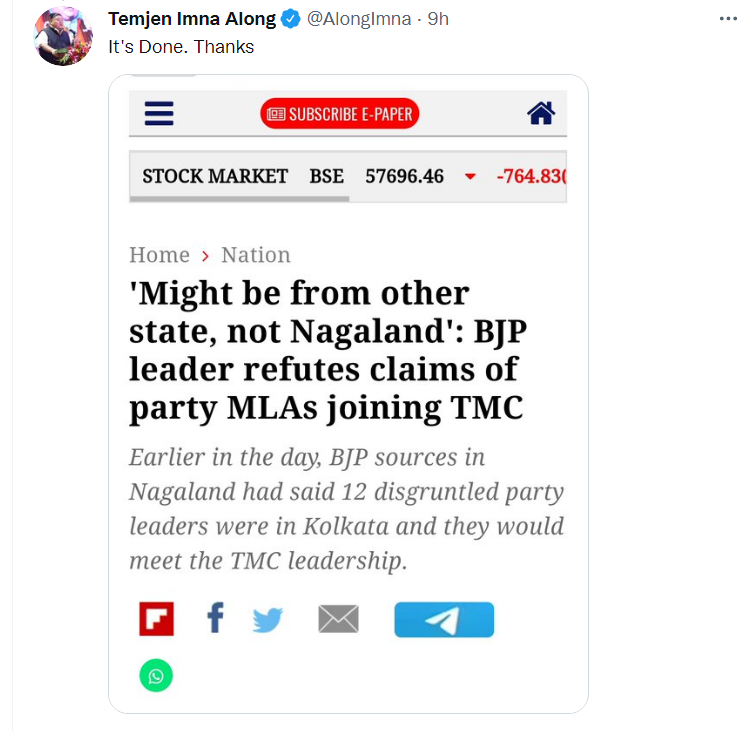
Screengrab of the tweet

The publication later tweaked their article after their initial report was dismissed by the BJP leadership. “It is done. Thanks,” posted Temjen Inma Along with a screenshot of the new headline of The New Indian Express. It must be mentioned that the BJP has 12 MLAs in an Assembly of 60 members.

It is notable here that the Nationalist Democratic Progressive Party with 21 MLAs and the BJP with 12 MLAs are a part of the alliance that runs the government in Nagaland.

Violence erupts in Nagaland after 13 civilians were killed by armed forces, 1 dead after mob attacked Assam Rifles camp

Violence erupted in Mon district in Nagaland today, as locals attacked several installations protesting against the unfortunate killing of 13 civilians by Indian Army soldiers mistaking them for insurgents. One civilian was killed in the violence that broke out today, and several were injured.

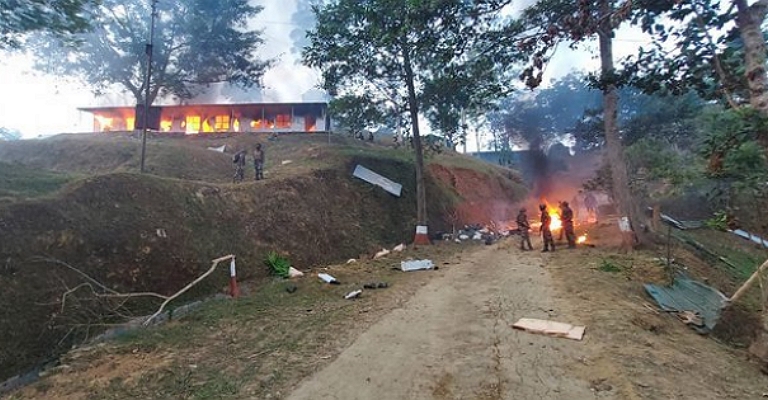
An angry mob of around 500 civilians attacked an Assam Rifles camp at Oting in the Mon district of Nagaland, which forced the security forces to open fire. This resulted in the death of one more civilian on Sunday, according to reports.

Visuals show a large number of civilians attacking the Assam Rifles camps and ransacking it, and torching some houses in the camp. Gunshots were heard in some of the videos from the incident.

The Konyak Union Office was also attacked in Mon by a mob, accusing it of not taking prompt action after 13 civilians of the Konyak community were killed by armed forces. With several such incidents of rioting and mass protests, the situation remained tense on Sunday.

The district administration has imposed curfew in the district to control the situation, internet and SMS services have been suspended for the time being.

Earlier on Saturday, 13 civilians were killed in an unfortunate incident in Mon district, where 6 were accidentally shot by the Army who mistook them as insurgents and opened fire on them. The angry locals in retaliation attacked the army team and the soldiers reportedly fired at them for ‘self-defence’. In this firing 7 more villagers were killed, while one soldier was killed and several injured in the attack by villagers.

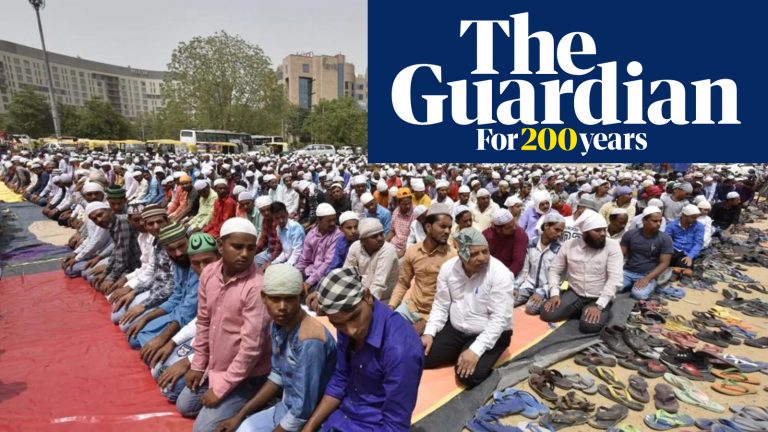
Guardian calls public grounds in Gurugram ‘Muslim sites’, says Muslims have right to offer namaz at those places

0

While residents in Gurugram are protesting against Muslims occupying public places every week for namaz prayers, Guardian has claimed that those public places are Muslim sites, and the Muslims in India have no place for praying now.

In an article titled ‘New city, old schism: Hindu groups target Gurgaon’s Muslim prayer sites’, the report by Hannah Ellis-Petersen claimed that just because Muslims are using open grounds like car parks for weekly prayers, they are ‘Muslim sites’ now, and they now have right over those places. It also equated Gurugram public space to fictional religious battlefields.

As per the report, the author has stated that since a car park in Gurugram was used as a temporary prayer site for decades by the Muslims, the car park can be conveniently termed as a prayer site.

The author tried to paint the residents of Gurugram and Hindu activists as villains for protesting against illegal occupation of public places every week, and the Muslims became the victims in the article. The author claims that “for the Muslim community, praying in the few public sites they have left has become a statement about their rights in society,” implying that Muslims can offer prayers in open grounds only. The article claims that since there are not adequate mosques in the area for all Muslims to offer Friday namaz, they are forced to use public places, and now they are being prevented from doing so.

In the last few weeks, several left-liberals have been making this argument, saying that Muslims have to use public ground because there are not enough mosques for all of them. But the fact is that, not a single religion has religious places that fit all the adherents of that religion at the same time. No place have enough temples, churches or gurudwaras where all Hindus, Christians or Sikhs can pray at the same time.

It is being assumed by Guardian and other left-liberals and Islamists that Muslims have to pray in the open only. But many people argue that if they don’t have enough mosques, they can pray at their homes or workplaces, as blocking roads and other public places cause huge inconvenience to general public.

Netizens slammed Guardian for naming public spaces in Gurugram as prayer sites :

Netizens slammed Guardian for labelling public places Muslim sites, and questioned their intention behind the article.

Sumit Agrawal said, “Seriously? Muslim sites? They are calling public properties ‘muslim sites’…. This is the exact reason why we must stand against such takeover of public properties.”

Entrepreneur Ram said, “This is such a garbage piece on so many levels. Public property is not a Muslim site. It is not the state’s responsibility to build a place of worship. Hindu groups are not laying claim on these sites for themselves. But this is the Guardian of bigotry & fake news.”

Tapashish Chakraborty notes, “The @guardian brings forth a most important caveat for non-Muslims. Stand firm against the slightest encroachment by Muslims or even the most public of your places like roads & parks will soon become “Muslim sites”.

Vinnie Tiwari said, “Such a misleading and trash article. What makes you think that pubic property belongs to any specific religion? Based people who dragged them out.

Similarly, many Twitters reminded Guardian that people are protesting against blocking of public spaces, and they are not Muslim sites.

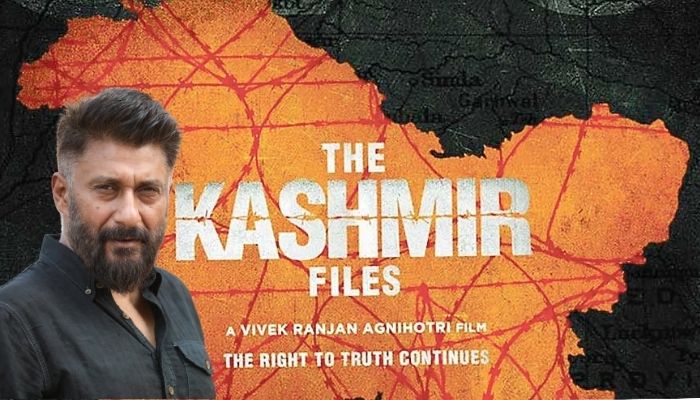
Kashmir suffered because the natives were othered by the invaders: Director Vivek Agnihotri makes a heartfelt speech on the pre-release of ‘The Kashmiri Files’

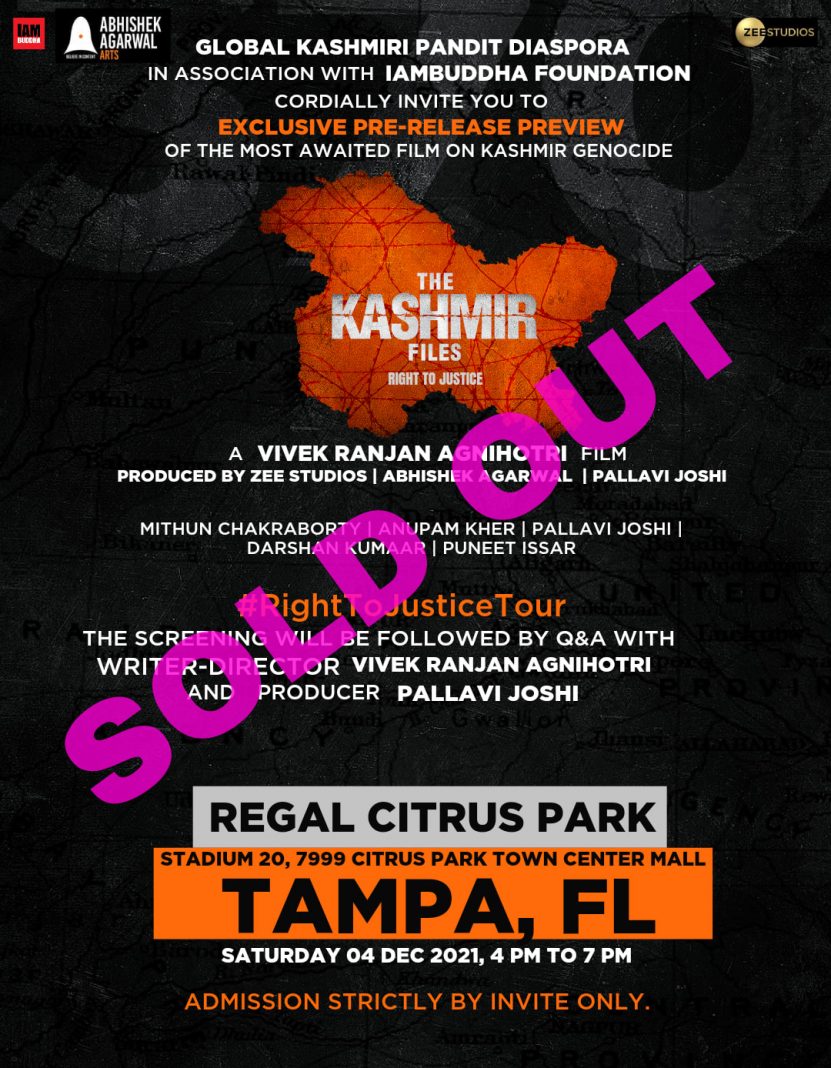
Film Director Vivek Agnihotri made a heartfelt speech on the occasion of the exclusive pre-release preview of his upcoming movie, ‘The Kashmir Files’ in the United States on Saturday (December 4).

During his speech, Vivek Agnihotri emphasised how the West conquered countries by destroying indigenous civilisations. “We worship somebody called Shiva and Shiva is a concept of oneness. This symbolism of Shiva has come from Kashmir…If you believe in God, then, you are a Hindu. If you do not believe in God, then, you are a Hindu,” he was heard as saying. While emphasising the inclusiveness of Hinduism, the director of ‘The Kashmir Files’ added how the basic tenet of humanity i.e. oneness comes from Kashmir. Where is this otherisation coming from?.

“Kashmir suffered because the natives were othered by the invaders. We are the only society in the world where we worship 3 Goddesses – Laxmi, Durga and Saraswati. Saraswati is the Goddess of wisdom, knowledge, poetry, art and literature. Her abode is Kashmir.” He lamented how once the abode of wisdom has now no trace of poetry or art. “Destruction of Kashmir is the destruction of knowledge. Humanity is being destroyed by China-funded and Pakistan funded terrorism.”

The full video of his speech can be accessed here. The event was organised by the ‘I am Buddha Foundation’ in partnership with the Global Kashmiri Pandit diaspora. The pre-release preview of ‘The Kashmiri Files’ was held in citrus park town centre mall in Tampa in Florida State of the United States.

The script of the movie has been written by writer-director Vivek Agnihotri and produced by Tej Narayan Agarwal, Abhishek Agarwal, & Pallavi Joshi. The film features Mithun Chakraborty, Anupam Kher, Pallavi Joshi, and Puneet Issar, along with Darshan Kumar, Chinmay Mandlekar, Bhasha Sumbli. Yuvraj’s Singh’s father Yograj Singh was the initial part of the cast but was replaced after his derogatory remarks against Hindus.

Actor Jacqueline Fernandez stopped at Mumbai Airport from leaving India after she was named in Rs 200 crore money laundering case

Bollywood actor Jacqueline Fernandez was stopped at Mumbai Airport from going abroad today. According to reports, she was leaving for Dubai for a program, but was stopped at the airport by authorities as the Enforcement Directorate had issued a lookout notice against her.

Some reports also claim that she has been detained and being taken to Delhi, but it is not confirmed. India Today claimed that she has not been detained, and was asked to return home.

Jacqueline Fernandez was scheduled to participate in Salman Khan’s Da-bangg tour to be held on December 10 in Riyadh. However, now it has emerged that she can’t leave the country, and hence won’t be able to join the show now.

The actor is named in a Rs 200 crore money laundering and extortion case, where she is accused of receiving several expensive gifts from the main accused Sukesh Chandrasekhar. Some pictures of Jacqueline Fernandez with conman Sukesh Chandrasekhar had viral on social media, which suggested that they were in a relationship as both were seen kissing each other.

The gifts given to the actor by Sukesh include diamond-studded jewellery sets, crockeries, four Persian cats worth 36 lakhs and a horse worth Rs 52 lakh. According to ED, they have found evidence of financial transaction between the two, and he had given gifts worth Rs 10 crore to her. Sukesh used to chat with Jacqueline over mobile from jail. When Sukesh had received bail in April-June this year, he booked a chartered flight for himself and also arranged for chartered flights for actress Jacqueline Fernandes to meet her in Chennai.

Jacqueline Fernandez has been named in the charge sheet filed by ED against Sukesh Chandrasekhar in the case, along with several other persons including his wife. Dancer-actor Nora Fatehi has also been named, who was reportedly gifted a BMW car.

Jacqueline Fernandez has been questioned by the ED several times in the case, after she had evaded multiple summons. She is expected to be interrogated again after she was stopped from leaving India.