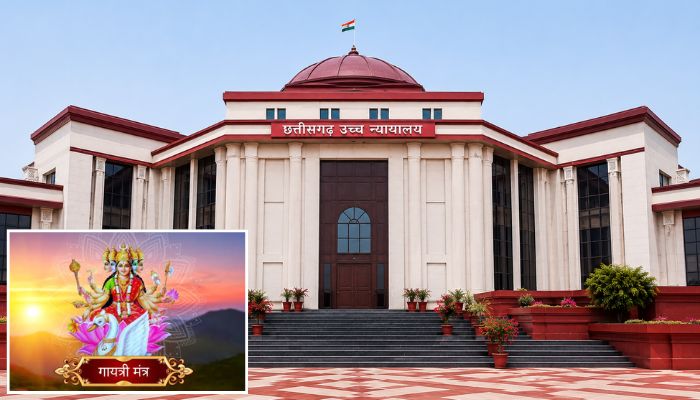
The Chhattisgarh High Court has given the green signal to the State Government’s order requiring government-run schools to include the recitation of the National Anthem, National Song, Deep Mantra, Saraswati Vandana, Guru Mantra, Shanti Mantra, and stories about the lives of great personalities at the start of the school day. The court has upheld the state government’s decision, saying that the order does not force students to act against their religious beliefs or conscience.
The court dismissed a petition challenging the government’s 12th June 2026 circular, calling it “premature” because there was no evidence that any student’s fundamental rights had actually been violated or that anyone had suffered direct harm because of the policy.
Delivering the order, Justice Amitendra Kishore Prasad observed that the circular, when read in its entirety, did not contain any compulsory or coercive direction requiring students to take part in activities that go against their faith.
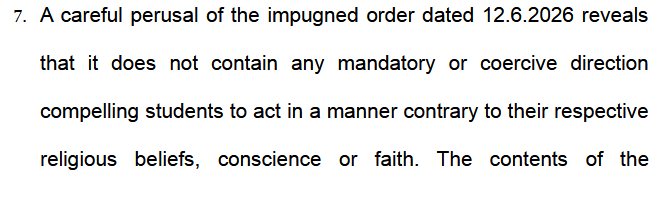
“A careful perusal of the impugned order dated 12.6.2026 reveals that it does not contain any mandatory or coercive direction compelling students to act in a manner contrary to their respective religious beliefs, conscience or faith,” the court said.
An excerpt from the Judgement
What does the government order say?
The dispute relates to a circular issued on 12th June this year by the School Education Department of the Chhattisgarh government for the academic session 2026-27. Under the order, students in government-run schools are expected to begin the school day with the National Anthem, National Song, Deep Mantra, Saraswati Vandana, Guru Mantra, Shanti Mantra and short accounts of the lives of great personalities or “Mahapurushas”.
On top of that, at the end of the school day, students are expected to recite the Rajya Geet, Gayatri Mantra and Shanti Mantra.
The state government has argued that the initiative is aimed at promoting discipline, cultural awareness, focus and values among students and should not be viewed as religious instruction.
Petitioners argued the circular violates constitutional rights
The petition was filed directly before the High Court under Article 226 of the Constitution seeking cancellation of the circular and a declaration that compulsory recitation of the prayers would be unconstitutional.
The petitioners included a former chairman of the State Waqf Board, a former minister handling minority affairs in the state and the district president of a religious action trust.
Represented by advocate Dr Aamir Khan, the petitioners argued that the inclusion of Saraswati Vandana, Gayatri Mantra, Guru Mantra and Shanti Mantra amounted to religious instruction in state-funded schools, something that is prohibited under the Constitution.
They argued that the circular violates Articles 14 (Right to Equality), 21 (Protection of Life and Personal Liberty), 25 (Freedom of Religion), 28(1) (which prohibits religious instruction in educational institutions wholly maintained out of State funds), 29 (protecting the cultural and educational interests of minorities and citizens) and 30 (empowering religious and linguistic minorities to establish and administer their own educational institutions) of the Constitution. They also alleged that it creates a situation where students from minority communities could feel pressured to participate in prayers and practices that do not belong to their faith.
According to the petitioners, India’s constitutional commitment to secularism means that no student can be directed to follow or practice the customs of a particular religion in a government educational institution.
Court says Article 28 does not prohibit moral instruction
One of the main questions before the court was whether the prayers and mantras mentioned in the circular amounted to “religious instruction” under Article 28(1) of the Constitution.
Article 28(1) states that no religious instruction can be provided in educational institutions that are fully funded by the State. However, the High Court said the phrase “religious instruction” has a limited and specific meaning.
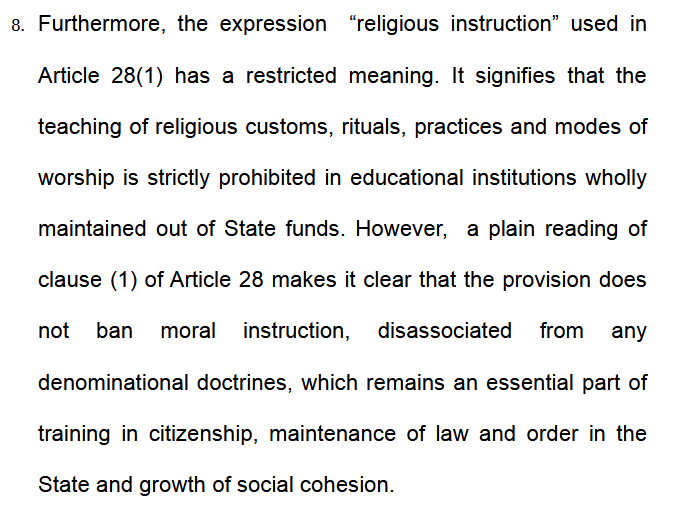
“However, a plain reading of clause (1) of Article 28 makes it clear that the provision does not ban moral instruction, disassociated from any denominational doctrines, which remains an essential part of training in citizenship, maintenance of law and order in the State and growth of social cohesion. In light of the foregoing, this Court believes that the petition is entirely premature, based on mere apprehension rather than any actual grievance. Thus, at this stage, the reliefs sought by the petitioners cannot be granted”, the court observed.
An excerpt from the judgement
The bench noted that teachings related to values, discipline and social responsibility cannot automatically be treated as religious instruction simply because they have roots in ancient Indian traditions.
State says the policy promotes culture and values, not religion
The Chhattisgarh government, represented by Deputy Advocate General Anand Dadariya, argued that the challenge was based entirely on assumptions rather than actual incidents.
The state maintained that the policy was in line with the objectives of the National Education Policy 2020 (NEP), which encourages the inclusion of Indian Knowledge Systems in education to strengthen cultural understanding and awareness.
Government lawyers argued that verses such as the Shanti Mantra and other traditional invocations promote universal well-being, gratitude towards nature and ecological balance rather than any particular religious doctrine.
The state also informed the court that students who choose not to participate in the recitations would not face punishment, disciplinary action or any negative consequences.
Officials further stated that the policy had already been implemented and no complaint of coercion or discrimination had been received from any student or parent.
Court leaves the door open for future challenges
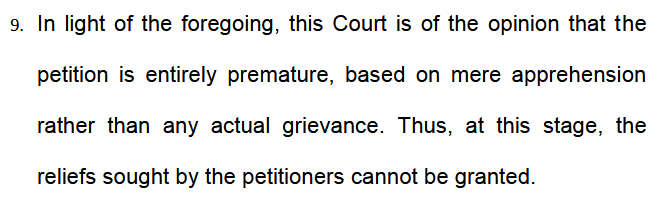
After considering the arguments from both sides, the High Court concluded that the challenge was based on apprehension rather than evidence of actual harm. The court said, “In light of the foregoing, this Court thinks that the petition is entirely premature, based on mere apprehension rather than any actual grievance. Thus, at this stage, the reliefs sought by the petitioners cannot be granted.”
An excerpt from the Judgement
At the same time, the court made it clear that the petitioners would be free to approach the judiciary again in the future if any instance of coercion or violation of rights emerges during implementation of the policy.
For now, the state’s school prayer policy will continue to remain in force across government schools in Chhattisgarh.
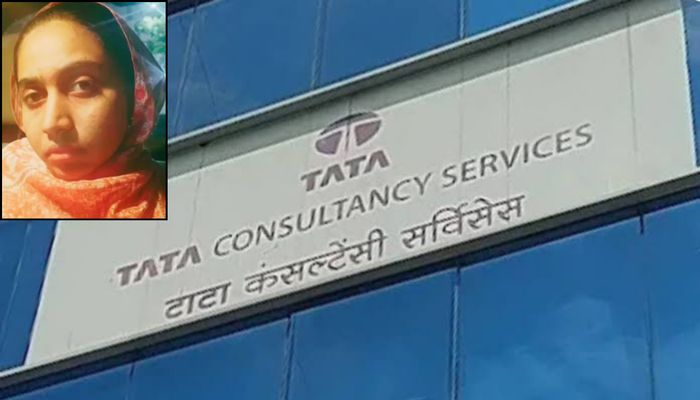
A Nashik court recently invoked Lord Krishna while granting bail to Tata Consultancy Services (TCS) Nashik BPO sexual harassment and religious coercion case accused Nida Khan, citing her pregnancy as the reason for releasing her. Additional Sessions Judge KG Joshi granted Nida Khan bail, observing that social stigma will be attached to her child if it is born in prison. Nida Khan, who is five months pregnant, was arrested earlier in May.
The Additional Sessions Judge went on to compare the situation to the birth of the Hindu God Krishna, who was also born in a prison. The court described the birth of a child while the mother is in prison as a “painful situation”. “The trauma of taking birth in prison, like Lord Krishna or the social stigma attached to it, is not something that anyone can bear. To avoid such a painful situation and to welcome the newborn baby and the overall welfare, it would be just and proper to exercise judicial discretion in favour of the applicant accused,” ASJ Joshi noted in the bail order dated 6th July, as reported by Bar and Bench.
The court further justified the bail, citing that the investigation in the case was complete and the chargesheet had been filed. Therefore, there was no reason to keep her in custody. “There is no pending seizure or discovery of any property. The prosecution has not sought her custody for further investigation. No purpose will be served by keeping the applicant in jail,” the court stated in the 10-page order.
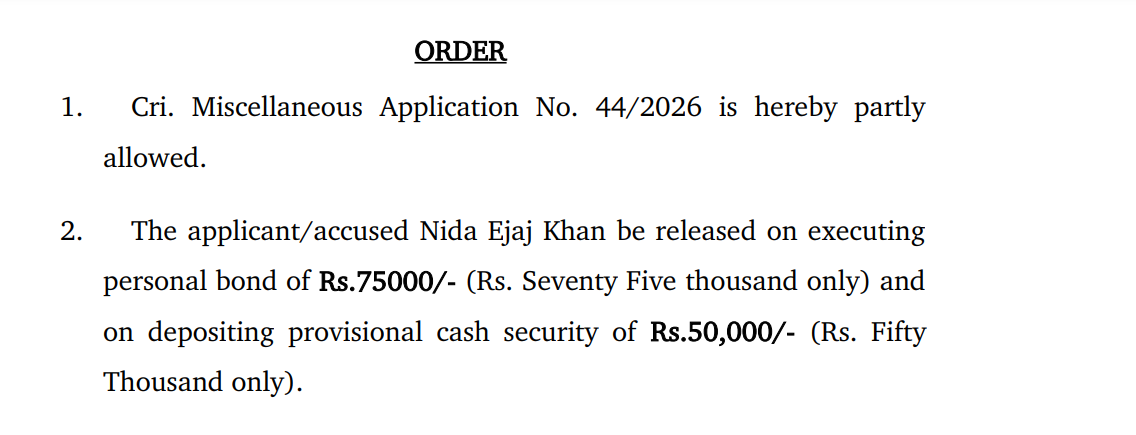
After securing bail, Nida Khan filed an application for the modification of the bail order, which required her to submit a surety of ₹75,000. Khan told the court that she was pregnant and poor and could not pay the said amount. She said that no one was available at her house to submit the security amount immediately and requested the court to reduce the amount of surety. The court partly allowed her application and allowed her to be released on executing a personal bond of ₹75,000 and depositing a provisional cash security of 50,000 immediately. The court granted her four weeks to furnish the original security amount of ₹75,000.
What is the case against Nida Khan?
Nida Khan was arrested on 7th May, almost one-and-a-half months after the FIRs were filed against seven accused for sexual harassment and religious persecution of Hindu female employees at a Tata Consultancy Services (TCS) Nashik BPO in Nashik, Maharashtra. Her anticipatory bail plea was earlier rejected by the court.
Khan’s co-accused, Tausif Attar, was also granted bail, while the bail plea of another co-accused, Danish Shaikh, was rejected. According to the complaint filed against Nida Khan, she provided a burqa, shared religious material, installed Islamic applications on the complainant’s phone, and visited her home to impart religious practices.
The case emerged in March 2026 when a Dalit woman employee of a TCS BPO unit in Nashik filed a complaint against Danish Sheikh, accusing him of rape on the pretext of marriage, sexual exploitation, harassment and forcing her to convert to Islam. More women came forward soon, levelling serious allegations of workplace sexual harassment, molestation, abuse and insult to their Hindu faith by certain employees of the same BPO. Nine FIRs were filed in the matter, and it was mentioned by the victims that their attempts to raise complaints with the BPO’s management were ignored by the HR and the concerned authorities.
The 2026 FIFA World Cup has produced its fair share of dramatic footballing moments, but one of the tournament’s biggest controversies has unfolded far away from the pitch. What began as anger over a post-match handshake has spiralled into a diplomatic row involving accusations of racism, sexism, legal threats, government interventions, and international condemnation.
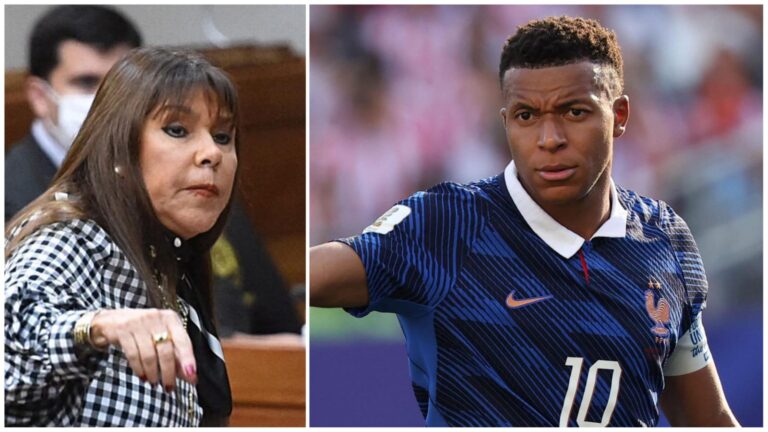
At the centre of the storm are Paraguayan Senator Celeste Amarilla and France captain Kylian Mbappé. The feud reached a fresh low when Amarilla called the French footballer a “son of a b**” during a speech on the Senate floor, days after Mbappé allegedly described her as a “despicable woman and unworthy of her office.”
What exactly triggered the unprecedented exchange? Why has the controversy attracted the attention of FIFA, the United Nations, the French government, and Paraguay’s own administration? Here’s everything that has happened so far.
The match that sparked the controversy
The dispute traces its origins to France’s tense 1-0 victory over Paraguay in the FIFA World Cup Round of 16.
The encounter was fiercely contested, with Mbappé eventually scoring the decisive goal from the penalty spot to send France into the quarter-finals. However, instead of discussions centring on the football, attention soon shifted to an alleged incident after the final whistle.
According to Amarilla, Mbappé refused to shake hands with Paraguay goalkeeper Orlando Gill, who had reportedly approached him after the match. The senator claimed the French forward shouted at the goalkeeper and dismissed his gesture.
Whether the interaction unfolded exactly as Amarilla described remains disputed, but she has repeatedly cited the alleged snub as the principal reason behind her criticism of the French striker.
Speaking in Paraguay’s Senate, Amarilla said:
“When Orlando Gill, a boy who was surely setting foot in a World Cup for the first time, in Europe for the first time, was playing before the world and extends his hand with all the humility of a Paraguayan, and this son of a b**** refuses to shake his hand and yells in his face, that is not French. A Frenchman would never have done that.”
The remarks represented yet another escalation in an already bitter public feud.
The controversy began with racial remarks
The senator’s latest insult came only after she had already attracted global condemnation for making racial comments against Mbappé.
In a series of social media posts following Paraguay’s defeat, Amarilla described the French captain as a “colonised Cameroonian” who had merely “pretended to be French.”
She further labelled him arrogant, embittered, ugly, nouveau riche, and cowardly.
She also mocked his education and repeatedly questioned his French identity despite Mbappé being born and raised in France.
The remarks immediately drew outrage across Europe and Latin America.
Critics pointed out that questioning a French citizen’s nationality because of his African heritage echoed a form of racial discrimination that many European footballers have faced throughout their careers.
Mbappé hits back
Unlike many footballers who choose to ignore political criticism, Mbappé publicly responded.
The France captain accused Amarilla of racism and said she had brought embarrassment to Paraguay rather than honour.
He reportedly wrote that the senator was “unworthy” of the office she occupies and stressed that she did not represent Paraguay or its people.
Mbappé also argued that Amarilla’s comments had overshadowed Paraguay’s impressive World Cup campaign.
He added that he would never allow racism and hatred to spread unchecked, regardless of who expressed it.
His response only intensified the confrontation.
Amarilla demands an apology, and threatens legal action
Instead of withdrawing from the dispute, Amarilla published an extraordinary open letter addressed directly to Mbappé.
While she admitted that some of her earlier comments had been made “in the heat of the moment” and acknowledged deleting several offensive posts, she demanded that Mbappé apologise to her.
She argued that calling her “despicable” and “unworthy” amounted to gender-based political violence.
The senator claimed she could initiate legal proceedings against the footballer under laws dealing with violence against women in politics.
She wrote:
“This is gender-based violence, plain and simple.”
She insisted that Mbappé retract his remarks or face possible legal consequences.
In another dramatic warning, Amarilla invoked the case of Brazilian football legend Ronaldinho, who was detained in Paraguay in 2020 over passport-related offences.
“Don’t mess with Paraguayans,” she warned.
The “son of a b****” remark
Far from calming the situation, Amarilla reignited the controversy this week by using even stronger language inside the Paraguayan Senate.
Referring once again to the alleged handshake incident involving Orlando Gill, she called Mbappé a “son of a b**.”
She also sought to distinguish the French footballer from France itself.
According to Amarilla, France represents the intellectual traditions of philosophers such as Jean-Jacques Rousseau, René Descartes and Montesquieu, writers like Victor Hugo, and thinkers including Simone de Beauvoir.
“I refuse to reduce all of that great France and that enormous cultural, artistic and democratic legacy to Mbappé,” she declared.
United Nations condemns Amarilla’s remarks
The controversy soon moved beyond football.
The United Nations Human Rights Office condemned Amarilla’s comments, describing them as racist and dehumanising.
UN human rights spokesperson Thameen Al-Kheetan stated that the senator’s remarks were “despicable” and highlighted the persistence of racism directed at footballers around the world.
The intervention by the UN significantly elevated what had initially appeared to be a sporting controversy.
Paraguay distances itself from its own senator
The Paraguayan government also moved quickly to clarify that Amarilla’s views did not represent the country’s official position.
The country’s Foreign Ministry issued a statement condemning her comments and reaffirming Paraguay’s commitment to human dignity, equality, human rights, opposition to racism, and opposition to xenophobia.
The ministry further expressed solidarity with those offended by Amarilla’s statements and reiterated Paraguay’s respect for France.
Such public distancing from a sitting senator is relatively rare and underscored the seriousness with which the government viewed the diplomatic fallout.
FIFA and France respond
The controversy also prompted reactions from football authorities.
Gianni Infantino said FIFA unequivocally condemned the racist abuse directed at Mbappé.
Meanwhile, the French Football Federation announced plans to pursue criminal legal action over Amarilla’s comments.
The federation described the senator’s remarks as unacceptable and contrary to football’s commitment against discrimination.
France’s public prosecutor also reportedly opened an investigation after receiving complaints relating to aggravated public insult and incitement to hatred.
President Macron backs Mbappé
French President Emmanuel Macron also entered the debate.
Posting on social media, Macron wrote:
“Another goal for Kylian Mbappé. Against racism this time.”
He added that France’s response would always be rooted in dignity, fraternity and respect.
The presidential intervention reflected how the controversy had evolved from a football dispute into an issue touching national identity and racial discrimination.
France coach says Mbappé remains focused
Despite the growing off-field drama, France manager Didier Deschamps insisted the controversy had not affected his captain.
Ahead of France’s World Cup quarter-final against Morocco, Deschamps told reporters:
“Kylian is in a good place mentally. He’s ready for tomorrow.”
France have attempted to keep the matter from becoming a distraction during their World Cup campaign.
Another controversy involving Paraguay
Interestingly, Amarilla was not the only Paraguayan public figure to attract criticism during the World Cup.
Former Paraguay goalkeeper José Luis Chilavert also sparked outrage before the France match by suggesting Paraguay would face “a squad from Africa” rather than France.
His comments were widely criticised as racially insensitive and further intensified scrutiny of anti-Black rhetoric surrounding the tournament.
Beyond football: Where criticism crosses the line
Sport naturally evokes passion. Players can be criticised for poor performances, controversial conduct or perceived arrogance. If Mbappé indeed refused a post-match handshake, fans and commentators are entitled to debate whether that reflected poor sportsmanship.
However, there is a fundamental distinction between criticising behaviour and attacking someone’s race, ancestry or identity.
Amarilla’s initial comments did not merely question Mbappé’s conduct. By referring to him as a “colonised Cameroonian” who was only “pretending to be French”, she challenged his legitimacy as a French citizen because of his ethnic background. That is precisely why her remarks drew condemnation from the United Nations, FIFA, the French government and even Paraguay’s own administration.
Her subsequent attempt to partially retract the racial insults while simultaneously escalating the personal feud, culminating in calling Mbappé a “son of a b****” in Parliament, has done little to repair the damage.
Likewise, if Mbappé indeed described the senator as “despicable” and “unworthy of office”, those remarks reflect the heated nature of the exchange. But equating criticism from a footballer with gender-based political violence while continuing to use abusive language herself has struck many observers as contradictory.
A controversy that overshadows football
Paraguay’s remarkable World Cup campaign should have been remembered for exceeding expectations and reaching the knockout stages. France’s victory should have been discussed in terms of Mbappé’s match-winning performance and Les Bleus’ march towards another World Cup title.
Instead, the tournament has become engulfed in a row that has drawn in politicians, football administrators, international organisations and heads of state.
With criminal complaints reportedly under consideration, diplomatic statements issued by governments, and global condemnation of racist rhetoric, what began as a dispute over a handshake has transformed into one of the most extraordinary off-field controversies of the 2026 FIFA World Cup.
Whether the exchange ends with apologies, legal proceedings or continued public confrontation, it has already demonstrated how quickly sporting rivalries can spill into politics, and how remarks made in the heat of the moment can overshadow achievements on the football pitch.
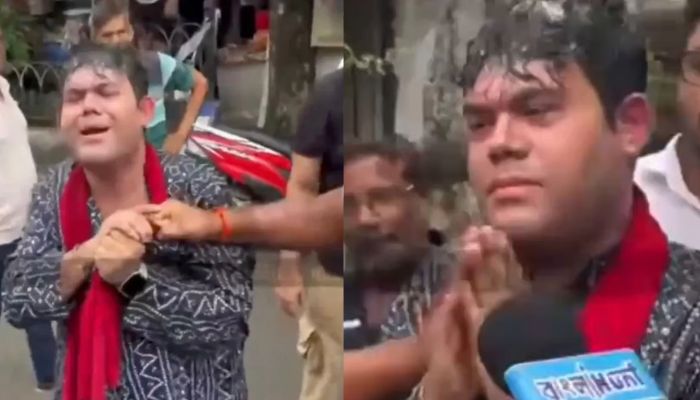
It has been two months since the BJP ended the 15-year tyrannical rule of the Trinamool Congress; however, the public anger against TMC leaders has not yet subsided. After Abhishek Banerjee and Kalyan Banerjee, TMC leader Nilanjan Das has reportedly met the blunt end of the ire of Bengali people. On 8th July, TMC IT Cell head and spokesperson Nilanjan Das was assaulted by locals in Kolkata’s Bhowanipore area.
Several videos have surfaced online, showing Nilanjan Das being confronted by a group of people, who also thrashed and dragged him. Meanwhile, the TMC IT Cell head is seen crying and begging at times.
In the video, angry locals could be heard calling Nilanjan Das “chor chor”.
Nilanjan Das is one of the bonded slaves of TMC. A vile cockroach who used to threaten anyone opposed to TMC’s fascism. Today, locals seem to have expressed their.. let’s say.. displeasure with him
I share this video to privately chuckle and publicly condemn such public reaction pic.twitter.com/Mze7KVku2V
Nilanjan Das getting manhandled in Kolkata’s Bhawanipore is politically significant. Bhawanipore is considered TMC supremo Mamata Banerjee’s stronghold.
Das was dragged by angry locals while he was interacting with a journalist. However, a police official intervened and escorted the TMC leader away.
From threatening FIRs against critics for a sport to facing public fury: Who is TMC leader Nilanjan Das?
Nilanjan Das is a prominent TMC leader and the party’s spokesperson making regular appearances on TV news debate programs. Das serves as State General Secretary and head’s TMC’s IT and Social Media Wing.
The TMC leader has an opprobrious record of threatening FIRs against anyone who criticized his party or Mamata Banerjee.
Nilanjan Das is a close aide of TMC motormouth MP Mahua Moitra.
In December 2025, the TMC State General Secretary, IT & Social Media Wing, Nilanjan Das filed a complaint against Shashank Singh, the man behind the popular X handle “Befitting Facts” over his posts criticising the TMC government over the gross mismanagement during the visit of global football icon Lionel Messi in Kolkata. The X user had also published critical posts against Mahua Moitra.
Singh was arrested after Das had filed a cyber complaint on 11th December, accusing Befitting Facts and another X user, Subham, of circulating “fake, fabricated and defamatory posts” accusing TMC MP Mahua Moitra of smoking e-cigarettes inside the parliament.
Sharing the complaint on his X handle, Nilanjan Das wrote, “Filed a complaint against BJP IT cell morons @subhsays @BefittingFacts for posting baseless, defamatory tweets against MP @MahuaMoitra.”
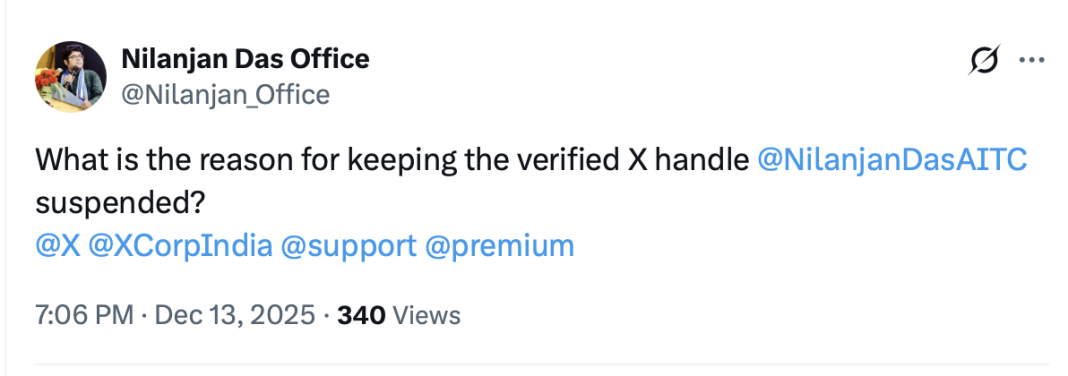
Nilanjan Das’s verified X handle was suspended by X at that time.
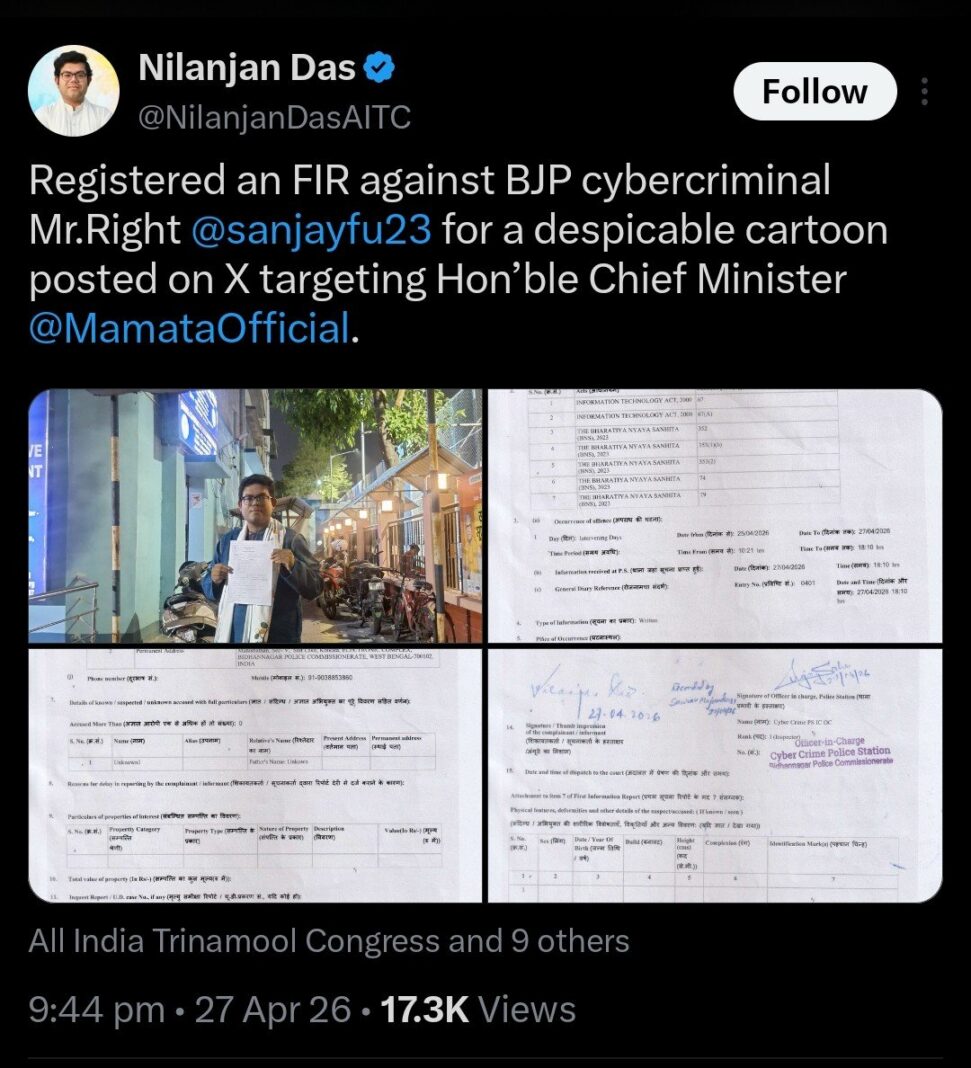
In April this year, Nilanjan Das got an FIR registered against an X user for posting a cartoon of then West Bengal Chief Minister Mamata Banerjee.
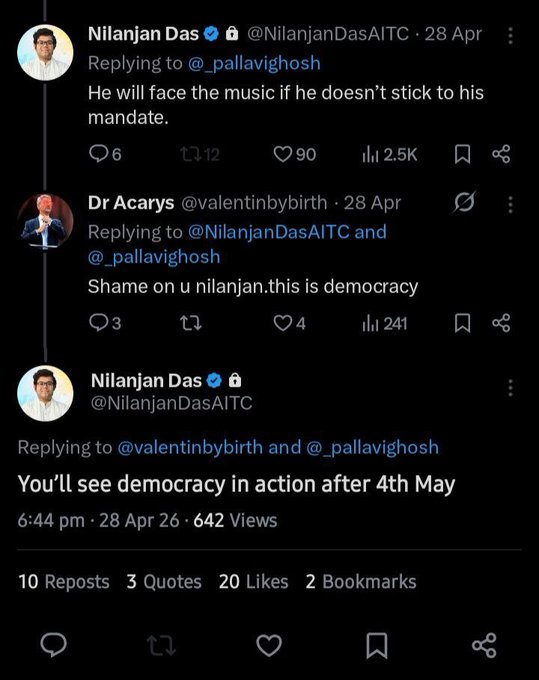
An X user criticised Das’s hounding tactics, saying that India is a democracy, and that the TMC leader should be ashamed.
In response, Nilanjan Das issued a veiled threat and wrote, “You’ll see democracy in action after 4th May.”
Das was apparently talking about TMC’s post-poll violent political retribution against the BJP and its supporters. However, the Bengali people handed a grand victory to the BJP and a humiliating defeat to the TMC.
Over recent years, Nilanjan Das has targeted numerous critics of the TMC regime through online intimidation and FIRs.
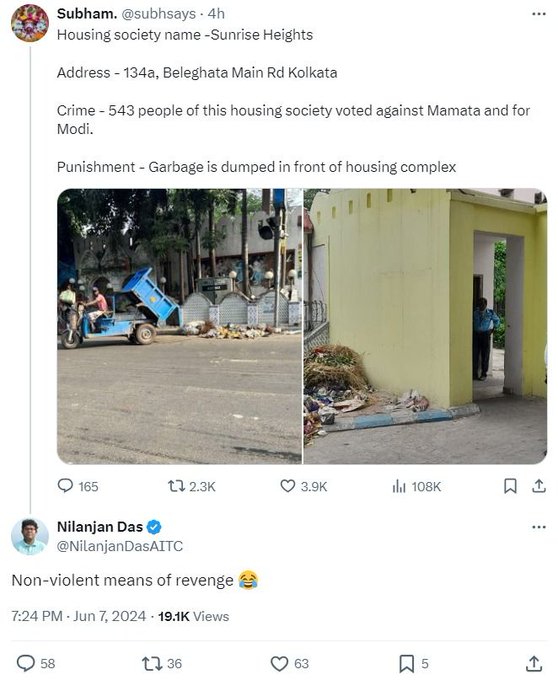
Back in June 2024, the people of a housing society in Kolkata were being punished by the TMC government for voting in favour of the BJP.
Garbage was being dumped outside ‘Sunrise Heights’ in the Beleghata neighbourhood of Central Kolkata as 543 residents of the housing complex voted against TMC.
Demonstrating peak shamelessness, Nilanjan Das ubbed the action of dumping garbage outside the housing society as a ‘non-violent means of revenge.’
The Trinamool Congress is home to several Hinduphobe politicians be it Sayoni Gosh or Mamata Banerjee herself who boasts of fighting Hindu Kafirs. Nilanjan Das is also among the TMC’s top Hinduphobes.
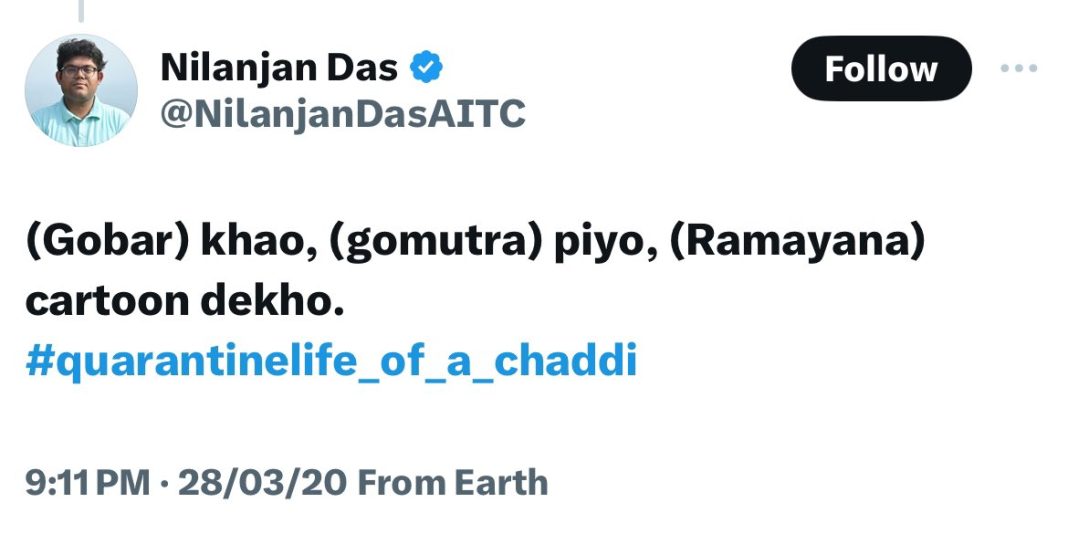
Back in 2020 when the nation was observing a lockdown in the wake of Covid pandemic, Nilanjan Das published an X post derisively referring to Ramayana, the Hindu epic, as a cartoon. He also hurled the ‘gomutra’ jibe.
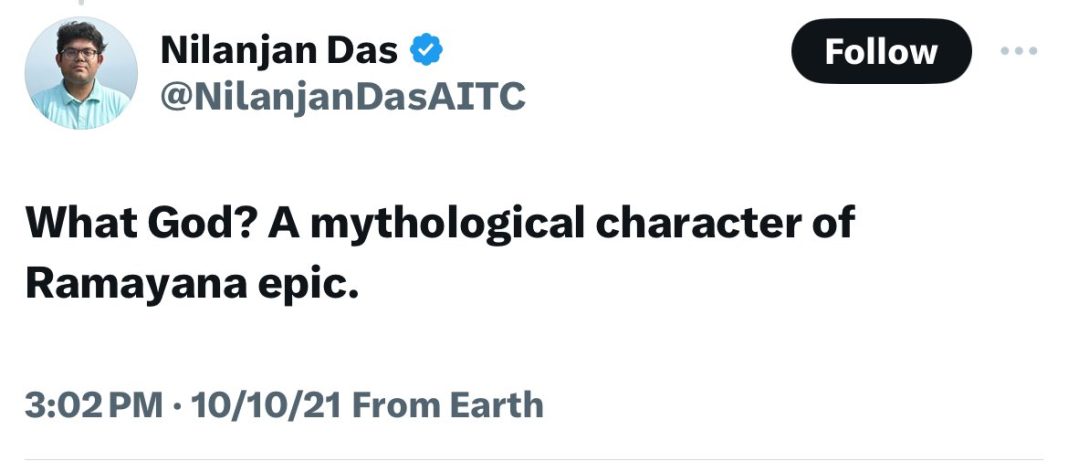
In another post, Nilanjan Das echoed what Congress said in 2007 when it questioned the existence of Lord Ram. “What God? A mythological character in Ramayana epic,” Das wrote.
In addition to online Hinduphobia, and issuing FIR threats against critical voices, Nilanjan Das also has track record of insulting ideological adversaries.
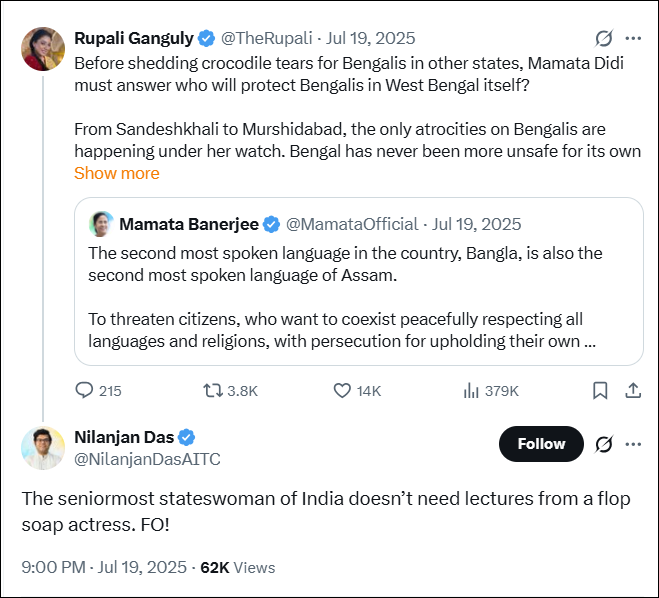
In July 2025, when popular actor and BJP leader Rupali Ganguly criticised then CM Mamata Banerjee’s governance, Nilanjan Das came to Banerjee’s defence. Das, however, did not counter Ganguly’s remarks, rather he dismissed her as a “flop soap actress”.
“The seniormost stateswoman of India doesn’t need lectures from a flop soap actress. FO!,” Das wrote on 19th July 2025.
Demonstrating his goon-like behaviour, Das called senior government advisor Kanchan Gupta an “old hag” during a live TV debate on post-poll violence in Bengal.
After May 4 election results in West Bengal, reports emerged at least two FIRs were filed against Nilanjan Das, one in Serampore in Bengal, and the other in Assam. Das had temporarily deactivated his X account back then.
Unsurprisingly, many people on social media are calling the assault against Nilanjan Das in Kolkata as “Karma”, for he is finally facing the same threats and intimidation he subjected his party’s critics to for years.
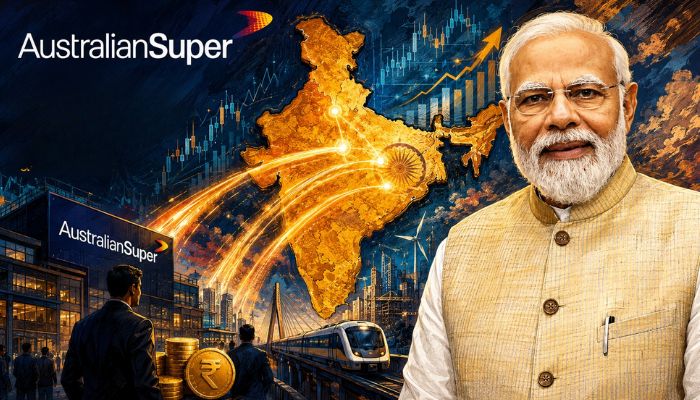
On 9th July, Prime Minister Narendra Modi shared on social media platform X that AustralianSuper had invested AU$500 million into the National Investment and Infrastructure Fund (NIIF). He added that the announcement was made by AustralianSuper Chief Executive Paul Schroder in Melbourne. PM Modi described the investment as another sign of global confidence in India’s growth story. PM Modi is currently in Australia as part of his 5-day trip to Indonesia, Australia and New Zealand.
India welcomes the AU$500 million investment from AustralianSuper, announced by their Chief Executive, Mr. Paul Schroder this morning in Melbourne. This is yet another glimpse of the global confidence in India’s growth and reform trajectory. It also reflects the immense…
In his post, PM Modi said, “India welcomes the AU$500 million investment from AustralianSuper, announced by their Chief Executive, Mr Paul Schroder this morning in Melbourne. This is yet another glimpse of the global confidence in India’s growth and reform trajectory. It also reflects the immense opportunities that our dynamic economy offers global investors.”
According to the press release issued by AustralianSuper, it will deepen its commitment to India’s NIIF with the fresh AU$500 million investment. With this, the fund’s overall holdings in India across all asset classes will rise to AU$3.3 billion.
Why Australian retirement money is looking beyond Australia
AustralianSuper is Australia’s largest superannuation fund. It manages more than AU$410 billion in retirement savings for over 3.6 million members. It is not a government provident fund like India’s EPFO. It is a profit-for-member fund which invests workers’ retirement savings across asset classes to generate long-term returns.
The retirement system in Australia works differently from India’s EPFO-style structure. In Australia, employers are required to pay superannuation contributions into an eligible employee’s super fund. Most employees can choose their own fund. If they do not choose one, it is the responsibility of the employer to check if the employee already has a “stapled” super fund. If that is not the case, the employer pays into a default fund. This makes the system competitive rather than centralised.
The scale of the retirement system is massive. Australian Prudential Regulation Authority (APRA) data showed total Australian superannuation assets at AU$4.4 trillion as of March 2026. Out of this, AU$3.1 trillion was in APRA-regulated funds. Employer contributions alone stood at AU$159 billion in FY 2025-26. It means Australian super funds constantly need large and stable investment opportunities to keep members’ retirement money growing.
This is why domestic investments have limitations. Australia has shares, bonds, property and infrastructure opportunities. However, its superannuation pool has grown faster than the domestic economy and capital market. According to AustralianSuper, the country’s superannuation industry is equivalent to 159% of Australia’s GDP and 129% of the total ASX market capitalisation. In simple terms, the retirement savings pool has become bigger than what Australia’s own market can comfortably absorb.
That is why Australian super funds are increasingly investing overseas. According to Deutsche Bank, by the end of 2024, 48% of Australian super fund assets were held internationally. It said funds were moving offshore for greater liquidity, more diverse investment opportunities and because their growth was outstripping the domestic economy. It also noted that super funds already own just under a quarter of the ASX.
For large funds like AustralianSuper, India offers exactly the kind of long-term growth market they need. Infrastructure, equities and private markets in India give them avenues that are difficult to find at the same scale in Australia alone. AustralianSuper’s fresh AU$500 million commitment to NIIF comes after its earlier AU$240 million investment in 2019 became one of its best-performing infrastructure assets. The fund’s total India exposure will now rise to AU$3.3 billion.
In other words, this is not a routine foreign investment announcement. One of Australia’s biggest pools of retirement money is looking at India as a serious long-term wealth creation destination. For ordinary Australians, their retirement savings are being placed in Indian infrastructure because the fund sees better returns, policy stability and growth opportunities here.
What AustralianSuper has to say about the investment
The latest investment is an addition to AustralianSuper’s original AU$240 million commitment to NIIF in 2019. According to the company’s statement, that investment became one of its best-performing infrastructure assets for the members of AustralianSuper.
The company added that the strong performance of the previous investment was one of the reasons behind the fresh commitment. AustralianSuper Chief Investment Officer Shaun Manuell said that the fund’s investment in NIIF has been one of its most successful partnerships.
He said, “AustralianSuper’s investment in the NIIF has been one of our most successful partnerships and that’s why we’re excited to invest again to help drive returns for members.”
Manuell added that the experience with NIIF showed what could be achieved when long-term capital was combined with visionary policy, trusted institutions and strong partnerships.
Policy consistency helped India attract the fund
The investment by AustralianSuper shows that policy consistency in India played a key role in its decision to invest further. Manuell said India remained an attractive investment destination because of its strong economic growth and expanding middle class.
He added that the Indian government had made it easier for institutions to deploy capital successfully. The company said it was making a second investment in NIIF because India’s fundamental strengths were still intact and it saw the potential for more returns for its members.
“India is an attractive place to invest due to its strong economic growth and expanding middle class, and the Indian government has made it easier for institutions to deploy capital successfully,” Manuell said.
What is NIIF
The National Investment and Infrastructure Fund was established in 2015 to attract investors from across the world and deploy capital into infrastructure development in India. Its headquarters are located in Mumbai, India.
The governing council of NIIF comprises Minister of Finance and Corporate Affairs Nirmala Sitharaman, Secretary of Department of Economic Affairs Anuradha Thakur, Secretary of Department of Financial Services M Nagaraju, Chairman of State Bank of India Challa Sreenivasulu Setty, Chairman of DSP Group Hemendra Kothari and Founder and Director of Kotak Mahindra Bank Limited Uday Kotak.
According to NIIF’s website, its Investment Committee (IC) is the key pillar of the governance structure. It is responsible for all investment and divestment decisions and reviews investment performance regularly. The managing director and CEO and the CIO are the team members of the IC.
In 2017, NIIF Sustainable Infrastructure Fund, also known as Master Fund-1, achieved its first close with a commitment of USD 300+ million. The final close of the fund came in December 2020 at USD 2.34 billion. This particular fund is the largest domestic infrastructure fund and invests in high-quality businesses and assets across core sectors including ports, airports, renewable energy and digital infrastructure. The investments have been made in five states including Rajasthan, Gujarat, Karnataka, Andhra Pradesh and Tamil Nadu.
In February 2021, NIIF Private Markets Fund’s final close came with total capital commitments of USD 600 million. In 2023, NIIF launched around USD 600 million bilateral India-Japan Fund. The Government of India and Japan Bank for International Cooperation were the anchor investors. Today, NIIF has USD 4.9 billion in AUM across its funds.
Global pension and sovereign funds looking at India
The Modi government has increasingly tried to attract large global retirement, pension and sovereign wealth funds to India in recent years. Apart from AustralianSuper, funds from Canada, Quebec, Norway and the Netherlands have also increased their exposure to India in different sectors.
The latest AustralianSuper investment adds to that trend. It shows that India is no longer being seen only as a consumption market. For major global funds, India is also becoming a serious destination for long-term infrastructure and retirement-linked capital.
The shocking assault on doctors and nurses inside a municipal hospital in Maharashtra’s Dombivli is not merely an isolated act of violence by an elected representative. It is symptomatic of a much deeper malaise that has taken root in Indian politics, a growing culture where many politicians, intoxicated by power and insulated by political patronage, increasingly see themselves not as public servants but as feudal overlords who can intimidate, threaten, and assault anyone who dares not bend to their will.
The incident unfolded at Shastri Nagar Hospital, operated by the Kalyan-Dombivli Municipal Corporation (KDMC), where doctors Srishti Baviskar and Vaibhav Salunkhe were attending to a critically ill newborn. With the Neonatal Intensive Care Unit (NICU) already full, the doctors advised the baby’s family to shift the infant to another hospital capable of providing specialised care.
It was not a case of negligence or refusal to treat the patient; it was a medical decision compelled by a lack of infrastructure, a reality government doctors confront every day across India’s overstretched public healthcare system.
Instead of accepting the doctors’ professional assessment or demanding accountability from those responsible for the shortage of critical care beds, the family called Shiv Sena (Eknath Shinde faction) corporator Ramesh Mhatre.
What followed was nothing short of disgraceful.
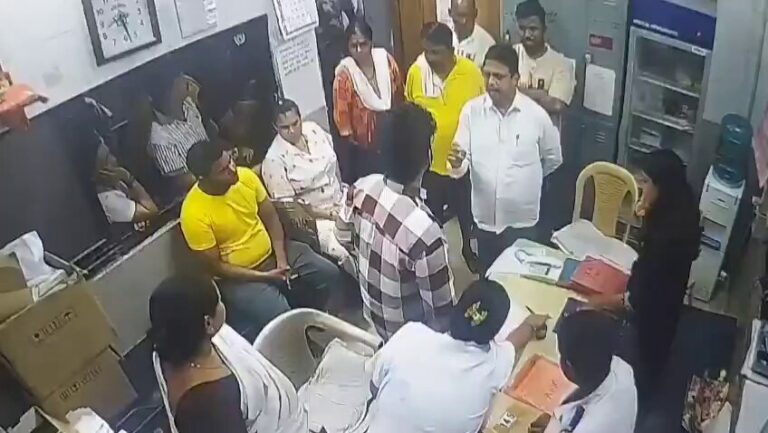
CCTV footage that has since gone viral shows the corporator approaching woman doctor Srishti Baviskar from behind while she is holding a mobile phone. Without warning, he forcefully strikes her hand, sending the phone crashing to the floor. Moments later, he and his supporters begin assaulting other hospital staff, including doctor Vaibhav Salunkhe, who sustained injuries in the attack. Images emerging after the incident showed visibly shaken doctors and hospital employees who had simply been performing their duties.
A major controversy has erupted at Shastrinagar Hospital, operated by the Kalyan-Dombivli Municipal Corporation (KDMC), after Shiv Sena corporator Ramesh Mhatre allegedly assaulted doctors and hospital staff.
If the visuals themselves were disturbing, the corporator’s subsequent defence was arguably even more alarming.
Far from expressing regret, Mhatre claimed he had done nothing wrong. He insisted he had merely struck the doctor’s phone because she “was not listening” and described her as “arrogant.” He even suggested that if doctors apologised first, he might express regret. His justification rested on the assertion that his actions had somehow “saved the lives of the mother and child.”
Shinde Sena thug Corporator Ramesh Mhatre joins me to face my questions on @NDTV. Remorseless goon, fearless in the certainty that nothing will happen to him. pic.twitter.com/AIC4uC2xRA
Such statements reveal a dangerous mindset, one in which political authority is considered superior to professional expertise. The issue was no longer about a newborn requiring specialised care; it became about an elected representative believing that a doctor owed him immediate obedience simply because of his political status.
This is precisely what makes the episode far more significant than an ordinary criminal assault.
Across India, one increasingly witnesses elected representatives barging into police stations, storming government offices, threatening bureaucrats, humiliating teachers, browbeating engineers, intimidating revenue officials, and now, assaulting doctors inside hospitals. The common thread running through these incidents is not political ideology but a deeply entrenched belief that electoral victory confers personal supremacy over institutions.
The irony is impossible to ignore.
Politicians are repeatedly described as “public servants.” The Constitution envisions them as representatives entrusted with safeguarding institutions and ensuring governance functions effectively. Yet many behave in precisely the opposite manner. Instead of serving the public, they demand to be served. Instead of strengthening institutions, they weaken them through intimidation. Instead of respecting professionals, they expect unquestioning submission.
The transformation from public representative to political strongman has become increasingly visible.
Many politicians today operate less like constitutional functionaries and more like local warlords. They command entourages, expect deference wherever they go, and perceive even the slightest disagreement as an affront to their authority. Their power is not exercised through law but through spectacle, public displays of dominance designed to reinforce the message that their influence overrides rules applicable to ordinary citizens.
Hospitals have unfortunately become frequent theatres for such displays.
Doctors, particularly those serving in government hospitals, work under extraordinary pressure. They contend daily with overcrowded emergency wards, inadequate staffing, shortages of medicines, malfunctioning equipment, and insufficient ICU or NICU beds. None of these systemic failures is of their making. Yet when patients’ relatives become frustrated, the easiest targets are the doctors standing in front of them. When politicians join that anger instead of calming the situation, the consequences become even more dangerous.
In this case, the doctors reportedly advised referral because there simply was no NICU bed available. That reflects a failure of public healthcare infrastructure, not of the doctors themselves.
Ironically, if there is anyone against whom an elected representative should have directed his anger, it should have been those responsible for ensuring adequate medical infrastructure. After all, politicians control municipal budgets, influence healthcare spending, and frequently inaugurate hospitals while promising improved healthcare facilities. If NICUs remain overcrowded and understaffed, that is fundamentally a governance issue.
Assaulting doctors for the consequences of administrative shortcomings amounts to punishing the messenger while ignoring the cause.
Perhaps the most troubling aspect of the episode is not merely the violence itself but the absence of accountability in the perpetrator’s own mind. Rather than acknowledging wrongdoing, Mhatre repeatedly attempted to justify his conduct by portraying himself as acting in the larger public interest.
This reflects a broader phenomenon in Indian politics where power often breeds impunity.
Many elected representatives appear convinced that public office entitles them to exercise authority beyond legal limits. Their supporters frequently reinforce this belief, treating acts of intimidation as demonstrations of decisive leadership rather than abuse of power. Such normalisation corrodes democratic values. When violence becomes an acceptable instrument of political authority, institutions gradually cease functioning independently and instead begin operating under fear.
The consequences extend far beyond doctors.
If a doctor can be assaulted inside a hospital for communicating an inconvenient medical reality, what message does it send to every government employee performing a difficult duty? Police officers, nurses, teachers, municipal workers, revenue officials and civil servants all become vulnerable to similar intimidation whenever their decisions inconvenience politically influential individuals.
Eventually, professionals stop exercising independent judgment. Decisions become guided not by law, ethics or expertise, but by fear of political retaliation.
That is fatal for any democracy.
To its credit, the Maharashtra Police registered a criminal case and arrested the accused corporator. Shiv Sena MP Shrikant Shinde also publicly condemned the assault, stating that no one taking the law into their own hands would be spared and promising disciplinary action within the party. Such responses are necessary, but they cannot remain symbolic.
The tendency to resort to physical aggression is by no means confined to one party or one state. During a recent protest march in Kolkata, former West Bengal Chief Minister and TMC chief Mamata Banerjee was seen slapping a Trinamool Congress worker and pushing others while attempting to disperse a crowd outside her residence after clashes between Trinamool Congress and BJP workers.
Regardless of the circumstances leading up to the incident, the visuals reinforced an unfortunate pattern in Indian politics: the normalisation of physical aggression by those occupying public office. When political leaders themselves use force to assert control or discipline supporters, they inadvertently legitimise the idea that authority is exercised through intimidation rather than restraint, weakening the democratic ethos they are sworn to uphold.
The law must establish beyond doubt that political office is not a licence to intimidate.
Assaults on healthcare workers should invite swift criminal prosecution, irrespective of the accused’s political affiliation. Political parties, too, must recognise that merely distancing themselves after public outrage is insufficient. Individuals accused of such conduct should face immediate organisational consequences, including suspension or expulsion where warranted.
Most importantly, society itself must reject the growing tendency to romanticise displays of political muscle.
A politician who slaps a doctor, threatens a bureaucrat or assaults a police officer is not displaying strength; he is displaying contempt for the very institutions that sustain democratic governance. Leadership is measured by restraint, accountability and respect for the rule of law, not by how effectively one can intimidate those performing public duties.
The Dombivli assault should therefore be remembered not simply as an attack on one doctor but as a warning about the direction in which sections of Indian politics appear to be heading. When elected representatives begin behaving like warlords rather than constitutional office-bearers, democracy itself is diminished. Public servants become subjects, institutions become battlegrounds for political ego, and violence replaces dialogue as the preferred instrument of authority.
The Constitution did not create elected representatives to rule over citizens. It empowered them to serve. Every assault committed under the illusion of political superiority is a betrayal of that constitutional promise.
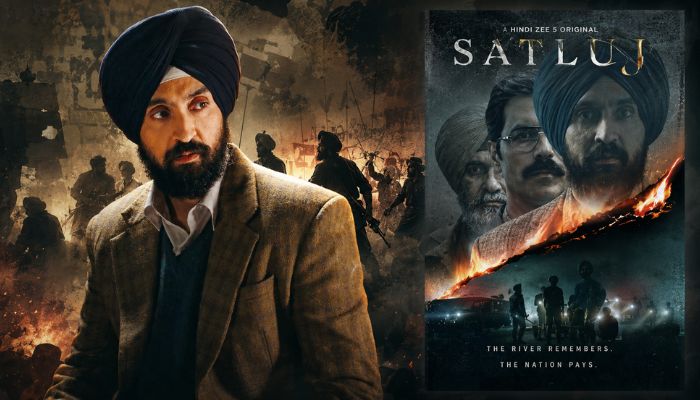
For years, Diljit Dosanjh has been sold as a harmless global Punjabi star. A singer, an actor and a soft-spoken celebrity who is loved by millions, if not by all. A man who sings about Punjab and speaks of love, farmers and identity. However, the newly released film ‘Satluj’ has brought out what years of image management had kept under the drapes. The mask is off.
Satluj, a propaganda movie
Satluj is not just a film that talks about the insurgency period in Punjab. It has a deeper aim. The movie was stuck for years because its politics was suspect. First, the movie was named Ghallughara (holocaust). The name did not go down well with the Central Board of Film Certification (CBFC), along with some scenes. The name was then changed to ‘Punjab 95’ and finally got released three years after it was made.
The movie was quietly released on the Zee5 OTT platform as ‘Satluj’ on 3rd July. On 6th July, the movie was removed from the platform without citing the exact reason. Notably, the film has vanished only for the Indian audience, not for the international audience, and Zee5’s international portal still runs it. The Ministry of Information and Broadcasting has now set up a three-member committee to examine the issue.
The problem is not that the film talks about police excesses in Punjab. Any honest society must be able to discuss such issues. The problem with ‘Satluj’ is the way it has presented Punjab’s insurgency years. Khalistani terrorists and Sikh extremists have been softened in the film while the Indian state has been turned into the only villain.
When the assassination of then-CM Beant Singh was shown in the film, it was portrayed as “revenge”. Those who do not understand the history of the Punjab insurgency will get the whole context wrong. In a way, the viewer was nudged to justify terror.
Furthermore, Jaswant Singh Khalra’s decision to take the matter to international platforms painted the Indian authorities of that time in a very bad light. KPS Gill, the man who literally ended militancy in Punjab, was shown as IPS Bitta, a bad cop.
Killings of Hindus did not find space in the film, not even as a simple reference. The reason behind strict police action was never explained. There was no hint of how Khalistani terrorists were killing Hindus, Sikhs who opposed militancy, police personnel and officials without any mercy.
OpIndia had flagged the pattern years ago
Diljit’s political ideology thus becomes relevant. OpIndia has said for years that his public image and his political messaging do not match. In 2020, during the farmers’ protests, it was evident that the movement was hijacked by Khalistani elements. Diljit emerged as one of the loudest celebrity voices in their favour. He openly attacked those who questioned the protest ecosystem. The actor-singer was celebrated by the usual left-liberal crowd as a brave “Punjabi icon”.
In June 2020, then-Ludhiana MP from Congress, Ravneet Singh Bittu, who is also the grandson of Beant Singh, had demanded FIRs to be registered against Diljit Dosanjh and others for supporting Gurpatwant Singh Pannun of the Khalistani terrorist outfit Sikhs for Justice (SFJ). Bittu had pointed to SFJ’s anti-India stand during the India-China faceoff and its attempt to lure Sikh soldiers. OpIndia had reported how Diljit had come under fire over his support for the pro-Khalistan separatist outfit.
From Operation Bluestar to Jagtar Singh Johal
Diljit has a long history of being surrounded by controversies. He had also faced criticism after the lyrics of the song “Rangrut”, sung by him for the film ‘Punjab 1984’, openly asked to pick guns and take revenge (for 1984). The lyrics say “Sodha zaalma nu launa AK-47iya ne”, which translates to “AK-47s will settle scores with the oppressors”. Congress MP Ravneet Bittu had then accused him of disturbing peace after 36 years of Operation Bluestar.
Then came his support for Khalistani terrorist Jagtar Singh Johal, who has been named in NIA charge sheets in murder cases involving Hindu and RSS leaders. Johal has been named as an accused in the murder of Brigadier Jagdish Kumar Gagneja, Ravinder Gosain, Amit Sharma and others. Diljit spoke about claims of torture and a free trial for Johal. While a free and fair trial is the legal right of everyone, the selective urgency was visible in Diljit’s support. When Hindu leaders were killed in Punjab, where was this celebrity conscience?
The refusal to clearly condemn Khalistan
The pattern became clearer during his online spat with actor-turned-MP Kangana Ranaut. During the farmers’ protests, Kangana repeatedly asked him to simply say that he did not support Khalistan and that he condemned Khalistani elements. Diljit dodged the demand and troll armies attacked Kangana on social media. Diljit never clearly condemned Khalistanis.
Old controversies now look like a pattern
These instances show that there is indeed a pattern. Support for the protest ecosystem when Khalistani elements were visible, refusal to clearly condemn Khalistan when directly asked, sympathy for those accused in targeted killings of Hindu leaders, and now, Satluj.
The reaction to Satluj has exposed the ecosystem even more. After the film was removed from Zee5, jailed pro-Khalistani MP Amritpal Singh’s party Akali Dal (Waris Punjab De) reportedly began organising public screenings across Punjab. Downloaded copies were shown in villages through projectors and large screens. Party leader Rashpal Singh Sosan promoted the screenings and even shared an old video of Amritpal Singh praising Jaswant Singh Khalra.
This is not a minor detail. If a film is being embraced and circulated by jailed pro-Khalistani MP Amritpal Singh’s party, it shows that the movie has political utility. His party is not screening Satluj as cinema. It is using the film as political material. It is using Diljit’s face and Khalra’s story to revive a narrative around Punjab, victimhood and separatist sentiment.
This is how terror is repackaged as resistance
Satluj is not merely a film. It is the latest chapter in a long-running attempt to repackage the Khalistani insurgency as moral resistance. It is an old trick which first erases the victims of terrorism, then humanises the extremist, then demonises the state alone and finally calls anyone questioning the propaganda “anti-Sikh”.
It has to be noted that questioning Khalistani propaganda is not anti-Sikh but pro-India. It is also pro-Punjab. The state has suffered because of Khalistani terrorism. Hindus, Sikhs who opposed extremism and police personnel were killed. Families were destroyed. The state made mistakes and excesses happened, but that cannot become an excuse to glorify separatists and terrorists.
The superstar image remains, but the politics is exposed
Diljit Dosanjh had years to clear the air. He had years to say, without clever wording, that Khalistan is unacceptable and that terrorism in Punjab cannot be romanticised. Instead, every new controversy has pushed the needle in the same direction.
With Satluj, the mask is off. The superstar image remains. The global concerts remain. The polished PR remains. But behind it stands the same politics and ideology that OpIndia had warned about for years.
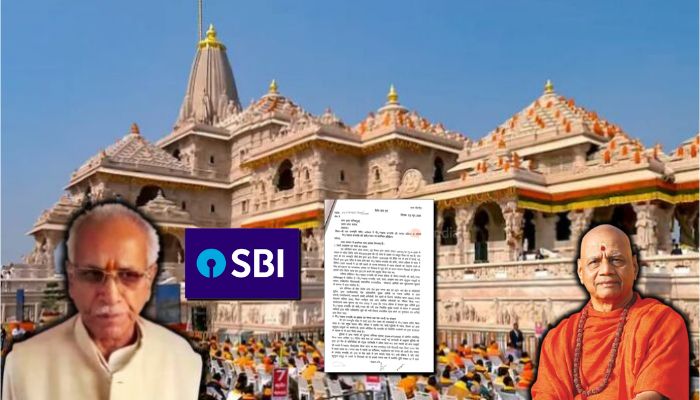
It took five centuries of struggle, sacrifices, and legal battles for Hindus to reclaim the Shri Ram Janmabhoomi in Ayodhya. However, that hard-earned civilisational triumph is now being tarnished by the petty greed and negligence of a few with insider access. The preliminary report by the SIT into the embezzlement of funds and valuables from daily chadhava, or donations, at the Ram Mandir reveals that the ‘Chanda Chori’ was a preventable theft had the temple authorities been less egoistic and more accountable.
Ram Mandir chanda chori
Consecrated in January 2024, the Ayodhya Ram Mandir attracts lakhs of devotees every year. Numerous of these devotees donate cash, gold, silver, and ornaments through hundi boxes installed inside the temple. The Shri Ram Janmabhoomi Teerth Kshetra Trust handles collection, counting, accounting, and utilisation for the temple’s management and related activities.
For daily cash handling, the Ram Mandi temple trust deploys its staff along with those hired via private agencies. These employees are tasked with counting notes, preparing bundles, and maintaining records. There are handling processes for ornaments, etc. According to the Temple Trust, regular internal audits are conducted to maintain transparency.
The allegations of ‘chadhava chori’ or the ‘chadhava scam’ at the Ayodhya Ram Mandir were first highlighted by local media. The matter gained political traction on 7th June 2026 after Samajwadi Party supremo and former Uttar Pradesh Chief Minister Akhilesh Yadav cited media reports of crores in unaccounted donations and called for judicial intervention. Alarming claims emerged about alleged discrepancies in donation collections, sudden wealth accumulation by several low-paid counting staff, and possible missing funds.
Allegations emerged that crores of rupees from daily cash offerings or chadhava were siphoned by temple management insiders. While initially it was claimed that the alleged unaccounted donations ranged from Rs 5 to 7.5 crores, media reports later claimed that the missing funds exceed the Rs 200 crore estimates.
CCTV footage covering periods of several months, from cash-counting areas, was alleged to be deleted, further raising suspicion of a cover-up.
Named in the media as the whistleblower of the alleged Ram Mandir donation theft, Mahipal Singh, who claims to be the Shri Ram Temple’s former accounts-in-charge, alleged that the theft of temple donations has been ongoing for quite some time and Shri Ram Janmabhoomi Teerth Kshetra Trust General Secretary Champat Rai was aware of it.
What the preliminary report of the SIT revealed
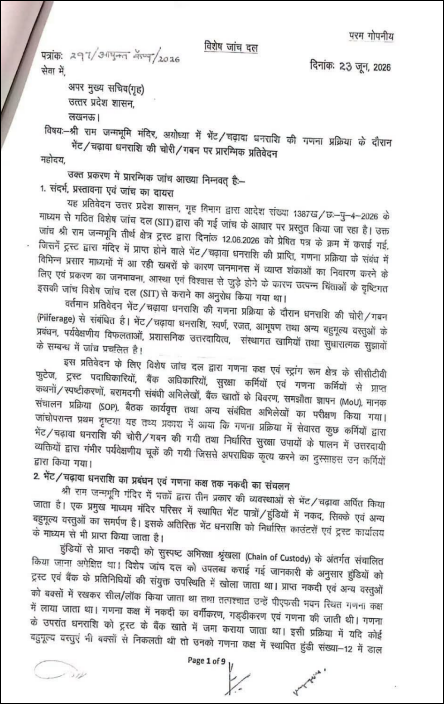
Amidst the allegations and denials, the Special Investigation Team (SIT) formed by the Uttar Pradesh government on the request of the Shri Ram Janmabhoomi Teerth Kshetra Trust submitted its preliminary report. The SIT report indicated systemic failures rather than a massive organised heist.
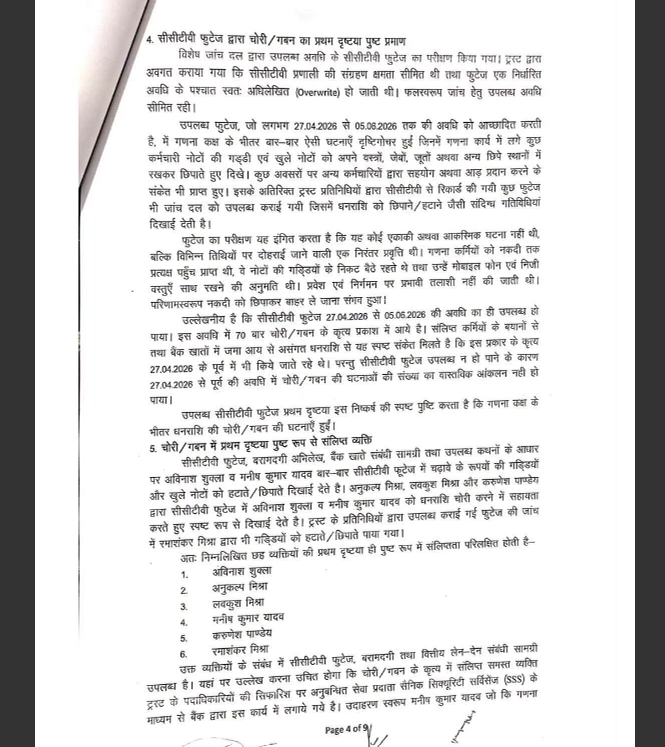
The report states that approximately 70 suspicious incidents of alleged pilferage were captured on CCTV between around 27th April and 5th June 2026.
Some of the counting staff members were also seen repeatedly concealing wads of cash in pockets, socks, underclothing, and even in the attached bathroom.
The SIT report hinted at serious lapses in security protocol. It found absence of proper frisking at entry and exit of the counting area, substandard control over personal belongings, combined counting of cash from multiple donation boxes (Daan Patra, Hundi), exploitation of CCTV blind spots, and inadequate monitoring.
“Hundi No. 12 was jointly opened at regular intervals, and the collected valuables were weighed and recorded along with the type and weight of the item. The investigation found serious deficiencies in the initial stages of this process. While a system for hundi-wise documentation and hundi-wise counting was in place, in practice, the contents of various hundis were mixed before counting. There was no system for numbering and tracking the boxes used for cash transportation to ensure how many boxes came from which hundi on which day, how many were counted, and how much remained,” the SIT report reads.
“This situation, in the context of the increasingly large amounts of public offerings received, presented a serious weakness in auditing and accountability. The investigation revealed significant systemic deficiencies not only in the cash counting process but also in the management of valuables. Devotees typically offer valuables through three primary channels: i) by depositing them in bills (hundis) and (ii) by depositing them at designated counters (iii) and by offering them near the sanctum sanctorum. Clear receipt, documentation, weighing, photography, custody, and transfer procedures were required for each channel,” the SIT report adds.
The CCTV video footage showed that some of the key employees counting the money were secretly hiding the bundles of notes and loose notes inside their clothes, pockets and shoes, while some other employees were helping them in this work by providing cover.
The statements of the arrested employees and the transactions in their bank accounts also clearly show that this theft was being carried out continuously much before 27th April.
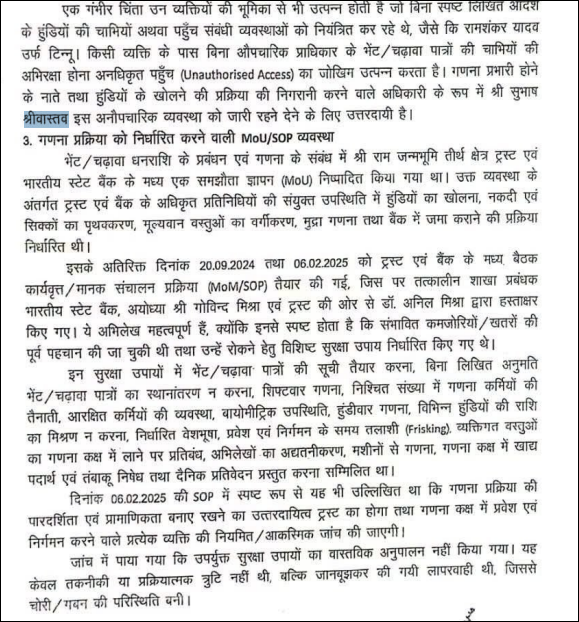
The SIT report emphasised that the continuous embezzlement of donated cash was not a mere oversight, but rather the result of deliberate and gross negligence of security regulations. A Memorandum of Understanding (MoU) and Standard Operating Procedure (SOP) were established between the Trust and the State Bank of India for the management of donations.
Under this, it was mandatory for the counting staff to wear special clothes without pockets, mark biometric attendance, keep mobile phones and personal belongings outside the room, count the donation boxes separately and be searched by security personnel while entering or leaving the room.
These rules, however, were not followed. What even worsened the situation was a new SOP issued on 6th February 2026; the strict daily frisking rule was relaxed and only a provision for “routine or random” frisking was added. This SOP was signed by then SBI branch manager Govind Mishra and trustee Dr Anil Mishra. This new SOP essentially diluted the security protocol agreed upon by the SBI and the Trust in September 2024, in the counting room, facilitating the embezzlement of donations.
“The issue of frisking not being carried out was also brought to Anil Mishra’s attention through internal channels. Despite this, no effective written instruction was issued to implement the search arrangement,” the SIT report states.
The report also mentions that the theft of donations took place under the watch of Subhash Srivastava, the in-charge of the counting room.
Apart from this, these deficiencies were also repeatedly brought to light in the internal audit reports from the year 2022 to 2026 and it was clearly advised to keep CCTV backup for 180 days, but the officials of the Trust completely ignored these warnings.
The SIT probe has found six employees directly involved in this theft, which includes Avinash Shukla, Anukalp Mishra, Lavkush Mishra, Manish Kumar Yadav, Karunesh Pandey and Ramshankar Mishra.
These individuals were appointed by the SBI through a private agency; however, their appointments were made on the recommendations of some temple Trust officials.
Accused Manish Kumar Yadav was appointed on the recommendation of his uncle Ramshankar Yadav alias Tinnu, who himself held the main keys of the temple donation boxes without any official order or authority. Tinnu is reported to be an aide of Champat Rai.
The SIT report said that Tinnu had keys of the donation boxes “without any clear written order.”
“Any person having custody of the keys to the offering boxes without formal authority creates a risk of unauthorised access,” the report said.
Despite the prescription of pocket-less uniform for counting staff to prevent concealment and theft of cash, the rule was not followed. Neither the temple Trust nor the SBI took note of or acted on this.
While the in-hand salary of these employees was around Rs 15,000, it emerged during police investigation that huge amounts of cash and huge fixed deposits (FD) were found in their bank accounts, in addition to those of their relatives.
The investigation also revealed that even before the formation of the SIT, the Trust had recovered cash, foreign currency and jewellery worth about Rs 78 lakh 94 thousand from them, while on 4th June, Rs 2.25 lakh was also found abandoned in the bathroom near the counting room.
According to the SIT, Avinash Shukla, Lavkush Mishra, Anukalp Mishra, Manish Yadav, Tinnu Yadav, Kalpesh Pandey, and Ramashankar Mishra appeared prima facie to be involved in the theft of offerings. Cases were filed against them under various sections, including theft. Trustee Krishna Mohan filed the case based on the report.
Petty theft at a grand scale: Illicit advantage of insider access, negligence of Trust authorities, and the eventual dodging of accountability
While the exact quantum of ‘chanda chori’ at Ram Mandir is not explicitly mentioned in the SIT report, media reports have estimated that it has risen from initial Rs 7.5 crore to Rs 200 crore. However, the preliminary findings of the SIT indicate that the donation theft was not a sophisticated heist involving vanishing of crores of rupees overnight or temple vaults being emptied in an organised manner. Rather, it was petty and opportunistic pilferage wherein staff pocketed small-to-moderate wads of cash during their daily counting duty in the room where the chadhava used to be kept.
Over days, and weeks, this small theft added up, enabled by astonishingly lax systems and security protocols despite handling donations from millions of devotees of Lord Ram from across the country and the world.
The theft was petty; the negligence and, to a great extent, complicity were grand. Recommendation-based appointments, relaxing of frisking rules, little to no implementation of the pocket-less uniforms rule, and deliberate neglect of the irregularities enabled the theft for months before the lid blew off in June this year.
The Shri Ram Janmabhoomi Trust has gone from initially denying any ‘chanda chori’ to seeking an SIT probe and stern action against the culprits.
The State Bank of India has also claimed that it flagged temple donation counting irregularities three months ago, and that the counting staff be removed from duty. Media reports claim that the Ram Mandir Trust ignored the SBI’s intervention and even shielded the accused counting officials.
In that case, a question arises here is that after SBI learnt that temple Trust officials were allegedly shielding chanda chor employees despite its warnings, why did the bank not call the trust out publicly or seek intervention from the state government?
It is apparent that the bank has activated its own defence mechanisms.
Meanwhile, Champat Rai, the former General Secretary of the Shri Ram Janmabhoomi Teerth Kshetra Trust, who resigned on moral grounds after the controversy blew up, has blamed the SBI.
In a statement, Rai wrote, “As per the MoU, all security measures were taken, like CCTV cameras were installed in the counting room and a door with iron bars was installed on it. The bank advised that counting should be done by sitting on chairs and keeping the money on a table, which helped in the theft.”
“All the banks in the country must have some rules for the chest room. The rules of the State Bank of India must be strict. Special searches while entering and exiting the counting room, clothes without pockets… In the temple’s case, the bank did not follow this, despite it being written in the guidelines. The clothes provided by the bank had pockets,” Rai added.
Alleging laxity on the part of the SBI, Rai said, “Senior officials of the bank need to explain how laxity was allowed in following the rules of the chest room.”
Rai even alleged that senior officials ignored security protocols. He even claimed that those selected by the SBI for counting work were kept as housekeeping staff.
“Perhaps the higher officials of the bank didn’t have any knowledge of this guideline letter; otherwise, the mistake would have been caught at some level. The letter with guidelines was written in a hurry, and the bank did not follow it. The workers selected by the bank for counting were kept as housekeeping staff. Is this appropriate?” Rai asked, and even claimed that he was not a signatory of this letter.
Champat Rai has largely avoided direct media interactions post-resignation, although he is denying personal wrongdoing through statements. Rai has even claimed that he was “betrayed” by people he trusted. However, he too comfortably sat on the supposed ‘betrayal’ until a whistleblower exposed the donation theft.
Similarly, Govind Dev Giri, the Ram Temple Trust treasurer, also claimed that he and Champat Rai are ‘untainted’ and have been ‘betrayed by wrong people’. However, when a media reporter recently questioned him about his personal accountability in the temple donation theft as the Trust’s treasurer, he first got irritated and then grabbed the mic and shot back immediately in a highly arrogant and aggressive tone, “Why should I resign?
राम मंदिर चढ़ावा चोरी मामले में ABP ने गोविंद देव गिरी से सवाल किया तो वो पहले झुंझलाए फिर माइक पकड़ लिया.
इसके बाद इस्तीफे के सवाल पर तपाक से बोले: मैं इस्तीफा क्यों दूंगा?
— Rajput's Of INDIA (@rajput_of_india) July 7, 2026
One wonders if Champat Rai can resign on ‘moral grounds’ despite claiming to have no involvement in Chanda Chori; what infuriates Govind Giri on the question whether he would resign too, as the theft happened while he was the Trust’s treasurer?
Apparently, the sky-high egos of those entrusted with the faith of a billion people are not very comfortable when asked for accountability.
While SBI and Ram Temple Trust are playing a blame game, political parties are engaged in their own manoeuvres to blame each other. BJP declares Samajwadi Party and Congress as ‘chameleons’ for silence over land sales for Waqf but crying hoarse over Ram Mandir donation theft. Samajwadi Party calls the BJP ‘betrayer of Hindu faith’. The Vishwa Hindu Parishad has also distanced itself from the matter.
Accused counting staff members, built palatial houses, expensed personal luxuries, and bought properties worth crores by embezzling the money donated to the Ram Mandir by lakhs of devotees, and those entrusted with the faith of a billion people do not want to be held accountable?
When Ram Mandir Trust officials entrusted with managing the offerings of millions fail at the most basic levels of accountability and operate with an air of unassailable prestige, the very trust that made the temple possible erodes. Early warnings were ignored; key Trust figures operated in an environment of immense prestige and minimal external scrutiny.
Now, when the common people, the devotees of Bhagwan Ram, are reminding the stakeholders in the issue that mere association with a sacred cause is not a sufficient guarantee of integrity, and questioning the alleged complacency at the top and vulnerability at operational levels, Trust officials are displeased and infuriated.
Adding to the already mounting public distrust is the media sensationalisation and amplification of unverified claims of gold and silver valuables donated by devotees going ‘missing’. It was claimed that a gold-plated Ramcharitmanas worth Rs 5 crore has gone missing; however, the temple Trust provided video evidence and documents confirming that it is in their possession. Similar claims were made about a diamond-studded necklace, silver bricks, etc; however, many such claims turned out to be baseless.
The counting-room insiders pilfered notes and bundles for months while the CCTV sat unmonitored and warnings brushed aside. Rs 7 crore or 70 crore or Rs 200 crore, theft happening inside Ram Mandir is more than a crime. Crores of Ram Bhakts offered their savings at the feet of their Aradhya, and trusted temple authorities that their offerings would be safe and utilised for temple operations and not satiate greed of a few.
The 500-year journey of resistance and reclamation deserves better custodianship. Blame games, self-preservation, dodging accountability, egos, and politics can serve immediate self-interests; however, the holy abode of Shri Ram will be left vulnerable for more such thefts and violations of the trust of countless Ram Bhakts if these problems of basic accountability and integrity are not fixed.
Cristiano Ronaldo has been my guy ever since I was old enough to pick a side in football. For years, I’ve said openly that referees have tended to be more lenient with Messi than they ever were with him. That’s why it means something when I tell you straight, Argentina’s 3-2 comeback against Egypt in the Round of 16 was earned on the pitch, not handed to them. The loudest claims that the tournament is being steered toward Messi don’t actually tell us much about Tuesday’s match. They tell us something older about football itself. The sport has never once managed to exist in a vacuum, untouched by everything else happening around it.
The Comeback
Egypt controlled the game for most of the first hour and kept Argentina pinned back. Yasser Ibrahim gave them the lead with a header in the 15th minute, and their goalkeeper Shobeir then saved a penalty from Messi. Egypt continued to threaten, and Zico thought he had made it 2-0 shortly after, only for VAR to rule the goal out after spotting a foul on Lisandro Martínez during the buildup. He eventually found the net in the 67th minute to put Egypt two goals ahead. With just eleven minutes remaining, Argentina looked like they were heading out. But then everything changed. Romero headed in from a Messi cross in the 79th minute, Messi equalised four minutes later, and Enzo Fernández nodded in the winner from close range deep into stoppage time. In the space of thirteen minutes, Argentina scored three times and turned the game completely around. It was one of those nights you don’t forget in a hurry.
The Officiating, on Its Own Terms
Egypt coach Hossam Hassan didn’t hold back after the final whistle. ‘We have been treated unfairly today. We have suffered injustice,’ he said. He felt Julián Álvarez should have been penalised for catching Mohamed Salah inside the box, claimed Alexis Mac Allister had pulled back Hamdi Fathy in a similar area, and believed there was also an unpunished foul in the buildup to Messi’s equaliser. Hassan went as far as suggesting the tournament was being nudged to keep Messi and Argentina in it.
He wasn’t entirely wrong that some of those moments deserved closer inspection. However, the decision to disallow Zico’s goal wasn’t some random call. VAR checked the entire attacking phase leading up to it, which is the standard protocol used across this tournament. That rule applies to everyone, not just Egypt. A disallowed goal and a couple of penalty shouts waved away in a frantic final period don’t point to a pattern of bias. It’s the kind of thing that happens in high-intensity, end-to-end knockout matches where fouls and messy challenges come thick and fast. These marginal decisions go against eventual winners just as often as they do against teams that go out.
Football Has Never Been Left Alone
What’s worth paying attention to is that this match carried its own layer of politics, and it didn’t need to be manufactured. After Egypt’s win over Australia in the previous round, Hassan came out wearing a Palestinian flag. During Tuesday’s game, some fans in the Atlanta stands responded by waving an Israeli flag in the direction of the Egyptian bench. This happened in front of a packed stadium, completely separate from anything the referee did on the pitch.
This kind of thing isn’t unusual in football. Every Russian club and national team has been banned from FIFA and UEFA competitions since the two bodies released a joint statement in February 2022, and UEFA recently confirmed that suspension will remain in place for the 2026-27 season as well. It’s not symbolic; it’s the game’s two biggest governing bodies openly saying that football cannot continue as normal while a war is going on. The sport has never been the isolated, neutral bubble it sometimes claims to be. It gets sanctioned, boycotted, and, as we saw on Tuesday, directly pulled into real-world conflicts whether the referee’s whistle is involved or not.
What was noticeable in the reaction afterwards was how fast the refereeing debate moved beyond normal football discussion for many people.
A large part of the loudest claims that the tournament was being steered toward Messi didn’t stay within regular post-match analysis. Much of that noise came from commentators and influencers who have long looked at Messi through the lens of his visits to Israel, including the 2013 Barcelona peace tour where he visited the ‘Western Wall’, and his decision not to speak out on the Palestinian issue.
For them, every marginal decision that went against Egypt was quickly turned into proof of a bigger pattern of favouritism, rather than being seen as part of one intense, high-stakes knockout game. The on-field controversy became another place where older communal and political tensions could surface again.
A Ronaldo Fan’s Final Word
Hassan’s frustration is understandable, but it comes mostly from the fact that Egypt were eliminated rather than from any clear or repeated injustice. Egypt weren’t the better side over the full match, Argentina had the majority of possession and created the decisive chances once they got going. What Egypt did manage was to frustrate Argentina for long periods and force them to chase the game. Yet in those final thirteen minutes, Argentina produced something that stood out: a comeback driven by sheer refusal to accept defeat. Scoring three goals from two down, against a team that had been on top for most of the night, took real belief and aggression. That kind of turnaround is what turns a match into something people remember for a long time.
Ronaldo is still the one I support. But credit where it’s due, that was one of the great World Cup nights, won fairly on the pitch, in a sport where politics has always found a way to sit right next to it.
The Canadian Police on Wednesday (8th July) debunked the allegations levelled by former Canadian Prime Minister Justin Trudeau linking the Indian government with the killing of Khalistani terrorist Hardeep Singh Nijjar. Speaking to CBC News, the Royal Canadian Mounted Police (RCMP) Deputy Commissioner, Lisa Moreland, said that there is no evidence linking the Indian government with the killing of Nijjar.
“There is no evidence to suggest that through this organised crime syndicate investigation and the charges laid forward that Indian government officials would be charged or involved in this….nothing has come out to link the Indian government,” Deputy Commissioner Moreland told the Canadian TV channel.
No Indian Govt official link found in Nijjar killing, Canadan Authorities
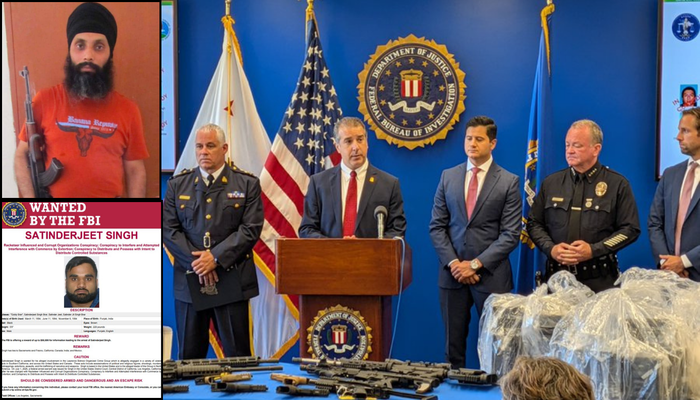
Moreland’s statement comes after the US Department of Justice (DOJ) unsealed three indictments on Tuesday, in which Lawrence Bishnoi was identified as responsible for Nijjar’s killing. According to an unsealed federal indictment, Lawrence Bishnoi, head of the Bishnoi criminal gang, ordered the killing of Nijjar outside a Sikh temple in Surrey, British Columbia, three years ago, on June 18, 2023. The DOJ has also charged Lawrence’s aides Satinderjeet Singh alias Goldy Brar, Rohit Godara, and Sukhraj Singh Kang.
The #FBI is offering a reward of up to $50,000 for information leading to the arrest of Satinderjeet Singh, #wanted for his alleged involvement in the Lawrence Bishnoi Organized Crime Group which is allegedly engaged in a variety of violent acts in Southern California, and across… pic.twitter.com/BdCxmELUKv
“…Bishnoi presided over a sweeping criminal enterprise that spanned multiple continents. Using contraband cellphones and other voice-over internet protocol devices smuggled into his jail cell, Bishnoi personally directed political assassinations, murders, shootings, extortions, kidnappings, drug trafficking, human smuggling, and other crimes committed by members and associates of the Bishnoi enterprise worldwide,” stated the press release by the DOJ.
“To help manage the enterprise’s day-to-day operations, Bishnoi delegated control to trusted lieutenants and regional leaders of the enterprise. These lieutenants and regional leaders included Satinderjeet Singh, 32, a.k.a. “Goldy Brar”, of Punjab, India, the North American leader of the Bishnoi enterprise, Rohit Godara, 37, of Rajasthan, India, the European leader of the Bishnoi enterprise, and Sukhraj Singh Kang, 58, of Punjab, India,” the press release added.
Operation Hard Ball against organised crime
Law enforcement authorities in the United States, Canada and Europe have launched a major crackdown on organised criminal gangs operating in their respective regions. The law enforcement authorities have arrested 24 defendants, 11 of whom are in California, allegedly connected to three India-based transnational organised crime groups. The arrestees have been charged with a litany of criminal acts, including the killing of Nijjar.
“Transnational criminal gangs who spread fear, drugs, and violence will face the full force of justice and the weight of the federal government,” First Assistant United States Attorney Bill Essayli said.
As part of Operation "Hard Ball," the FBI and our law enforcement partners throughout California, other U.S. cities and in Canada, India and Europe collaborated to execute dozens of search and arrest warrants targeting 37 members of violent transnational organizations who are… pic.twitter.com/WXIOk6vALU
The US Department of Justice (DOJ) said that a federal investigation, under the label of ‘Operation Hard Ball’, has been going on into Indian crime syndicates that engage in racketeering, targeted killings, shootings, extortion, the trafficking of bulk quantities of narcotics across international borders, and other crimes whose impact is especially felt in the Indian diaspora.
“In total, 37 defendants, including two defendants who ran their global criminal syndicates while imprisoned in India, are charged across three indictments unsealed today. Those arrested in the United States- 11 in California, one in Indiana, and one in Georgia, are expected to make their initial appearances today in federal court,” the press release said.
Law enforcement partners in the United States, Canada, and Europe have arrested 24 defendants – 11 of them in California – connected to three India-based transnational organized crime groups charged with a litany of criminal acts, including the assassination in Canada in 2023 of… pic.twitter.com/a8akzEuxt5
According to the press release, the law enforcement agencies are looking for 10 fugitives, out of whom seven are in the US, two are in India, and one is in Europe. During the investigation, the agencies seized around 1,000 kilograms of cocaine and 1 kilogram of heroin along with $40,000 in cash and a dozen firearms. “A total of 23 search warrants have been executed in the Sacramento area, and 11 warrants have been executed in the Los Angeles area,” the DOJ said.
India-Canada ties strained after Trudeau’s baseless allegations
Nijjar was shot dead in Surrey in June 2023, after which Trudeau claimed, without evidence, that the Indian government had a role in his killing. Trudeau’s unfounded claims had strained the diplomatic relations between India and Canada. The Indian government had dismissed the allegations as “absurd” and “motivated”.
In the wake of Trudeau’s allegations, India had recalled its High Commissioner to Canada, following which the Trudeau government asked 6 Indian diplomats to leave the country. In a reciprocal move, New Delhi expelled 6 Canadian diplomats, asking them to leave the country.