Home Blog Page 43

Obscene photos with a man of the Nihang who was issuing threats in Uttarakhand goes viral, another Nihang called ‘Vicky Thomas Singh’ calls him out

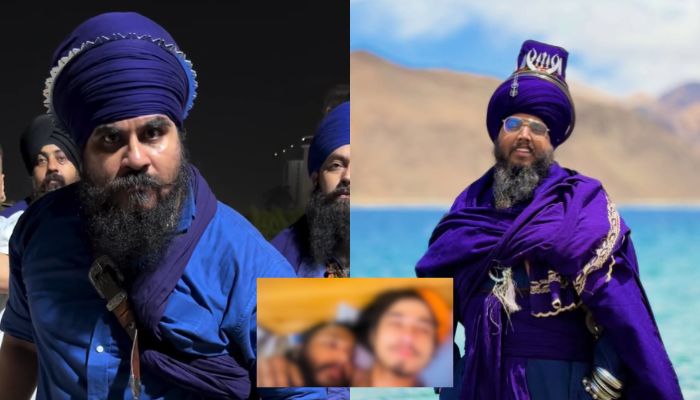
On 27th June, a Nihang Sikh identified as Vicky Thomas Singh published a video on the social media platform Instagram in which he called out another Nihang Sikh, Jasdeep Singh, for being in a homosexual relationship with another Nihang Sikh. In the video, Vicky Thomas shared blurred photographs of Jasdeep with another man and accused him of disrespecting the Sikh religion.

Jasdeep was recently seen among the group of Sikhs who created a ruckus at the Uttarakhand border while demanding the release of four arrested Nihangs.

In the video, Vicky Thomas Singh confronted Jasdeep over the photographs and asked him directly whether he was the person seen in them. Jasdeep acknowledged that the photographs were his and said, “Yes, it is me. I agree that it is my photograph.” He further admitted that what had happened was wrong, after which Vicky insisted that the act should not be described merely as a mistake but as a “crime”.

Vicky accused Jasdeep of bringing disrespect to the Sikh faith while presenting himself publicly as a Nihang. He repeatedly argued that a person wearing the Nihang bana, keeping unshorn hair and invoking the Guru could not be excused for actions involving homosexuality that, according to him, violated the religious standards expected of a Sikh.

He also accused Jasdeep of collecting money in the name of religion and claimed that Jasdeep shared UPI details while seeking donations for travelling to Uttarakhand. He appealed to people not to donate any money to Jasdeep, as he was “using religious attire and Sikh identity to conduct a business”.

He also demanded that Jasdeep appear before the Panj Pyare and accept religious accountability. “After committing such a crime, you should have presented yourself before the Panj Pyare. I had told you to do that,” Vicky said, alleging that Jasdeep had ignored his messages and failed to appear.

Who is Vicky Thomas Singh?

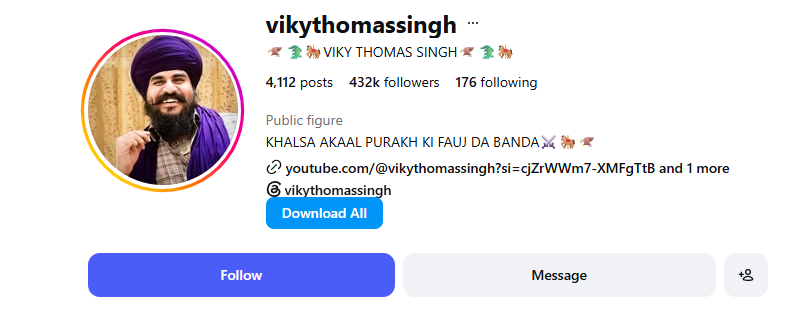
Vicky Thomas Singh, also known as Vicky Singh Thomson, is a convert to Sikhism who presents himself as a Nihang Sikh and describes himself as a social and political activist. He has made headlines over the past few years because of his association with Nihang groups and his repeated attempts to confront people whom he accuses of disrespecting Sikhism.

Vicky was reportedly born into a Christian family and initially converted to Hinduism. In 2020, he adopted Sikhism and began presenting himself as a Nihang Singh while retaining his former surname, Thomas, in his name. He first gained wider recognition during the farmers’ protests of 2020-2021.

He remains active on Facebook and Instagram under the name “Vicky Thomas Singh”, where he regularly publishes videos related to Sikhism, political controversies and social issues.

Source: Instagram

A few years ago, Vicky was reportedly in a relationship with transgender activist Laxmi Narayan Tripathi, who currently serves as the Mahamandaleshwar of India’s first Kinnar Akhada. In 2017, he was seen in a video interview with Laxmi where he was described as her “soulmate”. At that time, he had not converted to Sikhism.

Vicky has also been associated with several controversies. In August 2024, he reportedly appeared in a video in which threats were issued to actor and BJP MP Kangana Ranaut over her film Emergency. He was seen alongside several other men in the video.

His name had earlier surfaced following a violent clash involving two Nihang groups near the Golden Temple complex in January 2023. Vicky and others were accused of physically attacking members of a rival group during the confrontation.

Vicky’s political affiliations have also attracted attention. Photographs circulating online reportedly show him with senior Congress leaders, including Sonia Gandhi and Rahul Gandhi.

He was also present at the Red Fort during the violence that broke out in Delhi on 26th January 2021. On that day, Sikh groups had called for a tractor rally in Delhi. The Delhi Police had granted them permission for it but directed them to remain on the permitted route. However, during the rally, several Sikh groups broke through the barricades and entered Delhi, leading to chaos. They attacked police personnel and hoisted religious flags at the Red Fort. Several police personnel were injured.

Who is Jasdeep Singh and what happened in Uttarakhand?

Jasdeep Singh is a Nihang Sikh leader who recently made headlines following the dispute involving Nihang Sikhs and the Uttarakhand Police.

On 16th June, several Nihang Sikhs returning from Hemkund Sahib Gurdwara became involved in an altercation with local residents over the parking of motorcycles at Karanprayag market in Uttarakhand’s Chamoli district. Videos surfaced online in which Nihang Sikhs were seen drawing their swords during the altercation and trying to attack the locals. Police subsequently arrested four Nihangs and one local resident.

Jasdeep, who was among the group of Nihangs that reached Uttarakhand demanding their release, had earlier announced that he would march towards the Uttarakhand border with over 150 Nihang Sikhs. The group reportedly gathered near the Paonta Sahib and Kala Amb border areas, where Jasdeep issued an ultimatum to the administration. A video of him issuing the ultimatum went viral on social media.

Later, Jasdeep and other Nihang Sikhs held discussions with senior officials of the Uttarakhand administration and police. The authorities constituted a Special Investigation Team to conduct an impartial investigation. The agitation ended after a Chamoli court granted bail to the arrested Nihangs.

On 28th June, a welcome ceremony was organised for the Nihang group at Gurdwara Singh Shaheedan in Sohana, Mohali, following their return from Uttarakhand. During the programme, a turbaned man reportedly rushed towards Jasdeep and attempted to attack him with a sword.

Nihangs and supporters present at the venue overpowered the man and assaulted him, briefly creating a tense situation at the gurdwara. Police reportedly said that the alleged attacker appeared to be mentally unwell. An investigation was initiated into the matter.

Jasdeep also operates a Facebook profile under the name “Nihung Jasdeep Singh”, where he regularly shares videos and other content concerning Sikhism.

IndiGo’s historic landing at Udaipur: Read what GAGAN is and how this satellite navigation system could transform Indian aviation 

India has achieved an important milestone in civil aviation with the successful use of its indigenous satellite-based navigation system (SBAS), Gagan, to land a commercial passenger aircraft. On Friday, 27th June, an IndiGo Airbus A320 made a routine landing at Udaipur airport, but behind the scenes, it marked a historic first. Instead of depending on the traditional ground-based radio landing system, the aircraft completed its approach using Gagan, making it the first full-sized passenger jet in India to do so.

The Directorate General of Civil Aviation (DGCA) confirmed that while smaller turboprop aircraft had previously tested similar approaches, this was the first successful landing by a commercial narrow-body passenger aircraft using the indigenous technology.

What is Gagan, and why is it important?

Gagan (GPS Aided GEO Augmented Navigation) is a satellite-based navigation augmentation system jointly developed by the Indian Space Research Organisation (ISRO) and the Airports Authority of India (AAI). Its primary purpose is to improve the accuracy and reliability of GPS signals used by aircraft during navigation, especially while landing.

The system broadcasts signals through the GSAT-8 and GSAT-10 communication satellites, which remain in fixed positions over the equator and provide continuous coverage across Indian airspace.

Many people confuse Gagan with NavIC, India’s own satellite navigation system, but both serve different purposes. NavIC is an independent navigation network that tells users where they are. Gagan, on the other hand, does not provide location information by itself. Instead, it improves the accuracy of GPS signals that aircraft already receive.

Gagan constantly checks GPS signals, identifies any errors, corrects them and tells pilots whether the navigation data is safe enough to be used for flying and landing.

Why isn’t ordinary GPS enough for aircraft?

The GPS we use every day on our mobile phones works well enough for finding directions on roads, but aircraft require much greater precision. During landing, especially in poor weather or low visibility, even a small positioning error can become a serious safety concern.

One of the biggest reasons for this is the Earth’s ionosphere, a layer of the atmosphere filled with electrically charged particles. GPS signals slow down and bend while passing through this region, creating errors in the aircraft’s calculated position.

This problem is even more significant in India because the country lies under the Equatorial Ionisation Anomaly, an area where atmospheric conditions change frequently and cause larger GPS inaccuracies.

Without correction, ordinary GPS cannot provide the level of accuracy required for precision landings.

How does Gagan correct GPS signals?

Gagan solves this problem through a network of 15 reference stations spread across India. These stations are installed at locations whose exact position is already known with extremely high accuracy.

Each station continuously receives GPS signals and compares the location shown by GPS with its actual position. If there is any difference, the system immediately recognises it as an error.

The correction is then sent to a central processing facility, which calculates the accurate information and forwards it to India’s communication satellites. These satellites broadcast the corrected signals back to aircraft flying in Indian airspace. The aircraft automatically applies these corrections through its onboard receiver, giving pilots a much more accurate picture of their position.

Another major advantage is safety. Gagan constantly monitors the quality of GPS signals. If the corrected signal becomes unreliable for any reason, it immediately alerts the pilots so they can switch to another navigation method.

Historic landing at Udaipur

The IndiGo Airbus A320 used what is known as an LPV (Localiser Performance with Vertical Guidance) approach while landing at Udaipur.

This type of approach provides both horizontal and vertical guidance to pilots, almost matching the accuracy of the traditional Instrument Landing System (ILS) that many major airports use.

The biggest difference is that LPV approaches do not require expensive radio equipment to be installed at every airport. Instead, satellite technology provides the guidance.

That is what made the Udaipur landing historic. A commercial passenger aircraft completed a precision approach using India’s own satellite-based navigation system.

Why is this important for India’s airports?

India is rapidly expanding its aviation network under regional connectivity schemes, with many smaller cities getting airports for the first time.

However, installing a full Instrument Landing System at every airport is extremely expensive and requires regular maintenance. Gagan changes this equation completely.

A senior pilot explained the importance of the technology, saying, “For decades, aircraft have relied on ground-based navigation systems to guide pilots safely to the runway, especially during poor weather or low visibility. While these systems have served aviation well, they are expensive to procure and maintain. SBAS has fundamentally changed the way aircraft navigate and land. Instead of depending solely on equipment installed at airports, it allows pilots to receive precise horizontal and vertical guidance even at airports that do not have conventional precision landing systems.”

This means many regional airports can offer precision-guided landings without spending heavily on new ground infrastructure.

The country is adding airports under the UDAN regional connectivity scheme, but installing a full Instrument Landing System at every airport is expensive and requires continuous maintenance.

Safer flights and fewer disruptions

Satellite-guided approaches will allow aircraft to land more safely during bad weather, reducing cancellations, delays and diversions. Airlines will be able to operate more efficiently, while passengers will experience more reliable flight schedules.

In a document on SLS, aerospace major Airbus says: “This function enables pilots to perform ‘straight-in’ approaches using satellite positioning into airports, even in low-visibility conditions. Facilitating precision approach access to secondary airports, SLS capability enhances the airlines’ operations by enabling stable approaches, especially at airports currently not having precision approach means; at main runways as a backup to ILS (like during maintenance), or at alternate airports in case of diversion.”

An official overseeing this exercise on condition of anonymity said, “Almost half of the recorded controlled flight into terrain accidents occurred during approach and landing without vertical guidance. SLS allows approaches with vertical and lateral guidance to 200 ft above the ground, without expensive ground installation like ILS.”

A major boost for India’s aviation future

ISRO has designed Gagan with two major objectives. The first is to provide the accuracy, reliability, and safety needed for aircraft to execute secure approaches and landings in challenging weather conditions. The second is to improve overall air traffic management by allowing aircraft to fly more efficient routes across Indian airspace.

The Airports Authority of India has already published 23 LPV approach procedures across airports, and this number is expected to cross 40 by the end of the year. As more airports adopt LPV procedures and more airlines equip their aircraft with SBAS-compatible systems, Gagan is expected to become a key pillar of Indian aviation.

ISRO has designed the technology not only to improve landing safety but also to make flight paths more efficient and improve air traffic management across the country. Gagan is also compatible with similar satellite augmentation systems used internationally, allowing aircraft to receive enhanced navigation support even while flying across different regions.

Who is Faiyaz Premji, accused of distributing rat poison capsules during the Mumbai Muharram procession: All you need to know

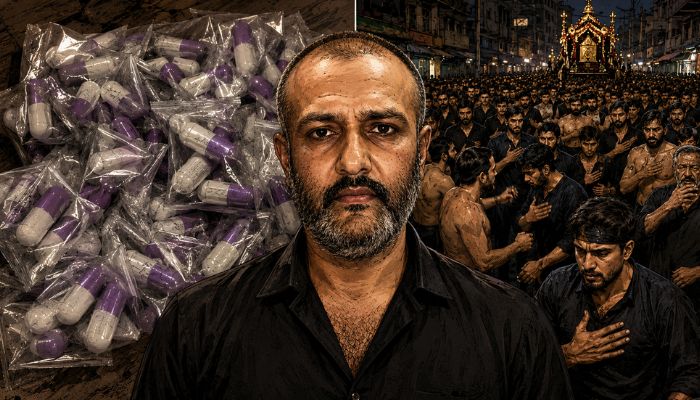
On 26th June, Mumbai Police arrested a 39-year-old Pune resident identified as Faiyaz Nisar Hussain Premji for attempting to poison participants in a Muharram procession by distributing capsules filled with zinc phosphide, a highly toxic chemical commonly used to kill rats. Faiyaz reportedly distributed the capsules, claiming that they were painkillers and Ayurvedic health supplements. He distributed the capsules in small packets near Rehmatabad Cemetery in Byculla, where the Ashura procession concluded.

Police recovered around 14,900 purple-and-white capsules reportedly filled with zinc phosphide. Police stated that Faiyaz intended to target at least 15,000 attendees at the procession. Investigators are still trying to determine his motive and examine his purchases, financial transactions, foreign travel and possible links to other individuals who could be involved in the crime.

His intention to kill participants in the Muharram procession came to light when 26-year-old Salman Mohammad Islam Sayyad developed nausea and repeated vomiting after consuming a capsule. Media reports cited investigating officials as stating that 11 people had consumed the capsules and fallen ill. However, authorities are yet to release an official statement regarding the health of the victims.

Poison packaged as Ayurvedic medicine

According to police, Faiyaz did not distribute the capsules in loose or obviously suspicious packaging. He packed them in professionally printed sachets, and the text on them read, “100% Natural & Ayurvedic Medicinal Health Supplement”.

The labels claimed that the capsules contained spirulina, ginseng, chamomile, ashwagandha, brahmi and several other herbal ingredients. They also carried batch numbers, manufacturing and expiry dates, purported licence details, dosage instructions and addresses in both Lucknow and the United Kingdom.

The elaborate packaging made it easier for the accused to present the capsules as legitimate health products. Some participants were told that they were Ayurvedic supplements, while others were told that they were painkillers or immunity boosters.

Police stated that Faiyaz deliberately avoided distributing zinc phosphide in its original form because its smell and appearance could have alerted people. Instead, he bought empty capsules and filled them with the chemical so that recipients would not detect the poison before swallowing it.

According to investigators, Faiyaz spent around 15 days filling thousands of capsules. Each capsule contained around one gram of the poison. Police stated that he had bought around 30,000 empty capsules and approximately 50 kg of zinc phosphide online. However, he managed to fill only 15,000 of them before Muharram.

Capsules thrown into the crowd

The Muharram procession began within the jurisdiction of JJ Marg Police Station, passed through Dongri and concluded near Rehmatabad Cemetery in Byculla. Police believe Premji selected the area near the endpoint because participants completing the long procession were likely to be tired and experiencing physical pain.

During interrogation, he reportedly told investigators that he knew many participants consumed painkillers after walking long distances or performing mourning rituals involving self-flagellation.

Witness Siya Shaikh, who had travelled from Ambernath with her family, said she saw a man carrying a bag standing near people distributing cakes. He allegedly removed bundles of packets, each containing four capsules, and began throwing them towards the crowd.

When questioned, the man reportedly told Shaikh that the capsules could be consumed by anyone above eight years of age. Her suspicions increased when she heard him describe the same packets as chocolates while speaking to a child.

Shaikh immediately warned her younger siblings and other children not to consume anything received from strangers.

Another participant, 60-year-old Fatima Rizvi, said she accepted a packet believing that it contained an Ayurvedic supplement. She later saw children receiving medical attention after allegedly consuming capsules they had mistaken for chocolates.

Police stopped Premji but initially allowed him to leave

Police personnel first intercepted Premji while he was distributing the capsules. When questioned, he reportedly claimed that they were painkillers being given free of cost.

As he had no permission to sell or distribute medicines or health supplements, officers recorded his Aadhaar details, residential address and other particulars. He was initially allowed to leave, while police personnel warned members of the public not to consume the capsules and asked them to discard the packets or hand them over to officers.

Police was alerted by hospital after Sayyad got admitted

Sayyad, a resident of Govandi, had attended the procession with his family. According to his statement, he was resting near Rehmatabad Cemetery at around 8.30 pm when he saw a woman in a black burqa give a capsule to her son.

When Sayyad asked about it, the woman reportedly told him that it was a painkiller used to relieve pain after performing “kama”, a mourning ritual in which participants strike themselves. She said that an unknown man had been distributing the capsules free of cost.

Believing it to be safe, Sayyad requested a capsule and swallowed it. At around 11.30 pm, while returning towards Govandi on a scooter, he began vomiting near Mhada Chowki. His condition did not improve after reaching home.

Members of the local Shia community advised his family to take him to Habib Hospital in Dongri. He was admitted at approximately 2.40 am on Saturday.

Doctors treated the case as a medical emergency and alerted the police. Investigators subsequently traced Premji to a hotel in Dongri and detained him. Police stated that he admitted to filling the capsules with zinc phosphide. A preliminary forensic examination also detected the chemical in the samples.

What is zinc phosphide?

Zinc phosphide is a poisonous chemical used as a rodenticide to kill rats and as a pesticide in agricultural fields.

After entering the stomach, it reacts with gastric acid and releases phosphine gas. The gas can affect vital organs, including the heart, lungs, liver, kidneys and brain. Severe poisoning can lead to organ failure, cardiovascular collapse and death.

There is no specific antidote for zinc phosphide poisoning. Treatment largely involves urgent supportive medical care, management of symptoms and, where necessary, respiratory or ventilator support. The chances of survival are significantly better when the patient is taken to hospital quickly.

Symptoms may include nausea, repeated vomiting, severe abdominal pain, breathing difficulty, dizziness and cardiovascular complications.

Who is Faiyaz Premji?

Faiyaz Premji is a 39-year-old Pune resident and a BBA graduate. He reportedly helps manage a paint business owned by his father. Investigators believe that his association with the business made it easier for him to procure the chemical online.

Reports suggest that he is married but lives separately from his wife. According to the police, he claimed that he suffered from insomnia, frequently searched for pharmaceutical products online, self-medicated and had regular disagreements with his father. Investigators are independently verifying these statements.

Premji reportedly identified himself as a Shia Muslim. Police are attempting to determine why he targeted a major Shia Muharram procession.

His mother and sister are said to live in Iran. Investigators are also examining his trips to Iran and Iraq since 2019, including two reported visits to Iran in 2025. His phone, online purchase records, bank transactions, contacts and travel history are being analysed to determine whether he acted alone or was connected to a larger network.

Police have not officially confirmed the involvement of any terrorist organisation, international group or accomplice.

Attempt to murder case registered

Deputy Commissioner of Police Jayant Meena said in a statement that the unauthorised distribution of capsules had raised suspicion and that the timely intervention of police personnel prevented a major tragedy.

A case has been registered under Sections 123, 109 and 110 of the Bharatiya Nyaya Sanhita, covering causing hurt through poison, attempt to murder and attempt to commit culpable homicide.

Premji was produced before a holiday court and remanded to two days’ police custody. Further investigation into the matter is underway.

The Gandhi family wants India to abandon Israel and side with Palestine: Read how the Congress party is overlooking the nation’s interest for appeasement politics

A major political debate has erupted over India’s foreign policy following a sharp intervention by Congress Parliamentary Party Chairperson Sonia Gandhi. In an opinion piece published in The Indian Express on Saturday, 27th June, 2026, the veteran leader levelled a blistering attack on the Narendra Modi government.

She criticised the administration’s stance on the humanitarian crisis in West Asia, stating that its “stony silence” and “inaction” on Israel’s “Gaza genocide” are not just morally reprehensible but also inexplicable from a national interest perspective. Gandhi claimed that by deviating from its historical geopolitical positions, India has alienated itself from long-standing allies in Palestine, Iran, and the larger West Asian region. She argued that this diplomatic withdrawal has distanced India from global public opinion while letting Pakistan swoop in to claim the space of a mediator, a role she believes India had a natural claim to, given its historically friendly ties with all regional players.

In her editorial, Gandhi specifically targeted the prime minister’s diplomatic scheduling, calling Prime Minister Narendra Modi’s visit to Israel ahead of the joint US-Israel military actions involving Iran a “bewildering strategic decision.” She urged that the spirit of Indian nationhood demands that it speak up for Palestinians whose children have been so brutally targeted. To ground her arguments, she referenced international findings, noting that in September 2025, the UN Independent International Commission of Inquiry concluded that Israeli authorities were committing genocide in Gaza. She wrote that in June 2026, the same commission, now headed by retired Indian jurist Justice S. Muralidhar, reiterated those findings, focusing on the heavy toll inflicted on the youngest citizens.

Screengrab of the article

Quoting the UN findings, Gandhi wrote, “The 94-page report is a harrowing read, with grim details on the extent of the devastation perpetrated by Israel in Gaza and the genocidal intent underpinning its actions. At least 20,000 children have been killed, and another 44,000 have been wounded, many for life.” She asserted that the targeting of children is a deliberate strategy, pointing out that “twenty-seven per cent of those killed or wounded have been children, and many of the boys were found with bullets on the head and neck. Ninety-seven per cent of Gaza’s schools have been destroyed.” She added that the destruction of healthcare infrastructure has led to a 300% increase in miscarriage and childbirth complications.

While Gandhi described the October 2023 attack by Hamas on Israel as a “dastardly, horrific, and absolutely unacceptable attack,” she argued that the subsequent retaliation by Israeli armed forces has been characterised by “wanton cruelty and barbarity.” She noted, “Senior Israeli leaders, down from Prime Minister Benjamin Netanyahu and his senior cabinet colleagues themselves, have called for the ‘complete siege’ and ‘total annihilation’ of Gaza, denounced the Palestinians as ‘animals’ who have ‘no right to exist’, and defined success for Israel as ‘hundreds of thousands fleeing Gaza’.”

Congress’s top brass backs the Op-Ed

Sonia Gandhi’s positions quickly received strong backing from the top leaders of the Congress party, who used the opportunity to demand a reset in India’s global alignments. Sharing the article on the social media platform X, Congress President Mallikarjun Kharge called the piece evocative and stated that it serves as a “stark reminder of how our current foreign policy has alienated our historical allies in Palestine, Iran, and the larger Middle East.”

Leader of the Opposition Rahul Gandhi also shared the editorial on X to amplify its message across digital platforms. He noted, “Through her editorial, Congress Parliamentary Party Chairperson Sonia Gandhi ji calls on India to reclaim its independent foreign policy, uphold humanitarian values, and speak up with moral clarity on Gaza.” The coordinated push by senior leadership signals that the Congress party intends to make the government’s West Asia policy a central point of political contestation.

India’s deep strategic dividends from Israel

International relations must be guided by tangible national security benefits rather than ideological sentimentality. India and Israel have developed a strong partnership over the last three decades. Although India recognised Israel in 1950, full diplomatic relations were established in 1992. Since then, ties between the two countries have expanded significantly in areas such as defence, technology, agriculture, cybersecurity and trade.

During the current government’s tenure, India has become Israel’s largest weapons buyer, with bilateral trade expanding dramatically from USD 200 million in 1992 to more than USD 6 billion by 2024. This economic and defensive bond is backed by a Bilateral Investment Treaty signed in September 2025, which has given a further fillip to trade in sectors like petroleum, chemicals, engineering goods, and polished diamonds.

Security experts emphasise that Israel has consistently proven to be a vital defence partner during times of acute national crisis when other global powers were reluctant to provide immediate assistance. 

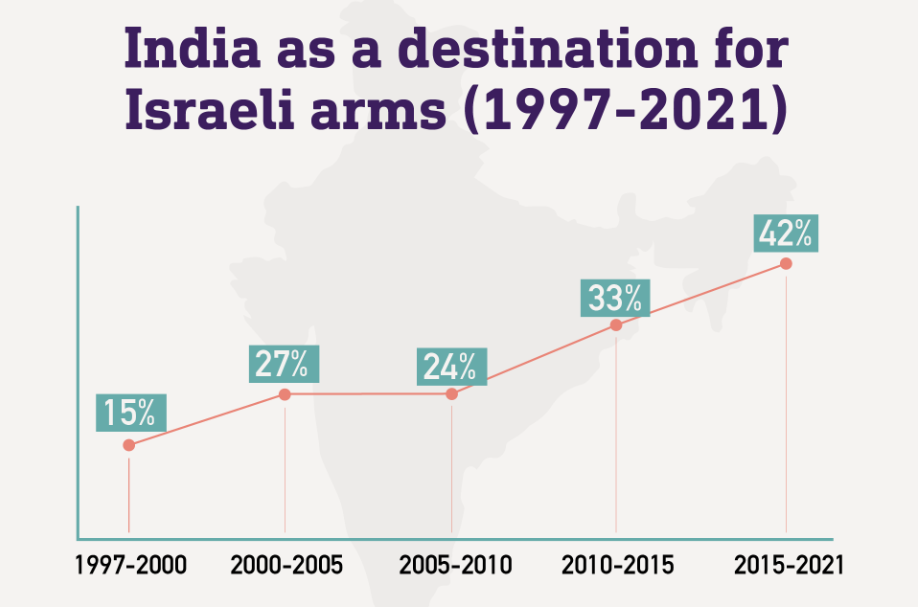
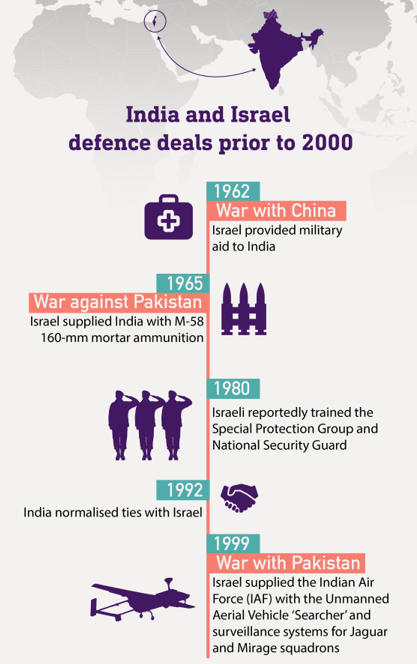
India’s defence deals with Israel date back long to 1962, when Israel provided military aid to India in its war against China. In 1999, during India’s war with Pakistan, Israel supplied the IAF with the Unmanned Aerial Vehicle ‘Searcher’ and surveillance systems for Jaguar and Mirage squadrons. The defence ties with Israel have notched up since 2014, with around 42.1% of all arms exports from Israel landing in India, with Azerbaijan, Vietnam, and the US making up the other major customers. 

India’s partnership with Israel is not limited to defence. Exports are, however, concentrated across a few key sectors, like gems and jewellery, especially cut and polished diamonds, which are sent to Israel’s large diamond trading hubs. Apart from this, petroleum products, organic chemicals, plastics, and engineering goods also form a major portion of the exports. In very recent years, there has been a sharp drop in Indian exports to Israel – PM Modi’s visit can supposedly perk up the exports again, courtesy strategic deals and tie-ups across areas. 

How the India-Israel partnership helped during Operation Sindoor

The practical value of this defence partnership was put on full display during the border escalation known as “Operation Sindoor.” The conflict escalated sharply following a deadly attack by Pakistani terrorists on 22nd April, 2025, in the Baisaran Valley of Pahalgam, where 26 Hindu tourists were killed by cross-border militants. In response to this provocation, the Indian Armed Forces launched a fierce, targeted counter-attack codenamed Operation Sindoor, aimed at neutralising terrorist infrastructure and launchpads run by Lashkar-e-Taiba and Jaish-e-Mohammed in Pakistan and Pakistan-occupied Kashmir.

The 23-minute operation, which commenced at 1:05 AM on 7th May, relied heavily on sophisticated Israeli-manufactured technology alongside indigenous and Russian systems to strike enemy positions and secure Indian airspace against incoming retaliatory threats. Israeli military hardware played a decisive role in ensuring the operation’s success:

  • Harop Loitering Munitions: The Indian Armed Forces deployed Israeli-made Harop kamikaze drones specifically designed to destroy air defence systems and radar units. Capable of staying over target areas for up to nine hours and equipped with a 50-pound warhead, these drones operated with high autonomy. During the operation, they successfully struck and eliminated a crucial Pakistani air defence facility in Lahore.
  • Heron Mk2 UAVs: For surveillance and reconnaissance, the air force used Heron Mk2 drones, which can cruise at altitudes up to 35,000 feet and stay airborne for over 40 hours. Operating from forward bases, these long-endurance drones provided real-time intelligence, target acquisition, and battle damage assessments across the rugged northern terrain, remaining safely out of reach of conventional ground-based anti-aircraft weaponry.
  • SkyStriker Drones: Manufactured through a partnership between Israel’s Elbit Security Systems and India’s Alpha Design Technologies in Bengaluru, these quiet, electrically propelled loitering munitions were used for covert low-altitude strikes. Carrying 5 to 10 kilogram bombs, they successfully engaged specific tactical targets even in environments where GPS signals were disrupted.
  • Barak 8 Missile Defence System: Developed jointly by India’s DRDO and Israel Aerospace Industries (IAI), the Barak 8 long-range surface-to-air missile system proved critical in protecting the domestic front. When Pakistan attempted a retaliatory strike by firing a Fatah-II ballistic missile aimed toward Delhi, the Barak-8 system successfully intercepted and destroyed the incoming missile over Sirsa, Haryana.
  • Spice-2000 Precision Bomb Kits: Indian warplanes used Israeli-designed Spice-2000 guidance kits to convert standard general-purpose bombs into smart, “fire-and-forget” precision stand-off weapons. Using advanced scene-matching algorithms, these bombs accurately penetrated the roofs of targeted terror camps while minimising collateral damage to surrounding civilian areas.
  • Tavor X95 Assault Rifles: On the ground, elite special forces units, including MARCOS and Garud commandos, were equipped with compact, bullpup-shaped Tavor X95 rifles manufactured under license in India. These rifles provided high reliability and manoeuvrability during close-quarters security operations.

The clean sweeps achieved during Operation Sindoor, which resulted in the elimination of nearly 100 terrorists, including close relatives and top commanders of JeM chief Masood Azhar and LeT strategist Abu Jundal, demonstrated how deeply embedded Israeli defence tech is within India’s operational readiness.

India’s Two-state policy and national interest

India officially supports a two-state solution that recognises both Israel and Palestine and advocates peaceful resolution through dialogue and diplomacy. From this perspective, the primary obligation of the Indian state is to protect its own citizens, defend its borders, and secure its economic interests. Getting deeply involved in distant ideological disputes offers no clear strategic returns and risks disrupting vital defence supply lines.

India’s long-standing, official diplomatic position remains a clear, balanced Two-State Policy: the formal recognition of an independent, viable Palestine alongside a secure, recognised state of Israel. Beyond upholding this balanced diplomatic stance at international forums, the specific internal dynamics or military conflicts of the region are external matters. Trying to force India to take an aggressive, unilateral stance against a critical defence partner like Israel is seen as a move that undermines the country’s pragmatic security calculus.

Congress has a history of Muslim appeasement that overlooks the nation’s interests 

Congress’s intense focus on international conflicts like the Gaza crisis is driven less by global strategy and more by a long-standing domestic political tradition of minority vote-bank appeasement. This political mindset frequently forces the party to overlook core national interests in favour of domestic electoral calculations, a criticism that has been levelled against the party since the early post-independence era.

This pattern of prioritising specific political fallout over uniform justice dates back to the highest echelons of post-independence governance under Prime Minister Jawaharlal Nehru. Historical records from December 1948 reveal that Nehru personally intervened in a massive ₹50 lakh income-tax evasion case involving Huseyn Shaheed Suhrawardy, Butcher of Bengal, who was widely seen as the chief architect of the communal violence during the 1946 Direct Action Day in Calcutta.

In an official letter dated December 12, 1948, addressed to Finance Minister John Matthai, Nehru intervened in the tax proceedings against Suhrawardy, explicitly cautioning that any “high-handed” fiscal action could lead to negative political reactions among Muslim leaders in both India and Pakistan. Nehru wrote, “There are certain public consequences of what might be done to Suhrawardy. Every such action has certain reactions both in India and Pakistan.” He urged the finance ministry to halt asset execution proceedings. 

This prime ministerial protection allowed a figure responsible for widespread communal violence, which killed thousands of Hindus in Bengal, to smoothly liquidate his commercial assets in India, evade a major financial liability, and safely move to Pakistan, where he eventually rose to become the prime minister.

The legacy of the UPA and modern electoral dynamics

This historical appeasement towards Muslims continued through the UPA government’s tenure between 2004 and 2014, under Prime Minister Manmohan Singh and UPA Chairperson Sonia Gandhi. During this period, the administration faced frequent accusations of leaning heavily into identity politics. Prime Minister Manmohan Singh’s public statements asserting that minority communities, particularly Muslims, must have the “first right on the resources” of the country.

Further policy decisions from that era are evidence of this political lean, including a May 2012 Planning Commission proposal to mandate a 15% allocation of funds within all central schemes specifically for minority groups. 

Additionally, the UPA formed the Sachar Committee and the Justice Ranganath Misra Commission to evaluate and address the socioeconomic status of Muslims. The Misra Commission’s recommendations included a controversial proposal to grant a 10% reservation to Muslims and a 5% reservation to other minorities, along with extending Dalit reservation benefits to individuals who converted to Islam or Christianity. It also suggested carving out an 8.40% sub-quota for Muslims within the existing 27% OBC quota. Meanwhile, the Sachar Committee drew sharp criticism for recommending an unprecedented headcount of Muslim personnel serving within the nation’s security forces.

This political legacy faced internal scrutiny following the Congress party’s severe defeat in the 2014 general elections. The party appointed an internal review committee headed by former Defence Minister A.K. Antony to investigate the loss. The Antony Committee report explicitly acknowledged that the party’s public image had suffered, concluding that repeated statements regarding specific reservations and a perceived pro-minority bias had alienated the majority Hindu community. The committee noted that the party had struggled under the political stigma of being perceived as prioritising one community over others.

This approach remains visible in the political rhetoric and electoral strategies of Rahul Gandhi and Priyanka Gandhi Vadra. In 2010, Rahul Gandhi had told the American ambassador Timothy Romer that the Hindus of the country are a bigger threat than the Muslim terrorists. 

In another controversial political remark, Rahul Gandhi described the Indian Union Muslim League (IUML) as a ‘secular party’, even though the party has described itself as “a political entity dedicated to safeguarding Muslim rights” in a petition filed before the Supreme Court. 

During his visit to the US in June 2023, an interviewer asked Gandhi why Congress was in alliance with a Muslim party (IUML) in Kerala when it opposes the ‘Hindu’ BJP. “You talked about secularism and democracy while opposing the Hindu party BJP, however, the Congress in Kerala has been in alliance with the Muslim party, the Muslim League in Kerala, the state from which you were an MP,” the interviewer asked. Responding to the question, Gandhi asserted that the Muslim League (IUML) was “a completely secular party”. “Muslim League is a completely secular party, there is nothing non-secular about the Muslim League. I think the person has not studied the Muslim League, “Gandhi said

BJP hits back at Sonia Gandhi’s formulations

The ruling Bharatiya Janata Party (BJP) launched a sharp counter-offensive against Sonia Gandhi’s opinion piece, accusing the Congress leadership of trying to inject domestic vote-bank calculations into sensitive matters of international diplomacy and national defence. 

BJP national spokesperson Shehzad Poonawalla strongly criticised the Congress party for what he described as a highly selective application of humanitarian concern. Addressing the media, he stated, “Sonia Gandhi speaks up for the Muslims in Gaza, they tweet about Rafah, but they are silent on Hindus in Dhaka. This shows that for them, even foreign policy is calculated on the table, on the calculus of vote bank.” 

The ruling party maintained that the opposition’s public statements are politically motivated attempts to misinform the public and undermine India’s global standing, placing short-term electoral considerations above the country’s long-term defence partnerships and strategic autonomy.

From fatal stabbings to sword displays: Muharram processions across India marred by violence, clashes, and public disorder

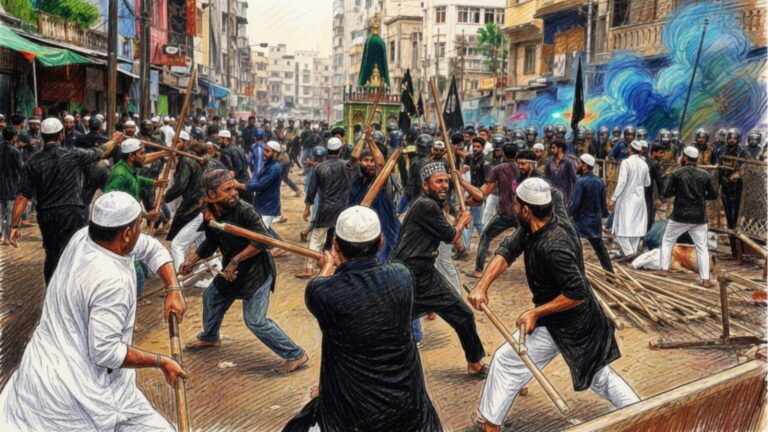
Several incidents of disputes, clashes, and violence have been reported from different parts of the country during Muharram. In some places, Islamic extremists clashed among themselves during processions and even resorted to killing, while in others, security personnel who arrived to restore order were themselves attacked.

In several incidents, Islamic extremists were seen brandishing swords, while videos also surfaced showing an AK-47 being waved. While Hindu festivals have often remained their target, incidents of violence have also come to light during their own religious observances. OpIndia has compiled all such incidents in one place.

Samastipur, Bihar: Violence during Muharram procession, youth stabbed to death; police also attacked with sticks

A case of a youth being stabbed to death during a Muharram procession has come to light in the Kalyanpur police station area of Samastipur district in Bihar. The incident reportedly took place at Gopalpur Bhutta Chowk, where a Tazia procession was being taken out on the occasion of Muharram.

The deceased has been identified as 22-year-old Javed. During the procession, while Javed was either watching or participating in the display of martial feats, a youth named Haider, a resident of the same village, allegedly attacked him with a knife. It is alleged that Haider stabbed Javed directly in the chest before fleeing the spot.

After the attack, Javed collapsed on the ground with serious injuries. With the help of local residents and the police, he was rushed to the Sadar Hospital for treatment, where doctors declared him dead during treatment. Local residents alleged that the accused had a criminal background and demanded his immediate arrest.

Sadar DSP-2 Sanjay Kumar stated that raids are underway to arrest the accused.

In another incident, in Ramnagar Sari village under the Mathurapur police station area, a dispute broke out between two groups during a Muharram procession. The verbal altercation soon escalated into a violent clash, creating tension in the area. When police and administrative officials reached the spot after receiving information about the violence, the agitated crowd allegedly attacked them with sticks and batons.

Three police personnel were injured in the attack and were admitted to Samastipur Sadar Hospital. They are currently undergoing treatment.

Mumbai: 14,900 poison-filled rat-killer capsules seized during Muharram procession

A case of poison-laced rat-killer pellets allegedly being distributed during a Muharram procession has come to light in Mumbai. In connection with the case, police arrested Pune resident Faiyaz Premji. More than 14,000 capsules were recovered from his possession. The incident came to light during a Muharram procession passing through the JJ and Byculla areas.

A police patrolling team noticed a man distributing capsules in a suspicious manner. He was questioned, and the material in his possession was seized. During the investigation, police claimed that the recovered capsules contained zinc phosphide, a highly toxic chemical.

According to DCP Jayant Meena, 14,900 filled capsules were recovered from the accused. During questioning, he stated that he had ordered 30,000 empty capsules and around 50 kilograms of zinc phosphide and had spent several days filling them. It has also emerged that one person fell ill in connection with the case and was admitted to a hospital for treatment.

The investigation further revealed that Faiyaz had travelled to Iran and Iraq multiple times between 2019 and 2025. In the past year alone, he had reportedly visited the two countries 19 times. Police are now examining the purpose of these visits, his digital records, mobile phone data, financial transactions, and contacts.

Muzaffarpur, Bihar: Violent clash during Muharram procession

A tense situation also developed for some time during a Muharram procession in Muzaffarpur, Bihar. In the Hathauri police station area of Muzaffarpur district, Islamic extremists clashed among themselves during a mourning procession. The dispute began with an argument between two women, which gradually escalated into a fight between two groups.

Soon, both sides started attacking each other with sticks and batons. Several people were reported injured in the clash. As soon as the police, who had already been deployed in the area, received information about the incident, they rushed to the spot and somehow brought the situation under control.

Speaking on the matter, Muzaffarpur SSP Kantesh Kumar Mishra said that the dispute began between two women during the procession and later turned into a clash between two groups. He added that three people were injured in the incident and the matter is under investigation.

Violence erupts in several areas of Muzaffarpur; ASI Mustaqeem Khan seen wielding a sword while on duty

Tension prevailed at different places in the Hathauri, Aurai, Piyar and Kanti police station areas of Muzaffarpur district. At Bariyarpur Chowk in the Piyar police station area, a dispute that began during the Tazia gathering later escalated into a violent clash, with both groups attacking each other using sticks and batons.

In another incident, near the Central Bank in Damodarpur under the Kanti police station area, a dispute broke out between two groups during a Tazia procession over the display of martial feats and giving way on the road. The dispute eventually turned into a physical altercation. Meanwhile, another video surfaced from Muzaffarpur showing a uniformed police officer performing sword tricks.

It was reported that the video featured ASI Mustaqeem Khan, posted at Kanti police station. After the video surfaced, the police initiated an inquiry. According to preliminary information, he had been deployed for Muharram procession duty, and someone recorded the video and later circulated it on social media.

Bhagalpur, Bihar: Extremists enter railway station carrying swords, raise slogans and create panic

A large number of Islamic extremists allegedly entered the railway station premises during Muharram in Bhagalpur, Bihar. More than 100 extremists carrying swords entered the station premises and raised slogans on the staircases and platforms. Passengers present at the station reportedly experienced fear and discomfort.

Videos related to the incident have gone viral on social media. Several users questioned the law-and-order situation and the public display of weapons at a railway station, demanding action. Initially, Station Master Ajay stated that the video would be investigated.

Subsequently, the Railway administration registered a case. Malda Railway Division Public Relations Officer Rupa Mandal said that after the viral video surfaced, a detailed report was sought from the Railway Protection Force (RPF). Based on the findings, an FIR has been registered under Sections 147 and 145 of the Railways Act.

The people seen in the video are being identified, and action will be taken against those found responsible.

Ujjain, Madhya Pradesh: Van bearing the words ‘Le Phir Aa Gaye’ suspended from a crane and blown up during Muharram procession

A video of a display during a Muharram procession in Ujjain, Madhya Pradesh, on the night of Tuesday (June 23, 2026), triggered controversy after going viral on social media. The video showed a Tata Magic van suspended approximately 40 feet in the air with the help of a crane.

Two youths standing on top of the van were seen waving red flags, and after some time, the vehicle appeared to explode with a loud blast. The words “Le Phir Aa Gaye” (Here We Are Again) were written on the van.

The video was also shared on the Instagram account “Parvez Edits 2.0”. After it surfaced, Haridwar saint Swami Shivanand Giri and several Hindu organisations objected to the display. The Hindu Jagran Manch questioned the district administration over whether permission had been granted for such an act.

Police have initiated an investigation. According to Ujjain Police, permission had been granted for the procession, but no permission had been given to use any kind of explosive material. Police have registered a case against organiser Shoaib Khan, Zahid Khan and Taslim Khan, who were seen waving flags, as well as crane owner Gopal Mali.

Deoria, Uttar Pradesh: Youth catches fire while performing stunt during Muharram procession

A youth sustained burn injuries after catching fire while performing a stunt during a Muharram procession in Deoria, Uttar Pradesh. The incident took place on Malviya Road in the district headquarters. He was immediately taken to a hospital, where, after treatment, his condition was reported to be stable and out of danger.

The injured youth, Saddam Khan, a resident of Bans Deoria in the Sadar Kotwali area, had participated in the Tazia procession on behalf of the Five Star Club. During the procession, he was sitting inside an iron drum while performing a stunt. Suddenly, the fire burning inside the drum flared up and spread to his clothes, causing burn injuries.

The incident created panic at the spot for a short while. However, members of the Akhara and people present nearby acted quickly, extinguished the flames, and safely pulled the youth out of the drum. Since the fire was brought under control in time, a major mishap was averted.

Saddam Khan was immediately admitted to a private hospital, where he is undergoing treatment. City Circle Officer Sanjay Reddy said that a Muharram procession was being taken out on Malviya Road when the incident occurred. According to the police, the situation remained under control and no other untoward incident took place.

Bareilly, Uttar Pradesh: Clash over throwing currency notes during Muharram procession leaves around 20 injured

A dispute broke out among Muslims during a Muharram procession in Padarathpur village under the Bithri area of Bareilly, Uttar Pradesh, over the throwing of currency notes. Within a short time, the argument escalated into a violent clash. Both groups attacked each other with sticks and batons, leaving around 15 to 20 people injured.

As the situation deteriorated, the police had to use mild force to bring it under control. A Muharram procession was passing through the village in the evening with a large number of people participating. During the procession, some individuals started throwing currency notes into the crowd.

People rushed to collect the money, resulting in pushing and jostling. This led to an argument between two groups, which later turned into a violent fight. Police personnel present at the spot initially attempted to pacify both sides, but when the situation appeared to be going out of control, they resorted to mild force and used batons to disperse the crowd.

Additional police personnel were later called from the police station, after which the situation was fully brought under control. Police have taken the matter seriously and initiated legal action. According to officials, efforts are underway to identify those involved in the clash and disturbing public order. CCTV footage is being examined, and FIRs will be registered against the identified individuals, who will subsequently be arrested.

Varanasi, Uttar Pradesh: Dispute escalates during Muharram procession

A dispute broke out between two groups during a Tazia procession on the Nai Sadak–Aurangabad route in Varanasi district, Uttar Pradesh, on the occasion of Muharram. Within moments, a large number of Muslims gathered at the spot, leading to panic and tension in the area for some time.

As the incident occurred on the boundary of the Chetganj and Luxa police station areas, personnel from both police stations immediately reached the spot and began efforts to restore order. Police officials appealed to the people to maintain restraint and allow the procession to proceed peacefully. However, due to the disturbance created by some individuals, the police had to use mild force to control the situation.

The police later removed those involved in the dispute from the spot and brought the crowd under control, after which the situation returned to normal. The Tazia procession then continued on its designated route. No serious injuries were reported in the incident.

Prayagraj, Uttar Pradesh: Temple platform damaged after DJ vehicle collides with it during Muharram procession

A dispute also arose during a Muharram procession in Prayagraj district, Uttar Pradesh. In Newada village under the Bahria police station area, the platform of a temple was damaged after being hit by a DJ vehicle participating in the procession. The incident sparked tension in the village for some time.

Considering the sensitivity of the matter, the administration immediately became active and deployed the Provincial Armed Constabulary (PAC) in the area as a precautionary measure to prevent any untoward incident. The situation was brought under control in the presence of police and administrative officials. The damaged temple platform was also repaired.

Several videos are also available on social media in which extremists can be seen brandishing swords, creating ruckus, raising slogans, and even waving rifles.

Irrespective of the festival,whether it is Ramzan, Holi, Ram Navami, or Muharram, incidents involving violence by Islamic extremists continue to come to light.

‘Trap girls, impregnate them before Nikah, and take the child’: What is ‘Jihad al-Akbar’, the radicalisation campaign under scanner for targeting Hindu women?

A shocking case of conversion and exploitation of women has come to light from Kota city in Rajasthan. On the complaint of Bajrang Dal, the police have already arrested the main accused, Manish Sharma alias Moin Khan. Objectionable videos of Hindu girls and women have been recovered from the accused. He was operating this entire network by running groups on social media.

Now the entire focus of the police and intelligence agencies is on the new clues coming from Moin Khan’s mobile. Deleted data from Moin’s phone and 3 secret audios that came from Pakistan have created a stir. After this revelation, a dangerous agenda has come to light, which has been named ‘Jihad Al Akbar’. Police are now busy connecting these links in a sequential manner.

What is ‘Jihad Al Akbar’ and who created it?

Jihad Al Akbar’ is a well-planned digital agenda being run through different platforms of social media. According to the secret audios received from Moin Khan’s mobile, this dangerous conspiracy has been prepared by extremist bosses sitting in Pakistan. In the audio, the Pakistani person claims that these people have been working on this mission since 1992.

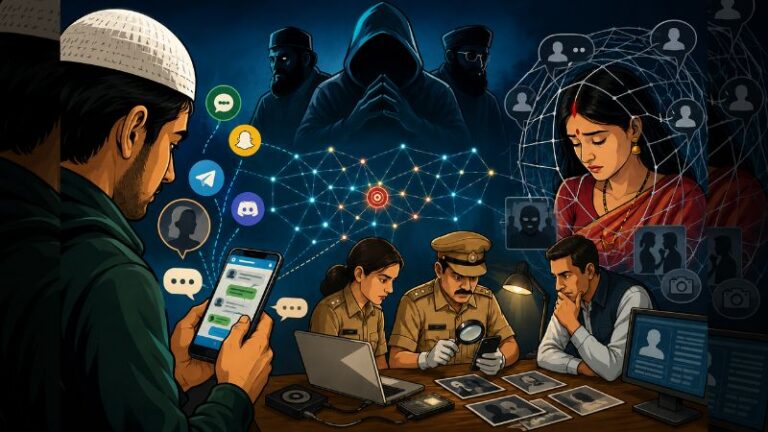
When the internet had just arrived in Pakistan, the web of this online conspiracy was being woven since then. To run this mission, the Pakistani handlers never come directly in front of themselves. They guide their local agents present in India through apps like Telegram, Snapchat and Discord. For this, secret groups and channels have been made properly, from where the entire network runs.

Why was this mission created, and what is its real objective?

The main objective of this mission is to carry out large-scale religious conversion of Hindu women in India and make them commit blasphemy. Pakistani handlers want to harm India’s internal security and integrity by using fake social media IDs. Through this, an attempt is being made to sow the seeds of hatred toward the Hindu religion among Hindus themselves.

Apart from this, through this conspiracy, there was also a plan to target organisations working in the national interest, like Rashtriya Swayamsevak Sangh (RSS). Pakistani bosses want to collect ‘interfaith data’, i.e. data related to Hindu-Muslim relations on social media. Their objective is to completely break India’s social fabric and weaken the country internally.

How are local boys and college friends being trained?

According to Dainik Bhaskar’s report, to take this conspiracy forward, local agents are given the task of awakening their own college mates and friends. In the audio received from Moin’s phone, Pakistani handlers explain to a boy named ‘Vakas’. They say that awaken your college mates and friends who are Muslim boys and hold secret meetings with them.

To incite these boys, first, religious matters are shown and explained. They are told lies about what others are doing wrong with their religion. Then they are told about their secret team. When the boys get excited and become ready to go along, then they are trained slowly and systematically for further work.

How are married Hindu women being targeted?

Under this entire agenda, married Hindu women and minor girls are especially trapped in the net. In the audio, the Pakistani person says that they need such Hindu girls and women in whose videos ‘mangalsutra and sindoor on the forehead’ are clearly visible. These women are first trapped in the web of love through fake IDs.

The truth of the agenda running in the group has been written in direct words without any story. Its meaning is, ‘Trap any Hindu girl or woman in love, make her pregnant before nikah and take the child after 9 months. After the child is born, she will have become Muslim.’ After that, women are made to create obscene videos with idols of gods and goddesses and are blackmailed.

What is known about Moin Khan so far?

According to police records, the accused Manish Sharma was originally Hindu, who later converted his religion and kept his name as Moin Khan. He is a resident of Vigyan Nagar in Kota and has studied only up to 10th standard. He used to work in a shop and got married in 2021, from which he also has a 4-year-old child.

Moin Khan has been in contact with Pakistani organisations on platforms like Telegram and Discord for the last several years. When his activities started appearing suspicious, a complaint was received on the Bajrang Dal’s helpline number. After that, the activists started keeping an eye on him. When his phone was checked, thousands of objectionable videos of girls, along with Hindu religious symbols and obscene content,t were recovered from it.

What else is there in the secret audio clips that came from Pakistan?

The three different audio clips received from Moin Khan’s mobile have confirmed this international conspiracy. In the first audio, the Pakistani person says that our work is not new and we have been working since 1992. In the second audio, he says to instil this thing in their minds that Muslim is supreme and their God is nothing.

In the third audio, the Pakistani handler talks about keeping the boy named Vakas sitting in India completely on the safe side. He says that I am sitting in Pakistan, so you never come in front; otherwise, there will be a security problem. He tells Vakas that if I make you the admin of the group, then RSS people will note your IP ID and reach your house.

What legal action has been taken in this entire case so far?

On the complaint of Bajrang Dal activist Yogesh Renwal, a case was registered on 15 June 2026 at Vijaynagar and Udyog Nagar police stations in Kota. A case has been registered against the accused Manish Sharma alias Moin Khan under IPC sections 196(1)(a), 196(1)(b), 299, 352 and IT Act sections 66, 67, 67A, and he has been sent to jail. Udyog Nagar police station CI Mangilal said that the accused’s mobile phone has been sent for forensic examination (FSL).

Bajrang Dal has sent an online complaint about this entire case to the Central Home Ministry on 22 June. Hindu Samaj-Kota has also submitted a memorandum in the name of the Prime Minister demanding strict action and investigation of the entire network. In Jaipur, ATS had caught a woman who had become Khadija from Babita, linked to the terrorist organisation Jaish-e-Mohammed, due to which agencies are also on alert. Regarding the case, BJP state president Madan Rathore and minister Madan Dilawar have given assurance of strict legal action against the guilty after investigation.

‘Cremation business’ controversy erupts after Isha Foundation modernised Asia’s largest crematorium in Patna: Read what the organisation told OpIndia about the project

The last journey of a loved one is never just a religious ritual. For most families, it is one of the most emotionally difficult moments in life. During such times, long waits, poor facilities, middlemen, and uncertainty about expenses often add to their grief. Over the past few years, the Bihar government has been trying to change this reality by modernising cremation facilities across the state.

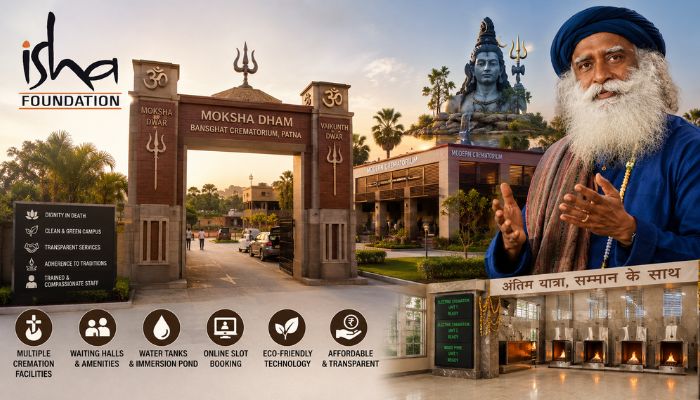
The initiative to build modern crematoriums in the state and upgrade existing crematoriums is part of this vision. The Bansghat crematorium in Patna, which has been modernised and operated, has been entrusted to ‘Sadhguru‘ Jaggi Vasudev’s Isha Foundation. However, this has now sparked controversy, with many raising questions on social media.

Some people are alleging that the government, in collaboration with the organisation, is also “commercialising” cremation, and that the poor will not benefit from it. However, the organisation maintains that the entire initiative is being misrepresented, as its goal is not to make a profit, but to make funeral arrangements transparent, convenient, and respectful.

What did the Isha Foundation tell OpIndia?

Before understanding this entire model, it’s important to examine why the government entrusted this responsibility to the Isha Foundation and what facilities have been developed there. Speaking to OpIndia, the foundation explained that its involvement in crematorium management is driven by the idea that every individual deserves a dignified farewell after death. The organisation said it has been managing crematoriums in partnership with the Tamil Nadu government for nearly 15 years.

Why has Isha Foundation taken over the operation of the crematorium?

Isha Foundation operates crematoriums with the aim of ensuring that every person receives a respectful and dignified final farewell. In partnership with the Tamil Nadu government, the Foundation has been operating crematoriums for the past 15 years, where special attention is paid to clean and well-maintained premises, trained staff, and traditional funeral facilities.

More than 125,000 funerals have been performed at these centres so far. Through these facilities, Isha strives to revive ancient traditions and death rituals with an energy-based approach, operating them as a service, not a commercial activity.

Based on this experience, the Bihar government has partnered with Isha Outreach, the social and environmental arm of Isha Foundation, to operate and manage crematoriums in the state, while the land ownership will remain with the government.

How will this crematorium be different from the existing government or municipal crematoriums?

The Isha model’s most distinctive features are its focus on dignity, cleanliness, and sensitive service. These crematoriums are professionally maintained, the fee structure is transparent, and trained staff handle the entire funeral process with sensitivity.

The complex provides dedicated space and well-organised facilities for traditional funerals, easing the burden on grieving families.

What fee has been fixed for cremation?

The issue of user charges has been at the centre of the controversy surrounding the project.

According to Isha Foundation, the fee for electric cremation has been fixed at ₹3,500. The organisation says this amount falls within the limits approved under the municipal agreement and is among the lowest charges permitted. The money will primarily be used to cover electricity consumption and maintenance costs.

For traditional wood-based cremation, the service charge will also be ₹3,500. However, families choosing this option will have to bear the additional cost of purchasing firewood separately.

The foundation insists that the fee structure has been designed to maintain transparency while ensuring the long-term sustainability of the facility.

Will any concession, free service, or government assistance be available for poor and needy families?

One of the biggest concerns raised by the public is whether economically weaker families will be able to afford these services.

Responding to this concern, Isha Foundation said the Bihar government is working on a support scheme for the financially weaker sections. While details are still being finalised, the organisation pointed out that it already provides free cremation services to Below Poverty Line (BPL) families at crematoriums managed by it in Tamil Nadu.

Why is this crematorium being referred to as a VIP crematorium?

This isn’t because of special or VIP access, but rather because of the superior infrastructure. Clean premises, organised parking, spacious waiting areas, and superior amenities aim to provide every family with a respectful and organised environment.

● Will it be based entirely on an environmentally friendly model? What technology will be used to reduce pollution and control emissions?

The redeveloped Bans Ghat crematorium has also been designed with environmental concerns in mind.

Electric cremation has been made the primary system because it produces significantly lower emissions compared to conventional methods. Advanced chimney systems have been installed to control smoke and reduce pollution.

In addition, the existing wood-fired furnaces are proposed to be gradually converted into LPG-based systems. According to the foundation, gas-based cremation will reduce dependence on firewood while also lowering pollution levels.

The broader objective is to create a modern crematorium that combines traditional practices with cleaner technologies.

How will the entire facility be operated and managed?

Isha Outreach will manage the entire complex, including human resources, sanitation, waste management, gardening, and maintenance. The Foundation will also handle technical operations such as furnaces, electrical systems, plumbing, and other infrastructure.

Will there be a transparent system to prevent the role of middlemen and unauthorised charges?

Yes, the entire system is designed to ensure transparency and minimise the role of middlemen. With funeral and premises operations managed directly, families will no longer rely on intermediaries for core services. Where additional traditional services are required, clear rules will be followed to prevent unnecessary fees.

If a large number of cremation cases arise on a given day, what plan is in place to manage crowds and waiting time?

Yes, adequate arrangements have been made to handle a large number of cases. The facility can handle 18 cremations at a time and will have multiple furnaces, trained operators, and adequate support staff.

Currently, the need is for approximately 1–2 cases per day, but the infrastructure has been developed to accommodate a much larger capacity. There will also be a waiting area, seating, and parking for approximately 40 vehicles.

● Has Isha Foundation implemented a system like the one in Patna anywhere else as well?

Isha Foundation’s Kayantha Sthanam model began in Tamil Nadu in 2010, when the first crematorium was entrusted to Isha in Coimbatore’s Nanjundapuram area. What started there has now expanded into a wide system of crematorium management across the state. Isha currently manages 33 crematoriums in Tamil Nadu, and over the past 15 years, more than 1,25,000 cremations have been carried out. 

Last year, Isha also launched free cremation services for families living below the poverty line (BPL) at its managed crematoriums in Tamil Nadu.

18 bodies cremated simultaneously in a 4.5-acre crematorium

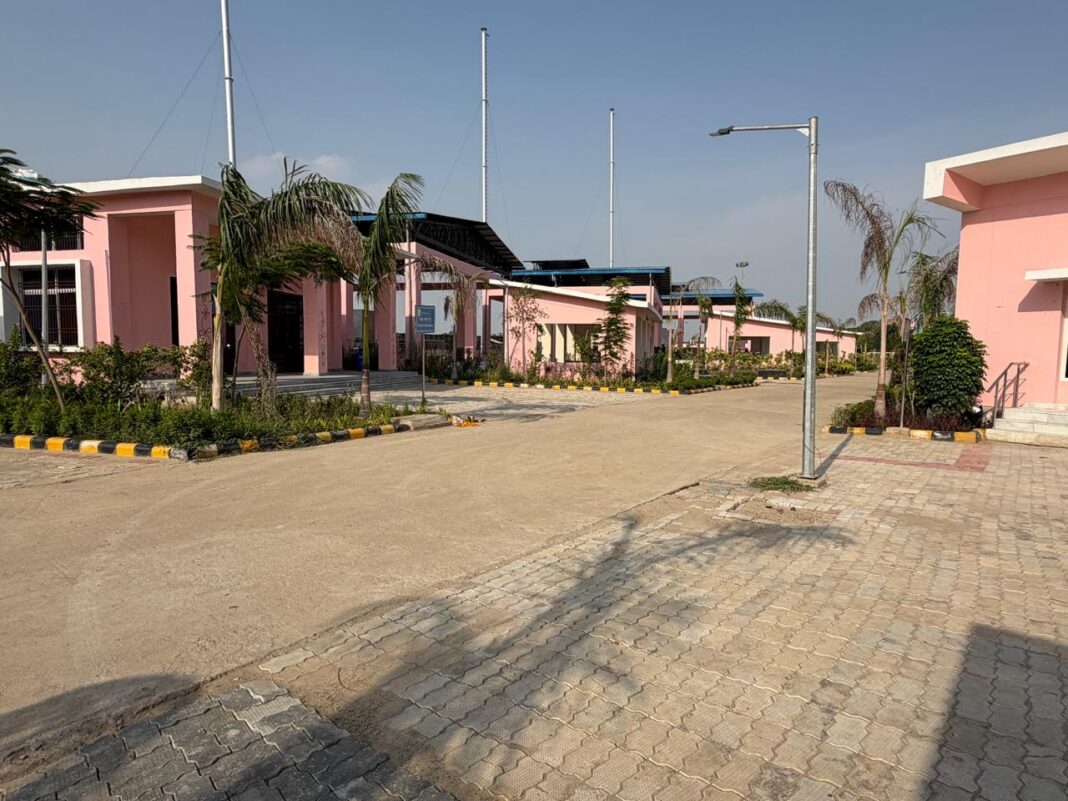
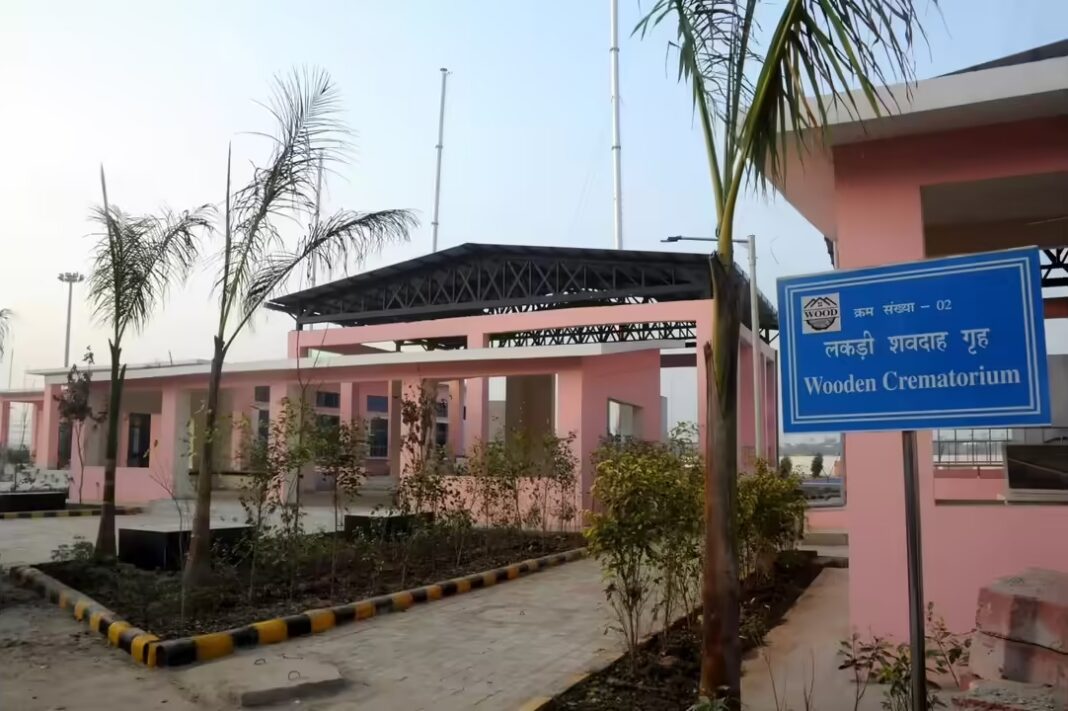
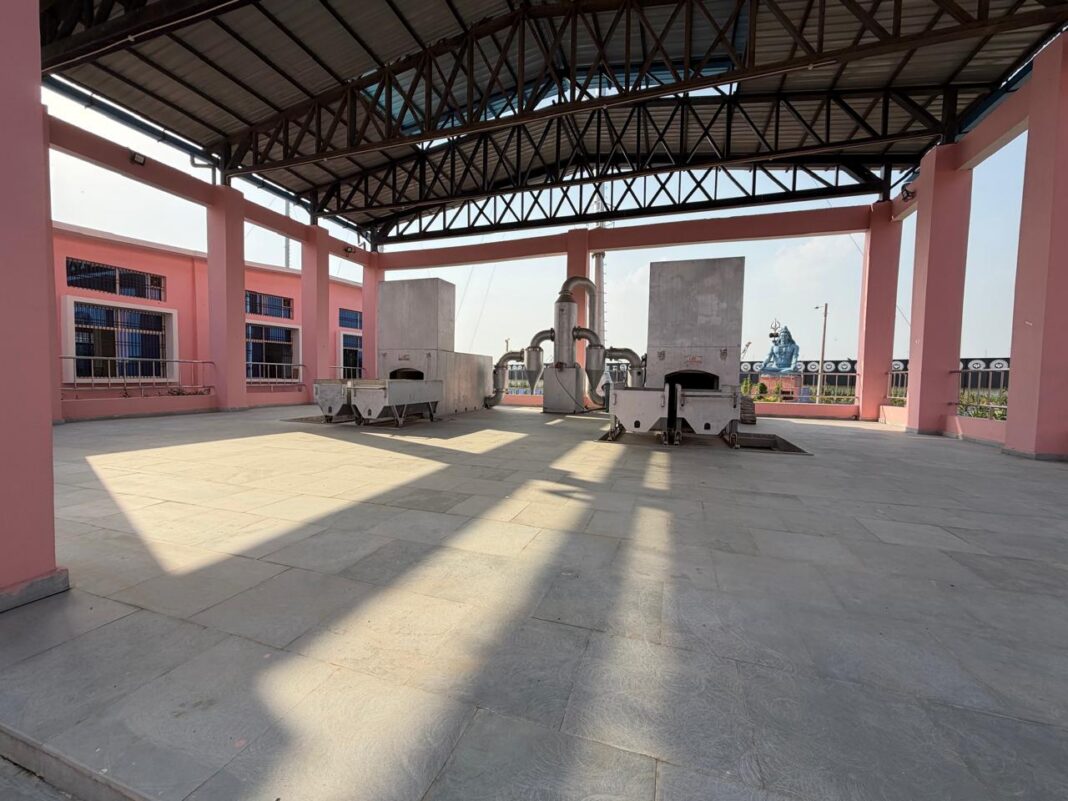
Spread across 4.5 acres, the redeveloped Bans Ghat crematorium represents one of Asia’s largest infrastructure projects related to funeral services. Developed by Patna Smart City Limited at a cost of ₹89.40 crore, the existing crematorium spanned 1.24 acres. It has been designed as a complex that streamlines almost the entire funeral process.

This complex has been modernised and is said to be one of the largest cremation grounds in Asia. It can accommodate up to 18 funerals simultaneously. Three types of arrangements have been made for this purpose. The first is for traditional pyre-based cremation, for which eight open spaces have been created.

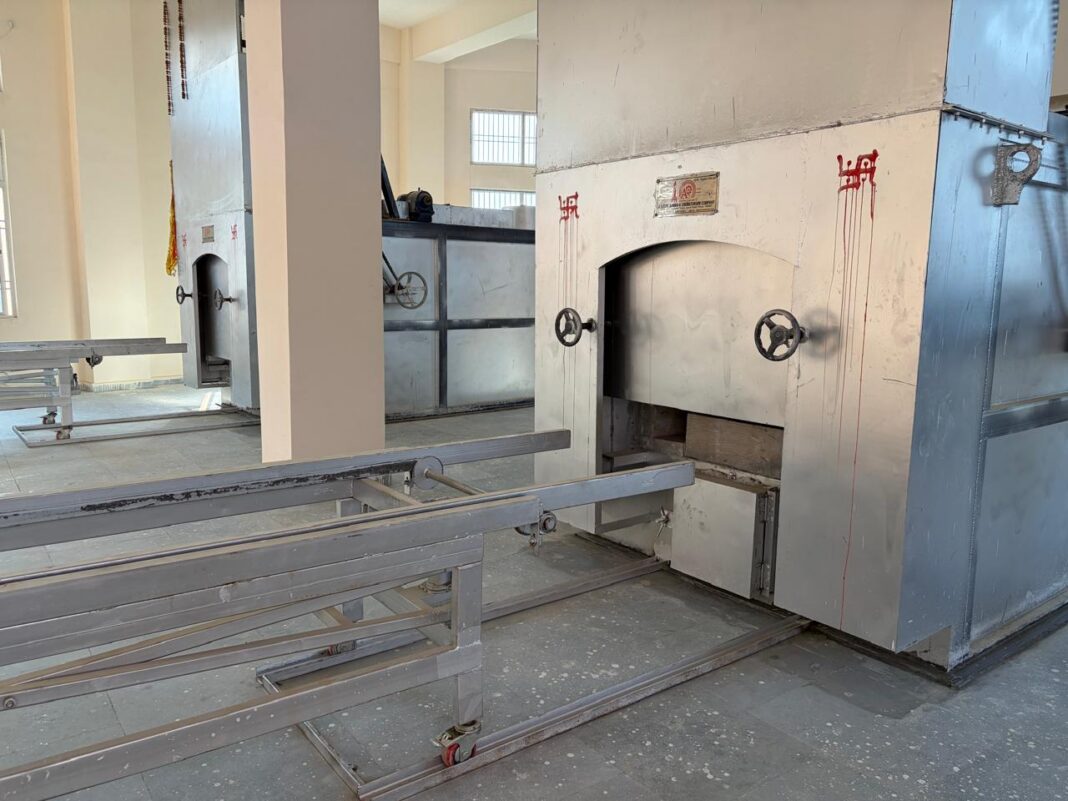
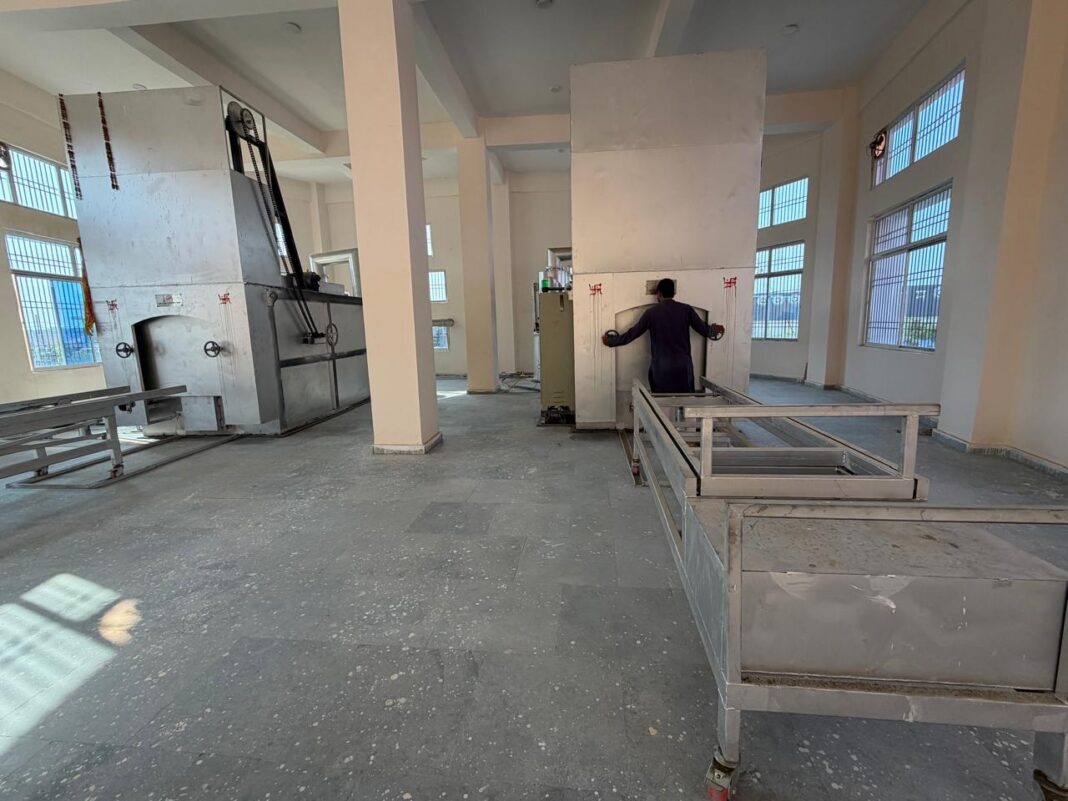
The second is electric cremation units, where four modern units have been installed. The third is six wood-based, environmentally friendly furnaces, which allow cremations to be conducted with less wood and a controlled process. Preparations are also underway for gas-based furnaces, which are proposed to be commissioned in the future.

The government says this will reduce both costs and pollution, but the discussion isn’t limited to the cremation process. Two large, air-conditioned waiting halls have been built for funeral attendees, ensuring they don’t have to endure the heat, crowds, and discomfort even in difficult conditions.

There are six wood cremation ovens, developed by a Bihar-based company. These ovens require less wood to cremate a body. The body is reduced to ashes in 20-25 minutes. A chimney has been installed to vent the smoke. Clean drinking water is available on the premises, along with clean and well-maintained toilets, and a canteen is available for the public.

Paintings on the walls of the cremation ground and the story of King Harishchandra

The modernisation project has not focused only on infrastructure. The walls of the crematorium have been decorated with artwork depicting the journey of human life from birth to death. Paintings also portray the concepts of heaven and hell based on a person’s deeds.

Furthermore, a portrait of King Harishchandra, along with his story, is engraved to inspire mourners to uphold truth and duty under any circumstances.

Attractive frames depicting tridents have been installed on the walls of the complex, which has been named Moksha Dham and Vaikunth Dham. This is an HPL (High Pressure Laminate) sheet. The view cutter was imported from Gujarat. Additionally, shops have been set up within the complex to provide funeral materials so that family members don’t have to run around outside.

An effort has been made to make clothes, puja materials, incense sticks, wood, havan materials and other essential items available at one place.

The main attractions are the two gates of the cremation ground. One is the Moksha Dwar, and the other is the Baikuntha Dwar. Both are 42 feet high. One is the entry point, and the other is the exit point. Both gates have the Om symbol carved in bronze. These were crafted by artisans from Jalandhar.

Bansghat has also incorporated several features rarely discussed in the context of cremation grounds. Two separate ponds, powered by the Ganges water, have been constructed. One is proposed to be used for bathing, and the other for immersion of ashes. A 12-foot-tall statue of Lord Shiva has been installed between the two ponds.

The statue is modelled after Adiyogi of Tamil Nadu. Artisans from Jalandhar were involved in its creation. It is made from a fibre material. Mounted atop a 15-foot-tall trident, the statue depicts the Ganges flowing from Shiva’s matted locks. Lighting has also been provided around it. Green areas have been developed along the paths in front. The rationale behind this is that direct access to the river isn’t always easy due to changing geographical conditions.

Mortuary, online booking and digital services

The redeveloped crematorium also includes several modern digital services. A mortuary facility has also been developed on the premises to preserve bodies if needed. An online slot booking system has also been added to relieve people from queues and chaos.

People can also book slots online. To do this, they need to visit the Patna Municipal Corporation website and generate a ticket ID. Bookings can also be made through the WhatsApp chatbot. A help desk has also been set up to assist people with documentation and procedures.

One can also book a Mukti Rath for pickup service. People can also apply for a death certificate. The government says that digital features in funerals are intended to provide convenience, not replace traditions.

‘Dignity in Death’: The core philosophy of the organisation

The most widely discussed concept at the heart of this model is “Dignity in Death.” Isha Foundation believes that death is a human and emotional situation. Therefore, the emphasis is on deploying trained volunteers, assisting with the process, reducing waiting times, collaborating with family members, and maintaining a conducive environment.

40 crematoriums are being built in Bihar using state-of-the-art technology. Construction of 20 of these crematoriums has been completed. Modern crematoriums have been constructed in 12 districts of North Bihar and 8 districts of South Bihar. The beautification work on these 20 completed crematoriums is in the final stages, after which they will be operational soon.

The Isha Foundation will also build an LPG-based crematorium at Digha Ghat in Patna. Additionally, there are plans to modernise crematoriums at Simaria Ghat in Begusarai, Bhagalpur, Gayaji, Saharsa, and Chhapra. The organisation also states that the purpose of the service is not profit, but to provide a respectful experience to families during difficult times. This government move is not an expansion of any business, but an attempt to give dignity to the funeral procession.


(This article is a translation of the original article published on OpIndia Hindi.)

UN Special Rapporteur found to be under China’s payroll: Read how OpIndia had flagged his anti-India bias and Islamic appeasement tendencies after the Pahalgam attack

A recent report of the UN Watch has accused the United Nations Special Rapporteur on counterterrorism, Ben Saul, of ideological bias and conflicts of interest. The report reveals that Saul has been receiving funding from the Chinese government.

According to Sky News, the report of the Geneva-based group also states that Saul has an anti-Western and anti-Israel bias. It points out that Saul has condemned the killing of the terrorist leader Ayman Mohammed Rabie al-Zawahiri, who was a senior member of the terrorist group Al-Qaeda in Afghanistan. “He’s not supposed to be an activist; he’s supposed to be an academic. We’re supposed to see scholarship,” UN Watch Executive Director Hillel Neuer said, speaking to Sky News.

“The UN expert should be the first to oppose the Hamas terrorists, to oppose the Islamic regime in Iran, and Ben Saul seems to echo the Islamic regime in Iran and its terrorist proxies,” Neuer said.

Quoting from the report, Neuer said that Saul received a $150,000 from the Chinese Communist regime. He pointed out that Saul has not rebutted the contents of the report. Neuer named several UN experts, whose offices received funding from China.

“He claims to be an independent expert. He is a law professor in Sydney and calls himself an independent expert. I want to know how he can be an independent expert when he is receiving $150,000 from the Chinese Communist Party? Let me be clear. No one is saying that it is going into his own pocket to buy a Ferrari, but it is going to his office. The same office, that has never condemned China for putting a million Uyghurs in camps under the pretext of counterterrorism, the very issue he is supposed to be an expert on”, Hillel Neuer stated to Sky News.

He said that the UN Special Rapporteur on Coercive Measures, Alena Douhan, received $ 1.3 million for her office from Russia, China, and Qatar. He named another UN expert, George Katrougalos, who is the chair of the UN Human Rights Experts’ office, and said that his office received 100,000 dollars from China, the same year he attended an event in Athens to promote the book of Chinese President Xi Jinping.

UN Watch has flagged several instances of UN ‘experts’ receiving dubious funding from governments like China, Qatar, Russia etc and peddling specific ideological interests in the name of Human Rights while ignoring acts of terrorism and plights of victims of Islamic terrorism.

How Ben Saul and other United Nations Special Rapporteurs had tried to defame India and peddle a false Muslim victimhood after Pahalgam attack

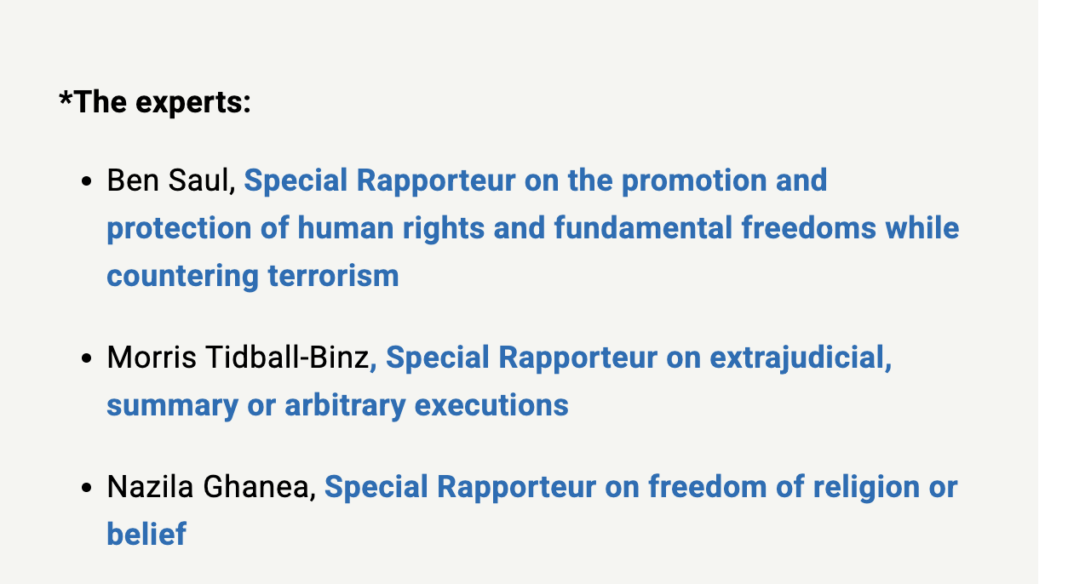
Notably, Saul was among the eight United Nations Special Rapporteurs who had issued a joint press statement expressing ‘concern’ over so-called human rights violations by Indian authorities in Jammu and Kashmir for their counter-terrorism measures after the ghastly Pahalgam attack. Opindia had reported how the UN Special condemned the terror attack but deemed India’s counter terrorism operations, including temporary media restrictions, internet shutdowns, and the blocking of 8,000 social media accounts, as ‘disproportionate’ and in violation of international human rights law.

Describing India’s counterterrorism actions as “collective punishment”, the UN rapporteurs claimed that authorities arbitrarily demolished homes, businesses and properties of families linked to suspected terrorists without court orders or due process. After the UN Watch report, it makes sense why Ben Saul, who is supposed to condemn acts of terrorism, was criticising India for fighting back against Pakistan-sponsored terrorism.

Somehow, the UN rapporteurs had also linked anti-illegal encroachment drives in Assam and Gujarat with the nationwide post-Pahalgam crackdown by authorities to argue that Muslims unrelated to terrorism were being targeted for sharing the same faith as the perpetrators of the Pahalgam attack.

While Assam and Gujarat have witnessed crackdowns on illegal encroachments, mostly involving Islamists encroaching government land and erecting Mazars or dargahs there, and illegal Bangladeshi and Rohingya occupying land, these anti-encroachment drives have been going on for more than a year. Although unrelated, the only demolition drive in Gujarat that came just days after the Pahalgam attack was to remove illegal structures in and around Chandola Lake by the government, a hub of illegal Bangladeshis, that also after the Gujarat High Court gave clearance for the action.

In addition, the assertion that houses of ‘innocent Kashmiri civilians’ were demolished is also false. Houses were demolished by the authorities, but not those of innocent civilians. The authorities razed down houses of only proven terrorists.

Terrorist Shahid Ahmed Kuttey’s Shopian residence, house of another active jihadi Zakir in Kulgam, house of Ahsan ul Haq Sheikh in Muran, Pulwama, who had also visited Pakistan in 2018 and infiltrated the valley earlier this year, house of Farooq Teewd,a who crossed into Pakistan in the early 90s and never returned, and houses of LeT jihadis Adil Hussain Thokar at Bijbehara, Anantnag, and Asif Sheikh at Tral, Pulwama, were demolished by the security forces using explosives. None of them were innocent or peace-loving ‘civilians’.

Who are the eight accused arrested by the police in connection with the Ram Mandir donation embezzlement case: Read details

In the ongoing probe into the Ram Mandir donation embezzlement case, eight persons named in the FIR were arrested by the police on Friday morning (26th June). The arrestees have been identified as Avinash Shukla, Anukalp Mishra, Lavkush Mishra, Manish Kumar Yadav, Karunesh Pandey, Ramashankar Mishra, Subhash Srivastava and Ramshankar Yadav alias Tinnu. The accused have been remanded to judicial custody till Monday and will be produced before the Special Court under the Prevention of Corruption Act on that day, as the court was not sitting today.

All of them were involved in the process of counting, sorting and bundling cash and valuables received as donations at the temple. A total of ₹79,85,493 has been recovered from them, except from Subhash Srivastava, as confirmed by the police and prosecution officials. The arrests come a day after an FIR was registered under Sections 306, 316(5), 317(4), 317(5), 61, and 3(5) of BNS following directions from the Uttar Pradesh government.

The FIR was lodged based on a complaint filed by a member of the Shri Ram Janmabhoomi Teerth Kshetra Trust and the preliminary findings of a three-member Special Investigation Team (SIT) constituted by the Yogi government earlier this month. 

Meanwhile, Ram Janmabhoomi Teerth Kshetra Trust general secretary Champat Rai and trustee Anil Mishra resigned from their posts earlier today on moral grounds. However, neither of them has been named in the FIR. Rai initially denied the allegations of theft of donation funds but later welcomed the SIT probe, which led to the arrests.

Let’s take a look at the details of the eight persons arrested in connection with the case:

Ram Shankar Yadav alias Tinnu Yadav– He used to work as the driver of the Trust’s general secretary, Champat Rai. He was also associated with VHP’s Karsevakpuram, who used to count donations. He is a prominent face among all the accused arrested in the case. As per reports, Yadav kept the keys of the donation boxes with him. Yadav reportedly gained influence within the temple’s internal management system because of his proximity to the members of the Trust. According to investigators, Yadav exercised significant control over the security, counting and transportation of donations collected at the temple. 

Tinnu Yadav was an autorickshaw driver in Ayodhya who later joined the VHP and became the personal driver of Champat Rai. As per claims, he has amassed properties worth over ₹50 crore by embezzling cash, gold, silver, and diamond offerings of devotees. However, Yadav claims that he had no role in handling the donations, and he purchased the land propetry worth ₹50 crore in 2008 from income generated by driving auto-rickshaws.

Manish Yadav– He is the nephew of Tinnu Yadav and was also involved in the donation counting process. The stolen money was recovered from his house as well.

Ramashankar Mishra, alias Ravi Mishra– He was involved in the donation counting process. He is accused of siphoning off the donation money in coordination with other employees. He was seen taking part in the cash- sorting process on a CCTV camera. Investigators have claimed that Mishra bypassed established financial protocols over an extended period to facilitate the alleged theft. He got his son, Anukalp Mishra, and son-in-law, Lavkush Mishra, involved in the work of handling donation money at the temple.

Anukalp Mishra– He is the son of Ramashankar Mishra and was involved in the work of counting donations. Anukalp Mishra is also a relative of Trustee Anil Mishra and brother-in-law of co-accused Lavkush Mishra. He is a resident of Basawan village in Ayodhya’s Milkipur area. Police recovered stolen money from his residence.

Lavkush Mishra– He is the son-in-law of Ramashankar Mishra and was also involved in the process of counting donation money. The allegation against him is that he and Anukalp Mishra were actively involved in siphoning off funds. His actions were captured on CCTV footage, and around ₹12 lakh was also recovered from his house.

Avinash Shukla– He worked as an attendant of the temple and was part of a team responsible for handling and counting cash and valuables received as offerings. An amount of ₹5 lakh was recovered from his bank account.

Subhash Shrivastava– He is a former bank employee who was in charge of the cash-counting staff. He was entrusted with supervising the entire donation counting process due to his banking background.

Karunesh Pandey– He was part of a team that handled the donations. He is accused of manipulating financial records related to incoming donations.

Among the 8 accused, two are linked to Champat Rai, who resigned as the General Secretary of the trust. They are Rai’s driver Ram Shankar Yadav alias Tinnu Yadav, and his nephew Manish Yadav. On the other hand, three accused are linked to trust member Anil Mishra, who also resigned today. They are Ramashankar Mishra, his son Anukalp Mishra and son-in-law Lavkush Mishra. This means 5 out of 8 accused are linked to the two members of the Shri Ram Janmabhoomi Teerth Kshetra Trust.

As per reports, the theft was discovered after the Mandir committee installed hidden cameras in the area used to count and arrange cash after discrepancies were found between cash received at donation boxes and cash deposited at the bank. The hidden camera footage showed that the accused were standing in front of the regular CCTV cameras while pocketing some of the cash while handling the money. Sometimes they also inserted extra notes in bundles, and took out the extra notes on the way to the bank.

Apart from cash, some jewellery donated by devotees was also stolen by the accused staff members. However, claims that they also stole 200 kg of silver donated to the Mandir were found to be baseless. The tota

Nazia Elahi Khan is an excuse: Islamists of Kolkata are desperate to show some street power after losing their political power

A fresh controversy has erupted revolving around social media influencer and activist Nazia Elahi Khan. She has been accused of making objectionable statements about Prophet Muhammad and his third wife Aisha during a podcast hosted by Divya Singh. The video went viral on social media and soon triggered agitations, legal complaints and demands of strict action against her by the Muslim community, its religious leaders and outfits.

Nazia has been declared “Gustakhe Rasool,” someone who disrespects Islamic prophet, by them and is being subjected to character assassination, vile abuses and death threats, including beheadings under the guise of “blasphemy.”

The agitation in Kolkata

Large Muslims mobs were observed on the streets of Kolkata, raising religious and inflammatory slogans and swarming to multiple police stations to file complaints against the 41-year-old influencer in various areas. Similar incidents occurred in Kasai Basti of Narkeldanga, where numerous members of the community, accompanied by the clerics of local mosques went to the police station and a zero First Information Report (FIR) was lodged.

They also protested and demanded her immediate arrest. They asserted that the cops assured them that all details will be collected from other police stations and an inquiry is going to be initiated at Lalbazar, headquarters of the Kolkata Police. The demonstrators threatened a wider agitation if the authorities fail to take action against her.

Another complaint was submitted by Congress leader Rukhsana Begum at Narkeldanga police station who was accompanied by several of her fellow believers. She referred to Nazia as a pig-faced woman and wanted her to be executed. Afterwards, she appealed for the latter’s arrest and the harshest punishment to make an example out of her.

Begum insisted that Muslims are being unfairly targeted. She insisted that Nazia should be expelled from the BJP and then accused the government of exploiting her as a tool for its political agenda. Begum argued that she is using her Muslim identity to gain money and recognition, aware that the community is generally accommodating while Hindus would not accept her.

Similar remarks were made by others, trying to tarnish Nazia’s reputation amid persist calls to apprehend her. The crowd also shouted Islamic slogans in the name of protest.

Members of the Muslim community led by clerics likewise reached Shibpur police station in Howrah. They asserted that stringent measures must be taken against Nazia to maintain communal harmony and peace, as she insulted Prophet Muhammad and his wife, who is revered as their mother, thereby violating religious sentiments. She was also told to hold her tongue.

They added that Nazia is from Kolkata and hence a campaign has been commenced to file complaints against Nazia in different police stations of West Bengal to ensure she is strongly penalised and does not dare to utter such statements in the future.

A group of Muslims arrived at the Ekbalpore police station to register an FIR against Nazia stated that they have been promised action against her after a report was forwarded to the cyber cell. They charged that she consistently voices disparaging comments against Islam, but this time she has gone too far and pronounced her as “Gustakhe Rasool,” demanding severe penalty.

Furthermore, they criticised Prime Minister Narendra Modi and Bengal cabinet minister Dilip Ghosh, expressing that the two have made anti-Muslim remarks. Afterwards, late Rahat Indori’s controversial poetry was referenced to contend that India does not belong to any single individual or community, and Muslims, like the tyrant Tipu Sultan and Veer Abdul Hamid have sacrificed their lives for the nation.

The complainants expressed that a straightforward comment is considered “hate speech” if the person is Muslim but ignored otherwise. They then moaned about how their “tolerant community” has been quietly abiding by the rules and regulations before threatening, “Do not assume you can act as you wish simply because we are treating you with leniency.”

Muslims hailing from separate neighbourhoods of Kolkata converged at their respective police stations as part of a purposeful drive against Nazia for alleged blasphemy.

Similar complaints in other parts of India

The complaints and aggressive demonstrations were not restricted to any single state but across the country. The representatives of the notorious “Raza Academy” went to the Pydhonie police station in Mumbai, asking for legal action against Nazia.

“Gustakhe Nabi ki ek hi saza, sar tan se juda” (Those who speak against Prophet Muhammad must be beheaded) were raised inside Kalyan’s Bazarpeth Police Station in Thane during a protest by members of the Muslim community including women.

The Meghwadi Police Station in Mumbai received a complaint from a group of Muslim women who called upon others, including politicians irrespective of their affiliations, to follow suit if they hold any love for Prophet Muhammad.

Adnan Ansari, a resident of Bhiwandi submitted an FIR at the Shanti Nagar police station after consulting his co-religionists. The JJ Marg police station in Mumbai also recorded a zero FIR, which was scheduled to be sent to Bengal for probe.

Muslims flooded the streets of Uttar Pradesh’s Moradabad carrying posters against Nazia and chanting slogans. They announced that the situation will only deteriorate as the community will not rest until their demands fulfilled. They gave a memorandum to the authorities asking for an FIR and her arrest. Nazia was instructed to apologise and retract her statements or face consequences, outlining, “We can endure anything but any insult to our Prophet.”

Muslim organisations along with AIMIM (All India Majlis-e-Ittehadul Muslimeen) conducted a demonstration in Baheri of Bareilly and presented a memorandum addressed to the President at the Tehsil complex, pushing for Nazia’s arrest and an FIR against her.

A group of attorneys in Prayagraj delivered a memorandum for PM Modi via the District Magistrate, pressing for legal action in the issue. According to the document, Nazia’s comments have upset Muslims and, if overlooked, could have an impact on communal harmony.

A throng of Muslims arrived at the IS Sadan Police Station in Hyderabad. They hit out at her with derogatory terms such as pig and accused her of trying to disturb the harmonious atmosphere in India.

A memorandum addressed to the President was handed over to the district administration on behalf of the Muslim community making similar demands in Madhya Pradesh’s Rewa.

What is brewing behind the protests in Bengal

The Islamists in Bengal are facing a significant crisis following the removal of All India Trinamool Congress (AITC or TMC) from power in last month’s election, attributed to their prolonged history of appeasement, corruption and discriminatory policies against Hindus. Former chief minister Mamata Banerjee went so far as to declare that she caters to the community due to their electoral support, even expressing her willingness to accept “a kick from a cow that gives milk.” With the TMC’s loss, the Islamists have effectively lost their access to political power in the state.

The TMC government slapped limitations on Hindu festivals, including Durga Puja, to facilitate Muslim processions, closed temples, paid less salary to Hindu priests than Muslim clerics, refused to act against rampant Muslim crowds attacking Hindus and whatnot, all the while relegating Hindus to the status of second-class citizens in their homeland.

Mamata openly pandered to her favorite community, which included those who entered the state illegally from Bangladesh. The TMC clashed with the centre over matters of national security and interests such as Citizenship Amendment Act (CAA) and National Register of Citizens (NRC), advocating for the intruders while reflecting animosity towards Hindus. Leaders of her party even bragged about how they assisted those who crossed the border unlawfully.

The TMC fostered and supported criminals such as Sheikh Shahjahan and Jahangir Khan, who enjoyed a free rein and terrorised the Hindu community. The fanatics were shielded while their vulnerable victims, including women, were persecuted. Mamata ingratiated herself with the Muslims to such an extent that she threatened how Hindus would be wiped out within moments by them if she were to be thrown out of power.

The TMC regime was absolutely fixated on prioritising Muslim appeasement while Hindus suffered in silence. However, the era of pampering, influence and preferential advantage has come to an end after the downfall of that government. Now, it is the time for equal treatment for all citizens without any bias.

These are undoubtedly very hard times for both TMC and those who have grown accustomed to mollycoddling over the years and are reluctant to relinquish their earlier position of political clout and favouritism.

Of course, the constitutional right to protest against Nazia and her statements is afforded to Muslims just like any other Indian citizen. Nevertheless, the concerted effort to lodge complaints against her in multiple police stations with major turnouts points to a calculated move to restore their lost political ground in the state.

The Islamist leaders are employing this pressure tactic to showcase that they continue to wield the authority awarded to them by the Mamata government for her vote bank politics, even under the saffron government. Essentially, they are desperate to reclaim their political status and convey that a change in government will not alter their dominance as a community in the state.

Violence and street power veiled in constant victimhood

India has been an unfortunate witness to how protests, which commence in response to purported blasphemy and wounded religious feelings rapidly transform into a disturbing display of violence time and again. A particularly notable example occurred when Muslims mobs were unleashed following former BJP spokesperson Nupur Sharma‘s factual response to an extremely demeaning anti-Hindu remark made by fellow panellist Tasleem Ahmed Rehmani during a television debate.

This incident resulted in the brutal murders of Hindu men, including Kanhaiya Lal, who was beheaded by Islamists merely for supporting her. Meanwhile, Sharma was forced to quit her public life and spends her days under continuous protection due to the threats made on her life, after the dog-whistling by AltNews’s Mohammad Zubair.

“Gustakhe Nabi ki ek hi saza, sar tan se juda” echoed in the streets at that time as jihadis hunted for her blood and ultimately claimed lives of innocent Hindus to fulfill their monstrous cravings.

The strategy is the same, whether it pertains to a Facebook post in Karnataka, a poster in Uttar Pradesh or a rally against Mughal despot Aurangzeb in Nagpur. Islamists illustrate a conspicuous pattern of hiding behind the allegations of “blasphemy” after denigrating non-Muslims and their faith as well as engineering unrest.

Their overtly fragile religious sensibilities are always on edge, prepared to be affronted at the slightest incitement and even when none exists, which subsequently leads to escalating tensions as fundamentalists wreak havoc in the country.

This is the reason hundreds and thousands of them gather at a police station for just a complaint to serve as an audacious exhibition and reminder of their strength and volatile antics. The primary aim is to intimidate and bend the rules through numbers while showcasing street power. The strategy is also utilised against the opposing party, including those in uniform, after committing a crime or wrongdoing.

Therefore, even a genuine reaction to their relentless attacks or mockery of other belief systems, especially Hinduism, can jeopardise the life and safety of the person.