Home Blog Page 4449

Why the greatest icons of free speech rights in India have always been Hindutvavadis and not ‘liberals’

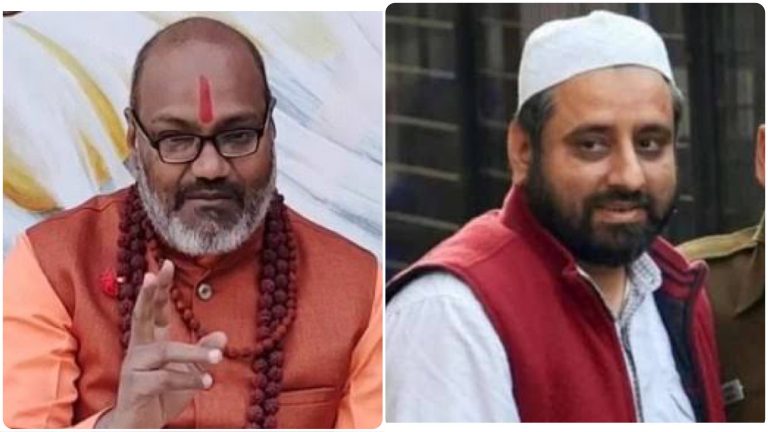
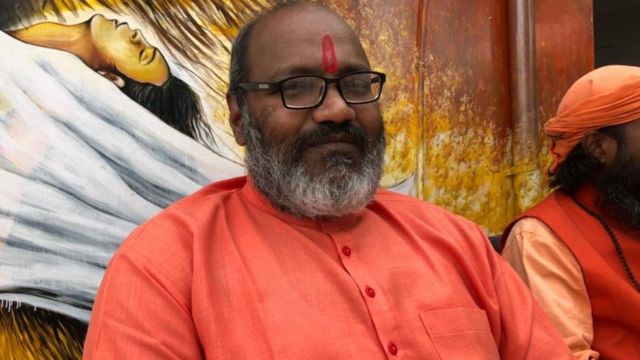
AAP MLA Amantullah Khan called for the beheading of Yati Narsinghanand Saraswati on Twitter due to alleged critical remarks the latter made against prophet Muhammad. At the time of writing this, the tweet had still not been deleted despite the platform’s pompous boasts of stern action against incitement to violence.

At the same time, there’s a conspicuous silence among journalists in the mainstream media regarding the violent threat that was issued. Whether we agree with Yati’s comments or not is irrelevant, incitement to violence is not acceptable under any circumstances. When it is an elected representative engaging in the same, it is even more troubling.

The episode, once again, brings to the fore the troubling aspects of Indian liberalism. Liberalism in India, unlike in the West, has been the strongest advocate for censorship, not free expression. Liberal icon Jawaharlal Nehru was the one who was responsible for enacting a law that all but ended free speech rights in India.

Thus, India is in a unique situation where free speech icons traditionally have been non-liberals. Yati Narsinghanand Saraswati may not endorse absolute free speech rights himself but the concerted incitement of violence against him for exercising his free speech rights has, nonetheless, turned him into an icon for the same.

Something similar had happened with Kamlesh Tiwari as well. Tragically, he had to pay with his life for his comments critical of Prophet Muhammad. On that occasion as well, liberals were hesitant to condemn the murder unequivocally and instead chose to downplay the threat of violent Islamic extremism.

Even when Kamlesh Tiwari was alive, he was jailed for the same comments. And he was imprisoned by a party that has complete support from liberals.

All of this just reveals that advocates for free speech rights are a microscopic minority in the political spectrum of India. There is an unspoken agreement across the political spectrum that absolute free speech rights is not conducive to the cultural realities of the country.

Liberals in India swear to have a commitment towards free speech rights but their conduct leaves little room for doubt that by free speech rights, they mean only the freedom to denigrate and insult Hindu Gods and Goddesses while censoring criticism of minority religions.

Hindutvavadis, on the other hand, have only now begun to have a say in the corridors of power but they recognise that absolute free speech has no major support in the country. But even so, they never advocate violence against people for speech alone.

In India, we have constitutional safeguards and limits to freedom of expression and it is these tools that Hindutvavadis use to combat speech they do not agree with. Liberals demonise Hindus for utilising the constitutional tools made available to them by liberals themselves while they justify the use of mob violence and terrorism by Islamic extremists to oppose speech they do not like. It is quite the spectacle indeed.

Thus, it has always been the case that icons of free speech in India have traditionally come from the Hindu spectrum of politics. Even prior to the advent of Narendra Modi and Amit Shah in national politics, it was the likes of Arun Shourie and Sita Ram Goel who led the fight for free speech rights.

Sita Ram Goel had trouble finding publishers for his book where he documented extensively the threats of Islamic extremist and the atrocities committed against Hindu Samaj. ‘The Calcutta Quran Petition’ remains one of the greatest contribution towards free speech in India. Until his last day, he remained strong in his commitment towards his ideals and yet, never did he receive an ounce of support from liberals in the matter.

Arun Shourie, too, was sidelined and demonised for his commitment towards the same. He wrote blistering critiques of liberal heroes and remained at the forefront of Hindutva discourse. But it was only after he jumped ship politically did he receive recognition for his contribution to public discourse.

It is truly a testament of the nature of Indian liberalism that there has truly never been an occasion where they have unequivocally supported free speech for anyone. When the Charlie Hebdo massacre happened, when the world united to condemn the violence against cartoonists, Indian liberals were at the forefront of victim blaming because the cartoons mocked the prophet of Islam.

Again, more recently, when Samuel Paty was beheaded in France, Indian liberals only paid lip service to prevalent sentiments but were extremely quick to return to the familiar trope of Muslim victimhood.

It is undeniable that Hindutvavadis may use caustic words to oppose speech they do not like, and use constitutional tools for the same purpose, but there has never been an instance where they have advocated the use of violence to achieve their end.

It is for this reason that those who have become the symbol for free speech rights in India have never been from the liberal end of the political spectrum. There is shrewd political reasoning behind the same as well.

Liberals truly believe that ‘Hindu majoritarianism’ is a bigger threat to liberalism in India than Islamic extremism. Rahul Gandhi captured it perfectly when he said that ‘Hindu extremists’ are a bigger threat than Jihadists. Therefore, in order to oppose Hindu centric politics, liberals made a deal with the devil.

Thus, we have a situation where liberals remain silent on Islamist atrocities on free speech while being careful not to offend Islamic sensibilities. At the same time, they use every opportunity they can to insult Hindu sentiments.

When the plank was abandoned by liberals wholesale, it was only natural that it would fall upon the Hindutva faction to carry it afloat. And thus, after all these years, we have Kamlesh Tiwari and Yati Narsinghanand who have becomes symbols of free speech rights in the country.
Yale professor blames Islamist attacks against Hindu temples in Bangladesh on Narendra Modi, backtracks after outrage: All you need to know

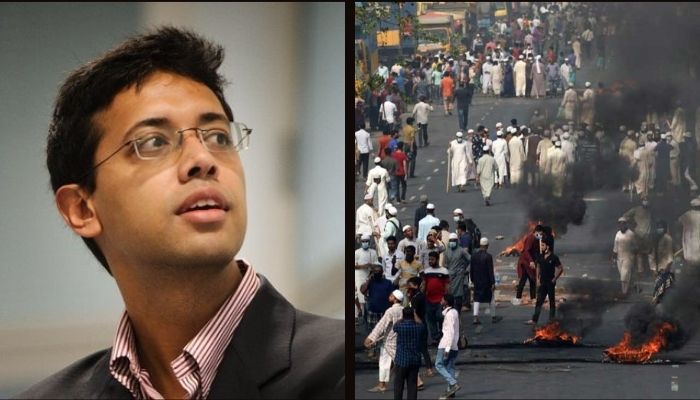
An Economics Professor at Yale University named Ahmed Mushfiq Mobarak has sparked controversy with his social media post, wherein he blamed Prime Minister Narendra Modi’s visit to Bangladesh to justify the violence committed by Islamist outfit Hefazat-e-Islam against Hindus.

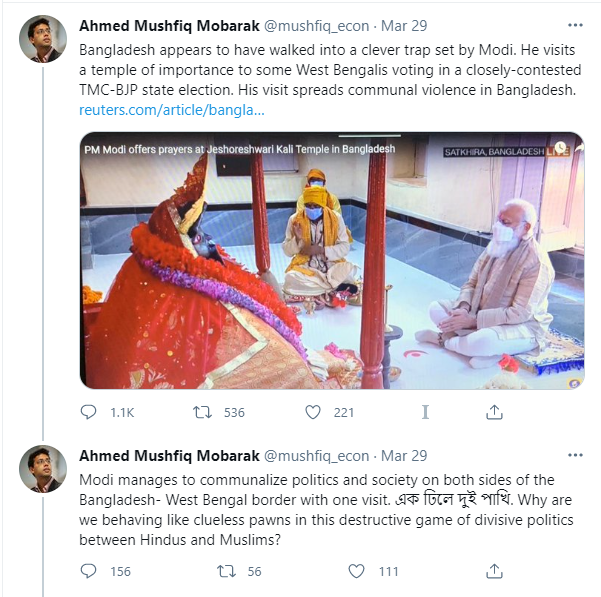
On Thursday (March 29), Mobarak tweeted, “Bangladesh appears to have walked into a clever trap set by Modi. He visits a temple of importance to some West Bengalis voting in a closely-contested TMC-BJP State election. His visit spreads communal violence in Bangladesh.” The Economics Professor tried to put the onus of the riots perpetuated by Islamists on the Indian Prime Minister.

Furthermore, he said, “Modi manages to communalise politics and society on both sides of the Bangladesh -West Bengal border on one visit. Ek Dhila dui pakhi (Killing two birds with one stone). Why are we behaving like clueless pawns in the destructive game of divisive politics between Hindus and Muslims?” The Yale Professor suggested that a supposedly polarising figure like PM Modi was responsible for communal violence against Hindus in Bangladesh.

Screengrab of the tweets by Yale Professor

After reports emerged on social media about how Hefazat-e-Islam targetted Hindu temples, the Professor turned ‘activist’ went silent on the micro-blogging platform. Following outrage by the Hindu community over the inhumane atrocities committed against them under the pretext of PM Modi’s visit, Ahmed Mushfiq Mobarak desperately tried to prove his ‘secular’ credentials.

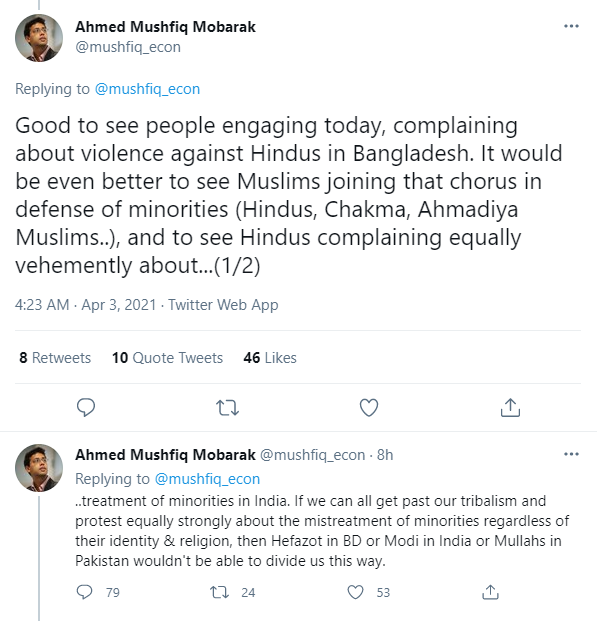
Without giving weightage to the matter at hand, the Yale Professor resorted to whataboutery and tried to draw false equivalence between Bangladesh, India and Pakistan. He wrote, “Good to see people engaging today, complaining about violence against Hindus in Bangladesh. It would be even better to see Muslims joining that chorus in defense of minorities (Hindus, Chakma, Ahmadiya Muslims..), and to see Hindus complaining equally vehemently about treatment of minorities in India.”

He further claimed, “If we can all get past our tribalism and protest equally strongly about the mistreatment of minorities regardless of their identity & religion, then Hefazat in BD or Modi in India or Mullahs in Pakistan wouldn’t be able to divide us this way.”

Screengrab of the tweets by Yale Professor

Netizens slam Yale Professor for his Islamist tendencies

Netizens, however, were quick to see through his desperate act of monkey balancing. They called him out on Twitter for displaying Islamist tendencies, maintaining a stoic silence on the ill-treatment of Hindus in Bangladesh and attempts to draw false equivalences.

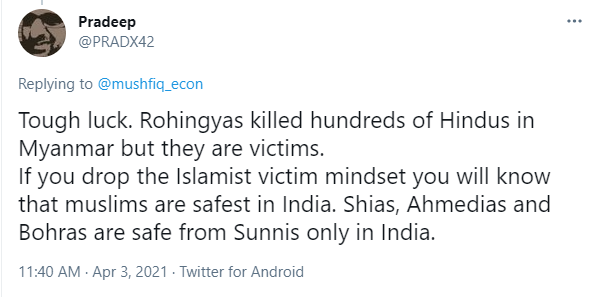
Twitter user Pradeep wrote, “Tough luck. Rohingyas killed hundreds of Hindus in Myanmar but they are victims. If you drop the Islamist victim mindset, you will know that Muslims are safest in India. Shias, Ahmedias and Bohras are safe from Sunnis only in India.”

Screengrab of the tweets

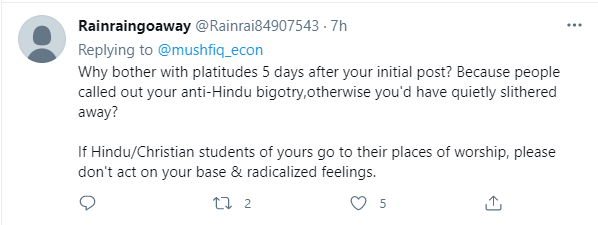
Another user pointed out the Yale Professor’s silence over 5 days. “Why bother with platitudes 5 days after your initial post? Because people called out your anti-Hindu bigotry, otherwise you’d have quietly slithered away? If Hindu/Christian students of yours go to their places of worship, please don’t act on your base and radicalised feelings,” wrote another user.

Screengrab of the tweets

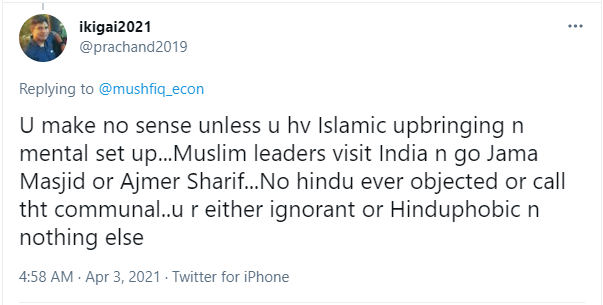
“You make no sense unless you have an Islamic upbringing and mental set up. Muslim leaders visit India and go to Jama Masjid or Ajmer Sharif. No Hindu ever objected or call that communal. You are either ignorant or Hinduphobic and nothing else,” a user pointed out the hypocrisy of the Economics Professor.

Screengrab of the tweets

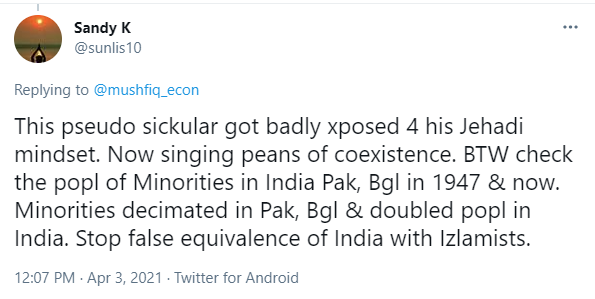
Sandy tweeted, “This pseudo sickular got badly exposed for his jihadi mindset. Now singing peans of coexistence. Btw, check the people of minorities in India, Pakistan, Bangladesh in 1947 and now. Minorites decimated in Pakistan, Bangladesh and doubled people in India. Stop false equivalence with Islamists.”

Screengrab of the tweets

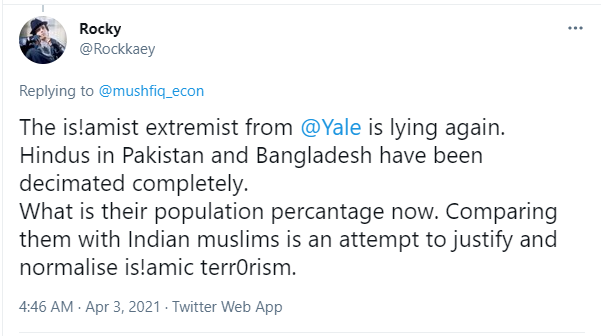
Another user wrote, “The Islamist extremist from Yale is lying again. Hindus in Pakistan and Bangladesh have been decimated completely. What is their population percentage now. Comparing them with Indian Muslims is an attempt to justify and normalise Islamic terrorism.”

Screengrab of the tweets

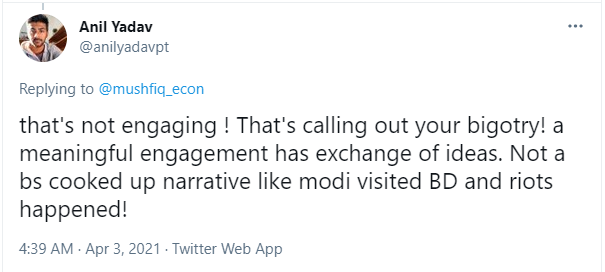
Twitter user Anil Yadav pointed out, “That’s not engaging! That’s calling out your bigotry! A meaningful engagement has an exchange of ideas. Not a BS cooked up narrative like Modi visited Bangladesh and riots happened!”

Screengrab of the tweets

Islamists attack Hindu temples, crematorium

During the official 2-day visit on PM Modi to Bangladesh, Islamists attacked Hindu Temples to protest against him. Violent protests have been underway in Bangladesh over the visit by the Indian Prime Minister and some protesters have died during attempts by the police to enforce law and order.

At the same time, three rooms of the 400-year-old Paruarkul Ashtagram Maha crematorium and Radhagobind Ashram were burnt down by unidentified miscreants in Mohammadpur Upazila of Bangladesh’s Magura district. Parts of three houses, chariots and idols were also reduced to ashes in the fire which was later brought under control.

Earlier, it was reported that Facebook services were down in Bangladesh in light of the violent protests. Border Guards have been deployed to enforce law and order on the streets. The Hefazat-e-Islami is a hardline Islamist organisation, whose members have been accused of persecuting Hindus in the past.

Islamic terrorist outfit Boko Haram claims it downed a Nigerian Air Force jet, experts remain doubtful: Details

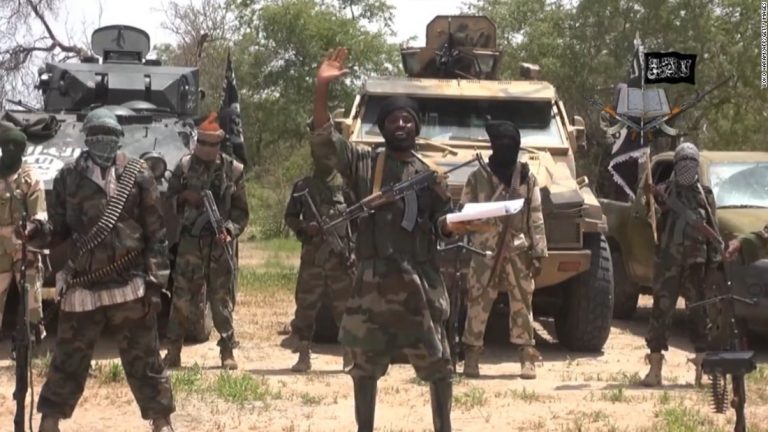
Two days after the Nigerian Air Force jet had gone missing, Islamic terrorist outfit Boko Haram released a video on Friday in which it claimed responsibility for downing a jet with two pilots on board.

A jet deployed against Boko Haram terrorists in Borno State of Northeast Nigeria lost contact with radar late last Wednesday. Air Force spokesman Edward Gabkwet disclosed the identities of the pilots but said their whereabouts are unknown.

On Friday, the terror outfit released a video of the destroyed jet and a corpse of one of the two pilots. The video was viewed by News Agency Reuters. However, it was unable to verify the authenticity of the video.

As per Reuters, the video showed the wreckage of a plane lying on the ground, with the charred fuselage bearing the phrase “NAF 475”. A Boko Haram terrorist with his covered with a mask stands atop the wreckage and identified the plane as the “jet fighter of the Nigerian Air Force 475”, Reuters said. Later in the video, a deformed corpse is shown in military fatigues.

“As you can see, this is the pilot of your aircraft, whom you sent to harm the servant of God. This is what God did to him. He fell from the sky, and if you do not repent this will be your reward,” the Boko Haram fighter says.

The footage also showed Boko Haram fighters moving along a dusty road, in gun trucks and on motorbikes. The video showed the jet exploding before it crashed.

While Boko Haram claimed the responsibility of shooting down the aircraft, experts doubt the authenticity of the claim and allege that the plane might have crashed due to some malfunction and not by the Boko Haram attack.

In a statement issued earlier on Friday, the Nigerian Air Force conjectured that the Alpha Jet aircraft (NAF475) that went off the radar with 2 crew members on board on 31 March 2021 might have crashed.

“Search and rescue efforts are still ongoing by NAF surveillance aircraft as well as NAF Special Forces and Nigerian Army troops on the ground,” its statement said. “At this point, the NAF is not ruling out anything regarding the incident. It however remains hopeful that the crew would soon be found and rescued.”

Nevertheless, the crash of the Nigerian Air Force Jet could deal a heavy blow to the country’s efforts to fight jihadist forces active in the northeast, given that airpower has so far proven to be a decisive factor in curtailing the spread of Boko Haram and its more powerful offshoot, Islamic State West Africa Province.

In 2014, a similar claim of shooting down an air force jet was made by Boko Haram. A video was released in which Boko Haram fighter claimed that an aircraft had been downed by the terror outfit and its pilot beheaded.

Since the extremist insurgency broke out in 2009, the conflict has claimed 36,000 lives in the region and displaced upwards of two million people from their homes.

‘Migrant labourers being drugged and forced to work longer as bonded labourers, used for cross-border drug smuggling’, MHA writes to Punjab govt

The Union Ministry of Home Affairs (MHA) has written a letter to the Punjab Government raising concerns on how migrant labourers from Uttar Pradesh and Bihar are being forced to work as bonded labourers in border villages of the state. The letter said that the Border Security Force deployed in the state border areas has informed the ministry that 58 Indian nationals who were apprehended were administered drugs and forced to work as bonded labourers in the state of Punjab.

“Border Security Force has informed the ministry that they had apprehended 58 Indian nationals from the border areas of Gurdaspur, Amritsar, Ferozpur and Abohar Punjab in the years 2019 and 2020”, MHA said in the letter, furthering: It’s been informed that human trafficking syndicates hire such labourers from their native places on the promise of a good salary. But after reaching Punjab, they are exploited, paid poorly and meted out inhuman treatment.”

Since it involves human trafficking, bonded labour and human rights, the MHA has urged the Punjab government to urgently address the serious issue.

The matter came to the fore after the Border Security Force (BSF) rescued a few of them. During the interrogation of these rescued labourers, it emerged that most of them were “either mentally challenged or in feeble state of mind” and had been working as bonded labourers with farmers in border villages of Punjab.

Following this, Arun Sobti, Deputy Secretary (PR and ATC), MHA, wrote a confidential letter to the Punjab Chief Secretary and the Director-General of Police on March 17, raising concerns about the same.

Speaking about the incident, a senior BSF official said that eight more such cases were reported this year.

He added, “Most of these cases were reported in the Attari block of Amritsar district. Our personnel have been apprehending labourers from Bihar, UP, Madhya Pradesh, Jharkhand and Chhattisgarh while roaming near the international border. During interrogation, it emerged that they were being exploited by the farmers. Some of them were found to be intoxicated. Most of the apprehended migrants were mentally ill. They used to tell that they were not aware where they were living.”

These migrants were not being used for cross-border drug smuggling, he clarified.

Imran Khan had approved restoring trade ties with India as Commerce Minister, but rejected it as the Prime Minister

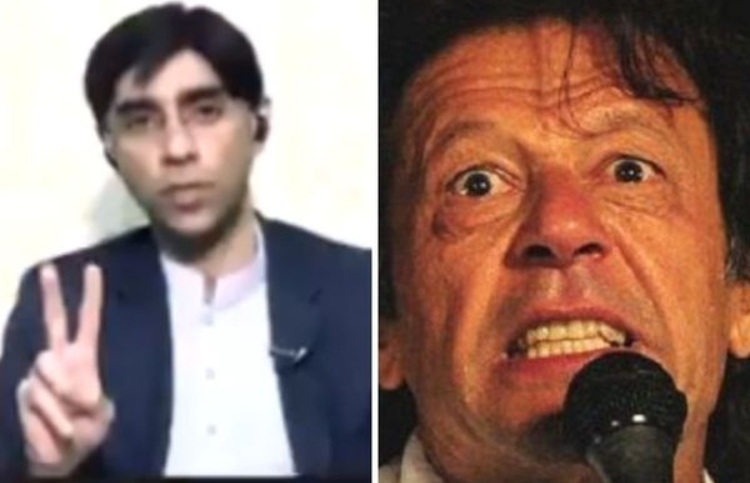
One needs a very different kind of intellect to comprehend the bizarre reasonings given by Pakistani ministers when it comes to defending their boss Imran Khan. In one such incident, Pakistan NSA Moeed Yusuf has said that Imran Khan as Commerce Minister approved a limited resumption of trade ties with India on March 26 but as a Prime Minister he opposed it.

“He may be the same persons but wears two different hats,” was the bizarre reasoning given by the Pakistani NSA when asked about Imran Khan’s flip flop on trade with India.

Speaking to a Pakistani news anchor, Yusuf termed Imran Khan’s decision as an example of the “strengthening of institutions.”

This outlandish statement came on the heels of Imran Khan’s refusal of an official proposal of the Pakistan government to allow imports of cotton and sugar from India to control prices and cope with a shortage in the country.

As per reports, as the commerce minister, Imran Khan had reviewed recommendations of the Cabinet’s Economic Coordination Committee (ECC) in favour of limited resumption of trade ties with India on March 26, and had approved the same. And six days later, the same Imran Khan rejected the proposal as the Prime Minister. A document accessed by News18 said that ‘ECC of the Cabinet is requested to approve the proposals for import of Sugar and Cotton from India’.

“The Honorable Prime Minister in his capacity as Minister-in-Charge for commerce has seen and authorized the submission of the summary to the ECC of the cabinet after adding criteria for allocation of quota to commercial importers”, the document had said, making it clear that as Commerce Minister, Imran Khan had authorised the proposal. But during a meeting of the Cabinet on Thursday (April 1), Imran Khan rejected the ECC recommendations. The Pakistan PM had said in the meeting that the restoration of trade ties with India would give a “wrong impression to the people of Kashmir”.

On Wednesday, amid the fear of shortage of input in textile production, Pakistan had decided to lift the ban and import cotton from India. There was criticism in various circles in Pakistan about attempts for better ties with India when India had done nothing to change things in Kashmir. Especially since the bone of contention for the ban was also the abrogation of Article 370 which removed all riders for Jammu & Kashmir as being an integral part of India.

A Cabinet meeting chaired by Pakistan Prime Minister Imran Khan on Thursday rejected a decision made a day earlier by the Economic Coordination Committee (ECC) of the Cabinet to allow limited imports from India. Pakistan had unilaterally suspended trade with India in August 2019 to protest the changes in Jammu and Kashmir.

Foreign Minister Shah Mahmood Qureshi had opined that there could be no normalization of ties until New Delhi reverses its decision to revoke the special status of Jammu and Kashmir.

India has, however, declined to comment on Pakistan’s flip-flop on the trade with the country.

Ajaz Khan’s interrogation leads NCB to raid at a TV actor’s residence in Mumbai’s Lokhandwala, drugs recovered

The Narcotics Control Bureau on Friday night conducted a raid at the residence of a TV actor in Mumbai’s Lokhandwala following the interrogation of actor Ajaz Khan, arrested earlier this week in connection with a drug probe. Drugs were seized from the residence of the actor in Lokhandwala.

It is being reported that the actor and a woman of a foreign nationality who lived with him left the residence minutes before the raid took place. The NCB is on the lookout for the duo.

Actor Ajaz Khan arrested by the NCB in connection with a drug probe

Earlier this week, actor Ajaz Khan was arrested by the NCB from the Mumbai airport upon his arrival from Rajasthan. Reportedly, the NCB has also conducted raids at various locations related to the actor. The agency had said that they had found alprazolam tablets from his residence during searches in the city’s Andheri and Lokhandwala areas.

The NCB officials claimed that Khan is arrested for his connection with the Batata Gang. The 4.5 grams of Alprozol tablets were recovered by chance during his house search but he is mainly arrested for his association with Batata Gang, the NCB said.

The NCB officials also contended that Ajaz Khan is a part of narcotics peddler Shadab Farooque Shaikh alias Shadab Batata’s syndicate. Shaikh was arrested last Thursday and over 2 kilograms of the banned mephedrone drug were recovered from him. Khan was arrested based on the revelations made by Mr Batata.

Khan had pleaded innocence, stating that only 4 sleeping pills were found at his home and that they were being used by his wife as antidepressants after suffering a miscarriage.

After the drug angle came forward in connection with the Sushant Singh Rajput death case, the Narcotics Control Bureau has intensified its efforts in busting the Bollywood-narcotics syndicate with extensive searches, interrogations and arrests.

How Anna Hazare’s 2011 anti-corruption movement led by Arvind Kejriwal could have helped Congress in the 2014 Lok Sabha election

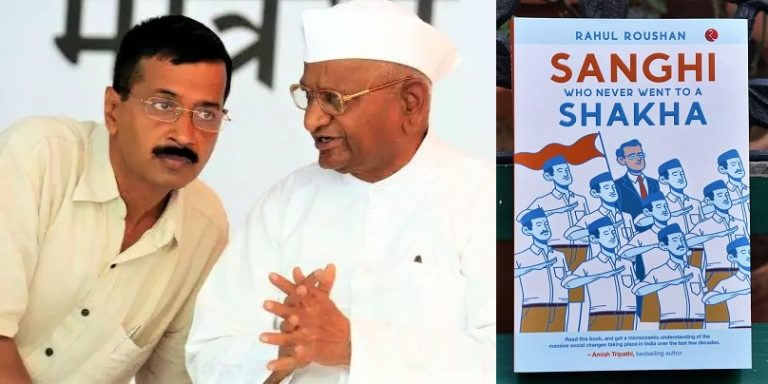
(Following is an extract from the chapter named “Hindutva vs the ‘Ecosystem’” from the book “Sanghi Who Never Went To A Shakha” authored by Rahul Roushan)

The ecosystem not attacking the Nehru–Gandhi family acerbically was seen during the anti-corruption movement too. None of the influential leaders of Team Anna, especially someone like Arvind Kejriwal, took the name of Sonia Gandhi as one of the corrupt leaders who should be kicked out.

Had Anna Hazare’s fast ended differently, say without the whole acrimony where the Congress tried to attack the movement and brand it as RSS-sponsored, it would have only helped the Congress. Perhaps, the ideal end to the entire drama would have been Rahul Gandhi promising to constitute the office of the Lokpal, and endlessly played TV visuals where he is seen offering a glass of orange juice to Anna Hazare, ending his fast-unto-death pledge.

The cases of corruption, such as 2G, CWG, coal scam, would have been effortlessly blamed on Manmohan Singh in the popular narrative, which would have been built once Rahul Gandhi became UPA-III prime minister in 2014.

A few weeks before the 2014 Lok Sabha elections, the then Prime Minister Manmohan Singh had expressed confidence that history will be kinder to him. It was virtually a farewell statement that hinted that he too knew that regardless of what happened in the 2014 elections, he won’t become the prime minister again.

And had the Congress won—and there could have been a fat chance of it winning had the anti-corruption movement ended the way I described in the earlier paragraph—history would definitely not have been kinder to Manmohan Singh. The darbari historians would have painted him as the villain to make Rahul Gandhi the hero. A rehearsal of the same was already done in September 2013, when Rahul Gandhi tore an ordinance by his own government that protected convicted lawmakers.

I have my reasons to believe that the anti-corruption movement, when it was launched, was not really aiming to pull down the Congress-led government. Swami Agnivesh, one of the original members of Team Anna, was once heard talking over the phone—purportedly to Congress leader Kapil Sibal, though he later said that it was another Kapil—where he compared his colleagues with wild elephants (mad elephant or pagal haathi to be precise).

Agnivesh was heard saying that Team Anna had lost their way and were behaving like wild elephants who were not ready to stop their onslaught. So, was Team Anna supposed to behave in a restrained manner and end their movement after a certain period of time?

Maybe they were, because a short-lived movement by the ecosystem would have helped the Congress. It would have created an environment that was against a corrupt ‘political class’, where the Congress and the BJP were to be equally seen as corrupt, thus denying the BJP any political advantage on the issue of corruption—similar to what had happened ahead of the 2009 Lok Sabha elections, where an environment was created against the political class over the issue of domestic security and not against the ruling class or party. That would have been a job perfectly done by the ecosystem, but somehow it decided to stretch it beyond the comfort of the Congress party.

It seems that the global developments around that time, especially the ‘Arab Spring’ of 2010–12, which resulted in regime changes in many countries of the Middle East and North Africa, gave a false hope to the ecosystem that they, too, could bring in such a revolution in India. If successful, it would have allowed them to rule directly, without needing the crutches and crumbs from the Congress party. Perhaps, that dream made them run amok like wild elephants, in the words of Agnivesh.

In fact, TV journalist Rajdeep Sardesai, in a viral video clip presumably recorded sometime in 2012, is heard saying in Marathi that he had advised Arvind Kejriwal to do a ‘Tahrir Square’ in India around the anti-corruption movement (Rajdeep Sardesai has confirmed the veracity of this video clip by repeating the same in his book 2014: The Election that Changed India’, Penguin Books, New Delhi, 2014). Tahrir Square is situated in Cairo, the capital of Egypt, and it had seen mass protests in February 2011, which went on to be one of the crucial events of Arab Spring. It resulted in the overthrow of President Hosni Mubarak, who had ruled for almost 30 years non-stop, before the protests broke out.

It can’t be ruled out that the ecosystem actually thought that they could pull off something similar to an Arab Spring in India too. If so, they were essentially trying to capture power directly, instead of getting a share of it via the Congress. This possible plan and desire of the ecosystem could be crudely likened to a criminal or local dada deciding to fight the elections himself, instead of lending his muscle power to some other candidate and being his sidekick.

That plan, if it existed, didn’t really fructify as Anna Hazare movement fizzled out over time. It couldn’t gather mass support like the movements in the Arab world did. Team Anna especially failed to attract any meaningful support outside Delhi. Some planned protests in Mumbai attracted very thin crowds and subsequent protests in Delhi had started losing sheen. Other parts of the country too gave very tepid response to calls for local protests. However, the passion and energy kept running high among the dedicated team and it often reflected on social media platforms.

The ecosystem soon realized, if at all it was hoping to rule directly by overthrowing the Congress in some popular uprising, that their plans were impractical. However, they didn’t lose all hope. Their desire of bypassing the Congress and capturing power directly resulted in the formation of the Aam Aadmi Party (AAP), which did exceedingly well in the December 2013 Delhi assembly elections. It gave them hope that they could make an impact in the 2014 Lok Sabha elections too, only to find out that Modi was too good for them.

[The book ‘Sanghi Who Never Went To A Shakha’ has been published by Rupa Publications (March 2021). It is authored by Rahul Roushan, an entrepreneur and media professional, and currently the CEO of OpIndia digital group.]

“You have mothers and sisters at home”, TMC candidate Koushani Banerjee intimidates locals into voting for her party

In a video that has now gone viral on social media, actress turned Trinamool Congress candidate Koushani Banerjee was seen intimidating people into voting for her party in the ongoing Vidhan Sabha polls. She is contesting from the Krishnanagar (Uttar) constituency.

While addressing the crowd at an election rally, she pulled up a man and asked, “Are you from the BJP? Come here.” At the same time, the ‘over-enthusiastic’ Trinamool Congress supporters were heard raising slogans of ‘Joy Bangla.’ Koushani Banerjee then cautioned, “Ghore sobar kintu maa bon aaacha. Vote ta bhebe dibi (Everyone has mothers and sisters at their home. Remember this when you cast your vote).”

By invoking the reference of mothers and sisters, she tried to instil fear in the minds of the people that voting for the BJP will supposedly lead to atrocities against women in their families. While it has not been explicitly stated, her statement can conversely imply that not voting for the TMC can invite the wrath of the party on the women in the society.

(Video Courtesy: Youtube/News 18 Bangla)

While hitting back at the Trinamool Congress for the comment of Koushani Banerjee, the State Unit of the BJP tweeted, “This is how she threatened the women of Bengal, this is Pishi’s (Mamata Banerjee’s) culture. The women of Bengal are definitely not safe under Pishi’s rule.”

Mamata Banerjee fear-mongers amidst ongoing polls

This is not the first time that a Trinamool Congress candidate has resorted to fear-mongering and intimidatory tactics during the campaign trail. While addressing an election rally in Falakata in the Alipurduar district on Friday, Mamata Banerjee said, “The central security personnel, who have come from outside, will try to intimidate you. Yesterday, they did in Nandigram. About 48 prior to the commencement of elections, the central security forces go to villages and intimidate people to not vote for the TMC. They warn people against voting for the TMC.”

Mamata Banerjee claimed that the central security personnel have been working in cahoots with the BJP as a part of a sinister conspiracy to defeat the Trinamool Congress. “Don’t listen to them. If they try to intimidate you, then, you must unite and chase them away with sickles, sticks and brooms,” the West Bengal recommended the people of Falakata to resort to violent means.

RTI reveals Delhi’s AAP government, despite numerous boasts, developed no new hospitals, built no new flyover from 2015-2019

The incumbent AAP government of Delhi has used its health care and infrastructure initiatives as its major electoral campaign planks. Its 2015 Assembly election manifesto promised to increase total bed strength in Delhi hospitals to 40,000 and had even said that the strength would be doubled in the first two years.

In the same year, AAP supremo and Delhi CM Kejriwal claimed that in the last four-and-a-half years, his government has built 23 flyovers. However, the reality seems far from what the AAP government in Delhi has advertised over the years.

RTI pleas filed by one Tejpal Singh revealed that contrary to the tall claims made by the incumbent AAP government, no hospital had been commissioned, nor had any flyovers been constructed in Delhi between the years 2015 to 2019. The RTI pleas were filed in 2019 to seek information about the health care and infrastructure initiatives taken up by the Delhi government in the last 5 years.

Akshay Lakra, the president of Delhi’s National Students’ Union of India (NSUI), the student wing of the Congress party tweeted the copy of the RTI replies dated 3rd July 2019.

The first reply from the Directorate of Health Services, Delhi confirmed that “as per information available in Hospital cell of DGHS, it is informed that No new hospital has been commissioned under Delhi government, during the period from April 2015 to 31st March 2019. 

Interestingly, Aam Aadmi Party’s 2015 Assembly election manifesto promised to increase total bed strength in Delhi hospitals to 40,000 and had even said that the strength would be doubled in the first two years. In the 2019-20 budget, the Delhi government had allocated Rs 7,485 crore (about 14% of the budget) to medical and public health.

However, we had also reported, how actually, the Arvind Kejriwal government had added only 394 new beds in government hospitals between 2014-2015 and 2017-2018.

Similar has been the fate of the ambitious Mohalla Clinics. AAP had promised 1,000 Mohalla Clinics, against which only 189 were opened as per a report in January 2019. AAP had then blamed the Narendra Modi led BJP government in the Centre for the delay.

Similarly, the second copy of RTI by the Public Works Department, Delhi, revealed that the department has not undertaken any flyover construction work in the national capital between April 1, 2015 to 31st March, 2019.

Interestingly, on July 16, 2019, when Arvind Kejriwal had inaugurated the 2.85 km signal-free new RTR Flyover, he boasted that under his leadership the AAP government in Delhi had built 23 flyovers in the last 4 and a half years as compared to the 70 flyovers built by the Sheila Dikshit government in 15 years.

AAP MLA Amanatullah Khan calls for beheading of Yati Narsinghanand Saraswati as ‘punishment’ for criticising Prophet Muhammad

AAP MLA Amanatullah Khan called for the beheading of Dasna Devi Temple head priest Yati Narsinghanand Saraswati for his alleged critical remarks on Prophet Muhammad.

“We can not tolerate such impertinence for our beloved Prophet Muhammad. This hateful insect should be awarded the most severe punishment by slitting his tongue and neck. But the law of the land does not permit us to do this, we have faith in the Indian constitution, and I want Delhi Police to take note of this,” Amanatullah Khan tweeted along with sharing the video of Narsinghanand Saraswati where he criticised the Islamic prophet.

Yati Narsinghanand Saraswati was speaking at an event held at the Press Club of India when he urged Hindus to be fearless in highlighting the characteristics of Prophet Muhammad.

“If Islam’s reality, for which Maulana says, ‘If you speak about Muhammad, we will behead you’, Hindus should get rid of this fear. We are Hindus. If we can about the characteristics of Lord Ram, and other Hindu deities, then Muhammad is nothing for us. Why could not we speak about Muhammad and speak truth?” Yati Narsinghanand Saraswati exclaimed.

The Dasna Devi Temple head priest further said, “If Muslims come to know the reality of Muhammad, then they will be ashamed of being a Muslim.”

Amanatullah Khan, in the past, has played the ‘Muslim card’ to defend Delhi Riots accused Tahir Hussain, claiming that the latter was being punished only because he was Muslim, ignoring the mountain of evidence piling up against Hussain. Khan himself was accused of inciting violence in Delhi on the 15th of December, 2019 during anti-CAA protests.