Home Blog Page 4532

‘Inserted her hand claiming she was planting a tree’: LGBT activist Divya Dureja accused of sexual assault under pretext of shamanic ritual

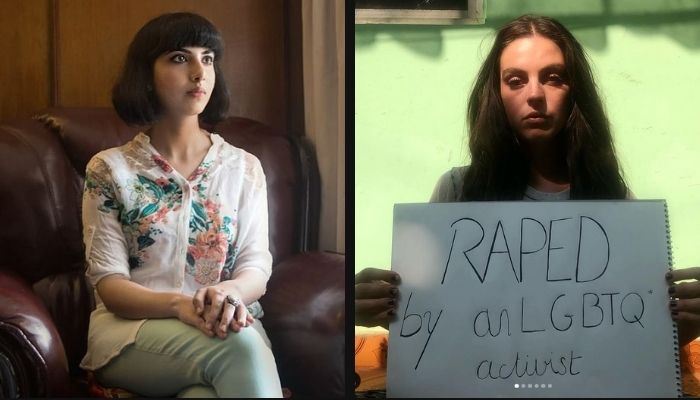
A popular LGBT activist Divya Dureja has been accused of wrongful confinement and sexual assault by a yoga trainer named Elodie Gendron.

The incident came to light when Elodie who identifies herself as a ‘queer’ took to Instagram to share her ordeal. In a post uploaded on Sunday (February 27), the victim wrote, “Last week, I was abducted, assaulted, and sexually molested by an Indian acclaimed psychologist, TEDx speaker, LGBTQ Activist, and Mental Health Advocate: Divya Dureja.” She informed that although she was initially hesitant about calling out her perpetrator online, the victim felt that the move was necessary in the larger interest of the LGBT community.

Elodie said that she was contacted on Instagram by Divya. They then decided to meet for lunch on February 23 (Tuesday), along with another friend, at Sea View Resort in Ashwem in North Goa. “Divya asked me to come to her room to help her with her hair. Under the false pretext of helping me with my chronicle back pain, she drugged me and locked me in her room for 6 hours, where she forcefully performed a so-called shamanic ritual, claiming we were meant since our past lives to be reunited, and that this ritual was what we needed to be together forever,” the victim narrated.

“After confining her in the room, Divya continued with her assault. She forced me to drink one full liter of water without interruption, to clean myself from negative energies. She then pulled me from behind forcing me to burb, yelling ‘you can do it, baby’. Following this, she obliged me to close my eyes and to stand against the wall. It lasted for four hours, and every time I tried to open my eyes, she started to scream very loudly,” the victim added.

Accused Divya digitally penetrated the victim

Under the pretext of performing a shamanic ritual, the accused went about her sexual assault. Elodie said, “I was terrified, in shock, and under the influence of the drug she’d given me. I could not move or do anything to defend myself.” After about 4 hours, the victim was allowed to lay on her bed. “She, then forcefully introduced her hand in my vagina, for long minutes, getting deeper and deeper, regardless of the physical pain she was inflicting me, claiming she was planting a tree,” the victim recounted.

FIR registered, accused in custody

She wrote, “As the effects of the drugs finally were evaporating, I told her I wanted to leave, and she screamed ‘No baby, no baby. Let’s make love.’ Finally, she started yelling ‘the spirit allows me to let you go, you can leave.’ And I could leave the room, in shock.” Elodie drove to her friend’s house in Arambol who then took her to the Pernem police station, where a First Information Report (No.33/2021) was registered. Divya was booked under Indian Penal Code (IPC) Sections 342 (wrongful confinement) and 354 (sexual assault).
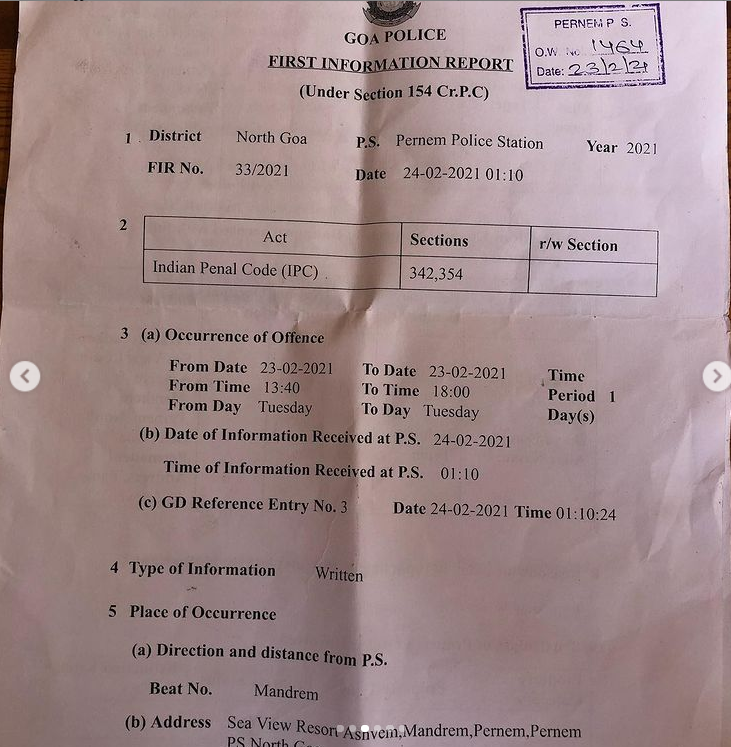
Screengrab of the FIR

The victim informed that Divya was arrested on February 25 by the police. Elodie is now recovering from the scars of the assault. Expressing her deep-seated fears, she wrote, “She’s (Divya) been arrested but I fear she will eventually be freed on bail and might assault someone else.” The victim lamented that although several waiters and even the owner heard her screams, they did not come to her rescue.

Elodie has been living in India for some time and has completed 500-hour coursework in ‘Hatha, Vinyasa & Ashtanga’ from Yoga teacher training school in AlakhYog. She was fascinated by the public profile of Divya Dureja, without realising the ‘predatory behaviour’ of the activist. Interestingly, Divya had once told Quint, “The important part is that it (lovemaking/sex) is consensual, communicative and a positive experience for all involved. At no point should there be any coercion felt or a purposely induced feeling of being ‘less/incomplete’.”
Aligarh, UP: Minor Dalit girl found dead in a field, rape and murder suspected

The Aligarh police have begun investigating the case in which a 16-year-old Dalit girl was found dead in a field in a village in Akrabad tehsil of Aligarh on Sunday, 28 February. The police have registered a case against unidentified persons for rape and murder. The body of the deceased has been sent for post mortem. While prima facie investigations suggest that the girl was strangulated, the police await the autopsy report to ascertain the real cause of death.

As per reports, the minor girl was found dead in a dishevelled condition and locals think that it may be a case of rape and murder. The Aligarh police have registered a case under Section 376 and 302 of the IPC and POCSO Act.

Giving more information about the case, Aligarh Senior Superintendent of Police Muniraj said that at around 6 pm on Sunday evening police was informed that the body of a 17-year-old girl has been found lying in the field. Following the information, the SHO, along with his police team reached the spot. He was soon joined by other police personnel including 5 station house officer (SHO) and 2 Circle Officers (CO). The officer said that the police who have formed five teams to investigate the case has sent the body of the deceased teenager, found in the Akrabad area, for autopsy.

Meanwhile, the police said that some locals have been detained for questioning and assured that they would soon solve the case.

Muniraj also said the police were investigating the allegations that the girl was sexually assaulted. “Everything will be clear when the post-mortem report is received,” he said.

Yesterday, SSP Muniraj had informed that the deceased had left her home at around 10-11 am to collect fodder for the cattle in the fields from where she went missing. The family and villagers began looking for her when she didn’t return home until 4 in the afternoon. Later they found her body in a field.

It was reported that when the police team reached the spot and tried to take the body for post-mortem, angry villagers blocked their way by setting fodder on fire and also attacked by pelting stones at them. The SHO of the Gangiri police station Pranendra Kumar was reportedly injured in the attack.

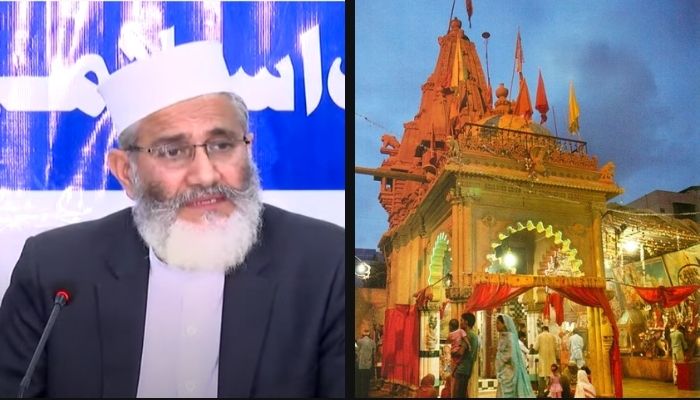
Pakistan: ‘Money of Muslims can’t be spent on building temples as per Sharia’, says Jamaat-e-Islami

During a press conference on Saturday (February 27), Jamaat-e-Islami chief Siraj-ul-Haq rejected the idea of using taxpayers’ money for constructing temples in Pakistan.

While assuming taxpayers in Pakistan to be only ‘Muslims’, Haq said that the money cannot be used against the guidelines of the Sharia and the discretion of the Muslim population in the country. At around 22 minutes into the press conference, he said, “As per Sharia, the money of Muslims cannot be used for building temples. If Hindus collect funds to build their own temple, then, it is their choice.”

The Jamaat-e-Islami chief further added, “However, using our money to build temples is not permissible. If a Minister wants to pay for the temple with his own funds, then he can do so. But the money of Muslims has to be used in a manner they deem fit.”

Video Courtesy: Youtube/ Hum News

While slamming Siraj-Ul-Haq for his comments, Pakistani Hindu activist Kapil Dev tweeted, “Siraj-ul-Haq, there are five million Hindu tax payers in this country. You make it with their money. Even if it is not approved, make it from the taxes received from buying and selling alcohol in our name. If not, the endowment department will be closed. Build from the rents of temples and gurdwaras.”

Hindu religious sites lying in a state of decay, say Pakistan SC committee

Earlier this month, the Supreme Court of Pakistan had slammed the Evacuee Trust Property Board (ETPB) for neglecting the Hindu religious sites in the country based on a report submitted to it. According to reports, a one-man commission was set up by the Supreme Court comprising of Dr Shoaib Suddle, with three supporting members namely Dr Ramesh Vankwani, Saqib Jillani and the attorney general of Pakistan.

The report said the sites had been lying in a state of decay. The commission visited the Katas Raj temples, Chakwal and Prahlad Mandir, Multan on January 6, 2021, and January 7, 2021, respectively and saw that the sites were lying neglected. A letter of the ETPB reportedly stated that out of 365 Hindu temples in Pakistan, only 13 (3.6%) were being managed by the board, 65 (17.8%) had been left to the Hindu community and the remaining 287 (78.6%) had been abandoned to the land mafias.

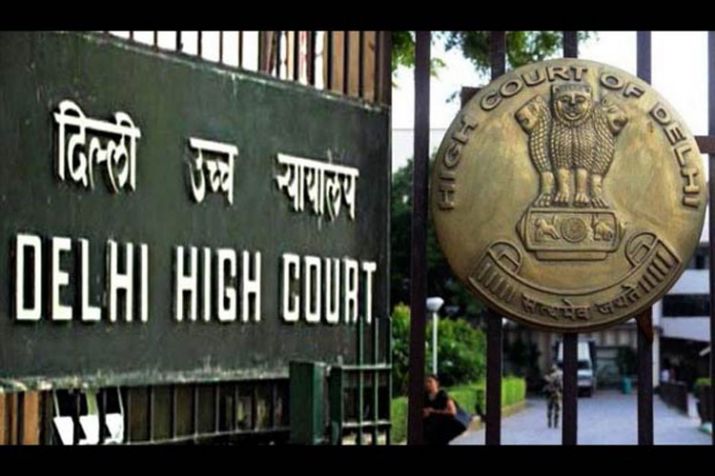
“You better withdraw the petition, warna jo kaam karte ho wo bhi band ho jaega”: Delhi HC pulls up petitioner over frivolous PIL

Courts in India are often burdened with frivolous petitions by litigants who would seek judicial recourse for each and everything under the sun. Over time, the courts have come down hard against such litigants and have even imposed financial penalties to refrain them from filing such petitions. Recently, one such petitioner who filed a petition in Delhi High Court on anticipated water supply shortage in Delhi withdrew his plea after the court questioned his locus standi in the case.

When the petitioner was unable to answer the questions raised by the Delhi Court, he offered to withdraw the plea. To this, the court said, “Yes you better withdraw it, warna jo kaam karte ho woh bhi bandh ho jayega.”

The petitioner had filed a plea seeking the court to direct the state of Himachal Pradesh to release water through Western Yamuna Canal on the basis of MOU dated 20.12.2019 HP & GNCTD, and order Haryana to facilitate this water to reach Delhi.

However, the court slammed the petitioner, asking him in what capacity has he filed the case and if he is smarter than the high ranking officials in the states who are looking into the matter.

“Who are you? In the eyes of law, who are you? You want directions to these states.. but the governments, high ranking officials are all looking into it, are you smarter than all of them? Are you the custodian of the state of Delhi?’ the bench of Chief Justice Patel and Justice Singh asked.

The court sought livelihood and bank details from the petitioner, stating that many times blackmailers approach the court.

The petitioner, in turn, responded that he is a ‘professor’ and has done work with ‘baulis’ around Delhi. The court further pressed the petitioner to reveal if he serves as a professor anywhere.

However, by now, the petitioner had developed cold feet and he expressed his desire to no longer pursue the petition any further. The petitioner asked, “Allow me to withdraw the petition”, to which the court responded: “Yes you better withdraw it, warna jo kaam karte ho woh bhi bandh ho jayega(You better withdraw it, or else what you work will also stop)”.

Delhi High Court’s Chief Justice Patel and Justice Singh held a discussion over it and decide not to impose any cost on the petitioners. “All the three states have Water Departments and experts who will handle this better than you. You’re not a super-government,” CJ Patel said after which the petition was unconditionally withdrawn.

From MEA Jaishankar to CM Patnaik: Leaders across the political spectrum join COVID-19 vaccination drive

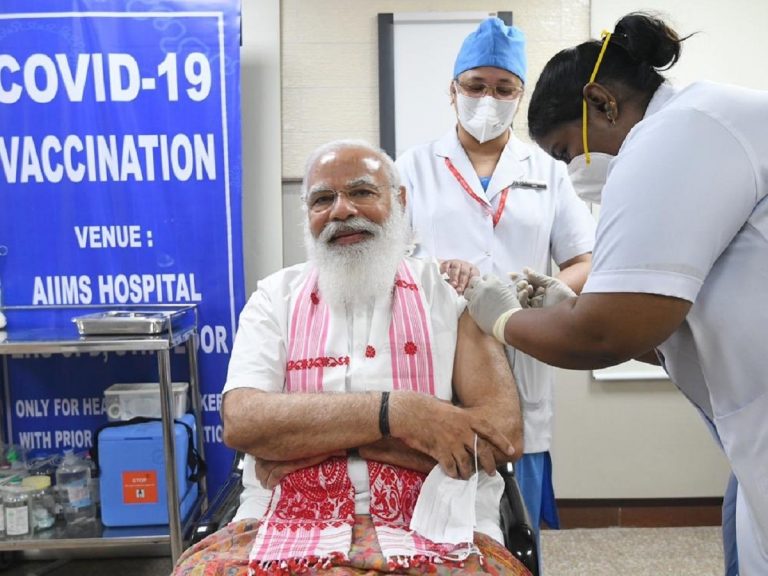
The 2nd phase of the Covid vaccine drive kicked off today, with PM Modi taking his first vaccine at AIIMS, New Delhi. PM Modi took his first dose of the Bharat Biotech’s Covaxin vaccination early morning at 7 A.M. today without much fanfare. The objective of the 2nd phase vaccine rollout is to vaccinate people above the age of 60, or above the age of 45 with co-morbidities.

The vaccines will be available free of cost at government hospitals, and will cost Rs. 250 at private healthcare facilities. PM Modi was joined by a multitude of leaders across the political spectrum participating in the Covid vaccination drive.

Odisha CM and chief of the Biju Janata Dal, Naveen Patnaik took his vaccine shot at the dispensary of the Odisha Vidhan Sabha this morning. “Happy to share that I took my first dose of #COVID19 vaccine today. Grateful to our scientists, health workers for their race against time to deliver the vaccine to people. Appeal to all eligible people to come forward and get vaccine for a #COVIFFreeOdisha,” tweeted CM Patnaik, displaying a picture of himself receiving the vaccine shot.

VP Venkaiah Naidu took his Coronavirus vaccine shot today at the Government Medical College in Chennai, Tamil Nadu. Via a tweet, the Vice President annoucned that he would taking another dose after 28 days and appealed to the the people get themselves vaccinated proactively.

The External Affairs Minister of India, Dr. S. Jaishankar took his first vaccine jab at AIIMS, New Delhi today. The vaccine administered to Dr. Jaishankar was Bharat Biotech’s Covaxin, the same vaccine which PM Modi received.

Rajasthan Governor and former Union Minister Kalraj Mishra received his vaccine at Raj Bhawan, Jaipur today amongst the company of eminent doctors. He gave his thanks to the scientists and doctors of the nation.

Dr. Jitendra Singh, a Minister of State in the Central Government, also took his his first doe of the COVID-19 vaccine today. He personally thanked the doctors who administered the vaccine to him via social media, and called for a COVID free India.

From across the political aisle, NCP Chief Sharad Pawar took his first dose of the COVID-19 vaccine at Sir Jamsetjee Jejeebhoy Hospital in Mumbai today and issued an appeal to all those eligible under the 2nd phase of the vaccination drive to get vaccinated.

Supriya Sule, Member of Parliament from Baramati, Maharashtra and the daughter of NCP Chief Sharad Pawar, also took the first dose of the COVID-19 vaccine at the Sir Jamsetjee Jejeebhoy Hospital in Mumbai today. She also spread a message affirming the safeness of the vaccine via social media and urged people to register and vaccinate themsleves.

Nepal’s Army Chief of Staff, Purna Chandra Thapa took his first dose of Made in India vaccine today. Last month, Nepal was supplied with a shipment of one million AstraZeneca vaccine doses. This vaccine is produced by the Serum Institute of India under the name Covishield. India has been providing vaccines to neighboring countries under the Vaccine Maitri initiative.

Bihar CM Nitish Kumar today took the Covishield vaccine along with both of his Deputy Chief Ministers Tarkishore Prasad and Renu Devi. The CM receieved his vaccine dose at IGIMS hospital in Patna in presence of Health minister Mangal Pandey. The CM also appealed to the people that they don’t let their guard down in the wake of COVID-19 active cases going down in the state, and continue to socially distance and wearing of masks. Bihar Government Ministers Vijay Chowdhary and Bijendra Yadav were also given the vaccine doses.

The Bihar CM also announced today that the entirety of Bihar’s populace will be vaccinated with no cost to the people. CM Kumar said that the vaccine will be available for no cost, even at private hospitals. The CM added that this entire exercise would be facilitated by the Bihar Government.  “The state will bear the expenses, in case of those who get the jabs at any of the designated private hospitals,” Bihar CM Nitish Kumar said.

This is in fulfillment of a poll promise by the NDA during the Bihar elections in 2020. The Bihar Government approved a proposal in December to provide free vaccines subject to the availability.

Phase 2 of the vaccination campaign will attempt to cover around 10 crore people, improving the total vaccinated figure from 1.45 crores vaccinations achieved during the first phase of the vaccination drive, which began on 16th January.

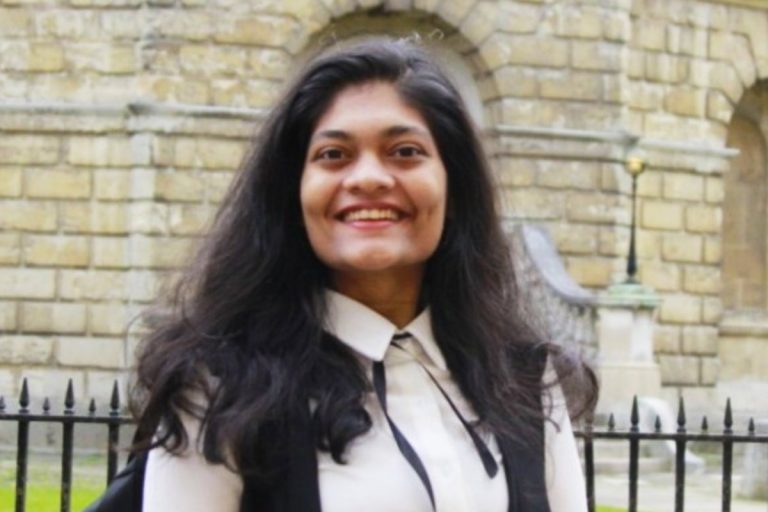
Rashmi Samant, president-elect of Oxford Student Union resigns after online attacks over her Hindu roots and old social media posts

Rashmi Samant, the woman from Karnataka who recently became the first female Indian elect of Oxford University Student’s Union, relinquished her post after being abused, bullied and targeted for being a Hindu and over her views against colonisation.

In what appeared like a coordinated attack, Rashmi Samant’s old social media posts were dredged up, accusing her of being racist, anti-semitic, Islamophobic, transphobic and even for her Hindu roots. Samant was elected to the prestigious post on February 11 and within a week, She tendered her resignation after facing a barrage of online criticism and abuse.

The controversy erupted after Cherwell, a weekly student newspaper published by Oxford, reported that Rashmi had commented on an image on Instagram of herself in Malaysia with the words “Ching Chang”, a pun involving the Holocaust. In another caption, Rashmi drew a comparison between Former Prime Minister of the Cape Colony (present-day South Africa) Cecil Rhodes and Adolf Hitler in a Student Union presidential debate. Samant was also accused of separating ‘women’ and ‘transwomen’ in a caption.

In addition, the Oxford Student Union’s Campaign for Racial Awareness and Equality (CRAE) and the Oxford SU LGBTQ Campaign also criticised the President-elect on social media for her allegedly callous social media posts and for refusing to take accountability for the same. 

Rashmi Samant attacked for her being a proud practicing Hindu

Besides the aforementioned allegations, Rashmi was also targeted for being a devout Hindu. One of the faculty members in Oxford even penned a post, dragging Rashmi’s parents into the controversy, attacking them for having a Lord Shri Ram display picture on their social media accounts while alleging that Rashmi’s student council elections were funded by Prime Minister Modi.

In a particularly vile post, the member of the Oxford University accused Rashmi of being Islamophobic by alleging that she came from coastal Karnataka, which the faculty member termed as “a bastion of Islamophobic far-right forces”. The professor also attacked Samant for her views on decolonisation and in doing so, also demonstrated the perverted understanding of the Hindu culture and traditions prevalent among many westerners.

“…Far-right Desi forces hate White people and Western modernity because they want to reinstate Sanatan Hindu “culture” with its inherent caste-based tortures and the most violent form of patriarchy. Of course, they are always ready to destroy statues of non-Hindutva people, be it Muslims or Christians or liberal Hindus,” the post read.

Rashmi defends herself, claims being Hindu and chanting ‘Jai Shri Ram’ is not a crime

Rashmi subsequently resigned from her elected position and returned to her home in the Udupi district of Karnataka but not before posting an open letter on her Facebook account after she was subjected to online bullying and cancel culture. In her letter, Rashmi described the privilege of being elected as the President of the Student’s Union at Oxford as one of the greatest honours of her life.

She subsequently also spoke about the cyberbullying she had to face for her Hindu faith and social media posts that she had posted in the distant past. Rashmi was particularly hurt by the unwarranted attack unleashed against her parents by a Faculty member and for insulting their religious sentiments and regional background in the public domain.

Defending her Hindu roots, Rashmi said, “The fact that I am a Hindu no way makes me intolerant or unfit to be the President of the Oxford SU. Contrary to this, I understand the value of diversity in its true sense, though my exposure to the intricacies of the developed world is limited.”

Rashmi then went on to explain her reason for resignation. ” I stepped down because my values taught me to be ‘sensitive’: sensitive to the feelings of the people who reposed their faith in me, sensitive to my convictions that above all we need to respect fellow human beings, and sensitive to the welfare of the student community that deserves a working SU, and at the personal level, sensitive to the effects of cyberbullying that is targeted against me in the name of ‘sensitivity!”

In an interview with India Ahead News, Samant defended herself, stating that the social media posts by her were made 5 years ago, when she was still a teenager and had not formed her convictions about the issues. She also added that the captions made by her, which were touted by many racist and anti-semitic were made in pun and not with a malicious intent to hurt others.

In her post, Rashmi had also asserted that colonisation is perceived differently by colonisers and the victims of colonisation. She wrote that she had run a campaign focusing on the habit of colonisers to impose their perspective on the indigenous people and had called for introspection of the granted notions of colonisation.

When asked about her parents being dragged into the controversy by a faculty member of Oxford University, Samant said that being Hindu and chanting “Jai Shri Ram” is not a crime and she was perturbed that her parent’s religious feelings and manifestations were openly insulted and attacked as a means to pressurise her into resigning from the post.

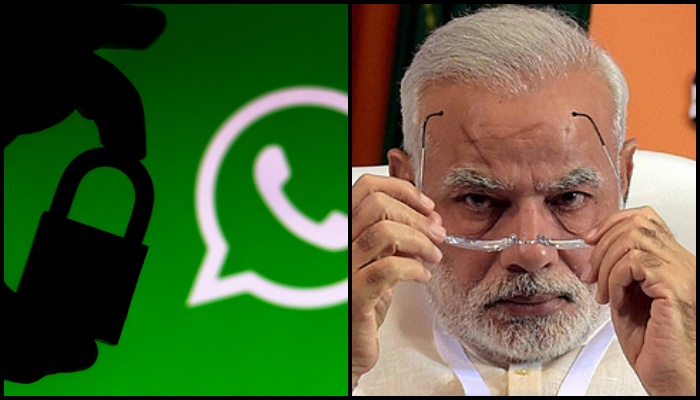
Don’t fall for propaganda! WhatsApp will not have to breach end-to-end-encryption to follow the new IT guidelines

We’re all well aware that the Govt of India has recently notified the new Information Technology (Intermediary Guidelines and Digital Media Ethics Code) Rules, 2021, also being dubbed as India’s new Social Media Code. Now that it’s finally out in the public, there have been many debates and discussions surrounding the guidelines issued. A very peculiar concern being hyped by a certain section of people is about ‘Privacy’. So, after protesting against the CAA & Farm Laws, the Aandolanjeevis are now ready to oppose the new IT Act guidelines over ‘Privacy concerns’!

Every time the Modi government tries to formulate a framework to tighten the noose around digital mischief like fake-news, misinformation, etc, the same cabal of ‘activists’, ‘journalists’ and ‘dissenters’ chime in to misguide and mislead the masses into believing that the framework somehow infringes on the rights of free speech and the right to dissent.

The same cabal had done this a while ago as well when the Modi government sought to check the fake-news forwards in 2017-18. The government had only stepped in after many cases, wherein rumours through WhatsApp forwards had led to grave crimes like mob-lynching and mob-attacks, claiming several innocent lives. At the time, WhatsApp was being used to spread rumours about child-lifting, and the fear is created led to several lives being lost.

While the Left and the usual suspects shamed the entire nation after one unfortunate lynching, several other lynchings that were a direct result of fake news being forwarded on WhatsApp, somehow, became a part of ‘freedom of expression’ simply because the Modi government wanted WhatsApp to ensure checks.

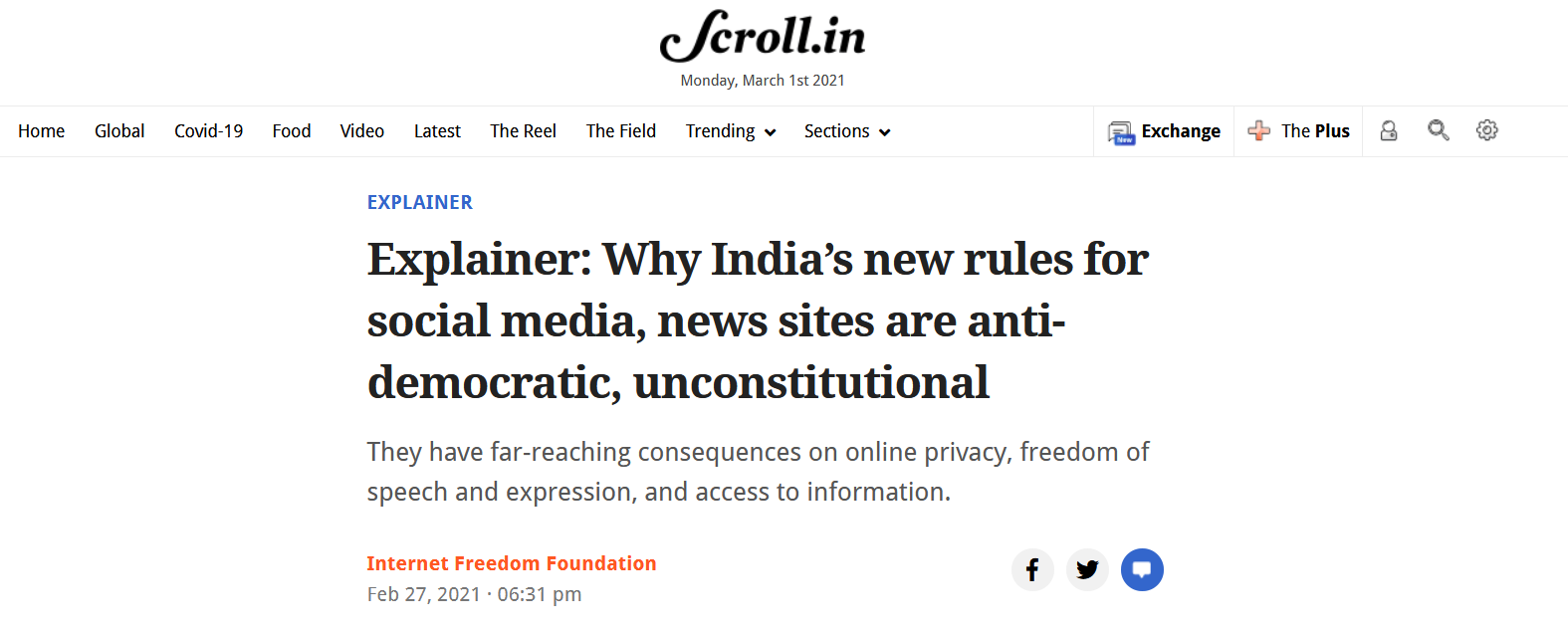
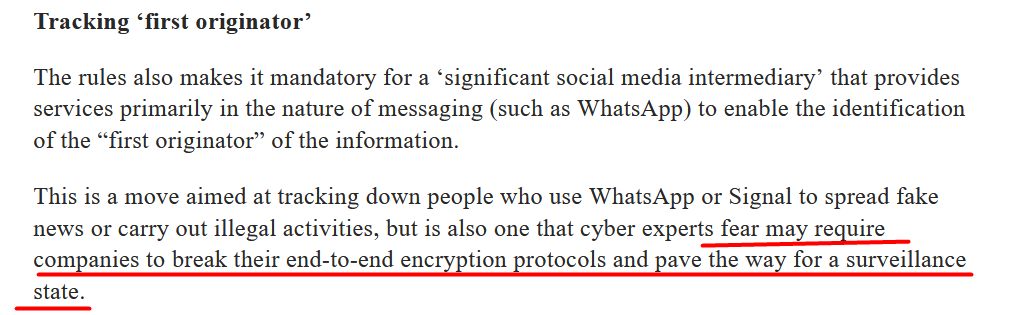
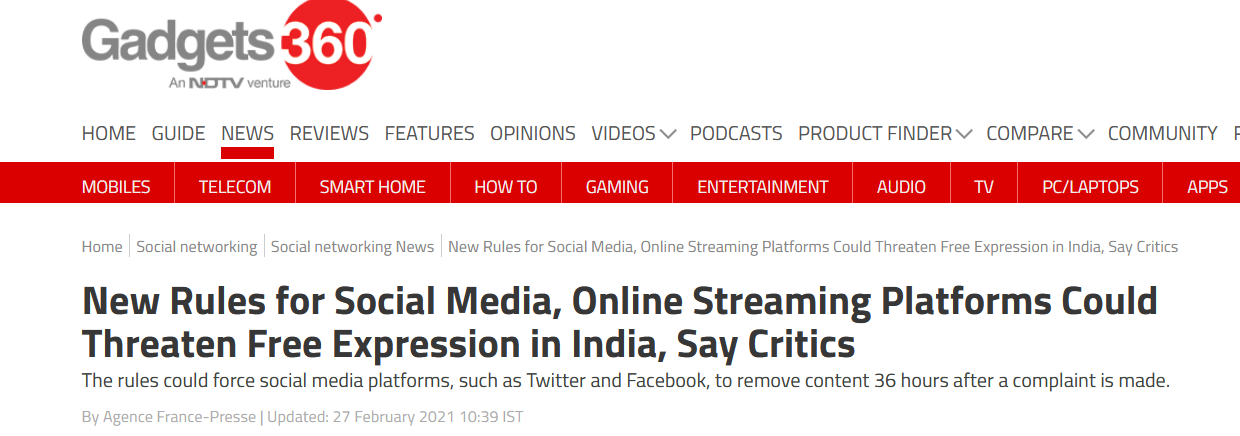
This time too, the Aandolanjeevis are back, with their same old narrative – “Modi’s India is turning into a surveillance state”; “The Modi government’s new guidelines will finish your privacy”, “Whatsapp would have to break E2E Encryption” screamed the headlines.

  • scroll.in-SM-codes
  • the-wire

It’s the same old tactic of bluffing around again and again by the same set of people, especially the left-leaning media-portals and their ‘journalists’; probably because they fear getting caught and prosecuted since most of the times they’re the ones found peddling fake-news and misinformation.

Surprisingly, even WhatsApp had tried to hide behind the same narrative, citing baseless technical limitations previously, but had later yielded, by incorporating the ‘Forwarded labels’ and ‘Forward limits’ feature, in an attempt to fight fake news, as was sought by the Govt.

The ‘privacy’ narrative is more of a vile attempt to dilute the mandate of the new guidelines. It’s not impossible to find the originator of a message despite encryption. It’s for sure a challenge, but not unachievable.

So, do these claims have any sound basis? Is it true that your privacy would get stripped off and India would then become a surveillance state?

Short answer – no.

So, what’s the reality? Let’s examine it with an example. How is that WhatsApp is able to distinctly identify messages as ‘forwarded-many-times’ (Double arrows) and ‘forwarded’ (Single Arrow) for its users? How is it that the ‘forwarded-many-times’ messages can’t be forwarded to more than 1 person at a time; while the others can be forwarded to up to 5 members at once? How does WhatsApp distinguish between such messages and operate upon them differently, for a user? Do they read your messages? Are they breaking the End-to-End (E2E) encryption?

Nope. Broadly speaking, the trick here is Metadata. Metadata, in simple terms, is data about the data. Explaining in laymen terms, metadata doesn’t contain the actual message transmitted, but has the technical info about the message being transmitted; like – headers, tokens, identifiers, timestamps, etc. Every message a user sends, has a unique identifier attached to it, which doesn’t read the content of the message but can be used to identify the message.

It’s based on such metadata that the ‘forwards’ and ‘forwarded-many-times’ messages are identified and are operated upon. And it’s on the same lines even the originator of the message can be traced to.

In fact, WhatsApp’s white paper on it’s encryption and security also explains the above mechanism in detail with all of the technical jargon.

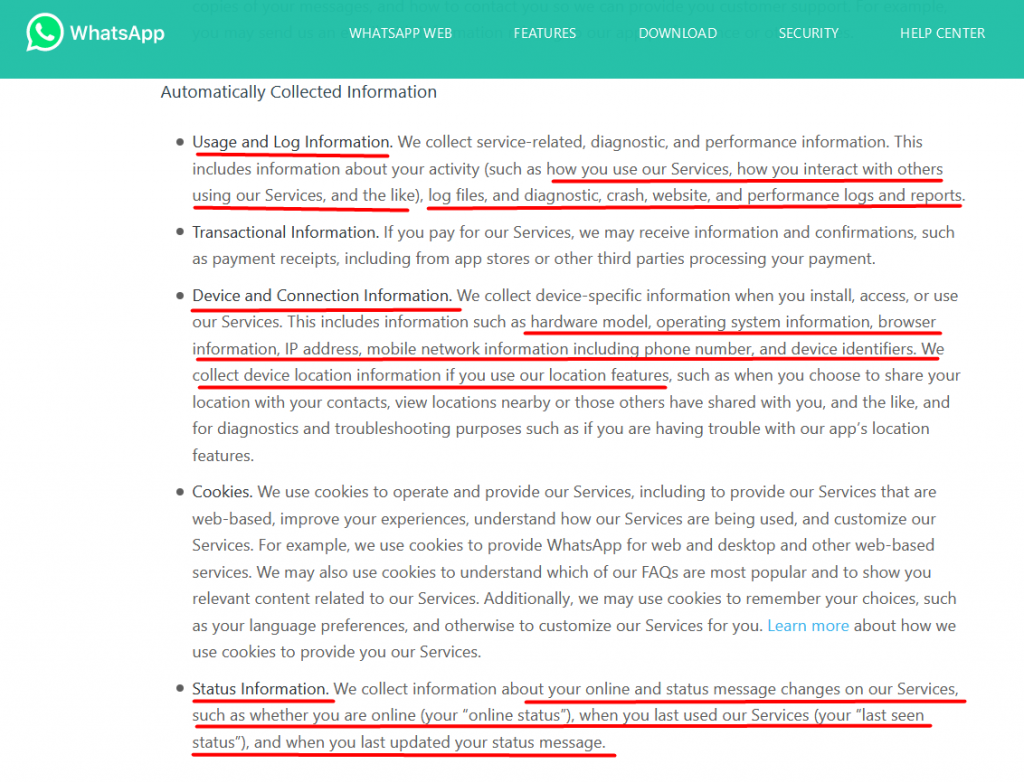
WhatsApp already has access to data like your Device details, mobile number, contacts’ numbers, last active status, profile pic, online status, IP Addresses, Network/Connection Information, etc. More details on the same is provided in their Privacy Policy.

A Screenshot from WhatsApp’s Privacy Policy

In fact, in the past, WhatsApp has also assisted the law enforcement agencies, with the metadata they have access to. One such case in an article quotes –

“..For instance, an immediate crackdown was ordered when policemen from a northern state recently approached WhatsApp about a group circulating child porn.

Without access to any user data, Whatsapp used the profile picture, group name and the fact that most members had virtually no interaction outside the group to identify and block the users”

Quote from an article stating as to how WhatsApp helped agencies nab the culprits

With the above capabilities, metadata & related information, WhatsApp like messaging apps can potentially narrow down to the origin of a message & thereby identify the originator of that message, without doing away with the E2E encryption. The integration of such a system will surely need technical brainstorming & some related changes in the app, and therefore it can be labelled as ‘challenging’ but not ‘impossible’.

There have been many studies and reports that discredit the theory that WhatsApp’s E2E encryption will need to be tampered with, in order to comply with the measures required by the Govt.

Mr. Himanshu Gupta, who was associated with Tencent’s WeChat app, published a detailed analysis in the Columbia Journalism Review (CJR) debunking the much-hyped claims of diluting the E2E encryption, for tracing the message origin & its originator.

Mr. NA Vijayashankar, a cyber-law & techno-legal info-security consultant, categorically discredits the claims of WhatsApp in an article of his, in a prominent Legal-News Portal.

In 2019, Prof. V. Kamakoti from IIT Madras member had argued on the same lines, while giving a lecture on “5G Technology from Indian Perspective at the Indian Council of World Affairs (ICWR).

It is pertinent to note that the technical approach cited in these studies & reports might differ at an individual level, but on the whole they revolve around a common conclusion, viz. – “Tracing the origin of messages is possible without diluting E2E encryption”.

In the light of the above, it would be grossly inappropriate and utterly ridiculous to believe that WhatsApp and other such messaging apps would need to dilute their security protocols in order to comply with the new guidelines and with the government’s requirements, in tackling fake-news cum misinformation.

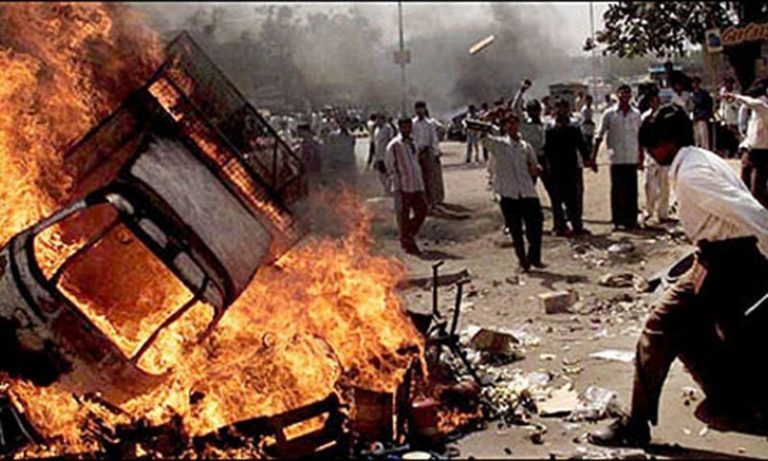
Gujarat 2002: The iconic photo(s) that were never taken and the question of ‘victimhood’

Almost everyone who has heard about the Gujarat riots of 2002 has seen the ‘iconic’ photo of the man with his hands folded. His face shrunken with fear, his eyes half watery and half looking away, as if reflecting on the brutality that fellow human beings can be capable of. The photo was taken on this day, nineteen years ago, at a locality in Amdavad.

The man who became the ‘face’ of Gujarat riots

The emotions here are primal. This is a powerful image of a human being quivering with fear. The photo raises all sorts of questions. About our humanity, about our society and the role of media in making it. And above all, questions about how we perceive victimhood. Now, there are some questions about this photograph itself; how it was taken and how the photographer managed such a perfect shot apparently in the middle of raging violence. But we will not go into the relatively small minded questions. We will focus on the big ones.

Let’s face it. In modern societies, there is a lot of power in which group gets to be the victim. We abhor the use of violence by one group to subjugate another. As such, the only way for one group of people to gain an upper hand on another is by presenting themselves as victims. Even China goes around telling the world that they are victims of India is trying to grab their land! How absurd is that?

But what does this tell you? As perverse as it may sound, it proves that in the modern world, victimhood is a very precious commodity. Everyone wants to claim it for themselves. Once you can claim victimhood, you automatically receive a number of privileges. It becomes a moral license to have your way in almost any argument.

This is what makes the media so powerful. With its reports, images and videos, the media decides which group can claim how much victimhood. This is why we need to ask about the photos from Gujarat 2002 that were never taken. Why were they never taken? Untold stories lead to forgotten victimhood. And when one group is unable to reclaim its victimhood, other groups who have proof of their victimhood are able to impose their will on them.

No, this does not mean any particular individual wants to be a victim. Who would want to have their house attacked or get burned alive by a mob? I am talking about what happens in practice. The suffering of individuals is appropriated by a larger group which then uses it to push narratives favorable to them. At one level, this is immoral, almost like one person snatching what belongs to another. At another level, it is important too. Unless groups maintain the memory of collective victimhood, how do they ensure something like that never happens again?

There is one particular controversy about Gujarat 2002 that I never understood. There is an allegation that the Gujarat government brought the charred bodies from the Godhra carnage to Amdavad and displayed them. Indian liberals accuse then CM Modi of doing this to inflame communal passions. The state government denies that such a ‘display’ even happened.

My question is this. Why is this even treated as an “allegation”? Why is it so important to liberals that nobody should even see the charred bodies from Godhra? Each of them used to be a living breathing human being before they were turned into a charred body. Why don’t they get to tell the world, at least in death, about how they suffered? Why should we be denied one last image of what happened to them?

The answer is obvious. The media wanted to bury the victimhood of one side by turning their suffering into statistics. Fifty nine people were burned alive inside that S-6 compartment. As long as there were no faces, no names and no dead bodies, it was easy for the media to wipe them out.

Not just to wipe them out, but to actually demonize them. Somebody said that the kar sevaks had harassed a woman. Somebody said that they had refused to pay for tea. How much does a cup of tea cost, by the way? Two rupees? Five rupees? Now imagine what kind of person would make excuses for burning 59 people alive by saying that somebody did not pay for tea. Could a cup of tea be worth 59 human lives?

And yet. those who made such arguments faced no public censure of any sort. Most of them lead socially respectable lives today and almost all are still in the business of ‘secularism.’

How did this become possible? Because we never got to see the names and faces of the victims. We only ever got a fleeting glimpse of their dead bodies. Their lives were never captured, whether in photographs or in news reports, for us to remember. Do you know the name of a single person who perished in that S-6 compartment? I am guessing you cannot. Meanwhile, Indian liberals still complain about the urban legend that someone, somewhere might have seen their dead bodies before these unfortunate people were lost forever.

They insist that Hindus can never be victims. They insist on hating kar sevaks as a class. And in order to achieve this, they insist that no record of their victimhood should remain anywhere. Even if someone saw their dead bodies, that was a crime too. Because if anyone heard that Hindus could be victims, then Hindus would have the moral authority to push their own narratives. They cannot tolerate that.

Each one of us here will be gone some day. As individuals, very few of us will make a lasting impact. For most, our group identity will be our only footprint that stays with the world long after we are gone. So when we lose the memory of collective suffering, our group is left powerless. When our stories fade, we cease to exist. And that is what they have always wanted.

After a massively successful Modi Para group rally, The Wire tries to peddle ‘anti-BJP’ narrative in West Bengal: Read how

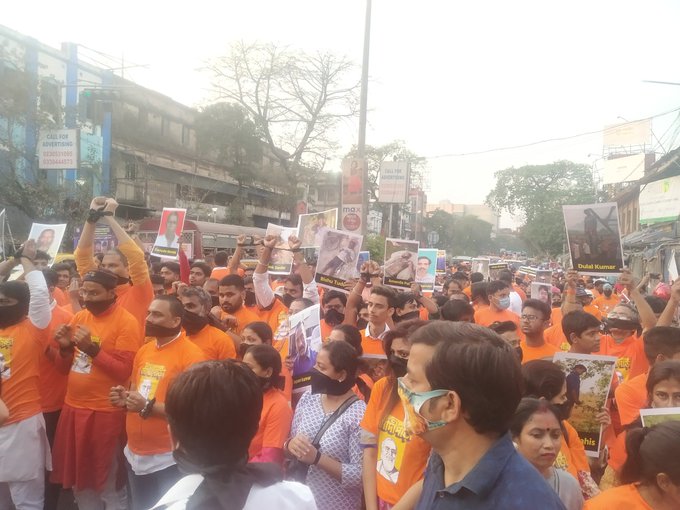
In a bid to oppose the political murders of hundreds of BJP Karyakartas in West Bengal and express their angst against the rising intolerance of the Trinamool Congress party at the behest of their supremo Mamata Banerjee in the state, the ‘Modipara’ group on Sunday conducted a rather unique march from Subhash Bhawan to Shyama Prasad Mukherjee Bhawan in Kolkata.

Though the members of the group called it a non-political march, hundreds of Karyakartas and volunteers led by BJP Leader Tejinder Pal Singh Bagga and Kapil Mishra gathered on Sunday evening to protest silently against the atrocities the Mamata Banerjee led government has unleashed over time on the BJP workers in the state.

The rally began from the Netaji House, in Kolkata’s Lala Lajpat Rai (Elgin) Sarani and ended at Dr Shyama Prashad Mukherjee Bhawan.

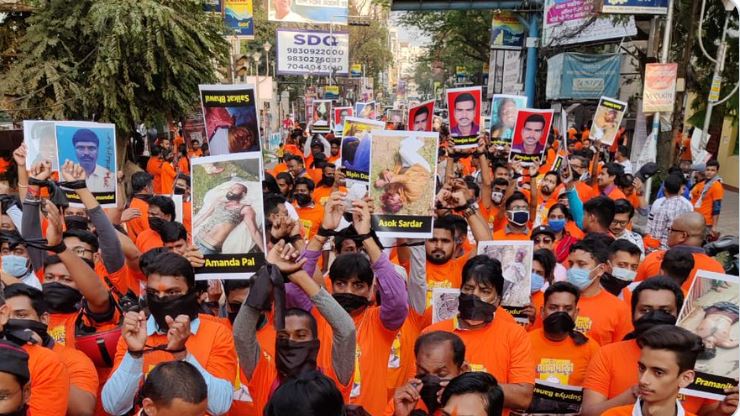
The Modipara volunteers handcuffed themselves and covered their mouth with black cloths to symbolically protest against Mamata Banerjee led TMC govt in the state, alleging that they can’t speak, can’t write fearing that TMC will kill them as they have allegedly murdered the 130 BJP cadres.

They also carried posters of the dozens of BJP karyakartas who have fallen prey to TMC’s wrath in West Bengal.

March taken out by the Modipara group in West Bengal

The Modipara group rally, which was organised to express angst against such political murders which have become the new normal in the state of West Bengal, drew hundreds and thousands of participants, making it a grand success.

Meanwhile, amidst the success of the rally, The Wire has decided to peddle the narrative that a “people’s campaign” against the BJP has gained momentum.

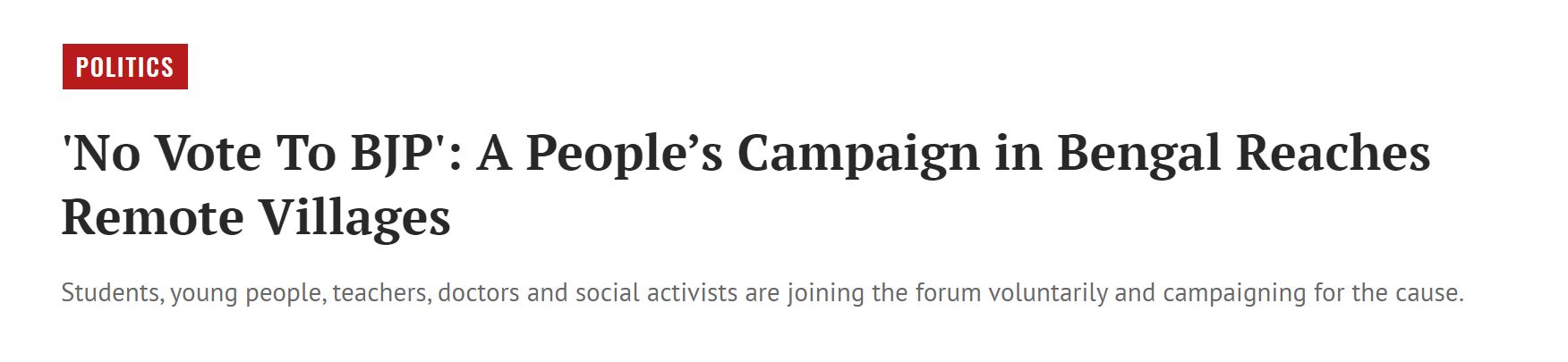
The Wire rushed to publish a report titled: “‘No Vote To BJP’: A People’s Campaign in Bengal Reaches Remote Villages”, which discussed how a campaign named “No Vote To BJP” carried out by ‘common people’ has reached remotest corners of the poll-bound state.

The report published by The Wire

It wrote how an out on bail commoner, spearheading the campaign, explained to the website that “since the 2019 parliamentary elections, BJP had unleashed an onslaught on secularism and Indian’s federal structure, sweeping attacks on the rights of minorities, systemic subversion of independent institutions and silencing of dissent”.

The Wire has gone all out to peddle the anti-BJP narrative claiming that “students, young people, teachers, doctors and social activists have been joining the forum voluntarily and campaigning for the cause”. It further claims that this forum which has 48 convenors operating from Kolkata, has reached the remotest village to campaign against BJP.

The Election Commission recently declared that the much-anticipated polls in Bengal will be conducted in eight phases, starting from March 27 to April 29. The result of the assembly elections will be declared on May 2. 

This time around, the fight is clearly between the incumbent Mamata Banerjee-led government and BJP which has been posing a big threat to the Trinamool Congress. Though the results of this high octane political drama will unfold over time, what is extremely interesting is that these self-proclaimed ‘neutral media’ houses have already picked sides and are trying their best to peddle an anti-BJP narrative in the poll-bound state.

Leftist Historian, who got the book on Delhi riots de-platformed, gives ‘activist’ Malala Yousafzai platform to propagate anti-India narrative

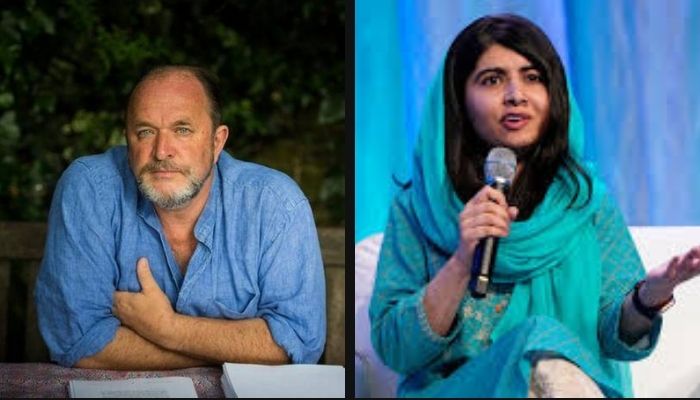
Leftist historian William Dalrymple has invited ‘activist’ and Nobel Prize winner Malala Yousafzai to the Jaipur Literature Festival (JLF), despite being well-aware of her anti-India rhetorics. Dalrymple, who serves as the Festival Director of JLF, has earlier tried to de-platform the ‘Delhi Riots 2020: The Untold Story’ books that reveal the anti-Hindu antecedents behind the rioting that took place under the garb of Anti-CAA protests in February last year.

Malala, while speaking at JLF claimed that the Muslims and Dalits are minorities in India and are at risk as they are not given the minorities’ rights. Interfering in India’s internal matter, she claimed that the Indian women and girls ‘speaking out for farmers’, climate change and protection of minority rights are ’empowering and inspiring’. It is imperative to note that the ‘climate activists’ are supporting farmers against the farm laws which aim to improve ground water levels and control air pollution which is caused due to stubble burning by farmers, mostly in Punjab and Haryana.

As per the official website of JLF, Malala is listed as a ‘speaker’ for the 2021 Edition of the event. “Malala Yousafzai is an education advocate, youngest Nobel laureate, Oxford University graduate and co-founder of Malala Fund. At age 15, she was attacked by the Taliban for advocating for girls’ education in Pakistan. She won the Nobel Peace Prize for her efforts to see every girl in school,” read the speaker description.

Screengrab of the Jaipur Literature Festival

The event, held between February 19-28 of this year, was based on the theme of ’embracing new digital paradigms with a specially curated festival experience.’

Malala’s anti-India propaganda during abrogation of Article 370

On August 8, 2019, Malala Yousufzai took to Twitter to peddle Pakistan’s false propaganda on Jammu and Kashmir about the decision of the Indian government to abrogate Article 370 that gave special status to the erstwhile state.

Again on September 14, 2019, she had resorted to fear-mongering and attempted to incite Muslims by making claims. Malala said that she talked to the people from Kashmir directly, despite having a ‘communication blackout’. She added that Kashmiris were cut off and unable to make their voices heard to the rest of the world. She claimed to have spoken to three Kashmiri girls, who said that the current situation in Kashmir was of ‘complete silence’ and all they could hear was the steps of troops outside their windows.

Furthermore, the ‘activist’ said claimed that one of the three girls told her that she could not go to school to appear for her exams that were supposedly held on August 12. As the girl missed her exams, she cried to Malala that she was now purposeless and depressed. However, August 12 was a notified holiday declared across India on the occasion of Bakr Id or Eid ul-Adha. Even on the Jammu and Kashmir General Administration Department website, 12th August was clearly marked as Eid.

Leftist-historian de-platforms book on Delhi Riots

On August 21 last year, Bloomsbury author William Dalrymple had announced on Twitter that he was working to stop the publication of ‘Delhi Riots 2020: The Untold Story’ book. Responding to a request by Congress troll Saket Gokhale to somehow stop the book, Dalrymple had replied, “I’m on it. As are several other Bloomsbury authors.”

Replying to another Twitter user with the same request, Dalrymple had replied, “Just seen this and onto it”. The leftist author had also tagged several other authors in his tweets, implying that he was requesting them to put pressure on the publishing house to pulp the book. After the book was de-platformed, writer Aatish Taseer had informed that William Dalrymple was behind the effort to prevent the book from being published.

“I’m extremely grateful to @DalrympleWill for his efforts in putting a stop to this shameful bit of state propaganda. It could not have happened without him”, Aatish Taseer had tweeted. However, the liberal agenda failed with Garuda Prakashan decided to publish the book.