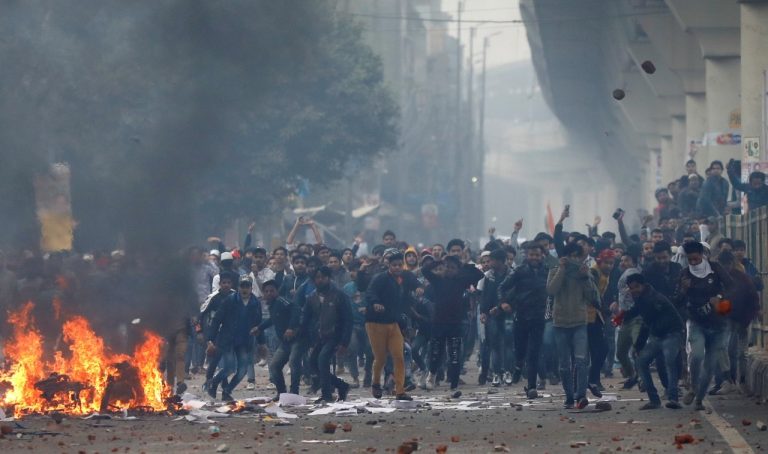
Since over the past month, a series of protests have erupted across the length and breadth of the country that saw an unprecedented turnout of one community on the roads – Muslims. The ubiquity and scale of participation of the community, especially of the women, in these protests directed against the newly enacted Citizenship Amendment Act (CAA) and the proposed NRC, has been quite striking. Muslims, wearing their religious identities on sleeves and chanting communal slogans, like ‘la-ilaha-ill-allah’, have hit the streets throughout the country daring the governments with an amorphous call to azadi – more specifically, a ‘Jinnah wali azadi’, intending to seek ‘freedom from the Hindus’ in the Jinnah style.
At times, the call intended to break India by wriggling out its chicken’s neck, as explained by a JNU student, Sharjeel Imam in a recently surfaced video. At first glance, it looks quite surprising. The Muslims have been protesting across the country against a cause that amusingly doesn’t exist. Given the level of illiteracy and awareness among the Muslim masses, one can admit that the rank and file of the community may not understand the nitty-gritty of complex legislation, yet many among the community are certainly capable of reading the law and making the truth out of it.
Many of their leaders must be knowing the truth, yet it looks surprising why they want the ignorance to persist and the lie to stay put forever. It appears that, through building a muscular mass movement, the Muslim thought-leaders are aiming at things beyond the CAA. In reality, the CAA is just the face, but the real objective of Muslims behind the unrest is something else.
Read: The Battle from CAA to JNU: Khilafat 2.0, Communist Fantasies, Petty Politics and the conspiracy of Hong Kong style protests
Is the CAA and NRC protests a test case for Indian Muslims to find their true political worth in India under Narendra Modi? Let’s examine. The Godhra incident and the riots of 2002 that followed it in Gujarat can be seen as the watershed events in the political evolution of Muslims in Indian democracy. Simultaneously, it was also a watershed period in the evolution of a new brand of activist-journalism where few media houses and journalists worked more like activists to ‘preserve’, what they called, the secular fabric of society from the emerging threats of a rightwing ‘onslaught’. These media activists dubbed Gujarat under Narendra Modi as a ‘Hindutva laboratory’ where the right-wing nationalists were set to experiment with their cherished ideals of cultural nationalism.
A new trend of activism had started emerging from Gujarat as all those opposed to Narendra Modi closed ranks in their fight against him, and they took immense pride in calling themselves ‘liberals’. These opponents, coming from different walks of life – art, cinema, literature and the civil society, apart from the media and the politics – appeared to stand in isolation but worked in close co-ordination to defeat ‘Modism’. To these neo-liberals of the post-Godhra India, Gujarat became the counter-laboratory to neutralize the surge of the Hindutva ideology.
Read: Muslim radicals set Delhi ablaze: What explains the behaviour of these Indian Muslims
The liberal cohorts chalked out a 3D model – demonize, defame and defeat – and worked tirelessly at it to sully the image of Modi and his government in Gujarat. Muslims became the eternal ‘victims’ in the BJP state and ‘justice’ for Muslims became the primary goal for all these liberals. In their competitive overzealousness to execute this 3D model, they turned blind eye to the ethos of liberalism as they took to cherrypicking of facts and displaying selective outrage on issues that divided the society in a regular way.
This reactionary model led to a strong counter-consolidation of opinions in favour of Modi, who on the strength of good governance, tough talkings and uncompromising stand on issues, became a rallying point for the majority of the people looking out for a strong leader. Thus began a cult of Modi in Gujarat that spread slowly to other parts of the country, melting the boundaries of state, languages and ethnicity. As the cult grew stronger, the defeat of the liberals grew bigger.
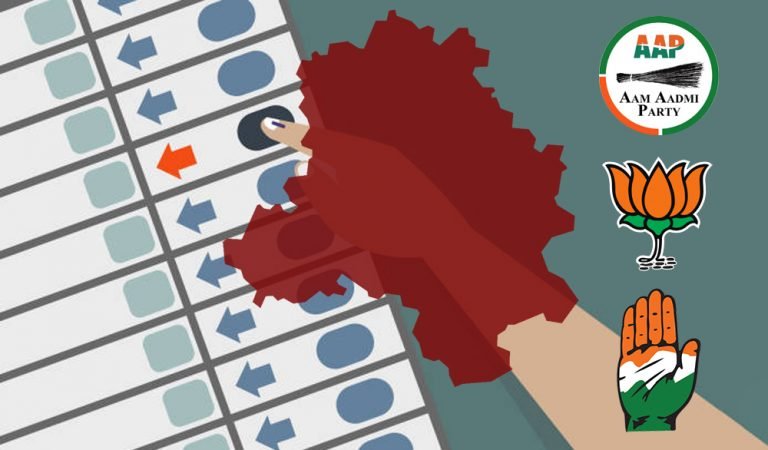
However, in the fight between Modi and the liberals, the Muslims became the sufferers as their real issues were pushed under the carpet. Although, while unable to stop the political growth of Modi on the national level, the liberal cabal had managed to evoke a perilous spectre around Modi that put permanent fear in the minds of Muslims about him. Stopping Modi, thus, became an existential question for the common Muslims. In such a scenario, the victory of Modi in 2014 and his ascendence to the throne of Delhi was a stunning event for the Muslim community. The fact that not a single member out of the 282 winnings BJP MPs in the 2014 election was from the Muslim community, was even scarier. It was for the first time in the history of India that a political party forming a government at the centre did not have a single Muslim MP. Further, 22 states and 6 Union Territories, comprising of 54% Muslim population that returns 364 MPs, had absolutely no representation in the 16th Loksabha (2014-19).
Read: Here are 20 heinous incidents of violence, arson, rioting by Muslims mobs during anti-CAA protests
The trend was already set, as Prof Christopher Jaffrelot (King’s India Institute, London) and Gilles Vernier (The Ashoka University) had, in a joint article published in the Indian Express (July 30, 2018), showed that over the span of 34 years since 1980 to 2014, just 20 Muslim candidates were put up the BJP out of who only 3 could win!
Even on the state level, the story was no different – out of total 1,418 BJP MLAs from all the states put together in January 2018, only 4 were Muslims. IN the 28 assembly elections across India till May 2019, the BJP had fielded only 22 Muslim candidates.
With zero representation in the ruling dispensation in 2014, the worst fears of the community had come true. Yet the community held its patience. The repetition of the BJP win in 2019 was even more stunning as the liberals, in tandem with a vociferous Congress and the other opposition parties, had convinced the community of a sure defeat for Modi.
But, despite all the shrill liberal noises around issues like intolerance, cow vigilantism and growing majoritarianism, the Modi win, to their dismay, came even bigger in 2019. Disenchanted with the liberals, the patience of the community had thinned out. Further, a more serious cause of the Muslim desperation is the declining political clout of the community in the post-Modi India since 2014. Representation of the Muslims in the Indian parliaments has historically remained very low. Studies say that protection of the interests of a community or a group is dependent on the physical representation of their members in the legislatures.
Read: CAA, NRC and Lessons for the Government of India from the Rohingya crisis
Political researcher Saloni Bhogale, after analysing 2,76,000 questions asked in the Indian parliament between 1999 to 2017, had concluded that Muslim parliamentarians were more inclined to ask questions that directly pertained to specific concerns of their community. Thus, with the Muslim population standing at 14.2% now, it is believed that, in order to safeguard the interest of the community in a better manner, the Muslim representation in Loksabha should ideally be in the range of 14-15%. The Muslims had won just 11 out of 489 seats (nearly 4%) in the first parliamentary elections in 1952, which peaked to a high of 49 seats (around 9%) in 1980 elections, in which as many as 30 Muslim MPs had won from the Congress party alone that formed the government.
However, the trend was again reversed in later years, as over a period of 34 years between 1980-2014, the Muslim representation in the parliament was reduced by two-third, as just 22 Muslims got elected in 2014. With a marginal increase to 26 MPs in the 17th Loksabha in 2019, the Muslim representation is hardly encouraging.
The worse part of this underrepresentation is that along with a regular decline in the share of Muslim representation in the parliament, their population went on increasing – from 9% in 1952, the Muslim population had grown to 14.2% in 2011. The population of Muslims, because of a higher growth rate, had almost doubled in just 30 years in absolute numbers between 1991-2011, and their share in the total population rose by 3% over this period, from 11.1% to 14.2%. However, over the same period, their share in parliament declined from around 7% to 4.5% (2014) – a phenomenon that is termed as ‘Missing Muslims’.
Though, under-representation of Muslims in the central legislatures is a long term phenomenon preceding the rise of BJP, the situation before 2014 was entirely different. Even though the Muslims had a minuscule presence in the parliament, they always had a strong say in the political decisions of the government. By their propensity to vote for a single party or candidate en block, the community created a sort of ‘vote bank’ within the democratic system that returned immense political rewards for them. Through a clever exercise of their vote bank, the Muslims managed to get the major political parties to dance to their tunes. As a result of it, all the successive governments since 1952 took up only those issues that the community liked, and dropped those that they didn’t like. Thus, although, the Muslims never had a considerable presence in the parliament, they always ruled in the Indian political system through proxies.
As a result of the proxy power of the Muslims in the successive governments, none of the political formations since 1952 had dared to touch contentious issues like the Common Civil Code, removal of Article 370, Triple Talaq, National Register of Citizens, 2-child policy or awarding citizenship to persecuted Hindu refugees, etc. Through a wily use of their vote bank and proxy rule, the Muslims had acquired an undeclared veto power in Indian political system since 1952. in other words, the ‘Missing Muslims’ used to express themselves through a political veto that they had appropriated for themselves through their vote bank. However, it all changed after 2014, when Narendra Modi stormed to power in Delhi making first BJP government in the centre with an absolute majority on its own.
Suddenly, the proxy rule of the Muslims and the resultant veto power was taken away because Narendra Modi was in no way dependent on the Muslim vote bank, while those making their political career on it were rendered ineffective. The vote bank had lost its clout and say in-Indian democracy.
Read: Infant’s death was ‘qurbani’ in the ‘jihad’: Shocking video emerges where anti-CAA protestor justifies using children for protests
The state of UP was a classic indicator to this phenomenon; a state with 80 seats in the Loksabha, and nearly 20% Muslim population- that goes up to 50% in pockets like, Rampur and Moradabad – couldn’t return a single Muslim member to the 16th Loksabha, whereas BJP had garnered 71 seats out of 80. Before 2014, Muslims decided the fate of candidates in as many as 20 seats in UP where Muslim populations exceeded 20% of the electorate.
Although 2019 general elections returned 6 Muslim MPs from UP to the Loksabha, a bigger victory to Modi in the parliament had made the gains virtually ineffective. Therefore, the inability of the Muslim community to stop the political growth of Narendra Modi beyond Gujarat and the tragic loss of their proxy rule and the political veto in Indian democracy were the two failures that threw the thought-leaders of the community in utter despair.
As Modi government began violating all those ‘no go’ areas of Indian politics and trampling every single forbidden zone against which the Muslims had been exercising their community veto till yesterday, the thought-leaders of the community were driven to a do-or-die situation. The anger, hatred and wrath visible among the Muslims today is precisely because of this despair that has been diligently explained to them by their leaders. Now, the Muslims feel that they’ve lost their existential battle and, in the case, they are left with no choice than what Jinnah had adopted in a similar situation in 1946 – direct action. And, Jinnah was greeted with thumping success. This explains why the Muslim leaders want the ignorance to persist in the community and the lie to stay put for ever.
Read: Into the Islamist’s mind: The role of educated Muslims in Sharjeel Imam’s ‘Plan of Action’
The ‘ignorance bomb’ happens to be a great weapon in a mass movement and the Muslim thought leaders are diligently making good use of it.
Therefore, these protest movements in universities and in those many Shaheenbaghs across the country is never about the CAA and the NRC, as admitted by Afreen Fatima, a JNU student, in a recently surfaced video; it’s also not about saving the democracy and the constitution or preserving the spirits of secularism in India – putting up Indian flags and reading the preambles of the constitution are just some of the devious facades meant to fool no one but themselves. The Muslim protest movements is all about testing their true political worth in the post-Modi India through the display of their collective might on roads.
By forcing a violent mass movement on the government, the Muslim leaders hope to pressurize the Modi-Shah duo to come to the negotiation table and force their hands into returning the Muslim community some of their privileges that they enjoyed in the Indian political order until 2014. They hope that a long and violent mass movement would deter the duo from annoying the community with further irritants, like the Common Civil Code and the Population Regulation Act.
But, given the aura of a tough customer that the duo carry around themselves, are the Muslim thought-leaders hoping for far too much?