Home Blog Page 5780

The Imperial Cholas, Part II: Uniting South India under a highly organized and efficient monarchic form of governance

The first part of the series on the Imperial Cholas can be read here.

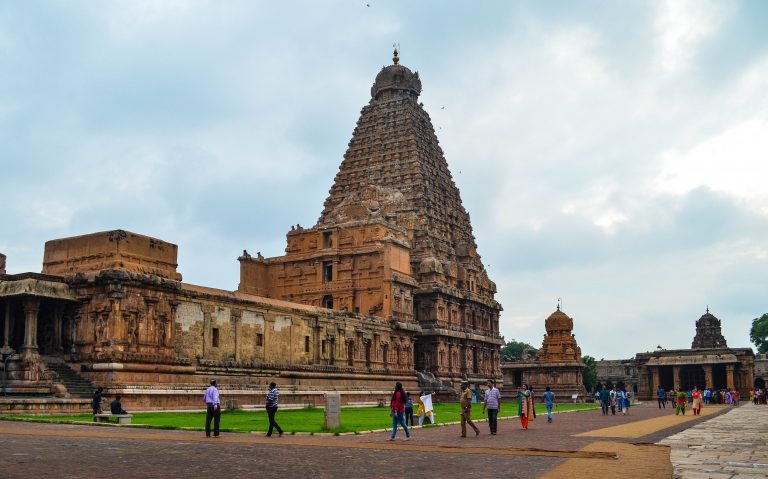
While the Cholas were historically present from the ancient times, it was mainly after the decline of the Pallavas, between 980 CE and 1150 CE, that the Chola Empire reached its zenith as the most powerful dynasty of south India. The Chola empire at that time extended across almost the whole of south Indian peninsula, and was separated from the north by the river Tungabhadra. It was primarily during the reign of Rajaraja I (985 CE – 1014 CE) that the Chola kingdom expanded from a small kingdom and took the form of a great Empire. Not only did Rajaraja I turn the Cholas into a mighty naval power, he also introduced many reforms and re-organised the administrative system. The Chola rule of this time can be studied in great details owing to the large number of inscriptions that were issued by the royal family, temple authorities, trading guilds, village councils, etc.; a practice adopted and rigorously implemented by Rajaraja I.

Before the rule of Rajaraja I, many parts of the Chola territory were controlled by independent hereditary overlords who all were in alliance with the Chola kings.  Under the orders of Rajaraja I, from around 1000 CE, a detailed form of land survey and assessment was started, which reorganised the empire into smaller units known as valanadus. Along with this reorganisation, the hereditary overlords were slowly replaced and made into dependant government officials. This process of replacing the overlords, however was a long term one, and the process which was started by Rajaraja I continued for almost a century, until the rule of Vikrama Chola (1133 CE). The removal of the overlords allowed the king to gain greater control over the entire empire. Rajaraja I also started with the practice of involving the crown Prince or Yuvaraj in various administrative works, while the other princes were placed as regional governors. While the succession was primarily hereditary in nature, sometimes the kings would bypass the Yuvaraj and choose an heir from the minor or younger princes who they thought were more suitable to rule.
Chola
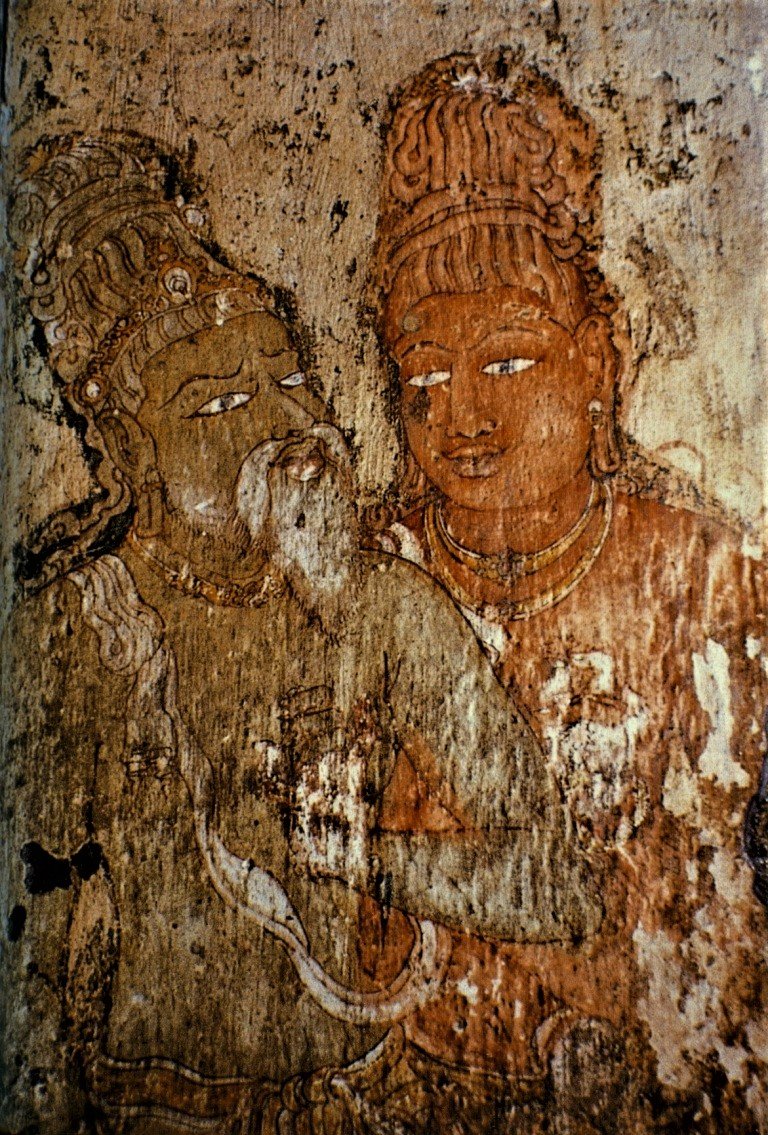
A Chola era mural, presumed to be of Rajaraja Chola and his guru Karuvurar

Among other administrative reforms brought in by Rajaraja I, the one that merits mention is the strengthening of local self-governance by giving autonomic powers to various public bodies and village councils; while at the same time bringing in a system of audit-control that made these local governing bodies accountable to the king. In Chola administration, the King was the central axle around whom the state administrative machineries revolved. The king (referred to as Chakravartigal and Tribhuvanachakravarti) was helped and guided by a council of ministers that looked after executive matters such as finances, security, and foreign affairs. To aid this council, an Enperaayam or a Committee of Eight was formed, which consisted of learned and experienced men selected by the King. The council also acted as an Appellate Court that provided justice to the subjects.

Besides these bodies, there was a well-developed secretariat that oversaw the working of the central administration. The head of each governing bodies/departments were in close contact with the King who often sought their advices. The king had a personal secretary who drafted and recorded his verbal orders. Regular royal tours added to the efficiency of the administration, and diligent officers were amply rewarded with lands, titles, and court honour. An important aspect of the Chola administration was the construction of many trunk roads to facilitate trade, army, and administrative movements.
Chola
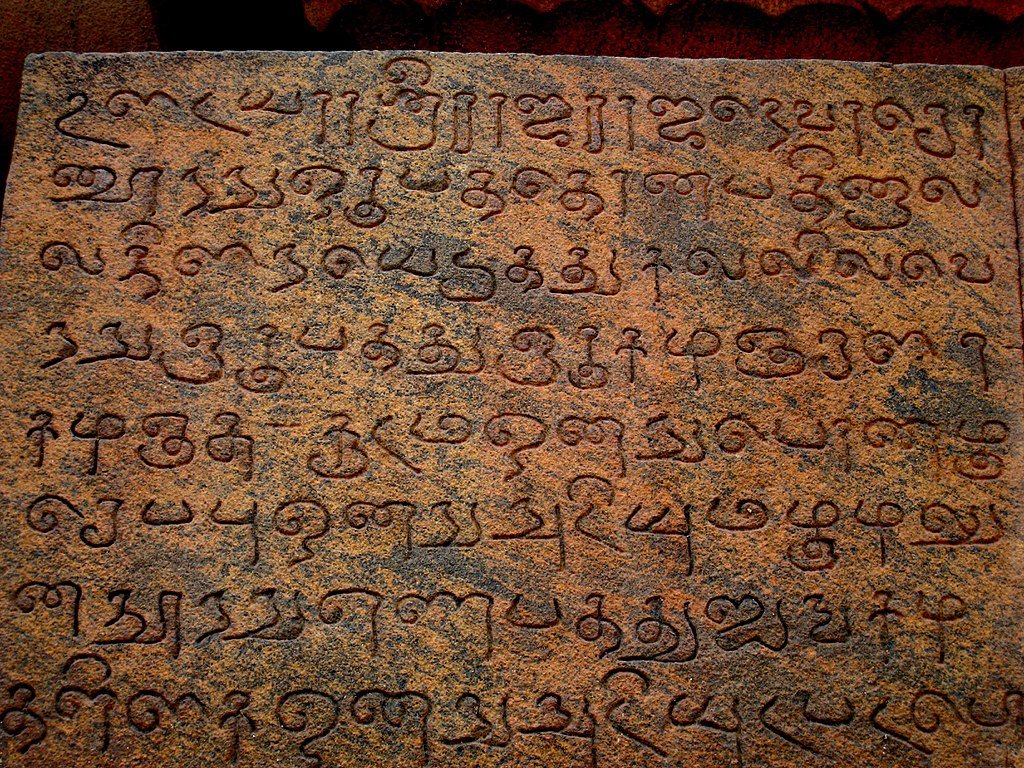
A chola era inscription (Rajaraja I )

In India, the village has always been at the core of local governance, until the advent of the British.   The Cholas were no different, and during their reign the villages formed to be the political and social units of governance. Many villages were grouped together to form districts known as Nadus, which were governed by an autonomous body called Nattar. The Chola state was divided into 9 provinces that were known as Mandalam, which were placed under salaried governors termed as Mandala mudalis. Rural governance under the Cholas followed a complex and well-organised system comprising of numerous officials and committees, as are evident from various the Chola inscriptions.

Land could be owned by an individual or communities, and tax (fixed at one-third of the produce) was primarily derived from land, both in cash and kind. Since agriculture was the main source of revenue, providing proper irrigation and water sources such as tanks, were the duties of both the state and local authorities. Besides land tax, the state also earned revenues from taxes on trade and other professions, and also from the conquests of neighbouring territories. The village assemblies that controlled local governance during the time of the Cholas were of three types: Ur (an assembly of all taxpaying landowners); Sabha (an assembly functioning in exclusively Brahmin villages); and Nagaram (a body made of local merchants and traders). Most of the governance were left at the hands of the local bodies, with the Centre interfering only when needed.

Read- Rajaraja Chola I: Conqueror, temple builder and one of the greatest emperors of India
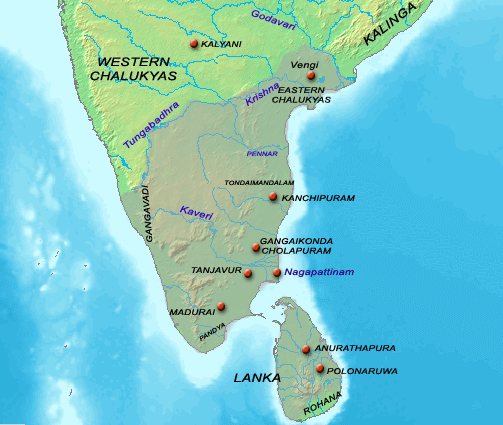
Cholas
Map of the Chola empire

Another point of interest during the Chola reign was the development of temple towns where the temples would play an important role influencing many aspects in the lives of a common man. The temples which received large donations from the kings and other wealthy patrons, were not only religious centres, but were also the hubs of various political, social, economic, cultural, and educational activities. Local assembly meetings took place in temples; and as seen from the 18 Chola era inscriptions found from a Shiva temple located at Visalur village near Keeranur (Koluthur taluk) in 2012, the temples at that time were also the centres of arts, cultural festivals, trade (often acting as banks), fairs, and various forms of charity works. The innumerable Chola inscriptions provide us with a mirror that gives a beautiful insight into the social, cultural, and economic history of medieval India.

The Cholas, especially from the time of Rajaraja I, developed a well organised administrative system that largely aimed at the welfare and prosperity of their subjects.
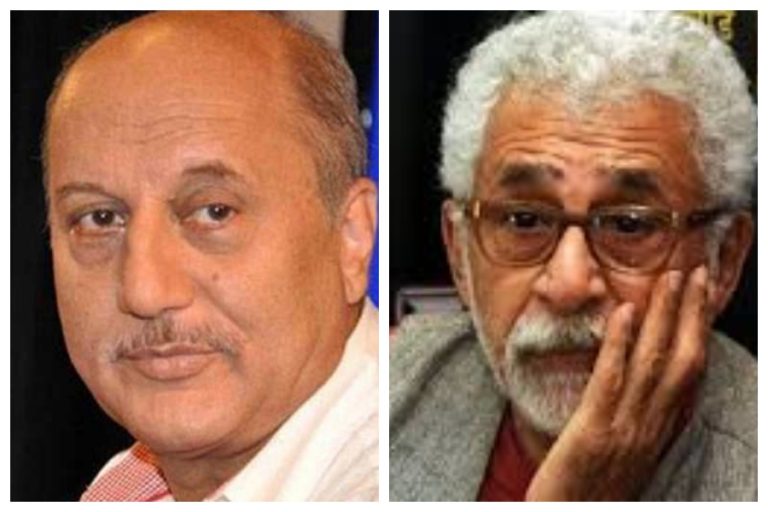
Watch: Anupam Kher gives a befitting reply to a troll, who unfortunately was Naseeruddin Shah

Veteran Bollywood actor Anupam Kher today took to Twitter to shut down a troll, who incidentally was senior actor Naseeruddin Shah with his befitting reply.

Anupam Kher shared a 1.28-minute video message for actor Naseeruddin Shah which he captioned as follows: “My love message for Naseeruddin Shah Saab !!! He is older than me even in age and in experience. I have always respected his art and will keep doing it. But sometimes it would be very important to answer a few things bluntly. This is my answer.


In his video, Kher takes a dig at Shah for calling him a ‘clown’ and ‘sycophant’ during an interview with The Wire. He said that though he respects him for his age and seniority, he has never taken him seriously. “Though I have never criticised you, today I want to reveal that you have led your entire life in frustration”, said Anupam Kher reminding his ‘A Wednesday’ co-star of his penchant to dress down his fellow co-actors. He said that if you can criticise senior actors like Dilip Kumar, Amitabh Bachchan, Rajesh Khanna, Shahrukh Khan, superior players like Virat Kohli, then I’m sure I am in great company.

He went on to remind Shah that he was not even taken seriously by any of these people then and nor is he being taken seriously now by him. Taking a subtle dig at the actor, Kher said that we all know that the intoxicating substances you have been consuming all this while have taken away your capacity to decipher between what’s right and what’s wrong.

He furthered: “If talking about me gives you the chance to make it to the headlines for a day or two, I am happy to give you this opportunity, may God keep you happy, your well-wisher Anupam”.

Anupam Kher concluded by responding to the “it is in his blood” insinuation made by Naseeruddin Shah. He said: ..and by the way do you know what I have in my blood… Hindustan (India).. just understand this much..”, said Anupam Kher.

Speaking at an interview with leftist propaganda website The Wire, Naseeruddin Shah called actor Anupam Kher “a clown and a sycophant” when he was asked about his views on Anupam Kher. Kher, whose wife actress Kirron Kher is a BJP MP, has been quite vocal about his support for the Narendra Modi government.

Naseeruddin on being asked about Anupam Kher on his pro-government stand had said, “Someone like Anupam Kher has been very vocal. I don’t think he needs to be taken seriously. He’s a clown. Any number of his contemporaries from NFD and FTII can attest to his sycophantic nature. It’s in his blood, he can’t help it.”

Earlier in November, Naseeruddin was among the 100 prominent Muslim citizens from across the country who opposed the decision and filed a review petition challenging the Supreme Court’s Ayodhya verdict, expressing the grief of Muslims but keeping the dispute alive will harm the community. He also made a controversial remark on how he feels unsafe in India due to rising communal temperament. “I feel anxious for my children because tomorrow if a mob surrounds them and asks, ‘Are you a Hindu or a Muslim?’ they will have no answer”, Naseer had said.

Interpol issues Blue Corner Notice against absconding rape accused Swami Nithyananda on Gujarat police request

0

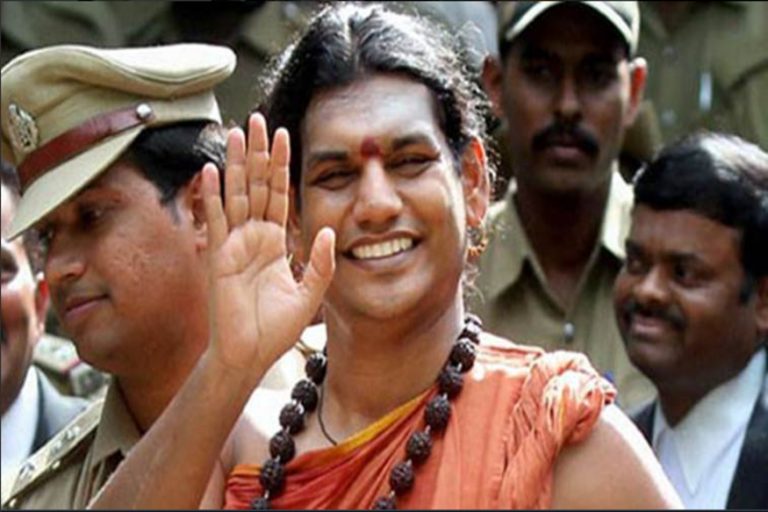
Interpol has issued a Blue Corner Notice seeking information about controversial self-styled godman Nithyananda, who had fled the country last year dodging the security agencies after a rape case was filed against him in Karnataka in June 2018.


Interpol issued the notice so after Gujarat police, who have been in relentless pursuit of rape-accused Nithyananda, requested CBI, which is the nodal body for Interpol matters in India, to issue a Blue Corner Notice against Nithyananda.

A Blue Corner Notice is issued by the international police cooperation body to collect additional information from its member countries about a person’s identity, location or activities in relation to a crime.

“Interpol issued the Blue Corner Notice against the controversial godman this month,” Deputy Superintendent of Police, Ahmedabad (rural), KT Kamariya said, adding that now the police are working to get Interpol to issue a Red Corner Notice, a global arrest warrant, against Nithyananda.

The Gujarat police had registered an FIR against Nithyananda after two girls went missing from his ashram in Ahmedabad in November last year. The ‘Swami’ was charged with kidnapping and wrongful confinement of children to make them collect donations from followers to run his ashram in Ahmedabad. Nithyananda was earlier declared wanted by the Gujarat Police.

Read- Swami Nithyananda flees India after being booked for kidnapping and abusing minor girls

In December last year, the Ministry of External Affairs had confirmed that the self-styled godman’s Indian passport has been cancelled. MEA spokesperson Raveesh Kumar attending the regional media engagement of the MEA had also confirmed that no agency has yet approached the Ministry with information on the whereabouts of Nithyananda, who is absconding.

Calling the claim of rape-accused Nityananda of forming a new country – Kailaasa through his website, ‘bizarre’, Raveesh Kumar had then said: ‘You can’t form a nation by creating a website’.

Nithyananda, who is over 40 years old, is a native of Tamil Nadu and his real name is Rajashekharan. He had set up his ashram at Bidadi on Bengaluru-Mysore highway almost 20 years ago. Nithyananda, who first hit the national headlines for his alleged video in a compromising position with an actress in early 2010, has been a highly controversial figure. In June last year, a Karnataka court had framed charges against Nithyananda in a rape case. Since then the self-styled godman has been untraceable.

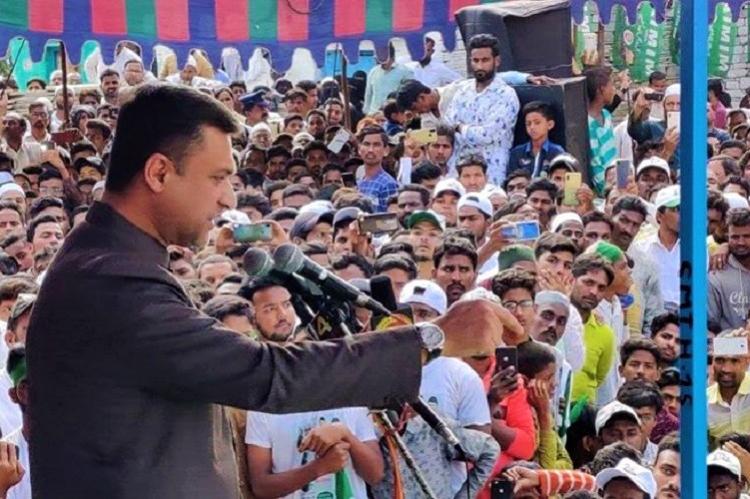
“I would like to ask the Prime Minister of India, what has your father built?”: AIMIM leader Akbaruddin Owaisi’s controversial remark

Firebrand politician, infamous for his “15-min” hate speech inciting violence against Hindus, Akbaruddin Owaisi has made yet another controversial remark while speaking over the CAA-NRC row. Glorifying the Muslim invaders, the junior Owaisi said that the proof that Muslims belong to India is the 800 years of Muslim rule over India.

[youtube https://www.youtube.com/watch?v=VjJLQkwq6q8?start=9]

The communal remark was made by Akbaruddin Owaisi in a political rally in Hyderabad ahead of municipal elections in Telangana. “Muslims are asked to furnish documents to prove their citizenship. I want to tell them that my co-religionists have ruled this country for 800 years. We(Muslims) have controlled and reigned over this country for 800 years. That’s the proof. This country is, shall and always be ours,” Akbaruddin exclaimed.

While exalting the central Asian Muslim marauders who invaded and plundered India for centuries, Owaisi derided PM Modi asking him if his father had built anything in the country as his ancestors did.

“My ancestors have built Charminar, they constructed Mecca Masjid(Hyderabad) as well as Jama Masjid. Qutub Minar was built by them. Even Red Fort, on whose ramparts Prime Minister of this country stands and addresses the nation was built by them. If you are asking for documents from me(Muslims), see Charminar that’s built by my ancestors, not yours. I would like to ask the Prime Minister of India, what has your father built?”

Earlier too, Akbaruddin has been accused of making inflammatory and contentious statements. In 2012, Akbaruddin had dared the central government to remove police for 15 minutes to wipe out 100 crores Hindus in India. In July 2019, Akbaruddin recalled his “15-minutes” remark while launching a scathing attack against the RSS.

Mumbai police denies permission to people to gather in support of Yogesh Soman, Mumbai University professor who was sent on compulsory leave for criticising Rahul Gandhi

Maharashtra’s Maha Vikas Aghadi government has pledged to silence any and every voice that is raised in dissent. Recent example of such silencing happened when Mumbai police denied permission to a group of citizens who wanted to gather in support of Yogesh Soman, a Mumbai University professor who was sent on compulsory leave.

Yogesh Soman, director of Mumbai university’s academy of theatre arts had posted a video criticising former Congress president Rahul Gandhi over his contemptuous remarks on Veer Savarkar. After this, student organizations like NSUI, AISF, Chhatra Bharati had demanded that action must be taken against Soman for this video. Succumbing to the pressure from these organisations and the Maha Vikas Aghadi govt, University administration sent Soman on compulsory leave and assured that an enquiry will be initiated against him.

This action left the right thinking citizens in shock and anger. Many came out in support of Soman on social media.

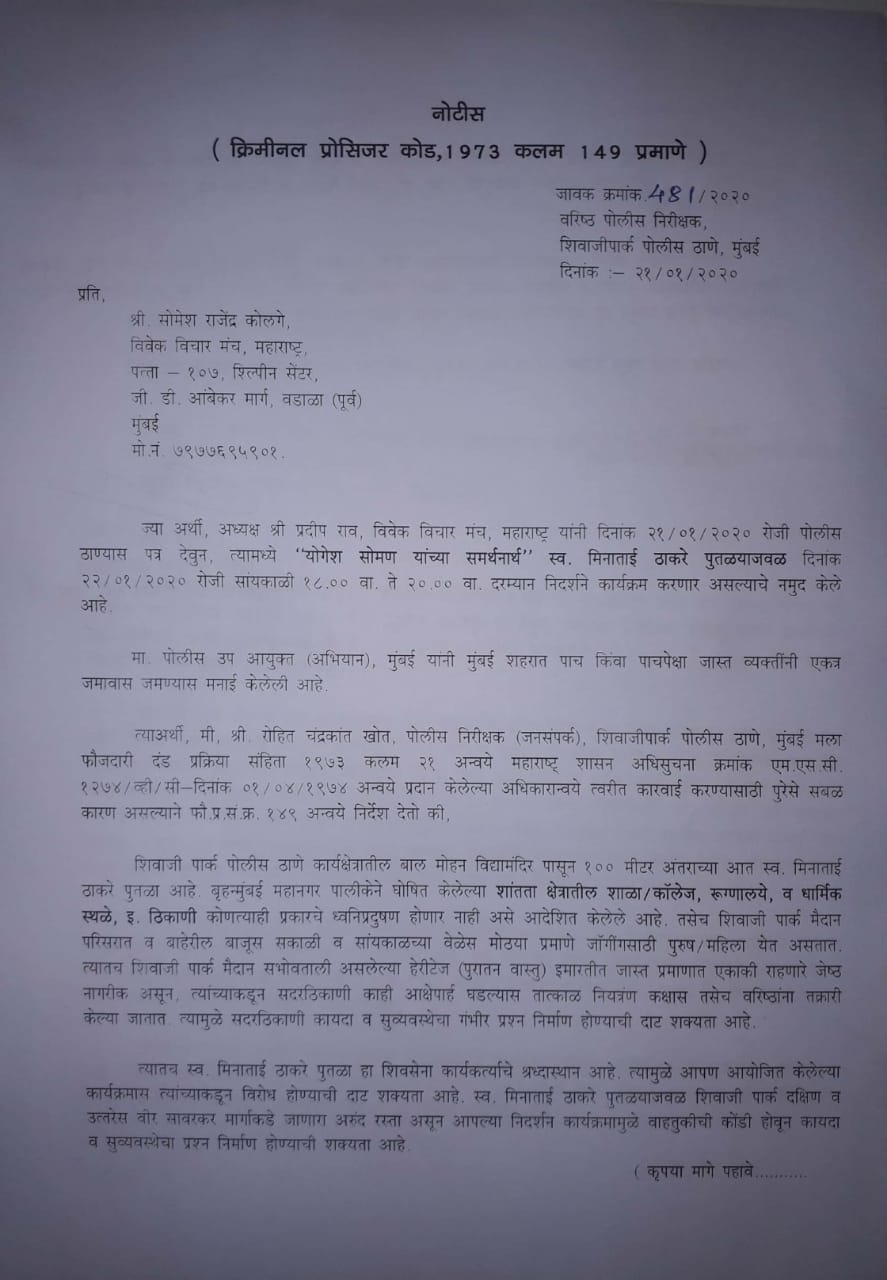
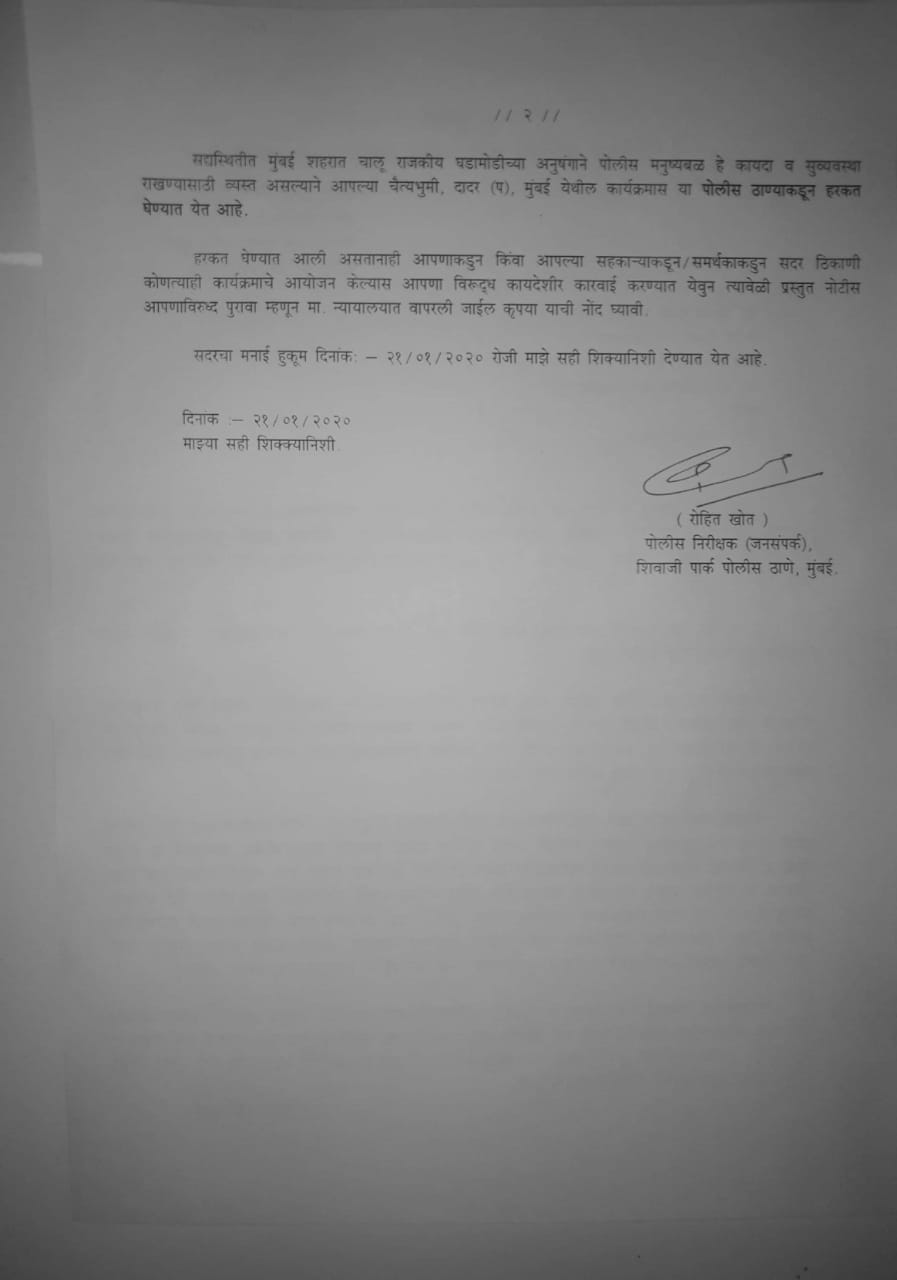
A meet was organised by Vivek Vichar Manch in Mumbai’s Dadar on 22 January to express solidarity with Soman. The organizers went to Shivani Park police station in Dadar to seek permission for this meet. The concerned police authorities rejected their application and denied permission for holding this meet. The police served the organisers with a notice u/s 149 of the CrPC and threatened to register complaints against organisers and participants if the meet is held after such denial.

Police letter denying permission (part 1)
Police letter denying permission (part 2)

In the notice, among other reasons for denying permission the police cited one reason that the meet is scheduled to take place in front of Late Meenatai Thackeray statue and this statue is a matter of faith for karyakartas of Shiv Sena. There is a possibility that Shiv Sena karyakartas would thus oppose or disrupt the meet.

It is unfortunate that a professor is sent on compulsory leave only for the reason that he dared to speak against Rahul Gandhi. It is even more unfortunate that common citizens who wished to express their support to the professor using constitutional and peaceful methods were threatened by the police. Is the Maharashtra police under such political pressure that they are not letting upright common citizens to express dissent? Uddhav Thackeray’s Shiv Sena is abusing power and using the police machinery against its own citizens. Killing democracy in their own state and accusing Modi govt for being fascist is the Shivsena way of politics. The night that is this Thackeray sarkar is dark and full of terrors for Maharashtra.

“Chalo Ayodhya”: Shiv Sena’s Sanjay Raut tweets as Maha CM Uddhav Thackeray completes 100 days in power, invites Rahul Gandhi

Motormouth Shiv Sena leader Sanjay Raut announced on Wednesday that Maharashtra Chief Minister Uddhav Thackeray will visit Ayodhya to mark the completion of a hundred days in power.


Raut said that Uddhav Thackeray will seek the blessings of Shri Rama and has urged his alliance partners to come along.


Raut’s appeal to his alliance partners appears to be a subtle dig at the Congress party who have been trampling over the Shiv Sena ever since the government was formed. Raut’s comment that Rahul Gandhi ‘visits several temples’ comes across as a thinly-veiled mockery of the former Congress President’s periodical Temple Run.

The Shiv Sena leader’s excitement was palpable on Twitter as well where he gave the slogan of ‘Chalo Ayodhya’. The slogan is closely associated with the attempts made by Hindutvavadis over the years to reclaim Ram Janmabhoomi.

The planned visit by Uddhav Thackeray is a not-so-subtle attempt by Shiv Sena to emphasize its Hindutva credentials. It comes only days after senior Congress leader and former Maharashtra CM Ashok Chavan had admitted that the Congress party had entered the alliance after approval from the Muslim community.

The Shiv Sena and the Congress party have also been at loggerheads over the legacy of Vinayak Damodar Savarkar. Only on Saturday, Sanjay Raut had advised the detractors of Veer Savarkar to spend two days at the Andaman Cellular Jail in an obvious dig at the Congress party and its former president Rahul Gandhi.

Not too long ago, Sanjay Raut had triggered a massive controversy when he revealed that former PM Indira Gandhi used to visit Karim Lala, one of the three most powerful underworld dons of Mumbai. Raut’s remark had sparked massive outrage from the Congress party following which he was forced to retract his statement.

JNU RTI reply said no server room at main gate so no damage there, media spreads fake news claiming server room was not damaged

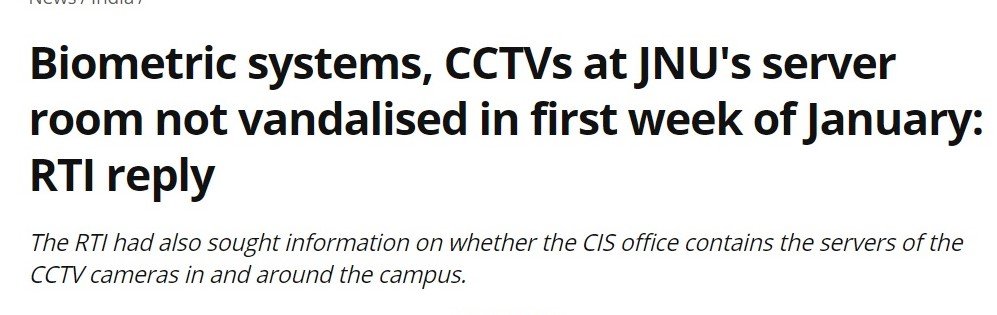
The Jawaharlal Nehru University has issued a clarification amidst media reports claiming that a reply to an RTI punctured holes in the administration’s version of events with regards to what happened at the university campus in the first week of January. The JNU administration said that the reply to the RTI was related to the specific location as mentioned and all the information mentioned in the FIR and other complaints are in line with facts.

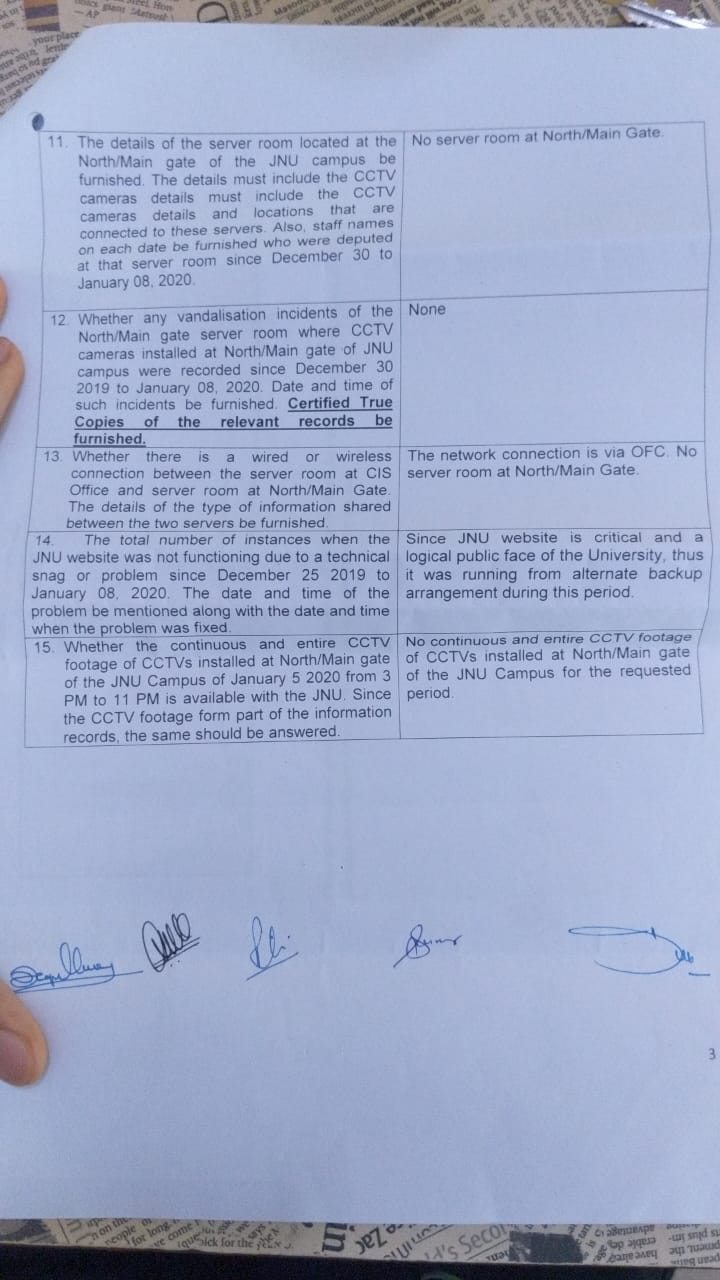
The RTI query had asked about vandalism at CCTV server room at North/Main gate of the JNU campus, but as there is no such server room at that place, the RTI had replied ‘None’ to the question about the vandalism at that server room. But this reply was taken out of context by media houses to claim that the RTI reply does not match with FIR filed in the case, and no server room was damaged at the JNU.

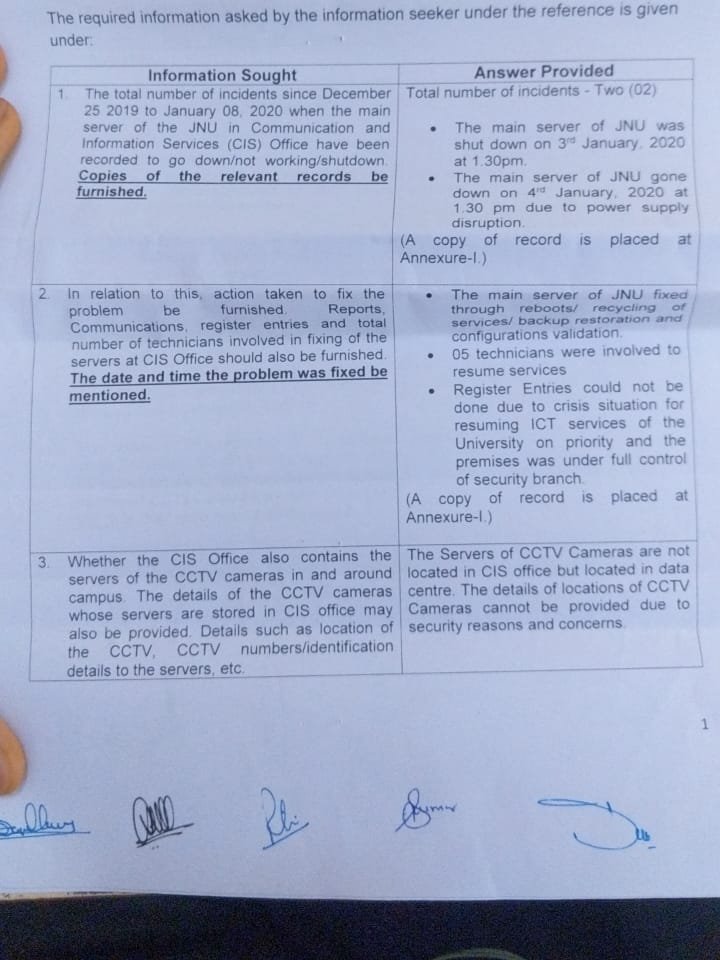
If we go by the RTI reply, we can see that the petitioner had asked about details of server room located at the North/Main gate of JNU campus, along with CCTV camera details. The RTI query had also asked whether any vandalism incident had taken place at the North/Main gate server room where CCTV cameras are installed, with details of the incidents. To the first question, JNU had replied that there is no server room at the North/Main gate, and they had replied none to the next question as this server room does not exist. As there is no server room at the location asked, which is the North/Main gate, it is natural that no vandalism took place there, as the vandalism had happened at the CIS data centre. Another reply to a question on connections at the server room also states that there is no server room at the North/Main gate.

The RTI reply does say that the CIS server room was dusrupted on two occasions, on 3rd and 4th January.


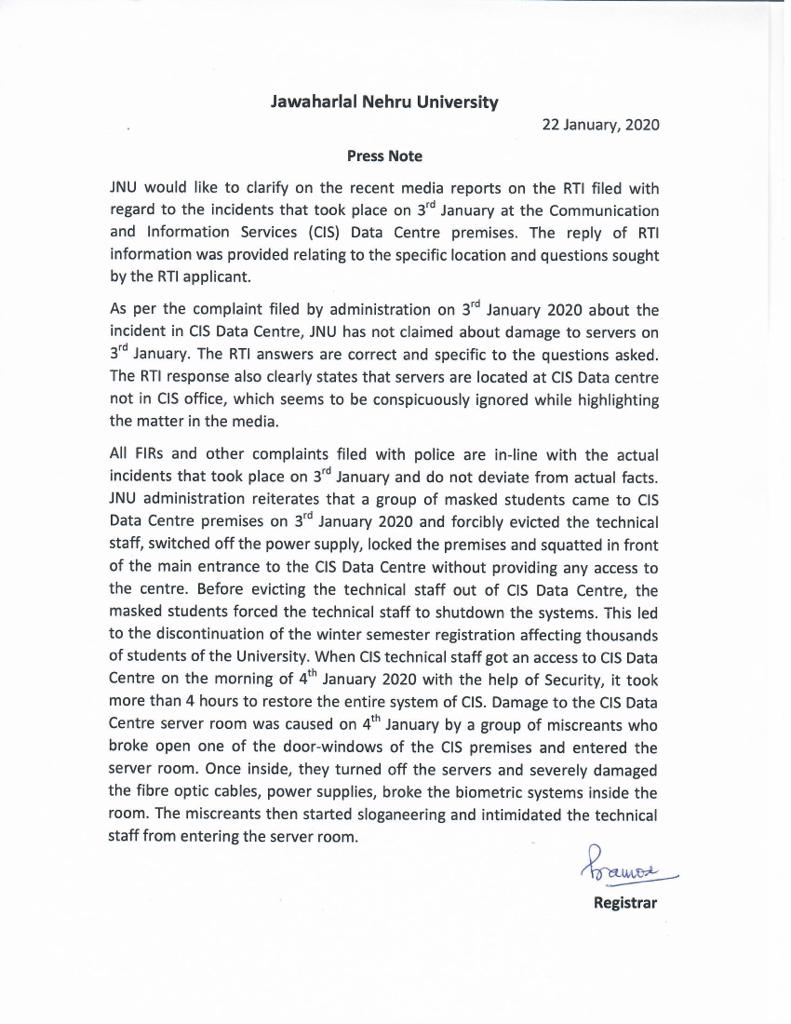
The statement issued by the JNU on Wednesday afternoon stated, “All FIRs and other complaints filed with police are in-line with the actual incidents that took place on January 3 and do not deviate from actual facts. The JNU administration reiterates that a group of masked students came to the CIS Data Centre premises on January 3, 2020 and forcibly evicted the technical staff, switched off the power supply, locked the premises and squatted in front of the main entrance to the CIS Data Centre without providing any access to the centre.”

JNU statement
JNU statement

As per the widely circulated reports, the reply to the RTI filed by Saurav Das, a member of the National Campaign for People’s Right to Information (NCPRI), said the main server of JNU at the Centre for Information System (CIS) was shut down on January 3 and had gone down the next day “due to power supply disruption”. The response also said a total of 17 fiber optical cables were damaged on January 4 at 1 pm. ‘None’ of the biometric systems were broken or destroyed from December 30, 2019, to January 8, 2020, the RTI reply as per reports.

The reply appears consistent with previous statements made by authorities at the JNU. JNU registrar Pramod Kumar had issued a statement on the 3rd of January saying, “At around 1 pm on January 3, a group of students using masks on their faces forcibly entered the office of the Centre for Information System, switched off the power supply, forcibly evicted all the technical staff, and made the servers dysfunctional.”

Furthermore, with regards to the questions regarding CCTVs, the reply said that the server of CCTVs are located at the Data Center and not the CIS. It further stated that further details regarding CCTVs couldn’t be disclosed due to reasons of security.

The clarification issued by the JNU authorities points towards the same. It said, “As per the complaint filed by administration on January 3, 2020 about incident in CIS Data Centre, JNU has not claimed about the damage to servers on January 3. The RTI answers are correct and specific to the questions asked. The RTI response also clearly states that servers are located at CIS Data Centre, not in CIS office, which seems to be conspicuously ignored while highlighting the matter in the media.”

Read- JNU violence: FIR filed against JNUSU president Aishe Ghosh and 19 others for vandalising server room

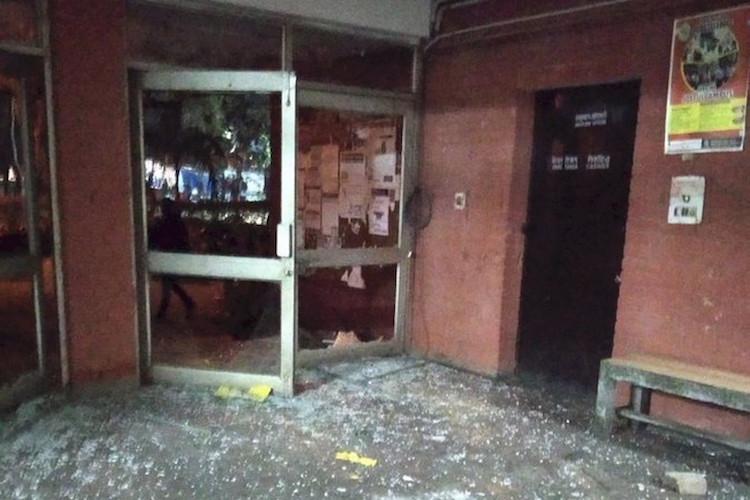
The clarification stated further, “Damage to the CIS Data Centre server room was caused on January 4 by a group of miscreants who broke open one of the door-windows of the premises and entered the server room. Once inside, they turned off the servers and severely damaged the fire optic cables, power supplies, broke the biometric systems inside the room. The miscreants then started sloganeering and intimidated the technical staff from entering the server room.”

The initial media report that spread the disinformation campaign was published by the Press Trust of India. Soon, it was picked up and reproduced by a plethora of news websites or individual reports were published based on inputs from the PTI. Consequently, it became fodder for political players acting in bad faith which used the report to target the JNU administration.

PTI report reproduced by India Today

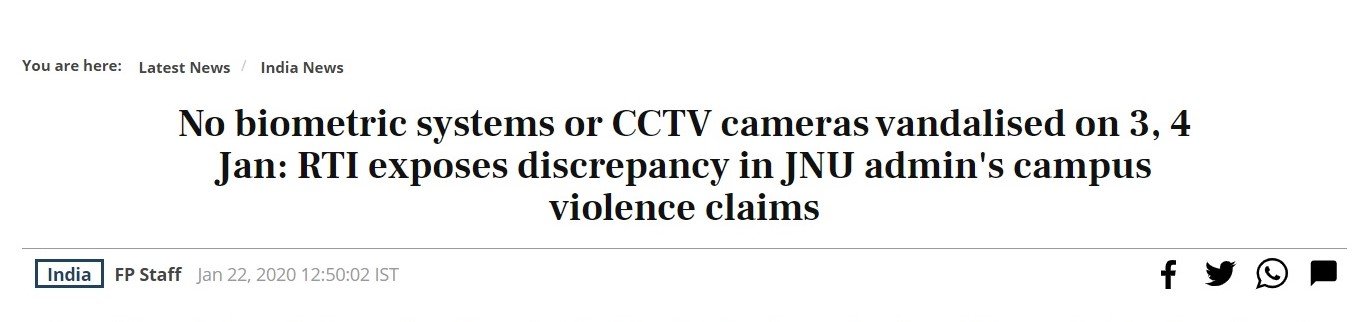
The headline of the report published by FirstPost on the matter with inputs from the PTI was even more outlandish. It claimed that the RTI reply poked holes in the official version of events as laid down by the JNU administration in previous days.

Headline of the FirstPost report

The Congress party then chose to use one such report by News18 to claim that the JNU administration had lied to the Police and claimed that there was no vandalism at all in the JNU campus.


It’s quite clear that the reply to the RTI spoke of a very specific location but it was twisted completely to portray something entirely different. In recent times, we have seen that RTI has become the favoured tactic of the Left to spread disinformation. Only yesterday, the Leftist crowd had claimed a grand moral victory after a reply to an RTI had revealed that the government had no information concerning the ‘Tukde Tukde Gang’. The Left had touted this to be a great victory when the response by the Ministry of Home Affairs was painfully obvious given the fact that ‘Tukde Tukde Gang’ is not an official government term.

Chief Justice Bobde has also, in the past, expressed apprehensions regarding the manner in which RTIs are used. He had expressed concern that people who have nothing to do with a particular issue demand information using the RTI. CJI Bobde also appeared annoyed with the fact that some people go around using the term ‘RTI activist’. The current campaign of disinformation against the JNU administration is a further cause of concern regarding the manner in which RTIs are used.

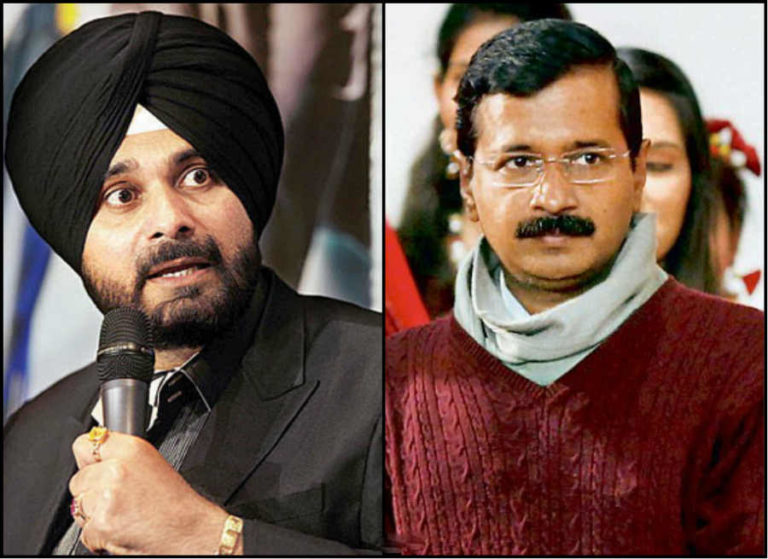
Congress leader and Pakistan PM Imran Khan’s friend Navjot Singh Sidhu to be star campaigner against AAP’s Kejriwal

The Congress party on Wednesday released the list of its star campaigners who will be spearheading its poll campaign ahead of the Delhi Assembly Elections scheduled on February 8. The list includes the name of 40 leaders including Congress president Sonia Gandhi, former party chief Rahul Gandhi, General Secretary Priyanka Gandhi Vadra and former PM Manmohan Singh.

After dropping him like a hot potato during Haryana election campaign last year, Congress has once again decided to get Pakistan PM Imran Khan’s friend Navjot Singh Sidhu back as one of their star campaigners to take on AAP’s Kejriwal’ in Delhi.

image via Twitter

Other names included: Madhya Pradesh CM Kamal Nath, Punjab CM Captain Amarinder Singh, Chattisgarh CM Bhupesh Baghel and Rajasthan CM Ashok Gehlot. The list also includes four film stars-turned-politicians, Raj Babbar, Shatrughan Sinha, Khushbu Sunder and Nagma. Sachin Pilot, Jyotiraditya Scindia and Randeep Surjewala have been named too, besides Congress MP Shashi Tharoor.

Though Congress had scored a duck in the last Delhi Legislative Assembly elections held in the year 2015, it remains to be seen what difference Sidhu’s campaigning would bring to the party which released its third list of candidates for the February 8 Delhi assembly elections yesterday. It has announced names of 66 candidates for the election to the 70-member Delhi assembly and it is likely to leave four seats for its ally RJD.

The motormouth Congress leader Navjot Singh Sidhu has been maintaining a low profile since he quit the Punjab cabinet in July last year over sharp differences with Chief Minister Amarinder Singh. Sidhu had quit after his portfolio was downgraded.

Sidhu had not campaigned much in the run up to the general elections too. When asked by media, he had cited a throat problem.

Sidhu has, however, always been in news for his fixation for his “friend and angel” Imran Khan. He has often heaped uncritical admiration for the Pakistan PM while turning a blind to the terrorism emanating from Pakistan.

In December last year, Sidhu was widely condemned for showering exorbitant gratitude for the Pakistani Prime Minister, thanking him on the behalf of ’14 crore Sikhs’ for conceiving the Kartarpur corridor project. Speaking at the inauguration of the Kartarpur Corridor in Pakistan, Congress’ motormouth leader Navjot Singh Sidhu had even compared Imran Khan with Alexander The Great.

Read: Humara Sidhu kidhar hai? Manmohan aa gaya? Watch this viral video of Imran Khan Niazi during Kartarpur Corridor inauguration

Navjot Singh Sidhu’s visit to Pakistan prior to this, to attend Imran Khan’s oath-taking ceremony, had also drawn criticism from several quarters, especially the Punjab Chief Minister Captain Amarinder Singh. He had slammed him for hugging the Pakistani Army Chief General Bajwa while on his visit to Pakistan. Sidhu was also excoriated for his meek acceptance to sit beside the puppet ‘president’ of PoK during the swearing-in ceremony.

Earlier in March last year, in his unbridled love for Pakistan Prime Minister, Sidhu credited Imran Khan for his ‘kind act’ to return Wing Commander Abhinandan Varthaman, ignoring the fact that they had no other way. Sidhu had then penned an open letter lauding “noble gesture” of Pakistan PM Imran Khan without holding him accountable for his country’s perpetual support to terrorism.

Dear Richa Chadha, women are not rehabs for angry, entitled men

Bollywood entertainer Richa Chadha today took to Twitter to dish out cure for misogyny.


In her overly simplistic tweet, she said that every angry, entitled man should be “blessed with a daughter” as it is the “best cure for c/overt misogyny”. There are multiple things wrong with this, like having an extremely simplistic view that having a ‘woman’ in a misogynist man’s life will cure him of the misogyny that has been ingrained in his mind because of decades of conditioning. However, more disturbing is the idea that she thinks women are rehabs whose job is to ‘cure’ broken men.

This is what one may call a Bollywood-inspired suggestion as if you have seen the kind of movies where there is a manic pixie dream girl whose sole purpose for those three hours is to rescue the hero from his depression or anger issues or just his wayward ways. Similarly, having a daughter(s) will automatically cure entitled men of misogyny. These entitled, misogynist men also came from women who gave them birth and clearly that hasn’t helped.

Chadha also blissfully forgets that more often than not, the women in the lives of such entitled, misogynist men, including those blessed daughters, are often on the receiving end of the abuse.

Read: A faceless troll thought we ‘need to be disciplined’ because we were ‘out of line’

Men don’t need to have daughters in their lives to treat women properly. It is not a cause and effect relationship. The kind of tweet and mindset Chadha is propagating quite often is peddled whenever we read news about sexual harassment. How the victim was someone’s daughter, sister. How hard is it to see her as just another human. Just ‘someone’. And not abuse her? Men often mention how they are worried about such cases as ‘father of a daughter’. No, you need to be worried about sexual harassment cases despite being father of a daughter, not because you are one.

To sum it up, Richa, daughters aren’t sacrificial beings who need to be in lives of misogynist men to get them to mend their ways. As someone who likes to identify herself as ‘feminist’,  one would assume she’d at least get that part right.

Inspired by Rajasthan Chief Minister Ashok Gehlot, man names his son ‘Congress’

In a bizarre development, a man in Udaipur, Vinod Jain, who works as a media officer at the office of Rajasthan Chief Minister Ashok Gehlot, named his second son ‘Congress’, after the Indian National Congress political party.

Explaining the rationale behind naming his son as ‘Congress’, Vinod asserted that his entire family is associated with the Congress party and it was totally appropriate that he named his son after the political party that his family has deep ties with. He also stated that he would like his offspring to maintain his family tradition and continue to serve the Congress party.

Read: Poisonous ‘congress grass’, considered a gift of Congress to the nation, now creating havoc in Kullu

Vinod also added that he is deeply inspired by Rajasthan CM Ashok Gehlot and would want his son to pursue political career when he comes of his age. “I am inspired by Rajasthan CM Ashok Gehlot and I would like my son to initiate his political career when he turns 18 and play an active role in the Congress party,” Jain said.

Vinod claimed that some of his family members had reservations about naming his son ‘Congress’ so he determinedly waited until they all came around it. Vinod’s son was born in July and it took months for Vinod to obtain his birth certificate issued by the state government reads his son’s name as ‘Congress Jain’.

Congress Jain, born in July 2019, is Vinod’s second child, born 18 years after his first girl child.