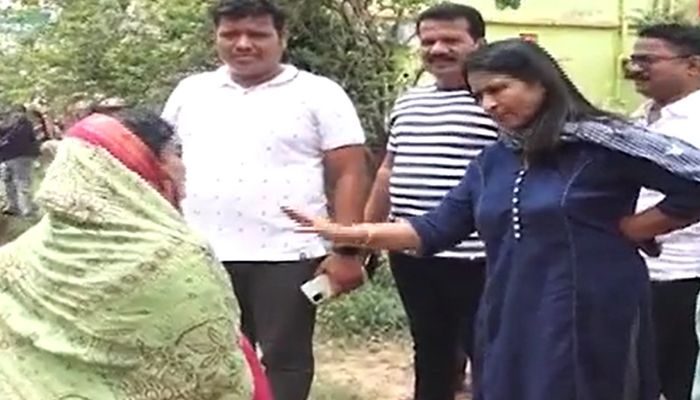
On May 27, Friday, the Lok Sabha Privileges and Ethics Committee summoned Maharashtra DGP Rajnish Seth, Mumbai CP Sanjay Pandey, Maharashtra Chief Secretary Manu Kumar Srivastava and Superintendent of Women District Prison, Byculla (Mumbai) Yashwant Bhanudas to appear before them on June 15 for oral evidence. The order was passed after Amravati MP Navneet Rana and her MLA husband Ravi Rana wrote to the Lok Sabha Speaker, Om Birla, alleging that she was subjected to “inhuman treatment” and harassment by the Mumbai Police following her “illegal” arrest following the Hanuman Chalisa row.
Parliament’s Privileges and Ethics Committee asks Maharashtra Chief Secretary to appear before them on 15th June for oral evidence, in connection with Lok Sabha MP Navneet Rana’s arrest matter pic.twitter.com/gwBGOUjWS7
Last month, a day after Navneet Rana was remanded to judicial custody over the ‘Hanuman Chalisa row’, the Amravati MP alleged caste discrimination and abuse at the Khar police station on April 23, 2022. She has made the revelations in a letter to the Lok Sabha Speaker Om Birla. She recounted the casteist treatment meted to her during her time in police custody.
“I was taken to Khar Police Station on April 23 and I spent the night in the Police Station…I made several and repeated demands for drinking water throughout the night, however, no drinking water was provided to me throughout the night,” the Amaravati MP said.
Navneet Rana informed Lok Sabha Speaker Om Birla, “To my shock & disbelief, the police staff present told me that I belong to Scheduled Caste & hence they will not give me water in the same glass. Thus, I was directly abused on the basis of my caste and it is only for this reason that no drinking water was provided.”
She claimed that the cops denied her water because she belonged to the SC community. “I emphatically state that basic human rights such as drinking water was denied to me on the ground that I belong to Scheduled Caste (Neechi Zaat),” wrote the Amravati MP to Om Birla.
I emphatically state that basic human rights such as drinking waster was denied to me on the ground that I belong to Scheduled Caste (Neechi Zaat): Amravati MP Navneet Rana writes to Lok Sabha Speaker Om Birla
“Further, when I wanted to use the bathroom at the night, police staff paid no heed to my demands. I was again abused in the most filthy language…I was told that we don’t let people from Neechi Jaat Scheduled Castes use our bathrooms,” Rana had added.
The Background of the Case
MP Navneet Rana and her husband MLA Ravi Rana were earlier arrested by Mumbai police for planning to recite Hanuman Chalisa before Matoshree, the family residence of CM Uddhav Thackeray. Though they had later withdrawn their plan, the duo was arrested from their home. Charges of sedition were also pressed against them.
They were produced before Bandra Court on Sunday (April 24) and sentenced to 14 days in judicial custody. Both of them were booked under Indian Penal Code (IPC) Sections 153 (A) (promoting enmity between different groups), 353 (criminal force to deter public servant from discharge of his duty), and Section 135 of the Mumbai Police Act (violation of prohibitory orders).
The political witchhunt against the couple did not end here. Hours after a special bench of Mumbai Sessions court granted bail to independent Lok Sabha MP Navneet Rana and her husband independent MLA Ravi Rana, the Shiv Sena-led Brihanmumbai Municipal Corporation (BMC) officials had arrived at their home in Mumbai’s Khar to inspect alleged illegal construction done by them.
On Saturday, a Muslim man named Shaikh Jafar Qureshi renounced Islam and accepted Hinduism in the Mandasaur district of Madhya Pradesh. The 46-year-old Sheikh was given the initiation to Hinduism by performing ritual worship by Mahamandaleshwar Swami Chidambaranand Saraswati at the Pashupatinath temple. From May 28 Shaikh Jafar Qureshi will be known by his new name Chetan Singh Rajput.
According to the reports, the ritual worship was organized by Mahamandaleshwar Swami Chidambaranand Saraswati of the Akhil Bharatiya Akhara Parishad Mahanirvani Sangh. Swami who gave Qureshi his new name asked to him clean his body with the cow dung and the holy gau mutra. Mahamandaleshwar Swami Chidambaranand Saraswati said that the religious ritual was not conducted for conversion, but ‘gharvapsi’ (homecoming). “All the Muslims in India were originally Hindu and were converted. In such a situation case, Sheikh Jafar has returned to his first religion which was Hinduism”, he added.
Qureshi also meanwhile termed the process as ‘gharvapsi’. He said that he has been following the Hindu religion since his childhood and that he never liked the Islamist people who possess fanatical thinking. “I am happy now that I am a Hindu. I have been visiting temples since I was a child. Later I had started performing Hindu rituals. During the time of Navratri also I used to keep fast for 9 days”, he said.
He added that he was married to a Hindu woman and was following the Hindu religion completely. “Today I’ll say I have just got a new name and that this religious ritual worship was just a formality. I was a Hindu and I will remain a Hindu. Now I feel complete after officially adopting the Hindu religion”, he added.
Elaborating his feeling over having a new name, Chetan Singh Rajput said, “Forefathers of Muslims were Rajput. So I decided to consider Rajput surname for myself. I am devotee of Lord Shiva and was fascinated by Sanatan Dharma since childhood”, he reietrated. He also stated that now he will support and encourage all those people who want to adopt Hinduism as a religion.
Earlier last year, Waseem Rizvi aka Jitendra Narayan Singh Tyagi had also renounced Islam and accepted Hinduism as his religion. He had said that a large number of Muslims wanted to embrace the Sanatan Dharma but were scared of retribution by the Islamic radical elements.
Days after Aviation Minister Jyotiraditya Scindia promised action against Indigo for ‘discriminating’ against a special needs child, the Directorate General of Civil Aviation (DGCA) has issued a show-cause notice to the airline.
“Based on the findings during the enquiry, a show-cause notice was issued to IndiGo Airlines through its authorised representative, in connection with special child offloading case in Ranchi,” DGCA said in a statement.
Moreover, the airline regulator has imposed a fine of ₹5 lakhs on Indigo under relevant Aircraft rules.
In view of this, the Competent Authority in DGCA has decided to impose a penalty of Rs 5 lakhs on the airline under the provisions of the relevant Aircraft Rules.
Earlier on May 16 this year, an inquiry conducted by the DGCA found Indigo prima facie guilty of handling passengers inappropriately and its staff members of violating applicable regulations.
DGCA inquiry into Ranchi airport incident where a specially-abled child was denied boarding by IndiGo staff, prima facie finds inappropriate handling of passengers by the IndiGo staff thereby resulting in certain non-conformances with the applicable regulations.
On May 7, 2022, a boy with special needs was not allowed to board an Indigo flight with his family at Ranchi airport. According to a Facebook user named Manisha Gupta, the child was initially in immense discomfort following a “very uncomfortable car ride to the airport.”
As his parents attended to him, IndiGo officials announced that they would not permit the boy to board the flight until he became ‘normal’. Gupta also shared a video of the incident on Facebook, showing several individuals at the airport arguing with IndiGo ground personnel and seeking a meeting with the senior management.
The youngster could be seen in a wheelchair in the video. IndiGo had issued a statement saying, “The airline made the family comfortable by providing them hotel stay and the family flew next morning to their destination. We regret the inconvenience caused to the passengers.”
There is zero tolerance towards such behaviour. No human being should have to go through this! Investigating the matter by myself, post which appropriate action will be taken. https://t.co/GJkeQcQ9iW
— Jyotiraditya M. Scindia (@JM_Scindia) May 9, 2022
Jyotiraditya Scindia, Minister of Civil Aviation in the Government of India, had assured a detailed investigation and appropriate action over the incident. “There is zero tolerance towards such behaviour. No human being should have to go through this! Investigating the matter by myself, post which appropriate action will be taken,” he said in a tweet.
History has it that any type of depiction of the Prophet Muhammad has always drawn fierce pushback from Islamists around the world. Over the years, there have been innumerable incidents of extreme violence with Islamists calling for the beheading of those responsible for committing such an ‘effrontery’. With the passage of time, such intolerance has only gotten worse.
This is what led to Islamists baying for the blood of the Hindu Mahasabha leader Kamlesh Tiwari, whose throat was slit in the most barbaric manner. It was alleged ‘blasphemy’ against Prophet Muhammad that also led to the brutal murder of the French teacher Samuel Paty, the brazen shooting of the Charlie Hebdo cartoonists, the horrific killing of cow-lover Kishan Bharwad, the legion of violent protesters that had hit the roads of Bengaluru, indulging in arson and vandalism and many more such incidents that occurred in the name of blasphemy against the Prophet Muhammad.
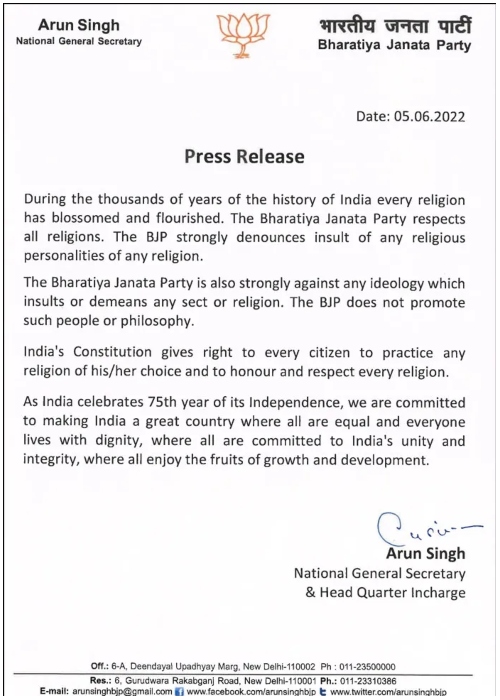
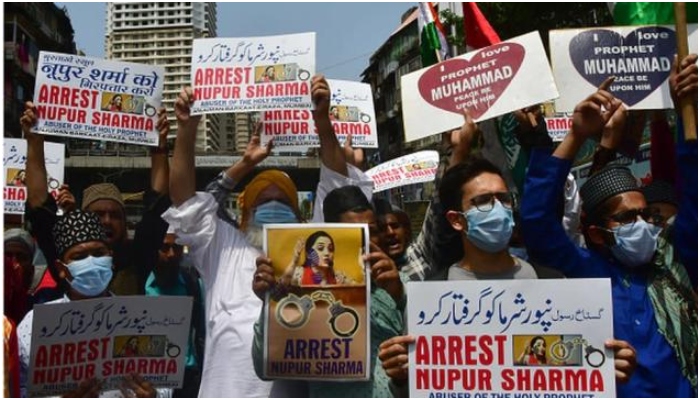
Recently, the unflattering reference to Prophet Muhammad has led to Nupur Sharma, the national spokesperson for the ruling Bharatiya Janata Party (BJP) and a leader of the party’s Delhi unit, receiving multiple death threats. There were multiple tweets threatening her, some even calling for her beheading after Alt News co-founder Mohammed Zubair shared her video with a twisted commentary to encourage trolls to attack her.
Actually, during a debate on Times Now on the disputed Gyanvapi structure, Nupur Sharma argued that since people are mocking the Hindu faith repeatedly, then they can also mock other religions referring to Islamic beliefs. Taking that video out of context, Zubair shared it with his 464,000 Twitter followers declaring Nupur a rabid communal hatemonger and someone who can incite riots.
The dog-whistling obviously worked perfectly as troll accounts descended upon Nupur Sharma’s timeline giving her all kinds of threats including threats to behead her. With several similar incidents like Kamlesh Tiwari and Kishan Bharwad abound, the police should look at these threats seriously.
Madras HC’s landmark judgment given in 2019 established the difference between blasphemy and freedom of expression
Well, all of these Islamists who openly mock Hinduism but get embittered by the tiniest of remarks against their Prophet must keep reminding themselves of the historic Madras High Court decision from 2019, which clearly defined the difference between blasphemy and expressing religious opinions based on one’s knowledge of the subject.
The court, in February 2019, was hearing a bail plea filed by BJP Tamil Nadu leader R Kalayanaraman, who was accused of blasphemy over a 2015 Facebook post on Prophet Muhammad.
The Tamil Nadu police had booked the BJP leader under different provisions of the Indian Penal Code for allegedly promoting enmity between two groups on the ground of religion and the First Information Report had been registered following receipt of several complaints objecting to a post on his Facebook page titled Kakkai Sidhar Kalayanaraman.
On 2nd February 2019, the 49-year-old BJP worker was arrested by the Chitlapakkam police in Chennai for using social media to allegedly propagate “hate”. Kalyanasundaram Rangaswamy had alleged written a Facebook post that offended the sensibility of Muslims. The BJP leader was granted bail after being kept in judicial custody for 19 days.
Granting bail to the BJP leader, Justice N Anand Venkatesh of the Madras High Court said, “In the considered view of this court, the petitioner has written his understanding about Prophet Mohamed and his family after reading the relevant history,” and hence he would be entitled to bail on condition that he would cooperate with the probe.
An excerpt from the 2019 Madras High Court judgement
Justice Venkatesh stated that after reading the entire message, he did not deem it to be reckless or derogatory. He said, “The freedom of expression always gets challenged when it touches upon religious beliefs. There were occasions when similar articles had been written questioning the history of Jesus Christ in the book The Da Vinci Code.
“Even in this State, there are articles written touching upon the life of Seetha in Ramayana. It is one thing to make reckless and derogatory remarks against religious beliefs and it is entirely another thing to express an opinion after reading the entire literature/history of various characters revered as God or Goddess in this society. Not every expression will qualify itself to bring disharmony between various sects or groups,” the Madras High Court judge added.
Notably, this so-called ‘offensive’ post was posted by the BJP leader back in 2015. This case is especially noteworthy since, after a year, D Selvamani, the Chitlapakkam sub-inspector, took cognisance of the ‘Facebook post’ and told his superiors. “I searched for him on Facebook and found abusive comments,” Selvamani told the Times of India, “which I revealed to my supervisors, who asked me to be the complainant in this case.”
Meanwhile, eyeing the minority votes, MMK leader MH Zawahirullah jumped into the fray to take credit for the arrest of the BJP leader, which led to a dispute between Selvamani and MMK leader MH Zawahirullah.
The case against the BJP worker was that his comments about Prophet Muhammad would foster religious friction and animosity between the two faiths. Rangaswamy was granted bail on February 21, 2019, after being detained for 19 days.
Rangaswamy’s lawyer told the court that the BJP activist made no derogatory or objectionable words about Prophet Muhammad. His post was about reading history and giving his opinion and understanding of Prophet Muhammad and his family. He argued that Rangaswamy’s right to do so is protected under the Freedom of Expression granted by the Constitution of India.
The prosecutor in the case mentioned that the BJP worker is a repeat offender and earlier too, he had been granted bail on the condition that he will not indulge in such activities again. The prosecutor also mentioned that he is ‘continuously indulging in such activities’ thereby endangering harmony between religions. The prosecution had vehemently contested bail.
Madras HC’s verdict on blasphemy drew on the historic judgment passed by the court in the Tamilsevan vs the Govt of Tamil Nadu case
The advocate who had appeared for Rangaswamy relied on the observations made during the case Tamilsevan vs the Government of Tamil Nadu. The judgement in the Tamilsevan case had laid down the following guidelines:
There is bound to be a presumption in favour of free speech and expression as envisaged under Article 19(1)(a) of the Constitution of India unless a court of law finds it otherwise as falling within the domain of a reasonable restriction under Article 19(2) of the Constitution of India. This presumption must be kept in mind if there are complaints against publications, art, drama, film, song, poems, cartoons or any other creative expressions.
The State’s responsibility to maintain law and order would not permit any compulsion on the artists concerned to withdraw from his/her stand and non- State players cannot be allowed to determine what is permissible and what is not.
It is high time the Government constitutes an expert body to deal with situations arising from such conflicts of views, such an expert body to consist of qualified persons in the branch of creative literature and art so that an independent opinion is forthcoming, keeping in mind the law evolved by the judiciary. Such an expert body or panel of experts would obviate the kind of situations we have seen in the present case. In such matters of art and culture, the issue cannot be left to the police authorities or the local administration alone, especially when there is a spurt in such conflicts.
The State has to ensure proper police protection where such authors and artists come under attack from a section of the society.
Essentially, the Tamilsevan judgement said that there is a bound presumption that Freedom of Expression would prevail over every other concern unless it can be demonstrated that the speech falls under reasonable restriction. It also says that maintaining law and order is the State’s concern and that concern does not compulsorily mean that the artist would have to withdraw his stand on issues.
This landmark judgement was relied upon heavily by the advocate representing Rangaswamy. He said (emphasis ours)
“The freedom of expression always gets challenged when it touches upon religious beliefs. There were occasions when similar articles have been written questioning the history of Jesus Christ in the book of the ‘Da Vinci Code’. Even in this state, there are articles that return touching upon the life of Sita in Ramayana. It is one thing to make reckless and derogatory remarks against religious beliefs and it is entirely another thing to express an opinion after reading the entire literature/history of various characters who were revered as gods or goddesses in the society. Not every expression will qualify itself to bring disharmony between various sects or groups and this has been clearly brought out by this Court in the judgement in S. Tamil Selvan referred Supra. This court has category held that there is always a presumption in favour of free speech and expression unless it falls within the domain of reasonable restrictions under Article 19(2) of the Constitution of India.”
Senior advocate Prabakaran appearing for Rangaswamy almost broke the glass ceiling in his argument, so to speak. It has been a long-held contention that criticism of minority communities and their respective religions, be it Islam or Christianity has usually inspired the ire of the state, whereas, criticism of Hinduism has been an acceptable form of free speech. The “liberal” argument in this regard is that the people who point toward this dichotomy wish to “Radicalise Hinduism” where the tolerant religion becomes intolerant to criticism. Nothing, however, could be further from the truth.
The contention of the ones who point out this dichotomy between the treatment given to critics of Islam and Christianity as opposed to the critics of Hinduism is not based on the fact they condone or want the criticism of Hinduism to be penalised. The contention simply stems from the fact that Freedom of Expression as enshrined in the Constitution of India has to function based on the principle of equality in front of the law. Criticism of one religion cannot be considered blasphemy while criticism of another, be considered revolutionary.
Senior counsel, by making that equivalence, upheld the very foundation of equality that most non-left thought leaders have been fighting for. What is good for the geese, must be held good for the gander.
The Court agreed with the submissions of senior counsel and granted Rangaswamy bail. The court held that Rangaswamy opined on Prophet Muhammad and his family after reading relevant history and no outright derogatory or slanderous comments were made.
What might appear to be a small step in the law can perhaps prove to be a massive step towards equality in freedom of expression for all future cases pertaining to ‘blasphemy’.
Mahant Ganesh Shankar Upadhyay of Kashi Karwat temple has slammed Aaj Tak and The Lallantop for presenting his statements about the Shivling found in Gyanvapi in a way to suit their own agenda. In a video response he gave to the channels while talking to Khabar India TV, Ganesh Shankar Upadhyay said, “If they have led me in a particular direction to say something and then used it to prove their point that there is no temple but there is a mosque; then can’t they see that it is originally a temple structure from the front and back and sides? Are they blind?”
In a report by The Lallantop and Aaj Tak, Mahant Ganesh Shankar Upadhyay’s statement, in which he had shared his childhood memories about the wuzukhana of the disputed structure at Gyanvapi, was used to peddle their agenda that there is no Shivling in there and hence implying that the structure is a not a temple but a mosque. The leftist media houses and subsequently the Islamists had used his selected comments to claim that a Hindu priest is saying that there is no Shivling in the structure.
When asked about the Shivling found in Gyanvapi during the videography, Mahant had told the Aaj Tak journalist, “Its shape is just like that of a Shivling. According to the information that we are fed since our childhood, it is a fountain. We were told so since our childhood. We have seen it since childhood. We used to go there. We have been to the mosque hundreds of times. We used to sit there for hours. We used to talk with the Maulavis and Sevadars there. The structure existed at that time too. It was seen in the centre there. It is not a new thing for me. Out of curiosity, we used to ask them what is this. So we were told that this is a fountain. We never saw it in operating condition, nor did we bother to ask first. We then asked them how it operates, and how it looks when there are fountains. And you know fountains usually look good and they were saying that it is since the Mughal era, so we were curious.”
Seer Ganesh Shankar Upadhyay, The head priest of Kashi Karvat temple which is located behind Gyanvapi mosque claims that the structure found inside the Gyanvapi Wazukhana is a fountain & not a Shivling. Says, he’s seen the fountain for last 50 years, but never seen it operational pic.twitter.com/aUR7gplDAU
He further said, “So we were like, there is a mosque in front of our home. Our Mahant residence is just 10 meters away. And there is a Mughal time fountain in the mosque as told by them. We had a cordial relationship with the Maulavis. There were no disputes in those days. We used to talk with them many times. So what information we have from those personal talks is that it is a fountain. But we have never seen it in working condition. Now there are visuals in the media. The pond is being cleaned. There is a top view of the structure. It indeed looks like a Shivling only. We have seen the pond in a dry condition for the first time. Though we were told that it is a fountain, now the thing has come up that it is a Shivling. It is a claim of Hindus and the court is to decide it. Nandi is also there, though it is situated at a distance. And there was a Kashi Vishwashwar temple is an undisputed fact. And that temple was destroyed during the Mughal rule. The mosque was made on the top of some part of the temple.”
According to his knowledge and understanding, It is a fountain. When asked if the boundary around the ‘Shivling/Fountain’ was recently constructed, He says, it was there since his childhood. Says, Fountains designs are usually like that & according to him it’s a ‘Fountain’. pic.twitter.com/RF3dZXS2h0
Even while continuing the talk, the Aaj Tak journalist had started his next question with a remark, ‘As you have said that it is a fountain.’ Even in the reports, Aaj Tak focused on Mahant saying that it is a fountain. In this way, Mahant Ganesh Shankar Upadhyay’s statements were used to peddle an agenda. They ignored the next part of his statement and focused only on the first part, where he had said what he was told by the Muslim clerics. He didn’t claim on his own that the structure is a fountain and not a Shivling.
While talking with Khabar India TV, furious Mahant Ganesh Shankar Upadhyay lashed out at the agenda peddlers. He said, “Those spreading and broadcasting false propaganda are a blot on Sanatan Hindu Dharma. You shoot for five times in different ways and show only the five minutes? You take some statement. Join it to some other and then make the thing that suits you. They have done it under a conspiracy. They have presented my remarks in a way that will divide the collective Hindu opinion. And dividing Hindus is a conspiracy of non-Hindus. There is a need to identify those who are creating this divide. This all is a conspiracy. There is a whole lobby doing that. They may be from the media. They may be from politics or they may be Vidharmi Hindus.”
Mahant Ganesh Shankar Upadhyay further said, “Shahar Mufti says that we gave away Babri and now nothing more can be given. What did they give? And is it really given by them? Did Hindus beg for that? No. It was a fight of centuries and generations. Thousands of people have given their lives for that. And they talk of Aurangzeb who killed his father, brother, and son. Among all the Mughal rulers, he was the ugliest. And about what centuries of history you are talking about. If you want to talk about centuries, talk to Hindus. How many centuries of history does Islam have? We are here for the last one lakh years. And we have its proofs. We have all the scriptures and Puranas.”
An interesting case has surfaced in Malaysia of a Muslim woman who wants to be declared a Non-Muslim so that she can follow the religion of her choice. Despite the fact that she was born to Muslim parents, the woman claims she has never converted to Islam. The 32-year-old woman was born to a man who converted to Islam and a Muslim woman.
The High Court in Malaysia will decide on June 15 whether the woman who wants to be deemed non-Muslim in order to practice Confucianism and Buddhism may proceed with her case.
On March 4, the lady filed a judicial review petition, bringing up the Shariah Court of Appeal, the Shariah High Court, the Federal Territories Islamic Religious Council (Maiwp), and the Malaysian government as respondents. After hearing arguments from her lawyer and the Attorney General’s Chambers, High Court judge Datuk Ahmad Kamal Md Shahid set a decision date on whether the woman would be granted permission for judicial review.
As part of her complaint, the lady is seeking at least 12 court judgments, including statements that Shariah courts lack the authority or jurisdiction to declare that someone is no longer a Muslim.
In a petition filed in July 2020, Sharia High Court refused to accept her decision to leave the Muslim faith in December 2021. The lady is requesting that the civil court stays the interim order. She also wants the civil High Court to declare that she is no longer a Muslim and that she has the right to practice her religions of Confucianism and Buddhism.
The claim of eating pork and consuming liquor
In her appeal, the woman stated that she had never accepted Islam’s doctrines and she has no faith in the religion. The woman also admitted in court to habitually consuming pork and drinking alcohol. It is notable that both pork and alcohol are prohibited in Islam.
Lawyers for the woman have said that she was raised by her mother following her parents’ divorce. The woman’s mother, according to the lawyer, is attempting to impose Islam on her daughter.
Hours after Alt News ‘fact checker’ Mohammed Zubair unleashed his troll army on Nupur Sharma, the BJP spokesperson started receiving death threats on the micro-blogging platform.
A snippet of one such disturbing discussion about ‘killing’ Sharma was recently conducted by Islamists on a Twitter space titled, ‘Democracy, Freedom of Speech and Blasphemy.’ A screen recording of the same was shared by a Twitter user named ‘Anti Hypocrisy.’
At the very onset, an Islamist could be heard lamenting that there is no punishment for ‘blasphemy’ in India and how it encourages ‘them’ (Hindus) to allegedly mock the Islamic Faith.
He then went on to cite scholars and fatwas where the killing of the blasphemy accused becomes indispensable, as per Islam. “Take a small example: If a person says that the skin colour of Prophet Muhammad was black, then, the killing of such a person becomes an obligation,” he informed.
People are running spaces where 100+ people are being incited to kill @NupurSharmaBJP .
The Islamist emphasised, “Imagine if there is a fatwa for murder to wrongly identify the skin tone of the Prophet, then, imagine what should be done (to her). And none should come in favour of the blasphemy accused else he too will become liable for the same punishment.”
He then went on to slam the ‘moderate’ Muslims for not condoning barbaric punishment for acts of blasphemy. “Such Muslims should think if there is any Iman left in them…” he continued.
“Even raising your voice in front of the Prophet is a sin, which you may not have realised while committing the act. And you will not even get the opportunity to express regret or seek forgiveness for it,” he concluded how Islam is ‘protective’ about the honour of the last Messenger.
The Background of the Controversy
Nupur Sharma has been at the receiving end of the unabashed hatred from the Islamists and ‘left-liberal-secular’ journalists for expressing her views on Islam on Times Now on Friday (May 27).
During a debate on the disputed Gyanvapi structure, Sharma argued that people can mock Islamic beliefs in response to objectionable remarks against Hinduism. She pointed out that Prophet Muhammad had married a six-year-old Aisha, and he had consummated his marriage when she was nine years old.
The dog-whistling against Nupur Sharma was first initiated by alleged fact-checker Mohammed Zubair, who shared an edited version of the video to drive a hate campaign against her. Other Islamists, masquerading as journalists, also came out of the woodwork to incite violence against the BJP spokesperson.
Several Islamists issued death and rape threats to Nupur Sharma, just as they had issued to deceased Kamlesh Tiwari and Kishan Bharwad.
On Saturday, a Muslim family from Barabanki in Uttar Pradesh claimed that they have been ostracized from the community and the village for voting in favour of the Bharatiya Janata Party (BJP) in the recently held Uttar Pradesh Assembly elections. The family has also allegedly been denied to offer Namaz at the village mosque.
According to the reports, the family who runs a small business in the village claimed on May 28 that the head of the village had issued instructions directing the villagers to not buy anything from the Muslim family’s shop. Also, the family’s access to the necessities like food, water, and other supplies has been restricted.
#BREAKING | Muslim family in Uttar Pradesh’s Barabanki ostracized allegedly over voting for BJP; denied to offer Namaz
A fine of Rs 20,000 has also been announced on anyone who attends the family’s son’s marriage
The Barabanki Police meanwhile have stated that the family has not been ostracized due to the political issue but over a land dispute. “The matter has been unnecessarily given a political angle but there is nothing as such,” said Additional SP, in a video message further adding that the family has been socially excluded since 2006 after a member of the Muslim family was accused of throwing bombs over a land dispute for the construction of a Madrasa.
— Barabanki Police (@Barabankipolice) May 27, 2022
According to the police, the family has falsely raised the issue and has given it a political angle after the villagers refused to attend their wedding function. The couple in the family has plans to hold the marriage of their elder son on May 31 but the people from their community and other villagers have refused to attend the wedding. According to the family, the village head has announced a fine of Rs 20,000 on anyone who attends the marriage. The village head has also allegedly refrained the villagers from eating food at the wedding or speaking to any member of the family.
The family members continue to claim that they are being troubled by the villagers for voting in favor of the BJP. They also stated that the Barabanki Police did not help them, instead forcefully took their signature. “They are imposing a fine of Rs 20,000 on us and those who speak to us. They are doing this because we voted for a different party. You tell me how the marriage will happen? The marriage is very near and this is one of the elder children. They will cause more trouble in future marriages too”, one of the family members was quoted.
The Police however reiterated that the family has been ostracized since the year 2006 and that this incident has nothing to do with them voting for the BJP. The authorities added that one of the members of the Muslim family who was accused of throwing bombs over a land dispute for the construction of a Madrasa was booked and was also sent to jail.
Kerala Police have taken into custody the father of the minor boy who was seen raising communal slogans against Hindus and Christians during a rally organized by the Popular Front of India (PFI) in Alappuzha, Kerala.
Police had earlier traced the boy to Palluruthy in Kochi two days ago, but the family had gone into hiding. When the family returned to their house, the father of the minor boy was caught by the police. The family claimed that they had just gone for a holiday and were not hiding from the police. PFI workers have staged a protest against police taking the father into custody.
Regarding the boy, the police are expected to submit a report to the Child Welfare Committee (CWC) over his behavior. The CWC will then arrange for his counseling.
Following the communal rally by PFI in Alappuzha, a video of the minor boy had gone viral from the rally where he was raising provocative slogans against Hindus and Christians. The police took cognizance of the matter based on the viral video and launched a probe into the case.
Since then, police have arrested 20 PFI workers under Sections 153 A (promoting enmity between different groups), 295 A (deliberate and malicious acts, intended to outrage religious feelings of any class by insulting its religion or religious beliefs), and 506 (punishment for criminal intimidation) of the Indian Penal Code along with Sections 75 (punishment for cruelty to child) and 83 (2) (use of child by militant groups or other adults) of the Juvenile Justice Act.
Kerala High Court has also asked the police to act against the organizers of the rally where the communal slogans were raised. In response to a petition filed by R Ramaraja Varma, who is a former professor of the SD College of Alappuzha, Justice PV Kunhikrishnan of Kerala HC said that if a member of the rally raised the provocative slogans, the organizers of the rally were also responsible. He said, “The police officers will do the needful by the law against all the persons who are responsible for this.”
Factual accuracy and respect for truth are not among the strong suits of the American news daily, New York Times. For decades now, it has revelled in the art of peddling fake news, disseminating propaganda, and patronising countries it deemed deserving of civilising pontification, even to the extent of appearing prejudiced, arrogant and outright stupid.
But recently, it marked a new low in exerting its stupidity when it published a report saying India was partitioned from Pakistan.
In a recent article talking about the novel “Tomb of Sand”, a Hindi book written by Geetanjali Shree and translated by Daisy Rockwell that won the International Booker Prize, the New York Times misled its readers by publishing grossly inaccurate information about the partition of India.
While giving a brief about the plot of the novel, which is about an Indian woman’s sudden decision to visit Pakistan, a country carved out of undivided India on religious grounds, the NYT article twisted the facts and erroneously claimed that it was India that was partitioned from Pakistan and not the other way around.
Relevant section from the NYT article
For the western readers who are moderately aware of India’s partition, this blunder of gigantic proportions by the New York Times might just be an “unfortunate slip-up”, a trivial error that somehow passed the editorial scrutiny. But for Indians around the world, especially those who have lived through the horrors of the partition or have heard of the tragedy of India’s vivisection firsthand, the mistake is nothing short of an attempt to rewrite the history and pass the buck of the partition on India while giving a clean chit to Islamists responsible for the creation of Pakistan.
The partition of India in 1947 divided British India into two sovereign entities: India and Pakistan. It was followed by periodic bouts of Hindu-Muslim riots after Islamists of the Muslim League, headed by Muhammad Ali Jinnah, demanded a separate country for the country’s Muslim population. Jinnah and his aides fanned anti-Hindu rhetorics in justifying their demand for a separate Islamic country, namely Pakistan, which invariably resulted in violence against Hindus.
Jinnah also famously called for the “Direct Action Day”, a clarion call given to the Islamists hankering for Pakistan to take matters in their own hands for the creation of Pakistan out of undivided India. It led to the 1946 Calcutta Killings and the genocide of the Bengali Hindu community. Soon, it spread to the rest of the country and culminated with the Partition and the terrible partition riots.
However, by claiming that India was divided from Pakistan, the New York Times is distorting history and whitewashing the Islamic extremism and religious bigotry of the Islamists and the Muslim League rulers who wreaked havoc in undivided India and brought about a bloodied partition of the country. More importantly, the NYT assertion pins the blame for the partition on India, denies its civilisational continuity, and describes it as a country that came into existence only in 1947.