Indian fast bowler Jasprit Bumrah was slammed on social media after a photograph from his wedding went viral which showed his near and dear ones celebrate the occasion with crackers. Previously, he had urged people to ‘Say no to crackers’ during Diwali.
Jasprit Bumrah married TV Presenter Sanjana Ganesan on the 14th of March. He has shared multiple photographs of his wedding on social media, one of which showed the momentous occasion being celebrated with crackers.
Say No to Crackers on Diwali & khud ki shaadi me Say Yes to crackers. Ab pollution kidhar gaya? Kitne paiso me bika tha @Jaspritbumrah93? Khatna karwa lena. Doob mar chullu me
There has been a concerted effort to have crackers banned during Diwali in recent times but Hindus have consistently resisted the efforts by the Indian State and other busy-bodies to interfere with their traditions. Last year during Diwali, despite bans across large swathes of India, Hindus across the country celebrated the occasion by bursting crackers.
Due to the bans, however, the cracker industry suffered a great deal of losses.
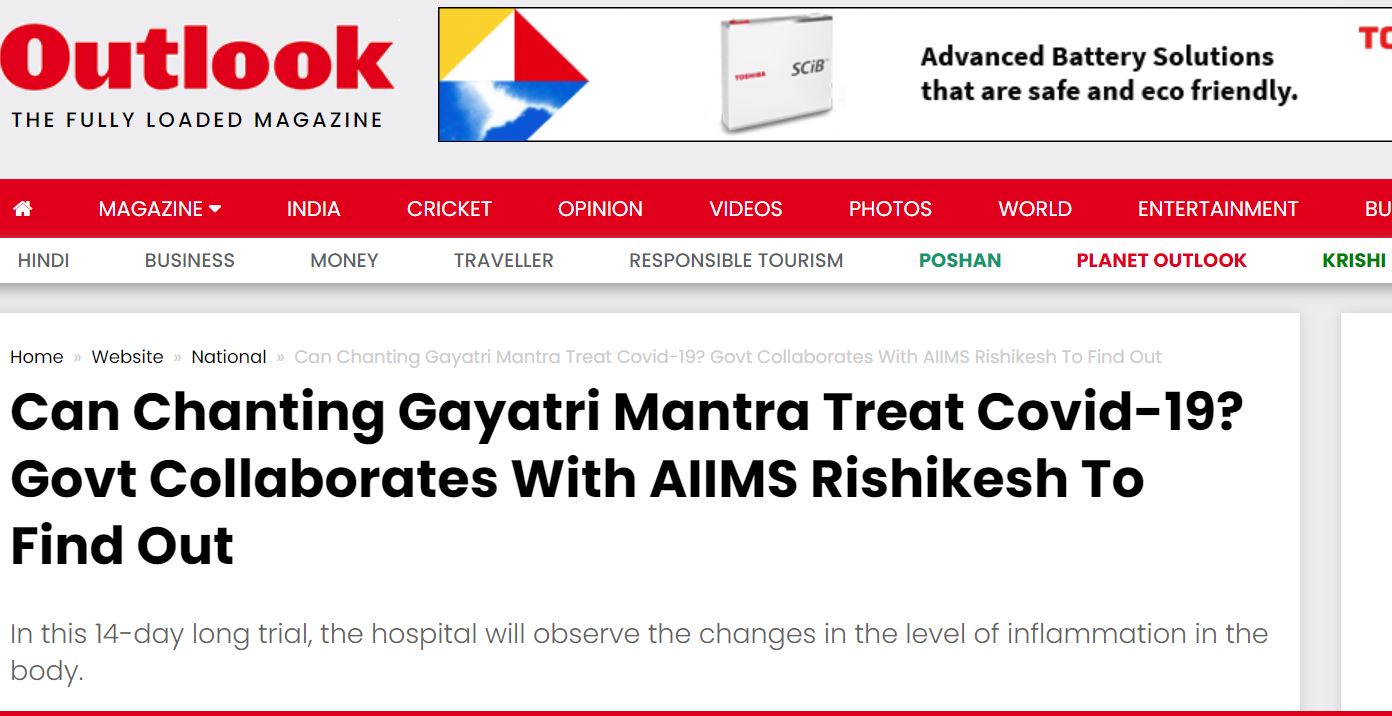
The Outlook today published a news article titled ‘Can Chanting Gayatri Mantra Treat Covid-19? Govt Collaborates With AIIMS Rishikesh To Find Out’. It is about a 14-day long trial program being undertaken by the All India Institute of Medical Science, Rishikesh, where people suffering from the Coronavirus infection would be made to chant the Gayatri Mantra and perform Pranayama along with the usual treatment.
Article published by Outlook on March 19, 2021
Though in the body of the article it is mentioned that the institute would be researching the effect of chanting Gayatri Mantra and performing Pranayama on Covid-19 patients in addition to usual treatment, the misleading headline makes readers believe that the central govt is considering using Gayatri Mantra as a stand-alone option to ‘treat’ COVID-19.
Since many social media users tend to only read the headline of an article when it’s shared on social media sites and not the entire news article by going to the website, as soon as Outlook shared this mischievously titled report on Twitter, users began to mock the central government for mulling such a preposterous option.
We are on the road of no-return. When science becomes a slave of religion, where is the hope for change. Please chant Gayatri Mantra and check results for erectile dysfunction also. ? pic.twitter.com/4PISG4CxIT
— dr. meena kandasamy | இளவேனில் (@meenakandasamy) March 19, 2021
But the fact is, unlike Outlook’s reports’ mischievous headline which insinuates that the Modi govt is considering using Gayatri Mantra to ‘treat’ COVID-19, AIIMS Rishikesh has started a 14-day trial in which it will only observe the effect of chanting Gayatri Mantra and performing Pranayama on Covid-19 patients and this will be done along with the regular medical treatment which is otherwise given to the patients suffering from the infection.
It is a well-known fact that controlled breathing or Pranayama is a specific set of respiratory exercises within yoga that has been proved extremely beneficial for the strengthening of the lungs and fight respiratory illnesses. Since COVID-19 infection has a direct impact on a person’s lungs, damaging the walls and linings of the air sacs in the lungs, it is only common sense that these deep breathing exercises will surely be beneficial for the patients fighting the COVID-19 infection.
Moreover, it has been specifically found that chanting of the Gayatri mantra elevates a person’s mind and soul to a higher level. The vibrations created by the chanting of The Mantra, stimulate the penial gland, which helps in release Endorphins and other relaxing hormones in the body that helps keep depression at bay.
This again will prove effective to treat the various traumatic stressors, including anxiety, depression, posttraumatic stress disorder, and other trauma- and stress-related disorders that the COVID-19 patient might suffer.
Isolation, loss of income and fear are triggering mental health conditions or exacerbating existing ones in coronavirus patients. Meanwhile, COVID-19 itself can lead to neurological and mental complications, such as delirium, agitation, and stroke. People with pre-existing mental, neurological or substance use disorders are also more vulnerable to SARS-CoV-2 infection ̶ they may stand a higher risk of severe outcomes and even death.
In such a situation, reciting Gayatri Mantra would only help these patients to fight stress and strain making them more resilient.
So basically, the central government is in no way trying to replace the medical treatment of COVID-19 patients with Gayatri Mantra or Pranayama, as the title of the Outlook article suggests, but is only trying to introduce it as an additional treatment, which might accelerate the recovery of the patients.
What the All India Institute of Medical Science, Rishikesh intends to do in this 14-days trial is that it will identify 20 patients and equally divided them into two groups A and B.
Ten patients of Group A, along with the usual treatment for Covid-19, will also be chanting Gayatri Mantra, in addition to an hour session of Pranayama in the morning and the evening. The other 10 patients in Group B are only getting the usual treatment for Covid-19.
In this 14-day long trial, the hospital will observe the changes in the level of inflammation in the body in both the groups and will compare them.
The study has been sponsored by the Department of Science & Technology (DST), Government of India.
US Secretary of State Antony Blinken and National Security Adviser Jake Sullivan had a tough time during a meeting with Chinese diplomats Yang Jiechi and State Councilor Wang Yi in Anchorage, Alaska where US officials received an astonishing dressing down from their Chinese counterparts.
Wang also told the US delegation that they are not in a position to speak to China from a position of strength. Blinken said during his remarks, laying emphasis on the “rules based international order” that the two countries will discuss the USA’s “deep concerns with actions by China, including in Xinjiang, Hong Kong, Taiwan, cyber attacks on the United States, and economic coercion toward our allies.”
“Each of these actions threaten the rules-based order that maintains global stability. That’s why they’re not merely internal matters and why we feel an obligation to raise these issues here today,” he added.
Yang, on his part, mocked the proponent of the “rules based international order”, which truth be told, is a thinly veiled euphemism for a world based on American hegemony. While it is true that India has used the phrase as well, the intended meaning behind the usage of the term has been starkly different than when it is used by Americans.
While India has emphasised the importance of international institutions and global cooperation during its usage of the term, the USA has used the same as a talking point to peddle its own agenda at the global stage.
“What China and the international community follow or uphold is the United Nations centered international system and the international order underpinned by international law, not what is advocated by a small number of countries of the so-called “rules-based” international order,” Yang said.
“And the United States has its style – United States-style democracy – and China has the Chinese-style democracy. It is not just up to the American people, but also the people of the world to evaluate how the United States has done in advancing its own democracy,” he added.
Furthermore, Yang took potshots at the United States for its forever wars in the Middle East to promote Democracy. “The wars in this world are launched by some other countries, which have resulted in massive casualties,” Yang stated.
“So we believe that it is important for the United States to change its own image and to stop advancing its own democracy in the rest of the world. Many people within the United States actually have little confdence in the democracy of the United States, and they have various views regarding the Government of the United States,” he stated.
Taking a dig at the USA for its various regime change wars, Yang noted the “failure to use various means to topple the so-called “authoritarian” states.” He also said that the USA is a “champion” in cyber attacks.
Blinken responded, taking a jibe at Yang for the latter’s “extended remarks”, said, “I have to tell you, what I’m hearing is very different from what you described. I’m hearing deep satisfaction that the United States is back, that we’re reengaged with our allies and partners. I’m also hearing deep concern about some of the actions your government has taken, and we’ll have an opportunity to discuss those when we get down to work.”
Wang shot back saying, “Well, it was my bad. When I entered this room, I should have reminded the U.S. side of paying attention to its tone in our respective opening remarks, but I didn’t.” He added, “The Chinese side felt compelled to make this speech because of the tone of the U.S. side. Well, isn’t this the intention of United States, judging from what – or the way that you have made your opening remarks, that it wants to speak to China in a condescending way from a position of strength?”
He added, “So let me say here that, in front of the Chinese side, the United States does not have the qualifcation to say that it wants to speak to China from a position of strength. The U.S. side was not even qualifed to say such things even 20 years or 30 years back, because this is not the way to deal with the Chinese people. If the United States wants to deal properly with the Chinese side, then let’s follow the necessary protocols and do things the right way.”
The Chinese side also brought up the Black Lives Matter protests and America’s track record of treating African Americans as evidence that the USA itself had failed to live up to its human rights ideals and urged the United States to do better when it comes to human rights.
There is some element of truth in the comments made by Wang and Yang, especially with matters related to Democracy and the “rules based international order”. While the United States harps on democracy and “rules”, it has waged wars for oil in the Middle East with little regard for international rules. And China appears to have decided that it will not allow the American charade to go unchallenged.
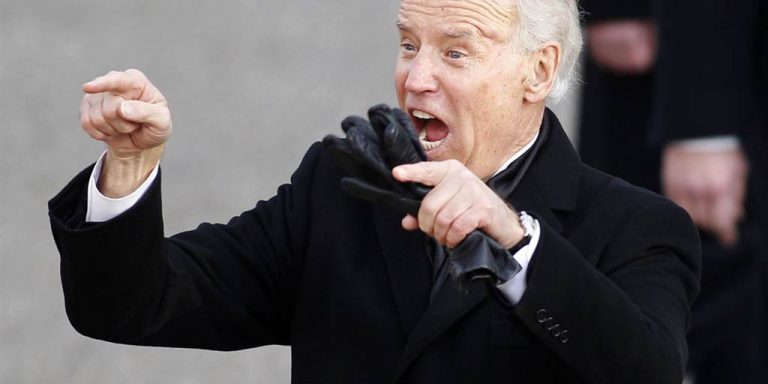
It has been a terrible week for the Biden administration in terms of international relations. Russian President Vladimir Putin in an interview with Russian state media implied that US President Joe Biden had gone senile and was mentally unfit to be president after Biden said that he believed Putin is a “killer”.
Putin said, “I want to propose to President Biden to continue our discussion, but on the condition that we do it basically live, as it’s called. Without any delays and directly in an open, direct discussion. It seems to me that would be interesting for the people of Russia and for the people of the United States.”
This was after Putin’s initial response following the “killer” remark where he said, “I wish you good health, I am saying this without any irony or jokes.”
Furthermore, it was reported earlier in the week that North Korea has not been responding to US efforts to establish dialogue. “We have already declared our stand that no DPRK-U.S. contact and dialogue of any kind can be possible unless the U.S. rolls back its hostile policy towards the DPRK,” first vice minister of Foreign Affairs, Choe Son Hui, said.
Choe also described US attempts to establish contact through multiple e-mails, phone calls and messages through a third country since February as a “cheap trick”. “We take this opportunity to warn the new U.S. administration trying hard to give off [gun] powder smell in our land,” dictator Kim Jong Un’s sister Kim Yo Jong said in response to a joint military exercise between South Korea and the USA in the region.
“If it [the U.S.] wants to sleep in peace for the coming four years, it had better refrain from causing a stink at its first step,” she is reported to have said.
To sum up the rotten week, the Biden administration had to confront Chinese officials who appeared intent on throwing ink at their faces. US officials suggested that the Chinese delegation “seem to have arrived intent on grandstanding, focused on public theatrics and dramatics over substance”.
Recently, the Devi temple of Dasna, Ghaziabad has been under limelight after a teenage Muslim boy named Asif claimed that he was beaten for trying to drink some water inside the temple premises. Ever since this incident has happened, the left-media and the so-called secular media ecosystem had pounced on the people responsible for managing the Dasna Devi temple in Ghaziabad.
Several opposition leaders, including local MLA Aslam Chaudhary, former Delhi MLA Alka Lamba, Congress President Vijendra Yadav and others, have lined up to meet Asif. On March 15 2021, Bahujan Samaj Party (BSP) MLA from Dholana, Aslam Chaudhary, reached Asif’s house and talked to him. During his visit, Aslam claimed that irrespective of religion, everyone has the right to visit a religious place. He had threatened to forcefully enter the temple. “I will go to drink water in the temple and take care of the temple. I will see who can stop me”, the BSP MLA had then said issuing a veiled threat to the temple authorities.
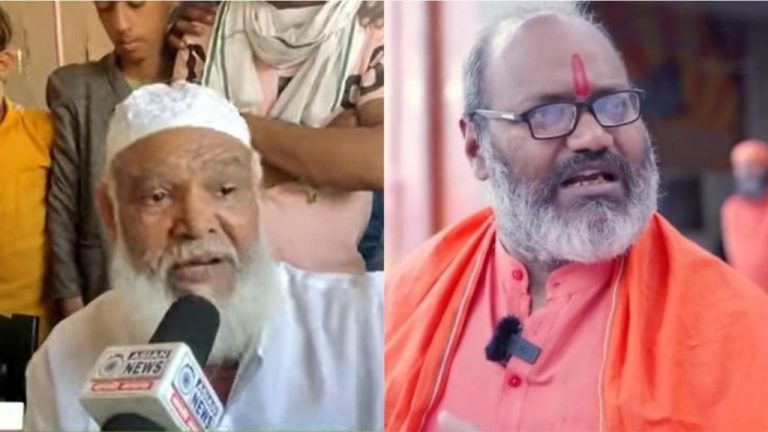
Now, reports have emerged that Aslam Chaudhary has made a complete U-turn. Probably, the terror of Uttar Pradesh CM Yogi Adityanath, who has shown zero tolerance to crimes and communal violence in his state and the united stance taken by various Hindu outfits including VHP and Yati Narasimhanand Saraswati’s devotees against the lies peddled by the left-wing media ecosystem surrounding the Dasna Temple controversy, has compelled Aslam Chaudhary to volte-face.
In a recently issued statement, the local MLA Aslam Chaudhary said that he had never spoken about entering the temple premises to drink water nor said a word about removing the board placed at the entrance of the temple saying that Muslim will not be allowed. “I have a Mandir in my house, I never spoke about entering the temple premises or break the harmony of the place”, said the BSP MLA taking a complete one-eighty degree turn.
हर हर महादेव Watch this 45 second video … असलम मियां LOL???Alsam changed his stand मैं मंदिर में नहीं जाऊंगा pic.twitter.com/nrL0F5kXm4
‘Dasna temple belongs to our ancestors, we will remove the board saying Muslims not allowed’: BSP MLA Aslam Chaudhary
Earlier we reported how the Dhaulana MLA Aslam Chaudhary was seen claiming that the Hindu temple belongs to his ancestors and the board placed by temple authorities, that bans Muslims from entering the premises, will be removed soon. He had used derogatory language against the temple priest, saying, “This baba is a mafia. He is spoiling the atmosphere in the area. If we had known about the incident, it would have been a serious situation. We will not allow his bail.”
Talking about the incident, Aslam said that the person who beat up Asif was in jail by the evening. He said he would ask the DM and SP to remove the board that says, “Muslims are not allowed to enter the temple.”
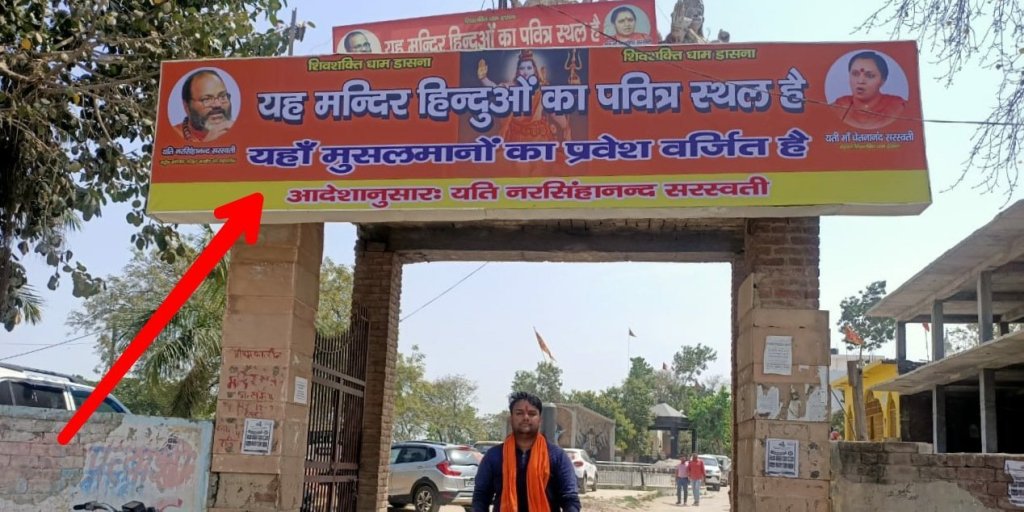
According to reports, since today it was being speculated that after the Friday Namaz, Muslims in huge numbers, led by MLA Aslam Chaudhary would be heading towards the Dasna Temple and would try and enter it forcefully, the temple authorities placed a bigger and wider board at the temple entrance where it is written in even bolder letters that “This temple is a sacred place of Hindus. The entry of Muslims is forbidden here.”
This almost double-sized board placed on the Temple entrance is an assertion of sorts that Hindus and temple authorities are not scared of the veiled threats issued to them by the Muslim community and MLA Aslam Chaudhary following the controversy.
Dasna Temple Mahant Yati Narasimhanand Saraswati also took to Twitter to inform that the temple authorities have doubled the size of the board prohibiting Muslims to enter the premises.
Earlier, the temple administration had clearly said that the board which was installed around 7-8 years ago would not be removed at any cost. There had been incidents of molestation of women and girls visiting the temple, they had said. To stop anti-social elements of the particular community, the temple authorities have placed the board at the temple entrance where it is clearly written, “The entry of Muslims is forbidden here.”
Meanwhile, many Hindu devotees, in a show of strength, have also started gathering near the temple premises today. The Uttar Pradesh administration had beefed up security in and around the Devi temple of Dasna in Ghaziabad, Uttar Pradesh to make sure no untoward incident takes place.
The national spokesperson of the Vishwa Hindu Parishad, Vinod Bansal, issued a press release on Twitter showing solidarity with Mahant Yati Narasimhanand Saraswati. Bajrang Dal Province Convenor Vijay Tyagi also cleared that Aslam Chaudhary’s veiled threats will not be entertained. He had said that if the MLA is genuinely feeling remorse for his past statement, he could visit the temple and seek forgiveness. But if the MLA wants to enter the temple premises to fan his jihadist culture, he would be paid back in the same coin, he said.
Vikas Tyagi also warned all those who try to even raise a finger on the Hindu monasteries, temples, saints and culture, with dire consequences.
The Dasna controversy
For the uninitiated, the Devi temple of Dasna, Ghaziabad had come under limelight after a teenage Muslim boy named Asif claimed that he was beaten for trying to drink some water inside the temple premises.
Speaking about the incident, Shringi Yadav, who was arrested in connection with the alleged assault on the Muslim boy Asif, dismissed the claims that the Muslim boy was targeted inside the temple for drinking water. Rubbishing the allegations, Yadav, who is now being depicted as the ‘mascot of hatred’ by the ‘left-liberal’ media, said that Asif was caught urinating on the Shivling inside the Dasna Devi temple. He also added the claims of Muslim youth entering the premises to drink water is not true.
Moreover, Mahant Yati Narsinghanand, the Mahant of the temple, said that Shiv Shakti Dham has a tap near the main gate and another tap close-by. If someone wants to drink water, why would he go inside the premises? He further alleged that it is a conspiracy against the temple. He alleged that there had been incidents of robbery at least four times in the temple premises.
There had been incidents of molestation of women and girls visiting the temple. To stop anti-social elements of the particular community, the temple authorities have placed a board at the temple entrance where it is clearly written, “The entry of Muslims is forbidden here.” It is being said that the board was installed around 7-8 years ago.
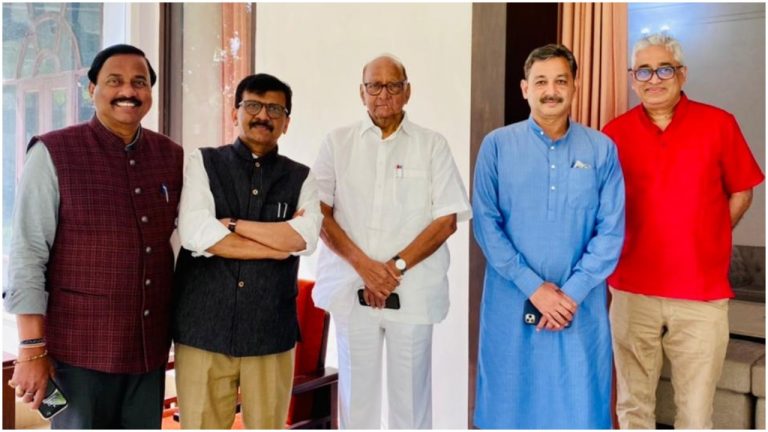
On Friday, Shiv Sena motor-mouth leader and Rajya Sabha MP Sanjay Raut took to Twitter to inform that he had met NCP Supremo Sharad Pawar at his residence in Delhi. In the image he had posted on Twitter, Sanjay Raut was seen with fellow leaders from Maharashtra, who had visited his residence in Safdarjung Lane in Delhi.
Sharad Pawar was also accompanied by NCP leader Sunil Tatkare and BJP Rajya Sabha MP Yuvraj Sambhajiraje Chhatrapati. Strangely, controversial news anchor Rajdeep Sardesai was also seen in the image, raising questions about his presence at Sanjay Raut’s residence.
“Today at My Delhi residence..15 Safdarjung lane. Hon. Sharad Pawar Hon Chhatrapati Sambhaji Raje Hon Shri Sunil Tatkare and Shri Rajdeep Sardesai,” tweeted Sanjay Raut.
Today at My Delhi residence..15 safdarjung lane. Hon. Sharad Pawar Hon Chhatrapati Sambhaji Raje Hon shri Sunil Tatkare. and Shri Rajdeep Sardesai.. pic.twitter.com/2lSltF5EVU
It was later revealed that Rajdeep Sardesai had visited Raut’s residence in Delhi to interview the Shiv Sena leader on the ongoing Antilia bomb scare controversy.
However, Rajdeep Sardesai’s presence at Raut’s residence took a different turn on social media after netizens noticed that Sanjay Raut had failed to address Rajdeep Sardesai with the prefix ‘honourable’ as he addressed the other leaders who visited his house.
Social media users pointed out that Sanjay Raut addressed the other three leaders by adding ‘Honourable’ or Hon. as a prefix to their names, however, he did not similarly address Rajdeep Sardesai. The different standards in Sanjay Raut’s greetings have now opened up jokes on social media asking whether Sanjay Raut does not consider Sardesai as honourable enough.
Netizens had their own take on the issue. One user said everyone visited Sanjay Raut’s residence was ‘honourable’, except Rajdeep Sardesai.
Everyone is honorable except Rajdeep Sardesai as per Naughty Sanjay Raut.
Just look at the way legendary fake news reporter Rajdeep is posing. Sheepish smile & hands folded back just like a student (or maybe a slave) stands in front of his master. Man has no self respect. https://t.co/VUng1K3pMT
— Pradeep Parker // Peter Prabhakar (@HouseOfFakts) March 19, 2021
I think Rajdeep isn’t honorable probably coz he went there uninvited. I’m not a pet person but hv heard they can smell their owner quite well and from pretty far. No offense pets. https://t.co/pCddyvXhCg
Nevertheless, Rajdeep Sardesai’s timid and sheepish looks on camera at Sanjay Raut’s residence has now become a talking point on social media, who are now busy making jokes at Rajdeep’s expense.
Sanjay Raut downplays Antilia Bomb scare case in Rajdeep Sardesai’s show
Earlier in the day, Shiv Sena leader Sanjay Raut stoked a controversy by casting aspersions against the NIA. Speaking to Rajdeep Sardesai, Sanjay Raut said that NIA was working at the behest of the central government.
The Shiv Sena leader said that the investigative agencies should focus on dangerous terror activities rather than going after ‘some gelatin sticks’.
Shiv Sena leader Sanjay Raut on Thursday defended the Maha Vikas Aghadi government and the Mumbai police in the ongoing Anitlia bomb scare case. Responding to Shiv Sena’s alleged links to the terror case, Raut said he could not answer for Sachin Vaze, but only investigative agencies can do it.
Casting aspersions on the National Investigation Agency (NIA), Raut said everyone knew under whom and whose behest the NIA, Enforcement Directorate, CBI work. Questioning the NIA, Raut said, “What has NIA achieved in the last few years. NIA’s job is to break the nexus between terrorists. Tell me, what has NIA done after the Uri terror attack, Pathankot terror attack and Pulwama attacks? Have they submitted any report?”
The Shiv Sena leader claimed that the entire NIA, central government and the opposition parties are after ‘some 20 gelatin sticks’ found in a vehicle. They should focus on other dangerous terror activities around the country, he quipped.
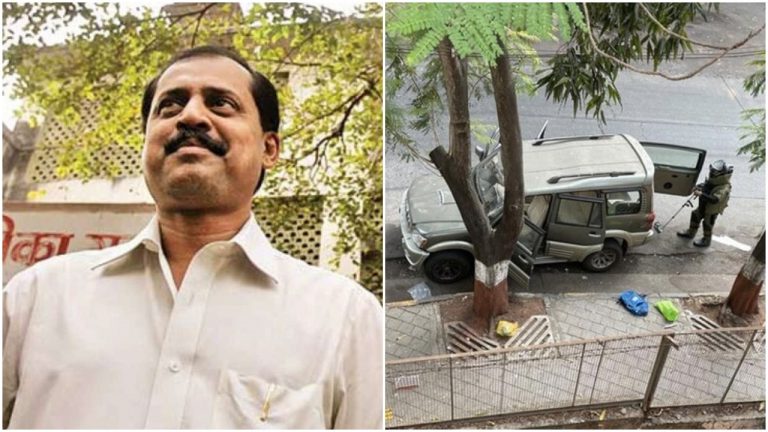
Over the last few weeks, the Antilia bomb scare case has taken a dramatic turn with the arrest of Mumbai police “encounter specialist” Sachin Vaze. The controversial cop and former Shiv Sena leader Sachin Vaze is also accused of murdering Mansukh Hiren, an important witness in the case. After his arrest by NIA, Mumbai police commissioner Param Bir Singh has also been transferred from his post.
From the recovery of an explosives-laden vehicle outside Ambani’s residence to the transfer of the Mumbai Police Commissioner, the case has turned to be one of the most controversial cases in recent history.
Here is a complete timeline of the events that have unfolded in the Antilia bomb scare case:
February 17: A Mumbai-based Businessman Mansukh Hiren’s car was stolen from Vikhroli area.
February 18: A day later, Mansukh Hiren files a police complaint at Vikhroli police station. In his complaint, Hiren claims that he had given the SUV to Sachin Vaze, who returned the car on 5 February 2021 owing to a technical snag in the steering.
Hiren said that he was forced to park the car at the Eastern Express Highway in Vikhroli on 17 February after the “steering got jammed”. The car was missing when he came back the next day and lodged a complaint with Vikhroli police station in Mumbai.
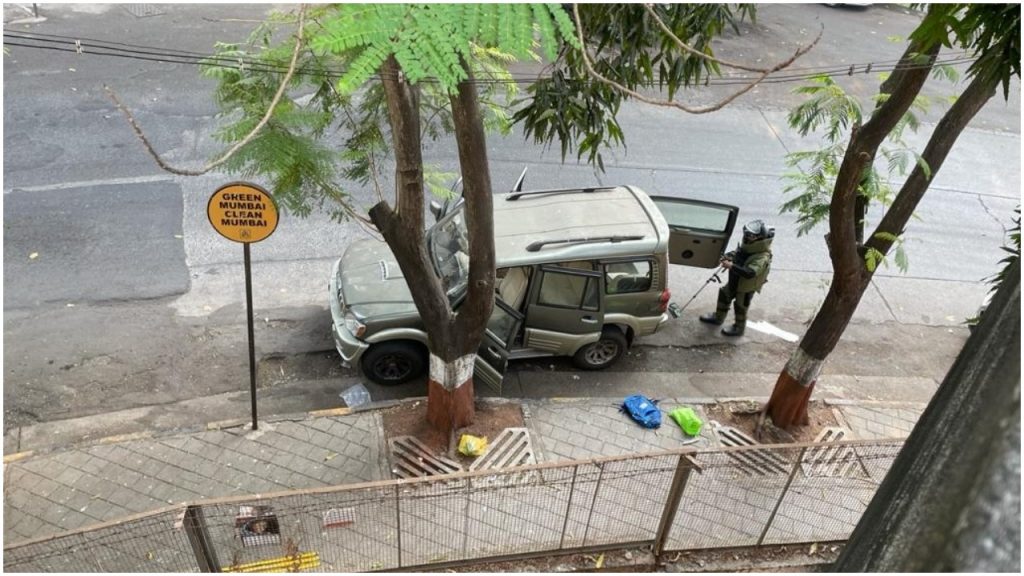
February 25: A Scorpio car with 20 explosive gelatin sticks was found outside Mukesh Ambani’s Mumbai residence – ‘Antilia’. The security staff of Antilia informed police about the suspicious Scorpio on Thursday at noon. Along with the bomb disposal squad and the canine squad, a police team soon reached the spot to look into the matter. The police cordoned off the area and removed the car from the spot.
The bomb-laden Scorpio found outside Mukesh Ambani’s home Antilia in Mumbai/ Image Source: India Today
The Mumbai Police recovered 20 unassembled gelatin sticks, some number plates and a threatening letter from the car. Several cops, including Mumbai’s crime intelligence unit headed by Sachin Vaze, reached the spot for investigation.
It is revealed from CCTV footage that two cars – an Innova (white colour) and a Scorpio (green colour) were allegedly used to plant the bombs outside Mukesh Ambani’s residence in Mumbai. The Innova had trailed the Scorpio, and after parking the Scorpio near Antilia, its driver had got into the Innova to leave the place.
The Mumbai Police also recovered a letter addressed to Mukesh and Neeta Ambani claiming that the planting explosives was just a ‘trailer’ and threatened to return later with more preparations to assassinate the whole family.
February 26: The Mumbai Police investigation reveals that the bomb-laden car belonged to Mansukh Hiren. ATS soon picks him up for investigation.
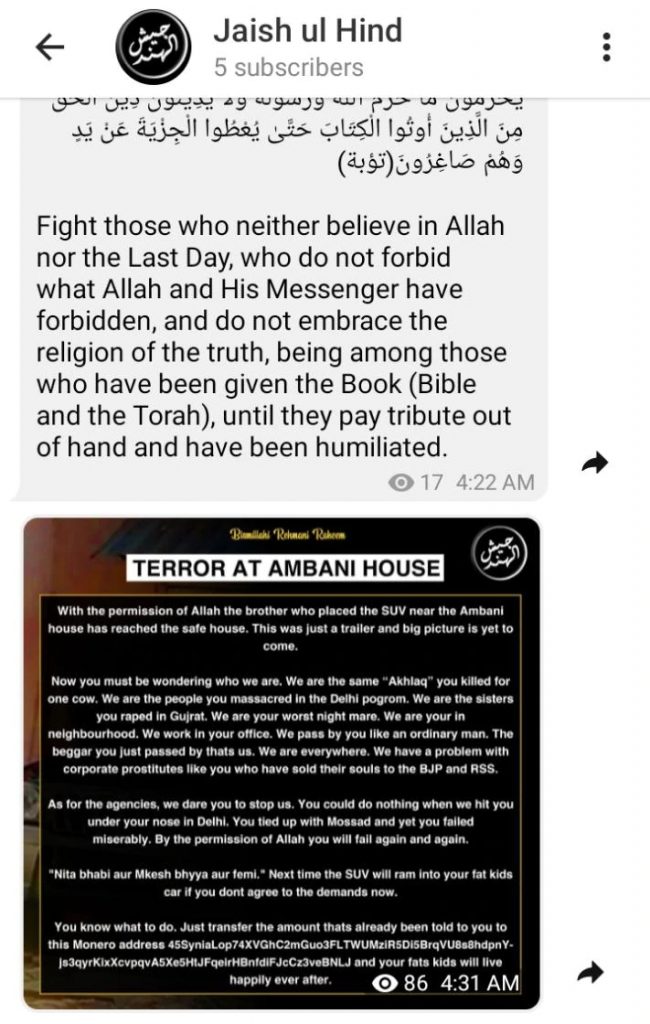
February27: Two days after the SUV laden with explosive material was discovered outside Antilla, the residence of Mukesh Ambani and his family in Mumbai, a threatening message from a Telegram account in the name of Jaish ul Hind was posted, along with a demand for payment in a cryptocurrency (Monero) from Mukesh Ambani.
The Telegram message
The Islamic terror group Jaish-ul-Hind claimed responsibility for planting the explosives-laden vehicle outside Reliance Industries chairman Mukesh Ambani’s house in Mumbai. However, the same evening, in another letter, Jaish Ul Hind said that it had nothing to do with the car found near Ambani’s house.
On the same day, Mansukh Hiren was seen going to the commissioner’s office in a white Land Cruiser Prado with Sachin Vaze. This vehicle costing one crore rupees belongs to a Shiv Sena leader.
March 2: Mansukh Hiren alleges harassment by the police in a letter to Maharashtra Chief Minister Uddhav Thackeray, Home Minister Anil Deshmukh, Mumbai Police chief Param Bir Singh, Thane Police chief Vivek Phansalkar. He had alleged that he was being treated like an accused despite being a victim in the case. Hiren wrote that NIA, police and journalists were harassing him, causing his mental health to deteriorate.
March 4: Hiren gets a call from “some Tawde of Kandivli Crime Branch”, who asks him to meet at Ghodbunder Road in Thane. Hours later, Hiren goes missing.
March 5: Former Maharashtra Chief Minister Devendra Fadnavis makes a sensational disclosure on March 5 in Vidhan Sabha where he claims that Assistant Police officer Sachin Vaze was in touch with Mansukh Hiren, the owner of the Scorpio car that was found laden with explosives outside the Ambani residence.
Hours later, Mansukh Hiren is found dead after being “missing” for five hours. During the initial investigation, the police said that it looked like Hiren had ended his life by jumping into Kalwa creek. However, the police claim is questioned as several handkerchiefs were stuffed in his mouth, suggesting a murder.
March 6: The family members of Mansukh Hiren refuses to accept his body, stating that they will do it only after the police and the administration make his postmortem report public.
Hiren’s wife alleges that Sachin Vaze, the Mumbai crime branch officer, killed her husband. The family points towards the letter penned by Hiren in which he alleged that he was mentally harassed in connection with the Antilia bomb scare case. Besides, the family members of Hiren rejects the notion that Hiren might have committed suicide.
Meanwhile, the opposition leader Devendra Fadnavis alleges that the last known location of Mansukh Hiren’s phone was near Shiv Sena leader Dhananjay Gawde’s office. Both Gawde and Vaze are purportedly close as both were named in an extortion case in 2017. BJP demands Vaze’s arrest.
The Maharashtra government transfers all three cases – Mansukh Hiren death case, stolen Scorpio case and Antilia bomb scare case to ATS.
March 8: The NIA takes over the Ambani bomb scare case, but the Mansukh Hiren death case remains with the Maharashtra ATS.
March 10: Facing heat from the opposition, the Maharashtra government announces that Sachin Vaze would be removed from the Crime Branch and posted in some other department.
March 11: The Delhi police recovers a SIM card and cell phone used to threaten Ambani from Indian Mujahideen member Tehsin Akhtar’s barracks in Tihar jail.
The SIM and cell phone were used to create the Jaish-ul-Hind Telegram account that claimed responsibility for the explosive-laden SUV and demanded cryptocurrency. The mobile phone user used an app to generate virtual numbers and then made a Telegram account. He was also using a TOR browser to mask his IP address on the internet.
Meanwhile, Sachin Vaze is questioned by state ATS in Mansukh Hiren death case, and the NIA team carries raids at different locations in Mumbai, Thane, Palghar.
March13: NIA summons Sachin Vaze for questioning, and after 12 hours of interrogation, they arrest him in connection with the case. During the interrogation, Mumbai top cop Sachin Vaze reportedly admits that he was involved in the Antilla Bomb Scare case. Sachin Vaze says he is just a very small part of the plan and the Shiv Sena leaders he named played a bigger role.
The NIA books Sachin Vaze under Sections 120 (B) for criminal conspiracy, Section 286 for negligent conduct with respect to explosive substance, Section 465 for forgery, Section 473 for making or possessing counterfeit seal and 506(2) for criminal intimidation.
Before the arrest, Sachin Vaze puts up a dramatic WhatsApp message – “time to say goodbye to the world coming closer.”
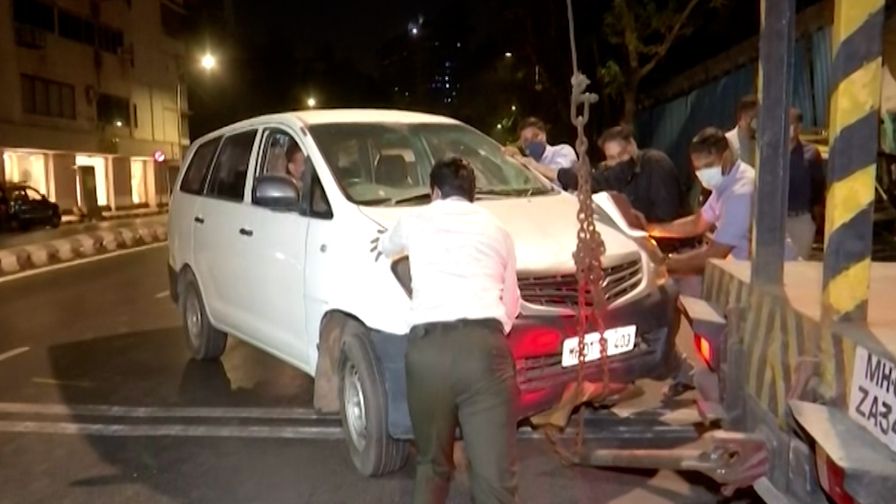
March 14: The National Investigative Agency officials recover the white Innova car from the Mumbai Police Commissionerate office. In addition to the Scorpio, the white Innova was used to plant the explosives outside Mukesh Ambani’s residence in Mumbai on February 25.
The Innova seized by NIA
The NIA officials traced the white Innova to the Mumbai Police Commissionerate office, where the suspicious car was parked. The NIA officials found that the white Innova belonged to the Mumbai Police’s CIU unit and was used by Sachin Vaze. In the meanwhile, the ATS already looking for the car but ‘could not find it’.
Shiv Sena leader Sanjay Raut comes to the rescue of Sachin Vaze, says the tainted cop is “very honest and capable officer”.
March 15: NIA says it has accessed CCTV footage, fingerprints and other evidence against Sachin Vaze. NIA gained access to CCTV footage covering a 2 km radius of Sachin Vaze’s CIU office from 25th February to 5th March 2021.
As per NIA, the CCTV footage confirms that Sachin Vaze met Mansukh Hiren on 25th February, the same day, gelatin laden Scorpio was discovered at Mukesh Ambani’s residence.
Arrested Mumbai cop and controversial “Encounter specialist” Sachin Vaze suspended by an order of Addl CP Special Branch, says Mumbai Police PRO.
Subsequently, Maharashtra BJP leader Nitesh Rane makes serious allegations against Sachin Vaze involving the Indian Premier League. Rane alleges that Vaze was in touch with bookies that start operating before the T20 cricket league.
Meanwhile, The NIA reveals that CCTV footage of Vaze’s society had gone missing. The NIA says Sachin Vaze’s aide API Riyaz Qazi had visited Sachin Vaze’s building in Saket society in Thane and took CCTV footage of and between February 17 to February 24.
March 16: The next day, it is disclosed that the CCTV footage was procured by none other than the tainted police officer himself. Vaze had reportedly seized the CCTV footage of his society, stating that the DVR was needed for official use by the police.
The footage was subsequently damaged. Vaze had allegedly confiscated the video footage so that no evidence can be found during the interrogation.
In another sensational disclosure, the NIA says that the explosives-laden Scorpio car that belonged to Mansukh Hiren that was found outside Antilia was never stolen but used by Assistant Police officer Sachin Vaze. That is the reason Vaze destroyed the CCTV footage, as it would have proven that the car with him before it was planted near Antilia.
It is reported that the car was used by Vaze, who had asked Hiren to file a false complaint about it being stolen. The NIA believe the owner of the car was pressurised to file a complaint about his missing car.
Not just his residence, Sachin Vaze also collected CCTV footage from a linked to the case, and destroyed it. He visited the shop where the fake number plates for the Scorpio and the Innova cars were made, and took away the DVR of the CCTV and the register of the shop.
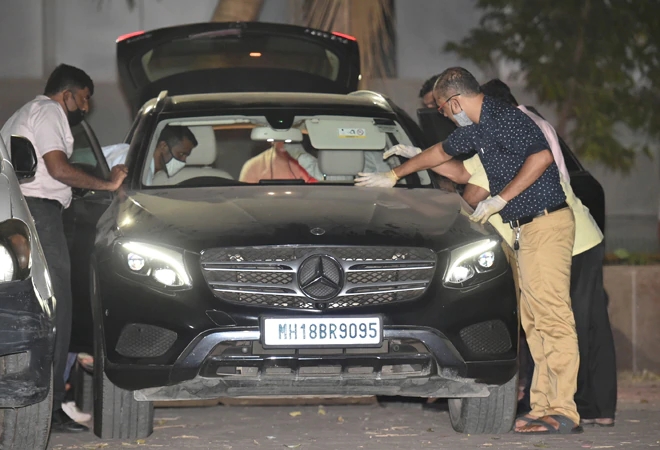
March 17: The NIA seizes a black Mercedes car used by the tainted Mumbai cop from the Crawford market area. The NIA officials also recover the number plate of the Scorpio car that used to plant bombs outside Antilia from the Mercedes car.
The NIA officials also recovered unaccounted cash of Rs 5 lakh, a few clothes and a cash counting machine from the car, in addition to the number plate that was attached to the Scorpio. The car used by the police officer had a fake number plate on it.
On the same day, one of the staff of Vaze admits before the National Investigation Agency saying that Vaze was seen wearing a PPE kit near Antilia a day before a bomb-laden car was parked outside Mukesh Ambani’s residence. The National Investigating Agency officials also recover a shirt from Sachin Vaze that was allegedly worn inside the PPE kit.
Maharashtra government sacks Param Bir Singh as Mumbai Police chief transfers him to DG Home Guard’s post. Hemant Nagrale replaces Singh.
March 18: The National Investigation Agency seizes two more luxury cars in the Antilia bomb scare case, which are linked to API Sachin Vaze, raising the total tally of the seized car in the case to 5.
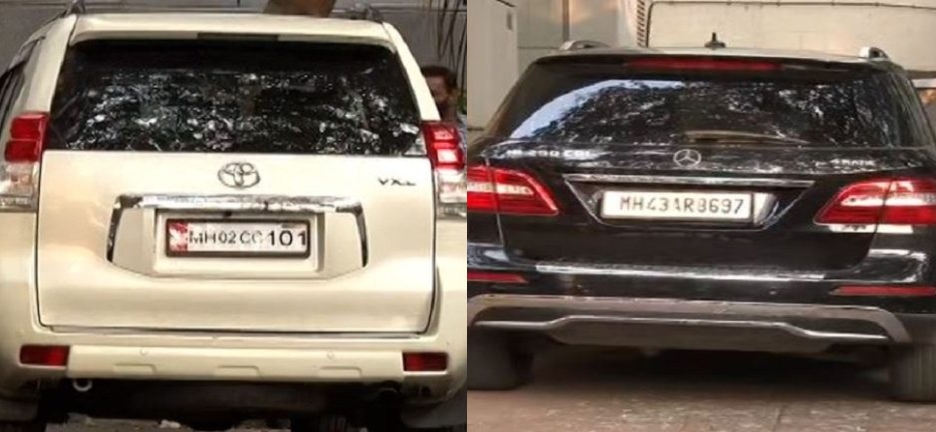
NIA brings two more luxury SUVs to its office in Mumbai in connection with the case. One of the cars is a black luxury SUV, a Mercedes Benz ML 250 CDI. After that, the agency brought another high-end SUV, a white Toyota Land Cruiser Prado GRJ 120 R. The Prado belongs to Vijaykumar Ganpat Bhosle, who is a Shiv Sena leader. It is also reported that NIA is looking for two more cars in the case, a blue Mercedes and a Skoda car.
The Land Cruiser Prado and Mercedes cars
The NIA also takes control of video footage recorded outside the Crime Branch that shows the tainted Mumbai Cop and former Shiv Sena leader Sachin Vaze with Mansukh Hiren, the owner of the bomb-laden Scorpio.
Sachin Vaze, the prime accused in the Antilia bomb scare case, was seen arriving at the Crime Branch unit in a Land Cruiser Prado along with Mansukh Hiren. The footage was recorded on February 26, a day after the bomb-laden Scorpio was detected outside Mukesh Ambani’s residence in Mumbai. The Prado car belongs to Shiv Sena leader Vijaykumar Ganpat Bhosle.
March 19: Top sources in the Maharashtra Anti Terrorism Squad (ATS) says that they had found injuries on the body of businessman Mansukh Hiren’s head and neck. An unnamed source in the Maharashtra ATS says that Hiren might have been assaulted before his death. The ATS official says that it appeared that someone might have assaulted Mansukh Hiren with a blunt and heavy object.
The investigation into all the three cases are currently active. Any information pertaining to the cases will be further updated.
In an internal announcement on Thursday, Facebook Inc. let its employees know that it is building an ‘under-13’ version of the image-sharing social media tool Instagram. This move from Facebook is seen as an effort to market its products to the upcoming generation of internet users. The announcement comes in light of Instagram’s Vice President of Product Vishal Shah’s post on an internal message board for employees.
“I’m excited to announce that going forward, we have identified youth work as a priority for Instagram and have added it to our H1 priority list. We will be building a new youth pillar within the Community Product Group to focus on two things: (a) accelerating our integrity and privacy work to ensure the safest possible experience for teens and (b) building a version of Instagram that allows people under the age of 13 to safely use Instagram for the first time.” Shah’s post read.
Facebook had acquired Instagram for $1 billion in 2012 amid fears of competition with other tech giants like Twitter and Google. Since then, Instagram has been the premier photo-sharing social media app, boasting about 1 billion users. Instagram is uniquely popular with teenage internet users, despite Instagram policy prohibiting any children under the age of 13 from using the platform.
This announcement comes following Instagram’s publication of a blog post three days ago, titled “Continuing to Make Instagram Safer for the Youngest Members of Our Community.” This blog post details Instagram’s plans to make the social media site safer for Instagram’s younger users. However, this post makes no mention of Instagram’s plans for building a new under-13 version of the platform. Some of these methods include Instagram blocking adults from sending Direct Messages to anyone aged below 18 who does not follow them, alerts from Instagram to underage users in order to caution them about interactions with adults etc.
In an interview with Buzzfeed, Adam Mosseri, the Head of Instagram said that “more and more kids” want to use social media apps like Instagram and creating a version of Instagram for kids where parents have control is “part of the solution”.
Throwback to ‘Messenger Kids’
This is not the first time Facebook Inc. will create a product exclusively for kids. In 2017, Facebook launched Messenger Kids, a product aimed at children between the ages of 6 to 12. Messenger Kids includes many parental control measures ensuring the safety of children. However, Messenger Kids has endured its fair share of criticism.
After the launch of Messenger Kids, a group of more than 95 organizations and individuals concerned with children’s health sent a letter to Mark Zuckerberg, asking him to discontinue the product. In their letter, the group cites research saying, “excessive use of digital devices and social media is harmful to children and teens, making it very likely this new app will undermine children’s healthy development.”
In 2019, there were reports of a bug that allowed underage Messenger Kids users to chat with adults their parents had not approved of. The bug allowed the underage users to interact with unapproved adults through the group chat feature. No clear reason for the existence of this bug was found. This particular incident raises serious concerns regarding the safety of children of such “kids only” social media websites going forward.
There is much debate and discussion underway following the resignation of ’eminent intellectual’ Pratap Bhanu Mehta as a professor of the Ashoka University. After Mehta’s resignation, Arvind Subramanian resigned as well, leading to a host speculations regarding the reasons behind the same.
As is to be expected, the resignation drove liberals on social media into a frenzy alleging a sinister government plot behind the resignation. Pratap Bhanu Mehta was made to resign because the Modi Government cannot tolerate dissent, so goes the claim. And some of it was fueled by a report that surfaced soon after his resignation and Mehta’s own statements.
The Edict Report and what other ‘sources’ said
The Edict, an independent student newspaper of Ashoka University, claimed that there was a plot of land that was behind the resignation. It reported on the 17th of March, “A source, who wishes to remain anonymous, told The Edict that the resignation of Professor Pratap Bhanu Mehta was endorsed by the Founders of the University. This endorsement, according to a senior faculty member with whom our source spoke, was motivated by an understanding that if Prof. Mehta resigned, the University’s efforts to acquire a new plot of land to expand the campus would get much smoother.”
“Additionally, formal recognition for the fourth-year post-graduate diploma, Ashoka Scholars’ Program, was also hinted at being part of the deal,” added the report. Vineet Gupta, a trustee and co-founder of Ashoka University, however, rubbished the allegations made in the report.
He told The Print in a statement, “The Edict article about Prof. Pratap Bhanu Mehta’s departure and its purported link with either the plot for Ashoka’s new campus or statutory approval for the four-year UG programme is factually inaccurate.”
“The plot of land for Ashoka’s new campus was acquired three years ago. There is no question of approval for the four-year UG programme being a factor, because that is governed by a national law and is not specific to any university. The four-year programmes have anyway been approved by the government under the new National Education Policy for all universities. The article is purely speculative. Please treat it as such,” he added.
However, faculty members appear to believe that his criticism of the government may have played a part. “The university has always tried to stay away from unnecessary media attention. Being a private institution, it does not want to be seen as anti-government, and Pratap’s columns were doing just that, drawing attention to the university,” one faculty member was quoted by The Print as saying.
“The founders were not happy with it, hence he was first asked to step down as V-C, which slowly paved the way for his resignation.”
Indian Express reported that ‘sources’ had told them that Ashish Dhawan and Pramath Raj Sinha, the founders of the University, met Pratap Bhanu Mehta recently and ‘suggested’ that they could not protect his ‘intellectual interventions’ given the “current political environment”.
Pratap Bhanu Mehta in his own words
The perennial critic of the Modi Sarkar, in his resignation letter, is reported to have claimed that he is a victim of his political opinions. “After a meeting with founders it has become abundantly clear to me that my association with the university may be considered a political liability. My public writing in support of a politics that tries to honour constitutional values of freedom and equal respect for all citizens, is perceived to carry risks for the university,” he stated.
“It is clear it is time for me to leave Ashoka. A liberal university will need a liberal political and social context to flourish. I hope the university will play a role in securing that environment. Nietzsche once said that “no living for truth is possible in a university.” I hope that prophecy does not come true,” Mehta added. Vice Chancellor Malabika Sarkar is reported to have tried to convince him to reverse his decision but to no avail.
“The VC also stated that unfortunately, Prof. Mehta did not wish to rescind his resignation after she asked him to do the same this evening. Furthermore, there were questions on issues of accountability and why there was little to no transparency regarding Prof. Mehta’s resignation from the university. The VC replied that she was hoping for him to withdraw his resignation and hence the university had not put out an official statement yet, which would be done by the night or the following morning, since there is some certainty with respect to his decision at the present moment,” The Edict reported.
Resignation letter of Arvind Subramanian
Arvind Subramanian, former chief economic advisor to the Modi Government, had much to say about the episode in his own resignation letter, which came two days later. He said, “However, the circumstances involving the ‘resignation’ of Professor Pratap Bhanu Mehta, who is not just a dear friend but a truly inspirational national figure, have devastated me. I am acutely aware of the broader context in which Ashoka and its trustees have to operate, and have so far admired the university for having navigated it so well.”
“But that someone of such integrity and eminence, who embodied the vision underlying Ashoka, felt compelled to leave is troubling. That even Ashoka — with its private status and backing by private capital — can no longer provide a space for academic expression and freedom is ominously disturbing. Above all, that the university’s commitment to fight for and sustain the Ashoka vision is now open to question makes it difficult for me to continue being part of Ashoka,” he continued.
The Alumni Speaks, so does the Faculty
The Ashoka University Student Government and the varsity’s Alumni Council backed Pratap Bhanu Mehta in a statement. “We express our unconditional support to Professor Mehta who always taught us to be critical of the structures we live around and question what is taken for granted,” it said.
“The events that have transpired point to a failure on the chancellor and vice-chancellor’s part in protecting the university faculty from external pressures, and more importantly, also point to the failure of the founders to ensure the same,” the statement read.
“We are also concerned about the larger implications this has on the freedom of speech for Ashoka’s students and faculty. This is not the first time that professors have come under fire for their opinions and/or their course content. We are worried about the support they will have in the future, whether it will force them to self-censor, and what this means for the quality of our education,” it added.
The University Faculty, in its own statement, stated, “This would fly against the principles of academic freedom on which Ashoka University has been set up — and which Professor Mehta, in his time as vice-chancellor and university professor, has so scrupulously fought to defend. It would also set a chilling precedent for future removals of faculty, curtailing our sense of who we are as researchers and teachers.”
The narrative in liberal circles
The circumstances of his resignation are still unclear. Pratap Bhanu Mehta claims that he has become a political liability but the Vice Chancellor of Ashoka University insists that she attempted to convince him to reverse his decision. It does not come across as the conduct of a Vice Chancellor who wants him gone.
Additionally, there are reports that the founders of the University themselves intervened in the matter. What was said in the meeting between them and Mehta, if such a meeting occurred at all, is not entirely known and all that we know is what has been reported in the mainstream media and from Mehta’s own comments.
The mainstream media, as we are well aware, has a well established tendency to misreport and misrepresent facts. Therefore, it is in the interests of everyone to reserve judgment until the founders present their own version of events.
Nevertheless, liberals have decided to paint Mehta a ‘martyr’ and interpret everything as he says as gospel truth. Sheldon Pollock, a professor at Columbia University, expressed his dissatisfaction with the Ashoka University in a statement to the Indian Express.
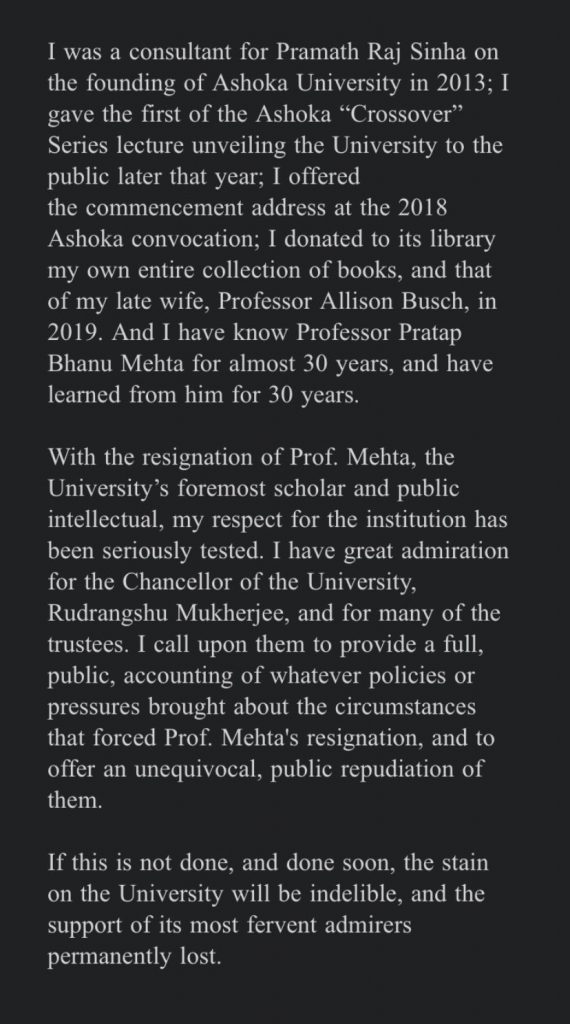
Pollock said, “With the resignation of Prof. Mehta, the University’s foremost scholar and public intellectual, my respect for the institution has been seriously tested. I have great admiration for the Chancellor of the University, Rudrangshu Mukherjee, and for many of the trustees. I call upon them to provide a full, public, accounting of whatever policies or pressures brought about the circumstances that forced Prof. Mehta’s resignation, and to offer an unequivocal, public repudiation of them.”
Sheldon Pollock’s statement to the Indian Express
“If this is not done, and done soon, the stain on the University will be indelible, and the support of its most fervent admirers permanently lost,” he added. Ichchhadhari protester Yogendra Yadav, who has been larping around as a farmer recently, said, “Pratap Mehta has single handedly raised the bar of public discourse in India.His mid-semester “resignation” shows we’ve entered next phase of suppression of ideas, that there are no “safe heavens” for dissenters, not even in private univs.”
Senior Congress leader Shashi Tharoor opined, “There’s more to this than meets the eye but it ends the claims of AshokaU to be the leading liberal arts university in India. This craven caving in confirms my statement to the LokSabha Tues that Universities are no longer safe spaces for free expression.” Kapil Sibal, calling it an ‘induced resignation’, said, “The last bastions of resistance too are falling”.
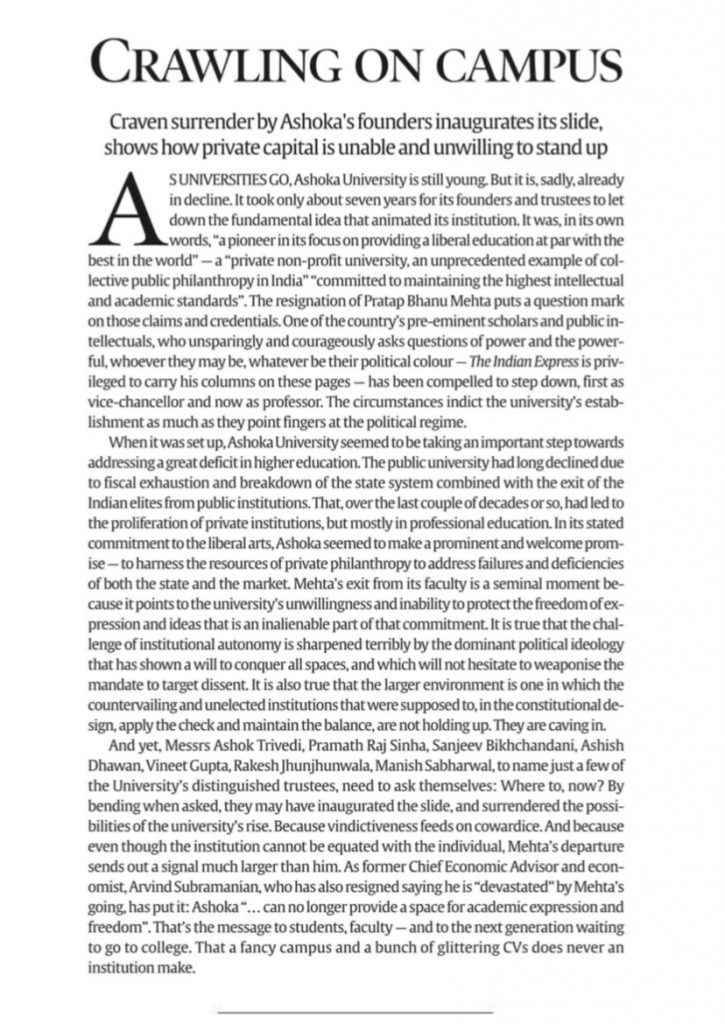
The Indian Express said in an editorial, “Craven surrender by Ashoka’s founders inaugurates its slide, shows how private capital is unable and unwilling to stand up. As Universities go, Ashoka University is still young. But it is, sadly, already in decline. It took only about seven years for its founders and trustees to let down the fundamental idea that animated its institution.”
Indian Express editorial
Sanjay Jha, who was unceremoniously humiliated by the Congress party, said, “Pratap Bhanu Mehta is an exceptional commentator, bipartisan, candid and erudite. We need more public intellectuals like him. His resignation is a loss for the students of Ashoka University, which apparently is the fountainhead of liberalism. Irony just died.”
Ramachandra Guha, another ’eminent intellectual’, commented, “In its journey thus far, Ashoka University had shown much promise. They may have frittered all that away by the spinelessness of their trustees, who have chosen to crawl when asked to bend.”
There were some who used the episode to once again hail the students of Jamia Milia Islamia and Aligarh Muslim University. One user said, “When you see what likes of Pratap Bhanu Mehta couldn’t put up with, try to imagine what students of Jamia and AMU have courageously endured.”
Pratap Bhanu Mehta: Political ideology and antecedents
Mehta has been a fierce critic of the Modi Government in recent times. In an interview to The Wire, he had said, “Even though the government is committed to winning elections to secure power, in every other way it ticks the checklist of fascist qualities”. Mehta claimed that “colloquially speaking, this is a fascist government and it is, therefore, not incorrect to use that term”. He also alleged that the current situation is worse than Indira Gandhi’s Emergency.
At the India Today Conclave ahead of the 2019 General Elections, Mehta declared that democracy in India was in a crisis and there was a “deep diminish of hope”. More recently, V-Dem released a report classifying India as an “electoral autocracy” where initially, its website mentioned Mehta as an advisor but his name has been wiped out since then. Mehta himself claims that he has not been on their advisory board since 2007.
Pratap Bhanu Mehta was also a Board member at Namati, an organisation where George Soros sits on its Advisory Council. But he appears to have been removed from his position since then as the website no longer mentions him as a member. It is pertinent to recall that George Soros had declared war against nationalism and Narendra Modi. Madeline Albright, former US Secretary of State during the Bill Clinton administration, is on its Advisory Council too.
Thus, from the onset, Mehta appears to be a foot-soldier for the neoliberal world order that is facing tough resistance from countries around the world. Even so, the precise reasons behind his resignation from Ashoka University remains unclear.
Just a few days ago, Microsoft reported a cyberattack on its mail server software. Microsoft has since then come forward to claim that a Chinese cyber-espionage group was responsible for this. According to Microsoft’s Threat Intelligence Centre, the cyber-group named Hafnium was responsible for the attack on Microsoft. Hafnium has previously been accused of both being sponsored by China and operating out of the country. Microsoft claims that its conclusion is based upon “observed victimology, tactics and procedures”.
In recent years, China has successfully established itself as one of the world’s foremost forces in terms of cyber power. A 2020 report titled the “National Cyber Power Index 2020” published by Belfer Center for Science and International Affairs at Harvard University, ranks China as 2nd in the world in terms of cyber power, only behind the United States. This index measures a multitude of factors including government strategies, capabilities for defence and offence, resource allocation, the private sector, workforce, and innovation. Therefore, as far as cyber-attacks go, China is more than capable of facilitating such cyber operations.
China has long been suspected of funding and facilitating malicious cyber groups which engage in cybercrimes. Here are only some of the most notorious cyber groups which are either suspected or confirmed to be Chinese-backed:-
APT10 (Advanced Persistent Threat 10)
According to a report by the U.S. Cybersecurity and Infrastructure Security Agency, a federal agency under the U.S. Department of Homeland Security, the Chinese-backed cyber-espionage group APT10 has been active since at least 2006. APT10’s focus is to facilitate economic and commercial espionage against powers like Japan, the U.K., the United States etc. APT10 utilizes a variety of methods on its targets including spear phishing, usage of various Chinese malware, persistent targeting of MSPs (Managed Service Providers) etc.
In December 2018, two Chinese hackers belonging to APT10 were charged by the U.S. Department of Justice (DoJ) with conspiracy to commit computer intrusions, conspiracy to commit wire fraud, and aggravated identity theft. According to the U.S. DoJ, these two Chinese hackers were working in association with the Chinese Ministry of State Security’s Tianjin State Security Bureau, therefore revealing themselves to be working for the Chinese government.
APT10 continues to be active and goes by a number of aliases including MenuPass, Red Apollo, Stone Panda, Cicada etc.
Mustang Panda
Mustang Panda is a China-backed cyber-espionage group with a history of committing cyber attacks against Western NGOs which have a nexus with Chinese minority groups. This cyber group dates back to at least 2017. Mustang Panda utilizes malware like PlugX and Poison Ivy which is in use by almost all the Chinese-backed cyber groups operating today. Mustang Panda also relies on phishing lures that look like official documents written in the target’s native language in order to get the target to open an attached file that contains a .zip archive that executes malware like PlugX when opened.
In 2020, it was reported that Mustang Panda was targeting organizations associated with the Catholic Church. At the time of these cyber attacks, the Chinese Government and the Vatican were discussing the renewal of a 2018 accord between China and the Vatican, fueling speculations that the cyber activities of Mustang Panda were meant to provide an insight into the negotiations between China and the Holy See.
Mustang Panda goes by a number of aliases including RedDelta, TA416, BRONZE PRESIDENT etc.
BlackTech
BlackTech is a cyber threat group which primarily operates in East Asia countries like Taiwan and Japan, conducting cyber espionage operations. Known targets of BlackTech include finance, engineering, technology and government sectors of countries like Taiwan, Japan, Hong Kong and the U.S. with relation to East Asia. BlackTech’s strategy for cyber attacks often includes using compromised legitimate software in order to achieve its goals.
Reports state that BlackTech continues to remain active, utilizing new strains of malware to attack sectors in countries like Japan, Taiwan etc. In August 2020, the Taiwanese Government linked the cyber group BlackTech to the Chinese Communist Party (CCP), saying that BlackTech was working for the CCP in order to target multiple Taiwanese government and commercial entities.
BlackTech is known by several aliases including Palmerworm, CIRCUIT PANDA etc.
APT40 (Advanced Persistent Threat 40)
APT40 is a Chinese-backed cyber group which specifically focuses on countries and issues related to the South China Sea. The South China Sea is a disputed region over which China claims territorial sovereignty. APT40 is documented to digitally target maritime, engineering as well as government entities of countries bordering the South China Sea. A 2018 analysis report on APT40 infrastructure reveals that servers in Hainan, China were utilized by the group, which heavily suggests backing from the Chinese state. It is also important to keep in mind that Hainan is an island province of China located in the South China Sea.
In September 2020, Microsoft revealed that APT40 attempted to maliciously gain control of the cloud server but were identified and disrupted. A month before this, the Taiwanese government accused APT40 of digitally targeting various Taiwanese entities. Earlier in 2020, Malaysia’s Computer Emergency Response Team (MyCERT) issued an advisory naming APT40, linking the Chinese-backed cyber group to an espionage campaign against Malaysian officials.
APT40 goes by a number of aliases including GADOLINIUM, Leviathan, TEMP.Periscope etc.
APT 41 (Advanced Persistent Threat 41)
APT41 is one of the most prolific Chinese-backed cyber groups, with targets across various sectors and countries. Sectors like healthcare, media, and video games have been a target for cyber crimes by APT41. These cyber attacks by APT 41 hit multiple countries, including the U.S., Japan, South Korea, India, Australia, and the U.K. APT40 utilizes various ways in order to digitally attack their targets. These methods include using stolen digital certificates to sign malware, exploitation of remote access, using a custom malware Trojan known as Winnti etc.
In September 2020, in an effort to shine a light on the activities of APT41 the U.S. Department of Justice (DoJ) unsealed three indictments against five Chinese hackers and two Malaysian businessmen for a plethora of cyber crimes. The DoJ linked the activities of the Chinese hackers to a Chinese company known as Chengdu 404 Network Technology, which most likely operates at the behest of Chinese Ministry of State Security, which is a secret police agency in China. The DoJ indictments state that the Chinese hackers associated with APT41 are responsible for cyber attacks against over a hundred different organizations located in multiple countries.
APT41 is known by many other aliases. These include Barium, Winnti, Wicked Panda, Wicked Spider etc.
Chinese cyberthreat is real
As evidenced by the National Cyber Index 2020, China is the 2nd most powerful cyber power in the world. What’s even more impressive is the fact that China did not feature in the top 10 of a similar list titled Global Cyber Security Index 2018 provided by the International Telecommunication Union, a specialized U.N. agency. This indicates that China’s rise in cyber power is very recent and that the abovementioned examples of Chinese-backed cyber groups do not fully represent China’s future capabilities, which could also target India.
India was also under analysis for the National Cyber Index 2020. Out of the 30 countries assessed, India secured a rank of 21, clearly nowhere close to our neighbour. In terms of cyber offence or defence, India lags behind China in various indicators. This is a potential cause of concern for India, with military tensions at the Line of Actual Control heightening in the past year. Clearly, in order to achieve parity with China, India needs to heavily invest in its cyberinfrastructure and cybersecurity across the board in general.
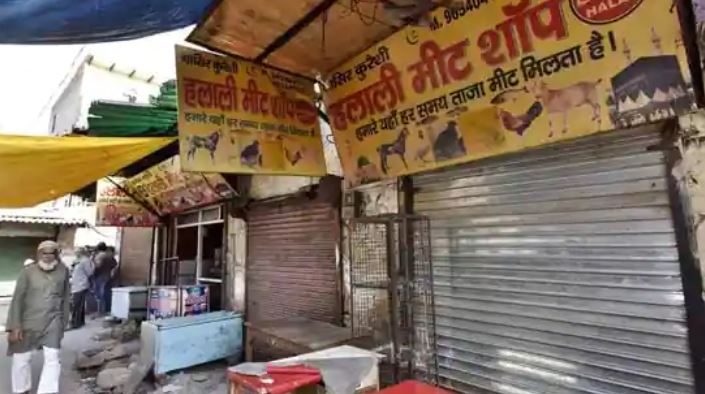
In its House meeting on Thursday, the Municipal Corporation of Gurugram has decided that all the city meat shops will remain shut once a week every Tuesday. The directive was issued after a few councillors raised the issue during the meeting citing the religious sentiments of the Hindus. After long discussions and deliberation, the Municipal Corporation of Gurugram (MCG) officials approved the proposal.
According to Hindu mythology, Tuesday is dedicated to Lord Ganesha, Goddess Kali and Lord Hanuman. While many Hindus observe fasts on Tuesday some refrain from eating non-vegetarian food. Garlic and onions are also avoided as they are both rajasic and tamasic in nature.
Contending against the proposal, MCG commissioner Vinay Pratap Singh said that food was a personal choice. “One shouldn’t raise such issues, you may believe in closing meat shops on Tuesday. In my opinion, this is an individual choice. I eat meat but my wife doesn’t. I do not force her, and she does not force me. It is completely a personal choice. When households have differences on this issue, the House should give this a serious thought before making any decision regarding the entire city. Food is an independent choice,” said Singh.
The MCG commissioner, however, left the decision on this matter to the House as councillors emphasised that by-laws allow for the same.
Mayor Madhu Azad also lent her support to the motion and subsequently, the resolution on closing meat shops falling within the MCG area on Tuesdays was approved.
As per the provisions of the Haryana Municipal Corporation bylaws, 2008, a municipal corporation has the power to order the closure of meat shops on a single day of a week.
Moreover, the MCG also discussed resuming the issuance of licences to meat shop owners and doubling the license fee from Rs 5,000 to Rs 10,000. The municipal body has also decided to increase the challan amount f unauthorised meat chops from Rs 500 to Rs 5000.
Soon after the agenda was tabled, MCG councillors Ashwani Sharma of ward no. 23 and Dharambir Singh of ward 21, said that the civic body should raise the licensing fee to Rs 50,000 and requested the closure on Tuesdays, citing religious sentiments.
The MCG’s original agenda of increasing the licensing fee from Rs 5,000 to Rs 10,000 was approved after officials decided that Rs 50,000 was not feasible.
Expressing his displeasure over the orders, Pritam Singh, the president of Jacobpura meat shops association, said the move would cause revenue loss. “If the MCG has passed this resolution, there is little else the association or the shopkeepers can do. The MCG should have taken into account that even if a few members of one community do not consume meat on Tuesday, other communities consume it. We were open seven days a week but now, will be forced to close on Tuesdays and lose revenue,” said Singh.
According to the MCG officials, there are 129 licensed meat shops in Gurugram. According to an estimate, there are more than 150 shops that are operating without obtaining a license.