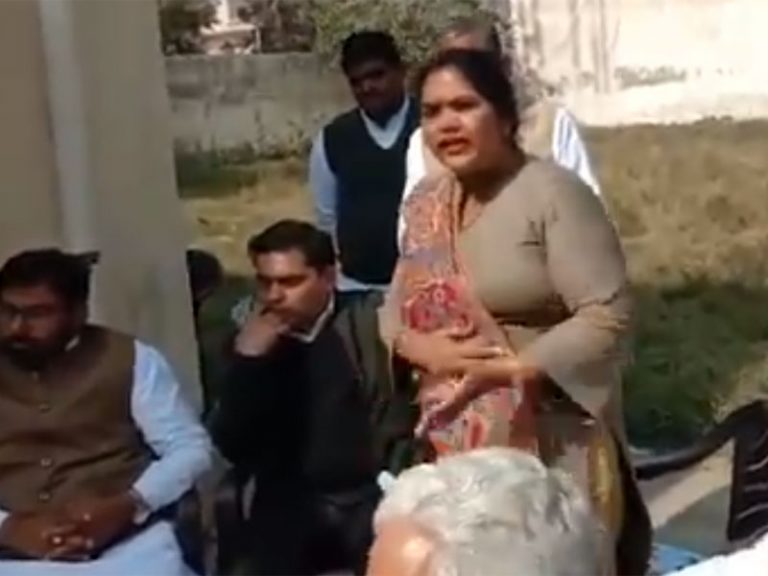
A viral video of Vidya Rani Danoda, Congress leader & former MLA aspirant from Narwana assembly seat, Haryana, is making rounds on social media in which she is seen urging Congress workers to distribute liquor among protesting farmers as a token of ‘support’. Danoda said that the protests had almost lost ground and momentum after the January 26 violence but somehow the supporters have been able to keep it alive.
Danoda said that after surveying the current situation in the state, they should do a march to show support to the farmers. She claimed that it would help Congress party in regaining its position in Haryana. Danoda further said that party workers should ‘help’ the protesting farmers in every possible way let it by giving them money, vegetables, ghee or even liquor.
When someone tried to stop her from mentioning liquor, she justified herself by saying that it is normal to give alcohol to an ailing man. She claimed that there are all type of people in the protests and to make sure they keep on protesting and stay put, it is essential to ‘support’ them by distributing alcohol if it is what the ‘protestors’ need.
As per a report in TV9 Hindi, the meeting had taken place in the Congress Bhavan on Sunday 14 February. When asked by media persons, she later claimed that her statements are being twisted and she had only joked about liquor as sometimes old and ailing persons are given liquor.
Who is Vidya Rani Danoda?
45-years-old Vidya Rani Danoda is a Congress leader from Narwana assembly in Haryana. In 2019 assembly elections, she managed to get only 9.2% votes and lost the seat by a margin of over 65,000 votes.
Reports of free-flowing alcohol at farmer protests
There have been several reports of free-flowing liquor at farmer protests. A conversation between two protesters went viral recently in which one protester admitted that he was camping at Ghazipur border for money and free alcohol. During Republic Day riots, a video of TV9 Gujarat went viral in which a trolley belonging to rioting ‘protesters’ was found laden with liquor bottles and snacks.
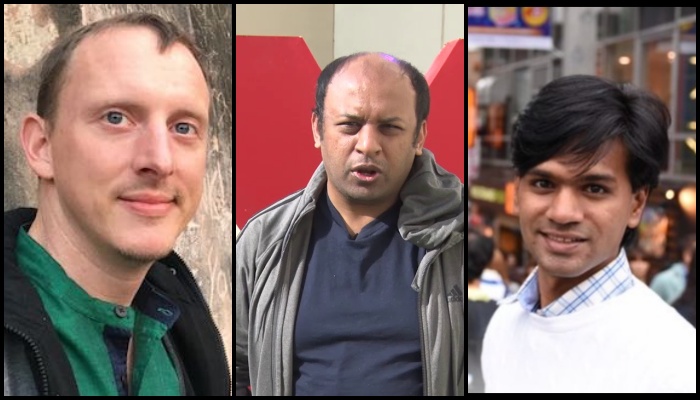
The Delhi Police in a statement on Monday has highlighted the role of a dubious foreign based activist in organizing the global campaign against India. The Police has said that the role of Pieter Friedrich has come to the fore in the investigation into the Greta ‘toolkit’ conspiracy.
#Live | The toolkit document is carefully crafted. @FriedrichPieter has been on the radars of Indian security establishments since late 2006: DCP (Special Cell), Delhi Police pic.twitter.com/5R5eHvS4Dx
The Police further said that Pieter Friedrich has been under the radar of the Indian security establishment since late 2006, when the UPA Government was in power. He has been under the radar “when he was noticed being in the company of one Bhajan Singh Bhinder or Iqbal Choudhary.”
Bhajan Singh Bhinder has been a very prominent proponent of the ISI’s K2 Desk. Pieter Friedrich got associated with Bhinder who has been running infowar operations or psyops. The Police also said that the toolkit has been prepared with great care.
The Delhi Police also said that the names of established media houses and ‘fact-checkers’ also find a mention in the toolkit. They said that only the accused will be able to say why the name of Pieter Friedrich features in the toolkit.
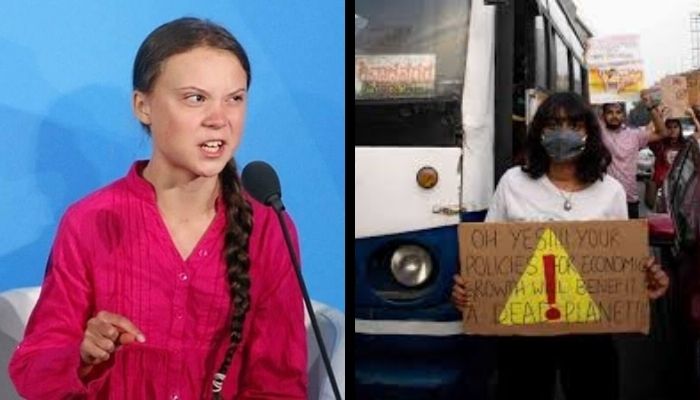
Earlier, the WhatsApp chats between Greta Thunberg and Disha Ravi also surfaced. After the Swedish activist leaked the anti-India toolkit on social media, Disha is reported to have told her, “Can we just not say anything at all for a while. I am going to talk to lawyers.”
As per reports, Disha Ravi and Nikita Jacob had also participated in an online meeting with Poetic Justice Foundation’s Mo Dhaliwal, who had earlier declared himself to be a ‘proud Khalistani’, to discuss and plan a ‘Twitter storm’ ahead of India’s Republic Day, which saw a massive insurrection attempt and widespread violence by so-called farmers in Delhi.
Here is an all too familiar ‘bait and switch’ tactic for pushing political propaganda on social media. A handle starts out by being dedicated to something that everyone loves. Such as good food or good sex. People begin sharing it widely and they manage to gather millions of followers. Then, one fine morning, the handle name changes. A page which used to be dedicated to say kittens is now suddenly called “We support XYZ politician.” Now that they have built a huge reach among people of all possible political beliefs, they can use the system to deliver their propaganda. If they had started out by declaring their political affiliations, chances are that they would have been left preaching to the converted. The manipulative ‘bait and switch’ approach is much more effective.
By now, you must have heard about the so called farmers’ protest, Greta’s toolkit and the Indian climate activists who may or may not have helped her. Perhaps you are out there, vigorously debating the issue along familiar partisan lines. If you are doing that, stop for a second and think about what just happened!
I thought the matter of farm laws was an economic policy matter. Whether you like the government’s view or not, this much was always clear. How did the climate activists get involved in opposing these laws?
If anything, you would expect the climate activists to take the side of the government here. One of the key demands of the so called farmers’ protest was to allow crop stubble burning. What kind of climate activist is in favor of creating toxic smog over Delhi and the rest of northern India? Also, the current agricultural framework in Punjab and Haryana has created incentives for causing massive environmental damage and water table depletion. Simply not sustainable.
Whatever the economic rationale for or against the laws, the climate science on this issue is completely clear. Stubble burning bad. Water table depletion bad.
So why are the climate activists on the wrong side of this? It suggests that the alleged activism never had anything to do with science. It was a bait and switch tactic for pushing politics. Which scientific study ever concluded that breathing crop stubble is good for us? Show me.
Now, I am not saying that a climate activist cannot be interested in other causes. Sometimes, we need to have trade-offs. Such as having to cut down a forest to build a factory that employs thousands of people. But in that case, the trade-off must be publicly acknowledged. That’s not what is happening here.
Rupi Kaur’s tweet on farmer protest
Did you notice? They don’t acknowledge the trade-off. They are claiming that these protests are part of climate activism agenda! In other words, climate activism can mean whatever political or social elites want it to mean. The classic bait and switch. The science is not even in the picture any more.
This tweet from a UK parliamentarian makes the scam even more obvious.
British Parliamentarian on farmer protest as ‘climate justice protest’
Look closely at the list. I see climate science at the top, which is a real science. But the other items on the list? Human rights? Class protest? Which branch of science is that?
I’m not saying the others are not worthwhile issues. I am saying they belong in a separate discussion. There is no branch of science that studies “class protests.”
But the mixing of issues appears to be deliberate. The strategy seems simple. Put climate science on top because everyone loves that. Once you have gained followers, you make them sign up for whatever view you have on the political agendas in the rest of the list.
Oh, excuse me there! Did I say they put climate science on top? Apparently, I didn’t look closely enough. The first item on the list is not ‘climate science’ but ‘climate justice.’ What exactly is that? Is it part of the natural sciences or the humanities?
It’s a carefully chosen weasel word. Climate change is a real problem. Scientists have confirmed it beyond all reasonable doubt. We all need to sign up and support climate science. But if you look carefully at the sign up sheet, you will notice that it reads ‘climate justice’ and not ‘climate science.’ You are signing up for politics, not science!
It’s a genius marketing tactic, really. The climate activists have gained access to schools, colleges and numerous other forums because they claim to be doing the work of science. Because science is amazing, they have gained an aura of moral authority like no other. Because everyone loves to support science, they have managed to raise enormous amounts of money. But the money won’t go to science. It will go to whatever they consider to be worthy political causes.
Have you ever wondered why Greta Thunberg, the world’s greatest ambassador of climate science, does not care about finishing high school? Think about it. Why would a science nerd not want to open even a Class 12 level science textbook?
Because she isn’t a science nerd. She couldn’t care less about science. She works for whatever political cause that she considers to be justice. And she affixes the word “climate” before everything to make you think she is all about the science.
How would you like to support some Quantumgravity human rights issues? How about Supercomputing socialism? It’s the cutting edge of science. Believe me, I’m starting a fund.
The Cyber Cell of the Delhi Police, which had arrested 21-year-old Disha Ravi on Sunday from Bengaluru, for editing and distributing the contentious toolkit accidentally leaked by Swedish Andolanjeevi Greta Thunberg, has reportedly accessed the Whatsapp chat between the two activists.
As reported by News 18, during the investigation, the police found that the Disha had expressed fears of being charged under the anti-terror law, Unlawful Activities (Prevention) Act in her conversation with Greta Thunberg. After the Swedish activist leaked the anti-India toolkit on social media, Disha said, “Can we just not say anything at all for a while. I am going to talk to lawyers.”
Disha Ravi-Greta Thunberg chats accessed.
‘Can we just not say anything at all for a while. I am going talk to lawyers. We can literally get UAPA against us’; Disha to Greta on WhatsApp: Sources. @ShankarNews18 shares more details with @AnushaSoni23. pic.twitter.com/P4pEPGQdRC
News 18 reported that Disha Ravi had made several false claims to the Delhi police to ward off the charges against her. However, when she was confronted with incriminating evidence from her digital devices and the contentious Whatsapp chats with Greta Thunberg, Disha admitted to having been in touch with several such people. Reportedly, the ‘climate activist’ had also tried to conceal details about her acquaintance with accused Nikita Jacob, who has been on the run from law enforcement authorities.
The Delhi Police are also probing Disha’s Gmail to unearth the email conversation between her and other accused. News 18 informed that the Enforcement Directorate (ED) will soon begin the investigation into any possible overseas transactions made by Disha Ravi through her organisation, Fridays for Future (FFF), in the past 5 years. The National Investigative Agency (NIA) will also intervene in the case, given that several links with Khalistani organisations have now surfaced.
Disha Ravi and Nikita Jacob took part in an online meeting with Khalistani Mo Dhaliwal
As per reports, Disha Ravi and Nikita Jacob had taken part in an online meeting with Poetic Justice Foundation’s Mo Dhaliwal, who had earlier declared that he is a ‘proud Khalistani’, to discuss and plan a ‘Twitter storm’ ahead of India’s Republic Day, which saw a massive insurrection attempt and widespread violence by so-called farmers in Delhi. In the Zoom meeting, the group had formulated a plan to post messages, graphics and videos ahead of Republic Day to spread their propaganda against India in the background of farmer protests.
Zee News reported that during the meeting in which Mo Dhaliwal was one of the attendees, it was planned how they could agitate the farmers and spread violence on the Republic Day. Mo Dhaliwal had said that they have to make the issue visible on the international platform. To ensure they succeed in their plan, they decided to contact celebrities, including Greta Thunberg, Rihanna and others.
Arrested Disha Ravi sent to judicial custody
In a closely-guarded operation, Special Cell of Delhi Police detained Disha Ravi, the so-called ‘climate activist’ and founding member of Greta Thunberg’s Fridays For Future’s India chapter. As per the reports, Disha was picked from her house in Soladevanahalli, North Bengaluru. She is a graduate of Mount Carmel college in Bengaluru and has been working in a company that produces plant-based food. She has now been remanded to five-day custody of the Delhi Police by a Delhi Court
The security agencies are investigating the toolkit and searching for people who created and distributed the documents. On February 4, Special Cell of Delhi Police had registered a case against the creators of the ‘toolkit’ on farmer protests under serious sections including sedition, criminal conspiracy and promoting hatred among groups under Sections 124A, 120A and 153 A of the Indian Penal Code. A Delhi court has also issued non-bailable warrants against Nikita Jacob and Shantanu, another two accused in the case.
From February 15, 2021, FASTag has become compulsory for all vehicles across the country. If you have not yet bought FASTag and understood how it works, it is high time you learn everything about it. FASTag is a government-initiated program that works like a prepaid system for toll plazas on national highways. Over 20 major banks are permitted to issue FASTag that can be used to facilitate a payment collection system at toll plazas.
Initially started in 2014 between Ahmedabad and Mumbai, the government has made FASTag mandatory for all new vehicles sold in India in 2017. From February 15, 2021, all 600+ toll plazas of NHAI and over 100 state highway toll plazas will collect payments primarily using FASTag. In case any vehicle does not have FASTag, it will be allowed to pass the toll plaza only after paying toll charges in double.
How does it work?
FASTag uses Radio Frequency Identification technology or RFID to allow users to pay toll fees directly from their savings or prepaid accounts. Indian Highway Management Company Limited, a subsidiary of National Highway Authority of India, operates the technology. The RFID induced sticker is affixed on the windscreen of the vehicle. FASTag is directly connected to your prepaid wallet which you can link to your Savings or Current account.
When RFID interacts with the FASTag system at the toll plaza, the payment gets deducted from your wallet automatically making it an entirely cashless transaction. The toll plaza records all the information from the FASTag when the vehicle passed through it, eliminating the need of halt during the trip.
Why is FASTag important?
Transport Corporation of India (TCI) and IIM Kolkata researched the time vehicles spend on toll plazas. They found that every year India loses around USD 6.6 billion due to transportation delays. To rectify the issue, the government introduced the Electronic Toll Collection system. A National Highways Programme was announced to reconstruct the toll collection system for better efficiency of the National Highway Grid.
Benefits of FASTag
The main aim of FASTag system is to ensure ideal traffic flow and reduce congestion at the toll plazas. Apart from smoother vehicular movement, there are several other benefits of FASTag.
For regular commuters who use highways frequently will spend lesser time searching for change at toll plazas.
As it is entirely contactless, it ensures hygiene and safety.
Due to the least human intervention, it makes the payment process efficient and effective.
It helps in reducing carbon footprint as it reduces the time spent by vehicles on toll plazas.
FASTag is mandatory even if you don’t take the vehicle on highways
The government is aiming to make FASTag a one-stop-solution for all utilities including parking lots etc. FASTag will be mandatory to get third-party insurance from April 1, 2021. Any vehicle can legally run on Indian roads only if the owner has opted for minimum insurance cover, also known as third-party insurance. If you enter a FASTag lane without FASTag, you will have to pay double the fees. The same rule will apply if you do not have a sufficient balance in your prepaid wallet.
How to get FASTag?
You can buy FASTag from any one of the authorized banks, including SBI, HDFC, ICICI, Paytm and several others. You can also buy FASTag from toll plazas. You will need some documents to buy FASTag:
Registration Certificate of the vehicle
Passport photo of the owner of the vehicle
KYC documents based on the category of the vehicle, i.e. personal or corporate
PAN Card/Voter ID/Passport
Aadhar Card
How to recharge FASTag?
You can recharge your FASTag using different modes of payments including Credit Card, Debit Card, Netbanking, NEFT and others.
What if FASTag gets damaged?
In case FASTag gets damaged, you can get a replacement from the issuer.
What if someone sells the car?
If you sell your car to someone else, inform the issuer about the transfer.
Though the system is robust and works perfectly, if there is any complaint regarding incorrect deduction or it does not work despite having balance in the prepaid account, please contact the issuer. The agency will review the complaint and act accordingly.
After the arrest of alleged ‘climate activist’ Disha Ravi on the back of the ‘Toolkit’ tweeted by Greta Thunberg, which detailed a co-ordinated global plan against India during the farmer protests, more information is now tumbling out that points towards an active coordination between Khalistanis and the so-called activists who were involved in writing and distributing the ‘Toolkit’.
As per the reports, two activists Disha Ravi and Nikita Jacob took part in an online meeting with Poetic Justice Foundation’s Mo Dhaliwal, who had earlier declared that he is a ‘proud Khalistani’, to discuss and plan a Twitter storm ahead of India’s Republic Day, which saw a massive insurrection attempt and widespread violence by so-called farmers in Delhi. In the Zoom meeting, the group had formulated a plan to post messages, graphics and videos ahead of Republic Day to spread their propaganda against India in the background of farmer protests.
Four days ago Special Cell team went to Nikita Jacob’s house. Her electronic gadgets were examined. Delhi police says that they would visit again to question her but she is not available: Sources on Toolkit conspiracy
Zee News reported that during the meeting in which Mo Dhaliwal was one of the attendees, it was planned how they could agitate the farmers and spread violence on the Republic Day. Mo Dhaliwal had said that they have to make the issue visible on the international platform. To ensure they succeed in their plan, they decided to contact celebrities, including Greta Thunberg, Rihanna and others.
It has been alleged that Disha Ravi was the one who contacted Greta Thunberg and shared the toolkit with her. Earlier, reports have suggested that it was Disha who asked Greta to remove the ‘toolkit’ that exposed the nexus. Greta removed her tweet and later posted another file claimed the previous file was outdated.
Disha Ravi was sent in 5-days police remand
Disha Ravi was arrested on February 13 by the Cyber Cell division of Delhi Police from her home in Bengaluru. According to the police, she was the key conspirator in creating and distributing the Greta ‘Toolkit’. The police informed that the objective was to spread ‘disaffection against the Indian State.’ Reportedly, it was Disha who had originally shared the Toolkit document with the Swedish ‘aandolanjivi’ Greta Thunberg.
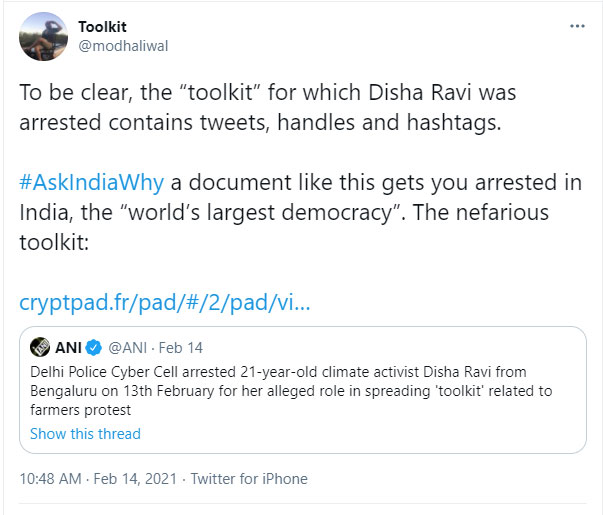
After the arrest of Disha Ravi, Mo Dhaliwal of Pro-Khalistani organization Poetic Justice Foundation posted a tweet supporting her. He claimed that Disha was arrested for supporting farmers. He shared the ‘edited’ toolkit and claimed her arrest was linked to that document. However, the case against Disha Ravi, Nikita Jacob and other was not based on the edited document but on the original ‘toolkit’ that had multiple layers of linked documents proving that the nexus was working against India for a long time.
Mo Dhaliwal’s tweet against Disha Ravi’s arrest (Source: Twitter)
Police had visited Jacob’s house
Four days ago, Delhi Police had visited Nikita Jacob’s house and examined her electronic gadgets. Since then, Jacob has been absconding, and police could not locate her whereabouts. A non-bailable warrant has been issued against Nikita Jacob on February 15, 2021. Another alleged activist Shantanu was also named in the case, and a non-bailable warrant has been issued against him as well.
Mo Dhaliwal had admitted his organization had meetings
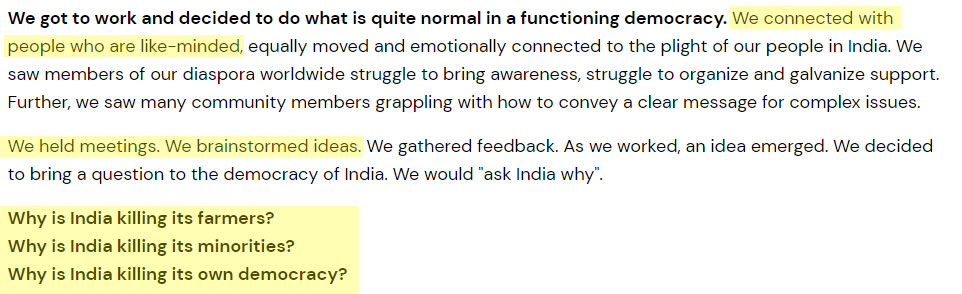
In a statement after Greta Toolkit exposed the nexus, Mo Dhaliwal’s Poetic Justice Foundation had issued a statement in which Dhaliwal admitted that he had meetings with ‘like-minded’ people and brainstormed ‘ideas’ to come up with the plan to use farmer protests for his own benefit. In the statement, he made outrageous claims such as the sexual assault on activist Nodeep Kaur in police custody and used discontinuation of Amentsy India’s chapter for his agenda. This claim was summarily debunked by Nodeep Kaur and her police statement itself.
Dhaliwal admitted he had meetings with like-minded people (Source: PJF statement)
In reality, Amnesty India was under ED’s scanner for receiving foreign aid without FCRA registration. Its accounts were frozen for illegal financial activities, but the organization tried to whitewash its wrongdoings by blaming the Indian government.
Pro-Khalistani Mo Dhaliwal was also seen propagating Khalistan movement in a video. In that video, Dhaliwal claimed that farmer protests are just the beginning of the struggle. He said, “The reason Khalistani people are so passionate about this (anti-farm law agitation) is that we are seeing the truth that they predicted in the 1970s. They (Khalistanis) wanted an independent land so that we did not have to live through this movement. I request to all of the young people here – Don’t close your eyes, hearts and minds to each other.”
Support from opposition and Pakistan for Greta ‘Toolkit’ conspirators
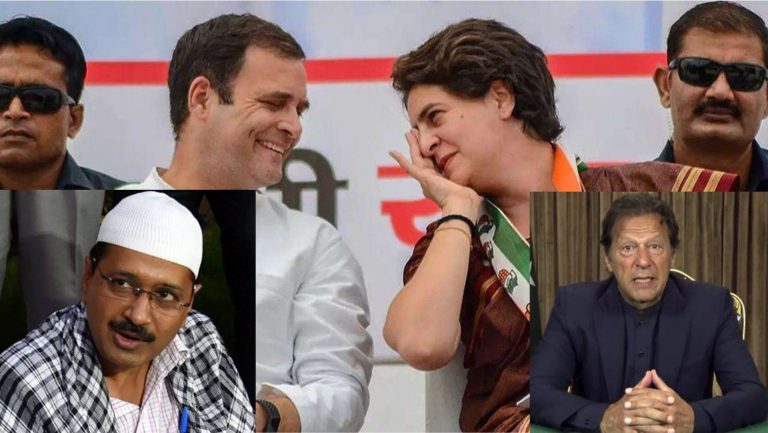
Several leaders of the opposition and liberals including Shashi Tharoor, P. Chidambaram, Arvind Kejriwal and several others have come forward in support of activist Disha Ravi. Above all, the support has also poured in from Pakistan as PTI Pakistan has raised voice in support of Ravi.
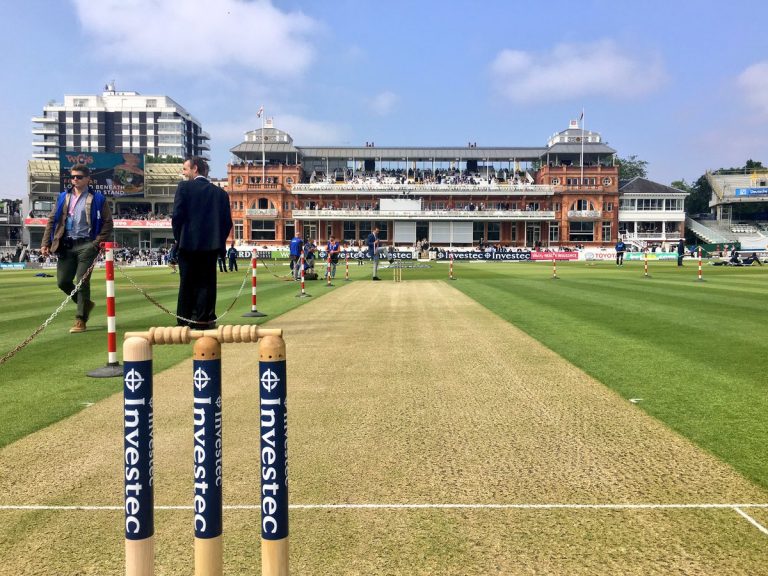
Before we begin, have a look at the number of overs bowled in the last 5 Test matches played at Lord’s
England vs Australia – 290.1 (Draw thanks to the weather) England vs Ireland – 175.3 (England won) England vs India – 170.3 (England won) England vs Pakistan- 267.2 (Pakistan won) England vs West Indies – 203.3 (England won)
With 90 overs per day, that means matches at Lords are lasting 2 or 3 days at most, with these consistently poor pitches, is it time to strip Lord’s status as a Test centre?
If every pitch was like this, then there would be no point in playing the longer format.
Yes, you expect it to seam and swing in England, but not like this; the game should at least stretch into the 4th day, if not the 5th, else why are we playing 5 day matches?
I am taking nothing away from seamer’s performance on such pitches; we can look back at batsmen who made 100s on these pitches and appreciate just how remarkable it was.
However, you should not have a pitch which is producing an unplayable delivery darting around corners every second ball.
I understand we want contrasting pitches and conditions around the world and do not want Test cricket to be formulaic; each country needs to have its own identity but we also want Test matches to last 5 days.
There are countries, including India, who produce turning tracks to suit their spinners, but at least the game goes into the 4th day there, like it is happening in Chennai right now.
The ideal scenario is a pitch which offers something for the quick bowlers to start with, flattens out and then spins later in the match, but not one where batsmen have no chance against the ball moving all over the place at 150 Kph for days.
I understand that groundsmen do get it wrong sometimes and this is not a personal accusation against any team or individual, but to be consistently wrong for years?.
Some people may also think it is a case of sour grapes because India lost at Lords very easily last time around but my opinion has nothing to do with that. I will criticise “2 days Test pitches” in India just as harshly.
When you see something that is not right or in the game’s interest then you have to speak up, it is important for Tests to have the potential to go on for five days, there is so much at stake.
There is a responsibility to preserve Test cricket as it is finding itself under threat from other sources.
It may be that the best side does win this match and series. However Lord’s pitch is not suitable for Test cricket and I would strongly take issue with anyone who says that it is.
The International Cricket Council (ICC) has to be strong enough to take action if Test pitches are not of a suitable quality.
That applies in India, Australia or anywhere in the world.
With the finals of the World Test Championship – which is supposed to be the whole reason for Test cricket these days – taking place at Lord’s in the summer, the ICC should seriously think about the suitability of Lord’s as the venue.
Just as they have with slow over-rates, there should be a penalty system in place, and consistently poor pitches, like at Lord’s, should result in them losing their status as a Test venue.
*Of course you will never read such an article from a “serious” cricket journalist, you will only read this- this.
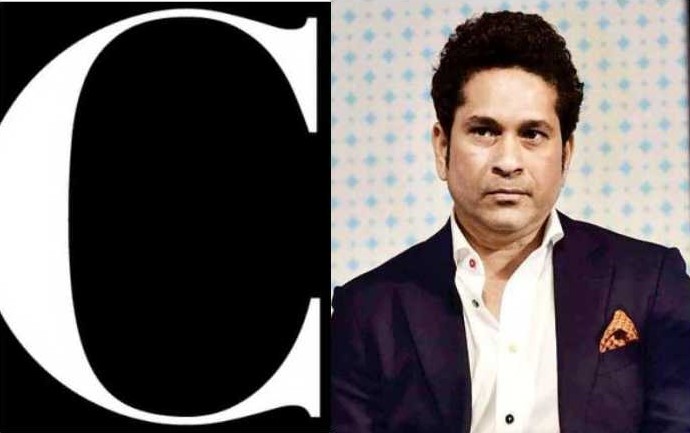
Far-Left media outlet The Caravan on Saturday published a wild hate-piece against Sachin Tendulkar because the cricket legend urged the country to remain united in the face of a global campaign against India. The column, penned by one Vaibhav Vats, makes extremely objectionable comments against the middle class as well.
Regarding the tweet posted by Sachin Tendulkar to promote unity in the face of adversity, Vats says, “What accounts, then, for this anomaly from someone unusually careful in his utterances? The answer lies in Tendulkar’s conservative upbringing as well as his psychological make-up, which can be described as a state of stunted adulthood.”
The Caravan columnist blamed Tendulkar’s “lower middle class” upbringing for the comment. His diatribe against him did not stop there.
Vats continued, “The ordinary Maharashtrian Mumbaikar of Tendulkar’s background often emanates an excessively deferential attitude towards the powerful and the moneyed of India’s financial capital, a dynamic ever-present in Tendulkar’s relationship with the Ambanis.”
The Caravan columnist appears to loathe the Indian middle class because like most ordinary people, they do not have the taste for continuous revolutions. Vats says, “Tendulkar became the epitome of values prized in the conventional, hierarchal and self-congratulatory milieu of the middle class, showing no eagerness to challenge the many prejudices of society and state. His notion of ethics remained limited purely to the realm of his own personal conduct.”
“Before the stark fault lines of our present time, it was harder to see what appears now with increasing clarity, that Tendulkar also shares the worst traits of the Indian middle-class: its indifference to the general good, its lack of commitment to the values of human rights and democracy, and its intellectual vacuousness,” he added.
He also quotes one Rahul Bhattacharya describing the legend as a “man-child superstar”. The column is replete with criticism of Sachin Tendulkar over his humble beginnings. At one point, he says, “Tendulkar seems peculiarly unable to transcend the limitations of his social background.” At another, Vats remarks, “His personality has not grown commensurate with his public stature, animated by no larger ideas about the society and the world that he inhabits.”
The Caravan columnist is not the only one in the liberal establishment with such petulant hatred towards the middle class. Earlier, ‘journalist’ Rohini Singh was spotted voicing similar hatred. The primary reason for the hatred is the fact that Rich Liberals are traditionally a revolutionary force while the middle class is a stabilizing one.
Thus, Rich Liberals hate the middle class since the latter is perceived to be an impediment in the way of their lofty revolutions.
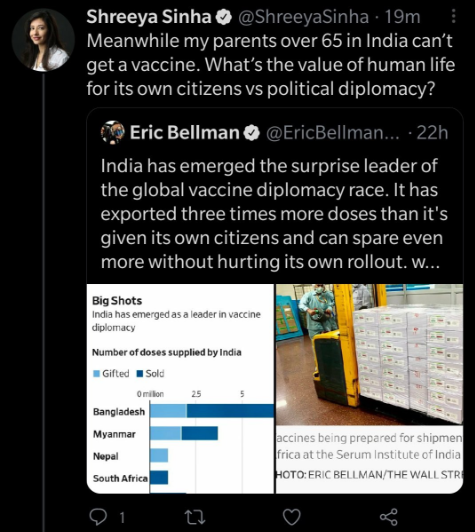
On Saturday, Shreeya Sinha, the Editorial Director of the New York Times (NYT), took to Twitter to cast aspersions about India’s Coronavirus vaccination drive and the political diplomacy of the Indian government.
While replying to the tweet of Wall Street Journal (WSJ) correspondent Eric Bellman, who praised India’s vaccination diplomacy, she claimed that her 65-year-old parents in India could not get vaccinated. “Meanwhile my parents over 65 in India can’t get a vaccine. What’s the value of human life for its own citizens vs political diplomacy?” Sinha asked.
Screengrab of the tweet by Shreeya Sinha
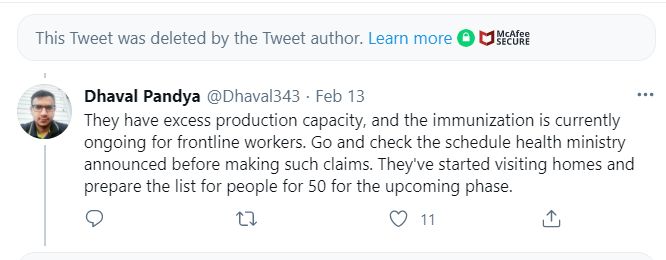
However, on being questioned about the logical fallacy in her tweet by a Twitter user (@Dhaval343), the Editorial Director of the New York Times quickly deleted her tweet.
Shreeya Sinha deletes her tweet
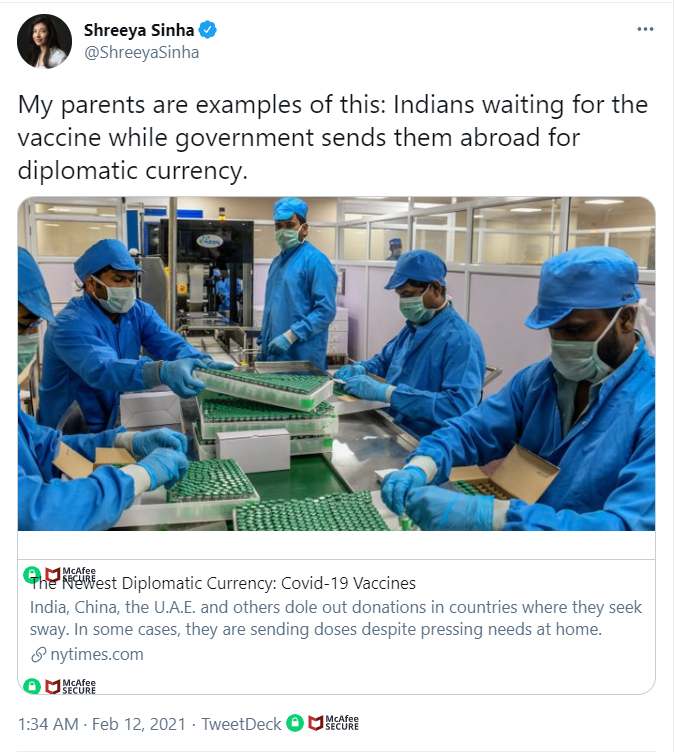
A day earlier, Sinha had shared an article by the New York Times titled, “The Newest Diplomatic Currency: Covid-19 vaccines”. The article claimed, “For now, the Indian government has room to donate abroad, even after months when cases soared and the economy was hobbled, and even as it has vaccinated just a tiny percent of its 1.3 billion people. Part of the reason for a lack of backlash: the Serum Institute is producing at a faster rate than India’s inoculation program can currently handle, leaving extras for donations and exports.”
Using the article as the foundation for her argument, the journalist said, “My parents are examples of this: Indians waiting for the vaccine while the government sends them abroad for diplomatic currency.”
Screengrab of the tweet by Shreeya Sinha
The logical fallacy in the claims of the New York Times journalist
The New York Times journalist Shreeya Sinha tried to insinuate that the government is deliberately not vaccinating a section of its citizens to gain a diplomatic edge in the world, essentially claiming that the Indian government is giving away vaccines to the world while not using those vaccines for its own people. However, nothing can be further from the truth. It must be mentioned that the Serum Institute of India (SII), which has been producing the Covishield vaccine (developed by Oxford- AstraZeneca) had initially produced supplied 50 million doses to the Indian government.
Dr Suresh Jadhav, Executive Director (SII) had earlier said, “Serum has a stock of another 50-60 million doses. It is also producing at a monthly average of 50-60 million which will go up to 100 million a month by April.” When the immunisation programme kickstarted on January 16 this year, the SII had supplied 11 million doses to vaccinate 6.3 million healthcare workers.
Although the Serum Insitute of India can produce vaccines at a faster rate than they can be administered to individuals, the existing infrastructure cannot handle the immunisation of every individual at once. The Indian government, therefore, chose a phase-by-phase approach to vaccinate the large population in the country. In the first phase, the government decided to vaccinate only the health professionals. In the second phase, the frontline workers were administered the vaccine.
The government prioritised the vaccines for healthcare and frontline workers, as they are at the highest risk of contracting the deadly virus. The Modi government had announced that in the third phase, starting in March, the elderly individuals above the age of 50 will be inoculated. Health Minister Harsh Vardhan said, “After completing the two phases, the third phase is expected to begin at any time in March. In this phase, every citizen above the age of 50 will get vaccinated. The process will begin in any week of March. It’s difficult to give an exact date, but it will begin in any time of the month — third or fourth week of March.”
So far, a whopping 82.85 lac people have been administered the vaccine. The expansion of India’s inoculation programme saw the government place order for additional 10 million doses of Covisheild from Serum Institute in India and 4.5 million doses from Bharat Biotech. The Modi government plans on vaccinating 300 million (30 crores) people by August this year. Due to the extra production of vaccines by SII that the government cannot put to use for its own citizens immediately, it has decided to help other countries by exporting the extra vaccine doses.
India has successfully lept forward on the diplomatic front by supplying vaccine doses to Bhutan, Maldives, Nepal, Bangladesh, Myanmar, Mauritius, Seychelles, Saudi Arabia, South Africa, Brazil, Morocco and other countries. This vaccine diplomacy has not only helped save countless lives of people in other countries but has helped India emerge as a true global leader. As such, India’s decision to not vaccinate the senior citizens right away and export vaccines instead to different countries was not a matter of choice, as claimed by the New York Times’ Editorial Director.
Is April the expiry date of Covishield vaccines?
Earlier, a Congress troll named Saket Gokhale had tried to cast aspersions about the was the expiry date of Covisheild vaccines. Gokhale had suggested that the vaccines would be useless after April. Mia Mala, who is associated with the Bhekisisa Health Journalism Centre, informed that SII had only 6 months worth of data to work with and as the expiry date specified the month of April. It can now be extended, given that the data is now available for more than 6 months.
“We have data for 6 months, but many vaccines last for longer, they stay stable for a year. But because the Covid vaccines are so new, we don’t have data for 12 months because they haven’t existed for 12 months. So even though it may say expiry date of April, that April expiry date could be postponed to May because we now have data that this vaccine says stable for longer than 6 months,” Mia remarked. Her comments came at the backdrop of South Africa’s decision to put the Covisheild vaccines on hold.
The South African Health Ministry officials have now reached out to SII to inquire if expiry dates could be extended. Assuming that the vaccines expire in April as Gokhale suggested, SII has the capability to produce millions of new vaccine doses.
Days after ‘climate activist’ Disha Ravi was arrested in the Greta Thunberg ‘toolkit’ controversy, support has poured in for her from the usual anti-Modi camp. On Monday morning, Delhi Chief Minister Arvind Kejriwal took to Twitter to claim that Ravi’s arrest was ‘unprecedented attack on democracy’.
Arrest of 21 yr old Disha Ravi is an unprecedented attack on Democracy. Supporting our farmers is not a crime.
Rahul Gandhi’s sister and Congress General Secretary Priyanka Gandhi Vadra, too, shared a couplet demanding release for Disha Ravi.
Seeing their support, Pakistan also came out in support of Disha Ravi.
India under Modi/RSS regime believes in silencing all voices against them as they did in IIOJK. Using cricketers & Bollywood celebrities narrative building was shameful enough, but now they have also taken Disha Ravi for custody over Twitter toolkit case. #IndiaHijackTwitterhttps://t.co/4kn6Cg0shh
Pakistani Prime Minister Imran Khan’s party took Disha Ravi’s arrest to attack India. Imran Khan’s party said that under PM Modi’s regime, India is silencing voices of everyone against them. Parroting India’s opposition’s stand, Pakistan claimed that ‘using’ cricketers and Bollywood celebrities to ‘build narrative’ was ‘shameful’ but now ‘they’ have taken Disha Ravi in custody over the toolkit case.
To put things in perspective, the ‘toolkit’ shared by ‘climate activist’ Greta Thunberg chalked out an elaborate plan on how to defame India on a global scale. It gave point by point timeline on how to tweet while tagging whom and get international media attention on the protests. The ‘toolkit’ was accidentally released by Greta, just one week after the Red Fort riots on Republic Day.