Home Blog Page 4932

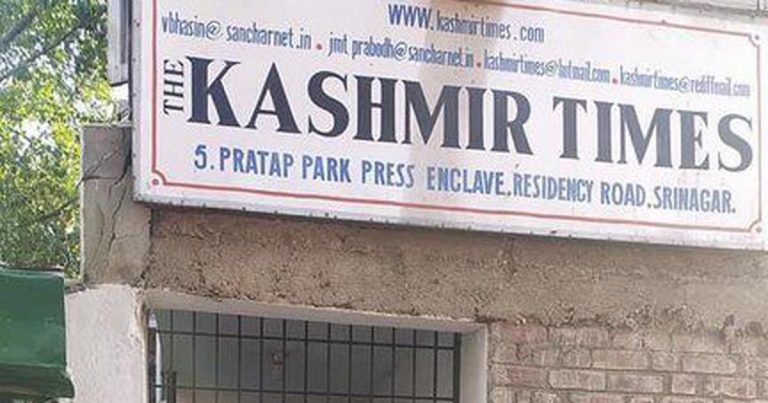
Srinagar: Govt-allotted office building of Kashmir Times sealed by authorities 5 years after allottee’s death, current Exec Editor calls it ‘vendetta’

The Estates Department of Jammu and Kashmir administration has sealed one of the two offices that were allocated by the government to run the newspaper Kashmir Times.

As per officials, the Jammu and Kashmir government had allocated two properties to Kashmir Times. One of them was used as office space while the other served as the residence of Ved Bhasin, the founder of Kashmir Times. Following his death in 2015, the administration had issued notices to the family to vacate the government-alloted residence.

As reported by Indian Express, Deputy Director of the Estates Department, Mohammed Aslam informed, “They themselves handed over the building to us and today our officials went to take possession.”

The official stated, “They have been allotted two buildings — one is an office and the other was allotted as a residence to Ved Bhasin sahib. Since Bhasin sahib died some years ago, we issued them notices to vacate the house. They themselves handed over the building to us and today our officials went to take possession.”

Executive Editor of Kashmir Times cries foul

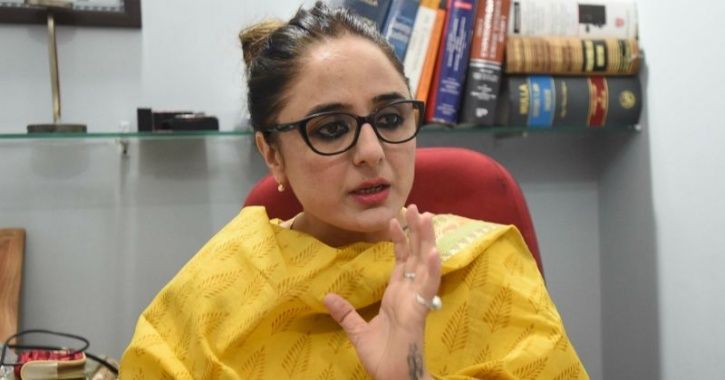
However, Anuradha Bhasin, the daughter of the late Ved Bhasin and the current Executive Editor of Kashmir Times, who was supposed to hand over the government allocated buildings after her father’s death, has alleged that the administration has ‘locked down’ the newspaper’s office in Srinagar in an illegal manner.

She alleged, “Today, Estates Deptt locked our office without any due process of cancellation & eviction, the same way as I was evicted from a flat in Jammu, where my belongings including valuables were handed over to “new allottee.” Dubbing the move of the Jammu and Kashmir administration as ‘vendetta’ and ‘peevish’ for speaking (the truth), she claimed that the due process of law was not followed.”

Anuradha Bhasin has been on a tweet spree and is constantly sharing tweets condemning the so-called ‘vendetta’, but she has not clarified as to why the building allocated in her father’s name was not vacated after her father’s death in 2015.

Omar Abdullah and Mehboob mufti have also jumped in to tweet in favour of Bhasin.

Last year in August, she had moved the Supreme Court against the abrogation of Article 370 and ensuring immediate relaxations against the supposed ‘blackout in the valley’.

Kathua lawyer links sex crimes with worshipping Devi to target and guilt trip Hindus during Navratri, Congress joins in

Advocate Deepika Singh Rajawat of Kathua Case fame appears to belong to the coterie of secular-liberals who believe that Hindus must not be permitted to enjoy their festivals in full fervour without efforts to guilt-trip them. Consistent with her atrocious conduct in the past that drove her to infamy, Deepika Singh Rajawat linked sex crimes with worshipping the Devi in order to target the Hindu community and dampen the festive fervour among Hindus.

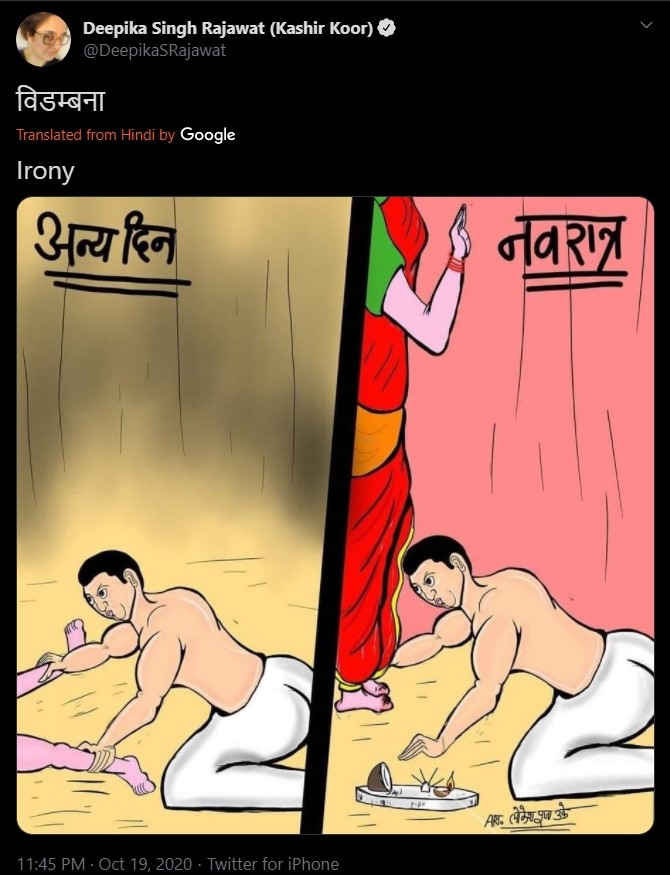
On Tuesday, Rajawat posted a cartoon that linked sex crimes with ‘Devisthan’. In the cartoon, a man could be seen raping a woman at some place during ordinary days while it says that on Navratri, the man worships the Goddess at the same place. The visuals depicted in the cartoon vaguely reminds one of the Hinduphobic narrative that was launched during the Kathua case, the crime that drove Rajawat to celebrity status.

Tweet posted by Deepika Singh Rajawat

The reaction of Deepika Singh Rajawat is quite different when the festival under consideration is Eid. On Eid, festivals become an occasion to bring people together. But during Navratri, the opportunity is to be used to target the Hindu community.

Thus, we see what has become a familiar trope in secular-liberal discourse. In the echo-chamber of liberal activism, targeting Hindus is how liberals collect brownie points to boost their careers. Of late, Deepika Singh Rajawat has witnessed a decline in her celebrity status following the fiasco in the Kathua Case. Therefore, she is looking to reignite the career prospects by targeting the Hindu community during an auspicious festival.

Targeting Hindus on the occasion of their festivals while celebrating ‘secular’ festivals in full vigour is the perfect encapsulation of the perversity that dominates liberal discourse and forms one of the foundational cores of liberalism. Rajawat was only paying obeisance to the liberal dictum when she linked sex crimes with the Devi.

It is a core part of the ‘Woke’ ideology to target the Hindu community based on our devotion towards the divine feminine. The fact that Hindus are the only religious group that conceptualise the God-head as a feminine entity which is a marked departure from Abrahamic faiths is perversely twisted in order to target the community.

Crimes are a reality of every human society and monsters have always existed and will continue to exist. Using crimes to target a community during their religious festival comes across as sheer malice. And it is no doubt that individuals such as Deepika Singh Rajawat do harbour malice in their hearts for the Hindu community.

Despite tolerating rampant pedophilia amidst their ranks, any secular-liberal hardly ever describes the Vatican as an organised sex racket. Liberals go out of their way to whitewash and cover up the crimes committed by Radical Islamists. They have even managed to project the Hijab as a symbol of women empowerment. It is only the Hindu community that is the subjects of its repeated barbs.

The Kathua case and the attempt to malign Hindus

It is pertinent to note here that Deepika Singh Rajawat has been using the case primarily to boost her own celebrity status, while the secular-liberal camp relied on her and her version of events to target the Hindu community. And those in the media were only overeager to cater their services to suit her interests. However, her conduct during the actual trial was abundant evidence of her own dedication towards justice for the victim.

She attended merely two out of a hundred and ten hearings and was ultimately removed by the family of the victim. That hasn’t stopped her, however, from linking sex crimes to worshipping the Devi during Navratri. During the Kathua Case, the ‘Devisthan’ angle was propped up by the entire media and the entertainment industry, something that is strenuously avoided when crimes are committed inside Madrassas.

It may be recalled here that following the tragic rape and murder of an eight-year old girl in Kathua, liberals and their Bollywood counterparts made a beeline to malign Hinduism and Hindus by highlighting the fact that the rape and murder presumably took place inside a ‘Devisthan’. A placard campaign was run on social media where liberals took special care to point out that the incident took place inside a “Devisthan”.

Instead of talking about the bestiality of the crime, assorted liberals, including leftist organisations such as NDTV, brazenly communalised the incident by focusing on the religions professed by the victim and the rapists. Exploiting the poor girl’s death, they communalised the whole matter by alleging that the Muslim victim was raped and killed by the Hindu perpetrators because they harboured deep animosity against the Muslims.

The Congress party joined in too

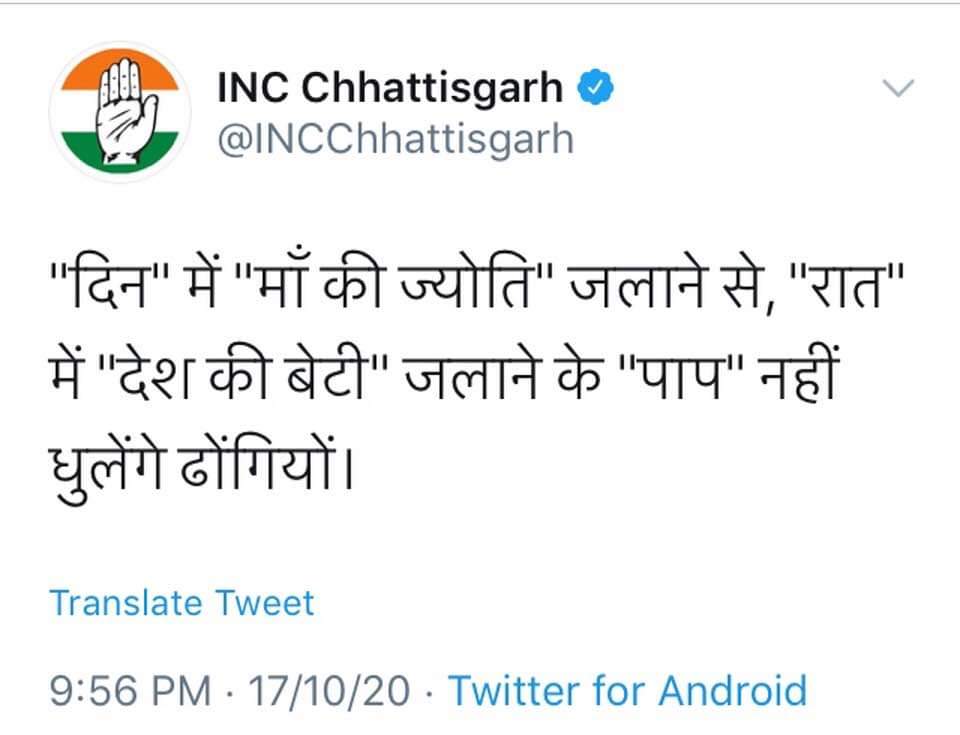
Deepika Singh Rajawat appears willing to revive that narrative again it seems. The Congress party, for its part, as the fountainhead of all such rhetoric, did not disappoint. Only recently, the Chhattisgarh unit of the party sermonised that lighting a lamp during the day for the Goddess won’t absolve anyone of the sin of setting a daughter on fire at night. It appeared to be another reference to the Hathras Case.

Image Credit: Twitter

All of this has become a familiar pattern ahead of every Hindu festival. Every festival is an occasion to offer more and more sermons to the Hindu community to the point where people do not even convey their greetings properly. Diwali becomes the focus for ‘No pollution’ campaigns, Holi becomes the focus of ‘Save Water’ campaigns and Navratri, again, is seen as an opportunity to guilt trip Hindus over crimes that are committed by monsters.

Individuals such as Deepika Singh Rajawat harbour so much hatred for the Hindu community in their hearts that they truly believe that Hindus must not be permitted to celebrate even one festival without feeling an overbearing sense of guilt. Their self-loathing also motivates them to go out of their way to prostrate before the ‘secular’ communities in the most pathetic of ways.

It is important to understand that such people engage in such behaviour the liberal community encourages and provides incentives for people to behave in such a fashion. If there were no incentives and people were punished for the same, they would be much less enthusiastic about targeting the Hindu community.

Unless such a twisted reward-structure is inverted and people actually suffered adverse consequences for their Hinduphobic rhetoric in terms of their career, we would see a marked decline in such incidents. The Congress party has realised this to a large extent, thus, we see Rahul Gandhi on Temple-runs before every election although there are errant politicians everywhere since it is extremely hard for people to abandon their intrinsic tendencies.

Accused in Ratan Lal murder was in touch with lawyer right after committing the crime: Read how ‘targeted for being Muslim’ trope is crumbling

0

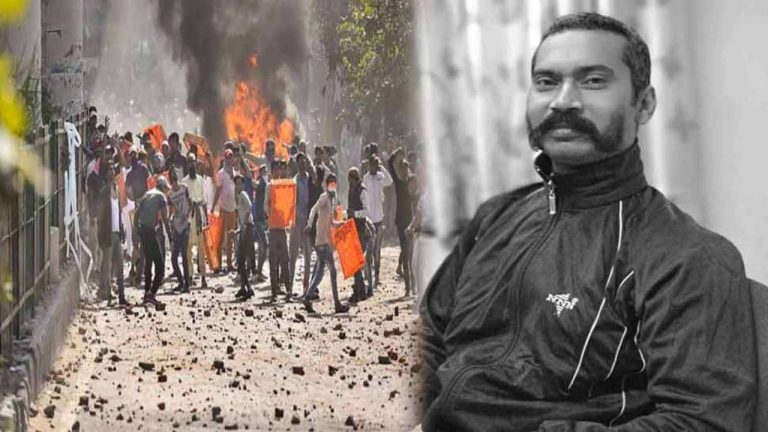
The Delhi anti-Hindu riots has been proved to be a pre-meditated conspiracy not just to destabilise India, but to target the Hindu population after Citizenship Amendment Act was passed by the parliament, granting expedited citizenship to persecuted minorities like Hindus, Sikhs, Jains and Christians from neighbouring Islamic countries. While the nefarious designs of the Islamists and the Left was evident, the very people who burnt Delhi had embarked on a vicious campaign to paint the Delhi riots as a ‘pogrom against Muslims’ when it was, in fact, just the opposite. Further, when Islamists started getting arrested their running theme was to allege that they were being “targeted because they were Muslim”.

That narrative was yet against shattered in court when the bail plea of an accused in the constable Ratan Lal murder was denied by the judge after his lawyers had claimed that he was targeted for being a Muslim. Shadab Ahmad, an accused in the murder of Ratan Lal had pleaded in court that he should be given bail since he was being targeted for being a Muslim.

The court, however, rejecting his bail, observed keenly that around the time Ratan Lal was murdered by the frenzied mob, Shabad Ahmad was curiously in touch with his lawyers. The CDR records prove that he was not only in the same area as the murder, but after the murder, he was also in touch with his lawyers. While remarking that it could be simply a co-incidence, the judge also mentioned that this detail was rather significant.

Interestingly, according to the CDR reports of Shabad Ahmad, he received three calls from his lawyers after the murder of Ratan Lal. The very lawyers who had called him at that time, are now representing him in court. Further, the calls also put the accused in the very spot where Ratan Lal was murdered.

Further, Additional Sessions Judge Vinod Yadav said call detail records (CDR) of accused Shadab Ahmad showed he was in constant touch with proclaimed offenders and co-accused in the case, Suleman Siddiqui and Ravish.

Interestingly, the judge said that the accused was not only in touch with some of those accused in the murder of constable Ratan Lal, but also in touch with those who are accused in the larger-conspiracy case of Delhi riots, which is being probed by the Special Cell. Noting this, the court said, “Charges against the applicant are serious… Applicant is not a resident of Delhi and as such, he would be a flight risk”.

Ahmad has been implicated by several eye-witnesses who have recorded their statement as per CrPC Section 161.

Murder of Ratan Lal during the Delhi anti-Hindu riots

Delhi Police on Monday filed a charge sheet in connection will the killing of head constable Ratan Lal during the violence that swept northeast Delhi in February this year. The police, in its charge-sheet, had stated that the murder of Ratan Lal was a part of a deeper conspiracy to gin up communal riots across the national capital. 

The Special Investigation Team of Delhi Police has filed a 1,100-page charge-sheet in the murder of Ratan Lal and deadly attacks by rioters on IPS Amit Sharma and IPS Anuj Kumar. At least 17 accused have been named in the charge-sheet. There are about 4 to 5 key conspirators in this whole case, which includes Salim Khan, Salim Munna and Shadab. The police stated that the riots were engineered in Delhi through a conspiracy to malign the image of the country. 

Ratan Lal’s murder was a deeper conspiracy

Constable Ratan Lal was murdered on February 24 when he was shot at by rioters while patrolling along with his seniors. The police had alleged in the charge-sheet that a group of 45 people held a meeting at the basement of a house on February 22, where the conspiracy of the riot was conceived. On February 23, a after the conspiracy was hatched, rioters asked senior citizens and children to stay indoor as they ran riot on the streets, indulging in vandalism. 

A day later, on February 24, rioters and vandals again hit the streets, damaging public properties, setting vehicles on fire and causing bloodshed. Around 1 PM in Chand Bagh area, patrolling party in Chand Bagh was vastly outnumbered by a huge crowd of rioters. Senior police officials tried to placate the riotous mob but the crowd turned violent and attacked police. Head constable Ratan Lal was shot dead by the rioters. Amit Sharma, Anuj Kumar and several policemen received serious injuries, the charge-sheet said.

Secret meetings, plan of action and riots: How Safoora Zargar and others are intertwined in the murder of Ratan Lal during Delhi riots

The chargesheet filed in the Ratan Lal case mentions that there was a secret meeting between the instigators, conspirators and rioters on the intervening night of 23rd and 24th and it was after this secret meeting that riots erupted that resulted in the murder of Ratan Lal by the Islamist mob.

The chargesheet mentions that after Bhim Army, a pre-planned, illegal march was started from Chand Bagh to Rajghat. This was done to instigate the feelings of people and also, the mob did not have the permission to carry out the march. 

The march was spearheaded by various local conspirators and organisers along with Safoora Zargar and other JCC members along with other locals such as Athar, Suleman, Shadab, Ravish, Saleem Khan, Saleem Munna and others. But the same was stopped and confined back to the protest site at Chand Bagh Mazar. Thereafter, the chargesheet says, “Which resulted into a secret meeting at Chand Bagh in the intervening night of 23/24 February between the organizers and conspirators”. 

The names who were with Safoora are pertinent since the chargesheet further said, “The riot at this site was the handiwork of D.S Bindra, Salman Siddiqui, Salim Khan, Salim Munna, Shahdab and Athar and others in cahoots with local rioters”

A witness statement which is relied upon in the chargesheet also corroborates the investigation of the police.

The statement by the Muslim witness reveals another interesting fact (the name of the witness is being withheld). Other than the secret meeting right before the riots broke out, another meeting about two weeks ago was held in secret. In this meeting, the witness says that at 12 AM a meeting was held where two people from every “protest” site from across the Yamuna river were called in. 

The proposition to support the call of Bhim Army on the 23rd of February was placed then itself. When some people present raised an objection saying that the sit-in protests were not yielding any results, “Upasana, Athar and Shadab did not listen to them”. It is pertinent to note that the police investigation found that Athar and Shabad, named in the witness statement, were indeed with Safoora Zargar in starting the illegal march and that the riot was their handiwork.


Coronavirus has already peaked in India, can be controlled by the end of February 2021, says expert panel

0

India has been putting up a tough fight against the coronavirus pathogen for almost 10 months now, with the first case of COVID-19 in India, which originated from China, reported on 30 January 2020. At last, there is some good news. According to a panel of scientists and doctors, the coronavirus pandemic has possibly peaked in India in September and the cases are going to plateau further.

Based on mathematical and statistical forecasting on the spread of the deadly pathogen, the panel also claimed that if all protocols are followed, the pandemic can be controlled by end of February 2021 with minimal active symptomatic cases.

The panel, which used the real-time dataset to make the prognosis, claimed that 30 per cent of India’s population was already projected to have developed antibodies, which indicated that they had been infected with the virus. Further, the panel estimated that there would be around 106 lakh symptomatic infections during the course of the pandemic. Currently, the panel claimed, there are an estimated 66 lakh symptomatic infections.

Coronavirus lockdown helped reduce the peak load on our system

The panel also said that in a ‘no lockdown’ scenario, cases would have been at least 14 times of what they actually were in the month of June, when the peak had begun.

Professor M Vidyasagar, chairman of the government-appointed panel said that according to the study’s findings: “Infections would have gone through the roof if lockdown was not imposed. If we had delayed it by two months, the peak would have been smaller than a ‘no lockdown’ scenario but greater than the actual scenario reported,” during the virtual presentation professor furthered: “Lockdown reduced peak load on our system, we pushed the peak to September, beginning end of June. It enabled our system to handle the pandemic much better.”

India maintains a steady declining trend in the number of active Coronavirus cases

The union health ministry also confirmed that India has maintained a steady declining trend in the number of active COVID-19 cases, which has stayed below eight lakh for the third consecutive day on Monday. The coronavirus recovery rate in the country has improved to 88.03 per cent. The virus, in the last 24 hours, has claimed 579 lives, which is the lowest COVID related deaths in the last 3 months.

There are 77,20,55 active cases of coronavirus infection as on date. The total number of recoveries have surged to 66,63,608 and exceed active cases by 5,891,553.

COVID-19 vaccines on its way

Prime Minister Narendra Modi, who has been personally monitoring the coronavirus situation in the country has informed yesterday that India at the “forefront” of vaccine development for Covid-19 with some of the vaccines in advanced stages. India was putting in place a well-established vaccine delivery system, through a digitised network along with the digital health ID, for the immunisation of citizens, said the Prime Minister while addressing the Grand Challenges Annual Meeting 2020 via a video link.

“Our population is four times that of the USA and many of our states are as populated as nations in Europe and Asia. But with a people-powered and people-driven approach, India has kept its Covid-19 death rate very low. Today we are seeing a decline in the number of cases per day and the growth rate of cases. India has one of the highest recovery rates at over 88%. This happened because India was one of the first countries to adopt a flexible lockdown when total cases were just a few hundred, one of the first to encourage usage of masks and work on effective contact tracing,” Modi said.

Bill Gates lauds India’s fight against COVID-19

Billionaire philanthropist Bill Gates who was also a part of the Grand Challenges Annual Meeting 2020 remarked that India’s research and manufacturing capabilities will play an important role in the fight against COVID-19. He added that India is “very inspiring” as it has taken several steps to improve the health of its people in the last two decades. “And now, India’s research and manufacturing will be critical to fighting COVID-19 especially when it comes to making vaccines at large scale,” he said.

As per reports, India is targeting 30 crore coronavirus vaccine shots by June 2021. Union Health Minister Harsh Vardhan said that India is expected to have a Covid-19 vaccine in a few months and the country should be in the process of delivering it to people in the next six months. According to reports, India is likely to begin administering the first round of Covid-19 vaccines to healthcare and essential service workers in January, and pharmacists may be deployed to administer the vaccine in the second phase.

Currently, India stands second behind the US in terms of active cases of COVID-19 as well as total caseload, according to Worldometer. Also, the country is in the dominant position in terms of the number of recovered cases and third in terms of fatalities globally behind the US and Brazil.

The indomitable Lokmanya Tilak: His political activism, activities in Mumbai, camaraderie with Swami Vivekananda and legacy

Chronicling Mumbai’s Tryst with Lokmanya Tilak

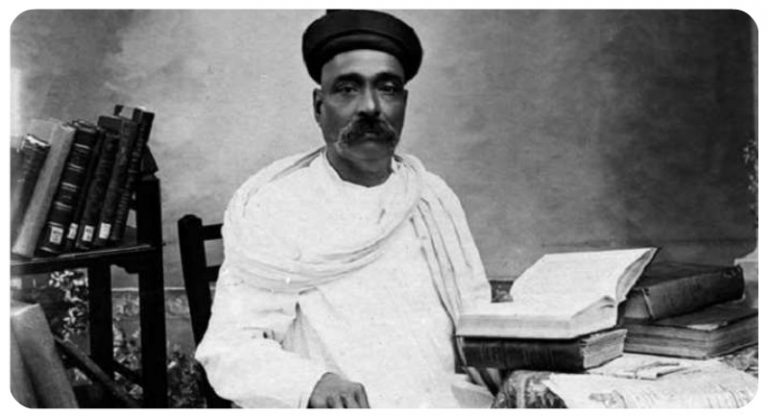
2020 was the year of Lokmanya Tilak’s centennial death anniversary. The prefix “Lokmanya” meaning “accepted by masses” comes from the fact that Lokmanya Tilak was modern India’s first mass leader who was looked up to by the masses. His following was unparalleled at that point of time. He was one of the first leaders to give a call for “sampoorna swaraj”, a paradigm shift from “partial rule” which was being demanded by the leaders then.

A good amount of Tilak’s lifetime was spent in Mumbai but unfortunately, the city appears to have forgotten this great son of Mother India. It is unfortunate that Mumbaikars don’t take pride in owning up Lokmanya Tilak as much as people from Ratnagiri (Tilak’s birthplace) or Pune do. There is a reason why Mumbai has a railway station in Lokmanya Tilak’s name and that is because Mumbai has a lot of memories of Lokmanya Tilak.

Lokmanya Tilak and Swami Vivekananda

In 1892, (before the World Congress of Religions), Lokmanya Tilak was returning from Bombay to Poona from Victoria Terminus (CST) when he first saw Swami Vivekananda. Swami Vivekananda also came and sat in the same compartment. A few Gujaratis who had come to see off Swami ji introduced Swami ji and Tilak. They hit it off very well and after reaching Poona, Tilak invited Swami Vivekananda to come to stay at his house, an invitation which Swami ji obliged and went to stay for 8-10 days.

Mumbai’s Sarvajanik Ganeshotsav

In those days, the British had decided to refrain from interfering in religious affairs of Indians after the 1857 war of independence. At a time when political meetings and gatherings to promote the idea of India’s independence were under scrutiny of the British, Lokmanya Tilak saw festivals as an opportunity for the people to come together (indirectly) for the cause of independence.

Till this point, the only recorded religious processions in Bombay were Moharram processions (Tilak had participated in one or more such processions). Tilak saw Ganesh Chaturthi celebrations which then were confined to Brahmin households as not just an opportunity to get people to come together for the cause of India’s independence but also an opportunity to grow a sense of pride among the Hindus and break the shackles of casteism which plagued Hindu society at that time leading to Hindu revivalism.

After Lokmanya Tilak made an appeal to people to have public celebrations of Ganeshotsav, in 1893, his followers, Raobahadur Limaye and Naraharishashtri Godse, started the festival at their chawl – Keshav ji Naik Chawl which was perhaps the city’s first sarvajanik Ganeshotav Celebrations. Lokmanya Tilak visited the Ganeshotsav in 1901 and also made a speech.

Shantaram Chawl

Till 1939 Shantaram chawl’s massive compound hosted public meetings and rallies of freedom fighters right from Lokmanya Tilak to Mohammed Ali Jinnah. These meeting drew crowds of 10,000-12,000 people. The chawl was the central-point of the Home Rule Movement started by Lokmanya Tilak with Annie Besant and others. On 16 June 1918, Tilak addressed a huge gathering alongside Jinnah which was presided by Mahatma Gandhi against the British Governor Lord Wellington to protest against his provocative statements against the Home Rule League.

101 days in Dongri Prison

Lokmanya Tilak was the first editor of Mahratta while his friend Gopal Ganesh Agarkar was the first editor of Kesari. After writing scathing pieces criticising the British for conspiracy to declare the young prince of Kolhapur, Shivaji IV as mentally unstable; both Tilak and Agarkar saw their first brush with prison when they were sentenced for four months and sent to Dongri Prison.  It was here during this stay that Agarkar wrong his book “101 days in Dongri Jail”

Sedition Trials

During his lifetime, Lokmanya Tilak was tried three times on sedition charges – 1897, 1908-09 and 1916. All these trials were fought in the Bombay High Court. In 1897, after his first trial, Tilak was sentenced 18 months’ imprisonment for inciting speech (Tilak had written on Shivaji killing Afzal Khan a week earlier) leading to assassination of Rand by Chapekar brothers in the backdrop of plague which was cut short after the British realised that Lokmanya Tilak’s arrest had made him a hero and gained momentum amongst the freedom fighters.

After his bail please getting rejected twice, Tilak’s lawyer Dinshaw Dawar secured bail for him (with Dwarkadas Dharamsey who arranged a sum of Rs 50,000 for bail bond, a big amount in those days in just 4 hours) a year later with appeals were made by several Indian and Europeans leaders including Rabindranath Tagore and Max Mueller to reduce his sentence.

This trial was significant as it was the first ever case of sedition and Tilak was the first ever freedom fighter to be convicted for sedition. During this time Tilak was sent to Dongri prison and to Byculla prison before eventually being moved to Yerwada jail.

In 1908, Tilak saw his second trial for sedition for defending Khudiram Bose and Prafulla Chaki who attempted to bomb and kill the British Judge, Magistrate Kingsford. This time Lokmanya Tilak was initially defended by the young barrister Mohamad Ali Jinnah but after the bail claim was rejected decided to contest his own case. Tilak lost the case and was sentenced to six years’ rigorous imprisonment by Justice Davar same man who has secured bail for Tilak 10 years ago sentenced Tilak to six year’s prison term in Mandalay (Burma).

After the sentence, Tilak responded, “I maintain that I am innocent. There are higher powers that rule the destiny of things and it may be the will of Providence that the cause which I represent is to prosper more by my suffering than by my remaining free.” A marble plaque still exists outside room no 46 of Bombay High Court with Tilak’s words etched on it. Court room no 46 has been kept preserved and is not used for regular hearings but used only on special occasions and events.

In 1916, Tilak had another run-in with the law when he was charged with sedition for a series of lectures he has addressed. It was Barrister Mohammmad Ali Jinnah who now wasn’t a rookie and a known leader of Home Rule League’s Bombay chapter yet again appeared for Tilak and this time won the case for Tilak.

The Bombay (Swadeshi) Store

Lokmanya Tilak wasn’t just a strong advocate of swadeshi but tried his bit to promote Indian entrepreneurs, businesses and industries (‘Atmanirbhar Bharat’?). In 1905 with Ratanji Jamsetji Tata and Dwarkadas Dharamsey as Directors alongside him Lokmanya Tilak founded “The Bombay Swadeshi Co-operative Stores Co Ltd” – a company to promote Indian products.

The first store was opened in what is today the times of India building and was inaugurated by Dadabhai Naoroji. This store is said to have been visited by the likes of Mahatma Gandhi and Jawharlal Nehru.

Ironically after the Dalal family brought majority stake in the company, this up-market store dropped “Swadeshi” from its name in 1995. The outlet where “The Bombay Store” stands today is operational since 1938.

First Political Strike of Bombay

After Tilak was sentenced rigorous imprisonment to Burma in 1908, Bombay witnessed the first ever political strike by the working class; the textile workers of Bombay which included Hindus of all castes as well as Muslims. All markets in Bombay lay shut on July 22. The textile factories and railway workshops remained closed for six days, one day for every year of the sentence. The army was called in which saw the death of 16 workers and over 50 injured.

Sardar Gruha

Sardar Gruha is an old building (built in 1898) located on Lokmanya Tilak Marg, just opposite the famous Mahatma Jyotiba Phule Market (Crawford). It started off as a guest house and was well known to prominent Indians like Mahatma Gandhi and Sardar Patel who preferred staying here as several British hotels in the area did not allow Indian guests.

Sardar Gruha was Lokmanya Tilak’s place to stay whenever he travelled to Mumbai. Because of his stature and his frequent visits, he was given a permanent room in the guesthouse. It was on the 4th floor of this building, flat no 198 that Lokmanya Tilak stayed for nearly three weeks before his death and also the place where he took his last breath.

Since then this room is used by Kesari as its regional office. Tilak’s pagadi, his chair and writing table have been preserved with a bust of Tilak installed in front of the building and the road being renamed to Lokmanya Tilak Marg.

Girgaum Chowpatty

Lokmanya Tilak was the first person (and last) to have been allowed (forced to by his followers) a public funeral in Bombay. After Tilak’s sudden demise, as the news spread across, people from Bombay as well outside thronged outside Sardar Gruha to get a last glimpse of their favorite leader.

Initially it was planned that Tilak’s body would be cremated at the nearby small Chandanwadi Crematorium but looking at the large crowd of people who were full of anger, disappoint and grief due to the untimely death of their revered leader, and lobbying by influential persons of Mumbai, the administration caved in, and granted special permission to have the cremation at Girgaum Chowpatty but with a caveat that this will be the first and last such permission to have a funeral in a public place and there would not be any memorial built on the site.

But eventually after Vithalbhai Patel (Sardar Patel’s brother) and Barrister KF Nariman (after whom Nariman Point is named) were able to convince the Bombay Municipal Corporation to grant permission to build a memorial. In 1925 a committee was setup with Sarojini Naidu has its head to raise money for the Tilak memorial. 13 years after his death, on 1 August 1933 the statue of Lokmanya Tilak was unveiled at Girgaum Chowpatty.

The final journey was said to have attended by a million people including prominent names like Mahatma Gandhi (who walked barefoot throughout the antim yatra), Jawaharlal Nehru and Maulana Shaukat Ali, a prominent leader of the Khilafat Movement.

It is unfortunate that most of the dwellers of Mumbai hardly know about Tilak’s association with the city – be it Ganeshotsav celebrations, Tilak’s Mumbai address – Sardar Gruha or Tilak’s Samadhi at Chowpatty. This write-up is my tribute as a Mumbaikar to one of the greatest leaders of India, Lokmanya Tilak, the first mass leader of modern India and his tryst with Mumbai.

So next time when someone wonders why was the Kurla Terminus renamed as Lokmanya Tilak Terminus in 1996 by the then Union Home Minister Lal Krishna Advani at the request of the then Minister of State of Railway Ram Naik, we hope this article helps people understand why.


BSP MLA Vinay Shankar Tiwari and wife booked by CBI in Rs 750 crore bank fraud case

0

On Monday, the Central Bureau of Investigation (CBI) booked BSP MLA Vinay Shankar Tiwari and his wife Rita Tiwari for their involvement in an alleged bank fraud of Rs.750 crore. Several teams conducted searches at premises linked to Tiwari at Gorakhpur, Lucknow, and Noida. Tiwari is the son of former minister and strongman Hari Shankar Tiwari. Tiwari is the sitting MLA from Chillupar, Gorakhpur.

Statement by CBI

In a press statement, the CBI said they had registered a case on a complaint from Bank of India against two private companies named Gangotri Enterprises and Royal Empire Marketing based at Lucknow and Noida, Uttar Pradesh. The directors and unknown others have been named for alleged misappropriation, cheating, and causing loss of Rs. 754.24 crore (approx.) to the consortium of banks. Ajit Pandey, the director of the company Gangotri Enterprises has also been booked.

The private company (Gangotri Enterprises) is involved in the construction of roads, bridges and flyovers. It availed credit from a consortium of banks led by Bank of India. The company did not route the transactions through Trust and Retention Account as per the regulations. There were irregularities in their financial statements. “Searches were conducted today at the premises of the accused/company at Noida and Lucknow which led to recovery of several incriminating documents,” it further added.

CBI has said that bank officials who cleared the loans will be called for questioning. 

A forensic audit revealed diversion of money

As per the reports, the FIR stated that the company took loans worth Rs.1129.44 crore between 2007 and 2012. In 2015 it was declared NPA. In July 2019, the Debt Recovery Tribunal had summoned Tiwari and 33 others after banks complained about loans turning into NPA. In a forensic audit done by the Bank of India, it was found that the loan money was diverted through investments and unsecured loans to related parties and entities. The bank declared the account as a fraud and reported it to RBI and CBI.

Times of India spreads fake news about PV Sindhu quitting national camp due to fall-out with family and coach: Here is the truth

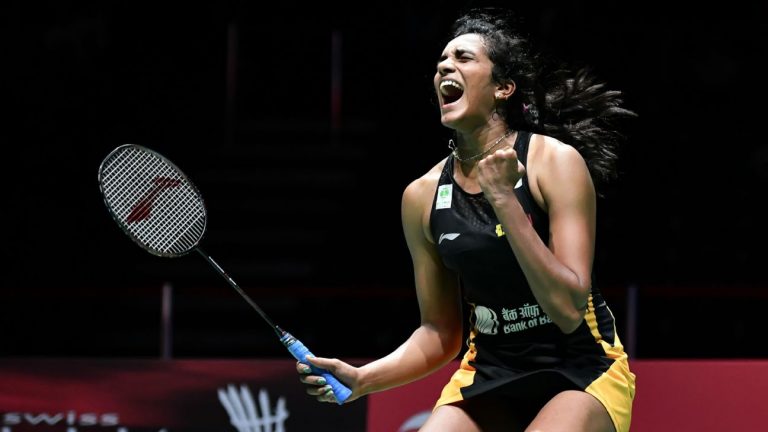
Badminton world champion PV Sindhu has left the national camp meant for young Olympic hopefuls and travelled to London to work on her personal recovery and nutrition. On Monday, PV Sindhu had taken to Twitter to announce that she was in London working on her recovery with Rebecca Randell of the Gatorade Sports Science Institute (GSSI).

As PV Sindhi travelled to London, Times of India began to spread ‘source based’ rumours about the reasons for her leaving the national camp and travelling to London.

In an article published on the 20th of October by Times of India, sports reporter Manne Ratnakar wrote that his ‘sources’ had informed him that PV Sindhu has been in the UK for the past 10 days already.

Times of India wrote, “Sources told TOI that Sindhu has left the country in a huff, apparently after tensions in her family. Before she left Hyderabad, Sindhu informed the coaches at the Pullela Gopichand Academy that she will not return to India for the next eight to ten weeks”.

The article by Ratnakar on Times of India further quoted sources to insinuate that she had left after a tantrum and a fall out with her family and “efforts were on to bring her back”. The source was quoted as saying, “She was upset with a few things. Efforts are being made to convince her to return home, she is unlikely to return anytime soon. At this stage of her life, she wants to be on her own and not be controlled. Maybe being at home during the lockdown took its toll and she wanted some freedom. We hope she enjoys the break and comes back”.

Times of India quoted another ‘source’ to claim that Sindhu will be training with English players for a while ‘otherwise her game will be affected’, insinuating that Sindhu had a fall-out with her coach Pullela Gopichand.

Soon after the article by the Times of India, PV Sindhu took to Twitter to issue a stern warning to the publication and the journalist and called the article fake news.

In a statement, PV Sindhu said, “I came to London a few days back to work on my nutrition and recovery needs with GSSI. In fact, I have come here with the consent of my parents and absolutely they were no family rifts in this regard. Why will I have problems/issues with my parents who have sacrificed their lives for my sake. Mine is a very close knitted family and they will always support me. I am in touch with my family members everyday. Also I do not have any issues with my coach Mr Gopichand or the training facilities at the academy. Mr M. Ratnakar the sports reporter of TOI who is spreading false news should know the facts first before writing them. If he doesn’t stop, I may have to resort to legal proceedings against him”.

Threatening to take legal action against the sports journalist and Times of India, PV Sindhu rubbished the article by TOI and said that she has no issues either with her family, who have sacrificed everything for her career, or with her coach Pullela Gopichand or his training facilities.

Not the first time Times of India has spread fake news about PV Sindhu

This is not the first time that Times of India has resorted to spreading fake news about world champ PV Sindhu. In a report published in July 2019, TOI had asserted that PV Sindhu had urged the Indian Olympic Association not to shun CWG over the exclusion of shooting.

Expressing her disappointment with the same journalist who is spreading fake news about her now, Mr Manne Ratnakar, Sindhu stated that he had patently misquoted her and that she had never asked the IOC not to shun the CWG. Sindhu said that as players they all want to participate in any sports event but she would always support what the Indian Olympic Association and the government decides. Another badminton player, Jwala Gutta had responded on Sindhu’s tweet, claiming this wasn’t the first time the journalist had twisted someone’s statement.

UK: Conservative party’s Israel body condemns BBC’s attempt to portray convicted Hamas terrorist as a victim, asks to apologise

0

Soon after the family of one of the child victims of the 2001 bombing in Jerusalem by Hamas terrorist criticised the BBC for giving a platform to advocate for one of the convicted terrorists, condemnation and criticism over the BBC’s attempt to whitewash terrorism have gained strength.

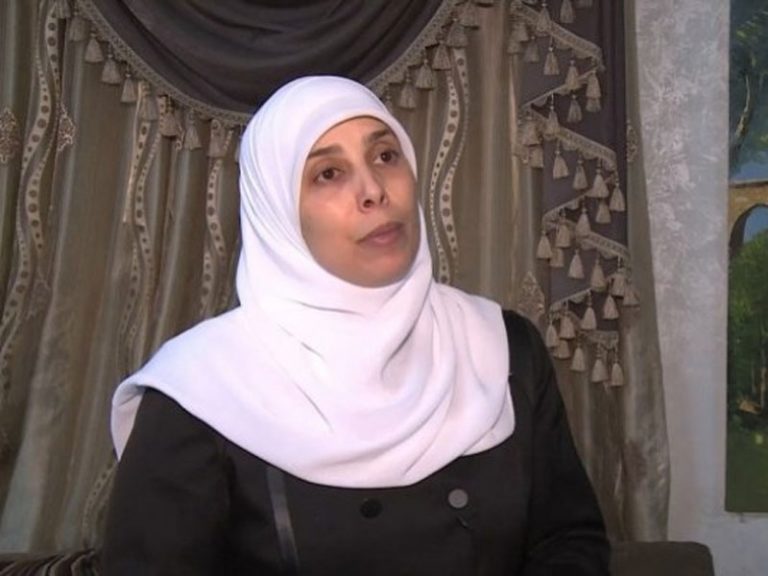
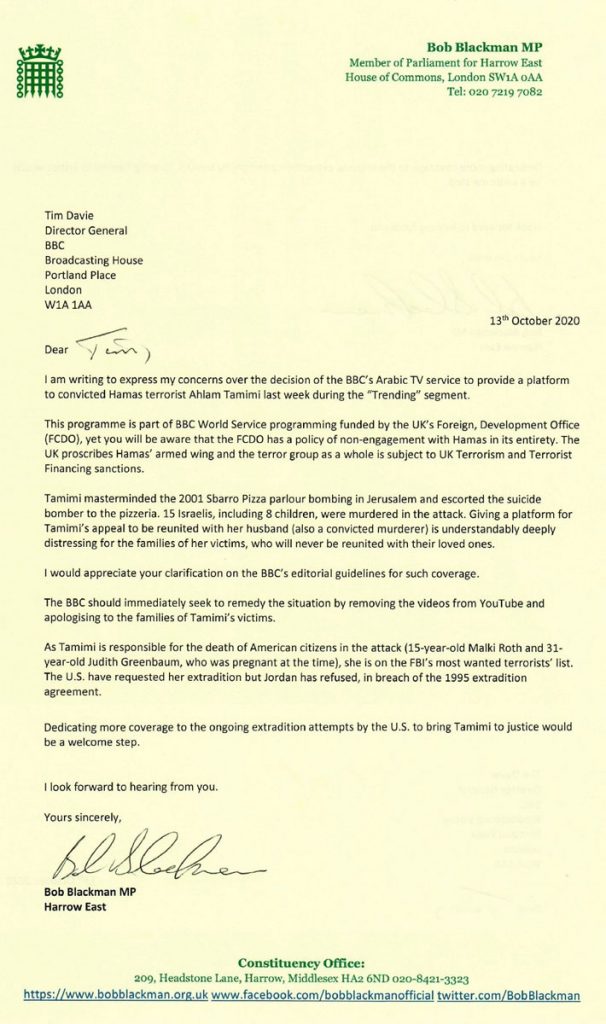
Conservative Friends of Israel (CFI) officer and MP Bob Blackman has written to the BBC to remove the content projecting convicted Hamas terrorist as a victim. Ahlam Tamimi was sentenced for killing 15 Israelis in the 2001 Sbarro Pizza parlour bombing in Jerusalem. She was featured on the BBC Arabic TV service in a segment of the program ‘Trending’ where she had appealed to King Abdullah II of Jordan to intervene so that she can reunite with her husband. Her husband is also a convicted murderer.

Blackman urged BBC to apologize to the families of victims

In his letter, Blackman has urged the BBC to remove all the content from its Youtube channel where it gave space to Tamimi. He also stated that the BBC should apologize to the families of victims of the 2001 bombing. He mentioned that the UK’s Foreign Development Office (FCDO) has a policy of non-engagement with Hamas in its entirely. UK recognized Hamas as a terror group as a whole, which is subject to UK Terrorism and Terrorist Financing Sanctions.

He said, “Tamimi masterminded the 2001 Sbarro Pizza parlour bombing in Jerusalem and escorted the suicide bomber to the pizzeria. Giving a platform for Tamimi’s appeal to be reunited with her husband (also a convicted murderer) is understandably deeply distressing for the families of her victims, who will never be reunited with their loved ones.”

He has urged BBC to seek to remedy the situation by removing the videos. He also asked for clarification on the BBC’s editorial guidelines for such coverage. He further added, “Dedicating more coverage to the ongoing extradition attempts by the US to bring Tamimi to justice would be a welcome step.”

The family of Malki Roth, who was killed at the age of 15 in the Sbarro Pizza parlour bombing in Jerusalem in 2001, has condemned the British Broadcasting Corporation (BBC) for providing its platform to her remorseless murderer.

The 2001 Sbarro Pizza parlour bombing

In August 2001, Ahlam Tamimi provided support to a suicide bomber to execute a terrorist attack in Jerusalem. She gave the guitar-laden with explosives to a suicide bomber, who detonated the bomb in the shop, killing 15 people, 8 of them children. The remorseless terrorist was convicted and sentenced to 16-years of rigorous imprisonment after her role in the bombing came to light. However, she was released after ten years of incarceration as a part of a prisoner exchange deal for captured Israeli Defense Forces’ soldier Gilad Shalit between Israel and Hamas.

She is currently living freely in Jordan. Her husband Nizar Tamimi was released in the Shalit prisoner exchange. He was convicted of terrorism after he murdered an Israeli student in 1993. Nizar Tamimi was pressurised by the Jordanian authorities to leave the country for Qatar on October 1. Tamimi is on the Most Wanted list of the US; however, Jordan denied extraditing her, stating the 1995 extradition agreement with the United States that has not yet been formalized by Jordan’s government. The US has offered a bounty of $5 million for her capture and conviction.

Twitter first says Leh a part of China, then, they say technical glitch, gets it horribly wrong even after fixing it: Read how

Two days after Twitter labelled the Indian territory of Leh in Ladakh as part of the People’s Republic of China (PRC), the microblogging website has now embroiled in yet another controversy.

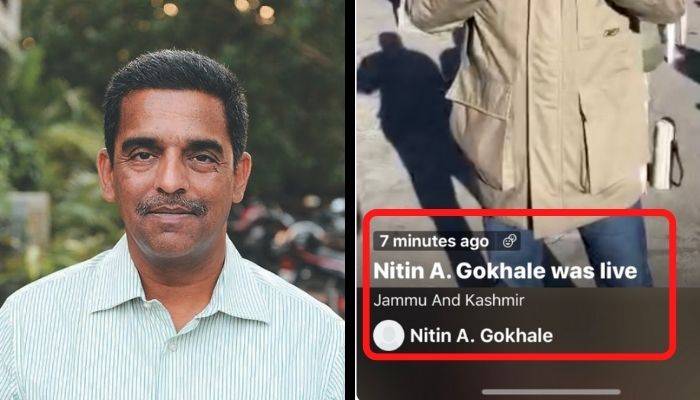
During a live session on Twitter on Sunday, a national security analyst and founder of Strat Times, Nitin A Gokhale, had found that the microblogging platform displayed the ‘Hall of Fame Leh’ area as part of the PRC. The screengrab of the live video read, “Nitin A Gokhale was live. Jammu and Kashmir, People’s Republic of China.”

Twitter issued a clarification, called it a ‘technical glitch’

Following a social media outrage, Twitter issued a statement claiming that the error was the result of a technical glitch. The microblogging platform emphasised, “We became aware of this technical issue on Sunday, and understand and respect the sensitivities around it. The teams have worked swiftly to investigate and resolve the concerned geotag issue.”

Nitin A Gokhale was however not satisfied with the response of the social media giant. He shared Twitter’s statement on the geotagging controversy and emphasised, “Reposting: Meanwhile this is Twitter’s response to the geotagging issue. Would have liked an apology/acknowledgement that it was a mistake. Will test it again today.”

Twitter fixes ‘technical glitch’, gets it horribly wrong, yet again

On Tuesday, Nitin A Gokhale went live on Twitter yet again but this time from the Kushok Bakula Rimpochee Airport area in Leh. He discussed the hustle and bustle in one of the busiest military terminals along the Line of Actual Control (LAC). He informed how the airport served as a military terminal for soldiers, departing for their official leave and arriving from temporary postings and leave period.

However, to his surprise, the national security analyst found that the microblogging platform had not fixed the technical glitch, despite being well aware of the sensitivity around it. Even though Twitter did not include Leh as part of the People’s Republic of China anymore, it, however, labelled the region as part of the Union territory of Jammu and Kashmir.

Constitutional amendment and the status of Ladakh

On August 5 last year, the Indian government abrogated Article 370 of the Indian Constitution and bifurcated the State of Jammu and Kashmir into two separate Union territories. While Jammu and Kashmir was designated the status of Union territory with a legislative assembly, the region of Ladakh has been converted into Union territory, directly administered by the Central government. Leh, which falls in Ladakh, is, therefore, a part of the Union territory of Ladakh and not Jammu and Kashmir anymore.

It is pertinent to mention that Twitter did not choose to update its geolocation tagging feature, despite being more than a year to the above mentioned constitutional amendments. Recently, it was also found that default weather apps of Chinese phones in India do not show reports for cities that China considers as ‘disputed. When OpIndia tried to make search queries, it found that the default weather app on Xiaomi phones did not provide results for districts including Itanagar, Pasighat and Longding.

Anti-Trump legal analyst of CNN and The New Yorker contributor suspended after masturbating on Zoom call

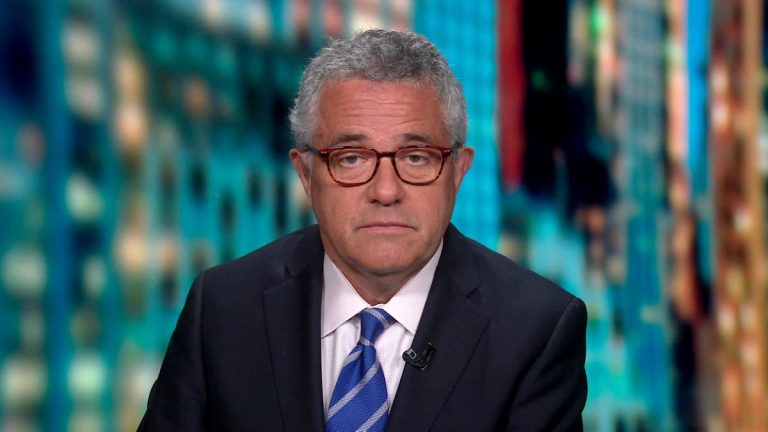
In a rather strange incident, chief legal analyst of CNN and a The New Yorker contributor, Jeffrey Toobin has been suspended by The New Yorker after he was caught masturbating on a Zoom video call with co-workers earlier this month. Soon after news spread about Toobin’s suspension “Zoom Dick” began trending on Twitter in the United States of America.

Vice reported that “the call was an election simulation featuring many of the New Yorker’s biggest stars: Jane Mayer was playing establishment Republicans; Evan Osnos was Joe Biden, Jelani Cobb was establishment Democrats, Masha Gessen played Donald Trump, Andrew Marantz was the far-right, Sue Halpern was left-wing democrats, Dexter Filkins was the military, and Jeffrey Toobin playing the courts. There were also a handful of other producers on the call from the New Yorker and WNYC.”

Jeffrey Toobin has offered an apology for masturbating on the Zoom video call and said that he thought he had put the video and audio on mute. “I made an embarrassingly stupid mistake, believing I was off-camera. I apologize to my wife, family, friends and co-workers … I believed I was not visible on Zoom. I thought no one on the Zoom call could see me. I thought I had muted the Zoom video”, Toobin said.

Jeffrey Toobin is a prominent anti-Trump voice and has been seen often on CNN talking, at length, about the impeachment of President Donald Trump. He has been working with The New Yorker for 25 years and is also a senior legal analyst at CNN.

While The New Yorker said that Toobin has been suspended pending an investigation, CNN was far more ‘circumspect’ in its statement. CNN said that Jeffrey Toobin had asked for some time off to deal with personal matters and that, the channel had granted it.

New Yorker editor David Remnick wrote an email to his staff clearly stating that Toobin had been suspended following the “incident” last week. He wrote, “Dear All, As you may have read in various news reports today, one of our writers, Jeff Toobin, was suspended after an incident on a Zoom call last week. Please be assured that we take such matters seriously and that we are looking into it.”

The New Yorker’s tryst with India and multitude of lies

In December 2019, Dexter Filkins went on an anti-India rant for The New Yorker in a report titled ‘Blood and Soil in Narendra Modi’s India’. The report was littered with every manner of conspiracy theory under the Sun and indulged in the complete distortion of historical facts. For instance, the ‘journalist’ said that Pakistan was created because Muslims of pre-partition India were too scared to live in a Hindu majority country. This is a shameless genocide denial of the highest order.

The ‘report’ also gives air to fantastical theories such as ‘The legend of Ram Janmabhoomi grew after independence’. Given the nature of such lies, it was safe to say that the report was a complete work of fiction, not journalism. We have published a comprehensive report detailing all the lies that Filkins has spread in the report but even then, we cannot say for certain that we managed to capture all of them. It can be read here.