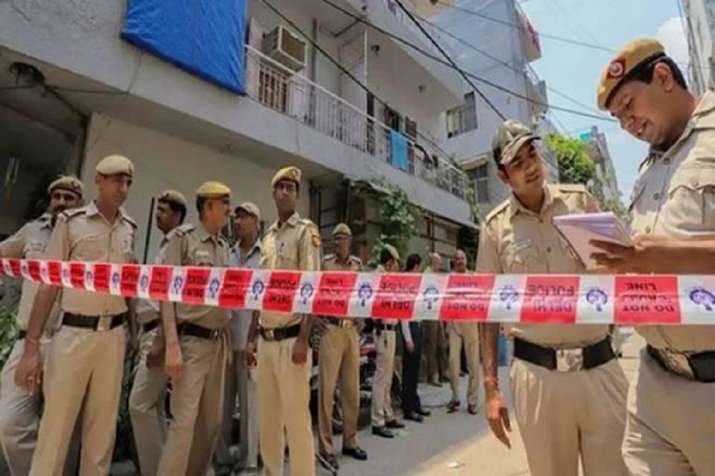
A 50-year-old doctor residing in the Deoli neighbourhood of South Delhi took the drastic step of ending his life amidst the nationwide lockdown imposed due to the Wuhan Coronavirus outbreak. A suicide note retrieved from the deceased’s house accused AAP MLA Prakash Jarwal and his aide Kapil Nagar for the harassment which provoked the doctor to take such a radical decision of committing suicide. The doctor’s body was found hanging from the ceiling of his house.
दिल्लीः देवली में एक डाॅक्टर ने की खुदकुशी, घर से मिले सूइसाइड नोट में विधायक समेत 2 लोगों पर आरोप। पुलिस जांच जारी।
The deceased, identified as Dr Rajendra Singh, ran his clinic in Durga Vihar. For several years, Singh had leased out water tankers to Delhi Jal Board which were abruptly cancelled by the local MLA. It is being said that he was subjected to persistent threats from the AAP MLA and his aide. Singh had alleged that he was dragooned by the AAP MLA to pay a hefty amount for the tankers or the government will terminate his contract. He did not cave in to the demands made by the AAP MLA after which his tankers were removed from the Delhi Jal Board. It is alleged that the accused AAP MLA Prakash Jarwal had withheld the outstanding payment in the tunes of a few lakhs, due to which the frustrated doctor committed suicide.
Delhi Police have taken the possession of the body and sent it for postmortem. A probe has been ordered in this regard. The police have seized the suicide note and mulling over the further course of action in the matter.
Prakash Jarwal, the youngest MLA from the Aam Aadmi Party, had left his job at a multinational firm to join Anna Hazare’s anti-corruption movement. He later fought and won the Delhi elections from Deoli constituency on the Aam Aadmi Party ticket. It is pertinent to note that Jarwal had been arrested earlier for allegedly assaulting a Delhi Jal Board engineer.
On Friday, Doordarshan (DD) broadcast comments of beneficiary women across the country thanking Prime Minister Narendra Modi for taking care of them by transferring Rs 500 to women account holders of Pradhan Mantri Jan-Dhan Yojana (PMJDY) during the lockdown period.
DD News has broadcast multiple videos where women have expressed their happiness after they got benefitted from the different schemes of the Modi government.
It is pertinent to note that the Modi government has announced that every PMJDY account holders would be given Rs. 500 for the next three months under the PM Garib Kalyan Package during the coronavirus lockdown in the country.
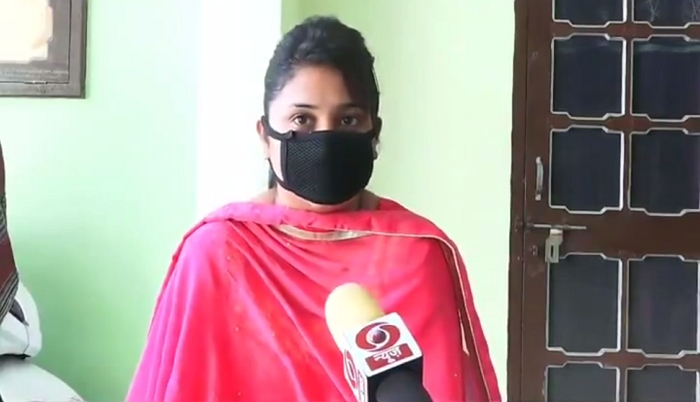
In one such video, a beneficiary named Kajal, a resident from Himachal Pradesh, thanked PM Modi for providing Rs 500 at a time when there was no livelihood opportunity for her due to the nation-wide lockdown.
Troll attack on beneficiary for being ‘not so poor’
However, the usual lots of the “liberal-secular” media, trolls took offence to the lady praising Prime Minister Modi. A lot of abuse began on social media as people raised questions on the authenticity of how ‘needy’ the beneficiary really was. The assertions of the elites in the media were that the lady was wearing a good attire and declare that she did not look ‘poor enough’ to be at all a real beneficiary under the scheme.
Vidya Krishnan, a notorious fake news peddler, who has been waging a misinformation war against the country through false reporting on coronavirus crisis, took to Twitter to mock the poor woman after she praised Prime Minister Narendra Modi.
According to Vidya Krishnan, the lifestyle of the woman in the video did not depend on Rs 500 given by PM Modi. Krishnan, who claims to be a journalist, seems to have analysed Kajal’s lifestyle within the 30 seconds time frame of the video tweeted by DD News.
Yes DD news, I totally believe this woman’s lifestyle is the kind that depends on Rs 500/- from the prime minister’s fund.
She probably used that money to buy that lock for her fancy door of her extremely sad looking hut. https://t.co/2860HcRGTI
Rifat Jawaid, an Aam Aadmi Party troll masquerading a journalist, also mocked the beneficiary, claiming that the Doordarshan should have chosen a better actress, who indeed looked poverty-stricken. According to Jawaid, the lady who received Rs 500 in her account was not enough poor.
Dear DD people, you should have chosen a better actress, who indeed looked poverty-stricken to justify the ‘gratitude’ for Rs 500. https://t.co/EUaxsGhSL9
Meanwhile, Congress trolls also hit the timeline to attack Modi government for indulging in propaganda. Gaurav Pandhi, a Congress party worker alleged the beneficiary to be a BJP worker.
After being at the receiving end of the hate pushed by the elite liberals, on Saturday, Kajal – the beneficiary of PM Garib Kalyan package, responded to the claims made by the trolls. In a video message, Kajal lambasted the beneficiary-shamers by asking them why cannot poor and Dalits dress properly or live in a good house.
Kajal, hitting out at those who mocked at her for not looking “poor enough”, stated that she worked in a beauty parlour and knew the importance of being clean and hygienic all the time. She attacked the liberals and trolls to stop passing vulgar comments on women.
Himachal resident Kajal lambasts beneficiary-shamers. “I want to ask these people, don’t poor & Dalits have right to dress properly? These are backward thinking people,” she said, hitting out at those who mocked her for not looking “poor enough” to avail Jan Dhan Yojana benefits. pic.twitter.com/MUHEuthOVe
— Prasar Bharati News Services (@PBNS_India) April 18, 2020
The troll attack on a poor woman living in a faraway village depicts everything that is bad about Indian journalism today. The liberals, who consider themselves to be elites in the society, perhaps think that a poor lady living does not qualify to wear good clothes or be residing in a pucca house.
The liberals, who are habituated to availing freebies during UPA days, do not understand the ambitions of a quintessential villager. The “liberal-secular” media are stuck in the socialist era where every non-elite was looked through a ‘deprived’ lens. The aspirational new India has now moved away from these cliched thought process, who have now started a living a life which once they aspired.
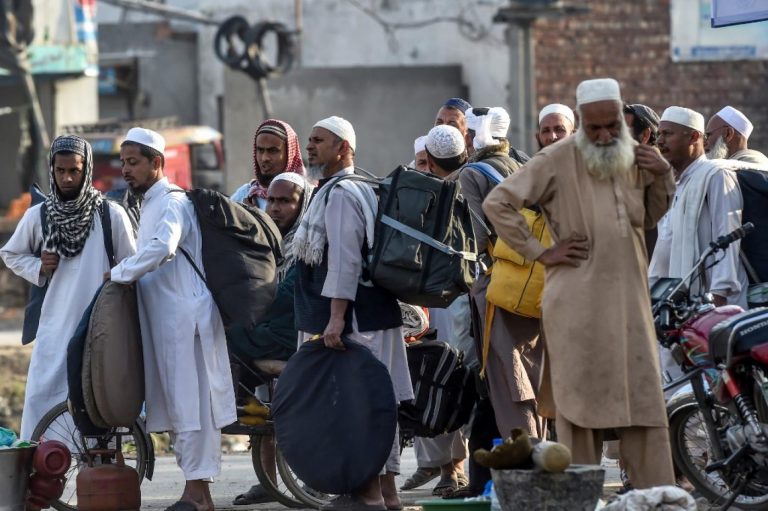
The chief of Faisalabad Tablighi Jamaat in Pakistan died on Thursday after contracting coronavirus. The 69-year-old Maulana Suhaib Rumi was the head of the Faisalabad chapter of Tablighi Jamaat in Pakistan.
According to the reports, the Muslim cleric had attended the Tablighi gathering in Lahore’s Raiwaind last month. Five members of his family, including two grandchildren, are also infected with the coronavirus.
His family members have been kept in an isolation centre in Faisalabad, some 150 kms from Lahore.
Tablighi Jamaat – The epicenter of coronavirus in Pakistan
According to the Punjab health department, over 1,100 Tablighi Jamaat members have been tested positive for coronavirus in the Punjab province. A large number of clerics who had visited the Islamic congregation in early March in its headquarters in Raiwand near Lahore were later tracked down across the country and placed in quarantine centres.
Like in India, one of the major reasons for the sudden rise in positive coronavirus cases in Pakistan is being attributed to Tablighi Jamaat congregation. Similar to the Nizamuddin Markaz congregation, which has caused large scale transmission in India, the annual Tablighi Ijtema congregation in Pakistan is also considered to be the main source of the spread of the Chinese coronavirus in the country.
Markaz despite Pakistan government warning
Reportedly, lakhs of pilgrims had gathered in Raiwand near Lahore last month amidst the novel coronavirus pandemic resulting in the transmission of the Chinese pandemic among the attendees of the event. It is estimated that nearly 2,50,000 people had congregated in camps near Lahore for the five-day festival.
However, Pakistan government had claimed that it had warned against five-day congregation but the Tablighi Jamaat went ahead with its annual congregation in Raiwind, Lahore and later transmitted the Chinese virus across the country.
With Tablighi Jamaat emerging as the epicenter of the coronavirus in the country, the Pakistan authorities had to place the entire city of Raiwind under quarantine, shutting down all general and medical stores, and completely restricted the mobility of people.
Tablighi Jamaatis- coronavirus carriers across the world
Tablighi Jamaat members have emerged as the prime suspects among potential coronavirus carriers, not just in Pakistan but in India, Malaysia and Brunei also.
In India, the Jamaat has come under severe criticism for defying the lockdown and organising a congregation. The Tablighi Jamaat is considered to be the epicentre of the transmission of the Chinese coronavirus across the country. Muslim clerics of Tablighi Jamaat organised a congregation in violation of the government’s lockdown orders, providing a conducive environment for the novel coronavirus to proliferate. Later they were also found hiding in various places to avoid getting tested and quarantined and had attacked medical teams who went to check them. Jamaat members kept in hospitals and quarantine centres also misbehaved with medical staff, spat on doctors, and harassed nurses.
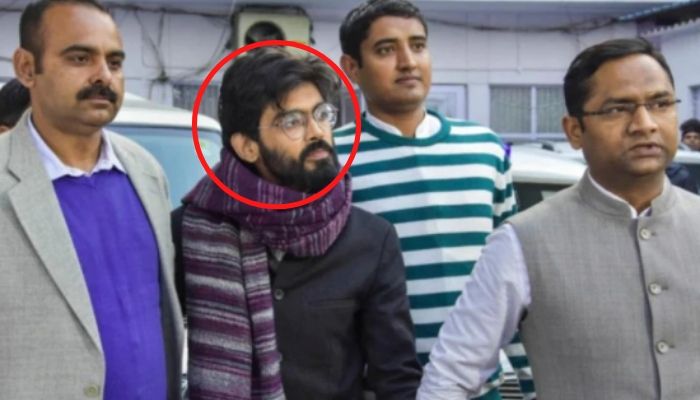
The Delhi Police has filed a supplementary charge sheet against radical Islamist Sharjeel Imam for instigating violence during the Anti-CAA protests at New Friends Colony near Jamia Millia Islamia University on December 15, 2019. He was booked under IPC Sections 124A (sedition) and 153 A (Promoting enmity between different groups) by the Delhi Police.
Sharjeel Imam was arrested for instigating & abetting Jamia riots by his seditious speech, delivered on 13th December 2019. On the basis of evidence, sections 124A and 153A of the IPC (sedition and promoting enmity between classes) were invoked in the case: Delhi Police https://t.co/bhOW1fQkcV
The charge sheet was filed at the Saket Court on 17th April for giving “seditious speech” and “abetting riots” in Jamia on December 15 last year.
“In the case of FIR no. 242/19 PS New Friends Colony, Sharjeel Imam was arrested for instigating and abetting the Jamia riots, due to his seditious speech delivered on December 13, 2019. During the investigation, on the basis of evidence collected, sections 124 A IPC and 153 A IPC (Sedition and promoting enmity) were invoked in the case. In this case, the first charge-sheet was filed against the rioters arrested by the SIT led by Shri Rajesh Deo. A Supplementary charge-sheet in continuation of the earlier charge-sheet has now been filed in the court of MM Saket court,” a statement issued by Delhi Police said.
According to police, riots broke out “in consequence to the protest march organised by Jamia students” against the CAA in December.
“The mob indulged in large scale rioting, stone-pelting and arson, and in the process destroyed many public and private properties. Cases of rioting, arson and damage to public properties were registered in both the police stations. Many policemen and public persons were injured in the riots,” the Delhi police added.
Four public buses and two police vehicles were set ablaze during the violent protests. DCP (Southeast) Chinmay Biswal had claimed that around 1500 demonstrators blocked the road and did not listen to the people who urged them to clear the road.
Eventually, the cops had to resort to lathi-charge and tear gas shells to pacify the mob. The clash left 60 people injured including students, police, and firefighters. Sharjeel Imam has been charged giving provocative speeches that ultimately culminated in the violence.
Earlier, a Court had sent Sharjeel Imamd to 14 days in judicial custody, till March 3. As per reports, the police had attached CCTV footage, call detail records and statements of over 100 witnesses as evidence in the charge sheet that was submitted before Chief Metropolitan Magistrate Gurmohina Kaur.
Threat of Separating Assam from India
In a viral video, Sharjeel Imam could be heard saying, “If five lakh Muslims are organized then we can cut off the North-east from the rest of India. If we cannot do so permanently, then at least we can do it for months. Our responsibility is to cut Assam from India, only then will the Government will hear our voice. If we have to help Assam then we will have to cut Assam from the rest of India.”
More disturbingly, he spoke of isolating Northeast India by blocking the Chicken’s Neck. The Chicken’s Neck is a narrow stretch of land of about 22 kilometers located in West Bengal, that connects the northeastern states to the rest of India, with Nepal and Bangladesh lying on either side of the corridor. Thus, Sharjeel had made his intentions very clear, he wanted a Civil War in the country and ultimately, another partition.
Sharjeel Imam wanted to Burn the Constitution
Shaheen Bagh protests were widely circulated as ‘organic’ protests in a bid to ‘save the constitution’. Except, like every drama, there’s a twist here. For this, we will have to go back to a few weeks when the Ram Janmabhoomi verdict was out. A conversation in a WhatsApp group of JNU students right after the Ayodhya verdict gives a clearer picture of how the Shaheen Bagh ‘organic’ protests blocking the highway culminated.
Sharjeel Imam said that how he would like to burn the constitution as the 1500 page Ram Jamnabhoomi Supreme Court verdict is too much to burn. On November 9, 2019, the Supreme Court ruled in favour of Ram Lalla and gave the land rights to the Hindus, paving way for construction of Ram Mandir where Babri Masjid was built after demolishing the temple. The Supreme Court also ruled that the government should give the Muslims a plot of 5-acre land to build a mosque, should they so wish.
Some tried to reason with Sharjeel by putting out a disclaimer that they are not being ‘constitutionalist’, but burning it may attract legal consequences. Sharjeel then said how he would like to have a ‘constitution burning ceremony’ in JNU. He explained how this verdict is a ‘watershed moment’ and that the Muslims who are ‘singing praises of the constitution’ must send a ‘clear message’ that ‘we do not believe in the constitution’.
On Friday night, the 14,690 feet Matterhorn mountain in the Swiss Alps, located on the border between Switzerland and Italy, was lit up with the Indian flag as a part of an illumination series by renowned artist Gerry Hofstetter. The objective behind lighting up the mountain is to spread hope and awareness regarding the Wuhan Coronavirus pandemic.
The breath-taking picture of the Indian Flag was posted on Twitter by Gurleen Kaur, an Indian foreign service officer who serves as the Second Secretary at the Permanent Mission of India to World Trade Organisation (WTO). She wrote, “Switzerland expresses solidarity with India in its fight against Coronavirus. Swiss mountain of Matterhorn lit in tricolour. Friendship from Himalayas to Alps…Thank you”
Swiss light artist Gerry Hofstetter said, “Light is hope. So if you do a message with light in such a situation as we are in now, you give that hope — especially with this iconic, standalone, pyramid-shaped, incredibly strong mountain. The Matterhorn was here before mankind was.”
He added that it was art that brought people together during epidemics in the past. Earlier, Hofstetter beamed words such as ‘hope’, ‘stay home’ and flags of the US, UK, and Italy onto the mountain. As of April 18, Switzerland has reported 27,078 live cases of Coronavirus and 1,327 deaths.
Coronavirus in India
On April 14, Prime Minister Narendra Modi had extended the nationwide lockdown in India till May 3, 2020, after the religious congregation attended by the Tablighi Jamaat members saw a sudden spike in the number of the Wuhan Coronavirus cases. The deadly virus has claimed 463 lives and infected 13,835 people in India so far.
As factories stay shut and vehicles stay off the roads amidst coronavirus lockdown, the water quality of the rivers has improved. Ganga is much cleaner in Kanpur and Varanasi and mountain ranges like Dhauladhar in Himachal Pradesh are visible from Jalandhar, Punjab.
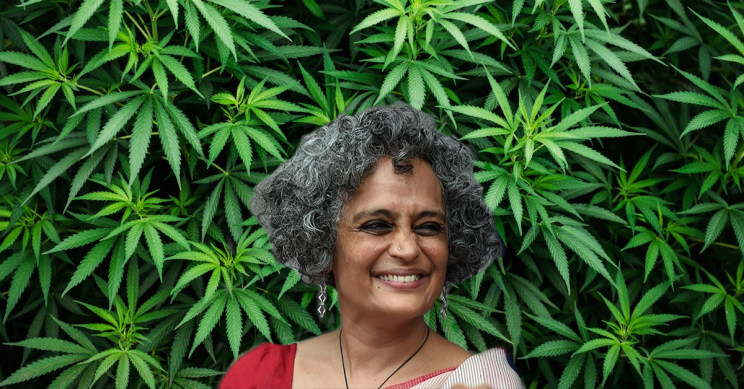
On Saturday, Arundhati Roy, the ultra-left wing ‘intellectual’ and a notorious anti-India propagandist, finally found out a medium to foul-mouth the country amidst the ongoing coronavirus crisis. With almost every credible Indian media outlets ignoring far-left cult propagandist Roy, she was finally featured in a German network to peddle her usual false propaganda.
In an interview to DW News, self-proclaimed ‘intellectual’ Arundhati Roy not only made misleading assertions on India’s response to the Chinese epidemic crisis but also indulged in blatant fear-mongering by spewing false propaganda to discredit Modi government’s response to limit the coronavirus pandemic in the country.
With no facts to back up, Roy began with discrediting India’s coronavirus cases. Roy claimed that coronavirus is not even a crisis in India, as she does not trust the official numbers released by the Modi government. Roy then began her usual antics of dragging manufactured crisis of ‘Hindu-Muslim’ tensions by asserting that the coronavirus crisis has exposed India that all of us knew.
Hatred against Muslims:
“We are suffering, not just from COVID, but from a crisis of hatred, from a crisis of hunger,” Roy claimed in the interview.
Continuing her usual rhetorics, Roy claimed that coronavirus has resulted in increasing hatred against Muslims in the country. She continued saying the so-called ‘anti-Muslim hatred’ comes on the ‘backdrop of a massacre in Delhi’, which she falsely claimed as the result of people protesting against the ‘anti-Muslim citizenship law’.
However, unsurprisingly, Roy’s claims are nothing but an out-and-out lie. The false narrative of Muslims being persecuted across the country during the coronavirus is just a plain falsehood. The objective assessment of the rising coronavirus cases in the country will reveal for itself that a particular section of Muslims in the country has been at the forefront of spreading the virus in the country. If someone follows Roy’s line of assertion, the contempt by those Muslims, the members of Tablighi Jamaat and their followers, against non-Muslims has only increased after coronavirus emerged in the country.
The rising resentment against non-Muslim communities by the Muslim community is evident with the fact that it is Muslim communities who have been unleashing violence against the ‘Kafirs’ in the country currently. The Muslim mobs have unleashed massive violence against front-line healthcare workers at a time when they are risking lives to limit the spread of Chinese pandemic coronavirus. It is rather delusional of Arundhati Roy to make such assertions without even caring to check facts.
Further, the Islamic event of Tablighi Jamaat is the epicentre of the coronavirus spread in India. The Tablighi Jamaat members not only transmitted the infection across the country but also emerged as a major headache for health officials after several cases of bad behaviour has been reported in these facilities. They were also kept hiding in mosques and various other places instead of coming forward to get tested.
Roy’s hallucinations on Delhi riots, which she claims of being a ‘massacre against Muslims’, is also just another attempt of dog-whistling. The anti-Hindu Delhi riots, that took place in the national capital in the last week of February were a direct result of Muslim mobs unleashing violence on the streets. It was evident from the fact that Muslim mobs descended on the streets and captured areas like Shaheen Bagh and Jaffarabad, acting as a spark for violence on the streets of the national capital.
Students, activists being jailed
Roy, a motherly figure for anti-national elements in the country, also claimed that the Modi government, under the cover of coronavirus, is moving to arrest young students, to fight cases against lawyers, against senior editors, against activists and intellectuals.
Arundhati Roy, perhaps thinks that calling thugs and rioters as ‘students’ and ‘activists’ will absolve their crimes of creating anarchy on the streets of the country. The ‘students’ as claimed by Roy, are no students at all. These are the same individuals who had unleashed Muslim mobs within the university campus and streets during the anti-CAA protests in Delhi, resulting in extreme violence in the national capital.
The ‘activists’ and ‘journalists’, whom Roy is defending are nothing but another bunch notorious fake news peddlers. These so-called activists have been forefront at peddling misinformation and inciting mobs against the government to further their ideological objectives.
Tactic reminiscent of Nazis
The ‘activist’ even claimed that the government was exploiting the virus in a tactic reminiscent of one used by the Nazis during the Holocaust.
Arundhati Roy said, “The whole of the organization, the RSS to which Modi belongs, which is the mother ship of the BJP, has long said that India should be a Hindu nation. Its ideologues have likened the Muslims of India to the Jews of Germany. And if you look at the way in which they are using COVID, it was very much like typhus was used against the Jews to get ghettoize them, to stigmatize them.”
If there is any consistency among the ultra-left anti-India brigade that works within the country, it is perhaps their hate for Hindus and the RSS. The constant vilification of the Hindus, especially RSS is not refreshing anymore. From referring RSS to Nazis to abusing them as militants, the left has always been fearful of the nationalist organisation.
In the interview, Roy tried the same trick to blame RSS for a few wrong things that continue to present in the country. The ‘Nazi’ card of Roy to slander RSS was played once again in the interview. Her claims of the government using the coronavirus crisis to exploit the situation to target the Muslims is just laughable as even the hardcore supporters of the Modi government are now critical of the lethargic approach of the government to act on Muslim leaders and the community, which has been forefront at creating troubles for the country, be it the Muslim mobs during the anti-Hindu riots or even on the non-action against the likes of Maulana Saad, the mastermind of the Tablighi Jamaat, which has emerged as the epicentre of the coronavirus spread in the country.
Situation is approaching genocidal
Since this government has come, Muslims are being lynched, Muslims have been hunted down.. It comes with a threat of extreme violence,” claimed Roy. “Honestly, the situation is approaching genocidal,” Roy claimed.
The irresponsible throwing of words such as ‘genocide’ to exaggerate the false claims of Muslims being targeted in the country raises questions about the state of Roy’s mental health.
Muslim detention centers
Roy also went on to make false assumptions that the Modi government has been building detention centres for Muslims. The government would “dovetail with this illness to create something which the world should really keep its eyes on.”
The most bizarre lies that ultra-left elements like Arundhati Roy peddle is that Modi government is building detention centres for Muslims in India. Ever since the Citizenship Act was passed in the country, the left has been enthusiastic to find out ‘detention centres’ that are being allegedly built to keep Muslims in the country. However, until today, none of them has found any.
However, Roy, who is in a hangover, seems to have been dreaming about detention centres. Only Roy, a fiction writer, has the audacity to invent a relevance to somehow link coronavirus crisis to the so-called detention centres for Muslims.
Arundhati Roy hallucinations against India does not need any response whatsoever. Roy will turn out to be another laughing stock, just like her comrades, if she ever thinks that her false propaganda and anti-India actions will influence citizens of the country anymore.
It may be noted that regular fake news peddler Arundhati Roy had donated to so-called fact-checker Alt News, which is nothing but another leftist Islamist propaganda site. According to a report, Arundhati Roy’s trust named Zindabad Trust had donated an unspecified amount to Alt News.
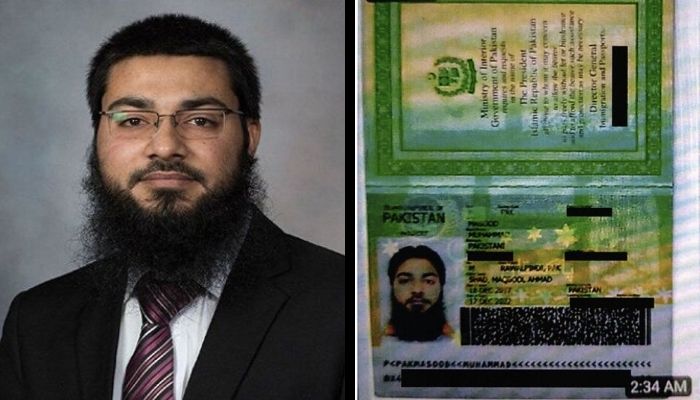
On March 19, the Federal Bureau of Investigation (FBI) had arrested a 28-year-old Pakistani doctor and former Mayo Clinic research coordinator named Muhammed Masood at Minneapolis St. Paul International Airport for providing material support to the Islamic State of Iraq and Al-Sham (ISIS). If proven guilty, he may serve up to 20 years in prison.
Masood had also pledged his allegiance to the extremist Islamic terror outfit, besides expressing his desire to execute ‘lone wolf attacks’ in the United States. He was living in the country for 2 years, at the time of arrest, on an H-1B visa.
The Pakistani doctor graduated in 2016 from the Riphah International University in Islamabad which supposedly produces professionals with Islamic morals and ethics. He worked at the Pakistan Railway Hospital, Federal Government Polyclinic Post-Graduate Medical Institute and the Government of Punjab’s Healthcare department in Rawalpindi before joining Mayo Clinic in Minnesota in the US as a research trainee in February 2018.
Laying the Trap
During the investigation, FBI officials found that Masood was the encrypted Social Media Platform (SMP) user ‘BB’ who wanted to travel to Syria and help the ISIS carry out their acts of terror. In the United States Vs Muhammed case, the FBI officials furnished computer records and conversations between two reliable sources that the Pakistani doctor mistook for as ISIS commanders.
Vicious Plans of the Pakistani Doctor
‘BB’ aka Muhammed Masood wanted to use his medical knowledge to work as a frontline jihadist and help the ‘mujahideen'(terrorists) on ground zero. He also wanted to be trained in weaponry. During his conversation with one of the sources, the Pakistani doctor revealed that he hated smiling at the Kaffir (non-Muslim/infidel) passing by but he did so nevertheless to avoid making them suspicious.
Masood also desired to study engineering and help transform small drones that could be purchased online into ‘suicide bombing drones’. He believed that ‘Qiyamah‘ (the day of judgment) was near and thus wanted to do jihad. The ISIS sympathiser also wanted to carry out “lone wolf” attacks in the United States.
On meeting one of the sources, he requested for a fabricated visa to keep his travel history clean and wanted to travel to Jordan before making into the ISIS territory.
In order to persuade Masood into exposing his dangerous mindset, a confidential source informed him that he might have to kill people for his ‘Iman’ (Faith) and asked whether he was willing to do such a thing. The Pakistani doctor replied, “I want to kill and get killed, again and again. This is what even Prophet Mohammed wished. Allah will protect its people.” Reportedly, he was in search of the ‘Truth‘ and was motivated to commit acts of terror after he began listening to one Anwar Nasser al-Awlaki.
The Inspiration
Al-Awlaki was a Muslim Cleric in Virginia who also worked as a recruiter and planner for Al-Qaeda, a dreaded terror organisation. He was the source of ‘motivation’ for at least three 9/11 hijackers, and a former American Army Major turned mass shooter in Texas named Nidal Malik Hasan. Al-Awlaki who was killed during an airstrike in 2011 also prepared a Nigerian Islamist, Umar Farouk Abdulmutallab to bomb Northwest Airlines Flight 253 in December 2009.
The Muslim cleric has left behind his Facebook page and several Youtube videos that continue to radicalise Muslims and inspire acts of terrorism. Reportedly, the Saudi news organisations refer to him as the “Bin Laden of the Internet.”
The story of Muhammed Masood was no different. He supposedly learnt from the lectures of Al-Awlaki that ‘Dawla al-Islamiyya’ in Iraq was the epitome of Truth. When the Pakistani doctor met one of the FBI sources who he mistook as ISIS commander, he said that one must know the direction in which the arrows of the Kaffirs are pointed. Masood emphasised that he understood the infidels better after moving to the United States and that he was sick of the place.
The Arrest of the Pakistani Doctor
Masood had resigned from his job at the Mayo Clinic on March 17, 2020. He also sold most of his personal belongings online, including, office chair, mattress, and shoe rack. The outbreak of the Wuhan Coronavirus, however, marred the plans of the Pakistani medic. He had booked a flight to Jordan from O’Hare International Airport in Chicago. His mistake was that he shared the itinerary with the FBI source.
On March 19 this year, Masood was nabbed by FBI ’s Joint Terrorism Task Force while he was en route a Transportation Security Administration (TSA) Checkpoint at the Los Angeles International Airport.
Pakistan Planned Terror Attack in Delhi
On March 29, two Pakistani terrorists, operating out of Shopian region in Kashmir, for the national capital to carry out a terror attack. As per a report, the two Pakistani terrorists had allegiance to ISIS and were communicating using Telegram. ISIS magazines al-Naba and Voice of Hind had also reportedly written articles urging jihadis to ‘capitalise’ on India’s preoccupation with coronavirus outbreak.
An editorial in al-Naba reportedly urged jihadis to exploit the ‘opportunity’ as the government’s ability to coordinate counter-terror operations might be reduced as the country was focusing on ensuring safety and supply of essentials to citizens amidst coronavirus outbreak. As per the report, on pro-ISIS channels, a message was circulated that read, “We are preparing for new attacks, which will be the last thing they want. The military apparatus is also crippled because of the restriction of movement. The overburdened hospitals will have a nightmare if the mujahideens greet them in the morning.”
Amidst the Coronavirus outbreak, as India went into complete lockdown first for 21-days and then, an extended period till the 3rd of May, Prime Minister Modi had appealed to business houses to ensure that no employee is fired from their job. He had appealed to people to show compassion and ensure that payments to employees were not reduced as well, considering owing to the lockdown, several employees would not be able to discharge their duties. As the nation deals with the Coronavirus pandemic and the economic and human cost of it, there are certain media houses that are indulging in spreading blatant misinformation and fake news to either create panic or to use the pandemic to target the Modi government.
There were two articles published, one in The Hindu and the other in the Indian Express that did just that – spread fake news at a time the nation is dealing with a pandemic. The articles aimed to target Prasar Bharati, India’s Public Service Broadcaster, and allege that the channel had fired its employees amidst the Coronavirus pandemic despite the directive from the Prime Minister about retaining employees through the lockdown period.
How The Indian Express spread fake news about Prasar Bharati under-paying its employees amidst the Coronavirus lockdown
Indian Express published an article in its section called ‘Delhi Confidential’, headlined ‘Against Appeal’. The article, published on the 16th of April 2020 claimed that Prasar Bharati had underpaid its employees despite the appeal from the Prime Minister.
The article said,
“Prime Minister Narendra Modi on Tuesday reiterated his earlier request to employers to be sensitive to their employees and the Labour and Finance ministries had mentioned in March that even contractual and casual workers should be paid in full and considered on duty for the lockdown days. All India Radio, however, may have ignored the advice of both. Many casual employees, who work as presenters, producers, script-writers, etc, for AIR have only been paid for the days they were called in March, even though many of them had shown willingness to come for more shows”.
Very clearly, the article in the Indian Express aimed to insinuate the following:
India’s public service broadcaster itself is not adhering to the appeal by the Prime Minister
That the “employees” of Prasar Bharati were not being paid fully
That Prasar Bharati was essentially only calling “employees” for work when required and paying them for those days instead of the full amount owed to them under normal circumstances
That the employees want to work and get paid for it, however, Prasar Bharati, in an effort to cost-cut during the lockdown is not allowing them to do so.
First and foremost, the use of the phrase “May have ignored the advice” itself gives away the charade of this article being “news”. Clearly, Indian Express had no basis to claim what it did other than either gossip or plain malice.
Further, in a letter written to Indian Express by Prasar Bharati, that has been accessed by OpIndia, the entire web of lies have been exposed threadbare.
In the latter, Prasar Bharati says that the article is “factually incorrect and is not only unfair to All India Radio but also is likely to mislead the readers”.
Detailing its position, Prasar Bharati makes the following points:
The letter written by Prasar Bharati to Indian Express says that the people mentioned by Indian Express are not “employees” of Prasar Bharati but “part-time freelancers who are engaged on a need basis only and are referred to as Casual Assignees. They are paid for the number of assignments done by them”.
The clarify that there exists no employer-employee relationship between these individuals and Prasar Bharati.
These casual assignees continue to receive payments from All India Radio for assignments completed as may have been assigned to them during the lockdown period. There is no entitlement for casual assignees to receive payments from All India Radio outside of assignments.
They are free to accept employments in other public and private organizations of their choice or pursue any other business or profession. Such persons can be teachers, managers, engineers, doctors, lawyers or entrepreneurs and can yet contribute to All India Radio as casual assignees in their spare time.
In fact, sources in Prasar Bharati tell OpIndia that several casual assignees have been working on assignments for delivery of AIR services such as FM Rainbow, Vividh Bharati, AIR News among others during the lockdown while there have also been instances of casual assignees declining assignments due to constraints and other pre-occupations.
It is thus evident that Prasar Bharati is in no way defying the appeal made by the Prime Minister. The casual assignees are being paid for the freelance work they do with the Broadcaster as earlier and the insinuation by Indian Express that Prasar Bharati is paying its “employees” less than what they are owed is factually incorrect and seems completely concocted.
How The Hindu spread fake news about Prasar Bharati firing its employees amidst the Coronavirus lockdown
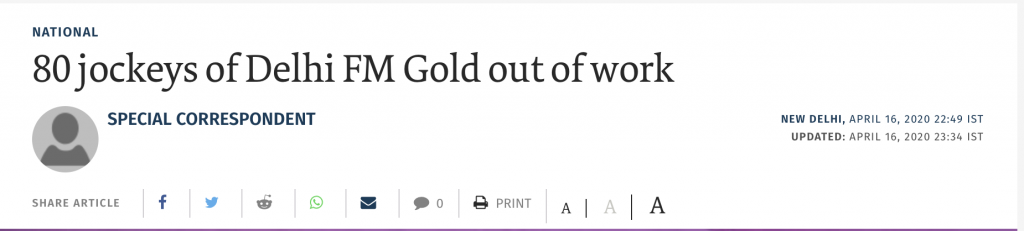
The Hindu, which is known to spread fake news, seems to have done it again. In an article published on April 16, The Hindu claimed that 80 Radio Jockeys (RJs) of Delhi FM Gold are out of work and not been paid despite govt orders.
Fake news published by The Hindu
Interestingly, in the article itself, the writer admits that they are casual workers. Being casual workers, they are called in only when the ‘need arises’ and hence, there is no employer-employee relationship that exists. Delhi FM Gold is again an All India Radio offering and hence, this hitjob seems designed to target the government itself.
When there exists no employer-employee relationship, and these RJs are called in “when the need arises” to begin with, it is not within anyone’s ‘right’ to demand that they be called in for assignments. In fact, the headline is preposterous as no radio channel possibly functions with 80 RJs on its payroll.
The Press Information Bureau too issued a clarification on the fake news by The Hindu.
#PIBFactCheck Claim: A prominent newspaper says 80 Radio Jockeys (RJs) of Delhi FM Gold are out of work and not been paid despite govt orders Fact: They are not employees, but part-time freelancers, engaged on a need-basis for assignments.They are free to accept jobs elsewhere pic.twitter.com/kz0jSlU8s5
— PIB India #StayHome #StaySafe (@PIB_India) April 17, 2020
What the CEO of Prasar Bharati said
The CEO of Prasar Bharati, Shashi Shekhar said that, “Several casual assignees drawn from the various panels continue to be engaged across the network of @AkashvaniAIR on a need basis subject to their availability and within the permissible limit of 6 assignments”.
Interestingly, Shashi Shekhar also revealed that there is a limit of 6 assignments per person that is already in place as far as All India Radio is concerned.
He further said that it was unfortunate that the media was publishing misleading details regarding the status of casual assignees without verifying factual position.
It will be the continued endeavour of @prasarbharati across its networks of DD and @AkashvaniAIR to harness young and upcoming talent and give opportunities to new voices and faces through this system of casual assignment after following due process.
The Hindu and Indian Express both habitually peddle fake news to further their agenda.
Recently, the Indian Express published a report claiming that the coronavirus patients and suspected cases have been segregated into separate wards on the basis of their religion at Ahmedabad Civil Hospital. The report had claimed that Dr Gunvant H Rathod – who is the Medical Superintendent, had said that separate wards had been created for Hindu patients and Muslim patients as per a state government decision.
According to Indian Express, Dr Rathod had said, “Generally, there are separate wards for male and female patients. But here, we have made separate wards for Hindu and Muslim patients.” On being asked the reason for such a segregation, Dr Rathod said, “It is a decision of the government and you can ask them.”
However, responding to the misinformation campaign of the Indian Express, the Gujarat government had categorically denied the claims. The Health Department of Gujarat had also clarified that no segregation is being done in the Ahmedabad civil hospital on the basis of religion for coronavirus patients. – article continues after ad — article resumes –
“Corona Patients are being treated based on symptoms, severity etc. and according to treating doctors’ recommendations,” the Gujarat government Health Department said in a statement.
There are two basic rules for dealing with the Wuhan Coronavirus pandemic: first, the more strictly we observe the lockdown, the more we overreact, the safer we will be eventually. Second, the more boldly and honestly we face up to the bad news, the better we are prepared to fight it. It is our only way out of this nightmare. Over the last few days, Mumbai, the financial hub of India and the capital city of Maharashtra, has emerged as the greatest spot of worry for India as far as Coronavirus is concerned. This was not unexpected, for the maximum city is our financial capital. In the US, the city of New York has been left similarly devastated by the virus.
In the daily war against the virus, it must be understood that the actual number of cases is not nearly as significant. What is significant is the rate at which the number of cases is increasing. “Flattening the curve”, as everyone talks about nowadays. For example, the state of New York reported over 750 deaths just yesterday. As terrifying as that may be, it represents a growth of just 7% over the number from the day before. A month ago, these numbers were much smaller, but growing at a much faster pace.
That’s why this changed test strategy from the BMC is so worrying. The BMC has decided that it will no longer test contacts of patients, whether high risk or low risk, unless they start showing symptoms.
Mumbai mirror article detailing how BMC will not be testing patients who have no symptoms of Coronavirus
As the article in Mumbai Mirror notes, the BMC’s new approach differs from the strategy of the ICMR, which advises that “asymptomatic direct and high-risk contacts of a confirmed case should be tested once between days 5 and day 14 of coming in contact.”
It is clear that this new strategy could lead to an artificial drop in the number of patients, giving a false sense of flattening the curve.
It is, of course, important to note that this new strategy does not mean that contacts of confirmed patients will be allowed to go around possibly infecting more people. The BMC is clear that they will be put into quarantine. But remember that the incubation period of the virus is anywhere between 5 to 14 days. Further, disturbing reports have emerged across the world, with instances of the virus taking even longer to show symptoms.
As such, putting contacts of confirmed cases into quarantine instead of testing them delays the feedback which we desperately need to be timely and precise.
On one hand, we should all understand the obvious capacity constraints under which the BMC is operating. On the other, there is room for genuine worry about the possibility of the state government using such tactics to make the numbers appear lower. After all, in the last few days, the state government has come off as almost comical in finding ways of passing the buck. Both related to the gathering of thousands of people in Bandra and the matter of certain privileged persons getting a pass to flout the lockdown. The possibility of some agencies of the state running a PR campaign with celebrities at a time like this also raises questions about priorities.
The role of liberal media is highly suspect as well. Many celebrity journalists have appeared to be more concerned with creating the image of “best CM” for Uddhav Thackeray, rather than holding the ruling party accountable for its performance. I wonder what the liberal media reaction would have been if a BJP-ruled state was the top hotspot in the country right now.
At a time like this, for the sake of Mumbai, Maharashtra and India, we can only hope that both our leaders and conscience keepers (self-appointed or otherwise) can rise above narrow political considerations. This would be an excellent time for Uddhav Thackeray to actually earn the title of “best CM” by performing on the ground. By saving Mumbai, Maharashtra and India. We all wish him well.
A 23-year-old man who had spit on a woman from Manipur was arrested on Friday, in Kalina area of Mumbai on April 6. The accused, Amir Mohammed Elias, is a Kurla resident, the Mumbai police said. According to the reports, the incident came to light when a friend of the victim had posted about the appaling incident on social media. The friend of the victim went by the name Linda Newami and had flagged the incident of the Manipur woman being spit on by a man on a bike, now identified as Amir Mohammad Elias.
This is not done! WE HAVE TO FIGHT #COVID19 OR THIS RACIAL ATTACKS? I request the @MumbaiPolice police to immediately take actions please! A NE girl from Manipur is the new victim again here in Mumbai. This happened just an hour ago. A biker came &spat on her.#StopRacismpic.twitter.com/sVIHuhR2Gh
The incident had occurred on April 6 afternoon when the 25-year-old victim along with her friend had walked from Geeta Vihar Junction towards the Military Camp in Kalina to collect the essential goods that were distributed by the police.
Elias ran away after spitting on victim from Manipur
The accused Amir Mohammed Elias, who is a delivery boy, approached towards them on a bike, took off his mask and spat on her near Kalina signal. The victim lodged a complaint at Vakola police station.
In her complaint, the victim said, “The biker came closer to me and removed his mask and spat on me before he sped on his bike. The biker’s act could expose me to coronavirus infection. I failed to note down the bike’s registration number as I was left in a shock.”
Over 100 CCTVs scanned to nab the accused: Mumbai Police
The police soon began to trace the accused Elias. They scanned over 100 closed-circuit television (CCTV) footage before tracking Elias’s address. The Mumbai police used an app to fix the blurred image of the vehicle registration number of the bike that he used to speed away after committing the offence.
The Vakola police team scanned through several CCTVs and also they scanned through the dump data of at least 1.5 lakh mobile users who were in the area on the day of the incident.
“The investigation team used an app to fix the blur pixel of the vehicle registration number and used dump data of phone users. Depending upon the activities of the phone users, the police zeroed in on the accused late on Thursday. The technical analysis helped in tracking the accused,” said Deputy Commissioner of Police (Zone VIII) Manjunath Singe.
However, the police said that Elias claimed that he has got the habit of chewing pan leaves and his act was not intentional.
The Vakola police have now registered a case under the Indian Penal Code sections 270 (Malignant act likely to spread infection of disease dangerous to life) and 352 (Punishment for assault or criminal force otherwise than on grave provocation) against Elias.
In a similar incident last week, a group of 4-5 women in the town of Rajasthan’s Kota, were seen spitting in polythenes bags and throwing them inside houses amidst coronavirus scare leaving people with a sense of fear and panic as cases of Chinese epidemic is on a rise in the country.