A major birth registration scam has been uncovered in the rural area of the Yavatmal district in Maharashtra. In an alarming revelation from Shendursani Gram Panchayat in Arni taluka of the district, 27,397 births were recorded for a population of 1,500 in the civil registration system (CRS) within three months from September to November. The matter first came to light on 24th November, and an FIR was lodged at the Yavatmal city police station on Tuesday (16th December) on the complaint of the district health officer (DHO). The FIR was registered under Sections 318(4), 337, 336(3), and 304(2) and Sections 65 and 66 of the IT Act. “A complaint regarding irregularities in birth registration entries of Shendursani has been received, and a probe has been launched,” said Police Inspector Nandkishor Kale.
Biggest Birth Certificate Scam of India
27,397 birth registration took place in September 2025, in Shendursani Village of Yavatmal District. Village Population is 1,500.
Most of these 27397 are above 18 year of Age & doesn't belongs to Maharashtra.
Former BJP MP Kirit Somaiya visited the village on Wednesday (17th December) and demanded an investigation into the matter. Speaking to the media, Somaiya expressed the suspicion that the credentials of the gram panchayat’s computer operator might have been misused by someone.
Visited Sendur Sani Village at Yavatmal
27397 birth registration done in September, October, November 2025 through Gram Panchayat Terminal. Th
ALL belongs to West Bengal, North India, Bangladeshi e.g.
Kitaboon Nissa Mohammed Azad Shamshad Ahmad Khurshid Alam
He said that most of the names found in the records belong to people from West Bengal, Uttar Pradesh, and surrounding regions. “I have spoken to Chief Minister Devendra Fadnavis and demanded that all these birth registration entries be cancelled,” Somaiya added. Notably, the CRS ID (MH18241RE) of Shendursani gram panchayat was also found mapped in Mumbai, indicating a cyber fraud.
A verification drive was initiated at the direction of the state government on 16th December to identify and cancel illegal and delayed birth and death registrations in the gram panchayat. During the verification, the officials of the health department in Arni came across 27,397 birth entries and seven death entries recorded between September and November 2025 in the CRS software. The numbers were clearly disproportionate to the actual population of the village.
Consequently, the DHO informed Zilla Parishad Chief Executive Officer (CEO), Mandar Patki, about the anomaly. The CEO constituted an inquiry committee headed by the deputy Chief Executive Officer of the Panchayat department. An on-site inspection was conducted by the committee at the village, which revealed that 27,397 birth records and seven death records did not fall within the gram panchayat’s jurisdiction and were considered highly suspicious.
Subsequently, a technical investigation was initiated by the Deputy Director of Health Services, Pune. The investigation done using the state login system disclosed that the CRS ID of Shendursani has been mapped to Mumbai. Thereafter, the case was referred to the office of the Additional Registrar General of India, New Delhi, and the National Informatics Centre (NIC). According to their assessment, this was a case of cyberfraud. The finding was then communicated to the Deputy Director of Health Services, Pune, on 11th December, who subsequently informed the Zill Parishad.
On 16th December, a late-night walk home in Mumbai’s Ghatkopar turned violent after a man and his relatives were assaulted for merely shooing away a barking stray dog. The victim, identified as Salikram Bholanath Yadav, suffered a fractured shoulder and head injuries requiring stitches following an attack by three local men in the Pantnagar police station limits. OpIndia has accessed the FIR registered in the matter.
What happened on the night of the incident
The incident occurred in the early hours of 16th December at around 2:30 am near Shravasti Buddha Vihar in Ramabai Colony, Ghatkopar East. The complainant was walking home with his nephew Akash Yadav and a relative, Rajan Yadav, after finishing work and having a meal.
According to Yadav, the trio briefly stopped as his nephew needed to use the restroom. At that point, a stray dog began barking aggressively at Akash. To scare the dog away, Akash raised his slipper. However, he did not hit the animal. Three men, sitting nearby and warming themselves by a bonfire, objected and accused Akash of hitting the dog.
The trio attempted to explain that no harm was caused to the dog and walked away peacefully. However, the three men allegedly followed and stopped them, leading to a violent assault.
What the FIR says
OpIndia accessed the FIR registered in the case at Pantnagar police station on the complaint of Salikram Bholanath Yadav. The case has been registered under Sections 115(2), 118(1), 118(2), 3(5) and 352 of the Bharatiya Nyaya Sanhita (BNS), 2023.
Source: Maharashtra Police
According to the FIR, the accused have been identified as Imran Ahmed Shaikh, Sampat Bhagirath Sutar and Hritik Sanjay Chandramore. All of them are residents of Ramabai Colony. The complainant stated that Hritik first struck him on the head with a wooden plank, which caused a bleeding injury. After that, Imran used the same wooden plank to hit Yadav on his left shoulder, left leg and back, which resulted in severe injuries.
Source: Maharashtra Police
Furthermore, Sampat assaulted Akash and Rajan with fists and kicks, causing them injuries. After the assault, the three accused fled the spot. Yadav later went to Rajawadi Hospital for treatment with a relative. Doctors informed him that he had suffered a fracture to his left shoulder and required multiple stitches on his head.
Source: Maharashtra Police
Fear and insecurity after the assault
In his statement, Yadav said that he had lived in the area for 25 years and nothing of this sort had happened earlier. He expressed fear for his safety and that of his family. He questioned whether residents are even allowed to protect themselves when faced with an aggressive stray dog.
The situation for ordinary people in Afghanistan is becoming increasingly difficult under the Taliban rule. Amidst the ongoing border dispute with Pakistan, the Taliban regime’s complete ban on the import of Pakistani medicines has created a severe shortage of essential drugs in the country. People are desperately searching for even the most basic medications.
Having been betrayed by Pakistan, Afghanistan is now looking to India for support. Expressing their trust in India, a country that has always stood shoulder-to-shoulder with the Afghan people, Taliban’s Health Minister, Noor Jalal Jalali, arrived in New Delhi on Tuesday (December 16, 2025).
Afghanistan bans the import of medicines from Pakistan
Just a few days ago, Abdul Ghani Baradar, the deputy head of the Taliban-led government in Kabul and in charge of economic affairs, announced a ban on the import of all medicines from Pakistan. Baradar described the quality of Pakistani medicines as “poor” and instructed Afghan importers to settle all outstanding payments with Pakistani companies within three months and arrange for supplies from alternative countries.
However, the ground reality is that finding new suppliers is proving extremely difficult for Afghanistan. According to Noorullah Noori, Director General of Administrative Affairs in the Taliban government, more than 70% of the medicines in Afghanistan have so far been imported from Pakistan. The sudden ban has had a direct impact on ordinary citizens, who are finding it difficult to access even basic medicines.
Afghanistan’s Crumbling Health System Under Double Burden
For decades, Afghanistan has been able to produce only a very small fraction of the medicines it needs. The country suffers from a weak pharmaceutical manufacturing infrastructure, a severe shortage of pharmaceutical laboratories, ineffective quality control systems, and frequent disruptions to its supply chain. These shortcomings have made Afghanistan heavily reliant on imported medicines.
Even before the current crisis, Afghanistan’s healthcare system was extremely fragile. The situation worsened significantly after the Taliban seized power in August 2021. The country then faced a severe humanitarian crisis, exacerbated by persistent droughts, devastating floods, and a near-total collapse of the economy.
The influx of hundreds of thousands of Afghans deported from Iran and Pakistan in recent months has pushed Afghanistan’s already weak healthcare system to the brink of collapse. Many of these returnees require immediate medical attention, but the limited resources of the healthcare system are proving insufficient to meet their needs.
According to recent data, approximately 1.86 million Afghans were deported from Iran between January and August, while more than 314,000 returned from Pakistan. This means that in just eight months, more than two million Afghan citizens have been forced to return to their country. The majority of these returnees require healthcare services.
According to the United Nations, nearly 22.9 million people, or almost half of the country’s total population of 46 million, are in need of humanitarian assistance. 16.8 million people have been identified as requiring aid, for which approximately US$2.42 billion is needed.
United Nations data (Photo Credit: UN)
Meanwhile, humanitarian aid operations in Afghanistan are facing a severe funding shortage, aggravating an already critical situation. The country’s health system is extremely fragile, and access to healthcare remains uneven, particularly in rural areas. Limited resources, inadequate infrastructure, and a lack of trained personnel have brought the entire health system to near collapse.
The frequent outbreaks of infectious diseases, serious maternal and child health issues, malnutrition, and non-communicable diseases are contributing to increased rates of morbidity and mortality in Afghanistan. According to health experts, there is a significant risk of several diseases spreading in the coming months. These include acute watery diarrhoea (AWD), measles, polio, Crimean-Congo hemorrhagic fever (CCHF), dengue, COVID-19, pertussis (whooping cough), and malaria.
Experts and humanitarian organisations warn that the situation in Afghanistan could become even more dire, with a surge in disease, deaths, and a mental health crisis, if immediate and adequate funding for health and humanitarian aid is not provided. A fragile healthcare system and ever-increasing needs are pushing the country towards a prolonged and profound humanitarian crisis.
Afghanistan needs India’s help to stay ‘healthy’
Following Afghan Foreign Minister Amir Khan Muttaqi and Industry and Commerce Minister Alhajj Nooruddin Azizi, Health Minister Maulvi Noor Jalal Jalali also arrived in India. His visit is being considered crucial for assisting Afghanistan, which is grappling with a health crisis. India has been consistently working to strengthen Afghanistan’s healthcare infrastructure. Earlier this month, India sent 63,734 doses of influenza and meningitis vaccines to Afghanistan.
Earlier, on November 28, India sent 73 tons of life-saving medicines, vaccines, and essential supplies to meet Afghanistan’s health needs. The Ministry of External Affairs wrote on ‘X’ (formerly Twitter), “Boosting Afghanistan’s healthcare efforts, India has sent 73 tons of life-saving medicines, vaccines, and essential supplementary materials to Kabul to address immediate medical requirements. India’s unwavering support for the Afghan people continues.”
Augmenting Afghanistan’s healthcare efforts.
?? has delivered 73 tonnes of life-saving medicines, vaccines and essential supplements to Kabul to cater to urgent medical needs.
In October, when Amir Khan Muttaqi visited India, India expressed its commitment to assisting Afghanistan’s healthcare sector. India announced the establishment of a specialised centre in Kabul for children and patients suffering from thalassemia. It also announced the construction of a modern diagnostic centre and the replacement of the outdated heating system at the Indira Gandhi Institute of Child Health in Kabul.
Additionally, India is building a new 30-bed hospital in the Bagrami area of Kabul, an oncology centre for cancer treatment, and a trauma centre for treating serious injuries. Furthermore, India announced the construction of five maternity health clinics in the Paktika, Khost, and Paktia provinces of Afghanistan to provide care for mothers and newborns in different parts of the country. During this visit, India also gifted 20 ambulances to Afghanistan to ensure that patients can be transported to hospitals promptly.
At a time when many countries are viewing Afghanistan solely through a political lens, India has made it clear that the focus of its foreign policy is not power, but the suffering of the Afghan people, and that India stands with Afghanistan in this difficult time. By putting the principle of ‘Vasudhaiva Kutumbakam’ (the world is one family) into practice, rising above borders, differences, and global politics, India stands firmly with its centuries-old friend.
(This article is a translation of the original article published on OpIndia Hindi.)
In the Supreme Court, ‘oral mentioning’ served as an unofficial pressure-valve for decades. Advocates would rise at the beginning of the day and ask for an out-of-turn listing, typically citing urgency. It was helpful in situations involving the death penalty, impending demolition, bail, habeas corpus, and eviction that were truly urgent. However, it also established a parallel path into the Court’s diary that relied more on prominence, seniority, and courtroom access than on objective standards. With a series of changes implemented under Chief Justice Surya Kant on December 1, 2025, the Supreme Court has now attempted to address that tension.
The new framework
The focus of attention is a Registry circular dated November 29, 2025, which states unequivocally that, except a very few, defined circumstances, no oral mentioning will be allowed before the Chief Justice of India. The same circular also adds a strict guardrail, junior lawyers may be urged to undertake whatever oral mentioning is still allowed under the new framework, but no designated Senior lawyers shall be allowed to do so before any court. This is significant because, as oral mentioning developed, it appeared to be a privilege of the most well-known speakers in Court No.1, giving the impression and occasionally the reality that the well-connected might shorten the line.
Instead of delay by paperwork, a predictable, documented procedure takes the place of the previous ritual. The Court has implemented automated listing within the next two working days for new cases that fall within certain urgency categories, particularly those concerning personal liberty or urgent interim relief, after the case is verified and any defects are fixed. Both the categories and the internal timing discipline are outlined in the circular. Litigants are informed that there is no necessity to mention for inclusion in certain auto-listed categories, and verified cases (filed or cleared by the cut off) get into the Main or Supplementary List. The reform’s most citizen-centric component aims to guarantee that an individual’s freedom is not contingent upon a senior advocate’s ability to speak at 10:30 a.m.
Regular bail, anticipatory bail, cancellation of bail, the death sentence, habeas corpus, eviction/dispossession, demolition, and any other matter that requires urgent interim relief are among the auto-listing categories outlined in the circular. The same circular also includes a compliance lever that, after registration, bail proceedings must be sent to the respondent’s (Union, State, or UT) Nodal Officer or Standing Counsel; otherwise, the case might not be confirmed and listed. In other words, provided the minimal fairness requirements are satisfied, the Court is working quickly to avoid “urgent” remarks that are procedurally half-baked.
The second layer is as follows. The Court permits mentioning only through a Mentioning Proforma along with Letter of Urgency submitted to a Mentioning Officer within specified deadlines (usually by 3:00 p.m. the previous working day and 11:30 a.m. on Saturdays) in cases not covered by automatic listing or in which a party requests an earlier date than the scheduled date because urgent interim orders are required. The proforma and urgency letter must be sent by 10:30 a.m. for the limited range of ‘exceptionally urgent’ cases, which specifically include anticipatory bail, the death penalty, habeas corpus, eviction/dispossession, and demolition. Crucially, the system now passes the request through the Registrar (Judicial Listing) for orders and requires an urgent letter explaining why the matter cannot wait for listing on the appointed date.
The third layer is an institutional disciplinary regulation that specifically targets the open ended aspect of traditional mentioning. Only topics that are included in the public Mentioning List are allowed to be stated, everything else is prohibited. Only a filed application requesting urgent relief or an early hearing may be considered for mentioning, once more via the proforma procedure; regular hearing cases cannot be mentioned for listing at all. This is not ornamental, rather, it transforms an arbitrary, personality driven moment in public court into an administrative judgment that can be tracked using standard inputs and timestamps.
When taken as a whole, these actions show what CJI Surya Kant seems to be doing strategically: changing the focus from who can persuade the bench in two minutes to which cases objectively require immediate court time. Even earlier, on his first day, the public signal was given. According to reports, the CJI clarified that, unless there are exceptional circumstances, requests for urgent listings must be submitted in writing via mentioning slips, with the Registry determining the urgency first. That strategy is pro-process rather than anti-lawyer. Additionally, procedural equality is a necessity for legitimacy in a court that must distribute limited hearing time among tens of thousands of pending cases.
From oral requests to written rules
Additionally, this transformation is part of a broader institutional arc. The same issue was brought up time and time again by previous Chief Justices. Queue jumping by mentioning was skewing access. In 2024, CJI Sanjiv Khanna prohibited oral mentioning and instructed advocates to submit petitions via email or printed slips or letters expressing urgency. When CJI Ranjan Gogoi took office in 2018, he prohibited urgent mentioning until parameters were established, excepting only dire situations like someone being evicted or hanged. Even CJI BR Gavai pushed in 2025 to specifically prohibit senior counsel from appearing in Court No. 1 in order to provide room for juniors and lessen the influence of the traditional voices. The combination of automatic listing, defined proforma-based mentioning, and published mentioning lists implemented simultaneously and connected to the verification discipline is what sets apart the CJI Surya Kant phase, not just the mood.
How was oral mentioning misused?
Now for the delicate but inevitable question: how and by whom was oral mentioning ‘misused’? The safest and most equitable way to describe it from a professional standpoint is that even in cases when individual remarks were genuine, the technique was fundamentally susceptible to abuse. Oral mentioning tended to favor those with (a) physical presence and familiarity in Court No.1 (b) confidence and courtroom capital, and (c) the ability to frame urgency persuasively in a matter of seconds because it took place in open court, within a limited time window, and with limited ability to verify claims on the spot.
The senior bar and well-funded litigants have a substantial correlation with that set of benefits. The technique could enable wealthy clients to obtain out-of-turn hearings by engaging senior counsel, but it would require significant judicial time each morning, according to commentary surrounding the 2024 ‘no oral mentioning’ directive.
Where does ideology fit in? Many of the most well known cause ‘PILs’ in India’s legal system, which are frequently structured around free speech, civil liberties, executive action, or governance, are defended by a select group of prominent senior advocates. Some of these individuals are thought to be ideologically conservative, others to be institutionally moderate, and yet others to be ‘left liberal aligned.’ The more crucial point is to clarify that activist litigation has natural incentives to push for immediate listing because it is intended to be urgent, high impact, and headline sensitive, and that a discretionary, personality-centric gatekeeping mechanism predictably rewards the loudest and most networked litigators.
This occasionally contributed to the public’s image of two tracks under the previous culture, one for common litigants who waited, and another for high-salience cases that made it to the Court more quickly through effective mentioning. Reducing discretion at the entry point and allowing verified urgency, particularly liberty, to drive priority are the best ways to interpret the Surya Kant changes as an institutional response to that perspective.
The legitimacy of this reform is further reinforced by a constitutional administrative context. The Chief Justice’s administrative supremacy as ‘Master of the Roster’ has been frequently upheld by the Supreme Court. Listing and roster control are administrative functions. The Court reaffirmed that roster distribution is crucial to institutional operation and cannot be undermined by conflicting allegations in Campaign for Judicial Accountability and Reforms v. Union of India (2018) 1 SCC 196) and related cases. Although oral mentioning is not the same as roster allocation, it has a direct impact on listing results, and controlling it through documented regulations is exactly the kind of administrative housekeeping that fortifies the Court’s impartiality.
Conclusion
From a governance standpoint, the changes are consistent with court administration in the digital age. For a long time, the Supreme Court’s e-Committee has promoted organised methods for urgent listing, such as online platforms that allow plaintiffs and advocates to submit urgent briefs for orders. In order to prevent courtroom theatrics from determining a litigant’s destiny, the 2025 reset applies that administrative logic to everyday practice: urgency should be prioritized with least drama, maximum documentation, and equal opportunity.
In conclusion, it would be better to describe CJI Surya Kant’s declaration stating regulation as a rebalancing rather than a crackdown. It reduces a VIP prone entryway that had become detrimental to the institution’s reputation while maintaining the Court’s responsiveness when it comes to personal liberty and urgent temporary relief. The circulars reorganize urgency rather than eliminating it. The reform’s modest strength is that it seeks to transform the Supreme Court into a constitutional court whose time is distributed according to principles rather than locality.
The quality of leadership depends on the mindset of the person occupying the chair. The laws do not change, the system does not change, only the decisions change with the change in leadership. Uttar Pradesh offers a clear example of this contrast. When politics driven by the MY (Muslim-Yadav) equation dominates, decisions often tilt towards appeasement. When the same chair is occupied by a saffron-clad chief minister, the focus visibly shifts to law and order and justice.
This difference becomes clear when past and present cases are placed side by side.
Dadri lynching case: A decade of legal struggle
In September 2015, Mohammad Akhlaq was beaten to death by a mob in Dadri for allegedly consuming beef. Uttar Pradesh was ruled by the Samajwadi Party with Akhilesh Yadav as the chief minister. Close to two dozen Hindu youths were arrested and imprisoned after this incident.
The case dragged on for years, but even today, there is no clear legal conclusion on who actually killed Akhlaq. During the investigation, it later emerged that beef had been cooked inside Akhlaq’s house. Despite this, the arrested youths continued to face trial, spending years running from one court to another.
Now, after almost a decade, the Yogi Adityanath-led government has approached the court to seek the withdrawal of cases against 18 Hindu youths, who are accused in the Dadri incident. The case is expected to be heard on 18th December. The withdrawal of cases will finally bring some respite to a family that has been waiting for almost a decade.
Akhilesh Yadav government and the ‘Innocent Muslim Youth’ narrative
To understand the political contrast, we must go back to 2012, when Akhilesh Yadav became chief minister. The Samajwadi Party’s thinking was already visible in its election manifesto, which promised to release what it called “innocent Muslim youths” arrested in terror-related cases. The party did not stop at release alone; it even spoke about providing compensation.
After coming to power, the government began the process in April 2012 to withdraw cases against 19 Muslim accused. These were not minor offenders. Among them was Waliullah, a terrorist involved in the 2006 Sankat Mochan temple blast in Varanasi, which killed seven people. When other linked blasts were included, the total death toll reached 18.
Investigating agencies had established that Waliullah had links with the Bangladesh-based terror group HuJI and had entered India after receiving training. Later, a court awarded him the death sentence. Yet, before that, the Samajwadi Party government was prepared to treat him as an “innocent” youth and push for his release.
More cases, same pattern
The same approach was seen in the Gorakhpur serial blast case. Accused Tariq Qasmi was also described as an ‘innocent youth’, and efforts were made to secure his release. He eventually died in jail, despite being found guilty by a court.
Another name that surfaced was Sitara Begum, who had provided shelter to Pakistani spy Vakas Ahmed. Even her case was considered for withdrawal.
At the same time, senior party leaders made statements from public platforms that strengthened the perception of appeasement. Remarks like “Muslim daughters are our daughters” sparked questions about whether the government’s priorities were justice and security or political calculations.
Courts step in to stop case withdrawals
The situation became so serious that even the judiciary had to intervene. In 2012, the Allahabad High Court openly criticised the Akhilesh Yadav government, stating that it was not the government’s job to decide who was a terrorist and who was innocent.
In a sharp remark, the court even said that if the government continued like this, it might as well award Padma Bhushan honours to those accused of terrorism. Following the court’s strong words, the government was forced to step back.
The cost paid by Dadri accused families
While terror accused were being considered for release, the condition of Hindu youths accused in the Dadri case continued to worsen. Some families sold land, others sold their homes. Entire households were destroyed financially and emotionally.
One accused, Ravi, died in jail. His land was sold, his family was pushed into poverty, and his wife was left widowed. Ravi’s mother later told media outlets that her son was subjected to severe torture in jail. There were also allegations that these actions were carried out under pressure from powerful figures, including senior political leaders like Azam Khan.
The contrast was stark, on one side, efforts to free terror accused, and on the other, families like Ravi’s left to suffer with no relief.
Yogi government’s legal route to Justice
The Yogi Adityanath government has now taken a different approach. Instead of making political announcements, it has followed the constitutional path by approaching the court to withdraw cases against 18 Hindu youths in the Dadri matter.
If the court accepts the plea, these youths may finally be able to live normal lives again after years of legal harassment. For them, it would mean an end to stigma, court visits, and financial ruin.
A shift in governance style
The difference between the two governments is evident. While the Akhilesh Yadav era is remembered for trying to tag terror suspects as ‘innocent’ when under pressure, it’s law, order, and accountability that define Yogi Adityanath’s government.
Yogi Adityanath has already reaffirmed that power is not to appease anyone but to take responsibility. In a state where governments used to falter with vote bank politics, his government has made it amply clear that the law is for all.
His firm stance against the mafia and gangs illustrates this strategy. His government has steered away from covering up for criminals and practice blatant appeasement. Rather, they focus on serving justice and the safety of society.
The Congress party, notorious for pushing petty political objectives ahead of the interests of the country has once again come under fire for displaying its perverse fondness for the terror state of Pakistan. Prithviraj Chavan, a senior Congress leader and former chief minister of Maharashtra, alleged that Indian planes were not only shot down during “Operation Sindoor” but the country was even beaten on the first day of the intense conflict.
“On the first day, we were completely defeated. In the half-hour aerial engagement that took place on the 7th, we were fully defeated, whether people accept it or not. Indian aircraft were shot down. The Air Force was completely grounded, and not a single aircraft flew. If any aircraft had taken off from Gwalior, Bathinda, or Sirsa, there was a high probability of being shot down by Pakistan, which is why the Air Force was fully grounded,” he insisted with the conviction of an official spokesperson of the Islamic Republic.
Interestingly, a report from a United States Commission last month revealed the propaganda surrounding India’s loss of jets. It emphasised how China initiated a disinformation campaign to hinder the sale of French Rafale aircraft in favor of its own J-35s, utilising artificial intelligence to generate fake visuals of supposed debris from the aircraft.
Pakistan, which heavily relies on Chinese weaponry, has relentlessly perpetuated the same falsehoods since India dismantled its terror infrastructure. However, the Indian National Congress appears to be very eager to adopt its misleading narrative even if it proves detrimental to India.
Chavan then went further to question the justification for India to uphold large military forces. “Recently, we saw during Operation Sindoor, there was not even a one-kilometre movement of the military. Whatever happened over two or three days was only an aerial war and missile warfare. In the future, too, wars will be fought in the same way. In such a situation, do we really need to maintain an army of 12 lakh soldiers, or can we make they do some other work,” he asked.
Chavan, in pursuit of his twisted political objective, did not hesitate to involve the Indian defense forces in the argument, reminiscent of Pakistan’s obnoxious claim of 700,000 troops in Kashmir. He similarly appeared to have an issue with the number of forces that India maintains for its safety and security.
“Why will I apologise? It is out of the question. The Constitution gives me the right to ask questions,” Chavan shamelessly retorted when he was asked to apologise after the controversy.
#WATCH | Pune | On his statement claiming India was defeated on day one of Operation Sindoor, Congress leader Prithviraj Chavan says, "Why will I apologise? It is out of the question. The Constitution gives me the right to ask questions…" pic.twitter.com/Idnp7nL63M
The Congress party possesses a well-documented habit of using the Constitution as a shield after engaging in anti-India rhetoric. Chavan had earlier inquired if the government chose the name “Operation Sindoor” in order to achieve “sentimental benefits” in May.
Congress endorsed Pakistan’s decpetions during “Operation Sindoor”
Chavan is clearly not the first Congress leader to align with Pakistan’s sinister propaganda. Rahul Gandhi had already misrepresented External Affairs Minister S. Jaishankar’s comments to bolster the adversar’s agenda during the operation.
Jaishankar indicated that Islamabad was notified regarding India’s actions shortly after their execution. The sequence of events verified by the PIB and nation’s defence authorities showed that the operation had already concluded by the time the message reached Islamabad. However, the Gandhi scion accused the union minister of a criminal act while Pawan Khera referred to it as mukhbiri (acting as an informant).
Revanth Reddy, the chief minister of Telangana, questioned Prime Minister Narendra Modi on the number of Rafale fighter jets that Pakistan allegedly shot down. Manickam Tagore, a Congress Lok Sabha MP, repeated the same fallacies and added that ministers in parliamentary democracies had a duty to address national security matters rasied by the opposition.
Another parliamentarian and president of Punjab Pradesh Congress Committee Congress, Amarinder Singh Raja Warring, claimed to have pictures of the tail of a downed Rafale fighter and declared that it had been found at the Bhisiana Air Force station. These troubling remarks transpired even after it was firmly outlined that “all strikes were carried out without any loss of Indian assets, highlighting the efficiency of our surveillance, planning, and delivery systems.”
The party has sided with Islamabad, furthering their spurious narrative from the outset of “Operation Sindoor” and Chavan’s recent statements are yet another despicable illustration of this.
Congress consistently echoes the propaganda of Pakistan
New Delhi’s extensive military operation against Pakistan’s terror industry has exposed the Congress party’s alarming inclination to not only accept the fabrications propagated by the country over its own government and security forces but also to blatantly circulate them. Nevertheless, the unfortunate reality is that India’s hostile neighbor has consistently found an ally in the grand old party over the years.
The Congress, along with its former chief Rahul Gandhi, previously peddled conspiracy theories regarding the Pulwama attack and asked for the evidence of the Balakot airstrikes, mirroring the demands of Pakistan.
The party did not shy away from political maneuvering even regarding crucial matter of cross-border terrorism when Jaish-e-Mohammed supremo Muhammad Masood Azhar Alvi, also known as Masood Azhar was recognised as a global terrorist on the United Nations Sanctions List in 2019.
Afterward, Congress leaders and former chief ministers of Madhya Pradesh, Digvijaya Singh and Kamal Nath, chose the pivotal development to criticise PM Modi, emphasising his purported “friendship” with Pakistan’s then Prime Minister and further asserted that this action stemmed from the Modi government’s intention to sway that year’s general elections.
Digvijaya Singh, who is already infamous for his pro-Pakistan and anti-Hindu remarks, charged that Bajrang Dal and Bharatiya Janata Party were financed by Pakistan’s Inter-Services Intelligence (ISI). Additionally, he compared Hindus to spies for Pakistan and argued that non-Muslims are more likely to be working for the ISI than Muslims.
However, Singh later complained that several channels were broadcasting “totally wrong” news regarding his utterances. The incident took place in 2019 after which cases were filed against him.
Congress even drew inspiration from Pakistan’s tactics, which frequently involve surrounding Indian embassies under the guise of protests. The Indian Overseas Congress declared in 2019 that it would hold protests outside Indian embassies worldwide in opposition to the Modi government’s management of the Indian economy and “India’s deteriorating condition.”
Conclusion
The aforementioned provides just an insight into the political ideology of Congress. The party leaders, including the now-suspended Mani Shankar Aiyar, have been extremely vocal about their affection for Pakistan. Meanwhile, Congress had persistently adopted a softer stance towards the nation and refrained from taking any decisive action, even following multiple terror attacks, including the horrific 26/11. Likewise, the current statements represent a continuation of the party’s position on Pakistan.
Furthermore, Congress often slyly distances itself from the leader or contends that the statement was made in a “personal capacity” if it cannot handle the backlash in the country. On the other hand, such statements are picked up by Pakistan and broadcasted internationally to attack India. The terror entity earlier employed Rahul Gandhi’s remarks to strengthen its arguments at the United Nations.
Similarly, these comments frequently feature in Pakistani media which leverages them to propagate its deceit and dishonesty as truth. However, Congress continues to reinforce the narratives of the Islamic Republic repeatedly, even during critical moments, fully aware of the implications. The party’s disdain for PM Modi has truly devolved into contempt for India for not voting it to power.
Seventh Day Adventist High Secondary School in Ahmedabad’s Khokhra Maninagar area has been at the centre of controversy for the past few months. The school is part of the global educational network of the US-based Seventh-day Adventist Church and is managed by local trusts and other organisations. In August 2025, the school was embroiled in a controversy following the brutal murder of a Hindu student by a Muslim minor student. The incident exposed administrative lapse at the school and brought to light some past incidents involving allegations of religious conversion and administrative irregularities.
After the killing of the Hindu student, a committee was formed to conduct a detailed investigation. Following the investigation, the committee submitted a report to the District Education Officer (DEO). Ultimately, on December 15, 2025, the Gujarat government assumed control of the school’s administration. From now on, the school will be run by the government. The DEO will manage the school as the government’s representative. However, several conditions and regulations are attached to this takeover. Let’s examine the entire sequence of events.
A Hindu student brutally murdered at the school
Seventh Day Adventist High Secondary School is a popular school in the Ahmedabad area, but it gained national attention after the murder of a Hindu student in August. On August 19, 2025, after school, a Hindu student, studying in Class 10, was attacked by a minro Muslim student, studying in Class 8, with a sharp weapon, resulting in the Hindu student’s death. The attack stemmed from a minor dispute between the victim and the attacker. However, there were also indications of a pre-planned conspiracy.
After the attack, the blood-soaked Hindu student was not rushed to the hospital by the school administration. His family and friends took him to the hospital in a rickshaw. He succumbed to his injuries on 20th August. The school administration was accused of not calling an ambulance immediately or making any attempt to take the child to the hospital. Moreover, the school administration tried to destroy evidence by cleaning up the bloodstains.
The accused’s Instagram chat went viral
Immediately after the incident, the Instagram chat of the accused went viral on social media. The chats of the accused showed thathe admitted to killing the Hindu student and showed no remorse or fear. “Yes…so what?…” and “Now stop…what’s done is done,” the accused said in the chat. His friend advised him to delete the chat. The police took the accused, who considered the notorious criminal Pablo Escobar his role model, into custody under the Juvenile Justice Act. His bail application was rejected.
OpIndia provided comprehensive on-the-spot coverage of the incident. The deceased student’s grandfather and classmates told OpIndia that there had been past incidents of bullying, threats, and even the feeding of meat by Muslim students to Hindu students at the school, but the school ignored the complaints and took no action.
Widespread Protests and Initial Investigation
Following the incident, parents of the victim and other students, people from the Sindhi community, and Hindu organisations protested outside the school. On August 23, the Jan Akrosh Mandal Sangharsh Samiti paid a tribute to the deceased student in front of the school. Thousands of people, including leaders of the Vishva Hindu Parishad, paid tribute to the Hindu student. The Samiti released a helpline number and appealed to other victims of similar incidents to register their complaints. Following appeals from Hindu organisations, several areas of Ahmedabad observed a bandh (strike) in protest against the incident.
The school was closed after the incident, and students began attending classes online. Parents raised questions about the school’s affiliation with a foreign church and the allegations of forced conversions. The Jan Akrosh Mandal Sangharsh Samiti submitted a petition to the DEO, the mayor, and the AMC, demanding the cancellation of the school’s recognition and lease. Meanwhile, the parents of approximately 160 students requested transfer certificates.
District Education Officer (DEO) Rohit Chaudhary dismissed the school principal, G. Emmanuel, administrator Mayurika Patel, and other staff members, holding them responsible for gross negligence. The DEO issued several notices to the school and demanded various documents, including building use permission, minority status certificate, and trust clarification. Additionally, an inquiry committee was constituted under the Right to Education (RTE) Act and tasked with investigating the school.
Investigation and Proceedings
The inquiry officer issued several notices to the school and ordered the suspension of staff members, including Principal G. Emmanuel and administrative head Mayurika Patel, for allowing the injured student to remain unattended for an extended period and for obstructing the investigation. The school administration filed a petition in the High Court against the inquiry officer’s order, but the court reprimanded it and ordered it to cooperate with the investigation.
Following this incident, the inquiry committee constituted under the RTE Act submitted its report in October 2025, revealing serious irregularities. The school was operating illegally – it lacked permission to increase the number of classes, there were discrepancies in the trust (inconsistencies between the Ashlock Trust, Council of Seventh Day Adventist Educational Institute, and the India Financial Association), it did not possess a minority status certificate for the primary section, and the building use permission was also incomplete. In addition to that, the school was operating in two shifts, which was not permitted.
Furthermore, the Ahmedabad Municipal Corporation (AMC) had leased the school land for 99 years in 2003, but the lease terms were violated as the school was being operated by a different entity. Consequently, the AMC also initiated the process of cancelling the lease and issued a notice to the school.
Foreign Connections and Past Controversies
OpIndia’s in-depth investigation into this matter revealed several details about the school. The Seventh-day Adventist Higher Secondary School was run by the Seventh-day Adventist Church, headquartered in Maryland, USA. This organisation operates over 7,800 educational institutions globally, and its values are based on Christian beliefs.
The school in Ahmedabad started on a small scale in 1979 and was shifted to its current premises in 2003. It is affiliated with the CISCE and the Gujarat Board and is led by Christian figures such as Principal G. Emmanuel. Locally, it is managed by various entities such as the Ashlock Trust, the Council of Seventh-day Adventist Educational Institutions, and the India Financial Association, all of which have been found to have irregularities.
The school also faced serious allegations of religious conversion. Parents and locals told OpIndia that Christianity was propagated in moral science classes at the school, and students were encouraged to convert. It was also alleged that some students were promoted to the next class without taking exams in exchange for ₹2 lakh. The school is alleged to have been constructed on land that previously belonged to a temple.
In 2016, a student, studying in Class 4, was severely beaten by teacher Moses Adla, resulting in injuries and bleeding. The teacher was subsequently suspended. The school was again embroiled in a controversy in October 2024, after the school administration took around 200 students on a trip without permission from the DEO. The trip was in clear violation of government rules. The District Education Office took cognisance of the incident and issued a legal notice to the school administration, and also complained to the police. Recently, there were allegations that Muslim students fed Hindu students mutton, claiming it was paneer, but no action was taken.
The school taken over by the government
Parents and locals had been consistently demanding that the government take over the management of the school due to its controversial activities. Taking into account the findings of the recent investigations and discovered irregularities, the Gujarat government took over the administration of the school on December 15, 2025. The District Education Officer of Ahmedabad has been appointed as the administrator. New admissions to the school have been stopped, and the school has been allowed to continue operating to protect the interests of more than 10,000 students enrolled there.
On 15th December, Bharatiya Janata Party (BJP) MP Nishikant Dubey sparked debate about the lost American nuclear-powered device somewhere near Nanda Devi, one of India’s most formidable Himalayan peaks. In a post on social media platform X, he accused Congress governments of collaborating with the CIA to install nuclear-powered espionage equipment on Nanda Devi in the Himalayas.
भारत के पहले प्रधानमंत्री नेहरु जी ने 1964 में तथा पूर्व प्रधानमंत्री इंदिरा जी ने 1967,1969 में अमेरिका के CIA से मिलकर न्यूक्लियर जासूसी उपकरण चीन के लिए हिमालयन नंदा देवी में स्थापित करवाया ।सभी उपकरण वहीं छोड़कर अमेरिकी भाग गए ।आज गंगा किनारे रहने वाले लोगों को उत्तराखंड से… pic.twitter.com/lGZxIGTQaS
He mentioned how, in 1978, then Prime Minister of India, Morarji Desai, acknowledged it in the Lok Sabha and stated that The New York Times has recently written a detailed article on it. He also questioned whether the nuclear fuel of the device was responsible for high cancer rates among people living along the banks of the Ganga from Uttarakhand to Bengal.
Since the incident happened, that too during the Cold War, stories of the nuclear-powered device remained limited to whispers. They were buried under layers of secrecy, diplomacy, and snow. In the past few years, climate disasters have intensified in Uttarakhand. The Himalayan region has remained ecologically fragile. During such intense events where human lives are lost, the story of the lost device resurfaces.
Interestingly, the spotlight has returned to the lost device, and international as well as Indian media are covering it. Politicians like Nishikant Dubey have issued statements. Social media is abuzz with discussions around the nuclear-powered device that has been missing for the past five decades and is possibly buried somewhere near Nanda Devi.
At the centre of the renewed debate is the plutonium-fuelled generator that went missing in 1965 during a joint Indo-American covert mission. While scientists insist it cannot cause nuclear explosions or sudden natural disasters, public fear has persisted for long, as the stories around the operation have always been discussed in bits and pieces. The fact is, the device has never been recovered, and it sends chills every time there is a natural disaster in the region around where the device went missing over 50 years ago.
To understand what the fear is, what the facts are, and what remains unresolved, it is essential to revisit what actually happened, what the Indian government admitted in Parliament, and what science says today.
Why the story has resurfaced in public discourse
The renewed attention to the Nanda Devi incident is not accidental. In recent years, Uttarakhand has witnessed deadly floods, glacier collapses, landslides, and cloudburst-related disasters. The 2021 Rishiganga tragedy, which killed more than 200 people, reopened old anxieties among villagers living in the upper Himalayan regions.
Locals, environmental activists and writers, and some political figures have questioned whether the lost device could have contributed to glacier instability. Even Captain Kohli, at that time, feared that it could have been because of the lost device. The speculations return every time there is a disaster, but the discussions have largely remained whispers rather than loud public debates.
The question is not whether the device can blast like a nuclear bomb. Rather, the question is whether the device that went missing in the Himalayas can still pose environmental or human risks.
What exactly was the device that went missing
First of all, the device was not a nuclear bomb. It was not designed to explode. The device was powered by a SNAP-19C radioisotope thermoelectric generator, commonly known as an RTG. SNAP stands for Systems for Nuclear Auxiliary Power. These generators produce electricity by converting heat released from the natural radioactive decay of plutonium-238 into electrical energy.
Illustration generated via AI using the illustration from NYT.
Such devices were widely used by the United States in the 1950s and 1960s to power remote equipment, including space probes, weather stations, and deep-sea sensors. Variants of the same technology still power spacecraft such as Voyager.
The specific SNAP-19C unit carried to Nanda Devi weighed roughly 38 to 50 pounds and contained plutonium-238 sealed in multiple protective layers. Its purpose was to supply continuous power to a high-altitude surveillance and telemetry station.
What the mission was actually meant to do
It was claimed that the objective of the mission was scientific research. However, the real intent behind placing the device in the Himalayan region was different. China’s first nuclear test took place in October 1964. Both India and the United States were concerned about China’s missile development programme. At that time, satellite surveillance was not widely available, and intercepting missile telemetry was difficult.
Illustration generated via AI using the illustration from NYT.
Reportedly, the CIA proposed installing a remote listening station high in the Himalayas to intercept radio signals and telemetry data from Chinese missile tests conducted in Xinjiang. The extreme altitude was chosen to overcome line-of-sight limitations and atmospheric interference.
The plutonium generator was critical because conventional power sources could not function reliably in such conditions for long durations.
How the device was lost on Nanda Devi
Then came 1965. Mountaineers from India and the United States attempted to install the device near the summit of Nanda Devi. When the climbers were close to completing their ascent, a severe blizzard blocked their way. The conditions were life-threatening. Indian Navy Captain Mohan Singh Kohli was leading the expedition. He ordered the team to abandon the equipment and retreat to a safe location. The generator and the surveillance gear were secured on an icy ledge near Camp Four.
Team that went to place the device in 1965. Source: Captain Kohli’s archives.
In 1966, the team returned to retrieve the device. However, the entire section of ice and rock had disappeared. It was believed that everything had been swept away in an avalanche. The government initiated intensive searches between 1966 and 1969. Radiation detectors were used, aerial surveys were conducted, and ground expeditions took place. However, the device remained lost.
According to a New York Times report, another device was set up near Nanda Devi in 1967. However, the signal from the device kept breaking up. When Indian climbers went back to identify the problem, they were shocked to find that the “warm” generator had melted through the ice cap and was resting inside what Captain Kohli described as a strange cave that looked like a tomb, several feet under the snow. The device was retrieved and sent back to the United States in 1968.
Image of the device installed in 1967. The device that went missing was a similar one. (Image: NYT)
What Morarji Desai told Parliament
On 17th April 1978, then Prime Minister Morarji Desai formally acknowledged the incident in the Lok Sabha after reports in the American press brought the covert mission into public view. He told Parliament that the operation had begun in the mid 1960s and was approved at the highest political level.
“It started in 1964,” Desai said, explaining that a mountaineering expedition was first undertaken by Indian climbers, followed by a joint Indo American expedition equipped with a nuclear powered device intended to be installed at a height of around 25,000 feet near Nanda Devi.
Desai stated that the expedition was forced to abandon the device due to extreme weather conditions. “When the expedition was approaching the summit, it was overtaken by a blizzard which made further ascent impossible. Facing fatal hazards, they were obliged to retreat,” he said, adding that the power pack had to be “securely cached” during the descent.
He informed the House that a follow up expedition in May 1966 failed to locate the device after a major avalanche in the area. “Every attempt was made by ground and aerial search aided by supersensitive scientific equipment to trace the power pack, but these efforts proved in vain,” Desai said, noting that searches continued until late 1968.
According to Desai, water samples from the region were tested up to 1970 and monitored for years thereafter, with no evidence of radioactive contamination. He also disclosed that in 1967, another nuclear powered device was installed on a neighbouring peak, functioned briefly, and was removed in 1968, with the equipment returned to the United States.
Providing technical details, Desai said the missing device contained two to three pounds of plutonium 238 sealed in multiple encapsulated capsules, designed with safety features to prevent leakage or contamination. He told Parliament that expert assessments indicated even in extreme scenarios, the risk of pollution was negligible.
“To be triply sure,” Desai announced the appointment of a committee of scientists to reassess the situation and continue monitoring. He concluded by assuring the House that there was “no cause for alarm on grounds of health or environmental hazards” and stated that no other device of this kind existed on Indian soil.
What happened next
Later, on 30th April 1978, then Foreign Minister Atal Bihari Vajpayee said that India would recover the device. Similar statements were made in Parliament as well. A high power committee was set up, including scientists Dr Atma Ram, H N Sethna, M G K Menon, Raja Ramanna and Dr Saha, to study and assess the risks posed by the device. A report was submitted in 1979.
Public fear versus official assurances
Despite assurances from the government from time to time, fear among locals has not subsided completely. Furthermore, political leaders have questioned why governments have not been transparent about the device being lost in the Himalayas. Criticism of American cooperation and warnings of long-term environmental consequences have followed every time the incident has been discussed.
From the perspective of locals, the fear is not irrational. The Himalayas feed one of the world’s largest river systems. The idea of plutonium anywhere near the Ganga’s source has provoked alarm many times in the past.
Villagers living near Nanda Devi, many of whom were aware of the incident through oral accounts, have continued to view the lost device as a lurking danger. The fact that it was never recovered has sustained suspicion.
What science says about the actual risks
Scientific consensus, both then and now, does not support claims that the device could trigger glacier melts, cloudbursts, or sudden floods.
Plutonium-238 generates heat, but the amount is limited and insufficient to cause large-scale ice destabilisation. It cannot cause explosions, earthquakes, or weather events.
The primary risk identified by nuclear experts is localised exposure if the protective casing were breached and radioactive material inhaled or ingested directly. This would pose a danger mainly to individuals who came into close contact with the device, not to river systems or downstream populations.
Studies reviewed by Indian authorities in the 1970s concluded that even in the event of capsule failure, dilution from glacial meltwater would keep radiation levels far below hazardous thresholds.
Could it be responsible for recent disasters
There is no scientific evidence that the missing SNAP-19C generator can cause disasters in the Himalayan region. Events including the 2021 Rishiganga flood have been attributed to factors such as glacier collapse driven by climate change, geological instability, and human interventions such as dam construction.
Why the issue still matters
Accountability, transparency, and environmental governance remain at the core of discussions around the Nanda Devi incident. The secrecy and opaqueness of past governments allowed hazardous materials to be deployed in ecologically sensitive regions. Calls for locating or conclusively ruling out the device’s presence are driven as much by psychological closure as by safety concerns.
A Cold War legacy that refuses to disappear
Over 50 years later, the lost plutonium generator remains buried not just in ice, but in unresolved questions. Governments insist there is no danger. Scientists broadly agree. Yet the device has never been found, and silence from authorities continues to fuel speculation.
The 16th of December is celebrated as Vijay Diwas or Victory Day in India and Bangladesh, as the Indian Armed Forces, joined by Bangladeshi freedom fighters, defeated the occupying forces of Pakistan in 1971. The nine-month-long bloodied war culminated in India’s decisive victory and the liberation of Bangladesh. Thousands of Indian bravehearts attained martyrdom in the 1971 War. The sacrifices of the war heroes are remembered and duly glorified. However, there were unknown ‘Dhurandhars’ of RAW who silently but effectively ensured India’s decisive triumph.
On 16 December 1971, Lt Gen AAK Niazi handed over his epaulets and revolver to the Indian Forces, marking the unconditional surrender of Pakistani Forces. Dacca erupted in joy as power was transferred to the new Government of Bangladesh.
The 1962 Sino-Indian War and the 1965 Indo-Pak War necessitated the establishment of the Research and Analysis Wing (RAW) in 1968. Rameshwar Nath Kao, the architect of RAW, built India’s external intelligence agency from scratch, recruiting talent, cultivating assets and setting up covert operations capabilities. RN Kao forged RAW as a formidable force in gathering foreign intelligence and conducting clandestine operations in the national interest.
Brewing unrest in East Pakistan, the early warnings and RAW’s strategic foresight
The Islamic Republic of Pakistan was carved out of an undivided India in 1947 on Islamic lines. Since its very creation, Pakistan was dominated by the army leadership, and this dominance turned into a Frankenstein monster for Pakistan. The people of East Pakistan (now Bangladesh) were subjected to constant political, economic, religious, linguistic and cultural discrimination from West Pakistan. There was increasing resentment among the East Pakistani populace against the discriminatory West Pakistan occupational forces.
While the direct intervention of the Indian Army on 3rd December 1971 is well-known, the preceding phase of RAW undertaking guerrilla operations in East Pakistan remains a hidden but glorious chapter that not only Indians but also Bangladeshis should know.
In the general elections held in 1970, the Awami League, led by Sheikh Mujibur Rahman, won 167 out of 169 seats in East Pakistan. Awami League was legally entitled to form the government, however, West Pakistani leadership, including President Yahya Khan and Zulfikar Ali Bhutto, refused to cede power. This stirred massive protests. In response, the Pakistani forces launched the brutal Operation Searchlight, killing, raping and brutalising Bengali civilians, intellectuals, students, and Hindus. The Pakistani barbarian forces committed a genocide of more than 3 million people. The barbarity of Pakistani forces at Yahya Khan’s behest resulted in the exodus of over 10 million Bengalis from their homeland.
The RAW had informed the Indian government as early as April 1969 about the brewing unrest in East Pakistan and the growing resentment among Bengalis against the discriminatory and oppressive dominance of Urdu-speaking Punjabi West Pakistani leadership. RAW predicted that the Pakistani forces might resort to violence, which may trigger a revolt and give strength to demands for East Pakistan’s independence. RN Kao, the RAW chief, advised Prime Minister Indira Gandhi to keep the option of direct intervention open. RAW’s foresight allowed India to prepare not only militarily but also diplomatically for the eventual and decisive military intervention.
The Indian intelligence agency infiltrated networks in East Pakistan and gathered real-time intelligence on Pakistani defence movements, political suppressions, and oppression of the Bengali people.
The KAO Plan, training and arming of the Mukti Bahini
RN Kao had chalked out a strategic blueprint, which came to be known as the ‘Kao Plan’ or the ‘Kao Bangla Plan’, to exploit Pakistan’s vulnerabilities. These vulnerabilities included geographical separation, economic disparities, ethnic, linguistic and cultural differences, and most importantly, the West Pakistani leadership’s disdain and oppressive conduct against the Bengalis. The ‘Kaoboys’ of RAW collected intelligence, executed covert operations and orchestrated psychological warfare.
One of the most significant contributions of the RAW in the liberation of Bangladesh was its role in training and arming Mukti Bahini, the Bengali guerrilla force which fought for Bangladesh’s independence. From early 1971 onwards, the RAW set up secret training camps under Operation Jackpot, along the India-East Pakistan border. The RAW and the Indian Army trained over 83,000 to 1,00,000 Bengali freedom fighters, including a specialised Mujib Bahini comprising 10,000 youths, the armed group loyal to Sheikh Mujibur Rahman. The Mukti Bahini operatives were trained in guerrilla tactics, sabotage and intelligence gathering. Lieutenant General Jagjit Singh Aurora oversaw the training and activities of the Mukti Bahini.
Mukti Bahini fighters during a training session somewhere in erstwhile East Pakistan. (Source: Daily Star)
The RAW coalesced its brains, weaponry and logistics with the courage and quest for freedom of the Bengali fighters. The Mukti Bahini undertook hit-and-run attacks, sabotaged crucial infrastructure like power plants, and looted weapons from police stations, and sometimes even tied down Pakistani troops, blasted railway lines and bridges to weaken the defences of the oppressive Pakistan Army and disrupt connectivity.
The frequent guerrilla attacks by the Mukti Bahini left the Pakistani forces in a constant state of fear and anxiety. The West Pakistani authorities began losing control of their police station, and after a point, there was a complete administrative collapse in the rural areas. To tackle this, the Pakistani government forces formed auxiliary units like the Razakars, Al-Badr, and Al-Shams. The Pakistani government wanted to regain administrative authority through these units; however, this strategy backfired spectacularly, as Mukti Bahini fighters easily targeted the Islamist fanatics of these auxiliary forces.
The slogans of ‘Joy Bangla’ and flags of what Bengali fighters would call their independent country, Bangladesh, began giving nightmares to the Pakistani oppressive forces. The Indian RAW waged a psychological and sonic warfare against the Pakistani forces prior to the full-scale military invasion. The RAW helped the Bengali freedom fighters use slogans, rumours to counter Pakistani state propaganda, leaflets, sounds, songs and other forms of symbolism to crush the morale of Pakistani oppressive forces, sending out a message that their days in East Pakistan are numbered.
Mukti Bahini fighters in Jessore, East Pakistan (now Bangladesh). Source: The Daily Star
However, RAW’s involvement was not confined only to training the Bengali fighters for armed struggle, but it also involved Bengali civil servants and bureaucrats in both West and East Pakistan. These assets provided crucial insider intelligence to RAW, which was then funnelled back to the Bengali freedom fighters on the ground.
The ’Ganga’ false flag operation, Operation Eagle and counter-insurgency in the Northeast: When RAW went ‘raw’ to inflict an unforgettable blow to Pakistan
Besides the recruiting and training of Bangladeshi youth for the Mukti Bahini, and waging sophisticated psychological war, the RAW conducted many lesser discussed high-impact operations that startled Pakistani forces, disrupted their logistics and crushed their morale.
RN Kao knew that Pakistan was shifting army personnel in large numbers to East Pakistan by air route. In response, the RAW Chief planned an operation to halt these overflights on Indian soil.
On 30th January 1971, RAW orchestrated the hijacking of an Indian Airlines plane “Ganga” from Srinagar to Lahore. The hijackers, who posed a Kashmiri separatists, freed the passengers and set the plane ablaze. The Indian government then used this incident as a pretext to ban Pakistani overflights on Indian soil. This move dramatically restricted Pakistan’s ability to transport troops and supplies from West to East Pakistan. While Pakistan had to use a significantly longer, 5,500 km sea route as an alternative, the logistical chokehold created by India played a key role in isolating Pakistani forces in the East and delaying their movement.
After Yahya Khan returned from Dhaka to Karachi in March 1971, the Pakistani forces began the genocide of the Bengali people in East Pakistan. The RAW informed Sheikh Mujibur Rahman that the Pakistan Army was planning to arrest him. Rahman sent his confidantes into hiding but stayed back at his Dhanmondi residence. On 26th March 1971, Rahman was arrested. RAW intercepted Pakistan Army’s “the bird is caged” message, and the Indian media amplified this news all over the world.
As the Pakistani forces intensified their crackdown on Bengalis and unleashed genocide, the Indian government knew that the time had come for India to intervene in East Pakistan to save the Bengali people.
Notably, the genocide and rape of the Bengali people of the then East Pakistan was spearheaded by former Army chief General Yahya Khan. Even as per the conservative estimates, over 200,000 Bengalis were killed, and in a deliberate campaign of genocidal rape, Pakistani military personnel and the Razakars raped between 200,000 and 400,000 Bengali women and girls. The horror was such that Bengali women lay like corpses while Pakistani men raped them.
When PM Indira Gandhi discussed what would be India’s strategy against Pakistan in a military intervention, the RAW chief was entrusted with the job of preparing the ground for the Indian Army to inflict the final and decisive blow on the Pakistani oppressive forces. RN Kao and his ‘Kaoboys’ K Sankaran Nair, head of Pakistan desk, PN Banerjee, head of Bangladesh operation, and Brigadier MBK Nair, head of technical division of RAW, ensured all preparations were made.
A Bangladesh government-in-exile was formed in Calcutta in April 1971, and Mujib Nagar was named its capital. In addition, a Bangladesh radio station was started in Mujib Nagar to keep the East Pakistani people informed about the plans of the Bangladeshi government-in-exile. Interestingly, PN Banerjee, joint director of RAW at Calcutta, was the overall in-charge of this government.
Besides, the RAW launched Operation Eagle in collaboration with the Special Frontier Force (SFF), a Tibetan paramilitary unit which operated under the RAW’s command. This operation by the RAW targeted the Chittagong Hill Tracts (CHT). Under the leadership of Brigadier Sujan Singh Uban, the SFF commandos conducted sabotage, dismantling major bridges and harassing Pakistani units, including the 97 Independent Brigade and 2 Commando Battalion. Brigadier acted on RN Kao’s “Uban, sabotage and harass them. Get into their heads. Destroy what you can. Bring back the Chittagong Hill Tracts” message and executed one of the most secret missions undertaken by RAW.
While Operation Eagle inflicted minimal damage to India, with only 56 dead and 190 wounded, it successfully foiled the intrusion of Pakistani forces into the territory of Myanmar. This operation significantly contributed to the overall collapse of Pakistan’s control in the region and India’s eventual victory in the Bangladesh Liberation War. To prevent a multi-front war and to secure India’s eastern borders, RAW mounted counter-insurgency operations against Naga and Mizo insurgents who were receiving support from China and Pakistan.
Relishing in the delusion of military and Muslim ‘martial race’ superiority as well as ridiculous ‘Kalma ki Taqat’ superpower, despite losing to India twice before, the Pakistani Armed Forces and President Yahya Khan were quite relaxed and self-assured. However, RN Kao was observing the game. On 3rd December 1971, the Pakistan Air Force (PAF) launched ‘Operation Chengiz Khan’, a series of pre-emptive airstrikes targeting multiple Indian airfields in the western sector. These strikes marked the official beginning of the Indo-Pakistan War.
Pakistan deployed over 50 aircraft, including F-86 Sabres, B-57 Canberras, and Mirage IIIs, to target runways, radar installations, and aircraft hangars. The PAF wanted to disrupt IAF operations; however, what stood between PAF’s nefarious designs and IAF’s assets was R.N. Kao and his RAW. The spymaster had already anticipated pre-emptive strikes by the PAF and informed the relevant Indian authorities, thus helping mitigate the impact of the airstrikes. The PAF’s airstrikes failed to inflict major blows to the IAF, while the IAF responded with the destruction of multiple Pakistani planes.
The RAW Chief, RN Kao, had, in a 24-page secret note written to Prime Minister Indira Gandhi on 4th January 1971, warned that Pakistan could launch a military attack on India to divert attention. The Indian forces acted on the RAW Chief’s intel and protected its assets, knowing that PAF could launch airstrikes anytime. In fact, it is reported that when 48 hours passed with Indian men-in-uniform waiting for a PAF attack on airfields across North India, the air chief grew doubtful and asked Kao about it. The RAW Chief asked the Air Force to wait for another 24 hours for the PAF airstrikes, and the very next day, the PAF launched an attack, only to have its four fighter jets shot down and inflict little damage to Indian airfields.
RN Kao’s proactive warnings not only blunted Pakistan Air Force’s offensive but also positioned India favourably on the global stage, as Pakistan’s aggression justified India’s entry into the war.
RAW made sure India got decisive victory against Pakistan and facilitated the liberation of Bangladesh
The Research and Analysis Wing’s multifaceted efforts, be it early warnings, training and logistical support to Bengali freedom fighters, covert disruptions, diplomatic manoeuvring or psychological warfare, the ‘Dhurandhar’s of RAW ensured that when the Indian Armed Forces entered the war, India proceeded to swift and decisive victory.
Consequently, the Indo-Pakistan War lasted just 13 days and culminated in the surrender and pant-removal ceremony of 93,000 Pakistani troops in Dhaka on 16th December 1971.
In outcome of the valour and sacrifices of the Indian forces and Bengali freedom fighters, a free and independent Bangladesh came into existence.
Despite being a newly formed agency, RAW proved that it can not only protect India’s territorial integrity but also come to the rescue of our neighbours facing oppression.
93000 "brave" men of Pakistan army surrendered and they were forced to take off their pants by the Indian Army.
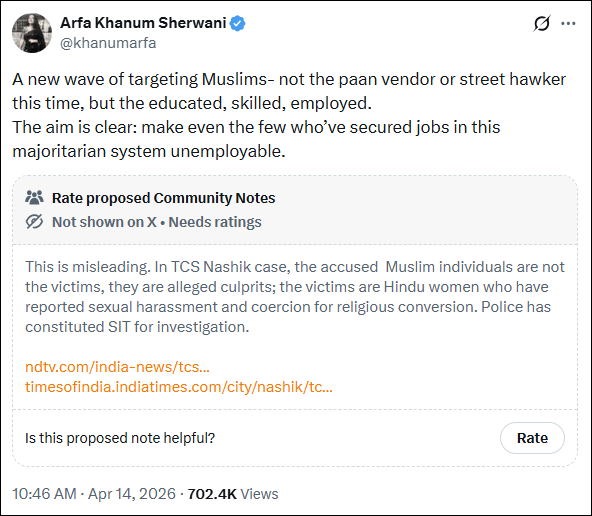
But according to @khanumarfa this is not showing defeat of Pakistan, this is Islamophobia.
While Pakistan’s founding father, Muhammad Ali Jinnah, once said that “No power on earth can undo Pakistan”, India, the very power from which Pakistan was carved out, undid half of Pakistan, ridiculing Jinnah’s remarks in over two decades of Pakistan’s creation.
Days after veteran Congress leader Mohammed Moquim wrote a letter to Sonia Gandhi flagging organisational shortcomings in the Party and calling for the party’s ‘open heart surgery’, he was expelled by the All India Congress Committee (AICC) from the party for “anti-party activities”.
The 60-year-old former MLA from Cuttack-Barabati assembly seat had written a strongly worded letter to Sonia Gandhi on 8th December, expressing concern over the party’s internal flaws and repeated electoral failures at both the national and state levels.
“This is for the information of all concerned that AICC has approved the proposal for the expulsion of Sri Md Moquim from the primary membership of the party due to anti-party activities,” stated a notice dated 13th December, posted by the Odisha Pradesh Congress Committee (OPCC).
Moquim, who apparently saw his expulsion coming, said that he did not regret writing the letter. “The Congress did not speak to me, and in the morning, I came to know from news channels that I had been expelled. I have no regret about this,” Moquim said, confirming his expulsion. He added that he followed Congress leader Rahul Gandhi’s slogan of ‘Daro Mat’ and wrote the letter. “Congress leader Rahul Gandhi always says ‘Daro Mat,’ and I got inspiration from his slogan to write the letter to Sonia Gandhi, flagging the issues that impact the party. The party didn’t accept it and expelled me from Congress. I have nothing more to say,” said Moquim. “I’m a 24×7 politician and would continue to work for the community and people. I would discuss with my followers and advisors on my next course of action,” he added.
It is notable here that Md Moquim had gone against Congress ‘High Command’ before. In the 2022 election for the President, Moquim had defied the Party whip and voted for NDA candidate Droupadi Murmu. He had stated that he ‘listened to his heart’, because Murmu is from Odisha and he wanted to vote for Odisha’s daughter.
Moquim’s letter raised concerns about the party’s internal flaws and poor performance
In his letter, Moquim had raised several points regarding the Congress party’s leadership and working, which, in his opinion, needed change. He cautioned that the Grand Old Party is on the verge of losing its legacy owing to internal flaws rather than external defeats. Describing the Congress Party’s condition as “alarming, heartbreaking, and unbearable,” Moquim pointed out the poor performance at the national and state levels. Apart from three national electoral defeats and 6 consecutive setbacks in Odisha, Moquim cited the party’s electoral defeats in Bihar, Delhi, Haryana, Maharashtra, and Kashmir as an indication of a deeper “organisational disconnect.”
Pointing to the party’s leadership crisis in Odisha, Moquim criticised the appointment of Sarat Patnaik as Odisha Pradesh Congress Committee (OPCC) president in 2023. He cited Patnaik’s repeated electoral losses, including forfeiting deposits, which led to the party’s lowest vote share of 13% in 2024. He also criticised the appointment of the current OPCC chief, Bhakta Charan Das, in 2025, under whose command the party lost three consecutive elections. Moquim also highlighted Das’s past criticisms of the Gandhi family during the JP movement, and his support for a separate “Kosal State”.
Talking about the Congress Party’s national leadership, Moquim said in the letter that Congress national president, Mallikarjun Kharge, who is 83 years old, is unable to connect and resonate with India’s youth. He also raised the issue of the disconnect between party leaders and the high command. He said that despite being an MLA, he was not able to meet Rahul Gandhi for three years. He also linked the exodus of young Congress leaders like Jyotiraditya Scindia, Jaiveer Shergill, Milind Deora, and Himanta Biswa Sarma with the disconnect within the party.
Sofia Firdous, Moquim’s daughter and current MLA of Cuttack Barabati
Mohammad Moquim has been a lifelong Congress worker and has ties to the party dating back to the times of the freedom struggle. He has been a loyal and valuable party member whose electoral achievements in the party include reclaiming the Barabati-Cuttack seat in 2019 after 35 years. Moquim’s daughter, Sofia Firdous, who is an emerging and promising leader of the Congress Party, won the same constituency in 2024 despite top BJP leaders, including Prime Minister Narendra Modi and Home Minister Amit Shah, campaigning for BJP’S PC Mohapatra.
Moquim was unable to contest the 2024 Assembly elections due to his conviction in a vigilance case. His daughter Sofia Firdous contested on a Congress ticket and won the Cuttack Barabati seat, becoming Odisha’s first Muslim woman MLA.
Honoured to attend the Gunjan Dance & Music Festival 2025 by Gunjan Dance Academy, led by Guru Smt. Meera Das. What an evening—pure Odissi grace and storytelling that carried centuries of devotion and culture.
It is notable here that Sofia is seen as one of the most promising young politicians in the state and enjoys popularity among the voters, especially the youth. She has a BTech degree from KIIT University and was leading her father’s real estate business before starting her political career.
As an MLA, Sofia has been vocal and always at the forefront. She raises numerous questions in the assembly, and has been among the first to speak on key issues, connecting with the people, visiting places and displaying a rare ‘energy’ that has been absent in the Odisha Congress for years.
In an interview with ThePrint earlier this year, Sofia stated that Odisha Congress needs to be the voice of the people if it wants to stay relevant in politics.
In fact, after Moquim’s ‘rebellion’ and expulsion from the Congress, there is some speculation among the political circles whether it was a ‘jealous’ move, to prevent Sofia’s rise as the ‘next generation’ face of the Congress in Odisha. Current OPCC chief Bhakta Charan Das and his son Sagar have both been targeted by Md Moquim in his letter, highlighting how the party has been suffering repeated election losses.
Congress and internal rifts: A chronic disease
Through his letter addressed to Sonia Gandhi, Moquim wanted reforms in the leadership and the working of the party. However, the Congress High Command is used to autocratic ways of decision-making. The party is not particularly known for encouraging the free flow of ideas and dissenting opinions from party no matter how long they have been associated with it. Congress has been dealing with internal rifts at the national and state levels, indicating the party’s waning organisational strength and the lack of strong leadership.
In Karnataka, the party has long been facing an infighting which has divided the party into two factions, with one supporting CM Siddaramaiah and the other supporting Deputy CM DK Sivakumar. The rift within the Karnataka Congress recently became undeniably visible after 4 party leaders, including three sitting MLAs and a former MP from Mandya, were issued notices by the party for openly backing Deputy Chief Minister DK Shivakumar as the next Chief Minister.
Internal conflict and the ‘High Command’s failure to pacify the situation is what caused the Congress Party’s fall in Punjab. Despite Amarinder Singh winning a strong mandate, the Party leadership in Delhi continued to undermine him and attempt to appease Navjot Sidhu. Eventually, Singh was made to step down as CM and Sidhu was made state Congress chief, a move that clearly failed, again. The result was Congress’s loss in the next assembly election in 2022.
Rebellious voices arose in the Rajasthan Congress after the party suffered a humiliating defeat in the 2019 Lok Sabha elections. Several Congress MLAs demanded that the then Chief Minister Ashok Gehlot be replaced by Sachin Pilot, the then Deputy Chief Minister. Leadership clashes between the Pilot camp and the Gehlot camp affected the party’s performance in the state. Though Pilot did not part ways with the party, the rift showed its effect, resulting in a resounding Congress defeat in the 2023 assembly elections.
Himanta Biswa Sarma, the 2-term CM of Assam, has cited this chronic leadership problem of Congress multiple times. Sarma had left Congress and joined the BJP in 2016 after being made to wait for hours by Rahul Gandhi. Sarma later recalled that when he had gone to meet Rahul Gandhi to discuss Assam-related issues, the Congress ‘Prince’ was busy playing with his dog, paying no heed to Assam leaders. Sarma has since become one of the strongest and most successful CMs of BJP.
The abovementioned incidents indicate that infighting has become a hallmark trait of the party, and the current case of Moquim is not a one-off incident. Moquim’s expulsion from the party for merely voicing his concern about the deteriorating stature of the party, without giving him an opportunity to be heard, is only the latest symptom of the old rot within the party. Any call for reforms arising from within the Congress party is shut out. The current leadership of the Congress Party has been ruthless in dealing with its own leaders. With this self-sabotaging attitude, it remains to be seen how long the Congress Party can afford to expel and repel its sane voices.