

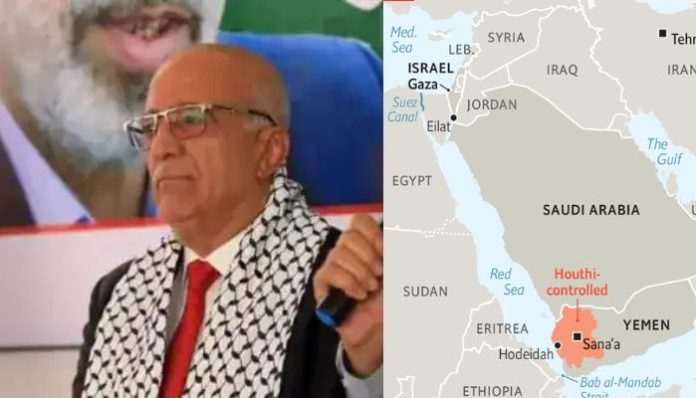
On 28th August, Houthi rebel-held government’s Prime Minister Ahmed al-Rahawi was killed in an Israeli missile strike in Yemen’s capital Sanaa. Houthi confirmed the death on 30th August. In an earlier statement, Houthis said that some ministers were assassinated and top officials were wounded in the air strike.
The group stated that al-Rahawi and his fellow officials were at a normal government seminar when the air strike occurred. The gathering was taking place in a Beit Baws villa, an old village on the outskirts of southern Sanaa.
Meanwhile, rebel-controlled television was airing a speech by Abdul-Malik al-Houthi, the reclusive group leader, who was reading out reports on the Gaza conflict and threatening revenge against Israel.
Tribal leaders told the Associated Press that senior Houthi officials had gathered to watch al-Houthi’s pre-recorded speech when the strike hit. They confirmed the location of the attack but spoke on condition of anonymity, fearing backlash from the rebels.
Al-Rahawi was just a year-old Prime Minister and was appointed in August 2024. He is the highest-ranking Houthi official to be executed since the US and Israel launched their concerted campaign of air and sea attacks on the rebels. Al-Rahawi was close to former Yemeni president Ali Abdullah Saleh before aligning with the Houthis in 2014 when they overran Sanaa and much of northern Yemen.
Last week, al-Rahawi had vowed to stand against Israeli strikes after an attack on an oil facility and power plant under rebel control. “Yemen endures a lot for the victory of the Palestinian people,” he said, underscoring his loyalty to the larger cause of fighting Israel.
Houthi threats after the strike
Mahdi al-Mashat, head of the Houthis’ supreme political council, vowed revenge after confirming the death of al-Rahawi. “We promise God, the Yemeni people, and the families of the martyrs that we will take revenge,” he declared. He went further, warning foreign companies to pull out of Israel “before it’s too late.”
For Israel, the strike marked a significant tactical victory. Defence Minister Israel Katz described it as “a crushing blow” to the Houthis, adding that “this is only the beginning.” The raid was one in a series aimed at taking out the top leaders of the Houthis, including their chief of staff and defence minister, Israeli officials said.
Ahmed Nagi, a Crisis Group senior analyst, stated that the murder of the Houthi prime minister was a “serious setback” for the rebels. It is, in his view, an indication that Israel has changed course from attacking infrastructure to attacking the Houthis’ command structure directly, which is riskier for the leadership of the group.
Houthis’ role in the regional conflict
The Houthis, who are aligned with Iran, have escalated their activities since the Israel-Hamas war broke out in October 2023. In their own words, they say their fight is in “solidarity with Palestinians.” In the past two years, they have fired missiles and drones at Israel as well as at merchant vessels in the Red Sea, interdicting one of the globe’s busiest trade corridors. Almost $1 trillion in goods travels via the Red Sea annually, making it an important international shipping artery.
On 22nd August, just days before the airstrike that killed al-Rahawi, the Houthis launched a ballistic missile armed with cluster munitions toward Israel. It was the first of its kind since 2023, according to the Israeli military.
The US and Israel have jointly carried out a series of retaliatory strikes against Houthi targets in Yemen, often hitting missile launch sites, drone facilities, and naval assets. However, Thursday’s strike was different; it went after the political and military leadership directly.
Israel’s wider conflicts: Hamas, Houthis, and beyond
The strike on al-Rahawi is only one piece of Israel’s wider war across the Middle East. The country is not only fighting Hamas in Gaza but also dealing with Iranian-backed militias in Yemen, Lebanon and Syria.
The war with Hamas erupted after the terror group launched its brutal attacks on Israel in October 2023. They took credit for missile and drone strikes on Israel’s southern city of Eilat, as well as for repeated attacks on merchant ships in the Red Sea. Their engagement expanded the security front of Israel, making it confront threats from both the north and the south at the same time.
At the same time, in Lebanon, Hezbollah is continuing to launch rockets into Israeli cities, making the northern border unstable. Pro-Iranian militias have also been busy inside Syria, although Israel has reacted by launching routine air strikes against arms warehouses and smuggling corridors.


