

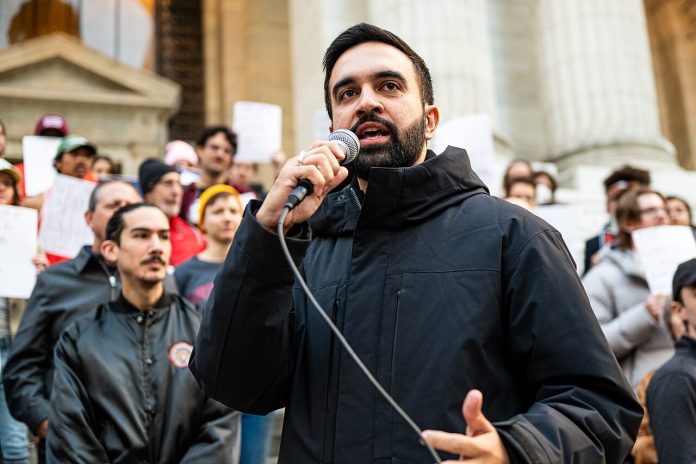
The impending mayoral election in New York City has sparked an unusual diplomatic and cultural debate in India, with Hindu intellectuals, retired officers, professionals, and community leaders issuing open letters raising concerns over the candidacy of Zohran Mamdani for his Hinduphobic tendencies.
Two separate letters, one addressed to India’s External Affairs Minister S. Jaishankar and another to filmmaker Mira Nair, Mamdani’s mother, have gained wide attention for their strong language and the list of signatories attached to them.
Concerns voiced to the Indian government
In a letter dated August 26, addressed to Dr. S. Jaishankar, the signatories urged India to take a firm stand against what they described as Mamdani’s “Hinduphobic lies” and defamatory remarks about PM Modi and India.
The letter accused Mamdani, a member of the Democratic Socialists of America (DSA) and frontrunner in the New York mayoral race, of falsely claiming that there were no Muslims left in Gujarat and of labelling Prime Minister Modi a “war criminal.” Citing census data and Supreme Court judgments, the authors argued these assertions were baseless and harmful to India’s global image.
The letter proposed specific measures for the Ministry of External Affairs, including Official condemnation of Mamdani’s remarks, a diplomatic protest to Washington, revocation of any Overseas Citizen of India (OCI) status he may hold, denial of entry into India, and scrutiny of his alleged links to anti-India organisations.
An appeal to Mira Nair as mother and filmmaker
The second open letter, also dated August 26, took a different approach by appealing directly to Mira Nair. Addressing her as both a public figure and mother, the signatories urged her to counsel her son against making “offensive and factually incorrect” statements about India.
The letter invited Nair to undertake a fact-finding trip to Gujarat, with expenses covered by the authors, to demonstrate to her son that millions of Muslims continue to reside in the state. It further reminded her of the Supreme Court’s clean chit to Narendra Modi in connection with the 2002 Gujarat riots, as well as details of the Godhra train burning that triggered the violence.
The letter also criticised Mamdani’s past remarks about “globalising the Intifada,” calling them inflammatory and antisemitic.
Zohran Mamdani and his inflammatory rhetoric against Hindus and India
Mamdani is notorious for a consistent pattern of inflammatory statements directed at Hindus and India. At a public forum hosted by New York Focus in May 2025, Mamdani compared PM Modi to Israeli PM Netanyahu, calling him a “war criminal.” The remarks sparked outrage among Indo-American leaders, who accused him of promoting hate and deepening divides.
This was not an isolated incident. In 2020, Mamdani described Hindus aligned with Modi’s party as “fascists” and berated fellow New York politicians Jenifer Rajkumar and Kevin Thomas for not denouncing Modi. Rajkumar responded at the time by calling his comments “extreme and divisive.”
Invoking the 2002 Gujarat riots, Mamdani has repeatedly claimed that “there are no Gujarati Muslims anymore.” However, census data confirms nearly six million Muslims in Gujarat in 2011, a number that has only grown since. Courts in India, including the Supreme Court, have exonerated Modi of allegations relating to the riots, noting that the violence began after a Muslim mob set fire to a train carrying Hindu pilgrims in Godhra, killing 59.
Mamdani also opposed the construction of the Ram Mandir in Ayodhya, appearing at a rally in 2020 where derogatory chants against Hindus were raised. His critics say this reflects a larger hostility toward Hindu identity.
His rhetoric has not been limited to India. Mamdani has frequently courted controversy for his anti-Israel positions, including refusing to sign resolutions condemning the Holocaust or commemorating Israel’s founding. Colleagues in the New York State Assembly have accused him of “unapologetic antisemitism.”
Community leaders argue that Mamdani’s rhetoric threatens the pluralistic ethos of New York. Jaspreet Singh, a Sikh community leader, remarked: “Instead of uniting the Indian community, he seeks to divide us by religion, pitting Muslims and Hindus against each other. Associating Hindus with fascism and using derogatory words against them is highly objectionable.”
Voices of the signatories
Several of the signatories of the open letters, who live in the United States, expanded on their concerns in personal statements. Hemant Patel cited Mamdani’s “unrealistic socialist agenda,” “distorted view of history,” and “dangerous public safety policies,” concluding he is “not suitable to serve as Mayor of New York City.”
Vibhuti Jha called him a “lose-lose-lose politician,” warning that “New York loses, US loses, India loses” if Mamdani gains power. Prof. Lakshmi Bandlamudi said he is “factually incorrect and ethically unsound” on India and Hinduism, adding that as a New Yorker, she cannot support his “extreme views” on policing.
Rahul Sur, IPS (Retd), UN (R), argued that Mamdani is “pretending to be someone other than who he really is,” citing “reckless, baseless and deliberate remarks.” While Deepti Mahajan urged Mira Nair to guide her son toward “fact-based dialogue,” stressing that his comparisons of Modi to a war criminal and calls to “globalise the Intifada” were “inaccurate and dangerous.”
Academics, former civil servants, and activists among signatories
Both letters were signed by more than 60 individuals across India and the diaspora, including academics, former civil servants, activists, and writers. Notable signatories include: Prachi Adhikari, Dr. Aditya Arya, Neeraj Atri, Prof. Lakshmi Bandlamudi, Gautam Bose, Sanjay Dixit, Prof. Bharat Gupt, Vibhuti Jha, Dr. Ajay Chrungoo, Lt. Col. Prabhat Kapoor (Retd), RVS Mani, I.Y.R. Krishna Rao, Hemant Patel, and Deepti Mahajan. The impressive roster of signatories feature two Bharat Bhushan awardees — Dr. Bharat Gupt and Dr. T. Hanuman Chowdary — alongside retired Chief Secretaries, senior officers from the Army, Navy, IFS, IAS, IPS, and UN, as well as noted academics and Dharmic theologians.
While the election of a U.S. mayor would typically be a domestic matter, the letters argue that Mamdani’s potential rise to a high-profile office in New York has international ramifications, given his outspoken criticism of India and its leadership. The signatories stress that their interventions are not interference in American politics, but rather a defence against what they see as “defamatory intrusions” into India’s sovereignty by a U.S. political figure.
(Full text of letters can be read here)


